A Universal LF/MF PreamplifierBy Lyle Koehler, KØLRPerhaps calling this a "universal" preamp is stretching things a little, but it works on the LF and MF bands with loop, whip or random-length wire antennas. Regeneration can be used with any type of antenna, although the circuit provides very high gain even without it. Because of its versatility, this preamp is ideal for experimenting with various types of receiving antennas. This article also shows how the preamp can be powered and tuned remotely, with only a single coax line between the remote antenna site and the receiver.
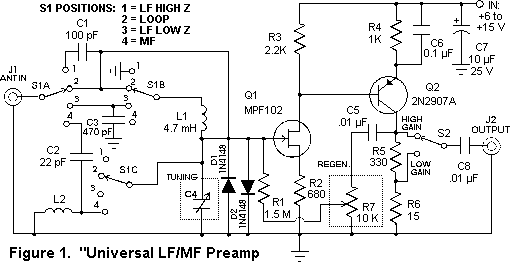
The CircuitThe universal preamp design is shown in Figure 1. It fits on a Radio Shack No. 276-150 general-purpose IC board with room to spare. Layout isn't especially critical; just follow the usual rules of RF circuit construction. Keep all leads as short as possible, and allow a respectable distance between the input and output leads. The preamp should be enclosed in a metal box to provide shielding. Tuning and regeneration control components are shown enclosed in dotted lines. Later in this article I'll show how these circuits can be modified to allow remote operation.
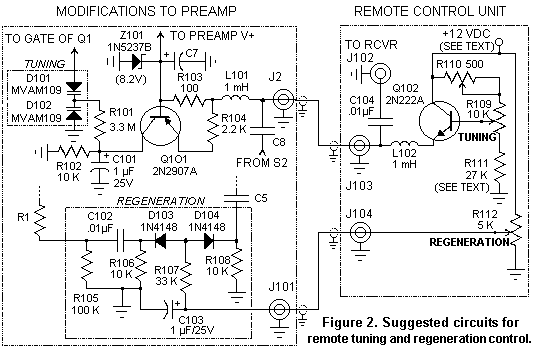
Notes: The recommended part for C4 is a neat little capacitor but it comes without mounting screws or a knob. The best source for screws and a knob for this capacitor is an old AM transistor radio. Two options are shown for L1. Both have the same specified Q in the Mouser catalog, but the 434-17- series parts I've tested are somewhat better than the 434-06- parts. If you "roll your own" inductor L2 it will have a higher Q than the Mouser part. All of the other components are standard and their values are not critical.The Mouser Electronics toll-free number is 1-800-346-6873. A four-position switch lets you select the input circuit that works best with your antenna. The "LOOP" position is for parallel-tuned loops fed with short lengths of coax. It will work at frequencies well beyond 10 MHz with a suitable loop (one that can resonate with C4). Using this circuit, I've heard IE on MF with a 7-inch long loopstick inside the shack, and have copied my own LF beacon in the daytime at over 250 miles with a 30-inch diameter, 22-turn loop. The "LF low Z" position works well with random-length wire or series-tuned loop antennas fed with long coax runs. Short whip antennas with short coax work best in the "LF high Z" position. An "MF" position is provided for use with MF antennas other than parallel-tuned loops. Regeneration control is achieved by feeding part of the output signal back to the gate of Q1 through a variable attenuator and the gate resistor R1. This approach eliminates the need for feedback windings on L1 and L2, which would degrade the coil Q and complicate the switching. Another advantage of this circuit is that regeneration can be used with loop antennas without adding feedback windings. When regeneration is used, tuning becomes very sharp. A 20 or 30 pF fine tuning capacitor across C4 is recommended (if you can find one!). This preamp has more gain than many receivers need. Switch S2 provides a way of attenuating the preamp output signal by about 20 dB, and a smaller value of R6 can be used if more attenuation is desired. S2 should be set to the "Low gain" position when regeneration is used. In fact, it may not be possible to reach the point of maximum usable regeneration (just before oscillation begins) with S2 in the "High gain" position. Remote ControlSuggested circuits for remote tuning and regeneration control are shown in Figure 2. Parts with three-digit numbers are additional components needed for remote control. Single-digit part numbers refer to components previously identified in Figure 1. Remote tuning is accomplished by using a back-to-back pair of varactor diodes in place of C4. The maximum capacity of a pair of MVAM109s in series is only about 250 pF. If desired, C4 can be left in the circuit to extend the low end of the tuning range, or another pair of varactor diodes can be connected in parallel with D101 and D102. MVAM109s are available from DC Electronics at (800) 467-7736.
If you want, you can run a multiple-conductor shielded cable between the control unit and preamp, and use separate wires for power, signal and tuning. (I've used 150 feet of ordinary audio cable in my field tests of the preamp with no significant loss of signal.) Separate wires let you use a much simpler remote tuning circuit. But that's too easy. Figure 2 shows how to make one shielded wire perform multiple tasks. Q101 functions as a DC amplifier with offset, so that the tuning voltage varies from zero to 9 volts while the voltage on J2 is varied from about 9 to 11.5 volts. RF chokes and blocking capacitors at each end of the line isolate the signal output from the DC supply/tuning voltage. With this circuit, a single coaxial line carries the power and tuning control voltage to the preamp, and brings the output signal back to the receiver. The inductance values of L101 and L102 aren't critical, but they should each have a DC resistance less than 15 ohms. Some tweaking of the nominal 12 VDC supply voltage and/or the 27 K resistor (R111) may be needed to get the full tuning voltage range in your circuit. To check the circuit, connect a DC voltmeter between the collector of Q101 and ground. With the coarse tuning pot (R109) turned fully counter-clockwise, the voltmeter should read less than 0.5 volts. As you rotate the tuning pot, the voltmeter reading should begin to rise and should be close to 9 volts with the pot fully clockwise. Increasing the value of R111 will raise the minimum tuning voltage. Increasing the supply voltage will raise the tuning voltage at all settings of the tuning pot. The 500-ohm pot (R110) in Figure 2 is a "fine tuning" control. It can be omitted if you don't plan to use regeneration. A diode attenuator circuit is used in place of R7 for remote regeneration control. Purists would use PIN diodes in the circuit, but 1N4148s work in this application. A separate wire is needed to carry the regeneration control signal. There's a practical limit for how much stuff we can do with one piece of coax. Actually, I haven't found that regeneration helps my LF reception -- certainly not enough to be worth the effort. In other environments, regeneration might offer some benefit, and it's hard to know unless you try it. PerformanceWhen using a long wire or large dipole antenna, it may be necessary to attenuate the input signal to prevent overloading and intermodulation. If you experience overloading from AM broadcast stations, use the LF low Z position with an additional capacitor (.01 UF or larger) in parallel with the antenna terminals. If you're being hammered by Loran-C pulses, try switching to the LF high Z position and putting a small capacitor (10 or 20 pF) in series with the antenna. Thanks to Bruce, AAØYB and Sam, WØIMG for leaving their beacons on during the thunderstorm season so I could perform some actual listening tests on LowFER signals. Both of their transmitters are about 95 miles from me, which provides a reliable signal path when the QRN isn't overwhelming. Using either the circuit of Figure 1 or a preamp with the remote tuning options in Figure 2, BK and SAM came in very well on a homebrew LF receiver with any of three portable loops ranging from 30 inches to 48 inches in diameter. Signals were also readable on a Radio Shack DX-440 portable receiver with all of the loops, although the 30-inch loop is pretty marginal. A 40-inch whip antenna mounted about four feet off the ground seemed to be nearly useless for LowFER reception. Extending the whip length to 11 feet brought the signals up to a readable level, but not to the QSO quality attainable with the larger loops. Maybe the whip would perform better on sky-wave signals. AddendumIn January, 1997, Lyle reports on a complication with the variable capacitor: Complaint department -- Mouser Electronics and Circuit Specialists have both discontinued the dual 266-pF variable capacitor used in the Universal Preamp. I don't know of any other supplier for this particular part. It's getting harder and harder to find an assured source of supply for variable capacitors. This article originally appeared in the August, 1995, issue of The LOWDOWN, and is protected under US and international copyright laws. Please obtain the author's permission before redistributing this document or reproducing it in any other form. The HTML code and our digital images are © 1995, 1997, 2013 by LWCA and may not be used elsewhere without our permission. |