QRSS Demonstration
John Andrews
| The following non-scientific tests were made using my Icom R75 receiver and 6 foot loop antenna during the daytime on 17 November, 2001. The signal source was a 10 mw exciter, feeding a small loop antenna through a variable attenuator. A minimum of 40 dB attenuation was used, which should make the level readings accurate even though the antenna did not present a 50 ohm load. The receiver was picking up whatever noise was present on 178.89 kHz at the time of the test. |
| The exciter was initially set to produce the "TAG" ID in 6 wpm CW, and the attenuator adjusted so that the signal was just audible by ear. This would represent the minimum signal possible for recognizing the ID by conventional means, and becomes the "0 dB" level for the rest of the tests. Viewed with Spectran, the signal could be decoded on the computer: |

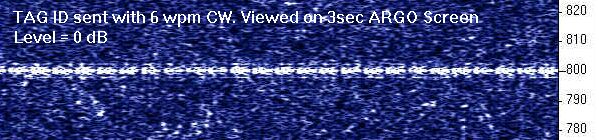
| The same signal as viewed on ARGO's 3 second screen could not be decoded, of course: |
| The exciter was then set for QRSS3 (3 second dots), and viewed with ARGO at the same power level: |

| Staying with QRSS3, the level was then reduced by 10 dB, still producing a copyable signal: |

| Using QRSS10, the level could be reduced to -15 db (note the change in noise level during the recording): |

| At QRSS30, the level was set to -19 dB: |

| And at QRSS60, good copy was had at -23 dB: |

| These are good illustrations of the power of reducing the data rate. Since actual on-air noise was being received, more accurate measurements were not possible. Assuming that propagation conditions are good enough to get your ID through during signal peaks, and that your transmitter stays put on a known frequency, the slower speeds can be used to achieve longer distances, or compensate for deficiencies in your antenna setup. |
| John Andrews, W1TAG |
Many more technical articles, including digital modes, can be found at www.w1tag.com www.lwca.org |