An excellent way to top off the year.
Posted by Bryce Ofstie on January 01, 2002 at 09:50:12
What a year. I figure I received reception reports from about
19 different listeners. I usually hear from 5 or 6. Most came in this last week and then to end it all with LF straight key night with Roger and Lyle made it a very good year of Longwave experimenting.
A couple of days ago I brought the LF Transmitter in the house for a few hours of maintenance and cured the phase modulation problems. The sidebands are gone. I found a 12 volt regulator failing under load. The transmitter draws more and less current with every 1.6 seconds (probably part of the divide by circuits).
The 12 volts out to the transmitter looked like a 3.2 second long square wave, 8 volts low and 11.5 volts high. On the transitions the phase lock loop (4046) would momentarily loose lock. I replace the regulator and problem solved. Steve sent a screen save from 1435 miles away and the sidebands were clearly visible on either side of the carrier. I wonder if the openings to Alaska and the LF propagation to Steve are related. Thanks everyone who pointed out the sidebands, I would have assumed they were caused by receiver overload at my end otherwise.
Looking at Larry's latest screen save I have to believe the problem has been corrected and now all the energy should be in the carrier where it belongs.
Happy New Year and Good listening,
Bryce
BOB and BA heard in MN
Posted by Lyle Koehler on January 01, 2002 at 11:06:05
This morning at about 1145 UTC I was able to hear both BOB and BA in normal CW mode. Pretty rough copy because of QRN; not "QSO quality", but good enough for a positive ID. Thanks to Bob and Brice for keeping signals on the air that can be received without all-night crunching on a computer! Other CW signals copied here this season include JDH, TH and BK.
musicmann 279
Posted by Paul Strickland on January 02, 2002 at 06:16:56
Hi folks, don't know if you are aware but a new radio station from the united kingdom will be on the air, hopefully late this yea,from the isle of man, using 500kw on 279khz longwave. It should be receivable in certain parts of the us and canada.
Happy new year,
Paul strickland. Liverpool, England.
Re: musicmann 279
Posted by John Davis on January 02, 2002 at 15:28:21
Hi Paul,
Yes, this is one we've been waiting to hear for some time. They had been making a big noise of planning to be the first longwave broadcaster to use the Crossed Field Antenna (CFA), a supposed miracle device that is claimed to work as well as a full-size aerial, but which has never yet been proven with full proof-of-performance field strength measurements. (In fact, one highly publicized CFA installation in Australia was a dramatic failure and has been dismantled.) We longwave experimenters have been following the antenna with interest because of its alleged benefits, and the IoM station was supposed to be a dramatic practical demonstration.
After last year's rejection of their original transmitter site as being contrary to Isle of Man land use regulations, they now apparently plan to transmit offshore from somewhere in or around Ramsey Bay (shades of Radio Caroline!). Other sources tell us they abandoned the CFA idea, but I wonder if that has been revived again now that they're all at sea...so to speak. Their Web site is woefully lacking in details about the new planned facilities. We'll be interested to see how they plan to power a 500kW transmitter miles out in the Irish Sea.
Please keep us informed if you hear of any definite timetable for the start of their transmissions.
John Davis webmaster@lwca.org
Re: cross field antenna
Posted by Harald on January 03, 2002 at 06:11:52
A crossfield antenna. How does it look like?
Are therefore insulated towers necessary?
What are its advantage and its disadvantages?
Why are they not general in use?
If someone has a construction drawing and/or a photograph of the aerial planned for the new transmitter of musicnann 279 then mail it please to me or put it in the forum.
CFAs - the ideal aerial for VLF, ULF and ELF?
Posted by Udo Maier on January 03, 2002 at 06:28:26
Is the CFA the ideal aerial for VLF, ULF and ELF?
Since it has only small dimensions (which are determined by what factors?)it would be ideal for amateurs in the LF and VLF range.
How small can I build a CFA in relation to the used wavelength that it works properly?
How big is its bandwidth?
Why does the US Navy not use such an aerial for its ELF transmitter?
Would it allow to run my proposed time signal station on 10 kHz which should be worldwide receiveable in an economic manner?
How big would a CFA of high effiency be for
- 279 kHz
- 153 kHz
- 77.5 kHz
- 24 kHz
- 10 kHz and 76 Hz?
Where are the problems of this aerial type?
Is it very difficult to build a CFA and especially to tune it?
Is it easy for an amateur?
Re: musicmann 279
Posted by Lyle Koehler on January 03, 2002 at 10:20:09
Apparently they still plan to use a CFA. Recent news of the proposed installation can be found at http://www.antennex.com/Stones/st0102/2002.html
I was amused by the statement "we would have liked to sit a shore-based CFA on a platform too; a tower block 10 stories high would have been ideal" Hmmm.
Re: CFAs - the ideal aerial for VLF, ULF and ELF?
Posted by John Davis on January 03, 2002 at 22:12:34
:: Is the CFA the ideal aerial for VLF, ULF and ELF? ::
It would be, if only it worked as claimed.
:: How small can I build a CFA in relation to the used wavelength that it works properly? ::
The part about working properly makes the question very difficult to answer, but the inventors have claimed that it is aperture-independent. If that were true, the bandwidth would also be very wide, if it were possible to make a suitable matching network.
:: How big would a CFA of high effiency be for
- 279 kHz
- 153 kHz
- 77.5 kHz
- 24 kHz
- 10 kHz and 76 Hz? ::
Since the inventors pretty much claim to be the only ones who know how to make it work properly, it's hard to give a definitive answer. But the inventors of a related "miracle antenna," the E-H array, say the optimum length of theirs is 0.7% of a wavelength. Now, that's a somewhat smaller fraction of a wavelength than the broadcast CFAs that have been built heretofore, but let's use that as a first approximation for our purposes.
In that case, a 10kHz CFA would be a cylinder "only" 210m tall, plus some added height and not inconsiderable width for the top-loading cone.
And at 76Hz, the .007-wavelength cylinder would be a mere 27631.6 meters tall. I think this answers the question about the Navy's ELF array.
:: Where are the problems of this aerial type? ::
Short answer--it doesn't work!
Longer answer--it has never been demonstrated to work the way its inventors claim. A CFA can be made to radiate, just as any length of conductor can be made to radiate if you match its impedance well enough to an RF source to make current flow in it. It works in that sense. The problem is, they claim it can radiate just as efficiently as a full-size aerial.
Apart from a few selected spot measurements in Egypt comparing a CFA with an existing vertical in the MF broadcast band, there are no hard numbers to support any such claims; and the real question in Egypt, according to professional broadcast engineering consultants with whom I've worked, is not why the CFA works better, but why the comparison antenna performs so badly.
A proper measurement of antenna efficiency requires applying a known amount of power to the system, then measuring at several distances along radials extending from the structure in several directions. The measurements are plotted onto graphs showing field strength versus distance. The distances are selected to be outside the near-field region of the antenna, but close enough that earth attenuation is not a significant factor. When the curves have been plotted, the data are extrapolated back to derive a reference field strength at 1 kilometer.
One kilowatt into a 100% efficient quarter wave vertical would produce 300mV/m field strength at 1km from the antenna.
What does the CFA do under these same conditions? No one knows! Despite repeated promises over the past decade by the inventors and promoters to make existing systems available to observers, and numerous grand plans to construct working commercial CFAs for professional measurements, there have been exactly NO such tests to date.
Amateurs have constructed many versions of CFAs for the ham bands. There are anecdotal reports that "it works almost as well as one of my other antennas," but of course, there are no field strength surveys.
Professional engineers have made extensive tests of self-constructed CFAs on antenna test ranges (among them, researchers at CRC in Canada, and Dr. Valentin Trianotti in Argentina). In all published cases, the CFAs performed the same as, and sometimes WORSE than, conventional top-loaded electrically short verticals.
The CFAs promoters claim the professional engineers just don't know how to tune the antenna properly to achieve the magic synthesis of radio waves from the two supposedly independent E and H fields. Apparently it's not enough to achieve the conditions stated in the patent papers. However, the professional researchers also experimented extensively with alternate coupling arrangements. No luck.
:: Is it very difficult to build a CFA and especially to tune it? ::
Small ones are easy enough to construct, but the tuning is quite another matter.
If you want to experiment with building one, I would recommend investing in a subscription to antenneX (http://www.antennex.com/), the online antenna experimenters' publication. Their readers have a tendency to flock to every new "miracle" antenna, but they don't just talk about them...they actually build them. Over the years, there have been several supposed "answers" to the phasing and matching problems, which could save you a lot of time and duplication of effort.
But despite optimistic reports from each such experimenter, the fact remains that no full-scale version has yet proven itself well enough to gain widespread commercial acceptance.
John
Re: CFAs - the ideal aerial for VLF, ULF and ELF?
Posted by Tony Levstik on January 04, 2002 at 10:02:23
C.F.A.
Creative False Assumption
Just My opinion.
Tony
NC ID'd in VE7 Land!
Posted by Steve McDonald on January 04, 2002 at 10:28:28
Nice condx early last night finally allowed a complete ID of Dex's signal; I will send the screen captures to him. Distance is 2,355 miles from Mayne Island...not bad for 1 watt Dex! At times BRO and LEK were painted on the screen, just excellent signals. LEK is 1,382 miles while BRO is 1,435 miles.
Steve / VE7SL
Re: CFAs - the ideal aerial for VLF, ULF and ELF?
Posted by John Andrews on January 04, 2002 at 12:50:20
Cleverly Fudged Analysis?
Re: NC ID'd in VE7 Land!
Posted by Les Rayburn, N1LF on January 04, 2002 at 14:01:40
Congratulations to Steve and Dex! I believe this to be the world's record for the longest lowfer reception (the only other reception I'm aware of over 2,000 miles is the one 17 years ago between Mike Mideke's Z2 beacon and Sheldon Remington in Hawaii). Certainly this is the longest reception where the entire path was not over salt water!
Truly amazing reception and to think it was done in QRSS60 mode too. Congratulations again?
So, Steve...how far do you reckon you are from Helena, Alabama? I'll go out tonight and try to tweak that last little microwatt out of it! (ha, ha)
73,
Les
EH antenna
Posted by Dennis Hoffman KCØFZM on January 04, 2002 at 15:06:55
Over the past several days while surfing the net for antenna info, I came across mention of the "EH" antenna. A search revealed a web site.
The guy who developed this antenna may have the answer for those who want to erect a LF antenna but don't have the real estate to erect a "conventional" antenna with a complex ground field. I would sure like to see comments on this antenna on the message board.
Re: EH antenna
Posted by John Davis on January 04, 2002 at 17:03:38
I had a nice visit with Ted Hart and his then-partner following their presentation on the EH antenna at the IEEE Broadcast Technology Symposium in 2000. Their premise was that if you use an electrically short conical antenna over a ground plane, constructed with just the right conical angle and an edge length of 0.7% of a wavelength, a critical inductance will exist, at which the antenna will: (a) synthesize radio waves from separate E and H fields around the cone, and (b) present a 50 ohm resistive load to the transmission line.
Unfortunately, like the CFA, no one else has been able to make it do exactly that. His partner has since left. And, plans to do a proper field strength study in the AM broadcast band have yet to materialize... which is a real disappointment to me, as I live within convenient driving distance of the EH "antenna farm."
As with the CFA, conventional antenna models show it to be a rather ordinary electrically short antenna, and experimental results tend to match the predictions of the conventional models; thus not indicating that some new principle beyond Maxwell's equations needs to be invoked.
Electrically short antennas do radiate, and under truly extraordinary circumstances can be as efficient as conventional naturally resonant antennas. If you built an EH antenna in free space and kept all losses within the antenna low, you could achieve very close to a 300mV/m field strength at 1km from the antenna for an input of 1kW.
But the same could be said of any other electrically short antenna in ideal circumstances. The trick is to do it in the real world, where the ground plane will interact with the real earth; or the field from an electrically short loaded dipole will interact and be mirrored by an imperfect earth; or the "magic" feeder networks will interact with each other and/or transmission lines and/or objects in the vicinity. These represent loss factors that are manageable in full-size antennas with their higher natural radiation resistance, but which seriously crimp the performance of electrically short units.
(Ironically, this will probably make the Isle of Man CFA look as if it performs more nearly as advertised; see the URL posted by Lyle in response to the Radiomann 279 message. Losses on a platform over seawater will be much lower than over land. But it is interesting that they expect to have to retune with the tide. If the CFA really worked on the principles that its inventors and promoters claim, it would be truly independent of its surroundings, and would never "see" the presence of the changing sea level! If the retuning turns out to be necessary, it will prove conclusively that the cross-field synthesis notion is just a pleasant fantasy. Even if the performance is halfway decent because of the low loss surroundings, the same effect would be achievable with any other large-diameter top-loaded electrically-short vertical in the same surroundings. That has certainly been the case on land so far, as in the notorious case of the Australian broadcast CFA. The promoters were never able to make it work satisfactorily, so the owner eventually disabled the D-ring and retuned it as a regular short vertical with better results. Other experimenters have observed the same thing.)
By the way, I mention the CFA in this post because the EH antenna is a sort of descendent of the CFA, but without the mumbojumbo of a separate D-ring over the ground plane.
John
DX WEEK in May 2002 in the ORE MOUNTAINS between Dresden an the Czech Rep.
Posted by André Müller - Germany - MIRIMAN@t-online.de on January 04, 2002 at 20:37:09
INVITATION ! ! !
ORE MOUNTAINS MIRIQUIDI DX WEEK in the great small town Thermalbad Wiesenbad (thermal spa also for visitors with a crazy
outdoor-pool).
You have direct connections from Frankfurt to Dresden Airport !
For more informations mail to: MIRIMAN@t-online.de !
Please tell others, spread and retail!
Thank you very much !
Re: CFAs - the ideal aerial for VLF, ULF and ELF?
Posted by Steve Olney on January 05, 2002 at 14:25:38
Cold Fusion Antenna
Re: CFAs - the ideal aerial for VLF, ULF and ELF?
Posted by Steve Olney on January 05, 2002 at 14:37:07
I have had a long-running "discussion" with the editors of Antennex over their evangelistic treatment of the CFA over past years. I stated that based on local experience (the Sydney CFA fiasco) including comparative FS measurements, the CFA would only work as well as a short fat vertical working against a very good ground.
Ironically, if they go ahead and put their CFA on a sea-platform (apparently the sea is shallow in the proposed area) they will have it working over a continuous conducting sheet. If it doesn't work there ('cause even a wet string would be expected to) then it won't work anywhere. Given the problems of erecting tall structures on a sea-platform, the CFA would seem the logical choice given their unsubstantiated faith in this unproven configuration. However, if I were them I would forgo the licencing fees for the CFA and try some sort of ordinary top-loaded vertical of similar dimensions.
Steve VK2ZTO
Re: DX WEEK in May 2002 in the ORE MOUNTAINS between Dresden an the Czech Rep.
Posted by Klaus Weber on January 06, 2002 at 09:29:03
Perhaps it is possible to span there an aerial for VLF and LF between the rock towers which are famous for this area.
Would an aerial spanned between two rock towers an efficient aerial?
Do some NDBs uses CFAs?
Posted by Andreas Berger on January 06, 2002 at 09:32:21
Do some NDBs uses CFAs. Since NDBs uses extreme short aerials with extremely low effiency I suppose it would be sensitive to run a NDB with a CFA aerial in order to show the effiency or ineffiency of this aerial type.
Re: CFAs - the ideal aerial for VLF, ULF and ELF?
Posted by Barry Dieser on January 06, 2002 at 20:22:32
Clearly Feckless Assertion (Yes, its a word! And it applies!)
Re: Do some NDBs uses CFAs?
Posted by John Davis on January 06, 2002 at 22:28:14
No NDBs use CFAs; at least, not in North America. If there are any elsewhere in the world, there are negligibly few of them.
Conventional monopoles and end-supported Tees have well-established characteristics which can be reliably predicted by established engineering techniques. CFAs have never been characterized in this way.
Although the efficiencies of many NDB antenna systems are relatively low, they are high enough to be useful. We don't know that about CFAs.
In addition, conventional NDB antennas can be constructed cheaply, are easy to tune, and do not require payment of patent license fees to anyone.
John
Re: CFAs - the ideal aerial for VLF, ULF and ELF?
Posted by John Davis on January 06, 2002 at 22:31:24
:: Clearly Feckless Assertion (Yes, its a word! And it applies!) ::
But what a Confoundingly obFuscational Apellation... :=)
RAL copy in Maryland
Posted by lloyd chastant on January 07, 2002 at 10:05:27
I've tried from time to time to capture RAL but just seemed to elude me but had nice captures on him this morning(0835EST)Distance 262 miles. de Lloyd W3NF FM19MH
IC-706MII Short Term Frequency Stability
Posted by Roger Thompson (AD5T) on January 07, 2002 at 14:25:28
I need some help or maybe just some sympathy.
Several years ago I purchased a new ICOM IC-706MII, in part due to the receiver's LF coverage, and, until QRSS60 became popular, I was pleased with it. I even had good results with WOLF receptions last season. My 706, however, has a consistent FM of about 0.3 to 0.4 ppm that impacts the copy of QRSS60 signals recorded with Argo. It is still evident in 30 second dot mode and with Spectran.
I find the frequency variation is roughly sinusoidal, but looks very much like the voltage characteristic of a RC relaxation oscillator with about a 30 second time constant when closely inspected. The overall period is in the range of 91 to 93 seconds and doesn't change with time or with frequency of operation, at least up to 10 MHz.
The FM is not evident during the period from cold start to about 10 to 20 minutes after power is applied. During this initial period, the Argo signal trace, while smoothly changing about a half Hz, is free of the frequency ripple. Changing power supplies has no impact and there is no apparent association with signal levels, the computer monitor, preamp tuning, antennas used, fans or other equipment nearby. I have no schematic or technical info for this radio and I've come to a dead end in guessing what causes or needs this sort of variation with time. Am I seeing a VCO control loop oscillation, an intentional frequency sweep, or something like that?
These are popular radios, so I wonder if others have this sort of short term instability, have fixed the problem, or if I just got unlucky?
Thanks, Roger
Re: IC-706MII Short Term Frequency Stability
Posted by Lyle Koehler on January 07, 2002 at 19:16:43
What about the fan in the radio itself? In the original version of the 706, which is the one I have, the fan runs all the time, and it is very stable after an initial warm-up. Some people objected to the fan noise, so Icom used a thermostatically controlled fan in later versions. I think I've seen an Argo trace from someone else that showed the effects of cooling fan cycling. It sounds like you may be experiencing the same thing. If that's the problem, perhaps the simplest solution is to bypass the thermostat so that the fan runs all the time.
Re: IC-706MII Short Term Frequency Stability
Posted by Roger Thompson on January 08, 2002 at 08:33:13
Thanks, Lyle.
I had discounted the internal fan, but it turns out to be running more than I thought. The noise from the internal fan is masked here by an air filter fan in the hallway nearby. The transceiver fan cycle is suggestive of the FM period in the radio, but a little off, perhaps due to my moving around in the room and checking for airflow near the radio. There's a good chance the 706 may settle into a more stable fan cycle when I leave it overnight, matching the radio drift. Still, I assume others must not have the instability problem or it would have been mentioned before.
Roger (AD5T)
A nice picture and some interesting facts about longwave broadcasting
Posted by Harald on January 08, 2002 at 20:58:39
Longwave broadcasting transmitters belong to the most interesting transmitting facilities in the world, because they belong to the transmitters which uses the highest transmitting power (most longwave broadcasting transmitters use transmitting powers of more then 100 kilowatt, the most powerful longwave broadcasting transmitter, Taldom in Russia is designed for the usage of a power of 2500 kW!) and the tallest aerial masts.
(The highest structure mankind ever built was the 648 metre high self - radiating mast of the 2000 kilowatt longwave transmitter Konstantynow in Poland. This mast, which stood on a 2 metre high insulator designed for 100 kV, collapsed in 1991 during reconstruction work).
In Europe the mast of a longwave transmitter is often one of the highest structures of a country!
Unfortunately there are no such facilities in America and Australia and because of the fact that this forum is most frequently visited from people living in these continents I think it would be very sensitive if a photograph of such a transmitting facility would be shown in this forum.
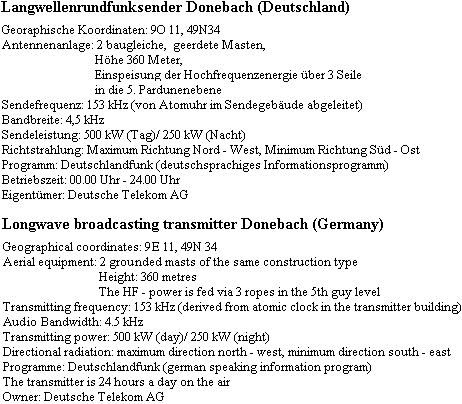
In the attachment of my mail you can find a nice photograph of the longwave transmitter Donebach (Germany) at sunset, which transmits the German speaking radio programme Deutschlandfunk on the frequency 153 kHz. As far as I know this is the lowest frequency on which speech is transmitted today!
It radiates toward North - West direction so I suppose it is surely possible to receive it in North America!
Technical data of the transmitter can be found below.
Icom R75 performance at lf/vlf
Posted by Clifton Turner on January 09, 2002 at 00:28:41
Can anyone tell me how well this receiver works below 500 kHz? Are any mods required to enhance performance there?
Any comments apreciated.
Thanks Clifton Turner
Re: Icom R75 performance at lf/vlf
Posted by Steve McDonald on January 09, 2002 at 00:38:30
Clint...the R75 is a superb performer below the BCB. It is a real bargain $$ wise also. Stability is excellent as well.
Steve / VE7SL
Re: Icom R75 performance at lf/vlf
Posted by John Andrews, W1TAG on January 09, 2002 at 08:36:18
Clifton,
I 100% agree with Steve. The R75 is a fine receiver for LF work. Have been using one for a year and a half, and see no reason for any mods. In terms of accessories, I have the 500 Hz first IF filter, the 250 Hz second IF filter, the high stability time base, and the DSP board. Comments:
1. If you can afford one filter for LF work, get the 500 Hz 1st IF filter. The SSB-width filter that comes with the radio is pretty broad for this application. I'm glad that I got the 250 Hz filter (later), but am not convinced that it has enabled me to do that much more.
2. I added the high stability time base this fall, and can now "trust" the receiver at LF to about +/- 20 millihertz. That's a big help for QRSS60 or WOLF reception, but not essential. If you are in a situation where you can leave the receiver on all the time, and the room temperature is fairly stable, you can probably skip this one.
3. The DSP option has been a promotional "freebie," and has real application for SSB or SWBC listening. I haven't seen it do anything useful for LF weak-signal work, though.
The R75 sits at my workbench, not in the "ham shack" end of the cellar. I've found it to be a useful piece of test equipment, in addition to its use in receiving weak LF signals. Any recommendations about external preamps would depend on what you were planning to use as an antenna.
John Andrews, W1TAG
Hifer beacon PBJ on the air at 0.1 WPM
Posted by Chris Waldrup on January 09, 2002 at 17:38:24
I changed hifer beacon PBJ on 13.55790 Mhz from 6 wpm to 0.1 WPM at the suggestions of a few members. If anyone receives this beacon, please let me know.
Re: Icom R75 performance -- comparisons??
Posted by John Davis on January 10, 2002 at 01:44:59
Has anyone used both the R75 and the IC706MII? If so, how do they stack up against each other at LF?
Thanks.
John
PBJ copy in Maryland
Posted by lloyd chastant on January 10, 2002 at 16:31:53
Had several good Argo captures of PBJ with 3s and 10s today around 3-4 PM on 13557.856MHz de Lloyd W3NF FM19MH
LowFER "RB" now running properly
Posted by Robert Bicking, W9RB on January 10, 2002 at 17:26:36
I took advantage of the January Thaw to do some troubleshooting on my antenna and found a bad connection that resulted in it being more like a 10 foot vertical with no top hat than a 31 foot vertical with a 25 foot diameter top hat. The current went up 50 %, to where it was last year. Hopefully, someone will hear it now. ID "RB" using QRSS5, normally on midnite to 8 am but all day today on 186.92 kHz. 73,Rob, W9RB.
Re: A nice picture and some interesting facts about longwave broadcasting
Posted by Ron Kovach on January 10, 2002 at 23:01:27
Hello Harald:
I usually check 153 kHz here near Philadelphia, Pennsylvania to observe conditions on the trans Atlantic path. It is very reliable and usually comes in around 5 to 15 dB above the noise, in a 20 Hz passband. I occasionally hear a smattering of audio (3.1 kHz passband), but this is very rare. Also hear Allouis at 162, BBC at 197.95 and the usual submarine transmitters in England, Germany, France, Italy and Iceland. Using HP3586C with preamp, Anritsu ML422B and usual FFT stuff as well.
Thanks, Ron K
Re: Icom R75 performance -- comparisons??
Posted by Roger Thompson on January 11, 2002 at 06:04:22
John,
I've used the 706MII without the high stability oscillator for several years as mentioned in my earlier post this week and would be reluctant to recommend it for QRSS60, although it works well enough for WOLF and shorter dot times. I've almost concluded an investigation into a periodic short term frequency instability, which appears to be directly related to the high heat generated by the display - thanks to Lyle for redirecting my attention to the internal fan. This instability is experienced by other users of the 706MII as well and may be a common "feature" that might be cured by adding the high stability oscillator, although I've not investigated this modification. I do plan to remote the front panel to see if this helps reduce the drift, and I understand others may have defeated the backlight somehow for the same purpose. Based on what I've experienced, I'd expect the high stability oscillator for either the 706 or R75 would be a benefit at LF. It also would be nice to have an external input for a better frequency standard, but the benefit would be only for a very few of ICOM's customers.
Roger, AD5T
RB copy in Maryland
Posted by lloyd chastant on January 11, 2002 at 06:38:13
Had nice copy of RB (186.92) with Argo this morning(6:20EST)in 10s.
Distance 697 miles.de Lloyd W3NF FM19MH
Does each large airport needs at least one NDB?
Posted by Harald Lutz on January 11, 2002 at 18:33:41
Does each large airport needs at least one NDB?
Last week I was in a village near Ramstein Air Force Base, Germany, a big airport of the US Army near Kaiserslautern, Germany and I was not able to receive any strong signals from NDBs there and according to NDB tables Ramstein Air Force Base has no NDB, so the absence of NDB signals is no wonder.
Why?
Why is there no NDB at Ramstein Air Force Base?
Are NDBs obsolete for military aviation?
Under which condition needs a (military) airport not to run any NDBs?
Do aircraft carriers have NDBs?
If yes, which frequencies do they use and how are they set in order not to disturb other NDBs or longwave transmitters?
Re: Does each large airport needs at least one NDB?
Posted by John Davis on January 11, 2002 at 20:48:03
Very interesting questions, Harald. I don't know the answers to all of them, but there are probably some readers here who can fill the gaps in my knowledge.
It is my understanding that some long-term US military airports in other countries do not have NDBs associated with them. If an air base has been, or is planned to be, in regular use for a long time, and if the host country has only a limited amount of LF spectrum available for new aerobeacons, an NDB is something the base can do without.
The Army and Air Force do have transportable LF beacons that they can position at overseas air bases temporarily, to provide a bit of extra guidance for pilots who may be flying into unfamiliar territory if their aircraft are not equipped with the full range of GPS and other navigational tools. I believe that this was done in Kosovo, for example.
Here in the US, many military bases with landing strips still have NDBs. And transportable beacons may be used whenever a previously disused landing area is reactivated, or when a large open area is designated as a temporary helicopter landing site during training maneuvers.
I don't think aircraft carriers use LF beacons. It is my understanding that radar, along with VHF navigational aids, meet all of their needs.
John
Spectrum analysis software and soundcard properties of Macintosh computers
Posted by Andreas Berger on January 12, 2002 at 00:13:30
What are the properties of soundcrds of Macintosh computers? With which frequencies can they sample signals?
Do they use the same values as PC soundcards (5512.5 Hz, 11025 Hz, 22100 Hz, 44200 Hz and 48000 Hz) or do they use other values?
Is analysis software similiar to "Spectrogram" and "Spectran" availble (as freeware / shareware on the internet) for Macintosh computers?
If yes, where?
What are the results of VLF reception using a Macintosh computer?
Re: Does each large airport needs at least one NDB?
Posted by Mike - WA1PTC on January 12, 2002 at 00:21:07
I think the biggest factor is that there are many technologies used by the military that far exceed the abilities of a simple LF beacon.
TACAN (I forget the meaning of the letters) is one example. This is a system that allows a pilot to determine distance from the TACAN station, bearing to the station (much more reliably than with an LF beacon) and exchange digital data with the ground.
Mike
Ken Cornell's LF/MF scrapbook
Posted by Clifton J. Turner Jr. on January 12, 2002 at 01:59:02
Does anyone know of a source for the last edition of ken's scrapbook (10th edition, I think). If anyone has an extra copy they would like to sell, I would be interested.
Thanks Clifton Turner
Musicmann 279
Posted by Paul Strickland on January 12, 2002 at 08:40:58
Regarding the transmission facility for the new 500kw longwave broadcast station which is likely to be on the air later this year. The CFA will be on a platform in about 20 feet of water on a sandbank, about 1 mile from shore. A 100kw MF CFA is already in use in Germany, so apparently all the technology used is proven. Also you might be interested to know that Atlantic 252 is relaunching as a sports station on 25th of February using 500kw daytime and 100kw nightime.
Regards, Paul Strickland, Liverpool, UK.
Re: Does each large airport needs at least one NDB?
Posted by Jacques d'Avignon on January 12, 2002 at 10:04:52
NDBs are not necessary at an airport, they are normally used in conjunction with an ILS installation as the starting point to the approach pattern.
NDBs are now mostly used as an enroute navigational system, between airports, and in remote area like the Canadian Arctic.
In many cases the NDB is being supplanted by the VOR/DME or TACAN system. The VOR/DME uses a VHF Omnidirectional Range and a Distance Measuring Equipment which gives the pilot a very precise and acurate distance and direction to the transmitting station.
The military uses TACAN (Tactical Air Navigation Equipment) that uses a different system for the direction transmission but uses the same DME as the civilian system. So it is not unusual to see an installation that is labelled VORTAC, this setup would have a VOR, a TACAN and a DME colocated.
Normally when you have a VOR you have a DME colocated but it is not a necessity.
I do not know about aircraft carrier, Canada does not have any??, but on the coast guard vessels there is a NDB for helicopter recovery and I believe that some vessels have a TACAN also installed.
Hope this partly answers your question.
Jacques
RB copied in Ontario
Posted by Mitch VE3OT on January 12, 2002 at 12:01:02
Hi Bob:
Kept searching and finally copied RB - started seeing a signal around 4 am, and very nice copy at 7 AM.
Picture on Web site at http://technology.fanshawec.on.ca/tele354
73 Mitch VE3OT
Re: Musicmann 279
Posted by Lyle Koehler on January 12, 2002 at 12:11:01
Where is the German CFA installation? Supposedly there was one "lying around" at Kiel, but according to an article in Antennex, it was never actually placed in service. The article I'm referring to is at http://antennex.com/Stones/st0700/scfa.htm
Re: RB copied in Ontario
Posted by Robert Bicking, W9RB, LowFER RB, Freeport, IL. on January 12, 2002 at 16:58:37
Anyone else hear it?? ON and MD are new locations. 73, Rob, W9RB.
Re: Musicmann 279
Posted by John Davis on January 13, 2002 at 00:10:48
Just by way of followup, since the article Lyle mentions is a year and a half old, I have not been able to find any other reference since then either to indicate that the CFA in Germany has ever been tested yet.
In addition, the Sydney CFA has indeed been sold since then--to a scrap yard. Also note that the mention of San Remo in the opinion piece strongly implies that the power was reduced because the antenna is so efficient. In fact, that's not the case. The Italian authorities simply decided they didn't need as much signal. (One could as legitimately infer that perhaps they give up on trying to get any more coverage out of it and decided to cut the electric bill.)
No CFA in the UK, Europe, Brazil, Egypt, or anywhere else has yet been put through a standard FCC antenna efficiency evaluation, to this very day, in any public manner.
The FCC has set minimum performance standards for mediumwave antennas. If a station uses a standard vertical radiator over a radial ground system as specified in the Rules and Regulations, it is assumed to be complying with these standards. This is because back in the Thirties, ol' Prof. Brown did such extensive studies characterizing base-insulated Marconis with radials that their properties are considered to be reliably known for engineering purposes.
That's not to say other types of antenna are prohibited for AM broadcasting in the States. A few shunt-fed verticals are still in use, and folded unipoles are not uncommon these days. I've even recently reviewed the application of an AM broadcast station which uses a skirted feed (a variation of the folded unipole) on a free-standing cellular telephone tower!
However, any atypical radiator must be backed up by both theoretical studies and actual measurements to verify groundwave characteristics, and skywave characteristics as well in many cases. In all cases, a non-standard radiator must prove its efficiency to meet or exceed the minimum standards. This is because an antenna of lesser efficiency is one whose characteristics will vary too widely with changes in the environment! It would make a very bad joke out of attempts at interference calculation.
No complete supporting data has yet been published for the CFA anywhere in the world.
Regards,
John
Re: Musicmann 279
Posted by Paul Strickland on January 14, 2002 at 11:00:13
Details of the CFA in egypt on 603khz can be found at:
www.longwaveradio.com/engineering.html I will definitely be going accross to have a look once they start building it, as I am only about 70 miles from the IOM. If it works as well as they think, I will be getting a monster signal from them. Paul Strickland
Re: Musicmann 279
Posted by John Davis on January 14, 2002 at 13:59:55
Hi Paul,
You'll notice that there are no actual details there...just a lot of promises about the way Dr Kabbary says things will be. The IoMIBC folks have simply bought a bill of goods.
As has been pointed out, though, now that their CFA will be over seawater, it could conceivably work as well as any other electrically short vertical over a highly conductive surface; which is to say, perhaps as little as 0.6dB down from a normal quarter wave vertical (if they can keep it in tune). They really should be glad they couldn't get a transmitter site on land--it wouldn't have worked nearly so well there.
Half a megawatt over mostly ocean should deliver quite a signal 70 miles away, in any case. But I can guarantee that it won't deliver any more signal than a conventional antenna under the same circumstances.
Regards,
John
Slant mode test
Posted by Bill Ashlock on January 14, 2002 at 14:50:55
A am running a test to determine the advantage of my slanted lines in a noisy or very weak signal environment. There will be a repeating slanted "WA" and a non-slanted "WA" pair for each of the two loop directions.
I would very much appreciate receiving ARGO screen caputers from anyone able to copy a weak signal from WA, 185.300, at QRSS30. Hopefully side-by-side WAs from the same loop direction can be compared in these caputures.
Thanks in advance!
Bill WA
Re: Slant mode test
Posted by Bill Ashlock on January 15, 2002 at 22:09:52
All,
I have WA sending only in the E/W direction with the same alternating slant and non-slanted signal as last night. This should make the comparison much simpler. Again, all signal captures sent to this address will be greatly appreciated.
Bill WA Andover,MA
185.300 QRSS30
Beacon NC testing new JASON mode on 177.200 KHz
Posted by Dexter McIntyre, W4DEX on January 16, 2002 at 18:11:58
Beacon NC is now transmitting JASON, Alberto di Bene, I2PHD's new masterpiece. JASON software can be downloaded from:
http://www.weaksignals.com/jason
NC is presently transmitting on 177.200 KHz. I don't know how to loop the text buffer to keep the message repeating but I will keep it loaded until at least midnight EST (0500 UTC).
GL,
Dexter, W4DEX
NC Jason copy in Maryland
Posted by Lloyd Chastant on January 16, 2002 at 21:20:06
Getting good copy on NC(177.20) with Jason mode tonite(9:15PM).
de Lloyd W3NF FM19MH
Re: Beacon NC testing new JASON mode on 177.200 KHz
Posted by John Andrews on January 16, 2002 at 21:31:13
Dex,
Have been watching with Jason for about an hour and a half, and have only seen random characters.
John Andrews
First LowFER receptions of JASON mode made by Lloyd Chastant & Larry Putman
Posted by Dexter McIntyre, W4DEX on January 16, 2002 at 23:47:00
The first two receptions of NC transmitting in Jason mode came so close to the same time we'll have to call it a tie. Both Lloyd Chastant and Larry Putman were sending me screen shots of their copy as the message progressed.
Lloyd's capture is posted at:
http://www.gostanly.com/w4dex/NC%20Jason%20by%20W3NF%2016Jan02.JPG
Larry's capture is posted at:
http://www.gostanly.com/w4dex/NC%20Jason%20by%20WB3ANQ%2016Jan02%20.jpg
I claim this to be a great Lowfer communications tool. Thanks Alberto!
Dexter, W4DEX
NC sending JASON fromat on 177.200 KHz
Posted by Dexter McIntyre, W4DEX on January 18, 2002 at 19:59:16
Roger on the slow reflector! NC is transmitting JASON on 177.200 kHz until about 0500 UT. Will probably move up the band tomorrow night.
Dex
WA low power operation
Posted by Jay Rusgrove on January 18, 2002 at 20:21:04
Bill
How many dB will you be down from normal?
Jay Rusgrove, W1VD
Re: NC sending JASON fromat on 177.200 KHz
Posted by Mike Reid on January 18, 2002 at 20:25:56
My noise floor went down to -89dbm tonight. I hope to see the message. Tomorrow I will guarantee that my vertical will be up.
Mike.
Re: WA low power operation
Posted by Bill Ashlock on January 19, 2002 at 01:33:05
Hi Jay,
The power level will depend on what the signal on John A's Web capture looks like. Most likely approx -30db. I'll begin lowering it tomorroe morning (Sat) at 9:30 and let you know where I end up.
Saturday night's power level will depend on whether or not Steve M. needs another night to attemp a copy at full power out in BC.
Will appreciate the return of any screen shots you and others are able to make at low power, particularly in the AM tomorrow. Mitch and I will attempt a 500(+) mi low power cature either Saturday or Sunday night.
Bill WA
185.300 QRSS30
Re: NC sending JASON fromat on 177.200 KHz
Posted by lloyd chastant on January 19, 2002 at 08:55:24
Had another nice Jason copy on NC tonite.
The Last Radio Network
Posted by Les Rayburn, N1LF on January 19, 2002 at 08:55:47
For those with an interest in "Atomic Culture" or just the history of longwave radio, you might be interested in reading a great article by Bennet Kobb, KC5CW.
It details the efforts of the government to create an early warning radio system on longwave, and specifically the transmissions of station WGU-20 on 179khz.
It can be viewed at:
http://www.conelrad.com/perki.html
If anyone has a recording of these test transmissions, I'd love to get a copy. I'd be willing to trade copies of the recent lowfer video documentary. A small MP3 or .WAV file would be fine.
73,
Paul Cianciolo copies NC JASON at 599 miles!
Posted by Dexter McIntyre, W4DEX on January 19, 2002 at 09:08:38
Paul received about one line of perfect copy of the NC JASON signal last night. The distance is 598.9 miles (963.9 km). His screen shot can be seen at:
http://www.gostanly.com/w4dex/NC-jason-w1vlf-18jan02.jpg
Dexter
Re: Musicmann 279 - why do the not use an old oil drilling platform as transmiss
Posted by Harald on January 19, 2002 at 12:53:33
Why does "Musicman 279" not want to use an old oil drilling platform as transmission site?
It would be much better than sinking them in the sea as "Shell" wanted to do it with the platform "Brent Spa".
An old drilling platform has a drilling tower, which could be used for the mountage of wire aerials or if it would be put on insulators as a self - radiating tower.
I think an old oil drilling platform would be a good choice and I think better work than an untested CFA.
Why do RJH63, RJH66, RJH69, RJH77, RJH99 and RAB99 work so strangely
Posted by Harald on January 19, 2002 at 13:06:27
The russian time signal stations RJH63, RJH66, RJH69, RJH77, RJH99 and RAB99 have -in great difference to other time signal station as DCF77 and MSF- no continous operation, instead they work in a complicate transmission schedule on 20.5 kHz, 23 kHz, 25 kHz, 25.1 kHz, 25.5 kHz.
Why do they transmit in such a manner? Why is on 20.5 kHz (except of RJH63) and on 23 kHz only A0 - transmission?
Why do not other time signal stations work in such a scheme?
In my opinion it would be very sensitive to run this stations continuously as DCF77 and MSF, because they could cover large parts of the world with their powerful signals?
Re: Musicmann 279 - why do the not use an old oil drilling platform as transmiss
Posted by John Davis on January 19, 2002 at 14:48:13
An interesting question, but one which I think they already addressed. Oil rigs tend to be larger and more difficult to transport than they really need for such shallow water. They don't really want to extend very far above the water line for aesthetic considerations, either. And, given the cleanup involved with a previously used oil rig, a brand new shallow water platform is not much more expensive than "recycling" an oil rig.
But I agree with you that it would make more business sense to use a tower rather than the untested CFA.
John
LF Beacon NC operating mode/schedule
Posted by Dexter McIntyre, W4DEX on January 19, 2002 at 18:14:40
Due to all the frequency and mode changing that I have been doing with the beacon recently I have added a "Current Beacon Status" page that I will update when changes occur. From the page below click on "Current Beacon Statue".
http://www.gostanly.com/w4dex/
As requested by several operators I have moved the JASON test transmission up the band to 186.186 kHz. This moves the signal farther from LORAN which is a problem in some areas. Also the East Coast stations have a problem with a 177 kHz German BC station during prime listening times.
The JASON signal is on the air now and I will keep the TX buffer loaded. The last load will be around midnight EST which should keep it sending until maybe 2 a.m. EST. When the text buffer empties JASON sends idle tones which can be viewed at QRSS10 rate. The tones are about +/- 4 kHz from the center frequency. The idle signal will remain on overnight.
Alberto plans to add a TX text loop back feature for beaconing which will be great for us Lowfers. Also a new narrow band format will be released soon. The new version will not be compatible with the present load so be alert for updates.
Make my time spent in the cold rain on a metal roof tuning the coil to the new frequency worthwhile by sending all reports be it partial or good copy.
73,
Dexter, W4DEX
http://www.gostanly.com/w4dex/
.
Jason Sails from NC to MA
Posted by John Andrews, W1TAG on January 20, 2002 at 09:01:36
I had some partial copy of NC's Jason signal on 186.186 this morning between 2 and 4 AM EST. All of the clear text received can be seen at:
http://webpages.charter.net/w1tag/cap-1.jpg
John Andrews, W1TAG
Re: Jason Sails from NC to MA
Posted by Dexter on January 20, 2002 at 09:19:07
John, That's a good try but it takes one full line of perfect copy to join the JASON Big Boy Club.
Dex
NC now running JASON V0.92
Posted by Dexter McIntyre, W4DEX on January 20, 2002 at 14:56:37
NC is now running JASON V0.92 which was just released. V0.91 is not compatible with the new version. Download JASON V0.92 from:
http://www.weaksignals.com/jason
or
http://home.wanadoo.nl/nl9222/digisoft.htm
I vote we double Alberto pay. Two thanks instead of just one.
Dexter, W4DEX
http://www.gostanly.com/w4dex/
.
Re: NC now running JASON V0.92 - DayTime Copy In MD!
Posted by Larry Putman on January 20, 2002 at 15:05:58
Got good Day Time copy of NC using the new version of JASON .92!
Larry WB3ANQ FM19rc
TAG on the air for testing
Posted by John Andrews on January 20, 2002 at 15:56:13
TAG will be on the air for a couple of days for testing. The frequency is 185.810 kHz. The format is DFCW (dual frequency CW) with 60 second elements, and 0.2 Hz shift. Current status of the beacon, and a description of the DFCW format may be found at:
http://webpages.charter.net/w1tag/
This is a marginal antenna setup, but any reception reports will be appreciated. I've been able to double the antenna current, so performance should at least be better than my last effort.
No listings yet, please.
John Andrews, W1TAG
Re: NC now running JASON V0.92 - DayTime Copy In MD!
Posted by John Davis on January 20, 2002 at 16:02:17
C'mon, Dex, fess up now. You're not really in Raleigh any more. You've done gone and put a platform offshore and are running one o' them newfangled CFA antennas, right?
But seriously--pretty darned amazing!
John
Re: NC now running JASON V0.92 - DayTime Copy In MD!
Posted by Dexter on January 20, 2002 at 22:28:50
Not in Raliegh any more or any less. Stanfield is just east of Charlotte. Not using a Certified Fake Antenna, not offshore but that platform makes things work! Just about every year since the building was built I have tried a different antenna configuration. What I have up now seems to work best. Next season I may bring the top hat wires even closer to the roof.
Dex
Re: NC now running JASON V0.92 - DayTime Copy In MD!
Posted by John Davis on January 21, 2002 at 11:32:44
:: Not in Raliegh any more or any less. Stanfield is just east of Charlotte. ::
Durn. I used to know all that gee-oh-graphical stuff. Must've had one of those famous middle age moments.
Sure hope you'll find time to write up details of the current antenna configuration. It certainly seems to take anything you choose to feed it and casts it out all over the continent.
73,
John
Re: NC now running JASON V0.92 - DayTime Copy In MD!
Posted by Dexter on January 21, 2002 at 14:33:27
The antenna is a single vertical wire 45 feet long with 4 sloping 25 foot long top hat wires. You can see the antenna wires, although barely, in a picture I have on my LF page.
http://www.gostanly.com/w4dex/
Click on LF. Click on the antenna thumbnail and use your imagination.
Dexter
WA - TAG 2Fer
Posted by John Andrews on January 22, 2002 at 16:08:18
I have moved TAG down to 185.302 kHz for the time being, 2 Hz above WA. With Bill running QRSS30 and BuzzSaw30, I am going to stick with DFCW60, all of which should be very pretty on a 30 second Argo screen. Rumor has it that NC may join us from the 185.298 side, but no confirmation has been received yet.
The status of TAG can be found at:
http://webpages.charter.net/w1tag/
Screen shots and reception reports would be appreciated. The TAG antenna should be vastly inferior to the WA antenna if Bill runs the full 1 watt input power.
John Andrews, W1TAG
Re: WA - TAG 2Fer
Posted by Larry Putman on January 22, 2002 at 18:38:04
I have copy Argo capture of NC and WA here now and looking hard for TAG!
Larry WB3ANQ FM19rc
Re: NC now running JASON V0.92
Posted by Mitch VE3OT on January 22, 2002 at 18:59:37
Dex:
Finally got solid copy of ur JASON transmission early this morning (22nd). Had inverted my BFO for three days running ! (a senior moment ) Solid through S7 QRN. Picture at http://technology.fanshawec.on.ca/tele354
73 Mitch
Re: WA - TAG 2Fer
Posted by Steve Dove on January 22, 2002 at 22:19:38
Greetings,
NC and WA screaming in (10pm Tue. night).
Will take snapshots overnight to see if TAG shows up, too.
Cheers,
Steve W3EEE
Re: WA - TAG 2Fer
Posted by Dick Goodman - WA3USG on January 23, 2002 at 07:53:45
Had absolutely beautiful copy on "NC" and "WA" in mechanicsbiurg, PA. with ARGO set to QRSS60 at about 6:30 AM EST! I also copied something in between the two of them ... can't tell if it was "TAG". I hope that you guys are going to run again tonight!!!!!
73 Dick Goodman, WA3USG
Re: WA - TAG 2Fer
Posted by John Andrews on January 23, 2002 at 11:32:20
Dick,
NC, WA and TAG should form a sandwich with WA in the middle, and NC and TAG 2Hz away. On your Argo screen, if you see NC below WA, look for TAG an equal distance above WA. And if your receiver's BFO is set the other way, NC will be on the top, with TAG at the bottom.
Thanks for trying! WA and TAG will be there until Friday morning. Not sure what Dex's plans are.
John Andrews
Re: WA - TAG 2Fer
Posted by Dexter McIntyre, W4DEX on January 23, 2002 at 11:56:39
I'll stay at the party.....unless I'm enticed to sneek away.
Re: WA - TAG 2Fer
Posted by Dick Goodman on January 23, 2002 at 21:59:41
WOW .... am seeing all 3 beacons in Mechanicsburg!!!! It's only 10 PM & there lots of static crashes! I've been seeing "NC" ever since about 7 PM. I'm going to bed ... will check screen saves in the morning!
I'm using the new AMRAD E-Field probe ..... what an antenna! I can't even detect anything with my loop!!! I mean NOTHING !!!!!!!
73 Dick, WA3USG
WA NC copy in Maryland
Posted by Lloyd chastant on January 24, 2002 at 22:08:37
Good copy this evening on NC and WA but still looking for TAG.WA even stronger than NC most of the time :)
de Lloyd W3NF FM19MH
BAT copy in Mechanicsburg, PA.
Posted by Dick Goodman on January 25, 2002 at 03:13:11
Great copy on "BAT" on 166.5 KHz from about 1230 AM EST until I fell asleep in my chair & my wife came down and made me come to bed!
73 Dick
BAT copy in Maryland
Posted by lloyd chastant on January 25, 2002 at 07:36:27
Had a nice QRSS 60 copy of BAT this morning at 7:00AM EST Based on Decatur,Ill(not sure of location) distance is about 640 miles. de Lloyd W3NF FM19MH
VE2IQ PSK Interface module
Posted by Stan AK0B on January 25, 2002 at 08:32:15
I have a VE2IQ PSK (Sigma-Delta converter) I built several years ago and have lost the schematic. I have search the web trying to locate Bill's URL and also the ARRL data base but can not locate the original information.
Can anyone point me to the orginial article or to a URL with the schematic ?
Thanks, Stan AK0B ak0b@swbell.net
Re: VE2IQ PSK Interface module
Posted by John Andrews on January 25, 2002 at 08:58:05
The information is at Bill's web site:
http://www.cafe.rapidus.net/bill1/bbs.htm
John Andrews, W1TAG
Re: The Last Radio Network
Posted by Harald on January 25, 2002 at 09:55:33
Why was this network not used for a national public information radio system for transmission.
It would have been an excellent "newsradio"!
Re: Musicmann 279 - why do the not use an old oil drilling platform as transmiss
Posted by Klaus Berger on January 25, 2002 at 09:59:22
Why is "musicmann" so afraid of the visual impact of a tower?
They should use a conventional aerial and let the tower design by an excellent architect.
A transmission tower can be an excellent symbol for the broadcasting company "Musicmann 279"
Maximum frequency for ground dipoles
Posted by Hans Mueller on January 25, 2002 at 10:16:13
Can ground dipoles be used for transmission on
- 100 kHz
- 500 kHz
- 1000 kHz
- 1500 kHz or above?
Which was the highest frequency ever transmitted by a ground - dipole?
Can a ground dipole have a length of lambda/ 4 and more?
Have ground dipoles ALWAYS a bad effiency?
Do some professional VLF- / LF - stations (e.g. top - secret marine transmitters) use ground - dipoles in order to keep their secrecy?
A good suggestion for the US Navy: when they would build an ELF transmitter at Panama and would put one electrode of the dipole in the Atlantic and the other in the Pacific and feed the whole ground dipole with a frequency of 76 Hertz would they get a high - effiency ELF aerial?
Re: VE2IQ PSK Interface module
Posted by John Davis on January 25, 2002 at 18:48:03
Hi Stan,
Does this hopefully mean we may be seeing more activity from your way?
Keep us posted.
73,
John
BAT
Posted by Roger Magnuson on January 25, 2002 at 23:24:20
BAT 166.5 is painting nicely on ARGO here in Duluth, Minnesota tonight. Who is BAT? Its new for me and coming in solid since 9pm local. May have been in earlier but just started looking around 9. Noticed the ending T and beginning B with very little space.
Roger, (RM 189.8)
Re: BAT in MA
Posted by John Andrews on January 26, 2002 at 08:39:33
BAT was also logged in Central Massachusetts last night. The signal began to show around 0300Z, and peaked between 0930 and 1030Z. I've got a screen shot if the owner turns up! As Roger noted, the T and the leading dash in the B are run together.
QTH is Holden, MA (FN42ch)
John Andrews, W1TAG
Re: BAT
Posted by Jonathan Jesse on January 26, 2002 at 12:41:03
Subj: BAT Copied Again in Plymouth, MA Date: 1/26/02 7:06:40 AM Eastern Standard Time From: (Jonathan Jesse)
To: MSGBOARD@LWCA.ORG
Got good captures of BAT again today. Signal didn't make a decent appearance until after 3 AM. Looks like his element spacing is off as the "T" runs right into the "B". Have captures for him if anyone knows his email address.
73 Jon W1JHJ Plymouth, MA FN41qw
The BAT Man
Posted by John Davis on January 26, 2002 at 12:56:10
Wholly owned subsidiaries! I, who have started to develop a certain uncanny resemblance to The Penguin in recent years, am about to reveal the BAT man's secret identity.
He is none other than reclusive billionaire playboy Bob Roehrig! By day (or more correctly, after every "BAT") known as WC2XSR/11, this is one of the stations under the Part 5 experimental license of the "Six Hundred Meter Research Group," and operates at up to 16 watts.
The apparent short spacing between the T and B in the QRSS message is because of the WC2XSR/11 call sign in 12wpm Morse. (Has anyone copied that portion by ear yet?)
Bob's e-mail is broehrig@aurora.edu and he plans to be on many evenings between 8pm and 7am Central. By the way, if you send him a report and/or screen shot, how about letting him know some of his former LWCA colleagues and others hang out here at this message board, and would be glad to hear from him? Thanks.
John
Re: BAT
Posted by Dexter McIntyre, W4DEX on January 26, 2002 at 13:19:01
BAT's signal was good into NC last night. Strongest copy was abround 5 a.m. EST.
Dex
Re: Maximum frequency for ground dipoles
Posted by John Davis on January 26, 2002 at 13:54:35
:: Can ground dipoles be used for transmission on
::- 100 kHz
::- 500 kHz
::- 1000 kHz
::- 1500 kHz
:: or above?
They could, but they would be much less effective than other antennas which would be as easy to construct at those frequencies.
:: Which was the highest frequency ever transmitted by a ground - dipole? ::
I know that frequencies in the VLF and LF ranges have been used in several experiments for cave and mine communication, but the object there was to penetrate into the earth, rather than transmit above the surface. A few years ago, amateur radio operators in the UK experimented with earth dipoles for above-ground transmission on 73kHz, and I believe also at 136kHz. Results were mixed. Nobody is still using such antennas on a regular basis in the LF ham bands today.
:: Can a ground dipole have a length of lambda/ 4 and more? ::
It could. It would then be operating more as a regular dipole, however, and the interaction of earth currents and direct radiation would probably make its operational characteristics very hard to predict.
:: Have ground dipoles ALWAYS a bad effiency? ::
Yes. That is inevitable when roughly three-quarters of the antenna is made of a resistive material (the earth itself). Low efficiency is also the reason ground dipoles aren't much used at frequencies where ordinary antennas can be constructed at reasonable expense.
:: Do some professional VLF- / LF - stations (e.g. top - secret marine transmitters) use ground - dipoles in order to keep their secrecy? ::
If they do, they've kept it a very good secret. :-)
:: A good suggestion for the US Navy: (if) they would build an ELF transmitter at Panama and would put one electrode of the dipole in the Atlantic and the other in the Pacific and feed the whole ground dipole with a frequency of 76 Hertz would they get a high - effiency ELF aerial? ::
A very interesting question. I believe they might indeed get higher efficiency. But they would probably also get huge quantities of broiled fish!
Fortunately, the few microbes that are found in rocks two miles below the state of Wisconsin are of much less environmental concern.
John
Re: Musicmann 279 - why not use an old oil drilling platform
Posted by John Davis on January 26, 2002 at 14:24:21
One reason the company is willing to try the unproven CFA concept is the difficulty of getting approval for a tower from the Isle of Man government.
At their originally proposed location, they had to prepare composite photographs showing what the comparatively short CFA antenna would look like from different locations on neighboring properties. Some of these were posted on their web site in the past; and it was evident that the antenna would hardly be visible in the landscape at all. Even so, it was ruled that they could not build there because it would affect the view enough to be contrary to land use plans.
In my opinion, a well designed tower can look right at home in most landscapes. But Manx residents tend to value tradition rather than change. I expect many of them would not agree with my opinion.
That is the sort of difficulty Musicmann 279 would face if they attempted to construct a conventional aerial. In addition, it would be a considerable burden to obtain enough land for the conventional radial ground system around the tower.
For these reasons, they have little choice but to use an electrically short antenna. I suspect that they have unrealistic hopes for the CFA--but perhaps being at sea, it will be efficient enough to work for them.
John
NC moves to BAT's neighborhood
Posted by Dexter McIntyre, W4DEX on January 26, 2002 at 19:02:41
BAT is running QRSS60 on 166.500 KHz. Look for NC close by.
Looks like the Lowfer reflector has stalled again. I've seen no messages since last night.
Dex
WA - TAG Again
Posted by John Andrews on January 26, 2002 at 20:18:38
As of Saturday evening, WA and TAG are back for the party.
WA is on 185.300 with QRSS30 and /30. TAG is on 185.302 with DFCW60, 0.2 Hz shift. Dash characters are on 185.3022, and dots on 185.302.
TAG status may be seen at:
http://webpages.charter.net/w1tag/
Minor improvements have been made to the TAG antenna. Any reports would be appreciated.
And Dex is right, the Lowfer mail list is a half-day slow again.
John Andrews, W1TAG
BAT Reception
Posted by Larry Putman on January 27, 2002 at 12:55:15
Bob,
I copied your QRSS(60) signal roughly between the hours of 0100 and 0500 EST.
The strongest signal was about 0320 EST.(See attached jpgs)
My location is Pasadena, Maryland FM19rc or 39.07 North 076.32 West.
Path distance 646 miles to your QTH at 41-50N/88-19W.
Heading to your location is 290.7 degs True.
Equipment used for reception:
TEN-TEC RX340 HF DSP Receiver with 100 Hz filter.
Antenna is a modified(larger) K9AY loop with Wellbrooke AMP/CONTROL box.
The loop heading is about 301 degs.
73
Larry Putman WB3ANQ
Re: Musicmann 279 - would not be a ground dipole the ideal aerial?
Posted by Frank Maier on January 28, 2002 at 06:32:17
Would a ground dipole not the ideal aerial, if they want to avoid any visual impact of the landscape?
Would it be possible to construct a ground dipole for the frequency 279 kHz so, that it would have the same effiency as an ordinary longwave aerial?
Re: Musicmann 279 - would not be a ground dipole the ideal aerial?
Posted by John Davis on February 08, 2002 at 20:58:18
Not very likely. A ground dipole is exceedingly inefficient at these frequencies, and its radiation patterns are highly unpredictable. An electrically short vertical over seawater is much more likely to do a better job for them.
John
Re: Musicmann 279 - what about the possibility of a superconductive aerial?
Posted by Arnold Schmidt on January 28, 2002 at 06:41:11
Would a superconductive aerial perhaps be the best choice for Musicmann 279? I think of a superconductor in an insulated dieelectric tank, like the liquid hydrogen tank used for the Space Shuttle. Since the only effective resistence is the radiating resistance, the aerial could be built extremely short.
An other idea which should be considered is the use of a superconductive CFA.
Re: Musicmann 279 - what about the possibility of a superconductive aerial?
Posted by John Davis on February 08, 2002 at 20:56:10
Superconductivity...a very expensive process for a conductor of any appreciable size. Moreover, it wouldn't help. The losses of electrically-short aerials are not in the conductive antenna surfaces themselves, but in the ground system and surrounding objects.
John
Re: BAT Reception
Posted by Lloyd Chastant on January 28, 2002 at 07:21:32
Copied BAT and NC at 7:00AM here in Maryland with very strong crisp signals...de Lloyd W3NF FM19MH
Last Chance
Posted by John Andrews on January 29, 2002 at 20:50:40
Weather permitting, I will be taking down the "Legal Loop" antenna this weekend, and experimenting with something else. Just to see if the "LL" can be heard outside of MA/CT, I have slowed things down a bit, and changed the ID.
Frequency: 185.302 kHz ID: "LL"
Format: DFCW, 240 sec dots/dashes.
Frequency shift: 0.1 Hz. Dash characters are 0.1 Hz higher than the dots.
Recommended Argo screen: 120 sec.
The frequency on the transmitter was checked tonight, and was within 0.01 Hz, so one end is OK. If you are pretty sure about your receiver's calibration, give it a shot! Last few days!
Don't know what DFCW looks like? Check out:
http://webpages.charter.net/w1tag/dfcw.jpg That's the TAG beacon as received in CT.
John Andrews, W1TAG Status page: http://webpages.charter.net/w1tag/
John's L(ittle)L(oop) seen in NC last night
Posted by Dexter McIntyre, W4DEX on January 30, 2002 at 11:11:59
John Andrews' LL was partial copy here in North Carolina last night. That's a 1079 km path made with a transmit loop is only slightly larger than my receive loop! Another significant LF accomplishment for the record books. Congratulations John!
Dexter
NC Beacon info at:
http://www.gostanly.com/w4dex/
The details...
Posted by John Andrews on January 30, 2002 at 11:32:43
Dex was able to copy one "L" of the "LL" beacon last night, in the 2-3AM EST period. A shot of the "L" may be seen on the right side of the screen at:
http://www.gostanly.com/w4dex/TAG/LL0745.jpg
A clean shot of the "LL" signal can be seen for comparison at:
http://webpages.charter.net/w1tag/cap-1.jpg
This illustrates once more the power of slowing down if you want to receive a challenging signal at a reasonable distance or a reasonable signal at a challenging distance. In this case, the DFCW mode with 240 second dots takes 28 minutes for one "L." A QRSS240 "L" would require 36 minutes. Given the nature of propagation peaks, this is pushing the envelope, if you are depending on hitting the top of the peak.
For anyone else wishing to give this a shot, "LL" will be on the air for a few more days. A write-up will follow, as this has been an interesting experiment.
John Andrews Beacon status: http://webpages.charter.net/w1tag/
Re: John's L(ittle)L(oop) seen in NC last night
Posted by Dick Goodman WA3USG on January 30, 2002 at 22:32:59
Hey!!!
Don't turn it off .... I'm a lookin'!!!
TAG, VLF and NC in CT
Posted by Jay rusgrove on January 30, 2002 at 23:13:49
To all,
Capture from earlier this evening of TAG, VLF and WA. Still awaiting the arrival of NC. Suggest use of welding goggles when viewing WA signal.
http://www.advancedreceiver.com/capture/00189.jpg
Jay Rusgrove, W1VD
RLD and JDH Status?
Posted by Les Rayburn, N1LF on January 31, 2002 at 00:02:08
Can someone tell me if lowfer beacons RLD and JDH are on the air? No copy here on JDH in over a week...while NC pounds in nightly, making me think that logging RLD shouldn't be too hard...but is it actually on the air?
HELP!
LL on until 1/26
Posted by John Andrews on January 31, 2002 at 08:57:46
Dick,
Not to worry. It will be on until Saturday morning.
John Andrews
WA in late afternoon in MD
Posted by lloyd chastant on January 31, 2002 at 18:55:40
Took a look around 4PM and there was WA nice and strong--no other copies.de Lloyd W3NF FM19MH
What's the DX record for a LowFER QSO ?
Posted by Tim Brannon KF5CQ on January 31, 2002 at 22:44:43
**Does anyone care to claim the QSO DX record?**
In his LF Notebook column in the February LOWDOWN, John Davis recounts the records that have been set this season already; crossing the Atlantic on 72 kHz, the Pacific on 136 kHz, and the North American continent on 1750 meters. But I'm curious to know, what's the record for a 2-way LowFER QSO? I never recall seeing this record published anywhere, and for me personally this would be the biggest trophy of all.
I remember seeing pieces about Lyle & Bruce Koehler, Roger Magnuson and Bryce Oftsie having QSOs in Minnesota, and I believe that Lyle and Brice Anderson have also QSOed on 1750 (as well as MedFER). I also recall that some of the guys in New England back in the 80s engaged in QSOs. And how about the West Coast group?
Does anyone care to claim the QSO DX record?
And then, can anyone set a new record before this season ends?
Please understand that I fully appreciate the need for beacon operations given the conditions faced on 1750 meters. But, given the great progress with ultra-narrow-band modes that has been made the last few years, I think this is an equally relevant benchmark of LowFER progress.
I assume that the current record holder will have used the CW mode. To beat this using C-BPSK, QRSS, WOLF, or JASON with a *very* slow data rate, the successful operators will have to work out a sequencing schedule and reporting system similar to what is used on amateur EME or meteor scatter schedules, but with a much longer time frame. How long a frame? How many repeats of a call sign would be needed for ID? Assume a 2-letter call sign? This is a unique challenge, and setting a standard would be a good first step. Suggestions???
C'mon ya'll, let's take it to the next level.
Tim Brannon KF5CQ Dallas
www.lwca.org
potrzebie