
Re: WM copied
OK Rick, I'll give a listen at my usual times. The 127C is doing ok, it remains stable and I leave the space heater off in the cellar so its sitting at a stable 58 to 60F. I either send the audio (spectran) to the laptop in the shack or up stairs to the main computer. I use a freq counter and test osc to calibrate.
Re: WM copied
Posted by John Davis on January 01, 2012 at 20:28:50.
In reply to Re: WM copied posted by Rick KA2PBO on December 31, 2011
" So; until I figure out what went wrong I ll put PBO back on the air."
Hi Rick,
This has probably already occurred to you, but you might particularly want to check R3, R4, C2 and C3 for correct value. If a decimal point has slipped--say, 47k accidentally got installed for R3 instead of 4700 ohms, that's the sort of thing that would cause excess attenuation at LF while VLF continues to work.
Please let me know how you fare with the repair.
John
Re: WM copied
Posted by Rick KA2PBO on January 02, 2012 at 03:13:51.
In reply to Re: WM copied posted by John Davis on January 01, 2012
Hi John;
I will probably get it back on the bench sometime this week but I will let you know what I find. And I did such a nice job waterproofing everything!! HI ! Oh well ; if I had better test equipment I could have tested things out first. All I did was get the bias set , box it up and stuck it outside.
Thanks again for circuit. It was nice to build something that I already had all the parts for !!
73 Re: WM copied
Rick
Posted by John Davis on January 02, 2012 at 03:40:03.
In reply to Re: WM copied posted by Rick KA2PBO on January 02, 2012
"And I did such a nice job waterproofing everything!! HI!"
Isn't that the way it always happens. That's why most of my prototypes end up in their "temporary" enclosures for eternity. Any time I try to do them up nicely, something comes along that I need to fix or update. :)
"It was nice to build something that I already had all the parts for !!"
Yup, I know what you mean. That was one of the big goals of the design--no exotic components required.
The buffer is likely going to be one part of a broader system that I'm still working on, and some of the other devices will probably require more advanced devices to achieve full performance. But I like building things I know will work with whatever I have on hand or can get nearby, even if I might want to upgrade it further later.
The next project, for instance, is kind of unique: a time-shifting VLF receiver front end. There are some modern ICs that we won't be able to get at Radio Shack which will be needed to achieve full spec from the circuit; but it will still achieve much of the functionality even if one is temporarily stuck using TL082 or LF353 chips. Most everything in it can be ordered from DigiKey, though.
John
Re: WM copied
Posted by Rick KA2PBO on January 02, 2012 at 04:01:48.
In reply to Re: WM copied posted by John Davis on January 02, 2012
John ;
That sounds like an interesting project. I dont mind springing for a fancy part every now and then . I am most interested in receiver projects right now. My current setup is rather crude but it gets the job done . I m using Lyles NE602 downconverter/ software setup. I do have a Rycom 6040 but its only ok for NDB and CW stuff .Id love to have one of the new receivers that get reviewed in the Lowdown but with a house and 3 kids its out of the question right now. So; I get to build my stuff; which isnt all that bad.
Looking forward to your next project and I ll get back to you with my findings ASAP.
Rick
lw/lf reciever. mw overspill
Posted by acl on January 02, 2012 at 18:57:20.
Hi. I'm new to dxing and live in the UK. I recently bought an eton g3 primarily for sw which it seems to be good at but I wanted to Dx lw and found that my radio puts mw replicas in lw. My reciever goes done to 150khz. Is there an inexpensive was of blocking the mw replicas as I'm afraid its blocking any chance of lw Dx. The radio also puts higher mw stations in other parts of mw, making Dx problematic here. Do I need to buy a new radio ? Thanks.
Re: lw/lf reciever. mw overspill
Posted by Lee on January 02, 2012 at 19:42:04.
In reply to lw/lf reciever. mw overspill posted by acl on January 02, 2012
Sounds to me that your receiver is being overloaded by strong local stations. I would suggest using an external antenna and antenna pre-selector [a user tunable RF filter] to attenuate strong local LW MW RF. You could also use an antenna low-pass filter to eliminatte the offending station/band. Re: "PBO" back on the air
Lee
Posted by John Andrews on January 02, 2012 at 23:31:01.
In reply to "PBO" back on the air posted by Rick KA2PBO on December 31, 2011
Rick,
You were lightly visible here at mid-afternoon today. Didn't see you earlier because the frequency was close to 187.204, and off the screen.
John, W1TAG FN42ch
Re: "PBO" back on the air
Posted by Rick KA2PBO on January 03, 2012 at 01:04:07.
In reply to Re: "PBO" back on the air posted by John Andrews on January 02, 2012
Sorry John !! I mentioned it on the Lowfer reflector but guess I forgot to post it here; my frequency changed somewhat . I moved the exciter and removed a troublesome xtal trimming cap. Now my exciter is more stable but the frequency is higher .When I get around to it , I ll put a new trimmer cap on the xtal and put it back on 187.2 . For now its parked on 187.204 .
Thanks for looking !!!
73 Re: WM copied
Rick
Posted by Rick KA2PBO on January 03, 2012 at 05:19:24.
In reply to Re: WM copied posted by John Davis on January 02, 2012
Hi John
Well I was able to get the amp back on the bench tonight. All the component values work out .I did some tests with my crude test equipment. I terminated my signal generator and fed the input of the amp through a 260pf cap ( my measured ant capacity to ground).Without a step attenuator handy, I had to drive the amp with the generators lowest setting of 100mv. My generator only goes down to 130khz .So; with 100mv in I measured 20 mv out from 130 to 600khz or so . By the time that 100 mv gets to the base of the 2n4403 its 5mv . But I get 50 mv on the collector .So I know the stage is amplifying.
I do have a question about the antenna to ground capacity. My ground is a rod right at the antenna location. What affect ; if any , does the 100ft of coax shield and the 12 v return and whatever else is common to those grounds in my shack , have on that original antenna to ground capacity reading ? Should I remeasure the antenna to ground capacity ?
Thanks Re: WM copied
Rick
Posted by John Davis on January 03, 2012 at 08:51:07.
In reply to Re: WM copied posted by Rick KA2PBO on January 03, 2012
Interesting results, Rick, and I'm not quite sure what to make of them at this point. I may need to ask you some further questions by e-mail.
The signal voltage at the base of the 2N4403 will not be too meaningful, as the base-emitter junction is in nearly full conduction and the FET is actually driving it with current fluctuations more than voltage. Together, the two transistors exhibit a tremendous current gain, and the 4403 and the load resistors convert that current back to voltage--with the voltage gain being defined almost exclusively by the ratio of the resistors tied to the source of the FET. Right at the collector, there should be twice the RF voltage that is being applied to the input of the amp, with the values chosen for R9 and R10. The impedance build-out resistor, R10, cuts the output voltage back to unity gain when a load is connected to the amp.
The fact that you're only seeing half of the input signal at the collector, added to that additional intentional 6 dB attenuation of the build-out resistor, means your buffer is currently exhibiting 12 dB of loss overall, rather than the desired unity voltage gain.
I would not worry about antenna capacitance change resulting from the coax and power runs to the shack. That will only be a small percentage of the total. And, the antenna capacitance is only significant in determining the low-end frequency response of the buffer. A little extra capacitance will only cause the -3 dB point to be something lower than 9 kHz, which is OK.
John
Tuned loop for longwave??
Posted by john on January 03, 2012 at 18:46:33.
hi, can anyone tell me what size tuning capacitor i would need and how long a piece of wire i would need to build a tuned loop for the longwave frequencys? lets say 100khz to 530 khz.
i know i would need about 120ft of wire and a 10 - 365 pf tuning capacitor for the am broadcast band, but what would be needed for the LW band. can i use the same tuning capacitor and adjust the length of wire or do i have to change both or just the tuning capacitor. any help would be appreciated.
Re: Tuned loop for longwave??
Posted by Lee on January 03, 2012 at 18:59:27.
In reply to Tuned loop for longwave?? posted by john on January 03, 2012
There are several tuned loop calculators on line. You plug in #turns minimum and maximum capacitance and hit enter for freq range calculation. Roll your own custom tuned loop. Re: Tuned loop for longwave??
Lee
Posted by Webmaster on January 04, 2012 at 00:27:50.
In reply to Re: Tuned loop for longwave?? posted by Lee on January 03, 2012
As you'll realize when you play with some of those online calculators lee mentioned, size of the loop makes a big difference in how much wire and how many turns you'll need, as well as how convenient it will (or won't) be to rotate the loop for best reception.
Here's a good design for an intermediate-sized loop that has been very effective for its author, which may give you some useful ideas where to start:
http://lwca.org/library/articles/gregg/CompactRcvgLoop.pdf
John
At Last--SJ in Kansas!
Posted by John Davis on January 04, 2012 at 10:35:32.
Would be a better view if I'd remembered to switch to QRSS20.
Actually, I now realize I've seen this signal before, but did not recognize what it was at the time. I took it for random PLC interference, because at this distance there are generally lots of "missing pieces" from fades, noise, etc. That shows up even in this tiny view.
I believe it would aid recognition under such adverse conditions if there were a bit more space between the S and the J. The repetetive pattern would stand out better.
I'm very glad to finally capture SJ here!
John
Re: At Last--SJ in Kansas!
Posted by Sal,K1RGO on January 04, 2012 at 16:36:35.
In reply to At Last--SJ in Kansas! posted by John Davis on January 04, 2012
Cool, That should be the longest distance SJ was copied.I'm glad too,condx must be very good.I'm trying to copy PBO for now if I ever catch a break from the noise. PBO copied
later.......Sal
Posted by Sal,K1RGO on January 04, 2012 at 17:44:47.
Hi Rick, Re: PBO copied
When the noise stops you come through quite good. got part of B , a full O, and a fair P.all affected by the noise floor. I got a screenshot. I 'll try for a better one and send you the best shot. copied here at 11 am to 12 noon local.
later ...........Sal
Posted by Rick KA2PBO on January 05, 2012 at 01:43:38.
In reply to PBO copied posted by Sal,K1RGO on January 04, 2012
Thanks much Sal. I got the screenshots .I share your pain with the noise too !!
Rick
Re: Format Tweak for BR 185.585 - QRSS Ident Added
Posted by Doug Williams KB4OER on January 05, 2012 at 10:18:49.
In reply to Format Tweak for BR 185.585 - QRSS Ident Added posted by Darwin Long on December 26, 2011
Copying your CW ident loud and clear here in TN. Grid EM86ui.
Link to audio:
http://dl.dropbox.com/u/33457409/br.wma
worldwide NDB database
Posted by john on January 05, 2012 at 18:46:42.
hi, i use to go to website that had worldwide listings of all NDB's. it's not navaid. you could punch in a range of freq's and get a list of beacons or you could enter a beacon and it would tell you where it was located etc etc. next to the identifier it had a list of hobbiests who received it along with their location for every beacon. i can't find it anymore and i've been out of the ndb hunting loop for a few years. my old computer had it bookmarked, but that's long gone. anyone?
Re: worldwide NDB database
Posted by Webmaster on January 05, 2012 at 20:05:03.
In reply to worldwide NDB database posted by john on January 05, 2012
From your description, you are probably thinking of:
http://www.classaxe.com/dx/ndb/rna/
It is not strictly a listing of NDBs, but a database of reception reports, with additional details about the stations where available. The database is organized by where the stations have been reported received...the letters RNA in this case meaning "received, North America."
It's good to use this resource in conjunction with William Hepburn's DX Info Centre NDB list.
John
Re: worldwide NDB database
Posted by john on January 05, 2012 at 22:30:23.
In reply to Re: worldwide NDB database posted by Webmaster on January 05, 2012
web thanks for the link and thx for the loop plans - i'm going to build one! john
Re: Format Tweak for BR 185.585 - QRSS Ident Added
Posted by Darwin Long on January 06, 2012 at 07:22:30.
In reply to Re: Format Tweak for BR 185.585 - QRSS Ident Added posted by Doug Williams KB4OER on January 05, 2012
Thanks so much Doug for the recording - glad you are copying it with ease tonight!
-Darwin
BR Cycle Timing Adjusted
Posted by Darwin Long on January 06, 2012 at 07:29:47.
I have adjusted the overall cycle timing such that the beacon's minute-to-minute cycle timing has remained in near perfect sync with WWV since 1/1, not varying more than a couple hundreths of a second over the past week. I've added second pulses and minute voice announcements during the QRSS portion of the broadcast that occurs from 0:00 to 9:59 of each hour.
Had a problem with what we suspect are youth vandals that came in the yard and cut one of the lower nylon guy lines on the tower this morning, so had to replace it. Hope that doesn't become a pattern... not a minute too soon as we have a fence company coming this weekend to get us started on fencing the yard.
-Darwin
SAQ Test Broadcast 10th January
Posted by Alan Gale on January 06, 2012 at 13:00:22.
TEST TRANSMISSION WITH GRIMETON RADIO/SAQ ON 17.2 KHZ
Because of the missing Christmas Eve transmission we will have a test transmission on Tuesday 10th, 2012 at 13:30 UTC.
There will only be a transmission with "VVV VVV VVV DE SAQ SAQ SAQ" running for about 30 minutes and no message.
For further information on what happened on the Christmas Eve transmission, read out website www.alexander.n.se.
There will be no QSL-card on this transmission.
Rgds
Lars/SM6NM
Lowfer 6R heard
Posted by Steve Ratzlaff on January 06, 2012 at 13:49:27.
Lowfer 6R faded up for decent copy a little while ago, 1320 utc. 182.837 kHz. First time heard, approx. 500 miles from me. Anyone know his email? Short mp3 file made. Steve AA7U, NE Oregon
Re: Lowfer 6R heard
Posted by John Davis on January 06, 2012 at 18:33:07.
In reply to Lowfer 6R heard posted by Steve Ratzlaff on January 06, 2012
Hi Steve. I don't like to put e-mail addresses in the body of messages here because it's not encoded and is subject to harvesting by spambots (unlike the e-mail heading behind your name, which is partially encoded until it is displayed in actual browser windows, and is therefore a little safer). However, I know Ed would be delighted to hear of such excellent DX involving his signal. That's quite a feat for conventional CW. Congratulations!
His e-mail is in the Operator Info page, also available from the LWCA home page by clicking on the LowFER/MedFER/HiFER button and then the Operator Info link near the bottom of the resulting menu.
John
Re: Lowfer 6R heard
Posted by Steve Ratzlaff on January 06, 2012 at 19:04:54.
In reply to Re: Lowfer 6R heard posted by John Davis on January 06, 2012
Thanks, I didn't realize such info was available; I've sent an email to that address listed (his old callsign). Have also sent a snailmail reply earlier, so he'll get it both ways. WMS off tonight
Steve
Posted by PAUL DAULTON on January 06, 2012 at 21:29:10.
I have turned WMS off for tonight so I can listen for WM and SJ. I copied both last night but they were broken up by my beacon. I want to get clean copies of both.
Look for HSA at ~185304, with ocnditions so good hopefully Dave can get some out of state captures.
Paul k5wms
Re: Lowfer 6R heard
Posted by Lee on January 07, 2012 at 01:04:37.
In reply to Lowfer 6R heard posted by Steve Ratzlaff on January 06, 2012
A little shameless self promotion on my part. Perhaps you might catch 187 khz JAM SoCal. It is on now QRSS30 and 5WPM. Thanks Re: JAM
Lee
Posted by Doug Williams KB4OER on January 07, 2012 at 12:41:05.
In reply to Re: Lowfer 6R heard posted by Lee on January 07, 2012
Lee,
Can you be more specific than 187kHz? I don't have high hopes to hear your 5wpm CW, but QRSS30 might get the job done to TN. Absolute frequency accuracy is a must, however, because a QRSS30 ARGO screen only shows about 7Hz of spectrum.
Re: Lowfer 6R heard
Posted by Doug Williams on January 07, 2012 at 12:42:04.
In reply to Lowfer 6R heard posted by Steve Ratzlaff on January 06, 2012
Wow. Nice job, Steve!
Lowfer JAM caught Friday night, QRSS30
Posted by Steve Ratzlaff on January 07, 2012 at 15:56:46.
I caught KE6PCT Lee's 187.000 kHz lowfer JAM on the overnight Argo captures. It was partially visible from about 11 p.m. PST to about 4 a.m. with several decent fadeups. On my system the signal was about +0.6 Hz from 187.000 but I haven't checked my system calibration in a long time--my system could be off a little. But no matter, just tuning to 187.000 and running Argo QRSS30 will get you the signal just fine, if it's propagating to your area. I've sent several capture shots to Lee. If the beacon is at his home, qrz.com gives the distance as 786 miles. Re: Lowfer JAM caught Friday night, QRSS30
73,
Steve AA7U
NE Oregon
Posted by Steve Ratzlaff on January 07, 2012 at 16:05:42.
In reply to Lowfer JAM caught Friday night, QRSS30 posted by Steve Ratzlaff on January 07, 2012
Use Slow speed on Argo QRSS30 if trying for JAM. I used Normal speed and it was difficult to make out the ident, but one never knows which speed will work better, when first trying to catch something. Re: JAM
73,
Steve AA7U
NE Oregon
Posted by John Davis on January 07, 2012 at 17:26:29.
In reply to Re: JAM posted by Doug Williams KB4OER on January 07, 2012
Lee's beacon is shown in our LowFER list at 187.000 this year. It had been "187~" in the past, signifying a frequency which was approximate or might drift. He upgraded his oscillator and/or frequency measurement capabilities considerably for this season.
Good luck trying for JAM, Doug. I have not yet succeeded here, but will continue looking. I think there's a better chance now with Lee's loading coil relocated above the roof line, where the bottom of the mast adjacent to the lossy environment of the house is no longer at high RF voltage, and is therefore not leaking excess current into those materials. (That bottom 7+ feet is still radiating, Lee, as its RF current is in phase with the upper portion of the antenna. It's just not electrostatically coupled to lossy materials as strongly.)
John
John
Re: JAM
Posted by Doug Williams KB4OER on January 07, 2012 at 17:42:24.
In reply to Re: JAM posted by John Davis on January 07, 2012
Ah, so his frequency actually *is* 187.000 kHz. I'll be watching......
Re: Lowfer JAM caught Friday night, QRSS30
Posted by Lee on January 07, 2012 at 19:55:28.
In reply to Lowfer JAM caught Friday night, QRSS30 posted by Steve Ratzlaff on January 07, 2012
Great googly moogly! I broke my 600 mile record. Awesome! JAM is sending JJ, not JAM
Thanks Steve. I just posted the pic of the newly elevated coil on the community forum. Also If you did not know I have a video on youtube showing the whole setup. "Amateur Radio Beacon Jam 187khz" is the boring title. Thanks again
Lee
Posted by Steve Ratzlaff on January 07, 2012 at 20:37:02.
I just learned from Lee that he's sending JJ, not JAM. That explains my captures, I couldn't get JAM out of any of them and thought things were odd. Re: JAM is sending JJ, not JAM
So anyone else trying to hear this 187.000 beacon, it's sending JJ!
I don't know why Lee wouldn't announce this change in keying. It's hard enough to try to receive a flea power beacon let alone not know the correct ident being sent when you do receive something....
Steve
Posted by John Davis on January 08, 2012 at 02:31:47.
In reply to JAM is sending JJ, not JAM posted by Steve Ratzlaff on January 07, 2012
Not under an obvious message title, but... Message 2265.
The QRSS ID is a new development this season. Perhaps Lee would care to clarify the nature of the 5 wpm message, though, for those trying to receive it.
John
Re: JAM is sending JJ, not JAM
Posted by Lee on January 08, 2012 at 04:44:26.
In reply to Re: JAM is sending JJ, not JAM posted by John Davis on January 08, 2012
I have posted in the past [Aug 11] the general message structure. QRSS30 the letter J twice and a 5WPM message. The 5WPM message consists of the beacon name JAM, grid location, and e-mail address. Re: JAM is sending JJ, not JAM
Lee
Posted by Doug Williams KB4OER on January 08, 2012 at 12:41:20.
In reply to Re: JAM is sending JJ, not JAM posted by Lee on January 08, 2012
Lee I monitored 187.000kHz all night last night on ARGO QRSS30 and no luck. Unfortunately I have a PLC on 187.0004kHz, and another one on 187.001kHz. They aren't strong enough to move my s-meter, but they both stayed on all night as a continuous carrier, and if your signal is superimposed on either one, I doubt I would see it. I'll try again in the future.
Re: Lowfer JAM caught Friday night, QRSS30
Posted by Doug Williams KB4OER on January 08, 2012 at 13:05:01.
In reply to Lowfer JAM caught Friday night, QRSS30 posted by Steve Ratzlaff on January 07, 2012
Good job, Lee and Steve.
I tried last night, all night, but unfortunately I have a PLC on 187.0004, which puts it (according to Steve's calibration) only about 0.2Hz from Lee's signal. :(
Re: JAM is sending JJ, not JAM
Posted by Lee on January 08, 2012 at 19:33:30.
In reply to Re: JAM is sending JJ, not JAM posted by Doug Williams KB4OER on January 08, 2012
Thanks for trying. Perhaps in the future I should slide it up or down a couple of hz. I need to researce what are common PLC tones and park myself away from them. Thanks again. JJ caught just after sunset
Lee
Posted by Steve Ratzlaff on January 09, 2012 at 02:55:57.
187.000 JJ was seen this evening for about 45 minutes just after sunset, then it dropped almost abruptly off with only traces seen after that. Re: JAM is sending JJ, not JAM
Steve AA7U
NE Oregon
Posted by Darwin Long on January 09, 2012 at 23:37:56.
In reply to Re: JAM is sending JJ, not JAM posted by Lee on January 08, 2012
I recall that there is a very strong PLC emanating from the San Francisco Bay area that is at 187.001 kHz. When travelling up there a few years ago, I was sometimes able to switch my receiver from sideband mode to AM mode and still be able to copy my Simi Valley SMV beacon at the correct pitch.
What would be great is to have a consolidated resource available that listed all known PLC frequencies in use around North America... some radiate at levels comparable to or beyond that of a 25-watt aeronautical NDB. Problem is, I don't think these are published or licensed transmissions, since they are intended to be confined to the power company's lines only (while we clearly can see they radiate hundreds of miles). Interestingly, I have not noted PLCs in other countries I have traveled to, and do not know if they are exclusively confined to the U.S.
-Darwin Long
PLC Freqs Hunting
Posted by Lee on January 10, 2012 at 01:49:19.
Looks like there is an interest in getting a published PLC freq list going. So here is the start. If you find somthing post it. I started and look what I found. This quote is from a PLC tutorial I found on line. Possible good news but I hard way to find this info out.
"Current US and Japanese regulations allow the use of somewhat broader spectrum Lowfer 6R fair at sunset 182.842
transmissions. For instance in the US and Japan transmissions are allowed up to approximately 525kHz where the AM broadcast band begins. This may change, however, due to the recent discovery that power line communication signals above 180kHz can interfere with aircraft navigation systems.
Canada has been the first to respond to investigations of airline crashes which traced the cause of the crash to power line communication equipment radiating above 180kHz. Operation above the AM broadcast is problematic due to the fact that band there are many licensed services which cannot be disturbed."
Posted by Steve Ratzlaff on January 10, 2012 at 03:14:17.
Listening to lowfer 6R presently 0300 utc past half hour, recently after sunset. Fair to decent signal with 6 Hz narrow audio filter. Argo also working well in CW/NDB mode along with filter, easy copy. Freq is lower than listed. Before I had it on 182.837; this evening 182.842 kHz. (499 miles) Re: SAQ Test Broadcast 10th January
Steve AA7U
NE Oregon
Posted by John Davis on January 10, 2012 at 04:42:59.
In reply to SAQ Test Broadcast 10th January posted by Alan Gale on January 06, 2012
Bumping this up as a reminder of the SAQ transmission this Tuesday morning at 8:30 EST, 7:30 CST, etc.
There's a low pressure system spinning up in the southwest that may bring severe weather to the Deep South on Tuesday, so I'm fearful of what the static levels may be like here in the Plains. But I'm going to give it a try.
Right now, the mobile listening post is covered in frost, just as it was on the morning of Christmas Eve...although I was already in the field well before it got so frosty that night, and tonight that frost is glistening in the moonlight while i am still at home. The car is loaded up with most of the gear. The receiver is on and warming up while the car is on umbilical power. Indoors, the upconverter (with its ovenized crystal oscillator) is on mains power, awaiting last minute transfer to its 24 volt battery pack in the car at departure; and the computer is also on mains power until that fateful moment.
So, after all that pre-launch preparation, I'm sure hopeful of a quiet dawn in the field!
John
SAQ Test now started 1324z
Posted by Alan Gale on January 10, 2012 at 13:26:09.
Hi All,
SAQ just started testing at 1324utc with a few tuning carriers and VVVs.
Good luck John, hope you manage to catch it this time.
73 de Alan.
Re: SAQ Test now started 1324z
Posted by John Davis on January 10, 2012 at 17:03:22.
In reply to SAQ Test now started 1324z posted by Alan Gale on January 10, 2012
Just a little too much static to hear them here, alas.
Argo showed a trace of carrier several hertz above 17.2 kHz from time to time, up to around 1345, but I have no idea if that was them.
John
Re: PLC Freqs Hunting
Posted by Darwin Long on January 10, 2012 at 20:57:14.
In reply to PLC Freqs Hunting posted by Lee on January 10, 2012
In the L.A. area, there's a PLC around 232kHz from the powerlines that run on the east side of the 710 Fwy near Compton. The NDB from Long Beach Airport (LG 233 kHz) is nearly obliterated by that PLC even 50 miles away - it's about the same strength as the beacon. Interesting that the airport never complained about that particular carrier possibly messing up some pilot's ADF heading being so close to Long Beach. The powerlines near the 710 Fwy also radiate a whole bunch of VERY strong carriers between 150 and 201 kHz, and they have strong harmonics, too.
I have not noted any PLCs above 245 kHz anywhere around the U.S., probably because of the threat of interference to NDBs or to DGPS.
lowfer 6R at sunset again Tuesday
Posted by Steve Ratzlaff on January 11, 2012 at 01:59:45.
I remembered to check a little earlier today, and 6R was already coming in, 0135 utc/5:30p.m., decent level. 182.843. Eventually I'll remember to check even earlier. Midwest storm ststic already a problem this early. MP and NA
Steve AA7U
NE Oregon
R75, 6Hz homebrew audio filter, 1600' E/W longwire
Posted by Vern Matheson on January 11, 2012 at 02:56:47.
Very strong signals tonight
Re: PLC Freqs Hunting
Posted by Lee on January 11, 2012 at 05:23:29.
In reply to PLC Freqs Hunting posted by Lee on January 10, 2012
My first attempt to find a list of PLC freqs was unsuccessful. I did find out that long haul HT utility lines can be using hundreds of watts. More local shorter HT ckts 1 to 10 watts. Add 25 miles or hundreds of miles of ckt wire and Bazinga. Major QRM problem. And I get the feeling that the specific freqs used are considered strategic/propriatory info. It would be nice if we had an insider. So here is an idea. People looking for specific Lowfers have noted the S9 PLC's in their area. Jot those down and post what you have see in your area. We can build a list freqs not park next to. Re: PLC Freqs Hunting
Lee
Posted by Pat Bunn on January 11, 2012 at 15:59:07.
In reply to Re: PLC Freqs Hunting posted by Lee on January 11, 2012
Exactly how does a PLC sound in order to ID it? I have some S9 very raspy sounding carriers that I can't ID.
Pat
Re: PLC Freqs Hunting
Posted by Darwin Long on January 11, 2012 at 17:38:12.
In reply to Re: PLC Freqs Hunting posted by Lee on January 11, 2012
I like this idea - and don't think it has been done by anyone yet, given how there seems to be no official references to PLC frequencies currently in use on the net. You'd think the FCC would have a database for PLCs given their high power output and distant-propagation potential, so would therefore be public information - but am not certain how PLC frequencies are allocated. The power companies probably have a list because they wouldn't want to choose a frequency in use by a neighboring power grid. Such a list would be extremely useful in selecting transmitting frequencies because what might be perfectly quiet and clear at your QTH might be a total mess in a city 1000 miles away. The way I used to choose an xmit frequency was to slowly tune over the entire 160-190 band and identify the highest frequency with no PLC QRM for about 1kHz in either direction... but then would be disappointed when travelling 800 miles away trying to catch my signal with a strong co-channel PLC in the city I was visiting.
It would be useful to do a day scan and then a night scan. It could be that a strong PLC you're hearing is actually several hundred miles away, and other LowFER listeners are probably being plagued by that same carrier at night.
If we look at a graph of the final product of people's PLC reports, we can then try to identify slots clear of any PLC QRM continent-wide which are also wide enough for LowFER signals to fit into. The only thing would be that there are probably many lower-power PLCs that mess the band up locally, but are not strong enough for everyone to detect, so at least maybe we could get the strongest pests identified that propagate off the ionosphere at night, hampering listening over a wide region.
Re: PLC Freqs Hunting
Posted by Darwin Long on January 11, 2012 at 17:49:02.
In reply to Re: PLC Freqs Hunting posted by Pat Bunn on January 11, 2012
A PLC can take on different sounds or have different signatures on a scan. Some are just a single, steady carrier with no apparent modulation. Others are a pair of carriers or maybe even three steady carriers that provide tones when you listen in AM mode. Still others pulse on and off in what seems to be a random sequence of 5WPM CW - these are more prevalent around wind-turbine farms. I've noted a few of these in southern CA near the Tahachapi wind farm between 270 and 300kHz, and those signals carry a couple hundred miles.
Some PLCs are on some days and off some days (is the case with one major PLC here in the New Orleans area), while others drone on continuously 24 hours a day (seemed to be the case with the PLCs in California).
Some of the 'raspy' carriers you may hear are from industrial equipment coupled directly to the electric grid - water pumps in agricultural areas are famous for transmitting buzz-saw type or wide-band interference for miles along powerlines. Sometimes interference is so bad that it knocks out AM broadcast reception for a mile up and down those lines from where the equipment is located. Re: PLC Freqs Hunting
Posted by John Andrews, W1TAG on January 11, 2012 at 17:58:48.
In reply to Re: PLC Freqs Hunting posted by Darwin Long on January 11, 2012
Two thoughts:
The power industry is absolutely paranoid about the PLC's, as they represent a potentially vulnerable security issue. This seems to be more the case in North America than in the rest of the world. Some have argued that the technology here has become dated, and more advanced systems are used elsewhere. I have no idea if that's true, but if so, then terrorists and others with negative intentions might have an easier time if frequency and other information was publicly available. In any case, I doubt that you will find much on-line data not protected by passwords, etc.
However, there appears to be one common thread to PLC use: The frequencies tend to be in integral 1 kHz steps. This is why Lowfer beacons have traditionally avoided such round numbers. Particularly now where so much Lowfer activity is narrowband, there is an advantage is staying at least 100 Hz off of exact 1 kHz multiples.
John Andrews, W1TAG
Re: PLC Freqs Hunting
Posted by John Davis on January 11, 2012 at 19:12:52.
In reply to Re: PLC Freqs Hunting posted by John Andrews, W1TAG on January 11, 2012
I can corroborate what John said about the, um, hypersensitivity of the power industry to this subject. There is an industry group that is supposed to more-or-less keep track of PLCs in use, but they report to the NTIA on a voluntary basis and not the FCC. It was NTIA's concerns (with a strong nudge from the power companies) that quashed LF ham bands in the US for the time being. So, don't expect to see any official lists online. We're on our own if we want to put anything together that's useful for hobby frequency coordination.
To expand on the nature and location of PLC signals, while there will indeed frequently be large clusters of them around 1 kHz multiples, a lot of them are now also located on 100 Hz multiples. Some that I have been finding in my own surveys using Argo in 3 second mode (which conveniently lets you capture 100 Hz of spectrum at a time*) are now apparently grouped in 50, 20, and even 10 Hz increments. Most of them are reasonably stable in frequency and apparently unmodulated most of the time. However, every once in a rare while, you'll see or hear frequency shift keying of some sort, or else a break or series of breaks in the carrier, and then a return to steady-state condition.
(* Two sessions running with different center frequencies can cut my search time in half by utilizing more of my CW filter's 270 Hz BW.)
One of our apparently local PLCs is a considerable exception. It just happens to fall within my CW filter's passband when I'm centered on 185.300, and sounds like "B" in QRSS1. It's strong enough to easily block out LowFERs at the watering hole. Fortunately, unlike most PLC signals, it's silent most of the time and poses no difficulties for monitoring.
I wouldn't venture many guesses about the future of PLC technology, except to say it doesn't look as if it will be going away any time soon. Despite some utilities intelligently co-locating optical fiber along their rights of way and easements, far too many of them seem enamored of the current sub-third-world methods. (Now you can see why I don't attend my IEEE Section's meetings. The group in this area is almost entirely power generation and distribution guys, and I suspect my views would not make me very popular.)
The "smart grid" concept seems to be reinforcing the idea of using power lines to carry even more RF, even in countries that weren't cursed with that alleged blessing before. And, I've lately been reading about chip makers touting their ability to deliver data and other communication on a power line to mobile basis!
Huge sea change there! That strikes me as kind of pushy for a technology that pleads its existence as a quasi-grandfathered incidental radiator with no allocation status. Now that the nose has been in the tent for so long, apparently there's no shame in just going ahead and becoming an unlicensed intentional radiator in direct competition with licensed fee-paying services...while the radio using public should just give up their hobby and their unique skill set and buy Internet access from the power companies.
Gosh, where did that soap box come from?
John D Re: PLC Freqs Hunting
Posted by Pat Bunn on January 11, 2012 at 21:34:30.
In reply to Re: PLC Freqs Hunting posted by John Davis on January 11, 2012
Don't feel bad John - I dropped my IEEE membership last year after that PC email carrying on about the "It's so easy your mother could program it" Arduino article. I'd been a memeber for a long time but that was all I could stand
Pat.
Re: PLC Freqs Hunting
Posted by Darwin Long on January 12, 2012 at 01:08:27.
In reply to Re: PLC Freqs Hunting posted by John Davis on January 11, 2012
All I know is that the power companies do not have much conscience when it comes to harmful radio interference, unless a huge number of complaints come in. What is the Tone I Hear on Longwave Frequencies Using Lower Sideband?
I remember complaining to the local power company in Los Angeles about interference from PLCs and unfiltered lines, citing two NDBs that were less than 1kHz from their frequency, receiving direct heterodyne interference over the entire area. No response.
Here in Louisiana, the power lines are far noisier - not necessarily with PLCs, but with really, REALLY bad arc-over noise from worn-out insulators, such that even for locals like WWL 870 only 20 miles away, stations can be completely wiped out while driving along mies and miles of these lines. I live in an EXCELLENT area of the country for transmitting... but comparatively really bad for receiving (anything 0 to 20MHz) simply due to the God-awful pervasion of 60-cycle arc-over noise across the entire band. You have to drive a couple miles away from the Delta far out along a bayou on a dirt road away from civilization to be in a quiet enough location to really DX anything, not just LW. Even the FM band gets noisy and weaker stations not listenable along some of these lines. Forget lying in bed and even DXing the MW or SW bands - most nights, I just get a loud "zhzhzhhzhzhzh" across the band, and can barely null it. I wonder how much power is actually wasted through radiation from the lines due to arc-over on defective or old insulators as opposed to actually powering the towns the lines serve. Seems the power companies should be focused on keeping these things in check to conserve power and keep the RF noise floor low.
Posted by John Miller on January 12, 2012 at 02:28:59.
I am new to the Board, so thank you all in advance for your help! I am an Amateur Radio novice and am starting my study to get my Technician License. That being the case, I am diving into everything Amateur Radio! And, since I love AM/MW DX'ing, I am naturally curious about Longwave. I asked our Memphis-area Director of Training the following question, and did reading on many sites, but I have not gotten an answer. So, thank you for your help!
My Question: When listening on Longwave Frequencies using Lower Sideband, I hear a consistent tone on frequencies such as 198 kHz, 243 kHz, 342 kHz, 387 kHz and 486 kHz. What is this tone? The tone is consistent, and the signal is strong. I live in Northwestern Mississippi, so am in the middle of the country. I am guessing that these signals are not too distant.
I have fine tuned around the frequencies I mentioned. The tone just changes in pitch on either side, and disappears +/- 2-5 kHz either side. My radio is a Radio Shack DX-398, fairly sophisticated for a portable receiver. It does AM/LSB/USB select and allows for very fine tuning.
Thank you again for your help!
Re: What is the Tone I Hear on Longwave Frequencies Using Lower Sideband?
Posted by John Davis on January 12, 2012 at 02:52:38.
In reply to What is the Tone I Hear on Longwave Frequencies Using Lower Sideband? posted by John Miller on January 12, 2012
There are quite a few different kinds of signals to be found on longwave, but at least some of those you describe might be the carrier waves of NDBs (non-directional beacons at airports). If you switched to AM mode, you would probably hear their idents in the form of approximately 5 wpm Morse code, which is sent as keyed audio tones amplitude modulated onto those steady carriers.
It is also possible some of those signals are Power Line Communication carriers (PLCs, a topic being discussed in one of the other threads).
And, all kinds of everyday electronic equipment emits incidental signals in the longwave range on a local basis...anything with a microprocessor, for instance, which is almost everything these days. :) Getting away from the house or office would cause those signals to diminish or disappear, if that's the source.
Re: What is the Tone I Hear on Longwave Frequencies Using Lower Sideband?
Posted by Steve Ratzlaff on January 12, 2012 at 02:55:19.
In reply to What is the Tone I Hear on Longwave Frequencies Using Lower Sideband? posted by John Miller on January 12, 2012
Hi John, Are you listening indoors, and using the L/USB mode when you hear this steady tone? Have you tried going outside away from the house, in the clear, to see if you still hear this? It's entirely possible you're hearing things generated in your own house by a switching power supply or wi-fi router or DSL box, etc. Especially if you're hearing something on 486 kHz, where there are no LF beacons or anything else. If you were hearing a mixing product of strong AMBC stations in your area, you'd also be able to hear their mixed audio, especially if you set the AM mode--doesn't sound like that's what you're hearing though. So perhaps more details on what you've done to try to pin down these tones would help. Re: What is the Tone I Hear on Longwave Frequencies Using Lower Sideband?
Steve AA7U
NE Oregon
Posted by John Miller on January 12, 2012 at 03:11:36.
In reply to Re: What is the Tone I Hear on Longwave Frequencies Using Lower Sideband? posted by John Davis on January 12, 2012
Thank you for the replies! I will take the radio outside and do some experimenting. Then, I will report back!
Outside
Posted by John Miller on January 12, 2012 at 03:41:51.
In reply to What is the Tone I Hear on Longwave Frequencies Using Lower Sideband? posted by John Miller on January 12, 2012
Well, that kind of took the fun out of it! I thought I might be on to some data transmissions or something. Yeah, it must have all been electronic sources. I did hear some faint Morse Code on 255 kHz, and some electronic source on 297 kHz.
I am guessing I will need more potent equipment to receive Longwave! What would you recommend?
Thank you again!
Re: Outside
Posted by Darwin Long on January 12, 2012 at 16:26:55.
In reply to Outside posted by John Miller on January 12, 2012
255kHz is a non-directional beacon "FYE" from Fayette County Municipal Airport near Sommerville, TN (50 watts). 297kHz is the DGPS beacon (digital FSK 100bps; no Morse ID) at Bobo, MS (750 watts).
A large tunable box-loop (easy and cheap to build) would breathe lots of life into your DX-398. From what I understand, it's great on SW and MW, but lacks sensitivity on anything below 500kHz unless you use an external loop antenna or tunable longwire. The best way to connect the external loop to your radio is IN PLACE OF the internal loop antenna because the internal loop already has a preamp and filter circuit for the band you're listening to. You can also inductively couple the external loop to your radio (place radio parallel to the loop right next to or inside it), or build a preamp and lowpass filter, and plug it into the external antenna input of the radio.
-Darwin
Re: PLC Freqs Hunting
Posted by Neil on January 12, 2012 at 17:13:45.
In reply to Re: PLC Freqs Hunting posted by Darwin Long on January 12, 2012
What do these PLC signals sound (or look) like? When I use Argo in NDB mode, I am getting what sounds like morse CW but it isnt. There are various lengths to all the "dits" and "dahs". I get it on several MW & LW freqs. I do have a major power line within about 500 feet of my location.
Re: PLC Freqs Hunting
Posted by Darwin Long on January 12, 2012 at 19:11:17.
In reply to Re: PLC Freqs Hunting posted by Neil on January 12, 2012
Mainly loud, steady tones (created by two or more carriers closely adjacent to each other), or strong unmodulated single carriers. The heterodyne tones may be an intentional modulation feature (similar to sidetone modulation on NDBs), and might vary depending on switching signals being sent. A few also sound like they might be carrying high-speed data. Occasionally, they will turn on and off for hours, for several minutes, or even pulse on and off briefly while conveying switching code information. I have also heard that, during decades past, these carriers also were capable of comveying intra-company voice communications, but I have never heard this mode in operation.
The PLCs seem to be carried over medium-power transmision lines that go between switching substations (2 to 10 miles long), not over the big 1MV high-tension lines from the generation plant(s), nor over your average wooden-pole 440/880v lines going down your neighborhood street.
Excellent VLF/LF receiver to sell
Posted by Larry Lanberg on January 12, 2012 at 21:18:02.
I'm going to sell my Mackay 3030A receiver (a 1980s shipboard receiver), which is made especially for low frequency reception. It does best from 15 kHz - 4000 kHz, but also runs to the standard 30000 kHz. Tunes with thumbwheel switches for each digit - not made with a tuning knob. Has a built-in preselector & tuner.
Not modifed, the cabinet never opened. Works exactly per specs brand new. WWVB 60 kHz pegs the radio's S-meter here in Virginia.
I won't ask much for it. It'll be a pain in the neck for me to ship (the radio itself weighs 48 lbs.), but I will. It'd be nice if someone who wants it will just come to my address, give me some cash & take it away.
If you're interested you can call me at my office 804-628-7600, or e-mail me (at the address above).
Larry Lanberg
Thanks PLC info
Posted by w0yse on January 12, 2012 at 22:43:28.
In reply to Re: PLC Freqs Hunting posted by Darwin Long on January 12, 2012
Darwin, thanks for your reply to my question. Very helpful. Re: Outside
Neil
Posted by John Miller on January 13, 2012 at 02:49:58.
In reply to Re: Outside posted by Darwin Long on January 12, 2012
Wow! There is definitely a lot of technical knowledge in the Ham Community! I have not built any components before, so will buy off the shelf. Last week, one of the people at our group meeting said the set he was building started smoking. I can't imagine what would happen if I tried! So, I will stay with pre-built.
As soon as I get my license (hopefully within a month), I will get a new set. So, I guess my questions would be, Do most base tranceivers do well on LW? As a Technician, I would be above 50 MHz. Is there a kind of antenna that could let me work the >50 MHz frequencies and listen to the LW frequencies?
Thank you for your help!
Beacon JAM SoCal New Freq 187.015 khz
Posted by Lee on January 13, 2012 at 09:24:37.
Beacon JAM SoCal New Freq 187.015 khz starting this weekend. My first adjustment to avoid PLC's at distant locations. Re: Outside
Lee
Posted by Paul on January 13, 2012 at 15:53:15.
In reply to Re: Outside posted by John Miller on January 13, 2012
Although many of the members here do have an amateur radio license, this isn't exactly a "ham community". We're here because it's all about LW and MW and some SW listening.
Several of our most talented members do not hold an amateur license.
Best regards,
Paul
Re: Outside
Posted by Darwin Long on January 13, 2012 at 17:09:41.
In reply to Re: Outside posted by John Miller on January 13, 2012
You can buy an Upconverter for the band your rig tunes. Many types are available. PBO -- Off the air
Posted by Rick KA2PBO on January 14, 2012 at 02:26:17.
We had 50 mph gusts here in the Poconos today. Just looked at my loop current and it was 5ma instead of the usual 38ma. Went outside with a flashlight and found a broken support rope. Hope to be back on soon.
73 137khz tonight
Rick KA2PBO
Posted by Vernon - VE1VDM on January 14, 2012 at 02:42:29.
MP, XKO, and NA so far...grabber in Nova Scotia Canada FN85ij
http://users.eastlink.ca/~ve1vdm/argocaptures/grabber.htm
Re: Outside
Posted by John Miller on January 14, 2012 at 06:06:38.
In reply to Re: Outside posted by Paul on January 13, 2012
Ah! Okay. That's good to know. I have been a listener only up to this point. It is only now that I am working on my license.
No matter what operating I do, I have LW/MW DX'ing in my blood! And, I will always be looking for pointers on how to pull in more signals.
Thank everyone for your help with my topic!
BR copy in Colorado
Posted by Mark Dittmar on January 14, 2012 at 07:06:59.
Copying BR in CW mode here in Westminster, CO, 12:05 a local time. Good enough to make a recording. Using a mini-whip antenna into homebrew converter into Icom746.
Re: BR copy in Colorado
Posted by Lee on January 14, 2012 at 09:52:52.
In reply to BR copy in Colorado posted by Mark Dittmar on January 14, 2012
Congrats Darwin. Thats over 1140 miles. CW mode. Audio! Nice work! Re: Beacon JAM SoCal New Freq 187.015 khz
Lee
Posted by Doug Williams KB4OER on January 14, 2012 at 11:49:26.
In reply to Beacon JAM SoCal New Freq 187.015 khz posted by Lee on January 13, 2012
Ok Lee. I left Argo doing screen captures of that frequency all night and........I think I *may* have one J.
http://dl.dropbox.com/u/33457409/187015Hz.jpg
That looks like a J to me at the very end. Keep in mind that I was running Argo in QRSS30 "slow", so the J will look compressed.
Here is the screen capture immediately following:
http://dl.dropbox.com/u/33457409/187015Hz%282%29.jpg
You can still see traces of a signal, but not enough for any ID. Those two screen captures are pretty much the best two for the entire night. The times are in UTC.
If my calibration is correct, and if that really is your signal, your frequency is actually 187.0162.
I calibrate with WWVB on QRSS120, but it's been at least a month since I last calibrated.
The distance between us is about 2000 miles, so if that is your signal that's pretty amazing.
If I might make a suggestion....consider, at least temporarily, switching to a full QRSS format to give us Easterners a better shot at your signal. Perhaps just send "J" over and over at QRSS90.
JAM SoCal Temp Sending Letter J x 6 QRSS30 + 5WPM 187.015khz
Posted by Lee on January 14, 2012 at 21:14:28.
JAM SoCal Temp Sending Letter J x 6 QRSS30 + 5WPM 187.015khz because of a possible east coast hit by KB4OER. If that is correct he found JAM at 187.0162khz. Thanks for all who give it a look. Re: JAM SoCal Temp Sending Letter J x 6 QRSS30 + 5WPM 187.015khz
Lee
Posted by Darwin Long on January 14, 2012 at 23:37:47.
In reply to JAM SoCal Temp Sending Letter J x 6 QRSS30 + 5WPM 187.015khz posted by Lee on January 14, 2012
...and congrats to you for a possible coast-to-coast multiskip yesterday! Sounds like something was in the air last night.
Am upgrading my listening post, so hopefully will be able to scan QRSS out here soon, and snag your signal.
-Darwin
Testing new HiFer 13557.450
Posted by Matt Burns on January 15, 2012 at 04:25:36.
Hi All,
I'm testing a new hifer transmitter on 13557.450 or thereabouts. The signal is a square wave fsk with a shift of 10 hz a period of about 10 seconds with about 7 seconds hi and 3 seconds low, the power output is about 2.5 mw and the antenna is a dipole.
Currently the transmitter is stable but temperature variations in the shack may shift the frequency up or down a dozen Hz or so.
Any reports would be appreciated.
Thanks,
Matt Burns Re: BR copy in Colorado
kc8com
Posted by Darwin Long on January 15, 2012 at 05:07:08.
In reply to BR copy in Colorado posted by Mark Dittmar on January 14, 2012
Thanks so much for the report, Mark! CX were really good last night and tonight - got all the TA LW broadcasters piling in again now.
MP & XGJ seen in N. UT
Posted by Neil on January 15, 2012 at 12:33:33.
I copied parts of XGJ until ~0630 UTC, but MP came thru all night until ~1230 UTC. WD2XFJ 183.530
QTH IS LAYTON UTAH, DN41ac. Ant: pa0rdt probe at 15 feet. RX: Yaesu FT100d
Posted by Mark on January 15, 2012 at 14:21:45.
Big signal this morning at 1400 utc from WD2XFJ on 183.530 in CW. Good audio copy in the speaker. He is in Burbank, CA DM04.
Mark, Ku7z Re: WD2XFJ 183.530
DN41af
Posted by Steve Ratzlaff on January 15, 2012 at 15:10:12.
In reply to WD2XFJ 183.530 posted by Mark on January 15, 2012
Very high static here all night, but fair aural copy here too, 1450 utc. Fading now 1509 utc. (Static continuing.)
187 J copied
Posted by Steve Ratzlaff on January 15, 2012 at 15:16:49.
Very high static all last night, but J copied now and then. First noted yesterday evening 0218 utc, then 0605 to 0700 utc, then 1100 utc, then back 1330 utc with best copy at 1412 fading away 1420 utc. Not as good copy as last weekend due to the very high static. Checked my calibration, it was the same as last week, about -0.12 Hz. So J is about 187,015.6 Hz.
Correction13557.530
Posted by Matt Burns on January 15, 2012 at 16:43:42.
In reply to Testing new HiFer 13557.450 posted by Matt Burns on January 15, 2012
It looks like the oscillator has either drifted a little more than anticipated or my measurements last night were a little off, either way the new frequency is 13557530.
I also forgot to mention the qth; the beacon located in Rock, WV.
Thanks,
Matt Burns Re: 187 J copied
kc8com
Posted by Doug Williams KB4OER on January 15, 2012 at 18:30:38.
In reply to 187 J copied posted by Steve Ratzlaff on January 15, 2012
Nice job again Steve! I just got a trace last night around 10pm local, but I believe it was Lee. Can't prove it though.
JAM SoCal Temp Sending Letter J x 6 QRSS60 + 5WPM 187.015khz
Posted by Lee on January 15, 2012 at 19:54:25.
JAM SoCal Temp Sending Letter J x 6 QRSS60 + 5WPM 187.015khz because of a possible east coast hit by KB4OER. QRSS60 is all the WinKeyer can give captain. I'll not be responsible if the the dilitium crystals shatter Jim. Thanks for all who give it a look. Re: JAM SoCal Temp Sending Letter J x 6 QRSS60 + 5WPM 187.015khz
Lee
Posted by John Davis on January 15, 2012 at 20:00:57.
In reply to JAM SoCal Temp Sending Letter J x 6 QRSS60 + 5WPM 187.015khz posted by Lee on January 15, 2012
They just don't make dilithium crystals like they used to, Lee.
Well, at least "J" only takes 13 minutes per letter at QRSS60, plus however much space between letters. Maybe I'll be able to stay awake when I watch tonight. :)
John
Testing new HiFer 13557.450
Posted by John Davis on January 16, 2012 at 01:25:25.
In reply to Correction13557.530 posted by Matt Burns on January 15, 2012
Welcome to Kansas, Matt! I'm very pleased to be the first to report this reception, for two reasons. It's the first time anyone using a dipole transmitting antenna has made it all the way here. And, I don't believe you're on the frequency that you thought you drifted to, which is great because that might have wiped out MTI, who is also something of a regular in SE Kansas. More below the picture.
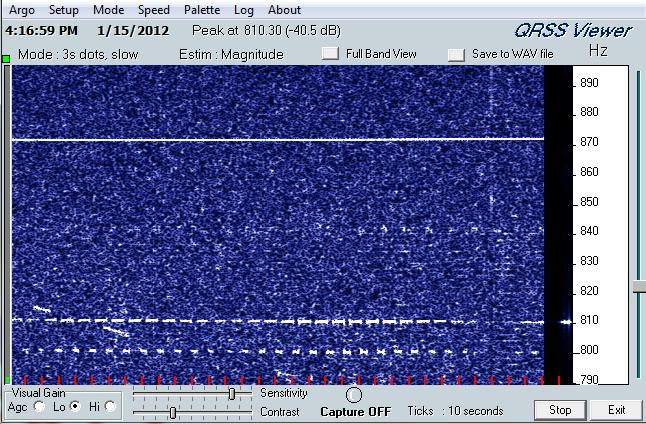
As of 4:16 PM CST, I measured your lower frequency as 13557.4558 kHz and the higher frequency as 10 Hz above that, plus or minus better than 1 Hz.
Best of luck with your new beacon! So you will be aware, I needed some way to identify it in the lists, so I used the last three letters of your ham call, as is commonly done. If you'd prefer some other combination of letters--which is also commonly done--just let me know.
73,
John
P.S. - For those who have been wondering about the measurements I sometimes post, the technique for producing that measurement is hinted at in the picture itself. I periodically check the calibration of Argo and my sound card with the 440, 500, or 600 Hz tones from WWV, and trim Argo to be better than 0.1 Hz. Since my receiver derives all its internal oscillators from a master reference, its absolute frequency error at the 800 Hz CW output is entirely dependent upon the tuned frequency and the percentage error of the MO.
The white line at lower right in the capture is the receiver output when tuned to WWV in memory at 10 MHz. It's 10.5 Hz high, which is 1.05 ppm. (The signal was quite stable today, which helps...Doppler shift is a royal pain some days.) Multiplying that by the carrier frequency gives an error at the tuned frequency of 14.24 Hz. The displayed signal at 800 Hz on Argo is therefore 14.24 Hz higher than it should be. The receiver is nominally tuned to 13557.470 at that moment, so subtracting the error means the carrier shown at 800 on Argo is actually closer to 13557.4558 kHz.
Since it's hard to interpolate the Argo display closer than half a Hz in QRSS3 mode, I allow for a possible error of twice that, since two such readings are necessary for each measurement: the received signal's position in Argo, and that of WWV. On days when WWV is experiencing a lot of turbulence, I specify a wider error tolerance.
Re: Testing new HiFer 13557.450
Posted by Matt Burns on January 16, 2012 at 03:38:54.
In reply to Testing new HiFer 13557.450 posted by John Davis on January 16, 2012
Thanks for the report John, you made my day!
For now the transmitter consists of 3 small boards laying out on my work bench under some bubble wrap for thermal insulation so the frequency was probably up and down all day. Once I get everything mounted in an insulated box things should be a bit more stable.
The antenna is a 20 meter dipole facing wsw/ene about 10 feet above the ground but it's also about 200 feet up the south side of a 600 foot hill so it does a little better than the average low dipole.
I haven't really decided on a name for the beacon but "COM" is ok with me, if I do switch to a qrss ID I may change that but for now I'm going to stick with the square wave fsk.
Thanks for the report!
Matt Burns Re: Outside
kc8com
Posted by Paul on January 16, 2012 at 17:05:31.
In reply to Re: Outside posted by John Miller on January 14, 2012
Excellent! This group is probably the most helpful anywhere on the web. Always the first place to turn if you need help!
LW broadcasters heard tonight
Posted by Alex NX1T on January 17, 2012 at 04:06:42.
For the first time since fall, copying some great propagation on LW tonight.
162 khz - Radio France Inter
171 khz - Medi
216 khz - Radio Monaco
All quite copyable.
Re: JAM SoCal Temp Sending Letter J x 6 QRSS60 + 5WPM 187.015khz
Posted by Lee on January 17, 2012 at 04:47:37.
In reply to JAM SoCal Temp Sending Letter J x 6 QRSS60 + 5WPM 187.015khz posted by Lee on January 15, 2012
Conditions seem to heating up. Think I'll leave JAM up in it's current config thru the week UFN.
Re: LW broadcasters heard tonight
Posted by John Davis on January 17, 2012 at 04:54:18.
In reply to LW broadcasters heard tonight posted by Alex NX1T on January 17, 2012
Congratulations, Alex!
I usually hear France Inter pretty well in the early evenings here in SE Kanas, but not tonight, because my first chance to listen came right after the start of their weekly maintenance period. None of the others were doing very well yet at that early hour either. Sure would love to hear Monaco (or any other broadcaster above Iceland on the dial), but in this part of the country, NDBs rule the entire region between 200 and 300 kHz.
John
Re: Outside
Posted by John Miller on January 18, 2012 at 03:53:51.
In reply to Re: Outside posted by Paul on January 16, 2012
Thank you very much! I am guessing there will be more questions from me down the road. :-)
tn beacon
Posted by bill on January 18, 2012 at 05:17:53.
i would like to know if anyone has heard this beacon Re: tn beacon
= beacon's radio frequency ID= morse code ID that beacon transmits Miles/ Watts= distance in statute miles from ... 371, FQW, Murfreesboro TN, –, –, – ...
Posted by Steve Ratzlaff on January 19, 2012 at 03:28:48.
In reply to tn beacon posted by bill on January 18, 2012
Hi Bill, if you go to NDB HK
www.classaxe.com/dx/ndb/rna/index.php you can enter the frequency or the beacon ident and it will show you where 371 FQW,TN has been heard and when it was last reported. It's listed as a 25 watt beacon. You can also scroll down to the bottom and download the whole database to save on your computer and use anytime. (I haven't heard it but have heard other Tennessee NDBs.) Looks like farthest west it's been heard is Colorado
73,
Steve AA7U
NE Oregon
NDB DXer since the 1980's
Posted by Pat Bunn on January 22, 2012 at 22:05:16.
I just received HK (ERMIN) at 332.0 this afternoon. It could be ID by ear but ARGO made it very plain. I can normally hear 10 or so NDBs - the with Wilmington Carolina Beach (about 300 miles) usually the longest distance normally. How unusual is it for me to receive a NDB from near Chicago here in upstate SC? I am just learning LW reception and wondering about what I can expect.
Re: NDB HK
I have greatly improved reception on my 80 meter dipole this weekend with a common mode choke - Jack Smiths design and also putting chokes in the power and digital lines coming into the shack.
Pat
N4LTA
Posted by Pat Bunn on January 22, 2012 at 22:30:54.
In reply to NDB HK posted by Pat Bunn on January 22, 2012
Duh - Just found out that there are two NDBs HK and one is about 60 miles north east from here.
Pat
Re: NDB HK
Posted by Doug Williams KB4OER on January 23, 2012 at 13:17:59.
In reply to NDB HK posted by Pat Bunn on January 22, 2012
Welcome to the hobby! I see you already answered your own question regarding HK.
Good job on the common mode chokes. I just ordered ten toroids (the one's Jack uses in his design) and am going to use five of them glued together to construct a choke for the antenna feed, and the others will be used on power supplies, wall warts, etc.
If you are using a wire HF antenna for LF reception, you might get better results by tying the feedline together in the shack and finding the right combination of L/C to "tune" the antenna for the desired frequency. When I was using a wire antenna, I constructed an "antenna tuner" in a metal project box that consisted of an air variable cap and a switch that selected various values of inductance (just small rf chokes that I bought from Mouser). This was, of course, for receive only.
Re: NDB HK
Posted by Pat Bunn on January 23, 2012 at 15:28:57.
In reply to Re: NDB HK posted by Doug Williams KB4OER on January 23, 2012
I ordered quite a lot of ferrite last week from Newark and Mouser. I first built a test choke based on Jack's design as I have his active antenna coming today. I plan to install it about 300 feet from the house next to a small pond and at least 300-400 feet from any other house.
Up to this point, I have been using my 80 meter dipole. It was very noisy until I tried the common mode choke. It has a current balun at the center but I may replace that with a better choke. I have built a JFET impedance matcher for it but I may wait until I get the Clifton Labs antenna installed and see how it does.
I was absolutely amazed at the noise reduction on the 80 meter dipole. I have been hamming and doing electronics my whole life and never would have believed what those type 31 ferrite chokes can do. I also put one in my 120 VAC and the digital lines and 12 volt lines to all the receiving equipment and the computer.
Right now I am using a R75 that had been stored away as my LF receiver. It is lousy below 500 KHz so I built a decent receive upconverter (somewhat like the one in the LWCA library but with improved front end filtering and a diplexer and better post amp). It seems to be doing fine using the R75 as a 4 Mhz IF. I have been looking at changing the mixer to a more modern switching type mixer but the SBL-3 seems to be working fine. I have searched the web looking for the upconverter that was published a couple of years ago in the LWCA newsletter but have not been able to find it. I understand it is a high performance upconverter with a switching mixer. I have also considered building an IF with a stable VFO using the new Si570 chip and narrow crystal filters. Lots of projects are possible.
Pat
Mystery Beacon
Posted by Pat Bunn on January 23, 2012 at 16:04:51.
I copied a mystery beacon at 137.31 KHz yesterday. It was loud enough for easy copy well out of the noise. Slow CW but it made no sense. A series of 5 dots and a dash if I remember or somthing close. and then more dashed and dots but no spacing. The spacing was short or missing and I couldn't make out a message.
I am just learning ARGO and the screen moved too fast to get a long string of morse (I had it on slow) - it was somewhat close to QRSS3.
I would guess that it has to be local but I can find no LOWFER close by at that frequency - I did verify the frequency by comparing it with a signal from my HP frequency synthesizer that I know is very close. The traces nearly overlayed on ARGO with it set at 137.31 KHz.
Any ideas?
Pat Re: NDB HK
N4LTA
Posted by Doug Williams on January 23, 2012 at 17:06:22.
In reply to Re: NDB HK posted by Pat Bunn on January 23, 2012
Hey Pat. I believe you will be very happy with the Clifton Labs antenna. I recently got one myself and have had excellent results with it on LF/VLF. I don't do much listening above 500kHz these days, but I'm sure it's an excellent performer on HF as well. Mine is only 50ft from my house, so you may get even better results at 300' from your house. The coax carries the DC current to the antenna, so with a long run like that you might want to use the "mini 8" type coax or larger. Jack is a great guy.
I also use an R75 with an LF converter. The converter I use is the AMRAD design, built by Todd Roberts. Todd builds his with an oven compensated crystal oscillator, which is necessary to minimize drift when trying to receive the slower QRSS speeds. I built my own converter years ago from an old QST article by Doug DeMaw and Jay Rusgrove (if I remember correctly) and it is also an excellent performer, but I did not incorporate an oven compensated oscillator because QRSS was not in use at that time.
If you are a member of the ARRL, you can probably look up the AMRAD design and download it as a PDF. I think Todd also still builds his converters, if he has any more of the OCXOs left. His construction job is top notch.
The R75 + converter combo has been a great performer for me. You can also by an OCXO as an option for the R75, which I did.
Re: Mystery Beacon
Posted by John Andrews, W1TAG on January 23, 2012 at 17:49:57.
In reply to Mystery Beacon posted by Pat Bunn on January 23, 2012
Pat,
You were probably copying WD2XKO, an experimental station run by W4DEX in Stanfield, NC. He was running around 137.49 kHz last night, using a mode called Opera. It keys the signal in an on-off fashion, but not in Morse code. The coding is read by computer, not by ear. If you are interested in following what is going on in that frequency range, you might want to subscribe to the Lowfer Reflector at QTH.net.
John, W1TAG/WD2XES
Re: Mystery Beacon
Posted by Pat Bunn on January 23, 2012 at 18:04:23.
In reply to Re: Mystery Beacon posted by John Andrews, W1TAG on January 23, 2012
That would make sense. The station was way above the noise and was turning the carrier on and off but not Morse.
Stanfield is about 90 miles from me if I remember correctly.
Pat
N4LTA
6R is off-the-air until the weekend.
Posted by Ed Larsen on January 24, 2012 at 01:48:22.
6R in El Dorado Hills, Ca. is off the air until the weekend. Some rain water got into the transmitter and coil. I should have it back on this weekend.
Re: NDB HK
Posted by Pat Bunn on January 24, 2012 at 03:34:05.
In reply to Re: NDB HK posted by Doug Williams on January 23, 2012
Doug,
You and I have essentially the same converter. I used the same oscillator but with a little different amplifier and I drive the SBL-3 a little "hot". My front end filter is nearly the same but I tweaked it a bit with "Elsie" to fit standard 1 percent capacitors. I added a diplexer and used a 2N5109 class a amp as a post mixer amplifier.
I have found that the oscillator is pretty stable in the shack in the die cast box if it is left on constantly. The mixer amp and the post amp heat things up and after things stabilize - it workes pretty well.
It sure beats the R75, which has serious problems in that it is loaded with AM intermod at night.
Pat
Re: stuff
Posted by Doug Williams KB4OER on January 24, 2012 at 10:42:25.
In reply to Re: NDB HK posted by Pat Bunn on January 24, 2012
Excellent work, Pat. I was at work yesterday and could not remember the details of the AMRAD converter. The other converter that I built years ago was very "old school"...had to wind a bunch of toroids by hand and it used diodes to "roll your own" mixer. It works very, very well however, with the exception that the oscillator, while plenty stable enough for NDB hunting, is not stable enough for the slower QRSS modes. You may or may not finid that to be the case with the converter you constructed. When you start monitoring for QRSS30 or QRSS60 amateur signals, the ARGO screen captures are only going to show you about 3 to 5 Hz of bandwidth, so any drift becomes very noticable. My "acid test" of entire system frequency stability is to set ARGO to QRSS120, tune to WWVB at 60kHz (may have to turn the gain down because WWVB tends to be very strong), let it sit for a few hours and watch for any drift.
As for the R75, your local MW situation may be different from mine. I did not get much if any AM intermod at LF without the converter, and the R75 maintained good sensitivity down to 100kHz or so, but there are a bunch of spurs below 500kHz. The lower you go, the more spurs. The converter solved that quite handily.
Now with the converter, I found (as several people told me I would) that a good low pass filter ahead of the converter is a necessity.
If you haven't yet, you should join the QRZ "Lowfer" mailing list. It is quite active in the winter.
Once again, welcome aboard! I find LF/VLF fascinating.
Re: stuff
Posted by Doug Williams KB4OER on January 24, 2012 at 12:09:13.
In reply to Re: stuff posted by Doug Williams KB4OER on January 24, 2012
Hey Pat. After having a cup of coffee and rereading your post, I figured out that you did indeed incorporate a low pass filter into the converter you built. ;-)
If I remember correctly, the original AMRAD design put the LPF in the same box as the converter. Mine are in separate enclosures. When you put the LPF in a separate enclosure than the converter, it's a good idea to use a good quality coax jumper between the LPF and the converter. I use a short piece of RG213.
If you put that same LPF in front of your R75 without the converter, you would probably find that it cures all of that AM intermod you mentioned, but the spurs would still be there, as they are inherent in the design of the R75, so IMO, it is better to use a converter. With the converter, you rid yourself of all the VLF/LF spurs, and the R75 has better receive specs in the HF range anyway.
It could very well be that your converter is stable enough for QRSS work as is, after it warms up. A good way to tell is the WWVB test I mentioned earlier.
Hifers today
Posted by Sal,K1RGO on January 24, 2012 at 17:44:39.
I had good copy on WV and GNK today at 11:00 local today. Somme QSB and up to 549 signals.
Re: stuff
Posted by Pat Bunn on January 24, 2012 at 21:39:29.
In reply to Re: stuff posted by Doug Williams KB4OER on January 24, 2012
My present converter is fairly stable and base on the W1VD/Demaw design. After talking to you, I have started a PC Board layout for a hybrid of the AmRAD converter which uses a 74HC4053 cmos switch as a mixer - which is a more modern mixer with better dynamic range. My present converter is an improvement over the Demaw design in that it uses a +7dBm Mini Circuits SBL-3 mixer.
The AMRAD front end filter appears to be a little better than the older Demaw design - I have a similar design in my converter that I peaked up with the Elsie filter program.
I found a TCXO at Mouser that will be a good bit more stable than my present 4 mhz crystal oscillator and hope to use it in converter #2. I also found some Coilcraft coils to substitute for the hard to get TOKO 10mm coils used in the AmRAD design and got some samples.
Hopefully in a couple of weeks I'll have the new converter to compare the present one to.
BTW - I joined the LW email group and have a copy of Opera. Thanks for pointing me in that direction.
Pat
Re: stuff
Posted by Doug Williams KB4OER on January 24, 2012 at 22:30:00.
In reply to Re: stuff posted by Pat Bunn on January 24, 2012
Hey Pat.
Well, you are a far better designer/builder than I am. About all I can do is copy proven designs, like following a recipe book. As long as everything is laid out for me, step by step, I'm pretty good at following directions.
For LF NDB dxing, any receiver/converter combo that maintains sufficient stability for 5wpm CW copy should be fine. This includes just about any receiver/converter manufactured/designed in the last 20 or so years.
When you start messing around with QRSS, you enter a different world. Here, bandwidths are measured in Hz, and the software you are using may only show you a few Hz of bandwidth over a time of hours. Stability is key, both for transmitting and receiving. A receive system that drifts 5Hz over the course of two hours is unsuitable for QRSS, IMO.
I haven't tried Opera. Frankly, I don't trust it yet. There have been several reports of the Opera software possibly installing viruses/malware. I will not install it until it is more stable/trustworthy.
You seem to be a very knowledgeable and able experimenter. I welcome you to this hobby and will do everything I can to help you. I have an extensive collection of books and magazine artciles. Feel free to contact me directly if you want or need anything sent to you.
Best 73,
Doug
Re: Hifers today
Posted by john on January 25, 2012 at 01:23:33.
In reply to Hifers today posted by Sal,K1RGO on January 24, 2012
sal, can you post the freq's??? so i can see if i can hear them.. thx john ki4ucw Re: stuff
Posted by John Davis on January 25, 2012 at 06:19:57.
In reply to Re: stuff posted by Doug Williams KB4OER on January 24, 2012
>>>A receive system that drifts 5Hz over the course of two hours is unsuitable for QRSS, IMO.
Agreed. In fact, I would go so far as to say exceedingly unsuitable. If a receiver's output can be that far off frequency at any given time, you might never find the desired signal at all on an Argo display when the radio is tuned to the nominal published frequency.
Even if you do locate the signal, that much drift wouldn't allow the received signal to fully "fill" each FFT bin that it drifts through during the course of a given dit or dah, which means you're giving up much of the detection capability that QRSS would otherwise afford you. And WOLF, which at this time apparently remains more sensitive and robust than any currently available Opera variant, is even more picky about precise tuning than Argo is.
(By the way, this might be a good time to point out that bin "widths" in QRSS and other digitally detected modes are generally measured in millihertz. That's milli, as in 1/1000th, designated mHz with the "m" in lower case. If one wishes to refer to a frequency in megahertz, it's becoming increasingly important to use the upper case MHz to distinguish them. Nowadays there actually are some occasions when a person may need to use both units of measure in the same paragraph, so care in capitalization will help distinguish what is meant.)
The high sensitivity of some modes to frequency errors is why I don't like to use upconverters at all, personally. Even if the converter uses a very good OCXO, as Todd's units do, the fact remains that you're upshifting the received frequency by a factor greater than 15 when going from 1750 meters to 3 MHz. Even if the upconverter LO is perfectly stable, you've introduced greater absolute error just from making it where the receiver is having to tune a higher frequency.
My Kenwood can exhibit up to 1 ppm of drift out in the car during the course of a few hours' listening due to temperature changes, especially if the session goes from daylight until after dark. Now, if I'm tuned directly to 185.300 kHz, that's less than 200 mHz of drift, which is not a problem even for QRSS120 over the course of an hour-plus ID. But if I have to tune in that same signal at 3.185300 MHz on the dial, then I'll have over 3 Hz of drift to deal with--even if the OCXO is centered perfectly on 3.000000 MHz the whole time. That would be off-screen at QRSS120, and is problematic even at QRSS30.
This is why I'm taking a different approach. I'll likely to continue using the R-5000 without upconversion above 30 kHz. With an old-fashioned mid-size vertical or random wire antenna matched to the radio's input impedance by way of Buffer Amp 2.5, the voltage coming in from the antenna has proven ample to totally swamp what few spurs the Kenwood has at LF. For VLF, however, I've planned that my next upconverter will shift the 9-30 kHz spectrum all the way up to a whopping...100 kHz!
Of course, I also realize that the R-5000 will not last forever, and I may need to change to an R-75 or equivalent someday. Taking that possibility into account, I'm incorporating a switch or jumper in the design to let me shift VLF to 200 kHz instead when necessary. By all accounts I've seen, the ICOM is pretty much free of spurs from there on up.
John
Re: Hifers today
Posted by Webmaster on January 25, 2012 at 07:10:01.
In reply to Re: Hifers today posted by john on January 25, 2012
>>> can you post the freq's
You might want to avail yourself of a resource we make available for that purpose right here at this Web site. That's what the "LowFER/MedFER/HiFER" button is for near the top of our LWCA Home Page.
I hope you'll find those lists helpful.
John
Mystery Repeating Tones On 332 KHz.
Posted by Dave Childs on January 25, 2012 at 07:17:27.
While NDB hunting last night I discovered a new repeating tone on about 332.5 KHz. The tone had a pitch of about 400 Hz., a duration of about 2 seconds followed by about a one-sec. pause. I listened to this signal last night for about 45 min., this morning & earlier tonight [though with difficulty tonight due to QRN]. While listening to this signal I never heard any format change nor ID.
Because of the daytime reception & constant signal strength I presume this station is within 400 miles. I live in east-central MI [coordinates: N43 10 17; W083 41b 02; grid: EN83DE] & this station appears to be coming from either southwest or northeast of here according to my outdoor, figure 8 pattern, loop antenna. Has anyone else heard this one or know what it is? Thanks & 73s!
Re: stability
Posted by Doug Williams KB4oer on January 25, 2012 at 13:07:42.
In reply to Re: stuff posted by John Davis on January 25, 2012
John raises a good point. Any time you use a converter, which is essentially another IF stage that is not locked to the receiver's main oscillator, (and assuming that you are not locking both the receiver and converter to some outside extremely accurate frequency reference), you have the possibility of introducing additional frequency drift.
In my practical experience, however, using the converter that Todd constructed, which has an industrial (I believe he told me they were surplus telephone company items) OCXO, the total drift of my receive system is enough that, after everything warms up, I cannot see any drift even on QRSS120 monitoring WWVB's carrier. This is in an indoor, temperature controlled envoronment.
Now the converter I constructed years ago, with it's non temperature compensated crystal oscillator, does exhibit enough drift, even indoors, to make it unsuitable for QRSS. It would probably be OK for QRSS3, perhaps QRSS10, but nothing slower.
The good thing about converters, however, is the fact that many receivers have less than optimal specs in LF/VLF, and the converter moves the signals up into a frequency range where the receiver has better sensitivity, less phase noise, and few, if any spurs.
Re: stability
Posted by John Davis on January 25, 2012 at 20:20:06.
In reply to Re: stability posted by Doug Williams KB4oer on January 25, 2012
Yes, I cannot speak highly enough of Todd's upconverter for stability. It's as solid and stable as can be. What I was getting at, though, is that upconversion places a greater burden for frequency stabilty on the receiver itself.
If you've got a receiver with a high stability master oscillator (an option available for the ICOM), or one that is locked to an external standard, and/or is located in a well controlled environment, that burden is greatly reduced! Otherwise, as I experience in the field, having to compensate for as little as 1 ppm drift at a dial frequency of 3 MHz becomes quite a nuisance for slow modes, whereas it can nearly be disregarded at 185 kHz.
Like everything else in engineering, upconversion entails compromises. Some receivers have more of an issue with sensitivity at LF than others, and some have more spurs, and some have more phase noise. Sometimes it's worth a few minor frequency concerns to work around those other problems. But that's not automatically true. A person should take stock of his own situation, which may differ considerably from generally accepted practice.
None of the previously mentioned receiver shortcomings are inherently present just because we're dealing with LF! Most of those issues arise because of compromises made earlier in the design process, where the emphasis was on HF performance. If the designer had to sacrifice anything in the process, it would come at the expense of BCB or LF coverage where "nobody" cares...except for those of us who are crazy enough to actually spend endless hours hanging out at LF and VLF, of course. ;)
Also, not only do the extent of those shortcomings vary among different receivers, just how serious they are in practice will vary with compromises made by the user in his receiving installation. Back when I lived in Georgia, I always dreamt of having a quiet listening location, but I also secretly dreaded it because I figured I'd have to buy a much more expensive receiver. The Kenwood didn't seem that sensitive at LF, to what little extent I tried cranking up the gain in the presenc of so much QRM; plus, I could hear signals as I tuned through the LowFER band that I knew weren't real, such as one particularly annoying artifact at 177 kHz that shifted in pitch backward from real signals when I tuned through it slowly. L.O. phase noise is not generally considered a huge factor with the Kenwood, but I could tell some difference the closer I tuned to the lower limit of 30 kHz.
"Clearly," I thought to myself, "I'll always be hard pressed to hear many domestic LowFERs. Trying for anything below 100 kHz is pointless. And transatlantic ham signals will always be out of my reach as long as I'm stuck with this radio running barefoot." Boy, was I wrong!
When I finally did get to a quieter location, I discovered it was worth my while to pay more attention to the antenna than I had done before. With less manmade noise in the vicinity, I dared to use a bigger antenna. When I began doing that last spring, I observed that improving the signal level arriving at the receiver was a perfectly fine answer in my own situation for overcoming spurs and phase noise in the receiver. I don't detect the spurs at all any more.
I'd bet many listeners don't have a clue how much signal they are wasting due to mismatch between their antennas and receivers. When I got hold of test gear and did impedance sweeps of the future LowFER antenna, I saw right away there was at least 20 dB loss in that band alone (and worse as one tunes lower) even if the radio's 500 ohm input was indeed 500 ohms. Later, it occured to me to sweep the radio's input too, and I found out just how wildly off that nominal impedance can be. Hence, the buffer amp project. All together, better matching made over a 40 dB difference--no voltage gain added, merely delivering the antenna open-terminal voltage to the receiver, along with filtering out some excess BCB energy. With the atmospheric noise of a quiet winter day now being audible above the receiver's internal byproducts, if there's a signal among the sferics at comparable level, it will be detected.
As I think about it, I suspect this accounts for the success so many LowFERs have had with the R-75 at 2200 and 1750 m in the past, who were not using upconverters at the time. There's more than one way to overcome the noise and sensitivity shortcomings of an otherwise good radio. Upconversion is certainly one way, especially in cases where the frequency stability trade-off is not a concern. In my case, it proved easier to deliver a stronger and cleaner RF signal to the radio at the original transmitted frequency, rather than try to ameliorate thermal stability issues that accompany tuning to a higher frequency.
I've actually been glad for the hardships imposed by the necessity of portable, off-grid monitoring. They have made me re-think the solutions I always assumed would be necessary if the time ever came when I could tackle weak signals at LF and VLF. That's helping me devise a systems approach to the problem.
Also, I have to credit your own DX achievements, Doug, along with Garry's and Andy's, for inspiring me to hope I might have even a remote chance of replicating some of them this far inland. It hasn't been all that long since those of us who live away from the coast simply didn't catch transatlantic ham signals, nor even have much hope for snagging SAQ. I haven't managed that latter feat yet, in fact, but remain hopeful. :)
John
Re: stability
Posted by Doug Williams KB4OER on January 25, 2012 at 21:46:50.
In reply to Re: stability posted by John Davis on January 25, 2012
Well John, as usual, you are absolutely correct, about everything.
This hobby requires a good bit of thought and work to be successful, even at just receiving. Everyone's situation is different, everyone has to make compromises (except Mal), and everyone has to put effort, and money, into building a successful receive and/or transmitting station.
My location, as almost all locations, has advantages and disadvantages. I live in a rural area, on a tall hill, and can monitor LF in the air conditioned and heated comfort of my home. On the other hand, my next door neighbor has an electric fence that drives me crazy, and a I have to get up at 5AM five days a week to go to work, which means my "monitoring" is mostly via software while I am asleep.
You have the advantage of having a relatively noise free piece of rural land, but you have to make field trips and sit and shiver in the cold, and deal with temperature induced frequency drift, Sasquatches, and who-knows-what-else.
Again, welcome to the hobby, Pat. It ain't for the faint-of-heart. But I have a feeling you got the right stuff. ;-)
Re: stability
Posted by John Davis on January 25, 2012 at 22:27:44.
In reply to Re: stability posted by Doug Williams KB4OER on January 25, 2012
Perfect example of compromises and trade-offs right there in the different QTHs, Doug.
Sasquatches? Oops, hadn't taken that possibility into account, but at least I'm not too near the edge of the woods. Skunks, armadillos, giant killer vampire nosquitos, and (in summer) snakes are the main things I keep a lookout for. Fortunately, other wild neighbors haven't been any problem thus far. The coyotes and the reputed panther are shy (or else have plenty of other prey to keep themselves occupied), and the wolf spiders don't howl too loudly. :)
Pat, I hope you'll share your upconverter mods with us in the form of an article at some point. It never hurts to keep up with new and improved methods. FYI, I'm glad to report HiFER USC continues to be a regular here whenever the ionosphere is at all cooperative.
John
Re: stability
Posted by Pat Bunn on January 26, 2012 at 01:25:31.
In reply to Re: stability posted by John Davis on January 25, 2012
I enjoyed reading both of your comments and agree stability is a major concern. I have done no QRSS work (still very little) until the past few weeks and have a lot to learn.
The more that I think on the stability concerns, the more that I am beginning to think that building a receiver rather than a converter might make more sense IF a stable VFO is doable. I have not closely examined the stability of the Si570 but Jack Smith examined a VFO kit based on the Si570 and found it to be very good. It has alway had excellent phase noise performance.
It should be fairly easy to build a single conversion receiver with excellent dynamic range and a very narrow crystal filter (good narrow crystal filters are fairly easy to implement). "Easy" is probably not a good word to use - but maybe do-able would be better
If the stable Si570 VFO with digital display is do-able - several good filter designs are already done and putting an impedance matching circuit like John has describe is well tested - and so is doing an IF,AGC, BFO and audio - so it might be a good project?
If all of the above could be combined - it would probably result in a receiver better than you can buy (at a reasonable price) for LW - "IF" is the key word
My R75 reminds me of the receiver in a IC718 that I sometimes use. Neither are considered to great receivers - My main transceiver is a K3 and until I owned it - I never understood how a "good" receiver sounds. It is pleasing to listen to in a way that is hard to describe.
Re: LF Receivers
Posted by Doug Williams KB4OER on January 26, 2012 at 12:16:43.
In reply to Re: stability posted by Pat Bunn on January 26, 2012
Pat I think that would be an interesting project for someone with the time and skills to design and test. It would be great to see a write up on such a project in the Lowdown. If a PCB template could be designed and sold by, perhaps, FAR circuits, that would be outstanding.
The trend these days seems to be away from analog receivers, however, and we now hear a lot about SDRs. Several people who are active on LF own and have high praise for the SDR-IQ receiver, and I am sorely tempted to purchase one myself. It apparantly has good sensitivity in the LF frequencies, and is actually capable of receiving down to 500Hz. I asked Dex to do my favorite stability test (QRSS120 with WWVB) with his, and the screenshot he sent me showed very little drift, proving to me that the SDR-IQ is easily usable for QRSS work.
As for the K3, I would love to own one. I have read nothing but praise for this transceiver. I like the "roll your own" aspect.....there are so many options to choose from. Have you considered using the K3 with your upconverter? This combo should make an outstanding LF receiver, as I imagine the K3 is a better receiver than the R75. Do you have general coverage receiver module in yours? I believe there is also a TCXO (or OCXO) option for the K3. NC Signal Report
Posted by Bob on January 26, 2012 at 15:13:20.
Hi, I'm a new HiFER enthusiast - nothing on the air yet - but right now at 10:11 AM EST here at FN13GD I've got a strong squarewave with Spectran on QRSS3 at about 13555.6 Khz - I'm assuming that's NC.
Thanks,
Bob
Re: LF Receivers
Posted by Pat Bunn on January 26, 2012 at 16:18:58.
In reply to Re: LF Receivers posted by Doug Williams KB4OER on January 26, 2012
I have a few SDR boards but most of them have a crystal oscillator that is no more stable than my analog receive up converter.
I actually have a Si570 kit and may do some tests soon if I get the time. My work business is picking up faster than I expected - the economy is warming up despite the news media - Hopfully I can get some time this weekend.
I have done PC Board layout for a long time - and find it somewhat soothing like working a puzzle. You should see my PC Board junk pile - I have a UV frame and can go from screen to prototype in about 30 minutes at home with very good quality down to about .015" traces.
I have not used the K3 as it is hooked up as my main QRP transceiver. I don't have a GC module or TCXO but I may take a look at those options.
Last night an ugly signal that is very loud showed up with harmonics up the band through about 200 Khz - It is close because the Rx picked it up loudly on a 3' piece of coax with my hand touching the grounded part of the SO239.
So I have to run that down also.
Re: NC Signal Report
Posted by John Andrews, W1TAG on January 26, 2012 at 18:05:04.
In reply to NC Signal Report posted by Bob on January 26, 2012
Bob,
Yes, that's almost certainly NC. The actual frequency will vary somewhat with temperature, but Dex's square-wave is unique in that part of the spectrum.
John, W1TAG
Thursday HiFERs
Posted by John Davis on January 26, 2012 at 22:11:18.
Here in SE Kansas, SIW and NC were coming in splendidly this afternoon on two different sessions of Argo simultaneously, with the normal speed CW ID from SIW copied by ear a few times. USC was also quite good most of the time, but seemed to suffer from a little more rapid fading than the others.
Conspicuous by its absence today was MP.
WV and EH were good by ear most of the time, too. Too much sideband splatter above mid-band to try for any of the westerners.
John
Re: Thursday HiFERs
Posted by Matt Burns on January 26, 2012 at 23:31:12.
In reply to Thursday HiFERs posted by John Davis on January 26, 2012
Just curious John, would I stand a better chance of getting logged if I moved down the band a bit? So far you're the only report I've received. Also, should I think about slowing the fsk down, decreasing the shift, or smoothing the fsk transitions? I noticed on your screenshot I have what appears to be an upper sideband showing at 840 Hz.
Thanks,
Matt Burns Re: Thursday HiFERs
kc8com
Posted by John Davis on January 26, 2012 at 23:48:28.
In reply to Re: Thursday HiFERs posted by Matt Burns on January 26, 2012
Hi Matt,
What you see at 840 Hz in the capture is MTI. That's how a signal keyed with conventional speed CW looks in Argo when it's not very strong.
I think your current frequency is fine, so far as being in the clear, although anything you could do to further stabilize variations with temperature would help. Both of the other ideas you mentioned (slowing the FSK down a bit and narrowing the shift) might be helpful, too. Actually, when I viewed your signal a couple of days ago, it seemed to me that the shift was only about 8 Hz at that time, which I believe is a step in the right direction.
It's a little early in the season for there to be many listeners active at HiFER frequencies yet, so I imagine more will notice you as time passes. And, some of our members don't visit online sources very regularly, and may only become aware of your beacon when they see the listing in the February edition.
Of course, there is also the directional disadvantage of a dipole antenna...up to half the potential listeners might not be in your main lobes...although I shouldn't be in them either, but copied you OK. So, I'm not sure how much effect that actually has.
John
An idea: qrss phone
Posted by Matt Burns on January 29, 2012 at 04:41:56.
Hi all,
I was thinking about the concept of qrss and narrow band modes a while back and came up with sort of an odd idea; why can't you slow down a recorded audio message by a factor of 100 or more, send it over a weak signal path then speed it back up at the receiving end?
For example I could record a 10 second message with a bandwidth of about 2 kHz, upconvert the recording by 10 kHz then slow the message down by a factor of 10 making a 100 second message at 1000-1200 Hz then repeat the process making a 1000 second (16 min 40 sec) message at 1100-1120Hz, the recorded message could be transmitted via ssb or even dsb consuming 20 or 40 Hz of spectrum then recorded at the receiving station, sped up, and downconverted to make a copyable phone message?
I know this might be a lot of work for nothing but I don't think it would be too difficult with software available now and I think pushing a 20 Hz wide signal across the hifer or lowfer bands should be quite possible under good conditions.
Let me know if this is just a pipedream or anybody is interested.
73's,
Matt Burns Re: An idea: qrss phone
kc8com
Posted by John Davis on January 29, 2012 at 06:22:37.
In reply to An idea: qrss phone posted by Matt Burns on January 29, 2012
Intriguing thought, Matt. I seem to have vague recollections of something similar being tried a couple of decades back with purely electromechanical means (that is to say, magnetic tape), although the results were no more than you would expect with all the limitations the technique entailed.
In software, it would be a lot simpler. In fact, there's no real reason why you would have to make two passes to achieve a speed and bandwidth reduction of 100, if you make it a point to not leave the digital domain!
To stretch the original audio sample in the time domain, you would "step up" the sampling rate by a factor of 100 from the real A/D sampling rate (a lot of interpolation would be involved, I expect). If done by the most basic linear-thinking approach, you would convert a file of X kilobytes to one of 100X kilobytes in size. This would be after digitally filtering the sampled audio to the desired bandwidth, of course, a process where there might also be several tricks possible to reduce the amount of computation needed later...and the file size. I'm not good enough at the math of DSP to comprehend the details myself, though.
If played back at the original real sampling rate, a message containing frequencies from 200 to 2000 Hz in its original form would output frequencies from 2 to 20 Hz in the time-stretched version. But there's no reason to play it back that way, of course. Modulating the information onto, say, a 1 kHz "carrier" entirely in software via the phasing method and achieving virtually perfect rejection of carrier and unwanted sideband is--well, not trivial for someone of my skill set, but certainly not difficult for someone who knows what he is doing. Out of the sound card comes 1002-1020 Hz, ready to be transmitted.
Of course, successful reception and playback will impose a need for very tight frequency control. Every frequency error in the transmitter, receiver, sound cards, upconverter, or wherever else is in the chain, will be magnified by a factor of 100 in the demodulated, re-time-compressed form. The person speaking could end up alternately sounding like Donald Duck and Tony the Tiger several times over the course of a 10 second message. :)
For that reason, plus the considerable number of times a HiFER signal can disappear in deep fades during the course of 1000 seconds, I suspect LF would be the best place to test the idea. Just some early thoughts, for whatever they're worth.
John
HiFER COM
Posted by Jonathan Jesse on January 29, 2012 at 23:11:04.
I do believe I captured COM today. I was home for lunch and grabbed
this at about 1:50 PM local.
Jon WS1K
FN41qw
http://lwca.org/mbarchiv/pix/COM-jj.jpg
new hifer?
Posted by Sal,K1RGO on January 30, 2012 at 17:48:56.
Today at 12 noon local, in addition to copying NC and GNK, I caught a capture of a strong square wave on QRSS3 top of the wave was 2/3 in time length vs bottom which was 1/3 ( not symmetrical),10Hz deviation in amplitude, and ~ 10 seconds in length time, on 13,557,850 Hz....anybody know who this is? hifer BIW copied
later, Sal
Posted by Sal,K1RGO on January 30, 2012 at 18:11:33.
At 13:00hrs local, I copied BIW on 13555.5 kHz on QRSS3...Who is this dude? sdr-iq radio
Later..........
Posted by bill on January 30, 2012 at 19:52:05.
i would like to know if any of you guys are using a sdr-iq radio to hear wolf signals and if it works for you and the antenna your using Re: new hifer?
thanks bill
Posted by Matt Burns on January 30, 2012 at 20:36:01.
In reply to new hifer? posted by Sal,K1RGO on January 30, 2012
Hi Sal,
That would be my hifer COM in Rock, WV. The frequency is still slowly drifting up and down the band with temperature variations in the shack, I was a little surprised to hear it was so high in the band but the 2:1 high to low ratio fits.
I would love to see the capture if you saved one.
Thanks,
Matt Burns Re: new hifer?
kc8com
Posted by Jon WS1K on January 30, 2012 at 21:25:59.
In reply to Re: new hifer? posted by Matt Burns on January 30, 2012
Had a strong copy on COM today, Matt. Dog bones but unfortunately I didn't grab a screen shot.
Jon
DCF77 reception in the USA?
Posted by John Szuhay on January 30, 2012 at 21:27:13.
Hi all,
This may be crazy but is it possible to receive the 77kHz time synch signal (DCF77) from Mainflingen Germany in the USA with the right equipment?
Why do I ask?
I have a German RCC watch that only synchs to the DCF77 signal. My travels to Europe are becoming less frequent, and I would like to use this watch in the US if possible.
Thanks in advance.
Re: sdr-iq radio
Posted by Jon WS1K on January 30, 2012 at 21:37:51.
In reply to sdr-iq radio posted by bill on January 30, 2012
Yes, I have an SDR-IQ and have received Wolf with it. There are a few guys on the Lowfer email list that have them. Works good for Wolf.
Antennas here are a 250' or so-sort of delta loop for LF & HF and an 8' Burhan Shielded Loop for LF.
Jon WS1K
Re: hifer BIW copied
Posted by John Davis on January 30, 2012 at 21:51:30.
In reply to hifer BIW copied posted by Sal,K1RGO on January 30, 2012
Hi Sal,
That's actually SIW. He uses a normal-speed CW ident in front of the S... unfortunately, with just the right timing and spacing to sometimes look like a dash in QRSS3, thus appearing to be a Morse "B" instead of just "S".
The signal is frequently strong enough here for the CW keying sidebands to show up, so I seldom have trouble making the distinction. But when the signal is weaker, that's when the "S" looks like a "B".
John
Re: sdr-iq radio
Posted by Garry, k3siw on January 30, 2012 at 21:55:42.
In reply to sdr-iq radio posted by bill on January 30, 2012
Bill, I use the SDR-IQ and its stability even with the internal clock is adequate to decode wolf and display QRSS60 well too. The big stations like WE2XGR/2 and WD2XES are easy to decode on 137 and 500 kHz. The only lowfer station I know using wolf is TAG on 185.8 kHz and being nearly 1500 km distant decodes aren't easy but I've managed quite a few during the winter.
I recently added a selectable external OCXO clock but it isn't necessary. For antennas I have an e-probe and a small 3' loop.
73, Garry, K3SIW, EN52ta, Elgin, IL
Re: DCF77 reception in the USA?
Posted by John Davis on January 30, 2012 at 22:00:23.
In reply to DCF77 reception in the USA? posted by John Szuhay on January 30, 2012
It is indeed possible with a good radio and a decent antenna to hear the signal during the early part of the night at many locations in the US. But it is difficult to obtain sufficient signal (and low enough static levels) to assure correct decoding with most normal watches, clocks, or other timecode controlled devices working with only their internal antennas.
In what part of the country do you reside? It will be easier to get adequate signal near the Atlantic, and moreso in the Northeast than, say, the Southeast.
John
Re: DCF77 reception in the USA?
Posted by Garry, k3siw on January 30, 2012 at 22:00:35.
In reply to DCF77 reception in the USA? posted by John Szuhay on January 30, 2012
John, yes, DCF77 reception is relatively easy, especially if you're near the Atlantic coast. The frequency is 77.5 kHz and with an e-probe+SDR-IQ the clock signal often displays using MultiPSK Clock.exe software. HBG on 75 kHz is usually a bit harder to decode but it often works too in the evening hours during winter.
73, Garry, K3SIW, EN52ta, Elgin, IL
Re: new hifer?
Posted by Sal,K1RGO on January 31, 2012 at 01:04:05.
In reply to Re: new hifer? posted by Matt Burns on January 30, 2012
Hi Matt, Re: hifer BIW copied
I later looked up the hifer list and thought it was COM, guess it is. your signal is strong here 569 and did have QSB where you faded out. Give me ur email and I will send you the capture. It is among the stronger , at first I thought it was commercial.
later....Sal
Posted by Sal,K1RGO on January 31, 2012 at 01:10:28.
In reply to Re: hifer BIW copied posted by John Davis on January 30, 2012
Hi John, Re: new hifer?
I later was thinking that it cud be SiW, I remember before he had ID and location, so I'm all straightened out now. It looked a bit different this time, thus the confusion.
.....later,Sal
Posted by Sal,K1RGO on January 31, 2012 at 01:15:57.
In reply to Re: new hifer? posted by Matt Burns on January 30, 2012
Must be a senior moment...HI..I see your email as listed here, I'm sending you a capture....
Re: Thursday HiFERs
Posted by Paul on January 31, 2012 at 04:07:13.
In reply to Re: Thursday HiFERs posted by John Davis on January 26, 2012
Don't fret. Sometimes my HiFer goes for months without a report, then BAM! I get like one or two per week for a while. I've mailed out probably close to 50 HiFer QSL cards in a couple years. You won't get fast & furious signal reports from a HiFer like you do a 10m beacon, but they will come.
Re: DCF77 reception in the USA?
Posted by Ludovico on January 31, 2012 at 06:05:45.
In reply to Re: DCF77 reception in the USA? posted by John Davis on January 30, 2012
Hi John,
Thanks for the reply. I live in Houston, TX but travel often to Pittsburgh, PA to look after my Mother.
I am anxious to try finding the DCF77 signal. Can the signal be boosted and filtered?
I am new to long wave...
Cheers,
John
Re: DCF77 reception in the USA?
Posted by Ludovico on January 31, 2012 at 06:12:56.
In reply to Re: DCF77 reception in the USA? posted by Garry, k3siw on January 30, 2012
Thanks Garry. That is encouraging news.
Wonder if the DCF77 signal is strong enough to be seen by my wristwatch here in Houston, TX?
So far no dice....
Would sending the watch up in a balloon help?
I am new to longwave, but wonder if this signal can be boosted somehow?
I have looked into simulating the DCF77 signal with GPS receivers/converters or computers but the solutions are too expensive.
Cheers,
John
Re: DCF77 reception in the USA?
Posted by John Davis on January 31, 2012 at 10:07:04.
In reply to Re: DCF77 reception in the USA? posted by Ludovico on January 31, 2012
Before our own longwave time signal station, WWVB, improved its radiated power several years ago, there were some users of self-setting clocks in more distant parts of the country who boosted the signal reaching their devices.
This was done with good outdoor antennas, frequently consisting of tuned loops, although active whip antennas and longwires could be used too with a bit of additional amplification or preselection (tuning). The signal was brought indoors via coaxial cable, and then coupled into the watch or clock by means of a multi-turn loop antenna, adjacent to or surrounding the device.
(At one of the places where I worked, we had an alternate antenna method available. The 300 meter tall TV transmitting mast picked up a lot of longwave signals, and it was only necessary to stand within six to ten feet of the base of the tower to have all the inductive coupling necessary to do the job.)
Sending the watch up in a balloon is an unusual but creative thought. It would not improve the signal level much, but it would distance the watch from many of the common sources of manmade electrical noise that plague the longwave spectrum. If you were back East, that might be enough improvement to enable the watch to decode DCF77. In Houston, however, I can almost guarantee there still won't be enough signal for reliable synchronization.
Speaking hypothetically, now: As Garry noted, there is software available that can decode time information from a receiver tuned to time signal stations, when the radio's audio output is fed into a computer sound card. Such software can be used to synchronize the computer's clock. Why not take it one step further? If someone were to write appropriate software to do the job, there is no reason why the process couldn't work in reverse--use the computer's clock, and generate timecode in whatever format was needed. It shouldn't be difficult to modulate the new timecode as amplitude-shift keying onto an appropriate audio tone in the sound card.
"Appropriate," in this case, means a tone at a sub-multiple of the carrier frequency used by the time station for which the watch is designed. The output of the sound card would be fed to a simple circuit consisting of a few diodes to generate harmonics of the tone. A transistor radio loopstick antenna should be sufficient to radiate those harmonics for a distance of a few inches. One of those would be on the watch's frequency and would contain the amplitude-shift keying generated by the software, in effect serving as a local substitute for the actual time station.
(To emulate DCF77, the sound card would need to output 19,375 Hz, the fourth harmonic of which is 77,500. The tone would need to be of sufficient amplitude to drive the diode junctions into conduction, of course, at both the high and low keying levels. A little more complex external circuit might allow for operation at lower levels, and/or utilizing odd-order harmonics. If there's a sound card guru who would like to collaborate on a relatively simple project that allows users to locally emulate their choice of DCF77, MSF, WWVB, HBG or JJY, I'd probably find it fun developing the hardware end.)
John
Re: DCF77 reception in the USA?
Posted by Ludovico on January 31, 2012 at 15:10:09.
In reply to Re: DCF77 reception in the USA? posted by John Davis on January 31, 2012
Hello John,
Thanks for the information.
I do not have any background in EE or RF, but this sounds like a fun challenge, especially if there is high likelihood of success.
After scouring the net I see that people have come up with solutions for emulating the DCF77 signal (from GPS receivers and computer clocks) but all at relatively high cost...more than the cost of the watch actually!
Thanks again,
John
Re: HiFER COM
Posted by Garry, k3siw on January 31, 2012 at 17:24:16.
In reply to HiFER COM posted by Jonathan Jesse (fwd) on January 29, 2012
Hifer COM was in nicely to NE IL this morning around 1530Z. The FSK tones were centered on 13557535 Hz. Also noted around that time were NC and USB.
73, Garry, K3SIW, EN52ta, Elgin, IL
Re: DCF77 reception in the USA?
Posted by Ludovico on January 31, 2012 at 17:51:00.
In reply to Re: DCF77 reception in the USA? posted by John Davis on January 31, 2012
John,
At a little more digging, I found a nifty little device that receives time from a GPS and converts it to a DCF77 signal. You can see it here:
http://www.nixieclocks.de/english/downloads/GPSNixieEnglish.pdf
Can you see a way to take this signal and broadcast it at 77.5 kHz at low power?
How much hardware would need, especially if you only want to broadcast over a few inches?
Thanks.
Re: DCF77 reception in the USA?
Posted by John Davis on January 31, 2012 at 18:10:52.
In reply to Re: DCF77 reception in the USA? posted by Ludovico on January 31, 2012
I can imagine emulation of a time signal station from a GPS reference being a bit expensive, since there would be significant hardware costs as well as application-specific software. I've tried finding articles on the Web for doing the job just with a PC, but haven't come across any thus far, so I have no idea what sort of interfacing they might entail. Looks to me like some of the possibilities I see suggested in various forums are for outputting the re-created time code through a serial port and getting it into clocks as raw data, while others might involve building small transmitters. Too much complication, IMO.
The method I'm proposing depends almost enitrely on the computer's existing sound card, and thus would be about as cheap as it can get: a couple of dollars worth of parts from Radio Shack, and the ritual sacrifice of an old defunct transistor radio. :) Cheap is good.
Posted by Ludovico on January 31, 2012 at 18:33:35.
In reply to Re: DCF77 reception in the USA? posted by John Davis on January 31, 2012
The GPS/DCF77 converter board from Germany I referred to is ~$150 USD which is not too bad.
I have no idea about building the LF RF transmitter though...
I really like your low cost approach! I have seen routines for building the DCF77 timecode. See for example:
https://github.com/nitram2342/gr-dcf77-transmitter
This code is designed to work with USRP and LFTX boards which are really expensive (for me anyway). ;(
Re: DCF77 reception in the USA?
Posted by John Davis on January 31, 2012 at 19:10:32.
In reply to Re: DCF77 reception in the USA? posted by Ludovico on January 31, 2012
I'll have to take some time to study their nixiclock design, to make sure the DCF77 input is raw data from a plain DCF77 receiver module--that is, whether it's the same one-pulse-per-second format transmitted by the station, or whether it has already been interpreted to another serial format specific to the clock itself.
If it's the raw data, the hardware would cost a few dollars more than the soundcard approach, but not very many more, and there would be no need to write sound card software.
Re: HiFER COM
Posted by Matt Burns on January 31, 2012 at 23:21:02.
In reply to Re: HiFER COM posted by Garry, k3siw on January 31, 2012
Thanks for the report Garry, it's good to hear that COM is getting out. It looks like you're my nearest neighbor as far as frequency goes, hopefully we don't end up too close. If we do let me know and I'll shift up or down the band a little.
You are also the closest reception to date at 496.8 miles. I've been working out the miles per watt more for my own amusement than anything else but at 2.5 mw that comes out to 198,720 miles per watt.
I don't know if you happened to get a capture or not but if you did I would love to see it.
Thanks and 73's,
Matt Burns Re: Thursday HiFERs
kc8com
Posted by Matt Burns on January 31, 2012 at 23:27:15.
In reply to Re: Thursday HiFERs posted by Paul on January 31, 2012
Thanks for the reassurance Paul, after a slow week I seem to be getting a new report just about every day, I guess that's just how the bands work. I remember the first time I captured "GL" George said it had been over a year since he'd seen a report, talk about patience!
73's,
Matt Burns
kc8com
potrzebie