 Right you are, Andy.
Lowfer JH
I removed the lm317 adjustable regulator and replaced it with a pot, so I can get the final voltage all the way to battery voltage now. Now at a full watt.
N Y Eve Beacon Shortage = Silver Lining!
Posted by John Davis on January 01, 2020 at 08:23:58.
Almost nobody was around on 2200 m WSPR tonight, but that let a very special call get through: 2EØILY.
Chris was part of the first 2200 m US-UK ham QSO in early 2018. That effort utilized very slow modes, while WSPR2 (although slow in some ways of looking at it) is roughly equivalent in sensitivity to QRSS3. This is far from my first transatlantic reception on 2200 m, but all previous instances were with slow modes like QRSS60 or DFCW90.
The only other stations in the WSPR sub-band from sunset up to this point were WH2XND (65 spots), N1DAY (32 spots), and apparently K3RWR in Opera (strong enough for aural CW copy). Presumably, everyone else was off somewhere, celebrating.
During the 0500 transmission slot, 37 other stations--all European--also copied 2EØILY. In the other timeslots between sunset and now, one other US station also decoded Chris tonight: Eric NO3M, who is roughly a thousand miles closer to him, managed 7 spots in that time. Nice start to the New Year!
Timestamp         Call    MHz       SNR Drift Grid    Pwr  Reporter RGrid    km    az

2020-01-01 05:00  2E0ILY  0.137551  -30   0   IO82qv  0.5  AE0CQ    EM27kc  6961  296
Re: N Y Eve Beacon Shortage = Silver Lining!
Congratulations John, and Happy New Year!
2E0ILY is the station that had the first 2200 m UK-US QSO with N1BUG after the band was finally allocated here. That contact was made at considerably slower speeds in March 2018.
Nearly a year later we had the second UK-US 2200m QSO, that time on JT9-1. I was especially pleased that it was done without scheduling. I saw his CQ, answered and we completed quickly with just a couple of repeated sequences required.
G0MRF made good on his long time goal of a trans-Atlantic QSO shortly thereafter, also using JT9-1.
Paul, N1BUG
P.S. - After repairing a power supply I am on the air again.
I love the visual modes, so starting last night (this night), I am once again transmitting DFCW90 on 137.779 kHz. Reports to come in so far include a shockingly strong full call sign capture from 9A3KB and partial copy on SP5XSB and RN3AUS grabbers.
I plan to continue with DFCW90 for a few nights. This may be a good opportunity for others to try receiving my signal at distances beyond what WSPR2 will manage.
After this DFCW90 run I would like to try some WSPR15 and JT9-10 if there are any stations wanting to try those modes. Please let me know of any interest.
I also hope to re ready for first EbNaut transmitting tests soon.
Happy New Year lowfers!
Re: N Y Eve Beacon Shortage = Silver Lining!
Posted by Andy KU4XR on January 01, 2020 at 16:14:20.
In reply to Re: N Y Eve Beacon Shortage = Silver Lining! posted by N1BUG (fwd) on January 01, 2020
HNY John;
Congrats on the decode! propagation smiled on you. Being in the right place at the right time
pays off
73: Re: N Y Eve Beacon Shortage = Silver Lining!
Andy - XR
Posted by John Davis on January 01, 2020 at 16:18:29.
In reply to Re: N Y Eve Beacon Shortage = Silver Lining! posted by Andy KU4XR (fwd) on January 01, 2020
Being in the right place at the right time pays off
Right you are, Andy.
That's the difference between gold and DX. Gold is where you find it, but DX is a matter of where and when.
Best DX wishes for all in the new year!
What DX meant in the mid-continent region when I was a youngster. Re: N Y Eve Beacon Shortage = Silver Lining!
A product of the 1920s Tulsa oil boom, DX was everwhere around
here until after the merger with Sunoco in 1968. The brand was
phased out by the late 1980s.
Posted by swlem3 on January 01, 2020 at 16:31:04.
In reply to N Y Eve Beacon Shortage = Silver Lining! posted by John Davis on January 01, 2020
Good work! What a nice New Years present. :-) Yes, congrats on the 2e0ily decode John. I had my equipment on all last night but came up with nada (other than) XND all night. I didn't even decode N1DAY overnight.
630 M WSPR
Posted by John Davis on January 02, 2020 at 07:12:15.
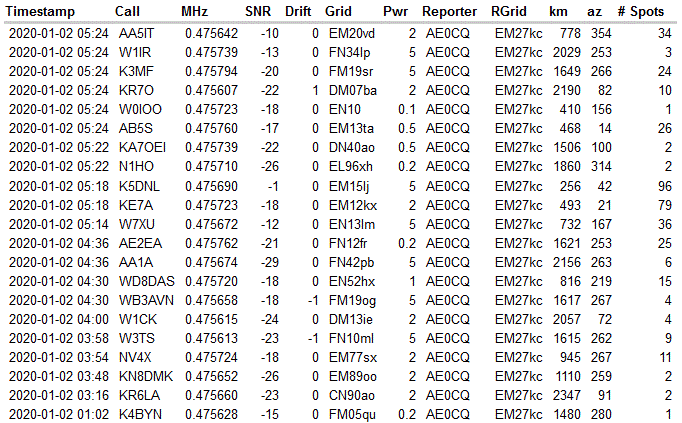
Hadn't been on 630 lately, but doing so now. Tried for JH without luck during a one hour break centered on midnight CST, down at 1750 m, so I've resumed 630 m again. Lots more stations on this band than there were on 2200 last night, but no major DX thus far either.
Twenty-one stations gave me 397 decodes in a seven hour span beginning half an hour before sunset; sample below.
K5DNL and KE7A give me day and night copy, being practically in my back yard at about 150 and 300 miles, respectively. (DNL is typically S9 in daylight and 10 over at night.) The farthest nighttime quasi-regular is KR6LA. Other familiar calls tonight included K3MF, KR7O, AB5S, KA7OEI, AA1A, etc.; while I think AA5IT, WØIOO, N1HO, and N4VX may be first-time visitors here,
---------------------------------------------------------------
 File Attachment 1: 1jan-630wspr1.gif
Re: 630 M WSPR
A few more evenings of copy should give you some of the VE's up in the NW, possibly G0MRF, and if you give it a try at sunrise you may catch VK4YB.
Re: 630 M WSPR
Posted by Ed Holland on January 02, 2020 at 21:21:54.
In reply to 630 M WSPR posted by John Davis on January 02, 2020
John,
I have found 630 m to be very active many evenings this Autumn. From here on the West Coast, WSPR from Hawaii and Alaska has been frequent copy when conditions are good. Many of the callsigns in your list are also reaching CM87 with excellent readability.
One weird thing, the log file for my installation of WSJT has garbled the distance data, or I'm importing it incorrectly into the spreadsheet.
Cheers
Ed
Re: 630 M WSPR
Posted by John Davis on January 02, 2020 at 23:05:39.
In reply to Re: 630 M WSPR posted by Ed Holland on January 02, 2020
The very high level of activity on 630 is why I haven't been spending much time there since early 2018, after US hams finally got official access to the band and started migrating there in earnest.
There's certainly no shortage of stations to look for on any given night. The main challenge is to find a quiet enough frequency and timeslot to copy anyone who might be buried under the stronger "local" signals...which effectively means anyone within 200 miles over the highly conductive soil such as we have here on the Plains. That fact, combined with the relative shortage of opportunities for DXpeditions to the farm, has prompted me to spend more of my time on 2200 m, and especially 1750 m, where copying anyone at all is a considerable challenge! :)
The hopeful news is, however, that I now have zoning permission to begin using my future home site at the edge of town for radio hobby pursuits prior to construction of the house, which is still several months away. Weather permitting over the next few weeks--and that may be a big "if"--I hope to start installing receive antennas and an Internet connection at my portable building. The site will probably be quiet enough on 630 and 22 meters (at least, if I apply LNV antenna principles) to let me begin monitoring those bands continuously, and upload spots and/or grabber screenshots in real time!
Who knows, maybe there'll even be enough bandwidth for a WebSDR, although that may not quite be within our local telco's abilities yet.
Re: 630 M WSPR
Posted by Ed Holland on January 03, 2020 at 00:51:53.
In reply to Re: 630 M WSPR posted by John Davis on January 02, 2020
That makes sense John.
As a newcomer not knowing what to expect, and only a listener, I was very pleased to find a lot going on wit h 630 m. Also, few signals, save perhaps a couple, are at any level sufficient to mask others.
2200 m reception is a challenge, but a couple of stations have been received already, likely more as I learn what to look for with the slow modes used here. As to setup, a better LF "UnUn" on the long-wire will help - it was a surprise to find that adding another hastily wound 1:1 transformer in the coax line, where it enters the radio room, made a big difference in cutting noise at 136 kHz, and was still very effective in improving reception of WWV at 60 kHz. Putting a better designed transformer in the right place (at the feed-point) ought to bring at least the same benefit, and is easy to test.
Good luck with the new site!
Cheers, and Happy New Year,
Ed
Re: 630 M WSPR
Posted by John Davis on January 03, 2020 at 06:21:34.
In reply to Re: 630 M WSPR posted by swlem3 on January 02, 2020
No need to wait until another evening for a VE and GØMRF. After my brief midnight sojourn to 1750 m Wednesday night, I spotted five additional stations--among them, one decode of GØMRF at 0646 UTC (7085 km / 4393 mi), and then at 0800 our old friend* John VE7BDQ became the second longest DX of the night (2605 km / 1615 mi). Interestingly, Dave's signal to noise showed as -25 dB, three dB stronger than John's. A very lucky quirk of propagation, there.
The complete list of unique calls for the night is in the attachment.
* I don't know John's calendar age, but refer to him as an "old" friend simply because he was among the first half dozen north-of-the-border amateurs to adopt 630 and 2200 meters way back when the bands were first opened to those wily Canadians, years ago, and has been a regular fixture since.
---------------------------------------------------------------
File Attachment 1: jan1fullwspruniq.gif
Re: 630 M WSPR
Very good John. Yep, BDQ has been around awhile now. Always good to see his call in the decodes.
On another note:
Unfortunately, I've got some what of a problem now on my end as far as pulling in the really weak ones. I've got a nasty source of powerline qrm that is requiring me to use software noise blankers. What happens is when I use them to knock down stong qrm/noise at that level, the software produces false extra decodes on strong signals in the bandpass. Those extra false decodes (on spurious freqs) get passed along to the wspr database. Not good, so I have to back down on the blanker level. Then I miss the weak ones. I think this situation cost me a decode of 2e0ily the time you got your decode.
In this rural area, I have the potential for a very low noise floor. Until I can find the problem myself, and turn an offending pole number into the power company, I'll never realize the full potential of this location.
Reminder: Lowfer net +/- 3927Khz Saturday morning 0800 California time
Posted by Jerry Parker on January 04, 2020 at 00:59:04.
Reminder: Lowfer net +/- 3927Khz Saturday morning 0800 California time Re: 630 M WSPR
Or listen online at kfs:
http://69.27.184.62:8901/?tune=3927lsb
or
KPH Point Reyes:
http:Reminder: Lowfer net +/- 3927Khz Saturday morning 0800 California time//198.40.45.23:8073/
or
Utah Web sdr:
http://websdr1.utahsdr.org:8901/
If you cannot get into the net on 80 meters you can listen and participate by
sending net control your thoughts at wa6owr@gmail.com
73,
Jerry WA6OWR
Posted by John Davis on January 04, 2020 at 06:04:13.
In reply to Re: 630 M WSPR posted by Ed Holland on January 03, 2020
Ed, I think you may have hit upon an important point with the second transformer.
From the generally agreed principles of low noise antennas, it seems like it ought to be enough to isolate the antenna ground from either end of the transmission line and its shield. That way, induced currents don't have a complete circuit from end to end of the cable, and thus potentials on the outside of the shield should equal those on the inside of the shield and the inner conductor itself, so no unbalanced noise currents reach the receiver. At least, that seems like it should be the case if the isolation of the shield from antenna ground is perfect. If it were, isolating one end of the coax would be sufficient.
But the isolation of the shield from earth can't be entirely perfect. There's always some capacitive coupling from the primary to secondary windings of the antenna transformer. In addition, depending on the routing of the coax, it is possible for coupling to earth (or to additional noise sources) to exist along the path; in which case, not all the noise ends up being balanced out. Remember in the June 2018 LOWDOWN where we mentioned that F. R. W. Strafford and Dallas Lankford found the noise reduction effect to be less at HF than LF? This extraneous coupling effect is probably why.
Hence, along with isolation at the antenna end, there may be additional SNR benefit in also isolating the coax shield from ground at the shack end. Your experiment strongly suggests that possibility, and it's one I will need to take into account at my new home site in town.
I too am pleased to see healthy activity on 630 m. It's just that I've had to put a lower priority on that band while I'm stuck with only the rural listening post; and only a limited amount of older gear that I'm willing to risk taking out into the wilderness with me; and basically only enough storage battery capacity to handle a single receiver and laptop computer at a time.
The new place at the edge of town is nearer to potential noise sources, but it has the advantages of continous electric service (and hence environment control), ready availability of phone/internet connections, and enough security to make extended periods of unattended monitoring a viable option. I'm eagerly looking forward to being able to listen, record and/or decode on two or more bands simultaneously! ...maybe even while napping in a comfy chair. :)
RY EH strong in EM83du N GA
Posted by WA1EDJ Bob on January 04, 2020 at 18:07:56.
My old standby's are solid into EM83du, a pipline to the NE. Bits and pieces pop in and out around them but no ID.
Bob Re: Lowfer JH
EDJ (back on the air soon I hope)
Posted by John Davis on January 04, 2020 at 22:27:37.
In reply to Lowfer JH posted by John Hamer on January 01, 2020
John, as you may have seen in another post, I tried for JH around midnight Thursday night. Alas, even going back and processing the image, I couldn't extract anything resembling a signal. I'll continue trying, of course (including tonight, if the storms off the Atlantic coast continue to die down after dark).
But I wonder if you have any photos of the new installation in its completed form, showing the relative positioning of the transmitter, loading coil, etc., to the base of the antenna, that you could share with us? What I'm curious about is whether there might be some loss factors at work that could be overcome to increase the radiated signal.
2200 M Friday
Posted by John Davis on January 04, 2020 at 22:49:16.
The regulars returned after the holiday. EA5DOM was the star of the evening, around half an hour after I began monitoring at sunset. Might have gotten more DX if I'd hung around longer, but static levels were rather high. Faced with the choice of freezing while doing a battery recharge or going home and getting a good night's sleep for a change, I made the logical choice and knocked off a little after midnight.
That gave me eight stations (see attachment) after seven hours, although WJ8CLO is apparently bogus. It looks to be a real signal on Argo, not an artifact, but neither the call nor grid match anyone who's legit.
---------------------------------------------------------------
File Attachment 1: 3jan-wspr.gif
Re: 2200 M Friday
John, it's interesting you decoded EA5DOM at 23:50 on 137532 Hz. I presume that was with mode wspr-2. I was monitoring the band with several opera32 decoders. For example, Op32RX.exe gave the following:
DATE TIME CALL FREQ QRB Eb/No SNR DEC FADE
2020-01-04 01:28:54 K3RWR 137482.03 1077 km 17.1dB -22.3dB 1 0%
2020-01-04 01:05:01 EA5DOM 137532.03 7140 km 6.8dB -37.4dB 1 36%
2020-01-04 00:56:08 K3RWR 137482.03 1077 km 20.3dB -16.3dB 1 0%
2020-01-04 00:25:00 EA5DOM 137532.03 7140 km 8.2dB -38.9dB 1 35%
2020-01-04 00:23:22 K3RWR 137482.03 1077 km 22.1dB -13.3dB 1 0%
2020-01-03 23:50:36 K3RWR 137482.03 1077 km 20.4dB -12.1dB 1 0%
2020-01-03 23:45:00 EA5DOM 137531.95 7140 km 10.9dB -37.9dB 1 38%
Opera32 takes about 33 minutes to complete whereas I noticed EA5DOM spaced such transmissions at 40 minutes. That leaves enough time to send wspr-2 in between. I guess that's what Luis must have done.
73, Garry, K3SIW, EN52ta, Elgin, IL Re: Lowfer JH
Posted by John Hamer on January 05, 2020 at 04:03:44.
In reply to Re: Lowfer JH posted by John Davis on January 04, 2020
John,
I'm sure there is much room for improvement in my setup. I have a few pictures at the link below:
http://www.jwhamer.me/lowferJH2019/
Regards, Re: 2200 M Friday
John Hamer
Posted by John Davis on January 05, 2020 at 06:10:53.
In reply to Re: 2200 M Friday posted by Garry, K3SIW on January 05, 2020
Interesting, Garry. That's probably what he did. Seems like an effective use of resources.
Re: Lowfer JH
Posted by John Hamer on January 05, 2020 at 15:42:01.
In reply to Re: Lowfer JH posted by John Hamer on January 05, 2020
John,
I should probably lift it off the ground huh? Re: Lowfer JH
Posted by Mike N8OOU on January 05, 2020 at 16:21:28.
In reply to Re: Lowfer JH posted by John Hamer on January 05, 2020
John H.
Am I correct to say from "transmitter2" that your loading coil is laying on it's side, basically on the ground plane? I have the WM lowfer coil vertical, and it is spaced above the ground plane wires about a foot.
I really wonder though, about how close your trees are to the antenna. WM is close to trees. It's signal seems attenuated until all the sap is down, and the leaves drop. If the Antenna Pic is recent, you are still very green.
Mike N8OOU
Re: Lowfer JH
Posted by John Hamer on January 05, 2020 at 18:09:08.
In reply to Re: Lowfer JH posted by Mike N8OOU on January 05, 2020
Mike,
The leaves have fallen now. I have a larger field, but I was going to try this location this winter. I may put it in the middle of the field next year.
Yes, the coil is horizontal on the ground. It was a basically a waterproofing thing. I did not build a loading coil this winter and my original one fell apart over the years. That one is just one I made with scrap wire for testing, so I'm going to build another one. I have a bunch of litz wire that was being thrown away at my last job. I guess it's obvious it shouldn't be laying on the ground like that. I'll have to come up with something to keep it waterproof vertically and off the ground.
John Hamer
Re: Lowfer JH
Posted by John Davis on January 05, 2020 at 22:19:22.
In reply to Re: Lowfer JH posted by John Hamer on January 05, 2020
John H wrote:
I should probably lift it off the ground huh?
That would be my first recommendation. It's easy to forget how much interaction a solenoid-wound coil can have with its environment, both via magnetic and electric fields.
Even if a loading coil for a LowFER antenna is mounted vertically, the lines of magnetic flux extending outward from lower end of the coil will interact with soil or other objects for some distance, resulting in power being transferred into lossy ground. For loading coils of typical dimensions, at least a foot of elevation will help. For really wide coils, I'd recommend a minimum elevation equal to at least the diameter of the coil. As for a maximum, one enters a region of diminishing returns by raising the coil much more than half of its overall length. (That's just for the matter of coil loss; there are cases to be made for raising it even higher onto the antenna to produce center- or top-loading, but that's another topic.)
The electric field also needs some consideration with a vertical coil. You want the "cold" transmitter end of the coil to be the one nearer the ground, for instance, and the "hot" antenna end to be the highest end of the coil. When the system is at or near resonance, the RF voltage on the "hot" end will run into the hundreds or even over 1000 volts. This makes it easy for crucial milliamperes of antenna current to be diverted away from the radiating element through any stray capacitances. Thus, keeping the high voltage end of the coil away from the soil and any other unwanted conductors is crucial to maximizing antenna current.
As you can imagine, capacitive coupling to earth is an ever present risk in a horizontally mounted loading coil situated near the ground. Elevating the whole unit at least a couple feet above the ground would be an excellent first step, in my view. But a word of caution: whatever you set it on will also need to be a good insulator. Concrete is not a good insulator of high RF voltages at LowFER frequencies, for example, so concrete blocks would be a poor choice.
When you elevate the coil, its Q will greatly improve, but the total capacitance across it will decrease, so you will likely need to use more of the coil's turns to re-establish resonance. I bet it'll make a significant difference in antenna current, though.
I also have some concerns about (what I take to be) the two low-pass filter inductors on the transmitter board, but I don' think those are terribly significant at this point.
John D
Re: Lowfer JH
Posted by John Hoopes on January 06, 2020 at 00:05:35.
In reply to Re: Lowfer JH posted by John Davis on January 05, 2020
I was wondering about the low pass filters as well. It has been my experience you don't need them because the high Q of the loading coil will act as a sharp filter. You can save some loss there but definitely, get the coil off the ground and orient vertically!
Just my humble opinion.
John Hoopes ex. JDH 184.5
Re: Lowfer JH
Posted by John Hamer on January 06, 2020 at 02:59:06.
In reply to Re: Lowfer JH posted by John Hoopes on January 06, 2020
Yes,
I know my lowpass filter is silly. After I made that transmitter, 7 years ago, i immediately made another one without the filter. I just never finished putting it together.
I wasn't going to run it without a low pass filter, I was just going to put it on another board, so i could experiment with different filters.
The little air core inductors were just an experiment. They are basically touching, so I know they are not great, but I figured I'd get everything else straight first.
I think I'll work on getting the loading coil off the ground first.
Thanks for the feedback.
John Hamer
Sunburnt EARs
Posted by John Davis on January 06, 2020 at 17:44:17.
Over the years I'd thought of EAR as a vampire beacon--it was never seen in daylight here in SE Kansas, although Garry and Mike in IL and Andy in TN (all about 450-500 mi closer) regularly report daytime copy via ground wave.
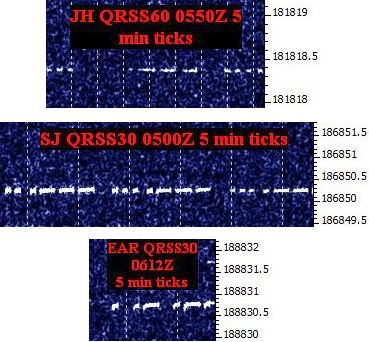
That changed yesterday. See the two attachments, one at QRSS60 and the other at QRSS30, taken at mid-day Sunday.
Over the past two winters, there have been a couple of anomalies observed, the first one starting around an hour after sunrise on the morning of Dec. 6, 2018, and reported in a message here. In addition to my publicly stated goal of trying to capture EAR in every calendar month, I quietly added post-sunrise and pre-sunset observations of EAR to my winter routine this year. There was one instance of the former in late November and a couple instances of the latter (2 to 3 hours pre-sunset) in December.
On Saturday night, the 4th, I started to do a repeat of Friday night's plan: listening to 2200 m WSPR for a while, then seeing if I could spot anything from JH, and if so, follow it all night. When that didn't pan out, I initially figured to go back to 2200 m, but the band was so quiet I decided instead to check up on EAR until morning copy of HiFERs might be expected again.
When I checked back after daybreak, I found such a prolonged post-sunrise event going on at 1750 m that I switched the radio over to a backup battery and left it tuned where it was! For a time after mid-morning, the signal faded briefly but then returned, yielding the reception documented in these attachments. Therefore, I'm currently doing an EAR-only ultramarathon, which will either end around midnight tonight or may go another 24 hours if results are promising and I have the strength to continue.
Only a brief reappearance this morning after the normal pre-sunrise fade, so far. It's not clear what was different (if anything) about yesterday morning. Solar flux and the geomagnetic field were both substantially the same as now. There are a few more thunderstorms off the western coast of Mexico, but not many, and now that they're in daylight they don't seem to be putting any more static into the radio.
More later.
---------------------------------------------------------------
File Attachment 1: 4jand0028.jpg
File Attachment 2: 4janc0032.jpg
Re: 630 M WSPR
Hi John,
Thanks for your thoughts. I was starting to think through the results of the experiment myself, wondering whether the improved S/N was down to adding a "better"transformer, or simply having an additional isolation. Initially, I had considered that the transformer at the antenna end simply did not have enough inductance to work at MF/LF, and was "shorting out" the feedline at these frequencies. However, latter explanation you have expounded upon seems very plausible, and I had begun to think along similar lines. There is at least 50 ft or more of feeder running close to, or is buried in the ground. Shield capacitance, and leakage coupling to ground is likely quite significant.
The performance of the second transformer surprised me. The core is a generic blue epoxy toroid, possibly N30 type material, ~1" diameter wound with just 8 turns each 22 gauge PVC insulated wire on primary and secondary. I have another and can make measurements of the typical inductance of each winding (unloaded of course). From other tinkering, I seem to remember this would be about 100 uH. The coupling efficiency is appreciable as far down as 60 kHz, gauged by a marked reception improvement of WWV. Additionally, the system is quite usable on 22m with or without the transformer.
Best of all, it is interesting to learn something about antenna implementation, and what precautions are important to improve reception. I do remember the June 2018 LOWDOWN article, and will search out my copy and read again. Since reception and setups are very location dependent, it would be great to get observations and experience from other stations. It seems there is more to explore here, and share with LWCA.
Cheers
Ed
Sunday 5th Jan HiFERs
Posted by Ed Holland on January 07, 2020 at 01:00:37.
Hello HF operators,
This weekend provided some reasonable listening conditions here on the West Coast. Saturday looked very promising, but alas, a mistake on my part resulted in no screen capture data to review. This is the perfect compliment to the opposite case, where I discovered that Spectrum Lab had been running unintentionally since the middle of December, creating several thousand useless screenshots. I did note, around 10 am (1800Z) that NC and EH, among others were present.
Yesterday, station PVC's Radio Officer received a stern reprimand and went about the job properly. Alas, conditions did not copoerate. NC was consistent for a while during the pre noon period, EH left a brief trace in one screenshot. What I think was 7 P left an incoherent trace, as did something near 13555.400 kHz, possibly SIW, maybe RY, unidentified. As the day wore on, condiitons deteriorated.
I should also spend time looking at the 13560+ kHz. Perhaps It would be possible to run two instances of Spectrum Lab, and analyse audio from two receivers, one each in the left and right channels? OF course, SDR would be another viable approach to wider monitoring, but I am trying to avoid buying more hardware...
HiFER beacon PVC was restored to the air yesterday evening, and should remain active until the weekend.
Cheers
Ed Re: Sunburnt EARs
Posted by John Davis on January 07, 2020 at 07:47:31.
In reply to Sunburnt EARs posted by John Davis on January 06, 2020
The second 24 hours also had EAR at noon, but only on the QRSS60 trace was it really recognizable. At the 48 hour mark, I paused the ultramarathon (no problem catching lots of solid EARs in the dark) and went back to 2200 m WSPR for the night. Will resume watching 188.830 in the morning for at least a while.
On 2200, there was an immediate flurry of decodes, allegedly including:
2020-01-07 05:40 E5ZJK 0.137433 -24 0 EP76 2 AE0CQ EM27kc 3330 196...although I have no idea what someone presumably from the Cook Islands would be doing operating from the north end of Hudson's Bay at this time of year. We'll see what the remainder of the night brings.
Planning ahead: Tomorrow I want to try for an extended session at 185.3, in hopes of capturing a night of SJ with SIW and WM in the relative quiet that nature has afforded recently. Wednesday may be a bit noisier as the next Pacific systems march inland, so my target will be 630 m that night...as always, assuming my strength holds out. Thursday may be too wet by evening, Friday too stormy, and Saturday too cold to hang out on the farm.
Re: Sunburnt EARs
Posted by John Bruce McCreath on January 07, 2020 at 16:02:17.
In reply to Sunburnt EARs posted by John Davis on January 06, 2020
Hi John....thanks for the marathon session of watching for EAR. There is no doubt that you received it, as shown in the attached Argo snips, as the little excursions in frequency at the start and end of the characters is plainly there!
Thanks & 73, J.B., VE3EAR 2200 m Jan 6-7
Posted by Ed Holland on January 07, 2020 at 16:08:05.
Currently sorting out reception at LF, and I was able to make some significant improvements on 2200m.
Elements included use of the extra feedline transformer. I also discovered that the computer/psu combination creates an ugly system of harmonics right around 136 kHz. Battery operation removers the issue, but wont last long on this old laptop. However, I was able to achieve considerable suppression by decoupling PC chassis to electrical ground, and further major improvement by winding the audio lead from the radio through a ferrite core. The noise level is reduced to a level very similar to running the PC on its battery.
The result was consistent multiple WSPR decodes of WH2XND, N6LF and KJ6MKI. Definitely the best reception achieved on this band.
Cheers
Ed
Re: 2200 m Jan 6-7
Posted by John Davis on January 07, 2020 at 18:10:43.
In reply to 2200 m Jan 6-7 posted by Ed Holland on January 07, 2020
Good work, Ed. Sounds like you're making great progress. WH2XND and N6LF also had great signals here overnight, but I had no decodes of KJ6MKI at all.
I reported on my first flurry of WSPR late last night in my follow-up EAR report. The rest of the night yielded the same eight stations overall, including two more decodes of the mysterious E5ZJK, still purporting to be in the Great White North. I've got to wonder what the explanation is...surely no Cook Islander would overwinter above the Arctic Circle, on purpose?
---------------------------------------------------------------
File Attachment 1: jan6-7_WSPR.gif
Re: 2200 m Jan 6-7
Ed, good work on the success in the noise reduction. When you're near as quiet as on battery operation, you've done quite well. I curious about the decoupling of the pc chassis. Did you accomplish this by using a three prong to two prong adapter? I had noise that came from the monitor with my desktop pc getting into my headphone cord and causing grief. I had to use a ferrite in that audio lead also.
John, E5ZJK may be a software artifact generated by wsjt-x, or the use of software noise blankers. I had them also. Same call kept popping up.
Re: 2200 m Jan 6-7
Posted by Ed Holland on January 07, 2020 at 21:26:08.
In reply to Re: 2200 m Jan 6-7 posted by Tom on January 07, 2020
John,
What I think was going on is that the PC, with only live and neutral connections, is forming an "earthy" RF loop via capacitance to the power connections, and another ground connection through the received. Noise reduced when disconnecting either: a) The laptop PSU, or b), the audio cable between radio and laptop.
The solution comprised two parts.
1)A small HV ceramic disc capacitor connected between ground on the power strip and the laptop chassis (actually the headphone output common return).
2) A hastily configured common mode choke on the audio cable - about 5 turns through a toroid core - as many passes as could be wound, before the the 3.5 mm plug would not pass through the aperture.
No calculations were involved a this stage - I was actually heading off to bed, and returned to the radio desk to see what was coming in when it struck me to try a few more random things, having isolated the power supply as the main problem earlier in the evening. Another pass with a better technical spec. might see further gains, and a neater implementation.
Cheers,
Ed
Wassup, SJ?
Posted by John Davis on January 08, 2020 at 07:09:36.
A 1750 m watering hole capture from Garry K3SIW inspired me to try to take a similar family portrait with SJ, WM, and SIW present as much of the night as possible on Tuesday night. But once again this winter, my noble plan was thwarted. SJ appeared at 7:42 PM CST, gradually settled down ...and then took a dive just before 9:25 PM. Kinda sad, because (even taking normal fades into account), everybody seemed to have pretty decent signals and noise was not bad despite storms off the Atlantic coast.
The attachments include Garry's capture before sunrise Tuesday, plus two versions of my Tuesday evening Argo shots, one at QRSS30 and one at 60 second speed.
---------------------------------------------------------------
File Attachment 1: capt_k3siw_7jan.jpg
File Attachment 2: 7jand-30.jpg
File Attachment 3: 7janc-60.jpg
Re: Wassup, SJ?
That's interesting frequency drift you observed John. I usually see some here too, but not that much. My screen capture was unusual in that SJ was quite steady in it for at least an hour.
73, Garry, K3SIW, EN52ta, Elgin, IL
Re: Wassup, SJ?
Posted by John Davis on January 08, 2020 at 19:08:56.
In reply to Re: Wassup, SJ? posted by Garry, K3SIW on January 08, 2020
I usually see some drift in the first hour after it's switched on, then it's normally steadier. It showed up again later last night, but continued wandering significantly right up until the last capture, about an hour before daybreak.
I'll try to stitch the shots together in scrollable form later, but it won't be pretty. (Still, it'll be better than the last time I tried, when it apparently wasn't on at all that night. Too bad, because both WM and SIW were great that night too.)
Re: Wassup, SJ?
Posted by Sal,K1RGO on January 09, 2020 at 02:17:21.
In reply to Wassup, SJ? posted by John Davis on January 08, 2020
It looks like that 60+ yr old xtal is on its way out. I found it to stop oscillating when I was about to shut it off for the day.I will run SJ now on 186.85 kHz since that should be more reliable and stable, so QSY to that frequency tonight and for the season.....sorry about that.... you probably lost SJ because of that. Noise studies for LF receiving & Decoding
later..........Sal,K1RGO
Posted by Ed Holland on January 09, 2020 at 05:43:46.
Hi Folks,
Following on from the noise control measures mentioned in the other discussion, here is a little more systematic observation of the various measures.
First of all, here's a Spectrum Lab view of the situation with the receiver connected directly to the feeder from the antenna, and the computer plugged in to the supply. As can be seen, harmonics abound. Although they are not strong enough to move the S-meter, they swamp even the stronger WSPR signals, and I suspect cause some AGC action.
(Edit: Aforementioned capture is one of the links in the next post.)
Re: Noise studies for LF receiving & Decoding
Posted by Ed Holland on January 09, 2020 at 05:47:41.
In reply to Noise studies for LF receiving & Decoding posted by Ed Holland on January 09, 2020
Now, that noise is mostly a result of the laptop power supply. It only appears if the antenna is connected (ground loop?) and most noise diminishes if the computer is disconnected from the PSU - see the attached spectrum. Note that some harmonic type QRN remains, albeit much reduced. This would all be well, if the computer would run forever on its batteries...
- - - - -
Alas, it seems I hit the wrong buttons uploading files, and failed. Here we go:
1) The basic noise situation, with no measures applied at the receive end of the feed, or to address laptop power supply noise
2) The noise running the basic setup, laptop on batteries
---------------------------------------------------------------
File Attachment 1: PSU_Unchoked_cable_Antdirect.jpg
File Attachment 2: Batt_unchoked_Cable_Ant.jpg
Re: Noise studies for LF receiving & Decoding
Adding the 1:1 toroidal transformer to the antenna feed line at the receiver, plus a common mode choke (cable wound through a toroid core, (~80 uH common mode inductance) on the audio cable AND decoupling the PC chassis to AC ground gives us the best of all worlds. Note that all three measures are necessary for best results. Although the audio cable choke and chassis decoupling help immensely, there is still some noise, possibly not from the PC, that is removed by addition of the feedline transformer. A comparison (with and without the feedline transformer is attached to this post:
Here is reception at 136 kHz, with all measures implemented
1) Feedline transformer, choke on audio cable, PC chassis decoupled. PC running on AC power.
2) With no feedline transformer, just choke and decouple of the laptop, some QRN lines appear
---------------------------------------------------------------
File Attachment 1: PSU_Choke_transformer_PCchassis.jpg
File Attachment 2: PSU_Choke_Notransformer_PCchassis.jpg
Re: Noise studies for LF receiving & Decoding
Lastly, here is the improvement this effort brings at 60 kHz, in reception of WWV.
Part way through the capture, the PC chassis decoupling was disconnected, to demonstrate the improvement gained.
---------------------------------------------------------------
File Attachment 1: 60kHz_chassis_decouple_on_off.jpg
Re: Wassup, SJ?

The new crystal seems stable...lots more than the wavy PLC QRM lines trying to engulf it. Do you think the crystal could be pulled up maybe half a Hz?
I'll miss SJ at the watering hole, but I can relate; like the old crystal, I've gotten less steady myself in the years since turning 60+.
(Times in the capture are CST, and 800 is 186.850 kHz.)
---------------------------------------------------------------
File Attachment 1: 8janc10.jpg
The Watering Hole Gang's (Mostly) All Here!
No particular cause is evident, but the IL > KS path opened on Wednesday afternoon, and remained until after even the northeast pipeline stations faded at sunset. At one point or another, I had copy of NC, XIL, 7P, EH, SIW slant, SIW WSPR, RY, K5LVB, MTI and WM gathered 'round 13555.400 kHz. Late in the afternoon I finally got snippets of WV, which had been missing for a few days. No sign of AZ this time, but NDB2 was booming in occasionally. I'll try to post a sound clip Thursday evening.
In the top end of the band, K6FRC, AMA, and ODX turned up at one time or another, but no WAS at any of the times I did band scans.
Re: Wassup, SJ?
Posted by Sal,K1RGO on January 10, 2020 at 00:23:09.
In reply to Re: Wassup, SJ? posted by John Davis on January 09, 2020
Hi John, I moved SJ up ~.7 Hz higher. This xtal is in a different circuit it's a divide by 64 (~11.958MHz) whereas the other was a divide by 2 (~370 kHz the only resource to get in the watering hole) Re: Wassup, SJ?
later....Sal
Posted by John Davis on January 10, 2020 at 06:47:16.
In reply to Re: Wassup, SJ? posted by Sal,K1RGO on January 10, 2020
Thanks for that news, Sal. It'll probably be early next week before I can try listening again. We've got wind and rain in the field tonight... severe thunderstorms tomorrow... and a winter storm forecast for Saturday. Think I'm gonna stay indoors for a while.
John
Re: The Watering Hole Gang's (Mostly) All Here!
Posted by John Davis on January 10, 2020 at 07:39:16.
In reply to The Watering Hole Gang's (Mostly) All Here! posted by John Davis on January 09, 2020
Here's the clip of NDB2 I mentioned Wednesday, made at 5:20 PM CST. I was tuning for AZ, a hundred-some Hz higher, and heard this shockingly loud signal instead. In the clip, you can hear me turn down the audio gain after the first ident completes. The other level changes were QSB. After the third instance is an unwanted visit from the "Chinese measles" pulser.
---------------------------------------------------------------
File Attachment 1: 8jan_ndb2.mp3
Thur. HiFERs: Return of PLM
The mysterious PLM returned on 13557.750 at 12:58 PM CST Thursday. It caught my ear as I was tuning upward to listen for TON (which I didn't hear until later in the afternoon) when suddenly there was PLM's slow ID, surrounded by a steady carrier and a couple of different random chirpers. In the attached clip, it sounds quite ragged from codar as well. In reality, the signal sounded quite nice on the radio's speaker. I wish the operator would step forward and take credit.
As the afternoon progressed, there was a partial opening to Illinois, albeit much less dramatic than Wednesday. And, two of the new HiFERs made their way to SE Kansas! I'll report on that and include clips Friday morning.
John
---------------------------------------------------------------
File Attachment 1: 9jan_PLM.mp3
Re: 630 M WSPR
The band was lively Wed. night into Thur. morning, as the 5 night/6 day multiband ultramarathon wound down because of deteriorating weather. Thirty unique call signs, most familiar but a goodly number of new ones too, yielded nearly 400 decodes...and that's with an extended interruption around midnight to track down SJ's new frequency on 1750 m.
Only one appearance of VK4YB, just prior to local sunrise, but at a decent SNR (-24) for that one spot, for the longest DX of the night. Second longest was GØMRF, who showed up eight times. K9FD was a close third.
---------------------------------------------------------------
File Attachment 1: 9jan630wspr.gif
Reminder: Lowfer net +/- 3927Khz Saturday morning 0800 California time
Reminder: Lowfer net +/- 3927Khz Saturday morning 0800 California time Re: Wassup, SJ?
Or listen online at kfs:
http://69.27.184.62:8901/?tune=3927lsb
orKPH Point Reyes:
http://198.40.45.23:8073/
or
Utah Web sdr:
http://www.sdrutah.org/websdr1.htmlIf you cannot get into the net on 80 meters you can listen on KFS and participate by sending net control your thoughts t wa6owr@gmail.com73,
Jerry WA6OWR
Posted by Sal,K1RGO on January 10, 2020 at 21:26:29.
In reply to Re: Wassup, SJ? posted by John Davis on January 10, 2020
Ok John, hope SJ cuts through the plc's Re: Thur. HiFERs: New Beacons AN2 & ABBY
later........Sal
Posted by John Davis on January 10, 2020 at 21:44:51.
In reply to Thur. HiFERs: Return of PLM posted by John Davis on January 10, 2020
Thursday's propagation was not great but still tantalizing, with two of the newer beacons finally making it here to SE Kansas.
The day started off kind of slowly in the 9 AM hour CST, with NC, sometimes XIL (meaning, frequent gaps of three to 15 seconds in the FSK trace, which now exhibits a Δf only a little greater than 1 Hz), sometimes 7P, EH and RY the only ones present below mid-band. Above the center, VAN's DAID, FRC, WAS and ODX were visible as keyed RF, but not yet audible.
Late in the noon hour, WV was now audible with fair to good signals. I started hearing PLM (earlier post) as early as 12:54 PM, then recorded it a few minutes later. After that, I was able to see TON, but not hear it until after 1 o'clock. It was accompanied by strong but random CW-like keying about 50 Hz below TON.
Next, right after 1:04, I tuned up to the top half, and that's when I ran across faint CW keying. With the help of Argo, I tuned it in better and found it to be at 13564.050 kHz. Initially, it was just an "N" here, a "2" there, but after about two minutes I started getting the complete AN2 identifier! Before I could get set up to record, though, a narrow band of white noise started wandering through the vicinity and obliterated the beacon. By 1:09 the QRM ended, but AN2 was weak and had drifted down to 13564.040, so I had to wait to record..
K6FRC was fair copy by then. AMA, WAS, and ODX were all rapidly varying between nil to good or very good copy, sometimes within the timing of a single character. Another narrow band of wandering white noise was afflicting WAS.
Tuning right up to the band edge, I heard more keying, which turned out to be ABBY, just outside the band at 13567.060 kHz. (I'll bet a couple more pF of capacitance across the crystal, perhaps something as simple as a small gimmick capacitor, would take care of that.) The signal was fairly strong at first, but settled somewhat back into the noise before I got the recording going, and didn't increase again during the available time. There are four repeats of the ID in the attached clip. The first is kind of hard to hear until the "Y." The second is much clearer. By then, your ear should be in good enough sync to hear the third one OK too; but to my ear the fourth one fades away by the second "B."
In early mid-afternoon, the IL > KS path opened up a little bit. SIW slant began appearing intermittently and SIW WSPR began leaving RF smudges on Argo every other two-minute time slot. (WM showed up for a couple of minutes, but didn't hang around. MTI began putting in an occasional appearance, but no K5LVB this time.) Two of the WSPRs actually decoded:
1956  -28  -1.2   13.555406    0   K3SIW         EN52      7
2032  -28  -1.0   13.555408    0   K3SIW         EN52      7
Codar got significantly worse as the afternoon wore on, but WV was now fair to very good, and even AZ was faintly audible. At 2:52 PM I got another chance at AN2 (clip attached). Only part of the "2" is clear in the first ident. The second instance at 6 seconds in is the best one. Note: Some readers may have to right-click and download the an2.mp3 file first to get it to play correctly.
John
---------------------------------------------------------------
File Attachment 1: abby.mp3
File Attachment 2: an2.mp3
Re: Thur. HiFERs: New Beacons AN2 & ABBY
Hello John,
I appreciate the reception report. Quite shocked it landed on someone’s antenna. I recently was able to lift end fed half wave 20m vertical antenna up a tree branch. The center sits about 30-25ft. Antenna height plays key role getting signal out with such low power. I will add a cap to pull her down below 13.567 when I get back in town.
Thanks again! Amazing!
WSPRing 30 Hz below RY?
Posted by WA1EDJ Bob on January 11, 2020 at 18:39:15.
I'm seeing some WSPR about 30 Hz BELOW RY. I see no one on the list there but SIW is close but above slightly. I THINK my rx tuning direction is correct. Got to get WSPR going and decode. SIW is about the only one I see WSPRing here in EM83du.
Re: WSPRing 30 Hz below RY?
Posted by John Davis on January 11, 2020 at 20:09:53.
In reply to WSPRing 30 Hz below RY? posted by WA1EDJ Bob on January 11, 2020
That would be K5LVB, which tends to drift a bit and was at 13555.365 when I decoded it on Wednesday of this week. His ID cycle is two minutes of "LVB" in QRSS3, followed by the WSPR2, then two minutes off.
(The last time I copied LVB in September, he was right on top of RY's spot, which is why it's shown there in the current list. I'm working on the columns for The LOWDOWN deadline today, though, so the list will be updated later this weekend.)
Re: WSPRing 30 Hz below RY?
Posted by WA1EDJ Bob on January 12, 2020 at 13:49:53.
In reply to Re: WSPRing 30 Hz below RY? posted by John Davis on January 11, 2020
Thanks John!
I do think I saw alternating QRSS and WSPR. That's probably LVB. I'll get WSPR going and see if I can decode. Sometimes it's a chore to get it back going since I don't use it regularly.
Bob More on Europe 1 closing
EDJ
Posted by Brock Whaley on January 12, 2020 at 16:58:41.
Europe 1 on 183 KHz is gone. We lose another one. It had been on reduced power for a few years since loosing one of their directional antenna masts. At one time, they ran 2,000 kw directional towards France. I remember how distorted and out of phase the sounded in Germany during visits there. The tight null was very evident. They had a huge signal when I lived in Ireland, and I heard them a few times here on the east coast of N.A. They always operated on a “split frequency” to avoid interfering with then East Germany also on a “split” frequency and the ITU designated frequency of 180 KHz, used by Sweden and Turkey at one point. Even before the long wave re-alignment that sent the assigned long wave frequencies 2 KHz lower (i.e. BBC Radio 4 from 200 KHz to 198 KHz), Europe 1 was always on a “split.”
Brock Whaley
Aiken, SC
https://www.lalettre.pro/Europe-1-coupe-son-emetteur-Grandes-Ondes_a21453.html
BACKGROUND
GERMANY / FRANCE
183 kHz LW ceased at 2229 UTC and transmitter was noted ff by 2300 UTC.
James Robinson (1/1-2020)
BACKGROUND
GERMANY / FRANCE
Europe 1 is closing down it's LW 183 kHz Felsberg at midnight between 2019 and 2020.
Voici cette boucle d'émail pour vous informé que Europe 1 annonce l'arrêt des Grandes Ondes se soir 00h00 via la presse!
https://www.lalettre.pro/Europe-1-coupe-son-emetteur-Grandes-Ondes_a21453.html
Gaétan Teyssonneau (31/12-2019)
BACKGROUND
GERMANY / FRANCE
A bad confirmation Europe 1 will leave LW on 183 kHz, the transmitter will be close.
Here is the message received today (in 3 languages) from Lagardére News (the owner of Europe 1). So onlys some days to get the nice QSL from Europe to Eugène Muller Eugene_Muller@bce.lu
"Dear Sir. As listening habits are changing and the use of digital media is increasing, Europe 1 will no longer broadcast on the long wave from midnight on December 31, 2019. A choice assumed by the station which has always shown innovation in its way of thinking and conceiving the listening of its programs. The environmental approach also motivated this decision. Leaving the big waves is also protecting the environment. Happy holidays to you.
Constance BENQUÉ, Managing Director Lagardère News, (Europe 1 / Paris Match / JDD) CEO ELLE Internationals
Christian Ghibaudo (23/12-2019)
BACKGROUND
GERMANY / FRANCE
As listening habits are changing and the use of digital media is increasing, Europe 1 will no longer broadcast on the long wave from midnight on December 31, 2019.
A choice assumed by the station which has always shown innovation in its way of thinking and conceiving the listening of its programs. The environmental approach also motivated this decision. Leaving the big waves is also protecting the environment. Happy holidays to you.
Constance BENQUÉ, Managing Director Lagardère News, (Europe 1 / Paris Match / JDD) CEO ELLE Internationals via Gaétan Teyssonneau (23/12-2019)
WSPR decoding
Posted by WA1EDJ Bob on January 12, 2020 at 18:19:49.
I need some clairification on WSPR decoding.
Is the RX audio decoder centered on 1500 Hz for WSPR,+/- 100 Hz?
So in need about a 1500 Hz audio sig going into the sound card to get a decode?
Not getting decodes, clock is good +/- 1 Sec.
TNX Re: WSPR decoding
EDJ
Posted by John Davis on January 12, 2020 at 20:50:52.
In reply to WSPR decoding posted by WA1EDJ Bob on January 12, 2020
That's correct, Bob. The decoder defaults to a 1500 Hz "BFO" setting unless you choose something else. The receiver is then typically put into USB mode and the "dial" frequency is set 1500 Hz below the center of the target band. For centering on 13.555400, you would tune to 13.553900. For 2200 meters signals centered around 0.137500, you would tune to 0.136000; and so on.
Give that a try first before going on to the additional complication I'll suggest below.
Unfortunately, I don't like wasting my radio's dynamic range by passing 2 kHz or more of bandwidth for signals that are all confined to ± 100 Hz of that range, especially when I'm also continually alternating between digital and CW aural reception anyway, so I complicate things for myself a bit. My radios are all set for 800 Hz BFO offset in CW mode when the dial is displaying signal frequency. In CW mode I tune to 13.555400, the intended reception frequency. Then I have to sorta lie to Argo and tell it my "dial" frequency is 13.5554600 and tell it my BFO setting is 800 Hz. Then it'll decode correctly around a center frequency of 800 Hz and the dial+BFO frequency will display the correct RF frequency.
John
Re: WSPR decoding
Posted by WA1EDJ Bob on January 12, 2020 at 23:33:47.
In reply to Re: WSPR decoding posted by John Davis on January 12, 2020
Ok,Thanks John.
I confirmed what you said. I took Argo, a sig gen set to 555,400, and moved my rx, set to USB, to see that freq at 1500 Hz on Argo.
Sure enough, the carrier showed up dead center of the WSPR 200 Hz window. Since I don't do this every day, I'm a little slow getting things set right. Just too many little gotchas sometimes.
So, I'll leave the rx going tomorrow and look for any decodes when I get home.
Thanks for the help!
Bob Re: Lowfer net +/- 3927Khz Saturday morning
EDJ
Posted by John Davis on January 13, 2020 at 07:46:54.
In reply to Reminder: Lowfer net +/- 3927Khz Saturday morning 0800 California time posted by Jerry Parker on January 10, 2020
An MP3 clip this week. Participants were WD4PLI, KI6R, AEØCQ via the net, and WA6OWR, net control.
websdr_2020-01-11_3927kHz.mp3
Lowfer JH
Posted by John Hamer on January 13, 2020 at 15:36:27.
I have made a few changes to the station over the past few days.
1. The loading coil is now vertical and about a foot off the ground.
2. The low pass filter has been removed and bypassed.
3. I have changed the input voltage from 12 to 24v (1 to 2 batteries)
Before I was trying to get 50ohms on the output of the transmitter because of the low-pass filter. Now that it has been removed, the antenna impedance does not matter. So, I am no longer doing impedance matching through taps on the loading coil.
Last time I checked the impedance of the antenna, it was ~220ohms. Now, with the changes, it is ~150ohms. So, something I have done seems to have made a difference.
With the 24v input, I can get a watt to the final without impedance matching.
My sdr play suggests the signal in my house, 100 yards from the transmitter, is 4db higher. I can't imagine that is accurate in any way, but it does suggest improvement.
Black cat reluctant to turn on ?
Posted by Vic on January 14, 2020 at 17:02:00.
Just back in Florida and getting set up to put my beacon JUN on air again.
My Black Cat kit worked well last year and I have high hopes for a repeat this time round.
However I have one annoying issue in that the oscillator does not fire up when power is applied. If I touch the xtal can with my finger it starts up and goes on just fine until power is turned off. I have tried adding some caps as described in the instructions but cannot seem to get it to start uo by itself.
Anyone else had this problem and any suggestions for a possible cure ?
I should mention that when first built the oscillator would not start at all until I added some extra capacitors as described in the kit instructions, but now it just needs that little extra opush to get going (rathjer like me in the morning)
73 Vic W4/GW4JUN
Re: Black cat reluctant to turn on ?
Posted by John Davis on January 14, 2020 at 17:31:16.
In reply to Black cat reluctant to turn on ? posted by Vic on January 14, 2020
Welcome back, Vic. Yes, Black Cat slightly oversimplified the Pierce oscillator, and that results in the oscillator being reluctant to start for some users. Here's a post that might help:
https://lwca.net/mbarchiv/msg0918.htm#8309
Re: Black cat reluctant to turn on ?
Posted by Vic on January 14, 2020 at 19:35:58.
In reply to Re: Black cat reluctant to turn on ? posted by John Davis on January 14, 2020
Hi John !
Thanks for that. Looks like an easy mod. I have almost no components here so will try to hunt out the 1- 4.7 Meg resistor tomorrow. Maybe find a junk transistor radio in a goodwill store or something. I do have a 1k so I can do that aswell.
Good to be back in the warm weather! i shall be using some new antennas this season so should be interesting how they compare with last years efforts. Re: Lowfer JH
73 Vic W4/GW4JUN
Posted by John Davis on January 15, 2020 at 07:57:29.
In reply to Lowfer JH posted by John Hamer on January 13, 2020
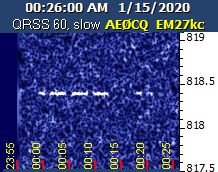
Wow, big improvement! Far better signal than the first time on the night of Dec. 18-19, even with the fade that hit in the middle of the H. (It lasted 10 or so minutes, and was recovering at the start of the next J. We'll see by morning whether the ionosphere cooperates a little better in the wee hours.)
Wish I could have started earlier in the evening, but it wasn't clear for a while whether the thunderstorms in the Deep South were going to ease up enough. Eventually, the Blitzortung strike count numbers got down to a similar level as before. At its best so far since midnight CST, during the first J, the signal-to-noise ration was up to 10 dB better than the December reception!
John
---------------------------------------------------------------
File Attachment 1: 15janJH1.jpg
Re: Lowfer JH
I also happened to look for lowfer JH and found it coming through fine, as were lowfers SJ and EAR. In the dead of night WM was in there at the watering hole with local SIW but this morning I see no sign of WM so something isn't right. Screen captures are at http://mailman.qth.net/pipermail/lowfer/2020-January/date.html (below).
73, Garry, K3SIW, EN52ta, Elgin, IL
Re: Lowfer JH
Posted by Mike N8OOU on January 15, 2020 at 14:23:38.
In reply to Re: Lowfer JH posted by John Davis on January 15, 2020
After reading this report early this morning I shut down WM to listen for the JH beacon. I captured this partial ID just before daybreak. It's good to see another Lowfer signal.
http://n8oou.meekfarm.us/ArgoCaptures/JHbeaconJan152020.jpg
Garry, I'll bring WM back up in a couple minutes.
Mike 73
Re: Lowfer JH
Posted by John Hamer on January 15, 2020 at 19:07:39.
In reply to Re: Lowfer JH posted by Mike N8OOU on January 15, 2020
Great News! It sounds like the changes have made a difference. Thank you for the suggestions and taking a look. I will work on building my new higher Q loading coil now.
Re: Black cat reluctant to turn on ?
Posted by Chris kc3gfz on January 16, 2020 at 13:20:25.
In reply to Re: Black cat reluctant to turn on ? posted by Vic on January 14, 2020
Interesting topic. I have the same issue. Thought it was maybe due to cold winter temps. Would this fix help the beacon restart when using solar power ? Mine would never restart without covering the solar cell next day after sun up. Re: Black cat reluctant to turn on ?
Posted by John Davis on January 16, 2020 at 18:41:30.
In reply to Re: Black cat reluctant to turn on ? posted by Chris kc3gfz on January 16, 2020
Would this fix help the beacon restart when using solar power?
Very likely.
Consider the state of the oscillator gate inputs after the darkness of night. If the only power is the solar panel, the oscillator gate inputs will be low to start with, so in the initial state, the exact instant power is applied, the output of the gate will be high by default. But remember: twilight, dawn, and sunrise are relatively slow processes, so the power is being applied very gradually. If there's no static electricity, and if the circuit board is dry enough that there's no leakage current from other parts of the circuit, then there's no reason for the input voltage to rise high enough to ever change the state of the inverting gate. (Ironically, the better your construction skills and the tighter your enclosure, the more likely this is.) The oscillator section may remain with its input low and output high indefinitely.
It takes at least one abrupt change of the gate's output state to start the oscillation. That first transition shocks the resonant circuit formed by crystal and associated capacitors, which in turn causes the next (and subsequent) inverting gate transitions, and so a sustained oscillation ensues.
When you cover and uncover the solar panel, that action is apparently just abrupt enough to couple a small amount of charge through the capacitor network to the oscillator input, allowing the startup transition to take place. Vic achieves the same result by touching the crystal, which causes the first gate transition either by static electricity or by piezoelectricity from mechanical vibration of the crystal. Bill Stewart breathes on the crystal at HiFER WAS, which provides a very thin condensation leakage path for charge from the gate output back to the input, in order to force a transition.
The 1 M to 4.7 M resistor is the circuitry counterpart to Bill's method. If the gate output began in the high state, the leakage through the resistor will charge up the input capacitance enough to trigger the transition to low, and we're off to the races. Or, if the output started out low for some reason, the resistor will soon discharge the gate input and cause the output to switch high, and away we go. For CMOS logic and crystals of unknown activity, 2.2 M or higher may be a good starting point, but I don't think it's too critical in most cases.
The 1 K resistor provides some isolation for stability. Some folks prefer 2.2 K on the grounds that the crystal and its associated capacitors form a higher-Q LC circuit that way. A few go as high as 4.7 K, but at some point you attenuate the feedback significantly, and a crystal plagued with low activity may become reluctant to start or sustain oscillation once again. You might have to play with that resistor a little.
Best of luck!
Re: Black cat reluctant to turn on ?
Posted by Vic on January 16, 2020 at 23:21:44.
In reply to Re: Black cat reluctant to turn on ? posted by John Davis on January 16, 2020
Very interesting explanation of the non start feature !
I managed to pluck a 120k resistor out of an old sat TV box yesterday and tried this on my Cat just in case it might work - even though it is nowhere near the recommended 1M - 4.7M range. Well, to my surprise, it did work. I have tested start up repeatedly and it fires up every time. I will continue with the second mod in the article when I have a few moments . But for now the first mod is working fine and appears non critical in terms of resistor value. Thanks again Amount for the link to that previous post.
I also added a switch to add a continuous tone fortune up purposes. I just used a small hobby knife to break the PCB trace from the microprocessor to the cmos chip and added a switch between the two.
Tomorrow I start work on a new antenna. Thinking of a 20 m dipole at about 33 feet up. I think this should work reasonably well on 13.5 MHz.
73. Vic. W4/GW4JUN
Re: Black cat reluctant to turn on ?
Posted by John Davis on January 17, 2020 at 06:58:27.
In reply to Re: Black cat reluctant to turn on ? posted by Vic on January 16, 2020
Before you start work on a new antenna, Vic, what have you been using until now?
While 33 feet is a good elevation for an antenna in this band, the directionality of a dipole is a mixed blessing at best.
Congratulations on your results with the resistor. I'm a little surprised that so low a value worked, but it's hard to argue with success. :)
Reminder: Lowfer net +/- 3927Khz Saturday morning 0800 California time
Posted by Jerry Parker on January 17, 2020 at 14:39:38.
Reminder: Lowfer net +/- 3927Khz Saturday morning 0800 California time
Or listen online at kfs:
http://69.27.184.62:8901/?tune=3927lsb
or
KPH Point Reyes:
http://198.40.45.23:8073/
or
Utah Web sdr:
http://www.sdrutah.org/websdr1.html
If you cannot get into the net on 80 meters you can listen on KFS and participate by sending net control your thoughts to wa6owr@gmail.com
73,
Jerry WA6OWR
Re: Black cat reluctant to turn on ?
Posted by KMONAS on January 17, 2020 at 17:07:32.
In reply to Re: Black cat reluctant to turn on ? posted by John Davis on January 14, 2020
Great advice. I was having the same problem. I will try the recommended resistor as well
Beacon MN Frequency Change
Posted by KM0NAS on January 17, 2020 at 17:42:16.
Hello All,
Small update to the frequency of MN. It was previously on 13.562.8. I just added a 1M resistor to c4 as discussed in the previous post and it worked like a charm. It now starts up every time with no fiddling around. It has caused a small frequency change though. The beacon is now on 13.652.68. This should be a good change as it will keep it a little further from AN as well.
Thanks,
~KMONAS
Beacon ABBY frequency change
Posted by Chris on January 17, 2020 at 22:29:06.
Frequency change from 13.567.60 to about 13.566.9 +-~~ to remain Part 15 Compliant. My thanks again to John for the "Gimmick" Capacitor trick. I was able to bring frequency down using two twisted insulated wires after doing some research. Well how much if any frequency drift due to outside temperatures.
Re: Lowfer JH
Posted by John Hamer on January 18, 2020 at 18:22:29.
In reply to Re: Lowfer JH posted by John Hamer on January 15, 2020
I am going snowboarding in Colorado next week, so I'm going to cut Lowfer JH off this afternoon. I will restart it when I get back on the 26th or 27th.
Re: Black cat reluctant to turn on ?
Posted by Vic on January 19, 2020 at 01:28:04.
In reply to Re: Black cat reluctant to turn on ? posted by John Davis on January 17, 2020
Hi John
Yes I am surprised that the resistor has worked so well.....but success is so sweet ;-)
Regarding the antenna, well last year I used an 88 foot long doublet in inverted V arrangement. Height was about 28 at the centre and only about 18 ft at the ends. It was a makeshift arrangement. It worked but was not impressive. The low height and Inv V gave a high angle of radiation and a lot of solar noise on rx. A temporary increase in the end heights as an extra pediment made a noticeable reduction in solar noise and I think in ex signal strengths on rx at least.
This year I need decent antenna for 20m for a regular sked with K5WLT in San Antonio, as well as something for my 22m beacon. Hence the idea of a 20m dipole co ax fed. I have one long length of low loss co ax with me. Then I am thinking of putting the old doublet back up but with more height at the ends . That would give me coverage of several ham bands....I might change the open wire feeder to TV 450 ohm ladderline because it is less conspicuous. We are in an HOA community here so I need to be careful that any antenna should not be too high or too vulgar in appearance heheheh.
I realise that for a 22m beacon a! vertical would be a better choice and I would like to try one. I have a small yard with houses close by and trees at the rear. Radials are tricky due to layout so I can't get them out in all directions...Also we have a contractor who cuts the lawn all round the property each week so I would need to remove the radials every week to avoid damage. Burying radials is for the most part not an option. I had thought of attempting. 5/8 wave vertical which are less critical radial wise . I might just be able to get a vertical wire up at the rear of the yard and could get a couple of radials running under the hedge. If not I could try a quarter wave vertical but the hedge would be in the way so the vertical element would really need to be fed about 8 ft above the ground, but radials
would be running down through the hedge ....a bit messy.
Finally I don't have much in the way of matching components. I have some bit's of wire but no capacitors. ( Orlando hamfest is in February though and it is very nearby!!)
So that's my challenge. What do you think? Any ideas or suggestions in appreciated ;-)
73 Vic W4/GW4JUN
Re: WSPR decoding
Posted by WA1EDJ Bob on January 19, 2020 at 13:58:44.
In reply to Re: WSPR decoding posted by WA1EDJ Bob on January 12, 2020
Finally after a week, I got the every thing going.
K3SIW decoded @ 1512 EST on 1/18 in EM83du. Will be looking for more decodes in days to come.
Using 130' long wire favoring NE/SW. GP is too noisy lately.
Bob Re: Lowfer net +/- 3927Khz Saturday morning
EDJ
Posted by Clint Turner KA7OEI on January 20, 2020 at 20:27:26.
In reply to Reminder: Lowfer net +/- 3927Khz Saturday morning 0800 California time posted by Jerry Parker on January 17, 2020
Notes on 18 January, 2020 LowFER net:
Jerry, WA6OWR; Dave, WD4PLI; John, AE0CQ; Ed, KI6R; Clint, KA7OEI
73,
Clint 22A beacon operational
KA7OEI
Posted by Ralph KD8GBK on January 23, 2020 at 04:14:13.
22A 5wpm CW beacon on 185.1kc operational as of 0400z 23 Jan 2020. Transmitting from EN56st in the Upper peninsula of Michigan. T vertical antenna, variometer, homebrew transmitter with 12v battery power. 73
LowFER SJ
Posted by Garry K3SIW on January 23, 2020 at 19:53:59.

Good copy here over night (Jan 21-22) of Lowfer SJ sending QRSS30.
--
73, Garry, K3SIW, EN52ta, Elgin, IL
---------------------------------------------------------------
File Attachment 1: capt_sdr-iq2_eprobe2_0001_crop.jpg
WSPR spots
Parked WSPR on the watering hole and spotting K3SIW and K5LVB daily in late afternoon
in EM83du ( N GA ). Ground plane ant.
EH and RY daily in afternoons, in and out.
Bob Re: WSPR spots
EDJ
Posted by Ed Holland on January 24, 2020 at 17:25:21.
In reply to WSPR spots posted by WA1EDJ Bob on January 24, 2020
I'll have to try WSPR on 22 m again, SIW makes it to our part of California quite often, EH has been notable of late.
Ed
PVC
Reminder: Lowfer net +/- 3927Khz Saturday morning 0800 California time
Posted by Jerry Parker on January 24, 2020 at 18:21:50.
Reminder: Lowfer net +/- 3927Khz Saturday morning 0800 California time Re: WSPR spots
Or listen online at kfs:
http://69.27.184.62:8901/?tune=3927lsb
or
KPH Point Reyes:
http://198.40.45.23:8073/
or
Utah Web sdr:
http://www.sdrutah.org/websdr1.html If you cannot get into the net on 80 meters you can listen on KFS and participate by sending net control your thoughts to wa6owr@gmail.com
73,
Jerry WA6OWR
Posted by Garry, K3SIW on January 24, 2020 at 21:46:39.
In reply to Re: WSPR spots posted by Ed Holland on January 24, 2020
Thanks for the reports Bob and Ed. So far the wspr hifer and slash code hifer have stayed up. Hope they do as well through the rest of winter.
73, Garry, K3SIW, EN52ta, Elgin, IL
Recent upgrades at WA5DJJ grabber
Posted by Mike N8OOU on January 25, 2020 at 04:27:53.
All;
I just received an email from Dave Hassall WA5DJJ that he has completed an upgrade to the 22m grabber hardware in his Super Grabber. Dave has very significantly reduced interference which has been visible in his captures. I took a look this evening and the improvement is quite impressive. Dave says there are a couple more changes coming in the near future.
While the Super Grabber initially covered the Amateur bands, he added the 22m HiFer band about a year ago.
QRSS SUPER GRABBER WEBSITE: www.qsl.net/wa5djj
I am not associated with the site, Just a happy user. As this is a 24/7 grabber, I have seen just about every QRSS HiFer beacon captured there while I watch for WM.
.
Mike N8OOU 73
Sunday HiFERs 1/26
Posted by John Davis on January 26, 2020 at 18:04:44.
Not an auspicious start to the day, plus QRM from Havana. Only the two northeast pipeline stations, EH and RY, were visible at the watering hole in the 9 AM CST hour... no NC, no 7P, no WV, no AZ. There was an intermittently buzzy/growly bit of QRM, which got abruptly worse when I tuned above the watering hole and totally swamped out all mid-band noise sources. Switching to AM mode, I caught very distorted music with lots of tones mixed in, and an ID for Radio Havana Cuba. Reminded me a lot of the old Soviet jammers that used heavily clipped audio from a domestic program feed, though I can't imagine what Cuba wanted to jam on 13,560 except maybe all the Walmart RFID readers in the eastern half of the US. (Ironically, the audio was slightly less distorted in FM mode.) No sign of K6FRC or anyone else above mid-band at that time. Am on my way back to the farm to see what the noon hour may bring.
Re: Sunday HiFERs - JUN in January?
Posted by John Davis on January 26, 2020 at 21:42:45.
In reply to Sunday HiFERs 1/26 posted by John Davis on January 26, 2020
Noontime brought being stuck in the mud for two hours, but also JUN apparently. (I did try to keep my priorities straight and deal with monitoring before shoveling two wheelbarrow loads of rock to put under the car wheels. I'm glad the necessary supplies were already on the farm, but I'm going to be sore tomorrow.) EH and RY had been joined by NC and 7P at times, and Havana was gone, but TON was visible only, not quite audible, and there were still no signs of WV or AZ.
Above band center, FRC was visible and faintly audible. Still no sign of MN at its new spot, and no VAN, WAS, AMA, or ODX, either. However, at 13565.185 was a clearly visible keyed carrier that I'm reasonably certain was JUN. It rose above the noise level a couple of times--just briefly, but long enough to be confident that I copied a U one time and a J the next.
Re: 2200 m Jan 6-7
Posted by Ed Holland on January 27, 2020 at 04:07:52.
In reply to Re: 2200 m Jan 6-7 posted by Ed Holland on January 07, 2020
Finally, today I had chance to look at the antenna end of the long-wire feed and termination. The toroidal transformer at the aerial feedpoint was removed and a measurement was made of the winding inductances. These proved to be very much lower than expected, only 12-15 uH on the low impedance winding connected to the coax. Clearly this is not particularly well suited to transfer of LF signal
A different core was found in the junk box offering much better uH to turns ratio, a new transformer wound, and the system connections renewed. I've yet to run any WSPR receive sessions at LF, but the reception of WWV was improved massively, as might be expected. So much so that one of the receivers now suffers from overloading from broadcast stations.
Cheers
Ed
Deafened EARs
Posted by John Davis on January 27, 2020 at 04:39:31.
I'm behind on reports again. Last Monday & Tuesday I did a 24 hour session with EAR to see if the winter's daytime appearances were continuing, and they did...more or less. Alas, a good chunk of the nighttime was eaten up by odd-looking QRM. Any time I listened by ear, I switched to AM mode briefly and was regaled by sidebands of alleged "music," which would account for the wider splotches of noise, but I'm puzzled by the appearance of spectral lines that suggest some sort of digital modes interspersed as well.
The noise began right after J.B.'s signal first began appearing, right around half an hour before sunset on the 20th (see attachment 20jan1.jpg). It grew worse throughout the evening (20jan2.jpg), finally easing up after 2:00 AM and ending about 3:00 AM CST.
Thereafter I had more or less normal copy the rest of the night, gradually going into the pre-sunrise fade about 6 AM (see top half of 20jan3.jpg) but lingering in bits and pieces until 7:15, about 15 minutes before sunrise. It then reappeared faintly for a couple of IDs after 8 AM.
In mid-morning EAR reappeared on the QRSS60 screen and remained until after 1:00 PM on the 21st (bottom half of 20jan3.jpg), although sufficiently broken up as to only be recognizable by its frequency tilt.
I will attempt to assemble a 24 hour scroll of the 60-second version for a followup post at some later time. My next report, though, will be about my overnight session with SJ Saturday night. That may be followed by a report on tonight's attempt to copy upper sideband on 476 kHz at 11 PM CST/midnight Eastern. I don't know that there's much chance of hearing the sked between a couple of California and Arizona stations on this side of the Rockies, but hopefully it won't cost anything to try.
John
---------------------------------------------------------------
File Attachment 1: 20jan1.jpg
File Attachment 2: 20jan2.jpg
File Attachment 3: 20jan3.jpg
Re: Deafened EARs
Thank you for the extensive report, John. My days of staying up that late are long gone!
I've saved your report and the Argo screen shots to my ever-growing EAR folder.
73, J.B., VE3EAR Re: Sunday HiFERs - JUN in January?
Posted by Ed Holland on January 27, 2020 at 16:21:50.
In reply to Re: Sunday HiFERs - JUN in January? posted by John Davis on January 26, 2020
I monitored around the watering hole yesterday, hoping to pick up SIW in WSPR mode. The only reliable catch was NC, showing a clear trace for long periods during the day. More review of the recorded data is in order to look for other visitors. During this time, PVC was off the air.
One irksome issue was a drifting "birdie" from within the receiver being used (Icom R-72). I'll have to trace that and see what could be the cause. It seems far too unstable to be anything involved with the PLL system. A nuisance on an otherwise nice radio.
Re: Lowfer JH
Posted by John Hamer on January 27, 2020 at 22:03:12.
In reply to Re: Lowfer JH posted by John Hamer on January 18, 2020
Lowfer JH is back on.
Unmistakable JUN in January
Posted by John Davis on January 28, 2020 at 08:30:55.
In reply to Re: Sunday HiFERs - JUN in January? posted by John Davis on January 26, 2020
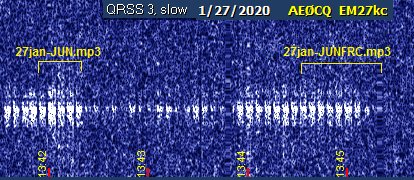
No bits and pieces Monday, but clear, complete, unambiguous IDs on 13565.185 kHz from before 1:42 PM CST! The full keying sidebands are visible in the capture above, and I have attached not one but two MP3 clips.
One recording is of JUN by itself. The later one starts two minutes after the earlier one ends, and I'm including it here to illustrate that two beacons from different directions can sometimes become strong enough to show up simultaneously in the narrow CW filter's bandwidth, even though one frequency may be off the side of the response curve a little ways. In the later recording, K6FRC at a BFO pitch of 650 Hz is audible under the target, JUN, at 805 Hz. It is just audible at the start of the file, then when JUN fades away around 40 seconds in, K6FRC from the opposite coast is left in the clear for a full ID of its own.
Elsewhere on the band around the same time, 7P, EH, and RY dominated the watering hole, with occasional traces of NC. AZ was visible and sometimes faintly audible. TON was visible but not audible. No WV, VAN, AMA, WAS, or ODX here on Monday.
(If Windows Media Player gives you a network error message when trying to play the second audio file after playing the first one, close the first player window then try again.)
---------------------------------------------------------------
File Attachment 1: 27jan-JUN.mp3
File Attachment 2: 27jan-JUNFRC.mp3
File Attachment 3: 27jan007.jpg
JH in MA
The propagation gods and perhaps the neighborhood LF crud gods appear to have favored JH last night. I had surprisingly good copy of JH from 0700 to 0850 UTC at the expected frequency. Nothing before or after, just a good, long signal peak. Distance is about 710 miles.
John, W1TAG
http://www.w1tag.com/files/JH012820.jpg
Daytime NDB Reception?
Posted by ROBERT on January 28, 2020 at 20:07:58.
Using the Utah WebSDR near Golden Spike National Monument, I am hearing RL-218, Ontario and QQ-400, Comox, BC at 2000z. How does daytime skywave work on LF? Thought D layer absorbed low frequencies? I also see daytime openings on the VK7JJ WSPR nets from 2200 to 80 meters... 73
Re: Daytime NDB Reception?
Posted by John Davis on January 29, 2020 at 11:14:10.
In reply to Daytime NDB Reception? posted by ROBERT on January 28, 2020
There are two possible explanations for what you described, and it's hard to say which is more likely without additional data.
Daytime sky wave is sometimes possible at LF. D-layer absorption is not absolute; it can always be expressed as some number of dB loss, above and beyond the free-space attenuation of distance. The apparent thickness of the D layer varies with solar radiation, which in turn varies with the elevation of the sun in the sky (low in winter) and our position in the solar cycle (currently at minimum). Thus, there is a statistical possibility of some daytime sky wave reception beyond what would otherwise be likely.
However, people often underestimate the ground wave potential of lower frequencies. A lot of daytime DX over multi-hundred mile paths is simply plain old ground wave propagation, made more effective at this time of year by low static levels.
There are rules of thumb for where sky or ground waves are likely to dominate over any given path, but these vary with frequency, soil conductivity, effective radiated power to some extent, the solar cycle, and the season.
Take the occasional winter daytime DX on the AM band here in Kansas, for instance. If I hear WBAP from Fort Worth in the daytime, it's almost certain to be mainly ground wave. If I get daytime copy of WOAI San Antonio, though, or WLS Chicago, it could be a mixture of the two modes. But when I hear WABC New York in early afternoon, it's almost certainly sky wave. On the other hand, down at LF, soil attenuation is much less and I have regular copy of aerobeacons via ground wave from central Texas and way up in Canada, even on summer days if noise is low enough.
The most nearly certain way to tell which wave is being received is with a field strength meter having a loop antenna; but even then, determining angle of arrival of a wave front can be difficult and fraught with ambiguity.
Another way is to monitor a given LF signal for an extended period and deduce the mode from its behavior throughout the daily cycle. Paths where ground wave is the dominant daytime mode but sky wave dominates at night are the easiest to determine. Those signals tend to show a steady level most of the daylight hours and variable level at night (stronger on average than day), with a distinct null near sunrise and sunset. The less deep or prolonged the minimum is, the more ground wave there probably is. But if the sunrise/sunset minima are prolonged and the daytime signal level is subject to a lot of fading, the more likely it is to be daytime sky wave...such as I've been experiencing from 1750 meter LowFER EAR this year. (Guys who are 400-500 miles closer to him get steadier daytime signals, which are likely to be ground wave, which are also the same sort of signals I get from their beacons here.)
I hope that helps.
Re: Lowfer net +/- 3927Khz Saturday morning
Posted by Clint Turner on January 29, 2020 at 12:43:44.
In reply to Reminder: Lowfer net +/- 3927Khz Saturday morning 0800 California time posted by Jerry Parker on January 24, 2020
Notes on Western LowFER Net, 25 January 2020
NOTE: Due to North Korean jamming on 3925 of Radio Nikkei (Japan), a frequency of 3928 will likely be used for the net to move it away from the strongest portion of the signal. Additional changes will be considered.
Present were: Jerry, WA6OWR; Dave, WD4PLI; Clint, KA7OEI; Ed, KI6R; John, AE0CQ via WebSDR and Email.
73,
Clint Re: Unmistakable JUN in January - Tue 1/28
KA7OEI
Posted by John Davis on January 29, 2020 at 13:05:03.
In reply to Unmistakable JUN in January posted by John Davis on January 28, 2020
Fair conditions in late morning. JUN and FRC shared the CW filter bandwidth again. WAS and TON were visible but not audible. NC, 7P, EH and RY were at the watering hole. Nobody else seen or heard.
Re: More on Europe 1 closing
Posted by Mike Terry on January 29, 2020 at 15:10:32.
In reply to More on Europe 1 closing posted by Brock Whaley on January 12, 2020
No wonder Europe 1 listening was dropping as reportedly they ran only 375kW using a 2 megawatt transmitter!
Re: JH in MA
Posted by John Hamer on January 29, 2020 at 15:16:48.
In reply to JH in MA posted by John, W1TAG on January 28, 2020
Awesome John, Great Capture!
Re: More on Europe 1 closing
Posted by John Davis on January 29, 2020 at 20:19:13.
In reply to Re: More on Europe 1 closing posted by Mike Terry on January 29, 2020
Surely listeners wouldn't give up and stop trying just because those in charge make it harder and harder to receive something clearly, would they?
SJ, Jan 25-26
Posted by John Davis on January 31, 2020 at 07:21:47.
This is the first capture of SJ I've posted since the QSY, but it's not the first time I saw it since then. Ten nights earlier (the 15th - 16th) I captured the ID rather raggedly, thanks to both QRM and QRN.
This past Saturday night was distinctly quieter, with copy commencing about 7:45 PM CST, peaking just before 3:30 AM, then suddenly vanishing. The PLCs continued, unabated. SJ's signal returned faintly around 4:30 AM, and slowly got better with a secondary peak from 5:40 to 6:10 AM. At that point, it disappeared for the rest of the night.
Here's a sample from the middle of Saturday evening. I observe that the spacing between characters is now only about two dot-lengths and between words is only around 3 or 4 dots. At first it struck me as being an unknown prosign, something like SW while the J was incomplete because of QSB, then later SJ, or else maybe HO, but finally I saw enough to realize it was the ID that I was looking for.
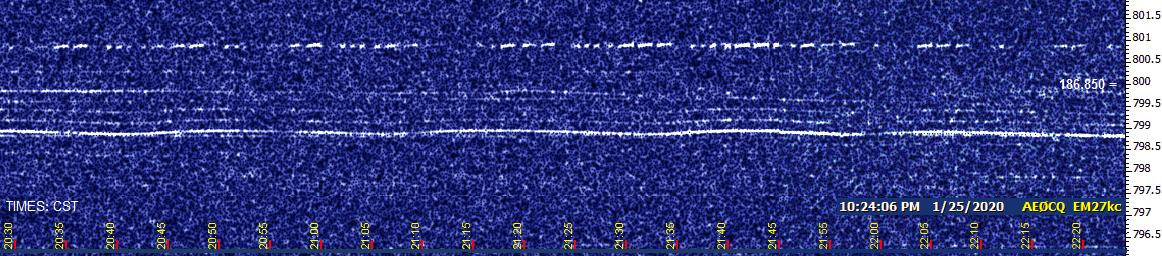
---------------------------------------------------------------
File Attachment 1: 25jan_SJ.jpg
JH in KS

Only two complete IDs here in Kansas Monday night, one at 9:33 PM (above) and one at midnight Central Standard Time, but bits and pieces of RF showed from around 7:20 PM until 6:25 AM.
I started out running one Argo instance at QRSS30 Slow and one at QRSS60 Slow, as usual, but realized later that was silly for a signal being sent in 60-second mode, and switched the alternate (30 second) screen to 120 seconds instead at 9:20 PM. I let that one run to sunrise; see the other attached file, and use your browser's magnifier tool if necessary.
---------------------------------------------------------------
File Attachment 1: 27jan_JH60.jpg
File Attachment 2: 27jan_JH120.jpg
Re: Daytime NDB Reception?
Thank you! Stumped the members of my ham radio club. They never tried low bands during the daytime. 73
potrzebie
