I think the EH noise may be when I turn on my 2 watt 10 meter beacon. The antenna for 10 meters is quite close to the hifer dipole.
Later..............Sal
Re: Temporary MEDFER GLD
Posted by Robert M6GLD on February 03, 2017 at 03:55:44.
In reply to
Re: LOWDOWN Typo
Posted by John Davis on February 03, 2017 at 06:29:35.
In reply to LOWDOWN Typo posted by Mark -- WA9ETW on February 03, 2017
Thanks, Mark. I'll pass that along to Dr Raab. The regular map of 600m station locations apparently also has it incorrectly as WI2XHI, but we didn't have room to use that page this month.
Another correction for the record: the cover mistakenly identifies me as the author of the article on "Old PH." It's actually a reprint of a 1917 article--and while I'm at a point where I do feel older every day, I haven't been around THAT long! :)
John
Re: Word Definition CODAR
Posted by John Davis on February 03, 2017 at 07:40:21.
In reply to Re: Word Definition CODAR posted by Mike N8OOU on February 02, 2017
Good example, Mike. About halfway down that page is another example, in the message entitled "HiFER WM on May 12." The capture in that one is scrollable left and right, covering over a two hour span during which the codar noise comes and goes.
John
Re: Solar Storm and Hifers
Posted by John Davis on February 03, 2017 at 08:04:42.
In reply to Re: Solar Storm and Hifers posted by Sal,K1RGO on February 03, 2017
That very well could be the cause, Sal. A few months ago, I did hear Morse keying in the background during a noise episode on EH. It seemed to be a repeating message, but it was largely drowned out by EH and the other signals present at the time, so I couldn't tell what was going on.
John
Wednesday Morning 1750 Meters
Posted by John Davis on February 03, 2017 at 08:53:41.
Sorry to take so long posting these, but it's been a busy week. Conditions were not really great at 1750 m Tuesday night and Wednesday morning. QRN was low, but there was a lot of fading on most paths.
In 1feb21.jpg (attached), you see an instance where the two Illinois stations were at their best, SJ made a brief appearance, and one or more signals forming a stairstep pattern just barely start to show up in the lower right.
In 1feb27.jpg (also attached), SJ is making one of its stronger appearances of the night, and the stairstep is more prominent, while SIW and WM are not as strong.
Wish I could be back out there monitoring tonight, given the apparently very quiet conditions, but it's cold enough that I'd need the pickup to make it practical, and it's in the shop for a few days.
John
---------------------------------------------------------------
 File Attachment 1: 1feb21.jpg
File Attachment 2: 1feb27.jpg
LW 252
Posted by Mike Terry on February 03, 2017 at 15:44:37.
Save RTE LW 252 Facebook group
3 February 2017
Billy Lawless gave a great speech in the Dáil yesterday about the importance of longwave to the Irish in Britain. He is a very strong supporter, and we are grateful for his work.
In an encouraging response, Minister of State for the Diaspora Joe McHugh also spoke positively of the continuing need for longwave, noting that he was well aware of its importance:
"While any decision on the future of long wave services in Britain is ultimately an operational matter for RTE, it can..., as a result of the study, now be informed by awareness of the role that the service plays in preserving and enhancing links with Ireland and keeping our people in Britain informed of important events and developments, such as the UK’s vote to leave the European Union and the Irish Government’s position."
He added that the consultative group involving RTE and representatives of the Irish in Britain would meet next week:
"A meeting of the consultative group will take place in London next week in order to discuss the next steps, explore possible ways forward In the context of maintaining the link with audiences in Britain, and of keeping the Irish community involved in decision-making. I am hopeful that a positive outcome can be achieved."
www.irishtimes.com/news/politics/oireachtas/call-for-retention-of-rt%C3%A9-s-uk-long-wave-radio-service-1.2961495
Watering hole trio
Posted by Andy KU4XR on February 03, 2017 at 22:24:19.
My grabber page caught the shot (attached) when all 3 lowfers were visible.. WM was the best I have seen it thru the night..
Andy - KU4XR
---------------------------------------------------------------
File Attachment 1: 3febKU4XR.jpg
630m Midwinter Operating Event
Posted by Steve VE7SL on February 04, 2017 at 00:41:12.
Just a reminder of tomorrow night's 630m Midwinter Event, including the 630m-HF crossband activity.
We hope to work you!
Canadian stations will call CQ on announced frequencies within the 630m band
and listen on individual HF (QSX) frequencies for callers.
Due to the RTTY and Sprint activities on the same night, some of the QSX
frequencies have been shifted from those that might normally have been used
in the past.
There will also be a large turnout of U.S. experimental activity, either in
beacon mode or in two-way QSO mode with other experimental service
stations.
In past events, several Transcontinental crossband contacts have been
completed. It is hoped that operating events such as this can serve to
demonstrate the interesting propagation possibilities of this unique part of the spectrum and generate
more new interest in the 630m band.
To read more about this event, please see the ARRL news announcement here:
http://www.arrl.org/news/second-annual-midwinter-630-meter-activity-night-set-for-february-4-5
This time out, there will be six Canadian stations, from Newfoundland to the
west coast, hoping to work as many of you as possible!
Station: CF7MM (Mark) CN89 Coquitlam, British Columbia
Time: February 5, 0200-0700 UTC
Transmit frequency: 475.0 kHz
Receive (QSX) frequency: 1801 kHz, 3501 kHz, 3528, and 7028 kHz
Station: VE7BDQ (John) CN89 Delta, British Columbia
Time: February 5, 0300-0700 UTC
Transmit frequency: 474.0 kHz
Receive (QSX) frequency: 1833 kHz, 3533 kHz
Station: CG7CNF (Toby) CN89 Burnaby, British Columbia
Time: February 5, 0200-0800 UTC
Transmit frequency: 476.5 kHz
Receive (QSX) frequency: 1827 kHz, 3527 kHz, 7027 kHz
Station: VE7SL (Steve) CN88 Mayne Island, British Columbia
Time: February 5, 0200-0700 UTC
Transmit frequency: 473.0 kHz
Receive (QSX) frequency: 3526 kHz, 7115 kHz
Station: VO1NA (Joe) GN37 Torbay, Newfoundland
Time: February 4, 2130 UTC, until February 5, 0130 UTC; After 0130 UTC, 5WPM
CW beacon until 1000 UTC
Transmit frequency: 477.7 kHz
Receive (QSX) frequency: 3525.5 kHz
Station: VE3OT (Mitch) EN92 London, Ontario
Time: February 5, 0000-0500 UTC
Transmit frequency: 477.0 kHz
Receive (QSX) frequency: 3610 kHz, 7105 kHz
Steve, VE7SL 73
Re: Temporary MEDFER GLD
Posted by Frank Cathell on February 04, 2017 at 18:50:10.
In reply to Re: Temporary MEDFER GLD posted by Robert M6GLD on February 03, 2017
Robert - I saw no antenna from the street. I assume you were using an indoor antenna (??) If so, it is doing remarkably well. Any detail would be appreciated.
Thanks,
Frank
Re: LOWDOWN Typo
Posted by Mark -- WA9ETW on February 05, 2017 at 05:56:36.
In reply to Re: LOWDOWN Typo posted by John Davis on February 03, 2017
Thanks, John.
WSPR DX
Posted by John Bruce McCreath on February 05, 2017 at 14:31:33.
I finally got some WSPR DX this season, with a total of four decodes of ZF1EJ overnight Feb. 4-5th. I used a PA0RDT mini-whip, followed by a series-tuned preselector (on the right freq,. this time) to my TS-440. WSPR-X in the two minute mode got the job done.
73, J.B., VE3EAR Re: WSPR DX
Posted by John Davis on February 05, 2017 at 17:41:02.
In reply to WSPR DX posted by John Bruce McCreath on February 05, 2017
Good work and congratulations, J.B. I actually count six decodes for you in the WSPRnet database:
  Timestamp       Call    MHz      SNR  Drift  Grid   Pwr  Reporter  RGrid    km    az
--------------------------------------------------------------------------------------
2017-02-05 04:54  ZF1EJ  0.475705  -28 	  0   EK99ig   2    VE3EAR   EN93dr  2720  359
2017-02-05 06:10  ZF1EJ  0.475706  -26 	 -1   EK99ig   2    VE3EAR   EN93dr  2720  359
2017-02-05 06:24  ZF1EJ  0.475705  -27 	 -1   EK99ig   2    VE3EAR   EN93dr  2720  359
2017-02-05 06:30  ZF1EJ  0.475705  -28 	  0   EK99ig   2    VE3EAR   EN93dr  2720  359
2017-02-05 06:50  ZF1EJ  0.475705  -30 	 -1   EK99ig   2    VE3EAR   EN93dr  2720  359
2017-02-05 06:58  ZF1EJ  0.475705  -26 	  0   EK99ig   2    VE3EAR   EN93dr  2720  359
Re: Temporary MEDFER GLD
Posted by Frank Lotito on February 06, 2017 at 02:00:42.
In reply to Re: Temporary MEDFER GLD posted by Frank Cathell on February 04, 2017
Three questions: (1) I assume Robert, M6GLD, has his Medfer station located in the Swimbridge, N. Devon area of England, and Frank Cathell is also located in that general area of N. Devon? (2) Are the rules for Lowfer, Medfer and HiFer operation in the UK similar to those in the United States? (3) The bio section of www.QRZ.com for M6GLD indicates that amateur equipment is installed on a pleasure boat. Is the MedFer station also on that boat?
73 Frank K3DZ / WH2XHA, Pittsburgh, PA USA grid square FN00
Re: Temporary MEDFER GLD
Posted by Robert M6GLD on February 06, 2017 at 04:56:03.
In reply to Re: Temporary MEDFER GLD posted by Frank Lotito on February 06, 2017
Swimbridge is my registered QTH. I am currently however halfway through a business trip to Tucson, AZ and brought along a simple MEDFER part 15 transmitter for unlicenced operation, since my amateur licence is of the UK foundation class and not recognised in the US. In the UK I have access to the 136 Khz band with upto 1 watt erp, but the antenna restrictions of living on a small boat mean I am yet to use the band. I am however active on topband.
Operation is 100 mW input into an indoor 3 meter wire with top capacity hat. The only earth used is that of the mains supply. The beacon is based around the transmitter side of an early 1980's 'Talking House' Broadcaster. This uses simple LC oscillator network that needed a day of operation to bring to a reasonable level of stability. Next year I shall see if I can get permission from the house owner for an external beacon, although I shall need to design an antenna that is compact enough to fit in my hold luggage and not require too much in the way of tools to erect. I shall also want to build a new transmitter from scratch with crystal controlled stability now I have found a frequency suffiently quiet to be usable.
WWVB
Posted by Frank Lotito on February 06, 2017 at 21:10:06.
In recent postings a number of you used the word "decode" when you were talking about WWVB at 60 KHz and a few other foreign time and frequency stations. A few questions:
(1) When you use the word "decode," do you mean you have the ability to extract the information sent by these stations?
(2) If yes, are you using PC based software to extract the information from your receiver's audio output?
A few times in the past I have inquired about such software. I also e-mailed NIST in Bolder. Nothing in the way of computer based software was available at the time of my inquiries. I'd appreciate any info you have on software that can extract the information broadcast by these LF time and frequency stations.
73 Frank K3DZ / WH2XHA
Re: WWVB
Posted by Garry, K3SIW on February 06, 2017 at 22:03:55.
In reply to WWVB posted by Frank Lotito on February 06, 2017
I use the CLOCK routine (v1.10.1) that comes with MultiPSK (v.4.25.1). See http://f6cte.free.fr/index_anglais.htm. CLOCK handles France-Inter, DCF77/HBG, BBC, MSF(UK), RAI(AM), CHU(AM), WWV-WWVH(AM), WWV-WWVH(SSB), JJY, and GPS.
73, Garry, K3SIW
Re: WWVB
Posted by Frank Lotito on February 07, 2017 at 12:09:25.
In reply to Re: WWVB posted by Garry, K3SIW on February 06, 2017
Are Windows based software titles available that can decode the WWVB transmission?
73 Frank K3DZ / WH2XHA
Re: WWVB
Posted by John, W1TAG on February 07, 2017 at 16:24:51.
In reply to Re: WWVB posted by Frank Lotito on February 07, 2017
Frank,
MultiPSK is Windows-based.
John, W1TAG Re: WWVB
Posted by Frank Lotito on February 07, 2017 at 19:43:09.
In reply to Re: WWVB posted by John, W1TAG on February 07, 2017
My question - "What windows based program decodes the WWVB broadcast"? My last posting is specific to WWVB. Yes, it has been established by a prior respondent that MultiPSK decodes a bunch of other time / frequency broadcasts. However that list did not include WWVB. Maybe WWVB uses the same modulation format as one of the other time / frequency broadcasts that MultiPSK decodes? Is nobody else hearing PLM?
Frank K2DZ / WH2XHA
Posted by John Davis on February 07, 2017 at 20:20:28.
And, is nobody going to take credit for the beacon?
It is a few Hz lower in frequency this afternoon, around 13557.740, and has added a dash between the slow CW IDs.
All I can tell about it from listening and watching is that it is subject to QSB (about 7 minutes between clear, audible IDs this afternoon) and that it has been present every day I've listened to 22m since first running across it. From the former, we can conclude that it is not local; and from the latter we can infer that it is probably not in the first skip zone and therefore is greater than 500 miles distant. In fact, the limited data thus far would suggest it is to the northeast or southwest, as its presence seems to track that of RY, EH, and FRC better than it does the Carolinians or the far Southeast.
Others copied today: FRC around 11:00 CST this morning, WV about 12:30 (QSB period approx. 4 minutes between audible ID clusters), EH fairly consistently, RY about half the time, USC briefly and faintly, and NC fairly strong a few times. No codar so far.
John
Re: WWVB
Posted by John, W1TAG on February 07, 2017 at 21:43:28.
In reply to Re: WWVB posted by Frank Lotito on February 07, 2017
Frank,
I apologize. I was just trying to help. The MultiPSK site claims that its Clock program decodes WWVB. If it indeed doesn't, then I am not aware of an alternative.
John, W1TAG
Re: WWVB
Posted by Garry, K3SIW on February 08, 2017 at 01:08:30.
In reply to Re: WWVB posted by Frank Lotito on February 07, 2017
Why the continued question? The CLOCK routine that comes with MultiPSK (http://f6cte.free.fr/index_anglais.htm) is windows based and does decode WWVB. That's why I submitted the capture at http://mailman.qth.net/pipermail/lowfer/2017-February/045983.html (and an earlier one of the program decoding clock information sent on 162 kHz by TDF). The MultiPSK program has perhaps the world's most unfriendly GUI but it does work and does so for a very large number of modulation schemes, and for a fee does even more.
Garry, K3SIW
Re: 630m Midwinter Operating Event
Posted by Jaap on February 08, 2017 at 10:03:23.
In reply to 630m Midwinter Operating Event posted by Steve VE7SL on February 04, 2017
Hi
recently I restarted my WSPR activity at 474.2kHz
using a 350m Beverage QTF300 i have good receive results
until now every night at least WD3XSH/17 is received
sometimes also
WG2XKA and WG2XPJ all FN
last week it was possible to break the 5600kM barrier
2017-02-01 02:54 WI2XRM 0.475715 -27 0 EL98pd 5 PA0O JO33hg 7368km
2017-02-03 had the best propagation sofar 5 decodes WI2XRM and 1x ZF1EJ
3 different nights could decode ZF1EJ last week
1 night 3 decodes
x-band QSO with VO1NA Joe
his signal was very clear
http://qsl.net/p/pa0oos//2017/vo1na_477_1.wav
TX is 50W was broken just the day before but 50W will be not enough for a 2way CW
TX antenna is 25m vertical L
best 73 Jaap
Re: Is nobody else hearing PLM?
Posted by John, W1TAG on February 08, 2017 at 21:14:03.
In reply to Is nobody else hearing PLM? posted by John Davis on February 07, 2017
JD,
Nothing heard here in MA during the day.
JA
Msg Board UPDATE & SURVEY
Posted by Webmaster on February 09, 2017 at 04:51:08.
This is principally for (1) mobile device users, and (2) anyone with older browsers who may now be having problems viewing the Most Recent LowFER and Most Recent HiFER boxes.
After months of off-and-on study, and the past week of day and night experimenting, I finally arrived at the conclusion that the iframe blocks I was formerly using to display those lists simply cannot be made to work compatibly with Apple mobile devices. Apple doesn't believe in scroll bars, which is OK; but when I tried to set a different type of property for the boxes' overflow behavior, Apple didn't like that either. (Nobody else seemed to object. All the HTML5 gurus I consulted said overflow settings are "not reliable" in iframes, but none of them gave any details of what...or who...they meant. Now I have a better idea.)
The new version of the Message Board puts those lists in div blocks instead. Their properties are well supported* in most newer browsers, although older ones might or might not present them in the fashion intended. Please post a reply here if you have trouble scrolling or if they look awkward in some way.
Based on my test with a borrowed iPhone this afternoon, users of iPads, iPhones, and maybe some other touch screen devices, should now be able to use finger swipes within the Most Recent boxes to scroll the lists. Again, please post here if everything doesn't seem to work as expected.
Thanks very much. Once we get the display consistent across platforms, I can start work on the actual new message features.
John
(*PS--I detest and refuse to tell you that ubiquitous Web developer lie: "We no longer support your browser." Makes it sound like they've been doing you some big favor all along, so now it's time for you to step up and do your part by getting a new browser...and buying a new computer if necessary to make the newer browser run! Websites do not in any way "support" browsers; it's the other way around. If they were honest, most of them would say "We decided we want to use trendy new features your browser doesn't support, so we're not even going to try to show you our content unless you get with the program!" We don't do that at lwca.org, but once in a while we're bound to run into a compatibility issue like we're currently facing. With your feedback, we'll make it as easy as possible on everyone.)
Re: Is nobody else hearing PLM?
Posted by John Davis on February 09, 2017 at 05:27:38.
In reply to Re: Is nobody else hearing PLM? posted by John, W1TAG on February 08, 2017
Thanks, John. I sure hope folks in various parts of the country will check on PLM from time to time. Even negative results can be useful, provided they're based on enough observations over enough time to where a person can reasonably say "it never seems to show up here."
I didn't get a chance to listen to HF today, myself. (I was making up for time lost on 1750m Tuesday during the severe weather in Louisiana and Mississippi. That static was far more ferocious on LF than usual that afternoon; garden variety t-storms in the same locations are seldom audible here during daylight, suggesting perhaps that tornadic storms have different properties at LF, just as has previously been observed at HF and VHF, except measurable over longer distances.)
However, I did notice by the end of the afternoon on Tuesday that PLM was gone from here by the time RY and EH faded out during the 4 PM hour. Two western beacons, AZ and FRC, continued to be visible most of the time and audible during periodic fade-ups after local sunset, as did about half the codar that had been present earlier in the day. (BTW, AZ was all the way down to 13554.02 yesterday.) This would suggest PLM is not to the west or southwest.
Further results from other locations may help narrow it down.
And, of course, if the operator were willing to step forward, that would help even more. :)
HiFERs Thursday (AM)
Posted by John Davis on February 09, 2017 at 19:23:57.
The lower solar flux lately and lack of other solar-terrestrial activity seems to be taking a toll on 22m today. I did a scan of the band about 10:45 AM CST, before switching to 2200m to set up for the SIW changeover. EH was only faintly visible, NC was pretty good, and FRC was weak to fair. If it hadn't been for the latter two, I would have thought something was amiss with the system, because absolutely nobody else showed up during the 15 minutes. Will check again at mid afternoon.
Re: Msg Board UPDATE & SURVEY
Posted by Mike n8oou on February 09, 2017 at 22:08:14.
In reply to Msg Board UPDATE & SURVEY posted by Webmaster on February 09, 2017
John
This reply is using my tablet. The scroll boxes no longer work on it, so I can read only the first few messages in those boxes. I can slide the page up and see the messages in thread order. Maybe the browser will tell you its name. Back to Linux.
Re: Msg Board UPDATE & SURVEY
Posted by Mike n8oou on February 09, 2017 at 22:15:54.
In reply to Re: Msg Board UPDATE & SURVEY posted by Mike n8oou on February 09, 2017
John
Ignore my previous message. I backed up to the main page to switch and test the legacy page, it worked fine. I exited and called the mb back up, and could scroll in the 2 list boxes. ???????
All seems good now.
Re: HiFERs Thursday (PM)
Mike - oou
Posted by John Davis on February 10, 2017 at 00:20:55.
In reply to HiFERs Thursday (AM) posted by John Davis on February 09, 2017
Checked again at 4 PM, with USC and NC gone, and EH and RY now dominant. PLM was present at 13557.735, and FRC was audible. No codar today, but a bit of some sort of broadband hash.
Within about 20 minutes, EH and RY were experiencing fades and PLM was on its way out of the picture entirely. FRC was intermittently good, though, as was AZ (today back up at 13554.120 kHz).
By 5 PM CST, EH and RY were barely recognizable, FRC was barely visible and not audible, AZ was gone, and PLM had not made a reappearance.
The timing of PLM's peak and decline likely amounts to another straw suggesting it is in the Northeast somewhere.
Re: Msg Board UPDATE & SURVEY
Posted by John, W1TAG on February 10, 2017 at 01:12:42.
In reply to Msg Board UPDATE & SURVEY posted by Webmaster on February 09, 2017
JD,
Looks great here on the iPad.
JA
Re: HiFERs Friday (AM)
Posted by EdWSlidell, LA on February 10, 2017 at 13:53:18.
In reply to Re: HiFERs Thursday (PM) posted by John Davis on February 10, 2017
Hello all. Listened for the PLM before ~1340 UT, and after a few minutes it was heard coming of a fade. Got up to about 349 at maximum, and faded out a few minutes later. It continued to reappear and fade over the next 15 minutes or so that I listened. Never quite got back up to the first strong showing. Seemed to faded out completely after ~0750 UT. Listened for GNK, WV, and others, but there was nothing but a beat between two QRSS signals below 13.556 KHz. Ed W Slidell, LA EM50cg
Re: Msg Board UPDATE & SURVEY
Posted by Ed Holland on February 10, 2017 at 21:17:32.
In reply to Msg Board UPDATE & SURVEY posted by Webmaster on February 09, 2017
Hi John,
All looks pretty consistent across the andriod browsers (Chrome and Samsung's Internet). Also using Chrome 56.0.2924.87 on PC.
Formatting of the message posting seems consistent and without the confusion of fields I have experienced before.
I see one issue in the movile chrome the "Board OK message and posting buttons obscure the message field sometimes when in portrait mode.
Re: Msg Board UPDATE & SURVEY
Posted by Dave n4ef on February 11, 2017 at 00:39:20.
In reply to Re: Msg Board UPDATE & SURVEY posted by Ed Holland on February 10, 2017
Opera mobile browser shows the message board nicely.
Dave N4EF
Testing New Hifer
Posted by Matt Burns, KC8COM on February 11, 2017 at 09:01:07.
After a long hiatus I am working on a new transmitter for Hifer "COM" currently I have an oscillator running around 13555.5 modulated with a slightly curved sawtooth wave, 8 second period, 10 Hz shift. I may slow that down a bit before putting it on the air.
Eventually I plan on having a keyed or frequency shifted morse qrss signal, I'm working on a design for a keyer idea that will switch the output on and off at various voltages as a capacitor charges, it will take two potentiometers for each dit or dah but I should be able to do it with discrete transistors and no logic ICs or microcontrollers.
Matt
Re: HiFERs Thursday (PM)
Posted by Chris Waldrup on February 11, 2017 at 15:02:26.
In reply to Re: HiFERs Thursday (PM) posted by John Davis on February 10, 2017
Hi John,
I'm concerned about lack of reception of PBJ lately at your station. I'm on the air and transmitting, will check again tonight. Do you think it's just propagation?
Chris report Feb 11
KD4PBJ
Posted by Bill Hensel on February 11, 2017 at 19:58:16.
1837 utc GNK and K6FRC
Would be nice to see more Beacon reports..
Re: HiFERs Friday (PM)
Posted by EdWSlidell, LA on February 12, 2017 at 15:25:42.
In reply to Re: HiFERs Friday (AM) posted by EdWSlidell, LA on February 10, 2017
I was able to listen again later, on the afternoon of 10 Feb. Between 2100 and 2330 UT, both PLM and GNK were easily heard, fairly consistently for the PLM beacon(2/3-3/4-9 RST). The GNK powerhouse was heard consistently, sometimes reaching 579 level. Just around 2330 UT both disappeared completely. Not other stations at all were heard during the period, not even the QRSS bees. Ed WSlidell, LA EM50cg
Re: report Feb 11
Posted by Paul on February 12, 2017 at 18:31:59.
In reply to report Feb 11 posted by Bill Hensel on February 11, 2017
Nothing heard here in the land of liberals, OM.
I am desperately trying for your HiFer. Planning to take a portable camping as soon as it warms up a bit and dries out.
73,
Sunday HiFERs 12th Feb
Posted by Ed Holland on February 13, 2017 at 02:32:21.
Hi there folks
Some listening at last, and quite a good day here in CA. circa 1800 UTC AA0RQ and GNK were noted at the top of the band, the former audible, and Bill's new/restored antenna and earth system is doing nicely.
Later, around 2030 UTC I set up to observe the watering hole and was fortunate enough to land NC, WM and others - see the screenshot from Spectrum Lab recorded whilst rewinding the audio transformer for the 1934 Philco - another project revitalised.
Hopefully I can be a little more consistent in the next few weeks.
Cheers
Ed
---------------------------------------------------------------
File Attachment 1: capt07.jpg
File Attachment 2: capt08.jpg
Re: HiFERs Thursday (PM)
Posted by John Davis on February 13, 2017 at 06:24:11.
In reply to Re: HiFERs Thursday (PM) posted by Chris Waldrup on February 11, 2017
Chris wrote:
I'm concerned about lack of reception of PBJ lately at your station ... Do you think it's just propagation?
I expect so. Your QTH now seems to be within the first skip zone distance from mine, according to VOACAP online. I believe that zone has been expanding as solar flux decreases. In addition, the southeast-to-northwest path hasn't been very good lately for stations outside the skip zone, either, as evidenced by very few recent receptions of MTI here, too, and none of FL in quite some time.
On the other hand, northeast-to-southwest has done quite well this winter, even into late afternoons, which I can't really account for.
John
Re: report Feb 11
Posted by John Davis on February 13, 2017 at 06:48:45.
In reply to Re: report Feb 11 posted by Paul on February 12, 2017
>>> Would be nice to see more Beacon reports.
Amen to that. They're always helpful to beacon operators, and they encourage other listeners as well.
I'd like to be able to get Internet service in the field so I could send reports closer to real-time, rather than have to wait hours before I can even review my log and captures. After too significant a delay, it feels less useful to post. At any rate, here are brief results of the little listening I managed Saturday afternoon between my sessions on 1750 meters.
Attached is a capture of the very short time USC was with us Saturday. Everybody faded out at the same time at the watering hole, but when NC and RY returned, USC wasn't with them. (EH was also missing the whole time, but I suspect Sal had shut down to listen for a while.) Up the band, I had a little weak copy of WV; constant visual presence from PLM plus audible IDs every 90-120 seconds; and FRC was audible for several IDs at a time, then both inaudible and invisible for several. Thought I had RQ at one point, but it was just beat notes between close-spaced random carriers once again. Had faint visual indication of AZ, but only one or two audible IDs.
(BTW, for antone wondering, the "punch card" effect in the middle of the capture are three groups of high power pulses that occur in bursts of a few seconds' length, separated by a comparable silent period. I term them the buzzsaw, the machine gun, and the ack-ack. Their repetition rates are 42, 26, and 21 pps, respectively, give or take 1 pps. They may repeat every couple of minutes over an indefinite span during the middle and late afternoons. Somedays there are quite a few, other days none at all.)
John
---------------------------------------------------------------
File Attachment 1: 11feb03.jpg
E-Field Strength vs RF Power
Posted by Frank Lotito on February 13, 2017 at 14:31:39.
The following paragraph is from http://www.lwca.org/sitepage/part15/index.htm (Web page section What is "Part 15?' / Are the requirements hard to meet?)
>> Among the various sections and subsections within Part 15 are a number of interesting provisions. One permits the use of up to 1 watt of power and a 15 meter long antenna between 160 - 190 kilohertz, in the longwave bands, with no license requirement. Another permits similar operation from 510 - 1705 kHz, in the medium wave band, with 1/10 of a watt and a 3-meter antenna. Yet another allows operation in a 14kHz-wide band centered at 13.56MHz, with a maximum field strength limit that works out to about 4.8mW into a dipole or a quarter-wave vertical over an elevated ground plane. <<
The above excerpt is applicable to 47CFR15, subparagraphs 217, 219 and 225(b). I can well appreciate the "old fashion" power cap of DC watts into the final amplifying stage of subparagraphs 217 and 219. I'm having trouble reconciling the max electric field strength proviso of sub paragraph 225(b) with the LWCA page's 4.8 milliwatts into a dipole, etc.
Can someone refer me to an article or two that discusses this conversion, that is, electric field strength measured at a specified distance to RF watts input to the dipole and ground plane antenna? I've tried to research this and wind up with equations that calculate the RF power a good part of 2 orders of magnitude higher than 4.8 mW. Most definitely, I am missing something by blindly trying to use these equations!
Thank you -
73 Frank Lotito K3DZ / WH2XHA Re: Sunday HiFERs 12th Feb
Posted by Mike N8OOU on February 13, 2017 at 15:09:29.
In reply to Sunday HiFERs 12th Feb posted by Ed Holland on February 13, 2017
Ed,
Over the past couple weeks I have been debating about going up on the roof for an antenna check on the HiFer. Your captures of WM gives me the excuse to hold that task off until later in the spring. Thanks for listening and reporting.
Mike - N8OOU
PVC into Pine Colorado
Posted by Bill Hensel on February 13, 2017 at 17:57:01.
From 1750 -1752 PVC was solid copy Q5 sure was glad to hear it. K6FRC was no copy
GNK was Q4-Q5 between 1727 - 1731...
Re: PVC into Pine Colorado
Posted by Ed Holland on February 13, 2017 at 21:40:49.
In reply to PVC into Pine Colorado posted by Bill Hensel on February 13, 2017
Hi Bill
Good job I remembered to turn it on again yesterday after the listening session! Re: E-Field Strength vs RF Power
Thanks for the nice report.
Posted by John Davis on February 14, 2017 at 07:29:45.
In reply to E-Field Strength vs RF Power posted by Frank Lotito on February 13, 2017
Can someone refer me to an article or two that discusses this conversion, that is, electric field strength measured at a specified distance to RF watts input to the dipole and ground plane antenna?
Sure. One could derive the formula from scratch, of course, by assuming the RF in question is radiated from a fictional antenna that distributes power equally in all directions at once, up, down, or sideways (an "isotropic" antenna); then take into account the impedance of free space to translate field intensity into power, integrating that over a sphere having a radius equal to the measurement distance. Fortunately, it boils down to a relatively simple formula. The result is what's termed Effective Isotropic Radiated Power, or EIRP.
In apps.fcc.gov/eas/comments/GetPublishedDocument.html?id=204&tn=255011 we see the essential relationship:
eirp = (E×d)2/30
where eirp is in watts, E is field intensity in V/m and d is the measurement distance in meters. Now, our legal limit of 15,848 μV/m equals .015848 V/m, and the measurement distance is 30 meters, so we plug those into the equation and evaluate it as follows:
eirp = (.015848×30)2/30 = (0.47544)2/30 = 0.22604/30 = 0.007535 W
That's 7.535 mW EIRP, meaning 15,848 μV/m is the voltage you'd get at 30 m from an imaginary isotropic antenna if you put 7.535 mW into it. That's a little less than twice 4.8 mW, not orders of magnitude off, fortunately. But why even that much difference? Because nobody has an isotropic antenna.
Every real-world antenna radiates more power in some directions than it does others, which means that all real antennas (in free space conditions, at least) have gain over an isotropic antenna. An ideal dipole radiates nothing along its axis, but that leaves more signal to radiate perpendicularly than would be radiated by the fictional isotropic antenna, so a dipole is rated for an antenna gain of 2.15 dBi (per the FCC's OET; others give it as 2.19 dBi). That means you'd need to cut the power into a dipole by 2.15 dB, or a factor 1.64, to produce the same field strength in its maximum lobe as an isotropic antenna.
Now, 7.535 mW/1.64 = 4.59 mW, pretty close to our number. Why that little discrepancy? It depends on how tightly you round the numbers that comprise the EIRP formula, and the textbook value you use for dipole gain. It's entirely possible for the number to turn out anywhere from just above 4.5 to nearly 4.8 mW, depending on your references.
John
(P.S. - At the risk of complicating things further, there's also the case of a monopole antenna. A ground-mounted vertical only has half a sphere within which to radiate, compared to a full spherical region around a dipole, so you only have to input half the power [2.3 mW] for the same signal strength as the dipole. Hence, the theoretical gain of a monopole is 3 dB greater than that of a dipole, or 5.15 to 5.19 dB [depending on your source] above that of an isotropic antenna. Why a monopole complicates things is multi-fold, though. One big reason at these frequencies is that the real world ground losses mean you won't achieve the full antenna gain from a ground mounted monopole, but it's hard to predict by how much without actual measurements. In the case of a vertical over an elevated ground plane, such an antenna only simulates the monopole case near-in because the radiated wave begins spreading into the lower hemisphere as soon as it leaves the edge of the plane, which lowers the apparent gain depending on just where you measure it and how far off the ground the base is. Meanwhile, a ground plane with downward angled radials looks more like a vertically oriented dipole right from the start, and can be treated as such...if the transmission line is sufficiently decoupled from the antenna; whereas one whose radials stick out horizontally for a ways and then droop is harder to analyze.)
HiFERs Monday
Posted by John Davis on February 14, 2017 at 18:47:18.
Only had a short while to listen between the end of the SIW LF monitoring and the arrival of rain clouds, beginning around 12:30 PM CST and lasting about 45 minutes.
NC was good and steady for prolonged periods, while USC and EH were present but a bit ragged. Little or no trace of RF from RY up in its winter wonderland. PLM was just at the edge of audibility, but not suffering from much QSB either--and it had dropped the dash since Saturday's listening session.
WV and AZ were both faintly visible. You could tell there was a keyed signal there by ear, but couldn't really copy it. FRC was even fainter, and indistinguishable by ear. Interestingly, AZ was sometimes audible, but other times not even visible.
Too wet to go to the field today, but nobody here is complaining about the rain.
John
LowFERs Sunday night/Monday morning
Posted by John Davis on February 15, 2017 at 00:25:56.
My hope of targeting SJ and TAG on 1750 m Sunday night was derailed by thunderstorm activity down in Texas. It was more like a mid-autumn or early spring night, with median static levels in the S3 or S4 range, and peaks above S9. The sum total of all LowFERs and PLCs in the passband run well below S0 in the daytime, and near or below S0 at night, just to give you an idea what Argo faces in trying to decode signals in the face of ambient noise.
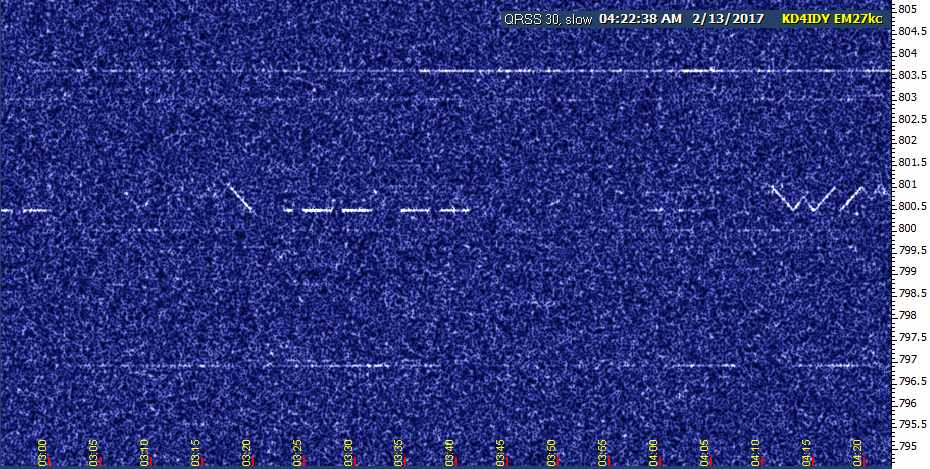
Above and below, respectively, are QRSS30 and QRSS60 views of one of the better early morning instances. I never saw SJ at all, and there were very few snippets of RF that even remotely looked like they belonged with TAG.
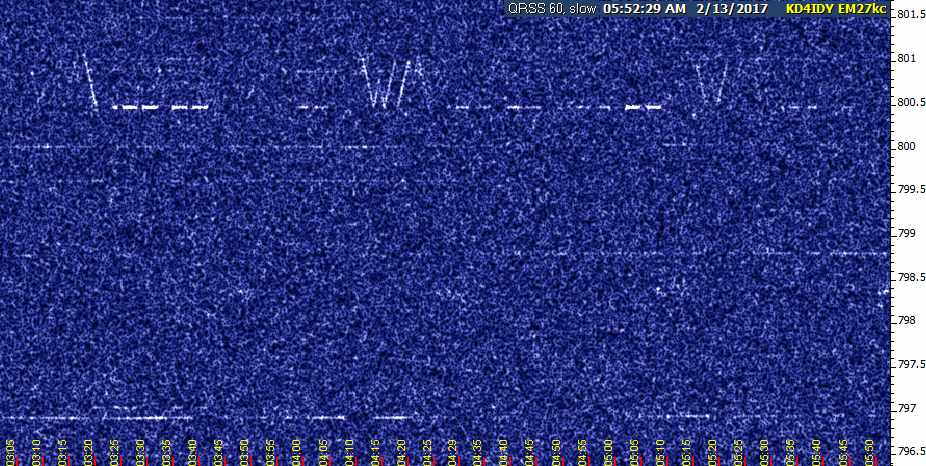
There were, however, other lines wandering around just below 185.297 to raise false hopes. What was remarkable was how well WM managed to come through at different times of night, with faint interception of the graphical ID even as early as 40 minutes after sunset.
Also attached is a screen full of SIW WSPR15 in the wee hours. It's unusual to see such wide swings in visibility of that signal over such short intervals of time. Usually, the fading in or out takes place over 15-30 minute spans.
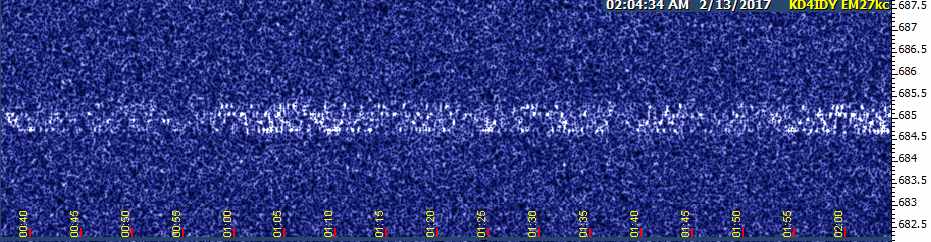
I don't know how much of it was variations in static and how much was actually changing propagation. Neither one of those factors usually changes so much over such a short time, and the SWPC data don't show any significant disturbances that morning. Also note that all the wavy lines and data bursts that usually show up in my captures of SIW WSPR are absent throughout, suggesting that they remained under the noise level the whole time; a further sign that changing noise levels might not be the main culprit.
Here is a partial sampling of some typical WSPR decodes for the night, up into mid-day Monday. The first one is the worst SNRr I've ever had at which WSPR15 still decoded:
0045  -42  -0.6    0.185185    0   K3SIW         EN51      0
0100  -37  -0.2    0.185185    0   K3SIW         EN51      0
0115  -37   0.4    0.185185    0   K3SIW         EN51      0
0130  -34  -0.2    0.185185    0   K3SIW         EN51      0
0145  -33  -0.6    0.185185    0   K3SIW         EN51      0
0200  -35  -0.9    0.185185    0   K3SIW         EN51      0

0345  -33   1.1    0.185185    0   K3SIW         EN51      0
0400  -32  -0.2    0.185185    0   K3SIW         EN51      0
0415  -32  -0.9    0.185185    0   K3SIW         EN51      0
0545  -35  -0.9    0.185185    0   K3SIW         EN51      0

0745  -32  -0.6    0.185185    0   K3SIW         EN51      0
0800  -28  -0.6    0.185185    0   K3SIW         EN51      0
0815  -31  -0.6    0.185185    0   K3SIW         EN51      0
0830  -30  -0.6    0.185185    0   K3SIW         EN51      0
0845  -33  -0.9    0.185185    0   K3SIW         EN51      0

1200  -30  -0.6    0.185185    0   K3SIW         EN51      0
1215  -30  -0.9    0.185185    0   K3SIW         EN51      0
1230  -34  -0.6    0.185185    0   K3SIW         EN51      0
1245  -35  -1.3    0.185185    0   K3SIW         EN51      0
1315  -40  -0.9    0.185185    0   K3SIW         EN51      0 (SUNRISE)
1330  -39  -0.9    0.185185    0   K3SIW         EN51      0
1400  -37  -0.2    0.185185    0   K3SIW         EN51      0

1700  -37  -0.9    0.185185    0   K3SIW         EN51      0
1745  -37  -0.9    0.185185    0   K3SIW         EN51      0
1815  -39  -0.9    0.185185    0   K3SIW         EN51      0
There were a lot of gaps in the last hour and a half prior to 1845 UTC/12:45 pm CST when I discontinued, that I can't account for. The signal looked OK on both the Argo and WSPR-X waterfalls, without any very nearby QRM lines or other artifacts that might have disrupted decodes.
I then switched over to 2200 m and began decodes of WH2XND's WSPR2 signal, and could easily copy the CW ID at the end of each transmission when static crashes weren't too rough.
1856 -10 -1.1   0.137527  0 WH2XND DM33 40
1900  -9 -1.0   0.137527  0 WH2XND DM33 40
1904  -9 -0.8   0.137527  0 WH2XND DM33 40
1908 -11 -1.0   0.137527  0 WH2XND DM33 40
In this case, the signal was just a little under S1 on the meter, while median static was S1 to S2--with occasional crashes above +20, that is! Those continuing Texas storms apparently produced a few superbolts, probably including upward lightning/sprites.
John
---------------------------------------------------------------
File Attachment 1: SIW13feb.jpg
File Attachment 2: WM13feb30.jpg
File Attachment 3: WM13feb60.jpg
MEDFER GLD
Posted by Robert M6GLD on February 15, 2017 at 05:41:54.
Tomorrow (Wednesday 15th) will be the last full operating day for MEDFER beacon GLD on 1634 khz here in Tucson, as I shall be returning home the day after. Many thanks to Frank K3YAZ for his reception reports.
GLD may return next year from the same location.
Regards,
Robert B.
Re: LowFERs Sunday night/Monday morning
Posted by Mike N8OOU on February 15, 2017 at 06:11:07.
In reply to LowFERs Sunday night/Monday morning posted by John Davis on February 15, 2017
John, Thanks for the WM captures. The beacon is lighting 3 NE-2's in series very brightly.
73 Mike -OOU
Re: RTE 252
Posted by Mike Terry on February 15, 2017 at 15:07:29.
In reply to LW 252 posted by Mike Terry on February 03, 2017
Alan Gale forwarded this to me - You might be interested in this recent article from the 10th of
February in the Irish
Post about the latest RTE consultations in London. If they're right
the service looks
like continuing till at least 2019, though having been up and down
the 'will they won't
they' road several times though I'll believe it when the official
announcement appears:
10th February 2017:
http://irishpost.co.uk/rte-longwave-252-set-continue-least-2019-positive-talks/
RY Gone?
Posted by John, W1TAG on February 16, 2017 at 16:42:26.
I suspect the RY antenna has been munched by a fallen tree. If so, the beacon will be gone for the season.
John, W1TAG
Re: RY Gone?
Posted by John Davis on February 16, 2017 at 21:50:05.
In reply to RY Gone? posted by John, W1TAG on February 16, 2017
Eureka! I have found it.
RY is still with us, but it is definitely down in level compared to the other denizens of the watering hole today. There was a very good opening to the east and northeast around 2 PM CST this afternoon, and at the peak of reception RY was recognizable too. The antenna might be damaged, but the beacon is still on the air. I'll report on all that tonight with captures.
JD
Report from Pine today
Posted by Bill Hensel on February 16, 2017 at 23:49:46.
At 1815utc TON faded up one time...HI AZ
At 2338 utc MTI, GNK, FRC made it into Pine, co
Posted by Bill Hensel on February 17, 2017 at 19:55:29.
I was happy to catch AZ for a dozen IDs in a row at 1945 Utc...nice catch it has been awhile sense I heard this beacon, I dialed up to TON and TSN no joy there...you got love 22 meters a strange little band indeed.
At 1951 utc FRC was Q3 Beacon Listener Identification
Posted by Frank Lotito on February 17, 2017 at 20:45:42.
A suggestion - To those individuals who report hearing beacons - Include the 4-digit grid square identifier of your listening station - for example, mine is FN00. Right now it appears most listening reports are only identified by the listener's name. For those interested in following the science of radio propagation I'm sure the grid square identifier is of more value that the listener's name. Remembering to include date / time is also helpful.
This web site does have a directory of beacons associated with their grid square. There is probably no reason to have a directory of listener's with their grid square. But on occasion it may be helpful if readers of this column knew how to contact a specific listener. Using this very public message board for one-on-one communications may not be in the best interest of the parties involved.
73 Frank K3DZ / WH2XHA
Re: E-Field Strength vs RF Power
Posted by Bill Hensel on February 18, 2017 at 15:49:31.
In reply to Re: E-Field Strength vs RF Power posted by John Davis on February 14, 2017
John, SWL report on AA0RQ from San Antonio, TEXAS
Thanks for posting this...
Posted by Bill Hensel on February 18, 2017 at 19:02:07.
Feb 16, 2017 20:35 UTC +/- Ur signal was good copy. QSB was slow (conditions on 20 mtr ham band very steady during this same time.)
Luxemburg on 261 khz
Posted by Mike Terry on February 19, 2017 at 07:09:12.
Reported yesterday Luxemburg on 261 khz - very low power of 4 watts - so local reception only.
Re: Msg Board UPDATE & SURVEY
Posted by Gregg on February 21, 2017 at 10:57:09.
In reply to Msg Board UPDATE & SURVEY posted by Webmaster on February 09, 2017
As long as you code so you get a green light with this:
https://validator.w3.org/
You should be OK.
Re: Msg Board UPDATE & SURVEY
Posted by John Davis on February 22, 2017 at 20:05:41.
In reply to Re: Msg Board UPDATE & SURVEY posted by Gregg on February 21, 2017
>>> As long as you code so you get a green light with this: (y)ou should be OK.
Should be, in an ideal world, but won't always in this one.
The HTML validator only indicates if your code conforms to the version you specify in your DOCTYPE declaration, which is now only allowed to be HTML5 or two strict versions of HTML4.n, but even 100% perfect code won't work right on a browser that doesn't follow the spec.
What I'd like is a "reverse validator" that tests different browsers against the W3C spec and lists what elements each does not support fully or correctly. As is, a mere mortal part-time developer has to discover (usually the hard way) that something doesn't work on a particular browser, then search all kinds of forums to find whether there's a workaround.
Remember the weekend when I tested rotation of the message lists? That required six separate lines of code because different browsers don't recognize the standard CSS "transform:" attributes. Firefox required a mozilla-specific declaration to make it work, Apple required a webkit-specific declaration, Opera insisted on one in their proprietary format, and Microsoft needed two different ones to make it work on both old and new versions of IE.
Although that was a fairly complex test, it was easier to locate all the necessary information for that one than it was to discover Apple just plain doesn't support any of the normal and accepted overflow behaviors for IFRAMEs... and only accepts a limited number of overflow options for the DIV element with which I replaced them.
The infamous Browser Wars are not over. They're merely being fought out of the spotlight, where the main casualties are Web developers who like to write simple, fast-loading, non-bloated pages.
John
GNK heard today in FM06
Posted by N1KGY on February 22, 2017 at 20:38:35.
GNK visible and solidly audible this afternoon on my new SDRplay RSP2 using HDSDR on my laptop for about 10~12 minutes before ducking back down into the noise.
Some other stubble visible in the waterfall between 13.559.900 and 13.561.900 but none rose to any level of audibility.
Antenna I heard you on is a 210 foot long OCF wire (generally used for TRX on MF and power HF) running N/S, with the long end pointed due south. I know, I should have used the vertical, but it was a spur of the moment idea to check out the watering hole.
73 Beacons?
-Chuck
Posted by Anthony Allen on February 23, 2017 at 05:42:22.
I need some help y'all. I don't normally listen to VLF or LW but what is this? After I recorded this I found another on 205.60 kHz. Listening from Jacksonville, Florida.
https://www.youtube.com/watch?v=Q0kMg4jtRxY
Thank you and 73 Re: Beacons?
Anthony
K4CSA
Posted by John Davis on February 23, 2017 at 08:43:31.
In reply to Beacons? posted by Anthony Allen on February 23, 2017
Hi Anthony. JA is the identifier of a medium power homing beacon at the Jacksonville airport. The fainter signal you heard in the background was harder to dig out because its ID was often covered up by JA, but I think I heard "IWJ," which is a lower power homing beacon at Blakely, GA on the same frequency. When I lived in western Georgia, I could frequently copy both beacons at night, but usually at different times because the ionosphere would let one through first, then the other. It's a good testimonial to the TS-870 that you could hear them both, given how close you are to JA. I've always liked Kenwood receivers for longwave listening.
Down on 216 kHz, you were hearing CLB from Wilmington-Carolina Beach, NC. That one has remarkable coverage up and down the coast by virtue of the conductivity of seawater, and naturally some of that signal spills inland as well. I can't hear it here in Kansas in daylight, but it comes in strong via skywave most every night I listen.
Those Morse signals are aeronautical non-directional beacons, usually termed NDBs. They were originally intended to be monitored on relatively simple aircraft receivers without the need for a lot of fine tuning that would distract a pilot's attention, so they actually transmit a form of amplitude modulation. There's a steady carrier (for JA and IWY, it's 344 kHz) and then the keyed sideband or sidebands, spaced 1020 Hz from the carrier for US beacons (400 for Canadians). In the old days, it would have been good old double-sideband AM, but nowadays most of them are only supposed to transmit the upper one. You'll often be able to find a copy of the keying when you tune a kilohertz below the carrier too, however, sometimes because it's an older plain-AM transmitter, or more often because of slight non-linearity in the final amplifier causing some sideband regrowth.
Even though marine beacons are long gone and aerobeacons are on the decline these days, NDB monitoring is still a signifcant part of the LW hobby. You'll find links to a couple of resources for identifying NDB stations on this site's home page. (www.lwca.org)
Some of the other signals you heard in the 300 kHz range (the "whirlybirds," I think you called them) are Differential GPS stations. They transmit a digital signal containing ground-based correction information that enables very precise navigation with specially equipped GPS units, offering tighter accuracy than the satellites alone can provide. There used to be lots more DGPS stations all across the US, but since budget cuts last year they are mainly found along the coast.
The voice and music signal you ran across is not exactly a harmonic, but is more likely a mixing product resulting from two strong AM broadcast stations in the city. The interaction could be taking place in an antenna amplifier if you are using one, or in the front end of the receiver itself if the signals are strong enough, or even in metal-on-metal junctions in the vicinity of the antenna if the signals are really strong.
I hope that helps.
John
Testing new Hifer ~13555200
Posted by Matt Burns, KC8COM on February 23, 2017 at 20:33:26.
Hi All,
I'm currently testing HiFer "COM" on about 13555.2 kHz running a sawtooth fsk with about 30 hz shift and 8 second period, going to try to get the shift down more and adust the frequency later tonight or tomorrow.
Thanks,
Matt Burns Re: Testing new Hifer ~13555200
kc8com
Posted by John Davis on February 24, 2017 at 06:40:33.
In reply to Testing new Hifer ~13555200 posted by Matt Burns, KC8COM on February 23, 2017
Good to have you back on, Matt. I'll look for you tomorrow, but I have a feeling I won't have much chance of seeing you unless you are able to get the shift down to just a few Hz.
Consider that an 8 second period is slightly shorter than a QRSS3 dash. A 30 Hz shift in that short a time will make for a very steep line, and the signal will remain in each FFT bin for less that 0.1 second, resulting in very inefficient detection where the signal is weak. Anything you can do to reduce the shift and lengthen the period will help.
John
Re: Testing new Hifer ~13555200
Posted by Matt Burns, KC8COM on February 24, 2017 at 14:14:33.
In reply to Re: Testing new Hifer ~13555200 posted by John Davis on February 24, 2017
Just an update, I slowed the fsk down to about a 25 second period but haven't attempted to cut the shift down yet. I'll try to work on that tonight if time permits.
Matt
Re: Testing new Hifer ~13555200
Posted by John Davis on February 25, 2017 at 02:22:58.
In reply to Re: Testing new Hifer ~13555200 posted by Matt Burns, KC8COM on February 24, 2017
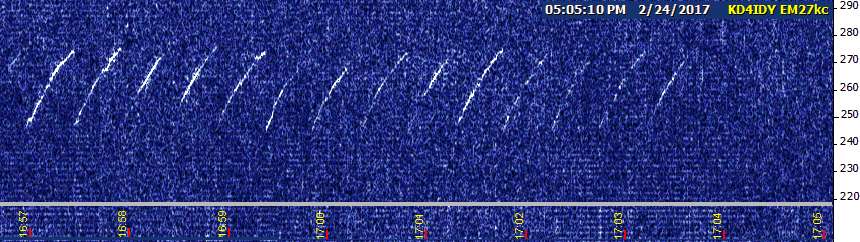
The change to a 25-second period undoubtedly helped. I didn't get started monitoring until after 2 PM CST today, and didn't see anything of COM until around 4 PM, but then it showed up pretty nicely for a while. Here is my final capture of it for the day, as it made one final hurrah then faded out for the last time:
---------------------------------------------------------------
File Attachment 1: COM24feb.jpg
Re: Testing new Hifer ~13555200
Posted by Matt Burns, KC8COM on February 25, 2017 at 14:12:11.
In reply to Re: Testing new Hifer ~13555200 posted by John Davis on February 25, 2017
Thanks John! I haven't made any changes yet but "COM" will remain on the air today, I'm going to try to get the shift down and get closer to the watering hole soon. Also, does anybody have experience measuring low power levels with a biased detector diode?
Re: Testing new Hifer ~13555200
Posted by John Davis on February 26, 2017 at 11:37:58.
In reply to Re: Testing new Hifer ~13555200 posted by Matt Burns, KC8COM on February 25, 2017
COM was higher in frequency today (Saturday). Low end of the sawtooth was around 13555.250 and the peak was .280, up about 5 Hz from Friday.
With warmer temperatures in the Carolinas, NC was down in frequency to 13555.520, enabling me to just barely get the entire watering hole within my CW filter bandwidth and display everyone from COM to NC on two Argo screens. If you can get the frequency up to just under WM at 13555.300, or else just above it from .310 on up, that would put it in some nice, clear spots.
The last time any of COM was visible was 4:41 PM CST, about the same time USC went away and RY suddenly rose to ample visibility for a few ID cycles. NC disappeared for 18 minutes at 5:01 PM and RY was gone temporarily, leaving only EH until NC encored for a final 12 minutes and RY gradually returned. EH disappeared at 5:47, leaving RY in its traditional role of final eastern HiFER of the day until 6:12 PM, a few minutes after sunset here.
At that time PLM was long gone too. AZ (if it was there at all) was buried under Codar, and only FRC could be heard at the other end of the band, where Codar was not so strong. (BTW, Friday was an interesting afternoon at 22 m, and I'm still trying to get time to write a detailed report on that.)
Hifer EH and RY
Posted by Mike N8OOU on February 26, 2017 at 14:34:31.
I shut the WM beacons down to do some receiving this weekend. EH was captured performing some dances in Argo. I am not sure if I had something going on with my reception. The EH frequency was shifting up and down some, and was switching between a sharp and fuzzy line.
RY was a weaker signal, but not impacted like EH. That kinda makes me think EH was impacted by propagation effects, or has a technical issue.
These captures were done on Saturday, see the images for details about location and time. This morning (Sunday) the band is dead so far.
https://www.dropbox.com/sh/fq7xsg8k8s4oqxt/AADQYAANrmyyF1FQ5CqSKQUza?dl=0
Mike
Re: Hifer EH and RY
Posted by John Davis on February 26, 2017 at 17:17:31.
In reply to Hifer EH and RY posted by Mike N8OOU on February 26, 2017
The small frequency jumps are fairly common on EH. The intermittent fuzziness is a more recent phenomenon, which Sal attributes (in message #6686) to operation of his 10 meter amateur beacon. When this is happening, it's sometimes possible to hear a normal speed CW message being keyed in the background, which seems to support this notion.
Re: Luxemburg on 261 khz
Posted by Mike Terry on February 27, 2017 at 11:58:29.
In reply to Luxemburg on 261 khz posted by Mike Terry on February 19, 2017
Being reported in Europe, not all the time, surprising for such low power.
Re: RTE 252
Posted by Mike Terry on February 27, 2017 at 11:59:52.
In reply to Re: RTE 252 posted by Mike Terry on February 15, 2017
There is a move to get the station on UK DAB, when that happens I expect LW to close.
Sunday Morning beacons
Posted by Ed Holland on February 27, 2017 at 21:57:18.
A chance to listen came along yesterday, around 10:30 am (80:30 UTC)
AA0RQ rose in level to being very comfortably audible for a while - a great signal. GNK was intermittent at the same time, just audible, but visible with Spectrogram.
Tuning Downwards, and avoiding the mele around 13,561 kHz I caught MTI on the waterfall plot, which I think is a first at this location. Also visible was NC, possibly EH and SIW. I need to re-examine the screenshot to be sure.
Anyhow, quite a good catch, and it was interesting to try a different time of day.
Note: PVC is off air today until I return home - I forgot to restart it yet again after listening.
Cheers
Ed
Re: Sunday Morning beacons
Posted by Bill Hensel on February 28, 2017 at 15:22:49.
In reply to Sunday Morning beacons posted by Ed Holland on February 27, 2017
Thanks for the AA0RQ mention...I think the work on the antenna, the additional top hat and the radial system work has helped. When it comes to 4 mw the propagation Gods along with the listeners signal to noise ratio are the two key points...
Re: Sunday Morning beacons
Posted by Ed Holland on February 28, 2017 at 17:21:00.
In reply to Re: Sunday Morning beacons posted by Bill Hensel on February 28, 2017
Well chance does have it's part to play, but AA0RQ is definitely stronger when it does pop up. I've noticed that on a couple of occasions since you mentioned working on the antenna.
I remembered to turn PVC on again last evening. This increases enormously the chances of being heard.. :)
potrzebie