 File Attachment 1: capt09.jpg
VLF TX Eastern Canada
Until further notice, an unmodulated carrier is on 8.2700075 Hz, GPS disciplined phase and frequency, 30 watts transmitter power to a 10 x 100 metre rotated L, ERP 10 uW.
Reports welcomed.
73 & TNX, Reminder: Lowfer net 3925Khz Saturday morning 0800 California time
Joe
Posted by Jerry Parker on February 01, 2019 at 16:10:37.
Reminder: Lowfer net 3925Khz Saturday morning 0800 California time
Or listen online at:
http://69.27.184.62:8901/?tune=3925lsb
Reminder: Lowfer net 3925Khz Saturday morning 0800 California time
see you there
KFS WebSDR in California Beacon SIW and WM
69.27.184.62
Posted by Linas KC9PCP on February 01, 2019 at 16:17:37.
I copied SIW and WM last night at 5 UTC, here at EN61br. Also there was something 0.1 hz above SIW that I could not decode (185.2994) Looked like really slow CW.
GNK Beacon
Posted by John Bergkoetter on February 01, 2019 at 18:25:19.
The GNK Beacon (13.563.99) was captured with Argo on 2-1-2019 by KF7RPF at DM22.
Re: Beacon SIW and WM
Posted by Mike N8OOU on February 02, 2019 at 16:28:42.
In reply to Beacon SIW and WM posted by Linas KC9PCP on February 01, 2019
Linas,
Thanks for the report on the WM Beacon. QRZ shows that you are about 200 miles away which puts you in the ground wave coverage of my beacon. Depending on your antenna and noise levels you should be able to receive the beacon about anytime of day or night.
Garry, SIW has a fairly consistent copy on WM, but for some reason, I don't have the same result with copying SIW here.
I am not aware of another transmitter between SIW and WM. Keep listening, maybe you can get an ID on the signal.
That is a neat looking transmitter on your QRZ page. Thanks for listening, Good Luck.
Mike N8OOU 73
ARGO with external USB sound card and SDR
Posted by Bob WA1EDJ on February 02, 2019 at 17:09:46.
I've used ARGO with SDR and an internal Sound Blaster card with virtual audio cable. That worked and I was able to route the SDR audio to ARGO with VAC. I'm trying the same scheme with a TASCAM external USB interface. It works fine with the SDR but I can't seem to get ARGO to see the SDR audio with VAC. Maybe someone with better knowledge of the Windows sound system knows if this can even work. While it works with a SB internal card, maybe there is an inherent problem with the USB interface? I like VAC, it was a pretty clean way of getting audio to ARGO.
Any ideas?
Bob HiFer Beacon HK 13,555.84
EDJ
WA1EDJ
Posted by Linas KC9PCP on February 02, 2019 at 17:35:34.
Beacon HK in EN61 will be running QRSS3 CW today at about 13,555.84. Anomalies With LWCA Website
Please post if you can hear it.
Posted by Webmaster on February 02, 2019 at 18:19:51.
Our hosting provider seems to have made some changes to our server on 1 February that affected our ability to transfer files. That greatly increases the difficulty of maintaining our own pages, also affects those using our facilities to host Argo and SpectrumLab grabber pages. The next day, they did something that has crippled our ability to display interactive and self-maintaining pages such as the Solar Activity Page, or even to display page visitor counts.
Fortunately, those seem to be the only effects...so far.
We have contacted them about these problems and hope that they will be able to remedy them soon. In the meantime, we apologize for the inconvenience.
John
Beacon HK 185.22
Posted by Linas KC9PCP on February 02, 2019 at 19:03:01.
Beacon HK will be on today from EN61 using QRSS3 CW at 185.22 Khz Re: Beacon HK 185.22
Please post if you can hear it.
Thanks,
Linas
Posted by Andy - KU4XR on February 03, 2019 at 21:57:59.
In reply to Beacon HK 185.22 posted by Linas KC9PCP on February 02, 2019
Hi Linas: I am looking for you this afternoon. Best chance is after dark. How long do you plan to let it run ? If I get any captures, an email address would be helpful to send them to you. I looked you up on QRZ.com, and there is no email listed. 73: Andy - KU4XR EM75xr
Re: Beacon HK 185.22
Posted by Linas KC9PCP on February 03, 2019 at 22:44:54.
In reply to Re: Beacon HK 185.22 posted by Andy - KU4XR on February 03, 2019
Hi Andy, Sunday HiFERs 3 Feb
Thanks for looking for my Beacon. It will be running today till midnight CST. I added my E-mail address so you can E-mail captures there, just post a message here also.
Thanks,
Linas KC9PCP
Posted by Ed Holland on February 04, 2019 at 00:53:41.
Hi Folks,
I managed time for some long overdue listening today. Fist off, at aournd 8:15 am (PST) at which point AZ was coming in nicely, audible with only slow, brief fades.
Later on, around midday, I captured EH, NC, and other indistinct traces about the watering hole. Not a bad catch.
Cheers
Ed
---------------------------------------------------------------
File Attachment 1: capt09.jpg
Lowfer listening today
I haven't done this for a while, so today I shut off the WM Lowfer for a listen in that band. I was receiving EAR this afternoon, but QSB was preventing a full ID. As dusk approached I was able to get several full ID's, this being the best just after dark.
https://www.dropbox.com/s/srjmeo6l6dwathr/feb030028.jpg?dl=0
I have had a solid daytime copy of SIW this afternoon. His signal continued strong into this evening.
https://www.dropbox.com/s/eu9s3s925mfxie0/feb030020.jpg?dl=0
With sadness, I have to say that I have not seen the new HK Lowfer on 185.22. I did not find beacon SJ either, I am not sure if it was on air during my listening.
Now, I will put Lowfer WM back on the air.
Mike 73
Re: Lowfer listening today
Posted by Linas KC9PCP on February 04, 2019 at 20:26:30.
In reply to Lowfer listening today posted by Mike N8OOU on February 04, 2019
Thanks for listening for beacon HK. After getting your report of not receiving it I did some checking and it turns out I had the antenna system tuned to the first harmonic. This has been corrected and by Tuesday and I will have the beacon running 7 to 11 CST most nights. Re: Lowfer listening today
73,
Linas
Posted by Garry, K3SIW on February 07, 2019 at 02:37:51.
In reply to Re: Lowfer listening today posted by Linas KC9PCP on February 04, 2019
Linas,
I've listened with ARGO at QRSS10 the last two nights and seen no signal at or around 185.22 kHz. You failed to mention your location but from your callsign I assume it is EN61br, Hickory Hills, IL, only 32.7 miles from me. At such a close distance a properly working lowfer should be quite strong. Daytime signals here from lowfers WM and EAR at much greater distances are generally fine copy and my lowfer 23 miles away is of course extremely strong.
You mentioned fixing a problem with your antenna wherein it was tuned to the first harmonic. I would think that's exactly the tuning you want. A modest vertical/tophat antenna typically needs a few mH inductance to resonate. If you're tuned to the second or higher harmonic that may well be the problem. When correctly tuned you should get on the order of 200 mA antenna current and the tuning should be somewhat touchy due to high Q. That's why most lowfers use variometers to fine tune resonance.
Hope you get things running as lowfer activity has been quite meager of late.
73, Garry, K3SIW, EN52ta, Elgin, IL Re: Lowfer listening today
Posted by Linas KC9PCP on February 07, 2019 at 15:39:06.
In reply to Re: Lowfer listening today posted by Garry, K3SIW on February 07, 2019
Hi Garry, Reminder: Lowfer net +/- 3925Khz Saturday morning 0800 California time
Thanks for checking for my beacon. I am in Hickory Hills a few blocks away from where the old HK aircraft beacon used to be on 332 khz. I've had it running on and off this week while re-configuring the coils, but it should be running 100% today starting at 7 PM. I was suprised at how much more wire I needed compared to my 630 meter setup. I am getting about 110 ma antenna current now and verified it is not the harmonic at 370.44. Its just a straight wire antenna now, but I hope to hope to soon have a top hat setup.
Thanks,
Linas KC9PCP
Posted by Jerry Parker on February 08, 2019 at 16:39:14.
Reminder: Lowfer net +/- 3925Khz Saturday morning 0800 California time
Or listen online at:
http://69.27.184.62:8901/?tune=3925lsb
Reminder: Lowfer net 3925Khz Saturday morning 0800 California time
see you there
KFS WebSDR in California LWCA SITE HANGING BY A THREAD
69.27.184.62
Posted by Webmaster on February 09, 2019 at 19:13:47.
It is possible that the LWCA site could stop working correctly or even disappear entirely for a few days.
I hate to be so melodramatic, but this is currently the only way I have to communicate with you, so if bad goes to worse please let others know (if possible) what happened. I've had a trouble ticket open for over a week with our hosting provider, Spry.com, but it seems every time I turn around we have lost another tool that I need to keep the site functioning.
Last Friday, 1 February, I lost the ability to connect by FTP, which is the quickest way to update and maintain files at lwca.org and the commercial Web site I handle. Since that time, I've had to edit files through a control panel, which is much slower. The next morning, 2 February, server-side includes (SSI) stopped displaying output of my CGI programs, which affects the Solar Activity Page display of WWV bulletins and our page counters. Today, a week later, I lost even the ability to access files through cPanel.
In short, the only control I currently have over this site is through the rather limited tools I wrote for maintaining the Message Board. If anything further goes wrong, the site may have to shut down altogether!
If that should happen, it is likely to be a few days before you'll find us on the Web again. When we do return, there could be a further delay before all content is available once more. And, considering that I haven't been able to perform backups for a while, some content might never return.
There is still a chance that Spry will come through for us and give me back all the functionality we need...but if not, please be aware that a disruption could be around the corner.
John
HiFer Beacon HK now 13555.425 Khz
Posted by Linas KC9PCP on February 10, 2019 at 16:27:05.
HiFer beacon HK in Hickory Hills, IL EN61 will be on all day today with a retuned antenna. Exact frequency varies a bit with temperature but should be +/- 10 Hz. CW ID in QRSS3. HANGING BY A THREAD--UPDATE
Thanks and 73
Linas KC9PCP
Posted by Webmaster on February 10, 2019 at 19:38:22.
In reply to LWCA SITE HANGING BY A THREAD posted by Webmaster on February 09, 2019
No improvement to report 24 hours later, and I have heard nothing further from our hosting provider, Spry, since my latest addition to the trouble ticket yesterday. This is very discouraging, to say the least.
There is a Plan B, but frankly it's not a very good one. Should the entire site fail, please visit lwca.net instead. It's live now, but there's almost no functionality yet. That will follow, but it could take longer than I intended.
I obtained the domain name some time ago, and had a spare hosting account available with GoDaddy. Unfortunately, during the time it was unused, they made some changes to the account without telling me. I bought a plan that included the Perl programming language, which is used extensively by our pages, but now only PHP is available! So, if or when the day arrives that I have to shut down lwca.org at Spry and relocate it, the temporary replacement site will do almost nothing on its own.
It is very important that this Message Board continues to be available, and it will be; but it will involve a process of manual updating. It'll be like 1977 all over again for a while...there will be an email address for your messages at lwca.net, and they will be added by hand.
So, be of good cheer. Eventually normal service will be restored. For now, enjoy it while we've got it.
John
Watering Hole Lowfers and EAR
Posted by Garry K3SIW on February 10, 2019 at 21:45:24.
Nice copy here overnight of lowfers SJ, WM, and SIW at the watering hole. See that SJ still has occasional frequency shifts.
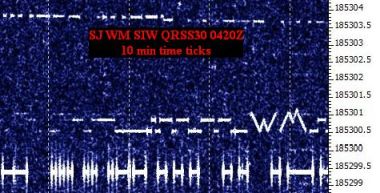
And of course with good conditions lowfer EAR was in there too.
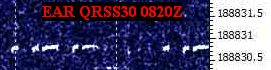
Garry, K3SIW, EN52ta, Elgin, IL
---------------------------------------------------------------
File Attachment 1: capt003_sdr-iq2_eprobe2_0003_edit_resize.jpg
File Attachment 2: capt003_sdr-iq2_eprobe2_0009_crop.jpg
TH now on 187.507 kHz
Since propagation was pretty good last night took a look for lowfer TH on the new frequency. At 1072 km with rate QRSS3 didn't expect much but turned out a number of "TH" sequences came through. Will be interesting to see how digital modulations turn out in the future.
--
Garry, K3SIW, EN52ta, Elgin, IL
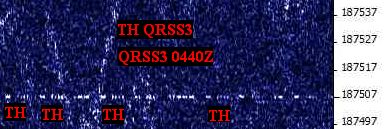
×2:
---------------------------------------------------------------
File Attachment 1: capt003_sdr-iq2_eprobe2_0005_edit.jpg
SDR Receivers Useful For MW/LW
Here is a list of SDR's that may be useful to some for receiving on LW/MW frequencies. The list was compiled by Dave AB5S and was posted on the Boatanchor List. An explanation of his selection process also follows...73 de Bill K4JYS:
"List of SDRs in North America which are usable to monitor the 630 Meter (472-479 KC) MW Ham Band. Those which didn't "make the cut" were nearly all overwhelmed by Common Mode noise from using long wires or other such antennas unsuitable for Medium Wave. Others were mis-configured or incapable of reception below 500 KC. The receivers on this list were checked early Feburary 2019. Of course, their configurations, antennas or operation can change without notice at any time.
73 Dave AB5S
P.S. What's up with Alberta?
They have an active Longwave club?"
Alberta, CA
http://kiwisdr.ve6slp.ca:8173/
http://ciw321.cfars.ca:8174/
http://kiwisdr.ve6slp.ca:8173/
http://va6ok.ddns.net:8073/
http://kiwisdr.ve6slp.ca:8173/
http://173.209.121.35:8062/
http://173.209.121.35:8062/
http://75.152.120.27:8073/
Arizona
http://no1dsdr.ddns.net:8073/
British Columbia
http://kiwisdr.ece.uvic.ca:8073/
California
http://198.40.45.23:8072/
Colorado
http://n6gn.no-ip.org:8073/
http://n6gn.no-ip.org:8074/
Dominican Republic
http://dr.twrmon.net:8073/
Georgia
http://wv5l-sdr.dynu.net:8073/
Hawaii
http://72.235.217.245:8073/
Idaho
http://ka7u.no-ip.org:8073/
http://ka7u.no-ip.org:8074/
http://ka7u.no-ip.org:8075/
Kansas
http://64.136.200.36:8073/
Maine
http://rx2.wa2zkd.net:8073/
Maryland
http://sdr.hfunderpants.com:8073/
Massachusetts
http://rosslloyd.asuscomm.com:8073/
http://kiwiab1ld.ddns.net:8073/
http://kiwisdr.baloney.fun:8073/
Montana
http://108.174.127.102:8073/
Nevada
http://74.82.153.108:8073/
http://12.29.214.134:8073/
New York
http://rx.jimlill.com:8073/
North Carolina
http://n4ttn.ham-radio-op.net:8073/
http://chimay.homelinux.org:8073/
Ohio
http://ohioswl.com:8073/
Pennsylvania
http://kiwisdr.dlinkddns.com:8073/
http://radiodxing.ddns.net:8073/
http://k3fef.com:8073/
Texas
http://50.26.40.209:8073/
Vermont
http://73.68.202.112:8073/
Virginia
http://n4tvc.zapto.org:8073/
______________________________________________________________ WA5DJJ 22M Super Grabber
Boatanchors mailing list
Home: http://mailman.qth.net/mailman/listinfo/boatanchors
Help: http://mailman.qth.net/mmfaq.htm
Posted by Mike N8OOU on February 13, 2019 at 00:55:37.
Beacon Operators;
I have been using the WA5DJJ Super Grabber to monitor the WM Hifer beacon over the past several weeks. I have found that the grabber paints my signal almost every day, a couple hours BEFORE dusk. By the time it gets dark in IL., I have disappeared off the grabber.
I set up a Linux cron entry to run the wget program at 01,21, and 41 minutes each hour. That captures the most current 20 minute view of Daves 22M grabber image. The script adds a time stamp to the filename and stores it to the harddrive. The captures can be quickly viewed later, using the Geeqie image viewer. I am no longer a windows expert, but I believe it has comparable capabilities. My simple Linux Script follows;
#! /bin/bash
#
# make a crontab -e to trigger this script
# 01,21,41 * * * * /home/mike/test1/grab22m
# snatch a personal copy of wa5djj 22m grabber. Neat "Solder-Wick" Desoldering Trick
wget --output-document=/home/mike/test1/djj22m$(date +%F_%T).jpg https://qsl.net/wa5djj/uhf4.jpg
Posted by Dave Childs on February 13, 2019 at 07:44:05.
I'm repurposing a piece of perf board into a digital timer project & needed to remove & relocate most of the original components. I tried using some braided copper wicking but couldn't get the solder to flow from the on-board component leads to the wicking. As an experiment I tried dipping end of the wicking into some plumbers' non-corrosive soldering flux before heating it next to a connection to be unsoldered & the improvement was amazing, like night & day. Desoldering time per connection now is less than half the time that a plunger type solder sucker took. And you only need to use a tiny amount of flux. Hope others find this tip helpful, too.
Re: Neat "Solder-Wick" Desoldering Trick
Posted by Dave Childs on February 13, 2019 at 16:30:34.
In reply to Neat "Solder-Wick" Desoldering Trick posted by Dave Childs on February 13, 2019
Also, in the interest of clarity I should probably explain that the perf board I'm using had copper solder pads on the underside...
Re: SDR Receivers Useful For MW/LW
Posted by Tim Brannon, WA5MD on February 13, 2019 at 21:29:03.
In reply to SDR Receivers Useful For MW/LW posted by Bill Stewart, K4JYS on February 12, 2019
Bill, Lowfer HK
Thank you so much for posting this list. I've used several receivers on www.WebSDR.org to listen to HF, but I didn't know about any that covered LF. I'm looking forward to trying more of these tonight after sundown.
73 de Tim
Posted by Garry, K3SIW on February 14, 2019 at 00:00:44.
I see lowfer HK is running well tonight, roughly QRSS3 at 185.194 kHz from EN61br, a bit above lowfer SIW running EbNaut on 185.185... kHz.
73, Garry, K3SIW, EN52ta, Elgin, IL Re: SDR Receivers Useful For MW/LW
Posted by Bill Stewart, K4JYS on February 14, 2019 at 00:01:18.
In reply to Re: SDR Receivers Useful For MW/LW posted by Tim Brannon, WA5MD on February 13, 2019
GL with your LF/MF listening Tim. I haven't tried any, but will try a few as time permits. I am now using a Ten Tec RX340 with a PA0RDT Mini-Whip which works real well. As Dave sorta said, results may vary depending on the setup, etc at the receive site. Let us know how the ones you try work...73 de Bill K4JYS
Re: SDR Receivers Useful For MW/LW
Posted by Lee Short on February 14, 2019 at 01:16:08.
In reply to SDR Receivers Useful For MW/LW posted by Bill Stewart, K4JYS on February 12, 2019
Thanks for that. Very useful!
Re: Neat "Solder-Wick" Desoldering Trick
Posted by Lee Short on February 14, 2019 at 01:33:08.
In reply to Neat "Solder-Wick" Desoldering Trick posted by Dave Childs on February 13, 2019
I to have been frustrated by the solder wicks slow response to heat. I own a small tube of Rat Shack flux. I will try that combo next time I need to remove something. Thanxs.
Re: Lowfer HK
Posted by Linas KC9PCP on February 14, 2019 at 17:42:41.
In reply to Lowfer HK posted by Garry, K3SIW on February 14, 2019
Hi Garry,
Thanks for the reception report, that is the first one I have gotten!
Hope it's not too close in frequency to SIW. You must have the same crystal I have, a tall HC13/U at 185.185 khz. I should be able to move it up a bit more.
Thanks and 73 Re: Lowfer HK
Linas KC9PCP
Posted by John Davis on February 14, 2019 at 21:14:36.
In reply to Re: Lowfer HK posted by Linas KC9PCP on February 14, 2019
From my perspective here in SE Kansas, I wouldn't recommend making any moves just yet. In this band, with slow modes such as these, you could be as little as 1 Hz away without any problem.
At this very moment, in fact, I'm conducting a survey down at my farm to see what frequencies might be quietest and which are noisiest in that immediate vicinity. I'll be repeating that survey again after dark, also, and will post when I have some results.
One thing that would be worth considering is maybe slowing down the keying on the LowFER beacon to about QRSS30, if you can. That would greatly improve the chances of being received over longer distances.
John
Re: Lowfer HK
Posted by Garry, K3SIW on February 15, 2019 at 03:16:44.
In reply to Re: Lowfer HK posted by Linas KC9PCP on February 14, 2019
Linas,
Your frequency is fine. Like John Davis says, properly stabilized lowfers can work within a Hz of each other without trouble, especially if they run much slower speeds than QRSS3.
My lowfer doesn't use a fundamental crystal but rather DDS circuitry. 185.185... kHz happens to equal 10 MHz divided by 54. The 10 MHz source is an OCXO with 50 ppb stability. That's not quite good enough for EbNaut so the OCXO is locked to a GPS Jupiter module. This is called a GPSDO and it offers nearly perfect frequency stability.
185.2993 kHz QRSS30/60 operation isn't nearly so critical so here the frequency is set by a special LF version N3ZI synthesizer clocked by a free-running 4.8 MHz OCXO.
Last year I ran wspr-15 and opera-32 on 185.185... kHz. The frequency for that was generated by a QRP Labs Ultimate 3S whose frequency synthesizer was clocked by a 27 MHz TCXO with homebrew bang-bang temperature control.
Obviously there are a lot of ways to generate stable lowfer frequencies.
73, Garry, K3SIW, EN52ta, Elgin, IL
Re: Lowfer HK
Posted by Linas KC9PCP on February 15, 2019 at 16:02:16.
In reply to Re: Lowfer HK posted by Garry, K3SIW on February 15, 2019
Garry, John, Reminder: Lowfer net +/- 3927Khz Saturday morning 0800 California time
Yes properly stabilized lowfers can operate right next to each other, but this one is not properly stabilized and heading lower. It was 185.22 last week. I will add some capacitance in series or parallel with the crystal to see if I can move it further above or below. I also have a couple crystal ovens I can adapt to this crystal. Thanks for the other suggestions I can look into for more stability.
Also as John suggested I will be trying QRSS30 this weekend. Just look for my post for the new frequency I come up with.
Thanks,
Linas KC9PCP
Posted by Jerry Parker on February 15, 2019 at 16:27:02.
Reminder: Lowfer net +/- 3927Khz Saturday morning 0800 California time
Or listen online at:
http://69.27.184.62:8901/?tune=3927lsb
Reminder: Lowfer net 3927Khz Saturday morning 0800 California time
see you there
KFS WebSDR in California Southern California Aero Beacons
69.27.184.62
Posted by Lee Short on February 16, 2019 at 04:38:56.
Anybody have a current list of Southern CA Aero beacons. Or point me to a WEB site. I've got a R75 receiver I want to check out thanks in advance. KE6PCT
K6FRC Into NC Again
Posted by Bill Stewart, K4JYS on February 16, 2019 at 16:24:51.
I am barely hearing K6FRC, 1611-1618Z, 2/16/19. Sigs are nil up to about RST 339 with the usual QSB. No others heard as of yet. WAS is down for a short listening period. Re: Southern California Aero Beacons
73 de Bill K4JYS
Posted by James Vander Maaten on February 16, 2019 at 17:58:23.
In reply to Southern California Aero Beacons posted by Lee Short on February 16, 2019
I found this.
http://www.dxinfocentre.com/ndb.htm
jim vm HANGING BY A THREAD--UPDATE 2
Posted by Webmaster on February 16, 2019 at 20:24:05.
In reply to HANGING BY A THREAD--UPDATE posted by Webmaster on February 10, 2019
After two weeks of being unable to administer most of our pages, some (but not all) of the functionality of our lwca.org server has been restored. Our "nuclear clock" has had a few more minutes added to it, figuratively speaking, but we should remain prepared to switch to lwca.net at any moment if this site does fail entirely.
As said before, current Plan B is not a very good one. But it will evolve into Plan B½ this coming week, and continue to improve from there. Watch for further announcements.
John
GNK beacon move
Posted by Domenic Bianco on February 16, 2019 at 22:17:55.
Hi All, Re: Southern California Aero Beacons
I will be moving to a house (once I find the perfect one) from my apartment in Madison Wisconsin to a much smaller town. I will be shutting the GNK beacon down tomorrow 2/17/2019 at about noon. As soon as I'm relocated, I will work on getting the transmitter back on the air asap. I'm looking at a few houses that are both way up on a hill so I can get back into 2 meter weak signal work. I will keep the board fully informed.
Thank you,
Domenic
KC9GNK
Posted by Lee Short on February 17, 2019 at 02:25:31.
In reply to Re: Southern California Aero Beacons posted by James Vander Maaten on February 16, 2019
Thanxs
Re: Southern California Aero Beacons
Posted by Lee Short on February 17, 2019 at 02:32:08.
In reply to Southern California Aero Beacons posted by Lee Short on February 16, 2019
So I decided to go airport WEB sites and got these freqs. Don't know if they are current or not but a place to start. El Monte 359khz, Compton 378khz, Pacoima 370khz, General Williams 282khz, MAAGG 337khz, Petis 397khz. Have fun.
Beacon HK 185.22 now QRSS30
Posted by Linas KC9PCP on February 17, 2019 at 02:35:24.
Beacon HK in EN61br Hickory Hills,IL is now running QRSS30 at 185.220 kHz till midnight Saturday and Sunday. Re: GNK beacon move
Looking forward to reports.
Thanks,
Linas KC9PCP.
Posted by John Davis on February 17, 2019 at 04:12:28.
In reply to GNK beacon move posted by Domenic Bianco on February 16, 2019
Thanks, Domenic. Moving is never fun, but best wishes! We'll look forward to having you back on.
Re: Beacon HK 185.22 now QRSS30
Posted by Garry, K3SIW on February 17, 2019 at 04:15:24.
In reply to Beacon HK 185.22 now QRSS30 posted by Linas KC9PCP on February 17, 2019
Unfortunately the transmission frequency is now quite unstable and the character lengths are not QRSS30 but vary quite a bit in length.
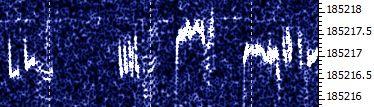
73, Garry, K3SIW, EN52ta, Elgin, IL
Re: Southern California Aero Beacons
Posted by Lee Short on February 17, 2019 at 04:48:11.
In reply to Re: Southern California Aero Beacons posted by Lee Short on February 17, 2019
After checking this list of airport beacons the only one that appears on dxinfo.com today is Petis 397khz. That is in San Bernadino. Not many choices left in SoCal.
Re: Beacon HK 185.22 now QRSS30
Posted by John Davis on February 17, 2019 at 04:54:01.
In reply to Re: Beacon HK 185.22 now QRSS30 posted by Garry, K3SIW on February 17, 2019
The frequency variations in the capture remind me a lot of the way HiFERs using the Black Cat kit look when they're trying to push or pull the crystal frequency a little too far.
A crystal cut for 185.185 kHz being pulled up to 185.22 is almost a +190 ppm change, which is a substantial stretch. For sake of stability, it might be better to simply let the crystal run at its rated circuit capacitance, at least until it's done aging, and then shift it just a little from its final frequency if necessary to avoid interference.
Just a thought. I have no guesses about the timing issue, however.
John
Re: Beacon HK 185.22 now QRSS30
Posted by Garry, K3SIW on February 17, 2019 at 05:01:47.
In reply to Beacon HK 185.22 now QRSS30 posted by Linas KC9PCP on February 17, 2019
QRSS rate has sped up and message "HK" is now easily seen. But frequency instability is still substantial. After keyup the frequency drops quickly, then stabilizes so dashes are easier to visualize than dots.
73, Garry, K3SIW, EN52ta, Elgin, IL
Re: Reminder: Lowfer net +/- 3927Khz Saturday morning 0800 California time
Posted by Paul on February 17, 2019 at 18:29:38.
In reply to Reminder: Lowfer net +/- 3927Khz Saturday morning 0800 California time posted by Jerry Parker on February 15, 2019
WA6OWR DE K6FRC
Did anyone check in this week? Re: GNK beacon move
Posted by Paul on February 17, 2019 at 18:33:37.
In reply to GNK beacon move posted by Domenic Bianco on February 16, 2019
Nice work, Domenic! Thank you for the update.
FB on getting into a house. Especially one with some elevation. I'm sure you already know that elevation doesn't just help on VHF, it helps on HF also. Hope you find a spot that is also RF quiet. Not many places in the US without a bunch of switching supply or digital RF noise anymore.
Looking forward to catching GNK from the new QTH! Best of luck and VY 73.
Re: K6FRC Into NC Again
Posted by Paul on February 17, 2019 at 18:34:14.
In reply to K6FRC Into NC Again posted by Bill Stewart, K4JYS on February 16, 2019
Thanks, Bill! Want a QSL?
Re: K6FRC Into NC Again
Posted by Bill Stewart, K4JYS on February 17, 2019 at 19:52:03.
In reply to Re: K6FRC Into NC Again posted by Paul on February 17, 2019
Tnx Paul...got one from a previous report. Save one for that 599 report when condx get better....73 de Bill K4JYS
Re: Beacon HK 185.22 now QRSS30
Posted by Linas KC9PCP on February 17, 2019 at 21:51:37.
In reply to Re: Beacon HK 185.22 now QRSS30 posted by Garry, K3SIW on February 17, 2019
Garry, John, Re: Beacon HK 185.22 now QRSS30
Thanks for the feedback. It looks like when I'm keying the PA stage it changes the load on the oscillator and causes the shift. The oscillator voltage is regulated but the PA is not so it looks like that as the PA voltage stabilizes the load keeps changing and affecting the frequency.
I will regulate the PA voltage to see if that helps, if not then I have a digital signal generator kit I will build and use that for the frequency source to eliminate any crystal pulling/aging issues.
As for the keying I was making some adjustments yesterday so maybe that's what you saw with the inconsistent keying.
Again thanks for the input and I'll post once I have these issues sorted out.
73
Linas KC9PCP
Posted by John Davis on February 17, 2019 at 23:48:02.
In reply to Re: Beacon HK 185.22 now QRSS30 posted by Linas KC9PCP on February 17, 2019
Linas, are you still on the air this evening? If so, I will listen again for a while.
Re: Beacon HK 185.22 now QRSS30
Posted by Linas KC9PCP on February 18, 2019 at 05:03:10.
In reply to Re: Beacon HK 185.22 now QRSS30 posted by John Davis on February 17, 2019
Hi John, Re: Beacon HK 185.22 now QRSS30
I was doing some experiments with stability and keying today,so it was on and off all day. It seems much improved now so I'll run it Monday Evening 7-11 PM before I start more modifications.
Thanks,
Linas
Posted by John Davis on February 18, 2019 at 05:53:48.
In reply to Re: Beacon HK 185.22 now QRSS30 posted by Linas KC9PCP on February 18, 2019
Thanks Linas. Not having heard back before dark, I set up several Argo instances to cover as wide a range of frequencies as I could, but did not turn up anything that looked like "HK" so I figured you might not be on tonight.
WM and SIW were quite good, but there was no sign of SJ tonight, just as when I listened early last week. Had to give up tonight when the pickup bed cover froze shut and I couldn't crank the generator to recharge batteries.
Will try again between 7 and 11 PM Monday.
John
Re: Southern California Aero Beacons
Posted by James Vander Maaten on February 18, 2019 at 17:26:06.
In reply to Re: Southern California Aero Beacons posted by Lee Short on February 17, 2019
Up here in northern California, we have only 3 LF NDBs. There could be more but the airport approach sheets are very out of date with the beacons shown.
I have heard 203 kHz TCY in Tracy, 404 kHz MOG near Montague, and MR 385 kHz Monterey.
Maybe someone could let me know if there are any more active NDBs in California.
skyvector.com is where I go for information.
Good luck, 73 jim vm
Re: Southern California Aero Beacons
Posted by John Davis on February 18, 2019 at 18:30:31.
In reply to Re: Southern California Aero Beacons posted by James Vander Maaten on February 18, 2019
A tool I sometimes like to use for NDB targets is the RNA database, linked on our lwca.org home page. It's based on listeners' loggings rather than official sources, but it has lots of search criteria available that really make it useful.
When I specified loggings of California NDBs over the last six months, it turned up the three Jim mentioned (TCY, MOG, and MR) plus 397 SB in San Bernardino among the recent loggings. 209 HGT is also listed as being logged back in early January, but a NOTAM describes it as "unserviceable."
John
Re: Beacon HK 185.22 now QRSS30
Posted by Garry, K3SIW on February 19, 2019 at 02:28:59.
In reply to Re: Beacon HK 185.22 now QRSS30 posted by Linas KC9PCP on February 18, 2019
Linas, HK looks much better and good enough for QRSS10. However, it still has a ways to go in terms of stability for QRSS30.
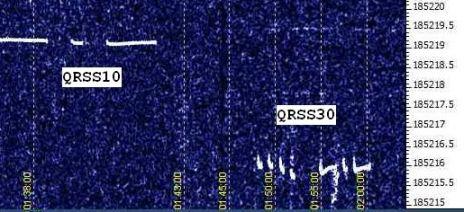
73, Garry, K3SIW, EN52ta, Elgin, IL
Re: Beacon HK 185.22 now QRSS30
Posted by Linas KC9PCP on February 19, 2019 at 05:08:58.
In reply to Re: Beacon HK 185.22 now QRSS30 posted by Garry, K3SIW on February 19, 2019
Garry, HK in SE Kansas
Thanks for the screen shots. All I did was reduce the coupling capacitor from the oscillator to the PA from 1000pf to 100pf. I still need to regulate the PA voltage and that will hopefully get it stable enough.
Thanks and 73,
Linas KC9PCP
Posted by John Davis on February 19, 2019 at 08:21:42.
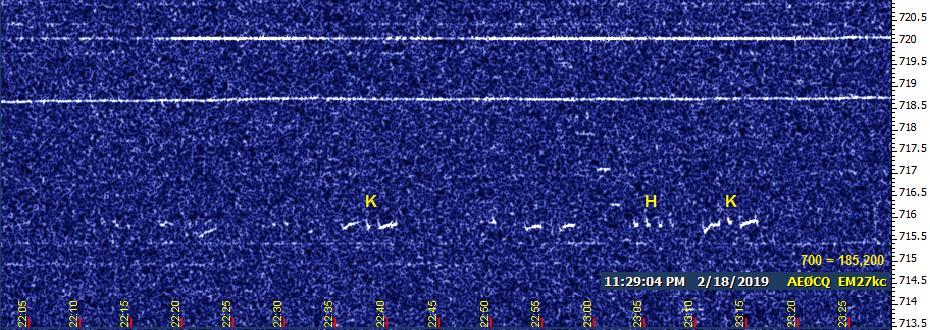
This capture spans about an hour and 27 minutes, encompassing my entire reception of HK this evening. Distance is approximately 504 miles. Congratulations, Linas!
From this evening's results, I would conclude that (a) groundwave coverage from there to here is likely to be problematic because your antenna current is not yet up to that of WM or SIW, but skywave offers a noticeable improvement, suggesting that operation later into the night would improve your DX chances; and (b) your current frequency is a fairly good one, relatively free of strong PLCs or other QRM here on the central Plains. The carriers about 2.5 and 4 Hz above you are prominent, but don't seem excessively loud here; while the one at 185,215.5 was stronger early in the evening, but of no consequence by the time your signal rose in level.
Looks like you made significant progress with the coupling capacitor change. I'm skeptical about seeing much improvement from regulating the PA voltage, however. The time constant of the upward tilting portion of the instability seems more consistent with thermal effects. Would it be practical to isolate the oscillator from heat produced by the final, do you think?
---------------------------------------------------------------
File Attachment 1: 18feb-HK.jpg
Re: Beacon HK 185.22 now QRSS30
Linas,
That decrease in coupling between your oscillator and PA certainly helped. But like Johh commented stabilizing the PA voltage probably won't do much. If you can add an emitter follower between your oscillator and PA that would minimize loading on your maintaining circuit. Also, if you can reduce feedback in the oscillator that will help prevent crystal heating. You only want just a bit more feedback than necessary to maintain oscillation, otherwise the crystal resistance heats the quartz unnecessarily and that leads to drift.
If you look closely at the QRSS20 capture at http://mailman.qth.net/pipermail/lowfer/attachments/20190218/bb327fae/attachment.jpg you'll see there is some longer term frequency wobble beyond the more obvious drop off at keyup. I think John commented on the problem of trying to pull a crystal too far off its fundamental frequency. Your present frequency of about 185.216 kHz is fine but you can also safely lower that quite a bit safely too.
If your crystal is really marked 185.185 it's hard to believe operating it so high results in an oscillator whose stability is set by the crystal rather than surrounding circuitry. Usually pulling a crystal up more than 20 ppm or so (4 Hz here) is not a good thing. If you have a scope or RF probe and signal generator you can check series resonance of your crystal by driving it through a resistor of a few hundred ohms and noting the frequency where minimum voltage across the crystal occurs.
Good luck and 73, HiFERs Tuesday 19 Feb.
Garry, K3SIW, EN52ta, Elgin, IL
Posted by John Davis on February 19, 2019 at 18:56:03.
Got started listening about 11 AM CST. Right away, AZ was visible, sometimes briefly audible.
Mystery signal! About 13557.43, drifting down to .42, was a keyed signal with some visible (but not particularly audible) chirp. Unfortunately, it was not audible enough to copy the message. Anyone want to claim it? It was accompanied by a long-tailed chirper at about .440, and moderate-length slightly-chirpy dashers at .460 and .560.
TON was faintly visible but not audible. WAS wasn't present at first, but gradually became visible and then audible. And, FRC was fair to good.
Down at the watering hole, NC was all the way up at 13555.580, off the normal screens. Must be cold in NC today. USC was fair to good, 7P was good, and EH was fair. No sign of RY yet when I had to return to town.
Will follow up with a later report and probably some captures. Also, have a report or two from last week that may be of some interest.
John
Re: HiFERs Tuesday 19 Feb.
Posted by ed holland on February 19, 2019 at 19:09:29.
In reply to HiFERs Tuesday 19 Feb. posted by John Davis on February 19, 2019
Nice report John,
No sign of PVC - I always wonder if I'm getting out at all... FRC seems to make it to you, so I wonder what the determining factor might be between our stations?
Oh well, we'll keep trying.
Ed
Re: HiFERs Tuesday 19 Feb.
Posted by John Davis on February 19, 2019 at 21:43:27.
In reply to HiFERs Tuesday 19 Feb. posted by John Davis on February 19, 2019
As of 1:30 PM CST, RY was present but not very strong yet, and EH was a little better than two hours before. I didn't get to try a band scan at that point, needing to switch over to 1750 meters for another project right then. (That one wasn't too productive, given the big line of thunderstorms from Texas through Georgia.)
About 3:00 PM I returned to 22 m and did a brief scan. No AZ, WV, or VAN, and no mystery signal any more at 13557.4± either. WAS was weaker than before, but still present, while FRC was absent altogether. At the watering hole, NC was gone and USC was only a ghost of itself. 7P and RY were better, and EH was thoroughly audible. Two WSPRs started showing up faintly, one below and one above RY. It took a little while before they were coming in consistently enough to decode, but they proved to be J1LPB and K5LVB, respectively.
More this evening.
Re: HK in SE Kansas
Posted by Linas KC9PCP on February 20, 2019 at 02:52:29.
In reply to HK in SE Kansas posted by John Davis on February 19, 2019
John, Re: Beacon HK 185.22 now QRSS30
Thanks so much for the reception report and screen shot. I am very happy about getting received in Kansas!
You have a good point about thermal effects as the PA is right next to oscillator being that it is a 12AU7 tube. I don't keep it on all the time because it's in a breadboard state, but I will be rebuilding it soon with lessons learned on a metal chassis that I can trust for long duration use. The new design will have full regulation and an itermediate stage for more stability.
Meanwhile I will running it most nights 7 to 11 till the new one is done.
Thanks and 73,
Linas KC9PCP EN61
Posted by Linas KC9PCP on February 20, 2019 at 03:17:47.
In reply to Re: Beacon HK 185.22 now QRSS30 posted by Garry, K3SIW on February 19, 2019
Garry, SJ, WM, SIW & a Healthy Pair of EARs
Thanks for the screen shot and suggestions, I will be rebuilding the transmitter soon and will incorporate an intermediate buffer stage and full regulation. As for the crystal I did not notice much better stability without the series capacitor to shift frequency, but its probably not worth doing more on this until I get buffer stage working.
Thanks and 73
Linas KC9PCP
Posted by John Davis on February 20, 2019 at 07:40:14.
In addition to HK, Monday night brought excellent copy of SJ, which apparently signed on just before 8:50 PM CST and had stabilized frequency by 9:30 PM and grew really strong by midnight...plus WM with the usual graphics and FSK, and SIW in EbNaut. Those are depicted in the file attachment "18-19feb.jpg" below. (Usually, I try to time-align two separate Argo windows in a case like this, but the notebook computer's touchy touch pad apparently enabled me accidentally to shut down the SIW capture too soon.)
Before yielding to the cold temperatures for the night, I tuned to EAR for half an hour, and was rewarded with the other attached capture of a strong, remarkably QRM-free signal.
John
---------------------------------------------------------------
File Attachment 1: 18-19feb.jpg
File Attachment 2: 18feb-EAR.jpg
Re: HK in SE Kansas
Wow! A tube LF transmitter. That takes me back to the good old days! :)
I think Garry and I were both assuming it was solid state when we were offering stability suggestions. My thoughts about thermal stability were predicated on heat from the final transistor possibly affecting oscillator components over the time frame of several seconds, as is often the case with solid state transmitters if built too compactly; but in this case it's more likely thermal effects in the crystal itself because of drive level. That makes Garry's comment about minimizing drive even more important.
Also, I was assuming the transmitter was keyed after the oscillator stage. If that's not a valid assumption, then a buffer stage with the keying applied there instead of the oscillator would kill two birds with one stone. Of course, that means you'll hear some backwave on a local receiver, especially if the triode stages are not neutralized. Neutralization is usually not important in this band*, and the backwave shouldn't be strong enough to bother a distant listener.
John
(*In college, I built a multi-purpose 2.5 W tube rig that first served as an AM carrier current transmitter in the dorm, later as an auxiliary transmitter at a commercial broadcast station for a time, and finally as an LF CW transmitter. It didn't exactly start out in breadboard form..."cardboard" would be the more accurate term, as the prototype was built and tested dead-bug style with the tubes mounted inverted through holes in a cardboard box. I then built it up neatly on a nice metal chassis over Christmas break, incorporating features I'd tested in its crude form. The first three RF stages employed unneutralized triodes. The oscillator had deliberate feedback, of course, but the two untuned buffer stages formed a long-tail pair--in effect, a cathode follower directly coupled to a grounded-grid gain stage, neither of which require neutralization for stability up through low HF. Two dual section tubes were used, one a dual triode and the other a triode-pentode combo. The PA was a pentode since it was originally operating at MF in common-cathode configuration; had I confined it to LowFER use, it could easily have been another triode. The only two tuned elements in the design were the crystal itself and the PA tank.)
Re: SJ, WM, SIW & a Healthy Pair of EARs
Posted by John Bruce McCreath on February 20, 2019 at 13:43:14.
In reply to SJ, WM, SIW & a Healthy Pair of EARs posted by John Davis on February 20, 2019
Thanks for the report and Argo snip, John. They're calling for freezing rain for us later in the day, but I'm hoping to dodge it like I did a week ago. I don't need any downed antennas!
73, J.B., VE3EAR Re: HiFERs Tuesday 19 Feb.
Posted by John Davis on February 20, 2019 at 17:53:36.
In reply to Re: HiFERs Tuesday 19 Feb. posted by John Davis on February 19, 2019
I indicated "more this evening," but it turned out there wasn't much more before our sleet arrived and I had to pack up and return to town. By 4:30 PM CST, only 7P, EH, and RY remained at the watering hole, all with good signals. AZ was faintly visible but not audible, wandering around 13554.20. No WV, no more drifting mystery signal at ≈13557.4, uncertain visibility of TON, no WAS...but a good signal from K6FRC most of the time.
No more WSPR traces visible by then, either, and the two decodes bracketing 3 PM turned out to be the only ones for the day.
2058  -25  -0.5   13.555409    0   J1LPB         FN03      0
2102  -24  -0.8   13.555365    0   K5LVB         EM10      7
John
The secret of a successful HiFER
I have been wondering the subject of this posting (success in HiFERing) since setting up PVC 3-4 years ago. In all that time, I received a few reports from Bill Hensel in Colorado and IIRC, from Patterson, CA. Lately, nothing at all.
By contrast, when the opportunity arises to listen during good conditions, Lots of stations can be identified, per my sporadic reports.
So why the imbalance? Is it the ratio of listeners to beacons? Location? something incorrect in the station or antenna setup? or is it just the way things are?
PVC is operating at a location ~600 ft above sea level, with no geographical obstructions "looking" out to the rest if the Contintental US.
The transmitter feeds a properly trimmed inverted V dipole through an antenna tuner. Power out of the TX is adjusted in accordance with that suggested for antennas of this typ. Signal is peaked up using the signal received on another antenna about 100 ft away. Very little inductance or capacitance is needed from the ATU to achieve this.
There is a significant length, perhaps 60 ft, of 75 ohm (RG6U) feedline. This leads from the basement location of the transmitter to the rooftop placement of the antenna. The antenna feed-point is ~18 ft above the (non conducting) roof, and the ends at least 6 ft above it. All connections are well made and checked.
One concern is there is a large solar panel array also on the roof, quite near the antenna on the Northeast side.
The signal can be detected readily with a small SW portable receiver at (and beyond ) 1 mile distant, in the hills to the West of the house. On one occasion, I succeeded in receiving at 3.5 miles.
The effort will continue. Thoughts from the team here would be welcome, as part of the fun is in trying to do better, and running experiments :)
Cheers
Ed
LF Upconverter Article Relocation
Posted by Webmaster on February 21, 2019 at 06:43:35.
The popular High Performance LF Upconverter article by Tim Brannon has been relocated within our online Library, and now reflects his new amateur radio call sign. It can now be found at: BY A THREAD--UPDATE 3: Progress!
/library/articles/wa5md/lfconvtr.htm
Posted by Webmaster on February 21, 2019 at 07:06:45.
In reply to HANGING BY A THREAD--UPDATE 2 posted by Webmaster on February 16, 2019
Thanks to the support folks at Spry, the LWCA Solar Activity Page has returned to full functionality, and the hit counters on our various pages work once again...although they are missing two and a half weeks' worth of counts, of course.
It took that long to get the trouble ticket elevated to the specialty administrators who handle the "outdated" legacy hosting plan we're on, and there's no telling how long the next outage will take to resolve. Consequently, we're continuing with Plan B½ to eventually migrate to a newer server. With luck, that will happen with no further disruptions visible to you, the reader, apart from the Message Board possibly going to read-only status for a few hours during the transition. Watch for further announcements.
Re: The secret of a successful HiFER
Posted by Mike N8OOU on February 21, 2019 at 14:31:19.
In reply to The secret of a successful HiFER posted by Ed Holland on February 21, 2019
Ed,
For the WM beacons (Hi and Low) I have elected to build the traditional 1/4 wave ground plane vertical. I have covered most of the build details on WM Beacon web pages. The Hifer radiator and ground plane lengths are adjusted for resonance on the transmitter frequency, and fed directly with no Antenna Tuners, Baluns or Chokes.
Sorry, I don't have any secrets for you. The only thing I will claim to be successful is that WM has been transmitting continuously since 2016, with just the occasional outage for listening or lightning storms.
Good Luck with your experiments.
73 Mike N8OOU
Re: The secret of a successful HiFER
Posted by Bill Stewart, K4JYS on February 21, 2019 at 15:39:47.
In reply to The secret of a successful HiFER posted by Ed Holland on February 21, 2019
Hello Ed,
I am not sure where you are located which also means I am not sure what the propagation should be for me to receive your beacon. Back a couple of years ago, when I started listening on 22m, I could hear a few beacons and numerous ISM type signals. Now when I tune the band I hardly hear signals of any kind. Maybe a few CODAR bursts, but seldom hear a beacon...maybe GNK or K6FRC...that's about it. So part of the problem could be the low or non-existent sun spot activity. From the reports I see on here, John Davis seems to have the best spot in the country for listening. Also those of us who run beacons may not listen all that much so that may remove some ears.
I am sure you know all the following....you have been at this beacon business longer than I have. You mentioned you were using an antenna tuner. They can be lossy and at our power levels could reduce your RF at the antenna. Also, and I think I am right on this....the power should be per the spec. at the antenna so you can adjust the xmtr output to give the required power at the antenna, so coax loss shouldn't be of any concern (with-in reason). Can you rig up your xmtr to feed the antenna directly and try that config for a while.
With my Black Cat xmtr, I feed a 22m dipole up about 40 feet and maybe 75 feet of coax. I adjusted the SWR to as close to 1:1 as I could. I have had pretty good results since I started WAS up a year or so ago.
Hope things get better for you...would love to put you in the log.
73 de Bill K4JYS/WAS
Re: The secret of a successful HiFER
Posted by Ed Holland on February 21, 2019 at 17:28:08.
In reply to Re: The secret of a successful HiFER posted by Mike N8OOU on February 21, 2019
Hi Mike,
Thanks for your notes on WM.. I did find the home page and will look again.
In fact PVC started out with a vertical, and 6 wire radials. With little experience, I was a bit confused about tuning it all up (old dip meter and noise bridge). I could easily go back to that setup.
Another option that interests me is a small tuned loop, if the sharp tuning could be held steady. Siting this might be a it more tricky, given the odd appearence sensitivity to nearby objects and susceptibility to wind.
Thanks again,
Ed
Thursday 21 Feb HiFERs
Posted by John Davis on February 21, 2019 at 20:23:58.
Got an earlier start than usual today, and was rewarded with fair to good copy of AMA at 8:57 AM CST on 13565.950. It was visible on Argo nearly all the time and was good, clear aural copy about 1/3 of the time. WAS turned up shortly thereafter with mostly good copy too. No WV, FRC, or anyone else in CW was audible or visible. At the watering hole, only 7P and RY were visible.
Later in the morning, NC, USC, and EH joined in, with occasional appearances by MTI. By the end of the noon hour, there had been two WSPR decodes:
1628  -17   0.9   13.555386    3   VS2VRC        FE61     47
1850  -24  -0.2   13.555405    1   J1LPB         FN03      0
That first one is probably an example of the most vivid imagination WSPR-X has ever displayed. Not only do I not believe anyone in grid FE61 (southern Argentina) was running 50 W with a VS2 call sign and a 1.5Hz/minute drift, Argo showed no signal whatsoever at that frequency! Sometimes WSPR misinterprets audio intermod products as a WSPR signal, but there weren't any present today until the noon hour. The space between RY and MTI was utterly clean for the entire transmission slot in question. First time I've ever seen WSPR pull a totally imaginary decode out of thin air.
There were a couple of anomalous Argo traces in the late morning that I need to study further...particularly, some strings of QRSS dots or short dashes that have been showing up intermittently at or slightly above 13555.400, and several seconds of FSK at 13555.550 around 10:32 AM. When I first saw that one, I assumed it was an intermod product because 7P, EH, and RY were fairly strong simultaneously. However, no combination of their frequencies right then could produce that product; so I have to conclude it may be a legitimate but unknown signal that I'm just not able to see most of the time. I've seen something similar at that spot before.
Just before switching to 2200 m at 1 PM Central, I did another band scan. AZ was visible but not audible, WAS was mostly audible, and AMA ranged from inaudible and invisible to moderately audible. All three were experiencing significant QSB from one ID cycle to the next.
John
K6FRC Report in NC
Posted by Bill Stewart, K4JYS on February 22, 2019 at 15:16:57.
Am hearing K6FRC again this AM, 1450-1510Z 2/22/2019. Sig mostly RST 229 to 339 but around 1508-1510 was maxing out at 439 on fade ups. Also hearing a few fairly strong CODAR bursts. As time permits, will try a few more listening periods later today.
73 de Bill K4JYS/WAS
Reminder: Lowfer net + or - 3927Khz Saturday morning 0800 California t
Posted by Jerry Parker on February 22, 2019 at 17:57:53.
Reminder: Lowfer net + or - 3927Khz Saturday morning 0800 California time
Or listen online at:
http://69.27.184.62:8901/?tune=3927lsb
Reminder: Lowfer net 3927Khz Saturday morning 0800 California time
see you there
KFS WebSDR in California New Beacon now active on 13564.4 kHz
69.27.184.62
Posted by Vic on February 23, 2019 at 20:10:42.
Hi Everyone
Announcing a new beacon on 13MHz !
Frequency 13564.4kHz
ID. JUN
Locator EL98
Location Clermont Central Florida USA
Power 4.5mw
Antenna. Dipole
Beacon Black Cat Systems kit
On Air Date 21 February 2019
Schedule appprox 10.00 - 22.00 EST daily ( subject to breaks for adjustments and listening)
Reception reports most welcome to this list or to me by email mail.
My beacon has been heard in SA Antonio Texas already ! Wow what fun this is ;-)
Best wishes to Everyone
Vic W4/GW4JUN
Re: New Beacon now active on 13564.4 kHz
Posted by Bill Stewart, K4JYS on February 23, 2019 at 23:28:35.
In reply to New Beacon now active on 13564.4 kHz posted by Vic on February 23, 2019
Welcome Vic....a bunch of us Black Cats meowing on 22m. I will take a listen for you. Re: New Beacon now active on 13564.4 kHz Freq correction
We are pretty close in freq.
73 de Bill K4JYS/WAS
Posted by Vic on February 24, 2019 at 17:14:45.
In reply to New Beacon now active on 13564.4 kHz posted by Vic on February 23, 2019
Hi Everyone
Just need to clarify the Freq of new beacon JUN as my original post was unclear.
Carrier freq is 13565.2kHz
USB disk Freq is 13564.4kHz
Apologies for my confusion !
Can anyone hear me ? ;-)
73 Vic W4/GW4JUN
Friday 21 Feb HiFERs
Posted by John Davis on February 24, 2019 at 17:14:59.
In reply to Thursday 21 Feb HiFERs posted by John Davis on February 21, 2019
Didn't get to check 22 m until after the 1750 m project was finished, so by 4 PM CST there weren't many signals left...just 7P and RY at the watering hole, a little WAS and FRC, and fair copy of AZ wandering up above 13554.2 kHz. What makes it worth reporting is that I don't usually see or hear AZ so many times in one week.
Couldn't follow up on Saturday because of thunderstorms and rainfall.
Sunday 24 Feb HiFERs
Posted by John Davis on February 24, 2019 at 18:02:38.
Yesterday's rains totaled less than 0.25 inch, but as wet as the ground has been for weeks, that was enough to extend Lake Inferior around the tower into a shallow moat some 50 feet or more in diameter, retain puddles in my gravel driveway, and allow the truck to leave tire tracks in the driveway too.*
Nonetheless, I ventured out to the farm this morning and mounted an expedition on foot across the Okeydokey Swamp and Lake Inferior to reinstall the antenna buffer. From 9 AM to 9:30, I was seeing USC, 7P, EH and RY at the watering hole, abundantly hearing WAS, sometimes faintly catching a snippet of K6FRC. I also spent a fair amount of time listening for new HiFER JUN, but no go so far. AZ continues to be visible and intermittently audible at 13554.230±, but WV was absent yet again. More later today, with any luck.
John
* The graveled sections of the driveway are known as Penny Lane and Lois Lane, which happens to run past Vicki Vale. The as-yet-unimproved sections are Memory Lane (which I keep forgetting to gravel), Frankie Laine--which goes through the second lowest corner of the farm, aka Frankie Valli, where I keep my herb garden (The Four Seasonings)--and then over the hill and around the bend with Nathan Lane to the deepest corner of the farm, Rudy Vallee.
Re: New Beacon now active on 13564.4 kHz
Posted by Vic on February 24, 2019 at 19:00:43.
In reply to Re: New Beacon now active on 13564.4 kHz posted by Bill Stewart, K4JYS on February 23, 2019
Hi Bill
I have corrected my original post ....the carrier freq is actually on 13565.2 ....I originally posted the usb dial Freq by mistake. I hope I am not causing anyone arm as I cannot easily move my xtal .
So far I have only heard AMA and GNK but I am listening regularly.
This is a lot of fun !
73 Vic W4/GW4JUN
Re: New Beacon now active on 13564.4 kHz
Posted by Steve VA3SC on February 24, 2019 at 21:36:33.
In reply to Re: New Beacon now active on 13564.4 kHz posted by Vic on February 24, 2019
Just heard your beacon 'JUN' beacon a few minutes ago under 'AMA'...around 21:30 UTC. I heard it briefly this morning as well. I'm located in Burlington, Ontario, the western end of Lake Ontario
Re: New Beacon now active on 13564.4 kHz
Posted by John Davis on February 25, 2019 at 04:09:38.
In reply to Re: New Beacon now active on 13564.4 kHz posted by Vic on February 24, 2019
13565.2 should be a good spot. Might have better luck in the next few days, now that I'll be looking in the right spot.
It's JUN in February...
Posted by John Davis on February 25, 2019 at 18:56:44.
...to paraphrase the old song!
JUN first showed up about 11:55 AM as a smudge of RF on Argo that looked to be a keyed signal at 13565.177 kHz, so I sat on the frequency a while. It became just strong enough to copy a couple of characters at a time, confirming that JUN is the call sign. A capture of the trace will follow this evening, and perhaps an audio clip.
Welcome to SE Kansas, Vic.
John
Re: New Beacon now active on 13564.4 kHz
Posted by Vic on February 25, 2019 at 20:00:55.
In reply to Re: New Beacon now active on 13564.4 kHz posted by Steve VA3SC on February 24, 2019
Hi Steve
Many thanks for that report ! You are about 1200 miles from me so you are my best DX so far 😀. Not bad for a few milliwatts and a low dipole antenna !
Please do let me know if you continue to hear JUN
Your story on qrz.com is very interesting.
Regards
Vic W4/GW4JUN
Re: It's JUN in February...
Posted by Vic on February 25, 2019 at 20:12:40.
In reply to It's JUN in February... posted by John Davis on February 25, 2019
Hi John
Oh wow ! Thanks for the report.This is so much fun for such a simple set up ;-) I must check to see how far away you are....it's a good haul in any case.
A screen shot and / or sound clip would be great. Please let me know what software you run for monitoring these beacons .....I might give that a try.
Here in Florida, for me at least, (an Englishman) it really does seem like Jun has arrived heheheh.
Kind regards
Vic W4/GW4JUN
Re: It's JUN in February...
Posted by ed holland on February 25, 2019 at 21:59:55.
In reply to Re: It's JUN in February... posted by Vic on February 25, 2019
Congratulations on the report - From one Englishman to another :-)
I think I'll have to try out one of these Black Cat beacons - they seem very successful!
I'll Listen for JUN over here in California on the next opportunity, On a good day, I am able to receive (and hear) some really long hop signals.
Cheers
Ed
Re: The secret of a successful HiFER
Posted by Ed Holland on February 25, 2019 at 22:07:30.
In reply to Re: The secret of a successful HiFER posted by Bill Stewart, K4JYS on February 21, 2019
Hi Bill, thanks for your notes - and sorry I missed your reply until now.
I might try as you suggest, and remove the tuner. It is possible to assess the field strength from a nearby antenna (they shouldn't interact significantly). Certainly worth an experiment, and easy to try.
Cheers
Ed
Re: Reminder: Lowfer net + or - 3927Khz Saturday morning 0800 California t
Posted by Paul on February 26, 2019 at 03:22:00.
In reply to Reminder: Lowfer net + or - 3927Khz Saturday morning 0800 California t posted by Jerry Parker on February 22, 2019
WA6OWR DE K6FRC
Did anyone check in this week?
Re: It's JUN in February...
Posted by John Davis on February 26, 2019 at 04:53:19.
In reply to Re: It's JUN in February... posted by Vic on February 25, 2019
As I hoped to be able to do, here is a screen shot of about 8 minutes of reception, showing how the signal strength fluctuated over that time, and an MP3 audio sample. The latter was amplified in post-processing, so it's not as clear as one might hope.
(Post-processing was a necessity, however, as I did not have a cable with me to record directly from the headphone jack of the radio. The recording was made from the high-pass-filtered and heavily clipped audio with which I drive the computer. That redistributes the energy spectrum of impulse noise and helps Argo better distinguish it from signal...but it's tinny and incredibly unpleasant to the ear. When I post-process WAV files of that feed to remove the harmonics, it tends to smear the keyed signal and makes it harder to copy than what I heard directly from the radio's speaker.)
In the capture, one can see the effects of QSB as the signal rose to visibility, which prompted me to sit on the channel, and then to audible levels over several seconds. I've marked the point during the copy which represents the MP3 recording interval. Wish I'd been prepared about five minutes sooner, though, when I had the clearest and most unmistakable aural copy of the morning!
Equipment was a 15 meter vertical antenna, a homebrew buffer amplifier for broadband impedance matching, and an Icom R75 receiver with narrow crystal CW filter, homebrew passive audio filter-clipper, and an Acer Windows 7 notebook computer. The Argo QRSS software, a simplified variant of Spectran, is from www.weaksignals.com and is also a great tool for discerning traits of signals other than QRSS as well.
John
---------------------------------------------------------------
File Attachment 1: 25feb-JUN.jpg
File Attachment 2: JUN-25feb.mp3
Re: The secret of a successful HiFER
Hi Ed.
I agree with Bill. In fact, I think Bill is one of the most knowledgeable people I have spoken to about this.
When re-reading your first post and describing your setup, by the description of your antenna, it is very apparent that you are sending the majority of your signal straight up.
My first HiFer was similar to yours, except located on a hilltop with steeply sloping sides to the east and west of it. More like a sharp ridge than a hill I guess. Even so, the inverted V was not heard much, if ever. In fact, my listening post (home QTH) is about 50 miles LOS from the beacon site, and I never, ever heard it. I just assumed such a low power beacon was not going to be heard that far away groundwave. I knew the antenna was good because using the antenna analyzer, the SWR was perfect 1:1, and when using the same antenna for receiving, it was very sensitive.
Then, something happened. The broadcast antennas needed to be replaced, and the inverted V had to come down so the crane and tower crew could properly rig the tower for the broadcast antenna replacement. I decided to keep the beacon on the air by purchasing a "Hamstick" antenna and mounting it on the roof of the small metal building using a heavy duty CB type antenna mount bolted to a seam in the metal roof. Upon returning home that night from work, I tuned in the HiFer, just for giggles, and I actually heard it! Didn't change the power or anything, just the antenna.
Not only that, I received some QSL reports from SWLs. Suddenly, my HiFer was being heard. So, I just left it that way, and it is still that way today, 20 years later.
Why? I suspect the takeoff angle is much lower on the HamStick antenna than the inverted V. Even though the HamStick is a short, compromise antenna at only 8 feet tall, there is much more signal on the horizon that there was with the inverted V.
Best of luck to you, my friend. I am sure you will figure it out in short time.
73, Paul
Re: The secret of a successful HiFER
Posted by Ed Holland on February 26, 2019 at 18:04:45.
In reply to Re: The secret of a successful HiFER posted by Paul on February 26, 2019
Thank you Paul,
I really appreciate the discussion, and notes on setup.
There is obviously lots to think about, and experimental fun to be had...and that is why I got into HiFERS in the first place - to timker with radio :-)
Expect updates to PVC soon!
Regards,
Ed
Re: The secret of a successful HiFER
Posted by John Davis on February 27, 2019 at 06:32:38.
In reply to Re: The secret of a successful HiFER posted by Ed Holland on February 26, 2019
(Caution: Long Article. I'm splitting it into two parts.)
Ed, you're already aware of most of these points, but I'm hoping to try to summarize all my observations about HiFERs in one place. I've been working on this over a couple of days and see that Paul has chimed in on the antenna in the meantime, As you see below, I endorse what he said for your situation.
Probably no-one can identify any single secret to a successful HiFER, because it's a combination of factors...a matter of statistics and probabilities, much akin to the famous Drake Equation for the chances of communicating with other intelligent life in the Universe. You may not be able to optimize all terms in the equation equally well, but every one you can improve increases the odds of success; while conversely, if any one term approaches zero effectiveness, the product of all the terms drops off too. Just because one beacon appears to succeed with less-than-optimal parameters doesn't mean another will, because it may have additional sub-optimal factors at work; and it doesn't mean that the first beacon's own performance couldn't be improved. It's all a question of probabilities. You can't categorically say setup A will definitely work and setup B won't; but you can say that A is likely to be heard a lot more often than B on any given day.
Here are some of the general factors any HiFER operator should take into account:
A. Your Geographical Location. Admittedly, most people have little control over this one, but I include it just as a reality check: Try not to be located inside the first skip zone of most listeners who might be trying for you. This can amount to a radius of 500 or more miles at this season of the year and this phase of the sunspot cycle. (For me, it means I hear both coasts much more often than I do stations here in the central states.) That's not necessarily the case for a 20m amateur QRP rig running 5 W or a transceiver putting out 100 W. The extra path attenuation inside the first hop under these conditions can sometimes be overcome by those power levels, greatly reducing the dead zone; but our HiFERs are at a 30 to 43 dB disadvantage from the start. On a good day you may get some usable signal through, but that happens less often than at mid-summer and/or solar max. Don't get discouraged and give up if you're not widely copied right away.
B. Choice of frequency.
- 1. Avoid the center of the band!!! I can't emphasize this enough. Newcomers often seriously underestimate the effect of ISM noise on the DX-ability of their signals because they sound so loud locally compared to the noise. But that's an illusion--your signal falls off much, much faster with distance than the noise will. If you want to be copied outside your own neighborhood, stay at least 2 kHz away from 13560 kHz, and preferably another kilohertz more on the high side.
- 2. Avoid the "watering hole" if you're bound and determined to run CW-only, and especially if your signal is prone to drift! It's a crowded region of the band, which is not a big issue for slow digital modes (if one plans adequately), but it means there will often be lots of carriers beating together audibly on a good day. That makes it harder to copy normal speed CW. Plus, if you're drifting and/or chirping as well, you'll interfere with other signals.
C. Choice of mode.
- 1. Please consider using QRSS3 or WSPR2, or FSK at QRSS3 rate, some combination of them, and/or some graphical mode that can be viewed on a waterfall display at QRSS3...or up to QRSS30 mode if the shift is slow and very narrow. (Bit rates longer than 3 seconds tend to be broken up by short-term fades, while longer term fading seems to favor ≈30 second or longer intervals.) These have all proven in practice to be very effective modes on this band. QRSS3 has a 10 to 13 dB power advantage over conventional Morse, depending on transmission speed. That can make the difference between copy or no copy on this band.
- 2. If you just simply prefer Morse, either consider mixing it with QRSS3, or at least try to include a dash-after-ID pattern of some sort, like VAN, PLM, and WV do! I don't mind listening for code; in fact, it's quite a thrill to copy a distant station by ear. But it helps if I can simultaneously watch Argo in QRSS3 mode to detect a carrier at least 10 dB sooner than I can hear it! You can't decode normal CW by viewing it at QRSS3, of course. But you can get a hint when a signal is potentially about to reach aural copy levels, and that tells me it's worthwhile to keep tuned to that spot a while longer.
Hardware-specific comments in the next part.
Re: The secret of a successful HiFER
Posted by John Davis on February 27, 2019 at 06:35:34.
In reply to Re: The secret of a successful HiFER posted by John Davis on February 27, 2019
Continuing with the Big List O' HiFER Secrets from the previous post:
D. Antenna.
- 1. KEEP IT SIMPLE. Don't go exotic with loops, OCFDs, slopers, or any other antenna whose characteristics are not readily definable in terms of both pattern gain and efficiency. Unless you have the means to truly measure maximum field strength in any direction at a distance of 30m, you're going to have to justify your power level by calculation; and anything other than a vertical monopole or simple dipole (with a proper balun) is liable to have too many unknown variables. Furthermore, other types of antennas may waste power at high angles and/or radiate different polarizations in different planes of reference, which sometimes results in more fading at HF. In connection with simplicity, also...
- 2. KEEP IT NON-DIRECTIONAL, if at all practical. There is absolutely no benefit for a beacon transmit antenna to be directional. In this band, you're limited to an absolute maximum signal strength in the main lobe, and you can run whatever antenna input power is required to achieve it, and that power is quite low in any case. Directionality is not needed for power gain, therefor. Contrarily, more gain in one direction means radiating LESS signal for someone in ANOTHER direction. So, just say no to directionality if you can.
- 3. If practical necessity dictates that you must utilize a dipole, then:
----a. Orient it to minimize the target audience that will be impacted by nulls off the ends.
----b. Try to avoid the inverted-V configuration for the multiple-polarization reason mentioned above.
----c. Use a balun or gamma matching or other technique so the coax doesn't radiate.
- 4. Position the antenna for maximum low-angle radiation if DX is your goal.
----a. For a vertical radiator, this normally means to mount it at ground level, which requires an abundance of radial wires and/or chicken wire fencing for efficiency; or else with the base a half wavelength (≈36 feet) above ground, with three or (even better) four quarter-wave drooping radials. Ground plane radials should be as close to λ/4 as possible, but radials at ground level are less critical as to length, as long as most of them are at least as long as the antenna's height. The worst location for a vertical antenna's feedpoint is a quarter wavelength above ground, as the surface reflection will cancel low-angle radiation. An alternative to full-size verticals that has had some success (viz K6FRC) is a short vertical like a Hamstick over a metal plane that's large enough to, in effect, prevent the antenna from "seeing" the ground directly.
----b. For a dipole, mount it in the open, preferably close to or greater than 36 feet above ground. The low-angle cancellation problem for λ/4 elevations applies to dipoles too, so being at least λ/2 elevation is preferable. This accounts for much of the success of WAS, for instance.
----c. Attic mounting may work occasionally, but I have never been able to hear such beacons consistently. That's not only because of signal absorption and limited elevation, but also because reflections and re-radiation by house wiring are largely unpredictable and can distort the pattern considerably.
- 5. For ease of tuning and good bandwidth, make the radiator diameter as large as practical. A whip or a single wire will exhibit narrower bandwidth than a copper or aluminum pipe. A cage of wires is great if you can manage it, but it's not a trivial matter, especially for dipoles.
- 6. Keep the antenna in the clear as much as possible; elevate further if needed to avoid loss from nearby trees or structures. No point striving for a low launch angle if it's all going to be blocked by obstructions.
E. Transmission line.
- 1. Since there's no specific limit on transmitter power or transmission line length, only a limit on radiated signal strength, there's no magic cable size or type that'll work best. Select for durability and long life under the worst expected weather conditions, and use cable ties or conduit as necessary to secure it from mechanical damage. Merely adjust the transmitter output to deliver the correct power at the base of the antenna.
- 2. If you make the transmission line an integral number of half-wavelengths long at 13.56 MHz, taking into account the velocty factor of the cable, you'll be able to keep your antenna tuner indoors. You may want a transformer or loading coil at the base of the antenna to get you in the ballpark, impedance wise, but you can keep the tuner itself out of the weather and where it'll be more readily accessible to you.
- 3. Weatherproof your connections in accordance with good amateur or two-way commercial radio practice. It'll pay off.
F. Transmitter.
- 1. There's no magic transmitter for this band. Since radiated signal strength is the limiting factor, no one rig will "get out" better than any other if it's set to radiate the same power. And since the required transmitter output is so low for most antennas to achieve the radiated limit (a single HCMOS gate can typically deliver twice the necessary power, or more) there is no need to worry about PA efficiency...unless you're arbitrarily imposing an artifical limit on your power source. There's seldom a need to do that, so why tie your hands behind your back if it's not really necessary?
- 2. Although no transmitter can legally put out a stronger signal than any other, some do differ in other characteristicss. You can and should select a design that maximizes frequency stability, for instance, and minimizes chirp or key clicks. Not all designs are equal in those areas!
- 3. Locate it indoors, if at all possible. Remember E.1. above: Since there's no specific limit on transmitter power or transmission line length, the transmitter may as well be in a dry, climate controlled environment. If enough people did that, it might also make it easier to conduct QSOs from time to time, in addition to beaconing.
G. Operating logistics.
- 1. Be on the air as often as possible when listeners are likely to hear you...both from the propagation standpoint and people's daily schedules. That may seem obvious, but those times can vary with the season and the part of the solar cycle we're in. Right now, daybreak to an hour or two after dark is probably sufficient to cover 99% of realistic propagation opportunities, but from late spring through early fall, there will also be nighttime openings. The closer you can maintain a 24 hour schedule, the better.
- 2. If you need to shut down sometimes to listen, that's fine. If you tend to do that at regular times or on certain days, it's good to let folks know through the Message Board. Naturally, the shorter the intervals you're off, the better the odds that you'll be heard.
- 3. Other things an operator can do to improve his odds:
----a. Publicize your schedule and frequency here (measured as accurately as you can, since some of your listeners will be using narrow filters).
----b. Make some basic location and contact information available to the public.
----c. Keep your info both complete and current. There's nothing more frustrating to a DXer than to not know whether the signal he's hearing even is DX...except maybe for never knowing whether the anonymous operator ever sees the report. Or perhaps discovering that a beacon he's been struggling to copy had already shut down months before! Put yourself in the listener's shoes.
These hints may not all be feasible in every case, but the more of them you can follow, the better your chances of success.
John
Re: The secret of a successful HiFER
Posted by Mike N8OOU on February 27, 2019 at 14:52:32.
In reply to Re: The secret of a successful HiFER posted by John Davis on February 27, 2019
John;
Excellent write up of important information for anyone putting up a new beacon, or even improving the operation of an existing beacon. I offer up a suggestion that you combine your two messages and file the resulting document into the LWCA Library Reference page. That would make it handy for future reference. I would put a link to it in the WM beacon web page.
Mike N8OOU 73
Re: It's JUN in February...
Posted by Vic on February 27, 2019 at 17:35:51.
In reply to Re: It's JUN in February... posted by John Davis on February 26, 2019
Hi John
Thank you very much for the screen shot and MP3 and detailed report. I am impressed that my little signals getting through to you ! Must be about 1100 miles. The id is clearly audible wow ! I cannot understand much from the screenshot but I will get the software and get some practice so hopefully it will all begin to make sense .
I see you are using a 5/8 wave vertical antenna. I am now working on my antenna farm here. Currently an inverted V doublet cut for 60metres...... not great. I am making a Moxon beam for 20 metres and was thinking of adding a dipole for 22 m to the pole. But I just read your missive on effective Hifer set up and I'm thinking I would be better with the vertical. I could just about get away with the vertical itself as I have a 40 ft fibre glass pole available. With that length I believe radials are much less crucial than if using a quarter wave radiator. I could probably get a couple of radials down but anymore would be tricky. I think that would be quite an improvement.
Do you find your vertical is very noisy on receive ?
Thanks for the two part missive.....brilliant summary of top tips !
73
Vic W4/GW4JUN
Another K6FRC Report (NC)
Posted by Bill Stewart, K4JYS on February 27, 2019 at 17:37:23.
Paul's beacon is making it's regular morning appearance. Between 1540-1555Z 2-27-19 K6FRC was running RST 229-339, and 439 on fade-ups. Fades took it down into the noise and than popped back up. I also heard a couple of CODAR bursts and a ditter a bit above the watering hole. No other beacons heard.
By the way, the receiving setup is a Ten Tec RX340 and a PA0RDT mini-whip active antenna.
I may have missed it Paul, but what is your setup?
73 de Bill K4JYS
Re: It's JUN in February...
Posted by John Davis on February 27, 2019 at 19:52:26.
In reply to Re: It's JUN in February... posted by Vic on February 27, 2019
Do you find your vertical is very noisy on receive ?
That one requires a yes-and-no answer. It's not noisy in most respects, largely because it's on my farm, a quarter mile from any neighbors. The nearest AC mains power is 150 feet away and I have no connection to it, so near-field pickup from any likely QRM source is negligible. Any noise picked up is far-field in nature (actual EM waves), so it is no greater than it would be if I had a loop antenna of equal sensitivity. That might not hold true if I were within a fraction of a wavelength of noise sources.
It is noisy in the sense that, like any omnidirectional antenna, I cannot reject noise originating from specific directions. Codar's distinctive twice-per-second chirp-chirp in SSB bandwidth (or kchunk-kchunk in narrow CW mode) can be overwhelming at certain times of year, for example, and I have no way to null it out whether it's arriving from either coast. It's all the same to a vertical.
I hadn't really though about it being a 5/8-wave antenna. That's a happy accident that came about because I originally constructed it to be a LowFER antenna, which has a 15 meter height limit. It has 32 buried radials ranging from 100 to 135 feet in length. That length is serious overkill for 22 meters, obviously; but on the other hand, I wouldn't skimp on the number of radials if I were to use a 40 foot pole for transmitting. Earth losses are highly significant at 13.56 MHz, so you want to make the ground system for any vertical appear to the RF return current as much like a nearly solid metallic conductor as possible.
Even if you can only lay in a few full-length radials (1/4 wave minimum, up to the height of the antenna), the more you can fill the gaps between those with smaller wires attached to the same common point, the better. These do not have to be heavy, bare ground wire. Stranded, insulated hookup wire can be effective, and they don't all have to be terribly long; 1/4 wave is great, 1/6 wave is OK, and shorter is still better than none. They can simply be laid atop the ground and held in place with lawn staples (if necessary) until grass grows up over them, after which they should no longer be a hazard to lawnmowers.
Just some things to consider. I'll look forward to listening for whatever you come up with.
73 Re: Another K6FRC Report (NC)
John
Posted by Paul on February 28, 2019 at 06:32:49.
In reply to Another K6FRC Report (NC) posted by Bill Stewart, K4JYS on February 27, 2019
Thank you for the report, Bill!
Transmitter is homebrew, using 2N222 transistor for the final amplifier. Uses a PicCon for keyer, which provides a simple form of remote control over the beacon via radio from my home 50 air miles away.
Antenna is a 20m hamstick on the roof of the metal shipping container building on top of a tall, sharp mountain ridge.
Unique among HiFers, I have a multi-stage helical bandpass filter on the transmitter output. Since the beacon is located at a commercial radio site, bandpass filters are required for all transmitters, even milliwatt ones. It has a fairly high Q and makes the beacon output very clean in addition to providing even more transmitter isolation than already available from the Polyphaser lightning isolator at the coax cable entry point.
Re: Another K6FRC Report (NC)
Posted by John Davis on February 28, 2019 at 08:41:39.
In reply to Re: Another K6FRC Report (NC) posted by Paul on February 28, 2019
Just a note of thanks, Bill and Paul. You guys provide the only place on the dial where I can obtain aural copy of states on the East and West coasts simultaneously. Most days I can hear WAS in the morning and FRC in the afternoon, but once in a while (like last Sunday) both just barely fit within the passband of my narrow CW filter at nearly equal levels at the same time.
John
LWCA Site Update
Posted by Webmaster on February 28, 2019 at 09:27:33.
Today's the day of the Big Migration. We're going to the Sorta-Promised Land, where there's a dedicated IP address for every server and an SSL certificate in every domain.
I'll explain that in more detail after the work is all done, but you should notice some subtle changes by this time tomorrow, and gradual stylistic changes in the days thereafter.
The final push begins at 2359 UTC today when the status box on this board will switch to Read-Only, and the board will be locked promptly at 2400 (6 PM Central). Otherwise, any last-minute posts might get lost in the move. Apart from that, barring unexpected catastrophes at our current hosting provider, lwca.org should continue to operate normally in all other respects during the transition. Within a few hours, everyone should see the posting status turn green again.
If anything about this site doesn't work correctly AFTER posting status turns green, please let me know...either by posting here or by writing to the lwcanews address at AOL.
I make that request because I find some sections of the existing site apparently haven't been working right for some time, and nobody had told me. Example: On Wednesday, I was trying to archive posts from the old Community Forums when I discovered that something had corrupted the forum database. Roughly half of the old posts are permanently gone!* So, please help out with this transition by advising us when you find something not working. The sooner we know, the better the odds of repairing the problem and/or recovering data.
Thanks.
John
(* That refers the old Forum only. Nearly every message ever posted to this Message Board over the past 22 years is safely archived and remains available. Archiving the Forum posts was a labor-intensive, fully-manual process, in the absence of archiving tools such as I wrote years ago to assist with this Message Board.)
Re: Another K6FRC Report (NC)
Posted by Bill Stewart, K4JYS on February 28, 2019 at 14:59:46.
In reply to Re: Another K6FRC Report (NC) posted by Paul on February 28, 2019
Tnx for the info Paul. A very impressive and professional setup. Sure pays off for you with your appearances out this way. Re: The secret of a successful HiFER
73 de Bill K4JYS
Posted by Ed Holland on February 28, 2019 at 17:07:32.
In reply to Re: The secret of a successful HiFER posted by Mike N8OOU on February 27, 2019
Hear Hear.
Thank you John! In agreement with Mike, I do think this info deserves its own place for future reference.
The station staff at PVC have some serious thinkingto do. Once changes are planned and put in place, I will update the details here, and at the 22 m beacon section on the HFU forums.
Thanks again for such an interesting and informative discussion
Ed
potrzebie