Re: JH in KS
I changed the battery last night and the tuning was not perfect. I don't know when I got off. I tried to play with it a little bit, but it was raining, so i'm going to get it tuned up in the next hour.
Re: Unmistakable JUN in January YES IT'S TRUE
Posted by Vic on February 01, 2020 at 19:59:27.
In reply to Unmistakable JUN in January posted by John Davis on January 28, 2020
Yes it's TRUE ! JUN in January.....and now in February as well :-)
Many thanks, John, for the reports and the sound clips. Very interesting indeed. I'll post a separate message to give full details of the set up of JUN but it's still amazing to me that my little signal can be heard so far away especially considering my simple set up and antenna.
This is so much fun !
I have more work to do on the antennas here and I will post updates as and when any major changes are done.
I have also received several (almost daily ) reception reports from my good friend K5WLT near San Antonio TX though nothing yet from the east coast. JUN back on air
Posted by Vic on February 01, 2020 at 20:13:12.
Beacon JUN is now back on air
Frequency 13560.185kHz
ID message "JUN" sent in cw
Location Clermont, Central Florida Loc EL98cl
Beacon Black Cat Systems
Output power 4 mW approx
Antennas : 1: Inv V dipole (cut for 5MHz) w/ open wire feeder
2: Dipole cut for 13560 MHz
Schedule Currently operating from about 09.00 EST to 22.00 EST with occasional breaks for listening
Re: JUN back on air
Posted by Vic on February 01, 2020 at 20:16:24.
In reply to JUN back on air posted by Vic on February 01, 2020
Sorry missed a bit off ;-(
Beacon JUN is now back on air !!
Frequency 13560.185kHz Re: JUN back on air
ID message "JUN" sent in cw
Location Clermont, Central Florida Loc EL98cl
Beacon Black Cat Systems
Output power 4 mW approx
Antennas : 1: Inv V dipole (cut for 5MHz) w/ open wire feeder
2: Dipole cut for 13560 MHz
Schedule Currently operating from about 09.00 EST to 22.00 EST with occasional breaks for listening
Reception Reports & comments welcome via this forum or by e mail to GW4JUN@GMail.com
Posted by Vic on February 01, 2020 at 20:29:50.
In reply to Re: JUN back on air posted by Vic on February 01, 2020
Not having a good day at the keyboard........
Correct frequency for JUN is 13565.185kHz
Test messages on 518 kHz Navtex
Posted by Garry, K3SIW on February 03, 2020 at 13:36:02.
Last night I copied a pair of test messages (VT08 and VT07) on 518 kHz Navtex at the end of the area 4 Bermuda window. They appear too strong to be from Bermuda and are probably from some other source. Does anyone know anything about this?
73, Garry, K3SIW, EN52ta, Elgin, IL
Lowfer beacons copied in NE IL
Posted by Garry, K3SIW on February 03, 2020 at 13:53:59.
Good conditions here over night so all 5 lowfer beacons that usually
decode came through (JH,SIW,WM,SJ, and EAR). Cropped screen captures are at http://mailman.qth.net/pipermail/lowfer/2020-February/date.html.
73, Garry, K3SIW, EN52ta, Elgin, IL
Weekend Hifers (1st, 2nd Feb)
Posted by Ed Holland on February 03, 2020 at 17:47:13.
Hi Folks,
I ran watering hole monitoring for Saturday and Sunday daylight hours. Propagation seemed to have some up-turns here and there, with regular reception of NC, USC (hard to see as I think the frequency shift is very much reduced). 7P was booming in for long periods of both days. SIW showed up as a clear trace on Sunday afternoon, although I have had no luck decoding the WSPR2 idents. Another unrecognised signal made an appearance each day in the 13555.400 to 13555.500 kHz range, as yet UNID but seemingly a simple keyed signal at slow speed, perhaps J1LPB? I need to review the captures again.
Lastly, at around 14:30 local time on Saturday, there was the welcome return of AZ, loud and clear and easy audible copy for many instances, over the period of 15 minutes or so.
Cheers
Ed
Re: Test messages on 518 kHz Navtex
Posted by John Bruce McCreath on February 03, 2020 at 18:25:37.
In reply to Test messages on 518 kHz Navtex posted by Garry, K3SIW on February 03, 2020
I had the same station copied here as well. I checked The Navtex section of Wm. Hepburn's DX site and found a station with the V identifier, and on 518 kHz., could be only in areas one and three.
73, J.B., VE3EAR Re: Weekend Hifers (1st, 2nd Feb)
Posted by Bob WA1EDJ on February 04, 2020 at 17:05:26.
In reply to Weekend Hifers (1st, 2nd Feb) posted by Ed Holland on February 03, 2020
Interesting Ed. USC has not been heard from in a while. I visited USC a few months ago and saw USC in action. Antenna ( dipole slung in tree ) may be compromised. Next issue of LD will have my picts of it.
EDJ is back on 555.420 approx. Testing a new TCXO for the U3S. Probably have to take it down tomorrow for storms.
Have a look if you can. John generally has a better chance to see it.
Later...
Bob...EDJ
Re: Weekend Hifers (1st, 2nd Feb)
Posted by John Davis on February 04, 2020 at 17:41:06.
In reply to Re: Weekend Hifers (1st, 2nd Feb) posted by Bob WA1EDJ on February 04, 2020
Ed, when you get a chance to review your captures, you might want to check the very narrow FSK signal more closely. When a signal of that description first appeared here a couple of months ago, I was hoping it was the return of USC. But when I could finally copy enough of it, it turned out to be a repeating string of the letters X, I, and L with no break to determine whether it's supposed to be XIL, ILX, or LXI. If that's what you see too, then there would be a second listener location reporting it.
Looking forward to trying for EDJ again here, but it'll be a couple of days before our weather lets me get to the field,
Re: Weekend Hifers (1st, 2nd Feb)
Posted by Ed Holland on February 04, 2020 at 19:06:06.
In reply to Re: Weekend Hifers (1st, 2nd Feb) posted by John Davis on February 04, 2020
Thanks John,
I will take a closer look.
Ed
WM Hifer QRT for the next 24 hours.
Posted by Mike N8OOU on February 04, 2020 at 19:48:30.
All;
I have stopped the WM Hifer a few minutes ago to capture a few Hifer Beacons. As I start monitoring, I see EH and 7P with quick fading. RY is booming in. No sign of others.
Mike 73
Re: WM Hifer QRT for the next 24 hours.
Posted by Bob WA1EDJ on February 04, 2020 at 22:00:52.
In reply to WM Hifer QRT for the next 24 hours. posted by Mike N8OOU on February 04, 2020
Mike,
If you can look for EDJ, great! Probably only on until Wed, storms comming.
Just got out of the hosp for the Prost. surgery. Hurt'in puppy here.
Bob Re: Weekend Hifers (1st, 2nd Feb)
EDJ
Posted by Ed Holland on February 05, 2020 at 06:30:25.
In reply to Re: Weekend Hifers (1st, 2nd Feb) posted by Ed Holland on February 04, 2020
Well this is frustrating. I have captures showing a signal 30 to 60 Hz below NC on multiple occasions, for 12th and 18th of January, and again for 2nd Feb. It is just perceptible in the screen captures as an FSK signal of 1 to 2 Hz shift, but alas, thanks to the range covered in the screenshot, resolution is not sufficient to make intelligable letters out of the trace. No other signal ever appears between this trace and NC, with 7P below, putting it in the right domain. Recording with a narrower window ought to reveal more. Usually with Spectrum lab it is possible to open two instances, so the greater portion of the "watering hole" can also be monitored, in addition to the sliver of interest.
Cheers
Ed
Re: Lowfer net +/- 3927Khz Saturday morning
Posted by Clint KA7OEI on February 05, 2020 at 08:00:32.
In reply to Reminder: Lowfer net +/- 3927Khz Saturday morning 0800 California time posted by Jerry Parker on February 01, 2020
Notes on 1 February, 2020 Lowfer net (+/- 3927Khz Saturday morning
Present were: Jerry, WA6OWR; Dave, WD4PLI; Clint, KA7OEI; John, AE0CQ
Note: North Korean jamming was in its normal place (3930 kHz) this week, rather than 3925 (as it had been last week), so we used the "normal" 3927 kHz frequency.
2020 NDB Handbook Announcement
Posted by Michael Oexner on February 05, 2020 at 08:12:13.
Hi all,
After countless hours of monitoring and editorial work the brand new 2020 editions of my NDB handbooks and CDs are ready now.
The GNDBH 2020 shows the details of more than 16900 NDBs worldwide. It is the perfect listening companion if you want to make use of the ever-growing network of WebSDRs.
The updated ENDBH 2020 now shows the data of more than 8200 NDBs, and the NANDBH 2020 features more than 5900 NDBs.
Please find all relevant details at the following URL:
http://ndblist.info/beacons/NDBpublications2020.pdf
Once again I'd like to say thank you to all NDB DXers for your continued support! Please keep it coming, I do appreciate your input!
--
vy 73 + gd DX,
Michael
Hifer monitoring update.
Posted by Mike N8OOU on February 05, 2020 at 14:01:43.
EH, 7P, and RY continued being received up to the 22:15UTC capture when a wspr transmission followed by a K5LVB id. All signals faded away shortly there after. Nothing seen until predawn, when small bits of EH and RY became visible for a few minutes.
My Argo covered 13555380 thru 13555540, so the other stations such as EDJ,USC,SIW would have been seen if signals were present. I will continue monitoring thru the day, and will bring WM back online this evening. EDJ - get well soon.
Mike 73
Re: Hifer monitoring update.
Posted by Bob WA1EDJ on February 05, 2020 at 15:49:55.
In reply to Hifer monitoring update. posted by Mike N8OOU on February 05, 2020
Thanks Mike!
Well it would have helped if I actually checked the freq.
Just measured actual freq to be:
13.554 920 , lower than I thought. However I did not correct the Ref freq on the U3S or use GPS. Was in a rush just before surgery. Anyhow, that's where to look.....
Will run into tonight when storms are expected down here. Spring begins....
Bob JUN beaming East Coast today
EDJ
Posted by Vic on February 05, 2020 at 17:21:51.
Just for fun I have swung round my little dipole to "beam" North/South for today .
So if we have anyone listening on East Coast can you hear me on 13565.185 kHz ? ;-)
73 Vic W4/GW4JUN and JUN
Re: Hifer monitoring update.
Posted by John Davis on February 05, 2020 at 19:50:18.
In reply to Re: Hifer monitoring update. posted by Bob WA1EDJ on February 05, 2020
Spring begins....
If you say so. ;)
Just thought you'd like to see what's going to be powering your storms tonight, Bob. As soon as this system clears out at both ends of the path (probably this weekend) I'll check for EDJ at its new slot.
Actually, we don't mind taking the winter weather down in this corner of the state this one time. That means they're missing out on it up in Kansas City during today's big celebration! Nothing against the 49ers, who are undeniably a great team, but to quote Andy Reid--How 'Bout Those Chiefs!
---------------------------------------------------------------
 File Attachment 1: 5feb.jpg
Re: Hifer monitoring update.
Does not look like beacon hunting wx to me. The big ones are set to arrive tonight through tomorrow afternoon.
Reset the U3S to correct ref freq tonight.
We are now TX'ing real close to 555 420 but will take EDJ down tonight until probably sometime Fri.
EDJ 13 555 420 now.
Bob Lowfer JH
EDJ
Posted by John Hamer on February 06, 2020 at 16:26:51.
We are supposed to get some pretty bad weather for the next few days here in SC, so I have shut the LH lowfer transmitter down. I am going to use this time to make some upgrades to the transmitter/loading coil. I will let everyone know when it is back up.
John Hamer
Re: Weekend Hifers (1st, 2nd Feb)
Posted by Ed Holland on February 07, 2020 at 16:11:50.
In reply to Re: Weekend Hifers (1st, 2nd Feb) posted by Ed Holland on February 05, 2020
I reviewed two days worth of screenshots last evening. Alas, I still don't have spectrum lab set up quite right, but the "mystery" signal below NC has been a regular with a good signal strength. It is also stable enough that narrowing the frequency window should be no problem.
Other visitors include EH, snippets of WM, SIW and 7P, along with NC
Re: Hifer monitoring update.
Posted by Bob WA1EDJ on February 07, 2020 at 19:26:56.
In reply to Re: Hifer monitoring update. posted by Bob WA1EDJ on February 06, 2020
EDJ back QRV as of 0600 2/7 on 555.420. While not on GPS, should be pretty close.
Bob HiFERs Saturday
EDJ
Posted by John Davis on February 08, 2020 at 20:30:39.
Got a couple of signals this noon that had been AWOL a while: WV and VAN. The latter's DAID was visible, and one ID came through audibly as well. The former was fair to good aural copy for minutes at a time.
At the watering hole, NC was quite strong up at 13555.585; a dotted line that resembles PVC at just above 555.530; 7P sometimes jumping a couple Hz; EH; and RY. I also got two decodes of K5LVB WSPR2 during the noon hour. There was a burst of what looked like WSPR2 for about a minute on 13555.410, but it went away and did not return again during the time I was watching.
K6FRC ranged from fair to good, WAS varied from fair to strong, and ODX was visible but not audible during the time available. No JUN or AMA today, There was an unknown down around 13562.2 that had keyed Morse, but it was not audible long enough to make out the ID amongst the other carriers then present. It also showed a fair amount of drift and chirp on Argo.
Just before 1 PM I switched over to my other project for today, monitoring the SIW freq/mode change on 1750 meters. Last time I did that, just under two weeks ago, WM was absent during both afternoon and evening hours, but it is present today. Will return to 22 m later this afternoon.
Re: HiFERs Saturday
Posted by Vic on February 09, 2020 at 01:28:17.
In reply to HiFERs Saturday posted by John Davis on February 08, 2020
Sorry no JUN today.....I forgot to switch it on this morning ! Doh !!
I am still getting regular reception reports from K5WLT in Texas but no others. I am amazed that my signal is being heard from my very basic antennas. I am switching between my 22m dipole and my 60m doublet. A quick comparison on Friday conducted live with K5WLT was inconclusive. We hope to try again next week.
Meanwhile I am planning on how I can increase the height of the antennas which I believe will improve the signal......we will see ;-)
73 Vic W4/GW4JUN AND JUN 13565.185 KHz
Re: HiFERs Saturday
Posted by Chris Kc3GFZ on February 09, 2020 at 02:00:57.
In reply to Re: HiFERs Saturday posted by Vic on February 09, 2020
My beacon was heard in SW Kansas. I think I have a good path to west. fmy location in SW Pennsylvania that is. I have completed ham contacts in the past via satilites.. I could get down to 14 def elevation toward the south west of my location. The east direction not soo good.
Good luck with your beacon.
Re: HiFERs Saturday
Posted by Chris KC3GFZ on February 09, 2020 at 02:11:07.
In reply to Re: HiFERs Saturday posted by Vic on February 09, 2020
My mistake in previous post. I mean my beacon was heard in SE Kansas not west.. It should help to raise your antenna even a little bit. I have a HWEF antenna for 20 m band in vertical position, no radials or grounds. It is hanging from a tree branch center of wire is around 30ft off ground. The coax feed point to matching transformer is about 15 ft off the ground.
73 KC3GFZ beacon “Abby”
Re: HiFERs Saturday
Posted by Ed Holland on February 09, 2020 at 03:20:27.
In reply to HiFERs Saturday posted by John Davis on February 08, 2020
Hi John,
You may have caught PVC if it was relatively early in the day. I switched off ~ 11:00 PST to start monitoring here in California.
Alas, conditions were very unpreposessing. NC struggled through at times, Snippets of 7P, which is usually strong copy, and a possible incomplete burst or two of EH.
I'd set up a well targeted recording instance of Spectrum Lab aiming for XIL, but there was nothing at all to be seen in that domain.
More tomorrow
Cheers,
Ed
Re: HiFERs Saturday
Posted by John Davis on February 09, 2020 at 04:19:22.
In reply to Re: HiFERs Saturday posted by Ed Holland on February 09, 2020
Resumed listening later than planned. EDJ showed up with one clear J at 5:27 PM CST, then a couple of weaker IDs as it gradually faded. Good steady frequency at 13555.421, ±1 Hz. Northeast pipeliners EH and RY were already gone, but NC was still bright and strong up at 13555.585. Around 5:40, I noticed pieces of another FSK signal at 555.530, but it was too incomplete to identify.
Ed wrote:
You may have caught PVC if it was relatively early in the day. I switched off ~ 11:00 PST to start monitoring
The sightings were between noon and 12:45 PM CST, so that would be within the possible time frame. In the later session, despite good signals from 7P and FRC, and fair one from AZ, there was no more "dotted line" visible.
Also no TON or VAN this tim; faintly visible WAS; no ODX.
Sunday is going to be wet here with possible thunderstorms, so no being hooked to the antenna tomorrow for me!
John
Re: Lowfer net +/- 3927Khz Saturday morning
Posted by John Davis on February 09, 2020 at 06:41:08.
In reply to Reminder: Lowfer net +/- 3927Khz Saturday morning 0800 California time posted by Jerry Parker on February 07, 2020
Joining Net Control WA6OWR this week were WD4PLI, KI6R, and via email AEØCQ. Recommend right-clicking and downloading the MP3 clip to your device before playing. As always, these large files should be deemed temporary on the server.
websdr_2020-02-08_3927kHz.mp3
Re: HiFERs Saturday
Posted by WA1EDJ Bob on February 09, 2020 at 14:56:15.
In reply to Re: HiFERs Saturday posted by John Davis on February 09, 2020
Thanks John!
Good to hear EDJ still making it. Good to hear the stability report. New TCXO no worse than others and a lot cheaper.
Upcoming week looks like mid 60's here in EM83du, rainy but I do not see any TS right now. Will continue QRV.
Bob 2200 m Catches
EDJ
Posted by Ed Holland on February 09, 2020 at 18:31:58.
Good morning!
Monitoring on 2200 m was quite fruitful overnight (8th-9th Feb PST). A total of 5 WSPR beacons were received:
WH2XND: 1009 km
N6LF: 666 km
KJ6MKI 111 km
KL7L 3220 km
WB5MMB 2605 km
The top three in the above list were recorded more or less continually throughout the night, with KL7L and WB5MMB only captured in one or two instances. I believe both latter stations are new additions to the 2200 m DX list here at PVC. Although there were significant, audible switching harmonics coming from somewhere (definitely received, rather than induced in the feedline), it is amazing to see WSPR thread through the noise. The new transformer at the antenna feed-point has made the long-wire far more effective at LF and VLF, and the extra isolating transformer at the radio end of the feed-line also ensures that signals remain un-polluted.
This morning, it's back to hunting some of those elusive HiFERs,
Cheers
Ed
Re: HiFERs Saturday
Posted by Ed Holland on February 09, 2020 at 19:35:11.
In reply to Re: HiFERs Saturday posted by John Davis on February 09, 2020
Thanks also, John, for the note on possible PVC reception. It does seem at least to be a possibility.
Listening in again today, but local conditions are rather noisy, and propagation weak.
Re: HiFERs Saturday
Posted by Ed Holland on February 10, 2020 at 17:29:07.
In reply to Re: HiFERs Saturday posted by Ed Holland on February 09, 2020
Sunday 9th Feb listening/monitoring revealed very quiet conditions similar to 8th Feb. For example there were only sporadic, weak appearances of NC and occasional broken copy of 7P. No other signals reached PVC with any visual or audible intelligibility.
Low Noise Antennas
Posted by Ed Holland on February 12, 2020 at 01:13:55.
More on the subject of Low Noise antennas.
As well as the previously documented experiments at station PVC, There has been some research, trawling the archives of the excellent "American Radio History" website. Looking through the early editions of Practical Wireless from the UK, mid 1935, turns up mention of a transmission line (not specific about type) terminated with transformers at the antenna connection and at the receiver. This was in an article on improving reception and different antenna types. Later that year and in 1936 there are adverts from a number of companies for commercial "Low Noise" Aerial kits including transformers and special interconnecting cable, so it seems this was becoming an established technique fro a while, commented on in an editorial piece. In at least on case, the cable is priced per yard, and clearly was significant in cost. Whether this was an early form of coax or two shielded conductors is not clear, but I'll keep digging.
It would be interesting to know what the construction of the transformers is. In other ads, there is mention made of fully shielded coils and IF transformers with iron cores. In the same ~2 month period I explored, an article on the new techniques for powdered iron magnetic materials, and chemistry in radio, so there was contemporary advance in the relevant materials technology and applications.
Reading through 1936, the low noise antenna of Messrs Belling and Lee still features in a prominent advert.
There's nothing new in radio it seems, but if it is of interest, I will keep rooting around.
Ed
P.S. I sent this to LCWAnews at AOL dot COM a little while back and have no idea whether it made it, or was lost in the vanishing email problems.
Lowfer JH
Posted by John Hamer on February 12, 2020 at 01:44:02.
Lowfer JH is back up. I built a booster for the final to keep the output from my batteries at 26vdc. This allowed me to reinstall my LM317 and adjust it to the ~23.5v required to get 950mw to my final. It will also compensate for the voltage dropping over the few days between battery charges. I am interested to see how stable the tuning is now.
I also made a smaller variable inductor inside my loading coil with a shaft so I can motor-drive it when I build my auto tuner. The previous one was a little large to spin on a shaft, so I had it wedged inside the loading coil. This made tuning frustrating, especially at night while holding a flashlight. I'm sure it shifted occasionally on its own.
The last thing I did was put a few coats of urethane on the wood stand to protect it. It is non pressure trusted SPF, so it wouldn't have lasted long.
I have a lot of pictures at www.jwhamer.me/lowferJH/
They are unnamed, and large, but if you have some time and a fast internet connection, check them out.
John Hamer
Re: Low Noise Antennas
Posted by John Davis on February 12, 2020 at 09:16:36.
In reply to Low Noise Antennas posted by Ed Holland on February 12, 2020
That indeed must have been one of those messages that went missing. Thanks so very much for posting it here, Ed. It is most interesting information!
Re: Low Noise Antennas
Posted by Ed Holland on February 12, 2020 at 21:00:40.
In reply to Re: Low Noise Antennas posted by John Davis on February 12, 2020
Thanks John, you are welcome.
There seems to be quite a bit more "digital archeology" to explore on the subject, and I have found a few pictures of related equipment (Year of manufacture as yet undetermined). This might help to shed light on the construction employed, and materials used.
Circuit architecture (where available) does not seem to follow the practice of breaking the connection between antenna earthing point and receiver electrical system ground, although a shielded, balanced line is used for feed connection in at least one (Kolster Brandes "rejectostat") design. However the ground connection at each end is made to a center tap on the transformer windings:
www.radios-tv.co.uk/community/radio/rejectostat-aerial-system/
More as I find it.
Ed
W4HBK Grabber on 22M
Posted by WA1EDJ Bob on February 13, 2020 at 00:05:36.
Bill has just put up a 22M grabber. I see what looks like NC up around 556 050. Does not seem right but I know of no other square wave out there.
Not sure who's rx it is though, see below. Maybe a cal problem?
Anyhow, good to have another one!
Bob
EDJ
W4HBK w4hbk1@gmail.com via groups.io
6:03 PM (56 minutes ago)
to qrssknights
My main grabber has been on 20m since before sunrise and so far I've seen many stns out around New Mexico plus M0BMN and VE1VDM. Will continue for a while and see who all shows up.
Also, the chat about 22m flung a craving on me and my secondary grabber is now on that band courtesy of the KiwiSDR at KPH nr San Francisco. I'm seeing a few unidentified stations plus some CODAR which remind me of pigs rooting in the mud.
de bill w4hbk
Re: W4HBK Grabber on 22M
Posted by John Davis on February 13, 2020 at 07:10:11.
In reply to W4HBK Grabber on 22M posted by WA1EDJ Bob on February 13, 2020
Um, I have to confess being greatly confused about a couple of things. What is the correct URL of this "secondary grabber" to which he refers? Is it the image right under the 20 meter screen on his qsl.net page? At this writing, that one seems tuned to 13566+, so does he change the frequency from time to time?
Also, what's your understanding of what the phrase "courtesy of the KiwiSDR at KPH nr San Francisco" means? Do people now operate grabbers that don't present the output of their own receivers at their own QTH, but instead are looking at signals from some SDR all the way across the continent? If that is indeed the case, one would hope for the images to be labeled accordingly, or else someone running across the site might mistake those captures for signals being seen in the call sign owner's home state instead.
(PS - Bob, I'm afraid we're sending you another arctic blast across the continent tonight, so watch for more storms and precip over the next couple of days. If that ends soon enough, I'll watch for EDJ again this weekend, once we warm up from the low teens into the 50s or 60s.)
Lowfers copied in NE IL
Posted by Garry, K3SIW on February 13, 2020 at 13:24:20.
All 5 lowfer beacons that are usually copied here in NE IL came through last night. Noticed anomalous keying by SJ where each keyup had noticeable frequency shift. ARGO captures of EAR, SJ, and JH are at http://mailman.qth.net/pipermail/lowfer/2020-February/date.html (below). Lowfer WM was at the watering hole around 185.3 kHz and local SIW was sending EbNaut at 185.185 kHz.
73, Garry, K3SIW, EN52ta, Elgin, IL
Re: Lowfers copied in NE IL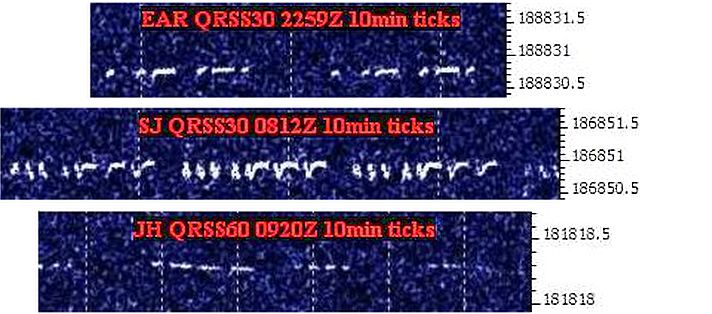
Posted by John Davis on February 13, 2020 at 19:50:41.
In reply to Lowfers copied in NE IL posted by Garry, K3SIW on February 13, 2020
Wow. I don't think I've seen a shift quite like that before. Below is what SJ looked like here five nights ago, the last time the weather cooperated out on the farm.
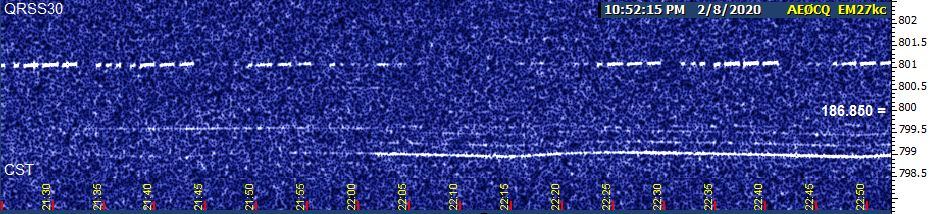
Prior to that, I'd captured SIW and WM from the 1900Z transition to after the sunset fade, which I will show in a later post. I'd planned to switch over to EAR for the rest of the night, up to noon Sunday, but the weather forecast had gotten worse during the evening. We were supposed to get overnight drizzle, then a chance of thunderstorms by daybreak, so I packed up after the final SJ capture and returned home. Long story short: the forecast was completely wrong. But it's been miserable every day since then Sigh.
---------------------------------------------------------------
File Attachment 1: 8feb021.jpg
Re: Lowfers copied in NE IL
Interesting that SJ was fine 5 nights ago. I found the long-term frequency fine last night but each keyup had frequency blips. That made the "dots" look really strange but the "dashes" were long enough that things quickly settled in fine. By the way, I see 3 spurs at 186.849+ kHz here also, the one on the lowest frequency being dominant.
73, Garry, K3SIW
Re: Lowfers copied in NE IL
Posted by Garry, K3SIW on February 14, 2020 at 13:03:24.
In reply to Re: Lowfers copied in NE IL posted by Garry, K3SIW on February 13, 2020
Whatever the problem was with lowfer SJ the previous night it was back to normal last night, just a bit lower in frequency. Also lowfer JH was better than the previous night, appearing at least partially over several hours. Perhaps the -10 deg F temperature here helped propagation.
73, Garry, K3SIW
Re: Lowfer net +/- 3927Khz Saturday morning
Posted by Jerry Parker on February 14, 2020 at 14:11:38.
In reply to Re: Lowfer net +/- 3927Khz Saturday morning posted by John Davis on February 09, 2020
Thank you John for posting this
73
Jerry WA6OWR
Re: W4HBK Grabber on 22M
Posted by WA1EDJ Bob on February 15, 2020 at 15:54:33.
In reply to Re: W4HBK Grabber on 22M posted by John Davis on February 13, 2020
Thanks John.
It appears HBK is IDing the grabber in use with an embedded call. Currently it seems to be K3FEF. Looks like RY is sitting at 555 470 on K3FEF not 555 390 if I'm seeing correctly. I see a definite Y. I believe RY to be quite close to 555 390.
I guess you have to read between the lines on these remote SDR RX's. It's a new world of on SDR receivers.
EDJ still QRV, no storms until mid week. It is chilly today, sunny, high 50's.
Bob Five in 24 Hours
EDJ
Posted by John Davis on February 16, 2020 at 07:04:13.
Namely, JH, SJ and EAR Friday night, plus WM and SIW Saturday.
The plan this weekend was to continue my investigation of this winter's anomalous daytime appearances of EAR here in SE Kansas. As winter plods on toward eventual spring, QRN-free nights are gradually growing fewer, but Friday evening looked promising. Spot checks did not show any signs of late afternoon EARs, however, unlike a couple of times earlier this winter. I started recording Argo screens before sunset, but even into early evening, if there were signs of EAR, they were covered up by QRM.
Rather than waste the evening waiting for the random stuff to go away, I tuned down to look for JH in its new configuration and was rewarded with several IDs. The first attached file shows the period of best reception of JH in both QRSS120 and QESS60 Argo windows. Notice how beautifully steady the frequency is!
Then I took a look at SJ, which was once again nice and solid, no longer making square-root symbols in place of dashes. After midnight, I retuned to EAR. It was coming in solidly at the time, despite the return of the peculiar QRM for about three more hours. A little bit of that period is shown in the second attachment.
There were two 55-minute fades of EAR during the remainder of the wee hours, followed by a sudden dip in level at 6:08 AM, which turned out to be the start of nautical twilight here. The signal struggled back to manifest as bits and pieces of RF right about local sunrise, peaking half an hour later, then disappearing again. There's a long stitched QRSS60 display for the interval depicting EAR through daybreak. (Because of its size, it's linked here as a separate page rather than being a file attachment. You may need to scroll your browser and/or use the browser's magnifier tool to get the full effect. I may convert it to a directly scrollable window later.)
I left the radio tuned to EAR all morning, in hopes of seeing the familiar tilted pulse train just before noon, as I have done in similarly quiet mornings up to the first of this month, but it simply wasn't there today.
Just before 1:00 PM CST, I tuned to the 1750 m watering hole (and yes, that's the correct way to use "m" for meters/metres, not the way it appears in my column in The LOWDOWN this month) and caught the return of SIW to its higher frequency. That's shown in the third attachment.
I continued capturing WM and SIW through this evening and will continue into at least mid-morning Sunday. They, like EAR, are also targets of my study of sunrise/sunset characteristics of the band. Although SIW and WM are visible day and night here, they are unfortunately not available in summer. SJ is also winter-only and is not on at my sunrise and sunset, and JH is not currently strong enough for daytime copy even in winter. So, that leaves only EAR, WM, and SIW as subjects for that kind of observation, and generally only in winter... which, practically by definition, means tough conditions for field work. :)
---------------------------------------------------------------
File Attachment 1: 14feb-JH.jpg
File Attachment 2: 14feb-SJ-EAR.jpg
File Attachment 3: 15feb-WM-SIW.jpg
NC
15 Feb: NC coming thru nicely this afternoon - been a while
Laurence KL7L
HiFERs Sunday
Posted by John Davis on February 16, 2020 at 18:06:17.
During the 9 o'clock hour CST this morning, 7P, EH and RY were coming through at the watering hole despite S3 levels of raspy QRM. Below that point, neither WV nor AZ were audible, despite lower QRM levels.
Above that point, the noise increased, totally swamping the normal mid-band cacophony and all signals above there. It appears Radio Havana has been reduced to broadcasting programs with diathermy machines now. Let's all be generous, guys, and donate to Capacitors For Cuba so they won't have to transmit with rectified but unfiltered AC any more...
Re: HiFERs Sunday
Posted by John Davis on February 16, 2020 at 21:15:39.
In reply to HiFERs Sunday posted by John Davis on February 16, 2020
Noon was better--no Havana, but CODAR was strong. WV and AZ were both visible and WV was sometimes audible. At the watering hole, NC, 7P, EH and RY were generally clear on Argo and traded places being audible. TON was slightly visible.
VAN's DAID was visible, and parts of the IDs also appeared to be present but were not distinguishable by ear. K6FRC started out at the edge of visibility and then grew strong enough to hear clearly. I think JUN was present on 13565.172, but it was not audible...just a keyed carrier faintly visible. No AMA. WAS varied from nil to fair copy, and ODX ranged from nearly nil to good copy.
Still monitoring, hoping for EDJ, MTI, and any others that may be near the edge of the first skip zone to show up as the afternoon wears on.
Portable receivers
Posted by Ian Harling on February 17, 2020 at 02:14:22.
Hi Guys.Can anyone recommend a decent rx for NDB frequencies? Re: HiFERs Sunday
73 G7HFS
Posted by John Davis on February 17, 2020 at 05:57:21.
In reply to Re: HiFERs Sunday posted by John Davis on February 16, 2020
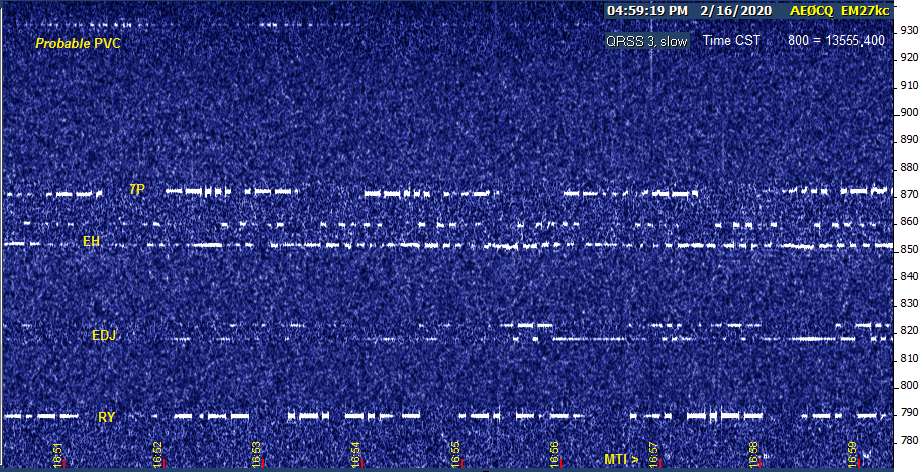
Six on one screen! From top: (likely) PVC, 7P, EH, EDJ, RY, and MTI, just before 5 o'clock Central. NC was present before, but around 50 Hz above this window.
No WV or AZ below the watering hole, and nobody above except faint FRC. Everyone was gone just over half an hour later.
John
---------------------------------------------------------------
File Attachment 1: 16feba0050a.jpg
WA5DJJ has 2 22M grabbers up
13.555 260 - 13.555 660
13.555 660 - 13.556 000
http://www.qsl.net/wa5djj/
If you'd like to see a different range on one of them, let Dave know. dhassall(at)zianet.com
Re: HiFERs Sunday
Posted by Chris on February 17, 2020 at 16:28:35.
In reply to Re: HiFERs Sunday posted by John Davis on February 17, 2020
Impessve catch I must say! NC making it to DJJ grabber
Posted by WA1EDJ Bob on February 18, 2020 at 17:55:28.
I consistently see NC making it to Dave's 22M #1 grabber in NM. Usually midday here in EM83du Monroe, Ga. Also seeing bits of EDJ. I'm about 280 Mi SW of NC. He seems to have a decent pipeline into DJJ.
Bob Re: Portable receivers
EDJ
Posted by Ed Holland on February 19, 2020 at 09:42:06.
In reply to Portable receivers posted by Ian Harling on February 17, 2020
Hi Ian,
Can you provide a few details about what you want to do? You mention portable receivers - are you considerring listening at a quiet (outdoor) location, or looking for convenience in a smaller radio?
Some of the older 90s sets of the Sony/Grundig/Sangean brands may suit, or perhaps a modern option with SDR and a tablet. Of the latter, I have no experience.
Your big issue will likely be noise. Some sets dont have great LW performance anyway, and internal digital circuits can cause unwanted interference. Unfortunately it is AM & SW performance that receives most attention in reviews, so finding out about MF & LF capability isn't so easy.
I do remember scouting a few NDBs with my Sangean ATS803a and these, plus its immediate successors are not too expensive on the used market. They have a half decent internal ferrite antenna, and one can always have fun building a tuned loop to boost reception
Hope that is helpful,
Ed
Re: HiFERs Sunday
Posted by Ed Holland on February 21, 2020 at 09:58:13.
In reply to Re: HiFERs Sunday posted by John Davis on February 17, 2020
Brilliant John!
When I get back from the UK, I think it might be worthwhile slowing PVC down in line with the other beacons at the watering hole.
Until then, it should remain operational as usual, unless a power interruption knocks out the signal generator "oscillator" source.
Cheers
Ed
COIL 3.86
Posted by Brian on February 21, 2020 at 15:48:49.
It's been some time since I posted about my Windows coil calculator. Version 3.86 is here:
http://ham-radio.com/k6sti/coil.zip (right-click, select Save to local drive)
See README.TXT to install the program. Some recent changes:
Accuracy
I've refined the inductor model. Average error magnitude is 2.0% for L and 4.8% for Q on a set of test coils measured with an HP 4342A Q meter. See COILS.TXT for details.
Coil Shape
I've added octagonal, hexagonal, and square shapes. Some experimenters use polygonal loading coils wound on a cage of PVC pipe for transmitting below the broadcast band.
Form Contact
This is the percentage of the winding in contact with the dielectric. Use it for coils with dielectric ribs (Air Dux), ridges (ceramic and phenolic forms), or wound on a polygonal dielectric cage.
Dielectrics
I've added a number of common plastics as well as cardboard, the latter for your kid's crystal set coil wound on an oatmeal box.
Metals
I've added several kinds of copper and aluminum. I've included information and references on the effect of tin plating.
Optimizer
The optimizer varies selected coil parameters to maximize Q while keeping inductance constant. Due to code refinement and use of assembly language, it now runs virtually instantaneously even on older computers.
Brian
HP 4342A Utilities
Posted by k6sti on February 21, 2020 at 16:13:45.
I've written some Windows utilities for the HP 4342A Q meter. They should be useful with other Q meters as well.
If an inductance is too large to resonate with a Q meter's variable capacitor at the frequency of interest, you can add an auxiliary capacitor to achieve resonance. However, even if the Q of the auxiliary capacitor is very high, it can significantly alter indicated Q. For example, if you use a 3000 pF auxiliary capacitor with a Q of 3000 to augment a variable capacitance of 300 pF and the indicated Q is 600, the meter would read 733 if the auxiliary capacitor had no loss. The calculation to correct indicated Q is simple, but for some reason it's not given in the HP 4342A manual. All that's needed is the capacitance and Q of the auxiliary capacitor. You can use the Q meter to measure both. The utilities in this package perform the necessary calculations.
COMPQ.EXE compensates for auxiliary capacitor Q. It calculates the Q the meter would indicate if the auxiliary capacitor had no loss.
SMALLCAP.EXE calculates the capacitance and Q of an auxiliary capacitor 450 pF using the series method.
PARCAP.EXE calculates the capacitance and Q of parallel capacitors. This lets you create an auxiliary capacitor larger than 450 pF without having to measure it using the series method.
L.EXE calculates inductance from resonant frequency and capacitance. Use it to measure inductance at frequencies other than the spot frequencies where the inductance dial calibration is valid.
The utilities are here:
http://ham-radio.com/k6sti/hp4342a.zip
Brian
Friday HiFER Report
Posted by John Davis on February 22, 2020 at 07:04:59.
Probable PVC was visible. 7P, TON, and FRC were audible (the latter two, much better than average). And, VAN was visible on both the dash-after-IDs and some of the CW segments as well, but never quite audible (frequency was a little lower today, about 13563.160).
All this was during the seven or so minutes I had available between 5:45 and 5:51 PM CST, after everyone else was gone from the band except CODAR...which was probably also from California.
2200M WSPR-2 overnight
Posted by John Bruce McCreath on February 22, 2020 at 14:39:38.
Decided to take a look/listen on 2200M last night for WSPR-2 activity. In order of reception, I got K3MF, WH2XND, WA9CGZ, WB5MMB, N6LF, W1DAY, and N3FL.
I used my VE7SL style 10 foot octagonal loop and TS-440S for the receiver, feeding WSPR-X v 0.8 r 3058 under WinXP.
73, J.B., VE3EAR
Re: 2200M WSPR-2 overnight
Posted by John Davis on February 22, 2020 at 17:29:56.
In reply to 2200M WSPR-2 overnight posted by John Bruce McCreath on February 22, 2020
It was an interesting night on the band. Just before daybreak here, even VK4YB showed up a few times. Alas, I seem to be suffering from a gradual increase in the number of dubious call signs and/or grid squares.
AE0CQ - EM27kc - 19 spots:
Timestamp          Call    MHz       SNR Drift Grid    Pwr     km  az   # Spots
 2020-02-22 15:00  WA9CGZ  0.137418  -21  0    EN61ch  0.1    786  236    37
 2020-02-22 12:46  VK4YB   0.137560  -29  0    QG62ku  1    13650  62      3
 2020-02-22 11:14  N8BWV   0.137426  -23  0    GD37    0.1  10765  327     1
 2020-02-22 10:20  E5ZJK   0.137433  -24  0    EP76    2     3330  196     2
 2020-02-22 08:10  KJ6MKI  0.137507  -33  0    CM88oi  0.2   2428  85      1
 2020-02-22 08:08  WJ2TXL  0.137542  -26  0    FP61    20    3336  229     1
 2020-02-22 06:32  WJ1BPW  0.137557  -25  0    CN61    2     2773  90      1
 2020-02-22 04:24  WH2XND  0.137577  -4   0    DM33xt  20    1573  72    227
 2020-02-22 04:24  K3MF    0.137406  -12  0    FM19sr  1     1649  266   108
 2020-02-22 04:20  K5DNL   0.137460  -4   0    EM15lj  0.1    256  42    144
 2020-02-22 04:20  WB5MMB  0.137551  -8   0    EM22nm  0.1    510  358    92
 2020-02-22 04:20  WH1FXM  0.137522  -27  0    EB81    2    12882  349     3
 2020-02-22 03:46  K0KE    0.137412  -9   0    DM79pm  0.1    878  105    37
 2020-02-22 03:44  N6LF    0.137441  -17  0    CN83lt  1     2463  98     58
 2020-02-22 03:42  N1DAY   0.137500  -22  0    EM85sg  0.5   1154  284    57
 2020-02-22 03:40  E7QQ    0.137488  -24  0    DL46    20    1908  48      8
 2020-02-22 03:36  N3FL    0.137560  -25  0    FM19ua  0.05  1660  269    55
 2020-02-22 03:20  F1HXW   0.137439  -25  0    DO84    20    2024  159     2
 2020-02-22 03:08  WG9IBD  0.137529  -22  0    DO93    20    1877  164     3
Saturday HiFERs - morning
This morning, only 7P, EH, and RY were at the watering hole, and maybe PVC. NC slept in or something, not yet showing during the 9 AM hour CST. No WV, but AZ was visible and frequently audible. TON was visible, but not as audible as yesterday evening. FRC was visible and sometimes audible, JUN was visible only, WAS was absent, and so was ODX.
Signals gradually deteriorated somewhat at the watering hole over the next two hours. Codar cranked up about 11:15:25 AM and continued to swamp most everybody until shutting off abruptly at 12:15.
Re: Saturday HiFERs - midday
Posted by John Davis on February 23, 2020 at 06:28:03.
In reply to Saturday HiFERs - morning posted by John Davis on February 22, 2020
Just fair reception at the watering hole of NC, possible PVC (dotted line on 13555.530), 7P, EH and RY during the noon hour. A few curved DAIDs from VAN were visible. K6FRC was visual-only most of the time, but became audible for a while at 12:24 PM CST. JUN was visible but not audible. Nobody else seen or heard.
Re: Saturday HiFERs - late afternoon
Posted by John Davis on February 23, 2020 at 06:44:02.
In reply to Re: Saturday HiFERs - midday posted by John Davis on February 23, 2020
By 5 PM CST, 7P had faded away for a while and EH and RY were dominant at the watering hole, then became a bit more broken. Over the next half hour, about 40 minutes before local sunset, it's as if someone began flipping switches in the ionosphere. EH underwent 20-some dB attenuation in an instant, just after 5:21. The path from 7P suddenly switched on at 5:22 PM, while at 5:27 PM, RY appeared to switch off in mid "R". The dotted line/likely PVC faded in during 7P's return.
FRC was visual-only, while 7P remained strongly visible until I switched to 630 m after sunset. Nobody else copied this time. 2200M JT9 copied
Posted by John Bruce McCreath on February 23, 2020 at 14:03:04.
After my success with WSPR-2 on 2200M, I decided to give JT9 a shot.
In order of reception, I logged K9KFR, NO3M, K3MF, NI7J, and K7PO.
73, J.B., VE3EAR
LowFER Beacon "EAR" Re: 2200M JT9 copied
188.835 kHz. QRSS30
EN93dr
Posted by John Davis on February 23, 2020 at 22:25:57.
In reply to 2200M JT9 copied posted by John Bruce McCreath on February 23, 2020
What is different in your setup between copying JT-9 and WSPR, JB?
WSPR on 630 Sat. Night
Posted by John Davis on February 23, 2020 at 22:55:20.
KL7L, K9FD, GØMRF, and VK4YB were the night's best DX, in that order. There were a number of new calls (N3HSK, KE6XUO, WBØTEM, WA3U) among the many regulars; plus a few old longwave friends such as AA1A and VE7BDQ.
Alas, there's also an increasing number of bogus decodes as time goes by. I've separated those out from the rest. Though it's not apparent from this list, many of the phony decodes show up on two frequencies during the same transmission time slot, often around 90 Hz apart.
And, there is an anomaly I had not previously encountered from AB5S: serious frequency drift during transmissions. The particular spot shown here says -3 Hz (others range from -1 to -4), but it's not clear how WSPR-X computes that. I've got an Argo capture of that same transmit interval, and it clearly shows the base frequency of the signal to be roughly 10 Hz lower at the end than at the start.
AE0CQ - EM27kc
40 unique call signs:

Timestamp           Call     MHz         SNR  Drift  Grid     Pwr   km      az  # Spots
2020-02-23 13:16    K9FD     0.475617    -21    0    BL11je    1   6173     59    40
2020-02-23 12:30    VE7BDQ   0.475731    -21    0    CN89la    1   2605    110    19
2020-02-23 12:08    W6DAX    0.475794    -29    0    CM98os    2   2251     87     7
2020-02-23 12:04    W0DJK    0.475775    -9     0    EN34gh    5    814    190    12
2020-02-23 11:58    WB3AVN   0.475625    -10    0    FM19og    5   1617    267    37
2020-02-23 11:52    KM5SW    0.475649    -6     0    DM65     0.5  1082     77     4
2020-02-23 11:38    KE6XUO   0.475789    -25    0    EM12     0.5   543     18     7
2020-02-23 11:18    N3HSK    0.475734    -24    0    FM28ei    1   1717    271    11
2020-02-23 10:00    KJ6MKI   0.475762    -30    0    CM88oi    10  2428     85     5
2020-02-23 09:52    VK4YB    0.475760    -29    0    QG62ku    1  13650     62     2
2020-02-23 09:48    AA1A     0.475691    -27    0    FN42pb    1   2156    263     3
2020-02-23 09:42    WB0TEM   0.475722    -4     0    EN12rt    1    646    169     1
2020-02-23 09:30    KL7L     0.475766    -27    0    BP51ip    5   4579    101     3
2020-02-23 08:38    K3FBH    0.475748    -28    0    FM19      5   1597    266     2
2020-02-23 06:16    W0YSE    0.475758    -28    0    CN85rq   0.2  2463    103     2
2020-02-23 05:54    G0MRF    0.475784    -28    0    IO91fr    5   7085    297     1
2020-02-23 05:36    W0IOO    0.475734    -16    0    EN10     0.2   410    156     6
2020-02-23 05:06    N4WLO    0.475751    -15    0    EM50uo   0.2   959    321     2
2020-02-23 03:58    WA3U     0.475635    -7     0    FM29co    5   1705    267    18
2020-02-23 03:54    AB5S     0.475704    -15    -3   EM13ta   0.2   468     14    77
2020-02-23 03:54    K4LY     0.475647    -8     0    EM85wb    5   1189    285   103
2020-02-23 03:54    NV4X     0.475725    -13    -1   EM77sx    1    945    267    67
2020-02-23 03:50    WD8DAS   0.475719    -15    0    EN52hx    1    816    219    61
2020-02-23 03:48    KN8DMK   0.475652    -24    0    EM89oo    2   1110    259    24
2020-02-23 03:44    K4SV     0.475695    -10    0    EM85wf    5   1184    284     3
2020-02-23 03:44    AE2EA    0.475760    -15    0    FN12fr   0.2  1621    253    75
2020-02-23 03:42    KR6LA    0.475661    -20    0    CN90ao    5   2347     91    39
2020-02-23 03:24    K3MF     0.475796    -8     0    FM19sr    5   1649    266    41
2020-02-23 02:46    K2BLA    0.475646    -5     0    EL99hb    2   1560    309    13
2020-02-23 02:24    KE7A     0.475741    -8     0    EM12kx    0.5  493     21   130
2020-02-23 01:46    AA5IT    0.475657    -13    0    EM20vd    2    778    354     2


Bogus calls and/or absurd grids:

2020-02-23 11:28    K31JEW   0.475681    -25    0    EK79     0.5  2191    336     1
2020-02-23 10:58    PW3HFF   0.475697    -28    0    EF02      1   8308      3     1
2020-02-23 09:14    WB2XQ    0.475673    -25    0    FM19      5   1597    266     1
2020-02-23 09:06    KE5VGG   0.475655    -19    0    DG22     0.5  7481     17     1
2020-02-23 08:30    M9ZAV    0.475741    -29    0    FB32      1  12835    341     1
2020-02-23 07:50    WD8JTV   0.475767    -26    0    EN52      1    792    223     2
2020-02-23 06:10    FW6VLG   0.475779    -27    0    EM88     0.2  1072    266     2
2020-02-23 04:06    OD7XPY   0.475776    -23    0    DH64     0.5  5983     12     1
2020-02-23 03:54    NV5DVI   0.475773    -26    0    EM77      1    893    270     1
Re: Saturday HiFERs - late afternoon
I forgot to mention JUN's unique behavior Saturday afternoon. It was faintly visible on 13565.200 at 12:24 PM. The next time I checked, it was absent from just before 2 PM CST until one single clearly audible appearance at 2:03:20 PM, then it disappeared again... not even visible on Argo. After that, it became intermittently audible again around 2:10 PM.
PLM
Posted by John Davis on February 24, 2020 at 05:57:04.

Mystery beacon PLM (13557.735) showed up in QRSS3 mode during the noon hour CST Sunday, with a dash between IDs.
Oddly, I may have seen this version of the beacon before without realizing it! You may recall, some time back, I mentioned what I thought might be a QRSS signal around this frequency, but decided it was just random fading afflicting a steady carrier that sometimes wanders through this part of the band. That's because prolonged observation looked like random characters with non-standard element lengths. Turns out I may have been partially right about both guesses--the QSB could have been chopping up a real signal.
In this capture and others today, the extended dash several times got chopped by fading and ended up looking like an M or an O or random gibberish. Combine that with fades in the middle of other letters, and it's no stretch to picture this signal looking like random slow keying. Fortunately, I let the captures run longer today, and ended up getting the bigger picture.
It's ironic that the long dash between IDs, which is sometimes so helpful in drawimg attemtion to a normal speed CW signal on a waterfall display, can actually be a source of confusion in QRSS when the QSB cycles interact with it. None the less, overall, it was a very good signal today. I wish the operator would take credit for it, or at least let us know where it originates.
---------------------------------------------------------------
File Attachment 1: 23febPLM.jpg
Re: 2200M JT9 copied
Hi John, I use WSPR-X in WSPR-2 mode, and WSJTS2 in JT9 mode. Both are older versions of the software, but they work for me, so I'm reluctant to try newer versions in the old WinXP PC I'm using. Antenna for 630M is an active whip, while 2200M is heard on a 10 foot octagonal loop with a preamp at the antenna.
73, J.B., VE3EAR Re: 2200M JT9 copied
Posted by John Davis on February 24, 2020 at 18:38:34.
In reply to Re: 2200M JT9 copied posted by John Bruce McCreath on February 24, 2020
Thanks, J.B. I was especially interested in the software because I also will be running an older and resource-limited computer for the foreseeable future. No stigma in sticking with what works, IMO.
Spotting 13 MHz beacons
Posted by Larry on February 24, 2020 at 22:16:38.
What is the process for spotting 13 MHz beacons?
Larry
Re: 2200M JT9 copied
Posted by Ed Holland on February 25, 2020 at 17:12:03.
In reply to Re: 2200M JT9 copied posted by John Bruce McCreath on February 24, 2020
Thank you John M,
You have inadvertently answered a question that has been at the back of my mind. I have seen references to WSPR-2 mode, but with WSJT-x, there is only one WSPR selection, as far as I can determine. Perhaps it is worth trying the other variants?
I can, however, report that the newer decode software does run quite happily on our old XP equipped laptop, even thought the machine itself is a bit slow.
Regards,
Ed
Re: Spotting 13 MHz beacons
Posted by Ed Holland on February 25, 2020 at 17:18:17.
In reply to Spotting 13 MHz beacons posted by Larry on February 24, 2020
Hi Larry,
It can be as simple as setting up a receiver and listening in CW mode between 13,553 kHz and 13,567 kHz
To dig out some of the weaker signals, the receiver audio is sent to a computer running spectrum analyser software such as Argo, Spectrum Lab etc. In this case, signals appear as if lines on a chart recorder type display. The programs can be configured to look at the slower Morse modes, which helps average out noise, or apply more complex processing to help pick out the weaker beacons.
Cheers
Ed
Re: Spotting 13 MHz beacons
Posted by Larry on February 25, 2020 at 18:13:16.
In reply to Re: Spotting 13 MHz beacons posted by Ed Holland on February 25, 2020
Sorry...my original question was ambiguous...I meant how do I make receptions reports?
Re: Spotting 13 MHz beacons
Posted by John Davis on February 25, 2020 at 19:53:20.
In reply to Re: Spotting 13 MHz beacons posted by Larry on February 25, 2020
Hi Larry. The best way to make reception reports is "frequently." :)
But seriously, you have a couple of options, depending on your objective. The easiest way is to post a message here on this board. Include the date, time, frequency as closely as you can determine it, where you are located, and from time to time remind us about the key details of your listening setup. Most of the more active beacon operators check this board fairly regularly, and will see your reports.
Of course, there's also a lot to be said for the personal touch. If you report directly to the operator, you can sometimes include more details of the reception, and you may even reach some of them sooner that way, since not everybody goes online every day. But how do you reach them? That's where our Operator Contact List comes in. Notice the LowFER/MedFER/HiFER link near the top of the Message Board main page (or the LWCA.org Home Page). That page has a link to operator info, including the email address or postal address of the operator, if known.
The best idea is to do both of the above: report to the board, as well as the beacon owner. Listener reception reports to the message board are very important in accurately maintaining the lists of active beacons. If you have specific questions about posting to the board--for instance, you may be wondering how some of us attach screen captures to our reports--you can get lots of answers at the Msg Board FAQs and Authenticated Authors links on the main message board page.
John
Re: Spotting 13 MHz beacons
Posted by Larry on February 25, 2020 at 22:32:28.
In reply to Re: Spotting 13 MHz beacons posted by John Davis on February 25, 2020
John,
Thanks for the info. I'm really surprised there isn't a more structured process, something similar to the Cluster spotting concept in the ham world that can take reports from various sources and re-direct. Perhaps this will come with time.
I have just started listening in the ISM band. Up until a few weeks ago I had no idea of the existence of these ultra low power beacons. So far, what I have heard absolutely amazes me. All my decoding is by ear.
My grid is GN37in, eastern Canada, Newfoundland Island; almost as far east in North America as one can go without getting feet wet.
Today I have heard:
ODX
This beacon has been in all day from my sunrise to sunset with only VERY short periods when it is not audible. At times it dropped below the noise floor for VERY brief periods, but most of the time it is several dB above MDS. Same thing for yesterday and the day before...in ALL DAY LONG.
ABBY
First heard this one yesterday at 2200 UTC. In/out.
WV
First heard today at 1834 UTC. In/out.
Larry Re: Spotting 13 MHz beacons
VO1FOG
Posted by Chris KC3GFZ on February 25, 2020 at 23:40:04.
In reply to Re: Spotting 13 MHz beacons posted by Larry on February 25, 2020
Hi Larry,
Thanks for the report on the ABBY beacon.
It is getting out pretty good from the look of things.
Thanks!
Happy hunting!
Re: Spotting 13 MHz beacons
Posted by Larry on February 25, 2020 at 23:45:38.
In reply to Re: Spotting 13 MHz beacons posted by Chris KC3GFZ on February 25, 2020
Chris,
Sure seems like it...Hi. What is the antenna?
Your published freq. is 13.566.90. I'm seeing it at 13.566.60. Perhaps drift is normal?
Larry
Re: Spotting 13 MHz beacons
Posted by Chris Kc3gfz on February 26, 2020 at 00:00:02.
In reply to Re: Spotting 13 MHz beacons posted by Larry on February 25, 2020
The beacon is outside in wooded area. Could drift a bit due to temperatures. My frequency counter may not be be working right . Thanks for the frequency info. The antenna is a halfwave endfed vertical antenna with matching transformer. It is hanging from tree branch. The coax feed point is about 15ft off ground. The center of the antenna wire is probably about 30-35ft high. Re: Spotting 13 MHz beacons
Chris KC3GFZ
Posted by Larry on February 26, 2020 at 00:09:47.
In reply to Re: Spotting 13 MHz beacons posted by Chris Kc3gfz on February 26, 2020
Yes could be...how does it achieve freq. stability? OCXO, TCXO? Have you measured the tx power? Is it really only 2.5 mW? Gibsonia, PA is 1400 + statute miles from me...
lh
Re: Spotting 13 MHz beacons
Posted by Chris kc3gfz on February 26, 2020 at 00:22:09.
In reply to Re: Spotting 13 MHz beacons posted by Larry on February 26, 2020
It is a black cat kit from black cat systems. You can search for the kit. It is running about 4mw power. No radials or grounds.
Re: JUN beaming East Coast today
Posted by Larry on February 26, 2020 at 00:36:06.
In reply to JUN beaming East Coast today posted by Vic on February 05, 2020
Vic,
I heard JUN VERY weak today, for a short period of time. Still waiting for it to be strong enough to make a decent recording. This is the 2nd time that I've heard it since Ronnie told me about these bcns in the ISM band.
BTW way, I'm the guy who has a sked with Ronnie. He's probably mentioned that to you.
Larry Re: Spotting 13 MHz beacons
VO1FOG
Posted by Chris kc3gfz on February 26, 2020 at 00:39:30.
In reply to Re: Spotting 13 MHz beacons posted by Chris kc3gfz on February 26, 2020
K6FRC beacon has been heard from California on the east coast with about 1.8mw out. Not sure about beacon ODX. I thin similar out put limits in Canada as the USA?
Re: Spotting 13 MHz beacons
Posted by Larry on February 26, 2020 at 00:40:12.
In reply to Re: Spotting 13 MHz beacons posted by Chris kc3gfz on February 26, 2020
Would you like a 20 second recording -about 3 sequences- of what I captured today? I think you'll be impressed with the s/n. If so, just fire me off your e-mail address..
lh
Re: Spotting 13 MHz beacons
Posted by Chris kc3gfz on February 26, 2020 at 00:42:02.
In reply to Re: Spotting 13 MHz beacons posted by Larry on February 26, 2020
Sure thing. christophermubel hotmail com
Thanks again!
Re: Spotting 13 MHz beacons
Posted by Larry on February 26, 2020 at 00:43:31.
In reply to Re: Spotting 13 MHz beacons posted by Chris kc3gfz on February 26, 2020
Unreal! Depending on the exact locations, that's about 2500 miles. I heard JUN today, but VERY weak. It is 2000 miles from me.
lh
Re: JUN beaming East Coast today
Posted by Vic on February 26, 2020 at 01:35:58.
In reply to Re: JUN beaming East Coast today posted by Larry on February 26, 2020
Hi Larry!
Yes Ronnie has told me that you heard my beacon JUN all the way from central Florida last weeki believe.
Since last Sunday afternoon I have been running it 24 hours a day as I knew you might be able to copy it.
I fell off my chair when I measured the distance between us ( Google maps,) as 2014 miles +/- a couple of miles !
I am also using a Black Cat beacon nominal 5mW out. Antenna is a 88 ft doublet at average height of 27 feet. Prior to last Friday I was using the same antenna but at about 20 feet high and also a resonant dipole for 13.560MHz at 27 ft high . That last antenna is temporarily out of service this week.
Please report any more reception of JUN . I will also try to join you on 20m with Ronnie
I hope to increase the height again later this week. Also trying to figure out a way to get a vertical up in my restricted space here.
Thanks for listening !
73. Vic W4/GW4JUN GW4JUN@GMail.com
JUN now 24 /7
Posted by Vic on February 26, 2020 at 01:43:21.
JUN now 24/7 from Sunday 23 February with occasional breaks for ham contacts on 20m.
Now working on antennas again .
73 Vic W4/GW4JUN. Beacon JUN
Re: JUN beaming East Coast today
Posted by Larry on February 26, 2020 at 01:54:30.
In reply to Re: JUN beaming East Coast today posted by Vic on February 26, 2020
I'm pretty sure I'll be able to get you a good recording soon.
I'm hearing ODX, near Toronto, 1300 miles +- ALL DAY LONG, sunrise to sunset with only minimal fades during that whole time period. Everything else is in/out, but ODX must be at the perfect single hop distance. AND it's an E/W path, which usually is not as strong as N/S.
Yes, try to join us on 20 m, Vic. I'm sure we'll find LOTS to chat about.
lh
Re: Saturday HiFERs - late afternoon
Posted by Vic on February 26, 2020 at 02:03:23.
In reply to Re: Saturday HiFERs - late afternoon posted by John Davis on February 24, 2020
Hi John
Thanks for the report ! I have been playing with the antennas here and I increased the height of my 88 ft doublet from 22 ft to average 27 ft and eliminated the droopy wires. The resonant 13MHz dipole is temporarily out of service due to difficulties keeping it up on my pole........need to re think that. Meanwhile now thinking of trying a vertical. Need to check how to match it to 50 ohm co ax.
On Saturday I was tinkering with the antenna and for some of the time I left the beacon running whilst the wires were being positioned and support poles re configured, so that might explain the intermittent nature of the signal.
Might try a 5/8 wave vertical next if I can match it to the co ax.....
73 Vic W4/GW4JUN. BEACON JUN
Re: Spotting 13 MHz beacons
Posted by Ed Holland on February 26, 2020 at 10:03:33.
In reply to Re: Spotting 13 MHz beacons posted by Larry on February 25, 2020
OK Larry, no problem. Sorry my response was a bit generic and obvious, but I didn't know where you were starting from - it seems like you are up and running with some great reports already :-)
There is also a 22 m section on the HF Underground forum, and a few different operators frequent that board, so it's also worth checking in over there once a week or so.
www.hfunderground.com/board/index.php/board,35.0.html
Cheers,
Ed
WV
Posted by Larry on February 26, 2020 at 13:01:53.
WV on 13.554.98 easily copied by ear 1300 UTC. Broadcast station on .570 masking higher sigs.
ODX
Posted by Larry on February 26, 2020 at 13:10:38.
ODX on 13.566.47 VERY strong. Easy copy by ear despite b/c stn on .570
KAH
Posted by Larry on February 26, 2020 at 18:04:04.
KAH 13.559.33 26-Feb-2020 1801 UTC >GN37in
This is below the published freq. of 13.560
JUN
Posted by Larry on February 26, 2020 at 18:38:39.
JUN 13.565.20 26-Feb-2020 1845 UTC > GN37in
Copied by ear. In for quite a while, beginning around 1815 UTC. Smack on the published freq. I'll send u an audio clip later, Vic.
ABBY
Posted by Larry on February 26, 2020 at 18:46:33.
ABBY 13.566.62 26-Feb-2020 1843 UTC
Re: ABBY
Copied by ear. At peak, several dB above noise floor.
Posted by Chris Kc3gfz on February 26, 2020 at 19:41:40.
In reply to ABBY posted by Larry on February 26, 2020
Hi Larry,
Coax cable unhooked itself this morning. I fixed that battery will need changed soon. I checked the power again for giggles and it reading 3.4mw . Full battery about 4mw Probably due to batter running about two weeks. I’ll probably change it out soon. Maybe we can experiment and see how low I can drop the tax power and see if you can still hear.
Chris
Re: ABBY
Posted by Larry on February 26, 2020 at 20:14:31.
In reply to Re: ABBY posted by Chris Kc3gfz on February 26, 2020
Chris,
I've NEVER liked those self-disconnecting feed lines! Whenever I encountered those, I've driven nails through them to hold them in place...but then they don't seem to work well...lol.
73 de Larry
WV
Posted by Larry on February 26, 2020 at 20:22:32.
WV 13.554.98 26-Feb-2020 2020 UTC > GN37in
Easy copy by ear now, 45 minutes before my sunset. BCN hasn't faded to noise floor for over 1 hour.
KAH
Posted by Larry on February 26, 2020 at 20:30:45.
KAH peaking now, easily copyable by ear desire QRM from .560. Interestingly, the peak of KAH is NOT coincident with a peak of ODX only a few short miles away...
lh
More on Low Noise antennas
Posted by Ed Holland on February 27, 2020 at 16:40:58.
Hi Folks,
With a little holiday time on my hands, I have been digging and searching through the American Radio History archives, tracing references to Low Noise antennas. There's quite a bit that seems worth pulling together, all on the theme of transformer coupling into and out of a shielded "lead In".
Also, having access to my modest library of radio books here in the UK at the moment, It is noted that my late Grandfathers copy of Sowerby's "Fundamentals of Wireless" (3rd edition), 1942, makes mention of the same, albeit briefly.
An early 1933 "Radio Craft" edition has two decent length articles. One, a comparison of some designs, including transformer construction details. This enters into an objective assessment of some of the designs using signal strength metering. The second, discussing aerial and other line suppression techniques. Mention is made of of "Several noise reducing antennas" available on the market. This latter declaration indicates that it is worth more investigation, and in noting the language used, perhaps more appropriate search terms.
More as I find it,
Ed
WV
Posted by Larry on February 27, 2020 at 18:30:37.
WV 13.554.98 27-Feb-2020 1230 UTC Copied by ear >GN37in
Re: Spotting 13 MHz beacons
Posted by John Davis on February 27, 2020 at 18:39:39.
In reply to Re: Spotting 13 MHz beacons posted by Larry on February 25, 2020
Larry wrote:
I'm really surprised there isn't a more structured process, something similar to the Cluster spotting concept in the ham world
It's probably because there are so few beacon operators, and even fewer regular listeners. We could certainly implement some sort of structured reporting protocol, but it's not clear what sort of form that would need to take in order to be meaningful with such a small number of participants. Suggestions are welcome.
Re: Spotting 13 MHz beacons
Posted by Larry on February 27, 2020 at 20:11:16.
In reply to Re: Spotting 13 MHz beacons posted by John Davis on February 27, 2020
Understood, John. Are you familiar with beaconspot.uk? Take a look at: Rx reports
https://www.beaconspot.uk/beacons.php
Posted by Larry on February 27, 2020 at 20:29:31.
ABBY, ODX, WV all in at this time 2020 UTC >GN36in Decode by ear
Re: Rx reports
Posted by Chris Kc3gfz on February 27, 2020 at 20:59:13.
In reply to Rx reports posted by Larry on February 27, 2020
Hi Larry,
Wondering what kind of rx antenna setup are you using?
Thanks
Rx reports
Posted by Larry on February 27, 2020 at 22:12:02.
In reply to Re: Rx reports posted by Chris Kc3gfz on February 27, 2020
Chris,
The antenna is a 3 el SteppIR Yagi at 75' ,same antenna I use for 20m to 6m. The antenna, being dynamic, tunes down to 13.750. So for rx it is pretty much resonant, although at the bcn freqs. even if I leave it tuned in the middle of the 20m band, it makes no difference. The rcvr is an IC-7800. My noise floor is VERY low, meter at 0 almost all the time. I typically turn on pre-amp 1, but preamps really don't help unless they are GaAsFet and installed at the antenna, before the feed line. I also have an OCFD (80m) but have yet to hear the bcns on it when I switch from the Yagi. The Yagi , being only 3 el, doesn't have a lot of gain, but it does have TREMENDOUS f/b ands f/s, so the greatest benefit is not receiving noise from all directions.
Larry Rx reports
VO1FOG
Posted by Larry on February 28, 2020 at 12:42:20.
Difficult copy this morning due to broadcast station on 13.570...but...
WV very strong +9 dB MDS Re: Rx reports
ODX strong +3 dB MDS
Posted by Chris on February 28, 2020 at 13:47:31.
In reply to Rx reports posted by Larry on February 27, 2020
Larry,
That antenna is nice. I bet your location has a very low noise to begin with. The height of you antenna is very beneficial as well.
Chris
Re: Rx reports
Posted by Larry on February 28, 2020 at 14:29:29.
In reply to Re: Rx reports posted by Chris (KC3GFZ) on February 28, 2020
On the higher bands -20m to 6m - the only grief is on 10m. I have an S3 noise on 10m when I point west, which is toward Canada and USA. In all other directions it is S0. Most of the time on a clear freq. switching the antenna out of circuit changes the noise floor on the rcvr very little. The lower HF bands <20m is another story, but that noise is mostly atmospheric. I think this is a good rx QTH.
Larry
Rx report
Posted by Larry on February 28, 2020 at 18:44:30.
ODX, KAH, ABBY easy copy by ear...1843 UTC
ODX has been in all day...as usual
Re: Lowfer net +/- 3927Khz Saturday morn (22 Feb report)
Posted by John Davis on February 28, 2020 at 18:50:01.
In reply to Reminder: Lowfer net +/- 3927Khz Saturday morning 0800 California time posted by Jerry Oarker on February 21, 2020
WA6OWR, WD4PLI, and AEØCQ were the only ones present, but several worthwhile topics were discussed. Here is an MP3 recording.
websdr_2020-02-22_3927kHz.mp3
rx Report
Posted by Larry on February 28, 2020 at 18:51:54.
WV also copied by ear...1849 UTC
I guess there is not much point in continuing these repetitive reports? I hear these bcns every day.
Re: rx Report
Posted by Chris kc3gfz on February 28, 2020 at 20:01:42.
In reply to rx Report posted by Larry on February 28, 2020
I suppose you can report how ever you like, weekly report or if you hear any new ones. Season changing soon and so will propagation. I’m sure you will hear some others soon. I appreciate your reports as well as John and others. Like he has said before not many listeners on this 13 MHz band. Looks like beacons are getting a bit more popular and quite a few in action.
Chris
potrzebie