Re: WOLF tonight (Monday PM)
John A transmitted WSPR again tonight. Conditions were as different from Sunday night's reception as night and...er, well, another night that's completely not the same. Little QRM and almost no QRN Sunday night with Preamp 1 on, versus S9+20 to +40 tonight with the preamps off! The lightning map from Vaisala showed why--Oklahoma was packed with thunderstorms, some less than 50 miles away, although I couldn't see lightning in the sky from the field. For the better part of two hours, nothing at all showed up on WOLF.
Finally, around 0230 I decided I had nothing to lose by playing around a little in the WOLF Config tab. It appeared to be gradually converging on plausible carrier frequencies but never quite made it because of its automatic restarts, so I wanted to try having it stack more frames, but it turns out 32 is apparently the limit. Also, it had been attempting to lock onto carrier frequencies as far from center as +0.893 to -0.957 at times, so I hoped that reducing the frequency tolerance setting might help confine its search to a narrower, more likely band.
After making my changes, I used the front panel button to 'Restart WOLF.' I suspect it did not immediately take my frequency tolerance change at that restart, however, although I see that it reverted the time stamp in the decoder output back to the last time the software restarted the decoding cycle itself. Eventually it locked onto a carrier only 49 mHz high, which was in the right range given the state of the battery charge at that point, so I got my hopes up a little. Sure enough, the Big WOLF eventually showed up three times over the next 22 minutes, in and out of the gibberish.
At the software's next automatic restart at 0327:40, two things happened: the decoder time stamp caught up with real time again, and the attempted carrier locks all seemed to be in the narrower tolerance that I had specified earlier. The latter could have been coincidence, so I'll need to observe more and see if I can confirm that hypothesis.
John D
Re: Monday HiFERs
2016-03-01 02:22:58 >WOLF10 -r 11024.559 -f 800 -t 1.0 -w 0.0000 -ut
02:23:22 f:-0.410 a: 1.3 dp: 54.3 ci: 8 cj:188 .YBANPYA*/HIG.F ?
. . .
02:34:41 >WOLF RESTARTED
02:23:22 f: 0.728 a:-0.5 dp: 70.0 ci:11 cj:285 5TJFT*CO4H3.E7H ?
02:23:46 f: 0.585 a: 0.2 dp: 67.5 ci: 9 cj: 80 AJJVFH9YUI*19C9 ?
. . .
02:50:10 f:-0.957 pm:59.47 jm:858 q: -5.0 -8.9 07085N6K41KG*8P ?
02:51:46 f:-0.957 pm:61.93 jm:858 q: -4.8 -8.0 75KCI*13J70LG K ?
02:53:22 f: 0.049 pm:64.53 jm:476 q: -2.8 -8.2 7WDI4GNB627JDRR ?
02:54:58 f: 0.049 pm:70.08 jm:476 q: -2.5 -9.3 1ME9*4SJ2BN46E5 ?
02:56:34 f: 0.049 pm:74.05 jm:476 q: -2.2 -8.4 4PGC M2UHL8NZJ6 ?
02:58:10 f: 0.049 pm:87.69 jm:476 q: -1.7 -7.2 WC1*G2N2CQKX4.R ?
02:59:46 f: 0.049 pm:94.80 jm:476 q: -1.8 -8.3 /*E997???6K5/I3 ?
03:01:22 f: 0.049 pm:104.3 jm:476 q: -1.6 -8.3 4PGC N8OZPZWACB ?
03:02:58 f: 0.049 pm:121.7 jm:476 q: -1.2 -8.1 4PGC N8OZPZWACB ?
03:04:34 f: 0.049 pm:127.3 jm:476 q: -1.2 -5.9 WD2XES BIG WOLF -
03:06:10 f: 0.049 pm:127.6 jm:476 q: -1.0 -6.0 WD2XES BIG WOLF -
03:07:46 f: 0.049 pm:128.9 jm:476 q: -0.8 -8.7 .000I8PENY30/N6 ?
03:09:22 f: 0.049 pm:131.0 jm:476 q: -0.7 -8.6 X YGAOAX4YZ5KR* ?
03:10:58 f: 0.049 pm:140.5 jm:476 q: -0.6 -7.4 KHQICCTX.???2CX ?
03:12:34 f: 0.049 pm:147.0 jm:476 q: -0.6 -7.5 KHQICCTX.???2CX ?
03:14:10 f: 0.049 pm:155.5 jm:476 q: -0.3 -7.2 J8/Z71 CX*KH2YJ ?
03:15:46 f: 0.049 pm:159.1 jm:476 q: -0.2 -5.8 WD2XES BIG WOLF -
2016-03-01 03:27:40 >WOLF10 -r 11024.559 -f 800 -t 0.2 -w 0.0000 -ut
. . . etc.; no further decodes before QRT . . .
Posted by John Davis on March 01, 2016 at 18:09:59.
In reply to Re: Monday HiFERs posted by John Davis on February 29, 2016
No late afternoon miracles, either. Before sunset the band was almost totally dead again except for overwhelming codar. Won't get a chance to listen on Tuesday, probably, but will resume later in the week.
Re: Smart Meters
Posted by Andy - KU4XR on March 02, 2016 at 05:52:35.
In reply to Re: Smart Meters posted by Dave on February 21, 2016
Pretty much the same story here.. My Utility installed the GridStream series meter.. It transmits in the 950 MHz range.. Re: Smart Meters
It does not cause any interference to HF, MF, or LF.. Only if I take a portable radio, and stand within 3 feet of the meter can I hear its internal electronics.. Andy - KU4XR
Posted by Ken WB8ZYZ on March 02, 2016 at 16:38:15.
In reply to Re: Smart Meters posted by Andy - KU4XR on March 02, 2016
The Power Company informed me that it is the 950 MHz range meter that they will install here,Thanks to all for input. Wednesday HiFERs & Pirate
I guess they don't want me to read my own meter anymore,hi hi
Posted by John Davis on March 02, 2016 at 22:21:36.
The old-time-radio pirate is back, this time at 13559.815 kHz... just noticeable at noon but fairly prominent after 1:30 PM CST, with a Burns & Allen episode.
RY hasn't been very strong today, EH is present most of the time but with variable signal strength, and likewise for MTI. Only USC and NC have been consistently strong this afternoon. No WV today, and only faint visual contact that might be GNK. Faint visual on FRC late in the morning, but nothing in mid-afternoon. And the biggie: no openings yet to Illinois on HF, though LowFER SIW was pretty fair, apart from a brief fade around 2 PM.
John
Hamrick
Posted by Don Ham on March 03, 2016 at 20:48:04.
I want to compile is radio frequency and station list from 50 to 545 KHZ. Actual lists and URL links to actual lists are great!
Thank you
Don / KI5SS
Re: Hamrick
Posted by John Davis on March 03, 2016 at 21:21:45.
In reply to Hamrick posted by Don Ham on March 03, 2016
Check our home page lwca.org for a link to William Hepburn's DX Info Centre for a good start.
DF2JPL 137.173 DFCW90
Posted by DF2JP on March 05, 2016 at 16:56:39.
Hi folks,
Will try my first LF-DFCW transmission from the new location tonight.
Antenna: Inverted-L 20m up with 102m Topcap: Antenna-C = 850pF
Antenna current 5A
Start 19:00 UT until local sunrise (06:10UT)
Hope someone is listening :o)
73 Joe "PVC" active on 13558.4 kHz
DF2JP
JO31hh
Posted by Ed Holland on March 06, 2016 at 01:18:43.
The slow dash ident for the 13558.4 kHz has finally been replaced by an automatic keyer. This now transmits the ident PVC at 5 wpm, repeated every 10 seconds.
The home made paddle key needed to program the keying circuit worked well once I got a little practice under my belt. 1 block of wood, 6 wood screws and some stiff wire for "keys" and a contact bar.
Cheers,
Ed
HiFER WSPR
Posted by John Davis on March 06, 2016 at 17:20:02.
The stubborn path to Illinois finally opened briefly each of the past two days, at least for SIW. (I've been wanting to see the new WM as well, but no luck there.)
Friday's opening was during the noon hour. I'd just gone to lunch when WSPR 2.12 crashed, apparently, so all I had to show for that session is some Argo captures of the signal.
Saturday's opening occurred later in the afternoon, and WSPR worked fine that time (results below). Unfortunately, that time, I mistuned the Argo session running QRSS30, so I missed the expanded view of the Doppler effects on SIW-slant, which I always like to use for comparison.
We'll soon see if everything is set up and running correctly today, provided the band opens up again...and the wind doesn't blow the antenna down.
160305 2116  11 -21 -1.8  13.555404  K3SIW EN52 7            0    99    0
160305 2120  15 -17 -1.7  13.555404  K3SIW EN52 7            0    21    0
160305 2128  16 -15 -1.8  13.555404  K3SIW EN52 7            0     1    0
160305 2132  16 -16 -1.7  13.555405  K3SIW EN52 7            0     1    0
160305 2136  15 -17 -1.6  13.555404  K3SIW EN52 7            0     1    0
160305 2140  19 -13 -2.0  13.555404  K3SIW EN52 7            0     1    0
160305 2144   7 -23 -2.0  13.555404  K3SIW EN52 7            0    10    0
160305 2204   8 -22 -1.9  13.555403  K3SIW EN52 7            0    27    0
160305 2208   8 -23 -1.8  13.555403  K3SIW EN52 7            0  4798    0
160305 2212  12 -20 -1.6  13.555403  K3SIW EN52 7            0     4    0
160305 2240  14 -18 -2.0  13.555403  K3SIW EN52 7            0    10    0
160305 2244   9 -22 -2.0  13.555402  K3SIW EN52 7            0     2    0
160305 2248   8 -23 -1.8  13.555402  K3SIW EN52 7            0    55    0
Re: HiFER WSPR & Others!
During the 11 AM hour, I had significant doubt about getting any band openings to IL today--or anywhere else. EH was mediocre, RY was wispy at best, USC was scarcely a ghost, and only NC was consistent amongthose at/near the watering hole.
I got WSPR ready to start if anything showed up, then did a quick band scan just before noon. Heard MTI with wide level fluctuations, and the old-time radio pirate (really raggedy looking carrier at 13559.82 today), but nobody else below the center of the band. Nobody at all above the center, except GNK, who started coming in remarkably well!
That prompted me to switch back down to the watering hole, where I immediately heard the beat of multiple carriers and saw a bright trace right below EH signifying the presence of slant SIW. I'd managed to miss most of that timeslot, but I got a nice decode on the very next one.
Had mixed results during the noon hour, largely because the multipath Doppler effects were very pronounced for a while. That punched holes in both the slant and WSPR signals, evidently at inopportune times for WSPR decoding. I'll show you pictures of what I mean later today when I bring the computer home. (No Internet at the farm, and my memory stick is locked up until tomorrow because I accidentally left it at my part-time job Friday.) Also, there was a 10 Hz jump in frequency at one point. More on this later, too.
During the 1 o'clock hour I started seeing a ghost of WM, then suddenly it materialized into a nice steady signal several minutes later. The new configuration no longer has the distinctive keydown shift upward at the start of an ID cycle, but is rock steady all the way through. A couple of times, the CW ID was nicely audible at the end, too.
No luck with 9ZS yet prior to my return to town for lunch, but in a few minutes I'll see whether there are any signs among the captures.
John
Re: HiFER WSPR & Others!
Posted by Mike N8OOU on March 06, 2016 at 23:15:57.
In reply to Re: HiFER WSPR & Others! posted by John Davis on March 06, 2016
John, Thanks for the detailed WM Hifer report. I have been watching it closely for any temperature related frequency excursions. I am glad to read that you can see the stability improvement.
The beacon is running in an un-heated metal building, with out the aid of GPS. The TCXO chip is completely responsible for the frequency to the SI5351A chip. The SI5351A chip provides the ability to generate the transmit frequency.
Disconnecting the GPS reduced the power consumption by half. I have switched the beacon back to solar power, and so far the panels have been able to fully re-charge the battery, even on some cloudy days.
This one change has provided a couple benefits for me.
Mike
Re: HiFER WSPR
Posted by Garry, K3SIW on March 07, 2016 at 00:46:33.
In reply to HiFER WSPR posted by John Davis on March 06, 2016
John, perseverance pays off. Glad you finally got an opening and some nice wspr decodes.
73, Garry, K3SIW, EN52ta, Elgin, IL
Re: HiFER WSPR & Others!
Posted by John Davis on March 07, 2016 at 18:45:41.
In reply to Re: HiFER WSPR & Others! posted by Mike N8OOU on March 06, 2016
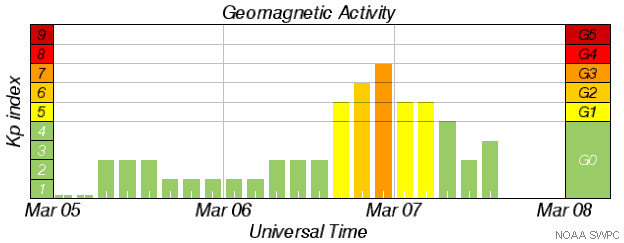
Well, it apparently took a G3 magnetic storm to turn 22 m from the dormant band that it was yesterday morning into the hot spot it became all afternoon. It was quite remarkable to once again see the Illinois path open for more than a few minutes. In fact, it was open for a whopping six hours. Even after that ended and most everybody else had faded from the band after sunset too, both RY and EH continued over two hours beyond sunset, until well after 8 PM CST. (FRC was also present after dark, but that's not so unusual for that path.)
I'm just now able to start transferring captures from the field computer, so there'll be more later today, but I wanted to start by elaborating on the frequency stability of WM. As I said, it looks quite steady to the eye in QRSS3, a considerable improvement. Since that initial remark yesterday, I've now had a chance to examine its performance over a longer time scale.
During the extended opening yesterday, bifurcation and other assorted Doppler effects afflicted SIW, EH, and even RY at various times, but WM somehow remained relatively immune most of the afternoon. By 5 PM, though, I'd noticed some widening of the WM trace, so I set up an Argo instance in QRSS30 to get a closer look. This enabled me to see that there was something resembling thermal cycling over about a 12.5 minute period, more like what I would expect to see from an ovenized crystal rather than a TCXO.
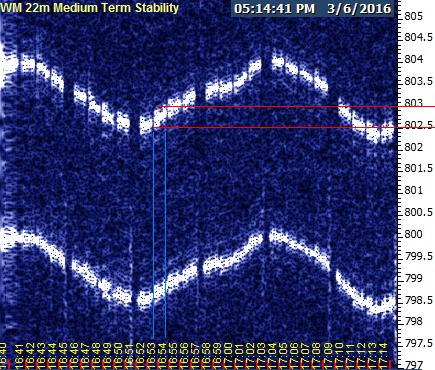
In this view, 13,555.300 MHz is represented by 802 Hz, within half a Hz either way. The peak-to-peak variation of WM was 2 Hz, which I would not have guessed from the QRSS3 view; but in perspective, that's still < ±0.075 ppm, no trivial feat for a non-atomic oscillator in an uncontrolled environment. In the worst case instance, on the frequency upturns, the slope does not exceed 0.45 Hz/minute, which would not be great for WOLF but is no concern at all for QRSS3, and is well within reason for WSPR-2, too.
More about SIW and some views of the other stations as well later today....
John
Re: HiFER WSPR & Mystery Signal
Posted by John Davis on March 08, 2016 at 00:29:39.
In reply to Re: HiFER WSPR & Others! posted by John Davis on March 07, 2016
First, here are the final decodes of SIW WSPR yesterday afternoon. This is from the ALL_WSPR log rather than the program window, so it contains additional information beyond what the first post in this thread contained.
160306 2304   8 -21 -2.3  13.555404  K3SIW EN52 7            0     1    0
160306 2328   7 -23 -2.2  13.555402  K3SIW EN52 7            0     3    0
160306 2344  12 -19 -2.2  13.555402  K3SIW EN52 7            0     1    0
160307 0000   6 -22 -2.3  13.555403  K3SIW EN52 7            0    17    0
Even though there were only a few decodes in the second half of the afternoon (final one in the 0000 UTC time slot, 6:00 PM CST), the actual signal continued to be visible in every transmission time slot all afternoon. That includes the next half hour right up until the end of the opening at 6:30 PM. It's interesting to observe what happens to the WSPR signal at various times to keep it from decoding successfully; more on that below and in another post later.
I'm kind of getting these reports from yesterday all out of sequence, by the way, so be aware that this post skips ahead to the end my primary HF session, so I can get you all started thinking up with ideas for what the mystery signal may be, at the far right.
The 6:12 and 6:16 time slots did not decode because the signal was in too deep a fade when the WSPR header was being transmitted. The 6:20 slot was too chopped up by fading in the middle, apparently. (Note how beautifully the holes in the SIW slant trace, just under EH, match each of the dark patches in the WSPR signal.)
At the same time, another copy of the SIW slant signal appears a couple Hz below the real one, apparently from a receding feature in the ionosphere. That additional reflection slows down gradually, so that the second copy of the received signal begins to match the original in amplitude. Notice that the same thing is happening on a less dramatic scale to WM from around 6:17 to 6:24.
At 6:24, it's as if an attenuator was abruptly switched in for the WM path, while SIW got much stronger. Unfortunately, as you can tell even by eye alone, the WSPR trace also got wider as the two copies of the slant signal got within 1 Hz of each other. This created frequency steps of non-standard spacing within the WSPR signal, so no decodes that time either.
At 6:27, the path from WM switched off entirely, and about 40 seconds later the magic ionosphere attenuator turned its attention to SIW. Meanwhile, EH started splitting into two copies, and ultimately into three. And then, just as if somebody had set a timer, the path from SIW suddenly switched off.
Well, I left the building at that point for some last-minute lawn maintenance before the light faded too badly, but left everything running. I wanted to broadcast some Epsom salt on my new stand of fescue before the predicted overnight showers, but didn't want to do it earlier while the field was filled with migratory robins. (Birds might mistake the crystals for seeds, although their continued enthusiasm once they discover them makes me think they like the taste for some reason. I didn't have quite enough of the stuff to begin with, so I didn't want to share. In addition, magnesium is a laxative for humans, and even more so for birds, something which these robins had already proven they didn't need.) Hence my late start on the lawn care.
At any rate, when I returned to the building scarcely eight minutes later, I thought something catastrophic had happened to the radio just before 6:35 PM! That horrific noise you see when you scroll all the way to the far right was S9+20, whereas the combined signals plus noise up to that point had averaged less than S2, nearly a 70 dB difference. It was very raspy in CW mode, so my next thought was a continuous power line arc. But when I switched to AM, there was no grinding buzz; in fact, there was hardly any apparent modulation at all. In SSB, it seemed a little modem-like. And, returning to CW and tuning around a bit, I saw that it occupied roughly from 13,555.0 to 13,555.4...and there appeared to be two broad peaks of maximum amplitude in between.
So, who operates a high power data signal on 13,555 kHz early on a Sunday evening? Or, is there some other explanation? Your ideas welcome!
John
630m beacon
Posted by Joe VO1NA on March 08, 2016 at 00:51:24.
Hello all,
The beacon is on again tonight. 10 WPM CW, 477.7 kHz, 40 watts to a 100m rotated L antenna h=18 metres. Reports very welcomed.
73 & TNX Re: HiFER WSPR & Others!
Joe
Posted by Mike N8OOU on March 08, 2016 at 04:47:40.
In reply to Re: HiFER WSPR & Others! posted by John Davis on March 07, 2016
John,
Very interesting indeed. I don't have an explanation for what might have occurred at that time. I have been watching at qrss 3 so after reading this message I setup my local capture to qrss 30. I think I have the same settings, but my results are different than your capture.
I have placed a capture series from this afternoon/evening on dropbox at this address.
https://www.dropbox.com/sh/fq7xsg8k8s4oqxt/AADQYAANrmyyF1FQ5CqSKQUza?dl=0
Use caution on the long link.
Two things deserve comment about these captures. One is the the Kenwood receiver was just powered up, so I am hoping the initial drift that I captured was related to that. I had to re-adjust the scale to get the signal centered.
The second comment is today / this afternoon we warmed from the 20/30's to 60F. I believe that is the warmest ambient since putting the TCXO on-air. The last few captures seem to have a very small drift.
I don't see the 2 hz frequency swing in today's capture.
I looked at the NWS temps for Sunday and didn't see anything unusual. Winds were a little stronger than normal.
I checked the beacon Sunday, along with solar and battery voltages. All seemed normal.
I don't know of any other action to take other than watch what happens in the future.
Mike. 73
Re: HiFER WSPR & Mystery Signal
Posted by John Davis on March 09, 2016 at 18:20:00.
In reply to Re: HiFER WSPR & Mystery Signal posted by John Davis on March 08, 2016
Not only was the ionosphere subject to G3 storm levels on Sunday afternoon and evening, as noted in an earlier post, there is now an excellent magnetometer capture on Spaceweather.com for March 9, which can be clicked to see a larger and more detailed view of how the storm looked in Preston, Lancashire, UK at the time.
Notice also the magnificent view of the moon's shadow moving across the earth during Wednesday's eclipse as seen from Japan's Himawari-8 (Sunflower-8) weather satellite. That is what I call "making science beautiful!"
John
[IMG] Ready for Prime Time
Posted by John Davis on March 10, 2016 at 02:46:21.
Actually, both the HTML <img> and the BBCode [img] are about now as good as they're going to get...and the latter is even better than I was shooting for, because it can recognize and fix nearly all missing closure tags now! (BBCode IMG tags normally require both a start and a closer.) It could handle that situation before as long as there was only one image in a post; but if there were two or more, a missing closure would cause part of the message to disappear.
I've logged in as an Authenticated Author for this live test. I'm about to write the following code into this message, containing a mix of properly formed HTML IMG tags, plus BBCode IMG tags, two of which are NOT properly terminated with the closing tag because I "forgot" them accidentally-on-purpose:
Demonstrating multiple image links below, first in <IMG src="/miscimg/pointright.gif"> HTML and then in BBCode [img]/miscimg/pointleft.gif <—(missing closure) and again in <IMG src="/miscimg/pointright.gif"> HTML and in BBCode [img]/miscimg/pointleft.gif[/img]. <—(normal closure) And a third time as: <IMG src="/miscimg/pointright.gif" border=1> HTML with a border=1 attribute, and finally in BBCode [img]/miscimg/pointleft.gif. <—(missing closure)
When I do that for real and not as a code specimen, then click Post, we'll see what happens:
Demonstrating multiple image links below, first in  HTML and then in BBCode
  and again in HTML and in BBCode . And a third time as: HTML with a border=1 attribute, and finally in BBCode .
Assuming all six pointer icons appear and the last of the right-pointing ones has a border around it, all has worked properly. This illustrates two key points:
• 1. The HTML version is a bit more complex and does not forgive errors, but it allows a little extra flexibility if you're familiar and comfortable with it. And,
• 2. The LWCA version of the BBCode [img] tag is so easy to use, you really don't need to add the closure! It's entirely optional.
Of course, the real life purpose of these tags is NOT to add lots of little icons to your posts...the idea is so you can display one or two pictures per post, probably each on their own lines, that you are hosting on your own Web site, or Dropbox or Photobucket account. Image tags are available right now to all Authenticated Authors, so sign up soon.
John Link Autoconversion Ready for Prime Time
Posted by John Davis on March 10, 2016 at 22:14:49.
Authenticated Authors now have two of the three features our users most frequently asked for in recent polls. Building on yesterday's success with making IMG tags more universally recognized by the software in the face of potentially confusing surroundings, I've done the same today for autoconversion of URLs into live links. Actually, both of these features previously worked OK when we announced sign-up for authentication, as long as there was only one of each type. More than one link or more than one image in a post increased the risk of errors, though. No longer!
While one should generally not embed more than a couple of images in any given message, it is sometimes desirable to post several links at a time. That works just fine now, with little risk of confusion. For example, I used a mix of http and https URLs in the paragraphs that follow. Some are inline with other text, one is on line by itself, and some are nestled amongst punctuation that really shouldn't be so close to a link that's about to be converted. But nonetheless, the result is:
Testing some URLs for automatic conversion, such as our own homepage, lwca.org. Or that old favorite www.google.com, and the ever popular (although kind of lonely on a line by itself today)
www.spaceweather.com
And doesn't everybody just love our very own lwca.org/sunpage.html?
So...sign up today at the Authenticated Authors link near the top of the Message Board, and enjoy!
John
(P.S. -- Regular HTML <A HREF="someURL">everyday links</A> and their BBCode equivalents ARE BACK! They also underwent significant improvement on Saturday the 12th. They, too, are now very error tolerant. Unlike raw HTML, which is very unforgiving of missing punctuation and may wipe out half your message if one quotation mark is out of place, typos in links on the Message Board do have consequences that are much less drastic. Documentation on using these improved hyperlinks will be forthcoming shortly.
A Modest Demonstration
Posted by John Davis on March 14, 2016 at 06:53:27.
Albert Einstein wrote:
Make everything as simple as it can be made, but no simpler.
Assuming this test message works as it should, I will be taking a break from coding for a week or so to work on my columns and other material for The LOWDOWN (although there will continue to be upgrades to the Board's documentation from time to time). We have now reached what I consider to be Version 3.0 of the new board software. Every one of the new and returning features that worked when we first went live with 2.0 a few weeks ago has been completely rewritten to make it more tolerant of complexity and typos in posts. As such, I think we have achieved for Board users a state approaching what Einstein was talking about.
To post this message, I signed in as an Authenticated Author myself, not as a Moderator or the Webmaster. Everything you see in this post is something that's avaiable to you right now if you were signed up too. (And, in fact, the preformatted text feature is available to everyone with no signup.) So, I continue to urge you to register ASAP so you'll be ready to make full use of the Board, both now and after the next wave of improvements in April! Now for the test...
Let's mix an autoconversion link like www.spaceweather.com with a BBCode named link like Google Secured, or W1TAG, and a conventional HTML LWCA link, and squeezing in a plain unnamed [ URL ] link for good measure, www.arrl.org . And then we'll mix it up a little by omitting the h t t p s in the Google link this time and basically repeating the others in a different order: Google test, www.arrl.org , LWCA, and www.spaceweather.com.
A little <PRE></PRE> preformatted text for good measure...
   STATIONS
--------------
 40.0     JJY
 60.0    WWVB
 77.5   DCF77
Or a line with just some monopaced code in it, which can be done identically with a [code][/code] pair or a <code></code> pair (or <KBD>, <sample>, or the now-obsolete <TT>, for that matter). And then, to accomodate a peculiar ambiguity of BBCode, a block of [code] containing multiple lines, so it should properly render as a <PRE>:
   STATIONS
--------------
 40.0     JJY
 60.0    WWVB
 77.5   DCF77
Which it does. And now an intentional code block error, with a valid [code] start tag but no end tag:
(code) STATIONS
--------------
40.0 JJY
60.0 WWVB
77.5 DCF77
...illustrating that the Board software tries to degrade gracefully with accidents. It converts everything that it can to proper HTML, but replaces problematic tags with markers in parentheses, rather than wiping out subsequent content from your post or leaving it looking terribly odd, as can happen all too easily with unfiltered HTML.
And finally, an image or two or three , just to be sure our <IMG> and [img] tags still work correctly. In real life, these will be used for such things as your screen captures, station photos, etc.
John
PVC back on air
Posted by Ed Holland on March 14, 2016 at 16:29:19.
Hi Folks,
PVC is back on air after a slight hiccup. It went silent somewhere between 1800 (PST)12/03/3016 and 0900 on 13/03/2016. On investigation, the 9V battery powering the keyer was exhausted! This has now been replaced with a mains supply, and PVC operation was restored yesterday around 17:00hrs. The good news is that this means more practice with the keyer, and my Morse proficiency is improving :)
Storms here in Northern California have resulted again in a tilted vertical antenna, which will require some attention next weekend. I may take the beacon off air during this time in order to install a balun at the feedpoint and perform some further antenna analysis.
As always, it is a fun work in progress.
Cheers,
Ed
mls beacon offline
Posted by mark on March 14, 2016 at 21:51:44.
Hi all. The spring thunder storms appear to be starting a little early this year. To be safe I took beacon MLS off line and grounded the antenna. I have some improvements and repair work to do but it will be back up in the Fall. Thanks for all the signal reports.
Re: mls beacon offline
Posted by John Davis on March 14, 2016 at 22:19:34.
In reply to mls beacon offline posted by mark on March 14, 2016
Thanks for letting us know, Mark. We'll look forward to seeing you again next fall.
Hifers 23-3-2016
Posted by Ed Holland on March 23, 2016 at 17:48:29.
I had a rare chance to listen this morning, so I suspended operation of PVC between 0815 and 0830 (PST) and turned on the receiver instead. I did not start spectrogram since this would have seen me late for work ;-)
Heard quite plainly were AZ, many complete instances of the full ident, with some fading. Also KC7MMI made it above the noise for some clear copies. I suspect there was much more, since the conditions seemed very good in general, but I ran out of time.
Hoping to post a better report again soon,
Ed
Re: Hifers 23-3-2016
Posted by John Davis on March 23, 2016 at 18:23:26.
In reply to Hifers 23-3-2016 posted by Ed Holland on March 23, 2016
Good work, Ed. Conditions at that time must have been good over the western half of the continent, because that's the same time (assuming you meant Pacific Daylight) that I was getting superb copy of FRC here in Kansas!
I tuned to your frequency in hopes of catching your signal, to no avail, but at least I have an excuse now. :)
I didn't make my way down to AZ until after band conditions changed abruptly at 1526 GMT, unfortunately. When that happened, EH and RY (the only two signals I had been seeing reliably earlier) went away entirely, as did FRC. NC, which had been very poor, started to show up better, then about 40 minutes later I began getting hints of RY returning and USC making an appearance.
Conditions have been variable since then, but I'm hopeful of a mid-day opening to Illinois. SIW is temporarily testing another WSPR-2 exciter on 13,555.375 kHz, into a different antenna, so I'd like to evaluate the comparative results. With the recent time change, solar noon is coming upon us right about this moment, so I'm going to return to the listening post now and see what happens.
John
Re: Hifers 23-3-2016
Posted by Ed Holland on March 23, 2016 at 21:17:45.
In reply to Re: Hifers 23-3-2016 posted by John Davis on March 23, 2016
Thanks John.
I'm considering some experimental work with my antenna setup for PVC. I have a notion that I may not be doing something quite right... It is a vertical, "dipped" at the working freq, and tuned up with an ATU using a rudimentary current meter.
However, I should have installed a balun at the feedpoint, especially since my setup is on the house roof, and so the ground-plane is not exactly 120 radials laying on moist soil. Also, I might string up a dipole, suitably E-W oriented, just for kicks. I can listen from about 4 miles away, which may give an opportunity for comparison.
...but this is all part of the fun!
Cheers
Ed Re: Hifers 23-3-2016
Posted by Paul on March 24, 2016 at 03:25:57.
In reply to Re: Hifers 23-3-2016 posted by Ed Holland on March 23, 2016
Hi Ed,
FRC's ground plane isn't ideal either. It is just using the metal roof of a small shipping container as the ground plane for the Hamstick vertical antenna. It works fine.
73, Paul
Re: Hifers 23-3-2016
Posted by John Davis on March 24, 2016 at 05:01:41.
In reply to Re: Hifers 23-3-2016 posted by John Davis on March 23, 2016
No openings from Illinois today. In the afternoon, NC drifted down on top of USC for quite a while,and EH drifted down to where SIW slant should have been. All three got quite strong at times, as did RY. During the strongest episodes, I had all sorts of audio IM products from the clipper, some of which apparently emulated the WSPR header closely enough to make it try to decode a signal, so there were three erroneous decodes today. (Argo confirmed there never was any real signal from IL, though.) EH and RY continued after the others faded out, right up until I had to disconnect everything just before sunset because of approaching storms.
FRC was occasionally slightly audible but not readable during the afternoon, although I could sometimes see its keyed carrier. I could see broken carrier from WV, but could not hear anything. It too has drifted down and was only a few Hz above the listed frequency.
No MTI or PBJ any time I checked today.
John
RQ is now AA0RQ
Posted by Bill Hensel on March 24, 2016 at 15:23:10.
AA0RQ is completely solar powered and is on 24/7
The Id has changed to AA0RQ...this is so I can possibly receive SWL reports, it doesn't seem like it is listened for by people that frequent this web site. I don't take it personal in anyway.
I have thought about taking it off the air because I received only a hand full of reports... Re: Hifers 23-3-2016
I know it gets out because I have heard it on remote tuners...
Next month it will have been on for an entire year..
good Hifer DXing......
Posted by John Andrews, W1TAG on March 24, 2016 at 16:29:34.
In reply to Re: Hifers 23-3-2016 posted by John Davis on March 24, 2016
I have watched the 13555.4 kHz range on two days this week. Propagation is slow to start in the morning, about 3.5 hours after sunrise. NC and USC are mostly absent - the only consistent signals are WM and the SIW's. This is unusual, as NC and USC are normally the dominant "watering hole" signals here. Judging by SIW's WSPR signal, signal to noise readings are about 10 dB worse than usual.
John, W1TAG
Re: Hifers 23-3-2016
Posted by John Davis on March 24, 2016 at 18:40:47.
In reply to Re: Hifers 23-3-2016 posted by John Andrews, W1TAG on March 24, 2016
Interesting observations, John. I notice solar flux has been running somewhat lower this week, which might account for the late start for propagation in the mornings...although one might hope the sun being at a higher angle in the sky at this season would offset that somewhat.
The directional differences are also interesting. I used to see only minor differences between NC and USC levels on any given day, but now they can differ widely; and MTI, which used to be nearly unavoidable for much of the day, may be absent for days at a time. Even when I get the occasional opening inside the first skip zone from Illinois, SIW and WM don't track well in level. This distance didn't used to be a problem at all until right about solar max; so I was hoping the decline in solar flux might allow more openings, but it hasn't thus far.
It's too blustery to be listening in the field today, and with 14.4 kV distribution lines on all four sides of my lots in town, even HF is a lost cause here at the house. So, today I'm going to spend my time winding transformers for the HF Beverages I plan to put up tomorrow on the farm. One is going to be oriented N60°E for Illinois and the Northeast states, with the mid-Atlantic only slightly down on the right side of the main lobe. Another will be at 120°, specifically for Florida. And finally, although this may happen a few days later, there will be one aimed due west, with CO, CA, and AZ as the primary targets. They will each be 2λ at 22m.
I don't expect the Beverages to bring in signals when the short path is simply not open to IL or CO, but maybe they will let me suppress some of the incidental codar and improve S/N when a path does exist. I took advantage of spare time on the farm yesterday afternoon to do the geometry for first laying out a single antenna run in each direction, then later adding a second run parallel to each for a phased array, per the example of Bob Sutton.
Just one question, though: does anyone here have experience with Beverages laid out over the outskirts of a radial ground system? The 60° and 270° versions may have to share the same acre that the vertical antenna occupies.
Since Beverages are generally characterized over an assumed homogenous ground, I wonder what the effects will be of having that ground interrupted by conductors running at various angles beneath the antenna, all of which are tied to a common point elsewhere? I know that you don't want to use autotransformers to couple a Beverage to a transmission line, for instance, particularly if there are multiple Beverages with their feedpoints nearby. Since wave antennas depend on the difference between propagation in soil and wire, a ground loop between two or more of them will distort their individual patterns. They'll still receive signals, but maybe not from the direction you were hoping.
I'm worried that this might also be the case if the ground loop does not occur between their feedpoints, as such, but in the soil itself under them. At the very least, the ground radials will not be symmetrical under a pair of Beverages in an array. My guess is that the radials might not affect a single antenna run too badly, but that it might make phasing a pair of them awkward or downright unpredictable. It would be helpful to know if anyone has first-hand experience with such a thing.
John
Hifers 24-3-2016
Posted by Ed Holland on March 25, 2016 at 16:22:08.
Hello again,
Here's a late submission of yesterdays reception report. Listening time was approx 0815 to 0830 PST (Daylight savings).
Working up the band, and running spectrogram, here is wat I hear or saw:
13,554.2 kHz AZ was plain audible copy
13,557.54 (freq from spectrogram) A trace, possibly PBJ?
13,558.07 kHz - A trace, possibly Paul with SPRT, no positive ID
13558.79 Repeating pattern, weak, with fading
13,562.22 The mysterious "pips". Audible, irregular and short bursts.
Some of my usual catches were absent, but it looks as if there were some previously unseen openings. I'll have to see if these can be identified in the future.
I'm also sorry that if anyone was listening for PVC, I neglected to return it to the air after my listening session! It is back as of 8am this morning.
Regards,
Ed
Re: RQ is now AA0RQ
Posted by Ed Holland on March 25, 2016 at 17:15:26.
In reply to RQ is now AA0RQ posted by Bill Hensel on March 24, 2016
Hi Bill,
I received AA0RQ on 23rd March ~0830 hours (PST DST). Audible in California, with many readable sequences of the new ident.
You are definitely getting out!
Regards,
Ed
HiFERs on 25 March
Posted by John Davis on March 25, 2016 at 17:32:26.
No difference in solar flux today, but the band became active much earlier in the morning than has been the case recently. When I started at 1400 UTC, NC, USC, EH, and RY were already present at the watering hole. Between EH and USC was a faint trace that might have been an FSK signal, or it might have been a mixing product. Time will tell.
Slightly above the watering hole was WV, with broken carrier visible on Argo first, then also becoming clearly audible. No sign of PBJ or MTI yet today, either, and nobody else except faint visual traces of FRC, and a faint broken carrier that might or might not have been RQ.
I'm currently set up and watching for the WSPRs from SIW.
Alas, even though WSPR 2.12 and Argo don't mind sharing the sound card, WSPR complains about too much received audio if I run the audio level high enough for Argo to make decent WAV recordings. Last night I tried to retrieve a recording I made of FRC yesterday morning, but the level was so low, I'll probably have to run it to another PC and crank up the gain to hear it clearly and be able to re-record it. (Too bad WSPR was in idle mode while I was tuned to FRC; perhaps its WAVs would have been at a more satisfactory level.) The notebook machine has a mind of its own when it comes to AGC, and then the applications which use the data all seem to have their own separate preferences too! Oh well.
John
Re: Hifers 23-3-2016
Posted by Ed Holland on March 25, 2016 at 20:13:33.
In reply to Re: Hifers 23-3-2016 posted by Paul on March 24, 2016
Thanks Paul - that is encouraging. I shall play around this weekend anyway, since the antenna is listing somewhat. I want at least to make sure signal isn't being lost down the outside of the feeder coax.
Cheers
Ed
Re: RQ is now AA0RQ
Posted by Bill Hensel on March 25, 2016 at 23:31:16.
In reply to Re: RQ is now AA0RQ posted by Ed Holland on March 25, 2016
Ed would you like a QSL card? I would be glad to send one...give me your address...
SJ QRT
Posted by KSal,K1RGO on March 26, 2016 at 14:41:42.
SJ on 185.303 kHz is QRT for the season, CUL Re: Hifers 23-3-2016
Later...........Sal
Posted by Paul on March 26, 2016 at 18:34:19.
In reply to Re: Hifers 23-3-2016 posted by John Davis on March 24, 2016
"Just one question, though: does anyone here have experience with Beverages laid out over the outskirts of a radial ground system? The 60° and 270° versions may have to share the same acre that the vertical antenna occupies."
I have experience running rhombic antennas over radial systems of nearby vertical antennas. No difference. In fact, the vertical did more to the rhombic's performance than the ground radials. It just made the rhombic slightly less directional, but not much.
Re: RQ is now AA0RQ
Posted by Paul on March 26, 2016 at 18:45:01.
In reply to RQ is now AA0RQ posted by Bill Hensel on March 24, 2016
Hi Bill,
As you know and we have discussed, I am a big fan of beacons of all sorts. As much as I love hearing CW beacons with 2 or 3-letter ID's, the idea also came to me that SWL reports might be more plentiful by using a full ham callsign on my HiFer. So, about 8 years ago, I did just that. In all that time, I did not get any more or any fewer HiFer enthusiast reports, but the reports from hams went through the roof. Mostly to complain that I was operating "out of band". Several OO's have "turned me in" to the FCC also.
Each time, I thoughtfully explain the 22m band Part 15 allocation, and explain the pains I go through to make sure my HiFer beacon is operating within the rules.
Two of the new HiFers on the air now are the direct result of discovering my HiFer, then contacting me, and hearing my 'sales pitch' for 22m Part 15 operation. I have also given 22m Hifer equipment and parts away to encourage more participation.
So, at the very least, you may raise more awareness for the 22m band. At worst, you will raise a lot of "ham cop" eyebrows and receive some hate mail. I keep the threatening emails like one keeps trophies. I always QSL the hate mail reports. That REALLY steams them!
Re: RQ is now AA0RQ
Posted by Bill Hensel on March 27, 2016 at 02:07:13.
In reply to Re: RQ is now AA0RQ posted by Paul on March 26, 2016
LOL
Tweaks to PVC
Posted by Ed Holland on March 27, 2016 at 03:15:20.
Hi folks,
I had a session on the roof today. For one, our solar panels were looking particularly grubby and secondly, PVC's vertical had developed a curious drunken attitude as a result of the last round of stormy weather here in California a couple of weeks ago.
Since I was there, I took the opportunity to make some other modifications. After reading further, in particular about elevated verticals, it seemed that best practice is to include a balun at the feedpoint to eliminate RF on the feeder shield and ensure the energy is going where it is intended. In the initial setup, I had wound a matching transformer, to cope with the 75 ohm coax to ~30 ohms of the vertical system, but had tied the feeder braid to the radials. I wound a new transformer, this time to test a toroid core, and have ensured that the shield, and radials are isolated. No other changes to the aerial system were made. On checking the tuning (gauged via aerial current leaving the ATU) I noted that a significant change in settings was necessary to obtain peak current, and that the peak is significantly higher than with the old feedpoint configuration.
I will try and assess signal strength from my 1 and 4 mile known points, but am already hopefull that more of my available 2mW is making it out as proper wild waves.
As ever, any reports of PVC are most welcome.
Cheers,
Ed
Temp at Hifer AA0RQ beacon today
Posted by Bill Hensel on March 27, 2016 at 13:39:18.
It might be of small interest to beacon operators that this morning, Easter Sunday
the temp at AA0RQ was 8dgs below zero( the beacon sits at the base of the antenna)....Pine, Co has got to be one of the coldest
mountain villages on the Eastern Slope of Colorado.
All the best to all....on this nice warm spring day.
Re: Temp at Hifer AA0RQ beacon today
Posted by Ed Holland on March 27, 2016 at 17:57:05.
In reply to Temp at Hifer AA0RQ beacon today posted by Bill Hensel on March 27, 2016
Brrrr!
Still, it proves your electronics are robust :-)
HiFERs on 28 March
Posted by John Davis on March 28, 2016 at 18:52:26.
By 9 AM CDT, all the regulars were at the watering hole: RY, EH, USC, and NC (still slightly above my main Argo window, actually, at that time). WV was nice and loud at times. MTI returned for the first time in quite a while. There was a strong carrier at 13,559.81 that I thought might be our old-timey pirate again, but no modulation. FRC was visible for quite a while before rising to the level of audibility.
In late morning, EH became rather noisy for a few minutes at a time (I may post a capture later today). By noon, it and RY were weaker, NC had drifted down into the Argo window, and USC was quite strong. There was a brief (less than one minute) appearance of what could have been WSPR at 12:10 PM a Hz or two above 13555.400, but it was not accompanied by any other signs of SIW, ao it may have been something else. WV was not as consistently loud, but still present. So was MTI. There was a carrier just slightly above MTI that I hoped might be PBJ, but it turned out to be a random phantom. Nobody else was visible or audible.
John
Re: HiFERs on 28 March
Posted by Ed Holland on March 28, 2016 at 20:20:10.
In reply to HiFERs on 28 March posted by John Davis on March 28, 2016
I also listened this morning, circa 8:30 PST (DST). Aside from a strong showing from AA0RQ, which was fading in and out substantially, I found it hard to distinguish much else. I may have seen the trace at 13555.400+, but could distinguish nothing from it.
Using the PC is still a bit of a learning experience - particularly with regard to choosing a speed for the waterfall display. I think there is a computing power or resolution problem that makes the display of, for example, the keying of AA0RQ rather vague.
I suspect also that a pre-dawn session on the band would turn up some different signals.
Cheers,
Ed
Can You Guess...
Posted by Webmaster on March 29, 2016 at 04:48:23.
...what this message means?
(Hint: Go back to the Message Board list, use the Authenticated Authors link, then click the Reference Page link at the top of the authors' page.)
---------------------------------------------------------------
 File Attachment 1: a-test.gif
File Attachment 2: b-test.gif
File Attachment 3: c-test.gif
Re: HiFERs on 28 March
Thanks for the post, John. I'm looking forward to being heard again!
Chris Belarus 279 khz
KD4PBJ
Posted by Mike Terry on March 30, 2016 at 15:03:10.
Acc. to info from Vasily Gulyaev, Radio Belarus and Belaruskaje Radio 1st channel relays will stop on all shortwave, medium wave and long wave on 1st April.
Mauno Ritola, WRTH fb group (29/3-2016)(via mediumwave.info)
Reaction to closure of Belarus: I read with sadness that Belarus will close its transmitters. The truth is that Belarussian transmitters are not in a good technical health. The 279 kHz transmitter's audio is undermodulated compared to its carrier and the other transmitters aren't better too. Unfortunately the economic state of Belarus doesn't allow them either to repair or replace these aging transmitters. In the years of 1990s and 2000s they were loud and clear in Hungary, even 1170 kHz transmitter were heard conveniently in an armchair. Their English language programmes were structured to raise attention of youth people like I was at that time. At the peak their English programme lasted for 2 hours. Then all disappeared and I cannot hear that powerful mediumwave transmitter anymore. I wish Belarus would reverse its decision of the closure. Re: HiFERs on 28 March
Tibor Gaal, Budapest, Hungary (29/3-2016)(mediumwave.info)
Posted by John Davis on March 30, 2016 at 17:11:14.
In reply to Re: HiFERs on 28 March posted by Chris Waldrup on March 30, 2016
Chris Waldrup wrote:
Thanks for the post, John. I'm looking forward to being heard again!
And indeed you were, that same evening. Sorry to be so slow posting results, but here's the way it looked with MTI and PBJ in near-collision. MTI was unusually strong, and PBJ was audible most of the time, too, with the exception of a few abrupt and deep fades. The two carriers were close enough that I could easily count the number of beats per second, which varied from ~4.5 at the start of PBJ keydown to 4 later. There was lots of codar interference right about then, as can be seen in the capture.
I copied MTI again Tuesday afternoon, but only a continuous carrier above it that time.
WV had also been very strong around mid-afternoon Monday. It was solid copy by ear most of the time, and sometimes even consistent enough for Argo NDB mode to work:
I notice in the NDB-mode capture that the top edge of my 250 Hz CW crystal filter bandwidth appears to have a bit of a response peak, then a very steep skirt.
I'm also attaching two files from Monday that illustrate the way propagation has typically varied during each day here over the past week of listening...conditions getting weak by late morning, RY nearly disappearing, then returning to the best reception of the day by late afternoon. (In the later image, I don't know whether USC had faded prematurely, or was off at the time. There appeared to be a rather abrupt departure and return earlier in the afternoon.)
While I'm thinking about it, here's a shameless plug: For this post, I signed in as an Authenticated Author, and everything you see here is something any Authenticated Author can now do on the Message Board...the BBCode named quote at the top, the two embedded images that I uploaded to another site and invoked here with the BBCode IMG tag (although I will transfer them to lwca.org eventually), the file attachments below, plus the autoconverted live link and the bold type in the next sentence. These are all things you can do too if you visit lwca.org/mb/aa_about.htm and sign up! Enjoy.
John
---------------------------------------------------------------
File Attachment 1: 28mara0019.jpg
File Attachment 2: 28mara0072.jpg
Hifers 30 March
Hi folks.
I had a chance to listen this morning, in the customary 8:15am (PST+DST) slot. Openings seemed a little different from the pattern seen in my last few reports. All frequencies in kHz:
13554.3 Mystery carrier, not audible.
1355.29 Obvious shifted pattern visible in Spectrogram, not audible. likely WM.
13555.56 Non audible, not readable in spectrogram but freq. corresponds to NC
13558.37 Curious dash, and upward ramp. Strong and audible, semi regular. Industrial?
13563.49 Trace, non audible
1356.366 Trace, audible
13563.99 Audible Morse but not readable, likely GNK
PVC was restored to air after the listening session. I checked antenna tuning using a receiver, and also peaking up antenna current. These setting corresponded. I do still have a nagging doubt that I am doing something incorrectly that is a handicap to the signal.
More listening tomorrow :)
Ed Re: Belarus 279 khz
Posted by Mike Terry on March 31, 2016 at 09:06:07.
In reply to Belarus 279 khz posted by Mike Terry on March 30, 2016
March 31, 2016
Per MW Masts Yahoo group:
Members, Hifers 31-March
Both through BDXC and Kai Ludwig's investigations via DXLD I have learned that definitely the AM services of Belarus Radyo will close tonight.
This means that the services from Sasnovy on 279kHz and 1170kHz will stop.
Yet another European country will disappear from my Active spreadsheet.
This is sad news particularly for those who benefited from the pan European reach of the Long Wave transmitter.
73 and 88 Dan Golkdfarb
Posted by Ed Holland on March 31, 2016 at 21:01:24.
Hi folks,
It has been a good week for listening opportunities. Today looked poor at first, but some openings appeared. All frequencies are my calibration, and potentially subject to offset compared to the Hifer list published values.
13557.55 Possible MTI, visual only
13558.28 Possible SPRT? visual only
13562.12 Trace, weak, no tally with hifer list
13563.55 AA0RQ, Visual & audible between fades
13563.99 GNK, Visual, Audible at times
13564.05 Possible FSK signal? No tally with Hifer list
13564.48 Carrier trace. Persistent, No tally with hifer list
That's it for today. PVC was restored to service at approximately 0900 PST+DST
Cheers,
Ed
Beacon EAR
Posted by John Bruce McCreath on March 31, 2016 at 21:16:08.
It may have gone un-noticed, but EAR was off the air for a while today due to a break in the antenna wire just above the base insulator. I blame metal fatigue after ten years of flexing....has it been THAT long! Once I had found my "Wellys" to keep my feet dry in the ankle-deep water around the helix house, I spliced the wire with a Marrette and
returned EAR to the air with no harm done.
73, J.B., VE3EAR
potrzebie