Short Radial Wire Termination
I have a few questions regarding “short for the wavelength” ground level radial wires for use on base loaded (again, short for the wavelength) vertical antennas for LF and MF. Your subjective thoughts and suggestions will be appreciated.
Let’s limit the discussion to radial wires made from insulated copper wire, and laid directly on the ground (no attempt for intimate ground to wire contact throughout the wire’s length,) and the lengths of the wires is not equal. I other words a far from ideal radial system installed in a back yard which just does not have enough of room, such as my back yard.
(1) In the past a popular theory recommended terminating short radials with a ground stake at the wire’s distal end. As I recall, it was said terminating with a ground stake provides a ”better RF ground return” than not terminating the wire. Is that still the consensus of thinking?
(2) Suppose all the radial wires are made of 2 lengths of wire. The first section is “x” feet long, and the second section is “y” feet long. Suppose there was a ground stake at the junction of wires ”X” and “Y”, and another ground stake at the most distal end of wire “y”. Does the ground stake at the junction of wires “x” and “y” buy you anything w.r.t. providing a “better RF ground return?”
(3) Considering the ability of a 160 and 630 meter E/M wave to penetrate the earth’s surface, is there a point of diminishing returns when it comes to ground stake length? Assume the stake is installed normal to the surface.
Thank you for your thoughts and suggestions –
73 Frank Lotito K3DZ / WH2XHA grid square FN00 Re: Short Radial Wire Termination
Posted by John Davis on March 02, 2017 at 07:47:14.
In reply to Short Radial WireTermination posted by Frank Lotito on March 01, 2017
>>> (1) In the past a popular theory recommended terminating short radials with a ground stake at the wire’s distal end. (etc)
Yes, in general, that's still considered a good precaution. How effective it is depends on a number of factors, though. Reading back through "ancient literature" on the subject, I see it was used in some military VLF installations up into WW II, and was tried at several LowFER stations in the 80s and 90s. The results for LowFERs were generally more significant for installations that either had few ground radials, or else radials that were short relative to the antenna height.
As you may have read in my reply back in late January about the proposed KH beacon, what you are attempting to do with a radial system is to capture and return as much current as possible through the metallic radials with as little as possible through the lossy earth itself. Most of that current will "land" within a radius equal to the antenna height, plus the radius of a modest top hat, plus a small additional fringing factor. (If the top loading is an L or a T with a length greater than the height, then its length that becomes the more relevant length for the radials closest to being beneath the top load arrangement.) For an electrically very short antenna, there's no need to worry much about the negligible current returning from outside that radius. If most of your radials are at least that long, you could expect to see less effect from ground rods than if the radials are shorter.
In general, you want the most possible radials in or on the ground near the base (say, within half the height of the tower), where the return current is greatest, with as many of those as possible running all the way out to the radius previously described. If you can't put very many all the way out to the full height of the tower, though, that's when you might want to try some ground rods at the far ends of the longer wires.
>>> (2) Suppose all the radial wires are made of 2 lengths of wire. [...] Does the ground stake at the junction of wires “x” and “y” buy you anything w.r.t. providing a “better RF ground return?”
"Anything," maybe. Enough to justify the extra work? Probably not in most cases.
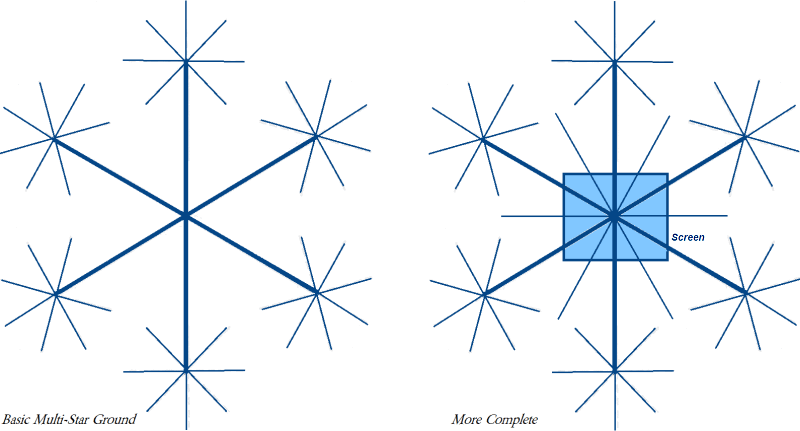
One exception might be if you were using the junction of "x" and "y" to connect multiple "y" wires to the junction to form a sort of multiple-star ground system to better collect some of the more distant return current. At left, below, is the basic concept. Ground rods, if you were to use them, might be fairly effective as the hubs of those "stars." In its original application at large VLF military stations, there might only be six stars like the basic configuration shown, but the heavier "wires" were often actually wide copper straps, elevated above the ground. That wouldn't be necessary here.
A few modern AM broadcast stations on lower frequencies use a configuration closer to the one at right...but with more stars and more in-between radials than shown here. The higher power ones also use a copper screen in the high current density region. In a LoweFER or Part 5 case, plenty of radials is better and the screen is optional, but chicken wire can take the place of copper screening if such is desired.
>>> (3) Considering the ability of a 160 and 630 meter E/M wave to penetrate the earth’s surface, is there a point of diminishing returns when it comes to ground stake length?
Certainly. The point will vary with both frequency and soil conductivity, though. At 630 meters and with good soil, the skin depth will be shallow, and it may be just as well to forget rods entirely. At 1750 meters or 2200 meters, or at 630 m with poor soil, four foot rods may be enough to provide benefit; or, may not produce much result at all, if there is an adequate number and length of radials already. Eight foot rods are seldom worthwhile, IMO, unless you're just plain stuck with VERY short radials.
If you do use ground stakes, consider enhancing and stabilizing the conductivity of soil around the grounds and radials with Epsom salt. Your lawn will probably love it too.
John
---------------------------------------------------------------
 File Attachment 1: multi-star2.gif
MTI
1504 utc MTI popped up for a couple of IDs on a very quite band, a band that seemed not open.
Current VLF stations?
Posted by N1KGY on March 03, 2017 at 05:56:48.
Does anyone have a relatively recent list of active VLF stations, 10~30Khz?
I've seen a number of lists online, but it seems they're all pretty old - many are from the early 2000s when VLF first became a popular topic.
Many of the stations in various lists are identified as "Inactive" or "De-commissioned" - so I'm wondering whether its worth the effort to cobble an antenna for this portion of the RF hinterland. Any info on what's currently active would be greatly appreciated!
Replies here or to >mycall<-at-yahoo-dot-c0m.
TIA,
Chuck Re: QRS and QRSS Memory Keyer
N1KGY
Posted by Matt Burns on March 03, 2017 at 14:53:56.
In reply to QRS and QRSS Memory Keyer posted by Frank Lotito on January 24, 2017
I'm working on a design for a very simple keyer that will key a transmitter on and off at points in time along the charging ramp of a capacitor. The on and off times for each morse segment will be set by two potentiometers. Right now my ramp generator (as seen in John's screenshot of "COM") isn't exactly linear so calculating on and off times and corresponding voltages on paper isn't going to yield optimal results but the charging resistor for the capacitor could be bypassed with a lower value and the output connected to an audio oscillator to allow for adjustment by ear at regular cw speeds. I'll try to draw up a schematic for what I have so far and find some way to post it soon. I may also attempt to make the ramp generator more linear so working out the timing on paper is more practical.....that would also make the ramp generator a "phantastron" which has to be one of the coolest words I've ever heard....
Matt
GPSDO Controlled Broadcast Stations
Posted by Frank Lotito on March 04, 2017 at 12:27:08.
https://www.gpo.gov/fdsys/pkg/CFR-2016-title47-vol4/xml/CFR-2016-title47-vol4-sec73-1545.xml
I understand that some number of GPSDO modules on E-Bay and similar auction / surplus sites are preventative maintenance pulls from broadcast stations. It appears that GPSDO frequency control, according to the above referenced 47CRF73.1545 URL, is above and beyond the minimum technical requirements required by US regulations. I assume there is a similar situation for certain foreign stations?
If indeed some broadcast stations are using GPSDO devices for frequency control, I would think that those stations could be used as convenient and reliable frequency calibration points scattered here and there around the bands. If yes, is there a up-to-date and reliable listing of stations that employ GPSDO's for frequency control?
73 Frank Lotito K3DZ / WH2XHA grid square FN00
Re: GPSDO Controlled Broadcast Stations
Posted by John Davis on March 04, 2017 at 15:38:53.
In reply to GPSDO Controlled Broadcast Stations posted by Frank Lotito on March 04, 2017
I understand that some number of GPSDO modules on E-Bay and similar auction / surplus sites are preventative maintenance pulls from broadcast stations. ... is there a up-to-date and reliable listing of stations that employ GPSDO's for frequency control?
No. The truth is, virtually no stations are so equipped, and there is no requirement for any that are to report the fact.
The relatively few exciters that are even equipped for GPS capability are mainly in digital TV transmitters, maybe a few FM models; and while some stations in bigger markets might use that option, I'm not aware myself of any that actually do. Including use of external frequency references in an exciter raises equipment certification issues on the manufacturer's side of things (how do you ensure that a defect in the external source doesn't drive the carrier frequency out of tolerance?), and it's almost trivially easy these days to meet the requirements of 73.1545 with plain crystal oscillators. On the broadcaster's side, there's no perceived benefit to maintaining atomic precision, so why bother?
Having said that, there is one instance where broadcasters could benefit from GPS disciplined oscillators or a WWVB-referenced carrier--but only if everyone else on the same channel were doing the same thing. Every several years, the FCC wrings their collective hands and wails "how do we save the AM band?" One of the three or four biggest problems always identified is the nighttime interference issue. For at least four decades I've been saying about that (as have others at various times), "It's easy. Require every station that operates at night to be frequency-locked to the national standard." The moment you do, you may still hear other programs faintly in the background, but all the grinding and rumble and chatter from co-channel carrier beats magically goes away. A quick nighttime listen anywhere on the AM broadcast band will tell you that hasn't happened yet. (sigh)
Re: GPSDO Controlled Broadcast Stations
Posted by Frank Lotito on March 05, 2017 at 16:12:01.
In reply to Re: GPSDO Controlled Broadcast Stations posted by John Davis on March 04, 2017
OK, looks like the information I came across regarding the broadcast industry as a source for GPSDO modules was incorrect. Two questions - (1) "Who / what activity" is offering these modules for sale on the Internet sites? (2) As I understand these modules from the OEM web sites, a standard output is 10 MHz with a bunch of zeros to the right of the decimal point. I understand a very few amateur transceivers do use an on-board 10 MHz clock, and they do have provisions for an external 10 MHz clock. What if your device, be it an amateur / commercial receiver / transceiver, or test equipment uses a reference time base oscillator other than 10.0000... MHz. Can someone suggest Internet articles that discuss frequency synthesizers using 10 MHz reference oscillators?
Re: GPSDO Controlled Broadcast Stations
Posted by John Davis on March 05, 2017 at 17:57:43.
In reply to Re: GPSDO Controlled Broadcast Stations posted by Frank Lotito on March 05, 2017
>>> "Who / what activity" is offering these modules for sale on the Internet sites?
Most of them probably come from the same places that formerly used the large number of rubidium atomic frequency standards being offered online by Chinese electronic salvage companies, namely the cell phone industry, plus telcos and others involved with the Internet backbone who need precise timing.
>>> Can someone suggest Internet articles that discuss frequency synthesizers using 10 MHz reference oscillators?
I don't know of many online articles that discuss synthesis from 10 MHz sources specifically, but maybe other readers can cite some for us.
One that does come to mind involves frequency multiplication rather than synthesis. Jay Rusgrove W1VD has an article on his site about generating the 30 MHz reference frequency required by the ICOM R-75 receiver, for one example. In it, Jay references Wenzel Associates' tech library time & frequency articles, which I have found to be a useful source of ideas for various projects.
Interestingly, there is no inherent reason why a GPSDO has to have a 10 MHz output. GPS timing pulses can be used to discipline an oscillator of almost any frequency, and there are manufacturers who do offer GPS-based sources at other customer-specified frequencies...although some of these are not actually disciplined oscillators, but are DDS or other clock generators that don't necessarily have the best phase noise properties.
John
Re: GPSDO Controlled Broadcast Stations
Posted by Paul on March 06, 2017 at 19:00:48.
In reply to Re: GPSDO Controlled Broadcast Stations posted by John Davis on March 04, 2017
Good reply, John.
I work in the broadcasting industry as an engineer. We do occasionally use GPS locked frequency standards, but very rarely.
One instance is when using on-channel boosters (both AM and FM). Having exciters locked on frequency, and working in step is a way to mitigate the interference on-channel boosters generate when listeners are between the main and the booster.
Another instance is when Ibiquity forced their IBOC (should be 'IBAC') garbage upon us. All the IBOC exciters have a 10 MHz. frequency standard input on them. The purpose of which I never fully understood as all of mine also have an internal 10 MHz. reference.
Weekend Beacons 4/5 March
Posted by Ed Holland on March 07, 2017 at 18:32:42.
Hi Fers,
I managed a bit of monitoring this weekend, and heard/traced a fair number of signals.
GNK and AA0RQ are frequent visitors, and were logged both days, with decent audible signals at times.
Nearer the Watering Hole, I variously logged NC, WM and MTI. Possibly also a snippet of SIW's slant mode, but things faded just as I had the narrow QRSS band dialed in on the display.
On the radio restoration bench. The interstage transformer for the '34 Philco is complete at last. Saved by Meccano/Erektor and other bits and bobs of ingenuity and learning (re-inventing the wheel?). Without this, the project would have hit a brick wall.
Ed
---------------------------------------------------------------
File Attachment 1: before_casing.jpg
File Attachment 2: in_case.jpg
Re: Weekend Beacons 4/5 March
Thanks for the report on AA0RQ..
Re: Weekend Beacons 4/5 March
Posted by Mike N8OOU on March 08, 2017 at 11:51:51.
In reply to Weekend Beacons 4/5 March posted by Ed Holland on March 07, 2017
Ed
Thanks for the report on WM Hifer.
Mike
HiFERs Wednesday 8 March
Posted by John Davis on March 09, 2017 at 02:43:20.
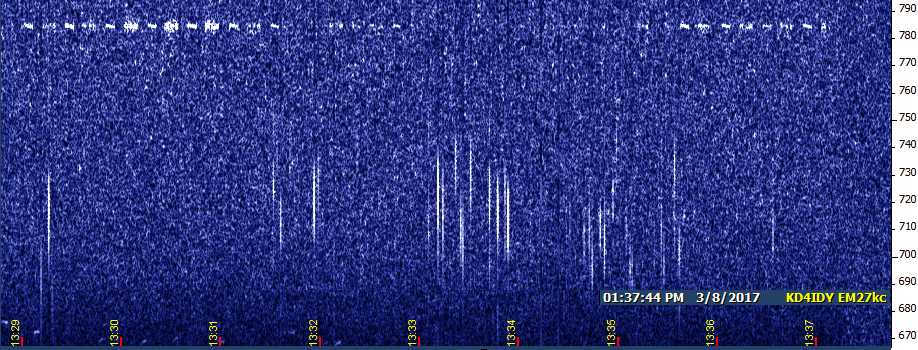
Mystery beacon PLM showed up pretty readable by 1:30 (below), and continued on and off till nearly sunset. Early on it was accompanied by the chirp/whistle signals seen here.
Otherwise, things didn't look too promising early this afternoon. At first only NC and a very loud and noise-plagued EH were present at the watering hole; no FRC, and a faintly visible AZ elsewhere. About half an hour later, PLM began showing up faintly and RY was very strong for a few cycles.
I left the receive setup doing its thing while I went out to commit mole-icide in the yard. When I returned, this is the view that greeted me:
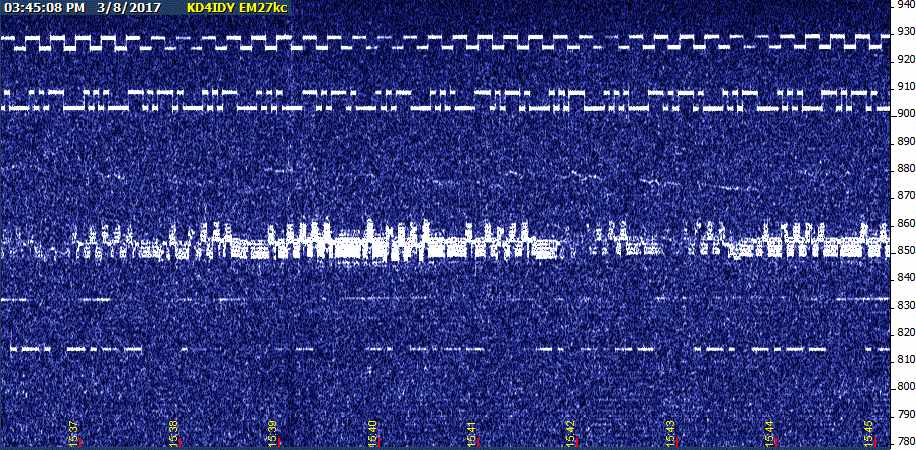
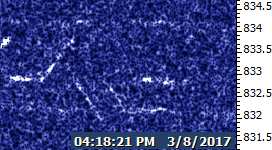
USC first showed up about 3:15 PM (it's been present briefly the past few sessions but this turned into one of the more solid appearances), then about 3:34 the line between EH and RY materialized, too. After I noticed it and realized what it might be, I made a quick band scan to see if FRC and RQ had shown up (they hadn't) so I returned to the watering hole and cranked up a QRSS30 window. Sure enough, it was SIW slant (below), but it didn't last long. (Notice also above that a brief trace of SIW WSPR2 began showing up very faintly right before the capture time, but it never got strong enough to decode.)
Unfortunately, I never saw COM or WM today.
John
---------------------------------------------------------------
File Attachment 1: 08mar3.jpg
File Attachment 2: 08mar1.jpg
File Attachment 3: 08mar2.jpg
Beacon JAM 187.015khz
The end of the season is near. I plan to turn off JAM 187.015khz end of March. So if you haven't tried to catch it time is running out. California is drying out so maybe I can get back to the "DRY TUNE" setup for the final days. In dry tune JAM is working at 400ma as apposed to wet tune which runs at 300ma. Thanxs Lee KE6PCT
UNID on 138005 KHz
Posted by Andy on March 11, 2017 at 20:20:16.
Hi all:
For anyone interested.. I monitored 136 KHz WSPR overnight, and during the 1 pm hour ( local time ) , I was hearing " tones " .. I didn't pay attention at first, but it was repeating, and that got my attention.. I began raising the frequency on the radio to bring the tone down, and found the frequency to be 138005 KHz .. The UNID sounds
like it is sending a , not so perfect - " T N " .. I recorded the audio with SpecLab, and used Audacity to look at the audio plot.. After looking, and listening a few times, the signal seems to be 2 different transmitters..1 sending a single tone - the " T " , and 2.5 seconds later, the 2nd replies with the " N " .. The " T " is slightly louder than the " N " and that is what has me thinking it is 2 transmitters .. It is also possible that the " N " is being sent at a slightly reduced power level, and the 2 tones, at different power levels make up a signalling modulation of some sort .. just conjecture on my part, this is the first time I have ever heard it.. The signal stopped
at 1:57 pm local time and has not returned as of 3pm.. I have dropbox links to the SpecLab captures, and audio .. ( 4-1/2 minutes ) .. I am curious as to what I was hearing .. BTW, the receiver bandwidth was at 2.4 KHz so the signal is relatively strong.. Thanks for any comments:
Link to the capture folder .. contains 4 captures:
https://www.dropbox.com/sh/5yhdkl7wdncmklt/AAD2ADAKvAFuA3lpQSWtl_a3a?dl=0
Link to the audio file:
https://dl.dropboxusercontent.com/u/49203948/UNID%20on%20138005%20KHz.mp3
73: Andy - XR
Re: UNID on 138005 KHz
Posted by John Davis on March 11, 2017 at 20:37:16.
In reply to UNID on 138005 KHz posted by Andy on March 11, 2017
Hi Andy. I suspect you're right about this being "a signaling modulation of some sort." If I remember correctly, some types of PLC systems do a speak-when-spoken-to polling and response in this manner. I observe that these signals are right on top of a fainter continuous PLC carrier, and that there are others present at multiples of 50 and 100 Hz in that vicinity, too.
John
Re: Current VLF stations?
Posted by John Davis on March 11, 2017 at 20:49:20.
In reply to Current VLF stations? posted by N1KGY on March 03, 2017
I don't know if anyone has emailed you a more recent source (if anyone has one, it'd be nice to share a link with everyone here), but if not, here's the most recent I've found. It's based on actual receptions by Jay W1VD in 2011.
Not all of these may be on the air, either. Time and frequency station HBG has discontinued operation since then, for instance, but most of the stations listed below 40 kHz should still be on. (Those designated TACAMO are intermittent by their nature, of course, and SAQ only operates on special occasions these days.) Most transmissions will be encrypted text in MSK mode.
John
Re: UNID on 138005 KHz
Posted by Andy on March 12, 2017 at 01:25:55.
In reply to Re: UNID on 138005 KHz posted by John Davis on March 11, 2017
I think you may have " hit the nail on the head " - JD .. After looking again at the posted captures, I see faint carrier lines at 100 Hz intervals, and the sending signal is sitting almost on top of a faint carrier line as you mentioned.. I must have just " lucked up " and caught one - phoning home - ... hi hi , 73: Andy - XR
RTÉ Radio 1 to continue on LW till 2019
Posted by Mike Terry on March 12, 2017 at 08:28:49.
An article in Radio Today by Roy Martin
RTÉ has agreed to continue its longwave 252 service in the UK until the end of June 2019.
After that, RTÉ hopes Radio 1 will gain approval from UK authorities to launch via a chain of small broadcast networks which cover main urban centres. Currently, a broadcaster has to be based in the UK to obtain an Ofcom licence.
RTÉ says using the DAB+ platform will be considerably less (approx one fifth) than the present quarter of a million per annum that RTÉ expends in running costs for 252.
Minister of State for the Diaspora, Joe McHugh T.D., has welcomed the recommendations: “I am delighted that there is now a way forward that takes into account as much as possible the views of older members of the Irish community in Britain. I have committed to making a contribution to this via the Government of Ireland Emigrant Support Programme. The research we funded on this issue has made clear that RTÉ Radio is a fantastic resource for Irish people in Britain. I’d like also to acknowledge the leadership the Irish community in Britain has shown on this.”
RTÉ plan to launch a service on DAB+ digital radio modelled from RTÉ Radio 1 and to work with stakeholders to maintain contact with the Irish community in Britain. Details of this service are still being worked out but it is likely to include a limited amount of new targeted programming commissioned for audiences in Britain. As a terrestrial radio service this is subject to regulatory approval in the UK.
The UK Government is currently in consultation about deregulating the radio industry, including the option to have a foreign company hold a radio licence.
http://radiotoday.ie/2017/03/rte-radio-1-to-continue-on-longwave-till-2019/
Hifer Beacon "D"
Posted by Chuck A on March 12, 2017 at 19:36:01.
Seeing and hearing beacon "D" on 13.527714MHz - H:1918Z. Solid copy for about 10 minutes, was in and out of the noise when I pointed the receiver at the watering hole about 20 min ago, is in and out of the noise again, now.
Not seeing any other sigs between 13.554 and 13.565 except a well defined streak of noise from 13.560 to 13.562Mhz.
Receiver: SDRplay RSP2 Re: Current VLF stations?
Preamp: ZFL-500-HLN
Antenna: pair of 68 foot (45*) sloping wires, one E/W and one N/S.
Posted by Chuck A on March 12, 2017 at 20:09:31.
In reply to Re: Current VLF stations? posted by John Davis on March 11, 2017
Thanks. Yes, this is the most current (and comprehensive) one I've been able to find, also. But 6 years is a long time, and there's been a lot of attrition in the spectrum below 30MHz in that time.
Since this is the best place to ask about LF/MF, I though I'd give it a go.
Warmest 73, Re: Hifer Beacon "D"
Chuck / N1KGY
Posted by Ed Holland on March 14, 2017 at 18:46:10.
In reply to Hifer Beacon "D" posted by Chuck A on March 12, 2017
Where are you Chuck? I wonder if D is any relation to the AC beacon we saw last year in this vicinity - just outside the 22 m ISM allocation?
Will have to see if I can hear D at my location here in Northern California. AC was rather strong, very clear audibility at times.
Ed
Re: Hifer Beacon "D"
Posted by Chuck A on March 14, 2017 at 22:18:25.
In reply to Re: Hifer Beacon "D" posted by Ed Holland on March 14, 2017
Hi Ed,
Apologies - given I haven't posted a lot, I should have specified my location:
I'm in the extreme southeast corner of FM06, about 12 miles NW of Nashville, NC.
"D" was very clearly audible when I posted about it, both on my SDRplay RSP2, and confirmed with my Palstar R30A since I was initially skeptical that it might be an artifact of digitization.
Cheers
Chuck
Re: Hifer Beacon "D"
Posted by Ed Holland on March 14, 2017 at 22:37:00.
In reply to Re: Hifer Beacon "D" posted by Chuck A on March 14, 2017
Hi Chuck,
Thanks and no worries. I'll still listen out, despite the distance. AC made itself known far and wide. If I can hear "D" and given that the frequency is in the same ball park, it makes for an interesting coincidence.
Don't give up on the rest of the band either - it varies remarkably as conditions change. Somehow, once these tiny signals get a chance, they fly far and wide!
Cheers
Ed
Re: Hifer Beacon "D"
Posted by Chuck A on March 15, 2017 at 17:09:18.
In reply to Re: Hifer Beacon "D" posted by Ed Holland on March 14, 2017
"Don't give up on the rest of the band either - it varies remarkably as conditions change. Somehow, once these tiny signals get a chance, they fly far and wide!"
Understood and agreed.
Cheers
Chuck
JAM Copied
Posted by Mark, Ku7z on March 16, 2017 at 00:04:59.
Got up early this morning and found really good prop on the NDB band so went looking for J-AM and there it was! Its been a couple of years since the last time I was able to copy it here. And it was without a loop antenna, the active whip did the trick today. (See attachment.)
73, Mark, Ku7z
DN41af
Ogden, UT (NUT)
---------------------------------------------------------------
File Attachment 1: JAM20170314crop.jpg
Digital on 136 KHz?
OK, I've got my RSP2 set up with a reasonable [temporary] antenna for 2200M - my 210 foot inverted-L with a loading coil - and I'm seeing/hearing some signals. So I pointed the output to WSJT-X (v1.7, fresh install) and expected to see some decodes of either WSPR or JT9/65 but no joy with either.
I know the setup works, because I tested it on 40M earlier this evening, and got lots of JT65 traffic decoding straight away.
And I'm not deaf on 136KHz, either - I've got S9+ noise which is definitely atmospheric, and I can hear some very faint CW down in the noise at about 136.200Khz.
So anyone have any ideas what I'm missing, or did I just pick a bad night to try?
Thanks Re: Digital on 136 KHz?
Chuck
n1kgy
Posted by John, W1TAG on March 16, 2017 at 02:21:43.
In reply to Digital on 136 KHz? posted by Chuck A on March 16, 2017
Chuck,
I have copied 10 WSPR spots of WH2XND tonight since 0120 UTC. I'm in central MA, and XND is in AZ, so you should have a shot. Be sure your receiver is set to 136.000 kHz USB. You may just want to let it run overnight, as the best signals might be closer to dawn. XND is the only WSPR signal you would likely be able to copy tonight, as the only other possibilities right now are in EU.
Good luck!
John, W1TAG
Re: Digital on 136 KHz?
Posted by Chuck A on March 16, 2017 at 02:50:52.
In reply to Re: Digital on 136 KHz? posted by John, W1TAG on March 16, 2017
Thanks John! Will give it a shot overnight.
Chuck
Re: Digital on 136 KHz?
Posted by John Davis on March 16, 2017 at 03:44:01.
In reply to Re: Digital on 136 KHz? posted by Chuck A on March 16, 2017
Before setting up tonight's attempt at LowFER JAM on 1750 m, I listened for WH2XND. Heard the signal immediately, well above noise, with the CW ID readily copyable by ear. Of course, I'm scarcely half the distance from him, but it does further confirm that he's on.
John
Re: JAM Copied
Posted by Lee on March 17, 2017 at 01:11:13.
In reply to JAM Copied posted by Mark, Ku7z (fwd) on March 16, 2017
Thanks Mark
HiFER Beacon "D" Again
Posted by Chuck N1KGY on March 17, 2017 at 18:58:34.
Just looked in on the waterfall, which I had set running at lunchtime, and "D" has returned. Too weak to hear at the moment, but fading in and out of the waterfall at 13.52771x over the last 2 hours or so. Not much else visible at the watering hole except some wide, fuzzy noise strips running from below 13.500 to above 13.600.
Also collecting *lots* of WSPR spots on 20M since I set it running before lunch. I am uploading them to http://wsprnet.org/drupal/wsprnet/map under N1KGY if anyone's interested.
Cheers Re: HiFER Beacon "D" Again
Chuck
Posted by John, W1TAG on March 17, 2017 at 19:46:54.
In reply to HiFER Beacon "D" Again posted by Chuck N1KGY on March 17, 2017
Very audible here in Central MA this afternoon. Some fading, but not deep. No way it's legal - the Part 15 regs for that frequency require a field strength 33.5 dB lower than in the 13.553 - 13.567 MHz range.
John, W1TAG
Re: HiFER Beacon "D" Again
Posted by Ed Holland on March 17, 2017 at 21:43:20.
In reply to Re: HiFER Beacon "D" Again posted by John, W1TAG on March 17, 2017
I listened this morning around 1500z. No sign of anything at or near that frequency, despite some good "watering hole" copy.
WM Lowfer Off Air
Posted by Mike N8OOU on March 18, 2017 at 14:18:56.
All;
I am taking the WM Lowfer down until later this summer. That last blast of winter seems to have created problems somewhere in the system.
Mike N8OOU
Re: HiFER Beacon "D" yet again
Posted by Chuck N1KGY on March 18, 2017 at 19:55:56.
In reply to HiFER Beacon "D" Again posted by Chuck N1KGY on March 17, 2017
"D" has appeared again today, loud and clear here on 13,527.712Khz as of 1931HrsZ.
I don't know how long it has been, I just tuned down to take a look at the watering hole, and it's between 10 and 12dB above the noise. Propagation must be really strong today, as the air noise is reading a whopping -88dBm (-9dB attenuator + splitter is included in this figure) according to HD-SDR.
Receiver is my SDRplay RSP-2 into HDSDR software, antenna is a horizontal Vee, each wire 68'5" in length @ height of ~30 feet, tuned with a Johnson Matchbox. I actually have a 6dB attenuator in addition to a -3dB/port splitter in line between the Matchbox and RSP-2, to minimize the IMD I often get from VOA, and still "D" is yuuuuuge ;P
Would love to know where "D" is coming from, and how much power it is running, because it's the strongest trace in my waterfall display covering 13,420KHz to 13,570KHz.
Re: JAM Copied
Posted by Mark, Ku7z on March 19, 2017 at 11:08:42.
In reply to Re: JAM Copied posted by Lee on March 17, 2017
Hi Lee, Am copying you again this morning (1045 utc) but much weaker with QSB.
73, Mark, Ku7z
WH2XVN Lowfer
Posted by Mark, Ku7z on March 19, 2017 at 18:09:40.
After looking for Jam this morning I stumbles onto Lowfer WH2XVN sending CW on 183.5. He is in Burbank, CA, DM04. Very nice signal at 1030 utc.
73, Mark, Ku7z
DN41af
Ogden, Northern UT (NUT)
SJ OFF
Posted by Sal, K1RGO on March 23, 2017 at 22:09:44.
Lots of wind here stressing my LF antenna and there is an intermittent contact issue so I will have to check it out . Meanwhile lowfer SJ will be off until the next season. Re: HiFER Beacon "D" yet again
later...........
Posted by Ed Holland on March 24, 2017 at 23:06:46.
In reply to Re: HiFER Beacon "D" yet again posted by Chuck N1KGY on March 18, 2017
I happened upon the following info related to "D" whilst perusing HF underground:
www.hfunderground.com/board/index.php/topic,33118.0.html
It seems that D is a Russian Naval Beacon "Sevastapol" located at a coastal station on the Black Sea.
Minimal HiFERs Today
Posted by John Davis on March 27, 2017 at 03:19:54.
First chance to listen in 10 days, from mid-afternoon until storm clouds started rolling in a couple hours before sunset, and not the most ideal propagation conditions, either. EH was pretty consistent all afternoon, and for extended times it was the only watering hole resident. RY made it through faintly at times, but it took until about 4 PM for NC to show up at all.
PLM was present, varying from barely audible, to quite strong (up to S1 a couple of times), to barely visible, to completely invisible once in a while for short periods. Since the last time I monitored, PLM switched from DAID to continuous idents.
John
Re: Minimal HiFERs Today
Posted by Ed Holland on March 27, 2017 at 03:59:46.
In reply to Minimal HiFERs Today posted by John Davis on March 27, 2017
Limited listening here (1900z), but AA0RQ came in well, also EH, NC and a trace or two unreadable in the low zone of the 13,555.xx watering hole. More time might have wheedled them out. A later check about 2 hours on saw most signals faded out.
Re: HiFER Beacon "D" yet again
Posted by Chuck, N1KGY on March 27, 2017 at 16:35:57.
In reply to Re: HiFER Beacon "D" yet again posted by Ed Holland on March 24, 2017
Cool. I registered with HF Underground back in 2005~6, and was a regular reader there for several years, but haven't logged-in in quite some time...probably close to 2 years now. I really should add it back into my reading list.
And I'm certainly pleased to have had good Ear-Copy of a Russian ;P
Thanks Ed! Re: Minimal HiFERs Today
-Chuck
Posted by Chuck, N1KGY on March 27, 2017 at 16:43:01.
In reply to Re: Minimal HiFERs Today posted by Ed Holland on March 27, 2017
Looking in here, there's nothing at the watering hole but a lot of noise. Not even my friend "D" is visible. Lots of T-storms across the Southeast today, warnings for worse as the afternoon goes on. I'll probably be disconnecting antennas shortly :( LW Beacon and Receiving
Posted by David Johnson on March 27, 2017 at 23:32:31.
Greetings, this is Dave (alt David ok) WA4NID active in LW many years ago but now finally moved to Graham NC where I have a bit more than 3 acres and NO stupid restrictive covenants from those wicked HOA thingies. So happy to start again in ham radio and also my LF pursuits.
For some reason I remember receiving NDBs on my Kenwood TS-440SAT directly, but maybe my memory is wrong. I have a converter and maybe I was using that, I did log lots of NDBs with this rig. The rig still works fine on ham bands!
I plan on completing some transmitter and antenna projects and getting beacons up on medfer, and 1750m bands. I know the 'season' is ending but that's ok. I am rather slow but I think my excitement will carry on through the months of experimenting, and hopefully I will be able to report fairly reliable operation of beacons into next fall and winter.
Anyways I just wanted to check in and say best wishes to all who are experimenting with the low freqs. I see that people use software for receiving weak sigs and this is great. I will learn about this more, but I am really wanting to transmit and also listen, and hopefully make contacts on LF with others!
In the past I had some experimental beacons running callsigns XP or XPJ, in honor of my wife Xiaoping Sun Johnson. I will likely go with XPJ for future beacons unless others have already been using this call. So listen 0ut for this soon!
Cheers!
Dave WA4NID Acronym
Former XP or XPJ
Posted by Frank Lotito on March 28, 2017 at 17:17:41.
A message board respondent recently used the acronym "DAID" when reporting his recent HiFer listening. What does "DAID" mean?
73 Frank K3DZ / WH2XHA
Re: Acronym
Posted by John Davis on March 28, 2017 at 18:53:01.
In reply to Acronym posted by Frank Lotito on March 28, 2017
Well, our occasional LOWDOWN correspondent, a certain Mr Answer Guy, explained it several years ago as a two-syllable adjectival Southern radio expression referring to a moribund state of a depleted battery, a range of frequencies experiencing poor propagation, or a hound that will never hunt again. If capitalized, it's generally being emphasized as part of an exclamation.
Example: "Man, this battree (or "band" or "dawg") is DAID!"
However, for most of us, it's the acronym used by NDB hunters to stand for "Dash After ID," once pretty common among LF beacons but now mainly confined to Canada. (In the case of the mysterious HiFER PLM when it's operating in that mode, the dash is 5 seconds in length, during which time its frequency droops about 1.5 Hz, giving it a noticeable slope at QRSS3.)
Incidentally, also according to our Mr Answer Guy (there are several imitations on the Web, which he does not currently inhabit; but so far as I know, ours is the original, in print since 1993):
"NDB" is a TLA = Three Letter Acronym
"DAID" in an EFLA = Extended Four Letter Acronym
...and anything over that is a GBHMLA = Great Big Honkin' Multi-Letter Acronym
Just FWIW... :)
Re: Acronym
Posted by Frank Lotito on March 28, 2017 at 21:53:33.
In reply to Re: Acronym posted by John Davis on March 28, 2017
>>> during which time its frequency droops about 1.5 Hz, giving it a noticeable slope at QRSS3.) <<<
Amazing, a frequency droop of 1.5 Hz! It was not that may years ago when the regular speed CW tone of many overseas amateurs' stations, and indeed, some W/K and VE amateurs' stations went through a 100 Hz +/- change in frequency for every dit and dah, HI. But, I wonder if in these days of milli, and for some micro-Hertz stability, a 1.5 Hertz QRG (if I used the correct Q-code) is considered a "no-no?"
73 Frank K3DZ / WH2XHA
Re: LW Beacon and Receiving
Posted by Lee on March 29, 2017 at 00:34:04.
In reply to LW Beacon and Receiving posted by David Johnson on March 27, 2017
Hi Dave. Nice to hear you are about to start Lowfer'ing again. Sounds like you have been away for a while. So please check out my youtube video entitled "Amateur Radio Beacon JAM 187khz Lowfer" Lots of thrill seeking don't ya know. Re: Acronym
Lee KE6PCT
Posted by John Davis on March 29, 2017 at 08:00:50.
In reply to Re: Acronym posted by Frank Lotito on March 28, 2017
>>> I wonder if in these days of milli, and for some micro-Hertz stability, a 1.5 Hertz QRG (if I used the correct Q-code) is considered a "no-no?"
Close on the Q-code. QRG refers to exact frequency, and I believe QRH is the one used to ask about or report frequency variations.
On the PLM signal, which is intended to be received by ear, a Δf of 1.5 Hz is basically nothing. Out of a typical BFO offset of 800 Hz, most trained, professional musicians cannot hear that little pitch change over a five second interval, even in the absence of any background noise.
But for digitally detected modes (even as relatively low-tech as QRSS3 is now considered by some to be) such a small variance is noticeable, and becomes quite serious at slower QRSS speeds.
Imagine the ARGO screen as a paint-by-numbers canvas--but instead of bearing outlines and details of objects to be depicted in the painting, the canvas is printed with a very fine grid of squares or rectangles called "FFT bins" that the software tries to fill at the appropriate times and in the appropriate quantities to recreate a recognizable semblance the original message. The "width" of each bin along the vertical axis represents frequency divided up into blocks of whatever resolution that the Fast Fourier Transform can discern out of a complex waveform for a given setting; while the "length" of each bin along the horizontal axis represents the passage of time during which energy centered on each of those frequencies is being accumulated in each bin.
The FFT routine "paints" energy into each of the frequency bins over successive time intervals. If the carrier is spectrally pure and has a steady frequency, and assuming the receiver doesn't drift, all the energy of the signal will all be deposited in a single row of bins all the way across the screen. It will exist in each single bin for the full integration time, and therefore the full value of energy at that frequency will be available for display on the screen. However...if the carrier is drifting in frequency during the integration time, its energy may not be captured in a single bin, but be spread across two or more. The resulting line will be dimmer, possibly in an exponential fashion, since the energy-to-brightness transfer curve of waterfall displays are intentionally non-linear to establish a sort of threshold effect. The faster the drift relative to the width of each FFT bin, the more bins the energy will be smeared across, and the dimmer the line will be.
Using the PLM example, 1.5 Hz/5 sec = 300 mHz/second. Since the bins are 366 millihertz wide for QRSS3, the effect of that much drift on detection efficiency is not terrible. The signal will be confined to a single bin for one out of every three or four time intervals, and will be partly in two adjacent bins during the other time slots. Not ideal, but not terrible.
The same drift in a signal timed for a QRSS30 transmission would span more than 8 bins in the same length of time. Each of those bins is being averaged for 10 times as long, although so is the random noise energy. As a practical matter, that means such a drifty signal might show up as much as 25% stronger than a QRSS3 version of the same message--but a constant frequency signal confined to a single bin width would show up 10 times stronger! Thus, that 1.5 Hz per 5 seconds means you're only getting one-eighth the pre-threshold detection efficiency that you would otherwise have with QRSS30, all other factors being equal. Not to mention, it would put the trace off the screen in not much more than a single dot length!
(I'm intentionally ignoring different possible time domain settings in relation to QRSS so as not to make things any more confusing than necessary, but be aware that adequate display of intentionally ramped graphical modes requires attention to both the frequency shift of the transmitted signal and the time over which it occurs. Slowing down the repetition rate doesn't help much unless the shift is also reduced, and vice-versa.)
Other digital modes that have been used fairly commonly in Part 15 experiments (WSPR, WOLF) may also balk at frequency variations of more than a single Hz over several minutes of time. Some modes that have been used in transoceanic ham experiments require stabilities in the millihertz or sub-millihertz range for the entire duration of a transmission, which may be hours long.
So, yes, for anything other than good old CW, I'd say a short-term QRH of 1.5 Hz is pretty much a "no-no" in this era.
John
MLS off line
Posted by Mark on March 30, 2017 at 02:08:59.
HL all. Beacon MLS will be off line on April 1st. The spring storms are coming and I want to play it safe. Thanks for all the signal reports and MLS will be back on this Fall. TNX .... Mark
Beacon JAM 187.015khz off April 1st
Posted by Lee on March 30, 2017 at 04:20:23.
Beacon JAM 187.015khz off Sat April 1st. Thanks to all who looked for it. Re: Acronym
Lee KE6PCT
Posted by Chuck, N1KGY on March 30, 2017 at 07:19:13.
In reply to Re: Acronym posted by John Davis on March 29, 2017
Well John,
I still hear a lot of QRH on many of the QRP signals, and of course the BAs are like trucks that take up several lanes on the highway... but it's an interesting point, none the less.
When I was first licensed, if you drifted less than 100Hz in the course of a QSO, no one would ever care, let alone comment. Likewise, a bit of "swoop" or "chirp" on your CW was pretty typical - my Drake TR-3 had maybe a 40Hz cirp from key-down to final freq, and there were a lot of homebrew rigs that were double or triple that!
But now in the age of ubiquitous DDS synthesizers, locked to Oven-ed TCXOs, I've noticed that the swoops, chirps, and other such "marks of character" seem to have mostly disappeared from the bands, to the extent that the bands really do sound different. Likewise, dang near every CW op now uses an iambic keyer. Hand keyed CW is rare these days outside a few OTs, and the occasional "purist" events where hand-keyed CW is the requirement.
Certainly it can be said that "the state of the art has progressed"; but has "the state of the artist regressed", also? Because we are all sounding pretty much like machines on the air, these days. And it's funny that the topic comes up now, when just this past weekend I was trying to explain to my son how much different the bands sound now than when I was his age... Close but no R4 LW
Posted by Ed Holland on March 31, 2017 at 07:17:27.
Hi folks,
I always try and bring a portable with me when travelling. Last year, during a long conference in Dusseldorf, I was able to receive BBC R4 and listen in the mornings to the news by radio.
Here in Munich, alas, we are much further from Droitwich. Whilst there's a carrier amid the noise, and perhaps the flutter of voices, there's no listening to be had. My patchy geographical knowledge had led me to underestimate the task - it is almost twice the distance to central England!
RTE befalls a similar fate, and the LW band is a much changed landscape than what I remember as a kid & teenager in the UK.
Cheers
Ed
FCC Approves 135.7-137.8, 472-479 kHz Bands!
Posted by Ed, KI6R on March 31, 2017 at 16:30:40.
The FCC has approved two new VLF band for the U.S. Go to www.ARRL.org to see the details. The new ruling becomes effective 30 days after publication in the Federal Register. It is hard to say how long publication will take. 135.7-137.8: 1W EIRP max and 1500W PEP max, 197 foot high antenna. 472-479 kHz: 5W EIRP max and 500W PEP, 197 foot high antenna. Operating stations must notify the Utilities Telecommunications Council (UTC) at least 30 days prior to starting operations. Stations must be located more than 1 km from any AC power transmission line that is utilizing a power line carrier (PLC) line protection system. The UTC must reply to the amateur within 30 days of notification or the amateur may commence operations. It looks like all modes are approved, CW, RTTY, data, phone, image. License class must be extra, advanced or general. My one primary concern is I'm certain that the UTC does not have accurate records regarding which PLC systems are in-service. Many systems have been taken out of service over the past 20 years and I doubt all updates have been sent to the UTC. For example, Sacramento Municipal Utility District (SMUD) used to have many PLC systems in service. At this time they now have only one, on a transmission line shared with the Western Area Power Authority (WAPA). Re: FCC Approves 135.7-137.8, 472-479 kHz Bands!
I'm going to get the soldering iron warmed up and start looking for some power MOSFETs! 73s, Ed, KI6R
Posted by Chuck, N1KGY on March 31, 2017 at 18:14:32.
In reply to FCC Approves 135.7-137.8, 472-479 kHz Bands! posted by Ed, KI6R on March 31, 2017
Woo Hoo. I've had a box full of LAPT A1860 and C4886 transistors for linear stages, and IRF840 MOSFETs for Class D/E PAs, just waiting for this day.
I'm going to have to go read the details of the announcement, to see whether we can notify UTC on the publication date, or if we have to wait 30 days for the Effective date to postmark our notifications...
Chuck
Re: FCC Approves 135.7-137.8, 472-479 kHz Bands!
Posted by John Davis on March 31, 2017 at 19:48:28.
In reply to FCC Approves 135.7-137.8, 472-479 kHz Bands! posted by Ed, KI6R on March 31, 2017
At long last!!! Here is the Report & Order in PDF for those wishing to see all the details:
ecfsapi.fcc.gov/file/0329181065646/FCC-17-33A1.pdf
FCC Rulemaking Helps HiFERs Too
Posted by John Davis on March 31, 2017 at 19:52:26.
Docket 15-99 that implements WRC07 ham bands at LF and MF also has a provision that allocates specific bands for oceanographic radars. That means in roughly five years, Codar should finally go away in the 22 m band.
John
potrzebie