HiFer OH
Notification that HiFer "OH" transmissions was terminated 28Feb19. This is due to shack layout changes involving antennas. Transmissions later this year will be using WSPR mode.
Reminder: Lowfer net + or - 3927Khz Saturday morning 0800 California t
Posted by Jerry Parker on March 01, 2019 at 15:32:00.
Reminder: Lowfer net + or - 3927Khz Saturday morning 0800 California time
Or listen online at:
http://69.27.184.62:8901/?tune=3927lsb
Reminder: Lowfer net 3927Khz Saturday morning 0800 California time
see you there
KFS WebSDR in California Re: New Beacon now active on 13564.4 kHz
69.27.184.62
Posted by Steve VA3SC on March 02, 2019 at 01:22:43.
In reply to Re: New Beacon now active on 13564.4 kHz posted by Vic on February 25, 2019
HI Vic. I need to check this message board more often. Nice to be furthest DX so far. It was right beside the new beacon near me, 'AMA'. To hear one 1200 miles away, as you stated, and another only 7 miles away coming in so well, was a real treat. I was curious what you were using for an antenna and power but you mentioned that in your posting. Thanks. I'll keep trying for you, and all the others of course.
Re: New Beacon now active on 13564.4 kHz
Posted by Vic on March 02, 2019 at 02:41:46.
In reply to Re: New Beacon now active on 13564.4 kHz posted by Steve VA3SC on March 02, 2019
Hi Steve
I am running the beacon JUN daily on 13565.2 kHz from about 09.30 EST to about 22.00 EST so any further reports are very welcome.
I am now upgrading my antennas and I hope to have this work done in about ten days. I will announce this when it is done. Hopefully this will improve the signal ;-)
Best wishes
Vic W4/GW4JUN
Re: New Beacon now active on 13564.4 kHz
Posted by Steve VA3SC on March 02, 2019 at 13:16:05.
In reply to Re: New Beacon now active on 13564.4 kHz posted by Vic on March 02, 2019
I'll shall check your frequency for sure...cheers
Re: New Beacon now active on 13564.4 kHz
Posted by Vic on March 02, 2019 at 13:54:43.
In reply to Re: New Beacon now active on 13564.4 kHz posted by Steve VA3SC on March 02, 2019
One of my listeners has reported that my beacon has drifted up 100 Hz to 13565.3 kHz.
This was due to my antenna tuner pulling the oscillator slightly. I have tweaked it down again ....I think...
So if anyone is listening out for JUN please just check 65.2 and 65.3 for the next week . Meanwhile I will try to work out a sure fire way of keeping it on the same frequency.
Marconi never had this trouble ! ;-)
73. Vic W4/GW4JUN
Re: Reminder: Lowfer net + or - 3927Khz Saturday morning 0800 California t
Posted by Clint KA7OEI on March 02, 2019 at 21:06:31.
In reply to Reminder: Lowfer net + or - 3927Khz Saturday morning 0800 California t posted by Jerry Parker on March 01, 2019
(Clint Turner generally prepares a summary of the weekly Western LowFER net sessions which he distributes to the participants and other interested parties. He has been kind enough to share this report week's with us. If there's interest, we will set up a page to archive each week's reports. - Webmaster)
Notes on the 2 March, 2018 LowFER Net, starting at 0800 PT. Sorry for omissions/errors On Air: Jerry, WA6OWR;
Dave, WD4PLI; Ed, KI6R; Clint, KA7OEI Jerry: John (via email): Ed: Dave: Clint: 73, Clint KA7OEI Re: Reminder: Lowfer net + or - 3927Khz Saturday morning 0800 California t
Vicariously, via SDR: Eb, KC6SOJ; John, AEØCQ
Posted by Paul on March 04, 2019 at 03:09:50.
In reply to Reminder: Lowfer net + or - 3927Khz Saturday morning 0800 California t posted by Jerry Parker on March 01, 2019
WA6OWR DE K6FRC
Did anyone check in this week?
Re: LWCA Site Update
Posted by Webmaster on March 04, 2019 at 08:55:37.
In reply to LWCA Site Update posted by Webmaster on February 28, 2019
As promised, a brief follow-up on what the recent migration to a new server means to you.
We have a dedicated IP address for the first time, which means any email-based services we may offer in future will be less likely to be wrongly identified as spam. Since there are no other shared users of this same address, none of them can get us blacklisted because of their outbound junk mail.
Our new SSL certificate should also help with that, as well as meaning that lwca.org and its underlying host, lwca.net, operate in 256-bit encrypted mode now. When an Authenticated Author posts here in the Message Board, his tripcode is now secure and no longer susceptible to easy interception. We've not previously had a problem with imposters spying on our enhanced posting capabilities and intentionally impersonating other users, but now we have a substantial degree of protection against it happening.
Finally, because the host machine has greater resources available, response times should now be as good as it's possible for them to be over any given network.
Oh! And really finally, the GMT times shown on posts in this Board now appear to be accurate to the nearest minute! Our previous hosting provider could be off by as much as two hours at some times of the year, but our new one seems to pay much better attention to such details.
That's not to say everything is perfect yet, but it seems to be greatly improved in many areas. As always, let me know if you encounter any difficulties or anomalies. Don't just assume I know about them. Thanks!
John Saturday & Sunday 3rd March Hifers
Posted by Ed Holland on March 04, 2019 at 21:50:15.
Saturday:
Listening around 1200 to 1300 (PST). Nothing audible, but strong traces were observed from NC, EH at times. There was a WSPR like trace, possible SIW or J1LPB, but I don't have anything set up to decode this mode.
Sunday:
Very short listening session around 1500 (PST). NC just visible but little else.
I have noticed that the noise in the centre of the band seems to offer something of the propagation predictor I was searching for in other signals e.g. broadcast stations. This was one of the reasons I asked some time ago "Your best spot in the ISM band". The combined signal strength in the noise zone seems to vary between S5 and S3, and this range was reflected on Saturday and Sunday, respectively. Also, the level of atmospheric noise was notably different between the two days, being lower on Sunday.
PVC's operating saw minor changes. The ID was slowed to 5 WPM, and a new connecting cable made up so that the ATU could be removed from the antenna circuit. Very little if any difference was noted in the signal strength recorded at the nearby antenna used for HiFER listening.
Plans for a new vertical with tuned radials are in progress once weather permits work on the roof again. California has been spectacularly wet and stormy this year!
New 22m Beacon 13558.4
Posted by Abe - N7SCQ on March 06, 2019 at 21:48:32.
All: This afternoon I'd placed my QRP CW Beacon on the air, running on 13558.4 Re: New 22m Beacon 13558.4
73 -- Abe
Posted by John Davis on March 07, 2019 at 07:45:21.
In reply to New 22m Beacon 13558.4 posted by Abe - N7SCQ on March 06, 2019
Listened late this afternoon for a little while here in EM27kc, but not sure if I was hearing you. I got to the farm about 5 PM CST, when there was nobody at the watering hole and none of the CW regulars were to be found, either.
By 5:26, however, K6FRC had shown up on Argo visually, and soon became nicely audible. It became really good by 5:31, with very little fading.
After watching and listening for several minutes, I tuned down to 13558.4, where I was able to see (and sometimes hear) TON right at 13558.500. Thirty seconds later, right at 5:33, I began hearing a signal at a lower pitch that appeared to be on-off keying. It started out at 13558.335, drifted slowly downward for a minute and a half, then disappeared. Never could make out the keying, unfortunately, but I'll try again Thursday.
John
Re: New 22m Beacon 13558.4
Posted by Abe on March 07, 2019 at 15:07:33.
In reply to Re: New 22m Beacon 13558.4 posted by John Davis on March 07, 2019
John: Thanks very much for the very informative observations :) I've been a QRP geek for many years, for the past couple of years I've WSPR'ed on the ham bands at 500mW, At this time the beacon is at 1.5mW PEP, the lowest power I'd ever transmitted since I've been in the hobby. I'm researching out nanowatts! thats next! 73 -- Abe
HiFER Thursday
Posted by John Davis on March 07, 2019 at 16:45:32.
At 9 AM CST, there wasn't much activity at the watering hole, except for a very powerful trace from EH (quite audible too). Half an hour later, RY was showing up and there were faint traces of what was probably 7P. A broken carrier was also showing at 13555.490, but I couldn't tell if it was Morse keying because of the loud EH carrier.
Between those two times I did a band scan, but absolutely no one else was audible other than FRC. There was a faint smudge of RF where WAS should be, but it wasn't audible. At 13558.340, there was a 10 Hz wide band of white noise drifting up and down a few Hz over the course of a couple minutes.
We'll see how things go during the morning.
John
HK Tonight?
Posted by John Davis on March 07, 2019 at 22:04:10.
In reply to Re: HK in SE Kansas posted by John Davis on February 20, 2019
Is LowFER HK likely to be on tonight? I was planning to spend time on the farm listening, but now our forecast is suddenly calling for drizzle and fog tonight. But QRN is still likely to be low, so I'm willing to brave the dampness if there's a chance of copying it.
(Got some nice copy of EAR last night, and both WM and SIW have been good this afternoon.)
Re: HiFER Thursday
Posted by John Davis on March 07, 2019 at 22:17:46.
In reply to HiFER Thursday posted by John Davis on March 07, 2019
[quote]DX, like gold, is where you find it. - Me[/quote]
At the watering hole as of midday, it was just the Big Four: NC, USC, EH and RY. NC was marginally stronger than everyone else, but they were all consistently good, steady copy--no significant QSB. There was one WSPR decode of J1LPB at the 1826 time slot.
Away from the watering hole, the remained no sign of WV or AZ, just a smudge of TON, WAS varying from nil to good over short time spans, and FRC weak to fair.
(The quotation, BTW, has no relevance to the report. It is part of a test of the Message Board software.)
John
Re: HK Tonight?
Posted by Linas KC9PCP on March 08, 2019 at 02:31:01.
In reply to HK Tonight? posted by John Davis on March 07, 2019
I turned Beacon HK on now at 185.2 running QRSS3 if you want to try copying it. Still working on the improved version that I can leave on all night. Lonely Vigil
Thanks,
Linas
Posted by John Davis on March 08, 2019 at 09:03:17.
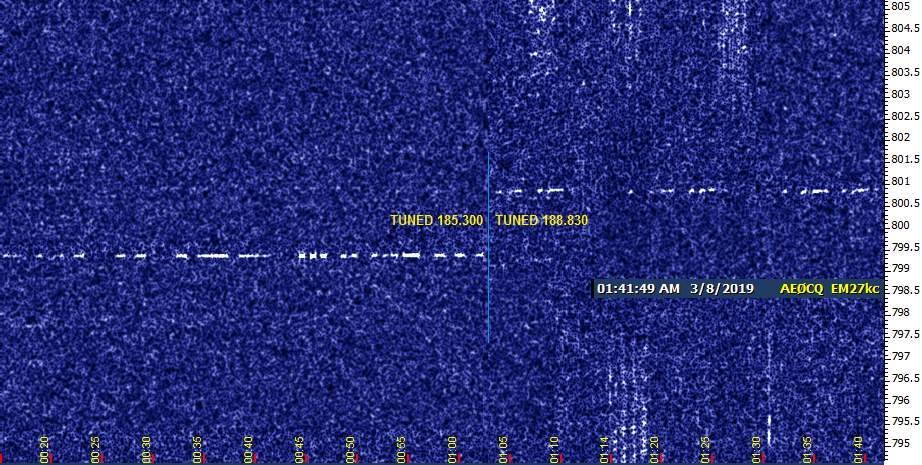
SIW had the 1750 m watering hole to itself, and only EAR was present at the upper end of the band tonight. No sign of SJ this session, and nothing I recognized as QRSS3 in the vicinity where HK should have been.
WM had been matching SIW in signal strength all afternoon and evening up until 6:10 PM CST, when it abruptly disappeared and never returned.
John
---------------------------------------------------------------
 File Attachment 1: 7-8mar.jpg
153khz tower destruction
Mediumwave transmitter Donebach gone [March 2nd, 2018]. Impressive 5-minute professional video by Media Broadcast of demolition of the 2-tower LW site at Donebach, Germany which was for 153 kHz DLF. Dramatic music, drone video, multiple angles of towers falling. All the guywires were broken simultaneously.
"Sprengung Sendetürme Donebach. Rund 50 Jahre prägten die beiden Langwellensender in Donebach das Bild der Region.
https://www.youtube.com/watch?v=R97VVkG1Oik via Peter Kruse, DXLD."
(Glenn Hauser, WOR io group (6/3-2019) via MediumWave.Info - News)
Re: Lonely Vigil
Posted by Mike N8OOU on March 08, 2019 at 12:50:35.
In reply to Lonely Vigil posted by John Davis on March 08, 2019
John
I'm caught on the act again! That is the exact time I had the WM Beacons powered off and put in the "Safe" mode. I'm away from the QTH for the next week. The Beacons will return then.
Mike M. 73
Re: Lonely Vigil
Posted by John Bruce McCreath on March 08, 2019 at 14:53:29.
In reply to Lonely Vigil posted by John Davis on March 08, 2019
Thanks for the report and screen snip, John. It's nice to know that someone is looking for EAR!
73, J.B., VE3EAR Reminder: Lowfer net + or - 3927Khz Saturday morning 0800 California t
Posted by Jerry Parker on March 08, 2019 at 15:28:54.
Reminder: Lowfer net + or - 3927Khz Saturday morning 0800 California time
Or listen online at: HiFer Beacon HK now at 13555.85 Khz
http://69.27.184.62:8901/?tune=3927lsb
Reminder: Lowfer net 3927Khz Saturday morning 0800 California time...
See More
69.27.184.62
KFS WebSDR
As an alternate system on the West coast, try the Northern Utah WebSDR. For reception from the East coast, use Home of K3FEF & W3TKP in…
Posted by Linas KC9PCP on March 09, 2019 at 14:41:49.
The beacon HK was not stable at 13555.425 so I moved it back to 13555.85 khz and it appears to be running well now at QRSS3. Hopefully I'll get some reports this time. [OT] Reminder: Lowfer net + or - 3927Khz Saturday morning 0800 Cal
Thanks and 73,
Linas KC9PCP EN61br
Posted by Paul on March 09, 2019 at 19:02:38.
Why am I not able to post my snarky write-only (never look for or read replies) comment on this weeks write-only post by Jerry? Re: 153khz tower destruction
Posted by joe vo1na on March 09, 2019 at 19:17:13.
In reply to 153khz tower destruction posted by Mike Terry on March 08, 2019
Thanks for posting, Terry.
It was dramatic but heartbreaking to watch!
73 VLF
Joe
Posted by Joe VO1NA on March 09, 2019 at 19:21:42.
Greetings all,
The VLF TX is QRV with an unmodulated GPS disciplined carrier 10 uW ERP 8.2700075 kHz in GN37 until further notice. Reports most welcomed.
73, Re: [OT] Reminder: Lowfer net + or - 3927Khz Saturday morning 0800 Cal
Joe VO1NA
Posted by Ed M. on March 09, 2019 at 19:39:52.
In reply to Re: [OT] Reminder: Lowfer net + or - 3927Khz Saturday morning 0800 Cal posted by Paul on March 09, 2019
What would be the point? You don't seem to look at replies from anyone else who bothers to answer your question, so why pick on Jerry?
Re: (Report on) Lowfer net - 3927Khz Saturday morning
Posted by Clint KA7OEI on March 09, 2019 at 19:52:48.
In reply to Reminder: Lowfer net + or - 3927Khz Saturday morning 0800 California t posted by Jerry Parker on March 08, 2019
Notes on 9 March, 2019 LowFER Net (+/-3927 kHz, 0800PT)
Present were: Jerry, WA6OWR; Dave, WD4PLI; Clint, KA7OEI; Ed, KI6R
Listening via web: Eb, KB6SOJ; John, AE0CQ
NOTE: Still at 0800PT after upcoming Daylight time change: "Earlier" (solar) time should help with propagation for a couple weeks, perhaps.
Jerry:
Ed:
Dave:
John, via email:
Clint:
73,
Clint KA7OEI
Re: HiFer Beacon HK now at 13555.85 Khz
Posted by John Davis on March 09, 2019 at 21:16:23.
In reply to HiFer Beacon HK now at 13555.85 Khz posted by Linas KC9PCP on March 09, 2019
During the half hour before solar noon here (12:00-12:30 CST), I was able to see bits and pieces of a carrier on 13555.850 that appeared to be the right length elements for QRSS3, but there was so much rapid fading that I never got a complete character. The signal was gone later in the hour.
Since we are mutually in a first skip zone of each other, I expect propagation to be difficult until we get later into spring. This is always the case with HiFERs WM, SIW and GNK too. However, there is a chance of a G1 magnetic storm Monday morning, which sometimes opens a window, so I will try to take advantage of that opportunity if/when it arrives.
John
HiFERs Saturday
Posted by John Davis on March 10, 2019 at 23:04:02.
WAS and AMA came in during noon hour. AN, FRC, TON & VAN were present at various times between 4:30 and 6:00 PM CST.
WAS and AMA both varied from visible but inaudible to fair-good audible copy, with WAS undergoing fade cycles from one ID to the next; while AMA would typically be good for 15 seconds, and then weak for a minute or so. Both were nicely stable in frequency.
In the late afternoon monitoring, AN (13562.860) had lost the audible chirp I reported a few weeks back. WAS wasn't there any longer, but K6FRC was good. TON was present just after 4:30, but not an hour later; although an interrupted carrier of some sort down at 13558.400 was present both times...just never strong enough to be audible. At 13563.140, VAN's drooping dashes were plainly visible on Argo (see file attachment) and sometimes the keying was just barely audible, but the nearby QRM would've prevented positive ID by ear alone for anyone not already familiar with the signal. In addition to the visible clusters of chirpers, there were bursts of quasi-white noise that Argo doesn't display.
Between 12:30 and 4:30, I let Argo watch the watering hole. NC was a no-show, at least within the passband of the CW filter. USC was consistently weak but recognizable for the first couple of hours, 7P was good at first, EH was painfully strong, and RY was good. By late afternoon, 7P and RY were marginal while EH continued unusually strong. Codar was intermittently very strong during the 5 PM hour, obliterating EH entirely for a few minutes around 5:45.
Conspicuously absent Saturday, yet again, were AZ, WV and MTI.
File Attachment
Re: HiFERs Saturday
Posted by jimvm on March 10, 2019 at 23:41:44.
In reply to HiFERs Saturday posted by John Davis on March 10, 2019
Thanks for the report John. I was thinking of throwing in the towel this season for
hifer beacon and just start listening. Over the past month I have tried using 2 1/4 wave radials with my hamstick antenna, then no radials and now I am back to using 1
radial that points east. I also have a 150pF cap across the base of the hamstick, SWR
is 1.1 @ 13.56 MHz. Without the cap SWR is 2.5.
I lifted 2 output leads from the 74HC02 Black Cat Systems beacon to reduce power.
There is still a backwave from the oscillator that is 50 dB down! The oscillator shifts about 180 Hz upwards when the beacon is not keyed!
73 jimvm HiFERs Sunday
Posted by Ed Holland on March 11, 2019 at 01:14:50.
Hi Folks,
Conditions lifted nicely for a while here in California, and several watering-hole signals were visible. NC reached audibility, USC was a clear trace and EH resolved nicely. Another lower signal, in the vicinity of 13,555.390 showed, but I could not read it.
Screen shot attached (hopefully),
Cheers
Ed
---------------------------------------------------------------
File Attachment 1: capt13.jpg
Re: HiFERs Saturday
jimvm: Another Lonely Vigil
Tnx for that big heads up on the Black Cat Systems Beacon Tx, Now thats what I call being an "Elmer" OM! You saved me a few bucks! Thank You. Sorry to hear about what happened on your end. This weekend I did order their keyer, I hope that works decent? .. I hope. I was going to buy their tx but opted out because I've plenty of radio stuff here that can FCC Part 15 the RF output requirement. I'm using a Marine Icom M-710, from the exciter end on the control board, there's small gray coax that leads into the PA input that can be unplugged. I'm using the exciter output with a variable 50 ohm attenuator to control the RF out, at this time I'm only 2.5 mW. No reports yet, I guess I just need to be patient.
73 and Tnx again -- Abe (N7SCQ)
Posted by John Davis on March 11, 2019 at 07:32:55.
Only SIW showed up at the LF watering hole...no SJ or HK again tonight.
I also listened by ear for Dave Curry's Part 5 Experimental Service beacon from Burbank on 183.5 kHz for a while after 1 AM CDT, but no go. Moderate QRN, but less QRM on that frequency than the previous time I tried it.
Used to be, if static was just a little troublesome at 1750 or 2200 m, I'd switch over to 630 m and let the computer look for WSPR while I napped. But the last time I tried that, a certain deluxe station was so overwhelmingly strong that its enormous FSK sidebands locked up even WSPR-X for multiple time slots in a row. Sigh. Can't tell anything about propagation THAT way! And didn't even feel like trying tonight. (For reference, a 60 meter tall antenna--the amateur limit--with a decent ground system can actually radiate in excess of 5 W EIRP with a little over 4 W TPO, thanks to the way EIRP is defined and the gain of a monopole radiating in a half space.)
Re: 153khz tower destruction
Posted by Mike Terry on March 11, 2019 at 09:12:03.
In reply to Re: 153khz tower destruction posted by joe vo1na on March 09, 2019
Yes it was Joe, not many LW broadcast stations left now in Europe. Its tragic as BBC Radio 4 Longwave is popular with a solid signal across the UK for us using older radios, has been for decades. Buying radios with LW is getting more difficult, especially for cars. DAB is being pushed by the government and manufacturers - its still widely not popular with the public for many reasons. The "official" statistics issued about DAB uptake are not to be trusted, if you buy a radio with MW, LW or FM plus DAB it goes into the stats as a DAB purchase! The DAB signal in my car sometimes drops out, I had no choice of radio when buying it. DAB is what many I know in the UK call "a con"and "the emperor's new clothes"... its days are numbered I hope.
Mike
Re: HiFERs Sunday
Posted by John Davis on March 12, 2019 at 08:30:18.
In reply to HiFERs Sunday posted by Ed Holland on March 11, 2019
Here in SE Kansas, Sunday was one of those days where east is west and up is down, etc. The rule of thumb lately has been that stations at the watering hole from the east are better before solar noon (USC & NC), and those from the west do better late in the day (7P), with EH and RY being partial exceptions, both present both morning and evening. This weekend, though, EH has continued to be ubiquitous during daylight but RY has been poor in the morning and very prominent late in the day; while 7P has done very well in the morning, and less so during the afternoon. And J1LPB has only decoded close to solar noon...just once some days, once in a while not at all, but on Sunday this:
1818  -25  -0.2   13.555413    1   J1LPB         FN03      0
1826  -25  -0.0   13.555412    1   J1LPB         FN03      0
1834  -25  -0.1   13.555414    3   J1LPB         FN03      0
1842  -25  -0.1   13.555412    1   J1LPB         FN03      0
The CW-only beacons followed the traditional pattern more closely, however. Bear in mind that this was the first day of Daylight Saving Time, so times expressed in CDT prior to 1:30 PM are pre-solar-noon, and those after are post.
1201p  faint WV when broadband hiss not too high; first time in a while
1204p  AZ visible, sometimes audible 13554.230; fairly steady freq; intmt wideband QRM
1215p  WAS nil to vy gd (lots of QSB)
1218p  AMA faint visual to fair aud. 13565.845 wavy instead of usual steady freq
(all freq. above only cal. +/- 2 Hz; below, +/- 1 Hz))
659p  AN fair-good, down in freq at 13562.810, steadier than last reception
704p  VAN DAID hooks visible, ID not audible
708p  K6FRC, fair to very good copy
Local sunset now around 7:20 PM after time change.
Monday in HiFER Land
Apparently a lot of the CW-only beacons were observing "Visible Not Audible Day" on Monday...and none at all turned up in my early morning band scan. WV was back to being absent, but when I tuned its spot about 9:36 AM CDT, there was a keyed carrier right on 13555.00 that looked like the letter A in QRSS3, moderately strong. I don't know what, if anything, preceded it, but nothing followed.
At the watering hole, it was the Usual Five: NC strong and somewhat lower in frequency (≈13555.53, suggesting it must be warming up in N Carolina); USC fair; 7P good; EH strong; and RY barely there at the time, getting better later. The one WSPR decode of the day came a little earlier than usual:
1526 -20 0.6 13.555410 1 J1LPB FN03 0About an hour after solar noon I did another band scan. That's when many of the CW beacons were behaving like good children...being seen, but mostly not heard.
217P  WV visual, not audible
218p  AZ vis not aud
223p  TON faint vis not aud
226p  VAN vis not aud  13563.130
230p  WAS vis not aud
231p  FRC faintly aud, good during one ID (see attached file)
234p  JUN 13565.210 visible, faintly audible--typically one letter per ID at max lev
          (J was hardest to discern, for some reason; U was easier; N the easiest)
241p  AMA 13565.948 weak to good at times
As I've mentioned before, Argo is a great tool even when observing CW signals. You can't "read" the Morse characters unless the signal is so strong that you can use NDB Mode (in which case, ears are more than sufficient). But QRSS3 can help you recognize individual stations by key traits if you've seen them before, whether they're currently audible or not: principally ID duration and repetition rate, occupied bandwidth, sideband distribution, and frequency stability (both moderate/long term and during keying).
---------------------------------------------------------------
File Attachment 1: 11mar-FRC-JUN.jpg
Re: Monday in HiFER Land
Agree about Argo , John. It's really really good at picking out nearly S0 CW.
I use a really old version, but I see no reason to ever change it!
BNC1 near watering hole now
Posted by John B on March 12, 2019 at 22:20:05.
It took a while to get my Epson chips delivered (they were sent to the outer banks for some reason, but digikey, being the super place they are, had the replacements in my hands in two days after reporting this, at no cost to me).
I ended up using the black cat keyer chip (I think it's an Amtel ATTiny), added a high efficiency low power 5V regulator and a FET inverter to match the keying logic to the epson chip. I also added a low pass filter and cleaned up the output. I'm back to being on the air seeing how my solar cell/battery pack/consumption balance works out. If it stays running for a few weeks, I'll try and load QRSS code on a fresh Atmel chip to slooowwww the CW down and see if I can do some battery management with some analog voltage measurement with the Atmel. I've done this with an Arduino Nano Mini (check to see if the battery is dying, if so put the chip in ultra low power state and go to sleep for hours, to let the solar cell charge back up ) etc but I don't know how much functionality is in the ATTiny.
Fun stuff. Let me know if you see it at the H2OHole... 13,555.3 there abouts.
John K5MO
Re: Monday in HiFER Land
Posted by Vic on March 13, 2019 at 00:24:41.
In reply to Monday in HiFER Land posted by John Davis on March 12, 2019
Hi John,
Thanks for posting such an interesting report and especially one that included JUN ;-). I am glad to see I have managed to get it back on my announced Frequency !
This is the first new report for a couple of weeks which may be due to my mis tuning of my antenna tuner which I think I have now fixed .
I am getting regular reports from San Antonio TX but missed a few days due to the tuning issue.
This is so much fun !!
Vic
Re: It's JUN in February...
Posted by Vic on March 13, 2019 at 02:17:05.
In reply to Re: It's JUN in February... posted by John Davis on February 27, 2019
Hi John
Many thanks for the info ....all very interesting. Radials are awkward at this location but let's call that a challenge to be solved ;-)
Currently working on antennas here so I will try to rig up some kind of vertical for my beacon as part of that . I'll report back ;-)
Vic
Re: New 22m Beacon 13558.4
Posted by John Davis on March 13, 2019 at 06:56:23.
In reply to New 22m Beacon 13558.4 posted by Abe - N7SCQ on March 06, 2019
Abe, I forgot to ask something important: what call sign, please?
Re: BNC1 near watering hole now
Posted by John B on March 13, 2019 at 11:01:44.
In reply to BNC1 near watering hole now posted by John B on March 12, 2019
Also, operation is 24/7
You can "see" it via my Kiwisdr at
mykiwisdr.hopto.org:8073
Since the receive antenna is about 100 feet from the 1/4 wave vertical, it's pretty strong :-). Power comes from a 2.2Ah battery fed by a small solar cell. All is fitted into a weatherproof commercial box .
Im going to go research programs for QRSS format for either the ATTiny or the Nano. The Nano has tons of flexibility and room for more software options , but I'll spend some time mining the web for info while the box does it's thing evaluating the solar budget.
Re: New 22m Beacon 13558.4
Posted by Ane on March 13, 2019 at 12:39:19.
In reply to Re: New 22m Beacon 13558.4 posted by John Davis on March 13, 2019
John: The call is N7SCQ, my message starts out with VVV VVV VVV (the three V's are old school code meaning "test") 73 Abe
WM Lowfer and Hifer QRV
Posted by Mike N8OOU on March 13, 2019 at 16:31:09.
All;
I have fired up the beacons after returning from my trip. They are running back on their published frequencies from EM68es.
Thanks to all for listening. 73 Mike.
Re: WM Lowfer and Hifer QRV
Posted by John Davis on March 13, 2019 at 17:41:48.
In reply to WM Lowfer and Hifer QRV posted by Mike N8OOU on March 13, 2019
Thanks, Mike. I'll be looking out for them again when (if) the farm dries out.
Reminder: Lowfer net + or - 3927Khz Saturday morning 0800 California t
Posted by Jerry Parker on March 15, 2019 at 14:15:59.
Reminder: Lowfer net + or - 3927Khz Saturday morning 0800 California time
Or listen online at: SJ beacon
http://69.27.184.62:8901/?tune=3927lsb
Reminder: Lowfer net 3927Khz Saturday morning 0800 California time......
See More
69.27.184.62
KFS WebSDR
As an alternate system on the West coast, try the Northern Utah WebSDR. For reception from the East coast, use Home of K3FEF & W3TKP in…
Posted by Sal, K1RGO on March 15, 2019 at 18:15:42.
Well it's getting to be spring with poor LF condx so I will run SJ for this weekend and then it will be QRT until the next season. PA filter for 2200 meters
later.......... Sal, K1RGO
Posted by Lee Short on March 16, 2019 at 23:45:01.
This question I was saving for the Long Wave NET. But since 0800 is the middle of the night for me I'll ask here. I have an Alinco SR8T that I plan to wide band. Low power mode 10-15 watts. The inductors I have will handle a couple of amps. The caps I purchased will at best handle 500 volts. At worst 200 volts. Are these caps going to stand up to the voltages produced on my vertical formerly 1750 meter legal antenna. Thanxs KE6PCT
Re: SJ beacon
Posted by John Davis on March 17, 2019 at 03:47:11.
In reply to SJ beacon posted by Sal, K1RGO on March 15, 2019
Hi Sal. Couldn't get to the field tonight, so I hope you are planning to still be on through Sunday night as well.
John
Re: SJ beacon
Posted by Garry, k3siw on March 17, 2019 at 12:25:06.
In reply to Re: SJ beacon posted by John Davis on March 17, 2019
Nice copy here overnight of lowfers SJ, WM, and SIW using ARGO at QRSS30, slow, tuned to the watering hole. Edited screen capture:
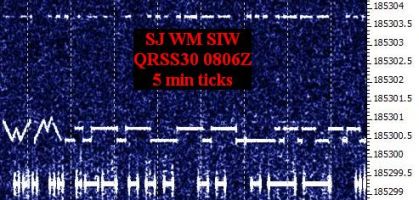
73, Garry, K3SIW, EN52ta, Elgin, IL
Re: New 22m Beacon 13558.4
Posted by Paul on March 17, 2019 at 15:54:57.
In reply to Re: New 22m Beacon 13558.4 posted by Ane on March 13, 2019
Good work Abe!
I have copied your 2m beacon before. Glad to see you put a HiFer on the air.
Think I might just barely be able to see you using Argo in CM98. Cannot copy anything by ear. Tried 4 different antennas, and combinations of those antennas, and just cannot quite pull you out.
What is your setup?
73, Paul Re: SJ beacon (!)
Posted by John Davis on March 21, 2019 at 08:31:05.
In reply to Re: SJ beacon posted by Garry, k3siw on March 17, 2019
Caught the entire final night of SJ for the season, but no luck with HK Sunday night. WM and SIW were good the entire time from 45 minutes before sunset (when I tuned to 1750 m) to the time I gave up, nearly two hours after sunrise.
The capture is too big to embed in a normal message, of course, but you can click to see the scrollable view here.
I've done a few all-nighters this way since fixing the ICOM R-75's power connector a few weeks back, but last weekend's sessions were particularly good with low QRM and QRN, and plenty of moonlight to help in the field. Being able to retire Kenwood R-5000 #3 (Ol' Drifty) again has helped with much more stable traces at QRSS30. Times shown are CDT, and 800 Hz = 185,300.
John
Promising Night on 2200 M WSPR
Posted by John Davis on March 22, 2019 at 01:32:52.
As much as 2 hours before sunset I was receiving N4WLO (959 km), WA9CGZ (786 km), and NO3M (1385 km), as well as the Part 5 Powerhouses WH2XND and WH2XXP. For years I've been preaching about the daytime potential of this band, and it was gratifying to finally see some more activity earlier in the day. Will continue monitoring into the night. Spots being uploaded to WSPRnet every few hours.
Re: Promising Night on 2200 M WSPR
Posted by John Davis on March 22, 2019 at 08:00:47.
In reply to Promising Night on 2200 M WSPR posted by John Davis on March 22, 2019
K3MF joined in at 0134 UTC, about an hour after sunset here. That's the only other station to be seen thus far tonight in WSPR-2. Continuing to monitor, though.
Reminder: Lowfer net + or - 3927Khz Saturday morning 0800 California t
Posted by Jerry Parker on March 22, 2019 at 17:54:17.
Reminder: Lowfer net + or - 3927Khz Saturday morning 0800 California time
Or listen online at:
http://69.27.184.62:8901/?tune=3927lsb
Reminder: Lowfer net 3927Khz Saturday morning 0800 California time
see you there
KFS WebSDR in California 630 m WSPR
69.27.184.62
Posted by John Davis on March 23, 2019 at 08:24:40.
There is method in my madness...or maybe the other way around. Earlier in the week, I spent a night monitoring the watering hole at 1750, then a night monitoring EAR on 1750, then 24 hours ago, a night of 2200 m WSPR.
To round things out, I planned to spend part of tonight doing 630 m WSPR...only part, because precip is moving in before daybreak, plus I need a more significant night's sleep for a change. I set up to capture nearly two hours before sunset, then ran errands, took a short nap, and finally returned to the field with intentions to pack everything up. Now, I'd absent-mindedly set up to use SSB bandwidth this time. But--I'd forgotten about the station that must not be named and its "Tennessee Terawatt" cranking out needlessly wide FSK Morse.
When I got back to the field and saw no decodes, I was dismayed! Once I switched to the narrow CW filter, however, things improved dramatically. So that the evening shouldn't be a total waste, I fought the urge to sleep and hung around for another hour and 40 minutes to see who all was there. In that short time, I had 114 legitimate decodes from 13 stations, plus one bogus specimen.
The first decode of each beacon is shown in the table below. The column at the far right displays the number of times each one decoded.
 Timestamp          Call    MHz        SNR Drift  Grid     Pwr  km    # Spots
 ----------------------------------------------------------------------------
 2019-03-23 04:56   AE2EA   0.475742   -19   0    FN12fr   0.2  1621    10
 2019-03-23 04:58   N1DAY   0.475707   -12   -1   EM85sg   1    1154    18
 2019-03-23 05:00   WD8DAS  0.475719   -20   0    EN52hx   1    816      5
 2019-03-23 05:00   W9XT    0.475641   -18   0    EN53uh   0.1  901      6
 2019-03-23 05:00   W4KZK   0.475691   -20   0    EM97xe   1    1336    17
 2019-03-23 05:00   WB3AVN  0.475619   -21   -1   FM19og   5    1617    10
 2019-03-23 05:02   KA7OEI  0.475738   -19   0    DN40ao   0.5  1506    13
 2019-03-23 05:04   WA3U    0.475627   -11   0    FM29co   5    1705    14
 2019-03-23 05:06   W3TS    0.475662   -22   -1   FN10ml   5    1615     9
 2019-03-23 05:22   AA1A    0.475672   -25   0    FN42pb   1    2156     8
 2019-03-23 05:40   W4VU    0.475672   -28   0    FM06fb   0.1  1395     1
 2019-03-23 05:54   NU6O    0.475671   -22   0    CN70vr   1    2536     4
 2019-03-23 06:08   KR6LA   0.475661   -24   0    CN90ao   2    2347     2
Re: SJ beacon (!)
That's a really impressive view of a LF night. WM is sure strong to your QTH.
BNC1 - 13555.3
Posted by John Brewer on March 23, 2019 at 11:41:03.
In reply to Re: BNC1 near watering hole now posted by John B on March 13, 2019
I'm going to change antennas and move BNC1 a more permanent site since the power balance seems to be good. At some point I'm going to transfer it to a smaller weatherproof box but I'll let it run for a while as is
Right now, it's just transmitting normal speed CW. What beacon mode would you suggest I investigate next ? The processor is an ATtiny and I'm pretty sure I can use the Arduino IDE to program the Tiny 85's so I have a lot of flexibility.
The RF is now coming from an Epson oscillator.
Re: BNC1 - 13555.3
Posted by Paul on March 24, 2019 at 18:35:39.
In reply to BNC1 - 13555.3 posted by John Brewer on March 23, 2019
John Davis is the guy to ask.
I run my HiFer at 13 WPM CW just because I'm a beacon luddite. I have seen WSPR in action, and that looks pretty awesome. But, all my radios have tubes in them, what do I know? .... .. .... ..
73, Paul
Re: BNC1 - 13555.3
Posted by michael tyler on March 24, 2019 at 20:18:44.
In reply to Re: BNC1 - 13555.3 posted by Paul on March 24, 2019
Real radios have tubes....I would build a tube HiFer Beacon if it wasn't so difficult to lower the power...Come to think of it, that warm glow would be nice to have in the outside mounting box I am using for the HiFer in the winter time...…...just thinking (:-)
Re: BNC1 - 13555.3
Posted by Ed Holland on March 25, 2019 at 05:50:27.
In reply to Re: BNC1 - 13555.3 posted by michael tyler on March 24, 2019
Lowering the power is easy. My fastest way on the air was to use a 20m QRP kit with 1.25W stated output, with a 13.560 MHz crystal and 3 resistor attenuator to reduce to tbe appropriate mW for vertical or dipole. A tube kvalve) circuit should be possible along the same lines without too much trouble.
Re: BNC1 - 13555.3
Posted by Paul on March 25, 2019 at 15:21:22.
In reply to Re: BNC1 - 13555.3 posted by michael tyler on March 24, 2019
Agreed!
those tubes again
Posted by michael tyler on March 25, 2019 at 21:05:21.
In reply to Re: BNC1 - 13555.3 posted by michael tyler on March 24, 2019
I was speaking with "tongue in cheek" about being hard to reduce the power . my favorite are the 1s5,3a5 ect...I have a few of the 60?? that were used in old time weathersonde transmitters. They usually don't survive very long at max output but would work well at HiFer levels...and those wire leads are just begging for a crystal,resistors,coils and caps to be attached to them. Sounds like a project around the corner.
Re: BNC1 - 13555.3
Posted by John Davis on March 26, 2019 at 06:01:36.
In reply to BNC1 - 13555.3 posted by John Brewer on March 23, 2019
John Brewer wrote:
What beacon mode would you suggest I investigate next?
My recommendation would be QRSS3. In principle, it's as simple to generate as CW because that's exactly what it is, only at a much slower speed (equivalent to 0.4 wpm). If the ATtiny has enough onboard memory to let you program one QRSS3 ID followed by a few normal speed CW IDs, that would be even better. Cover all the bases, as it were. Most PIC microcontrollers can do that, such as the famed K1EL K-ID2 chip, but I don't know enough about the Tiny myself to guess whether it can.
WSPR 2 is a great mode, but requires considerably more code to generate and requires specific software to decode, while QRSS3 can be viewed on any waterfall display that's slow enough and has reasonable resolution. Both match very closely in weak signal detectability, although WSPR does have an advantage on data throughput rates. Both have a greater than 10 dB SNR advantage over 5 wpm CW, for instance.
The RF is now coming from an Epson oscillator.
You may want to take advantage of that fact to provide a modicum of frequency control. HiFER WM is already in the 13555.300 to .305 frequency slot with Morse FSK viewable at QRSS3 settings, normally with a frequency accuracy within 1 Hz or better. It hasn't been reported much lately because the first skip zone is currently quite large, but it will again become a regular in much of the country by late spring and through the summer.
To avoid collisions, it would be helpful if you could vary Vcc on the oscillator IC by a few tenths of a volt in either direction to shift your frequency. The 5 volt chips are rated for ±0.5 V from nominal, so that should pose no significant problems. (Lyle Koehler, who popularized the Epson SG8002 programmable oscillators in beacon transmitters, actually tested them over a much wider voltage range, from 6.5 down to 2.5 V, but that's not recommended for longevity or stability.) In practice, an SG8002 in the 22 meter band can be shifted downward about 3 Hz per +0.1 volt, or upward about 5 Hz per -0.1 Hz change in Vcc.
Unfortunately, ambient temperature fluctuations can cause greater excursions of the oscillator frequency than voltage adjustments may entirely compensate. But if that happens, perhaps it will be in a direction away from WM.
John 2200m WSPR2
Posted by Jim Poulette on March 27, 2019 at 12:33:35.
In reply to 630 m WSPR posted by John Davis on March 23, 2019
27 Mar 2019
For those interested, I'm going to try to maintain a WSPR2 beacon on 137.475 kHz presently running about 200mW EIRP (calculated) using a TVTR2/Hafler P3000 combination into a 'less than perfect' antenna (35' vert wire with ~500' of hat and ~1000' of radials). Once spring arrives in earnest (today we still have a foot+ of snow here in NH - temp 13F this morning) the antenna will be replaced with a much better 80' vertical wire. We are at about 1300' AMSL here, but the terrain is tumultuous (the Granite State) with mountains between 3000'-6000' to the SW and N. Good luck to all!
Heard by last night:
Time Call Best SNR #Spots km
-------------------------------------
0938 K3MF -15 33 510
0506 K2DOM -18 48 441
0918 N1BUG -2 66 358
0220 NO3M -24 15 677
0138 VE3HOA -15 33 414
0556 VE3OWV -16 33 436
0232 WA2ZKD -26 11 455
Re: BNC1 - 13555.3
73
Jim, WQ2H/WK2XAH
Posted by john B on March 28, 2019 at 22:47:50.
In reply to Re: BNC1 - 13555.3 posted by John Davis on March 26, 2019
Hi John,
Thanks for the many good tips. I bought several oscillators and will look to see what I asked the other one to be programmed to. I certainly don't want to QRM WM, which always "prints" so well on the long duration waterfalls. The chips are only a few bucks plus shipping so it's easy to replace them with another frequency.
I've not done any programming on the ATtiny85 but the code speed logic is super simple (at least in the instance I'm using on the Nano) and I could certainly adjust the code speed with only a few bytes of extra code by nesting loops accordingly.
This is fun stuff!
Re: BNC1 - 13555.3
Posted by john B on March 28, 2019 at 22:49:31.
In reply to Re: BNC1 - 13555.3 posted by michael tyler on March 24, 2019
"Real radios have tubes...."
Maybe I should mod one of my Globe King's :-)
John K5MO
Reminder: Lowfer net + or - 3927Khz Saturday morning 0800 California t
Posted by Jerry Parker on March 29, 2019 at 15:38:37.
Reminder: Lowfer net +/- 3925Khz Saturday morning 0800 California time
Or listen online at: 8 meters 40.680 MHz
http://69.27.184.62:8901/?tune=3925lsb
Reminder: Lowfer net 3925Khz Saturday morning 0800 California time..
Posted by Brian on March 29, 2019 at 19:45:39.
I still need to check the rules for part 15 near 40 MHz, but does anyone know if a Hifer type beacon would be permitted there ? What do you think about petitioning the FCC for a small sliver there to study propagation ? Do you think they would grant a part 5 license beacon ? Just testing waters !!! Some countries have already gained access to the 8 meter band such as Ireland.
Re: 8 meters 40.680 MHz
Posted by John Davis on March 30, 2019 at 07:31:29.
In reply to 8 meters 40.680 MHz posted by Brian on March 29, 2019
There are two sections of Part 15 that permit operation in the vicinity of 40.680 MHz, one of which is highly restricted in transmission types and one of which is more general, but the DX prospects are not very good in either case because of the signal strength limitations.
§ 15.229 Operation within the band 40.66–40.70 MHz. This is the one that's most lenient about transmission types and purposes. The field strength limit is 1000 μV/m at only 3 meters from the antenna, and there are frequency stability requirements similar to 22 m and reasonable spurious emission limits.
Assuming unobstructed line of sight conditions, that's equivalent to 100 μV/m at 30 meters, a field intensity only 1/158th that of 22 meters, or a power ratio of 1/25116; in other words, the equivalent of 0.187 μW into a dipole.
At 300 m (approx. 1000 feet) that's 10 μV/m, or 1 μV/m at 10 km (6.2 miles), or 0.1 μV/m at 100 km (62 miles)...again, under unobstructed line of sight conditions, which is hard enough to achieve over a few miles, let alone scores of miles. If one takes extraordinary measures with transmit antenna location (namely, lots of height above ground) and uses high gain receive antennas, that does leave open some possibility of very modest DX, but nothing like 22 meters.
§ 15.231 Periodic operation in the band 40.66–40.70 MHz and above 70 MHz. This section allows for operation at up to 5 times the power, but only for very specific purposes (door openers, alarm systems) and for very short duty cycles (seconds per hour).
This provision is not only unavailable for communication and experimentation, but it's why I suspect the FCC would be very reluctant to issue Part 5 experimental licenses there for propagation tests. The risk of opening garage doors all over town or causing security systems to fail would require considerable justification, and would probably result in very restrictive duty cycle limits.
Now, at this point I might suggest looking further into 6 meter Part 15, as embodied in § 15.235 Operation within the band 49.82–49.90 MHz. Here, the field intensity limit is 10,000 μV/m at 3 meters, or about 18.7 μW into a dipole. In addition, paragraph (c) contains a remarkable alternative provision for homebuilt devices that allows for a 1 meter antenna (a λ/6 monopole) permanently attached to the device, and an input power limit to the entire device of 100 mW under any condition of modulation. (The whole device, mind you, not just the final.) But even with frequency stability requirements necessitating separate oscillator and amplifier stages, that still allows for outputting multiple milliwatts into a relatively efficient antenna, provided you can mount it somewhere high enough. Sounds like a worthy design challenge for those who enjoy being constrained to a power budget...but maybe not for anyone who insists on the charming glow of tube filaments. :)
John
Notes on the 30 March, 2019 Lowfer net
Posted by Clint KA7OEI on March 30, 2019 at 17:01:59.
In reply to Reminder: Lowfer net + or - 3927Khz Saturday morning 0800 California t posted by Jerry Parker on March 29, 2019
Notes on the 30 March, 2019 Lowfer net (3927Khz Saturday morning 0800 California time) Present were: Jerry, WA6OWR; KI6R, Ed; Dave, WD4PLI; Clint, KA7OEI Dave: Jerry: Ed: John (via email): Clint:
Please excuse errors/omissions.
Via web: John, AE0CQ; Eb, KC6SOJ WD4JWM amplifier running now
- Couldn't get 100 watts at 25 volts - Noted that it was made to match a 5 ohm drain impedance - changed it to 2.5 ohms to get more output power at 25 volts.
- More power easily available at higher supply voltage (e.g. 32 volts or so.)
Still working on the CCI 100 watt amplifier - possibly replacing the binocular with a pot core for the lower frequency coverage in the output - but the 'JWM amplifier went together well enough that he was somewhat distracted from work on the CCI.
Noted that the mountains around L.A. are dark green - the amount of rain has caused everything to bloom: Long term worry about fire danger. His wife is doing better after an accident at home with her electric wheelchair.
Other than taking care of his wife, he's not had time to do radio-related projects. Picked up a waterproof cabinet for outdoor projects
Also, a large bucket of variable capacitors and low-pass filters
- More interested in the filters as they are handy platforms for reworking to other frequencies.
Still been clearing brush - lots of vegetation to clear!
When testing amplifiers, using an old HP 400EL voltmeter across a dummy load to calculate RF output power.
Got a DG8SAQ Vector Network Analyzer (VNA3?) via Ebay (Full "EC" version with other accessories: <$700 shipped; Simplest version - <$550 shipped via EvilBay).
- 1kHz-1.3GHz range, about 50dB dynamic range - good enough for most ham work.
- Max 0dBm input - need to take care if checking amplifiers
- Full S-parameters, driving software will export S2P files. No time for LF monitoring this week, but the contractor for garage repair and cleanup at the new site should be getting started next week.
Some 630/2200M
Last weekend - club project at an HF remote station in central Utah at an old AT&T Long Lines microwave site
- Measured tower and surroundings to allow more accurate antenna modeling.
- Replaced the older HF rig (had been an Icom IC-718) with a somewhat newer Kenwood TS-480: The Kenwood, unlike other brands - at least of that vintage - allows everything to be done remotely.
potrzebie