Extended hours for "NWNJ" LowFER beacon:
Posted by John Bogath on April 01, 2002 at 13:15:07
LowFER beacon "NWNJ" (North West New Jersey) has a new digital ID-er to replace its old mechanical one. Beacon hours will be from 4 PM-ET Saturdays to 4 PM-ET Sundays
(24 hours), starting on April 06, 2002. Additional radials are being added to the antenna ground-system each week now.
160-190 kHz Deregulated!
Posted by Dafirsta Dafourthmonth on April 01, 2002 at 15:31:59
I'm amazed that nobody else has caught this. Following the release of a U.S. government report that high intensity low-frequency radio energy helps retard global warming, the FCC has acted to remove power restrictions on transmitters operating below 500 kHz. Realizing that stations like NAA can't get much bigger, emphasis was placed on existing services that were grossly underpowered. Here is the text of the new Section 15.217, covering 160-190 kHz:
(a) The total input power to the final radio frequency stage (exclusive of filament or heater power) shall not exceed one Megawatt.
(b) The total length of the transmission line, antenna, and ground lead (if used) shall not exceed 15 kilometers.
(c) All emissions below 160 kHz or above 190 kHz are strongly encouraged.
(d) Any interference to Power Line Carrier (PLC) operation is also encouraged, unless it hinders the operation of a high power longwave transmitter.
In a cautionary note, the FCC did suggest restraint in areas of the country that are short of rainfall. This was evidently in reaction to concerns about forest fires in Andover, Massachusetts.
Re: 160-190 kHz Deregulated!
Posted by 'Wild Bill' Marconi on April 01, 2002 at 18:10:36
Thanks for catching that important news release, Dafirsta. (That's a Ukrainian name, isn't it?)
We in the 040102 Meter Radiobug Bunch are especially glad to see the new Section 15.217(c), as we've been trying to get the FCC to authorize us a vast array of LF and VLF frequencies for our experiments. But so far our channel choice is--well, one. And that's hardly even half-vast.
Every day on our reflector, someone recognizes another longwave frequency that they vaguely remember hearing something about somewhere in the dim past, and we immediately set about discussing what it would be like to adapt some 60-year-old boatanchor gear from some other service to use there.
Those discussions are so much fun, in fact, that only one of us has ever actually gotten around to putting a signal on the frequency we already have.
But now that the new Section 15.217(c) is here, we'll be able to play radio BIG TIME at last! Thanks again.
G. Elmo Marconi President, 040102 Meter Radiobug Bunch
'Catch the Radio Bug Today'
Re: 160-190 kHz Deregulated!
Posted by Dafirsta Dafourthmonth on April 02, 2002 at 10:01:35
Dear Wild Bill:
Good to hear from you. Yes, the name is of Ukranian heritage. I come from a large family. I remember when my youngest brother, Dathirtietha, was born. My mother's last words were "I'm SO glad I didn't marry Joe Dafifthmonth!"
Sorry to hear that your big project is stalled. Please do remember that as the wheel was not invented in a day, its reinvention cannot be done swiftly. (from an old Ukranian proverb)
Dafirsta
Re: 160-190 kHz Deregulated!
Posted by Anthony Oresteen on April 02, 2002 at 16:14:51
Sounds like an April Fool's joke. Lowg wave vs global warming? That's great!
Re: 160-190 kHz Deregulated!
Posted by AL on April 01, 2002 at 19:24:18
YUP. ITS APRIL FIRST!!!!
AL
Re: Ultimate LOWFER Transmitter?
Posted by Tony Oresteen on April 02, 2002 at 16:58:44
Sounds like a very interesting project. I'd like to see:
1. CW mode option.
2. Coax ant 50 ohm connection. How about 600 ohm ladder line connection?
3. low pass output filter tank to keep harmonics to -40 db.
4. Line level input for audio loop message input.
5. 13.8 VDC power operation.
Re: Part 15 in 1750 Meters
Posted by Tony Oresteen on April 02, 2002 at 17:04:00
There was an article in the Jan 1972 issue of Popular Electronics with plans to build Jime White's AM transmitter for 1750. I started building it in 1973, never finished it but I plan on doing so this year (at last!).
A companion reciver was described in the Feb 1972 issue.
Anyone built this transmitter?
Thanks!
Tony
Anyone aware of any good research on unsymmetrical, radial ground-systems ?
Posted by John Bogath on April 03, 2002 at 10:52:06
It would seem that an unsymmetrical, radial ground-system could be used to advantage by a LowFER station. For example, a station on the East-coast could install the most and the longest radials on the west-side of a vertical antenna in order to enhance the signal in that direction (i.e., increase gain). Does anyone know of any research done in this area or have personal experience with this ?
Re: 160-190 kHz Deregulated!
Posted by Harald on April 04, 2002 at 02:06:02
If it is correct, that longwave transmissions reduce global warming, then Europe, Russia, Mongolia and the states of North Africa and the Near East which run longwave broadcasting facilities do a very good job in this respect (Nearly all longwave broadcasting transmitters operates with powers greater then 100 kW, some uses powers up to 2500 kW!)! Especially Germany which runs 4 longwave broadcasting transmitters at the moment and has the licence to run a fifth one at Burg near Magdeburg on 261 kHz (perhaps there is someone who wants to hire this 200 kW facility. But it is not cheap at all!) shows the best example!
The authority of Man Island should therefore musicmann279 to operate as fast as possible and they should allow them to construct a high tower, which could be seen as a monument against global warming!
If it would be possible to build a grounded tower carrying a rhombic aerial with an observation deck on its top they would also build a nice tourist attraction for the Isle of Man.
At the foot of the tower could be a nice information centre about radio technology and the way transmission saves our climate be installed!
Another suggestion would be the introduction of longwave broadcasting throughout the world. Especially in thin populated poor countries it would allow to supply people in rural areas with radio in a better quality then the usage of shortwave in the tropical bands would allow!
I think we should also make an idea contest of further applications of VLF: a worldwide receivable time signal on 10 kHz would be although its high operational cost a great benefit for the mankind and if such transmissions would help save our atmosphere they are especially welcome!
(Another idea of using VLF transmitters would be the radiation of special messages for computer users which can receive them with their soundcard. This would be perhaps interesting for education)
Radio Station GBR at Rugby
Posted by (via) Harald Lutz on April 04, 2002 at 02:14:42
Here is a short history of a visit to the Rugby station:
www.amrad.org/pipermail/lf/2000q1/000167.html
And a longer history of the radio station itself:
www.lwca.org/library/global/HaraldRugbyMsg2016.htm
ULF transmission on 1.725 Hz??
Posted by Jay Flynn on April 01, 2002 at 18:04:31
I have maintained a moving coil seismometer at my home in Sherman Oaks, CA. (Los Angeles)for over five years now and in the last few years have noticed a persistant frequency present in the output waveform.
To explain briefly, a moving coil seismometer is exactly that, a coil mounted on a pendulum moves in a strong magnetic field to generate a small voltage when the earth moves. In this case the coil is about 220 turns with a cross-sectional area of about 5 sq. CM. The coil is short winding of only 1.5 CM long. The output is amplified so that voltages in the tens of microvolt range produce a readble output. The coil axis is horizontal, east-west.
I first thought the signal at the output was due to drilling or industrial activity. It stops for a few hours and then returns. Other than that, I can not discern any pattern to the operation.
Today, I read in the "WUN - WORLDWIDE UTILITY NEWS - ELF and VLF Guide Version 1.0 - updated 15 November 2001" about the observed signal at 2.5 Hz. So I did a FFT on my archives and the current signal - absent an earthquake. I found at least two "carriers". One at 1.725 Hz and another 10 db weaker at 1.25 Hz. Both signals are well clear of the background noise and very stable in frequency over time. I do not see anything at 2.5 Hz.
Does anyone else detect these signals? Is the signal on 2.5 Hz still active?
Jay Flynn
The area of NAA Annapolis – what is there now?
Posted by Harald on April 04, 2002 at 02:18:13
What is there now on the area of the former transmitter NAA? An empty field? Or is it still used for radiotechnical purposes, now perhaps as location of AM and FM broadcasting transmitters (very sensitive, because high towers are available)?
Why was it not possible to transform this facility in a museum similar like SAQ Grimeton?
Re: Anyone aware of any good research on unsymmetrical, radial ground-systems ?
Posted by John Davis on April 04, 2002 at 13:51:09
Really detailed technical studies, no. In broadcasting, that situation has always been something to remedy as expeditiously as possible, rather than study.
Having had occasion to help a couple of AM stations who found themselves with asymmetrical radials unintentionally, I can offer the observation that it does not enhance signal in the elongated direction.
An electrically short vertical radiator needs as good a ground system as possible in ALL directions, so that displacement current (which inherently is "picked up" by the earth and other objects all around) is returned to the ground point through as low-loss a path as possible. Otherwise, total antenna efficiency suffers, which affects radiation in _all_ directions.
Groundwave will be attenuated less on the side of the antenna that has longer radials, of course, but that's not enough to offset the total loss. Nor does the lesser groundwave attenuation in that direction translate to increased skywave strength.
So, my recommendation would be to make the radial system as good as you can in ALL directions around the base, out to a radius at least equal to the height of the antenna. That's a minimum condition for achieving tolerable efficiency.
If you then want to supplement it with a few longer radials as an experiment, that's fine. But I would not offset the antenna if it meant having to decrease any radials to a length shorter than the antenna height, or if it meant moving the antenna closer to potentially absorptive objects like trees.
Keep us posted on your results.
73,
John Davis
The end of GBR Rugby in 2003? We should think about a future use!
Posted by Harald on April 05, 2002 at 08:13:07
Yesterday I asked Alan Melia [Alan.Melia@btinternet.com] if he has some pictures of GBR Rugby. Today he mailed backed to me. In his mail is mentioned that GBR on 16 kHz will close around June 2003
(Here is its original answer:
Harald I do not have pictures of GBR Rugby, though some nice black and white pics were published in Radio Bygones, as in an article by Brian Falkener....even these look decidely as though they have come from other copyright material, like IEE proceedings papers. Colour film was not in regular use until the the late 1950s, so it is unlikely there will be any shots of the early equipment in colour. The station manager did reply to reports of the Submariner's centenary transmission last year and did, I believe, issue a QSL for that. I do not believe they would do it for normal transmissions bearing in mind the usage of GBR 16kHz. As you maybe aware GBR on 16kHz will close around June 2003.
)
I think we should check the possibility if it is not possible to use the facility and frequency for an other purpose. An idea contest would be the best choice!
My suggestions:
- world wide receivable time signal (perhaps as a network with other transmitters on the same frequency, if it is possible to use the signal in the disturbation areas)
- transmitter for small software, e.g. Anti – Virus program patches which could be received with all PCs with a soundcard (only an external coil and a decoding software required)
- For special transmissions as SAQ Grimeton
- For special teletype messages in Morse, which could be decoded by all PCs with a soundcard and a program as getCW (and people who have the necessary Morse knowledge could do it directly)
Perhaps you have further suggestions. We should collect them here and bring them to British Telecom, the owner of the facility.
In all cases we should save the facility as a museum. We should not allow that it will be knocked down as Annapolis!
(I do not believe that this will happen, because MSF is still on the air, but who knows…)
Proposal for a worldwide usable time service in the VLF range
Posted by Udo Maier on April 06, 2002 at 12:13:26
I thought again about the idea of a global usable time service in the VLF range and had therefore the following idea: 6 or more transmitters worldwide spread should transmit the time on the appropriate number of carriers. The carrier frequencies are changed in definite intervals (a similiar transmission mode was used by OMEGA and is still used by ALPHA with the only exception that their carriers are/were unmodulated.)
Each transmitter should at the beginning of a new carrier send its "call sign", so the radio clock knows from which transmitter comes the signal. The the time information should follow. As carrier I would take frequencies between 9 kHz and 15 kHz.
By this transmission mode no problems would occur with interferences between two or more transmitters using the same frequency at the same time but the device would be usable and sellable throughout the world without modifications.
This would be very sensitive for products of the consumers industry.
In order to reduce costs existing facilities should be as far as possible used, they should be equipped in such way that the existing aerial could be used for the time service and for the other services at the same time.
I think for each continent one transmitter should be enough.
Of course the operation costs of the system would be high, but it would be also very useful for militaric operations of all kind (especially for submarines), so it would be surely financable.
What causes TAOS Hum - connections to ELF transmitters?
Posted by Bernhard on April 06, 2002 at 12:28:17
What is the source of TAOS Hum? Are there connections between TAOS Hum and ELF transmitters?
Re: What causes TAOS Hum - connections to ELF transmitters?
Posted by John Davis on April 06, 2002 at 22:52:47
I have been to Taos. Although I took no scientific instruments with me, I never heard any hums beyond those that I can detect at various locations here in the southeastern US.
We live in an ocean of low hums and rumbles here, most of which are caused by conduction of vibration through rock from industrial plants many miles away. I have been able to identify some of the sources by knowing when certain of these facilities shut down for maintenance or for holidays. It is also possible that some of the hum also comes from even greater distances, ducted between rock layers of different density or refracted by seismic faults.
If I were inclined to think the source was something out of the ordinary, I'd be able to convince myself of that notion pretty readily; because (just like in Taos) there's no way to pinpoint the origin or even the general direction by ear. That's a normal phenomenon, though, given the properties of the ear-brain system at very low audio frequencies. And, because of the way the vibrations are being conducted to the listener, the sound may well be coming from all directions. The foundation of my house (for instance) is acoustically coupled through highly compacted rocky soil to a huge slab of granite that underlies much of the state where I live, so the very walls around me may act as sounding boards.
Of course, there is not much manufacturing near Taos. But it doesn't take too much energy to set some geological features into vibration. A big enough power generating plant somewhere in the region, a mining operation downstate, heavy truck traffic, or perhaps even the downhill flow of the Rio Grand River or its nearby tributary as they run through the mountains, might provide enough energy to excite some type of geological resonance.
That last part is just a guess, of course.
One thing fairly certain is that there are no manmade ELF operations based in the Southwest. Now, there is a rather paranoid radio talk show host who seems to believe it has something to do with the HAARP experiments in Alaska, but the hum is said to have been around for a long time and doesn't seem to match any of the known operations of the HAARP array.
So, personally, I'd be more willing to accept UFOs as an explanation than ELF for whatever is going on at Taos. (grin)
John
MEL San Jose, CA rx in Daly City, CA in daytime
Posted by Mike KB6WFC on April 07, 2002 at 17:47:29
Hi,
Is there some way that I can contact Mitchell Lee of San Jose, CA 95112? I have reception of the MEL beacon this fine afternoon of April 7, 2002 at 2112UTC, see http://www.geocities.com/silversmj/mel0204072112.jpg . No records broken here, it's just my second LowFER reception. I spend most of my little bit of pasttime NDB DXing.
73 de Mike KB6WFC Daly City, CA USA CM87sq 37:40:47N 122:28:21W
"Land of the Free & Home of the Brave"
RX: HP3586B (3100Hz filter mode)
ANT: AA7U Steve Ratzlaff active (8' LORAN-C) whip
base @ 16'
Also got PLI in Burbank, CA but . . .
Posted by Mike KB6WFC on April 07, 2002 at 19:20:04
Hi again,
Well, I looked & listened a little longer & found PLI in Burbank, CA just under & a little lower in frequency than MEL, see http://www.geocities.com/silversmj/pli0204072249.jpg .
Tried to eMail Dave at currycom@pacbell.net but it bounced the message. Any ideas how I can get in contact with him other than snailMail?
73 de Mike KB6WFC Daly City, CA USA CM87sq 37:40:47N 122:28:21W
"Land of the Free & Home of the Brave"
RX: HP3586B (20Hz filter mode this time)
ANT: AA7U Steve Ratzlaff active (8' LORAN-C) whip
base @ 16'
Re: Anyone aware of any good research on unsymmetrical, radial ground-systems ?
Posted by Jay Flynn on April 07, 2002 at 21:13:08
If you haven't seen it already, the NBS Monograph 60 has a in depth mathematical treatment of radial systems in general.
An unidentified transmitter on 22.3 kHz received on April 2nd
Posted by Harald Lutz on April 08, 2002 at 00:50:56
On April 2nd, I first received the transmitter on 22.3 kHz, which can be seen on the spectrogram attached to my mail. The signal looks like the signal of RDL so I suppose it is located in Russia.
It was the first time I received this transmitter, since I do VLF reception with my PC!
Look also on the signals on 15.8 kHz. I can receive them sometimes, but their origin is unknown to me. I suppose they come from a transmitter, but I do not want to exclude an origin from a electric engine.
Have also a look on the signal of RJH63 on 20.5 kHz!
Yours sincerely,
Harald Lutz
NOTE: The mentioned file (rjh63_4.jpg) is 793840 bytes in size, and cannot be accomodated in the message board. Please contact Harald directly if you would like to have it e-mailed to you.
Re: MEL San Jose, CA rx in Daly City, CA in daytime
Posted by John Davis on April 08, 2002 at 01:46:14
Am forwarding MEL's contact information separately. Mitch is one of many LowFERs who are not into Internet stuff, so no e-mail. Our online privacy policies preclude posting street addresses of beacon operators unless they specifically request it. The information is in the contact lists in The LOWDOWN, though, several times a year.
Sorry to hear that Dave Curry's e-mail is no longer valid. I suspected as much when I tried to contact him about the most recent link to his Web site being dead also. Smail mail may be the only way on that one.
Glad to hear you're having good luck copying the California gang!
73,
John
Re: The area of NAA Annapolis – what is there now?
Posted by John Davis on April 08, 2002 at 02:54:05
:: ...An empty field? Or is it still used for radiotechnical purposes, now perhaps as location of AM and FM broadcasting transmitters (very sensitive, because high towers are available)? ::
Annapolis was actually the site of NSS. But there are no towers there any longer. It's a natural wildlife preserve now.
:: Why was it not possible to transform this facility into a museum similar like SAQ Grimeton? ::
Maintenance on VLF tower systems such as at Annapolis can be very expensive, much more so than the SAQ array. And sadly, we are not noted in this country for having as much respect for our industrial and technological heritage as they have in Sweden.
There are a number of Web sites about NSS. One that I discovered recently is at:
http://members.aol.com/k6dc/history.htm The page takes a while to load, especially if you have a dialup connection, and consists of several articles from over a period of years. It really should be broken up into separate documents for ease of reading. But it features some wonderful photos of the station from the Navy archives.
Regards,
John
Re: MEL San Jose, CA rx in Daly City, CA in daytime
Posted by Mike KB6WFC on April 08, 2002 at 11:34:27
Hi John,
Thanks.
73,
Mike KB6WFC
Re: Anyone aware of any good research on unsymmetrical, radial ground-systems ?
Posted by John Bogath on April 08, 2002 at 22:30:23
Thanks for the info. Jay, but I wonder just where I might find a copy of the NBS Monograph 60. I have a lot of ground-system research/info. here, but I am specifically interested in asymmetrical radial systems that may yield some gain in a preferred direction or departure-angle. I'd like to apply such info. to the installation of my own LowFER antenna.
Re: ULF transmission on 1.725 Hz??
Posted by alves on April 10, 2002 at 06:28:42
Hi Jay,
I'm a young radio listener trying to become a ham radio,and I live in France.
The signal at 2.5 Hz that a lot of ham radio detect is maybe of natural origin.
I think it can be ALFVEN resonnances wich occurs at a few hertz,and they are only listenable at night.
You will find some litterature about ALFVEN and SCHUMANN resonances at:
http://sprite.gi.alaska.edu/schumann.htm
Thanks,from Thierry,elf_vlf@hotmail.com
Re: Anyone aware of any good research on unsymmetrical, radial ground-systems ?
Posted by Jay Flynn on April 10, 2002 at 14:29:11
NBS Monograph 60 "Influence of a Sector Ground Screen on the Field of a Vertical Antenna" Wait, J.R. and Walters L.C. 1963
is available from the NTIS (800) 553-6847 Order # COM7510053 call for the price.
You might try a decent university technical library. Some have archives going waaaaaay back. According to the NTIS it is NOT available on their web site, but it might be worth a few minutes hunting.
BTW, you should recognize the author Wait. He was one of the gurus of propagation and wrote lots of articles on antennas.
21.9 kHz – the lowest carrier frequency ever used for speech transmission!?
Posted by Harald on April 10, 2002 at 04:09:46
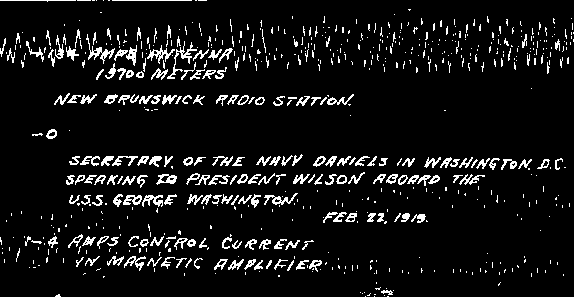
On Febuary 22nd, 1919 the secretary of the US Navy Daniels in Washington, D.C. spoke to President Wilson aboard the USS George Washington via radio transmission on the frequency 21.9 kHz (wavelength: 13700 metres)!
The used transmitter was WII in New Brunswick. It was a 200 kW machine transmitter, similar to SAQ in Grimeton.
The control current in the magnetic amplifier used for modulation was between 1 Amperes and 4 Amperes (see oscillogram recording below). Unfortunately no data about the used bandwidth are available, but I suppose the quality of the transmission was very poor!
I believe that this was the lowest carrier frequency ever used for speech transmission. Or were even lower carrier frequencies used for speech transmission? (I first did not believe that there was a speech transmission on 21.9 kHz!)
I got this information from Bengt Dagås, who works at Telia and is responsible for the conservation of the famous VLF transmitter SAQ at Grimeton (Sweden).
Re: 21.9 kHz – the lowest carrier frequency ever used for speech transmission!?
Posted by John Davis on April 10, 2002 at 18:50:12
Hi Harald,
I believe your information is correct regarding 21.9 kHz being the lowest frequencies used for practical speech transmission.
There were some tests on even lower frequencies. However, none of those amounted to real, practical communication.
The transmission of voice and music was a favorite topic of study for Canadian inventor Reginald Aubrey Fessenden. He conducted early tests of the idea using high-speed rotary gap spark transmitters, which produced a quieter note than conventional sparks. In the course of these tests, it is believed he sent an amplitude-modulated signal for a mile or more on 10 kHz, and later for a distance of perhaps five miles on 20 kHz.
Naturally, those experiments neither constituted practical communication, nor were they as productive as his better known efforts in 1906, using Alexanderson alternators between 60 and 100 kHz.
Many of us regard Prof. Fessenden's Christmas Eve, 1906, voice and music broadcast as an historic event to celebrate. But while doing research for a future article on the subject, I learned that a voice signal from Fessenden's Brant Rock, Massachussetts, transmitter (intended for reception at another station on the U.S. east coast) was received and logged at Fessenden's station in Scotland, nearly three weeks before the Christmas Eve transmission. When December of 2006 arrives, we will have two centennaries to commemorate: the first transatlantic voice transmission, as well as the first widely heard broadcast of entertainment by radio.
So, returning to the subject at hand... yes, I believe 13700 meters is a record low frequency for transmission of speech over any useful distance.
Regards,
John
Are direct (baseband) wireless transmissions of audio signals possible?
Posted by Udo Maier on April 11, 2002 at 11:47:06
Are direct transmissions of audio signals possible?
I would it do in the following way: I would connect an audio amplifier to a ground dipole and then feed a speech or music signal into it. This would allow speech transmission without a carrier? Or?
What would happen if in the aerial of a professional ELF transmitter e.g. Clam Lake an audio signal with frequencies between 0 Hz and 10 kHz would be fed in. Would it be worldwide receivable? How would the quality change with increasing distance?
Re: ULF transmission on 1.725 Hz??
Posted by Jay Flynn on April 11, 2002 at 14:30:19
Thank you, Alves =
I read the web site and found it very interesting. However, I tend to think what I am seeing is man-made, because the signal is so constant. The Fourier Transform shows a very sharp spike at 1.725 Hz.
I will post any other obeservations I make. I do NOT see anything at 2.5 Hz.
Good luck on becoming a Ham! I am also WB9AWX
Re: Are direct (baseband) wireless transmissions of audio signals possible?
Posted by Jay Flynn on April 11, 2002 at 14:39:33
I don't think it would be very practical over long distances. Early experiments in radio tried this approach and found that moving up in frequency and adding a carrier was the best approach.
The major effect on transmission of base-band signals would be dispersion. That's the fact that in a waveguide, (earth-ionosphere in this case) the velocity of propagation at verious frequencies is not the same. That is why "whistlers" and "tweaks" occur. The energy from a lightning stroke goes out in a broad band of frequencies. A ELF receiver hears the distant stroke as a descending tone, because the higher frequencies move significantly faster than the lower ones. Hence there would be quite a difference in arrival times for the various frequencies in the audio leading to a hopeless jumble.
That said, it might be possible with adavanced computer processing to create a reverse dispersion filter to correct all these time differences (which are predictable) and return the signal to its original form.
Again, given the limits on antenna, power and efficiency, I don't think such a system is very practical.
Re: From which VLF – transmitters I can also decode the information of the signa
Posted by Udo Maier on April 12, 2002 at 06:52:23
Here is the answer of Mr. Tron Jacobsen I found today in my mailbox:
>>From which VLF - transmitters I can not just survey the transmitting activity and find out the >direction of the signal, but also use the information of the signal in a much more or less >sensitive way?
>E.g. I could imagine the usage of ALPHA for finding out the geographical coordinates of my PC. >Is there software on the internet available, with which I can use the ALPHA signals in order to >determine the position of my PC or perhaps for setting the clock.
During the early '90's the US Coast Guard developed a combined Alpha and Omega receiver. This was partially designed by Captain Ben Peterson, the former Chieff of Electrical Engineering at the US Coast Guard Academy. The receiver used a Texas Instruments TMS320C30 microprocessor based SPECTRUM plug in board in a portable PC. Ben is now retired, but I think you could get some help from Lori Costantino at Signal Corporation, US Coast Guard Academy; lori_costantino@signalcorp.com
>(Of course, there are much better ways to do this job, but for a technical demonstration this >would be still interesting!)
>Is software available, with which I can use the signals of the Russian VLF transmitters "Beta" >for setting the PC clock?
The Russian TS and standard frequency system do not transmit time correction data. The rely on phase comparison with the transmitted signal. A possible exception is the FSK tail by RJH63 Krasnodar at 20.5 kHz ( 1131-1140 UTC in the winter, 1031-1040 UTC in the summer ) FSK system is not identified, but could contain correction data.
>Although I assume, it is illegal, but the question remains: is it possible for amateurs to decode >the signals of VLF - transmitters which send messages to submarines?
You cant decode the MSK streams in use by the French, British or US / NATO facilities. They are buildt up by several individual signal streams embedded in a common multichannel MSK signal. You could be able to decode T600 aka Bee 36-50 in use by the CIS MIL HQ at VLF. The simplest way is to listen to some of the Russian morse transmission at VLF. Both ordinary A1A morse ( on-off keying ) as well as FSK morse.
>If the answer is "yes", from which stations and with which software? Where is this software >available?
HOKA for the T600 decoding capability.
Re: Can ELF and ULF - frequencies come from space to earth?
Posted by Udo Maier on April 12, 2002 at 06:57:31
Here is the answer of Mr. Trond Jacobsen:
>Can ELF and ULF frequencies trepasure the ionosphere?
Yes, they can.
>I believe, that this should not be completely impossible, since the height of the ionosphere is >not small for these frequencies in relatio to their wavelength and according to the tunneleffect >it is possible for waves through a barrier for some frictions of a wavelength!
>This must also happen with ELF and ULF waves coming from space. Is there a fault in my >statement? If yes, where? Radiowaves transmitted by a tether in space are receivable at earth level. Both space organisations as well as Defence interests has performed tests using space tethers ( towable longwire antennas from spacecrafts )
Re: Also got PLI in Burbank, CA again!
Posted by Mike KB6WFC on April 13, 2002 at 19:48:00
Hi,
Well, it's a fine Saturday afternoon (April 13, 2002, 2250+UTC) here in Daly City, CA & I'm aurally & visually (Spectran) copying PLI in Burbank, CA on 183.507kHz. Used 3100Hz filter at first & have now switched to a 400Hz filter. ID message format for the time seems to be 3XID followed by some other morse message not all decipherable as of yet, then about a 4½ second DAID & some silence. Total cycle is about 1' 22.22". This can't be groundwave, can it?!
73 de Mike KB6WFC Daly City, CA USA CM87sq 37:40:47N 122:28:21W
"Land of the Free & Home of the Brave"
RX: HP3586B (3100 & 400Hz filter modes this time)
ANT: AA7U Steve Ratzlaff active (8' LORAN-C) whip base @ 16'
Re: Are direct (baseband) wireless transmissions of audio signals possible?
Posted by Jim Wood on April 14, 2002 at 00:24:44
Possible? Absolutely. Around the turn of the last century, one Nathan Stubblefield claimed to have "solved the problem of telephony without wires." He drove two rods in the ground, fed them with the output of a carbon mike and some batteries, and picked the signal up as much as a mile away with nothing more than two more rods driven into the soil and connected to a telephone earpiece. There's a good accounting of this on the Web, and a book as well... look it up with any search engine using 'Stubblefield.'
Nathan also 'transmitted' inductively with a 40-foot diameter coil of wire to a smaller secondary coil, though reception was limited to only a few hundred yards because of the inverse-square law.
Give it a try - either way - it's an interesting concept and was proven about 100 years ago.
Reception of PRK Saratoga, CA
Posted by Mike KB6WFC on April 14, 2002 at 19:04:03
Hello,
Well, it seems Sunday is the best day to play with radio, HI!
At 2010+UTC on April 14, 2002, I captured PRK of Saratoga, CA on Spectran 183.1625kHz sending PRK PRK PRK RADIO SARATOGA. IMHO a 599 signal, see http://www.geocities.com/silversmj/prk0204142010.jpg .
One can also see what I believe is PLI's signal near 183.5kHz.
This makes my fourth LowFER reception.
73 de Mike KB6WFC Daly City, CA USA CM87sq 37:40:47N 122:28:21W
"Land of the Free & Home of the Brave"
RX: HP3586B (3100Hz filter mode, set at 182.0000kHz USB)
ANT: AA7U Steve Ratzlaff active (8' LORAN-C) whip
base @ 16'
Re: Are direct (baseband) wireless transmissions of audio signals possible?
Posted by John Davis on April 15, 2002 at 05:10:57
Jim Wood writes:
:: There's a good accounting of this on the Web, and a book as well... look it up with any search engine using 'Stubblefield.'::
Jim is a colleague of long experience in the field of earth communication experiments, and he knows whereof he speaks.
I would only add one note of caution when Web searching: there are some loonies out there who have convinced themselves that old Nathan had some kind of secret technology in his induction coil boxes, with all kinds of imagined capabilities which were never actually documented by Stubblefield or anyone else. So apply a bit of skepticism.
Some of the rather peculiar claims stem from an honest lack of understanding of even the rather meager electrical science of the time.
Example: A few days ago, while researching something else, I encountered a news item on the Web from a 1902 issue of Scientific American (certainly a far more reputable publication than the average tabloid newspaper). The article contains a number of interesting photos and some mostly-accurate text. But not entirely accurate! On the one hand, the writer says of the Stubblefield system that "utilization is made of the electrical currents of the earth instead of the ethereal waves employed by the Italian inventor;" yet moments later he claims "what is known as the Hertzian electrical wave currents are used." Well, today we readily recognize the inherent contradiction. If they're not waves in the "ethereal" sense, they're certainly not the kind of waves Prof. Hertz worked with!
You can read the article yourself at:
www.angelfire.com/nc/whitetho/1902stb.htm
Much of what you'll find on the Web about "wireless" pioneers like Stubblefield and Loomis is fascinating, but be prepared to apply a healthy dose of skepticism to what you read there.
Having said that, as Jim observed, the concept does work.
As for using it with an antenna such as at Clam Lake... remember that the earth currents themselves do not travel much beyond a few times the distance between the sending rods. The Navy is counting on actual radiated energy (ELF radio waves) to reach its submarines, not the earth currents. To achieve this, they are applying megawatts to the antenna system in order get just a few milliwatts to radiate. And, the receiving system must employ narrowband techniques in order to achieve useful levels of signal-to-noise ratio.
If one were to apply baseband audio to the Clam Lake system, four things would quickly become evident:
* There would be difficulty matching impedance over a useful part of the audio spectrum.
* Higher audio frequencies would radiate from the antenna better than the lower ones. But even despite the higher efficiency...
* The extra bandwidth to convey audio also entails a serious degradation in received signal-to-noise ratio, meaning the higher efficiency would be eaten up overcoming noise, so the transmitter power could not be reduced. If anything, it might have to be increased further. This is also because...
* The earth-ionosphere waveguide has increasingly worse attenuation rates as one increases frequency from 100 Hz to about 2 kHz; and the loss exhibits rather large diurnal variations in that range, too.
Ultimately, if one station were able to overcome all these obstacles and achieve global communication at baseband, with no other "channel" to tune, only one station at a time could ever be "on the air" at baseband in the whole world.
I might add that even if listeners on land could perhaps receive the station, submarines below the surface would only hear the bass components of the speech or music. This is because seawater also exhibits extra attenuation at higher audio frequencies. If the signal will not be usable by submarines, no government is likely to fund such a massive facility, when the same result for land-based listeners can be achieved at much lower cost by shortwaves.
Although global transmission of baseband audio by electromagnetic waves is not feasible, local and regional transmission by means of earth currents below 9 kHz is indeed possible--and fun. There are still plenty of opportunities for experimentation with modern circuitry and communications modes that were unavailable to early pioneers in the field.
John
Re: Reception of PRK Saratoga, CA
Posted by Mike KB6WFC on April 15, 2002 at 12:16:21
Hello,
Confirmation received April 15, 2002 15:02:34UTC.
Here's some excepts:
"... The beacon has been off the air since about Feb. 01. The reason for this was our "power crisis". ...
... , it was merely turned off and not disconnected. ...
... As far as DX, the best report that I've had is Hawaii about 10 years ago. I have been heard in San Diego, Nevada Atomic Test Site, and Mount Shasta. I can copy my beacon with a Sony 2001 receiver and a 3 foot tuned loop about 200 miles out during the day. ...
I am using a 50 foot vertical antenna with 20' top hat. I have radials buried in the ground which also serve for my Ham activity. The loading coil is a 6 inch form wound with 120/60 litz wire with a variometer. The inductance is about 2.2 Mh. ..."
Thanks Dan!
73 de KB6WFC
Underwater propagation of VLF
Posted by Miguel KC6WAZ on April 15, 2002 at 23:08:45
Hello. First timer here. And sort of lost in space with this particular subject:
I know submarines do achieve communication via VLF half a globe or more of distance while very submerged.
These VLF antennas are on continents, not underwater. The submarines, do trail long antennas underwater.
I knew radiofrequencies do not propagate underwater, or at least in other than VLF
I knew the optimal underwater communication is acoustic sonar, not electromagnetic waves.
Now, how all this comes together ?
If I apply bursts of balanced plain 120V AC 60 Hz to two copper poles submerged in the sea and reasonable apart; how far will the seawater attenuation at 60 Hz allow the signal to be picked up ?
Thanks,
Miguel
2 letter "beacons"
Posted by Charlie Conner on April 15, 2002 at 23:42:48
Any suggestions where to look up the locations of 2 letter ID's such as PK and FQ near 420 KHz and PP on 513 KHz??
Cant find these on the FAA page. (?) Thanks for the help and good DX. Charlie
Re: Underwater propagation of VLF
Posted by John Davis on April 16, 2002 at 04:06:37
Hi Miguel,
It's a question kind of like, "If I drive to the store to buy a bushel of apples and ten pounds of potatos, and ham is the optimal seasoning for cooked vegetable dishes in the South, what octane of gasoline should I run in my car?" :-)
But seriously... The dispersal of electric current from a 60 Hz source in seawater is a very different matter from the attenuation of radio waves in that same water. Such an experiment will produce no measurable radio waves; and because of the high conductivity of seawater, nearly all the current between the plates will be confined to a radius roughly equal to twice the spacing of the plates. It would not be an effective communication method.
If you could clarify the purpose of your question and/or rephrase it a bit, someone here may be able to offer more specific answers.
73,
John
Why does the ELF transmitter of the US Navy not use an HVDC powerline as fee
Posted by Andreas on April 16, 2002 at 08:50:31
In my opinion the best way to realize the ground dipole for the ELF transmitter of the US Navy would be the usage of an HVDC powerline. Especially the famous "Pacific Intertie", which runs from Oregon to Los Angeles would be an excellent choice, because it is 1362 km long and it is running nearly straight on.
I would have built at the halfway between the converter station the transmitter, which feeds the ELF via a special transformer in the conductors. Just before the converter stations the ELF signal is outcoupled by capacitators.
These capacitators would also bring a benefit to line operation since they block AC components from the converter station which can cause disturbance in telecommunication lines close to the HVDC line.
Why is this concept of a ground dipole not realized for the ELF transmitter of the US Navy?
Its effiency would be bigger, since the length of the dipole is much bigger (1362 km versus 40 km in Clam Lake)?
And the usage of an existing powerline would save money.
Or is perhaps such a device existing as (secret) backup transmitter?
Re: 2 letter "beacons"
Posted by Jim Smith on April 16, 2002 at 12:00:50
FQ-420 Fairmont, MN 43-23-25.5N 094-19-04.9W
PK-420 Olathe, KS 38-45-11.1N 094-44-12.6W
PP-513 Omaha, NE 41-24-06.3N 095-53-36.0W
As for looking them up yourself try KUØKU's excellent xls file @ http://www.mindspring.com/~longwave/aero_db.htm
and
http://worldaerodata.com/
73, Jim
Re: 2 letter "beacons"
Posted by Charlie Conner on April 16, 2002 at 12:48:45
Hey..Jim: Thanks a lot. Appreciate the quick response.
Have a nice day now!!
Charlie
Re: 2 letter "beacons"
Posted by Webmaster on April 16, 2002 at 13:28:12
Let me also add my thanks, Jim.
Even though the aero_db.htm page is five years old, and we no longer publicize it, I'm gratified to see that it still has some usefulness left.
I'm even more delighted to see the World Aero Data site. They apparently use the same DoD list that I was developing software to search, but they're already up and running. Works quite well! We'll add a link to that site from our LF Utilities page soon. Thanks again, Jim.
73,
John
Re: Underwater propagation of VLF
Posted by KC6WAZ Miguel on April 16, 2002 at 16:14:03
Hi John, thanks for your response.
Fully agreed, my post is as poorly worded as can be. I am sorry, It's my third language and trying to improve.
Hope to be at least not worse this time:
The electromagnetic propagation attenuation underwater varies with frequency. Which frequency is less attenuated ?
Same example:
How far can a balanced AC signal applied to submerged poles propagate ? (at that least attenuated frequency)
The purpose is basic rudimentary signalling.
From your reply, explaining the confinement of the waves to a 2x plates-spacing DUE to high conductivity of seawater; ¿would the same setup in fresh water allow a larger propagation by being such water less conductive ?
Thanks for your patience,
Miguel
Re: Why does the ELF transmitter of the US Navy not use an HVDC powerline
Posted by John Davis on April 16, 2002 at 17:06:21
:: Why is this concept of a ground dipole not realized for the ELF transmitter of the US Navy? Its effiency would be bigger, since the length of the dipole is much bigger (1362 km versus 40 km in Clam Lake)? ::
Interesting thoughts, Andreas.
Several factors affect the efficiency of a ground-dipole antenna; which, in reality, is a type of loop antenna.
While the Pacific Intertie is much longer than the feeders at Clam Lake, "almost" straight is not sufficient for optimum efficiency. The power line also has vast variations in elevation along its length, making the effective area of the loop smaller than it would otherwise be. And finally, it is essential to maintain as low a resistance as possible between the buried ground terminals. That condition can be guaranteed at Clam Lake, where the geology is well understood and the underlying rock is uniform; but the different and discontinuous rock strata that exist between the Pacific Northwest and southern California do not provide such a definite return path. This, too, reduces the effective area of the transmitting loop.
Efficiency is not the only criterion for an ELF antenna, however. Availability of continuity on the line must be 100% to meet military reliability standards; hard to guarantee in a system as large as the Intertie. There is an additional problem, brought back into the spotlight by recent world events: security. A thousand-mile power line, running across diverse tracts of public and private land, is hard to protect. Either an accidental or deliberate outage, if it were to occur at a time when the country was under threat of imminent missile attack, would be a totally unacceptable risk.
The Navy's redundant inland sites are easier to secure and to maintain in reliable operating condition.
:: And the usage of an existing powerline would save money. ::
Probably not. These days, the guiding principle of free market economics in this country seems to be that the government must pay premium prices for any resource it wants to use, while huge corporations must be given public resources at little or no cost.
Confining the antenna to a national forest is a much more economical approach for the Navy.
:: Or is perhaps such a device existing as (secret) backup transmitter? ::
It is theoretically possible, although here in the U.S. we're not very good at keeping secrets involving facilities which are in public view. The transmitting station would be rather conspicuous, involving a very big, thoroughly insulated transformer....which would be distinctly out of place on a DC power line, to say the least.
Re: Underwater propagation of VLF
Posted by John Davis on April 16, 2002 at 20:14:08
Hello Miguel,
Actually, I must compliment your use of English. Your sentence structure is very clear and natural, you use the different parts of speech correctly, your vocabulary is ample, and your syntax and grammar are better than many native speakers of the language.
My request for clarification was because I suspected there might be a philosophical misunderstanding about the difference between signalling with electric currents in water, and the propagation of radio waves in water. These are two very different things.
When electromagnetic waves radiate from an antenna, the oscillating electric and magnetic waves are no longer attached to the antenna in any way. They do not depend on a return current path to the antenna in order to continue propagating.
However, signalling with currents dispersed from plates submerged in water does depend primarily on the current returning to the source through the water, plates and wires.
It is only the fact that the current does not flow in a straight line, but spreads out from each plate over a wider path, which enables communication to take place. How far that current disperses from each plate depends in part on the conductivity of the water (or soil, or other partially conductive medium).
If the medium is highly conductive, current flows between the plates in a more direct path. Because there is little resistance, there is less voltage drop between any two points along the path, so the electrons have little reason to spread apart from each other as they travel.
Conversely, if the medium is more resistive, and there is more voltage drop between points along the path, the electrons will try to keep their distance from each other and disperse more widely from a straight-line path. Less total current will flow, but it will spread over a wider region.
You are therefore correct in concluding that high conductivity translates into shorter range, and that fresh water will disperse currents more widely than seawater.
In one way, that is similar to VLF and ELF radio waves. Radio waves penetrate deeper beneath the surface in fresh water than they do in sea water, and it does partly relate to conductivity.
However, that's where the similarity ends. Frequency selection is a very different matter.
For VLF and ELF radio waves, lower frequencies allow better penetration of the water and result in lower attenuation. There is no single ideal frequency. The lower you can go, the better.
For dispersion of current between immersed electrodes, though, higher frequencies are more effective. At least, that's what I found when experimenting in fresh water lakes some years ago.
I was using music from a stereo to energize steel plates suspended in the water, through an audio impedance matching transformer. (Caution! Even a few watts of audio can produce dangerous electrical shock if you are in the water near the electrodes!)
Sailing around on the lake in a non-conductive boat, I was able to lower small electrodes into the water and hear the music quite nicely, except that there was more treble than bass in the audio. By using the electrodes as an electrostatic probe on land, I could also detect the audio (high frequencies only) within a few feet of trees, metallic fences, grounded power poles, and other objects.
From these results, I concluded that higher frequencies... at least, those which are high but still within the audio range... propagate better than lower frequencies when one is dealing with current dispersal/induction communication methods.
I believe there is much more to be learned from experiments such as these, but I have not had the time to pursue those interests for several years.
Perhaps this information will be of some use to you.
73,
John
Good explanation...
Posted by Miguel KC6WAZ on April 16, 2002 at 21:37:03
Thanks John, I understand it now.
Then next step is to try hands on, make measurements, and keep learning about it.
73, Miguel
Re: Good explanation...
Posted by John Davis on April 17, 2002 at 02:07:08
:: Then next step is to try hands on, make measurements, and keep learning about it. ::
Excellent. I'm glad I could be of help, and I hope you'll let us know the results of your experiments.
73,
John
VLF signals from unidentified flying light balls in the area of Hessdalen
Posted by Harald on April 17, 2002 at 06:49:17
In the area of Hessdalen there is an automatic station for monitoring unidentified flying light balls, about which is often reported in this area. Although many observaions done by this station could be explained, there are still more then a dozen unexplained observations! (More informations on: http://www.hessdalen.org).
A few month ago, I contacted a scientist per e - mail working there on an apparatus for receiving radio waves including VLF.
Here you can find his answer to my mail. It is very interesting.
Dear Mr. Lutz,
I am not a specialist of the VLF region specifically, even if last year I tried to interpret the situation which we found, just phenomenologically and
>from a purely geometric and dynamic point of view, in the same way in which I work in astronomy (which includes also radio-astronomy, even if I am an optical).
> I read your article in the internet about your VLF research project
> Hessdalen and about the spike and Doppler signals you receive at
> Hessdalen.
> I think it is very interesting, since this would allow a global network
> for
> UFO monitoring.
Even if I am allergic to the word "Ufo", I also think that a global network may be useful to address scientists to the nature of the light-phenomenon.
Nevertheless VLF research alone is totally insufficient. Microwaves should be investigated even more: even if there is no proof that this happened in Hessdalen, such kind of light-phenomena left tracks of microwaves just in the ground or in the vegetation everywhere in the world.
And always an optical counterpart should be found. But maybe it is not the case: it can be that low-energy plasmas exist in nature and that some triggering mechanism, such as cosmic rays may energize them to the optical.
> I receive at home VLF below 24kHz with my PC
> (http://www.vlf.it/harald/strangerec.htm) and made many spectrograms
> automatically. Perhaps, but I do not
> believe so, but who knows, I have recorded spikes and doppler signals you
> described in your article, but I cannot say so, since I do not know the
> exact
> characteristics of spike and doppler signals.
What you say is very interesting. Can you show me some of these specific frames (in particular the doppler)?
> So, please answer my following questions: how can I find out the
> difference of a spike and of a signal produced by electric device?
We are not totally sure yet that "spike signals" are not man-made. For instance, VLF communication signals from submarines cannot be ruled out
(last year, just while we were taking measurements in Norway, the Kursk tragedy was just starting and going on....), but they cannot even be proved,
as I know well that the publication of this material seems to be top secret.
Nevertheless, I have seen several signals by well-known electric devices
(Romero's web site: www.vlf.it) and they are partially or totally different
>from the spike signals which we recorded in Hessdalen last year, and not so periodic or so long-lasting. We found something man-made too in Hessdalen last year, in fact these signals were obviously eliminated from our data.
The question of "spike signals: man-made or not?" remains unsolved by now
(...... what about HAARP?).
This summer we carried out a new mission to Hessdalen (this year it was aimed at the optical aspect which I directed: soon a long report will be published on internet with many photos and graphs), with the secondary goal of trying to monitor VLF interferences in the Valley. Eng. Montebugnoli directed this initiative. They found nothing, in spite they carefully monitored 6 different points of the valley in a radius of about 20-30 km.
On the contrary, it seems that another researcher of the "radio group" (who was with us there) found something interesting in Hessdalen this summer: but at the best of my knowledge, they are not spikes or dopplers, but something else. He is just working on the data, and will publish them soon. His name is Flavio Gori (gori@mail630.gsfc.nasa.gov), who is the biggest expert in Italy on VLF (Inspire Project) and who, like you, is very favourable to the construction of a VLF global network. I think you should contact him, or maybe you already know him.
> Which are the basic
> characteristics of spike signals?
More precisely, a "spike signal" is constituted by many trains of impulses
(we called it also "comb signal"), which occur in a strictly periodic way.
The sequence of these signals can last also half an hour, they generally start and stop almost suddenly. The frequency in which we saw them was: 3-7 KHz.
Here attached some typical examples, some of which were post-processed in detail by graduand in astronomy Simona Righini (simona.righini@infinito.it).
The trains of impulses which you find in file Spike.jpg is just the result of a zoomed processing of some of these spikes (Spike_A.jpg).
I can attest that the so called "spike signals", in the world may appear exactly with the same morphology in the ULF (see Elfrad web site:
http://www.elfrad.org/2000/anomaly.htm ), VLF (see our data of last year),
HF (see Hessdalen data in 1984:
http://hessdalen.hiof.no/reports/hpreport84.shtml ), UHF (astrophysicists in Anctarctica found them by chance in 1991 while they were pointing their dish in order to study the cosmic microwave radiation) wavelength windows. In some cases, but not very often, it seems that these signals occur simultaneously with light-phenomena, like it happened in Hessdalen in 1984.
> How can I find out doppler signals?
> In which frequency range they occur?
Last year we found them in the range 1-2 KHz.
> What are the exact characteristics of doppler signals?
They appear like inclined lines in a graph which gives frequency vs. time.
The inclination changes rapidly with time, and there is also an inversion of the inclination of the lines. There is no sign by now that they are man-made, they are not even known signals of radio-nature. The model which I did is the only one, by my opinion, which can explain the dynamics and the geometry of this specific phenomenology, but not the reason why they occur just in VLF. Probably they may occur also in other wavelength regions.
You can see an example in file Doppler.doc.
> Please mail me also some spectrograms and doppler signals with high
> resolution.
I did not find highest resolution than these, unfortunately.
Best Regards
Massimo Teodorani, Ph.D.
Astrophysicist
Re: VLF signals from unidentified flying light balls in the area of Hessdalen
Posted by John Davis on April 17, 2002 at 17:33:12
Hi Harald,
A most interesting discussion.
I may be able to shed some light on what Massimo calls Doppler signals. The spectrogram you sent of these signals can be viewed here:
These very strongly appear to be what Natural Radio listeners call "risers."
Or perhaps I should say, that is what the more adventurous Natural Radio listeners call them, because the phenomenon is related to warblers and other natural cyclotron emissions associated with auroral chorus. They do not enter the earth-ionosphere waveguide at a suitable angle to propagate to lower latitudes, so one can only hear them in regions where aurorae can be seen almost directly overhead. I don't believe it is necessary for there to be visible aurorae at the time, especially in a period of high solar activity; but they are most commonly detected when an aurora is present.
Steve McGreevy has recorded many splendid examples of risers during his expeditions. You will find links on our Natural Radio page that lead to some of his recordings, and there are now two CDs containing some of his best captures.
The "spike" signals could very well be human-triggered emissions. I notice Massimo mentioned HAARP as a possibility, but we should remember that Russia has a similar facility, and I believe Norway also has one of even higher power than HAARP. So, there are several possible origins for pulsed signals of the type described.
It is a most interesting project being undertaken at Hessdalen. We will be eager to see what sort of VLF signals occur there, and whether they can be coordinated with observations of the unknown lights.
John
New QTH anyone? - (fwd)
Posted by Mike Dennison on April 17, 2002 at 20:04:51
Subj: LF: New QTH anyone?
Date: 4/17/02 12:49:18 PM Eastern Daylight Time From: mike.dennison To: rsgb_lf_group@blacksheep.org
The RSGB has just published the following as part of next Sunday's GB2RS bulletin (published to non-members next Friday at http://www.rsgb.org/news):
-------------
BT Looking to 'Redevelop' its Rugby Radio Site
It has been announced that the 1700-acre Rugby radio station site is to be 'redeveloped' by BT. It was brought into service, originally by the Post Office, as a wireless telegraphy station in 1926. A year later it started carrying Royal Observatory time signals and over the next 70 years the station, using the callsigns GBR on 16kHz and MSF on 60kHz, was used for sending radio telegrams to ships. The 16kHz transmissions can also be received by submarines when submerged.
The MSF 60kHz transmitter now carries time signals from the National Physical Laboratory. Its effective radiated power is estimated at 10 to 15 kilowatts, using a T-shaped antenna 180 metres high and 500 metres across the top. Now, with the arrival of satellite communications, much of the Rugby site is becoming redundant, and BT is searching for a partner to redevelop it. Their property agents have estimated its land value alone at nearly £400 million. The current contract for the MSF 60kHz service extends until 2007.
-----------------
Mike, G3XDV http://www.lf.thersgb.net
====================
A simple way to convert your PC in a powerful VLF – receiver
Posted by Harald on April 19, 2002 at 09:51:37
A simple way to convert your PC in a powerful VLF – receiver
In earlier days for reception of VLF – signals you either had to buy or to build an appropriate receiver or converter. Today it is much easier; you only need a customary PC with soundcard (Pentium processor and beat frequency of 100 MHz or more is also required) and a few additional device.
Every PC (with Pentium processor and a beat frequency of 100 MHz and more) with built – in soundcard can be converted with the usage of only less additional equipment into a powerful receiver for frequencies below 24 kHz.! As hardware only an appropriate aerial, as software a spectral analysis program, which is available on the internet as freeware, is required.
Aerial
As aerial for VLF – reception is –as for the reception of long- and mediumwaves, too- the usage of an inductive aerial recommended.
This aerial should consist of a coil with a diameter and/ or a number of windings as much as possible.
The electrical and mechanical properties of the used coil, as its inductivity, ohm’s resistance, number of windings, etc. are only from low importance and may vary in a wide range.
Therefore its manufacturing is very easy.
You only need one roll of insulated wire, which is connected to the LINE- or MIC – input of the soundcard with an at least 2 metre long cable. As cable you can use each type with two conductors.
Because in appropriate shops ready – soldered plugs can be bought for all types of PC soundcard inputs, you even need not to solder the necessary plug for the soundcard input by yourself.
For good reception the coil should be placed as far as possible away from the PC (if possible at least 2 metres) and from other electrical device with the axis showing parallel to the ground.
In buildings made of steel and concrete a place near the window is the best choice.
It is possible, if you want to achieve a higher sensitivity to switch two or more coils in serial. You have to mind the sense of the windings, otherwise the induced signals distinguish each other.
Setting of soundcard input
After the aerial was connected to the soundcard input, the used signal input must be determined at the PC.
Therefore click with the right mouse button on the loudspeaker symbol at the right end of the Windows task bar. A popup menu appears, on which you have to choose the option for “loudness”.
On the dialog, which is now shown, click on the menu point for “options” and then choose from the sub menu the point “properties”.
You will see a second dialog on the screen, set the option for “recording” and click afterwards on the “OK” – button. Now you can set the soundcard entrance you want to use. For VLF – reception, the balance control of this entrance should be put in the middle and the loudness regulator to maximal loudness.
All these settings can be changed of course later, if e.g. the spectral analysis of a sound signal shall be done, which is fed via an other soundcard entrance in the PC.
General considerations about the reception technique and analysis software
There are many programmes available for the spectral analysis of signals, which come via the soundcard in the PC (look http://www.vlf.it/harald/strangerec.htm).
My favourite software is “SpecPlus”, since this extremely powerful software offers the possibility to save the received signals as frequency – time – intensity – diagrams (such called spectrograms) automatically in a disk – space saving way as jpg – files.
Besides this, “SpecPlus” runs very stable, when a Windows95, Windows98 or Windows ME operating system is used. (I do not know how well it runs under Windows NT 4.0, Windows 2000 or Windows XP. It does not work under Windows3.x!)
Monitors of PCs generate strong noise in the VLF – range. For this reason it is very sensible not to view the spectrograms directly on the screen, but saving them as file on hard disk and viewing them at a later point of time.
Therefore automatically working with monitor switched – off is the best operation mode. Between midnight and 6o’clock local standard time is usually the best time for VLF – reception, because most electric devices are switched off at that time and the level of disturbing signals is therefore lowest.
And because of the fact, the PC is in common not used at these hours, it can be used then for VLF – reception.
The Software “SpecLab“
“SpecLab“ is downloadable as zip – file from http://www.qsl.net/dl4yhf/spectra1.html.
After successful download and extraction with WinZip in an installation directory, the software can be installed, experience shows that no troubles occur.
After successful installation some settings have to be done.
First you should set the colour palette. There are many wrong colour display modes available.
Although wrong colour displays can look like somewhat pop, I prefer for good reason a mode, which shows the signals black and the foreground white.
First such a display mode can be easily understood without knowledge of the used colour palette and you can, if you want, compress the received jpg – files further with other programmes without loosing informations (if you use a display in false colours the colours can easily changed by this process,. This effect is, because the colours show the intensity of the signal, not desired at all!).
For the setting of the colour palette a file containing an appropriate colour palette is load via the menu point “Option” and the sub nenu point “Load Color Palette”.
Now the sampling rate is adjusted. Choose therefore the menu point “Option” and then the submenu point “Audio Settings”.
The sampling rate determines the value of the highest frequency you can receive. Its value is:
F = sampling rate / (2 * Input Sample Rate Divisor).
For a maximum reception frequency of 24 kHz (customary sondcards cannot process input signals with higher frequencies), you have to set the sampling rate on 48000 Hertz and the Input Sample Rate Divisor on 1.
Then you have to fix the FFT properties. Choose therefore under “options” the menu point “FFT Settings”.
For VLF – reception you must set FFT – Output on “Logarithmic” and as FFT – type you should choose “Real Number FFT Starting at 0“.
At least the display mode is adjusted. Call therefore via the menu point “Option” the submenu point “Display Spectrum display Settings“.
Set the amplitude range on the dialog which will now appear for VLF – reception between –130 dB and –60dB.
Experience shows that this range is very sensitive for the display of VLF – signals, because stronger signals do normally not occur and the noise of the soundcard has a value in the order of –110dB to –120dB.
There are some further adjustments possible in this window.
Finally you have to adjust in the main dialog with the controls “B” (brightness) and “C” (contrast) below “Color Palette” the best value for the sensitivity. Disconnect or short – circuit for this purpose your aerial and move the control “B” so long that the background just appears white.
Set the contrast of the display with the control ”C“.
You can set it in such way, that small differences in signal intensity appear or not. Because of the fact that the settings of the regulator “B” and “C” influence each other, you have perhaps to do these steps several times, until you are content with the display.
Afterwards your PC is ready for VLF – reception!
Re: Got PLI in Burbank, CA again!
Posted by Mike KB6WFC on April 20, 2002 at 22:14:27
Copied PLI again this afternoon even with all the HF absorption going on, message is:
PLI PLI PLI PLI PLI PO BOX 1884 BURBANK CA 91507, then the long dash & long space
73 de KB6WFC
LOWFER "RB" off until fall
Posted by Robert Bicking, W9RB on April 21, 2002 at 15:43:35
My beacon at 186.92 kHz will be off until fall (has been off for a while but I neglected to notify you).
Wanted! An (if possible cheap) seismograph for the PC
Posted by Harald on April 22, 2002 at 06:21:06
All software techniques used for ELF and ULF – reception can be also used for earthquake detection. The only problem is: where can I get a seismograph for my PC, which should be as cheap as possible. Which company sells such equipments or construction kits for seismographs?
What are the prices? (I live in Germany and if no European sellers are available, there are costs for shipping and freight)
Where can I get more informations about amateur seismology?
GBR Rugby again on the air
Posted by Harald on April 22, 2002 at 07:25:33
From March 31st, 2002 8:01:29 UT until April 21st, 2002 7:57:40 UT was GBR Rugby off the air because a mast of its aerial had to be repaired. Now its again on the air.
WA back in business
Posted by Bill Ashlock (fwd) on April 22, 2002 at 09:43:58
Could be earthquake-induced Hyper Dimensional Physics, but whatever the cause, WA, after a month of silence is back on the air at 185.300, QRSS30. We also have have 5" of snow in the forecast tomorrow (after 96deg last week) so that Moon must really be doing a number on us!
I was re-testing the Rac on three different conductors today for the next loop article and ended up with the RG-8. So I figured why not blow the cobs out of the transmitter and see how see how the propagation is in mid April? We are running 1.2A with the RG-8 at a 1w input power so we are getting out. Any signal reports are very much appeciated.
How about some company, Loop Group - Jay, John, Paul, Mike?
Bill A
Re: Wanted! An (if possible cheap) seismograph for the PC
Posted by Bernhard on April 22, 2002 at 10:47:12
Hello,
what do you want to detect? I live about 100m from a railway and sometimes I can FEEL the vibrations! I think it would be difficult to say whether you receive an earthquake or just some children jumping around in your neighbourhood. You might need a silent place somewhere in the nature.
Maybe it is possible to build your own seismograph? You could place a magnet on a spring that hangs in a coil that might be similar to a coil you can use for VLF reception. The magnet that is going up and down produces a voltage in the coil. What do you think about it?
Bernhard
Re: Wanted! An (if possible cheap) seismograph for the PC
Posted by Harald on April 22, 2002 at 12:05:34
Harald,
You might be interested in an article published in "Electronic Design" August 23,1999 page 77. Under Pease Porridge. To quote the source:
"Take your garden-variety electret/condenser mike element; I used a Panasonic unit(Digi-Key p/n 9931-Nd, $1.40 each).Carefully remove the baffle or screen and open up the top of the can with a sharp, pointy X-ACTO knife. By open up I mean enlarge the opening of the top hole to gain access to the Mylar electret membrane.
Once you have exposed this membrane, you can attach a small lead ball that's 10- to 100- mils in diameter with a small drop of super glue. Where do you get this small ball, you ask? Just melt solder on the end of your iron and shake it over a glass of water. You can get any size you want.
Size is important because it impacts the frequency response and the output. Any way , when finished , select the proper bias resistor for a 9-V supply(6 to 12k), Tune for max, and you have a whopping output. When looking at the signal on a scope, you can tell the direction of the movement and lots of other things. A small amp, threshold comparator, and alarm finishes the thing." This was sent to the magazine by Neal Tenhulzen. I have also run across some web sites which have plans. Check out Scientific American web site and back issues of the magazine under the Armature Scientist column. Also "Radio Science Observing" Vol 1 and 2 by Joseph Carr is also a good source of all radio science circuits.
I hope this is helpful.
Walt
Rock Bottom Radio (>1 Hz)
Posted by Richard VE7ZEP on April 23, 2002 at 00:47:05
I was up late reading a back issue of "Pop Comm" (Sept.1992) and in an article about VLF/ELF radio waves, there is mention of a world-wide microseismic noise peak at 0.16 Hz and signals thought to be earthquake related have been detected between 0.05 and 10 Hz.
Has anyone designed, or played with, a receiver this low in frequency?
I had to ask.
Re: Wanted! An (if possible cheap) seismograph for the PC
Posted by Frank Carson on April 23, 2002 at 07:59:10
There is a company that advertises in "Nuts and Volts" that sells a "Geophone". It is a sensor that is used in oil drilling to detect vibrations. VERY sensitive - hook it up to an o-scope and you can "see" a paperclip dropped on the work bench. I have the e-mail address at home (I'm at work now), and can send it to you/post it here on the message board. Drop me an email if you don't see it here in the next day or so.
Frank Carson
Re: Wanted! An (if possible cheap) seismograph for the PC
Posted by Mike Thompson on April 23, 2002 at 12:56:38
I actually bought the Geo-phone. The order info escapes me at the moment though.
The circuit that comes with it, is basically trash and it went directly into my junkbox. However the actual Geo-phone element is, like you say, quite sensitive.
I have mine hooked directly up to my Veleman handheld scope, and I can detect people walking almost 100 feet away in the building that I work in. I can also pick up resonant vibrations in the floor at times, as well as see the air conditioner on the roof turn on;)
Another, cheaper method, that I have toyed with is taking a Piezo element from and old piezo siren or equivilant beeping device, I hooked the wires directly up to my scope. Then I placed the element ontop of a brick, then took a metal ruler with some pennies taped to the end to weight it down a bit and placed this on top of the element and then a brick on top of that.
This actually picked up a decent amount vibrations, and the setup literally only cost me a few pennies;)
Re: Wanted! An (if possible cheap) seismograph for the PC
Posted by Frank Carson on April 23, 2002 at 22:12:05
The company that markets the Geophone is Gateway Electronics. Their URL is:
http://www.gatewayelex.com
The geophone is $9.95, and is listed under their "Gadgets" section. Heck, the price is right!
Frank Carson
Selective Voltmeter Manual
Posted by Mike Thompson on April 24, 2002 at 14:55:44
Hello,
Does anyone out there know of a source that would carry either the service or the owners manual for the Rycom 6010 Selective Volt Meter?
Thanks
TAG in Jason Mode
Posted by John Andrews on April 24, 2002 at 19:11:29
Stewart Nelson has requested audio recordings of on-air Jason signals, complete with noise, fading, etc. I am currently running TAG in Jason mode on 177.800 kHz. Stewart has indicated that he would like .WAV files, maybe 15 minutes in length, 8 bit mono, with 5512 Hz sampling being adequate. If you can record such a thing, contact him at for ways to deliver the file to him.
I plan to leave TAG in this mode until 4/28, at least.
John Andrew, W1TAG Tag Status: http://webpages.charter.net/w1tag/
Re: Rock Bottom Radio (>1 Hz)
Posted by Jay Flynn on April 24, 2002 at 23:53:13
Richard =
I may have inadvertantly designed and built a receiver for this region.
For over ten years now, I have maintained a moving coil seismometer at my residence in Los Angeles. Despite being in an urban environment, the device is capable of detecting and measuring seismic activity down to a local magnitude of 1.2 or so on the Richter scale.
To explain briefly, a moving coil seismometer is exactly that, a coil mounted on a pendulum moves in a strong magnetic field to generate a small voltage when the earth moves. In this case the coil is about 220 turns with a cross-sectional area of about 5 sq. CM. The coil is short winding of only 1.5 CM long. The output is amplified so that voltages in the tens of microvolt range produce a readble output. The coil axis is horizontal, east-west. The system has a designed damping factor of 0.8-0.9. Damping is done by loading the coil output with a small resistor.
The output of the coil is fed into a chopper-stabilized 8000X amplifier. The amplifier output runs into a PC which handles the alarm and recording functions. A specific trip level can be set and the computer automatically records events above this level.
To give you some idea of the device's sensitivity, the 7.1 Loma Prieta (San Francisco) earthquake saturated it for over 15 minutes. The recent 6.8 earthquake off Acapulco produced a trace up to 1/3 the saturation level. Magnitude 6 and 7 earthquakes in the Kermadec Islands (off New Zealand) are routinely detected. The 1994 Northridge (Los Angeles) 6.8 earthquake (only 6 miles from my home) simply knocked the unit out of operation.
Up until about 1996, local noise was from traffic (I'm only 1.5 miles from the busiest freeway interchange in the US, if not the world). However, the noise level in the wee hours was quite low. Since 1996, I have noticed a continuous sine wave in the background.
I first thought the signal at the output was due to drilling or industrial activity. It stops for a few hours and then returns. Other than that, I can not discern any pattern to the operation.
I read in the "WUN - WORLDWIDE UTILITY NEWS – ELF and VLF Guide Version 1.0 - updated 15 November 2001" about the observed signal at 2.5 Hz. So I did a FFT on my archives and the current signal - absent an earthquake. I found at least two "carriers". One at 1.725 Hz and another 10 db weaker at 1.25 Hz. Both signals are well clear of the background noise and very stable in frequency over time. I do not see anything at 2.5 Hz.
I have tried to track down the signal by "freezing" the pendulum. This prevents the pendulum from responding to seismic waves. However, the carriers persist. I can only assume the signals are from a changing magnetic field.
I also did a narrow band extraction of the 1.725 Hz signal and found that it slowly faded in and out over the course of several minutes.
At the moment, I have no explanation for possible sources of such signals. Any ideas?
Thanks,
Jay
Re: Fwd: LF: ZL6QH tests 23 March
Posted by Bill Curtis on April 27, 2002 at 21:26:48
What location was the transmitting originating from? - Bill ,n1rik
New England Get-together
Posted by Mike Staines (fwd by Webmaster) on April 27, 2002 at 23:19:14
From: Mike Staines Date: Friday, April 26, 2002 11:06 PM Subject: [Lowfer] New England Get-together Sorry that this post might be off-topic for some of you but it is the only way I know to reach all the New Englanders and nearby Canadians, including the lurkers. (Odd, I had no trouble thinking of 3 more ways. - JHD :-) The New England Lowfers will be gathering at the Hosstraders Ham Radio Flea market on Saturday, May 4th at the Hopkinton (NH) fairgrounds. We will meet at the Sound trailer at 10:00 and probably mosey over to the picnic area nearby. Everyone is encouraged to attend. Guest speakers will be William "Loopey" Ashlock and John "Laser-TAG" Andrews. For those of you who have never been to a Hosstraders event, you are missing something. It starts mid-day on Friday and runs straight through the night until about 3:00 Saturday afternoon. Deals are made by flashlight at 3:30 in the morning, I kid you not. All proceeds are handled by the Shriners. They pay the bills then keep the remainder for the Boston and Quebec Burn centers. I think they average about $10,000 a year to the hospitals. Questions and directions can be sent to me directly. 73,
Mike wa1ptc Concord, NH
Eddystone VLF Receiver
Posted by Rod Letts on April 28, 2002 at 22:06:19
I have an Eddystone 850/2 VLF-LF receiver in excellent condition for sale.
Tunes 10kHz to 600kHz in 6 bands.
Includes circuit diagrams.
There is a photo of one of these receivers at the marine radio site
http://www.zip.com.au/~sb/anars/w_radio.htm
Asking price for this collectable, vintage 11 valve(tube) receiver is U$475 plus postage.
My location is Australia and will freight internationally.
Email me for details.
www.lwca.org
potrzebie