Reception of ominous signal on three frequencies
Posted by Harald on April 01, 2003 at 06:10:10
Last night I received at my home town ( 8E58, 48N43) a very strange signal which occured on the three frequencies 17.1kHz, 15.7 kHz and 13.8kHz simultaneously (look on the spectrogramme at the attachment of my message, where all data of its reception are noted). The bandwidth of all three signals are approximately 500 Hertz.
I never received such a signal until now. What is its source and what is its purpose?
L1RPA Heard in MA!
Posted by John Andrews, W1TAG on April 01, 2003 at 08:09:13
In what must have been an amazing peak of springtime propagation, L1RPA was successfully copied overnight here in Massachusetts on 135.831556678899 kHz! This is the first instance of an East Wombularian station crossing the pond at LF. It demonstrates the incredible power of QRSS8640000, where a call sign can be sent in the lifetime of the operator. My thanks to Alberto, I1PHD, for creating a special slow-speed version of Argo to allow this test. Actually, the biggest hurdle was to enable Argo to run continuously through the successive Windows upgrades that will be released while the call sign is being sent.
Loof, L1RPA, informs me that he is running six 2N2222A's in push-pull parallel, feeding 1500 watts into a wire that runs from his house to his outhouse. The incredible cold of East Wombularia precludes the necessity of cooling the 2N2222's, as long as they are kept at the outhouse end of the antenna. The TV width coil he uses for loading also benefits from the low temperature.
For those who may actually want to duplicate this incredible feat after April 1st, tune in tonight for more of the first dot. Be advised, however, that this kind of propagation may be a once-a-year-event.
John Andrews, W1TAG
Re: L1RPA Heard in MA!
Posted by Bill Marconi on April 01, 2003 at 10:44:29
John A. writes:
"In what must have been an amazing peak of springtime propagation, L1RPA was successfully copied overnight here in Massachusetts on 135.831556678899 kHz!"
Darn! I wondered why I couldn't find that signal. With my confounded numeric dyslexia, I was centered on 135.831556678866 instead...which, of course, placed the desired signal entirely off screen at QRSS8640000.
I'll be sure to get the frequency right tonight. I wouldn't want to miss this pique of propagation.
--Mild Bill
Re: L1RPA Heard in MA!
Posted by Joe VO1NA on April 01, 2003 at 17:33:17
Amazing! He's 599 + 60 dB on my coherer receiver. He's a solid "O" on Argo, even with the computer switched off!
I must see if I can get a schematic of his 2N2222A class E++ amplifier!
Hopefully the ionosphere will not be damaged at 135.83 when he goes QRT tonight.
Joe
Re: L1RPA Heard in MA!
Posted by Chuckie Fessenden on April 01, 2003 at 17:52:50
Gentlemen:
It is my understanding that the 2 foot diameter loading coil for the 1500 watt transmitter has been situated beneath the seat of the outhouse. For safety and cosmetic reasons I find this disturbing, particularly since strange high pitched modulation has been detected occasionally on the carrier of the QRSSSSSSSSS^73 signal. I would assume that the Federal Commode Commission has been made aware of this emission.
Carry on.
Looking for ML-422B information
Posted by Carl Walker on April 01, 2003 at 18:46:16
I just picked up one of these units to complement the HP 3586C I've got. The ML-422B seems to be quite a nice little receiver / meter (one could argue the demodulated audio sounds a little nicer than the HP), but I'm having real trouble finding any documentation for it on the Internet.
Does anyone have the operators manual for this unit? My curiosity revolves around two primary areas - the GPIB programming information, and if there's a way to turn off the automatic calibration feature. I'd be more than happy to pay any associated costs for a photocopy of the GPIB information, if someone happens to have one of these manuals - or know of a source.
I don't know if anyone needs information on the HP 3586, but I do have the manual for that unit, and I am more than happy to share it if someone would like. I've been writing a little software to control that box for signal level monitoring and graphing, as well as using it as a spectrum analyzer.
Thanks,
-Carl Walker, WA1RAJ
PS: I intend on getting a LOWFER beacon on the air from here in New Hampshire as soon as the ground thaws, and the mud dries out ;-)
www.vlf.it update
Posted by renato romero on April 02, 2003 at 15:35:57
www.vlf.it update:
"On the possible origin, propagation and detectability of ELECTROMAGNETIC PRECURSORS OF EARTHQUAKES" by E. R. Mognaschi
73, renato romero
QSL received from Lowfer MEL
Posted by Mike KB6WFC on April 03, 2003 at 16:20:43
Hi,
Great news! I received a one 8½x11" sheet, hand-written QSL stationery from MEL Lowfer owner/operator Mitchell Lee for my reception on 4-7-2002 (be nice - that's correct, a year ago) on 183.5312kHz. He mentioned that he had performed some work on the oscillator which resulted in a 13Hz drop from the previously listed frequency of 183.544kHz. He also stated that he was testing a ~40-45' top loaded wire some 6' from the wall of his house, the transmitter was a Class-C MOSFET driven at a 20% duty factor with 1W DC input (about 11V and 90mA). He said that he was hearing it at the Livermore Flea Market. He has plans to erect a permanent aluminum structure in the clear. He was willing to put the current MEL antenna on the air again but only temporarily on weekends. About the only way I know how to get in touch with Mitch is my snail mail; he good at qrz.com under KB6FPW.
I haven't been listening for Lowfers since listening for KPH on SKN over New Year's on 426kHz. My HP3586B has stopped hearing and I haven't had time to have a close look at it. Although, if MEL was back on I'm sure I could hear it fine with my Icom IC-735.
Pic of my reception can still be viewed from http://www.geocities.com/silversmj/mel0204072112.jpg . Distance from my QTH to MEL QTH 40 miles.
73 de Mike KB6WFC (one happy Lowfer listener)
185Khz Argo
Posted by Laurence KL1X on April 03, 2003 at 23:30:22
Im presently listening during US nighttime on 185.3 to 185.303 ish and outputting QRSS30 Argo on http://www.kl1x.com
This may be temporary dependant on tower work...I revert to 137Khz plots during the daytime at the moment.
73 Laurence KL1X Anchorage BP41 GMT-9
Re: 185Khz Argo
Posted by Eric Smith on April 04, 2003 at 18:33:40
Thanks, Laurence. Very nice! I'll be looking for your 185.3 shots!
Thanks again,
Eric
Re: Looking for ML-422B information
Posted by Dave Brown on April 05, 2003 at 05:58:27
Carl- Presume you are referring to the Anritsu ML-422B?
I have a 422C and the operation manual (which I have)covers both models. They are basically identical except the B is the Bell system variant while the C model is the CCITT variant.
Dave Brown ZL3FJ
US Army Signal Corps LF/BC wavemeter
Posted by Howard Holden WB2AWQ on April 06, 2003 at 22:05:30
Anyone have a manual or operating instructions they could share or other pertinent info, especially how a BC-DA-153 buzzer-type wavemeter (75 to 1500 KC/S) was used by Sig Corps, vintage early 30s. Thanks. Howie WB2AWQ
Re: US Army Signal Corps LF/BC wavemeter
Posted by Frank J. Lotito on April 07, 2003 at 09:50:59
I believe the US Army still maintains an archive of old tech info available for research to the general public and by request to public libraries. A few years ago I was able to get my "rinky-dink" local library to request a Korean War vintage TM era manual for me. I was able to use the TM manual at the library, but I could not check it out to take it home.
Look up the following for additional info:
QST, May 1996, page 64 for an article about this. Two different resources are listed.
These organizations may have an online directory.
You could also try W7FG Manuals at 1-800-807-6146.
GL
The last signal of GBR Rugby?
Posted by Harald on April 07, 2003 at 21:10:30
On April 1st, 2003 I received the signal shown in the downloadable spectrogram on 16kHz. Afterwards I did not receive any signal on 16kHz. Was this the last signal of GBR Rugby?
Will the frequency 16kHz be given up with the shutdown of GBR Rugby?
GBR-QRT.jpg (condensed to 145KB)
Editor's Note: This was confirmed to be the last transmission from GBR.
Therefore, despite its large size, it will remain available in long-term archive.
*Data of Spectrogram

April 1st, 2003: Coil Axis oriented in North-South direction
Sampling rate: 48kHz
Time Resolution: 125ms
Frequency resolution: 25Hz
Time data in MST

*Spektrogrammdaten

1.4.2003: Spulenachsen in Nord-Süd-Richtung orientiert
Samplingrate: 48kHz
Zeitauflösung: 125ms
Frequenzauflösung: 25Hz
Zeitangaben in MEZ
W & G SPM-19
Posted by John Harbor on April 09, 2003 at 09:44:16
Hi,
I was refered over here, in hope that Somebody Can tell me what the following error codes in a W&G SPM-19 selective level meter mean??
1--006
1--201
They are in the Operators manual under chapter 6 they tell me, but I only have the WS manual and it refers me back to the Operators manual.......Doh.
If you know, can you E-mail me on htp@lisp.com.au
Thanks for any help John
Re: Description of the longwave transmitter „Europe No.1“ in Felsberg-Berus
Posted by Rash on April 09, 2003 at 13:38:00
The longwave band was re-planned some years ago, everything moved down 2kHz
Anyone running JASON ?
Posted by Stan AK0B on April 09, 2003 at 23:47:41
Anyone experimenting with JASON. If so what has been the results. How does it compare to WOLF or QRSS ?
I have played with just about everything this past year, HELL, SLOWFELD, PSK31, MFSK16, MT-63 and RTTY under low power conditions on 14 mhz <100 mW. I have also copied micro power <1 mW QRSS signals on 30 meters.
Still looking for a weaksignal mode to make two-way contacts under micro power conditions preferable in HiFer bands or 40, 30, 20 or 17 m ham bands. I have also been considering trying metor JT144 ping software.
Thanks, Stan ak0b
Re: Anyone running JASON ?
Posted by John Andrews on April 10, 2003 at 07:44:43
Stan,
Jason appears to have the "power" of QRSS with dot speeds of 10-20 seconds. It's a little difficult to make a direct comparison, as computer power and brain power are different things!
I did a lot of Jason testing last year, particularly during the summer, when I could observe my own signal from 130 miles away on weekends. Jason has a lot of potential for 2-way contacts, and will hopefully be used on 136 kHz if we get the band.
A year ago, LEK and BRO provided signals for comparison of QRSS60 and WOLF. Over the period of a week, the signals were fairly similar. If WOLF could be implemented in a "real time" mode, it should provide better weak signal performance than Jason.
Regarding HF, WOLF was shaky even on 160m when Lyle ran it a couple of years ago (though it did work). There were some Jason tests last year on the "Hifer" band, and the results were only fair. Given the Doppler shifts and fading, QRSS3 seems to offer the best results. There has been some QRSS10 operation, but I'd hate to do a QSO with the fades. As always, copying the same 2-3 letters over and over is a LOT easier than having a conversation.
John Andrews, W1TAG
Latest version of ARGO build 1.13
Posted by Myrton on April 11, 2003 at 03:19:05
Just got it and fired it up. Works just super for NDB's.
My receiver Kenwood TS-450-sat, QF-1 Autek Audio filter, Loop antenna.
Re: 185Khz Argo
Posted by Myrton - N1GKE - on April 11, 2003 at 03:25:06
Still I am not hearing/receiving signals in 160-190 Khz band, but not giving up either.
I have ideal location away fromm power lines and other man made interference, but antenna system needs major improvement.
Keep transmitting folks, I'll find you yet.
Myrton - N1GKE -
FN41
Re: Reception of ominous signal on three frequencies
Posted by Myrton - N1GKE - on April 11, 2003 at 04:42:29
For what it is worth.
I see in morse code what appears to be the letters E A.
Did you only receive this once ? Or is it continual ?
Re: Latest version of ARGO build 1.13
Posted by Webmaster on April 11, 2003 at 16:39:22
One can find ARGO version 1, build 132, at:
http://www.weaksignals.com
John
Re: Reception of ominous signal on three frequencies
Posted by Harald on April 11, 2003 at 16:39:58
I received a similiar signal shortly before. But who should transmit a morse signalin such a mode?
It is not one of the common ways to transmit morse signals as A1 or A2?
If someone has transmitted this signal in the VLF range, which kind of aerial must be used?
Re: Latest version of ARGO build 1.13
Posted by Myrton - N1GKE on April 12, 2003 at 12:10:31
Thanks for the heads up John.
I've managed to crash my several times. lol.
Not having much success below say 200 khz,
but still working on skyhook as well...
Cheers.
News from RU6LA
Posted by Ed Lesnichy on April 12, 2003 at 23:58:46
(Editor's Note: This is a report Ed sent to the RSGB LF group recently about his DXpedition in March, plus some additional files and updated information.)
Hello lwcanews!
#3 (1320z, 20 Mar, 2003) DXpedition's Report
MAR 10
19z (0100 local time) Vic UA9OC and Ed RU6LA have arrived in MO94TK, abt 220km from Novosibirsk to South-West (on a bad winter road abt 330km), nr village Dovolnoe (in translation "Pleased" ;-)) to South abt 5km Co-ordinates abt 54 29' N 79 39'E (Dovolnoe)
Temperature abt -25 C AVG SunSet 1230z SunRise 0100z
MAR 11 Temperature at day -3..5 C, very sunny, thickness of snow 0.5...1m Have begun to do BigVertical II and abt 15z finished abt 2km BV to Eu On TS-850 S-meter without ATT and preselector (1IF 500Hz, 2IF 250Hz filters) at 17z DCF39/Noise S 9+10dB/ 1-2 - excellent!
Night Mar 11-12 - best propagation under DXpedition's times ;-((
Since 17z first Argo's files:
RU6LWZ O FB in 3s mode (2904km)
1800z first DX - OH5UFO O FB in 10s mode (3303km)
1940z DK1IS O in 30s mode (4493km)
2100z OK1DTN - O in 3s mode!!! (4214km)
UA6LV is possible manages on the phone to us - I ask to give the message in DXcluster abt OH5UFO DK1IS OK1DTN signals in MO94TK
2130z M0BMU - O in 10s mode (5047km)
later M0BMU O in 30s mode I saw also some weak signals (not indificated)
MAR 12
10z finished Big Vertical II ANT current 3-3,5A with 60-80w Output But techical problems till MAR 13 (not amateur radio ;-((
We give periodically short signals (push key)
Not 120s Beacon test for ZL ;-((
Since 16z RA9MB O in 3-10s mode Periodically we give "UA9OC K" in 10s mode
2320z QSO RA9MB O/O 10s mode (400km) - First UA-UA QSO more
100km distance in QRSS I saw also some weak signals
MAR 13
0z RU6LWZ O/O First Europe-Asia QSO and first UA As/UA Eu in QRSS
0030 UA6LO O/O
1300z DCF39/N S 7/4
1430 - 1830z beacon QRSS120 137.700 ("UA9OC")
19z RA9MB O/O agn Periodically we give "UA9OC K" in 10/30s mode
2000z DCF39/N S 9/4
2350z DCF39/N S 9+5dB /4 I saw also some weak signals
MAR 14
0020z DCF39/N S 9+10dB/2
0130z 7/1
1330 finished abt 2km BV to ZL
1330 nill on 137.700
1430 send "NN" for ZL6QH nill
1530 QRSS120 "UA9OC"
1740-1830 M copy ZL6QH (.6Q...) (13870km?)
Bob ZL2CA info abt co-ordinates ZL6QH:
174 degrees 41 minutes 46 seconds East
41 degrees 15 minutes 10 seconds South This is RE79IG in my soft ??
I have no the Internet and communication on HF with UA6LV
Periodically we give "UA9OC K" in 10/30s mode
2130 IK5ZPV O/O 10s mode - not S (4919km) First UA As/I
2200 DCF39/N S 7-8/3
2300 9/2
MAR 15
0050 M0BMU O/M 30s mode First UA As/G and best UA's distance
0120 RU6LWZ 559/559 First Europe-Asia and UA As/UA Eu in CW
0130 UA6LV 559/449
1430 QRSS120 "NN" for ZL6QH nill Periodically we give "UA9OC K" in 30s mode
1900 DCF39/N S 9/1-2
2000 7/1-2
2135 QSX 136/3.5 UA9ZAG 559/599 NO30BR
MAR 16 abt 0000z IK5ZPV O/O 30s mode (1:2 dot:dash)
0000 OH5UFO O/M 30s first UA As/OH
0115z DCF39/N S 4-5/2 We dismantle BVs and Big Vertical II Abt 10z we have gone away to Novosibirsk OFF
.............
I can not work DFCW (FSK F1) - in my license only A1 ;-((
In Russia there are following limitations on 136 kHz:
29 jun 1998 radio amateurs of Russia have permission for
135.7-137.8 kHz A1A with power (Output - not ERP!):
100w 1 kategory
50w 2/3 kat
10w 4 kat I.e. not CEPT's limitations in pwr
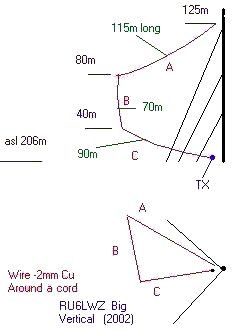
I use Big Vertical (below) on high (135m) tower H effective ~90m QTH-Loc KN97LN
As Dave G3YXM has fairly noticed (in RadCom July 2002):
"These restrictions mean that only those who have access to really efficient aerials (like Ed's) are going to be heard in the UK."
I believe that such restrictions detain development 136 in Russia.
I use 100w TX and it allows me to achieve abt 20w ERP.
But at me is 3á thermo-current-meter in ANT and I usually support a current in the aerial.
73! Ed RU6LA
Download Ed's Excel-based list (Zipped, 27KB) of current and previously active LF ham enthusiasts, including Russia.
Re: The last signal of GBR Rugby?
Posted by Mike Terry on April 13, 2003 at 03:04:25
The reports about GBR Rugby closing are completely incorrect according my contact works for the NPL.
Mike
Re: The last signal of GBR Rugby?
Posted by Mike Terry on April 13, 2003 at 08:26:30
On second thoughts (here's where my ignorance shows) I've just realised the Rugby MSF time station is on 60 kHz - so am not sure what is/was on 16kHz -any ideas??
Re: The last signal of GBR Rugby?
Posted by John Davis on April 16, 2003 at 22:53:58
:: On second thoughts (here's where my ignorance shows) I've just realised the Rugby MSF time station is on 60 kHz - so am not sure what is/was on 16kHz -any ideas?? ::
MSF will continue as-is for now, but the big GBR rig on 16kHz is the one being retired. It was used for linking far-flung outposts of the Empire together by wireless telegraphy, way back when, and for Royal Navy communications.
There was an article on the history of the station in The LOWDOWN two years ago...am excerpt of a 1976 British Telecom article, brought back to mark the station's 75th anniversary in 2001. (See Costa Krallis' QSL, below this message, from the special submarine commemorative transmission.) Medium Wave News reprinted it in the UK just this month. I'll see if we can put what we had on the Web soon, as this is the year of the anticipated shutdown.
The 16kHz monster's usefulness is now significantly less than it was, and real estate developers have been eyeing all that land greedily for many years. Transmissions on VLF will continue from Criggion, Anthorn, and Skelton when needed.
John

lekbro in Maryland
Posted by lloyd chastant on April 13, 2003 at 07:11:10
here is the best I got from overnite captures on 182.2 of LEK and BRO hr in Maryland
www.geocities.com/lacwman/lekbro.jpg
de Lloyd W3NF FM10MH
Longwave Radio 279 - Isle of Man
Posted by Mike Terry on April 13, 2003 at 08:43:19
Does anyone know if this project is still ongoing?
Mike
Re: Longwave Radio 279 - Isle of Man
Posted by Webmaster on April 13, 2003 at 21:40:36
>>> Does anyone know if this project is still ongoing?
Their web site gives no indication to the contrary, nor do a couple of other broadcasting sites I looked at. Unless you have come across other information, we can presumably look for them in late summer or autumn, per their January news releases.
Even when all is going well, it inevitably takes a while to build a radio station. Especially one which must hold onto the ocean floor. :)
John
Re: lekbro in Maryland
Posted by Stan on April 13, 2003 at 23:20:32
Thanks for the post. I can read the BRO, but sure can not decode the LEK. Is that the other signal or is that interference of some kind. ?
Nice to see what a 182 khz signal looks like. Did not expect to see the short term fading of the signal.
de Stan ak0b
Re: lekbro in Maryland
Posted by John Davis on April 14, 2003 at 00:23:48
"Short term fading" may be relative in this context, given that the ticks are at two minute intervals.
John
Re: lekbro in Maryland
Posted by Lyle Koehler on April 14, 2003 at 09:31:13
For those who didn't see Mitch Powell's posting to the LowFER e-mail reflector, there is a very clean screenshot of LEK and BRO at http://www3.sympatico.ca/mitch.powell/lekbro14.jpg
Mitch's capture shows all three of the modes that LEK is sending (actually four, but the fast CW doesn't show up on the screen). The short-term fading messes up all of the modes, although the DFCW comes closest to being readable.
Lyle, K0LR
Re: Longwave Radio 279 - Isle of Man
Posted by Mark Andrews on April 14, 2003 at 13:58:01
It is very hard to tell. A visit to the Musicman site would seem to say that there is still life in the project but one has to ask who would have the sort of money they would seem to want to spend on all this hi-tech gear when the RTE/Luxembourg project on 252 failed.Given that we know some of the names of the people involved it seems hard to tell the reality from the "Wish list"this project has been rumbling on for at least 5 years with little sign of progress.
The last VLF payphone
Posted by Jim V. M. on April 14, 2003 at 15:00:39
Here is the picture of the last VLF payphone.
A little late in posting.
http://www.earthsignals.com/add_CGC/VLFPhone.htm
73 Jim
Re: The last VLF payphone
Posted by J. Jason Wentworth on April 14, 2003 at 17:52:49
Noticing the publication date of the article ^April 1,^ I have to ask: Is it for real? I've never heard of VLF subcarrier payphones. If it is real, why would they be unable to get any more tubes for it? LF and VLF equipment seems to be much more accommodating when it comes to tube selection, so this VLF payphone should have been designed to use commonly-available tubes. -- Jason
Re: The last VLF payphone
Posted by John Davis on April 15, 2003 at 02:58:36
>>> If it is real, why would they be unable to get any more tubes for it? LF and VLF equipment seems to be much more accommodating when it comes to tube selection, so this VLF payphone should have been designed to use commonly-available tubes. >>>
This dilemma is very easy to explain, Jason. Remember, the article says this phone was designed 50 years ago, which was before transistors were yet ready for widespread use. And a device with all the functional capabilities of a payphone would obviously be more complex that a 5-tube radio of the era. There could be up to two dozen amplifier stages in such a phone.
The Bell System at that time widely used ultraminiature vacuum tubes manufactured and/or contracted by Western Electric, in everything from rural subcarrier systems to undersea cable repeater amps. So, for compactness and durability, it's only natural that they'd want to use the same devices in VLF payphones too.
The problem nowadays is, Western Electric abandoned vacuum tubes about 40 years ago. Even the formerly most common of those ultraminiature types have become as rare as hens' teeth--which they weren't much larger than to begin with.
Yet even though most of what I've written above is true in its own right... you are correct that the article in question was dated April 1. And at the very bottom of the page, I observe that it says:
"Mischievously Provided by Earthsignals.com"
A very clever bit of fun. :-)
John
Lock-in Amplifier Weak Signal detection
Posted by Stan on April 15, 2003 at 11:50:15
Anyone experimenting with lock-in amplifier technology to detect weak signals ?
The question that come to my mine will it work on CW ?
An analog devices application note on the AD630 shows a signal being recovered from white noise after 100 db of attenuation. Impressive. But do not know if the detector would stay locked under pulse (CW) signal conditions like QRSS.
Stan ak0b@swbell.net
Re: W & G SPM-19
Posted by Laurie Mayhead (FWD) on April 15, 2003 at 12:29:36
Subj: LF: Re: W&G assistance Date: 4/15/03 5:11:16 AM Eastern Daylight Time From: laurie@g3aqc.freeserve.co.uk (Laurie Mayhead)
To: rsgb_lf_group@blacksheep.org
> Can tell me what the following error codes in a W&G SPM-19
> selective level meter mean??
> 1--006
> 1--201
>
> They are in the Operators manual under chapter 6 they tell me, but I only
> have the WS manual and it refers me back to the Operators manual.......Doh.
> If you know, can you E-mail me on htp@lisp.com.au
> John Harbor
> ------------------
>
> I am sure somebody on here mentioned the -19 at some time in the past.
>
> Thanks and Cheers de Alan G3NYK
> alan.melia@btinternet.com
>
1...006 Level above selective branch is too low.
1...007 Level above selective branch is too high.
Possible faults:
Failure of one or more modules in the mixer section.
1...201 Calibration adjusting network
Insufficient extent with analog
1...202
Insufficient extent with didital Possible origins of fault
*Defective cal. adjusting network if in IF amp.
*Basic gain of complete equipment is set wrong
*Defective cal. signal or gain setting
Hope this helps although I find it confusing (perhaps it has suffered in the translation )
Laurie.
RTE 252
Posted by Mike Terry on April 15, 2003 at 13:07:35
The Irish longwave transmitter on 252 kHz is currently carrying a relay of RTE Radio 1 parallel 567 kHz - though with a very long delay compared to the MW outlet. Observed from tune-in at 1040 UTC today (Tuesday 15 April).
This is the first time programming has been heard on the LW channel (other than the occasional test tone) since the closure of TeamTalk on 31 July 2002.
Re: Lock-in Amplifier Weak Signal detection
Posted by John Andrews on April 15, 2003 at 15:35:10
Stan,
It's an interesting circuit, but it requires a high-level signal of the same phase as the one that's buried in the noise. That's perfectly fine in an application where you generate a signal, run it through some sort of noisy process, and then want to detect the result at the same site. You still have the original signal for phase comparison.
The typical LF application involves a signal of fairly well known frequency that is generated hundreds of miles away. You have no phase reference at the receiving end, as you don't have access to a clean copy of the original signal. If the reference signals at both ends were locked to a common source, such as WWVB, you might stand a better chance. GPS "disciplining" doesn't seem to apply, as I understand it.
Others smarter than I am may want to weigh in, here.
John Andrews, W1TAG
Re: Lock-in Amplifier Weak Signal detection
Posted by Alan G3NYK on April 15, 2003 at 16:24:12
Hi Stan and John, this is an interesting question as when I got interested in LF I acquired a lock-in amp instrument of a type I used in the Lab in the 1970s very cheaply at a local flea market. Yes, as I understand it you would need a frequency/phase reference....this could be derived from a known source, I believe that GPS could be used and would be sufficiently accurate. What you then have is something like coherent CW of many years ago. Some work has been done in this area
The problem now is that the signal recovery is nothing magic it is achieved purely by reducing the bandwidth with a large integrating capacitor. Fine so far, you integrate the dot for a given time, but at Key-up the level on the integrator drops very slowly again. Thus you need an integrate and dump (at the end of the dot) "filter" system.This of course must know where the element "frame" is in time. It think the modern solution with PC FFT applications which are optimised for a particular speed have proved very much easier to operate and, I believe, do provide signal recovery close to the theoretical levels.(here's were I get shot down !!)
Some work has been done by Bill De Carle on synchronous reception, but the take up was small on LF, initial results were impressive with BPSK. I suggest a look at Bill deCarle's Web site (it used to be in the "Links")
Cheers de Alan G3NYK
grounded dipole
Posted by jason geren on April 16, 2003 at 20:22:15
I have a double grounded dipole set up, total lengnth is about 1200 feet, and it is buried about 16 inches deep. 6 gauge wire insulated in half inch O.D pvc pipe. I have it grounded at each end. One end is a metal drainage pipe that runs under a road, the other a 14 foot iron pipe. I use it for everything from vlf to shortwave. Ihave a high z phone a coil and capacitor and full wave bridge of signal diodes, Im picking up some unidentified signals one is a constant clicking like tapping a pecil lead and the other sounds like a teakettle whistle. If anyone knows what these are please E mail me and let me know atjasongeren@hotmail.com.
Unidentified transmitter on 20 kHz
Posted by Harald Lutz on April 16, 2003 at 23:54:22
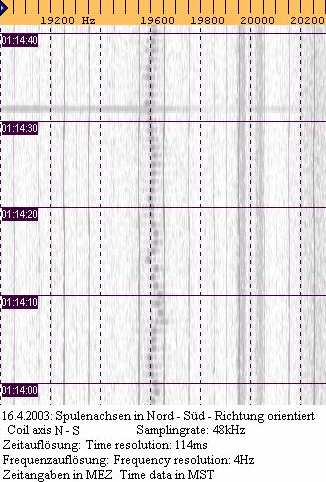
Last night I receivesd a new transmitter on 20kHz (look on the spectrogramme). The signal is similiar to that of the Russian transmitter RDL on 18.1 kHz.
Has anyone also received this transmitter and know its origin?
Odd signal on 36.3 kHz
Posted by Jacques d'Avignon on April 17, 2003 at 08:23:28
For the past few days, a signal has appeared on 36.3 kHz. It consists of dashes about 1 second in length and every 2 seconds. At interval the dash will be much longer, about 10 seconds and then the regular short dashes sequences resumes. It appeas to have a fairly wide band.
Re: Odd signal on 36.3 kHz
Posted by Jacques d'Avignon on April 17, 2003 at 09:54:49
The freq is 36.8. New glasses are probably necessary! have a sound file in wav or mp3 format and a spectrogram of this sound.
Let me know if you want a copy.
Happy Easter to all.
Jacques
GBR on 16kHz, closed down on the 31st of March
Posted by Mike Terry on April 18, 2003 at 01:06:06
GBR, the Rugby VLF station on 16kHz, closed down on the 31st of March. The following message was sent at 2400UTC on the 31st of March: "VVV DE GBR VVV DE GBR. After 77 years, three months of almost continuous operation, the GBR 16kHz service from BT Radio Station Rugby ceases today. A thank you to our customers, mainly the Royal Navy, without whom the service would not have been required and whose co-operation has enabled the service to run so smoothly. A big thank you must go to all of those who over the years have been involved in the design, construction, maintenance and operation of GBR. They can feel very proud of providing a consistent high level of reliable service and a job well done. This is the final transmission and GBR will now be shut down for the last time. DE GBR GBR QRT."
Re: GBR on 16kHz, closed down on the 31st of March
Posted by Harald on April 18, 2003 at 15:48:38
Look on http://www.lwca.org/mb/msg/2876.htm !
Why did I not know it before? Then I would take an other mode for my spectrogram!
Will there be no transmission of VLF signals on 16kHz in the UK? Or will the new transmitter in Skelton also transmit on 16kHz?
LOWFER reports 19 April
Posted by Ray W2RS on April 19, 2003 at 14:16:43
Hi,
I turned my loop around this afternoon to peak at 290/110 degrees, where NWNJ is within 10 degrees of a peak and TH is within 10 degrees or so of a null. For the first time, NWNJ and TH are approximately equal in strength at 449. JJX and HS, neither near a peak or a null, are about 339. All reports are on groundwave, approximately 1400 EDT/1800 UTC.
Loops do have nulls!
73,
Ray
Re: LOWFER reports 19 April
Posted by John Davis on April 20, 2003 at 00:00:36
:: Loops do have nulls! ::
Well, at least the good ones do! :-)
Thanks for the reports, Ray.
John
Re: The last signal of GBR Rugby?
Posted by Harald on April 20, 2003 at 01:07:38
Today I got a letter with a QSL card. My asumption was correct, this was the final transmission of GBR!
MSF remains in operation at least until 2007. It uses an aerial of the T-type at the most Northwest-site of the facility.
Criggion is not the only remaining VLF transmitter in the UK. There is also a VLF transmitter at Anthorn and a new one at Skelton. Criggion's frequency is 19.6kHz, the frequency of Anthorn seems to be 22.1kHz, but I read that the frequencies are swopped sometimes under the stations. A good question is if there will be again transmissions on 16kHz, e.g. from Skelton.
Watch out for new VLF transmitters! In December2002/January 2003 there was a new one on 19.3kHz and in April I received one with a signal similiar to Russian RDL on 20kHz!
NDB "OK"
Posted by Eric Smith on April 20, 2003 at 21:37:26
Friday I received my first copy of The Lowdown (Hey... _I'm_ in there!). I saw mention of NDB "OK" which I've heard, and is near me. I took a picture of it today and posted it to my site where I intend to post more as I get their pictures taken.
Check it out. Click on the thumbnail for more and larger pictures:
http://www.nutstreet.net/lf/NDBs/
Eric, KD5UWL
Denmark
Posted by Mike Terry on April 21, 2003 at 02:39:18
From DXLD:
** DENMARK. According to the DR News today Kalundborg LW transmitter 243 kHz is out of order due to antenna problems (Ydun Ritz, 20/4-
2003, Ydun`s MW[non] news via DXLD)
[and non]. Expected to be back in operation sometime by tomorrow. So, at the moment the only station on this frequency is the Turkish transmitter in Erzurum (200 kW). Schedule: 0355-1600 - TRT Erzurum Radyo (regional?!) 1600-2305 - TRT-4 (Jens Soendergaard, Randers, DENMARK, hard-core-dx via DXLD)
Re: RTE 252
Posted by Mike Terry on April 21, 2003 at 02:41:55
From DXLD:
** IRELAND. RTÉ have confirmed that they are still carrying out engineering tests on their 252 kHz long wave transmitter based in Summerhill, Co. Meath. This follows increased speculation following the appearance of RTÉ Radio 1 on 252 yesterday morning.
Speaking to Radiowaves News today, Colin Kennedy from RTÉ's Coverage Planning Department said: "Radio 1 programming is being broadcast presently for the purpose of these tests but a final decision has yet to be made as to the future output of this frequency." He also says that the test transmissions are liable to frequent interruption (via Radiowaves News, Wed 16th April via Alan Pennington, BDXC-UK via DXLD)
Re: Denmark
Posted by Mike Terry on April 21, 2003 at 03:26:39
From HCDX
Kalundborg, Denmark, 243 khz - out of service Sunday, April 20 2003
The longwave transmitter (situated in Kalundborg, 243 kHz) of Danmarks Radio,
is at the moment out of service due to antenna failure. The transmitter is expected to be back in operation sometime by tomorrow.
So, at the moment the only station on this frequency is the Turkish transmitter in Erzurum (200 Kw).
Schedule:
0355-1600 - TRT Erzurum Radyo (regional?!)
1600-2305 - TRT-4
/Jens Soendergaard, Randers, DENMARK.
Part 15 how question
Posted by Stan AK0B on April 21, 2003 at 18:00:40
Operation within the band 13.553-13.567 MHz.
(a) The field strength of any emissions within this band shall not exceed 10,000 microvolts/meter at 30 meters.
Question:
How does one convert this to power input or output at the xmit output connector.
Re: Part 15 how question
Posted by John Davis on April 21, 2003 at 19:24:22
>>> (a) The field strength of any emissions within this band shall not exceed 10,000 microvolts/meter at 30 meters.
. . .
How does one convert this to power input or output at the xmit output connector. >>>
The key is to first think of power input to the antenna, taking into account the antenna gain. Then you can work out a power budget counting line loss to get the necessary transmiter output power.
An imaginary isotropic radiator would produce this field strength in all directions-- that is, spherically-- with an input power of 3mW. (Find the power per unit area of that volt-per-meter value, using the value of 120*pi ohms characteristic impedance of free space, then integrate to find total power over the surface of a sphere of 30m radius. It works out to 3mW for 10,000uV/m.)
Now, a real-world antenna possessing gain over an isotropic source will require less input power to achieve the same volts-per-meter field strength.
A dipole in free space, for instance, should achieve the same field strength as an isotropic radiator with about 2.2db less input power--or, 1.8mW. This is because of the dipole's directionality. (A quarter-wave vertical over a good ground plane, elevated adequately above the surface of the earth, will also have a similar doughnut-shaped radiation pattern and therefore a comparable pattern gain to a dipole.)
If you have an antenna with more directionality than a dipole, it would need even less power at the antenna input to produce the same field strength. A 5/8-wave vertical, for instance, would require reduced input power. So would a Yagi, a rhombic, or other directional antenna, each in proportion to their gain over a dipole. You gain nothing in terms of signal strength by using one of these, because you have to cut back power to meet the maximum limit of field strength in the main lobe.
So, basically, a simple vertical is the best antenna for this band if you can manage it. A quarter wavelength is 18 feet.
Take into account the line loss (transmission line is OK in this band; there is no size limit on it), but make sure you don't deliver more than 1.8mW to the antenna input, and you can be pretty confident of not exceeding the limit.
John
Re: Part 15 how question
Posted by Stan on April 21, 2003 at 20:14:06
Thanks John,
on the characteristic impedance of free space is that 377 ohms ?
Stan
Re: Part 15 how question
Posted by John Davis on April 21, 2003 at 20:50:17
:: on the characteristic impedance of free space is that 377 ohms ? ::
That is correct.
John
Re: 55.5KHZ STATION
Posted by Heynonnymouse on April 22, 2003 at 05:19:48
Antenna was 4400 feet long kept up by balloon Tx was on from 17th march till 8th april continuous with some short tx breaks.Callsign GQV, Power averaged 30 kw input.
Re: RTE 252
Posted by Mike Terry on April 22, 2003 at 16:14:39
RTE to relay Radio One on longwave: report
22 April 2003
Ireland's Sunday Tribune newspaper reports that public broadcaster RTE has decided to relay its Radio One service into the UK on longwave 252 kHz. According to the report, the service will launch "in a few weeks." The transmitter at Trim, Co. Meath, is currently on the air irregularly with engineering tests. It's not yet known whether RTE will carry its domestic commercials on longwave, or sell airtime to advertisers targeting the Irish community in the UK.
QSL-card from last transmission of Rugby Radio
Posted by Harald on April 22, 2003 at 22:28:38
Ladies and gentlemen,
In the attachment of this mail, below, you can find my QSL-card from the last transmission of GBR Rugby.
Yours sincerely,
Harald Lutz
Coordinated Listening Session
Posted by Shawn Korgan (Fwd) on April 23, 2003 at 18:16:02
Date: Tue, 22 Apr 2003 11:39:46 -0600
From: "Shawn E. Korgan" Subject: Coordinated Listening Session
Greetings,
The INSPIRE project is holding its semi-annual VLF coordinated listening session this Saturday and Sunday (April 26th and April 27th). All participants are encouraged to record from 8:00 AM - 8:12 AM local time and from 9:00 AM - 9:12 AM local time. Participants may also record the first twelve minutes of additional hours (before or after the above stated times) to compare with the results from nearby time zones. Participants are encouraged to add time marks to their cassette tapes (at least every two minutes) and to make a log of all activity noted during each listening session.
For further information on becoming part of the INSPIRE project (open to everyone) please contact either Bill Taylor
(taylor@mail630.gsfc.nasa.gov) or Bill Pine (pine@mail630.gsfc.nasa.gov). Results will be compared in the semi-annual INSPIRE journal.
Shawn Korgan INSPIRE Team I-1
reception of CQ 5 or MGY
Posted by mike WMT 185 kc on April 24, 2003 at 14:00:42
from april 11th 18h edst to april 14 14:30 edst, i had a beacon with CQ 5 in MCW, also at times, hand keyed a message de MGY,(in MCW) followed by an annc. in AM, on 185 kc. I've gotten rpts from Ct.& Vt.----has anyone else heard this?
if so, let me know with a signal rpt and time. WMT is not on a regular sked at this time, but will resume one later this spring.
"NWNJ" frequency change to 189.655 KHz.
Posted by John Bogath on April 25, 2003 at 23:07:10
Once again, an intermittant crystal is forcing a frequency change at "NWNJ". The new frequency is 189.655 KHz, and is effective immediately. All other information for this beacon is current.
loop antenna Q? I need help....
Posted by Caleb on April 26, 2003 at 18:15:57
I'm building a sheilded loop using 3/4" cooper pipe and 25 pair telephone wire.
I was wondering if i soldered a flat copper plate to the back of the space in the shielding. What effect would this have? Better f/b i hope since the loop is bidirectional
It's kind of hard to explain without a pic so,
front view
             ________
             | plate |
        _____|       |______
        pipe          pipe

       ______         ______
             |       |
             |_______|

  side view
      p |
      l |
      a |
      t |
      e |
Re: loop antenna Q? I need help....
Posted by John Andrews on April 26, 2003 at 20:11:18
Caleb,
Don't do anything that shorts the gap. Even a very narrow connection between the ends of the gap will kill the magnetic field pickup.
John Andrews, W1TAG
Re: Lock-in Amplifier Weak Signal detection
Posted by Renato Romero, IK1QFK on April 27, 2003 at 17:46:00
Hi Stan, a new article about a lock-in amplifier will be published next week on www.vlf.it. Message will follow in this message board too, as www.vlf.it update.
73, Renato
NDB antenna design
Posted by Stan AK0B on April 28, 2003 at 21:32:18
We have a local VLF station near the qth and it employs an old style flat top with several wires making up the top hat and what appears to be a single wire feed. they used a vertical for years, but changed over to this type design a few years back.
It is quite small for the frequency. Anyone know of the design source (or cookbook) for determining the size, freq, feed line impedance of these.
de Stan ak0b
Re: NDB antenna design
Posted by John Davis on April 28, 2003 at 23:49:29
Hi Stan,
The NDB would be at LF rather than VLF. There's no cookbook for these aerials that I'm aware of, but I expect most of the beacon manufacturers have compiled proprietary charts and tables that they use for planning purposes. Other readers may be able to elaborate upon this thought further.
There is no magic size/frequency relationship for NDB antenna systems. As with LowFERs, a structure of practical size will be a small fraction of a wavelength. One builds the best antenna he can given the available space and money, then resonates it to the assigned frequency with an inductor. (Only a handful of beacons, principally those for transoceanic routes, were considered to need the kind of efficiency that would justify the expense of a full-size mast.)
One can find the essential formulae for determining capacitance to ground and radiation resistance in sources ranging from Terman to various editions of the Jasik "Antenna Engineering Handbook." Software such as NEC is generally invoked nowadays for this purpose. Then (knowing the capacitance) it is simple to find the right range for the inductor, and (knowing the radiation resistance and typical ground system losses) it's simple to approximate the radiation efficiency. After everything is installed, there's usually a field strength survey to confirm the station's predicted coverage.
John
UNID
Posted by Robert Montgomery on April 29, 2003 at 07:29:51
Unid beacon around 203 EZ. Clearly hrd as EZ in the evenings here 40 miles north of Philadelphia, PA. However, ESN from Maryland is no longer heard and wondering if this might be the same one. Navaids shows no listing.
Any ideas?
Thanks Bob Montgomery
Re: loop antenna Q? I need help....
Posted by Peter Narick on April 29, 2003 at 10:27:10
It is not clear what is wanted here, but as John A. states, "don't short the gap," and expect pick up. It is ok to cover the pipe gap to weatherize the ant. This may be done using a longer piece of pvc pipe over the cu pipes. Note, special means to support the seperated pipes for the gap is required for mechanical strength.
Your idea of "better f/b i hope since the loop is bidrictional" is not supported in current practice at LW, regards signal pick up. However it is true the loop is bidirectional in the plane of the loop.
Peter
Re: NDB antenna design
Posted by Lyle Koehler on April 29, 2003 at 10:33:51
As John indicates, there are no magic dimensions for LF "flat top" antennas. Antenna modeling techniques, a link to a freeware modeling program, and sample flat top antenna models are included in my article at http://www.computerpro.com/~lyle/models/lftxant.htm
Re: NDB antenna design
Posted by J. Jason Wentworth on April 29, 2003 at 17:21:00
That raises an interesting question--how does one determine the frequency at which a flat-top Tee antenna is resonant? Here's an idea I have, and I'm wondering if it would work in practice:
If you have a resonant receiving Inverted-L antenna cut for 1000 kHz, it is 234 feet long from feedpoint to tip--for the sake of round numbers, let's say it's 34 feet high with a 200 foot long horizontal section. If you then add a second 200 foot long horizontal wire running in the opposite direction to the first, it is now a Tee antenna. Since it is essentially two Inverted-Ls back-to-back at the vertical downlead, would the Tee antenna also be resonant at 1000 kHz? -- Jason
Re: "Inverted Coathanger" NDB antenna design
Posted by J. Jason Wentworth on April 29, 2003 at 17:34:41
The desire for a higher antenna capacitance, and thus a lower required inductance for resonance, explains the 3-point and 5-point Inverted Coathanger NDB antennas. One of these antennas has more 'wire in the air' than a flat-top Tee antenna of the same size, thus it can use a smaller and less lossy loading inductor. -- Jason
Re: NDB antenna design
Posted by Alan G3NYK on April 29, 2003 at 19:13:14
Hi there are sone basic formulae for all sorts of LF antennas on Rik Strobbe's site http://www.qsl.net/on7yd
To Jason the "T" would resonate at the same frequency as the "L" if the top is symmetrical.
What is NOT well modelled on the NEC programs at LF is the effect of top-capacity on the ground loss. This is a vital factor in transmitting LF signals from low aerials. NEC seems to underestimate ground loss, and does not (as far as I have seen) show a ground loss reducing as the top capacity is increased (This is well supported by measurements and older articles (circa 1920)) Doubling the aerial capacity can half the ground loss. Even at the stage where the extra capacity does not increase the radiation resistance, it can be very benificial in increasing the ERP, through ground loss reduction. Experiments have shown that for an amateur station aerial extra top wires are much more useful that extensive ground mats( which are usually too small to be effective)
Cheers de Alan G3NYK alan.melia@btinternet.com
Re: UNID
Posted by Stephan Walther-Larsen on April 29, 2003 at 19:22:33
Maybe its :
EZ 204Khz , LIZAH, New Jersey 40.36.26.N / 074.13.04.W ??
Kind Regards
Stephan Denmark
Re: Odd signal on 36.3 kHz
Posted by Stephan Walther-Larsen on April 29, 2003 at 19:29:26
Id like a go on that sound file
please email me at swl at c dot dk
Re: UNID
Posted by Robert Montgomery on April 29, 2003 at 22:25:42
Thanks, not sure I have heard of that city, but will have a look.
thanks again bob Montgomery
Re: NDB antenna design
Posted by John Davis on April 30, 2003 at 00:05:31
:: ...If you then add a second 200 foot long horizontal wire running in the opposite direction to the first, it is now a Tee antenna. Since it is essentially two Inverted-Ls back-to-back at the vertical downlead, would the Tee antenna also be resonant at 1000 kHz? ::
No. There would be significantly increased total capacitance, allowing resonance with a smaller inductor.
John
Re: "Inverted Coathanger" NDB antenna design
Posted by John Davis on April 30, 2003 at 00:20:32
:: The desire for a higher antenna capacitance, and thus a lower required inductance for resonance, explains the 3-point and 5-point Inverted Coathanger NDB antennas. One of these antennas has more 'wire in the air' than a flat-top Tee antenna of the same size, thus it can use a smaller and less lossy loading inductor. ::
It can use a smaller value of inductance, but that does not necessarily make the inverted coathanger a more efficient antenna. The reason for the greater capacitance is not so much more wire in the air...it's because the Y-shaped lower portion of the antenna is closer to the earth over more of its length than a flattop. Because of charge distribution, anything above the Y doesn't really contribute a lot of capacitance to earth.
Moreover, even though the lower inductance value of an inverted coathanger may mean less coil loss, it doesn't always translate to higher efficiency for the whole antenna.
In fact, the antenna effective height is lower than a flattop of the same physical height. This is because a greater fraction of the capacitance to ground takes place at a lower elevation, meaning the vertical component of the RF current tapers off faster than it does for a flattop.
John
Re: NDB antenna design
Posted by John Davis on April 30, 2003 at 00:25:37
I notice that Alan and I disagree on the resonance of the T versus the L.
If the problem were stated as a 200 foot top section, fed either at one end or at the middle, I'd agree that it would not much affect resonance.
However, as I understand what Jason wrote, the question is whether an L with a 200 foot top section and a T containg two (2) such top sections would resonate at the same frequency. I think if Alan looks at it from that standpoint, he might reconsider. :-)
John
VLF Earthquake Precursors?
Posted by Webmaster on April 30, 2003 at 00:34:27
Did anyone happen to be monitoring the whistler receiver at NASA in Huntsville via streaming audio this morning (29 April), during or for a while prior to the 4.9 earthquake along the Georgia-Alabama border at 0900 UTC? Any interesting results?
John
Re: NDB antenna design
Posted by J. Jason Wentworth on April 30, 2003 at 02:36:32
I was referring to a self-resonant 'T' antenna. If a self-resonant 1000 kHz 'L' antenna is 234 feet long ^34 feet vertical and 200 feet horizontal^, then it would seem that a 'T' antenna with a 34 foot vertical downlead and a 400 foot horizontal flat-top wire would also resonate at 1000 kHz.
If not, does this mean that a 'T' antenna with a total length of 234 feet ^a 34 foot vertical downlead and a 200 foot long horizontal flat-top^ would be self-resonant at 1000 kHz? This would actually be a better deal since one could use a shorter flat-top. -- Jason
Re: "Inverted Coathanger" NDB antenna design
Posted by J. Jason Wentworth on April 30, 2003 at 02:38:46
Are there any formulas for designing this kind of antenna? It would be interesting to try it with a crystal set. -- Jason
Re: NDB antenna design
Posted by Alan G3NYK on April 30, 2003 at 16:08:57
Hi all,
Ah an interetsing question. I think Jason has reiterated that he is talking about the self resonance of the wire, and not the way it could be resonated with an "external" inductor. My thoughts are if you draw a standing wave from the feed point to the end of one leg of the "T" you get a quater wave at 1000kHz. Then since the voltage at the split must be the same and the current at the other open end zero you can only draw a copy of the standing wave on the first leg on the second leg (that is a lousy explanation....I hope you follow my "fuzzy thinking" I usually scribble drawings on beer mats ) Thus a T with two 200 foot top runs will resonate at the same frequency of the "L" with the 200foot top. I agree the capacity to ground of the antenna has increased.....so does that mean the addition of an extra top wire has reduced the aerial inductance?? (because the antenna can be modelled as a capacitor, an inductor, and a resistor in series.)
Cheers de Alan G3NYK alan.melia@btinternet.com
Re: NDB antenna design
Posted by J. Jason Wentworth on April 30, 2003 at 17:39:35
Right Alan, the self-resonance of a 'T' antenna is what I meant. It is very cut-and-dried for an 'L' antenna ^1/4 wavelength from feedpoint to far end^, but it seems to be less so for a 'T' antenna.
Over the years I've heard both explanations for a 'T' antenna ^same total wire length as an 'L' antenna for the same frequency *and* two 'duplicate' 'L' antennas pointing in opposite directions but with a common vertical downlead.
Since the 'T' antenna has greater capacitance than an equivalent 'L' antenna, it seems that it would be like an 'L' antenna that is cut too long for the intended frequency ^which is sometimes done intentionally to raise the maximum current point higher off the ground^. If so, this would also be beneficial to the 'T' antenna and it could be adjusted ^as it is on an 'L' antenna^ with a variable capacitor in series with the antenna feedpoint. What do you think? -- Jason
www.lwca.org
potrzebie