Re: RTE 252 IMPROVE RECEPTION IN LONDON
Posted by Mike Terry on April 01, 2004 at 11:43:27
Gabriel,
I have got this so far.
Mike,
I am in receipt of your email re above.
I have forwarded your email to J.P. Coakley, Head of Operation in RTE Radio who should be able to assist you with your query. His email address is johnpaul.coakley@rte.ie Kind regards.
Bernie Fitzpatrick - RTE Information Office.
ID change
Posted by Robb WB8BHU on April 01, 2004 at 19:56:21
LOM "CB" 272 kHz has been changed to a regular NDB with ID "CHC" still on 272 kHz. This is not yet on the Airnav site. (per CMH NOTAM)
Robb
Predicted signals on 22.3 kHz received!
Posted by Harald on April 02, 2004 at 12:18:51
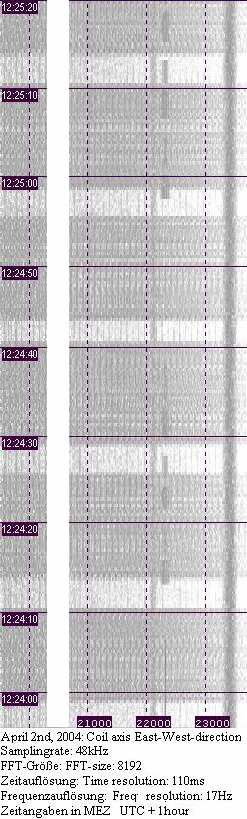
According to my predictions, I was able to receive the signal on 22.3 kHz at April 2nd, 2004 12:24 Middle European Standard Time (look at the spectrogram below). Although there was much noise, the signal is clearly visible on the spectrogrammes.
Has anyone received this signal, which is typical for Russian VLF-transmitters? If not, then try it next May 2nd or June 2nd, between 10 o'clock UTC and 12 o'clock UTC.
Re: Check out for a signal of a Russian(?) transmitter on 22.5kHz on April
Posted by lloyd chastant on April 02, 2004 at 15:23:55
I have been seeing a signal on 21.681Khz that is sending a series of dashes about 4-5sec long with a 3 sec space..haven't really checked down there too ofton so it may be a regular or what may it be????
de Lloyd W3NF
Re: Check out for a signal of a Russian(?) transmitter on 22.5kHz on April
Posted by Harald on April 02, 2004 at 17:27:39
When did you receive the signal on 21.7 kHz? Where was your reception site?
Re: Check out for a signal of a Russian(?) transmitter on 22.5kHz on April
Posted by lloyd chastant on April 02, 2004 at 17:51:27
Harald,I have been hearing it for the last couple of days hr in Maryland.FM19MH.If you will send your email address I can send you a ARGO jpg of what it looks like..I'm not sure if it is real or some image or ???seems oK.
de Lloyd
Re: Check out for a signal of a Russian(?) transmitter on 22.5kHz on April
Posted by Harald on April 02, 2004 at 22:41:29
I received such a signal on August 5th, 2001 (look at the spectrogram).
It shows clearly the signal, you describe! Look also on the signal on 17.8 kHz.
Beacon ST in St. Louis
Posted by Derek Cohn/WB0TUA on April 03, 2004 at 01:03:59
Dear Friends,
I'm just getting interested in longwave and have a Signal Corps BC-314-G (150 Kcs to 1500 Kcs). I am located in St. Louis, MO. I was listening last night around 400 kcs and distinctly heard a beacon transmitting "ST". I put ST in the NavAid database and got no hits. If this is not a Navagation Aid, does anyone have any idea what it might be? By the way, I was able to copy NavAid beacons from as far away as Puerto Rico last night with a 50 foot wire laying on the ground. I didn't expect that.
Thanks for any help you guys can give me!
Derek WB0TUA
New Amateur Radio LF World Record Claimed:
Posted by Mike Terry on April 03, 2004 at 06:01:05
Amateur stations in New Zealand and Asiatic Russia are laying claim to a new low-frequency world distance QSO record. Bob Vernall, ZL2CA, told ARRL this week that ZM2E, near Wellington, New Zealand, and UA0LE, near Vladivostok, Russia, completed a two-way contact during the night of March 20 on 137.70 kHz.
"The path length is estimated to be 10,311 km (6,392 miles), which is claimed as a new world record between amateur stations on LF bands," Vernall said. "For several hours signals received at ZM2E were so strong that they could be decoded 'by ear,' despite high peaks of QRN." By noting tone-on and tone-off times and checking them against a highly-accurate digital clock, the ZM2E operators at one point were able to decode the very slow-speed (QRSS) CW without resorting to Argo DSP software signal detection.
The Wellington Amateur Radio Club station at Quartz Hill uses the special ZM2E call sign for work in the 136-kHz band. A DXpedition station, UA0LE obtained permission to support its LF antennas from a 90-meter (295.3 feet) broadcast mast.
Vernall said UA0LE set up for a slow-speed CW beacon transmission on 137.7895 kHz using 60-second dits--known as QRSS60. "They used the shortened form of 'UATLE' to save time in sending," he explained. Because they need to be succinct, Vernall said, LF DX signal reports use the same "O," "M" and "T" signal reports http://www.arrl.org/tis/info/pdf/78518.pdf developed for moonbounce and other weak-signal communication.
On the big day, ZM2E started calling UA0LE at 0930 UTC--sunset in Vladivostok. The first good UA0LE signals showed up on the computer screen at 1030 UTC, Vernall said.
The defining moment came when UA0LE confirmed reception of the "O" report from ZM2E. "At 1650 UTC, we received 'ZM RO E,' and by acknowledging our report to them it satisfied the minimum requirements for claiming a two-way contact," Vernall said. The two stations continued to "tie the ribbons" on the QSO for another hour or so.
Vernall and Andrew Corney, ZL2BBJ, were the operators at ZM2E. The operators in Vladivostok were Vlad Burakov, UA0LE; Vic Bondarev, UA9OC; Andy Rodichev, RA0LGH, and Ed Lesnichy, RU6LA.
Source:
The ARRL Letter Vol. 23, No. 14 April 2, 2004
Re: Beacon ST in St. Louis
Posted by Michael Oexner on April 03, 2004 at 10:22:54
Hi Derek,
Per my NANDBH 2004 your UNID beacon is ST-404.0 (1020 Hz mod) St. Louis/Zumay MO N38 47 17 W090 16 44. Hope that helps.
Good going with your Puerto Rico catch - should have been DDP on 391 kHz, right?
Other easy catches for your location should be the following ones:
FZ-227.0 St. Louis/Eaves LM-338.0 St.Louis/Oblio SU-326.0 St. Louis/Snoop
vy 73 + gd DX,
Michael
Re: "Grasswire" antenna for LowFER or HiFER use?
Posted by Alan G3NYK on April 03, 2004 at 11:15:27
Hi Jason and John....Hmmm well any bit of conductor will act as a receive aerial. I get very good signals off my insulated counterpoise on 136kHz. "Ground aerials" were used for VLF by such august names as Marconi and Beveridge. However these need to be very long to be effective. As far as I can determine their advantage was a lower sensitivity to "static" and higher frequency interference. Horizontal components will tend to cancel out, with images in the ground, so you are left with a predominantly vertical component. I cannot see it being a very effective TX aerial as you have effectively an "upside-down" Marconi. I suppose it would have some "effective height" because of the depth of the "skin effect" at 180kHz...see Reg Edwards programs. I would have though a flag pole cunningly disguised as a vertical and flying the national flag would be a much better option. As John says even small tuned loops can outperform short wire aerials at these frequencies.
One can only try the best that you can install in your particular situation, and particularly ground conditions.
Happy experimenting Alan G3NYK
HiFer RAD status
Posted by Tim N2GFT on April 03, 2004 at 16:58:42
HiFer RAD is back to sending CW only after experimenting with DSB and AM modes.
Look for it ~13.5608 with CW ID and other misc. info at 15 wpm and 5 wpm. :-)
I may experiment with DSB again at a later time, but I don't have the time right now to build a PA stage to make up for the loss in my ring-diode balanced modulator.
Tim
Isle of Man - Long wave radio must post bond
Posted by Mike Terry on April 04, 2004 at 08:30:22
Tue 30th Mar 2004
The company planning to set up a Long Wave radio station in the north of the Island must have a bond in place, with the Manx Government, before work can start on the offshore transmitting facilities it intends to build.
Transport Minister John Shimmin told the House of Keys the money would be used to cover the cost of removing the platform and aerial Isle of Man international Broadcasting intends to build, in the event of the venture not being a success.
However, he couldn't say how much money was involved.
http://www.manxradio.com/
Paul Rusling sent me these comments which he is happy can be appended.
"Hi Mike
I don't have any difficulty with this, especially as it was our suggestion. You can quote me on any of this. When we first went to IOM there was a huge former ITV mast just outside Douglas that NTL (the owners, taking over from old IBA) had refused to take down even though it was no longer in use. This was a thorn in the side of IOM Government, environmentalists, etc, so I offered that we would place a bond to cover cost of removal of our mast if it ever became abandoned.
Same applies with an offshore structure. Its like an insurance payment to ensure it doesn't become abandoned, like the old Army forts in the Thames Estuary. As ours is a jack up rig, it is simply rejacked into its 'floating' condition and towed away. And it certainly would be , costing
£6m, and containing valuable transmitters and generators, plus a lot of aluminium, copper,
Teflon and etc - even as scrap it would be worth around £1 million.
As we are confident that the bond wouldn't be called, we are happy to escrow the amount needed
- its an investment by our shareholders.
(Feel free to append that to any report you feel might be of interest)
Thanks for your consideration
Paul Rusling"
Advice on decoding software
Posted by Chris Waldrup on April 05, 2004 at 13:20:27
I am getting a computer in my workshop for the first time tonight due to a new computer for my wife's office and am curious as to what most use for decoding beacons. I would like something that is pretty simple to figure out as I am slightly software challenged! Something that will allow me to decode QRSS and PSK31 would be preferred. Any help would be greatly appreciated.
Chris KD4PBJ Apex, NC
Re: Advice on decoding software
Posted by John Andrews on April 05, 2004 at 13:33:47
Chris,
There are lots of choices, most of them freeware.
For QRSS, the easiest approach is ARGO, which is available at:
http://www.weaksignals.com/
You will also find Spectran at that site. It is more flexible than ARGO, but the extra configuration choices can be confusing for someone starting out.
For PSK31, you have tons of choices. Links to a number of programs can be found at:
http://www.aintel.bi.ehu.es/psk31.html
One "do it all" program that handles most of the common HF psk variants is MULTIPSK by F6CTE. It may take a bit of work to get used to the user interface, but it is a very powerful program. Download at:
http://members.aol.com/f6cte/
When you get more confident with setting up arcane parameters, Spectrum Lab by DL4YHF has an incredible number of processing tools for QRSS and PSK. Download at:
http://www.qsl.net/dl4yhf/
John Andrews, W1TAG
Re: Isle of Man - Long wave radio must post bond
Posted by John Hoopes on April 06, 2004 at 13:01:08
Mike,
I read somewhere that the IOM LW station planned to use a crossed field antenna. Do you know if that's still the case?
John
Re: Isle of Man - Long wave radio must post bond
Posted by Warren K2ORS/WD2XGJ on April 06, 2004 at 13:52:50
If they do use a crossed field antenna nobody will hear them! It's been well documented that CFA is hokum - practically all radiation comes from the feedline!
73 Warren
Re: Isle of Man - Long wave radio must post bond
Posted by John Davis on April 06, 2004 at 15:23:51
>>> If they do use a crossed field antenna nobody will hear them! It's been well documented that CFA is hokum - >>>
It is, but there's a chance they'll be heard OK with it...if the matching network doesn't catch fire handling 500kW, or if the supporting insulators don't break down too regularly.
A CFA is no different from any other electrically small vertical, except for the mumbojumbo D-plate. In practice, the toploaded cylindrical section will work against the ground plane section. (In many amateur applications, you're right: it's currents induced on the feedline that do the bulk of the radiating--a glorified discone antenna with the CFA as the top section and the coax shield taking the place of the cone. They won't have enough feedline here, though, so they'll have to resonate it against the ground plane, just like any other electrically short vertical.)
With the whole thing over ocean water, the losses will be much lower than if it were over land, and *if* they can keep it on the air at full power, it will appear to work just fine. Which, unfortunately, will help the self-deluded charlatans promoting this pseudoscientific claptrap to sustain the CFA myth a little longer.
But I'm betting it'll never see full power operation. If that turns out to be the case, it could be a 6 million pound investment down the drain very quickly. Sad, after all else they've gone through to reach this point.
John
Re: Isle of Man - Long wave radio must post bond
Posted by Mike Terry on April 09, 2004 at 04:46:05
09 April 2004
A campaigner fighting to overturn the granting of a licence for a long-wave radio station has admitted defeat after a two-year court battle.
Bride man Nick Cussons won't appeal against a high court judgement to reject his petition of doleance against the Communications Commission's granting of a licence to Isle of Man International Broadcasting.
However, he is backing Ramsey Commissioners' call for a public inquiry into the licence and the building of a platform to house the radio antennae in Ramsey Bay.
Mr Cussons said: 'I would like to thank those who have supported me. To coin a phrase, this is not the beginning of the end, but the end of the beginning.'
http://www.iomonline.co.im/ViewArticle2.aspx?SectionID=870&ArticleID=771998
Re: Isle of Man - Long wave radio must post bond
Posted by Mike Terry on April 09, 2004 at 08:27:08
John,
The only problem with your argument is, that it isn't operated as an electrically short vertical, top-loaded or otherwise. The feed doesn't do anything like that.
Hope this clarifies matters.
Regards
Mike
Re: Isle of Man - Long wave radio must post bond
Posted by John Davis on April 09, 2004 at 12:09:06
Hi Mike,
I know what the inventors say about how the antenna operates, but few scientists or professional engineers accept the notion that you can independently create E and H fields and somehow force them to synthesize a Poynting vector in an arbitrary region of space. They have good reason to be skeptical, since hardly any of the inventors' other claims for it have ever come true. And, after 140 years of consistent success in predicting electromagnetic phenomena, Maxwell's fourth equation is not thought to need "correction" at this time by anyone except the CFA promoters.
The CFA has never been shown by actual measurement to equal the performance of a standard quarter-wave vertical antenna over a known good ground system. The comparisons made against an old vertical antenna in Egypt are questionable at best; and in fact, the results published at the NAB Convention a few years back were exceedingly misleading, with highly selective datapoints sometimes taken at different locations from those for the comparison antenna.
The results at a commercial radio station in Australia were utterly dismal--the unlucky station was the weakest on the dial, and then had to further reduce power because of RF interference from the strong near-field effects of the antenna. They eventually abandoned the site and went with a conventional antenna.
And, although not much has been made public on this side of the Atlantic yet about the CFA field tests in Shropshire, sources tell me the results weren't exactly impressive. One tuning approach gave passable signal strength, but did not remain stable with weather. Another approach was more stable, but gave less signal strength.
These traits are entirely consistent with the known operational characteristics of electrically short vertical antennas. And they are diametrically opposed to key properties claimed for the CFA: inherently broad bandwidth, stability, negligible near-field interaction, and so on.
I have spoken and corresponded with amateur radio operators in the US and the UK about their experiences with Prof. Hately's CFA kit and independent experiments. I've even listened to one on the air in the 40m ham band. The best anyone has said to me about it is, "it works almost as well as one of my regular antennas." The worst is unprintable.
I've personally met with professional engineers from the US, Canada, and Argentina who've tried their level best to duplicate the results claimed for the antenna. Both by experiment and by mathematical analysis, they consistently conclude that it is no different from any other electrically short vertical.
John
UNID on 1710?
Posted by Mikey on April 09, 2004 at 13:16:25
The last few eves (0200 PDT) I've been hearing a spanish language station on this freq. (Might actually be 1709)
I live in Seattle BTW. My spanish is lousy but I think it might be a Cuban. I don't think it is legal for Mex. stations to be this high. Any ideas? 73, Mike N7ORL
Re: UNID on 1710?
Posted by John Davis on April 09, 2004 at 15:52:20
Hi Mike,
Is it predominantly voice, or is there music too? If there is, is it of broadcast quality, or very bandwidth limited?
What I'm wondering is whether it could be a particularly strong TIS or highway advisory station in California, or perhaps Baja or elsewhere, specializing in Spanish language travelers' information? As you note, broadcasters shouldn't be that high. However, it is a frequency authorized for TIS/HAR.
Anyone else hearing it who may be able to shed some light?
New world low-frequency distance record
Posted by Mike Terry on April 09, 2004 at 17:52:15
Amateur stations in New Zealand and Asiatic Russia have claimed a new world low-frequency distance record. ZM2E at Quartz Hill near Wellington and UA0LE near Vladivostok completed a two-way contact during the night of the 20th of March on 137.70kHz. The path length is estimated to be 10,311 kilometres or 6392 miles.
(RSGB)
Re: UNID on 1710?
Posted by Mikey on April 10, 2004 at 08:07:22
Sorry, I forgot to note several important things... It is indeed broadcast quality. I've heard no music as of yet. The announcers have that "engaging" quality in their speech that you hear in typical public-destined transmissions. But it doesn't appear to be a loop. If I continue to hear it, I'll find a way to get it onto some kind of tape or disc. Thanks fer reply, Mike.
Re: UNID on 1710?
Posted by Jacques d'Avignon on April 10, 2004 at 10:52:19
There is a station on 1710 that appears at night on a regular basis on the East Coast except on Friday night.
The language is Hebrew and the station is said to be located in the New York City area. The station goes by the name of "Lubavitch Radio".
Re: UNID on 1710?
Posted by Robb, WB8BHU on April 10, 2004 at 11:37:54
Hi Mike,
Do you have a loop to get some directional bearing on the signal? This would help to nail an ID. I'll watch for it from here in Ohio.
73,
Robb
Re: UNID on 1710?
Posted by John Davis on April 10, 2004 at 12:11:09
>>> There is a station on 1710 that appears at night on a regular basis on the East Coast except on Friday night.
... The station goes by the name of "Lubavitch Radio". >>>
Pirates who observe the Sabbath? How refreshing.
Musicmann should be on air by next Easter
Posted by Mike Terry on April 14, 2004 at 18:43:11
The Chief Executive of the firm behind a new Long-Wave radio station has expressed his delight at the end of the legal process.
Paul Rusling was speaking after Bride resident Nick Cussons decided not to appeal after his petition of doleance challenging the award of a licence to Isle of Man International Broadcasting was dismissed.
Ramsey Commissioners' have called for an independent inquiry and believe the siting of the station's transmitter in Ramsey Bay could cause potentially harmful impacts on the public and the environment.
However, Mr Rusling says any concerns have been disproved and hopes the station will be launched by next Easter.
http://www.manxradio.com/
We are Cruisin' on 2-1-6, The AMazing AM!
Posted by Mike Terry on April 15, 2004 at 11:53:53
I noticed this website was updated a few weeks ago say maybe there is a glimmer of hope for the project...
http://www.northernstar.no
Northern Star International Broadcasters AS presents
The international broadcasting venture
CRUISIN' 216
WITH
- REACH OF MANY MILLIONS OF LISTENERS
-REACH OF MATURE MARKETS OF NORTHERN EUROPE
- GREAT PROGRAMMING: MUSIC, NEWS, SPORTS AND NORTHERN LIGHTS
DIGITAL AM RADIO WILL GIVE CRYSTAL-CLEAR RECEPTION IN FM QUALITY
The high power of the license will enable the station's signal to be heard across several advertising markets, in Scandinavia, the British Isles and many areas of Western Europe on 216 kHz AM Long Wave. The station will also be heard around the world in other media, such as the Internet.
Cruisin' 216 is the working title of our radio station. It is subject to further market research prior to launch and therefore not necessarily the
'on air' name of the station.
To the best of our knowledge, all contents are absolutely correct, honest and truthful.
Cruisin' 216-The AMazing AM
Northern Star presented this web site on December 10th, 2001
Site last Updated: March 1st, 2004
MedFER TIL 1704.830KHz...
Posted by Scott Tilley, VE7TIL on April 15, 2004 at 14:36:57
MedFER TIL is on the air at 1704.830KHz. The power output is low (~4mW) and is running in QRSS10 mode with 10wpm CW between QRSS10 IDs. I've recieved reception reports from southern OR so far. The beacon will be on until further notice 24/7. QTH is Vancouver, BC
Regards,
Scott
mp3 recorders
Posted by Michael St. Angelo on April 16, 2004 at 23:53:15
I'm looking for an audio recorder to record my vlf dx catches. I want a digital recorder with better quality than the popular digital "voice" recorders but I'm not in the market for high end DAT or minidisc recorders.
I've been looking at the Archos line of mp3 players/recorders. Some models have an external microphone or line-in jack to record audio of "mp3 music" quality,
which is at a 128k to 192kbps rate.
They look promising but some reviews on Amazon complain about the units locking up and poor tech support and service.
Does anyone have an experiences with these units or any other models.
The Apple iPods, besides being overpriced, don't have analog inputs.
Thanks,
Mike St. Angelo N2MS
WD2XES Receptions
Posted by John Andrews on April 19, 2004 at 11:38:09
I have a collection of screen shots and descriptions of European receptions of WD2XES at:
http://webpages.charter.net/w1tag/TA.htm
While geomagnetic activity has been low, giving favorable Kp and Dst indexes, propagation is now being limited by thunderstorm static. The best distance for a U.S. reception of XES is 1339 miles, by Laurence Howell.
John Andrews, W1TAG/WD2XES
Re: Musicmann should be on air by next Easter
Posted by Mike Terry on April 20, 2004 at 02:38:09
The company has just announced the appointment of a chairman and are actively involved in progressing with strenthening the management team and funding.
Strange pylons at the St. Lorenz River
Posted by Klaus on April 20, 2004 at 16:58:54
When I travelled to Canada in 1991 I saw halfway between Montreal and Quebec two strange pylons at both sites of the St. Lorenz River. The strange of these two pylons was that on the top of both pylons which are approximately 130 metres high was a cabinet and it seemed that the line between these pylons just span the St. Lorenz river. Which is/was the use of these two pylons? They did not look like as a part of a "conventional" power line. Where they the part of a longwave transmitter?
Re: Strange pylons at the St. Lorenz River
Posted by J. d'Avignon on April 20, 2004 at 20:26:34
These pylons are stricly used for power lines. There are quite a few now. They carry 315 kV or 735 kV lines.
Re: Strange pylons at the St. Lorenz River
Posted by Klaus on April 21, 2004 at 07:48:39
And why was there a cabinet on the top of two of them?
Re: RTE 252 IMPROVE RECEPTION IN LONDON
Posted by Paul Strickland on April 22, 2004 at 10:49:01
I've always found long wave reception better on a battery powered radio as it tends to pick up less interference through the mains supply from tv's etc. You could also try putting the radio by a window (as some buildings may block the signal out) and rotating it horizontally for best reception.
I've found the Roberts r-862 and Bush Tr-82 (both available at Argos for under £30) particularly good on long wave.
Re: RTE 252 IMPROVE RECEPTION IN LONDON
Posted by t.ony on April 22, 2004 at 13:46:36
There is a general technique that works well for any mw/lw radio. It was shown to me by an Elmer many years ago. It is basically a multi-turn loop tuned with a old broadcast capacitor.
No attaching wires are required, just bring the loop near the radio and turn the capacitor to peak the signal. It brings many stations in loud and clear that were only just about the noise level.
I built one for friend a few years ago when he moved to London and missed a foreign station. For MW reception I used about 8 turns 5 foot in diameter of mains flex with a 500 pF capacitor. One interesting aspect is that you can twist and fold the coil and so reduce the coil size and double the turns. The effect (eg "Q") of the coil is not so good, but it still works.
I once thought about marketing these antennas using a toy "hula hoop" to hold the coil but figured I'd never become a millionaire!
The cost, using mains flex and a 2nd hand capacitor is basically the cost of the capacitor - probably less than £5. If anyone wants me to build one at cost plus postage, email me : t "dot" wells "at" blueyonder "dot" co "dot" uk
Tony G7IGG
Re: Strange pylons at the St. Lorenz River
Posted by Jacques d'Avignon on April 22, 2004 at 15:29:47
I have no idea what the cabinets are for. These power lines were built a long time ago and possibly no one knows what they are really for. Shelter of some kind? Maybe. Instrument for the power line or other use? Maybe. Shelter for the grounding system of the power line? Maybe. Connection for instrument?
If anyone knows, please help!
Re: NDB Software
Posted by Jan Lustrup LA3EQ on April 25, 2004 at 06:30:26
How does on save setting in that program(Spec. lab). I can't find any "save" button!
73's Jan
Re: NDB Software
Posted by John Andrews on April 25, 2004 at 12:55:05
Jan,
1. Spectrum Lab remembers all settings from one session to the next, so if you are just doing one thing, it will "wake up" with the same screens.
2. If you click "Quick Settings" and "Load & Create User Defined Entries," you can have it save the current settings under a name that you choose. You would go back to that screen to call up a previously stored entry.
John Andrews, W1TAG
UNID beacon "DA"
Posted by Barry on April 25, 2004 at 19:36:39
Been hearing a beacon "DA" on 224 khz, but cant seem to find any information for identification. I hear it in the afternoons, so it cant be too far away from me.
Anybody have any idea?
Barry Fredericksburg, Virginia
P.S. Conditions last night were outstanding. Only been DXing beacons for a couple of days, and was able to log beacons in 14 states last night, including Cuba, Bahamas, DomRep and Puerto Rico. Fun stuff!!!!
Re: UNID beacon "DA"
Posted by Jacques d'Avignon on April 26, 2004 at 06:59:34
DA 223, Ft Belvoir, VA
Re: UNID beacon "DA"
Posted by Barry on April 26, 2004 at 10:30:47
Thanks. Where did you find the info?
"DA" isnt listed on the NavAid website.
LWBC still heard in April
Posted by Brock Whaley on April 26, 2004 at 22:41:55
Monaco-Monte Carlo- I believe the transmitter is in France, but RMC heard April 25, 0230-0330 GMT on 216 Khz. Male and Female in FF, no music or sounders heard. Fair to good, o/u the powerhouse CLB beacon in Carolina Beach. First time heard. Other LW TA's on 183, 234 also in, but France 162 not noted at all. Quiet conditions on the band considering it was in the 80's today, and it's April. It's still a thrill to hear a station for the first time!
100 foot longwire. Home-brew longwave tuner. Palomar convertor. Sony 2010.
Brock Whaley WH6SZ Lilburn, GA
Re: UNID beacon "DA"
Posted by Jacques d'Avignon on April 27, 2004 at 07:37:55
It is in the "Beacon Finder" published by Kevin Carey.
It is not in Navaid and none of the 2-letter NDB are listed in Navaid for whatever reason.
You can reach Kevin at: wb2qmy@arrl.net
Re: Musicmann should be on air by next Easter
Posted by Mike Terry on April 27, 2004 at 13:43:07
Two more new professional team members just appointed, things are getting exciting:
http://www.longwaveradio.com/News.html
(Also RTE is now on 252 longwave which brings more listeners in the UK,Ireland and northern Europe to the LW band, some car radios no longer have LW though...Mike)
BRO back on the air
Posted by Bryce on April 27, 2004 at 14:50:11
I lost a driver chip (lightning) in the DDS exciter about a month ago, finally got around to replacing it. BRO is still 182.200 kHz but not locked to GPS/LORAN at this time. Running a sequence of normal CW, Hellscriber, and QRSS 30. Good Listening,
Bryce
Re: LWBC still heard in April
Posted by John Andrews on April 27, 2004 at 20:17:18
Brock,
At 0000 UTC tonight, the French station on 162 kHz is rolling in here in Central MA. There is also broadcast audio (music) on 171 and 177 kHz. Europe 1 on 183 kHz is off at this point.
John Andrews
HIFer Power limits
Posted by Stan on April 27, 2004 at 21:34:08
How is the power being measured for HiFer operations in the 13.5 MHz band ?
What is the best way to know you are running everything legal ?
Thanks, Stan
Re: HIFer Power limits
Posted by John Davis on April 27, 2004 at 23:16:52
>> What is the best way to know you are running everything legal ?
The literal best way would be to use a calibrated field strength meter and survey all around the antenna at a distance of 30 meters.
Almost no one has the means to do that at home, of course, so a little basic radio engineering suffices. It's possible to determine that 4.9mW into a dipole in free space produces the FCC-specified field strength. So, by knowing the (maximum) gain of any given antenna with reference to a dipole, we know how much to cut back the power from 4.9mW.
A normal quarter-wave ground plane has the same gain as a dipole, so the same input power can be used. A well built and accurately tuned 5/8-wave vertical has a gain of 3.4dBd (3.4dB with respect to a dipole), so one would need to reduce the power 3.4dB, to about 2.2mW, to be sure of remaining legal.
Once one has established how much input power is appropriate for a given antenna, the question becomes how to measure it. Some guys use an RF millivoltmeter to read the output of the transmitter into a termination of the same impedance as the antenna or transmission line into which it normally works. By this method, one would set the output to 495mV RMS across 50 ohms for 4.9mW.
Another way of determining power would be to measure the input power to the final amplifier, probably working at some higher power level than the needed output for ease of measurement, then incorporate an accurate--and well shielded--fixed attenuator between the amplifier and transmission line.
Whatever method one uses to achieve compliance, I would recommend documenting it thoroughly. Having the measurements and calculations on hand and accessible would be wise in case of inspection.
John
Re: NDB Software
Posted by Jan Lustrup on April 28, 2004 at 18:32:52
Thanks John,
You'r a lifesaver! 73,s LA3EQ Jan
VLF-Book
Posted by DD3LY on April 29, 2004 at 01:45:35
Dear VLF-freaks,
I am searching for a famous american book about VLF-technology. I am unsure but I think it was published by McGraw Hill. Is there anybody out there who can send me its title (and editor)? Possibly there may be such a book for sale. Any offer welcome.
Thank you for reading Yours
Andreé DD3LY
www.vlf.it update
Posted by Renato Romero on April 29, 2004 at 17:13:09
The web site www.vlf.it has been updated:
"EARTHQUAKE PRECURSORS"
By Dionysios Dimakos (SV1ZJ)
73, Renato Romero
www.lwca.org
potrzebie