 File Attachment 1: 1apr-a.jpg
File Attachment 2: pvc2.mp3
File Attachment 3: pvc-aud.jpg
File Attachment 1: 1apr-a.jpg
File Attachment 2: pvc2.mp3
File Attachment 3: pvc-aud.jpg
P V C !
At last. At long last, PVC in Kansas! Ed, if you've made a change, it must be a step in the right direction.
I went to the farm at 5:30 PM to set up for an LF experiment, but checked 22 m first just for kicks. At first, not only were the easterners gone, but the entire band appeared dead except for codar and the mid-band noise cluster. However, about 5:45, I saw 7P struggle back to visibility, and just above it, the faint dot-like string of broken carrier that I've previously hypothesized might be keyed CW.
I got visual confirmation of that guess at 5:48 when keying sidebands appeared! As you can see in the attached Argo capture (1apr-a.jpg) the first sidebands were close to the carrier, suggesting fairly slow Morse. To emphasize the processing power of Argo in QRSS3, even though the sidebands were visible, the keying was not yet evident to the ear. This may be partly due to the close proximity of 7P. But at least I could tell it was something real, so I waited patiently. Well, semi-patiently.
Just after 5:54, the slow CW became audible, albeit faintly. I copied a C, then PVC, then PV before a brief fade. Quickly setting up to record, I captured about two minutes of signal, some of which became anything but faint for an ID plus part of another just before 5:59 PM. The two-minute recording is too large to post here, but I've excerpted the part highlighted in yellow as the MP3 file attached here.
The best ID was so strong that the keying envelope is plainly discernible in the Audacity waveform display shown in the other image file, pvc-aud.jpg.
Congratulations, Ed. Nice work!
Afterward, I also had some brief but unusually good copy of VAN, and solid reception of K6FRC as well. I'll report on those later.
John
---------------------------------------------------------------
File Attachment 1: 1apr-a.jpg
File Attachment 2: pvc2.mp3
File Attachment 3: pvc-aud.jpg
Mini Whip installation
I have heard conflicting information about the use of Miniwhips in regards to installation. What I do know is that you need to keep them away as much as possible from interference causing devices including home electronics, powerlines and transformers, CATV lines, phone lines. Where I am stuck at is the actual installation of the whip Some say it's fine to use a metal mast, others say it is better to have the device isolated, either by using a plastic pole, mounting to a non conductive object (such as a tree) or if not possible, mounting to a metal pole with the top portion (where the whip is being mounted) being place.
It therefore stands to reason that anything in the vicinity of the whip which can conduct will throw off the whip. And then there is the actual mounting. Can it work sufficiently if it is tie strapped to a non-conductive mount or does it have to stand vertical and from from any contact with any object.
Looking for some input here as I received two whips recently (RA0SMS) and I am wondering what you folks might have done or experienced with your setup - if you use mini-whips.
One other point is that there is a debate amongst some that being lower to the ground may offer better LF coverage (groundwave) but higher up will have the ability for the devices to work on average with all bands up to 10m. Re: P V C !
Thanks!
Jason J1LPB
Posted by Ed Holland on April 02, 2019 at 13:27:30.
In reply to P V C ! posted by John Davis on April 02, 2019
Hi John,
Thank you so much for the report! This is very exciting, and certainly a record for PVC. I must confess I checked the date of your post twice to be sure it was not an April Fool :-)
I can confirm that it IS PVC - the speed and repetition are instantly recognisable.
No recent changes have been made (bad weather has precluded antenna work) although several weeks ago I changed the balun at the antenna feedpoint and removed the ATU - connecting directly to the transmitter output. Aerial is still a 1/2 wave inverted V
I really appreciate the effort in posting screenshots and audio. I can send a QSL by post if desired - please contact me by email
Thanks again,
Ed 2200m wspr KL7L into Texas
Posted by swlk5 on April 02, 2019 at 17:24:55.
Was fortunate to decode KL7L 2200m wspr in N. Texas this morning.
2019-04-02 11:42z KL7L 0.137458 -29db BP51ip 0.5w SWLK5 EM13 4813km 106az
I'm not sure how far into the East mainland US this station has been heard. I'd like to know if it has been heard further East than my grid square.
Re: Mini Whip installation
Posted by Bill Stewart, K4JYS on April 02, 2019 at 18:48:27.
In reply to Mini Whip installation posted by Jason Goldring on April 02, 2019
Hi Jason,
I have been using the PA0RDT Mini-Whip for about six months or so. It is very well constructed and the 'antenna' is only a small piece of circuit board or something similar and is placed within the small PVC enclosure with the circuitry. There is no 'whip' per-say. You can see all the details at this link: http://dl1dbc.net/SAQ/miniwhip.html. It takes a non-switching p/s at about 12vdc...can be found on eBay and not very expensive.
For this one, it is suggested it be mounted on a non-metallic mast up 15-18ft or so....see info. I put mine on about 18ft of PVC. I enclosed the antenna device within a short piece of PVC and mounted it on top of the PVC mast with a PVC cap on top for WX protection. I did that to keep the BNC coax connector out of the WX. At the bottom of the PVC mast, I put in a bulkhead coax connector allowing the coax shield to be grounded. I stuffed that bulkhead connector back up the bottom of the PVC mast to keep it out of the WX. The 18ft PVC mast is mounted to a 10 ft 4X4 treated post mounted in the ground. I used 125ft of moisture resistant RG-8X coax. It is just laying on the ground....it could be put in PVC pipe or garden hose. My antenna is not in the best of locations, but works very well. It is about 25 feet from the 160m Inv L and maybe 60ft from the pwr line service drop to the house. I use it primarily for LF beacon chasing and 22m listening. I am well pleased. The further away from the house, pwr lines and other metal objects, the better. It is very sensitive and low noise. Re: Mini Whip installation
If you have any questions let me know.
73 de Bill K4JYS
Posted by swlk5 on April 02, 2019 at 19:07:23.
In reply to Mini Whip installation posted by Jason Goldring on April 02, 2019
Here's some good info, Jason:
http://ve7sl.blogspot.com/search/label/PA0RDT Local qrm at 17.470 khz spacing
Posted by swlk5 on April 02, 2019 at 21:47:16.
I'm looking for a local source of qrm. Throughout the LW/beacon band, I have "peaks" spaced 17.470 khz apart. Anyone know of a device that generates harmonic qrm with that frequency spacing? Most likely, I won't be able to do anything about it... especially if its in a neighbors home. I can't rule out smart-meters, etc. Even if I can't do anything, I'd still like to know the source.
Re: Mini Whip installation
Posted by John Davis on April 03, 2019 at 05:09:32.
In reply to Re: Mini Whip installation posted by swlk5 on April 02, 2019
The RA0SMS antenna has a couple of significant differences from the PA0RDT antenna that has been the subject of most comments thus far; in particular, a little larger pickup plate, and a dual gate FET input stage that's configured to provide voltage gain, not just impedance transformation, As a result, the RA0SMS circuit furnishes more signal, sometimes more noise, and more tendency for intermod distortion and artifacts from strong signals. However, the basic "mini-whip" principle is the same, so in my own discussion that follows, I'll continue the trend of referencing the PA0RDT version.
There is a lot of conflicting information about how to best utilize such an antenna. This amounts to good news/bad news.
The good news is, all the suggestions are correct...under very specific conditions. The bad news is, you will have to experiment to find out the optimum configuration for your own circumstances.
The bad news is, the published PA0RDT "theory" of operation is not at all accurate. Roelof's own remarks about transmission line elevation and grounding in VE7SL's blog posts (not to mention various users' remarks about the benefits of isolating noise conducted via the transmission line) confirm that this is no supposed "e-probe," but an off-center-fed grounded dipole, akin to absolutely any other active whip. Only the proportions are a tad different, but the real principle is the same: the transmission line is part of the antenna, like it or not. The good news is, it's inexpensive and it still works fine for a lot of people...if they're willing to experiment a bit.
John
Re: P V C !
Posted by John Davis on April 03, 2019 at 05:18:48.
In reply to Re: P V C ! posted by Ed Holland on April 02, 2019
The "dotted line" was back again just below 13555.490 several times today, even before noon CDT. At one point, keying sidebands were visible again too, but 7P was so strong and so close in frequency that the Morse was indistinguishable by ear.
Others heard/seen on Tuesday: USC intermittently, EH solidly for a time, RY strongly until after 5 PM, WV again at last (faintly visible but not audible), AN visible but not audible, VAN briefly visible and audible for a few characters at a time in late afternoon, WAS intermittently up to early afternoon, and FRC great in late afternoon.
John
Re: 2200m wspr KL7L into Texas
Posted by John Davis on April 03, 2019 at 08:01:24.
In reply to 2200m wspr KL7L into Texas posted by swlk5 on April 02, 2019
Seems to me it has been reported before up in W1 land (New England), but I don't find any spots there mentioned online for at least a year. It's even possible that I'm thinking of Laurence's former Part 5 Experimental Service license, WE2XPQ.
Your spots are quite remarkable, never the less. In the past two weeks, apparently the only longer DX on KL7L were the reports from Japan. Congratulations!
John
Re: 2200m wspr KL7L into Texas
Posted by swlk5 on April 03, 2019 at 09:37:43.
In reply to Re: 2200m wspr KL7L into Texas posted by John Davis on April 03, 2019
Thanks John. I guess the New England station would have been N1BUG. I do wonder if that would have been under WE2XPQ. 630 M Last Night--and Today
Posted by John Davis on April 03, 2019 at 20:23:59.
This is a decent regional band in daylight, folks. I started monitoring over an hour before sunset last night, and was already decoding K5DNL with displayed SNR in the -1 to +5 dB range. (Reality and WSPR were pretty far apart! At +5 dB displayed S/N, the signal on the ICOM S-meter was S5 or better, while noise was around S0. That's +30 dB in my book!) In fact, K5DNL and W7XU were sometimes both equally strong later in the evening, which often proved problematic for decoding the other visible stations. I had to turn off the noise blanker, cut the receiver audio gain to minimize clipping in my external audio limiter, and bypass the radio's preamp to prevent sideband splatter from these two signals. Even then, when they were on simultaneously, there were frequent ghost intermod products on Argo.
Thus, it was only a fair night on the band. Below is a sample that shows the stations I copied, and the column at far right counts the number of times they each decoded. I have no idea why the receptions with these particular timestamps were selected for display; they are neither the first, last, nor best samples of the night.
K5DNL apparently shut down after the 1444 UTC (9:44 AM CDT) time slot, but KE7A and W7XU continued on all morning, at distances of roughly 150 and 300 miles!
Timestamp           Call      MHz       SNR  Drift Grid    Pwr    km    az   # Spots
------------------------------------------------------------------------------------
 2019-04-03 00:50   WB3AVN   0.475619   -22   -1   FM19og   5    1617   267     8
 2019-04-03 01:46   W5DFN    0.475619   -16   0    EM70hn   0.02 1156   312     2
 2019-04-03 03:38   W1CK     0.475619   -9    0    DM13ie   2    2057   72      1
 2019-04-03 06:58   KM5SW    0.475647   -11   0    DM65     0.5  1082   77     34
 2019-04-03 07:00   K5DNL    0.475680   +1    0    EM15lj   5     256   42    193
 2019-04-03 07:00   KE7A     0.475749   -15   -1   EM12kx   1     493   21    124
 2019-04-03 07:08   W7XU     0.475768   -5    0    EN13lm   5     732   167   120
 2019-04-03 07:10   K3MF     0.475775   -10   0    FM19sr   5    1649   266    25
 2019-04-03 07:10   W3TS     0.475661   -22   0    FN10ml   5    1615   262    11
 2019-04-03 07:10   NU6O     0.475670   -23   0    CN70vr   1    2536   90     17
 2019-04-03 07:16   AE2EA    0.475751   -21   0    FN12fr   0.2  1621   253    31
 2019-04-03 07:18   AA1A     0.475672   -25   0    FN42pb   5    2156   263    23
 2019-04-03 07:20   WD8DAS   0.475719   -21   0    EN52hx   1     816   219    21
 2019-04-03 07:22   VE7CA    0.475660   -26   0    CN89ki   1    2623   111     6
 2019-04-03 07:28   K9FD     0.475617   -20   0    BL11je   1    6173   59     22
 2019-04-03 07:28   KR6LA    0.475660   -22   0    CN90ao   2    2347   91     10
 2019-04-03 08:00   W4VU     0.475702   -26   1    FM06fb   0.05 1395   279     6
 2019-04-03 09:20   K2BLA    0.475649   -3    0    EL99hb   2    1560   309     7
 2019-04-03 10:20   W0DJK    0.475699   -14   0    EN34gh   20    814   190     6
The Return of K5LVB
The band was variable Wednesday. Just before noon CDT, NC was fair to good copy at 13555.540, USC was good at 555.50, 7P was just visible at 555.470, EH was good at 555.445, and RY was not visible yet. There were also 5 Hz wide smudges of random noise bands spaced roughly every 90 Hz in the vicinity of the watering hole. WV was faintly visible but only briefly audible, and no one else was present on the band.
By 12:30, USC was mostly gone, but struggled back to intermittent visibility. RY was becoming visible and 7P was better most of the time. Something like a demented codar was also present at times, having a 6 sweep per second rate.
This status quo continued until just after 3 PM CDT, by which time USC had disappeared once and for all and NC was down to 13555.515. A faint trace of QRSS3 and WSPR appeared below RY (which was now very solid), but was not clear and only lasted one cycle. Over the following hour, NC, 7P, and EH gradually diminished and RY got stronger.
The trace below RY returned at 3:54 PM and soon resolved into LVB QRSS3 and K5LVB WSPR. At nearly 470 miles, LVB is in the first skip zone from my QTH, so like SIW and WM and PBJ, it is seasonally dependent here. It hadn't been around for many weeks. Very nice to see it return! (Spots below, and image file attached.)
By 4:30, NC was gone and 7P and EH were struggling, but a faint trace of the PVC dotted line finally appeared. RY faded quickly, and EH stopped at 4:42. The last good "LVB" in QRSS3 was at 4:54 PM, and the subsequent WSPR segment was somewhat broken up but still decoded. The next two transmissions were barely visible and produced no decodes, then it was gone for the day.
By 5:30, only intermittent traces of 7P and the dotted line remained. A band scan turned up nobody else but K6FRC, who was fair to good aural copy by then. With storms moving in for tonight, I then packed up and returned to town.
John
2102  -26  -0.3   13.555381    0   K5LVB         EM10      7
2108  -27  -0.1   13.555382    0   K5LVB         EM10      7
2114  -27  -0.2   13.555380    0   K5LVB         EM10      7
2120  -20  -0.1   13.555380    0   K5LVB         EM10      7
2126  -23  -0.2   13.555381    0   K5LVB         EM10      7
2132  -17  -0.1   13.555381    0   K5LVB         EM10      7
2138  -18  -0.2   13.555381    0   K5LVB         EM10      7
2144  -24  -0.2   13.555380    0   K5LVB         EM10      7
2150  -20  -0.1   13.555381    0   K5LVB         EM10      7
2156  -23  -0.0   13.555381    0   K5LVB         EM10      7
---------------------------------------------------------------
File Attachment 1: 3aprb.jpg
Reminder: Lowfer net +/- 3927Khz Saturday morning 0800 California time
2200 m WSPRers
Reminder: Lowfer net +/- 3927Khz Saturday morning 0800 California time
Or listen online at:
http://69.27.184.62:8901/?tune=3927lsb
Reminder: Lowfer net 3927Khz Saturday morning 0800 California time..
Posted by John Davis on April 06, 2019 at 08:08:47.
Not everyone was on Friday, apparently, and those that were had a big disadvantage in the form of severe storms in west Texas and southern South Dakota. From about 4:30 PM CDT, only WH2XND and WA9CGZ decoded. After 2350 UTC, nearly an hour before sunset here in SE Kansas (EM27), CZG disappeared and only XND came in for the next 4½ hours.
Prior to sunset, signals were in the neighborhood of S1 and static varied from less than S1 to about S9; generally closer to the former. After dark, XND's signal increased, which was fortunate, because so did the static. It rose to a steady S9 with frequent peaks to +20.
At 0330 UTC, K3MF began showing up. At a distance of 1649 km and only 1 W EIRP, its mere presence was something of a wonder...yet it was sometimes close in SNR to the more powerful and slightly nearer XND, and a couple of times even a few dB better. The 0506 slot was the last decode of K3MF for more than an hour, though, during which time even XND wasn't doing so well.
At 0540, I tired of seeing such a ragged trace of XND on Argo and only wisps of K3MF, so I cranked up the drive to my external clipper by at around 6 dB. That made an immediate improvement in XND and eventually helped K3MF return to decodability...except for one odd anomaly right at 0600 UTC.
In that time slot, XND dropped from -17 dB SNR to a ragged trace at the bare edge of visibility on Argo. Also, instead of QRN having a steady minimum of S9, it occasionally took brief dips to around S2. It was as if someone temporarily switched off a few of the thunderstorms to allow for short gaps between some strikes. (Noise maxima were still S9+20 dB, though.)
For XND's next transmission 4 minutes later, SNR was back to -17 dB. Over the next 15 or 20 minutes, QRN minima got to where they no longer dropped below S5, with maxima remaining +20. At those static levels, I don't expect to see any additional stations the rest of the night, but it's an instructive preview of what is likely to lie ahead this season.
I've uploaded this evening's spots to WSPRnet, and will do so again in the morning.
John
JUN back on air Sat 6 April
Posted by Vic on April 06, 2019 at 15:12:46.
JUN beacon now back on air on 13.565.2
I will run the beacon daily for the next week with occasional breaks mid afternoon EST for a 20m ham sked.
This is my last week of beacon operation for this season so please take a listen....I'm looking to beat my current DX record of 1100 miles !
Thanks ! 73 Vic
Re: JUN back on air Sat 6 April
Posted by John Davis on April 06, 2019 at 21:57:35.
In reply to JUN back on air Sat 6 April posted by Vic on April 06, 2019
Vic wrote:
This is my last week of beacon operation for this season so please take a listen...I'm looking to beat my current DX record of 1100 miles!
I'd wondered about JUN's absence. Too bad it won't be on for the peak of 22 m season, though. Conditions usually improve significantly from the end of March through late June. First skip zone blockage goes away for part of each day* and longer paths tend to become more solid too. There are sometimes even what appear to be sporadic-E openings that greatly enhance signals at unusual times of day--and night.
(* Two examples of this from the past few days: the return of K5LVB to visibility on Wednesday the 3rd, and nearly 20 minutes of SIW slant mode this afternoon, beginning right about solar noon, 1:23 PM CDT. Higher angles of insolation will gradually compensate further for the current low levels of solar flux.)
I did listen for JUN briefly this afternoon and would have stayed on frequency longer if I'd had your message while I was still out in the field. However, it might not have made any difference, because the band was rather weak and it was past optimum time for signals from the east anyway. If our predicted thunderstorms tonight go away by mid morning, though, I'll try again tomorrow.
John
---------------------------------------------------------------
File Attachment 1: 6apr-SIW.jpg
Notes on Lowfer net +/- 3927Khz Saturday morning 0800 California time
Notes on 6 April, 2019 Lowfer net (3927 kHz Saturday morning 0800 California time) Present were: Jerry, WA6OWR; Clint, KA7OEI; Ed, KI6R (Had phone calls that I had to take - missed a few portions of the net.) Jerry: 73, Clint KA7OEI Re: JUN back on air Sat 6 April
Via Web: Eb, KC6SOJ; John, AE0CQ
Ed:
Clint:
John:
Posted by Vic on April 07, 2019 at 13:52:10.
In reply to Re: JUN back on air Sat 6 April posted by John Davis on April 06, 2019
Thanks for that .....very interesting.
JUN is back on Sunday morning from 09.00 EST and will run until late tonight.
73. Vic
DNU back online
Posted by Adam/KE8DNU on April 08, 2019 at 23:37:57.
after a bit of a hiatus, I have put DNU back on the air. at this time it is still utilizing the same dipole as before, but there -will- be improvements over the summer.
in the meantime, I've achieved my WAS cw award from the ARRL, so I can focus more on this hobby a bit more, with that finally under my belt hihi
please let me know if it is being spotted, as it is in "the thick of it" in terms of the QRM portion, 13.561.3 to 13.561.6
HiFERs Tuesday
Posted by John Davis on April 09, 2019 at 19:26:10.
Band conditions don't seem particularly good today, but some interesting effects have shown up so far. At the watering hole, around noon CDT (an hour and a half before solar noon), USC was blasting in, EH and NC were poor to fair, and 7P and RY were barely visible. Sometimes MTI appeared, then grew loud enough to be copied by ear at 12:11 and again at 12:18.
JUN was faintly visible after 12:34 PM, then either the Chinese Measles or Russian Woodpecker on Crack (whichever the actual origin may be) started up. Very abruptly after the third round of pulses, JUN became clearly audible for two IDs and then began to weaken again.
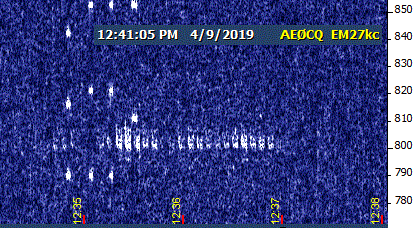
This is not the first time I've noticed a similar effect in recent weeks, so even though this is just an anecdotal report for now, if someone confirms it as a scientific reality, I'd appreciate co-credit in the naming. It showed up on different days in the past month; once when I was monitoring WV, who was coming in poorly until the pulser started and then was briefly enhanced, and another time when I was monitoring WAS, with similar results. During today's Pulse Happy Hour, I had time to see what appeared to be a similar phenomenon and both WV and WAS again. More than that, it looks as if the trains of pulses don't necessarily just trigger an enhancement, but may actually toggle propagation downward first, then upward! Wouldn't that be something?
But, of course, these few instances are not enough to establish any kind of pattern by themselves. They could just be coincidences that I finally noticed. It does give me something new to watch for in future, though.
Then, at 12:42 I started seeing a strong QRSS3 signal around 13555.360 that turned into an "L" and the start of a "V," so I cranked up WSPR X quickly, and over the next several minutes was rewarded with:
1744  -21  -1.0   13.555358    0   K5LVB         EM10      7
1750  -22  -0.3   13.555358    0   K5LVB         EM10      7
1756  -26  -0.3   13.555358    0   K5LVB         EM10      7
At 1:02 PM, the signal was too weak to decode, but I've left WSPR and Argo running while I returned to town to file this report, so we'll see later what's been going on since then.
John
---------------------------------------------------------------
File Attachment 1: 9apr-JUN.gif
Re: JUN back on air Sat 6 April
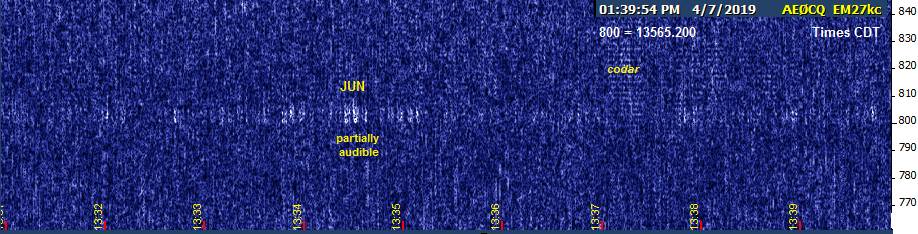
On Sunday, I watched and listened for an extended time around local solar noon, and could see JUN, but only copied a letter here and there. Codar was very much present for a lot of the afternoon, which didn't help. From about 3:20 to 3:30 PM, I could again just barely see JUN, but could pick out one letter from each ID cycle...sometimes only part of a letter. For instance, there were a number of times when the J was incomplete and gave me a "W" or an "O" instead. But today, Tuesday, I managed a couple of complete IDs; see other report.
John
---------------------------------------------------------------
File Attachment 1: 7apr-JUN.jpg
Re: HiFERs Tuesday
Hi John,
That is an interesting effect.. One piece of important information would be to know the origin of the pulses in relation to the origin of the other signals that see a corresponding "lift"
The time-scale in the plot above is around 2 minutes for the dropout and reappearance of JUN. I suppose two hypotheses are tenable:
1) Pulses affect propagation directly.
2) Appearance of the pulses, then appearance of other signals represents a moving change in the ionospheric conditions that lifts one signal, then the other.
In favor of (1) above would be the abruptness of output from the pulse source, rather than its fading in and out. That a change in another signal occurs, seemingly with this switched behaviour does suggest a causal link, rather than a coincidence.
If so, what is the mechanism - and that is why I wonder about origins of the signal? If propagation is to be affected, it means sufficient power is radiated by the pulses to change ionisation - what would the range of such an effect be?
As to to the dip, I suppose with enough power, the pulses could increase lower level ionisation, resulting in more absorption of our wanted signal (JUN). This ionisation might be expected to dissipate more rapidly than effects created at higher altitude that enhance JUN, leaving the lift in conditions to remain for a while.
Of course, this is pure hypothesis - Too little information exists to support the ideas fully, but an interesting phenomenon for discussion.
/Ed
Re: HiFERs Tuesday
Posted by Ed Holland on April 10, 2019 at 18:31:13.
In reply to HiFERs Tuesday posted by John Davis on April 09, 2019
More on this... I spent a littl effort searching around. This website:
www.sigidwiki.com/wiki/Category:Radar
Is useful in helping to identify odd signals, and includes sound files. The link above is directly related to long range radar signals. Interestingly, the most common style I hear is similar to the JORN system in Australia.
/Ed
Re: HiFERs Tuesday
Posted by John Davis on April 10, 2019 at 19:10:03.
In reply to Re: HiFERs Tuesday posted by Ed Holland on April 10, 2019
Hi Ed. Yes, the mechanism would be the big question, assuming further observation supports the existence of a real phenomenon and not just coincidence. It would make sense that weak signals are where such an effect might be most noticeable, since we're continually working at the edge of detectability already. A few dB change makes a bigger difference to a HiFER than it would for a stronger signal, where receiver AGC would obscure a lot of the difference and the ear would likely not notice anything. So, we have a highly sensitive tool at our disposal; but conversely, one that is inherently touchy and whose availability is largely unpredictable.
As for the two general hypotheses, I agree that (1) does seem to have more going for it. During these particular observations, the pulsed signal was consistently strong and abrupt in its start/stop times...no fading visible on the S-meter nor selective fading/echo evident to the ear, as one sometimes hears on pulsed emissions after the band is no longer fully "open" to this QTH at the end of the day.
The signals that may or may not be affected by them were in the S0 or lower range, while the pulses were blasting in at a steady S9+20. This is thousands of times more received power than all the codar sites combined deliver to my antenna on a bad day. It would be most interesting to know exactly where they originate and how much peak power is involved. Whatever the power, however, it's hard to imagine effects on "normal" signals unless the first reflection of the pulses was occurring near mid-path of the desired propagation. That's not too hard to envision. But it's difficult to imagine the ionosphere being significantly affected on the pulser's second hop.
I suppose it's both a blessing and a curse that I already have so many Argo captures of the watering hole available to search. One additional problem in making use of those, though, is that many of those took place while I was doing other work on the farm or having lunch or running other errands, so I don't have as thorough knowledge of relative signal strengths for most of those as I do for yesterday's observations. Argo alone will yield only very approximate information about that.
It would be great to hear from anyone else who sees similar instances, and from those who don't! ...first, to establish whether this is a "real thing" or not, and secondarily, if so, whether the interaction only affects certain paths.
John
Re: HiFERs Tuesday
Posted by John Davis on April 10, 2019 at 19:23:33.
In reply to Re: HiFERs Tuesday posted by Ed Holland on April 10, 2019
Thanks for that link, Ed. The pulse rate and duty cycle of what I hear also seems similar to JORN, but I have never encountered the "intro" tone yet. Interesting.
Reminder: Lowfer net 3927Khz Saturday morning 0800 California time..
Posted by Jerry Parker on April 12, 2019 at 16:22:35.
Reminder: Lowfer net +/- 3927Khz Saturday morning 0800 California time
Or listen online at:
http://69.27.184.62:8901/?tune=3927lsb
Re: VLF
Posted by Paul Nicholson on April 12, 2019 at 18:32:22.
In reply to VLF posted by Joe VO1NA on March 09, 2019
Joe, your 8270.0075Hz carrier continues to be a regular visitor to my spectrogram here in Todmorden UK, 3575km.
Today about 6nV/m field strength. Generally the daytime signal is in the range 5 to 9nV/m, a very consistent beacon although sometimes it tries to hide under the noise.
http://78.46.38.217/fbins3.html#p=1555088400&b=270&s=fd&m=cardioid&w=r&h=62&z1=0.34&z2=0.64&c=1&mb=618,118,743,178,1
Unique VLF antenna
Posted by Ed Holland on April 12, 2019 at 20:03:15.
phys.org/news/2019-04-slac-compact-antenna-radios.amp
This is interesting - a piezoelectric VLF radiator, developed at SLAC, a stone's throw away from us.
HiFERs Saturday the 13th
Posted by John Davis on April 13, 2019 at 16:07:43.
Got an earlier start today and was surprised to see SIW slant and WSPR already before 9:30 AM CDT, although with wide QSB. Not much else yet...just NC and RY faintly, WV at fair audibility, and a good signal from K6FRC. No AZ, MTI, PBJ, AN, VAN, WAS, JUN or AMA. Shortly after 9:40, 7P materialized, but nobody else was present during the rest of the hour.
Am returning to the field now, but will have to shut down in early afternoon due to approaching rain and possible thunderstorms.
Note on 13 April Lowfer net
Posted by Clint KA7OEI on April 13, 2019 at 16:23:26.
In reply to Reminder: Lowfer net 3927Khz Saturday morning 0800 California time.. posted by Jerry Parker on April 12, 2019
Notes on 13 April, 2019 LowFER net: Sorry for errors/omissions. Present were: Via email/SDR: Clint KA7OEI Re: PVC + VAN & FRC (Going Back to Cali)
Jerry, WA6OWR; Dave, WD4PLI; Clint, KA7OEI
John, AE0CQ
(plus others receive-only via KFS WebSDR)Dave:
Jerry:
Clint:
John (via email):
73,
Posted by John Davis on April 14, 2019 at 06:44:23.
In reply to P V C ! posted by John Davis on April 02, 2019
I also had some brief but unusually good copy of VAN, and solid reception of K6FRC as well. I'll report on those later. (...much later, as it turned out...)
Before I delay further--on April 1, the ionosphere was not fooling! In addition to my first aural copy of PVC, VAN and K6FRC were remarkable too. See the attached screen capture as well as the MP3 audio clips.
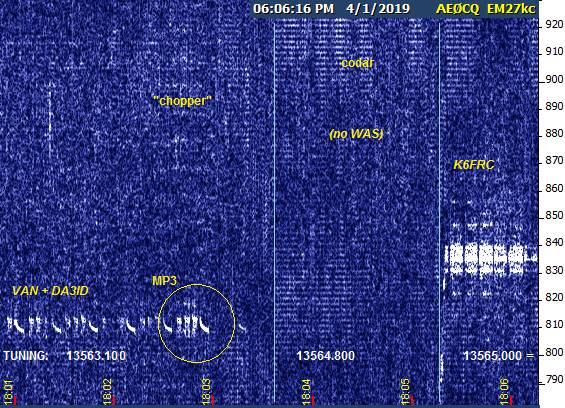
Codar was prominent that afternoon, but as you'll notice both visually and aurally, VAN was also afflicted with a faster pulser (10 pps as opposed to the usual codar 2 pps "kchuck-kchuck." I called this one "the chopper" for its resemblance to one of the frequent sound effects from M*A*S*H (at least, when heard on my radio's speaker; it's a little different in the filtered audio posted here).
The timing and duration of the VAN clip are denoted on the capture by the circled area. It starts during the indicated dash-after-ID, although that's hard to tell by ear. At that early point, some of the 2 pps codar can be heard. At 7.5 seconds, the first of three IDs begins. Then, at 10.5 seconds, the 10 pps "chopper" attacks, and the next ID at 12.2 seconds is more prominent. The best ID is probably the third one, at 17 seconds in. The next dash-after runs from just before 22 seconds to 27 seconds. The next three IDs are inaudible, but you can hear the 2 pps codar return just before the clip ends.
The FRC clip speaks for itself...several powerful IDs and the occasional QSB.
---------------------------------------------------------------
File Attachment 1: 1aprb.jpg
File Attachment 2: 1aprVAN.mp3
File Attachment 3: 1aprFRC.mp3
Re: Note on 13 April Lowfer net
Excellent work. Thank you! Re: HiFERs Tuesday
Posted by John Davis on April 15, 2019 at 00:34:57.
In reply to HiFERs Tuesday posted by John Davis on April 09, 2019
I wrote:
... so we'll see later what's been going on since then. (Sigh! Another delayed response on my part.)
In addition to the things I mentioned before, MTI became audible late in the noon hour and again just before 3 PM. Both SIWs plus WM turned up in afternoon captures on Tuesday. SIW slant attempted to materialize right at solar noon here, about 1:23 PM, and succeeded about 10 minutes later before vanishing for the day at 2:05 PM (see attachment 9aprc.jpg). Interestingly, WM didn't turn up for nearly 50 more minutes (see attachment 9apra.jpg). The remainder of the afternoon's WSPR decodes:
1856  -23  -0.7   13.555402    0   K3SIW         EN52      7
1900  -23  -0.5   13.555402    0   K3SIW         EN52      7
2002  -22  -0.4   13.555364   -1   K5LVB         EM10      7
2044  -22  -0.1   13.555365    1   K5LVB         EM10      7
2050  -10  -0.3   13.555366    0   K5LVB         EM10      7
2056  -23  -0.5   13.555365    1   K5LVB         EM10      7
2102  -14  -0.4   13.555366    0   K5LVB         EM10      7
2108  -18  -0.3   13.555366    0   K5LVB         EM10      7
2114  -29  -0.3   13.555366    0   K5LVB         EM10      7
2120  -23  -0.3   13.555366    0   K5LVB         EM10      7
2126  -24  -0.3   13.555366    0   K5LVB         EM10      7
2144  -30  -0.3   13.555366    0   K5LVB         EM10      7
By very late afternoon, the stations at the watering hole had dwindled to 7P, EH, and RY. (LVB was still intermittently visible until 5:46 PM, but didn't decode any more after the 2144 time slot.)
After 6 PM, 7P diminished but PVC's dotted line began showing up. There were times when it might have been loud enough for aural copy were it not for EH and RY being in such close proximity (and a reprise of NC and 7P just before 7 o'clock); QRSS3 would probably have been good copy, though. Other log entries from the late afternoon (times are Central Daylight):
628p TON visible, sometimes audible
633p  WAS mostly good, but rapid QSB
      FRC poor to very good -- (see below)
700p  PVC dots now on 13555.480
704p  RY very audible
707p  7P vy aud
709p  EH vy aud
732p  one lone VAN DAID then gone again
735p  vy strong WAS, peaks S1 to S2 w/less rapid QSB
      no FRC, then weakly audible
740p  JUN faintly audible; remarkable for E-W path so late in day
When WAS and K6FRC were at their best in late afternoon, I could hear them both simultaneously within the passband of my narrow CW filter--along with the ubiquitous codar. An MP3 audio clip is attached.
---------------------------------------------------------------
File Attachment 1: 9apra.jpg
File Attachment 2: bothWASFRC.mp3
File Attachment 3: 9aprc.jpg
Re: HiFERs Saturday the 13th
The rest of the day did not support my hopes from early morning. The SIWs went away and did not return, leaving no WSPR decodes. By late morning, NC was strong enough on 13555.530 kHz a couple of times that I was able to see a 120 Hz hum modulation sideband at 13555.410, down in level a little more than -30 dBc. 7P was also good strength, and RY was fair, while EH appeared to be off.
USC came in very faintly just before noon, and the PVC dotted line showed up for a minute or two at a time during the noon hour. (Not audible, but it would have been visible for a couple letters at a time at QRSS3.) EH switched on at 12:29 PM CDT on 7P's frequency, drifted slowly downward toward its usual vicinity, and was abruptly gone again at 12:48.
Two odd things happened in early afternoon. First: On 13555.380, a sorta-QRSS3-looking signal appeared around 1:27½ PM CDT, exhibiting greater signal strength than any other signals then present at the watering hole. It appeared to be keying intermittently or randomly, though. Unlike LVB, whose QRSS keying is sometimes weak and broken by QSB, this one appeared consistently strong when present at all, and it lasted five minutes from end to end, more than twice as long as LVB's QRSS ID does.
The second peculiar happening was when all the watering hole signals simultaneously observed a two and a third minute long "moment of silence" commencing at 1:49 PM CDT. I was away from the radio tending to other matters on the farm right then, so I wasn't able to tune around and see if the noise core at the band center was affected, for instance. NOAA does not show any solar x-ray or geomagnetic events at that time, so I have no clue what happened. In the following hour, I quit for the day because of precipitation encroaching from Oklahoma.
No Sunday report this weekend, unfortunately, due to other activities.
John April EARs
Posted by John Davis on April 16, 2019 at 08:09:04.
A good night! I was beginning to wonder if QRN was ever going to let me capture a complete ID of EAR this month. By late afternoon Monday, LF overnight conditions didn't look too promising, so I set up for monitoring 630 meter WSPR instead. At 1 AM CDT, I decided to check 1750 meters, just in case, and was rewarded with the attached signals.
---------------------------------------------------------------
File Attachment 1: 15aprc.jpg
Re: April EARs
Hi John....thanks for the report and Argo snips! I'm glad you decided to take a look, even with poor conditions!
73, J.B., VE3EAR Hifers April 18th
Posted by Ed Holland on April 18, 2019 at 22:28:57.
Hi Folks,
I tried listening this morning (~1000 PST + DST) here in Northern California. Above 13560 kHz, there was noticable sideband splatter from a broadcast station at 13570 kHz, possibly, Chinese origin, possibly China Radio International.
Looking nearer the 13555 kHz spot, there were no traces visible over ~1/2 hour of monitoring, generally quiet conditions.
I have started making a note of the atmospheric noise level and the signal strengths of the mid band signals at 13560 kHz (both in S-units). Today, both these were low, noise not registering, and only about S-3 for the center band stuff. I am wondering if this is a good indicator, so will try to correlate to beacon observations.
Cheers,
Ed
Reminder: Lowfer net +/- 3927Khz Saturday morning 0800 California time
Posted by Jerry on April 19, 2019 at 17:58:03.
Reminder: Lowfer net +/- 3927Khz Saturday morning 0800 California time Re: Lowfer net Saturday morning
Or listen online at:
http://69.27.184.62:8901/?tune=3927lsb
Reminder: Lowfer net 3927Khz Saturday morning 0800 California time..
Posted by Clint KA7OEI on April 21, 2019 at 16:34:58.
In reply to Reminder: Lowfer net +/- 3927Khz Saturday morning 0800 California time posted by Jerry on April 19, 2019
Notes on 4/20 net. I got to the radio a couple of minutes late - likely missed some of Ed's early comments. Present were: Jerry, WA6OWR; Ed, KI6R; Dave, WD4PLI; Clint, KA7OEI Via SDR: John, AEØCQ; Keith, KA6ASJ; Eb, KC6SOG Ed: Jerry: Clint: Dave: John (via email): 73, Clint KA7OEI Re: Lowfer net Saturday morning
Posted by Paul on April 21, 2019 at 17:21:59.
In reply to Re: Reminder: Lowfer net +/- 3927Khz Saturday morning 0800 California time posted by Clint KA7OEI on April 21, 2019
Thank you, Clint!
Re: HiFERs Tuesday
Posted by Ed Holland on April 23, 2019 at 04:35:58.
In reply to Re: HiFERs Tuesday posted by John Davis on April 10, 2019
I happened to be listening today - Spectrum Lab running as I worked on other things, listening to the receiver in the background. HiFERs were nonexistent, but there were three or for bursts of "JORN" I heard definite tones preceeding all but the first instance, and may have missed a tone if it was transmitted. Two of the bursts were preceeded by multiple tones.
I followed the watering hole during this brief flurry of activity (perhaps 5 minutes). No other changes were observed in the band.
New Beacon: MN 13562.8
Posted by KMONAS on April 23, 2019 at 17:10:55.
Hello Everyone, the snow has finally melted here and I was able to get my antenna up today so my new beacon is on the air. Here are the details.
Frequency: 13562.8
Call: MN (13 WPM CW)
Grid Locator: EN34fw
Location: Shorewood, MN
Antenna: Dipole at 40 feet. Radiating mostly North and South
Schedule: Should be on 24/7 unless I decide to use the antenna for a listening session.
Details: Beacon is a Black Cat Systems kit.
Reports welcome!
Weird signal at 13,555.93
Posted by Linas KC9PCP on April 23, 2019 at 21:38:31.
I'm hearing a weird signal at 13,555.935 right now, it varies up and down by 5 Hz with a 2 second cycle time, but somewhat irregular. I'm in EN61br southwest suburbs of Chicago, just wondering if anyone knows what this is or can hear it too. Re: Weird signal at 13,555.93
Thanks,
Linas KC9PCP
Posted by Linas KC9PCP on April 24, 2019 at 00:15:31.
In reply to Weird signal at 13,555.93 posted by Linas KC9PCP on April 23, 2019
Now also at 13,558.01 and 13,541.23
Re: New Beacon: MN 13562.8
Posted by John Davis on April 24, 2019 at 07:21:39.
In reply to New Beacon: MN 13562.8 posted by KMONAS on April 23, 2019
Thanks for the good word, Kirk. It'll probably be Thursday or Friday before it's dry enough here for me to go to the field again, but I'll certainly include you in my listening schedule. As Ed noted earlier, conditions have not been great on 22 m the past few days, but we're bound to get a break eventually.
Lowfer WM
Posted by Garry, K3SIW on April 24, 2019 at 17:01:10.
Seeing lowfer WM again weakly at the 185.3 kHz watering hole this morning.
RTE 252 LW to continue for 2 more years after antenna upgrade
Posted by Mike Terry on April 26, 2019 at 08:37:24.
Fine Gael Press Office
April 25 2019
http://www.hildegarde.ie/longwave-radio-to-continue-for-the-benefit-of-diaspora-naughton/
Reminder: Lowfer net 3927Khz Saturday morning 0800 California time..
Posted by Jerry on April 26, 2019 at 15:05:25.
Reminder: Lowfer net +/- 3927Khz Saturday morning 0800 California time Re: Lowfer net 3927Khz Saturday morning
Or listen online at:
http://69.27.184.62:8901/?tune=3927lsb
Reminder: Lowfer net 3927Khz Saturday morning 0800 California time..
Posted by John Davis on April 27, 2019 at 18:20:21.
In reply to Reminder: Lowfer net 3927Khz Saturday morning 0800 California time.. posted by Jerry on April 26, 2019
Ed KI6R and Jerry WA6OWR were the only on-air participants today, but there were three or four of us monitoring via the KFS WebSDR. Clint KA7OEI was not with us, so there are no notes as such...but if you are interested in hearing this week's Net for yourself, you can do so because I also made this recording:
websdr_2019-04-27_3927.0kHz.mp3
Because of its large size (≈6 MB) this file will not be a permanent resident on this server, but it and this message will disappear after about May 5. You can either right-click and select Save to download it to your computer, or simply click or tap the link to play it on most devices.
John
HiFERs Tonight
Posted by John Davis on April 28, 2019 at 06:49:28.
Just as soon as you try to state what is "typical" behavior at 22m, the ionosphere changes the meaning of the word.
Lately, "typical" has meant mornings are good for the eastern HiFERs, especially EH and NC, and late afternoon is good from the west, notably 7P and FRC--except RY, who comes in better later in the day than other Easterners and is sometimes the last to disappear in the evening. And, "typical" has meant almost no signals from inside the first skip zone (SIW, WM, GNK, K5LVB, PBJ) unless there's a geomagnetic disturbance...which is currently a pretty rare phenomenon.
Well, the first thing different about today was fair to good copy of AMA at 5:15 PM CDT, which was (a) hours later than it can usually be heard, and (b) is the first time it has made it through at all in almost two weeks. Also, K5LVB was unusually strong several times in mid-afternoon, but only decoded once; the WSPR waveform looks strangely distorted for some reason.
1844 -16 -0.2 13.555369 0 K5LVB EM10 7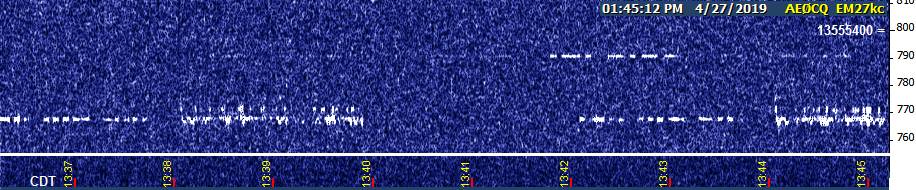
But it was nighttime that turned out truly atypical this time! I returned to the field at 10:30 PM CDT, hoping to hear some 630 meter CW, but QRN was overwhelming. So, after giving up on that idea, I tuned to 22 m to set up the radio for morning HiFERing. Surprise! I was greeted by multiple audible carriers, including rare simultaneous appearances of both SIWs and WM.
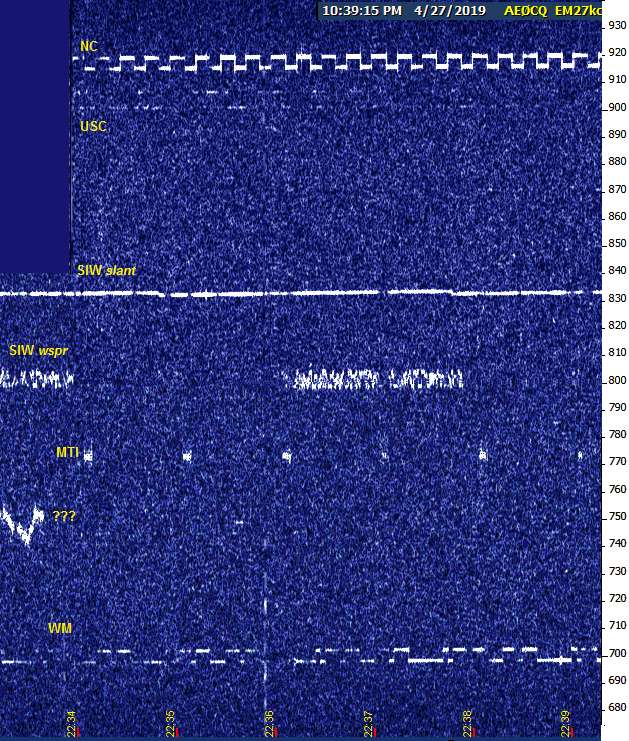
I watched long enough to snag a couple of full slant-mode IDs. Here's the best one. Notice the tremendous amount of multipath propagation, especially near the start.
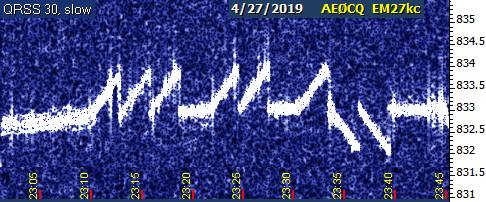
The SIW WSPR decodes were 100% solid from the time I tuned in after 10:34 PM CDT until local midnight, and they were showing no sign of letting up even then.
0336  -17  -0.3   13.555401    0   K3SIW         EN52      7
0340  -18  -0.3   13.555400    0   K3SIW         EN52      7
0344  -19  -0.2   13.555402    0   K3SIW         EN52      7
0348  -19  -1.2   13.555402    0   K3SIW         EN52      7
0352  -17  -0.9   13.555404    0   K3SIW         EN52      7
0356  -17  -0.4   13.555404    0   K3SIW         EN52      7
0400  -22  -0.3   13.555402    0   K3SIW         EN52      7
0404  -20  -0.2   13.555403    0   K3SIW         EN52      7
0408  -16  -0.2   13.555403    0   K3SIW         EN52      7
0412  -14  -0.9   13.555403    0   K3SIW         EN52      7
0416  -16  -0.5   13.555403    0   K3SIW         EN52      7
0420  -15  -0.5   13.555402    0   K3SIW         EN52      7
0428  -14  -0.1   13.555402    0   K3SIW         EN52      7
0432  -16  -1.1   13.555403    0   K3SIW         EN52      7
0436  -15  -0.6   13.555403    0   K3SIW         EN52      7
0440  -17  -0.4   13.555403    0   K3SIW         EN52      7
0444  -16  -0.2   13.555403    0   K3SIW         EN52      7
0448  -12  -1.1   13.555402    0   K3SIW         EN52      7
0452  -14  -0.1   13.555402    0   K3SIW         EN52      7
0456  -16  -0.5   13.555402    0   K3SIW         EN52      7
John
---------------------------------------------------------------
File Attachment 1: 27apr-night.jpg
File Attachment 2: 27aprSIW.jpg
File Attachment 3: 27aprLVB.jpg
Re: HiFERs Tonight
John, perhaps the big snowstorm we had made a propagation impact. Got about six inches here, ending around 0400Z.
73, Garry, K3SIW, EN52ta, Elgin, IL
Re: HiFERs Tonight (1st Followup)
Posted by John Davis on April 29, 2019 at 08:19:56.
In reply to Re: HiFERs Tonight posted by Garry, K3SIW on April 28, 2019
Signals faded shortly after my report last night, but returned about 4½ hours later. K5LVB appeared first, shortly after 4:30 AM CDT, then K3SIW. LVB's WSPR waveform was no longer distorted. Both signals continued into daytime Sunday...mid morning for SIW, almost noon for LVB.
That got me wondering just how much 22 m evening propagation has actually changed since my last nightime check on April 9, at which time the band was still thoroughly dead by a couple of hours after sunset. So, I did what may be my first 24 hour continuous 22 meter session ever...26½ hours, in fact, and it would have been longer if it weren't for severe thunderstorms moving in from central Kansas tonight. (There was still time to spare, in principle, but I couldn't trust myself not to doze off. Didn't want to wake up only after a storm was already in progress!)
I've just uploaded all the WSPR spots from that entire period to WSPRnet. I wanted to post below just the ones since midnight Saturday Central Time (0500 on 28 April, UTC), the last time I reported here, but the board software objected to the message size! I've split off the list into a separate file that you can read here: Sunday28Apr_spots.txt. These decodes give a good idea of first skip zone propagation for the day. When SIW WSPR was at its best, WM appeared several times (sometimes with clearly audible CW IDs), and MTI was visible and frequently audible. I'd hoped these conditions might help me hear MN and see PBJ too, but both of those remained elusive.
Stations outside the first skip zone and/or away from the watering hole were present Sunday in a limited fashion. WV was present several times, though never more than fair strength; it also returned for a while at 11:30 tonight. TON showed up weakly twice during the day. FRC was present three or four times, but not good copy; quite unusual. AMA was copyable briefly at 3:38 PM CDT. After dark tonight, when NC started drifting back upward in frequency, I could then see that it had been parked atop the "dotted line" of PVC for a while. It was the first time I'd seen PVC in the past few days, but it wasn't loud enough to actually hear.
(Haven't heard or seen anything from WAS for an even longer time, come to think of it. Any info?)
The emergence of the Illinois stations and K5LVB this evening was quite interesting to watch. They began showing up in late afternoon, then there was a gap beginning a few minutes before sunset, after which they all eventually returned, even stronger. There's a lot of data to digest, though, and it may take me a while to figure out how best to present it. When I do, I'll have a further follow-up.
John
Re: HiFERs Tonight (1st Followup)
Posted by Bill Stewart, K4JYS on April 29, 2019 at 22:53:04.
In reply to Re: HiFERs Tonight (1st Followup) posted by John Davis on April 29, 2019
John, always good to read your comprehensive reports. As to your question abt WAS, it's still purring. It is interesting to me that sometimes you can copy NC, but not WAS. I am probably abt 125 miles east of Dex. My dipole is broadside to the NW/SE. From what I read prop. condx will be pretty dismal for a while longer. Lets petition FCC for mo power! Re: HiFERs Tonight (1st Followup)
73 de Bill K4JYS
Posted by Mike N8OOU on April 30, 2019 at 04:12:48.
In reply to Re: HiFERs Tonight (1st Followup) posted by Bill Stewart, K4JYS on April 29, 2019
Bill, I too find it interesting, reading/seeing the differences in JD's reception of SIW and WM. In our case I think we are about the same distance to JD, SIW is simply a couple hundred miles north of me. Even simple QSB fades are on different schedules.
JD, Thanks for the report of WM. Watching the meters here says the beacon is operating normally, but a distant report is the best confirmation.
73 Mike
Re: HiFERs Tonight (1st Followup)
Posted by Ed Holland on April 30, 2019 at 17:09:31.
In reply to Re: HiFERs Tonight (1st Followup) posted by John Davis on April 29, 2019
Great report John,
It is very interesting that the propagation changes so much hour to hour, and day to day. I wish I had more time for monitoring, so that conditions on the West Coast might be compared. I suppose Spectrum Lab could be left running unattended, then the "strip-chart" viewed later.
If these observations were run concurrently with your listening/recording, it might reveal more - or, I suppose, just add more confusion!
PVC would have to go off air, but I would not be averse to a coordinated experiment. If I can be sure of continuous recording.
Cheers
Ed
potrzebie