Index of back LOWDOWN issues?
Is there an index of articles/subjects from back issues of the LOWDOWN? Way back issues, like in the 90's?
I'm looking for some old articles by Mike Mideke. I'm sure I mis-spelled his name but you know who I'm referring to.
TNX
Bob JT9 heard on 630M overnight
EDJ
Posted by John Bruce McCreath on April 01, 2020 at 14:41:30.
I parked on 474.200 overnight, and received the following stations using
a PA0RDT mini-whip, TS-440S, and an old WSJT-X in a WinXP PC.
In order of reception, W3TS, W9GT, K1BZ, W9SRW, VE3CIQ, W7XU,
WB4JWM, N8CGY, K7PO, NO3M, and W1XP.
73, J.B., VE3EAR
LowFER Beacon "EAR" Re: Promising Morning Monday 30 Mar.
188.835 kHz. QRSS30
EN93dr
Posted by John Davis on April 01, 2020 at 21:11:38.
In reply to Re: Promising Morning Monday 30 Mar. posted by Chris on March 30, 2020
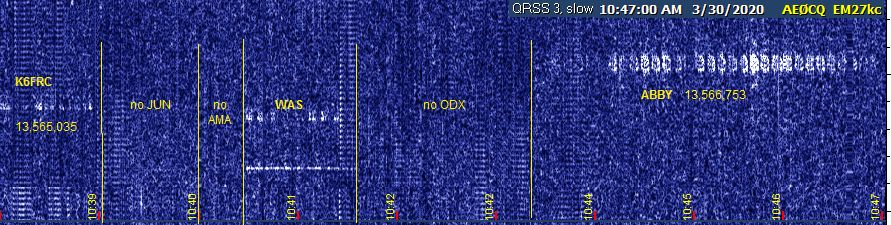
Here's ABBY and some neighbors during the session. The other attachment show the watering hole and unique codar interference just before I went to the top half of the band. The odd codar appeared to be sweeping at twice the usual frequency shift rate, but half as often as "normal" codar, and it was only on approximately a quarter of each minute. After I tuned above center, it was all just the typical codar up there.
ABBY was certainly nice and stable in frequency during the 3 minutes I watched and listened Monday...though less so today; see later report.
I've also got more screen captures and reports from Monday afternoon of interest, plus to understand those in context, I'll need to go back and report on last weekend, too. Hope I don't confuse everyone--including myself. :)
---------------------------------------------------------------
 File Attachment 1: 30mar_abby.jpg
File Attachment 2: 30mar01.jpg
Re: Index of back LOWDOWN issues?
Sorry, Bob. Though I wish there were, there has never been a cumulative index of The LOWDOWN. Larry Putnam used to do an index for each year individually, but he stopped doing even that about 20 years ago.
WSPR Sunday Night
Posted by John Davis on April 01, 2020 at 21:38:53.
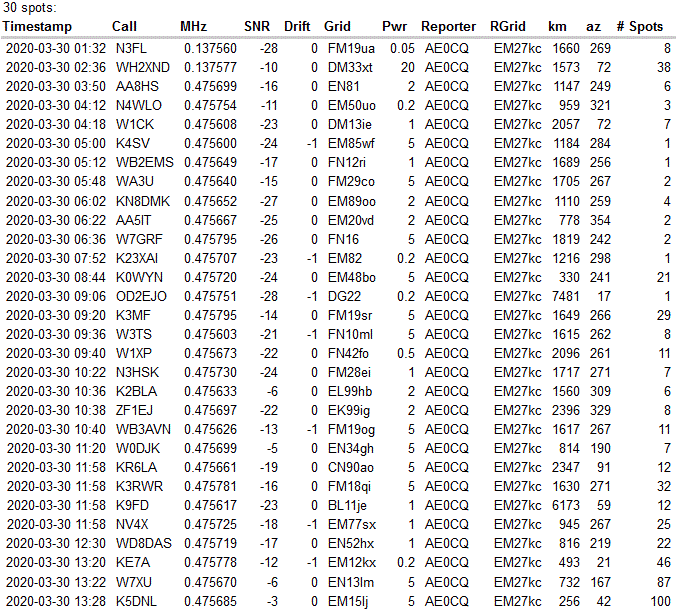
I started out monitoring WSPR on 2200 m from before sunset. Only WH2XND and N3FL had come in by 10 PM CDT (and XND seemed to discontinue transmission in mid-timeslot), so I gave up and switched to 630 m.
Lots more activity there...and as usual, too much of it "local" (meaning, within 300 miles) so lots of intermod products showed up. The MF band did give me 28 more unique call signs for the night, although two of them are clearly bogus. (A Lebanese station operating from the middle of the South Pacific? Not too likely!)
This time, fortunately, I've preserved all my Argo captures and the original WAV files for the night, too, so maybe I can analyze the origins of the spurious decodes a little better.
---------------------------------------------------------------
File Attachment 1: wspr2930mar.gif
Re: Promising Morning Monday 30 Mar.
Nice report John! It is a black cat kit.. not sure if there are any tips or tricks to keep frequency more stable? Good to know Abby still getting out west of me. Re: Promising Morning Monday 30 Mar.
Chris
Posted by Chris on April 01, 2020 at 21:52:53.
In reply to Re: Promising Morning Monday 30 Mar. posted by Chris on April 01, 2020
I have another black cat kit as a backup. Maybe one of the components is failing me. I did place the chips backwards months back by accident while testing. Maybe moisture got to t too over time.
Chris Re: Promising Morning Monday 30 Mar.
Posted by John Davis on April 02, 2020 at 15:36:08.
In reply to Re: Promising Morning Monday 30 Mar. posted by Chris on April 01, 2020
A failing component is possible, but it wouldn't be high on my list. The attached screen shot shows a smooth curve, suggesting that the frequency is settling to a new equilibrium after some disturbance ...a brief power interruption, the sun going behind a cloud, or some such event.
---------------------------------------------------------------
File Attachment 1: 1apra12.jpg
Re: Promising Morning Monday 30 Mar.
John ,
Thanks for the info, I didn’t factor maybe it being outdoors and the temprarature changes. Hope it don’t don’t wonder off really far. Iit has ween quite windy as well. Appreciate the input.
I’ll leave Abby be and see how she does over the coming weeks.
Chris
Re: Index of back LOWDOWN issues?
Posted by WA1EDJ Bob on April 02, 2020 at 16:46:21.
In reply to Re: Index of back LOWDOWN issues? posted by John Davis on April 01, 2020
Thanks John!
Oh well, I guess I have to sit down with the stack and search. Not a bad thing all in all!
On another topic>>>> What ever happened to WWV and the time/freq standard stations going off air?
You had mentioned this quite a while ago. No news since.
My atomic clocks are still going and I keep seeing them being sold in stores.
TNX Keeping an EAR out for WM
Bob
EDJ
Posted by John Davis on April 03, 2020 at 06:06:14.
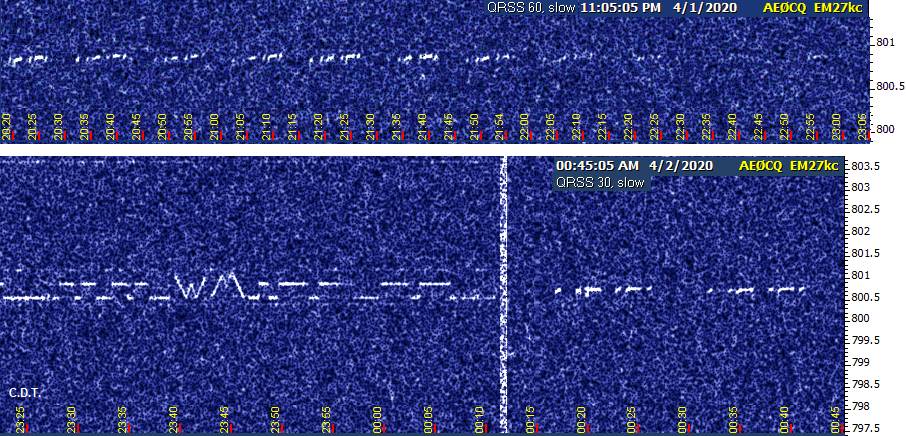
Both WM and EAR did a fine job Wednesday night. I started listening on 1750 m about 8:15 PM CDT, half an hour after local sunset, when 22 m finally started dying out for the night (see a later report on that in the HF section). EAR was already present despite static in the S4 to S8 range, and peaked around 9:30, then began a long fade as depicted in the top trace at 60-second speed.
I then tried the watering hole at 185.300, where I had noticed a healthy signal from WM in the afternoon; alas, surrounded by even healthier PLCs. Sure enough, there it was at night, even healthier and minus its annoying little friends. The recent antenna repairs must have helped. By this time, average noise was up about an S-unit from the immediate post-sunset values, and peaks intermittently went to S9+20.
After getting specimens of the 30-second FSK, the graphical ID, and the 60-second FSK of WM, I checked back on EAR again. It had also returned nicely. Rain was moving in, so that was my last reception for the night--and probably the next few. If nature cooperates Saturday, perhaps I'll have a shot at WM and SIW together.
---------------------------------------------------------------
File Attachment 1: 1apr-WMEAR.jpg
Re: Index of back LOWDOWN issues?
We did mention WWV's outcome a bit on the home page and in print, but not so much here in the board, as it was not very dramatic. Basically, Congress ignored the idea in the next few continuing resolutions and the stations are still in the budget for now.
Re: Keeping an EAR out for WM
Posted by Mike N8OOU on April 03, 2020 at 14:12:41.
In reply to Keeping an EAR out for WM posted by John Davis on April 03, 2020
John,
Thanks for the reception and report. You caught really strong signals of both EAR and WM.
After a few days of moderate winds, the replaced support rope settled into the treetop, with the antenna dropping only a few inches. Certainly less than a foot, so the new result so far is a gain of at least a foot of vertical height over the winters position. The PA current has been running at winter values.
My vegetation progress seems to have slowed from my previous report, Right now shrubs, blackberries, trees in the head tall size have formed their leaves. But full size trees which is what I suspect is my dummy load, have not progressed into producing leaves.
I hope everything stays together and operating so we can track signals over the next couple months.
In a separate effort for this beacon season, I have built a "home made" ground resistance measurement device and have been tracking the soil conditions around the beacon. I am looking forward to see what changes as we get into summer.
Mike N8OOU 73
Re: Keeping an EAR out for WM
Posted by John Bruce McCreath on April 03, 2020 at 14:36:58.
In reply to Keeping an EAR out for WM posted by John Davis on April 03, 2020
Hi John....thanks for the report and llooonnnngggg Argo snip! That sure was a long fade.
73, J.B., VE3EAR PVC QRSS testing
Posted by Ed Holland on April 04, 2020 at 00:37:15.
Hi Folks,
Just a quick note that I have finally figured out how to program the K16 keyer to run in beacon mode at QRSS3. It will be on from today.
Complex stuff with the K16 is actually teaching me Morse... but the sequence and timing to imput embedded commands is quite another challenge.
On another subject, signal strength plotting of beacons, some good progress has been made using spectrum lab. It is possible to plot and record the strength of a signal peak with noise from a nearby non signal band subtracted. This appears to be very effective in normalising the data. I will post some samples in another message.
The aim is to track a beacon or multiples over the course of a day, to see just when they pop up, and with what strength.
Cheers
Ed
2200M WSR-2 copied
Posted by John Bruce McCreath on April 04, 2020 at 13:33:56.
I decided to take a look for WSPR-2 activity on 2200 metres overnight. K3MF and WH2XND were the only ones logged.
I'll try my luck on WSPR-15 mode for Saturday night.
73, J.B., VE3EAR BUH/BUV
Posted by K2TGR on April 04, 2020 at 14:05:01.
BUH/BUV is off the air. We are downsizing into a converted 40' 1977 AM General transit bus affectionately known as "The Catbus" (from the anime My Neighbour Totoro). I've been quite busy the last number of months and I'm not even sure the signal has been getting out, as the vertical on the roof was pounded in a bad storm we had and half of the dipole got taken out by a falling limb a couple of months ago. My apologies for that, but I've had more important things to worry about.
Anyway, the beacon will be reactivated with a new transmitter from the Catbus. The antenna will be a 38" fiberglas CB stick whip antenna that is already onboard the bus and resonates at 26.400 mHz (slightly below the 11 meter band), which will be matched to the transmitter on 13.553 mHz using a homebrew tuner in a Altoids tin.
New callsign will simply be "CAT" and I will let you all know when it is up and running and the modes and exact frequencie(s).
Re: BUH/BUV
Posted by Bill Stewart, K4JYS on April 04, 2020 at 14:27:10.
In reply to BUH/BUV posted by K2TGR on April 04, 2020
Seems I vaguely remember (questionable) that you ran BUH with a horizontal antenna and BUV with a vertical antenna. Is that correct? If so, just wondering if you got enuf reports to indicate one config. was better than another.....tnx, 73 de Bill K4JYS
Re: BUH/BUV
Posted by K2TGR on April 04, 2020 at 16:45:04.
In reply to Re: BUH/BUV posted by Bill Stewart, K4JYS on April 04, 2020
Hi Bill,
Yes, you are correct. There is a vertical mounted to a vent pipe on the house and a dipole in the backyard. The dipole definitely did a better job!
Re: BUH/BUV
Posted by John Davis on April 05, 2020 at 06:52:26.
In reply to Re: BUH/BUV posted by K2TGR on April 04, 2020
Thanks for the update. BUH and BUV had been absent for a long time here.
When they were still audible, I had been wondering about the difference between the two antennas. Most of the time, I seem to get more reliable signals from stations that use verticals than dipoles, but it was different with your installation... perhaps something about the radials, or maybe the feed point of the vertical happened to be close to λ/4 above ground, or something.
Will look forward to trying for CAT when it comes on. And congratulations on the new ham call, too.
John
Re: PVC QRSS testing
Posted by John Davis on April 05, 2020 at 07:21:29.
In reply to PVC QRSS testing posted by Ed Holland on April 04, 2020
I'm eager to get to the farm and look for the QRSS3 signal, Ed. Two out of the last three times I was there, I did see the "dotted line" effect that has characterized PVC's CW signal, so I'm very hopeful that the QRSS3 signal will make it through. It may be two or three more days before I can find out, though.
Going to the farm is permitted under our state stay-home order, and if all is normal, there's no reason for anyone else to be lurking within a quarter mile of my place--but conversely, if I have vehicle trouble or sustain an injury while out there, that could involve unwanted close proximity to others. So, to stack the deck in my favor as much as possible, I'm going to limit myself to traveling there only on sunny, dry days with reasonably calm winds. Such days are pretty rare so far this year.
Re: PVC QRSS testing
Posted by Ed Holland on April 05, 2020 at 15:34:31.
In reply to Re: PVC QRSS testing posted by John Davis on April 05, 2020
Thanks John,
I look forward to your next report, but do take care out there.
Cheers,
Ed
"And today...PVC..is topping the bill."
Posted by John Davis on April 08, 2020 at 18:20:10.
(For full effect, it will help to have "Being for the Benefit of Mr. Kite" playing in the background.)
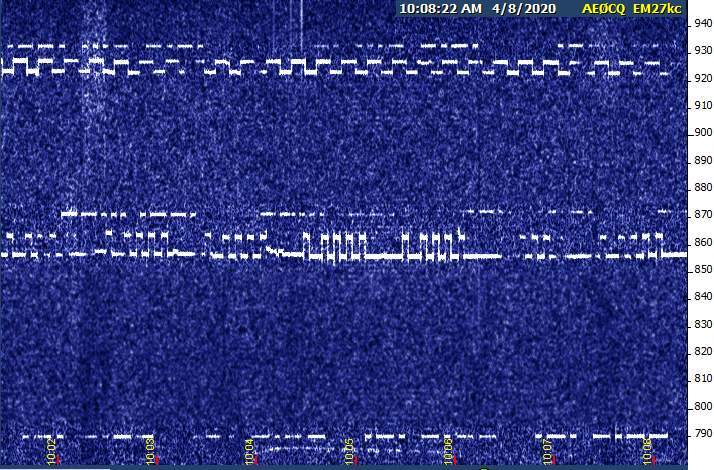
Started seeing new PVC yesterday afternoon, but even better copy this morning. My first copy yesterday noon looked like the usual dotted line effect at first, but eventually longer bits began appearing, leading me to believe that short-term QSB was driving the already weak signal in and out of view at a rapid pace. By yesterday evening, complete letters were showing up on screen at times, but only partial characters other times. Before sunset, it was possible to confirm that this was indeed PVC, but the first full and incontrovertible ID didn't come until 10:30 PM Central Daylight Time last night, when PVC joined the much stronger NC for a final gasp before departing the band for the night.
NC, 7P, EH and RY are also prominent in this capture from today, and MTI was visible just below this screen at the beginning of some, but not all, minutes. There was no sign at all of WV this morning, but AZ was visible and sometimes audible. That was also true of TON a few minutes later. K6FRC was fair to good, ODX was steady at a good audible level, and ABBY was visible on Argo but tended to fade in an out of audibility.
Congratulations, Ed. It'll be nice to have (hopefully frequent) visual confirmation that PVC is making it this far and hopefully farther.
"In this way Mr. H will challenge the world..."
(Yes, I realize that substituting Ed's final initial in that line destroys an internal rhyme, just as substituting "today" for "tonight" and PVC for "Mr. Kite" did in the subject line. But I would argue that John Lennon set the precedent by re-naming the circus horse to Henry, thereby giving up a much more sublime double internal rhyme:
And of course Zanthus the Horse dances the waltz.)
---------------------------------------------------------------
File Attachment 1: apr0140.jpg
Re: "And today...PVC..is topping the bill."
John,
Thank you very much for the report. It is great to see PVC up there so clearly. Wanting to leave the beacon on, I have not been able to do any logging here in CA, so have been unaware of the conditions over the last few days. I believe there was something of a magnetic storm yesterday, according to the space weather site, so perhaps that helped.
I shall maintain PVC in QRSS3 mode for the time being. If I get really clever with programming the keyer, it should be feasible to run alternate IDs at QRSS3 and (for exanmple) 10 WPM.
If PVC goes off for 22 m monitoring purposes, I'll post a message to that effect.
Thanks again,
Cheers
Ed
Notes on 4 April Lowfer net (+/- 3929Khz Saturday morning 0800 PDT)
Posted by Clint Turner on April 09, 2020 at 05:32:26.
Notes on LowFER Net - 4 April, 2020
Present were:
Jerry, WA6OWR; Dave, WD4PLI; John, AE0CQ;
73 de Clint, KA7OEI
630 m WSPR
Posted by John Davis on April 09, 2020 at 05:47:33.
That mass of storms east of the Mississippi is very noisy. Most decodes tonight have been well under 1000 km, and have included K5DNL (31 spots by 11:40 PM CDT), KE7A (25), AA5IT (2); and at 1 decode each: W&216;IOO, WD8DAS, and K4SV (1184 km). Just as I was returning to civilization to file this report, KA7OEI also decoded...I think it was the 0444 UTC timeslot, but I'll have to doublecheck that when I return to the field.
John
Lowfer SIW back to sending wspr15/qrss/opera32
Posted by Garry, K3SIW on April 09, 2020 at 16:09:02.
Lowfer SIW has returned to sending a wspr15/qrss/opera32 sequence on M,W,F at 185.185... kHz. Will probably run that way for another month before mowing needs require QRT. The EbNaut mode performed well but lately it seems the phase switching relay isn't making good contact on one of the phases. Should replace it with solid-state over summer so that doesn't recur.
Decoding EbNaut isn't really hard if one has a GPSDO with 1pps and 10 MHz outputs. Spectrum Lab has nice software to correct the PC sampling rate based on the 1pps input and 10 MHz can be used to create an LO that stably mixes the received signal down to an audio frequency. Here we use 166.666... kHz (i.e. 10 MHz divided by 10, then 3, then 2 to obtain a square wave LO). That maps lowfer SIW to 18.518518... kHz, nicely below the Nyquist sampling rate even with a primitive sound card like the one used here (48 ksps max). Audio files saved by Spectrum Lab can then be decoded using the Windows program ebnaut-rx.exe with a frequency offset of 0.518518 Hz and appropriate start offset.
73, Garry, K3SIW, EN52ta, Elgin, IL
Both WM Lowfer and Hifer Off Air
Posted by Mike N8OOU on April 10, 2020 at 02:16:04.
Both beacons are off air for the next few days. I will get them back up as soon as possible.
Mike 73
Re: 630 m WSPR
Posted by John Davis on April 10, 2020 at 06:05:09.
In reply to 630 m WSPR posted by John Davis on April 09, 2020
The rest of Wednesday night was still fraught with QRN, but noise dropped a few dB when I cut off the generator and left the shack running on battery power only. Apparently, its inverter has decided to dump most of its hash right in the 630 meter band now, for some reason. None the less, eleven more stations joined the party by daybreak.
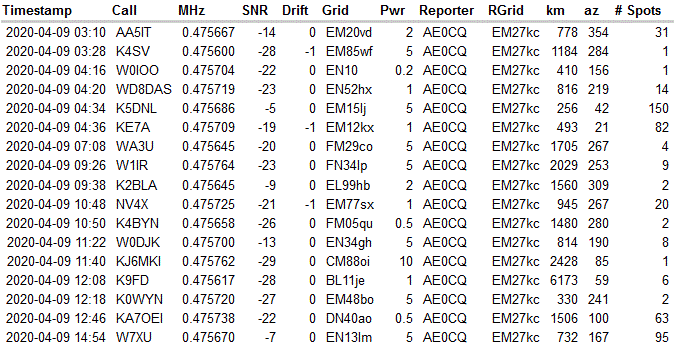
As for Thursday (tonight), I looked at prospects on 2200 m and found them to be highly discouraging despite somewhat fewer storms. On 1750 m I couldn't see anyone at all under S9-plus static. WM turns out to be off, but neither SIW or the usual PLCs could be discerned either.
---------------------------------------------------------------
File Attachment 1: wspr8apr.gif
Reminder: Lowfer net +/- 3927Khz Saturday morning 0800 California time
Reminder: Lowfer net +/- 3929Khz Saturday morning 0800 California time 2200 m WSPR. Plus, where did1750 m go?
Or listen online at kfs:
http://69.27.184.62:8901/?tune=3929lsb
or
KPH Point Reyes:
http://198.40.45.23:8073/
or
Utah Web sdr:
http://www.sdrutah.org/websdr1.html If you cannot get into the net on 80 meters you can listen on KFS and participate by sending net control your thoughts to wa6owr@gmail.com
73,
Jerry WA6OWR
69.27.184.62
KFS WebSDR
As an alternate system on the West coast, try the Northern Utah WebSDR, North of Salt Lake City. Also, on the west coast is W7RNA Sedona WebSDR in Arizona. For better HF reception from the East coast, use either NA5B…
Posted by John Davis on April 11, 2020 at 06:39:24.
A certain bit of dialogue opens lots of westerns and war movies: "Sure is quiet out there tonight." Followed by: "Yeah, too quiet." That's the way both the Part 15 and Amateur LF bands were here on Friday. QRN was lower (both this afternoon and tonight) than it had been in some days, but so were signals after about 3:30 in the afternoon, despite no apparent space weather anomalies.
After a lackluster morning on 22 m, I switched over to 1750 m before noon to establish baseline levels and watch the SIW frequency/mode transition at 1:00 PM. Had good copy of both the QRSS30 and 60 during the noon hour (no WM for comparison, alas). Turns out the changeover clock was five minutes fast, so there was no decode of the first WSPR15 transmission, but the QRSS "SIW" on 185.185 was readable even though the trace was less bright than it had been on 185.2997. The next two WSPR15 transmissions were timed correctly to the top of the hour and decoded fine for showing such a poor SNR:
1900  -41   0.4    0.185185    0   K3SIW         EN51      0
2000  -42   0.4    0.185185    0   K3SIW         EN51      0
Before 4 PM CDT, though, the signal faded away entirely, leaving only the annoying PLC at 185.1877 to confirm the receiver was still functioning. I thought perchance it was an unusually early pre-sunset fade and the signal would return after dark. By 11:15 PM, though, it hadn't; so I tuned up to watch for EAR, which stubbornly remained invisible too. After another half hour, I gave up and went to 2200 m.
Down there, WH2XND was conspicuous by its absence. Being the weekend, I hoped for more stations, but there was only one showing up over the next half hour:
0446  -27  -0.3    0.137420    0   N6LF          CN83     30
0454  -22  -0.1    0.137420    0   N6LF          CN83     30
0506  -24  -0.1    0.137420    0   N6LF          CN83     30
I appreciate Rudy's clean, precise signal, but some variety would be nice. :)
Still not totally convinced the receive setup was working correctly, I checked again with WWVB...still S9+20...and DCF77...still audible even though part of the path from Germany was now in daylight. With my eyelids growing heavy and thunderstorms forecast here for later tonight, I called it quits for now.
John
WM's back in operation
Posted by Mike N8OOU on April 11, 2020 at 16:00:28.
Both beacons are on the air again, after another bout of heavy winds . I was able to sneak their repair up the list of the many cleanup tasks here.
Mike 73
Live NDB in southern California
Posted by Lee on April 12, 2020 at 03:12:04.
Any live beacons in SoCal still working. I have my doubts but I could be wrong. Thanks for any responses.
Re: Live NDB in southern California
Posted by jim vm on April 12, 2020 at 18:20:41.
In reply to Live NDB in southern California posted by Lee on April 12, 2020
Although I can not copy it at my QTH there is one NDB near San Bernardino airport.
Try 'Petis' 397 kHz, id SB.
73 jim vm Re: Live NDB in southern California
Posted by Lee on April 12, 2020 at 19:58:08.
In reply to Re: Live NDB in southern California posted by jim vm on April 12, 2020
thanks
JT9 on 630 metres
Posted by John Bruce McCreath on April 13, 2020 at 14:29:24.
Overnight listening/watching on 474.200 kHz. using WSJT-X ver 1.1 r 3496 resulted on sis stations copied. They were, in order of reception, K9KFR, VE3CIQ, K9OMA, WB2EMS, NO3M, and W7XU. PA0RDT mini-whip and TS-440S.
73, J.B., VE3EAR Former BUH/BUV
Posted by K2TGR on April 17, 2020 at 15:00:28.
BUH/BUV as I posted earlier, is now defunct. As of today I am testing a new beacon on ~13.5649 using callsign TGR at ~5 WPM. Antenna is just a short fiberglas CB whip mounted on the front of the bus, which has been tuned to a VSWR of 1.3:1 using my QRP TunerCan.
If I shut the beacon off for more than a couple of minutes or change something, I will post here.
WSPR on 630 (plus one on 1750 m)
Posted by John Davis on April 21, 2020 at 21:13:48.
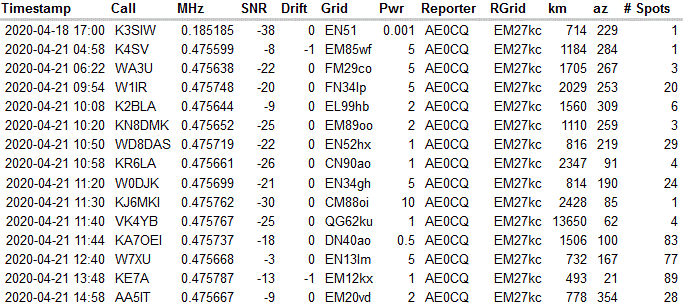
Here are Monday night's unique-call decodes plus one from Saturday afternoon on 1750 (K3SIW in WSPR15).
On 2200, K4SV has wandered out of the WSPR2 segment and was absolutely, thoroughly not decoding, although it was clearly visible on Argo. It's a couple Hz lower than usual, so the decode shown here is technically impossible. To make it happen, I had to tune the receiver down 10 Hz then lie--I mean, amend the frequency after the fact by the same amount--in ALL_WSPR.TXT. Four nice honest decodes of VK4YB, at least!
---------------------------------------------------------------
File Attachment 1: 0420wspr.gif
Notes on 11 April, 2020 Lowfer net
Notes on 11 April, 2020 Net
Present were:
Jerry, WA6OWR; Clint, KA7OEI; Ed, KI6R; John, AE0CQ
73,
Clint
KA7OEI
Lowfer net +/- 3929Khz Saturday morning 0800 California time
Notes on 18 April Lowfer net
Posted by Clint Turner on April 23, 2020 at 06:46:32.
Notes on 18 April Lowfer net
Present were:
Jerry, WA6OWR; Paul, K6FRC; Dave, WD4PLI; Clint, KA7OEI; John, AE0CQ; WA6FIZ, Mickey
73,
Clint
KA7OEI
Lowfer net (+/- 3929Khz Saturday morning 0800 California time)
Re: Former BUH/BUV
Posted by KM0NAS on April 24, 2020 at 17:56:12.
In reply to Former BUH/BUV posted by K2TGR on April 17, 2020
Not hearing it now but will keep my ears open.
"T" 13563.30 khz
Posted by Bill Hensel on April 25, 2020 at 19:16:59.
Just got my Hifer on the air once again today April 25, 2020...ID is the Letter "T" sent about every 1.5 seconds the frequency is 13563.30 khz...
I have been hearing it today on the Sedona, AZ SDR so I know it is getting out...
I will have the beacon on the air periodically, when I'm out hiking or fishing during the summer time...
Location is Pine Grove, Colorado.
73, Re: Former BUH/BUV
Bill
Posted by John Davis on April 25, 2020 at 19:48:25.
In reply to Re: Former BUH/BUV posted by KM0NAS on April 24, 2020
Just got back from listening, still no TGR; but ODX, WAS, and FRC were present on the top half of the band. WV was fair in the lower half of the band, with NC and RY vying for strongest signal in the watering hole and 7P and EH trying to make their way through too.
Mid-day and early afternoon are currently poor times for listening, though. Lately, even the morning hours aren't that great. However, some--but not all--evenings have been productive. So, I'll try again later.
Could you pin down the frequency a little closer, perhaps? That may help in locating the signal.
John
Re: "T" 13563.30 khz
Posted by Ed Holland on April 28, 2020 at 18:23:30.
In reply to "T" 13563.30 khz posted by Bill Hensel on April 25, 2020
Hi Bill,
I'll look out for "T" - Nice to see you running a HiFER again.
Cheers
Ed
Re: "T" 13563.30 khz
Posted by Bill Hensel on April 30, 2020 at 17:40:23.
In reply to Re: "T" 13563.30 khz posted by Ed Holland on April 28, 2020
On April 28, T was heard in VA on a SDR...it was also heard in AZ and Nevada. watering hole lowfers
So it is getting out.
Posted by Garry, K3SIW on April 30, 2020 at 23:02:51.
Haven't seen lowfer WM at the watering hole for a couple days. Perhaps the recent big storms have made it QRT. My lowfer SIW is running at the moment with QRSS30/60 at 185.2993 kHz but will be shut down this weekend for the summer.
73, Garry, K3SIW, EN52ta, Elgin, IL
potrzebie