HiFer RAD back on the air
Posted by Tim Pauly on June 01, 2003 at 19:03:29
RAD, 13.5608 MHz, is back on the air as of today at 7:00 PM.
RAD has a new antenna, a 15 foot vertical suspended in a mulberry tree in the backyard. The transmitter is mounted in a plastic enclosure at the bottom of the antenna and is keyed by an old 486 laptop.
RAD currently transmits the following ID: "ttttt de rad rad rad" four times at 10 WPM, ending with "radford va", then "rad rad rad" once using QRSS3.
Hifer ESA back on
Posted by Jim on June 01, 2003 at 20:14:15
Hifer ESA is on June 1 & 2 for KLFB (Ed) to copy.
The frequency is approx. 13.566 MHz. ID is ESA ESA ESA and 3 second dash. Using 1/2 wave vertical antenna,
grid sq. is CM97BJ (San Jose, CA).
73 Jim
Short, single F1B-Signal on 17.8kHz
Posted by Harald on June 02, 2003 at 18:12:37
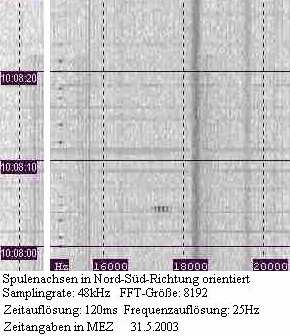
On May 31st, 2003 I could receive the following F1B-signal on 17.8kHz at my home town at 8E58 and 48N43 (look at the spectrogramme). It was the only signal on this frequency this day. What could the sense of such a signal be?
Hifer YEN copy in Maryland
Posted by lloyd chastant on June 07, 2003 at 10:38:20
Took a look this morning and had a nice copy on Hifer YEN -QRSS3(Florida) about 1345z hr in Maryland..My copy showed about 13558.03.
de Lloyd W3NF FM19MH
Hifer HI.....Booming signal.
Posted by Tom kcØw on June 07, 2003 at 23:09:55
Hifer beacon on 13.558 was great copy into Minnesota at 02:35 UTC on 5/7/03. Anyone have any info on this beacon in general?
Tom kcØw
HIFER's MP and GA copy in Texas
Posted by Tony Levstik on June 08, 2003 at 03:19:37
I was able to copy both Hifer MP and GA here in Sherman Texas at 9:00pm 05/07/03
Tony Levstik
HIFER 'RY'
Posted by Steve McDonald on June 08, 2003 at 13:24:08
Great signal from 'RY' this a.m. (10:15 local).
Screen shot via e-mail request.
VE7SL / Steve
RY Returns
Posted by John Andrews on June 08, 2003 at 21:06:09
Hifer RY is back on the air as of June 8, on 13555.41 kHz. Current format is QRSS3, sending the RY ID.
Reports are welcome, and thanks to Steve McDonald for the first!
John Andrews, W1TAG TAG/RY Status: http://webpages.charter.net/w1tag/
Re: Hifer YEN copy in Maryland
Posted by John Andrews on June 08, 2003 at 21:08:11
Also copied YEN this weekend, at 0015 UTC on the 8th. The frequency agrees with Lloyd's report. There is a slight tilt to the characters, particularly on the dashes.
John Andrews, W1TAG
Re: Hifer YEN copy in Maine, not Maryland!
Posted by John Andrews on June 08, 2003 at 21:09:23
Doh!
JA
Hifer power limit question
Posted by Bill on June 08, 2003 at 23:01:43
Hello,
Is the 1.8 mw limit for Hifer's taken at the radio or the antenna feed? Also, I recall reading something about a 3 mw limit for 0 dbi antennas.....Does this mean that with a vertical antenna you can run 3 mw?
Thanks,
Bill
Re: Hifer power limit question
Posted by John Davis on June 09, 2003 at 00:40:48
:: Is the 1.8 mw limit for Hifer's taken at the radio or the antenna feed? ::
This is at the antenna input, but remember that the actual limit as specified in the FCC rules is a field strength limit. The rule of thumb regarding power is only a guide for meeting the field strength limit, and the acceptable power depends on antenna gain.
:: Also, I recall reading something about a 3 mw limit for 0 dbi antennas.....Does this mean that with a vertical antenna you can run 3 mw? ::
No. A vertical working against a ground plane does not represent 0dBi. It has gain over an isotropic radiator. It would be closer to 0dBd, meaning the same gain as a dipole. That's the antenna for which 1.8mW is the correct approximation to use.
John
New F A Q File
Posted by Webmaster on June 10, 2003 at 18:23:48
Do you know how to get the most out of the message board?
For instance, were you aware that there are size limits on messages now? (Probably not, as most users aren't that windy; but the limits have already helped us stop some unwanted advertising messages.)
Can you tell if your message has successfully been posted? Do you know why some messages are referred to the moderator rather than being posted directly? How can you reduce your risk of receiving e-mail "spam" when you write a message here?
We've just updated and expanded the Frequently Asked Questions file to cover a lot more topics such as these. Click the FAQ link at the top of this message, or the one at the top of the Message Board index page to find out more.
Enjoy!
John
Progress!
Posted by Webmaster on June 11, 2003 at 00:05:05
Huzzah! Progress!
It is always gratifying to have you, our loyal readers, using this message board to communicate with fellow longwave and Part 15 enthusiasts.
Of course, the same technology also makes it possible for people with less noble intentions to waste your time and our server space trying to sell their wares. We've kept you from encountering much of it. But as I'm sure you've noticed in your own email, spam is multiplying like rodents these days. So, to make life a little simpler for all of us (except the low-life spammers) we revised the board software to help prevent repeated spam.
After many days of struggle, we can now reject bad posts based on:
* content of the message
* the sender's email address
* the name of the sender
* keywords in the subject line
* excess size, indicating probable advertising
Take that, vile parasitic spammers!
They may occasionally be able to sneak a message through until we catch and remove it. But never again will the same ones be able to spam the board day after day.
To spammers, "scruples" means about as much as it does to a dish of cholera bactera. Spammers are slimy, devolved, mindless wastes of DNA... lurking pathogens who afflict unsuspecting victims with pestilence and corruption. They are the mosquitos that spread the yellow fever and malaria and West Nile of the online world. They are boils on the backside of the Internet.
In short: Spammers are unclean, repulsive, vicious, nasty, lying, loathsome vermin, for whom total eradication is far too merciful a fate.
But I mean that only in the nicest possible sense.
John
A Sawtooth on HIFER
Posted by Steinar Aanesland on June 11, 2003 at 05:56:20
Hi
I captured a sawtooth picture on 13.555,460MHz +/- a few Hz this morning and wonder if Dexter is back in business on Hifer?
http://home.c2i.net/saa/Images/11_06_03/sawtooth.jpg
Best regards from Norway Steinar Aanesland
Re: A Sawtooth on HIFER
Posted by Dexter McIntyre on June 11, 2003 at 16:46:54
I have had the generator running the saw tooth signal recently centered on or about 13555.500 kHz. I was able to repair the SPM-19 last winter with the help of Jim, MØBMU and several others on the rsgb_lf_group@blacksheep.org reflector. I'm certainly not going to leave it on this summer unless the sky is clear! I've got a two-way radio channel element with a 13555 kHz crystal I need to get running for a permanent presence on the band.
Thanks for the report Steinar.
Dex
HiFer copy GA and RY in Texas
Posted by Tony Levstik on June 12, 2003 at 21:31:20
I got good copy of both Hifer's GA and RY here in Texas.
~1:02 utc 06/12/03
Here is the link for the screen jpg.
http://home.att.net/~levstik1/hifer.jpg
Tony Levstik levstik1@worldnet.att.net
Spectrogram of the last transmission of GBR Rugby
Posted by Harald on June 12, 2003 at 22:18:18
A spectrogram of the last transmission of GBR Rugby is available on:
http://www.alien-ufo.de/forum/attachment.php?attachmentid=2489&sid=bccb841bab31d39c897db91c49cf7f60
Have a look at it.
Re: HiFer copy GA and RY in Texas
Posted by John Andrews on June 12, 2003 at 22:32:27
Tony,
That's a good shot! Thanks for the report. I keep looking for TLTX, but it's in a very busy chunk of spectrum with a lot of lines and junk visible. No luck yet.
John Andrews
Re: HiFer copy GA and RY in Texas
Posted by Gilles Auger on June 12, 2003 at 23:25:20
Hi
Thanks for the GA reception report Tony, i am please to see that everything is working very well, good catch.
73
Gilles Auger
Dairy, er... HiFer Month and other musings
Posted by Tim Pauly on June 14, 2003 at 19:13:36
My wife chuckled at that line on the homepage....
HiFer RAD is back on the air with a new antenna and so far no loggings... Oh well.
Anyway, I just wanted to post the fact that I updated RAD's web page with pictures and updates on the beacon: http://www.yougothere.com/hosted/beaconrad
Also, if I get the time in the next couple of months, my daughter and I will be working on two projects:
1. Natural radio ("whistler") receiver with an improved front end design that filters out power line noise better.
2. Laser beacon. I recently found out that there are a lot of experimenters out there that use low-power tone-modulated lasers shot over the horizon, and they can be "heard" up to hundreds of miles away by way of atmospheric and cloud scattering. AT&T allegedly experimented with using cloud-bounce lasers for telephone communication up to 150 miles distant in the 60's.
Check my beacon page over the next couple of months for updates. Hopefully this proves to be some interesting stuff...
73,
Tim N2GFT
"RAD"
backpackable am radio
Posted by Jim Behrends on June 15, 2003 at 00:17:51
I'm looking for a small lightweight am radio that I can take to the outback of Alaska. I have a pocket loop antenna and need a good AM radio to go with it. Any suggestions?
Re: Dairy, er... HiFer Month and other musings
Posted by Johan on June 15, 2003 at 17:16:15
I'll be watching your moves on 13 MHz!
73,
Johan ON5EX
Signal report
Posted by Ray, W2RS on June 15, 2003 at 19:27:01
Hi,
Today I went outside and turned my loop towards Europe, to get ready for the SAQ event on June 29th. It's now peaked at 35/215. Ground wave conditions at 2200 UTC (1800 local) today must have been pretty good, as I got the following results:
TH 579 JJX 559 NWNJ 449
Unfortunately, nothing heard from HS. The heavy foliage here must have had something to do with that.
73,
Ray, W2RS (FN20ww)
Siemens Level Oscillator Info Needed
Posted by H. A. Simpson on June 17, 2003 at 22:42:48
Does anyone have or know where I might obtain a schematic or manual for the Siemens Level Oscillator, W2006. This is a 10 kHz to 17 Mhz signal generator from the 60's that I wanted to use as an LO and for general use. Mine's got an electrical problem.
Thanks,
73
Al WA1VHD
VLF Low Data Rate
Posted by Dave Rickett on June 18, 2003 at 16:35:23
Are there any intentional low data rate signals below and near 9 kHz? For example 8800.0 Hz on and off for a minimum of 10 seconds each. Or closely spaced frequency pairs at say 8800.0 and 8800.1 Hz that are stable and precise and are switched at a minimum of 10 s. This is for large sample dsp to detect weak signals.
I will source similar signals using audio amplifier ac power up to several hundred Watts if someone wants to try and detect them . Of course the radiated power will be very small but the cost of continuous power at several hundred W adds up.
Re: VLF Low Data Rate
Posted by Stewart KK7KA on June 19, 2003 at 06:28:32
Hi Dave and all,
AFAIK there are no such signals. Even if there were, e.g. military,
they would not interfere with your proposed experiment, because the effective RX bandwidth is so small. And we would not cause any interference to them, because our ERP would be miniscule.
I am quite fascinated by this subject, because the extremely high stability of the path could allow operation at "any" SNR. In July, 2001 I posted a message to the lowfer and LF lists;
a copy can be found here.
Unfortunately, I received several replies from respected members,
suggesting that my estimate of the ERP that could be achieved with a simple amateur setup was one or two orders of magnitude too high.
As a result, I did not pursue this further.
So the big question is, what would you use for an antenna and how efficient do you think it might be. If you could get 20 mW or more into the air, it might be possible to detect your signal here in Paris, with a few days' integration. With 2 mW or more, I should be able to see it when I get back to Reno.
73,
Stewart KK7KA
Re: Hifer ESA back on
Posted by Jim on June 19, 2003 at 15:58:51
I have the ESA Hifer beacon on solar power now.
Operating 24 / 7 for now, give a listen for.
Tune 13.566 MHz, 8 wpm CW id, 'esa esa esa ------'
73 Jim
vlf radio
Posted by danny stewart on June 20, 2003 at 13:40:11
I am wanting to start listening to VLF so I need some advice on a good VLF radio to buy. So any help would be of great value. Thanx 73 DE OPRESSO LIBER Danny
Re: backpackable am radio
Posted by danny on June 20, 2003 at 18:17:37
i have been extrememly impressed with the radio shack dx 398 lf/mf/sw/fm radio. it is small, lightweight and very sensitive to weak radio signals. it is made by sangean, and the sangean model is a ATS 909. i have 2 of them so i am rather impressed with the performance in a little package. hope that helps. 73 DE OPRESSO LIBER danny
LW Reception in US Midwest
Posted by RIchard Fry on June 21, 2003 at 08:25:16
Can anyone supply freqs and UTC times for receiving any foreign LW broadcast stations in Illinois, using a Sony ICF-SW7600GR and its internal antenna? Or is this hopeless. I have heard LW beacons, but no BC stations.
Re: LW Reception in US Midwest
Posted by Jacques d'Avignon on June 21, 2003 at 08:33:34
Not hopeless, but very very unlikely. Even with the high power of the LWBC, the Midwest is a long stretch. Even in Eastern Canada you very seldom hear them. Now if you were living on the coast you would probably hear most of them at night.
During our DXpeditions in Miscou, New Brunswick, we hear Iceland about 16 hours a day. France is around for about 8 or a bit more, but as soon as you travel inland you rarely hear anything.
Sorry to disapoint you!
Jacques
Re: backpackable am radio
Posted by Philip on June 21, 2003 at 17:49:30
What Danny said. I strongly favor the dx-398 / ATS-909. It has the best performance you can get without using a tabletop radio costing many more dollars. It is sensitive, selective, stable, and has good audio quality.
AM performance can be spectacular with an external loop plugged into the antenna jack. A wire antenna should work well, but probably not as well as a tuned loop.
Hope this helps, and may you enjoy the beautiful Alaskan outback.
Philip / KG2DH
Re: LW Reception in US Midwest
Posted by Warren K2ORS on June 21, 2003 at 21:12:52
I think that Jacques has a good point. However I don't think that you could receive LW broadcast stations with a SONY SW7600GR and internal antenna even if you lived on the coast. I live relatively near the coast(15 miles) and can hear LW broadcasters most evenings with my high end receivers and an external antenna. Even when LW broadcasters are absolutely booming in on my Racal 6830 I can't hear them at all on my Sony 2010 with it's internal antenna.
73 Warren K2ORS
Re: LW Reception in US Midwest
Posted by Richard Fry on June 22, 2003 at 17:05:21
Thanks to you both. It does make one wonder how transatlantic radio traffic was practical in the days of Marconi, when it is not too practical with today's sensitive receivers and 1,000s of kilowatts of radiated power.
Coast Stations NMC, KPH and KFS
Posted by Richard Dillman on June 22, 2003 at 20:30:22
COAST STATIONS NMC, KPH AND KFS WILL RETURN TO
THE AIR USING MORSE CODE
For the first time since 12 July 1999 listeners around the world will have the opportunity to hear three historic US coast stations on the air using Morse code.
On July 1st, Coast Guard Communications Area Master Station Pacific (CAMSPAC), Pt Reyes will retire the historic "Sparks" from the Telecommunications Specialist Enlisted Rating Badge, as the Coast Guard restructures its work force replacing that specialty with two others, the Operations Specialist and the Information Technology Specialist.
As a special part of the ceremony surrounding this change NMC will return to the air using Morse code (CW) and possibly radioteletype (RTTY). These services, once the mainstays of Coast Guard communications, have been retired for several years but will be reinstated for this ceremony.
At present the frequencies known to be authorized for NMC are 8574kc and 500kc with the possible addition of 488kc. Additional HF frequencies may be authorized by the time of the event. Those wishing the latest information about NMC frequencies and times of operation should write directly to TCCM Loren R. O'Banion at: LObanion@d11.uscg.mil
The public is invited to visit NMC to participate in this event. The unit's Receiver Site, located at 17000 Sir Francis Drake Blvd on the Pt Reyes National Seashore will be open to the public between the hours of 9am and 3pm. Persons wishing to attend must RSVP to (415) 669-2004.
KPH will activate its HF and MF transmitters to participate in this historic event and to give listeners the opportunity to hear three US coast stations on the air - possibly for the last time. KFS will also return to the air on a single frequency.
KPH will transmit on 6477.5, 8642.0, 12808.5 and17016.5 on HF and on 500 and 426kc on MF. KFS will transmit on 17026.0kc. These frequencies have been made available through the generous cooperation of Globe Wireless, the current owner of the KPH and KFS licenses.
KPH and KFS operators will listen for calls from ships on 6276.0, 8368.0, 12552.0 and16736.0 on HF and 500kc on MF.
Reception reports for NMC may be sent to:
USCG CAMSPAC Pt. Reyes ATTN: LCCT O'Banian
1700 Sir Francis Drake Blvd. , POB 560 Point Reyes Station, CA 94956-0560 USA
Reception reports for KPH and KFS may be sent to:
Ms. DA Stoops P.O. Box 381 Bolinas CA 94924-0381 USA
Good Listening and VY 73,
RD
====================================== Richard Dillman, W6AWO Member of the Maritime Radio Historical Society
http://www.radiomarine.org
Re: LW Reception in US Midwest
Posted by J. Jason Wentworth on June 23, 2003 at 08:12:55
In the old days, the Marconi stations had large receiving antennas as well as large transmitting antennas, which enabled them to hear weak Long Wave signals from distant stations. -- Jason
Hifer and Medfer PBJ off for maintenance
Posted by Chris Waldrup on June 24, 2003 at 18:36:50
I have taken Hifer and Medfer PBJ down for a little while and plan on being back up in mid July.
Chris KD4PBJ
Re: Hifer and Medfer PBJ off for maintenance
Posted by John Andrews, W1TAG on June 24, 2003 at 22:11:15
Chris,
Awww... I'll miss the Hifer PBJ. It's a regular here in MA and up in southtern ME. It's frequently the only hifer signal audible, especially in the evenings when MP doesn't do as well here.
John Andrews
HIFER beacon
Posted by Steve Lare on June 25, 2003 at 10:33:26
I'm hearing the beacon 'HI' here in Holland, MI on a fairly regular basis up in the HIFER band. I have a question, it seems as though there is a CW beaon there that sends simply an 'E'... does anyone know who this might be?
Please reply via email: n8kdv@iserv.net
Re: HIFER beacon HI
Posted by John Andrews on June 25, 2003 at 11:52:55
I have emailed the address to Steve, and will provide it to anyone else who is interested.
John Andrews
Fw: Grimeton Radio/SAQ transmission 2003-06-29.
Posted by Holger 'Geri' Kinzel DK8KW on June 25, 2003 at 18:25:25
Forwarded message:
"CQ CQ CQ DE SAQ SAQ SAQ"
This year the Grimeton Radio/SAQ transmission will be on Sunday 29th June with the VLF Alexanderson alternator on 17,2 kHz. There will be three transmissions with the same message, at 08:30 UTC, 10:30 UTC AND 12:30 UTC.
The station will be open to public.
QSL reports can be given via:
- E-mail to: info.alexander.n.se
- or fax to: +46-340-674195
- or via SM-bureau
- or direct by mail to: "Alexander - Grimeton Veteranradios Vaenner, Radiostationen, Grimeton 72, SE-430 16, ROLFSTORP, SWEDEN
- or via amateur radio QSO with the call "SA6Q" on following frequencies:
137,7 CW
14,035 CW
14,215 SSB
on the following times:
07:00-08:00 UTC
08:45-10:15 UTC
10:45-12:15 UTC
12:45-14:00 UTC
Note: SAQ is now a member of the Swedish Amateur Association (SSA) and "QSL via bureau" is OK.
QSL-cards to "SA6Q" also via bureau.
Also read website: www.alexander.n.se
SM6NM/Lars
WWVB Caught in the Act!
Posted by John Andrews on June 25, 2003 at 19:46:50
Those of us who spend time tweaking 1 watt transmitters and their antennas may be interested to know that the big guys do the same thing.
I was testing my LF receiving loop tuning tonight, around 2300 UTC. Stopping on 60 kHz, I heard the normal WWVB signal, though possibly weaker than usual. A few minutes later, I tuned back and heard nothing. Then a sweeping tone tone was audible, and I started Spectran to see what was going on.
Here are two screen shots. The first is a series of frequency sweeps which run from 200 Hz below to 200 Hz above the 60 kHz frequency:
http://webpages.charter.net/w1tag/files/WWVB-1.jpg Note the different slopes, and the possibility that it might be manually tuned.
The second shot is of a minute of WWVB normal time code, followed by the start of the frequency sweeps:
http://webpages.charter.net/w1tag/files/WWVB-2.jpg
I called up the WWVB web site, and found the following information in their "outage" section:
"Starting on 23 June 2003 and running until 4 July 2003 the WWVB broadcast may be interrupted during local daylight hours in order perform maintenance and testing on the WWVB antenna system. Interruptions may last from 1200 UTC to 2400 UTC each day during that time period."
Suppose they're looking for volunteers to turn that knob?
John Andrews, W1TAG
Re: WWVB Caught in the Act!
Posted by Jacques d'Avignon on June 26, 2003 at 11:32:13
They must be doing something right, the signal level is 2 to 3 S units higher now in Ottawa than it was a few days back.
Jacques
Was GBZ also shut down on March 31st, 2003?
Posted by Harald on June 27, 2003 at 23:53:16
According to www.subbrit.org.uk/sb-sites/sites/c/criggion_radio/index2.shtml GBZ Criggion was also shutdown on March 31st, 2003. But a transmitter on 19.6kHz is still very active in the same way as before!
Is Criggion also out of service? Which transmitter is now the transmitting site for the signals on 19.6kHz? Skelton? Anthorn? Or is Criggion still active?
Morse sign of GBR Rugby on Mike Oldfield's "Tubular Bells"
Posted by Harald on June 28, 2003 at 00:48:52
As Gerhard Kirchner tested a sound frequency analyzer with the aid of a record of the album Tubular Bells by Mike Oldfield, which was published in 1973, he discovered weak morse signals on a frequency of 16kHz, which appeared after a closer look as a call sign of the British VLF transmitter GBR, which was used until its shutdown on April 1st, 2003 for transmitting message to submarines of the British Navy (see LW Message Board posts from April).
Of course, these signals (which are not audible to humans, because their strength is just a few decibels above noise level, and sounds at 16kHz are nearly inaudible for humans at all) were not recorded on the record with the desire of Mike Oldfield. The studio in which the music was recorded was just 60 kilometres southerly situated from the transmission site of GBR Rugby in Shipton on Cherwell. They result from the used transmitting power of GBR of 500kW, and the excellent ground wave propagation at 16kHz, which is 10-times better than for longwave radio and 40-times better than for mediumwave radio!
On other records there where also signals found, which came presumably from GBR Rugby, but they were of less strength.
With a FFT analysis software like SpecPlus, you can find out if your records also contain signals from GBR Rugby or perhaps other VLF stations. (You may find such signals if the record was recorded in a distance less then 100 kilometres away from such a transmitter.)
Perhaps you will find some signals of GBR. Do not forget: they are also history now, because GBR Rugby does not transmit any more since April 1st, 2003 and according to my observations this frequency is not in use by other transmitters!
(Editor's Note: You can find Gerhard's original letter on this subject in our May 2000 archive, about 3/4 of the way through the document, with the title "VLF Transmissions on Music CDs." Gerhard's Web page showing his early observation of this phenomenon is also still available.)
Re: Fw: Grimeton Radio/SAQ transmission 2003-06-29.
Posted by Ray, W2RS on June 28, 2003 at 07:43:15
The e-mail address given for signal reports, info.alexander.n.se, appears to be incorrect. When I went to the web site and clicked on "Kontakta oss," an e-mail reply form came up with the following address on it: info@alexander.n.se
Good luck! Hope they get lots of reports.
73,
Ray
Signal report, 1500Z on 28 June
Posted by Ray, W2RS on June 28, 2003 at 11:18:41
Hi,
Now that things have dried out for several days, ground wave signals are improving. At 1500Z (1100 local) this morning:
TH 579 JJX 449 NWNJ 449 HS barely audible on peaks, maybe 219
My loop is still peaking at 35/215, in hopes of hearing SAQ tomorrow morning. That favors HS but does not put any of the other stations in the nulls. Cutler, Maine, on 24.0 kHz, is 20 dB over S9 when it's on. My grid square is FN20WW.
73,
Ray, W2RS
SAQ results
Posted by Ray, W2RS on June 29, 2003 at 10:56:32
Hi,
Signals from SAQ were too weak here to copy the message, but I did get their callsign (by ear) during the 0830 transmission. At 1030 I got only occasional Morse letters, but no callsign, and no copy at all at 1230.
Ray, W2RS (FN20WW)
Spectrograms of SAQ transmissions
Posted by Harald Lutz on June 29, 2003 at 16:16:38
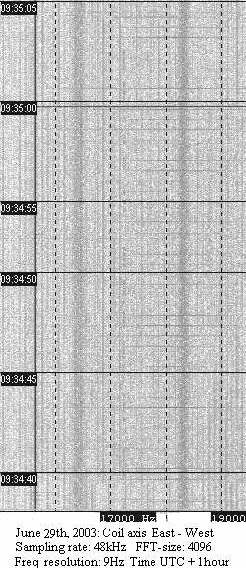
I succeeded in the reception of today's first transmission of SAQ at my home town, Sindelfingen, at 48N 43 and 8E 58.
Attached you will find a spectrogram with all data on it.
The signal of SAQ is clearly visible at 17.2kHz.
Editor's Note: Contact Harald directly for the full size spectrogram, or one from his reception of the third transmission from SAQ at 1230UTC.
Fw: LF: Re: SAQ
Posted by John Andrews on June 29, 2003 at 18:43:39
Subj: LF: Re: SAQ Date: 6/29/03 9:11:02 AM Eastern Daylight Time From: w1tag@charter.net (John Andrews)
To: rsgb_lf_group@blacksheep.org
SAQ was audible here in Massachusetts this morning. I auto-recorded the 0830 and 1030 feeds, but stupidly left the NR (noise reduction) enabled on my receiver before retiring last night. That removed a lot of the audio! The signal was well buried in the noise, but the VVV's and CQ DE SAQ's were pretty easy copy. Not so for the text, though I will play with the recording later.
The 1230 feed was heard live, and again the preliminary stuff was understandable, but only occasional words could be copied during the text section.
Anyway, not bad for a summertime daylight T/A signal, even on that frequency!
John Andrews, W1TAG
Re: Fw: LF: Re: SAQ
Posted by Mike Burns on June 30, 2003 at 09:40:41
Hi John
Might I ask what your hardware/software setup was. I got nothing here in Western NY.
Mike B.
Re: Fw: LF: Re: SAQ
Posted by John Andrews on June 30, 2003 at 10:59:22
Mike,
I used the Icom R75 with a homebrew LF to 10 MHz converter ahead of it. The converter is something I built about 6 years ago and only use for <30 kHz reception, as that's the bottom end of the R75's range. The antenna was the usual 12 turn, 6 foot square loop, resonated with about 0.11 uF! I didn't need the 30 dB preamp in the converter, so the loop output was working right into the DBM in the converter.
I'm about 50 miles inland from the coast, but the extra over-the-ground path you have might make the difference.
John Andrews
Re: Fw: LF: Re: SAQ
Posted by John Andrews on June 30, 2003 at 12:44:55
I gave up last night on trying to decipher the SAQ message. After limiting out a lot of the static bursts with Cool Edit, I found that so many characters are blotted out that I'd be guessing. Some words are out in the clear, and a bunch of letters, but not enough for real copy. I would have had better luck with the 1030 UTC recording if the receiver's NR function hadn't been left on.
John Andrews
Re: Fw: LF: Re: SAQ
Posted by Ray, W2RS on June 30, 2003 at 16:21:56
John,
Your comment about leaving on the noise reduction brings up an interesting dilemma. If I'm going to try to copy by ear, I generally need the noise blanker. However, it's easy to see how it screws up digital analysis, Argo etc. I've got more than one source of buzzing noise, so trying to null it out with the loop often doesn't work, and also pulls the loop away from being peaked on the desired signal. Short of moving to the country to escape all the neighbors (I'm in a suburb), I guess it's an either/or situation: either set up for Argo or ears.
Got any other suggestions?
73,
Ray
Re: Fw: LF: Re: SAQ
Posted by John Andrews on June 30, 2003 at 16:43:22
Ray,
On this receiver, there is a noise blanker, which I normally leave on for LF work. I turn it off only to get cleaner AM copy, or if I find it is creating copies of a strong nearby signal every 120 Hz up and down the dial. That sometimes happens when receiving near WA, who is about 40 miles away, or down in the 73 kHz region, where the blanker may key on Loran pulses.
But the receiver also has a DSP noise reduction button. It is probably a great idea at HF, but it tends to take a big bite out of the signal at LF. It is likely most useful with "hiss" type noise, and that ain't what I'm hearing at LF! Anyway, that's the function I left enabled, and it pulled the SAQ level way down. Combined with the odd keying, I can't do much with the recording.
John Andrews
www.lwca.org
potrzebie