 File Attachment 1: 5jula4.jpg
PVC reception restored
Hi Folks,
I restored the "Random Wire Dipole" used for listening yesterday. A quick, and rather late scan provided nothing audible, but verified good reception of other signals, notably Radio New Zealand on nearby 13840 kHz at a healthy S9+. This week should provide some opportunities to do some listening on 22 m during the typical hours for better propagation of HiFERs.
Next I have to get the long-wire back up... there's always something
Cheers
Ed
Re: new 13MHz beacon
Posted by Ed Holland on July 02, 2019 at 18:55:08.
In reply to Re: new 13MHz beacon posted by adrian chadd on June 30, 2019
I had a listen on the restored dipole last evening. Nothing yet, either audible or visible. I was able to detect NC, all the way from North Carolina!
There was quite a lot of QRN on the band though. Since you are so close, relative to other beacons, it does not surprise me. "GroundWave" propagation is not very extensive, and I have yet to hear other beacons in the Bay Area. About 4 miles distant was the farthest I can receive mine (PVC).
Thought there might be a better chance, since it is coming across the Bay, but there is still quite a few miles of land, plus hills to negotiate.
I'll keep an ear out anyway.
Cheers,
Ed
wspr
Posted by Jerry on July 03, 2019 at 01:34:20.
anyone doing wspr and is there a agreed to wspr frequency? Is it just me?
Posted by Bob WA1EDJ on July 03, 2019 at 10:46:16.
22M seems pretty dead lately down here in Ga. Not hearing my usual's EH, both SIW's.
Last night about 8:00 PM EDT, NC suddenly appeared and stayed strong through 10:00 PM.
SIW slant was weakly visible.
All gone this morning.
Lets see today.....
EDJ is not on any reliable schedule due to afternoon TS's. This is likely to persist all summer. Never can predict a safe day to leave it on without destruction.
Bob Re: wspr
EDJ
Posted by John Davis on July 03, 2019 at 20:53:57.
In reply to wspr posted by Jerry on July 03, 2019
The only one who has operated WSPR on 1750 m in recent years has been K3SIW, who announced a couple of months ago that he plans to run WSPR-15 again this coming winter on his alternate frequency, 185.185 kHz. It seems to be decodable at roughly the same conditions as QRSS20 can be recognized.
Because so few have ever tried the mode on 1750 m, there hasn't yet been an attempt to establish a sub-band for the mode. Also probably a factor in that: due to the inconvenience of retuning traditional LowFER antenna installations, most of the early WSPR attempts were simply made on the operator's regular frequency. However, if there were a resurgence of interest in 1750 meters generally, a commonly agreed WSPR slot might be very desirable.
John
Reminder: Lowfer net +/- 3927Khz Saturday morning 0800 California time
Posted by Jerry on July 05, 2019 at 15:55:01.
Reminder: Lowfer net +/- 3927Khz Saturday morning 0800 California time Re: Is it just me?
Or listen online at kfs:
http://69.27.184.62:8901/?tune=3927lsb
or
KPH Point Reyes:
http://198.40.45.23:8073/
or
Utah Web sdr:
http://websdr1.utahsdr.org:8901/
If you cannot get into the net on 80 meters you can listen and participate by
sending net control your thoughts at wa6owr@gmail.com
73,
Jerry WA6OWR
Posted by Ed Holland on July 05, 2019 at 16:06:07.
In reply to Is it just me? posted by Bob WA1EDJ on July 03, 2019
Bob,
Not just you.. there has been precious little to hear in Northern California, nor much time to monitor the band.
There have been times in the last couple of years when I wondered if the radios were working properly. This solar minimum has been quite pronounced.
Cheers
Ed
Re: wspr
Posted by Jerry on July 05, 2019 at 16:07:40.
In reply to Re: wspr posted by John Davis on July 03, 2019
I am pursuing wspr on 1750 meters.
I have purchased the low band filter from QRP LABS:
https://www.qrp-labs.com/lpfkit.html
I will be changing the values suggested by Clint
KA7OEI:
Using the QRP-Labs nomenclature for the filters:
C1=C4=0.0147uF (0.01uF+4700pF)
C2=C2=0.0288uF (0.022uF+6800pF)
L1=L3=54uH - 105 turns on T50-2 (red) toroid (approx. 78" wire)
L2=62uH - 112 turns on T50-2 (red) toroid (approx. 80" wire)
I will be using the SOTA Beams WSPRLITEFLEX followed by the
low band filter and an amp.
Work on the transmitting antenna continues here.
73's
Jerry WA6OWR
Re: Is it just me?
Posted by Jason Goldring on July 05, 2019 at 19:15:11.
In reply to Is it just me? posted by Bob WA1EDJ on July 03, 2019
It has been dead north of the border. I can hear ODX with no issues due to his QTH and the occasional chirper but too much QRM to lock down anything at this point. Mind you, I bounced up to 20m on 14.230 and there were sporadic cycles of SSTV I could decode, then just as quickly the cycle would end. The band is somewhat there but not nice to low power I guess. I've been shooting WSPR 24/7 on 22m and no reports. Nothing. And I typically hear SIW every so often. Not recently.
Jason WAS...is!
J1LPB
Posted by John Davis on July 06, 2019 at 05:48:19.
In reply to WAS Back On - Freq. Change posted by Bill Stewart, K4JYS on June 28, 2019
Right at sunset tonight (Friday 5 July) I snagged WAS on its new frequency, 13566.315 kHz. Sorry it took me a week to get a chance to hunt for it, Bill, but between rains, truck repair, and family pre-holiday travel, it had been three weeks since I had a chance to go to the field.
I first tuned to 22 meters after 8 PM CDT, half an hour before sunset. The watering hole was vacant except for snippets of K5LVB's QRSS and WSPR transmissions and a certain amount of Codar. K6FRC was visible but only intermittently audible. When I tuned up a little above 13566 at 8:42 PM I could copy bits of a keyed signal, but not enough for a complete ID. All I could tell for sure at that point was that it wasn't ODX, so I began to hope it might be WAS. The timing and the symmetry of the keying sidebands suggested that it probably was.
Sure enough, just before 8:45 PM it became clear enough to copy well by ear. Later, as can be seen in the attached Argo capture, QSB took it away again; but it was audible one more time when I checked back around 10:30.
[Edit: 6 July 2019 - Corrected frequency label on attached graphic.]
---------------------------------------------------------------
File Attachment 1: 5jula4.jpg
P is for Power
The mysterious "P" is making an early appearance this summer, and unlike the past two years when its signal was comparable to most others on the band, it appears to have returned to conspicuously high power levels.
I was looking for WV shortly before 9 PM CDT when my ears were assaulted by a signal peaking above S7 on 13554.990 kHz. This is roughly 24 dB stronger than any known-legitimate HiFER ever comes in with this setup even during enhancements, or approximately 200 times the ERP. It's in the range that Codar tends to read on the S-meter on days when it's at its very worst. And given how poor the band has been lately, it's worth noting that neither any such beacon enhancement nor full-strength Codar have happened recently; so the real ERP difference may be considerably greater.
The attached capture shows its bandwidth on Argo, and there's also an MP3 sound clip attached. On the screen shot I've outlined the portion of the recording that's in the MP3 clip.
After several more minutes of observation, it became evident that the first upper sideband of keying was obliterating another signal that had ocean-wave-like frequency undulations. When I checked the frequency again at 10:14 PM, P was gone and the wavy signal turned out to be WV, which was indeed audible most of the time by then.
---------------------------------------------------------------
File Attachment 1: 5jula5.jpg
File Attachment 2: P.mp3
Hi-z antenna for longwave
Hi, are hi-z vertical arrays (in this case 3 verticals) any good for beacon hunting below 500 kHz? Will they perform better than longwires, active loopss and or active e-field antennas like the mini whip? Thanks, john
OWR antenna project update
Posted by Jerry Parker on July 06, 2019 at 20:15:01.
OWR Lowfer antenna project.
Today the welder put 45 feet of my lowfer antenna with base together.
Any suggestions for insulated guying material
Next is up to the mesa, add top hat and guy wires.
We are on the way
73's
Jerry WA6OWR
Re: Is it just me? (Friday night notes)
Posted by John Davis on July 06, 2019 at 20:32:50.
In reply to Re: Is it just me? posted by Jason Goldring on July 05, 2019
In addition to the copy of WAS and P noted before in separate posts, the band also provided other reception here in SE Kansas last night, although admittedly fewer stations were present at any one time than usual.
NC was visible off and on through most of the evening, not giving up until after midnight when everyone else was also pretty much gone. K6FRC was present visually but only faintly audible at 8:38 pm (CDT), but was much stronger by 10:23 PM although with occasional deep fades.
The dotted line pattern of PVC showed up on 13555.545 at 10:07 PM, at which time NC and K5LVB were the only other watering hole residents (they were coming in poor to fair at the time). Presumed PVC never did reach audibility and eventually disappeared again. It looked like it was going to make another try at 11:26, a few Hz lower in frequency, but never quite made it.
Meanwhile, K5LVB did manage three decodes despite the very patchy appearance of the signal:
0338  -29  -0.3   13.555379    0   K5LVB         EM10      7
0356  -26  -0.3   13.555375    0   K5LVB         EM10      7
0408  -27  -0.3   13.555376    0   K5LVB         EM10      7
WV was briefly audible around 10:04 PM, no longer afflicted by Powerhouse P. It was still in the immediate vicinity of 13555.000 and was definitely wandering in a slow ocean wave pattern. I'll have an update on Saturday's reception of these two stations later.
VAN was present with its hooked DAID pattern clearly visible at 10:21 PM, but CW keying was not audible. An update on this one will be found in Saturday's notes, too.
By 11:34 PM, only FRC remained on the band, and even the mid-band ISM noise was minimal. With a forecasted 40% chance of storms by morning and lightning visible in the far west, I decided discretion was the better part of valor about midnight and returned to town. Because no storms materialized by 6:30 Saturday, I returned to the field and set up again. Nothing to write about at that time, but things got mildly interesting later and have remained so into mid-afternoon. Check it out if you're in a position to do so.
Re: Is it just me?
Posted by John Davis on July 06, 2019 at 20:49:11.
In reply to Re: Is it just me? posted by Jason Goldring on July 05, 2019
I've been shooting WSPR 24/7 on 22m and no reports.
Jason, do you have the means to measure the input to your antenna, as Bill did recently?
Not that my receive setup is perfect, and goodness knows the usual signal paths haven't been consistent lately...but I haven't seen your signal in months now, even when conditions have allowed me to copy your quasi-neighbors such as AMA and ODX.
Other stations with a "pipeline" to here of the sort yours had, such as EH, NC, FRC, WAS and 7P, can disappear for days at a time, sometimes even a couple of weeks under present conditions; but if one is absent for months, I have to suspect something may be amiss.
John
Re: Is it just me?
Posted by Jason Goldring on July 06, 2019 at 22:14:37.
In reply to Re: Is it just me? posted by John Davis on July 06, 2019
Hi John - Yes I sure do, I agree something must be wrong. We have had some pretty wicked storms come through here lately and that might have taken it's toll somehow. I will check it out and report back - thanks for the feedback. Saturday 22 M Updates - early morning.
Jason
Posted by John Davis on July 06, 2019 at 23:03:08.
I returned to the field a little after 6:30 AM CDT, about half an hour after sunrise. Nobody at the watering hole or any CW beacons, and only a little more mid-band ISM noise than at midnight.
During the 7 o'clock hour, the "Chinese measles" pulsers fired up, then NC began materializing. Halfway through the hour, the first Codar began showing up too.
By 8 AM, USC began appearing faintly and MTI made its first appearances, quickly rising to full audibility at 8:15 and 8:17. SIW slant showed up shortly thereafter, and remained a fixture off and on through mid-morning, vanishing between 10:05 and 10:10 (see attached capture). SIW WSPR also showed up at decodable levels, but only for relatively short intervals (less than half a minute at a time), so it never decoded.
By the 11 o'clock hour, NC's signal was drifting down over another one. Soon after, it became apparent that it was 7P, the first time I've seen it since before the HamventionTM. By noon, it was vanishing down into the noise again.
More on the noon hour band scan in the next message. I had hoped to add some screen captures to this message over the weekend, but they weren't very good (full of QRN and QRM). Sunday's shots are much better, and will be posted over the next day or so instead.
Re: Is it just me?
Posted by Jason Goldring on July 06, 2019 at 23:39:25.
In reply to Re: Is it just me? posted by John Davis on July 06, 2019
Looks like it was a failing BS170 transistor. It was putting out enough for me to monitor it at home, but to fail at about only ~1-2mw as metered, probably a manufacturing flaw. Replaced, SWR checked again at 1:4. Crossing fingers..... Re: Is it just me?
Thanks again John.
Jason
Posted by John Davis on July 07, 2019 at 02:12:19.
In reply to Re: Is it just me? posted by Jason Goldring on July 06, 2019
Good deal. I'll be looking out at the next opportunity...meaning, whenever the pop-up thunderstorms permit. Had to vacate the farm during the 6 PM hour, and they've been malingering all around us ever since. (Just now got enough confidence back to reconnect my modem, but it's not clear yet which direction the next batch of storms is moving.)
Re: OWR antenna project update
Posted by J.B. McCreath on July 07, 2019 at 14:35:36.
In reply to OWR antenna project update posted by Jerry Parker on July 06, 2019
Hi Jerry,
I've had good luck with the nylon rope sold by TSC stores, for both guys and halyards.
They quite often put pre-cut lengths on sale, which is very convenient. Put a short
length of heat shrink tubing at the ends to prevent fraying. I've had some up for
over ten years, with no "aging" problems.
73, J.B., VE3EAR Re: OWR antenna project update
Posted by Jerry on July 07, 2019 at 15:01:08.
In reply to Re: OWR antenna project update posted by J.B. McCreath on July 07, 2019
Thank you for the tip
Re: Is it just me? (J1LPB is back!)
Posted by John Davis on July 07, 2019 at 15:35:51.
In reply to Re: Is it just me? posted by John Davis on July 07, 2019
Several decodes this morning during the 9 AM CDT hour. Will be returning to the farm after the World Cup. Reports later.
LIstening in again
Posted by Ed Holland on July 08, 2019 at 02:52:31.
Hi Folks,
Apologies to anyone listening for PVC, but I found I'd forgotten to switch on again... Running now.
I did find time to listen, and found rather a quiet band. Saturday evening, I saw a couple of carriers above 13,562.00, but I don't think the frequencies correspond to HiFERs.
Sunday morning (7th July ~ 09:00 PST) I scanned again. A very low background noise level didn't seem to promising, but 7P made an appearance, and was audible at times. Alas, it was the lone signal copied.
Cheers
Ed
Re: Saturday 22 M - Mid-day (WV, P, WAS, VAN)
Posted by John Davis on July 08, 2019 at 05:11:53.
In reply to Saturday 22 M Updates - early morning. posted by John Davis on July 06, 2019
During the noon hour, WV was back up at 13555.040 kHz and no longer undulating in frequency. P was visible and faintly audible (much more like a typical HiFER) around 13554.990, with a bit of frequency spread on Argo indicating chirp, although it was not particularly audible as such.
WAS remained visible and faintly audible at 13566.315 kHz. VAN's hook-like DAID was fairly clear on 13563.092 from 12:39-12:50 PM CDT, although CW keying was only audible a few times. I've indicated these instances with asterisks in the attached capture.
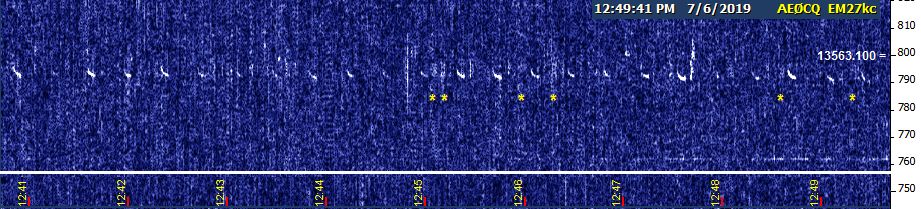
---------------------------------------------------------------
File Attachment 1: 6julb43.jpg
Re: Saturday 22 M - Afternoon (NDB2, MN, more)
From 1 to 2 PM, a prolonged band scan yielded fair to (briefly) very good signals from NDB2; and weak to fair signals from MN (presently 13562.845 kHz).
K6FRC was visible on Argo just before 1 PM, sometimes also with fair to good aural copy. At the watering hole, NC, SIW slant, and MTI were visible. (NC was in collision with SIW slant. MTI was audible several times.) Alas, only the faintest whispers of SIW WSPR could be seen. It did decode one time, however:
1944 -29 -0.5 13.555405 0 K3SIW EN52 7
Hints of 7P started showing up from 3:30 to shortly before 5:00, by which time SIW had gone away. 7P rematerialized a few times during the 5 o'clock hour, until both it and NC faded away by 6:10 PM. By 6:30, EH was visible in a patchy sort of way, with frequency undulations suggesting that it had just been switched back on after being off for listening. What may have been SIW WSPR appeared a couple of times then, followed by part of K5LVB's WSPR segment. By 7:00 PM, all had gone away again.
With storms developing around the northern horizon, I did not wait for post-sunset enhancements, but packed up and returned to town.
Sunday Report(s) - The WSPRers
Posted by John Davis on July 08, 2019 at 05:58:30.
All three 22 m WSPR beacons were on and arriving in SEK today. J1LPB was a regular from just after 9 AM CDT (when I arrived at the field) until 5 PM (when heat exhaustion and growing clouds prompted me to pack up and leave).
In addition, from roughly 1:00 to 3:30, K3SIW and K5LVB joined the party from time to time. Below is a sample of the decodes from that time frame. The full batch has been uploaded to WSPRnet and can be searched with AE0CQ as the reporter's call sign. (As noted once before recently, SIW WSPR does not appear as strongly or consistently these days as SIW slant does.)
1624  -23   0.1   13.555413    1   J1LPB         FN03      0
1626  -27   0.1   13.555413   -1   J1LPB         FN03      0
1630  -21   0.2   13.555414    1   J1LPB         FN03      0
1632  -25  -0.0   13.555369    1   K5LVB         EM10      7
1632  -21   0.3   13.555414   -1   J1LPB         FN03      0
1636  -33  -0.6   13.555404    0   K3SIW         EN52      7
1636  -20   0.3   13.555415    0   J1LPB         FN03      0
1638  -26  -0.0   13.555369    0   K5LVB         EM10      7
1638  -22   0.3   13.555414   -1   J1LPB         FN03      0
1640  -32  -0.6   13.555405    0   K3SIW         EN52      7
1642  -24   0.1   13.555414    1   J1LPB         FN03      0
1644  -21  -0.2   13.555369    0   K5LVB         EM10      7
1644  -20   0.2   13.555414   -1   J1LPB         FN03      0
1648  -21   0.2   13.555414    1   J1LPB         FN03      0
1650  -24  -0.1   13.555370    0   K5LVB         EM10      7
1650  -20   0.3   13.555414   -1   J1LPB         FN03      0
1654  -25   0.1   13.555415    1   J1LPB         FN03      0
1656  -26  -0.1   13.555370    0   K5LVB         EM10      7
1656  -23   0.3   13.555414   -1   J1LPB         FN03      0
1700  -22   0.1   13.555414    1   J1LPB         FN03      0
1702  -27  -0.2   13.555371    0   K5LVB         EM10      7
1702  -19   0.2   13.555414   -1   J1LPB         FN03      0
1706  -19   0.2   13.555414    1   J1LPB         FN03      0
1708  -26  -0.1   13.555370    0   K5LVB         EM10      7
1708  -21   0.3   13.555414   -1   J1LPB         FN03      0
1712  -20   0.1   13.555414    1   J1LPB         FN03      0
1714  -19   0.3   13.555414   -1   J1LPB         FN03      0
1718  -21   0.2   13.555414    1   J1LPB         FN03      0
1720  -20   0.2   13.555414   -1   J1LPB         FN03      0
1724  -18   0.3   13.555414    1   J1LPB         FN03      0
1726  -28  -0.2   13.555369    0   K5LVB         EM10      7
1726  -15   0.1   13.555414   -1   J1LPB         FN03      0
More from Sunday's activities in a future post.
Re: Saturday 22 M - Mid-day (WV, P, WAS, VAN)
Thanks for the report, John. K6FRC/B Six Mtr Bcn Hrd in NC
jim vm
Posted by Bill Stewart, K4JYS on July 08, 2019 at 20:00:38.
Hey Paul...just in case you read this, just letting you know your six mtr. beacon is making it into NC around 1947Z on +/- 50.080. Sigs are 549 to 559, QSB. So far no stns from out west have been heard on CW. That could be partly my minimum setup. Using a IC-706mk2g with a 2-ele at 20 feet. Re: Hi-z antenna for longwave
73 de Bill K4JYS
Posted by John Davis on July 09, 2019 at 06:51:18.
In reply to Hi-z antenna for longwave posted by John on July 06, 2019
It would help to know more about the verticals in answering your question, such as their height, their spacing from each other, approximate distance to trees and structures, and at least a rough idea of how you plan to couple them together into an array.
I use a 15 meter vertical antenna myself with good results, with a unity gain buffer amplifier for impedance transformation. However, it's only a single element. There are times I'd love to have more than one, separated by enough distance to achieve useful amounts of directivity to null out noise sources such as clusters of thunderstorms.
RTE 252 now off air
Posted by Mike Terry on July 10, 2019 at 12:46:50.
RTE Radio 1 on 252 Khz is now off air from today for possible 10 weeks or so here In the UK we can hear signals from Algeria Chaine 3 even in the middle of the day.
Re: RTE 252 now off air
Posted by Mike Terry on July 10, 2019 at 12:58:44.
In reply to RTE 252 now off air posted by Mike Terry on July 10, 2019
Earlier this year the chair of Ireland’s Oireachtas Communications Hildegarde Naughton TD (Galway West and South Mayo) announced that a major antenna upgrade will ensure the transmission of RTÉ on long-wave will continue for at least the next two years.: “The maintenance of long wave radio for the Irish diaspora is a significant concern to the Committee.”
She announced that service will have to be “temporarily suspended” for approximately ten weeks, but RTÉ has said it will endeavour to complete the works as quickly as possible.
“I welcome the efforts being made to continue this service, which serves as an invaluable link between the diaspora and home,” she added.
See http://www.theirishworld.com/reprieve-for-rte-longwave/
AZ Beacon
Posted by John Bergkoetter on July 10, 2019 at 13:36:00.
I was able to see beacon AZ for a few minutes yesterday; can anyone tell me where the beacon is located? I re-did my Inverted V antenna this last weekend and since then AZ has been showing up for short intervals. I am at DM22.
Re: Saturday 22 M - Mid-day (WV, P, WAS, VAN)
Posted by Bill Stewart, K4JYS on July 10, 2019 at 13:40:30.
In reply to Re: Saturday 22 M - Mid-day (WV, P, WAS, VAN) posted by John Davis on July 08, 2019
Tnx John for the recent rpt on WAS. Glad the new freq is working. I have finally packaged the xmtr into a small plastic box and with a separate p/s, have mounted them on a small board and hung it on the wall out of the way. Much better than previously with the xmtr laying on a bench top...hi. Tnx for all your listening and reporting. Re: AZ Beacon
73 de Bill K4JYS
Posted by John Bergkoetter on July 10, 2019 at 15:42:02.
In reply to AZ Beacon posted by John Bergkoetter on July 10, 2019
Never mind; I found the page where the beacons are listed.
Re: Sunday Report(s) - The Watering Hole
Posted by John Davis on July 11, 2019 at 00:19:36.
In reply to Sunday Report(s) - The WSPRers posted by John Davis on July 08, 2019
The daytime hours were amazing, as seen in these morning and afternoon captures and the all-day SIW slant capture.
As early as 9:20 AM CDT Sunday, USC, NC (then in collision with another FSK that turned out to be EH, once NC drifted lower in the heat), 7P, J1LPB, and MTI were already present, accompanied by QSB and miscellaneous QRM and QRN. They got much better by the time of the AM capture attached (7jul-wh-am.jpg), although codar was sometimes present by then too.
By mid afternoon, the Illinois path was open more consistently, although USC had disappeared for the day and 7P was pretty scarce most of the time. This enabled decodes of all three WSPR stations, as noted in the earlier report. One such instance of that can be seen it the attached file 7jul-wh-pm.jpg, at 1420 CDT/1920 UTC. That's the time slot that produced:
1920  -25  -0.3   13.555369    0   K5LVB         EM10      7
1920  -32  -0.8   13.555405    0   K3SIW         EN52      7
1920  -25   0.1   13.555414   -1   J1LPB         FN03      0
The -32 dB of K3SIW is the lowest SNRr at which I've ever seen WSPR-2 decode.
For what it's worth the SIW WSPR signal was again coming through at a lower visually apparent level than its slant-mode counterpart, which was visible off and on through the morning as well as most of the afternoon. View the "9 to 5" coverage here in scrollable form (opens in new tab or window):
Note that nothing was visible in the 13555.43 slot right at the start; then codar switched on abruptly at 9:45 AM CDT; an early look at SIW from 10:30 to 10:45; and its return around 11 AM, accompanied by a Hz or so of receiver drift as the temperature rose from the low 80s °F to 110 °F inside the building during the hour before noon. (The latter temp is a bit rough on old geezers!) A half hour gap follows, then an hour of weak signal from SIW, being swamped by NC drifting further downward in frequency.
The SIW signal faded further, vanishing entirely around 1:58 PM. I took the opportunity to do a quick band scan, which will be the subject of my last report for Sunday. I returned to the watering hole by 2:10, to discover that the IL-KS path was open in earnest! The final few hours were pretty consistently solid, with some multipath Doppler showing up a few times.
The path from Illinois switched off right at 5 PM, just as the "W" ended. After a couple more minutes of watching, I did a brief band scan (see later post) then returned to the watering hole at 5:20, at which time SIW had not returned and I needed to shut down and return the gear to town.
---------------------------------------------------------------
File Attachment 1: 7jul-wh-am.jpg
File Attachment 2: 7jul-wh-pm.jpg
Re: Lowfer net +/- 3927Khz Saturday morning 0800 California time
Notes on 6 July, 2019 Lowfer net (+/- 3927Khz Saturday morning 0800 California time) Present were: Jerry, WA6OWR; Dave, WD4PLI; Clint, KA7OEI; John, AE0CQ (via WebSDR and email) 73, Clint KA7OEI Re: Sunday Reports - The Band ScansDave:
Jerry:
Clint:
John:
Posted by John Davis on July 11, 2019 at 06:01:31.
In reply to Re: Sunday Report(s) - The Watering Hole posted by John Davis on July 11, 2019
P, WV, MN, ODX and KAH turned up at different times of the day. Just before 9:30 in the morning, CDT, I copied P at a couple Hz below 13555.0. By ear, it initially sounded as if the "P" ident was following a couple of "V"...but then it got kind of jumbled. As the Argo traces built up, I could see that it was actually two signals only a couple of Hz apart, and surmised it was probably WV and P inadvertently on the same spot. I determined to check on that later in the morning.
Much needed to be done on the farm Sunday, however, so I didn't get to check again until my brief mid-day scan. At 1:58 PM, the two signals were over 10 Hz apart, and it was clear to both the ear and eye that it was indeed WV and P interacting. At 2:01 PM, I had several minutes of fair to good copy of MN on 13562.345.
At 2:07 PM, I snagged KAH on 13567.768. I presume Ian still hasn't been to the lake to nudge it back in band. Over the course of two minutes, two IDs were good and solid to the ear, two were audible for two characters at a time, and the remainder were identifiable only as a keyed carrier. At 2:09 I tuned down to 13566.465 and was rewarded with four or five repeats of copyable ODX idents.
The final band scan of the day was from about 5:03 to 5:20 PM. It yielded only P. WV was no longer present, nor any other CW signals--not even MTI or FRC. That was when I had to quit for the day.
RSP2
Posted by Jerry on July 11, 2019 at 14:51:46.
Are any of you using the RSP2.
How does it compare with other receivers.
Thanks,
Jerry WA6OWR
Re: RSP2
Posted by jim vm on July 11, 2019 at 20:15:06.
In reply to RSP2 posted by Jerry on July 11, 2019
I have one rsp2 rx. I do not like the sdrplay software, too many settings to adjust! Plus my win10 computer only has a usb 2.0 port, causing motorboating unless I set the bandwidth to minimums. The RSP spectrum analyzer SW works good. Mine is the 12 bit version.
I can use a raspberry pi 3b+ with the RSP sw and that too is over complicated. The rsp2 works great on 1090 MHz for adsb.
I keep the rsp2 in my desk draw most of the time! Prefer to use my Flex 6300 for HF.
73 jim vm
Reminder: Lowfer net +/- 3927Khz Saturday morning 0800 California time
Posted by Jerry on July 12, 2019 at 22:34:21.
Reminder: Lowfer net +/- 3927Khz Saturday morning 0800 California time Meager Friday Evening on HF
Or listen online at kfs:
http://69.27.184.62:8901/?tune=3927lsb
or
KPH Point Reyes:
http://198.40.45.23:8073/
or
Utah Web sdr:
http://websdr1.utahsdr.org:8901/
If you cannot get into the net on 80 meters you can listen and participate by
sending net control your thoughts at wa6owr@gmail.com
73,
Jerry WA6OWR
Posted by John Davis on July 13, 2019 at 04:40:58.
Now that we are farther past the Solstice, evenings seem less productive. I got started over half an hour after sunset, and at first only EH could be seen, faintly. K6FRC was fluctuating rapidly (sometimes over the course of a single ID) from poor to very strong.
At 9:41 PM, nature offered a brief ray of hope. A dotted line pattern suggestive of PVC appeared on 13555.535, then faded after a couple of minutes. Simultaneously, NC appeared faintly, EH went away for a while, and SIW slant started to show. 7P turned up for a few IDs too. K5LVB also appeared, so faintly I didn't expect the WSPR-2 portion to decode...but it did!
0244 -27 0.1 13.555379 0 K5LVB EM10 7
At one point, the dotted line achieved enough visual strength for one single ID that it should have been faintly audible; and probably would have been, were it not for EH, 7P and LVB all rising in level briefly within the same 100 Hz wide segment right at the same moment. In about 10 more minutes, though, everything pretty much returned to the way it was earlier, and only EH remained.
Around 10:36 PM CDT, I did another band scan. When I checked on FRC again (the only signal audible) I found it to be faint but considerably more consistent in level. Returning to the watering hole, the dotted line was back. This time it was all alone in the receiver passband, and I could just detect that it was a keyed signal. Not enough was present to confirm it as PVC.
I'll try again in the morning.
Re: RTE 252 now off air
Posted by Mike Terry on July 13, 2019 at 17:11:16.
In reply to Re: RTE 252 now off air posted by Mike Terry on July 10, 2019
Back on but seems to be lower power.
Re: Reminder: Lowfer net +/- 3927Khz Saturday
Posted by John Davis on July 13, 2019 at 17:22:22.
In reply to Reminder: Lowfer net +/- 3927Khz Saturday morning 0800 California time posted by Jerry on July 12, 2019
Since we won't have our usual Clint's Notes this week, here is the recording of this week's session:
websdr_2019-07-13_3927kHz.mp3 July 13, ≈9 MB
Right-click the link to save to your computer or device for most reliable playback.
Last week's net was well covered in Clint's report, but if anyone wants to hear that one, here it is too: July 6.
Eyes and EARs
Posted by John Davis on July 13, 2019 at 17:46:40.
Does anyone remember the name of the software that allows you to overlay multiple Argo captures to try to extract repeated info from noise?
I tried to capture EAR last night. The static from then T.S. Barry was not as bad as that from thunderstorms in the high plains, which I hoped would ease up overnight. They didn't. But thanks to EAR's accurate timing of IDs every 15 minutes, plus the fact my captures are set for exactly 30 minutes, clicking through the night's images reveals recurring partial Morse elements in the same place every frame. It's clear from these that the "R" was present in the right place often enough to confirm I was seeing EAR intermittently under the S9+20 noise, but I'd like to assemble a composite with somewhat more visual certainty.
Re: Eyes and EARs
Posted by John Davis on July 13, 2019 at 17:59:26.
In reply to Eyes and EARs posted by John Davis on July 13, 2019
Does anyone remember the name of the software that allows you to overlay multiple Argo captures...
A better term than overlay, or at least more common in technical use, is "stack." I'm aware of some applications for astronomers, but these may be overkill for Argo captures...and there was at least one program already out there for Argo images.
Re: Reminder: Lowfer net +/- 3927Khz Saturday
Posted by Lee on July 14, 2019 at 02:50:31.
In reply to Re: Reminder: Lowfer net +/- 3927Khz Saturday posted by John Davis on July 13, 2019
Thanxs John
Re: Eyes and EARs
Posted by John Bruce McCreath on July 14, 2019 at 13:11:39.
In reply to Re: Eyes and EARs posted by John Davis on July 13, 2019
Thanks for the determined effort, John. I can't help you with a software source, but I do recall there was something available that would do what you want. Keep digging!
73, J.B., VE3EAR Re: Eyes and EARs
Posted by Mike N8OOU on July 14, 2019 at 15:34:30.
In reply to Eyes and EARs posted by John Davis on July 13, 2019
John;
I couldn't remember the name of the programs either. I went down this path.
http://pensacolasnapper.blogspot.com/search/label/stitching
and
http://pensacolasnapper.blogspot.com/search/label/stacking
to end up here;
https://github.com/swharden/QRSS-VD
Maybe what you are looking for resides there. I have done a download and am looking at it.
Mike. 73
Re: Eyes and EARs
Posted by John Davis on July 14, 2019 at 16:59:33.
In reply to Re: Eyes and EARs posted by Mike N8OOU on July 14, 2019
Thanks for the good info, Mike. QRSS-VD itself doesn't quite look like what I'm after, partly because I don't have the Python platform available on my notebook and partly because its many capabilities are likely to be a strain on the machine's limited resources. (It had enough of a strain with Argo and WSPR together to cause some data loss during observations of 22m yesterday morning, in fact.) This program looks to be a very versatile, complete capture utility in one program; but I fear I'd need a new computer to run it, which might not be a great idea in the field.
However, that same page also mentioned Scott's QRSS Stitcher and QRSS Stacker programs, which let you work with groups of images captured from Argo, SpecLab, etc, which is exactly my current situation!
It appears QRSS Stitcher automates the process I've been doing manually to create panoramic all-night views of signals, aligned in time and frequency with the border areas trimmed off. QRSS Stacker then provides additional tools to help you identify the repetition rate and even the frequency drift across multiple repetitions in the stitched images, and overlays them for you into a single trace that can be further tweaked for best alignment. Looks promising.
I did try one of the astronomical image stacking tools yesterday, named RotAndStack (short for "rotate and stack," but more appropriately pronounced "rotten stack" in my situation). It highlighted the trouble with using an astronomical tool for analyzing radio data: routines to help align data that is inherently visual in nature from the beginning (ie, two spatial dimensional arrays of brighter and darker pixels) tend to be confused by data that originates differently but is presented in a graphical representation of time, frequency, and intensity. Even after forcing the software to stop rotating the images in a bogus attempt to align them better, it still didn't do an effective job of combining them. The output found patterns in the random noise, but obliterated the patterns that the eyes could detect as the letter R occasionally.
Because the captures were at 30 minute intervals, every other ID was being overlaid on its second nearest counterpart; that is, it was clustering the data as pairs of IDs. With Stitcher and Stacker, if I get the repetitions set right, all individual IDs will be overlaid into a single composite, which should be twice as effective. Even so, based on the first attempts, I'm still not sure it'll be enough. But it'll be worth a try.
Re: Eyes and EARs
Posted by Mike N8OOU on July 14, 2019 at 22:10:30.
In reply to Re: Eyes and EARs posted by John Davis on July 14, 2019
John,
I have tried QRSS-VD before, it runs find on my linux systems, but for some reason I keep going back to ARGO. I guess I used ARGO first which makes it my preference. However, this github zip file for QRSS_VD has both QRSS Sticher and Stacker (Windows programs) which seem to work ok in the Linux/Wine environment. I was able to merge two .jpg files into one. I'm not sure they are the same programs from the past. They produced the combined image I was expecting.
Mike 73
Sunday 14th July
Posted by Ed Holland on July 15, 2019 at 15:32:45.
Hi Folks,
Yesterday offered a good opportunity to monitor 22m. I have been playing around a bit more with Spectrum Lab recently (to measure loudspeaker response) and while reading up on features and controls, paid a bit more attention to the possibilities.
And with that, I learned that it is trivial to capture data, screenshots etc on a schedule or time interval. There are other trigger conditions also.
While most of the fun in radio is listening in real time, getting more samples during the day seems an interesting prospect.
And so, I listened, and recorded yesterday for about 3 hours, 11 am to 2 pm local time, and later in the evening, around 7 45 pm
7P was a pretty consistent signal during the middle of the day, with scant else to be seen or heard.
Later on, several signals appeared at the watering hole, USC, 7P, Another signal synchronised on the minute (Could be WSPR, or CW, hard to see at the resolution used). Possibly EH lower down the chart as well, but the trace was too broken to read.
The capability for unattended recording is beckoning, and I'm giving consideration to the best receiver for this task i.e. one that I am prepared to leave on for long periods, without concern over the wear and tear. Perhaps a little SDR is in order?
Cheers
Ed
Re: Sunday 14th July
Posted by Jason Goldring on July 16, 2019 at 02:21:10.
In reply to Sunday 14th July posted by Ed Holland on July 15, 2019
Hi Ed, just my 2 cents. I have tried (and still do) the same thing - recording sessions, but I often find that in 22m and 1750m bands there is a whack of interference that comes through on the SDR, such as that which I am experiencing now, however, the advantage of them being software controlled and open source to a large extent, there are a number of different RTL_SDR drivers you can use suited to your needs. I am using one right now that really trims bandwidth and keeps IMD at bay, but it's still prone to overload. If you need any help let me know! I have several SDR's running. Re: Sunday 14th July
Jason
Posted by Ed Holland on July 16, 2019 at 18:06:38.
In reply to Re: Sunday 14th July posted by Jason Goldring on July 16, 2019
Hi Jason,
Thanks for your note. IMD is certainly a concern. A while back, I got the notion to try and build a high Q preselector, just to see what could be done, thinking from first principles. Retuning is a nuisance for general work, but for a receiver parked at one frequency, the narrow bandwidth would be a problem.
On similar principles, I had good luck with a tuned loop for receiving at 22m, and this had a very narrow bandwidth and enough sensitivity to see 22m signals.
Sometimes having only a 14 kHz band can be seen as an advantage ;-)
Cheers
Ed
Re: Sunday 14th July
Posted by Bob WA1EDJ on July 17, 2019 at 14:18:35.
In reply to Re: Sunday 14th July posted by Ed Holland on July 16, 2019
Ed,
Can you describe the tuned loop for 22m? How small is it? Sounds interesting.
Bob Re: Sunday 14th July
EDJ
Monroe GA
Posted by Ed Holland on July 17, 2019 at 15:56:49.
In reply to Re: Sunday 14th July posted by Bob WA1EDJ on July 17, 2019
Hi Bob,
The loop I tested was quite experimental, which is a nice way of saying lash up.
I made a PVC pipe frame, 2' x 2' from two sections of 3/4" material crossed at the centre. 12 or 14 gauge wire was run through holes at the pipe ends to create the main loop, in the form of a square. The two ends of this piece of wire met at the top part of the frame at one corner, and connected to a 10-150 pF variable capacitor. That forms the high-q tuned circuit.
A smaller coupling loop ~ 1/5 of the main loop diameter was formed at the lower corner. It has no direct connection to the main loop, but forms a coupling transformer that provides something close to 50 ohm matching to the high impedance of the main loop. The small loop can connect directly to the coax line.
If you have things right, there will be a sharp tuning peak on the variable capacitor - some means of adjusting this while keeping hands away from the capacitor and top of the loop are helpful, as it is prone to detuning by nearby objects.
It is very simple to test, and lots of examples pop up if you search the web. I haven't tried a full weather-proof build yet, but may do this.
I even tested mine as the antenna for PVC - it put out a good signal as much as I could judge from ~1 mile distant, but received no reports.
Cheers
Ed
Re: Sunday 14th July
Posted by Ed Holland on July 17, 2019 at 19:53:52.
In reply to Re: Sunday 14th July posted by Bob WA1EDJ on July 17, 2019
Hi again Bob,
This calculator is really helpful for loops. It is designed for transmitting loops, but the info is also great for receiving loop design.
www.66pacific.com/calculators/small-transmitting-loop-antenna-calculator.aspx
Another hobby crossed over into the loop experiment after a bicycle wheel exhausted its useful life. Using just the rim, cut at one place to connect the capacitor, this seemed to offer reasonable performance for 22m receive. In that case, the loop is only 60 cm, or about 24" diameter. An alloy rim provides lots of conductor, high Q and thus narrow bandwidth.
Another factor is the small size and ability to null out local noise sources - lots of placement options.
One thing I do object to is the term magnetic loop. What the system really is, is a very high impedance antenna.
Cheers
Ed
Saturday the 13th
Posted by John Davis on July 17, 2019 at 20:04:55.
In reply to Meager Friday Evening on HF posted by John Davis on July 13, 2019
Friday the 13th came on a Saturday this month, and lasted all weekend.
I resumed listening Saturday morning before 9 AM CDT, hopeful of a good day because the watering hole looked fairly active. USC was solid, NC and EH were moving into collision with each other, J1LPB WSPR was showing clearly, and MTI was strong. Elsewhere on the band, WV was fair to good, K6FRC was intermittent, but none of the other stations were audible. By 10 AM, SIW slant became visible and remained until 11 AM, and reappeared from around 12:50-2:30 PM; but that's all I can tell you about the mid-day reception up until after 3 PM. That's where the #13 business was hard at work.
Thing is, I'd set up two QRSS3 Argo instances to capture the entire watering hole, one QRSS30 instance to watch for SIW slant, and one of WSPR-X to monitor the WSPR Gang of Three. At one point, all three Argo windows had automatic capture turned on. Alas, this Windows session was the first since I'd allowed Automatic Update to do its thing, and without warning a resource war broke out between the software applications, thanks to the confusion the update caused to the AMD processor and/or other devices on the Acer motherboard. Different apps took turns not working, then all user input was blocked for several minutes too. When I finally regained some degree of control and got all the Argo instances resynchronized, I thought all was well and went to run necessary errands. Turns out, one or more of the apps violated the terms of the cease-fire and shuffled some of the windows around on the desktop...turning off the QRSS3 captures in the process, leaving only the QRSS30 and (miraculously) WSPR-X to provide any info when I resumed human participation at 3 PM. Between 9 AM and 3 PM there had been 35 WSPR decodes of J1LPB and 3 of K3SIW.
By that time, USC, EH, 7P, NC, and MTI were the watering hole residents, but all showing fair to poor levels. Elsewhere, WV was weak to fair, a weak keyed signal was visible but nut audible just below WV, and I eventually had copy of ODX by 3:28 PM.
Not long after that, just to add injury to insult, the pickup decided to overheat at a time when I needed the A/C to cool down! My water supply on the farm was down to just a couple of cups, but adding it to the reservoir gave me just enough coolant to make it back to town after everything had cooled a bit. All in all, a less productive day that it could have been. Re: Saturday the 13th
But the next day was even worse. I didn't get a chance to get away until the noon hour, so I was setting up hastily to catch solar noon (a little after 1 PM). Haste meant a chance to lay waste to the fuse inside the radio...and nowadays, we no longer have anyone who sells fuses in town between noon Saturday and 7:30 AM Monday. A trip out of town (35 miles each way) could have fixed it sooner, but at the cost of missing solar noon anyway. Bummer! But at least the radio was not permanently harmed.
Posted by Ed Holland on July 17, 2019 at 20:40:40.
In reply to Saturday the 13th posted by John Davis on July 17, 2019
Goodness, John, what an adventure...
I had a minor panic last week when suddenly, without warning, the tuning control on my most used receiver suddenly developed a grinding sensation - and sound - when used.
That sent my mind racing - what if the encoder is starting to self destruct? It turned out to be rubbing from the C clip that retains the shaft in the control's bushing. Carefully it was removed, smoothed with 2000 grit emery, cleaned, and replaced with a tiny drop of oil. That cured the problem, although it took a while to recover from those initial fears of the worst.
Wishing you better luck,
Ed
HiFERs Wednesday, 17 July
Posted by John Davis on July 17, 2019 at 20:41:21.
Finally got another chance to listen late this morning. WM and a mystery signal were the highlights. USC, EH, and 7P were poor to fair copy at the watering hole, NC and SIW WSPR were better, J1LPB and K3SIW WSPR were intermittently visible (K5LVB showed up a little later), MTI ranged from poor to good copy, and HiFER WM was back!
A band scan turned up WV at 11:17 AM CDT on 13554.995 kHz. Then, three minutes later, I ran across a mystery signal centered on 13557.360 that sounded like an odd multitone signal. It was 50 Hz wide and was somewhat stronger than a normal HiFER typically is. I tried to make a recording, but I'll have to retrieve it when I return to the field in a few minutes.
At 11:23 AM, 13562.830 yielded MN for just a couple of aural IDs and a few more visible repetitions. Above 13565, however, anybody who might've been present was being wiped out by SWBC sidebands.
At the 12:34 PM scan, WV and NDB2 were fair to good copy for a couple of IDs each.
Here's some of the early WSPR decodes today:
1628  -28   0.3   13.555413    1   J1LPB         FN03      0
1636  -28  -1.0   13.555405    0   K3SIW         EN52      7
1636  -28   0.4   13.555413    1   J1LPB         FN03      0
1644  -23  -0.0   13.555368    0   K5LVB         EM10      7
1644  -31   0.3   13.555413    0   J1LPB         FN03      0
1650  -20   0.2   13.555368    0   K5LVB         EM10      7
1652  -28   0.3   13.555413    0   J1LPB         FN03      0
1656  -22   0.0   13.555368    0   K5LVB         EM10      7
1700  -25   0.4   13.555414    0   J1LPB         FN03      0
1702  -24  -0.1   13.555369    0   K5LVB         EM10      7
1708  -26   0.3   13.555414    0   J1LPB         FN03      0
Re: HiFERs Wednesday, 17 July
Here are files of the mystery signal on 13557.360, both a brief MP3 of the fluttery sound and an Argo capture showing its bandwidth. It was not present when I was able to return to the field in late afternoon; but then again, none of the watering hole residents were doing well either and none of the CW beacons were audible or visible at all by 5 PM CDT.
I regret that it took so long to set up the recording, and that it had to be made through the external Dicke Fix audio processing. That took a lot of the apparent fluttery quality out of the recording and rendered the random clicks and pops the same level as the tones themselves. The closest to what I was hearing in real time are the first 15 seconds of the recording and the last 10 seconds. The two-per-second codar pulses can be heard as pop-pop-pop-pop sounds due to the narrow CW filter at around 40 seconds in.
---------------------------------------------------------------
File Attachment 1: 17jula.jpg
File Attachment 2: 20190717exotic.mp3
Re: RSP2
Hi Jerry,
I have a RSP2Pro, and It does the job for me. I agree that SDRUNO is a little overkill, (maybe crazy overkill) but I find it workable especially with a good antenna. No comparison to a Flex slice receiver, but then I think that's out of their wheelhouse.
What I don't like is all the peripheral stuff you really should have to protect it, Rx/Tx sense switch, receiver guard, etc. It runs fine on a Win10 I7 laptop I have, although it does hog resources. Wouldn't want to have too much running along side it.
I use it only to monitor first-glance band activity and to free up other radios. Good luck !
73 Re: Sunday 14th July
Jim, WQ2H/WK2XAH
Posted by Bob WA1EDJ on July 18, 2019 at 15:58:11.
In reply to Re: Sunday 14th July posted by Ed Holland on July 17, 2019
Thanks Ed!
If I ever get out of the several rabbit hole's I have going, I may try a loop.
Thanks for the info.....
Bob EDJ
Thursday HF 18 July
Posted by John Davis on July 18, 2019 at 18:00:15.
The Illinois path is open--the SIWs, WM, and (as of noon CDT) NDB2. Also, USC, EH, NC, and MTI have joined in. K5LVB has been visible in QRSS3 and decoding nicely in WSPR. WV and MN have been audible briefly, but no sign yet of the Canadians, FRC, WAS, or anyone else above 13563. (The 50 Hz wide mystery signal from yesterday has also been absent thus far.)
Re: Sunday 14th July
Posted by Ed Holland on July 19, 2019 at 04:22:27.
In reply to Re: Sunday 14th July posted by Bob WA1EDJ on July 18, 2019
Rabbit holes - I keep falling down them :)
Lately:
Fiddling with spectrum lab for HF logging
Fiddling with spectrum lab to evaluate home made HiFi speakers
Building loudspeakers
Restoring old radios
Repairing the car...
Antennas are fertile ground for this as well :) Re: Thursday HF 18 July - Afternoon & Evening
Posted by John Davis on July 19, 2019 at 06:01:59.
In reply to Thursday HF 18 July posted by John Davis on July 18, 2019
At mid-afternoon, most of the same stations were present, plus there were now WSPR decodes fro, J1LPB. WV had drifted downward several Hz. Visual presence of RF from FRC, and possibly WAS, but not audible enough to confirm.
I was tied up with an unsuccessful attempt to meet up with a contractor, so it was half an hour after sunset before I got another chance to check on 22 m. The SIWs were gone and there was no more NDB2 either, but WM hung around until after 9:30 PM CDT. EH and NC were fair to good, and K5LVB was pretty consistent! Others that showed up some of the time were 7P, MTI, and J1LPB. In the 10 o'clock hour, FRC was fair to good, and MN was barely perceptible.
Re: Thursday HF 18 July - Afternoon & Evening
Posted by Ed Holland on July 19, 2019 at 16:04:42.
In reply to Re: Thursday HF 18 July - Afternoon & Evening posted by John Davis on July 19, 2019
I monitored for an hour last night, around 7:45pm to 8:45 pm local time.
USC was the only prominent trace, with hints of another ~ 150 Hz lower in frequency, but not readable.
Screenshots at 15 minute intervals showed relatively steady conditions, until dusk, at which point everything started to fade away.
Cheers
Ed
Re: RSP2
Posted by Jerry Parker on July 19, 2019 at 21:32:30.
In reply to Re: RSP2 posted by WQ2H - Jim on July 18, 2019
Thanx, 73's
Reminder: Lowfer net +/- 3927Khz Saturday morning 0800 California time
Posted by Jerry Parker on July 19, 2019 at 21:34:15.
Reminder: Lowfer net +/- 3927Khz Saturday morning 0800 California time Re: Reminder: Lowfer net +/- 3927Khz Saturday morning 0800 California time
Or listen online at kfs:
http://69.27.184.62:8901/?tune=3927lsb
or
KPH Point Reyes:
http://198.40.45.23:8073/
or
Utah Web sdr:
http://websdr1.utahsdr.org:8901/
If you cannot get into the net on 80 meters you can listen and participate by
sending net control your thoughts at wa6owr@gmail.com
73,
Jerry WA6OWR
Posted by Clint KA7OEI on July 20, 2019 at 16:33:33.
In reply to Reminder: Lowfer net +/- 3927Khz Saturday morning 0800 California time posted by Jerry Parker on July 19, 2019
Notes on 20 July, 2019 Lowfer net
Present were:
Jerry, WA6OWR; Clint, KA7OEI; KI6R, Ed; John, AE0CQ - via email (which apparently didn't reach Jerry)
73, Friday HiFERs
Clint KA7OEI
Posted by John Davis on July 20, 2019 at 17:31:39.
The day started off promising, with the path to Illinois opening (SIW slant and WM visible between 9:30 and 10:00 AM CDT), EH and NC in collision with each other, and MTI present most minutes. SIW WSPR showed up some after 10 AM, but mostly in fragments that never decoded. A little later, K5LVB appeared and decoded through the noon hour, but only once after that.
The Illinois path closed about 10:20 AM. NC continued to drift down in frequency as the day heated up, later reaching a low around 13555.420 kHz, while EH was in collision with 7P early in the 11 AM hour.
The SIWs and WM reappeared very briefly a couple of times late in the noon hour. EH was poor and ragged in the early afternoon, apparently in collision with something else by then...but it turned out to be colliding with itself, exhibiting unusual jumps and dips in frequency.
Away from the watering hole, WV was audible as early as 9:28 AM just above 13555.0. At 1:29 PM it was visible and weakly audible at 13555.035, which appears to be nearly the high end of its frequency drift. A keyed signal appeared at 13556.460 at 9:40 AM, moderately visible but not copyable by ear; most likely ODX, down a little from its original frequency, but I can't say with certainty. At 1:39 PM, with "local QRM" underway from the mowing service, I could see faint RF smudges and almost but not quite aurally decode keying from two stations simultaneously, one at 13566.285 and the other at 13566.460 once again. The lower one could have been WAS, drifted down somewhat from where I last saw it, but I'm niot sure about the higher one.
Before 3 PM, the band was so poor and it was so incredibly hot that I had to discontinue for the daylight hours. I checked the band one more time in the half hour before midnight. There were only faint hints of NC at the watering hole. WV had wandered down to 13554.985 and was weak by then. Mid-band noise was almost gone. K6FRC was undergoing wide QSB swings, but was frequently good to very good copy. And, there were smudges of keyed RF and distinctive curved DAID tails from VAN, which came close to being aural copy a few times.
Saturday HiFERs, 20 July
Posted by John Davis on July 20, 2019 at 17:45:11.
In the 9 o'clock hour, today's starting out promising too, but who can say where it's headed. USC is present, along with EH, NC and SIW slant--but all these are still rather faint. MTI is solid at times, and WM ranges from nil to clear visual copy. There are early hints of K5LVB. WV is faint, and nobody else outside the watering hole has shown up yet.
Friday 19th July. Saturday 20th all day monitoring
Posted by Ed Holland on July 21, 2019 at 03:24:37.
Hi Folks,
I set a receiver + Spectrum Lab screen capture running Yesterday (Friday) at 10 minute intervals. This ran for an hour, starting around 7:30 (PST +DST). At one point NC and USC, visible throughout monitoring may well have been audible. There were static bursts, likely from very distant storms. In one capture, another signal appeared at ~13,5555.390. With the once/minute synchronization it could have been K5LVB.
Today, I set up in the morning, and let the system run the same 10 minute interval all day. Just for a change, I gave the Icom R-72 an outing ont he airwaves, and it proved to be up to the job. Results were interesting, although there were rather few signals to see. 7P came in at varying strengths all day, also something ~13555.400, but not readable. We may have had instances of NC or USC, but not for long if the pictures are truthful. I'll write up the variations noted in another post. REcording concluded around 8 pm which might be a bit premature, as I have seen things pick up again neat/at Dusk.
It would be interesting to log this data and get an idea of the trends.
Cheers
Ed Re: Friday 19th July. Saturday 20th all day monitoring
Posted by John Davis on July 21, 2019 at 05:14:56.
In reply to Friday 19th July. Saturday 20th all day monitoring posted by Ed Holland on July 21, 2019
Hi Ed,
Good work there. It'll take me a couple of days to have the time to do this (still trying to get everything out for the LOWDOWN deadline this weekend), but I'll be posting some of my own captures for the same period. It may be helpful for you to see the relationships between some of the signals that are more commonly visible here. For instance, the once per minute beacon is likely to be MTI, and K5LVB's QRSS and WSPR segments are normally below MTI's frequency, sometimes above, and sometimes right on top of it.
Today's results were another partial disappointment here. Like Friday, I started off seeing lots of stations from different directions, but none of them came in very well. All traces were surrounded by a lot of gritty-looking receiver noise, most of the time. After everybody faded away around 10 PM CDT tonight, though, I may have found out why!
When I do marathon listening sessions, I take my stealth buffer amplifier to the base of the 15 meter mast, connect a BNC jumper to the buried cable, and attach the buffer's clip leads to the ground rod and the mast. That normally is a durable enough arrangement to withstand multiple days of high winds that we have here on the prairie without further attention on my part...but it may not have been able to handle the additional stress of the lawn mowing service bumping up against the cable conduit and/or shooting great bales of grass clippings in the mast's direction, as happened Friday afternoon. Wish I'd checked that possibility sooner.
When I shut down tonight, lightning from storms 200 miles away in northern Missouri was visible on the horizon. Even though we're not supposed to have storms here until Sunday night, they were clearly expanding southward faster than forecast, so I decided to take the buffer home with me tonight rather than wait for daybreak. Surprise! The ground lead was still attached just fine, but the antenna clip lead was just looped slightly on itself and was resting on a rock.
I'd been receiving all day today, and probably Friday, with a short piece of wire at ground level, possessing an effective height of perhaps three inches. That changes my outlook a little. Perhaps propagation was a lot better than I thought, but I won't be able to test it again until at least Tuesday at the earliest.
John
Re: Friday 19th July. Saturday 20th all day monitoring
Posted by Ed Holland on July 21, 2019 at 16:13:29.
In reply to Re: Friday 19th July. Saturday 20th all day monitoring posted by John Davis on July 21, 2019
Hi John,
I confess, life is much easier here in California. There are no storms to be concerned about... and the aerials stay connected, unless wind causes major problems and wires to fall.
Thanks for the notes. It will be interesting to compare reception over a long period. The only down-side will be the necessity to de-activate PVC for the duration. I would certainly be open to coordinating our observations.
Saturday was revealing, 7P was obviously running like clockwork, and showed variations in path, but was never missed in a capture. It is a shame that little else was making it through, but there were hints - I need to recap the data.
Another session was started this morning, so PVC is not on air.
Cheers
Ed
Re: Friday 19th July. Saturday 20th all day monitoring
Posted by John Davis on July 21, 2019 at 18:42:15.
In reply to Re: Friday 19th July. Saturday 20th all day monitoring posted by Ed Holland on July 21, 2019
I confess, life is much easier here in California. There are no storms to be concerned about...
I dunno. Storms you can generally see coming ... earthquakes, not so much.
Re: Friday 19th July. Saturday 20th all day monitoring
Posted by Ed Holland on July 22, 2019 at 16:04:39.
In reply to Re: Friday 19th July. Saturday 20th all day monitoring posted by John Davis on July 21, 2019
Well.. there is that.
Rewind to ~1982, in an average East Midlands suburb, somewhere on the Northern spiral arm of the Nottingham Suburbs. A boy of 12 is studying geography and tectonic faults, having just learned of the 1906 San Francisco earthquake. Our teacher expressed how crazy it was to keep building in that area, as it was only going to happen again..
I sat there, thinking to myself "Well, at least that is one thing I'll never need to worry about".
The San Andreas Fault runs approximately 1/4 mile from our house...
Back to radio, I set the Icom running at around 8 am yesterday, and recorded for a good 12 hours. There's a lot of detail to go into, and I have yet to review the data from Saturday, but yesterday was quite different.
At the outset, conditions were very unpromising. 7P was about the only thing struggling through. This situation prevailed throughout much of the daytime, with occasional lifts for an ID or so. Things went very flat in the heat of mid afternoon. There was something of a recovery from 4 pm, with 7P accompanied by some hints of other traces. However, the real drama came later, with a big lift around 7:30. Several signals appeared quite suddenly, occasionally audible. During the interval 7:30 to 7:50 pm there were around 5 traces, with EH making a sudden roller coaster shift across the watering hole, before settling high ~ 13,555.6xx.
As dusk grew upon us, propagation deteriorated again until all traces vanished.
I should be able to setup an evening session again today. PVC will be on until then.
Cheers
Ed
Re: RTE 252 now off air
Posted by Mike Terry on July 23, 2019 at 07:36:20.
In reply to Re: RTE 252 now off air posted by Mike Terry on July 13, 2019
Back on full power.
Tuesday the 23rd
Posted by John Davis on July 23, 2019 at 16:35:55.
Today started off with USC very solid during the 9 o'clock hour CDT, EH and NC in collision, and some appearances from MTI. Away from the watering hole, WV was fair to good, ODX was visible but not audible, and WAS was visible and frequently audible somewhat lower in frequency than the last time I copied it...around 13566.273 give or take a couple of Hz. Nobody else was visible or audible during the hour, and no hints of a path to IL or TX yet.
(The path to Texas was open last night during the midnight hour CDT, with multiple decodes of K5LVB. There were also some transmissions that looked fine but WSPR would not decode. It was the only station visible or partially audible at that time.)
Re: Tuesday the 23rd (PM)
Posted by John Davis on July 23, 2019 at 21:36:49.
In reply to Tuesday the 23rd posted by John Davis on July 23, 2019
No opening to IL or TX. (There tried to be one around 12:30 CDT. A little codar showed up on my QRSS30 screen about that time, as it had earlier in the morning; but this time it framed two faint slant-mode "dots" from either an S or an I.)
USC, NC, and EH are all that's left at the watering hole as of 4 PM. I infer it's been a cool day in Stanfield because NC never dipped below 13555.475 today. MTI was reasonably strong until the noon hour, but has since gone away. The only other signals present at 4 PM were WV and ODX.
Re: Tuesday the 23rd (PM)
Posted by Ed Holland on July 23, 2019 at 23:41:12.
In reply to Re: Tuesday the 23rd (PM) posted by John Davis on July 23, 2019
I'll setup a 7 pm monitor again today. From what you've seen, I suspect things will be quiet here in CA.
Yesterday I monitored the evening-dusk hours, and it was a very different story to the 60-90 minute lift seen on Sunday. Apart from a feint, incomplete appearance of 7P, nothing else struggled through.
There may have been a slight bump in Solar activity on Sunday, but would need more data to correlate this type of thing.
Re: Tuesday the 23rd (PM)
Posted by John Davis on July 24, 2019 at 17:53:55.
In reply to Re: Tuesday the 23rd (PM) posted by Ed Holland on July 23, 2019
I went back to the field myself around sunset. My objective was to begin monitoring 1750 m early, in case a seldom observed (ie, never has happened so far) "gray line" enhancement might occur to EAR's signal before nighttime QRN got too bad. No luck with that, nor was anyone still around on 22 m. There was a hint of codar a couple of times, but no beacons and very little mid-band noise either.
As for Sunday's enhancements, I checked NOAA's SWPC Radio Dashboard (via our Solar Terrestrial page at this site) as soon as I saw your report, but couldn't find any x-ray or proton flux events, and no geomagnetic anomalies, to account for them. Sometimes this band just seems to give us unexpected treats, probably from some more localized phenomenon going on upstairs.
Re: Tuesday the 23rd (PM)
Posted by Ed Holland on July 24, 2019 at 18:56:43.
In reply to Re: Tuesday the 23rd (PM) posted by John Davis on July 24, 2019
Thanks John,
I monitored again last night, and recorded a minor enhancement of signals between 7 pm and 8 pm local CA time (02:00 to 03:00 UTC).
This was extremely limited, unlike Sunday's event, but did follow a similar time pattern. However signals were much weaker, broken traces only popping into view during the hour, with nothing before or after. On Sunday, the time window was wider, with signals visible either side of the hour long peak - stronger against the background noise threshold.
22M PSK31 Testing
Posted by Bob WA1EDJ on July 24, 2019 at 22:46:14.
I'm really close to finishing a PSK31 beacon for 22M. I have good local decodes on Digipan. Exact freq will be published when everything is ready to TX. Will be about
13558.xxx.
John: Can you decode PSK31? You listen more than anyone out there.
I'll use Fldigi to send a looping message provided I figure it out. The macros look pretty easy to do.
Just need to install the LPF and test. Should be on air by the weekend.
Looks like TS's will be few and far......
Bob Re: 22M PSK31 Testing
WA1EDJ
EDJ
Posted by Ed Holland on July 25, 2019 at 00:21:59.
In reply to 22M PSK31 Testing posted by Bob WA1EDJ on July 24, 2019
Hi Bob,
I'll have to check, but I think Spectrum Lab can work with PSK31, so I will look out. Perhaps a check on some easier ham signals first, to get the basics working, before trying HiFER decodes.
Good luck,
Ed
Re: 22M PSK31 Testing
Posted by John Davis on July 25, 2019 at 01:24:51.
In reply to Re: 22M PSK31 Testing posted by Ed Holland on July 25, 2019
It has been a while since I used MultiPSK. Back then it was with one of the Part 5 licensees down in the tens of kHz, so it may take a little time to get back in practice.
John
Re: 22M PSK31 Testing
Posted by Bob WA1EDJ on July 25, 2019 at 10:55:58.
In reply to Re: 22M PSK31 Testing posted by John Davis on July 25, 2019
Thanks Ed and John. Well Digipan is an easy decoder to use and find for DL. As with all of them, once you get the sound card issues sorted out so it can "hear", its pretty easy if just RXing.
I just got the LPF built and will check all is still working tonight. If so, probably be on the air tomorrow night.
Bob North Country Radio QRT
EDJ
Posted by Warren K2ORS on July 25, 2019 at 14:50:30.
William Sheets has decided to retire and shut down North Country Radio. Wednesday 24th Evening HiFERs
North Country Radio sold kits including a lowfer/medfer transmitter, whistler receiver etc. I built the whistler receiver a number of years ago, simple kit but worked fine.
Another good one gone!
http://www.northcountryradio.com/
Posted by Ed Holland on July 25, 2019 at 15:03:50.
Each evening this week, I have monitored 22 m at the watering hole to gather data to investigate a propagation lift that seems to occur around local sunset.
Although monitoring did not start until 730:pm (PST+DST), There were a number of signals present at the watering hole. Not as strong as those seen on Sunday, but close, and readable. EH was among the strongest, another hint of a signal on the minute marks, Possible NC and USC. Returning to EH, I again observed it make an upward shift of perhaps 100 to 200 Hz before settling again.
All signals retreated again as dusk retreated, and by 8:30 to 8:45 pm the band was silent.
Re: North Country Radio QRT
Posted by John Davis on July 25, 2019 at 16:03:05.
In reply to North Country Radio QRT posted by Warren K2ORS on July 25, 2019
Thanks Warren, although that is very sad news indeed. Their designs were always interesting and of high quality.
Re: Wednesday 24th Evening HiFERs
Posted by John Davis on July 25, 2019 at 16:13:47.
In reply to Wednesday 24th Evening HiFERs posted by Ed Holland on July 25, 2019
I took a quick look at 22 m here just after sunset. A mystery buzz was present, and very strong. It's one I've seen and reported before...strong spectral lines every 50 Hz (13555.350, .400, .450, .500 etc) and very precisely on frequency, so it's not an ordinary random source like an SMPS or something. It was strong enough to cause intermod in the audio chain that resulted in multiple copies of NC and MTI appearing on Argo. I don't know how long it lasted or how low in frequency it extended, but it was significantly weaker above 13565 kHz.
Thursday Morning
Posted by John Davis on July 25, 2019 at 16:22:03.
By 9 AM CDT, some short-hop paths were open, plus EH, NC and MTI. WAS also showed up, at 13566.250 today. Filling in the first skip zone was SIW slant, and K5LVB QRSS and WSPR were apparent; but no sign of SIW WSPR or WM yet. Unfortunately, I won't have chances to monitor further today myself. (No sign of the 50 Hz growler this morning.)
EDJ PSK31 Beacon Operational
Posted by Bob WA1EDJ on July 25, 2019 at 22:31:55.
TX on 13.558 780
Power out very low after adding the LPF. Maybe 3 mW. I'm not a solid RF designer.
FLDigi is looping a message so should run till terminated. I will leave it on until storms threaten, but none forecast for a few days.
Lets see if this works!
Bob Reminder: Lowfer net +/- 3927Khz Saturday morning 0800 California time
EDJ
Monroe, Ga
Posted by Jerry Parker on July 26, 2019 at 12:33:19.
Reminder: Lowfer net +/- 3927Khz Saturday morning 0800 California time Mike Medeke
Or listen online at kfs:
http://69.27.184.62:8901/?tune=3927lsb
or
KPH Point Reyes:
http://198.40.45.23:8073/
or
Utah Web sdr:
http://websdr1.utahsdr.org:8901/
If you cannot get into the net on 80 meters you can listen and participate by
sending net control your thoughts at wa6owr@gmail.com
73,
Jerry WA6OWR
Posted by Jerry Parker on July 26, 2019 at 12:35:11.
Can anyone provide me with contact info on Mike Mideke.
Thanks ahead of time
Jerry
Re: EDJ PSK31 Beacon Operational
Posted by Ed Holland on July 26, 2019 at 15:49:11.
In reply to EDJ PSK31 Beacon Operational posted by Bob WA1EDJ on July 25, 2019
Bob,
Nice work. I will keep an ear out for your signal, starting this evening.
Cheers
ED
Re: Mike Mideke
Posted by John Davis on July 26, 2019 at 17:32:51.
In reply to Mike Mideke posted by Jerry Parker on July 26, 2019
Info emailed.
Re: EDJ PSK31 Beacon Operational
Posted by Bob WA1EDJ on July 27, 2019 at 12:55:08.
In reply to Re: EDJ PSK31 Beacon Operational posted by Ed Holland on July 26, 2019
Thanks Ed!
I think you are in CA? I don't think any of my beacons were copied in CA. I seem to make it to John in Kansas when things are right. I rarely copy anything out far west, Arizona occasionally. My pipelines are to the NE, EH and RY. Both SIW's and sometimes short skip with NC and USC.
Bob Re: Lowfer net 3927Khz Saturday morning
EDJ
Posted by Clint KA7OEI on July 27, 2019 at 17:07:10.
In reply to Reminder: Lowfer net +/- 3927Khz Saturday morning 0800 California time posted by Jerry Parker on July 26, 2019
Notes on the 27 July, 2019 Lowfer net:
Present were: Ed, KI6R; Jerry, WA6OWR; Clint, KA7OEI; Dave, WD4PLI; by Web - John AEØCQ
Saturday the 27th
Kind of a late start...around 1:20 PM CDT, just after solar noon. Not much was going on. Only NC and EH were visible at the watering hole, and only WV and WAS were present elsewhere on the band. I watched a while for EDJ, to no avail. MultiPSK (at least, the free version) is clearly not well suited for my purposes. If anything HAD turned up on screen and I had been away from the operating position, I'd have missed it for lack of means to save to a file.
Staying glued to a screen in 100°+ is rough enough. Watching random noise induced characters wander down that screen for an hour becomes utterly mind-numbing!
At 3 o'clock I did another band scan. I was lucky to be tuned to MN when it became abruptly visible and audible from 3:04 to 3:06 PM, after which it faded back to the edge of visibility. An odd codar-like QRM appeared then, sounding more "gal-lump gal-lump" than codar's "kchuck kchuch" in CW bandwidth. Spectrally, it resembled what two codar signals with a 10 pps rate but with a frequency offset of 2 Hz between them might look like; or alternately, like a conventional codar signal with three lines out of every five missing. If lop-sidedness has a sound, that was it!
WAS was good on 13566.365 at 3:14.
Three minutes later, I switched back to the watering hole, where NC was briefly very loud. EH was only fair at first, then took over as the loud one several minutes later. MTI was faintly visible each minute, eventually becoming audible. Just after 4 PM, USC showed itself intermittently, and faint traces of 7P and even WM began appearing before 4:15. WM didn't last long, but within 30 minutes USC, EH, 7P, NC and MTI were all decent copy. (I tuned away briefly to check for WV, but it was barely visible and definitely not audible right then.) Signals remained much the same until 5:19 when USC vanished and the "Chinese measles" started seconds later. Everybody slowly deteriorated over the following hour. Some just went away entirely, while others (USC, NC) returned for a couple of minutes at a time.
The 7 o'clock hour started with only faint codar. EH rematerialed at 7:44 over the span of about a minute, then hints of NC and MTI showed up intermittently later. At 8:25, hints of WM appeared. By 8:50 PM, EH was only fair, NC was poor, and MTI and WM were gone again. At that point I did a quick band scan, which turned up K6FRC with fair to good signals, but nobody else. That's when I switched over to Project Resistance.
(That's what I've named the attempt to copy LowFER EAR in every month, 'cause as we all know, "Resistance is Futile.")
PSK31 EDJ QRT Till Late 7/29
Posted by Bob WA1EDJ on July 28, 2019 at 23:35:36.
Lawn mowing tomorrow Monday, must disconnect antenna for wife to mow. Back on Monday night after 6PM EDT.
Bob EDJ
Re: PSK31 EDJ QRT Till Late 7/29
Posted by Ed Holland on July 29, 2019 at 16:02:10.
In reply to PSK31 EDJ QRT Till Late 7/29 posted by Bob WA1EDJ on July 28, 2019
Hi Bob,
I'll listen again this evening, we might get that evening lift again.
Saturday was promising, in terms of band activity, but I couldn't say I saw your signal, though there were traces in the vicinity. Since the beacon list shows rather few known HiFERs in the 13558.xxx segment, I assume these were other ISM sources which tend to cluster in/near the mid band.
Cheers
Ed Re: EDJ PSK31 Beacon Operational
Posted by Ed Holland on July 29, 2019 at 19:38:28.
In reply to Re: EDJ PSK31 Beacon Operational posted by Bob WA1EDJ on July 27, 2019
Ho Bob,
I think there is a chance, on a good day, all the stations you mention can be picked up here. We are about 35 miles South of SF, and at about 600 ft elevation. Seems to be a fair spot for listening.
Cheers
Ed
Re: EDJ PSK31 Beacon Operational
Posted by Ed Holland on July 30, 2019 at 23:37:00.
In reply to Re: EDJ PSK31 Beacon Operational posted by Ed Holland on July 29, 2019
^That should have read Hi Bob (smartphone typing)
I listened in last night. Signals at the 13.555 showed a flicker of life, so I retuned to bring your frequency in to the window for an hour. No luck yet, but will try again.
Cheers
Ed
Re: EDJ PSK31 Beacon Operational
Posted by Ed Holland on July 31, 2019 at 18:55:58.
In reply to Re: EDJ PSK31 Beacon Operational posted by Ed Holland on July 30, 2019
Tried again yesterday, but generally poor conditions prevailed. More tonight.
Ed
Re: EDJ PSK31 Beacon Operational
Posted by Bob WA1EDJ on July 31, 2019 at 22:27:10.
In reply to Re: EDJ PSK31 Beacon Operational posted by Ed Holland on July 31, 2019
Thanks Ed,
The PSK beacon has basically been off during the day. TS's pop up here in the SE almost every afternoon. Since I still work, which sucks at 68, I disconnect in the morning and reconnect when I get home at 5 PM EDT.
I think I'm going to set my U3S for for QRSS3 on the same frequency and run it for a while since it runs a little more power. The PSK31 TX is pretty low power, less than the U3S and maybe just too weak. I do run through almost 100 ft of coax too. I know the U3S has been heard before so I'll try it. It will just be EDJ.
Bob
EDJ
potrzebie