The French VLF-transmitter HWU at Le Blanc
Posted by Harald on August 01, 2003 at 00:46:37
Has anyone some information about the history and the used technique (aerials and transmitting device) of the French VLF-transmitter HWU near Le Blanc, which is active on 18.3kHz, 20.9kHz and 21.7kHz?
Why is the transmitter on 18.3kHz sometimes for a long time inactive?
An article about the radio mast of Gabin (Poland)
Posted by Harald on August 01, 2003 at 01:02:56
It is largely unknown that the tallest structure mankind ever built was the 646 metre high guyed radio mast of the 2000kW longwave broadcast transmitter of Gabin (Poland), which worked on 227kHz (later 225kHz).
This mast was completed in 1974 and collapsed during maintenance work in 1991. Afterwards, the transmissions on 225kHz were performed by an old transmitter near Warszawa. Since 1998 a new facillity near Sojec Kujokoski is used for this purpose.
I have got an article about this mast, unfortunately in Polish language, from the Polish Broadcasting Service.
I cannot translate this article into English, (but) I suppose that there are some Polish speaking people active in the message board!
(Editor's Note: The image file is too large to post here, but if you would like to take a crack at translating it for the rest of us, please post a reply below. The Webmaster will gladly e-mail you the file, and you will have our eternal gratitude. Or at least, our very long-term gratitude.)
Re: An article about the radio mast of Gabin (Poland)
Posted by Alan Schoberg on August 01, 2003 at 22:02:59
There are 2 towers of 600+ meters standing on the prairie roughly 60km north of Fargo ND. They are both used by television stations to cover most of eastern ND and a good slice of northwestern MN.
In the spring of 1997 a furious late spring ice storm took down the KXJB tower, but it has since been rebuilt. During the interim, their signal was launched from a temporary 240 meter tower at the same site and the difference in signal quality at my QTH was obvious.
Other than NDBs, longwave transmitting in ND was done on 13.1 KHz by an OMEGA station at La Moure from a shorter 365 meter tower, but that operation was supplanted by GPS in September 1997.
Here are some URLs for anyone curious -
http://www.kvlytv11.com/info_tower.html
http://www.skyscraperpage.com/cities/?buildingID=1322
And for the former OMEGA station -
http://www.globalsecurity.org/military/facility/lamoure.htm
Re: 252 Ireland
Posted by Mike Terry on August 02, 2003 at 00:07:44
From BDXC:
I have just been reading the Annual Report of Radio Telefis Eireann (RTE)
It appears that consideration is being given to the possible closure of the Following Medium Wave Transmitters.
RTE Radio 1 Cork 729Khz RTE Radio 2 Dublin 1251 Khz RTE Radio 2 Athlone 612 Khz
Dont forget that the Working Title of Radio 2 is Radio 2 FM
It also seems that the Future of '252' does not look good. For Accounting Purposes, this has been classed as part of the Tara Television 'Fiasco', it is after all, for accounting purposes, known as Radio Tara.
Ken Fletcher
2040UTC=2140UTC+1
1st August 2003
Re: An article about the radio mast of Gabin (Poland)
Posted by Harald on August 02, 2003 at 02:22:37
> And for the former OMEGA station -
> www.globalsecurity.org/military/facility/lamoure.htm
Is the planned frequency for the LaMoure transmitter correct? The choice of a frequency of 150kHz for submarine communications for a transmitter far away from the sea?
LF Rx With ICOM IC-R71A
Posted by Richard on August 02, 2003 at 06:05:41
I'm thinking about obtaining an unused Icom IC-R71A from a co-worker who has absolutely no interest in radio (too bad, eh) and I was wondering if someone could provide some insight on it's performance at frequencies below 500 kHz? Any mods suggested to enhance it?
Thanks for any info.
Question - The VLF-transmitter Anthorn
Posted by Harald on August 02, 2003 at 16:39:21
On which frequencies does the VLF-transmitter Anthorn (UK)transmit?
When did it begin operations?
What aerial system is used?
R-1449 equals CEI 357 ???
Posted by John Kolb on August 03, 2003 at 21:03:56
In Keith Ballinger's reply Re: Unknown Receiver 1Khz to 600Khz (8/9/02), he stated the CEI 357 had a pushbutton to shift the frequency display for added resolution.
I just got my R-1449/WLR6 working (it sat in the garage for years, since I assumed the coax lead out the rear was the antenna connection - tracing out the coax connectors, I found that's the audio out instead - using the correct connector pins for the antenna did wonders for the performance). The R-1449 is a 1-600 kHz receiver, apparently used in submarines, 150 Hz to 6 kHz bandwidths, with a nixie tube freq display with pushbutton switch for higher resolution freq display.
I've seen several messages in the archives about the CEI 357 receiver. The major contractor for the 1449 was Sylvania, but almost all modules in the set are marked CEI, so probably built by CEI as a subcontractor.
I've put picures and a wiring diagram of the R-1449 on my website: members.cts.com/king/j/jlkolb
Could some of you 357 owners take a look and tell me how closely it matches the 357?
Any pictures of the 357, R-1401 or R-1687's on the web?
Anyone know of anyone else with one of these? I heard that one sold on ebay recently.
Regards,
John
If you have problems...
Posted by Webmaster on August 04, 2003 at 18:15:09
If you ever have problems posting to the Message Board (can't help you with problems like financial planning, conflicts with the neighbors, cars that won't start, etc.) then be sure to let us know right away:
webmaster@lwca.org
After checking our log files today and finding no new posts --not even attempts by the highly dedicated spammers-- for 24 hours or so, I discovered a small software glitch and was able to get things going again.
Of course, any Web site may be unavailable for several minutes at a time. But if the problem persists, don't hesitate to write! That helps us get things working again sooner for you.
Thanks.
John
Hifer AZ back up
Posted by Jim Mandaville on August 05, 2003 at 00:28:18
Hifer AZ (13.5545 MHz) is back up as of 2100 MST 4 Aug 03. Operation is now continuous as allowed by the present thunderstorm season.
New HF RFID Tag Limits Should Not Affect Amateurs
Posted by Tony Levstik on August 05, 2003 at 10:01:35
I found an article in the ARRL website about the FCC increasing the limits for RFID Tags in the 13.553 to 13.567 MHz band.
It states that it is for Devices that transmit data. Wouldn't a Beacon fall under that category ? :-)
Here is a link to the page were the article can be found.
http://www.arrl.org/index.php3
Tony
New HF RFID Tag Limits Should Not Affect Amateurs
Subj: ...But They Do Affect US !
Posted by John Davis on August 05, 2003 at 22:54:43
>> Wouldn't a Beacon fall under that category ? :-)
Guess what, Tony...it would, and DOES!
I've just been perusing the new rules, and they constitute a revision and expansion of Section 15.225 "Operation within the band 13.553 - 13.567 MHz," the very one under which we operate HiFER beacons. The change apparently will apply to ALL devices operating under that section.
It should be noted that these new rules are NOT YET in effect! It will be about four months before we can double our power, because rule changes don't become effective until 120 days after publication in the Federal Register. Keep an eye on the Longwave Home Page (lwca.org) for the effective date.
When the changes are finally are in effect, the rules will read:
§ 15.225 Operation within the band 13.110-14.010 MHz.
(a) The field strength of any emissions within the band 13.553-13.567 MHz shall not exceed 15,848 microvolts/meter at 30 meters.
(b) Within the bands 13.410-13.553 MHz and 13.567-13.710 MHz, the field strength of any emissions shall not exceed 334 microvolts/meter at 30 meters.
(c) Within the bands 13.110-13.410 MHz and 13.710-14.010 MHz the field strength of any emissions shall not exceed 106 microvolts/meter at 30 meters.
(d) The field strength of any emissions appearing outside of the 13.110-14.010 MHz band shall not exceed 30 microvolts/meter at 30 meters.
(e) The frequency tolerance of the carrier signal shall be maintained within +/- 0.01% of the operating frequency over a temperature variation of -20 degrees to +50 degrees C at normal supply voltage, and for a variation in the primary supply voltage from 85% to 115% of the rated supply voltage at a temperature of 20 degrees C. For battery operated equipment, the equipment tests shall be performed using a new battery.
(f) In the case of radio frequency powered tags designed to operate with a device authorized under this section, the tag may be approved with the device or be considered as a separate device subject to its own authorization. Powered tags approved with a device under a single application shall be labeled with the same identification number as the device.
These are the same limits under which our Norwegian friend, Steinar, is allowed to operate his beacon AAS. That'll be something to look forward to!
John
Icom R-75 and beacon Dxing
Posted by Al Milano on August 05, 2003 at 11:31:47
Hi Folks,
I recently traded in a bunch of my SW receivers in order to get myself an R-75 to help DX NDBs. To my surprise, though it doesn't seem to work that well for this purpose. It works VERY well with other stuff: utilities, Pirates, etc. I know that a lot of folks have used this radio for NDBs successfully, maybe you guys have some tips? (I'm using the stock filters right now). In any case, it looks like I'll have to work on getting myself an AOR7030 if I expect to have better success. Any opinions on the best reciever for NDBs? (aside from Selective Level Meters).
Any input would be greatly appreciated,
TIA,
Al
Re: Icom R-75 and beacon Dxing
Posted by John Andrews on August 05, 2003 at 11:51:17
Al,
What is the R75 not doing for you? I can hear TONS of NDB's with mine. What sort of antenna are you using?
John Andrews
Re: Icom R-75 and beacon Dxing
Posted by Al Milano on August 05, 2003 at 12:01:16
Well, my antenna isn't ideal (but I don't think it's that bad either). It's an RF Systems MTA GMDSS antenna. Mounted on a short mast, top of a 2 story house (with very low loss coax -I can't think of the name of it, but it's really thick).
Al
Re: Status of Cutler, Rugby, Hegeland
Posted by Harald on August 05, 2003 at 12:14:10
On June 29th, 2003 Helgeland was active. Last Sunday the ominous transmitter on 17.8kHz transmitting F1B-signals on 17.8kHz was active again. Is 17.8kHz perhaps Helgelands second frequency? Is the former OMEGA transmitter standby for Helgeland?
Re: Icom R-75 and beacon Dxing
Posted by John Andrews on August 05, 2003 at 12:46:05
Al,
OK -- I have no experience with that type of antenna, so I have nothing to go by. There is no real information on their web site, either.
You still haven't said what the problem is. I'd assume that you're not hearing as many signals as you had hoped for. What sort of things ARE you copying? Are you using the receiver in AM or CW mode? Have the two preamp settings in the receiver been of any help? Or is the problem with excessive electrical noise?
John Andrews
Re: Icom R-75 and beacon Dxing
Posted by Al Milano on August 05, 2003 at 13:34:36
Well, the antenna is made for coverage of 100KHZ to 25Mhz, optimized for GMDSS reception.
It seems like I can only copy the closer beacons and for whatever reason NAVTEX doesn't come in at all really. Now I just temporarily "retired" a Sangean ATS-909 (with Kiwa Narrow filter)that was able to get NAVTEX and some distant NDBs pretty well. It's strange. Some of the beacons I logged with the 909 haven't been copied on the R75, or if they have, they don't sound as good. I use mostly SSB modes (U & L)and CW, and I've tried lots of combinations of the stock filters. On everything else, the R75 has impressed me. I try the Preamp 1 from time to time, also #2, but that one doesn't seem to improve things much.
Re: LF Rx With ICOM IC-R71A
Posted by Tony Levstik on August 05, 2003 at 13:34:57
I have an R71A and have found that it does have some phase noise which does make hearing weak signals a little difficult.
A good External LF/VLF pre-amp seems to help over come the noise.
The stability of the radio Seems to be good. And mine works well for QRSS.
The only mod that I have seen was one to Enable the pre-amp that is in the R71A to operate from Medium wave down to VLF.
I have tested this mod on Two R71A's and Have found that the pre-amp in the R71A Does Not perform well below ~400khz.
It actually starts to attenuate signals below ~400khz. probably due to it's design.
I would recommend using an External pre-amp for LF/VLF reception and not making any mod's to the R71A's pre-amp.
Tony Levstik
Re: Icom R-75 and beacon Dxing
Posted by John Andrews on August 05, 2003 at 18:46:57
Al,
Again, I claim no knowledge of the antenna, only that I've never heard of it! I would defer to almost anyone else who is active with NDB work.
In general, receivers like this are "deafer" at LF than at MF or HF. The R75 has seemed to be better than average, though. I just measured a 0.23 microvolt MDS (minimum discernable signal) in USB mode at 300 kHz. The two preamp positions improve that to 0.11 uv and 0.06 uv respectively. That's not bad.
Most of my LF experience with this receiver has been with loop antennas that use an external preamp. I generally don't use the Preamp 2 function on the R75, and only occasionally the Preamp 1. I would expect the loop and external preamp to provide more signal than your passive antenna, but that's a guess without further data.
Last year, I tuned around the NDB frequencies with the R75 while up in Maine. With a 4 foot square, 20 turn loop antenna, I logged 70 NDBs in the middle of the day in the summer. I don't have a basis of comparison, but that didn't seem too bad.
John Andrews
Re: Icom R-75 and beacon Dxing
Posted by Al Milano on August 05, 2003 at 20:15:01
John,
That sounds great! (logs in Maine). I plan to make a lot more testing/DXing attempts. I'm also seriously thinking about getting an indoor loop, possibly Wellbrook or the AOR LA-350 with LW element. Thanks for that great info.
You wouldn't by any chance, own an AOR7030 also, would you?
It seems that a couple of NDB DXing experts have said good things about it.. I'm not sure I'd like that menu system though.
Thanks again,
Al
List of all LF- and VLF-transmission sites in the UK?
Posted by Harald on August 05, 2003 at 21:52:21
Which LF- and VLF-transmitter sites exist in the UK? I know for VLF:
Rugby, Criggion, Anthorn and Skelton and for LF:
Droitwich, Burghead and Westerglen.
But are there more LF and VLF-transmission sites in the UK?
(Please do not tell me all NDB sites, I have a table of them)
Re: Icom R-75 and beacon Dxing
Posted by Tim Brannon on August 06, 2003 at 00:24:18
Have you tried a different antenna? I have had good success with just a simple 50 foot random wire and a tuner, made with a large multi-tap coil and an old air variable capacitor.
Re: WD2XDW Alaskan 137 Khz experimental beacon, part 5
Posted by Laurence KL1X on August 06, 2003 at 03:26:49
Beacon now at around 120W on 137.7739 Khz and runs during night-time hours, around 0500-1500Z (Alaskan GMT-9)
QRSS 6 with slow CW ID WD2XDW. Cheers
Re: LF Rx With ICOM IC-R71A
Posted by Richard on August 06, 2003 at 05:41:52
Thanks for the info. I have heard similar recommendations for using an external pre-amp, or upconverter, and QRSS reception is what I was going to use mine for.
Pse help on NDB FZ-220 Fulton NY
Posted by Michael Oexner on August 06, 2003 at 06:55:47
Hello,
As the editor of "The North American NDB Handbook" I'm currently looking for modulation offset info on NDB FZ Fulton/Oswego County Airport NY on 220 kHz.
It would be great if someone on the list could let me know by acutally monitoring the NDB's signal if this NDB uses 1020 Hz modulation (as 99% of the US aero NDBs do) or if it is one of the rare cases of 400 Hz modulation. This could best be done by checking out both sidebands carrying the Morse code ID and measuring the respective frequencies.
I'd also appreciate if it could be confirmed that the NDB's carrier frequency is 220 kHz (there's some loggings around indicating it could be 219 kHz).
-- vy 73 + gd DX,
Michael
Editor of "The European NDB Handbook" & "The North American NDB Handbook"
Re: Icom R-75 and beacon Dxing
Posted by Al Milano on August 06, 2003 at 09:32:41
I did in fact, get a chance to try a random wire (about 30 ft or so)and it worked fairly well. The only thing I had to compare it to at the time was a 40ft folded dipole. The dipole didn't cover LW, only SW, so it wasn't a fair comparison. In fact, I'm planning on picking up another 70ft long wire SWL antenna from Radio Shack this week (I cut up my last one for experiments). I can't use it at my QTH, but I can bring it over a friend's house to hang it horizontaly.
Re: LF Rx With ICOM IC-R71A
Posted by Peter Barick on August 06, 2003 at 18:15:10
One other concern: using an "upconverter." Consider: this may only compromise total rx stability as another oscillator of unknown stability is added to the mix, that of the converter. I have heard from others having used the R-71A for LF and QRSS that it is a fine rx but has some added attenuation for LF, as noted elsewhere. Therefore it would seem your aims would lie in a proven antenna-pre-amp mix and plans for making them can be had on some notable LF Web sites.
Peter
Interesting articles about France Inter on 162 and Europe 1 on 183kHz
Posted by Harald Lutz on August 06, 2003 at 20:48:57
On:
http://perso.wanadoo.fr/tvignaud/am/allouis/fr-allouis.htm
you can find an article about the longwave transmitter of France Inter on 162kHz (transmitting power: 2000kW), and on:
http://perso.wanadoo.fr/tvignaud/am/e1/fr-e1.htm
an article about the longwave transmitter of Europe 1, which works on 183kHz (transmitting power: 2000kW).
Both articles are in French and contain many pictures of these transmitters!
Re: Pse help on NDB FZ-220 Fulton NY
Posted by Don Moth (fwd) on August 07, 2003 at 10:37:59
Michael.
This is to confirm that NDB FZ at the Fulton/Oswego County Airport is on the frequency of 220 khz and uses 400 Hz modulation. My good friend and fellow LOWFER/SWL K2JDD and myself both heard that beacon when it was in test mode before being assigned "FZ" and have listened to it many many times since. Jack is about 35 miles from it and I am about 42 miles from it and have visited the transmitter site. (Outside the fence that is).
Hope this helps out.
Don W2MPK Lowfer Bcn 177.9 Khz
Rycom 3126 selective voltmeter
Posted by Rick Robinson on August 08, 2003 at 08:16:21
I bought a Rycom 3126 selective voltmeter 2 weeks ago for $5. To my surprise, it works. I've got Rycom trying to locate a manual for it.
Does anyone have one or any experience with the 3126?
Rick Robinson KF4AR Hendersonville, NC
Re: 252 Ireland
Posted by Mike Terry on August 08, 2003 at 16:50:24
From ukradiolisteners:
IRELAND. RTÉ Radio 1 has been relayed on 252 kHz for several hours
on a number of occasions recently, including 15, 16, 18 and 22 July.
Apparently the transmitter had been damaged by RTÉ engineers and is
now being tested following repairs (Radiowaves web site via MW Report,
Aug BDXC-UK Communication via DXLD)
The future of the Irish longwave station is still rather uncertain.
David Duckworth has spoken to staff in two departments at RTÉ, both of
whom confirmed that RTÉ has not yet decided what to do with it. They
also both said that if maintenance costs become high, it would be
dismantled. The situation seems to be that RTÉ have no money to
programme or operate the transmitter regularly. They presumably are
not likely to hire it to a third party as it could then be competing
with RTÉ`s own channels, which are part commercially funded (David
Duckworth, Dave Kenny, MW Report, Aug BDXC-UK Communication via DXLD)
MusicMann - news release
Posted by Mike Terry on August 09, 2003 at 12:28:24
The Sound of Silence
http://www.longwaveradio.com/News.html
A report issued by one of the UK's leading specialists on noise and vibration has confirmed that it will be almost impossible for anyone on land to perceive any sounds coming from the offshore transmitter site to be constructed near the Bahama bank, just off the coast at Ramsey. The report is in stark contrast to the emotive claims by objectors that "the noise of the radio station will be heard across the Island all day and all night." In fact the level of sound reaching shore will be below the ambient noise levels in even the quietest part of the Island, just as our own engineers have always maintained.
ANV's report analysed the sounds produced by various items of equipment on the transmission platform, including power generators, cooling plant, etc and how this would be suppressed using various acoustic treatments. They took into consideration the location on the platform of such equipment (on the eastern side, facing away from shore) and the prevailing winds etc,
however for the purpose of the study the worst case scenario of a gentle on shore breeze from the east was assumed. This demonstrated irrefutably that the noise level from the platform at the closest point of land would be considerably below the ambient noise conditions found in that part of the Isle of Man. There is therefore no likelihood of the noise being even discernible on the Island, much less it being a nuisance, as had been claimed by objectors. Other fears (of health effects, risk of oil pollution, etc.) have also been proven erroneous by experts.
The report states unequivocally that "The worst case calculations indicate that noise levels from the operation will be below the existing ambient noise levels, assuming a gentle onshore breeze, thus ensuring any potential disturbance is minimised. During periods of higher wind speeds or offshore winds, noise from the operations of the platform will either be masked by other sources or be up to 10 dB(A) lower."
IMIB's platform will house four diesel generators (though only one will be in use at night, and two at peak times) and electronic equipment containing cooling fans. The equipment is acoustically treated as appropriate (our staff need to work alongside it at times and noise levels for employees are strictly regulated) and exhausted to the east - away from the Island. In addition, the prevailing winds are from the west, further dispersing any sound. Common sense suggests that the distance between the platform and shore of some 4 kilometres means that any sound is unlikely to be heard at all.
4 July 2003
Re: MusicMann - news release
Posted by Mike Terry on August 09, 2003 at 12:29:07
The Final Countdown
News release from IOMBC
http://www.longwaveradio.com/News.html
The last remaining hurdle to the launch of our radio station will be reached in the High Court shortly, when a Bride resident's Petition of Doleance is heard. The petitioner alleges that the Isle of Man Government's Communications Commission reached its decision to award our broadcast licence unreasonably and that it failed to respond to his requests for information.
The Petition of Doleance, similar to a request for judicial review, first came to court last year but has been delayed by a series of legal wrangles,
including the question of the petitioner's locus standi (legal standing) to bring such a case. The High Court has already decided that the resident is not an affected party.
The Communications Commission will be defended by the Government Advocate,
Stephen Harding. Although not a defendant, IMIB plc clearly has a considerable interest in the outcome of the hearing and so will be represented, by Seth Caine of Cains - the Island's largest firm of advocates. The case has been listed for hearing on 30th September 2003.
29 June 2003
Re: MusicMann - news release
Posted by Tim Pauly on August 09, 2003 at 23:26:56
It seems like a lot of time, effort, and money to put into a LW music station. This station has been talked about for so long -- I wonder how it will be a success financially. Just a curiosity...
HiFer RAD heard in Arkansas
Posted by Tim Pauly on August 10, 2003 at 00:04:19
I got an e-mail reception report from Paul, K5WMS in Jacksonville AR today. This is the first report since I put up the new vertical antenna, so it's a big deal to me :-)
It's been so long since I've had a reception report, I was beginning to think it wasn't getting out!
Just FYI, I award RAD reception reports with a nice little full color "Official QSl" card in .jpg format. :-)
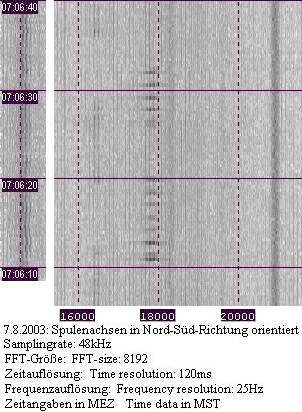
Re: Status of Cutler, Rugby, Hegeland (spectrogram)
Posted by Harald Lutz on August 10, 2003 at 00:18:16
The transmitter Helgeland was active again on 7 August. It transmitted F1B-signals on 16.4kHz. Look at the spectrogram below, which shows them.
Re: HiFer RAD heard in Arkansas
Posted by John Andrews on August 10, 2003 at 11:04:59
Tim:
Well here's another one for your collection...this time from Maine:
http://webpages.charter.net/w1tag/files/RAD081003.jpg
Had to wait quite a while until the fading coincided with the ID!
John Andrews, W1TAG
Short Long-Wave Antenna
Posted by Dan Owens on August 10, 2003 at 14:11:29
I am trying to capture very minute electrical signals from an array of small electrodes. The signal radiates at changing frequencies between 90KHz and 250KHz and at an amplitude of approximately 1mV p-p. I would like to develop an antenna to help capture the small signals but I need some help because I am long-wave challenged.
Any suggestions on a design that is no more than 1 inch in length and 1/4 inch in diameter?
Thanks,
Dan
Re: HiFer RAD heard in Arkansas
Posted by paul daulton on August 11, 2003 at 19:57:58
I AM BRAND NEW TO HIFER HAVE 185KHZ XMTR BUILT BUT NO ANT YET LAST WEEK END COPIED RAD-AZ-RY-GA-HI(CW) AND A COUPLE OF MORE THAT WERE NOT Q5 SENT TIM COPY OF RAD ON ARGO SCREEN WOULD LIKE E-MAIL ADDRESS'S FOR ALL OF HIFER BEACONS HOPE TO BE ON AIR IN COUPLE OF WEEKS ANY ONE WANTING COPY OF RAD CAPTURE CONTACT ME k5wms@aristotle.net
Re: HiFer RAD heard in Arkansas
Posted by Webmaster on August 11, 2003 at 23:09:07
:: WOULD LIKE E-MAIL ADDRESSES FOR ALL OF HIFER BEACONS ::
Visit our home page (lwca.org) and click the LowFER/HiFER link. When the page loads, click Operator Info.
If an operator has an e-mail address, it will be listed there.
John
Re: MusicMann - news release
Posted by Harald on August 12, 2003 at 06:24:57
Why do they not feed the platform via a submarine cable (perhaps in the innovative HVDC light technology) from the power grid of the ile of man?
Then the diesel generators would be only necessary as standby!
When using a CFA as aerial, an aerial never tested before, then feeding the transmitter via an HVDC light cable would be not more innovative!
receiving 198 from orlando florida
Posted by Brian Ripley on August 14, 2003 at 04:56:02
I am interested in receiving 198 England. My location is Orlando Florida. Is it possible to do so? What would be the best antenna and receiver for doing so? Could I make a receiver for this frequency that would perform better than a full coverage longwave receiver. Any help would be greatly appreciated including refferences to matterial on the subject. I want to listen to the cricket so that is why I am not opting to listen on the internet since only the domestic matches are carried when England plays at home. The matches away are played in our night, which means that I have a possibility of receiving them. Do I have more than that? thanks very much
Brian
Re: receiving 198 from orlando florida
Posted by John Andrews on August 14, 2003 at 22:40:17
Brian,
This may not be a simple task. I have not yet heard 198 from the U.K. in Massachusetts, despite having a pretty good receiving setup. My principal complication is from an aeronautical beacon in North Carolina, which comes in quite well year-round. The beacon call sign is DIW. If I look at 198 kHz with spectral analysis software, I do see other carriers, but have never heard anything useful. On the other hand, I regularly copy LW stations such as Iceland on 189 kHz, and Radio One on 183 kHz.
Given your location in Orlando, you've got the extra problem of static crashes from thunderstorms. Things will quiet down during the winter, and signals from EU will improve with the longer nights, but I'm very skeptical that you'll have any luck.
John Andrews
Re: receiving 198 from orlando florida
Posted by brian ripley on August 15, 2003 at 02:32:50
Thanks very much for that information. I just want to clarify that this beacon is on 198 kilohertz. This is quite disappointing since of course, I am much closer to the beacon being in Florida and the beacon as well as the bbc are both east of me, I think. So I don't know how I can null the beacon. Of course, both are north of me as well. If you have any more thoughts on approaches I could take, I would be very interested. Thanks Brian
Re: receiving 198 from orlando florida
Posted by John Andrews on August 15, 2003 at 09:10:53
Brian,
Yes, DIW is on 198 kHz. Aero beacons here in the U.S. are licensed from 190 kHz up. There is really no protection for LW broadcasting from EU or elsewhere. Below 190 kHz, things are a little simpler, and the larger broadcast stations from EU can be heard in the eastern U.S.
I think your possibilities are minimal, given the similar bearings of North Carolina and the U.K.
John Andrews
Re: Short Long-Wave Antenna
Posted by John Andrews on August 15, 2003 at 11:40:07
Dan,
Since nobody else has responded...
My only suggestion would be to use that very short conductor you described, and connect it to the gate of an FET wired as a source-follower. Don't use any cable between the "antenna" and the FET gate, as shunt capacitance will kill the signal. I'd suggest a resistor from gate to ground in the 1-10 megohm range.
John Andrews, W1TAG
Re: Icom R-75 and beacon Dxing
Posted by L. Wayne on August 16, 2003 at 06:57:56
I just purchased an Icom IC-R75 radio. Through experimentation, it has demonstrated to have excellent receiving abilities with a tunable series-resonant LC, circuit on the recieving (50-ohm) input. My antenna is an 80ft. dipole strung in the attic with a 75-ohm feed line. I know that a dipole is a 50-0hm device, but I leave the tuning and filtering to the series resonant preselector. The series resonant circuit is best operated on frequencies below 6 mhz. Also, the R75 has a problem with images on the LF band without a series resonator. This series device is made of plastic tubing about 1" in diameter (about 7" long) with about 300 turns of 24 ga. telephone wire connected in series with a 10 to 500 pf. tuning capacitor. Also it is necessary to have a ferrite rod from an loop- stick antenna (with the wire removed) so that you can place it at different distances in the 1" plastic (PVC) coil form. The rod greatly expands the frequency range of the circuit. I have made a 3 coil series resonant device for my R75, which makes it an excellent receiving system.
KL1X 137 kHz Beacon in ARRL Letter
Posted by Robert Bicking on August 16, 2003 at 08:25:38
The KL1X beacon has a nice write-up in the latest ARRL Letter (V22, No.32) which can be viewee at the web site www.arrl.org
Re: KL1X 137 kHz Beacon in ARRL Letter
Posted by Laurence on August 16, 2003 at 21:50:43
The ARRL have been very keen on keeping up with the new on this beacon - which is encouraging.
WD2XDW is running close to 1.9 W (theoretical) ERP for some 3A aerial current. Its now running +24 hours on
137.77350 KHz +-0.01Hz at QRSS60 until advised. Steve VE7SL was the first to receive the beacon some 2100Kms to my south. Its still pretty greyish up here at midnite so signals are still pretty weak. Thanks to all the Lowfers for the technical support and encouragement.
Vy 73 Laurence KL1X.
Re: receiving 198 from orlando florida
Posted by Warren K2ORS on August 16, 2003 at 22:09:01
I live probably 15-20 miles southeast of John and I have picked up the BBC on 198 a number of times. Granted it is not as strong as the stations on 162 or 171 but I have received 198 loud and clear maybe half a dozen times in the past year. I am not using a proper LF antenna most of the time. My setup is a Racal 6830JD receiver and most of the time I'm listening on my 25-500MHz 30 element log-periodic antenna. I have heard the BBC on 198 also with an old "Rado West" ferrite loop antenna, which is a ferrite core antenna (1" diameter by almost 2' long, wound with litz and includes a fet pre-amp). The BBC does come in ocassionally in the summer but rarely readable due to the static.
73 Warren K2ORS
Re: receiving 198 from orlando florida
Posted by brian ripley on August 18, 2003 at 00:24:34
Thanks very much for the replies. It is great to hear that someone was able to pick 198 bbc up and that someone explained the difficulties that could be encountered in trying to receive it. I would like to try to develop an understanding of how one person can pick it up sometimes even with this beacon on the same frequency and another person can't receive it. I guess I am asking, what characteristics make Warren be able to pick up the radio 4 despite the beacon. Somehow, Warren ishas a setup that nulls that beacon. How is this done. thanks very much
Brian.
Re: receiving 198 from orlando florida
Posted by John Davis on August 18, 2003 at 13:10:04
>>> I would like to try to develop an understanding of how one person can pick it up sometimes even with this beacon on the same frequency and another person can't receive it. I guess I am asking, what characteristics make Warren be able to pick up the radio 4 despite the beacon. Somehow, Warren has a setup that nulls that beacon. How is this done. >>>
It is very unlikely that Warren's setup can null the beacon. Most likely, Mother Nature is doing it for him.
Warren is probably within a skip zone of the beacon. This is not the same meaning of skip as in "CB talk." It's a region at a certain distance from a station where signal tends to be at a minimum because one of two things is happening:
(a) The groundwave signal has dropped below receivable level but the skywave's launch angle has not yet returned it to ground from its trip to the ionosphere, so there is no appreciable signal to be heard from either source; or,
(b) The groundwave signal and the skywave signal are arriving with nearly equal intensity, but are in opposite phase and cancel each other for part of the time.
The latter is probably what's happening in Warren's location. It might or might not happen for you, too. But even if it does, John A. is also right...you won't receive BBC4 consistently enough for regular listening.
At LF, the phase relationships of signals arriving via multiple paths change slowly enough that you can have many minutes during which a given signal will be strong, followed by many minutes in which the signal is simply gone. This is the sort of thing that enables us aerobeacon hunters in the Southeast to sometimes copy a 25 watt beacon in Alaska (for example) on the same channel used by dozens of stations in closer states.
But the ionosphere is fickle. Even if it does tantalize you with an occasional reception of your target, the fact is that DIW is a very powerful beacon, and relatively close to you by comparison with Droitwich. You may be able to copy BBC well enough for DX purposes sometimes, but I surely wouldn't count on it being audible long enough to follow a cricket match.
John Davis
www.vlf.it upgrade
Posted by ik1qfk, renato romero on August 18, 2003 at 16:35:58
A new upgrade of www.vlf.it is on line:
VLF TUBE RECEIVER by Giuseppe Accardo and Alan Scremin (upd Aug 2003)
73, Renato Romero
Re: receiving 198 from orlando florida
Posted by paul strickland on August 20, 2003 at 05:27:04
I live about 100 miles from the droitwich 198 tx and it still sounds awful. It has to be one of the worst sounding am stations in europe. With its quiet muffled audio it sounds like having a pillow over the speaker.
NB. rte have 252 on air at the moment (9am utc, 20/08/03)
Re: receiving 198 from orlando florida
Posted by brian ripley on August 21, 2003 at 04:52:49
John, thanks for that explanation. I think I am familiar with the skip you are talking about at least on shortwave. When american forces radio transmitted form the voice of america transmitters in Greenville North Carolina, sometimes, the signal would be weak and be overwhelmed by radio Canada international. This was more likely to happen in southern Georgia than in Florida. Brian
Re: 252 Ireland
Posted by Mike Terry on August 22, 2003 at 15:04:15
More daytime tests by RTE this week.
HIFER YEN
Posted by AL on August 24, 2003 at 13:55:39
HI
I HAVE HIFER YEN ON 13558.033 DOWN FOR ANNUAL MAINTENANCE UNTIL AFTER LABOR DAY WEEKEND.
AL
WD2XDW
Posted by Laurence KL1X on August 24, 2003 at 22:43:18
WD2XDW Beacon heard 4 hours into daylight during Strong Geomag event some 2200Kms South (VE7SL) Probably bottom of very thick D layer bounce sub 50Kms height.
'Browser Privacy' May Equal NO POST
Posted by Webmaster on August 25, 2003 at 12:52:25
We are continuing to see a few legitimate messages not make their way through to the board without some help from the moderators. Here (in a shortened version of an earlier message) is one reason why that happens.
As you know, there has been a recent surge in spam of all kinds, including automated attacks on even the most obscure message boards such as this one. One of several ways we screen out spam is to look for missing or defective header data.
Spammers, like hackers and other forms of online lowlife, tend to be secretive. So, they omit certain information that every legitimate browser is supposed to send in every WWW request. This includes such data as the version of browser, the language for which the browser is set up, and the URL of the page containing the link the user clicked (the "referrer"). All this is information a Web server legitimately wants to know in order to provide the proper response to the user, so the board tests for it.
Lately, some software firewalls have added bells and whistles that don't really provide you the user with any more security, but which apparently sound impressive in these security-conscious times. Some of them have the unfortunate side effect of making your message look like spam!
Norton calls one of their options "browser privacy." If turned on, it refuses to tell the Web server what page contains the link that the user clicked.
Now, that's totally pointless. It doesn't give you any more security at all! (No one can crack your computer simply by knowing that you read the LW Message Board.) But it does needlessly prevent us from confirming the source of the request. That, in turn, IS a security concern for webmasters!
If you have the Norton firewall with this option turned on, trying to post a message to this board will simply get you a "not found" error. It won't stop you from reading pages at this site (yet), but since the Message Board is an interactive feature, it's not prudent to allow it to respond to potentially fictitious browsers.
On behalf of webmasters everywhere, I urge you to please take this into account when you set up your firewall or your browser's built-in security features, and select only the options that are going to yield you some tangible benefits. Thanks!
John
Unidentified transmitters and pulses?
Posted by Harald on August 26, 2003 at 01:17:23
(Three messages to the board, dated 23 August, are combined here:)
Subj: Unidentified transmitter on 15.8kHz active again!
Date: 8/23/03 12:47:40 PM Eastern Daylight Time From: Harald_der_Grosse@gmx.de (Harald Lutz)
File: 15800
Today I received again after a break the signal of an unidentified transmitter on 15.8kHz. The signal is a pulsed F1-signal, so it cannot be the result from the oscillators for the horizontal electron beam deflection of TV-sets on 15.625kHz! I suppose it comes from a transmitter. Has anyone an idea where it is located?
Has anyone also received this signal?
My reception site is 8N 58, 48N 43
Subj: Unidentified transmitter on 17.9kHz in MSK-mode!
File: 17800
Today I received the first time a signal of an unidentified transmitter on 17.9kHz in the MSK-mode. I suppose it comes from the same transmitter, which sometimes sends F1-signals on the frequency of 17.8kHz (The MSK-signals turns into this signal on the spectrogram)
Has anyone an idea about the identity of this transmitter or also received it?
Subj: Pulsed VLF-signals
File: 19600
Why is sometimes the VLF-transmitter on 19.6kHz pulsed in such a way, that it is even able to overstear the amplifier of my soundcard at 48N43, 8E58 more then 700 kilometres away from its official transmission site in Anthorn, Northern England.
These pulses have a definite shape, so they are not a result of propagation effects, like fading, but the effect of pulsing the transmitter!
In order to show the board the strength of the signal, the spectrogram contains also an explanation of the used grey scales.
How are these pulses generated? With which power might the transmitter work during such pulses? Are these pulses generated with several transmitters on several sites?
252 Ireland testing
Posted by Paul Strickland on August 26, 2003 at 06:34:39
RTE are testing 252 again today from 10am UTC, probably for most of this week if it's anything like last. They are putting out RTE Radio 1 as on their internit feed at www.rte.ie
Re: 252 Ireland testing
Posted by Mike Terry on August 26, 2003 at 14:40:43
RTÉ to launch longwave service on 1st October
26 August 2003
Lennie Kaye, Technical Operations Manager (Radio) at Irish public broadcaster RTÉ, has told Media Network that the official launch of the longwave service of RTÉ Radio 1 on 252 kHz is planned for 1 October 2003. The transmitter has been testing in recent days, leading to a spate of E-mails to Media Network and other media sites. RTÉ acquired the transmitter from its previous commercial owners, TEAMtalk, when that station closed on 31 July last year. The longwave service is intended primarily for Irish expatriates living in the UK.
At the same time, RTÉ has expanded its radio services on the Sky Digital platform by adding the stereo version of RTÉ Radio 1 on the Electronic Programme Guide (EPG) at 910. The existing Radio 1 service on EPG 892 has been re-named "RTE Europe" as it's carried on the Astra 2B satellite which has a wider footprint than the new stereo service on Astra 2D that covers mainly Ireland and the UK. The RTÉ Europe service carries the same alternative programming at certain times as the mediumwave transmitter in Ireland on 567 kHz.
© Radio Netherlands Media Network.
http://www.rnw.nl/realradio/html/medianews.html
Re: receiving 198 from orlando florida
Posted by Kenneth Bones on August 27, 2003 at 10:25:08
If you can obtain a modern car radio which has LW coverage, you may find you get excellent results depending on location. Try parking the car as high ASL (.if inland)or right on the eastern seaboard. A RF amp. fitted in series with the coax feed to RX may help and also extend the vertical car aerial a few extra feet or more. From a former medium wave DX-er who has logged many USA standard broadcast stations using sometimes 250 watts.
Another 137 kHz Experimental License
Posted by Robert Bicking, W9RB on August 27, 2003 at 20:09:23
I have applied for an experimental 137 kHz license and have been issued the call sign WD2XFE. If granted, I plan to see how my LowFER antenna does with a few more watts into it. The antenna was described in the Oct. '99 Lowdown and is on my website www.qsl.net/w9rb/ The e-mail link there isn't correct.
I have completed a Xmtr from plans in the RSGB book on LF which is capable of 400W. Will post a message if the license is granted and I get on the air.
73, W9RB
Totals on 28 Aug
Posted by John Andrews on August 28, 2003 at 10:51:35
With Bob's application, the FCC database now shows the following relevant applications for the 136 kHz band:
WC2XTC Mike Troy, W2AG (granted)
WD2XDW Laurence Howell, KL1X (granted + pending mod.)
WD2XES John Andrews, W1TAG (pending)
WD2XFE Bob Bicking, W9RB (pending)
Additionally, TI and Boeing have long-standing licenses in that range for non-communications purposes.
John Andrews, W1TAG
HiFer beacons RY -- HI ??
Posted by Tony Levstik on August 29, 2003 at 16:34:26
I got good screen pics of 2 HiFer beacons.
First beacon looks to be RY
http://home.att.net/~levstik1/hifer1.jpg
Second beacon might be HI. I could just hear what sounded like HI at 5wpm repeated several times then a long dash. and the signal was riding a slow sinewave .
http://home.att.net/~levstik1/hifer2.jpg
Tony Levstik
Re: HiFer beacons RY -- HI ??
Posted by John Andrews on August 29, 2003 at 16:47:04
Tony,
Can't help you with the second shot, but the first one contains NC (square wave) colliding with MP. I can just make out the MP ID inside the square wave. Dex's crystal drifts down as the day warms up, and he frequently runs into MP, who is pretty steady at 13555.46.
But you did get a "Y" from RY in that shot. That's the thing that looks like the starship Enterprise in the lower part of the screen.
John Andrews, W1TAG
IC-R71A SSB filter
Posted by Tony Levstik on August 29, 2003 at 18:06:45
IC-R71A SSB filter
Im looking for a "Stock" ICOM R71A SSB Filter (CFJ455K5).
Have a radio that is missing the filter.
If anyone has one they would like to sell please Email me.
levstik1@worldnet.att.net
Tony Levstik
Re: HiFer beacons RY -- HI ??
Posted by Tony Levstik on August 29, 2003 at 18:10:43
Thanks for the response.
I thought RY's signal looked Odd.
Looks like I got two for one on that screen capture.
Tony
Re: HiFer beacons RY -- HI ??
Posted by lloyd chastant on August 30, 2003 at 06:46:21
Tony Noticed you are using a very old version of Argo..There is a version 134 now which may be good to go to....and also your audio setting is way too high causing the left line to go to RED..keep that level at about 1/3 level-in the green- and Argo will be much happier...HI!!
73 de Lloyd W3NF
Recent reception
Posted by Ray, W2RS on August 31, 2003 at 12:44:44
Hi,
With the weather a little cooler today than it's been, I listened for the nearby Lowfer beacons (i.e., within 50 miles or so) on ground wave around noon local time (1600Z), with the following results:
TH 579 NWNJ 449 JJX 449 HS no copy
A few nights ago, around 0200 local time, I tried listening for LWBC. I got a steady carrier from Iceland on 189 with occasional hints of audio (music) in there (LSB was better than USB, due to QRM), but too weak to understand anything they were saying. No joy from Droitwich on 198. The North Carolina NDB, at about S5, took out whatever possibility there might have been. No copy of Europe 1 on 183. Just too far away for this time of year.
My LFL-1010 loop remains pointed towards Europe, peaking NE/SW.
I'm glad to see more Part 5 licenses coming through. Hopefully I'll be able to hear a few of you when the season gets going. One problem with my current receiving setup, though: upconverting to a 28 MHz IF does not provide enough frequency stability to make use of the QRSS modes. 1 ppm at 28 MHz is 28 Hz. QRSS3 might work for short listening periods, but that's about it. If any of you guys out there would care to try QRSS3 for portions of your transmitting periods, I'll be happy to give it a try and let you know how it works.
73,
Ray
KPH
Posted by Ray, W2RS on August 31, 2003 at 13:04:03
Hi,
I got a nice QSL from the gang at KPH in California, confirming my HF SWL report of their operation on 1 July. It was typed on an old RCA marine radiogram blank. They said that their next operation will be in December, so keep an eye out for further information.
It's too bad that there was no 426 kHz propagation to the East Coast, but that's pretty unlikely at any time of year. Hopefully those of you west of the Rockies will have a better shot.
73,
Ray
Re: KPH
Posted by Mike KB6WFC on August 31, 2003 at 17:47:43
Hi Ray & All,
I got mine the other day as well! It can be viewed from http://www.geocities.com/silversmj/KPH_030713QSL.JPG (trying cutting & pasting the URL if it doesn't work for you).
While not this Summer, I typically can hear NDB DIW-198 & CLB-216 (both in NC near the Ocean), 2kW & 400W, respectively, most especially during the Winter season. KPH was running abt 4kW in a 750' Marconi Tee antenna on 426kHz and it is somewhat near the Ocean as well although I think there is a small mountain/hill that may obscure the signal in your direction, so I think the chances of it being heard on the East Coast are very GOOD, especially this Winter!
Keep trying! 73
Re: KPH
Posted by Ray, W2RS on August 31, 2003 at 21:05:13
Hi Mike,
If they transmit during the night, there might be a possibility, although I must admit that I've never heard any AM broadcast stations from the West Coast here ever, even those on clear channels. During the day, there's no chance whatever. If you can get them to stay up all night, by all means try :-)
73,
Ray
Re: KPH
Posted by Mike KB6WFC on September 01, 2003 at 14:33:02
Ray,
I think they have; I think they will. Last year, they operated over New Year's Eve/Morning Straight Key Night. I imagine that is what they will do again.
73 & GD DX
BTW - Fall is a great time to build antennas for the Winter. Point those loops, bevvies, Pendants, K9AYs, EWEs out West :O)
www.lwca.org
potrzebie