
Re: Thursday (was: Friday) evening HiFERs
It was great to see MP on 22 m this evening before sunset once again! The watering hole view, from top to bottom, was NC, 7P, EH, MP, and USC. Will post a capture in the morning when I return to consciousness.
John
Re: Thursday (was: Friday) evening HiFERs
Posted by John Davis on August 01, 2014 at 13:50:50.
In reply to Re: Thursday (was: Friday) evening HiFERs posted by John Davis on August 01, 2014
More evening HiFERs
This Friday, 1 August, conditions were not as good. At first, only USC showed up, with MP appearing intermittently. Then, about half an hour before local sunset, I could hear NC but not see it. Had to start another Argo instance, as it had drifted considerably upward from recent days. EH faded in, too. Almost nothing from 7P tonight.
Yesterday, the watering hole was the only place I saw or heard anything. Tonight, though, MTI was nicely audible. Still no PBJ visible.
John
New e-mail address
Posted by Lee on August 03, 2014 at 01:25:25.
My new e-mail address for the upcoming season is fccpart15 at charter.net
Re: More evening HiFERs
Posted by Chris Waldrup on August 03, 2014 at 19:48:13.
In reply to More evening HiFERs posted by John Davis on August 02, 2014
Thanks for the note.
I had changed out the battery (12V 7 AH gel cell) on Friday that powers PBJ.
I just put it on a scope to make sure the bad lightning storm we had earlier in the week didn't fry either the KID chip or Epson oscillator. Also checked the gel cell again, it's at 12.56 V. All seems ok.
I'll check back in a few days to see if it has been received.
Chris Re: More evening HiFERs
KD4PBJ
Posted by John Davis on August 03, 2014 at 22:58:14.
In reply to Re: More evening HiFERs posted by Chris Waldrup on August 03, 2014
Thanks for the update, Chris. Didn't see either PBJ or MTI Saturday night, and just barely the "big three" at the watering hole (NC, EH, USC).
This morning I watched the watering hole for a while and caught NC, 7P, EH, the SIW duo, and USC...but ran out of time to look for anyone else. This afternoon I went back, but conditions had deteriorated again...only the "big three" poorly again, and just barely saw a bit of MTI for a couple of cycles before it faded, but couldn't hear anything. Will keep looking!
John
HiFERs
Posted by Laurence KL7L on August 04, 2014 at 18:34:52.
7P on QRSS3 around 13.555480 coming thru clearly at the moment -so is the radar :-(
EH was way strong last night and Ill look thru the other captures and see whats there -
HF Condx have generally been lousy for the past few days
Laurence KL7L Alaska Europe 1 off air temporarily
Posted by Mike Terry on August 06, 2014 at 17:09:13.
Europe 1-183 KHz is off for maintenance until August 7.
bad luck...
Posted by Douglas Williams on August 10, 2014 at 11:52:47.
Well, I hadn't turned on my receivers since probably April, so yesterday I decided to fire everything up to make sure it was all operational. Unfortunately, I discovered that both my Clifton Labs active antenna and my Winradio Excalibur Pro SDR are non functional. I also discovered that I made the (sure to be expensive) mistake of leaving the coax connected between the antenna and the indoor gear. It has always been my habit to disconnect that coax during my "summer break", but this year I forgot.
The damage almost certainly was caused by a nearby lightning strike and came in through the coax rather than the AC mains because I have all devices plugged in to a very beefy Isobar surge suppressor which was itself switched off.
Fortunately my R75 powered on, and hopefully my Todd Roberts LF converter wasn't damaged.
Re: bad luck...
Posted by Krystallo on August 10, 2014 at 14:56:04.
In reply to bad luck... posted by Douglas Williams on August 10, 2014
Hey Douglas,
I'm VERY sorry to hear about the loss of your gear. HOPEFULLY things might be cost effective to repair.
I once had a nice home brew FET rig get taken out by a 2" arc caused by SNOW. So I've "been there" , at least a BIT.
FWIW,this week a guy in my class was working on a hospital roof ( only 3 or 4 blocks from my home) and was within FOUR feet of a metal lab vent pipe that was hit by an isolated strike a full FIFTEEN minutes BEFORE any rain/ hail.It was VERY loud here. I imagine how loud it was to him ! He felt "some" shock,but was OK.
Lightning is always very scary to me re my gear and antennas.
I hope you recover you capabilities soon.
de N1NQC
Re: bad luck...
Posted by Douglas Williams on August 10, 2014 at 18:48:17.
In reply to Re: bad luck... posted by Krystallo on August 10, 2014
Thank you for the kind words, Kevin. I blame myself for leaving the coax connected, though I would probably have lost the remote part of my active antenna regardless. I do recall being home last month during a close lightning strike and hearing a distinct "pop" inside the house.
-Doug KB4OER
Special event 630/600 meters
Posted by Fritz Raab W1FR on August 10, 2014 at 23:54:45.
SPECIAL EVENT - 630/600 METERS
The 630/600-meter operators will be conducting a special event during the weekend of Oct 31 - Nov 1 - Nov. 2. This event marks the 106th anniversary of the Berlin Treaty that created the international distress frequency at 500 kHz. This event includes US experimental stations, Canadian amateur stations, and US heritage maritime stations.
For US experimental ops, this will be a CW event and the main activities will be:
- Some stations will run beacons with special anniversary messages, perhaps followed by special QSLs.
- Other stations will simulation maritime communication. They will call CQ on a designated calling frequency and then QSY to complete the QSO. Silent periods will be observed.
- The frequency bands are
465 to 480 kHz and
495 to 510 kHz.
Different licensees have different frequency authorizations
- The designated calling frequencies are
475 kHz for the lower band
500 kHz for the upper band.
- This may be the last such event with operations on 500 kHz itself. This band is not being included in new experimental licenses as it is supposedly reserved for a new maritime-data service.
The Maritime Radio Historical Society (MRHS) will conduct a mini "Night of Nights" with special attention to MF operations. This will give listeners the best chance of copying their MF signals by operating during the winter and extending our operating hours well into the evening hours Pacific time. KPH will keep 500 kc and 426 kc (and HF) active with special messages, press and weather. And they will send a verification to any listeners who mail in a reception report.
Three Canadian amateurs will be operating in the 472 - 429 kHz band. In addition to activities similar to those of the US experimental stations, the Canadian amateurs will conduct cross-band communication tests with amateurs operating on 80 and 40 meters. The plans include:
Station: VO1NA (Joe) GN37 TORBAY, Newfoundland
Time: 2130Z - 0130Z Friday evening Oct 31-Nov1
TX Frequency: 477.7 kHz
RX (QSX) Frequency: 3562 / 7062 kHz
Station: VE7SL (Steve) CN88 Mayne Island, B.C.
Time: 0200Z - 0600Z Friday evening Nov 1(Z)
TX Frequency: 473.0 kHz
RX (QSX) Frequency: 3566 / 7066 kHz
Station: VE7BDQ (John) CN87 Delta, B.C.
Time: 0200Z - 1000Z Friday evening Nov 1(Z)
TX Frequency: 474.0 kHz
RX (QSX) Frequency: 3536 kHz
All stations will either call CQ or run "VVV" marker beacons while listening on their respective QSX frequencies. QSX frequencies will be included in the CQ or marker beacon.
The official time period is
00:00 on Nov. 1 through
23:59 on Nov. 2.
These include Friday and Saturday evenings in North America. Stations on the east coast may start a little earlier if they like.
More information may be available at www.500kc.com as the time approaches.
Re: bad luck...
Posted by John Davis on August 11, 2014 at 00:31:26.
In reply to Re: bad luck... posted by Douglas Williams on August 10, 2014
Sorry to hear that news, Doug.
It's impossible to predict where lightning energy will go when it strikes; and in fact, it is difficult enough to determine where it went after the fact, unless you saw where it actually struck and/or have a sufficiently detailed damage trail.
In this case, it is entirely possible a secondary discharge zapped the preamp and came in on the coax to find its way to the utility ground. Or, it is equally possible that a pulse of current from a nearby strike to the power line came into the house on the neutral (rendering arrestors ineffective) and found its way out to the antenna and its ground, zapping any electronics that got in its way.
That's what makes it so very hard to protect against lightning. The common conception of the earth as a giant sink that you can use to soak up lightning, if only you have a good enough ground connection, is just not true. Every lightning bolt is the completion of an electric circuit whose path you can't know ahead of time. There are many possible routes the current may take to get from the point of strike to the various locations where charge has built up in the earth itself. There are measures you can take to reduce certain specific risks from lightning, of course, but there's never any absolute guarantee.
I hope the damage turns out not to be anything major and that you will be back in action soon.
John
Re: Special event 630/600 meters
Posted by Krystallo on August 11, 2014 at 12:07:37.
In reply to Special event 630/600 meters posted by Fritz Raab W1FR on August 10, 2014
Hey Fritz,
GREAT info! Hopefully I can get some type of participation in.
de N1NQC
Recent HiFERs in SE Kansas
Posted by John Davis on August 13, 2014 at 16:34:44.
Been meaning to update for some time, as the receiver is set up to monitor most days when I'm down doing work on the farm...but by the time I get back home, I'm so worn out that it's easier to procrastinate than write up reports. Here, at least, are a couple of captures from this Monday afternoon and one from very early Tuesday morning (during a break from WSPR monitoring in the 630 meter band). Times shown are CDT. Frequencies have been adjusted at the end of each capture to within one or two Hz. For the watering hole shots, 800 Hz is 13,555.4 kHz.
In the first view, SIW slant mode had been coming in rather ghostly all afternoon, and was about its best at this point. The QRSS6 version is also visible, but badly broken up. Right at the highest frequency deviation of SIW are traces of what was earlier identifiable as MP. Above EH on the left side of the screen are tiny fragments of 7P. By mid-frame, though, the traces above EH are audio intermod artifacts in the hard limiter between the briefly powerful signals of EH and SIW.
An hour later, there was no sign of SIW or MP. 7P still tended to be broken up a lot, but was identifiable with certainty during this slot. NC and USC continue to be clearly recognizable. Note, also, intermittent traces of someting just above 850 Hz, which was also present a few times in the shot above.
For the view of PBJ and MTI, 800 Hz = 13,557.54 kHz. (Except for the uncalibrated snippet of USC at the far left, who was also intermittently visible at that unreasonable hour, before I tuned up to MTI and PBJ.) This was my first copy of PBJ since Chris changed out the battery. Daytime conditions have been just OK from the east and northeast lately, but terrible from the southeast in the daytime.
John
Re: Recent HiFERs in SE Kansas
Posted by Krystallo on August 14, 2014 at 11:56:37.
In reply to Recent HiFERs in SE Kansas posted by John Davis on August 13, 2014
Hey John,
In image 1 and image 2, who are the bottom two traces ?
de N1NQC
Re: Recent HiFERs in SE Kansas
Posted by John Davis on August 14, 2014 at 14:06:26.
In reply to Re: Recent HiFERs in SE Kansas posted by Krystallo on August 14, 2014
The very bottom one in the first two captures is USC in FSK CW mode. There's a pretty clear ID at the right side of the first picture.
The very intermittent trace right above USC, at about 802 Hz, is an unknown at this point, or possibly just QRM. If
I get a chance today, I'll probably go back and label them.
John
Re: Recent HiFERs in SE Kansas
Posted by krystallo on August 14, 2014 at 16:41:02.
In reply to Re: Recent HiFERs in SE Kansas posted by John Davis on August 14, 2014
OK on all John.
Just curious.
K
Re: Recent HiFERs in SE Kansas
Posted by Krystallo on August 14, 2014 at 16:43:24.
In reply to Re: Recent HiFERs in SE Kansas posted by John Davis on August 14, 2014
OK, Thanks.
K
Re: bad luck...
Posted by Douglas Williams on August 15, 2014 at 23:40:19.
In reply to Re: bad luck... posted by John Davis on August 11, 2014
Thanks, John. I feel fairly certain that the damage came in over the antenna coax, rather than the AC Mains.
Sent both the outdoor (preamp) and indoor (coupler) units back to Jack Smith at Clifton Labs. Awaiting his response regarding repair estimates, though I will likely agree to whatever he says.
The Winradio WR-G33DDC is a different matter. The whole unit is only the size of two cigarette packs, which means lots of tiny surface mount components. It is the best LF receiver I have ever used.
I *really* hope it can be repaired.
-Doug KB4OER
Re: bad luck...
Posted by Pat Bunn on August 15, 2014 at 23:52:26.
In reply to Re: bad luck... posted by Douglas Williams on August 15, 2014
Jack will fix it for $20 or so. I have had mine blown several times. Both times the output transistors blew indicating a surge on the feedline. My feedline is 300 feet or so and I suspect that a close lightning strike induced a pulse on the output. I keep a separate board ready to change out and return the blown one to Jack - I have the transistors but I wouldn't even attempt to change those surface mount transistors for $20.
Re: bad luck...
Posted by Douglas Williams on August 17, 2014 at 19:50:00.
In reply to Re: bad luck... posted by Pat Bunn on August 15, 2014
Thanks, Pat.
Well, I can see how a 300' feed line could act as an antenna for close lightning strikes. My feedline is only 50', and most of it is buried, but I still remember hearing a "snap" after a recent lightning strike that I happened to be home for.
Mine may be a bit more expensive, as I had Jack modify his design a bit in order to lower the bottom end of the frequency response down to 3 kHz or so. He had to use some lower voltage components in order to accommodate my request, so it's possible that more than just the output transistors were damaged. Time will tell.
Back in the 1980s, I knew a ham who had a large (200' +) dipole fed with 450 ohm "ladder line". He (wisely) left it disconnected from his transceiver except when he was operating. If there was a nearby thunderstorm, the disconnected ladder line produced a visible arc and an audible "snap" inside his shack whenever there was lightning.
Sunday HiFERs, Part 1
Posted by John Davis on August 17, 2014 at 22:13:01.
At mid-afternoon, only NC, EH and USC were visible at the watering hole, plus recurring traces of an unknown signal or noise about 15 Hz above USC. A lot of QSB was present on all three. Up the dial, the keying pattern of MTI was visible on Argo's QRSS3 display, and was sometimes audible as well. No PBJ, though. Also heard GNK fading in and out, surprisingly good sometimes, considering how the band was behaving for everybody else today.
I didn't stay there long. Too much static on LF to see anybody there, and it was 110 degrees in the building, so I didn't want to leave the computer battery in that environment very long for such unpromising results. Will return to the field in a little while, though, when there's a bit of shade on part of the building.
John
iphone/ipad/ipod ???
Posted by Brian nb9e on August 17, 2014 at 23:01:45.
I have been in contact with the guys at Blackcat systems hoping that they would release an app that we could use on our smart phones and tablets like Argo and Spectran. They asked me the following questions:Hi,
Could you describe exactly what features you would need? I assume you'd want to vary the waterfall speed? Also the displayed bandwidth? What values for both? Also the number of FFT points, and maybe some additional averaging. Anything else?
On Aug 17, 2014, at 4:33 PM, Brian Chapman wrote:
Yes for those of us who are monitoring weak signal modes such as QRSS-3 and copying visually the 5 wpm aeronautical beacons below the AM broadcast band. Please checkout weaksignals.com. Brian nb9e
Sent from my iPhone
On Aug 15, 2014, at 13:54, Chris Smolinski wrote:
Hi Brian,
You're basically looking for an audio spectrum waterfall type program?
On Aug 14, 2014, at 9:50 PM, Brian Chapman wrote:
Can you guys make us a program like Argo or spectran to decode QRSS-3 etc on the iPhone/iPad/iPod as many of us hams are experimenting with receivers on 630 and 2200 meters as well as the unlicensed Lowfer 1750 meter band in lieu of the new allocations being granted here in the US. Thanks for your consideration, sincerely, Brian nb9e
Sent from my iPhone
Chris Smolinski
Black Cat Systems
http://www.blackcatsystems.com Can someone help me fill in the blanks ??? Thanks, Brian nb9e
Re: Sunday HiFERs, Parts 2 and 3
Posted by John Davis on August 18, 2014 at 19:00:56.
In reply to Sunday HiFERs, Part 1 posted by John Davis on August 17, 2014
Went back at 5 PM CDT and 8 PM, in hopes of better reception. Not much different at 5 PM, except for hearing MTI faintly some of the time.
Around sunset was a little better. NC, EH, and USC were each alternately stronger at times and weaker at others, and MP joined the party for several minutes at a time too MTI was audible, but no PBJ. I could see the pattern of AJO's DAID on Argo, but couldn't ever hear the CW. Saw a bit of keyed signal that might have been SZX, but there wasn't enough to be sure. GNK was present, sometimes fairly decently, and FRC was beginning to come in, one or two letters at a time.
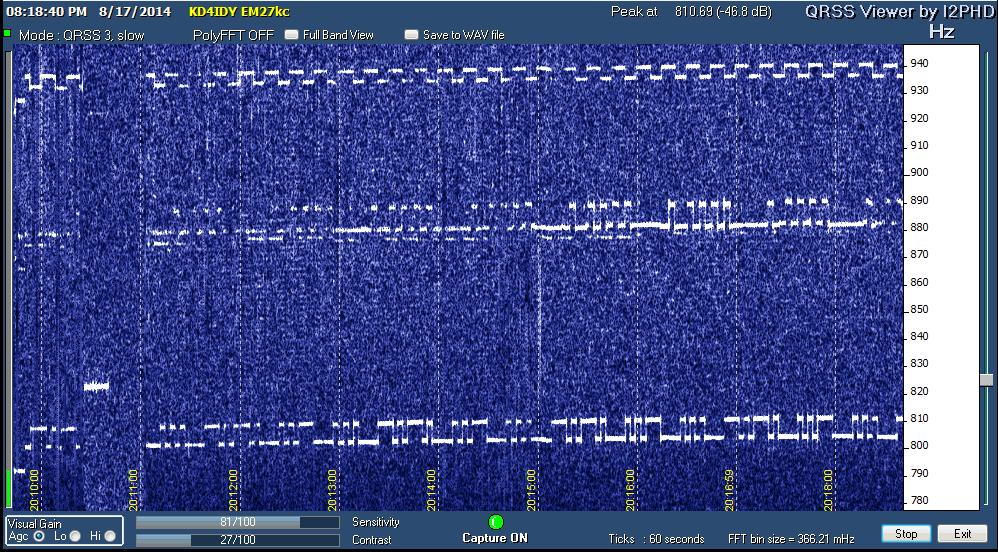
A captured snippet of the watering hole appears below. There's frequency drift because I didn't leave the receiver powered up between sessions, having been discouraged by all the QRN at MF and LF from storms down in Arkansas and elsewhere. I normally have 800 Hz as 13,555.400 kHz, but the scale is uncalibrated by about 2.7 ppm at that point; will put together a "fixed" version later.
John
Re: iphone/ipad/ipod ???
Posted by Lee on August 19, 2014 at 09:04:25.
In reply to iphone/ipad/ipod ??? posted by Brian nb9e on August 17, 2014
Genius! HiFer "OH" Terminated
Lee
Posted by Tom Lau on August 19, 2014 at 23:13:03.
John:
Due to antenna system change here at my condo, it is necessary to shut down the
"OH" transmit system. Looking forward, I do not think it will return to the
airwaves. Tough decision, but, necessary. Termination date was August 8, 2014.
Thanks, 73
Tom N8TL
Beacon "NA"
Posted by Krystallo on August 23, 2014 at 06:35:04.
Hey All,
Beacon "NA" on 13.5557 Mhz.
6 second dahs, 2 second dits, ID every 40 seconds.
K
Re: Beacon "NA"
Posted by John Davis on August 23, 2014 at 18:32:28.
In reply to Beacon "NA" posted by Krystallo on August 23, 2014
Is there a chance you could stretch the dot length to 3 seconds? That would be a great help for those of us who use Argo and don't have customizable setting for faster speeds than QRSS3.
John
Re: Beacon
Posted by Krystallo on August 23, 2014 at 19:16:44.
In reply to Re: Beacon posted by John Davis on August 23, 2014
Hey John,
Unfortunately I can't very easily. The storage chip on the (home brew) keyer can't support the full " NA " ID any slower. I'd have to change the ID to something shorter (ie a short single letter).
K Re: HiFer "OH" Terminated
Posted by Paul on August 23, 2014 at 19:42:41.
In reply to HiFer "OH" Terminated posted by Tom Lau on August 19, 2014
Copy your message, Tom. Very sorry to hear about the QRT of "OH".
Do you know someone with a business or a shop somewhere that would let you relocate the beacon to their place so you can keep it on the air? For example, my HiFer beacon is located atop the hilltop metal building of my former employer. They graciously allowed me to keep it there as a favor and thanks for my years of service.
Re: Special event 630/600 meters
Posted by Paul on August 23, 2014 at 19:49:35.
In reply to Special event 630/600 meters posted by Fritz Raab W1FR on August 10, 2014
Hi guys,
Paul here from the MRHS Transmitter Department.
Chief Operator RD mentioned that we may also be running some messages from our "True Believers" on MF during this event. Check our website www.radiomarine.org for more info as the day approaches. If we do run messages, you may be able to submit your messages for air there.
VY 73 DE PS
AR Re: Beacon
Posted by Krystallo on August 24, 2014 at 12:18:01.
In reply to Re: Beacon posted by Krystallo on August 23, 2014
Hey John,
I looked at the list and will update the keyer to an "A" at 3 second dit, 3 second space,9 second dah.
So the NEW beacon ID will simply be beacon A. Hopefully I can do this today, will confirm when change is actually done.
I hope this will be compatible.
K
NDB changes Brazil
Posted by Michael on August 24, 2014 at 15:03:32.
Hi all,
Just updated my NDB change blog, please have a look at ndbchangeblog.blogspot.com
Here some examples:
http://ndbchangeblog.blogspot.de/2014/08/brazil.html
Brazil
Delete:
AI-320.0 São João no logs rww
AVA-265.0 Avare no logs rww
BEL-250.0 Belém last log rww 2011-12-27
BGC-385.0 Bragança Paulista last log rww 2010-09-04
BKO-380.0 Florianópolis/Boko last log rww 2010-09-04
BL-315.0 Salinópolis last log rww 2009-04-27
BVI-405.0 Boa Vista last log rww 2014-01-26
CN-310.0 Ilha Caviana de Dentro/Canivete last log rww 2011-11-28
FGR-275.0 Porto Alegre/Figueiras/Viamão last log rww 2010-09-04
IL-350.0 Cariano/Florianópolis last log rww 2010-09-04
MAN-340.0 Manaus last log rww 2007-11-02
NX-320.0 Domel/Paranaguá last log rww 2010-09-04
PCI-210.0 Pici/Fortaleza last log rww 2013-01-03
PNH-255.0 São José dos Pinhais/Afonso Pena last log rww 2010-09-04
PP-215.0 Maracá/Campo Grande last log rww 2013-01-20
PPM-285.0 Plataforma Pampo PPM-1 no logs rww
PTL-345.0 Petrolina last log rww 2013-01-28
SCB-350.0 Sorocaba last log rww 2007-01-21
SJC-230.0 São Jose dos Campos last log rww 2010-09-04
SM-300.0 São Marcos no logs rww
ULD-350.0 Uberlândia last log rww 2010-09-04
vy 73 + gd DX,
Michael NDB changes Canada
Posted by Michael on August 24, 2014 at 15:06:19.
Here the changes in Canada.
http://ndbchangeblog.blogspot.com/2014/08/canada.html
Delete:
8H-375 Saint Paul AB last log rww 2013-12-02
7V-233 Jasper/Hinton AB last log rww 2013-09-30
3Y-234 Donnelly AB last log rww 2013-12-23
2U-284 Mackenzie BC last log rww 2013-02-23
W4-323 Jenpeg MB last log rww 2014-06-21
YPP-303 Parent QC last log rww 2014-07-26
vy 73 + gd DX,
Michael
ENDBH + NANDBH editor NDB changes Mexico
Posted by Michael on August 24, 2014 at 15:08:28.
http://ndbchangeblog.blogspot.com/2014/08/mexico.html
Delete:
CSL-402.0 Cabo San Lucas last log rww 2013-05-25
vy 73 + gd DX,
Michael
ENDBH + NANDBH editor NDB changes USA
Posted by Michael on August 24, 2014 at 15:11:14.
http://ndbchangeblog.blogspot.de/2014/08/usa.html
Change:
VLY-421.0 McKinney/Fluet TX N33 15 42 W096 35 20 ex EF-421
Delete:
ENZ-394.0 Nogales AZ last log rww 2014-05-02
UAD-263.0 Salinas/Chualar CA last log rww 2014-04-01
CPM-378.0 Compton CA last log rww 2012-12-31
DC-348.0 Greeley/Weld County/Buffs CO last log rww 2013-11-09
BKK-275.0 Bonifay/Tri Co (Army) FL last log rww 2013-04-19
UWI-400.0 Dalton/Whitfield GA last log rww 2014-05-20
HK-332.0 Chicago/Ermin IL last log rww 2013-09-09
SO-353.0 Winfield KS last log rww 2013-01-03
CNK-335.0 Concordia KS last log rww 2013-11-24
JBL-256.0 Jonesboro/Hodge LA last log rww 2013-01-15
BWK-397.0 Bunkie LA last log rww 2014-01-31
LQ-382.0 Boston/Lyndy/Lynnfield MA last log rww 2014-03-05
LI-346.0 Boston/Hullz MA last log rww 2013-12-16
BO-375.0 Boston/Miltt/Milton MA last log rww 2014-03-05
GAI-385.0 Gaithersburg MD last log rww 2012-09-22
DM-223.0 Detroit/Spenc MI last log rww 2014-01-16
LLU-356.0 Lamar/Spring River MO last log rww 2013-05-05
MCZ-336.0 Williamston NC last log rww 2014-01-12
JN-263.0 Smithfield/Jurly NC last log rww 2013-12-25
RBE-341.0 Bassett/Rock Co NE last log rww 2013-10-06
PP-513.0 Omaha/Flick NE last log rww 2011-01-05
MLE-371.0 Omaha/Millard NE last log rww 2014-07-26
LH-338.0 Lancaster/Caser OH last log rww 2013-05-24
BFK-215.0 Buffalo OK last log rww 2010-05-08
PEN-201.0 Astoria/Karpen OR last log rww 2013-12-25
EUD-254.0 York PA last log rww 2013-01-02
JUE-414.0 Lebanon TN last log rww 2013-04-07
UBC-239.0 Ballinger TX last log rww 2010-11-27
BKS-353.0 Falfurrias/Brooks Co TX last log rww 2013-08-09
PWT-206.0 Bremerton/Kitsap WA last log rww 2014-08-02
CAN-274.0 Bremerton/Carney WA last log rww 2014-03-30
BCK-362.0 Black River Falls WI last log rww 2012-08-12
HL-212.0 Wheeling/Dorch WV last log rww 2008-02-24
vy 73 + gd DX,
Michael
ENDBH + NANDBH editor Re: Beacon
Posted by John Davis on August 24, 2014 at 15:43:04.
In reply to Re: Beacon posted by Krystallo on August 24, 2014
Sounds as if that should be compatible. The other possibility that occurred to me overnight was (depending on what type of circuit you are using) whether it might be possible to slow down the clock rate by a third, but the shorter call sign is also a good solution.
John
Re: Beacon
Posted by Krystallo on August 24, 2014 at 22:32:17.
In reply to Re: Beacon posted by John Davis on August 24, 2014
Hey John,
My beacon has now been reestablished as a single letter "A": 3 second dit, 3 second space, 9 second dah.
Hope it will read OK on receivers.
K
Re: Beacon
Posted by John Davis on August 25, 2014 at 00:06:01.
In reply to Re: Beacon posted by Krystallo on August 24, 2014
Will keep an eye out for it! Band conditions haven't been very good here lately, but of course, there could be an opening at any time.
How close to the nominal 13.5557 do you expect the frequency is?
Thanks.
John
Re: Beacon
Posted by Krystallo on August 25, 2014 at 12:09:14.
In reply to Re: Beacon posted by John Davis on August 25, 2014
I would say frq is "fairly close", but not sure exactly HOW close.100 Hz ???
K 630M Texas to Australia
Posted by John Andrews, W1TAG on August 25, 2014 at 17:53:37.
David, VK2DDI reports reception last night of John Langridge's (KB5NJD)WG2XIQ WSPR2 transmission on 475.621 kHz, for a distance of 8628 miles. VK2DDI is near Berry Mountain in New South Wales, and WG2XIQ is in Duncanville, TX. The reception was on 25 August 2014 at 0950 UTC, with a WSPR-computed signal to noise ratio of -30 dB.
Transequatorial propagation at these frequencies is possible in late summer and late winter, narrow periods when the whole path is in darkness. As WSPR2 is not the very best of weak-signal modes, this reception is a significant achievement.
John, W1TAG
Re: Beacon
Posted by John Davis on August 25, 2014 at 20:48:50.
In reply to Re: Beacon posted by Krystallo on August 25, 2014
Checked for it yesterday. Afternoon conditions were poor for all signals on 22 m, but improved during the evening with NC, EH, and USC very prominent, and MP reasonably good for a while. I saw a hint of something at 13555.690 but just barely at the threshold of visibility, so I can't tell what it was.
I'm using multiple windows of Argo build 143 simultaneously to cover all bases near the watering hole, but that has the drawback of having to use my SSB filter, not the much narrower 250 Hz CW filter. As long as the band is quiet, I don't lose too much sensitivity that way. However, when more signals are present or Codar picks up, that's when knowing the frequency as closely as possible would help so I could use the narrow filter.
73 Re: Beacon
John
Posted by krystallo on August 26, 2014 at 03:36:25.
In reply to Re: Beacon posted by John Davis on August 25, 2014
Hey John,
I think I've done just about all I can on this end, so I'l just let it run for a while and we'll see what happens.
If someone could change the beacon list to the new single letter A as the Id and the new speed it would be appreciated.
K LF & HF Today
Posted by John Davis on August 27, 2014 at 22:39:46.
Got out to the field this morning and saw NC, EH, and USC pretty fair. Not much else going on at 22 m, though, so I switched down and started watching for MP on 2200 meters. Static crashes from about 150 miles away in northeast Kansas were showing up at S9+10dB on the receiver, but it was not a continuous roar like we've been experiencing the past few weeks. After each crash or group of crashes, there's be a second or two where noise was down to S1 or lower, and that was sufficient for MP to build up on the Argo display at QRSS60. When I went for a quick lunch about 1:30 PM CDT, static had actually diminished a little...but by the time I returned, some small thundershowers had popped up within 35-50 miles over in Missouri, making the static more continuous and gradually swamping MP.
Switching back to HF, EH was welding-goggle intensity for a while--and while it was, there on the two Argo Build 143 windows were ghosts of EH, 120 Hz above and below the main signal. They were way down from the carrier, but the carrier was so strong, the hum was visible too, part of the time.
I was using a wider IF filter than usual to watch for 'A' simultaneously with the watering hole crowd. As for the latter, the only others showing up this afternoon were NC and USC. Still no luck with A, though. Up the dial a bit, MTI and PBJ were both visible on Argo, only 2 Hz or a little less apart. Eventually MTI became audible for a little while. Nobody else seen or heard. By 4:30, the thunderheads were looking a little close for comfort, so I packed up and came home for the day.
John
Re: Beacon "A"
Posted by Krystallo on August 28, 2014 at 03:41:22.
In reply to Re: Beacon posted by krystallo on August 26, 2014
Thanks for the update on the list .
K
Re: NDB changes USA
Posted by Krystallo on August 29, 2014 at 09:21:43.
In reply to NDB changes USA posted by Michael on August 24, 2014
Hey Michael,
I'll miss BO and especially LQ.
Thanks for the update.
K
A VLF-transmitter in Saudi Arabia?
Posted by Alpharetz on August 29, 2014 at 13:40:29.
According to http://www.ans.gov.sa/SAUDI-AIP/2014-08-21-AIRAC/html/eAIP/OE-ENR-5.4-en-SA.html and http://en.wikipedia.org/wiki/List_of_tallest_structures_in_Saudi_Arabia there are east of Qurayyat in Saudi Arabia at 31°35′9.66″N 37°54′1.32″E two radio masts more than 450 metres tall. Are these masts used for a VLF-transmitter? If yes, which is its callsign and its frequency?
If not, what is the purpose of these masts: Saudi-Arabia never operated a longwave broadcaster, for a mediumwave station, they are too tall and the site is too remote for a FM-/TV-broadcasting site. Where can one get information, what is the purpose of these masts?
Re: A VLF-transmitter in Saudi Arabia?
Posted by John Davis on August 29, 2014 at 19:55:04.
In reply to A VLF-transmitter in Saudi Arabia? posted by Alpharetz on August 29, 2014
It is a virtual certainty that Saudi Arabia has no need for a VLF facility at all, nor even an LF station in that particular region, other than perhaps LORAN. Two masts would not be required for that purpose, however.
Actually, on the satellite imagery available to me, I cannot find visible evidence of either tower presumably located near those coordinates...neither shadows of tall masts, nor earth excavation for ground systems. I could not say whether that's because the images are outdated, or whether these are still only proposed obstructions to air navigation and not yet built, or whether the coordinates are wildly inaccurate.
However, as a broadcast engineer simply looking at the heights, surface elevation, and proximity to both Saudi settlements and the Jordanian border, I would not dismiss the likelihood of FM or TV broadcasting as the purpose. These would be excellent locations to cover substantial territory in both countries. A national broadcaster trying to provide a terrestrial based program service to remote areas would do well to select such a site.
You might be able to locate a Web site that specializes in domestic broadcasting in the Middle East and check whether high power TV or FM broadcasting is conducted from the vicinity of Al Qurayyat.
John
Re: bad luck...
Posted by Douglas Williams on August 30, 2014 at 00:25:21.
In reply to bad luck... posted by Douglas Williams on August 10, 2014
Final (sorta) verdict:
The damage was extensive (and expensive).
Radixon (Winradio) simply replaced my G33DDC with a brand new one, only charging me about 1/3 the price of buying new.
Jack at Clifton Labs stated (I paraphrase) that he had never seen such damage in a returned product. He repaired it all, however, for ~$50, and (per my request) brought the unit back to his standard, non-modified version. Great guy.
I won't know, until I get the antenna back, whether my R75, and other pieces of gear were damaged.
Given the damage reports, I suspect that my antenna, while probably not the victim of a direct lightning strike (which would have likely burned it badly), was at least subject to a "feeler" or "streamer" effect of a nearby lightning strike on (probably) a tree.
potrzebie