Re: They come and Go
Hi Bill,
Many of us are also tube guys. A couple of us here are hard-core tube guys. Personally, I work in broadcasting and work with some very BIG tube type transmitters.
My very first hobby beacon design used a couple of octal tubes. When I installed the current HiFer beacon at a commercial radio site (that is nearly impossible to access), I decided to design something as robust as possible. It's been on the air 24/7/365 for over 10 years.
Don't take anything you read on here personally (you're not one of those "snowflakes" are you?). Ed was just joking that some of the newbies seemed to have very good success with widely heard signals. He was joking more about beginner's luck than anything else.
73, Paul Re: They come and Go
Posted by Bill K4JYS on August 01, 2018 at 11:54:00.
In reply to Re: They come and Go posted by Paul on August 01, 2018
Hi Paul, Re: They come and Go
Let me state right off the bat that I never thought Ed's comments were aimed at anyone personally. That never entered my mind. I'll admit that I had very little trouble getting WAS going due to the kit method. Maybe a couple of hours from kit building to throwing up the dipole and putting out a signal. Yep, I probably did have a bit of beginners luck. It is interesting to read the descriptions of some of the solid state rigs being used. A good bit of design work went into them. Congrats to those guys.
...73 de Bill K4JYS/WAS
Posted by Bill Hensel on August 01, 2018 at 13:34:24.
In reply to Re: They come and Go posted by Bill K4JYS on August 01, 2018
Someone has to be listening to hear them...a listener in the skip zone just is not going to hear them...even if the beacons are 10 MW wonders it is still amazing to
hear them..I remember beacon HI, I think that was the first Hifer I had ever heard...
It is all a joke anyway...the Cosmos is probably laughing ....photons are amazing particles... Re: Sunday Afternoon (Interleaving A-OK)
Posted by Bob Confrey on August 01, 2018 at 16:11:52.
In reply to Re: Sunday Afternoon (Interleaving A-OK) posted by John Davis on July 30, 2018
John,
I've had EDJ WSPR off most of the week. TS's all week here. When are your usual listening sessions? On Sat and Sun? Are you always remote?
Took the CWID off the end of the WSPR transmission. It was actually a second configuration right after the WSPR config. Somehow it got enabled and appended the 1EDJ to the transmission. Interesting to know for when I WANT to do that. I don't seem to have your personal email. Can you share it? Not all this chatter needs to be on the list. Unless you want it to?
TNX....EDJ
WV beacon
Posted by Steve on August 02, 2018 at 00:13:03.
Hearing WV beacon on 13.555.2 MHz at 00:05 UTC weak with QSB 13.554.20 is the listed frequency
Re: WV beacon
Posted by michael tyler on August 02, 2018 at 00:34:06.
In reply to WV beacon posted by Steve on August 02, 2018
Thanks for the report Steve. I had to replace the oscillator after a storm and the frequency is a little off from what it use to be. thanks again for the report.
Re: WV beacon
Posted by Steve on August 02, 2018 at 02:47:47.
In reply to Re: WV beacon posted by michael tyler on August 02, 2018
You are welcome. I'm interested in doing the same thing up here. Would you mind sending me an email. I'm know I have a few questions.
Re: WV beacon
Posted by Bob Confrey on August 02, 2018 at 10:43:26.
In reply to WV beacon posted by Steve on August 02, 2018
WV also copied here in Monroe, GA. EM83du, 1900 local. First copy of WV. Could have had a CW QSO.
Also copied, EH, NC, USC occasionally, SIW WSPR and slant.
Bob Wednesday Report
WA1EDJ
EDJ
Posted by John Davis on August 02, 2018 at 17:03:59.
Placeholder message. Please check back later and use your browser's Refresh.
Re: They come and Go
Posted by Ed Holland on August 02, 2018 at 17:22:39.
In reply to Re: They come and Go posted by Bill K4JYS on August 01, 2018
Hi again,
Indeed, my comments were not directed at anyone or intended to be negative - simply a tongue-in-cheek comment on beginner's success in being heard ;-)
The more, the merrier in my opinion, and it is to be hoped that the additional beacons also bring more interested listeners. That would be perfect - mode chances for everyone. I can hear many more signals than I receive reports for PVC.
Bill Hensel commented about skip zones, and this could have much to do with success in reception. All we can do for beacon setup, is to yield the appropriate allowable field strengths and let the physics of propagation do the rest.
Good luck everyone,
Ed
Something New Has Been Added! (K5LVB)
Posted by John Davis on August 02, 2018 at 18:05:22.
Was pleasantly surprised to see this new addition at the watering hole just before mid-day.
Started monitoring with a quick band scan around 9:30 AM, at which time USC, NC, EH and SIW slant were showing (in that order, high to low) and MTI was audible at the top of most minutes. Up the band, PBJ was visible, GNK was not strong but held a fairly consistent level, and there was a hint of something at PCO's spot, but nothing definite. Nobody else was yet present.
Had to tend to other matters for a while. When I returned about 11 AM CDT, USC was no longer visible, but NC, EH, SIW slant, and hints of SIW WSPR were present. From 11:10-11:12 I listened to WV with fair copy, next tried for AZ and/or NDB2 without success, no go also at VAN and PCO, then parked on WAS for several minutes with copy ranging from invisible to moderately audible to about 30 seconds of really excellent aural copy. GNK was widely variable in signal strength by then (fairly typical for mid-day), and FRC remained absent. PBJ was now broken up into a string of seemingly random dots.
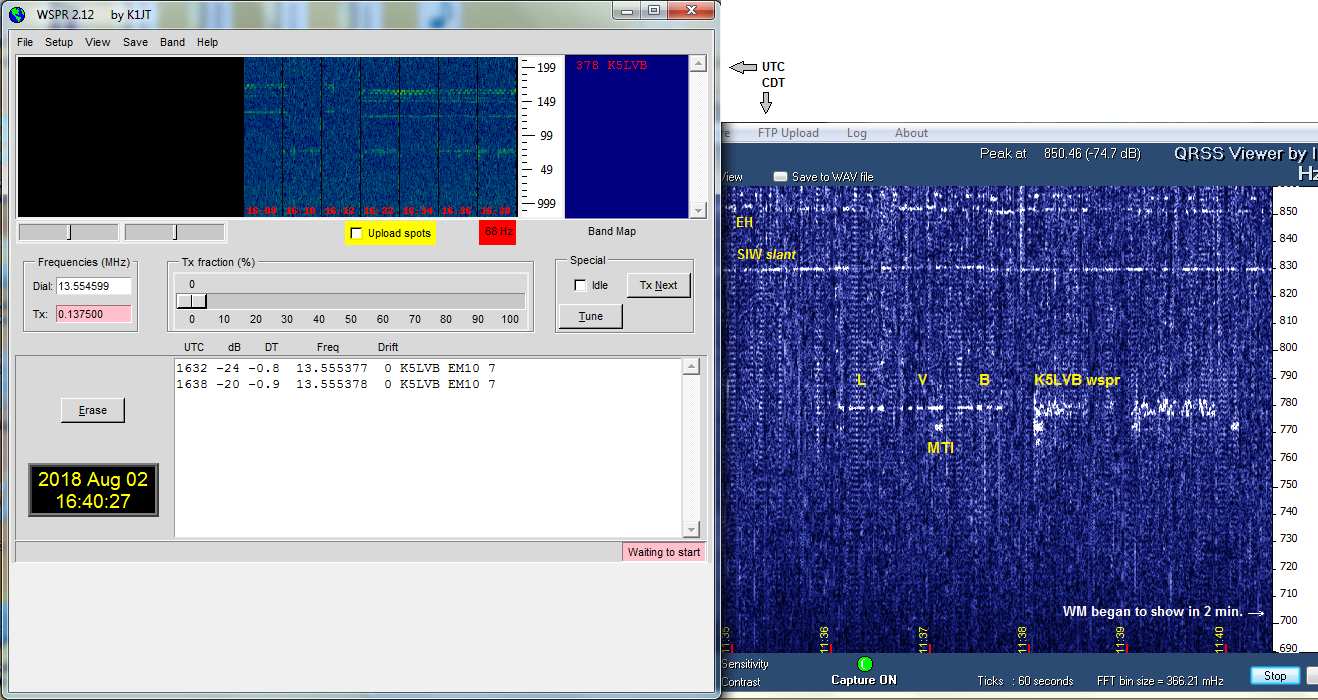
At 11:26 I returned to the watering hole, where the high frequency of NC was tangled up with 7P, EH and SIW slant were still chugging along, and there were hints of SIW WSPR that prompted me to crank up WSPR 2.12 to be ready. Good thing I did, because the bits of surplus RF I thought I saw above MTI at 11:30 didn't suggest to me what was about to come. The path to EM10 apparently opened up about then, because what I saw at the beginning of the 11:32 (1632 UTC) time slot really had me baffled until it decoded! :) Six minutes later came a repeat, preceded by the QRSS3 ID seen above. Continuing to monitor....
---------------------------------------------------------------
 File Attachment 1: 2aug-1.jpg
K6FRC Hifer heard
I heard K6FRC Hifer beacon for the first time at my Olivehurst QTH.
I can copy his 10 meter and sometimes the 6 meter beacon.
A distance of about 120 miles. The only other Hifer I copied was TSN but that was years ago.
Still using my Black Cat Systems oscillator modified beacon on 13.563.12~.
John you can purge my ESA Hifer listing.
jim vm Re: Something New Has Been Added! (K5LVB)
Posted by K5LVB on August 02, 2018 at 19:23:48.
In reply to Something New Has Been Added! (K5LVB) posted by John Davis on August 02, 2018
Thanks for noticing me! I had been transmitting since last weekend on 13566.100 kHz, but I don't think anyone heard me. So a few hours ago, I changed frequency to 13555.390, close to the other WSPR beacons. Re: Something New Has Been Added! (K5LVB)
I'm using a Raspberry Pi with a TAPR QRPi shield (made for 20m but 22m still gets through the filter), and a simple 16 ft. horizontal wire antenna on a 20 ft high balcony. I have an open view to the North. Software: PiCW for QRSS3 and WsprryPi for WSPR. Location is Austin, Texas.
Posted by John Davis on August 02, 2018 at 23:22:19.
In reply to Re: Something New Has Been Added! (K5LVB) posted by K5LVB on August 02, 2018
The rest of the afternoon's decodes:
1632 -24 -0.8  13.555377  0 K5LVB EM10 7
1638 -20 -0.9  13.555378  0 K5LVB EM10 7
1702 -24 -0.8  13.555384  0 K5LVB EM10 7
1744 -26 -1.0  13.555384  0 K5LVB EM10 7
1750 -26 -1.1  13.555384  0 K5LVB EM10 7
1756 -25 -1.1  13.555385  0 K5LVB EM10 7
1808 -27 -1.1  13.555386  0 K5LVB EM10 7
1814 -24 -1.2  13.555386  0 K5LVB EM10 7
1816 -24 -1.2  13.555402  0 K3SIW EN52 7
1820 -27 -1.1  13.555387  0 K5LVB EM10 7
1820 -27 -1.4  13.555400  0 K3SIW EN52 7
1826 -25 -1.0  13.555387  0 K5LVB EM10 7
1836 -26 -1.4  13.555402  0 K3SIW EN52 7
1848 -27 -1.3  13.555402  0 K3SIW EN52 7
1850 -26 -1.0  13.555388  0 K5LVB EM10 7
1856 -25 -1.1  13.555387  0 K5LVB EM10 7
1900 -29 -1.4  13.555400  0 K3SIW EN52 7
1902 -28 -1.1  13.555388  0 K5LVB EM10 7
1904 -26 -1.2  13.555402  0 K3SIW EN52 7
1908 -25 -1.1  13.555388  0 K5LVB EM10 7
1914 -30 -1.1  13.555387  0 K5LVB EM10 7
1916 -27 -1.4  13.555402  0 K3SIW EN52 7
1920 -25 -1.2  13.555387  0 K5LVB EM10 7
1920 -27 -1.2  13.555400  0 K3SIW EN52 7
1926 -27 -1.1  13.555387  0 K5LVB EM10 7
WM was intermittent and only fair visual copy in the early afternoon, and was gone from about 2:30 PM onward, when both the paths to IL and TX began closing. By 4:30, the watering hole was all codar with a little NC and EH. A little WV was occasionally audible, while WAS showed visually but not aurally.
WSPR data for Part 15 / RSS210
Having my beacon down thinking a rebuild of the mounting bracket and angle would prevent another tree limb strike (solar panel), I decided to briefly test WSPR on 1665.0 not expecting anything special to come out of it. I was surprised when I got a consistent report from a fellow running the WSPR software, yet he could barely pick out the CW when I switched modes.
It seems you cannot post (nor would it be wise to do so) anything on WSPRNET.ORG any reports from part 15 / rss210 unlicensed devices, however, what I did find is that WSPR does store the information as collected on the local computer.
I banged out some quick code to parse the log file looking for the frequency section and further parsing it so that if the frequency lies within a lowfer/medfer/hifer band it would subsequently extract the entire line and post it to a simple HTML page on a local (internal network) website, for the sake of testing.
I wonder if this might be a worthy project to see through to simple publication. It would simply be a add-on program for WSPR that looks in the directory every few configurable moments (seconds, minutes, etc) then posts to a website to be publicly visible. Search functionality I can see being added, but moreover, the mere fact that you can simply fire up your browser and see how your beacon is doing is seemingly attractive.
Maybe I am missing a portal that already does this? I suppose that is ultimately the question.
PCO slight changes
Posted by Bill Hensel on August 03, 2018 at 17:02:38.
PCO now sends 20 ids in a row with a 2 sec pause then repeats the series of IDs. Re: WSPR data for Part 15 / RSS210
Posted by John, W1TAG on August 03, 2018 at 18:10:34.
In reply to WSPR data for Part 15 / RSS210 posted by Jason Goldring on August 03, 2018
Jason,
If I go to wsprnet.org, select ALL for band, and key in K3SIW, I see his spots from anyone reporting on his 22m signal. Should work for other frequencies.
John, W1TAG
Re: PCO slight changes
Posted by Ed Holland on August 03, 2018 at 20:05:51.
In reply to PCO slight changes posted by Bill Hensel on August 03, 2018
Bill,
Thanks for the update - I'll keep an ear on your frequency when possible.
Cheers
Ed
N8OOU testing WSPR on 2200m
Posted by Mike N8OOU on August 04, 2018 at 15:42:24.
I'm testing WSPR on 2200m using my WM Lowfer antenna. I plan to let it run all weekend (8/4 & 8/5). 137540, 5W input - very low EIRP.
Reports are welcomed. Thanks for listening.
Mike 73
One Screen, Three WSPRs
Posted by John Davis on August 04, 2018 at 16:14:20.
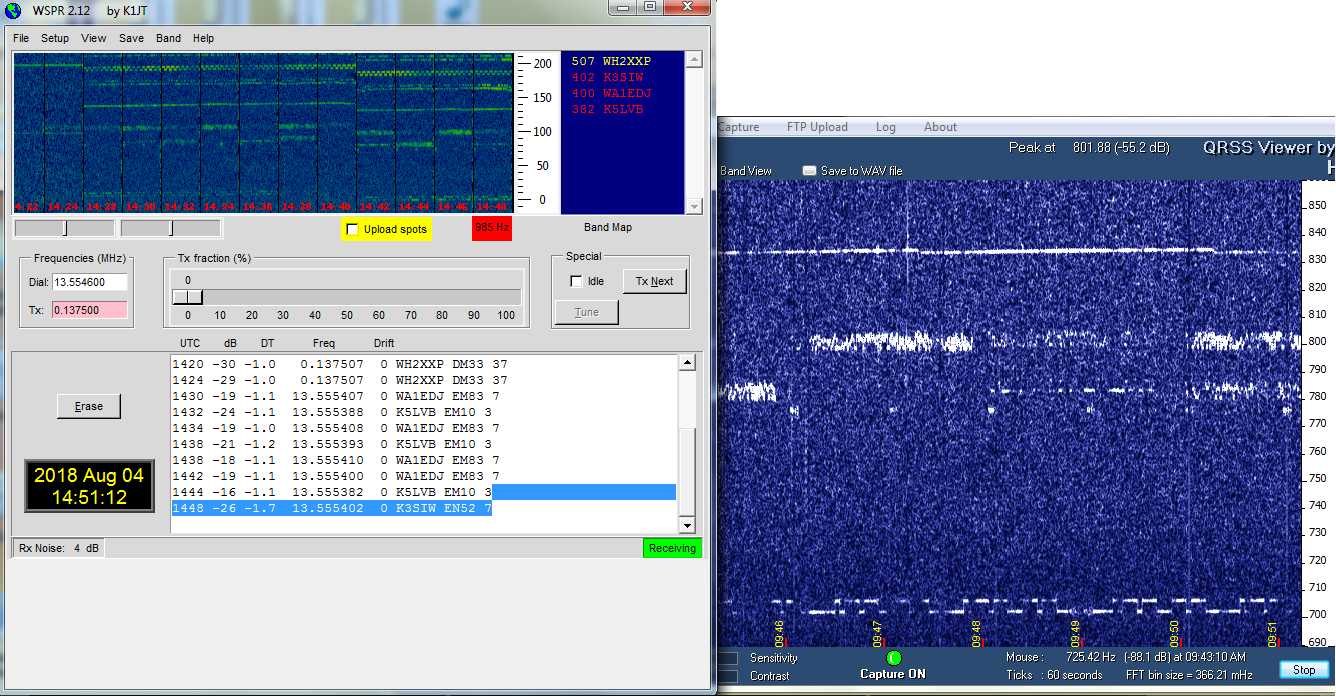
Apparently, it pays to get up earlier now that we're past the summer solstice! I intended to spend the early morning looking for WSPR on 2200 m while QRN was a bit lower than overnight, but found 22 m already more active.
Have some more observations on propagation to report, but I'll save those for later. Right now, I need to return to the farm and look for N8OOU on LF!
---------------------------------------------------------------
File Attachment 1: 4aug6.jpg
Re: N8OOU testing WSPR on 2200m
My first session in the field this morning was before your post, but we didn't get the usual break morning from QRN today. When I returned during the 11 AM (CDT) hour, static on 2200 m was slightly worse, if anything. These were the only decodes at 137 kHz during the hour:
1636 -32 -1.1   0.137507  0 WH2XXP DM33 37
1644 -30 -1.1   0.137507  0 WH2XXP DM33 37
1656 -28 -1.2   0.137507  0 WH2XXP DM33 37
...although Argo showed a slight excess of RF around 137.540 for part of the 1648 UTC time slot. Will continue to check from time to time today and tomorrow.
John Before I Forget--Fri 3 Aug
Posted by John Davis on August 04, 2018 at 19:45:23.
The band is changing a bit now that we are post-solstice, apparently. The two most recent listening sessions have not peaked near solar noon for short-skip, as was the case not long ago, but instead have fizzled out well before noon.
On Friday, both K3SIW and LVD WSPR signals were clearly visible when I first started just around 11 AM CDT, along with fair USC, good NC and EH, and a really bright line from SIW slant, plus sometimes audible MTI as well. However, the radio hadn't stabilized enough to decode WSPR yet, so I did a little monitoring at 2200 m where the drift is proportionally smaller, and a band scan at 22 m before returning to the HiFER watering hole. That yielded faint copy of WV for a few IDs at a time, GNK with mostly strong signals but wide QSB variations from letter to letter, and WAS with plenty of visual traces but only occasional audible copy (thanks, codar).
Had really good copy of PBJ for a couple of QRSS6 ID cycles starting just before 11:37 AM, too. It suddenly emerged out of nothing, but then was pretty constant except for a few short but deep dips; see the attachment.
When I returned to the watering hole, the WSPRers were gone and SIW slant was barely visible. I left WSPR 2.12 running and tended to other matters for a while, assuming the short-skip path would re-open around solar noon as usual; but it didn't.
By 2 o'clock, I gave up and did another band scan. Nobody else was copied this time except VAN, which ranged from just under visibility to fair aural copy for two or three IDs at a time. The aural copy was actually better sometimes than the trace in the attached image suggests. The slightly curved DAID was the most distinctive visual feature, of course.
I then switched to monitoring 2200 m for a few hours, with only seven decodes, all of which were WH2XXP and mostly at -29 dB SNRR.
At 5:17 I checked back on 22 m, with only EH and NC remaining at the watering hole, good copy for a minute or so, then gradually deteriorating. At 5:21 I tuned in WV at 13554.98, but it soon faded also. There was nobody else for about 10 minutes, then WAS showed up both visually and audibly, but only briefly. St that point I called it a day.
---------------------------------------------------------------
File Attachment 1: 03aug.jpg
Re: N8OOU testing WSPR on 2200m
John, A big thank you for going back to check, I figured the noise would increase as the day set in. I don't expect you will hear me except under the most ideal propagation. I will be your "Weak Signal" source for sure.
Mike 73
Re: One Screen, Three WSPRs
Posted by Bob Confrey on August 04, 2018 at 22:53:18.
In reply to One Screen, Three WSPRs posted by John Davis on August 04, 2018
TNX John! Good work. Looks like wx is ok here in GA for the weekend. I will continue with a break tonight for listening.
I'd like to find a way to interleave QRSS with the WSPR, even QRSS at a slightly different freq. My problem is I have the U3S set for a 90 sec cal cycle between the 2 min WSPR transmissions. I really don't have time left to QRSS before I start the next WSPR frame.
I may just move off 555.400 with SIW and start a different frame sequence. Then send the QRSS when I can give it a few mins. Maybe widen the cal cycle. The U3S is very versatile this way. I'll let you know.
Bob
EDJ
Re: One Screen, Three WSPRs
Posted by John, W1TAG on August 05, 2018 at 00:20:57.
In reply to Re: One Screen, Three WSPRs posted by Bob Confrey on August 04, 2018
Had nicely interleaved copy of SIW and EDJ WSPRs today in southern ME, with EDJ going away around 2300z.
John, W1TAG/1
PCO radial changes
Posted by Bill Hensel on August 05, 2018 at 01:58:02.
PCO will be run daily but at random times. The antenna is my 130ft inverted L.
At listeners request I will be glad to turn the beacon on at specific times.
73 Bill Pine Colorado
Re: One Screen, Three WSPRs
Posted by Bob WA1EDJ on August 05, 2018 at 12:46:50.
In reply to Re: One Screen, Three WSPRs posted by John, W1TAG on August 05, 2018
Thanks John! I'll be moving slightly off .400 soon to try some tests. Perhaps interleaving QRSS with WSPR. Your RY is at .415 (when on) so I may move to .407 or .408. I think that will be clear of you and SIW. Not sure if RY moves around but I should stay here I set the freq since it is GPS locked. QRSS wise I should not interfere but not sure for WSPR.
Your RY is always a pipeline down here to GA when on. EH is the same. I have a good path to the NE here.
Bob Re: N8OOU testing WSPR on 2200m
EDJ
Posted by John Davis on August 05, 2018 at 16:30:21.
In reply to Re: N8OOU testing WSPR on 2200m posted by Mike N8OOU on August 04, 2018
"I will be your 'Weak Signal' source for sure."
Unfortunately, Nature provided Big Signal sources nearly all night. No go with your signal, and even XXP's 5 W EIRP had trouble much of the night.
I went back to the field about 11 PM and could see XXP's signal on Argo, but not enough to decode, so I concentrated on 22 m for a while (see separate post re: that session). It was 12:52 AM (0552 UTC) before I got my first decode of XXP, and 1:16 (0616) before the next one, after which they were consistent in the -25 dB SNR vicinity for about two hours, then improving to the minus-mid-teens for about three more hours.
In the half hour before sunrise, his signal improved very rapidly or the noise diminished temporarily, or both. (I can't really say which, as I was napping at the time.) Minutes after sunrise, it deteriorated rapidly and ended with the 1140 time slot (see below), and was just barely visible on Argo when I resumed consciousness about an hour later. Still no sign of OOU during that interval, unfortunately. Will check some more today.
John
1104 -11 -1.1   0.137507  0 WH2XXP DM33 37
1108 -11 -1.1   0.137507  0 WH2XXP DM33 37
1112  -9 -1.1   0.137507  0 WH2XXP DM33 37
1116  -8 -1.1   0.137507  0 WH2XXP DM33 37
1120  -8 -1.0   0.137507  0 WH2XXP DM33 37
1124  -9 -1.0   0.137507  0 WH2XXP DM33 37
1128  -9 -1.1   0.137507  0 WH2XXP DM33 37
1132 -10 -1.0   0.137507  0 WH2XXP DM33 37
1136 -14 -1.1   0.137507  0 WH2XXP DM33 37
1140 -25 -1.1   0.137507  0 WH2XXP DM33 37
GNK Report - WAS QRT For Listening
WAS down for some listening.
Hearing GNK from about 1540 to about 1640Z...part of the time listening from the dinner table. Sig generally maxing out at about RST 339 and down to barely preceptable or into the noise. Fade ups generally 3-4 ID heard and down for about 15sec or so then back up to the 339 for a few IDs. Interesting to hear the QSB cycle.
Will be tuning around some this afternoon.
de Bill K4JYS/WAS
22m dipole and Ten-Tec RX340. Re: One Screen, Three WSPRs
Posted by John Davis on August 05, 2018 at 16:49:21.
In reply to Re: One Screen, Three WSPRs posted by Bob WA1EDJ on August 05, 2018
Some followup on the rest of yesterday's results:
My sojourn to 2200 m only lasted half an hour, during which I was barely able to copy WH2XXP three times, twice at -32 dB SNRr. Conditions there were deteriorating further, so I returned to 22 m. Only WA1EDJ came through the rest of the afternoon, snd even it went away by 2:20 PM; see the entire day's decodes below the signature.
Other signals on the band Saturday (times CDT, freq +/-5 Hz):
8:42am - MTI, visual & aural
12:11pm - WV 13554.990
12:18pm - WAS
4:28pm - WAS again, 13564.95
Missing in action: PBJ, VAN, PCO, FRC
John
UTC  SNR  DT   FREQ      DF ID     GRID P(dbm)
1354 -18 -1.1  13.555403 -1 WA1EDJ EM83 7
1358 -17 -1.0  13.555406  1 WA1EDJ EM83 7
1402 -22 -1.0  13.555391  1 K5LVB EM10 3
1402 -18 -0.9  13.555410  1 WA1EDJ EM83 7
1406 -20 -1.0  13.555404  1 WA1EDJ EM83 7
1410 -23 -1.6  13.555407  1 WA1EDJ EM83 7
1416 -29 -1.1   0.137507  0 WH2XXP DM33 37
1420 -30 -1.0   0.137507  0 WH2XXP DM33 37
1424 -29 -1.0   0.137507  0 WH2XXP DM33 37
1430 -19 -1.1  13.555407  0 WA1EDJ EM83 7
1432 -24 -1.1  13.555388  0 K5LVB EM10 3
1434 -19 -1.0  13.555408  0 WA1EDJ EM83 7
1438 -21 -1.2  13.555393  0 K5LVB EM10 3
1438 -18 -1.1  13.555410  0 WA1EDJ EM83 7
1442 -19 -1.1  13.555400  0 WA1EDJ EM83 7
1444 -16 -1.1  13.555382  0 K5LVB EM10 3
1448 -26 -1.7  13.555402  0 K3SIW EN52 7
1450 -21 -0.9  13.555383  0 K5LVB EM10 3
1456 -20 -1.1  13.555383  0 K5LVB EM10 3
1502 -20 -1.1  13.555382  0 K5LVB EM10 3
1502 -15 -1.1  13.555401  0 WA1EDJ EM83 7
1508 -25 -1.0  13.555382  0 K5LVB EM10 3
1510 -21 -1.1  13.555401  0 WA1EDJ EM83 7
1514 -23 -1.1  13.555386  0 K5LVB EM10 3
1518 -19 -1.1  13.555401  0 WA1EDJ EM83 7
1520 -22 -1.1  13.555386  0 K5LVB EM10 3
1522 -20 -1.1  13.555403  0 WA1EDJ EM83 7
1526 -19 -1.1  13.555386  0 K5LVB EM10 3
1526 -19 -1.1  13.555401  0 WA1EDJ EM83 7
1530 -19 -1.2  13.555402  0 WA1EDJ EM83 7
1532 -19 -1.2  13.555387  0 K5LVB EM10 3
1534 -20 -1.1  13.555403  0 WA1EDJ EM83 7
1538 -18 -1.1  13.555389  0 K5LVB EM10 3
1538 -23 -1.1  13.555403  0 WA1EDJ EM83 7
1542 -22 -1.1  13.555403  0 WA1EDJ EM83 7
1544 -20 -1.2  13.555390  0 K5LVB EM10 3
1546 -20 -1.2  13.555404  0 WA1EDJ EM83 7
1554 -18 -0.9  13.555404  0 WA1EDJ EM83 7
1556 -22 -1.3  13.555393  0 K5LVB EM10 3
1558 -21 -1.1  13.555404  0 WA1EDJ EM83 7
1602 -20 -1.1  13.555394  0 K5LVB EM10 3
1602 -21 -1.1  13.555405  0 WA1EDJ EM83 7
1610 -20 -1.1  13.555405  0 WA1EDJ EM83 7
1614 -20 -1.2  13.555396  0 K5LVB EM10 3
1614 -15 -1.2  13.555406  0 WA1EDJ EM83 7
1618 -17 -1.1  13.555407  0 WA1EDJ EM83 7
1620 -21 -1.2  13.555396  0 K5LVB EM10 3
1622 -20 -1.1  13.555407  0 WA1EDJ EM83 7
1626 -19 -1.1  13.555395  0 K5LVB EM10 3
1626 -18 -1.1  13.555407  0 WA1EDJ EM83 7
1630 -23 -1.1  13.555407  0 WA1EDJ EM83 7
1632 -22 -1.3  13.555385  0 K5LVB EM10 3
1636 -32 -1.1   0.137507  0 WH2XXP DM33 37
1644 -30 -1.1   0.137507  0 WH2XXP DM33 37
1656 -28 -1.2   0.137507  0 WH2XXP DM33 37
1706 -24 -1.1  13.555401  0 WA1EDJ EM83 7
1726 -24 -1.3  13.555404  0 WA1EDJ EM83 7
1730 -24 -1.2  13.555404  0 WA1EDJ EM83 7
1734 -22 -1.2  13.555404  0 WA1EDJ EM83 7
1738 -26 -1.3  13.555404  1 WA1EDJ EM83 7
1742 -23 -1.2  13.555404  0 WA1EDJ EM83 7
1746 -26 -1.2  13.555405  0 WA1EDJ EM83 7
1750 -24 -1.1  13.555405  0 WA1EDJ EM83 7
1754 -25 -1.3  13.555405  0 WA1EDJ EM83 7
1758 -24 -1.1  13.555406  0 WA1EDJ EM83 7
1802 -25 -1.3  13.555406  0 WA1EDJ EM83 7
1814 -23 -1.3  13.555407  0 WA1EDJ EM83 7
1822 -27 -1.3  13.555407  0 WA1EDJ EM83 7
1826 -26 -1.3  13.555407  0 WA1EDJ EM83 7
1838 -23 -1.3  13.555407  0 WA1EDJ EM83 7
1850 -23 -1.2  13.555407  0 WA1EDJ EM83 7
1854 -26 -1.2  13.555407  0 WA1EDJ EM83 7
1858 -27 -1.3  13.555406  0 WA1EDJ EM83 7
1910 -27 -1.2  13.555406  0 WA1EDJ EM83 7
1918 -29 -1.4  13.555408  0 WA1EDJ EM83 7
WV Report
Copying WV in eastern NC from 1725-1732Z. Sigs generally ranging from RST 229 to maybe pushing a 449, but with occasional fade-ups to 559 or about an S6 (ambient noise floor at about an S2). First time I have heard WV. His dit/dah marker good for attracting attention plus making S-meter readings.
de Bill K4JYS/WAS Re: One Screen, Three WSPRs
22m dipole/Ten-Tec RX340
Posted by John Davis on August 05, 2018 at 17:56:14.
In reply to Re: One Screen, Three WSPRs posted by Bob WA1EDJ on August 05, 2018
Hi Bob. For alternate frequencies, might I recommend somewhere between 13555.315 and .360 ? It's a quiet area, and would allow a comfortable safety margin from surrounding signals. It also fits nicely in the decoding window of WSPR-2 if the receiver is tuned to center the window around 13555.400 (ie, USB "dial frequency" of 13553.900 and 1500 Hz "BFO"; or in my case, CW mode and corresponding fibs about "dial" and "BFO" to make freq display correctly).
One alternative on the upper side of RY would be 13555.420, also well within the window, but with one drawback: sometimes NC and EH drift down that far, but usually not for too many hours at a time.
Based on our earlier results, it appears that WSPR is potentially sensitive to other WSPR signals if the two are close enough that a frequency step in one of them could potentially be seen as a valid step in the next adjacent one. (WSPR is good at rejecting steady tones and even random impulses within the bandwidth of a valid signal, but a tone that's stepping or drifting at about the right frequency interval in the right time duration is another matter.) As for WSPR interfering with a nearby QRSS signal, that's a little less likely but could happen when a propagation enhancement brightens ...and thereby widens... the WSPR trace; or if the all-too-common Doppler shifted multipath of 22 meters widens it. For those reasons, I am inclined to believe one should leave a guard band of 4 or 5 Hz, or more where practical, on either side.
John
PLM Report
Posted by Bill K4JYS on August 05, 2018 at 18:02:08.
Am just barely hearing PLM from 1737-1755Z. Sigs are mostly at the noise threshold, but with a few IDs just above the noise floor to positively identify....mostly RST 229 or less up to 339 a few times. Re: WV Report
73 de Bill K4JYS
Posted by John Davis on August 05, 2018 at 18:21:33.
In reply to WV Report posted by Bill K4JYS on August 05, 2018
Great reports on GNK and WV, Bill. Glad to hear you're having such good reception there.
WV was also pretty strong here this morning between 7:50 and 8:00 AM CDT.
I guess it's a good thing I also checked for WAS early today. The attached Argo capture was shortly after 8 AM CDT. Strength ranged from barely visible to comfortably audible. There started to be a bit of upward drift after while, and then I got chased off the frequency by some kind of fluttery pulsating QRM that seemed to be wandering back and forth through the upper two-thirds of the band. But it was nice reception while it lasted.
John
---------------------------------------------------------------
File Attachment 1: 5aug-WAS.jpg
Re: PLM Report
Fantastic, Bill! Was he by any chance running a dash after some number of IDs? I'll explain why I ask this in a later post...
Re: PLM Report
Posted by Bill K4JYS on August 05, 2018 at 19:49:01.
In reply to Re: PLM Report posted by John Davis on August 05, 2018
Hey John, WAS Back Up
Yep, long dash after the IDs.
Also, tnx for the report on WAS. I'll fire it up again later today. Oh, I may have mentioned the trouble with the Blackcat not starting up after removing the power. I found, after a few power outages, that it will eventually re-start on its own....so no real problem. If I want it to immediately restart, I just touch the xtal with my finger and it cranks right up....just a little eccentricity...hi.
73 de Bill K4JYS/WAS
Posted by Bill K4JYS on August 05, 2018 at 20:27:24.
It's back up after a good listening session this afternoon. Now not hearing any sigs at all...band is quiet except for a little static and the spurious, raunchy sig put out by my air/cond fan controller every 20 or so kc across the spectrum...lf/mf thru six meters. Re: PLM Report
de Bill K4JYS
Posted by John Davis on August 05, 2018 at 20:38:46.
In reply to Re: PLM Report posted by Bill K4JYS on August 05, 2018
Bill wrote:
Yep, long dash after the IDs.
So I wasn't hallucinating! ...this time. ;)
Right as you posted about PLM, I was considering asking you to target that frequency, because late last night I thought I heard PLM for the first time in nearly a year. It was at the right spot. Only thing was, I couldn't get a complete ID in any single cycle...it was an M here, a P there, and what I thought was an occasional L, but it was too weak to be sure of the whole thing. And if it was PLM, something new had been added. Argo was clearly showing DAID (see attachment; drift in these images is from charging the radio's storage battery), even though I was not always hearing the complete dash by ear.
Sure wish we knew who the operator is and how to contact him/her with reports...or even just where the beacon is, for that matter.
John
---------------------------------------------------------------
File Attachment 1: 04aug-PBJPLM.jpg
WAS Heard in Canada
Well, wonders never cease. A bit ago I got an email report of WAS being heard in Burlington, Ont. by Steve, VA3SC. He reported: "QSB. Sometimes popping up quite well."
He also reported hearing GNK and WV over the last week. After I heard GNK, WV & PLM today, the SWL report on WAS really capped off an excellent radio day.
73 de Bill K4JYS
Re: WV Report
Posted by Bill K4JYS on August 05, 2018 at 23:39:04.
In reply to Re: WV Report posted by John Davis on August 05, 2018
Tnx John for another WAS report....can't get too many...hi. Re: N8OOU testing WSPR on 2200m
I guess ya never know what kind of a signal will show up in the ISM band.
I will try some more listening sessions on occasion...twas fun today.
73 de Bill K4JYS
Posted by Mike N8OOU on August 06, 2018 at 13:07:09.
In reply to Re: N8OOU testing WSPR on 2200m posted by John Davis on August 05, 2018
John, and others;
Thanks for your time and effort in attempting to capture my WSPR signal. Over the weekend, I have come up with an idea of how to move the PA to the base of the antenna. I hopefully will get that done today (Mon) with only a short outage. In my past tests on 2200m, when I get the exciter too close to the antenna, the RF confuses the uP. I hope that change increases the EIRP by removing any feedline loss. Later this week I will give up on 2200m, test 600m again, then get the lowfer back on the air.
Mike 73
Historical Method Of Signal Processing
Posted by Frank Lotito on August 06, 2018 at 13:37:54.
Many-many years ago when digital signal processing was still a theoretical pencil and paper exercise of mathematicians, I recall reading about a simple “inject a pure tone” method of digging the signal out of the noise. Basically it required the user to inject a frequency, lets call it F1 at a low level, but as I recall somewhat higher in amplitude of the desired signal F2. The frequency F1 was a few hundred to a kilohertz different from the desired signal F2. This technique would “elevate” the desired signal enhancing the possibility of a better copy. Re: Historical Method Of Signal Processing
..
Does anyone recall such a technique? Is it still used today?
..
73 Frank Lotito K3DZ@live.com
Posted by Bill K4JYS on August 06, 2018 at 15:08:05.
In reply to Historical Method Of Signal Processing posted by Frank Lotito on August 06, 2018
Probably not what you are talking abt, Frank, but your post jogged the old memory a bit.
Back in the late '50s, I recall discovering that rcvrs had a variable freq. 'xmtr' in them (local osc.) which I used as a bfo, beating with a cw sig in another, bfo-less, rcvr. No inj. level control so the cw sig needed to be pretty srong. It worked in a pinch.
I also remember, while in tech. school, another student, in another room played his radio too loud plus I didn't like his music. I had an old GE sw/bc rcvr that really put out a strong local osc. sig. I would tune it across his station and make a loud hetrodyne until he gave up....he never figured out what was going on....hi. A tid-bit from my reckless youth. PCO is gone for good
73 de Bill K4JYS
Posted by Bill Hensel on August 06, 2018 at 15:44:31.
Maybe PCO will come back on the air Interesting summer 2200m WSPR test
when the sun spots come back..Time will tell.
73 Bill
Posted by Paul N1BUG on August 06, 2018 at 19:58:57.
After finally getting the new amplifier and power supply completed to reach 1W EIRP, I spent several nights transmitting WSPR2 during the hours of common darkness with Europe. Although the Part 5 stations knew it could be done and were not too surprised, I was absolutely amazed to be heard by 2E0ILY, PA0RDT, and DL0AO (5804 km) at this time of year. Wow! It would certainly be most interesting to continue these experiments and try other modes during the summer. I regret that is not practical and have discontinued transmissions until sometime in the Fall.
Before full onset of winter (and the quiet season) I hope to have at least two new receiving antennas and will be looking for two way QSOs.
Paul
Re: PCO is gone for good
Posted by Paul on August 06, 2018 at 20:55:20.
In reply to PCO is gone for good posted by Bill Hensel on August 06, 2018
Very sorry to see you go (QRT), Bill. Was hoping to finally catch the elusive PCO. Maybe next cycle.
VY 73, PS EDJ WSPR/QRSS on 555.420
Posted by Bob WA1EDJ on August 06, 2018 at 21:52:05.
Got the U3S running a 10 min WSPR frame with FSKCW on 13 555.420. One 2 min WSPR and 4X EDJ's in 10 min frame....Will be on as soon as I get ant connected back up from lawn mowing. TS's permitting for next few days.
Bob Re: PCO is gone for good
EDJ
Posted by Ed Holland on August 06, 2018 at 22:03:57.
In reply to PCO is gone for good posted by Bill Hensel on August 06, 2018
Sorry to see PCO go Bill,
Will you still be checking in with listening reports?
Ed
WV
Posted by VE3DJI. on August 06, 2018 at 22:59:52.
Heard WV on 13.555 faint but steady Aug 5 2100 Z from Kingston, on. R75 with ore amp, 60 m dipole. Not heard since
Re: Historical Method Of Signal Processing
Posted by John Davis on August 07, 2018 at 02:30:05.
In reply to Historical Method Of Signal Processing posted by Frank Lotito on August 06, 2018
Interesting question, Frank. I've been flogging my memory for hours, but can't recall ever hearing of such a technique before.
In the days before I had the Little Shack on the Prairie and buried coax to the antenna, and instead had to sit in the car at the base of the mast, I frequently had various steady tones being injected at different times and various places within the passband of the radio by way of the computer display, the car's data bus, and sometimes the radio itself ...and I can't say it ever helped me pull out any signals any better. The psychoacoustic masking effect of the pure local tone left the brain prepared to interpret everything else as noise to be ignored. But of course I had no control over the separation of the tones from the desired signal, and very little control over their level, so it's hard to draw any conclusions from that experience.
Working on the assumption that some listener(s) at some time or another did get positive results from this technique, however, I asked myself what might be the basis. So far, only three ideas have sprung to mind.
1. The wildest first: It's conceivable that the technique depends on intermodulation between the two tones, arising from nonlinearities in the receiver's audio chain or the speaker or headphones, to produce a third frequency to which the listener's ear is more responsive.
2. A more plausible variation on the first idea: Perhaps the frequency of the local tone is chosen so that the received signal forms a discordant pair of pitches. You've probably had the experience of being somewhere that a radio is playing, either in another room or at a low enough level that you barely notice its presence--until the dreadful two-tone EANS attention signal comes on for a Required Weekly Test or a weather warning. Even though its modulation level is no higher than processed music or speech, it does get your attention pretty quickly! It cuts through chatter, air conditioning, or other common domestic noise sources fairly easily. Alas, the downside of this hypothesis is, both tones need to be at nearly the same level for maximum effect, not one stronger than the other.
3. My favorite notion, based on your mention that the local frequency may need to be at a higher level: Possibly, the local tone is acting to defeat (or at least limit the range of) the radio's AGC action, if the AGC is not otherwise defeatable. We know that switching off AGC and manually riding the RF gain control, or else increasing input attenuation until the receiver is just below the threshold of AGC action on the channel of interest, is a technique used by some DXers and commercial CW ops to prevent bringing up noise between character elements, and/or to prevent noise from modulating the level of the desired signal. The ear can ignore certain kinds of noise better than it can fill in amplitude fluctuations in a signal.
If your inquiries turn up any sources that explain the principle, I hope you'll post back with what you find out.
John
Re: N8OOU testing WSPR on 2200m
Posted by Mike N8OOU on August 07, 2018 at 23:59:59.
In reply to Re: N8OOU testing WSPR on 2200m posted by Mike N8OOU on August 06, 2018
I have changed the parameters on my 2200m WSPR test. It is now running WSPR-15 on 137.615 KHz or the standard dial frequency of .136000 MHz plus 1615. Transmissions will occur on the 00 and 30 minute mark.
I plan to let this run a couple days to at least, complete a good "burn in" test of the station.
Reports are welcomed.
Mike 73
Re: PCO is gone for good
Posted by John Davis on August 08, 2018 at 05:38:45.
In reply to Re: PCO is gone for good posted by Ed Holland on August 06, 2018
I'll also miss having PCO to watch for. Even though it was rather rare copy here (most recently 27 July, it was a worthy challenge.
John
Re: Testing on 2200m Completed
Posted by Mike N8OOU on August 08, 2018 at 14:30:40.
In reply to Re: N8OOU testing WSPR on 2200m posted by Mike N8OOU on August 07, 2018
All;
Thanks to all for listening, I have finished testing for now. This test was successful, in that my hardware didn't fail, but no one reported hearing my signal. I may try again later this fall.
Mike 73
Reminder: Lowfer net 3927Khz Saturday morning 0800 California time
Posted by Jerry Parker on August 10, 2018 at 22:06:38.
Reminder: Lowfer net 3927Khz Saturday morning 0800 California time
Or listen online at:
http://69.27.184.62:8901/?tune=3927lsb
click on the autonotch to get rid of heterodynes
Hope to see you there.
OR Try the other Western US HF WebSDR systems: W7RNA Multiband WebSDR Receiver and Northern Utah WebSDR. They both work very well.
W7RNA Sedona AZ http://w7rna.dyndns-remote.com:18901/?tune=3927lsb
KA7OEI Northern UT http://websdr1.utahsdr.org:8901/?tune=3927lsb
"NOW HAS 630M RECEIVER"
Jerry WA6OWR
Casual listener - 555.710 ?
Posted by Ray Deady on August 10, 2018 at 22:12:43.
Swinging around the band and 555.710 CW is coming in and out, first time I have copied. Found the board looking for a station, nothing I can see on the list. EDJ back on 555.420
-Ray
Posted by Bob WA1EDJ on August 11, 2018 at 13:04:47.
TS's seem to out of the area for a few days. EDJ is WSPRing and FSKCW on 13 555.420.
The U3S synth board has had the 27 MHz xtal replaced with a TCXO.
TNX Re: EDJ back on 555.420
Bob
EDJ
Posted by John Davis on August 11, 2018 at 15:26:39.
In reply to EDJ back on 555.420 posted by Bob WA1EDJ on August 11, 2018
Doing a nice job here this morning. Started out warming up the receiver about a quarter past 9 AM CDT and saw the FSK "EDJ" pretty shortly thereafter. Codar started showing up, too, but by :50 after (the 1450 UTC time slot) conditions were good enough and the radio was stable enough to get a WSPR decode at -22 dB SNRr. Continuing to monitor, even during my temporary absence to report here.
Catching Up - Sat. Night Aug 4-5
Posted by John Davis on August 11, 2018 at 16:06:55.
Nighttime had been productive on 22 m in the late spring, but not so much around the solstice. Last Saturday night, though, I was preparing to monitor 2200 m WSPR, but until the radio warmed up enough I figured I'd tune around HF a bit. Results were surprisingly good for a while! Times are CDT:
11:33PM - Watering hole: EH, NC, SIW WSPR good, but oddly no SIW slant
11:34   - EDJ fair/wk
11:36   - MTI audible
Away from the watering hole:
11:41   - WV mostly good, but wide variations of level
11:46   - PBJ good visually, slightly audible*
11:54   - 13557.74 PLM, 1st time in 2018 (w DAID)*
  no VAN, no PCO
12:11AM - GNK faint
  no FRC
Back to watering hole:
12:23   - NC good, EDJ WSPR partially visible
12:27   - MTI
12:33a  - EH returning, in collision w NC... faint WM
By then, conditions overall were only fair so I returned to 2200 m for the night.
(*The capture of PBJ and PLM was posted previously in a reply to Bill K4JYS, and can be viewed at: lwca.org/mbarchiv/pix/2018/04aug-PBJPLM.jpg )
John
Re: Catching Up - Sun. Aug 5
Posted by John Davis on August 11, 2018 at 17:17:10.
In reply to Catching Up - Sat. Night Aug 4-5 posted by John Davis on August 11, 2018
An hour after sunrise on Sunday, 2200 m still had all the overnight static level but without the overnight signal levels, so at 7:30 (CDT) I went back to 22 m to see who was around. EH and NC seemed to be loitering around outside, not quite ready yet to go to work, so I did a band scan. During the 8 o'clock hour, nearly all the regulars showed up and clocked in. The two Californians arrived for work after 9 AM, but they're excused because of the time zones. Too bad they missed out on the free donuts, though. <g&ft;
7:50 -  WV difficult aural copy due codar exc when vy strong
8:00 - PBJ vis & aud but w some fluttery noise
8:06 - no VAN no PCO no GNK
8:11 - WAS sometimes too weak to copy despite visible trace,
  sometimes clear; see attachment; seems to be 13,564.850 today
8:13 - a little upward drift begins on WAS
8:21 - looks like LVB at watering hole
8:26 - SIW-slant clear
8:32 - LVB & SIW WSPR together (see decodes below)
!! ionosondes
8:46 - EDJ visible & decode!
8:50 - WM intermittently visible
8:56 - MTI audible as well as visible
9:07 - WV now consistently fair-good
9:13 - no more PBJ
9:17 - VAN easily recognizable
9:21 - GNK fair-good, then a wandering roar
9:23 - FRC, first time in weeks; then wandering roar
   chases me off this freq too
Alas, the only HiFER WSPR decodes of the day were these that occurred in the 8 and 9 o'clock hours. Instead of getting better in the pre-solar-noon hours, conditions actually deteriorated. Some WSPR signals were visible later in the morning, but were apparently too patchy to decode. Also, I tried early mornings again on Monday, Wednesday and Thursday but they were not this productive.
John
1332 -24 -1.1   13.555383  0 K5LVB EM10 7
1332 -26 -1.2   13.555399  0 K3SIW EN52 7
1338 -24 -1.0   13.555383  0 K5LVB EM10 7
1344 -22 -1.1   13.555382  0 K5LVB EM10 7
1346 -27 -1.0   13.555399  0 WA1EDJ EM83 7
1350 -26 -1.0   13.555382  0 K5LVB EM10 7
1350 -18 -1.0   13.555399  0 WA1EDJ EM83 7
1354 -27 -1.0   13.555399  0 WA1EDJ EM83 7
1404 -26 -1.6   13.555401  0 K3SIW EN52 7
---------------------------------------------------------------
File Attachment 1: 5aug-WAS-1.jpg
Re: EDJ back on 555.420
Another brief report because of another temporary absence from the field, although unscheduled. (The Co-Op showed up unannounced to spray my field. I have no idea what they're spraying, but at this time of year it's never anything that's good for mammalian life to breathe or otherwise ingest!) So, I skedaddled, even though I wanted to linger for the rest of the hour, and then shut down for the day before any storms pop up.
At any rate, what I've noticed this morning is that nearly every WSPR transmission from EDJ has exhibited a -1 Hz drift during the two minute slot. When I saw that earlier this morning, I assumed it was radio drift as the shack warmed up, but that trend acts more slowly...Old Drifty's output audio changed as much as six Hz/hour due to local heating, but in a positive direction instead of downward. Also, SIW and LVD decoded several times during the morning, always showing 0 drift during their two-minute slots.
I have a screen shot of one of the later time slots that may be helpful, but I left the premises so fast that I forgot to grab the memory stick. Will follow up after I've been back to the farm.
John
Re: Reminder: Lowfer net 3927Khz Saturday morning 0800 California time
Posted by Paul on August 11, 2018 at 21:16:39.
In reply to Reminder: Lowfer net 3927Khz Saturday morning 0800 California time posted by Jerry Parker on August 10, 2018
I keep missing these... Dang!
Does anyone ever check in to this?
73, PS WM Lowfer On Air
Posted by Mike N8OOU on August 11, 2018 at 21:34:50.
I changed the antenna over to 1750m this afternoon and started up the WM Lowfer Beacon. 185.3 Khz QRSS60/30/Graphic modes.
Good Luck to All
Mike 73
Re: EDJ back on 555.420
Posted by Bob WA1EDJ on August 11, 2018 at 23:21:07.
In reply to Re: EDJ back on 555.420 posted by John Davis on August 11, 2018
Thanks John, that's interesting. The one big change I've made in the last week is that on my U3S 5351A synth board, I removed the 27 MHz xtal and installed a 27 MHz TCXO recommended by Mike N8OOU. This is also GPS disciplined. I have a 10 sec cal cycle set up at the end of the FSKCW transmission. During the transmission, nothing is adjusted. It could be warm up during the transmit cycle. I may have to investigate the "park" feature of the U3S. I have not taken any measurements with a counter but plan on setting up a config on the U3S to just transmit a solid carrier and check for long term drift. What I can do, since I have several more synth boards, is just plug a different one in that is still using xtal. If I can accomplish that tonight I will and post as such. Not sure. Sat nights go too fast!
Thanks for your observations. At least we are doing some experimenting on this band!
Bob Re: EDJ back on 555.420
EDJ
Posted by John Davis on August 12, 2018 at 03:50:31.
In reply to Re: EDJ back on 555.420 posted by Bob WA1EDJ on August 11, 2018
"At least we are doing some experimenting on this band!"
Indeed! Although I am temporarily sans workshop to participate directly, I hope these remote observations are sometimes helpful in that regard.
Perhaps the two attached captures will provide a clue as to what may be going on. The file "11aug2.jpg" is a typical QRSS3 view along with the WSPR decode closest to local noon here. On the Argo screen, the slight downward drift during the WSPR segment is noticeable to the eye. What's less apparent is that the drift continues downward for a little while longer, then turns around.
The other one, "11augc19.gif", is an example of serendipity. I set up an Argo instance to watch for SIW slant differently this morning, at QRSS10. That just happened to be a very good speed for grabbing consecutive 10-minute cycles of EDJ too! In this shot, it's evident that there's not an ongoing long-term drift that has to be corrected further each cycle, but something cyclical that starts over each time.
By 4 PM, the radio shack had stabilized at the high temperature for the day (and so had NC, apparently), as evidenced by the nice flat GPS-referenced codar lines. Blowing up the image ×2 I was able to confirm the reported 1 Hz drift during the WSPR segment, and ≈1.6 Hz overall between the low point of the FSK and the maximum at the end. FWIW, that's less than 0.12 ppm, which is nothing to sneeze at.
I've seen that curve in connection with TCXOs before, but I can't quite place it. The circuit doesn't shut off power to the oscillator between the calibrate cycle and the next transmission, does it? If not, perhaps the TCXO is located where it feels the heat of the PA?
I hope I'll have another chance to listen right after you've made changes to the unit, but it's not certain that I'll be able to get to the field before afternoon t-storms show up here on Sunday. If I could find my little Commradio CR1a with its incredibly short warm-up time and built-in battery, though, that would expedite setup considerably.
John
1450 -22 -1.2  13.555429  0 WA1EDJ EM83 7
1500 -21 -1.0  13.555424  0 WA1EDJ EM83 7
1510 -20 -1.0  13.555429 -1 WA1EDJ EM83 7
1512 -28 -2.0  13.555410  1 K3SIW EN52 7
1516 -28 -1.8  13.555411  0 K3SIW EN52 7
1520 -27 -1.4  13.555412  0 K3SIW EN52 7
1520 -22 -0.8  13.555433 -1 WA1EDJ EM83 7
1530 -19 -0.9  13.555434 -1 WA1EDJ EM83 7
1540 -21 -1.1  13.555438 -1 WA1EDJ EM83 7
1552 -24 -1.2  13.555422  0 K3SIW EN52 7
1556 -25 -2.2  13.555421  0 K3SIW EN52 7
1600 -30 -1.7  13.555422  0 K3SIW EN52 7
1600 -24 -1.0  13.555442 -1 WA1EDJ EM83 7
1610 -19 -0.9  13.555445 -1 WA1EDJ EM83 7
1620 -24 -1.5  13.555446 -1 WA1EDJ EM83 7
1630 -21 -1.0  13.555447 -1 WA1EDJ EM83 7
1640 -20 -1.1  13.555448 -1 WA1EDJ EM83 7
1650 -21 -0.8  13.555449 -1 WA1EDJ EM83 7
1656 -26 -0.8  13.555405  0 K5LVB EM10 7
1700 -21 -1.0  13.555450 -1 WA1EDJ EM83 7
1710 -27 -1.1  13.555450 -1 WA1EDJ EM83 7
1720 -22 -0.9  13.555449 -1 WA1EDJ EM83 7
1800 -17 -1.2  13.555421 -1 WA1EDJ EM83 7
1820 -25 -1.1  13.555423 -1 WA1EDJ EM83 7
1830 -29 -1.3  13.555423 -1 WA1EDJ EM83 7
1838 -18 -1.4  13.555386  0 K5LVB EM10 7
1840 -22 -1.3  13.555422 -1 WA1EDJ EM83 7
1850 -27 -1.4  13.555386  0 K5LVB EM10 7
1850 -22 -1.4  13.555423 -1 WA1EDJ EM83 7
1900 -25 -1.1  13.555422 -1 WA1EDJ EM83 7
1920 -27 -1.4  13.555421 -1 WA1EDJ EM83 7
2010 -28 -1.1  13.555420 -1 WA1EDJ EM83 7
2050 -25 -1.4  13.555420 -1 WA1EDJ EM83 7
2100 -26 -1.4  13.555421 -1 WA1EDJ EM83 7
2110 -21 -1.3  13.555421 -1 WA1EDJ EM83 7
---------------------------------------------------------------
File Attachment 1: 11aug2.jpg
File Attachment 2: 11augc19.gif
Re: EDJ back on 555.420
Yes, drift is pretty apparent. I don't believe you saw anything like that with just the xtal synth board installed in the U3.
I did try to install another xtal synth board in the U3 last night. That did not go as planned. For some reason the freq came out 1+ KHz higher than the set displayed freq.
I don't know why. Maybe of stored config information in he micro you just can't swap like that? Mike N8OOU is working with me on this. So, bottom line, no non-TCXO is running on the U3 right now. I may just try "parking" the synth on a freq so it never shuts off as it does now between transmissions. Sure looks like warm-up drift to me.
Thanks for your help. If I try anything today, I'll post.
Bob
EDJ
Three successful transmissions from SAQ Grimeton on Alexanderson Day
Posted by Mike Terry on August 12, 2018 at 13:24:03.
News from
the Alexander Association
Grimeton SAQ Veteran Radio Friends
www.alexander.n.se
Three successful transmissions from SAQ Grimeton on Alexanderson Day 2018.
On Alexanderson Day, July 1st, 2018, three transmissions with the old Alexanderson alternator SAQ at World Heritage Grimeton Radio Station, Sweden took place at 08:45, 10:45 and 12:45 UTC on 17,2 kHz CW. A video stream from all three transmissions was also broadcasted on our YouTube channel.
We have recieved 321 listener reports, whereof 5 was unheard.
THANK YOU all listeners for your reports and for all your enthusiastic and positive feedback!
A summary report with all listener reports can be viewed and downloaded here.
Explore our interactive listener reports map. Open the map here or click on the map image below. Use the menu to the left, to search through recent transmissions. Click on the individual dots for detailed listener information. Enjoy!
(Please report any errors or change requests to webmaster@alexander.n.se)
Best regards from The Alexander association team @Grimeton, Sweden.
Beacon "P" on 13.5549
Posted by Mike on August 12, 2018 at 13:26:16.
With very quiet band conditions this morning (Sun 08/12/18) I had a solid audio copy of the letter "P" on 13.554.9 as measured with the aid of Argo. Time was 13:00 thru 13:20 UTC. No S-meter reading, and only a couple fade outs during that time.
Mike 73
Re: WM Lowfer On Air
Posted by Garry, K3SIW on August 12, 2018 at 14:01:30.
In reply to WM Lowfer On Air posted by Mike N8OOU on August 11, 2018
Mike, I looked for your signal last night and didn't see anything. But this morning it was in there weakly until 1232Z when it rather abruptly disappeared. Is it still QRV?
73, Garry, K3SIW, EN52ta, Elgin, IL
Re: WM Lowfer On Air
Posted by Mike on August 12, 2018 at 14:53:03.
In reply to Re: WM Lowfer On Air posted by Garry, K3SIW on August 12, 2018
Garry, Yes I powered both beacons down to conduct a brief receive test here this morning, which has run longer than planned. I should have it back on before 15:30Z. It's surprising that you copied it this morning vs last night. We had heavy fog, and my local signal was about 10 dB less than yesterday evening.
Thanks for listening.
Mike 73
Re: WM Lowfer On Air
Posted by Paul on August 12, 2018 at 22:08:57.
In reply to WM Lowfer On Air posted by Mike N8OOU on August 11, 2018
Listening in QRSS/30 mode. Either it's just putting out carrier or my cable modem is right smack on your frequency.
Not enough signal to move the S-meter but certainly enough for a nearly steady line on Argo for the last 60 minutes.
Re: Beacon "P" on 13.5549
Posted by Steve VA3SC on August 13, 2018 at 00:29:41.
In reply to Beacon "P" on 13.5549 posted by Mike on August 12, 2018
Also hearing P beacon at 00:30 UTC
Re: WM Lowfer On Air
Posted by Mike on August 13, 2018 at 13:29:02.
In reply to Re: WM Lowfer On Air posted by Paul on August 12, 2018
Paul,
Thanks for listening for the beacon. Once in a while when I power up this beacon the voltage comes up slow enough that the uP does not reset properly. It can get stuck on one frequency in that case. Usually I check for that after power up. I didn't do that yesterday, so I can't say that the beacon was running properly after the restart.
I just picked up your message this morning (Mon). It is wiggling properly at this time. So I can't help say if your solid line was me, or something else.
Mike.
Windings for 2200m LPF on Ultimate 3?
Posted by Jason Goldring on August 14, 2018 at 20:02:25.
Hey folks, is there a general consensus on the amount of windings you would use on the 2200m LPF kit for the Ultimate 3 to bring it up around the 160 - 190 range?
By modelling it out I would say it would be short 2 turns on all three toroids but I would hate to find out after cutting.
Thanks, Re: Windings for 2200m LPF on Ultimate 3?
Jason
Posted by Mike on August 16, 2018 at 23:56:18.
In reply to Windings for 2200m LPF on Ultimate 3? posted by Jason Goldring on August 14, 2018
Jason,
I believe the tuning on the 2200m LPF is such that there will be little impact if you wind the coils per the assembly manual. I don't think the output drops much until you go above 300KHz.
You can test the LPF with the U3S, dummy load, and an oscilloscope to measure the rf voltage on the dummy load. An RF Probe for your meter would also work with a little less precision. Transmit on a number of frequencies from 137 thru 500Kc and measure the output power to plot on a graph. Change only the frequency in the U3S.
I submit the idea to not solder in the coils until they are adjusted to your liking. Use the points of wood toothpicks to wedge the wires in the holes as you test.
I'm sorry, it's been so long since I wound mine, I don't remember the number of turns I ended with.
Good Luck
Mike N8OOU 73
Re: Windings for 2200m LPF on Ultimate 3?
Posted by Jason Goldring on August 17, 2018 at 02:22:34.
In reply to Re: Windings for 2200m LPF on Ultimate 3? posted by Mike on August 16, 2018
Mike, thanks so much for the valuable input. Winding them in itself is a task indeed, but a very refreshing idea about the toothpicks, one more trick to deal with uncertainties. It's a great kit to work with.
Have a good evening, Low noise antennas
Jason
Posted by Ed Holland on August 17, 2018 at 08:19:22.
The recent Lowdown edition made mention of low noise antennas and noted the origins of some approaches using transformer isolation.
While here in the UK (and away from the radiis for a while), I was able to refer to my 1955 copy of Newnes "Radio and Television Engineers Reference Book". The section on receiving aerials makes specific mention of low noise methods, including transformers placed in the feedline, and also the use of coax and even shielded balanced lines. Alas, there was no mention of transformer construction, as the pre-toroid methods woukd have been interesting to learn about. I have pictures of the relevant section if anyone is interested in the details.
There is a lot of material in this book, much of it relevant today for many hobbyists and especially with respect to valve/tube circuits and operation. Fun to dip into on a soggy afternoon.
Ed
EDJ back on 555.420 QRSS3
Posted by Bob WA1EDJ on August 17, 2018 at 21:50:47.
I'll get EDJ back on 13 555.420 QRSS3 only tonight, storms permitting. I've done a bit of stability testing lately and will try QRSS3 with no GPS calibration gaps. Seems best to just leave the TX running and thermally stabilize. Will run the TCXO synth board in the U3S.
If John is not in TS hell, maybe he'll report. I will be sketchy for me.
Bob Re: EDJ back on 555.420 QRSS3
EDJ
Posted by John Davis on August 17, 2018 at 21:58:32.
In reply to EDJ back on 555.420 QRSS3 posted by Bob WA1EDJ on August 17, 2018
Will try to watch for it tomorrow morning. We're supposed to have 36 hours without storms now, but all the rain through this morning has temporarily replenished Lake Inferior around the Little Shack on the Prairie. It'll need some drying time before I can drive or wade out there.
Re: EDJ back on 555.420 QRSS3
Posted by Bob WA1EDJ on August 18, 2018 at 15:35:10.
In reply to Re: EDJ back on 555.420 QRSS3 posted by John Davis on August 17, 2018
r
Thanks John!
We are still running as of noon time GA. No storms yet. I'll see if I dare leave it running while I'm gone this afternoon. Earlier, Mike N8OOU was seeing me.
TNX...Bob....EDJ
Re: EDJ back on (& more)
Posted by John Davis on August 18, 2018 at 15:51:51.
In reply to Re: EDJ back on 555.420 QRSS3 posted by John Davis on August 17, 2018
Set up during the 9 o'clock hour CDT and immediately saw EDJ FSK. The radio was still drifting slowly, but EDJ and everybody else were tracking smoothly together.
At 9:25AM, "everybody" consisted of a weak signal that appeared to be EH, a very definite NC, EDJ, and QRSS3 from LVB (plus a little of his WSPR a bit later).
A scan of the band turned up P on 13,554.990 at 9:30 with a fair to moderate, fairly consistent signal level. GNK was present at 9:42 AM, ranging from barely audible to good over the span of a single ID.
I checked for several other regulars in between those. Absent this morning were WV, PBJ, PLM, VAN, WAS, FRC, and even MTI. None of the Illinois signals showed up yet either.
By 9:47 AM, the watering hole contained only 7P, NC, and EDJ. I'm hopeful the band will perk up a little more today, as this is my last good chance to listen for a while. I will be tied up with other things for almost the next two weeks.
Re: EDJ mid-day Sat (also LVB, P, WV, MTI)
Posted by John Davis on August 18, 2018 at 20:34:10.
In reply to Re: EDJ back on (& more) posted by John Davis on August 18, 2018
EDJ was nice and steady right up to its apparent shutdown between 12:12 and 12:13 PM CDT. See attachment 18aug-EDJ.jpg, which shows the shutdown both in Argo's QRSS3 and 10 modes, the latter revealing EDJ to be pretty steady relative to the faint GPS-referenced Codar lines that also show up there.
By the noon hour, MTI was showing up at last and became audible once in a while too. No sign of SIW or WM at that time, though SIW slant had appeared for several minutes beginning around 10:30 AM. After it went away, I began getting several good decodes of K5LVB WSPR, which are shown below. (Frequency in the WSPR spots is not corrected for receiver discrepancies, but the QRSS3 captures are ±2 Hz, and the QRSS10 is probably better than ±1 Hz.)
The other attachment depicts P, with WV materializing about 10 Hz below it. We've never had any clue where P is located, but in this shot, note how often its signal peaks nearly coincide with WV...not a perfect match, but close, suggesting the same general bearing from here, and maybe not too much separation between them...although that's far from certain with such a short sample, of course. (Mike T., if you get a chance, could you go portable some time and see if you can copy it? If my guess is right, you could well be within the first skip zone and therefore unable to hear it from your own QTH, but it just might be local copy in some neighboring county.)
Nobody above the watering hole turned up at all this time, not even GNK.
John
1544 -23 -0.9  13.555385  0 K5LVB EM10 7
1550 -23 -1.0  13.555386  0 K5LVB EM10 7
1556 -24 -0.9  13.555387  0 K5LVB EM10 7
1602 -22 -1.0  13.555388  1 K5LVB EM10 7
1608 -21 -0.9  13.555388  0 K5LVB EM10 7
1614 -22 -1.1  13.555388  0 K5LVB EM10 7
1620 -22 -1.1  13.555388  0 K5LVB EM10 7
1626 -22 -0.9  13.555393  0 K5LVB EM10 7
1632 -21 -1.0  13.555393  0 K5LVB EM10 7
1638 -24 -0.9  13.555393  0 K5LVB EM10 7
1644 -20 -1.1  13.555393  0 K5LVB EM10 7
1656 -26 -1.1  13.555394  0 K5LVB EM10 7
1702 -27 -1.1  13.555394  1 K5LVB EM10 7
1714 -27 -1.1  13.555395  0 K5LVB EM10 7
1720 -25 -1.1  13.555395  0 K5LVB EM10 7
1726 -30 -1.0  13.555396  0 K5LVB EM10 7
---------------------------------------------------------------
File Attachment 1: 18aug-EDJ.jpg
File Attachment 2: 18aug-P_WV.jpg
Re: EDJ mid-day Sat (also LVB, P, WV, MTI)
Thanks John!
Yes! I did shut down just about 1:15 EDT as I was getting ready to leave for the afternoon. No storms at that time but looked iffy on the radar. Well, good thing. When I returned home at 1830, storms had come through and we had a power outage. All electronics blinking. Even though I had the U3 Disconnected from the outside antenna and just running, a surge took it out. Blank display and will not reset. The micro got hit no doubt. Thats really all there is to a U3. I have blanks and a AVR pocket programmer so I'm prepared for this.
Maybe have it back tomorrow. Thanks for the check. I think the stability it decent if I keep it running on QRSS. Just got to watch those storms!
Bob
EDJ
Re: EDJ mid-day Sat (also LVB, P, WV, MTI)
Posted by John Davis on August 19, 2018 at 03:04:50.
In reply to Re: EDJ mid-day Sat (also LVB, P, WV, MTI) posted by Bob WA1EDJ on August 18, 2018
Just got to watch those storms!
Amen! That's why I won't be going to the field on Sunday, in fact. NOAA is talking about "a few strong to marginally severe storms."
As far as stability goes, it looks plenty stable to me for WSPR without periodic GPS recalibration. Probably just seems to be a question of whether the oscillator can simply be left running between transmissions.
Re: Windings for 2200m LPF on Ultimate 3?
Posted by Paul N1BUG on August 19, 2018 at 12:35:58.
In reply to Re: Windings for 2200m LPF on Ultimate 3? posted by Jason Goldring on August 17, 2018
I agree with Mike. I both modeled and measured the standard U3S 2200m LPF. Cutoff is around 240 kHz. Worst ripple below that is around 200 kHz at -0.6 dB which is negligible in most applications.
I did some analysis on this because I ran into some trouble with the filter. Because the cutoff is so high, attenuation at the second harmonic of 2200m is only about 12 dB. It turns out this can cause problems when used with certain amplifiers. For the time being I added an external LPF, but when I get time I want to try modifying the internal one to lower the cutoff frequency. I will likely use 61 material ferrite cores. They will require far fewer turns. I am using them now in several LPFs in receive and low power transmit applications with very good results.
Paul
555.410 into KGD Dipole
Posted by Jason Goldring on August 20, 2018 at 00:55:03.
13.555.410 from FN03bh running WSPR2 and QRSS3 with a CW identifier within intervals
Call is J1LPB
Heavily modified KGD Dipole, vertical for the TX. Horizontal and the SWR went a little too high. Keeping it at 1.4 right now on vertical with a modest bandwidth.
https://www.nonstopsystems.com/radio/frank_radio_antenna_KGD.htm
I am going to try and pull the TX a bit higher at some point but I needed a starting point with what I had as it miraculously settled at 1.8 SWR, after heat shrinking and tightening the coils dropped to 1.4 at freq.
Hoping for some QSL miracle... :)
Jason G Re: Windings for 2200m LPF on Ultimate 3?
Posted by Jason Goldring on August 20, 2018 at 01:19:10.
In reply to Re: Windings for 2200m LPF on Ultimate 3? posted by Paul N1BUG on August 19, 2018
Thanks Paul. Finished them up hoping to get them running before the rain comes in on Monday night into Tuesday, I can measure the ground before and after the soggy soil takes place and see how that plays out.
Have a good night, Re: 555.410 into KGD Dipole
Jay
Posted by Mike on August 20, 2018 at 03:57:52.
In reply to 555.410 into KGD Dipole posted by Jason Goldring on August 20, 2018
Jason,
Were you by chance testing last Friday night, Sat AM?. I captured a QRSS signal overnight which was fading in and out on that frequency. Almost all id cycles had missing elements which made a positive ID impossible except for this one. The first dit of the J was painted in the previous screen, and the last part of the message was on the next. Date/Time, Callsign, My Location are documented in the capture.
https://www.dropbox.com/s/m6rprqtnahnzse8/aug180040.jpg?dl=0
Mike 73
Re: 555.410 into KGD Dipole
Posted by Jason Goldring on August 20, 2018 at 13:09:47.
In reply to Re: 555.410 into KGD Dipole posted by Mike on August 20, 2018
Good morning Mike;
From Thursday evening to Saturday morning, yes, the beacon was intermittently running for drift testing / calibration. Saturday afternoon I switched over to a 4700uf filtering cap across the power supply, even though the intention was to run it of a solar pack, the flexibility of disconnecting and hooking it up to the bench with a barrel connector drove the need for such.
Late Saturday the testing was complete and the device was packaged to bring up Sunday after I finished the heat shrinking on the dipole.
During the testing I had only QRSS running, lowest possible power into a 50 ohm load.
**With the same settings, I put it into a dipole trimmed for 555 used for WSPR reception, shy of the 1:1 balun for a period of time, measured harmonics and spurious RF on the SA, then placed the 1:1 inline,measured the same. I believe that was mid Saturday morning, then I took it down.
So perhaps it was me, yes. Since then the antenna was changed over, I added the CW ID and WSPR modes. Been running since late afternoon yesterday with only a brief pause to reorient the battery / solar controller higher up in the shed.
What you should be seeing is J1LPB FN03
Thanks for the info!
Jason
22 M vs 20 M beacon reporting
Posted by Frank Lotito on August 20, 2018 at 19:46:25.
A few questions regarding 22 and 20 meter beacon reporting by beacon hunters:
(1) Is there a on-line “collection point,” that is something akin to the WSPRnet organization where specific format data uploads can be made for 22 meter beacon stations heard?
(2) In comparison, what does 22 meter beacon hunting bring to the table that 20 meter amateur WSPR does not bring, besides the ability to use modulation modes other than WSPR?
(3) If the WSPR listener elects to upload his decodes to WSPRnet (an amateur license is not required to upload data) the 20 meter transmitting stations (plural) and receiving stations (plural) are identified by grid-square and all sorts of key basic semi-quantified propagation data, and the data are uniformly presented. My opinion is the WSPRnet data base is far superior to the relatively anemic (content and quantity) data presented on this message board, or am I missing something?
(4) If a beacon hunter wants to hone his receiving station's performance for the ultimate in "cat's meow performance," I do not see a difference in whether it is done at 22 or 20 meters. In other words, QRM, QSB, QRN, QSD, antenna design and placement, transmitter and receiver design, etc. at 22 meters and 20 meters is identical in my mind. - Or- am I again missing something?
73 Frank Lotito K3DZ
Re: 22 M vs 20 M beacon reporting
Posted by John Davis on August 21, 2018 at 01:19:17.
In reply to 22 M vs 20 M beacon reporting posted by Frank Lotito on August 20, 2018
I expect guys with more 20 m QRP background will have additional thoughts, but for now here are a couple of my own, with your questions reorganized in a little different order:
My opinion is the WSPRnet data base is far superior to the relatively anemic (content and quantity) data presented on this message board, or am I missing something?
No, I'd say that's a pretty accurate assessment as far as it goes; which is to say, WSPRnet's very purpose is "have your machine call my machine and we'll do signal reports on a specific transmission mode sometime," while this one is for...well, people.
It's not intended to be a database, but it does provide an opportunity for the (admittedly relatively few) masochistic folks who pursue DX on this band to report what they're doing and what they're copying, regardless of signal type, and sometimes in a lot more detail than the WSPR database can accommodate. For example, WSPR itself makes no distinction between lack of decodes due to poor propagation or those due to particular types of QRM; lack of reports means...something...but there's no way to know what, exactly. Reports here often include detailed information of that sort.
I think there's a need and a place for both: databases and personal reports; especially the latter for modes that are not readily machine decodable and/or automatically reportable, such as slash mode, Hellschreiber, or even normal speed CW under difficult conditions.
Is there a on-line “collection point,” that is something akin to the WSPRnet organization...
Not that I'm aware of. I'd say the Reverse Beacon Network would be a better model where multiple modes are involved. We could certainly create a database if there was a demand for such a collection point, but it depends on having lots of reporters monitoring bands with lots of stations. That's just not the case at 22 meters. Which builds up to the next questions....
If a beacon hunter wants to hone his receiving station's performance for the ultimate in "cat's meow performance," I do not see a difference in whether it is done at 22 or 20 meters.
So far as the ne plus ultra receive station goes, you're right. The band doesn't matter. But the demands on the operators at each end might be different.
I would not agree that the QRM is identical, for instance. There is no Codar on 20 m as a rule, no ISM devices with ragged, hum-infested power supplies, and I've never encountered SWBC sidebands wiping out half the 20 m band at once. Nor is the effect of QSB the same when the definition of QRP is so different in practice between 20 and 22 m.
...what does 22 meter beacon hunting bring to the table that 20 meter amateur WSPR does not bring, besides the ability to use modulation modes other than WSPR?
Challenge.
Basically, 30 dB more challenge, based on the general ham definition of QRP as TPO ≤ 5 W at 20 m, vs the legal limit of ERPD ≤ 4.7 mW at 22 m. Or, 43 dB more challenge if one compares the legal 100 W TPO of beacons in the Amateur service to the <5 mW of 22m. At such a difference in power, a QSB fluctuation that's a minor inconvenience in the ham band is life-or-death to a Part 15 signal.
(To appreciate the difference only 20 dB can make, look at reception probabilities calculated by VOACAP for 1 W vs 100 W on 20 m, centered on a transmitter site in Germany: en.wikipedia.org/wiki/File:QRP_HF_Coverage_1W_vs_99W.png )
To paraphrase JFK: "We choose to do 22 meters, and the other bands; not because it is easy, but because it is hard."
Re: 22 M vs 20 M beacon reporting
Posted by Frank Lotito K3DZ on August 21, 2018 at 12:16:43.
In reply to Re: 22 M vs 20 M beacon reporting posted by John Davis on August 21, 2018
For WSPR reporting the "maximum" suggested transmit power is 5 watts. Many amateur band WSPR mode transmissions have been and still are made at far less power. The Sotabeams WSPRlite software permitted programming the transmitter for as low as 50 mW (if memory serves me correct). I see the lowest programmable power is now at the 5 mW level with the latest firmware update. (I have yet to investigate that firmware change, and if applicable install, it on my year plus old WSPRlite transmitter.) Re: 22 M vs 20 M beacon reporting
..
As far as QRM and other types of effects that inhibit reception on 20, I submit 20 is far from the quiet stable band we'd like it to be! And the big challenge has been to work your way around the co- and adjacent channel "Texas Kilowatt" with his 6 element monoband yagi pointed down your throat!
..
Have fun, be safe -
Posted by Ed Holland on August 21, 2018 at 14:27:28.
In reply to Re: 22 M vs 20 M beacon reporting posted by Frank Lotito K3DZ on August 21, 2018
There are two nice aspects to this as far as I am concerned (not specific to WSPR)
1. A chance to operate a transmitting station and experiment with radio without licence requirements. Soething I longed for as a kid in the UK, which has no part 15 equivalent AFAIK.
2. A place or two to compare reception notes with like minded individuals, whatever the chisen mode of operation. And also a place to share ideas and techniques.
I don't have time to make use of an amateur licence, but have really enjoyed the opportunity to dip into 22m. I want to work with MF and LF too, receive setup first but hobbies pull me in all directions!
Ed Re: 22 M vs 20 M beacon reporting
Posted by John Davis on August 21, 2018 at 17:47:41.
In reply to Re: 22 M vs 20 M beacon reporting posted by Frank Lotito K3DZ on August 21, 2018
For WSPR reporting the "maximum" suggested transmit power is 5 watts. Many amateur band WSPR mode transmissions have been and still are made at far less power.
Part of my reason for mentioning 5 W, but it is only a suggestion, and even more power is available when needed. Under Part 15, the specified maximum is a mandate, and all transmissions are expected to be QRPp. (Though I really think the proper code modification should be QRrP.)
As far as QRM and other types of effects that inhibit reception on 20...
It's not a contest. <g>
(Although, come to think of it, that might be an interesting competition for 22 meter monitors--either a Worked All QRM award, or a QRM Contest Day to see who can snag the most different identifiable manmade sources in a given span of time. "Bill and I almost tied this year. His new MegaMart's RFID readers were almost a match for my industrial park's diathermy machines, but then one of the codar sites on the East Coast came unlocked from GPS for a couple of minutes on the Argo trace, confirming that I'd been getting QRM from two sites instead of just one." Or something like that.)
...I submit 20 is far from the quiet stable band we'd like it to be!
Agreed. My point was that the nature of the QRM is different, and thus provides its own unique challenges.
Different fun for different folks.
Re: 555.410 into KGD Dipole
Posted by John Davis on August 21, 2018 at 17:54:24.
In reply to Re: 555.410 into KGD Dipole posted by Jason Goldring on August 20, 2018
May have gotten some visual copy this morning. There were traces of something resembling QRSS about 555.410 but broken up, then at 1516 UTC definite WSPR just above SIW's trace. No decode at that time, unfortunately, because I failed to notice in time I'd bumped the WSPR software into "idle." More monitoring currently underway.
GNK Being Heard---Barely
Posted by Bill K4JYS on August 21, 2018 at 19:22:48.
GNK heard from 1902Z until 1909Z. Re: 555.410 into KGD Dipole
Ranging from in the noise up to about a RST 439 then
gradually fading back into the noise floor.
From 1903 to 1905 ranged from a 229 to a max of 439.
WAS down for a short listening session.
Nothing else heard as yet.
Bill K4JYS
Posted by Jason Goldring on August 22, 2018 at 02:05:58.
In reply to Re: 555.410 into KGD Dipole posted by John Davis on August 21, 2018
Thanks John for the update. We have seen some pretty torrential rainstorms, thunder, lightning here over the past 18 hours or so. A close-by airport closed down traffic and taxi transfers for ground crew and crafts between gates for a period of time. Beacon was offline for a short period of time but back up now. You know on the days when you set out to put things together and try to make things work the very near future always throws you a bit of a punch. Live and learn. Live and adapt I guess. new 22 meter beacon
Cannot mess with mother nature.
Jason
Posted by Bruce Hammond on August 23, 2018 at 02:57:30.
New beacon is AA8HS 13 wpm CW 13.566 Mhz Real World "Typical" Power for DX?
grid square EN81
Toledo, Ohio
Posted by Jason Goldring on August 24, 2018 at 14:31:58.
Reviewing the Canadian rules in RSS-210 regarding limits for license exempt devices.
B.3 Band 1.705-10 MHz
Devices shall comply with the following requirements:
The field strength of any emission within the band shall not exceed 100 µV/m measured at 30 m with an average meter;
So technically, by virtue of the posted ruling, 160, 80, 60 and 40m is open for use by anyone who can manage to work with the power output limitation.
For the power needed to be radiated by a center-fed, 1/2-wave dipole in the direction of maximum radiation to produce a given field intensity at a given distance, over a free space path:
P = (E * D)^2 / 49.2
where
P = Applied power in watts
E = Desired field intensity in V/m
D = Distance to the above E field in meters
So, if we want know what power it takes to produce a free-space field of 100 µV/m at a distance of 30 meters, we have…
P = (0.0001 * 30)^2 / 49.2
= 0.003^2 / 49.2
= 0.000009 / 49.2
= 0.0000001829 watts (approx)
182.9 nanowatts. Enough for near field testing, I get that. But I believe 10-15 fW is about the lowest a cellphone can work at, more often though, when mine is running the app I have usually shows a link in the pW range to the closest tower, about 2km away. Therefore, would one not think it may actually work out that ultra low speed data transmissions with major EC would be possible over long distances? I have seen uW defined in WSPR and people have made it happen. Does anyone have any further insight about such low power experiences?
Re: Real World "Typical" Power for DX?
Posted by Ed Holland on August 24, 2018 at 16:17:28.
In reply to Real World "Typical" Power for DX? posted by Jason Goldring on August 24, 2018
Great topic for conversation.
I believe the US field strength limits are similar, but would have to check.
It would seem there are two possible routes to explore here. One is super low power over ground wave ranges (miles), with the other being what could be achieved via ionospheric skip. Receive/detection methods are fertile areas for experiment.
The 22m band permits 15,000 uv field strength, and the results are routinely impressive. With less than 100th of this emission what is possible with slow modes?
Ed
Re: Real World "Typical" Power for DX?
Posted by Jason Goldring on August 24, 2018 at 18:19:18.
In reply to Re: Real World "Typical" Power for DX? posted by Ed Holland on August 24, 2018
Ed, thanks for the feedback.
I can easily attenuate my beacon power down to nW range through a add-on at the output. Losses have to be taken into account and modeled so that you are right at that maximum limit given the ruling. It would be a worthwhile undertaking to pick a band, say 13.55 somewhere where it is clean and just take a run at it, possibly with WSPR15 or QRSS30 / for a period of time, hoping to get some hits with the micro power TX.
I guess once the data collection is done and has some success you could work yourself out into the other bands and see where that ends up getting you, no doubt better results as you are dealing with a much larger audience.
Re: Real World "Typical" Power for DX?
Posted by Ed Holland on August 24, 2018 at 20:33:59.
In reply to Re: Real World "Typical" Power for DX? posted by Jason Goldring on August 24, 2018
Jason,
Large audience is exactly what this needs, lots of observers/listeners.
I took some time to look at the Part 15 regulations that apply to the US. The 100 uv/m field strength limit applies, but with a caveat if the signal bandwidth is narrow, quoting the on-line text for operation from 1.705 Mhz - 10 MHz:
"However, if the bandwidth of the emission is less than 10% of the center frequency, the field strength shall not exceed 15 microvolts/meter or (the bandwidth of the device in kHz) divided by (the center frequency of the device in MHz) microvolts/meter at a distance of 30 meters, whichever is the higher level. "
Certainly, this increases the challenge level, but at least there is the opportunity to find a quiet spot to operate.
It occurs to me that another approach that could be tried is to run in the 22m band and use the propagation beacon approach of sending at different power levels, starting at maximum, and cutting down. Use a well defined timing and sending sequence.
Just thoughts,
Ed
Re: Real World "Typical" Power for DX?
Posted by Jason Goldring on August 24, 2018 at 22:10:21.
In reply to Re: Real World "Typical" Power for DX? posted by Ed Holland on August 24, 2018
Love the idea of stepping up (or down) the TX power, maybe doing the cycle a few times then trying another antenna setup to figure out directional gains and losses. Yes great idea Ed!
EDJ back on 555.420 Long Frame
Posted by Bob WA1EDJ on August 25, 2018 at 12:29:11.
EDJ is back on 13 555.420 QRSS3 longer frame ( 20 mins ) to allow for U3S cal cycle. Note any drift between frames. Running TCXO. WX looks good for next few days so should stay on.
Bob WWV and WWVB in Peril !
EDJ
Posted by John Davis on August 25, 2018 at 17:03:03.
We've already posted this on the LWCA home page, but because of the urgency it probably ought to be here as well:
The administration proposes to cut out a third of the entire National Institute of Standards and Technology budget in 2019, including the entire budget for broadcast dissemination of standard time and frequencies. This would not only end the shortwave transmissions of WWV/WWVB, but also the 60 kHz WWVB signal that operates millions of Americans' "atomic clock" alarm clocks, watches, and even some appliance timers.
NIST had an executive summary of its budget proposal posted in a very inconspicuous part of its site since February, and it only came to the attention of the amateur radio community in August after an SWL blog caught wind of it. The full budget proposal can be found here as a PDF file. The approximately $6 million cost of both HF stations and the LF facility combined was less than two-thirds of one percent of the 2018 continuing resolution for NIST, and only 1% of its currently proposed budget.
Tom Kelly W7NSS, of Portland, OR, started a We The People petition at the whitehouse.gov website, which you can read and, if desired, sign by visiting the (now corrected) link. The petition needs 100,000 online signers by September 15 to receive White House acknowledgement. Therefore, if you are concerned, you should not only check out the petition yourself but also urge friends and neighbors to do so. Since nearly every household these days has at least one "atomic clock" controlled device in it, this is a matter that deserves widespread attention by people who are not involved in radio, as well.
Since Congress is ultimately responsible for authorizing budgets, our U. S. Senators and Representatives also need to be made clearly aware how many Americans this move will affect. Re: WWV and WWVB in Peril !
Posted by Bob WA1EDJ on August 25, 2018 at 22:32:04.
In reply to WWV and WWVB in Peril ! posted by John Davis on August 25, 2018
John,
I'm getting a 404 error when I try the link.
Bob
[Link in original post now corrected. - Webmaster]
Re: WWV and WWVB in Peril !
Posted by Paul N1BUG on August 25, 2018 at 23:26:02.
In reply to Re: WWV and WWVB in Peril ! posted by Bob WA1EDJ on August 25, 2018
I am getting a 404 on that link too. Try this one:
petitions.whitehouse.gov/petition/maintain-funding-nist-stations-wwv-wwvh
The petition doesn't seem to be getting many signatures. Most people will never know what happened until it is too late. I suspect many consumers never will figure out why their clocks stopped working right and just throw them out.
Paul
Re: WWV and WWVB in Peril !
Posted by John Davis on August 26, 2018 at 03:00:14.
In reply to Re: WWV and WWVB in Peril ! posted by Paul N1BUG on August 25, 2018
Thanks for posting the link again, Paul. I made an unrelated booboo in the first posting, which I went back and corrected, but apparently broke the link in the process. (Some days it's best to do nothing.) It's been fixed now.
You're right, most people haven't heard anything about this yet. That's why we've got to make sure they do, because there very much IS a risk of it becoming too late, too fast. When Congress returns from their campaign trip vacations, they're not going to be reading the fine print in their rush to get a bill passed.
John
Re: WWV and WWVB in Peril !
Posted by Jason Goldring on August 26, 2018 at 03:07:20.
In reply to Re: WWV and WWVB in Peril ! posted by Paul N1BUG on August 25, 2018
I have joined and sponsored this but in academics of economy I can see companies selling the idea to buy new items to replace that which will fail.
Among that mindset, GPS.
Wondering how this will fair as a advertising bull to buy news products?
J.
Re: WWV and WWVB in Peril !
Posted by Jason Goldring on August 26, 2018 at 03:18:13.
In reply to Re: WWV and WWVB in Peril ! posted by Jason Goldring on August 26, 2018
And should I let spell check be the crumb of my existence.... LOL new products...
Re: WWV and WWVB in Peril !
Posted by Bob WA1EDJ on August 26, 2018 at 13:41:43.
In reply to Re: WWV and WWVB in Peril ! posted by Jason Goldring on August 26, 2018
Where are the manufactures of these clocks and devices? They stand to loose a lot in worthless products if this happens. They should be speaking up?
Bob
EDJ
Re: WWV and WWVB in Peril !
Posted by Bill K4JYS on August 26, 2018 at 15:01:54.
In reply to Re: WWV and WWVB in Peril ! posted by Bob WA1EDJ on August 26, 2018
Seems I saw a snippet somewhere that there has to be a period for public comment before the ax falls. Not sure if this is true tho. There certainly hasn't been any publicity on this until recently, on mostly radio related lists, ARRL, etc. I would think the news media would spread this since it affects a lot of folks...not just those of us in radio. Re: EDJ back on 555.420 Long Frame
Bill K4JYS
Posted by Jason Goldring on August 26, 2018 at 15:56:35.
In reply to EDJ back on 555.420 Long Frame posted by Bob WA1EDJ on August 25, 2018
If it's going right now I am picking up a very faint E then it dies out. Almost like the cycle is starting off at a high TX power then being turned right down. Spacing has been 22 minutes, now on third cycle since I picked it up. Odd. FN03 WWV / WWVB
J
Posted by Frank Lotito on August 26, 2018 at 21:16:35.
OK, let's hear something on the positive side - I assume there is one more than one positive technical aspect. We need not be blindly joining the uninformed crowd by wringing our hands at the demise of old technology and lamenting "stuff the body and keep the party going." At least not until the complete technical argument is made known by people who "do" understand the technology. I assume via satellites timing as accurate, maybe even more accurate and with less short and long tern uncertainty is available? And, the satellite broadcasts can cover a greater area of the globe with a far more reliable and consistent signal level 24/7/365? Frank Lotito K3DZ
Re: EDJ back on 555.420 Long Frame
Posted by Bob WA1EDJ on August 26, 2018 at 21:26:53.
In reply to Re: EDJ back on 555.420 Long Frame posted by Jason Goldring on August 26, 2018
I actually discontinued the 20 min frame idea last night. I was having a distinct drift problem between frames due to the 1:30 tx off time between frames so I just went to 100% tx on time. This is a U3S with the TCXO option on the 5351A synth board. It behaves much better with no GPS for freq calibration and 100% tx on time.
Sounds like just propagation issues.
TNX Saturday 25th August Hifers
Bob
EDJ
Posted by Ed Holland on August 26, 2018 at 22:32:09.
Hi Folks,
I found time to listen yesterday afternoon, and was fortunate to happen upon a lift in conditions, of sorts. There was more atmospheric noise (calm weather conditions locally), and a few crashes from what I assume were far distant storms.
As to stations, there were three definite loggings. At the watering hole, EH and NC were strong and easily recognized via spectrum lab. Below this, and not heard for a long time (many months) was AZ, coming through loud and clear, plainly audible.
Tuning up to the broadcast band frequency of 13.840 kHz netted a lovely signal from Radio New Zealand International. I shall attempt to use this in future as a guide to conditions. There's also WWCR on 13.845 kHz from Nashville which might also provide a useful opportunity to correlate beacon reception.
So far today (26th Aug) things have been quiet to the point one thinks the receivers are faulty.. Ah well, it was fun while it lasted.
Cheers,
Ed
Regards,
Ed
Re: WWV / WWVB
Posted by John Davis on August 27, 2018 at 01:05:02.
In reply to WWV / WWVB posted by Frank Lotito on August 26, 2018
There is NO positive technical aspect to doing away with these services.
What "new technology" is out there, ready to take over for Atomic Clock watches, alarm clocks, etc.? This is not like LORAN, which was used by very few people any longer. We're talking about something that already has widespread use because it's cheap, simple, and works in many places where the satellite signal doesn't reach.
NO technical argument was made for any replacement whatsoever! It's just a huge budget cut, pure and simple, that was hidden away until almost too late to do anything about it.
Re: WWV / WWVB
Posted by Frank Lotito on August 27, 2018 at 17:14:00.
In reply to Re: WWV / WWVB posted by John Davis on August 27, 2018
If HF / MF / LF time signals are so important, why don't "smart" cell phones, tablets, etc. contain receivers for these frequencies? As I understand, these modern communications devices do a zillion times more capable than the writer(s) of Dick Tracy ever envisioned for the wrist type radio / TV devices. These things could not be done w/o GPS capability. And for every day time keeping, including radio hobbyists' WSPR transmissions, Internet time with its so-so latency is more than adequate. Even the Walmart quality single AA cell wall clock is more than accurate enough with its cheaper than dirt resonator / crystal oscillator. In this column contributors write about their GPS stabilized local oscillators. I don't recall anyone slaving their receiver / transmitter local oscillator / reference oscillator off the iffy LF / HF WWV / WWVB broadcasts. Maintaining LF / MF / HF time and frequency broadcasts make no more sense to me than maintaining LF standard broadcast radio transmitters! Time to move on -
Re: WWV / WWVB
Posted by Ed Holland on August 27, 2018 at 17:17:41.
In reply to Re: WWV / WWVB posted by John Davis on August 27, 2018
I was looking at the NIST page, trying to determine whether WWVB was impacted, or if the cuts related to the HF services specifically?
A very large number of devices use the 60 kHz service... With or without the users awareness of the service.
Re: WWV / WWVB
Posted by Bill K4JYS on August 27, 2018 at 18:51:22.
In reply to Re: WWV / WWVB posted by Frank Lotito on August 27, 2018
With all the nasty hacking going on into these so call 'wonderful' technological advances, the possibility of CME's from the sun and numerous other disasters in the wings, you would think the NIST would have enough scientific sense to keep a suitable backup, which WWV etc would fill the bill. If all these el cheapo AA battery style clocks are so great, why do I Re: WWV / WWVB
have to keep setting them and replacing the batteries. My atomic clocks run trouble free with a yearly battery change. There must be millions of the atomic clocks around the world and a whole lot of other much more important timing uses that WWV, etc keeps running. If they do shut down WWV, then the consumer once again gets crapped on...like the forced change from analog to digital TV....a bunch of hooey. Whew, thanks for letting me get that out of my system.
Bill K4JYS
Posted by John Davis on August 27, 2018 at 19:10:12.
In reply to Re: WWV / WWVB posted by Frank Lotito on August 27, 2018
If HF / MF / LF time signals are so important, why don't "smart" cell phones, tablets, etc. contain receivers for these frequencies? As I understand, these modern communications devices do a zillion times more capable than the writer(s) of Dick Tracy ever envisioned for the wrist type radio / TV devices. These things could not be done w/o GPS capability.
They're not done with GPS capability! Some phones have GPS devices built in, but for location, not timekeeping.* Timekeeping is done over the network for most mobile devices, and thus is only within a few seconds accuracy, which is fine for them.
But network time is not always fine for WSPR, very seldom for WOLF, and never for any serious slow DX mode. This very morning I synced my laptop via NTP, went to the field, double checked against WWV over the air just to be safe, and found it to be nearly a second and a half off. Most of the WSPR stations (even the GPS synced ones) end up about a second off in the other direction due to software delays, so the total error would have been outside the 2-second window of WSPR. I also used WWV to find the frequency error of my receiver in a matter of seconds, without having to drag along any GPS-disciplined secondary standard!
Hobby applications aside, I can't imagine very many users of radio-controlled clocks would agree it's "time to move on." To what? Right now, and every aingle year for the past two decades and more, the sale of "atomic clock" wall clocks, alarm clocks, and self-setting wristwatches has been a 200 to 300 million dollar segment of the consumer electronics industry. Evidently, people who buy such devices like the convenience of a clock that resets itself whenever necessary and adjusts automatically for daylight time...regardless of whether they need microsecond precision timing, or could get close-enough time of day from their phones, or any other consideration.
What sense does it make to kill a multi-hundred-million dollar market like this, when it generates more tax revenue than is required to provide the service its products need to operate? That's like amputating a foot merely to lower the expense of buying new socks! You lose more than you gain.
John
*BTW...one reason time service to mobile computing devices is network driven rather than taken from internal GPS receivers is that GPS is a pretty fragile signal. It's blocked more easily than the cell signal, which in turn is hard enough to acquire in parts of many homes where longwave driven clocks often still work. Contrary to what TV shows depict, the bad guy's cell phone cannot be tracked by GPS if he's deep in the heart of an office building, or the closet of an unsuspecting victim's home! Even a surveyor-grade instrument with a full-size antenna wouldn't work in some of those locations! Heck, not even Google could track you there. ;-p
Re: WWV / WWVB
Posted by John Davis on August 27, 2018 at 19:49:30.
In reply to Re: WWV / WWVB posted by Bill K4JYS on August 27, 2018
Good points, Bill.
Some people have argued here in the past for reviving Loran as a backup for GPS, for the same precautionary reasons you cite. Somebody's probably going to get around to pointing out that I've argued against that notion before, but that's because it's a very different issue. Loran (even enhanced) is not a satisfactory substitute for the positioning capabilities of GPS because Loran lacks the (a) accuracy, and (b) z-axis capability of GPS. It would be next to useless in surveying and high-end aviation applications, yet requires multiple chains of multiple stations that add up to scores of millions of dollars to operate each year.
WWVB, however, matches GPS capabilities very well in time and frequency dissemination capabilities, is already used by millions of Americans whether they're aware of it or not, and costs each of them 2¢ a year to operate--including the 24/7 availability of time and sub-ppm frequency accuracy available at the push of a button on any HF receiver.
Your mention of "the forced change from analog to digital TV" is apt, although this is actually harsher on the consumer in some ways. With DTV we had 10 years in theory, and 13 in practice, to get used to analog going away. But if the NIST budget gets approved as is, remember, FY2019 starts in October of this year!
1665.0 beacon update
Posted by Jason Goldring on August 27, 2018 at 21:19:09.
1665.0 was off air for a bit, reprogramming the controller for J1LPB instead of JHG01, in addition to adding a new ground rod for the strap, the other one disintegrated.
**Current mode is MCW only until the keyer and logic board are back in.
J.
WA4KFZ 137.460khz WSPR FM18
Posted by Jason Goldring on August 27, 2018 at 23:45:05.
1526 -23 1.0 0.137461 -1 WA4KFZ FM18 37 586
Mark, Rig is an Icom ic-7410 at 5W with an hustler 6btv
e-QSL sent on spot.
Jason.
Monday: PLM, 7P, WV, maybe WAS, more.
Posted by John Davis on August 28, 2018 at 17:24:00.
Nobody from Illinois showed up Monday the 27th, but many of the regulars were at the watering hole, if not always for very long. Codar was abundant, unfortunately, and I found out later that we were in the aftermath of G1 and G2 magnetic disturbances, so I suppose great conditions were not to be expected.

My initial band scan around 11 AM CDT turned up these beacons. There was a lot of short term variation in WV's strength, which is unusual. PLM was only audible briefly, but remained visible. And while the signal at WAS' spot probably was (no pun intended), I can't be totally sure. It was the right keying speed, but I couldn't get a positive ID. There was also very brief and faint copy of FRC, not shown here. But no GNK!
At the watering hole:

MTI only appeared a dozen times all day, and was only audible about a third of those times. There were two WSPR signals faintly visible a few times during the 1 o'clock hour, one of which finally decoded as K5LVB:
1838 -25 -1.4 13.555382 0 K5LVB EM10 7
Everybody started fading away by mid-afternoon. FRC reappeared faintly and briefly at 4:31 PM, but at the watering hole only a weak EH remained.
Conditions overnight were even worse. The band was TOTALLY dead, with not even the mid-band noise was present.
---------------------------------------------------------------
File Attachment 1: 27auga.jpg
File Attachment 2: 27augb.jpg
Re: Monday: PLM, 7P, WV, maybe WAS, more.
John, in your note, what is your take on LVB as an example if both modes are being used. QRSS certainly goes the distance but WSPR seems to solidify the identity of such. After tossing around the pros and cons of each I still stand mixed between the two modes but I am leaning towards WSPR to provide more solid evidence of a spot, even though the visuals in Argo / Spectran can certainly point out anomalies in and out of band aside from the targets you are looking for. Re: Monday: PLM, 7P, WV, maybe WAS, more.
Conditions noted, I know it varies based on the same.
Jason
Posted by John Davis on August 29, 2018 at 01:27:56.
In reply to Re: Monday: PLM, 7P, WV, maybe WAS, more. posted by Jason Goldring on August 28, 2018
Just my opinion, but I think both modes have merit, especially when used together. Sometimes I'm able to identify a new, unknown signal from QRSS, even if I have to stitch many repetitions together to see the full pattern, whereas with WSPR it's all or nothing, and it may be days before I get a decode...just like the report I'm about to post in a few minutes. :)
So, I like to have both, just as it's great when a CW beacon also has dash-after-ID, or even better an occasional character in QRSS, to make it easier to know when I'm on target.
J1LPB
Posted by John Davis on August 29, 2018 at 01:30:25.
Today's WSPR decodes in EM27kc:
1854 -25 -0.8  13.555406  0 J1LPB FN03 3
1910 -28 -0.8  13.555405  0 J1LPB FN03 3
1920 -22 -1.4  13.555385  0 K5LVB EM10 7
Re: Monday: PLM, 7P, WV, maybe WAS, more.
Noted and appreciated. Each mode works towards mutual benefits. Comes down to the detective in us. Re: J1LPB
J.
Posted by Jason Goldring on August 29, 2018 at 02:02:51.
In reply to J1LPB posted by John Davis on August 29, 2018
48 inch total length copper loaded dipole. That is the KGD I was (am still) running. Re: WWV / WWVB
Not bad at all. Thanks for the spot post!
Jason
Posted by ed holland on August 29, 2018 at 19:55:00.
In reply to Re: WWV / WWVB posted by John Davis on August 27, 2018
The real savings, vs loss of a widely used standard seem absurd here. I signed the petition.
Last night, I turned the invisible dog fence off for a few minutes, and tuned in to 60 kHz just because it is (still) there.
Ed
Re: WWV / WWVB
Posted by Lee Short on August 29, 2018 at 23:32:34.
In reply to WWV / WWVB posted by Frank Lotito on August 26, 2018
I signed the petition. We only need 89,000 plus signatures by Sept 18! What? I think we will need a larger audience.
https://petitions.whitehouse.gov/petition/maintain-funding-nist-stations-wwv-wwvh
Re: WWV / WWVB
Posted by Lee Short on August 29, 2018 at 23:52:32.
In reply to Re: WWV / WWVB posted by Lee Short on August 29, 2018
I just e-mailed my representative in congress. Adam Schiff. May I suggest that everyone else contacts their representative please!
Re: WWV and WWVB in Peril !
Posted by Chuck, N1KGY on August 30, 2018 at 05:55:40.
In reply to Re: WWV and WWVB in Peril ! posted by John Davis on August 26, 2018
I signed the petition also, as did every member of my household.
Call me obssessive, but when it comes to essential national level infrasructure I believe in 3-level redundancy.
And, IMHO WWV/WWVH/WWVB is about the best deal going in terms of cost/value to the consumer who wants a "self setting" clock for whatever reason, as well as serving as a ubiquitous and cheaply accessible time and frequency standard used in countless commercial, technical, and scientific applications.
Accurate time data is a pre-requisite for GPS navigiation, but most gps units dont provide a "locked" stream of time data, so we're limited to using the time_date sentence and the pps output. But this is still a reference...not a locked-source, either for time or frequency. But with WWV I can use a PLL with a long integration time to subsume most of the tertiary frequency shifts (ionospheric doppler) and give me a "hard" reference with very good long term stability. With long-term frequency stability comes the ability to measure time accurately... even through deep fading, so long as individual fades are not longer than the integration time of the PLL.
Obviously, a very simple micro-controller like an arduino can recover time_date info
Re: WWV / WWVB
Posted by Paul N1BUG on August 30, 2018 at 21:35:38.
In reply to Re: WWV / WWVB posted by Lee Short on August 29, 2018
IMHO what is needed is to reach the millions of people who own clocks and other devices that are set by WWVB. Most of them have no clue the radio service that makes them do their magic is in jeopardy.
May I suggest not only signing the petition and contacting your representatives in Congress, but if at all possible try to get some media coverage of this issue!
Paul
Re: WWV and WWVB in Peril !
Posted by Ed Holland on August 30, 2018 at 21:43:14.
In reply to Re: WWV and WWVB in Peril ! posted by Chuck, N1KGY on August 30, 2018
I posted the petition link over in the Astronomy forum "Cloudy Nights" where I hope it might reach a wider audience of US based people with an appreciation of standards.
Transmitting on 2200m again
Posted by Paul N1BUG on August 30, 2018 at 23:50:31.
I have just resumed transmitting WSPR2 on 137.437. I will try to be on almost every night from now on, starting shortly before my sunset and ending shortly after sunrise in extreme western Europe. Some nights will be WSPR2, some will be WSPR15 on or about 137.621, and others will be DFCW on or about 137.779. Combinations of the modes are also possible.
I will gladly do QSOs on request! CW, JT9, DFCW and if necessary QRSS.
Paul
Re: WWV / WWVB
Posted by Lee Short on August 31, 2018 at 00:40:22.
In reply to Re: WWV / WWVB posted by Lee Short on August 29, 2018
Also wanted to mention Facebook. I'm not on Facebook but my wife is. She posted for me the plan to defund NIS, WWV, WWVH, WWVB and the petition address. Facebook has the potential to take off like wild fire so does anyone else have a contact there? Use it!
potrzebie