
RTE - 252 kHz
Reports from around the UK of a stronger signal on 252 kHz.
It seems work has been carried out on the aerial mast in recent times.
2200m musings
Posted by swlem3 on August 02, 2020 at 19:39:38.
Been decoding wspr on 2200m since this morning, noting the wide variation of snr on my decodes. I've seen -13 to -26db decodes on WH2XND so far today. Most of this variation is due to T-storms to the SE of me. When the storm qrn goes up, snr's are worse, and vice versa. Not telling you anything you don't already know, of course, just going to make an observation. Sure, some of the variation is probably due to propagation change... but how much? With any given rx station, how much of "variation" on 2200m is due to:
Actual propagation shifts in signal level.
T-storm qrn
On site qrm from either "in house" electronic noise-makers switching on or off (or the neighbors stuff)
Oh, and then there's possibly powerline qrm to add to the mix.
I'm sure others can add to the list, but I'll stop there. My point is that it seems darn hard for anyone looking to study propagation at these freqs, to get meaningful data with all the variables in most times of the year other than the dead of winter. The job seems easier looking at data in winter, but there are still the local variables of how well the rx station has control over his "environment". Did the decodes dip because of fading, or did the rx station have noise bursts that either take the signal out or just heap noise on it?
Not much to do on a lazy hot Sunday, so I thought I'd just muse over a situation I'm presently monitoring. Yea, I know, nothing new here that you fellows don't already know. :-)
I'd venture to say this low freq ham band has to give those that study propagation on it headaches.
Ray ... N Central TX
Digital Radio Mondiale (DRM30)
Posted by Navin on August 03, 2020 at 04:45:10.
Are there any use cases or experimental use of DRM30 (https://en.wikipedia.org/wiki/Digital_Radio_Mondiale) for Longwave Radio?
Re: Digital Radio Mondiale (DRM30)
Posted by John Davis on August 03, 2020 at 05:58:15.
In reply to Digital Radio Mondiale (DRM30) posted by Navin on August 03, 2020
Not in Region 2, to my knowledge. We have no long wave broadcasting here, of course. Also, even DRM Mode D requires more bandwidth than is practical on the Amateur Radio Service LF and MF bands (due to such considerations as the narrow width of the available bands, and extreme difficulty of accommodating the full sideband width in electrically short antennas of decent efficiency). Narrowband digital voice has been attempted on 630 meters via a non-DRM amateur-specific CODEC, but even that has only seen limited success over relatively modest distances, so far as I know.
HiFERs Sunday 8/2
Posted by WA1EDJ Bob on August 03, 2020 at 13:54:30.
A few decodes of LVB and SIW on WSPR. Generally only a random decode, no repeats.
EH daily.
Rare appearance of 7P at 2011 EDT local.
Using 22M GP 10' off ground.
Bob Re: 2200 m musings
EDJ
EM83du
Posted by John Davis on August 03, 2020 at 17:56:53.
In reply to 2200m musings posted by swlem3 on August 02, 2020
I'd venture to say you're right about the headaches! :)
Those are interesting observations, Ray, and they track with a lot of my own ruminations about the shortcomings of WSPR as a tool for study of propagation.
There are just too many unknowns that the software can't report to you: as you noted, the nature and/or origin of the noise used in the SNRr calculation; whether the desired signal was actually low in level, or the radio was desensed by the presence of a stronger local signal; whether that noise was within the necessary communication bandwidth of the received signal, or even within the 200 Hz wide WSPR segment, or totally outside the WSPR slot but somewhere else within the (IMO, pointless) 2.5 kHz BW over which it is calculated; whether the signal faded below usability or the station simply went QRT.
(It can't even tell you the number or depth of fades that occur during the transmission slot. An example from this spring: With the speaker turned down, I didn't notice that I'd bumped the tuning completely out of band, right in the middle of a transmission timeslot. For over 40 seconds, there was no signal at all, but the decoding algorithm not only recovered enough of the payload to identify the station, it didn't even make a 2 dB difference in SNR over the previous transmission. Conversely, I've seen much shorter natural fades result in no decode at all. Moral: it's a tool without much repeatability or consistency.)
Others have correctly pointed out that some of those shortcomings can be partially overcome by evaluating lots of reports from multiple locations, basically averaging the results and applying a bit of guesswork.
In the end, though, each individual is only able to say that at a given time, this station was or wasn't decodable. If it was decoded, then other communication over the same path would probably be feasible on nearby frequencies. But if there was no decode, or only a poor one, then you can't really know anything else for sure...was there no signal to detect, or was it QRMed in its own channel?...unless you're employing other tools simultaneously and making observations of the amount and type of noise in near-real-time.
Having done that extensively with the Part 5 Experimental Service licensees who operated on 2200 meters before it was authorized to hams in the U.S., I can offer the thought that during daytime over most of the year, propagation is remarkably stable at 2200 m. From two hours after local sunrise to two hours before local sunset, almost any variation in SNR that you read will be from changes in noise levels, not signal levels. (The sunrise/sunset fluctuation windows may be slightly wider for certain paths in mid-winter.) At night, you're on your own.
August EAR
Posted by John Davis on August 03, 2020 at 21:30:03.
With this capture, the first three of the Fearsome Four summer months are in the bank now. I am going to try for better reception tonight, if possible, but September is the next major obstacle in the way of my goal, and that one is often tricky. Although we seldom have much bad weather here during that month, the tropics can throw a wrench in the works at any time.
In the broadest sense, I've now met my objective. With this capture, I've finally seen EAR in every calendar month--just not in the same year, which is my real target.
On Saturday morning I had several snippets of RF that were unmistakably EAR by virtue of frequency and repetition rate, but no disinterested party without that prior knowledge would have recognized it. This one I feel comfortable counting. Like last month's, this was a QRSS60 screen stretched ×2 horizontally to emulate the span of QRSS30 with a few more dB sensitivity.
John D
---------------------------------------------------------------
 File Attachment 1: 3augEAR.jpg
Re: 2200 m musings
John, You've brought up additional interesting situations that manage to complicate getting accurate propagation data. Watching the waterfall, I've seen numerous fades in the two minute wspr time-slot as you mention. Here's a couple more that came to mind... Is the rx station using a directional antenna? Does the station's antenna respond better to certain incoming wave angles?
Yes, your right, wspr has shortcomings and needs to be looked at as just one "tool" in the toolbox.
I agree with your last paragraph. 2200m is remarkably stable in the daytime and most of the time only the rx stations qrn/qrm provide much of the "variable" in decode levels. I have seen some nice "openings" happen during the daytime. Occasionally, Rudy N6LF will pop in for several hours of decodes here in Texas. Yep, at night, things can get "interesting" and that's part of the fun of 2200m operating.
Thanks for your comments John.
Ray Lowfer WM transmitting again
Posted by Mike N8OOU on August 04, 2020 at 02:21:41.
All;
I reassembled WM Lowfer this evening. Same time, same place, Same format. (185,300 plus a smidgen for SIW, FSKCW 30 and 60, WM graphic at QRSS30) I did make a change for this season by modified the loading coil into the traditional variometer. That opened up some extra space in the Helix can so I can include the 630m equipment. I have also learned that it is much easier to tune the antenna compared to sliding the smaller coil in/out of the larger.
Mike 73
Re: Lowfer WM transmitting again
Posted by Garry, K3SIW on August 04, 2020 at 14:23:38.
In reply to Lowfer WM transmitting again posted by Mike N8OOU on August 04, 2020
Mike, good copy here this morning. Nice to see WM QRV again at the watering hole. Capture available at http://mailman.qth.net/pipermail/lowfer/2020-August/047869.html.
73, Garry, K3SIW, EN52ta, Elgin, IL
Re: Lowfer WM transmitting again
Posted by John Davis on August 04, 2020 at 16:19:01.
In reply to Re: Lowfer WM transmitting again posted by Garry, K3SIW on August 04, 2020
Beautiful capture, Garry. Just got back from the farm myself, but at this distance the daytime groundwave is just barely visible as smudges of excess RF at the two FSK frequencies.
Static is a little stronger than usual for late morning, too... S1 base level, S4 median, with crashes to S9+30... where it's usually under S0 minimum, S1 or 2 median, and under S9 for crashes.
I'll monitor tonight, Mike, when the skywave should help.
Re: August EAR
Posted by John Davis on August 04, 2020 at 17:10:53.
In reply to August EAR posted by John Davis on August 03, 2020
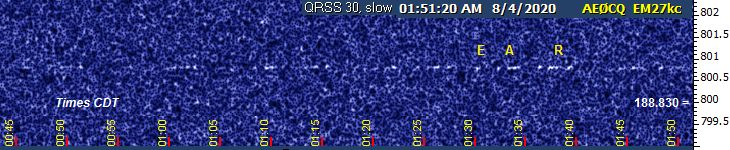
Two nights in a row, this time in "native" QRSS30. The 60-sec screen showed recognizable signal from about 12:30 to 2:30 AM, and again from about 3:30 to 4:25, but the best ID of the night shows up fine in 30-sec slow mode.
---------------------------------------------------------------
File Attachment 1: 4aug-EAR.jpg
Friday Night (7/31) HiFERs
Sunset is no longer a magic time for propagation here, but late night sometimes is. I went to the field in time for sunset Friday night, and nobody was around but EH. Period.
I switched to 630 m WSPR for a few hours, but checked 22 meters again just before 1 AM Central. NC, MTI, WM and WV were prominent in the lower half of the band. In the upper half, K6FRC was strong, and the dash-after-IDs of VAN were visible at 13563.19, in partial collision with a steady carrier. Significant codar was also present,
After that, I moved to 1750 m for the rest of the night to watch for EAR.
Saturday (8/1) HiFERs
Posted by John Davis on August 04, 2020 at 21:25:41.
In reply to Friday Night (7/31) HiFERs posted by John Davis on August 04, 2020
The late-night results inspired me to return to 22 m when I wrapped up my nighttime quest on 1750 meters about 9 AM CDT. I sort of expected to see a few Westerners lingering at that point, but didn't have hope for many Easterners or short-hop E layer signals yet. However, EH was already present (nearly in collision with someone, probabbly PVC), along with NC, MTI, WM, and WV.
In the top half of the band, VAN was now all the way up at 13563.210, with one remarkably clear CW ID at 9:22 AM, followed by mostly visual reception. K6FRC was strong visually, but difficult copy by ear due to a strong, noisy carrier 40 Hz below it, and increasing amounts of codar. KAH was fair copy, ODX was visible but not quite audible, and ABBY's keying sideband pattern was visible but not quite audible at 13566.625 kHz.
When I returned to the watering hole after 9:33, JB had joined the party. I could now confirm that it was PVC that EH was preparing to walk over. NC was already right on top of 7P. SIW slant was occasionally strong, and K3SIW WSPR began showing up for seconds at a time.
By 11 AM, EH drifted up a little and NC had drifted on down, enabling both PVC and 7P to shine for several minutes. (I'll try to remember to post a follow-up later with some captures attached.) K5LVB started showing up in late morning when propagation deteriorated from the west.
I had to discontinue monitoring in early afternoon, but a band scan between 1:20 and 1:30 PM turned up a good signal from WV, KAH visible and later audible, and a faint visual reception of WAS.
Re: HiFERs Sunday 8/2
Posted by John Davis on August 05, 2020 at 06:31:42.
In reply to HiFERs Sunday 8/2 posted by WA1EDJ Bob on August 03, 2020
Nice going, Bob. My own Sunday HiFERs were late evening because we were expecting afternoon storms (which ended up not materializing, of course, since I was prepared for them). One attachment is a full nine minute continuous screen of a rapid Tier 1 scan of the lower half of the band, showing broken-up V and C of PVC and a brief plainly audible 7P. Then I checked for WV with no luck. AZ was present, and up to fair audibility at times, but undulating in frequency. No sign of PBJ for a few weeks now. TON was visible and faintly audible.
No sign of LBC at mid-band Sunday night. The upper half had more codar than the lower half, with K6FRC visible but not audible. VAN started out invisible, but briefly became audible between 11:16 and 11:17 PM CDT.
Antenna was a 5/8 λ vertical. After that scan, I turned my attention to 1750 meters the rest of the night.
---------------------------------------------------------------
File Attachment 1: 2auga032.jpg
File Attachment 2: 2augb030.jpg
HiFERs Monday 8/3
In my first band scan right at the end of the 9 AM hour CDT, I detected keyed RF at 13563.330 that I hoped might be T at long last, but the duration of each sideband cluster was clearly too long. It never reached audibility, and was gone again in a matter of seconds. FRC was faint copy right at 10:02 AM.
A quick band scan between 1:29 and 1:34 PM yielded faint to fair copy of WV and NDB2. The latter was nice and steady at 13554.005 kHz, only a few Hz from where I saw it a week ago. MN was fair to good copy on 13562.630. No FRC that time.
As for WSPR, K3SIW has decoded here a few times recently between civil noon and solar noon. Monday yielded these three:
1804  -32  -0.6   13.555404    0   K3SIW         EN52      7
1808  -30  -0.6   13.555405    0   K3SIW         EN52      7
1812  -32  -0.5   13.555405    0   K3SIW         EN52      7
K5LVB decoded 48 times that same day between 1620 and 2256 UTC, with reported SNR from -20 to -30.
This report covers only the normally aural-copyable HiFERs and WSPR. The watering hole and a special case regarding LBC will be covered in one or more later posts.
Re: Lowfer WM transmitting again
Posted by Mike N8OOU on August 05, 2020 at 13:37:17.
In reply to Lowfer WM transmitting again posted by Mike N8OOU on August 04, 2020
Wed 8/5 update;
WM Lowfer locked up several times overnight. I could not restart it this morning. I suspect an RFI issue with the new Helix Can physical layout, but can't investigate it until this afternoon. It should be back on later this evening.
Mike 73
Re: August EAR
Posted by John Bruce McCreath on August 05, 2020 at 13:41:13.
In reply to August EAR posted by John Davis on August 03, 2020
Hi John....I'll QSL your August capture! You've set the bar pretty high for yourself.
73, J.B., VE3EAR Any copy of JB?
Posted by WA1EDJ Bob on August 05, 2020 at 15:43:22.
John,
I've heard John B. K5MO mention he has a HiFER JB on .555 280 ish (according to you he says). He mentioned it on KnightsQRSS.
I've not seen you mention it?
Bob Re: Any copy of JB?
EDJ
Posted by John Davis on August 05, 2020 at 19:25:58.
In reply to Any copy of JB? posted by WA1EDJ Bob on August 05, 2020
My first mention of JB was in the thread "Sunday 12 July Mid-day," although I'd reported on its predecessor (the rather "wordy" BNC1). My most recent posted report before this past weekend was July 25. It has been seen here many other times, but too often by the time I get back to the computer, days have gone by and I neglect to report.
Latest sighting was about two hours ago. This attachment is typical of much of the day, and there's usually one or two clearer IDs in the morning or evening. Frequency tends to be between 555.280 and .270. The main target of this capture was WM, which was undergoing some rather wild Doppler-induced frequency modulation of uncertain origin. More on that in another post later.
---------------------------------------------------------------
File Attachment 1: 5augb.jpg
Re: Any copy of JB?
John;
I just fired up a radio to check the Lowfer, saw this message and switched my Kenwood to the Hifer. I also started Argo for a local copy. It's after 4pm CDT. The Argo screen basically looks normal but.... What I am hearing sounds like two tones with a slight beat frequency. What caused my hair to stand up was in a couple of the CW Id's I heard a faint echo of the ID in between the cw elements. I'm trying to make a recording of this just to convince myself I've not gone wacko.
Mike N8OOU
Re: Saturday (8/1) HiFERs
Posted by chris on August 05, 2020 at 23:32:21.
In reply to Saturday (8/1) HiFERs posted by John Davis on August 04, 2020
John,
Thanks for the report on Abby. Sometimes i think there is a gremlin inside of the beacon. It likes to float frequency between 13566.60~70.
Chris
EDJ WSPRing tonight
Posted by WA1EDJ Bob on August 05, 2020 at 23:46:22.
WA1EDJ
13.555 435
QRV overnight, QRT approx 0800 EDT 8/6 - leaving for work - No one here to disconnect when TS's arrive.
Bob Re: HiFERs Monday 8/3 - LBC
EDJ
EM83du
Posted by John Davis on August 06, 2020 at 01:58:32.
In reply to HiFERs Monday 8/3 posted by John Davis on August 05, 2020
As hinted in the first post of this thread, I received LBC again Monday morning, but not via real time aural copy. The signal level was good enough (see attached JPG), but the mid-band noise was also back at its normal level.
The resulting roar occupies roughly the first 30 seconds of the MP3 file. The rest of the clip is approximately that same interval after running it through the best processing I was able to devise with Audacity. I can hear the "L" distinctly a few times, but if you can hear the rest of the ident, you've got better ears or a more vivid imagination than I do.
---------------------------------------------------------------
File Attachment 1: 3auga03.jpg
File Attachment 2: lbc3aug-x2.mp3
Re: EDJ WSPRing tonight
Sorry, Bob, not a good night for 22 m here. All signals were completely absent by an hour before sunset; only the mid-band noise remained. By midnight, not only were there no signals, but the mid-band noise had also gone. Not a peep.
Ready for new DX season
Posted by John Bruce McCreath on August 06, 2020 at 10:39:00.
I finally have the new shack Win7 PC up and running, ready for the coming LW and MW DXing season.
The latest releases of Slow JT9 and WSJT-X have been installed and tested, so bring it on!
73, J.B., VE3EAR Re: EDJ WSPRing tonight
Posted by WA1EDJ Bob on August 06, 2020 at 13:19:24.
In reply to Re: EDJ WSPRing tonight posted by John Davis on August 06, 2020
I'll try to go QRV from about 1800 EDT to 0800 next morning daily, depending on TS activity. We are at 30% daily here. Not worth the risk since I'm not hope to disconnect. Testing the new W3PM WSPR TX project he has out. Working nicely. 5351A is barefoot to LPF.
Bob Re: EDJ WSPRing tonight
EDJ
Posted by Ed Holland on August 06, 2020 at 20:37:40.
In reply to Re: EDJ WSPRing tonight posted by John Davis on August 06, 2020
Conditions were flat here last evening (05-Aug). Even the typical mid-band signals were well down relative to the noise.
Ed
Re: EDJ WSPRing tonight
Posted by John Davis on August 06, 2020 at 21:07:25.
In reply to Re: EDJ WSPRing tonight posted by Ed Holland on August 06, 2020
Regrettably, this afternoon turned into a wash-out here on 22 meters. The usual pipelines to EH and NC diminished to a trickle after solar noon. The E=layer dependent beacons showed up for less than one minute out of ten, although both WM and SIW slant were their normal widths today, unlike yesterday's anomaly.
We've got a good chance of storms in early evening, but I was hoping to leave the radio and computer on until Bob got home from work. The only thing on radar was the anticipated line of storms well west of us. However, about an hour ago I packed everything up and returned to the house, because my motorcyclist's experienced "weather eye" told me the sky was not to be trusted. (That's courtesy of years of summer excursions on the back roads of West Georgia.) Sure enough, a line of thundershowers with a miniature bow echo has materialized down along the Oklahoma border and is currently over the farm, with rumbles now becoming audible here in town.
My next chance to try for EDJ will probably be mornings this weekend, if it will be available.
John
SAQ Alexanderson Day in the Age of COVID-19
Posted by Mike Terry on August 07, 2020 at 09:55:14.
Despite mid-summer conditions, at least seven US listeners, most of them radio amateurs, were able to copy the 17.2-kHz signal from the SAQ Alexanderson Alternator at the World Heritage Grimeton Radio Station in Sweden. The July 5 transmission from the vintage electro-mechanical transmitter commemorated the annual Alexanderson Day. All told, more than 600 reception reports were received — a new record.
“The odds were not optimal this year, with the ongoing coronavirus pandemic, and in the early Sunday morning, the rain was pouring down, and heavy wind gusts made it hard to even take a peek at the antennas outdoors,” the report from SAQ said. “The transmitter hall was empty except for five members of the Alexander Association.”
Dating from the 1920s, the Alexanderson alternator — essentially an ac alternator run at extremely high speed — can put out 200 kW but typically is operated at less than one-half that power level. Once providing reliable transatlantic communication, it is now a museum piece and only put on the air on special occasions.
The transmitter was developed by Swedish engineer and radio pioneer Ernst Alexanderson, who was employed at General Electric in Schenectady, New York, and was chief engineer at the Radio Corporation of America.
Two Alexanderson Day transmissions were made. “On the first transmission, the rainy weather was making it hard at first to reach good output to the antenna, but after a few minutes with the ‘VVV VVV VVV de SAQ’ loop, the system started to dry, and the amps [antenna current] increased. Skies cleared for the second transmission later in the day, and, according to the report, the antenna current rose to 60 A, which ‘is optimal,’” the report said.
The occasion marked the inaugural transmission by Kai Sundberg, SA6KSU, at the helm of SAQ in a radio uniform dating back to the 1960s.
An article about Alexanderson Day, “The Legacy of Radio at Grimeton Station, SAQ,” appears on page 66 of the July 2019 issue of QST.
http://www.arrl.org/news/saq-alexanderson-day-in-the-age-of-covid-19
"vintage" Palomar Loop antenna
Posted by John B on August 07, 2020 at 13:10:53.
I recently purchased a used Palomar LA1 loop antenna with 3 plug ins for the loop amplifier (LF thru BCB).
I remember seeing these units advertised for as long as I've been a ham, but never owned them. Can anyone provide any first hand info on their performance?
I don't have the "loop coupler" that is referenced to connect the antenna to radios not having an external antenna jack, but I do have the base unit / amp and I have plenty of radios with external antenna jacks :-)
Thanks for any info. I know there's rarely any substitute for large outdoor antennas in a RF quiet location, but thought these might be fun to experiment with.
John
Reminder: Lowfer net +/- 3929Khz Saturday morning 0800 California time
Posted by Jerry Parker on August 07, 2020 at 14:05:01.
Reminder: Lowfer net +/- 3929Khz Saturday morning 0800 California time
Or listen online at kfs: Re: EDJ WSPRing tonight
http://69.27.184.62:8901/?tune=3929lsb
or
KPH Point Reyes:
http://198.40.45.23:8073/
or
Utah Web sdr:
http://www.sdrutah.org/websdr1.htmlIf you cannot get into the net on 80 meters you can listen on KFS and participate by sending net control your thoughts to wa6owr@gmail.com
73,
Jerry WA6OWR
Posted by WA1EDJ Bob on August 07, 2020 at 14:32:36.
In reply to Re: EDJ WSPRing tonight posted by John Davis on August 06, 2020
I'm generally around until about 1330 EDT on weekends, then head off to Athens (Ga) for some shopping until about 1830. When not at QTH I generally disconnect unless it REALLY looks safe.
So I'd say your schedule should sync up. I'll be QRV when ever home and over night this weekend.
Thanks John!
Bob
EDJ
Hardware & software testing on 630M
Posted by John Bruce McCreath on August 08, 2020 at 14:09:22.
Doing some hardware and software testing over the weekend. I’m trying to run Slow JT9 and WSPR simultaneously on the new shack Win7 PC, listening on 474.200 (dial) kHz. for any signals.
73, J.B., VE3EAR
LowFER Beacon "EAR" Re: EDJ WSPRing tonight
188.835 kHz. QRSS30
EN93dr
Posted by John Davis on August 09, 2020 at 05:44:45.
In reply to Re: EDJ WSPRing tonight posted by WA1EDJ Bob on August 07, 2020
Saturday morning was fairly productive, but I have a favor to ask. Could you QSY about -10 Hz please, Bob, to avoid SIW slant mode? As can be seen in the earlier of the two attached captures, your signal collides with Garry's. That was the only E-layer short propagation of the day from IL, but it shows the potential for conflict clearly.
The second capture shows the watering hole denizens of the late afternoon, just before they all started disappearing. After the 2152 UTC time slot, your signal appeared twice more, but with big QSB holes that apparently prevented decoding. EH and NC disappeared shortly after 5 PM CDT, MTI and JB faded away, and eventually even 7P was gone before the end of the hour. (EH made a one minute encore after 9 PM, and PVC had a solid P and V about 10:20 PM and a partial C.)
To give an idea of signal levels today, below are my first hour of WSPR decodes on Saturday morning, including the K5LVB decodes of the day, plus the last hour and a half of the afternoon.
1440  -23   0.3   13.555430   -1   WA1EDJ        EM83      7
1448  -25   0.4   13.555433   -1   WA1EDJ        EM83      7
1500  -17   0.3   13.555431   -1   WA1EDJ        EM83      7
1502  -24   0.2   13.555361    0   K5LVB         EM10      7
1504  -24   0.3   13.555432   -1   WA1EDJ        EM83      7
1508  -27   0.3   13.555363    0   K5LVB         EM10      7
1508  -24   0.2   13.555434   -1   WA1EDJ        EM83      7
1512  -23   0.2   13.555433   -1   WA1EDJ        EM83      7
1514  -27   0.4   13.555364    0   K5LVB         EM10      7
1516  -22   0.3   13.555432   -1   WA1EDJ        EM83      7
1520  -23   0.3   13.555364    0   K5LVB         EM10      7
1520  -22   0.2   13.555432   -1   WA1EDJ        EM83      7
1524  -13   0.2   13.555432   -1   WA1EDJ        EM83      7
1528  -21   0.3   13.555434   -1   WA1EDJ        EM83      7
1532  -21   0.3   13.555433   -1   WA1EDJ        EM83      7
1536  -15   0.3   13.555432   -2   WA1EDJ        EM83      7
1540  -18   0.2   13.555432   -1   WA1EDJ        EM83      7

2028   -9   0.0   13.555435   -1   WA1EDJ        EM83      7
2036  -25   0.3   13.555435   -1   WA1EDJ        EM83      7
2040  -24  -0.0   13.555435   -1   WA1EDJ        EM83      7
2048  -22   0.1   13.555435   -1   WA1EDJ        EM83      7
2056  -25   0.0   13.555433   -1   WA1EDJ        EM83      7
2100  -20   0.0   13.555434   -1   WA1EDJ        EM83      7
2104  -27   0.1   13.555435   -1   WA1EDJ        EM83      7
2108  -28   0.1   13.555436   -1   WA1EDJ        EM83      7
2128  -22   0.0   13.555436   -1   WA1EDJ        EM83      7
2132  -18   0.0   13.555436   -1   WA1EDJ        EM83      7
2136  -15   0.1   13.555435   -1   WA1EDJ        EM83      7
2140  -19  -0.0   13.555434   -2   WA1EDJ        EM83      7
2144  -18   0.2   13.555434   -1   WA1EDJ        EM83      7
2148  -17   0.0   13.555435   -1   WA1EDJ        EM83      7
2152  -25   0.0   13.555436   -1   WA1EDJ        EM83      7
---------------------------------------------------------------
File Attachment 1: 8auga03.jpg
File Attachment 2: 8auga49.jpg
Re: EDJ WSPRing tonight
Sunday morning started off OK about an hour after sunrise. Things were still quiet right at sunrise when I first got to the farm, but the faint ghost of EH was trying to materialize, the mid-band noise was already on the increase, and a mystery signal (either narrowband noise or semi-random Morse-like keying) was starting to fade in on 13565.000.
I returned to the watering hole and waited. EH eventually solidified, and then was joined by NC.
At 1244 UTC I was pleased to see the start of the WSPR header. There were actually three visible transmissions in a row, but the 1252 UTC time slot did not decode. There was a fade right at the start of the header. I've seen some WSPR signals decode successfully anyway, but after nearly four minutes of trying, the software finally gave up. I suspect it may have been stymied by the frequency drift, which seems to be greater in the cool part of the morning.
1244  -23  -0.3   13.555432   -2   WA1EDJ        EM83      7
1248  -27  -0.3   13.555432   -2   WA1EDJ        EM83      7
There was no signal visible in the 1256 or 1300 time slots, but I don't know to what that should be attributed. EH took a big dip in level at the same time, though NC did not seem to be much affected. I returned to town to post this report, but still have the setup running to watch for further activity.
John
Abby hifer adjustment/ frequency change
Posted by Chris on August 09, 2020 at 14:42:49.
Hello peoples,
I have added a 5v regulator to the beacon to help stabilize frequency. Beacon is currently at 13566.80.
Chris
Re: EDJ WSPRing tonight
Posted by WA1EDJ Bob on August 11, 2020 at 13:41:19.
In reply to Re: EDJ WSPRing tonight posted by John Davis on August 09, 2020
Thanks John!
I've been QRT since Monday morning. I took the TX down and reworked the code for easier QSY. I can now shift freq on the fly. I did lower the WSPR freq by about 15 Hz.
Next time I'm QRV, should be better. Still storming down here in GA.
I have 2 WSPR TX's. The one you heard is the QRPLabs based 5351A synth with a 27 MHz ref xtal. They tend to drift more. I have another Adafruit 5351A synth based TX that seems more stable. It's a work in progress. I'll work on it.
I'll let you know when I'm QRV. What is your listening schedule?
Bob Re: Abby hifer adjustment/ frequency change
EDJ
EM83du
Posted by Chris on August 11, 2020 at 16:06:16.
In reply to Abby hifer adjustment/ frequency change posted by Chris on August 09, 2020
Listening to beacon via a couple KiwiSDR receivers, the center frequency is about 13566.72-75. Close to where it use to linger. Will continue to monitor and update if it makes a big shift in frequency.
Chris
Grabber active
Posted by Vernon Matheson on August 12, 2020 at 14:14:35.
Grabber active again today / tonight.
Access at https://swharden.com/qrss/plus and scroll down to my grabber VE1VDM-1
Cheers Re: Grabber active
Vernon
Posted by John K5MO on August 12, 2020 at 20:26:24.
In reply to Grabber active posted by Vernon Matheson on August 12, 2020
Thanks Vernon, I can see bits of "JB" in your recent grabs below WM.
Re: Grabber active
Posted by WA1EDJ Bob on August 13, 2020 at 22:41:04.
In reply to Grabber active posted by Vernon Matheson on August 12, 2020
Vern,
Thanks for grabbing 22M! We appreciate you guys dropping the grabbers down to us, and John for adding a signal!
I'll be joining again as soon as WX cooperates. My WSPR TX is good to go and will be close to 13.555 410.
Every day they say storms, nothing happens here. The one day I go QRV it will be on top of us!
Bob Re: Grabber active
WA1EDJ
EDJ
Posted by Vernon on August 14, 2020 at 11:42:53.
In reply to Grabber active posted by Vernon Matheson on August 12, 2020
Grabber active again today ( August 14 )
Vernon
Reminder: Lowfer net +/- 3929Khz Saturday morning 0800 California time
Posted by Jerry Parker on August 14, 2020 at 12:34:09.
Reminder: Lowfer net +/- 3929Khz Saturday morning 0800 California time
Or listen online at kfs: Propagation
http://69.27.184.62:8901/?tune=3929lsb
or
KPH Point Reyes:
http://198.40.45.23:8073/
or
Utah Web sdr:
http://www.sdrutah.org/websdr1.htmlIf you cannot get into the net on 80 meters you can listen on KFS and participate by sending net control your thoughts to wa6owr@gmail.com
73,
Jerry WA6OWR
Posted by Mike Terry on August 14, 2020 at 13:09:15.
Some long distance reports of beacons on various newsgroups. Sorry I can't recall details.
Has anyone in LWCA experienced these conditions recently?
Mike
Re: Propagation
Posted by Mike Terry on August 14, 2020 at 13:15:25.
In reply to Propagation posted by Mike Terry on August 14, 2020
Just found a great thread on the IRCA group.io headed "Freakish Longwave Propagation on the Lucky 13th at Rockwork" by Gary DeBock in WA (USA). For example:
362 WK Whakatane, New Zealand 25 watts Across 6,846 miles of ocean, this is probably the best DX catch that I've ever made with Ultralights and FSL's at Rockwork. The Morse code ID (at 1315 on 8-13) is "di-dah-dah dah-di-dah)
Signal ID ??
Posted by Vernon Matheson on August 14, 2020 at 13:23:30.
I see a carrier between 555.430 and 555.440 that comes and goes with the propagation. Can anyone tell me if this in fact a very slow CW signal rather than just IF.
Thanks
Vernon - VE1VDM
Re: Signal ID ??
Posted by WA1EDJ Bob on August 14, 2020 at 15:17:39.
In reply to Signal ID ?? posted by Vernon Matheson on August 14, 2020
That could be SIW in slant mode. Looks like a straight line but actually slopes up gradually and drops like a sawtooth wave.
Bob VE1VDM Grabber
EDJ
Posted by Vernon Matheson on August 14, 2020 at 15:41:05.
You may see a VDM signal on my HIFER grabber. It is a bit of bleedover from my 10M FSKCW transmissions. Please ignore as I am not TX on 13mhz
Vernon
EDJ QRV as storms permit
Posted by WA1EDJ Bob on August 15, 2020 at 14:36:07.
WSPRing on about 555 400 trying to avoid SIW slant as TS's permit. Probably go QRT this agernoon. Sun - Tue should be better days (maybe).
Bob
EDJ
EM83du
Re: EDJ QRV as storms permit
Posted by John Davis on August 15, 2020 at 16:34:34.
In reply to EDJ QRV as storms permit posted by WA1EDJ Bob on August 15, 2020
Was going to try listening today, but tomorrow may be better. Just too hot this afternoon, and we've got a chance of storms by evening here. After an unexpected severe storm chased me out of the field Monday, I've been extra weather-wary this week.
Just one thought, though...if possible, 13555.420 or .425 might be a better spot. While .400 avoids SIW Slant, it's likely to be right on top of SIW WSPR. Best of luck!
Re: EDJ QRV as storms permit
Posted by WA1EDJ Bob on August 16, 2020 at 00:36:26.
In reply to Re: EDJ QRV as storms permit posted by John Davis on August 15, 2020
Next few days look better here. Will QSY to .425, hopefully tonight. If not, Sun AM.
I just reconnected ant at 2030 EDT. Saw NC EH and probably SIW slant before I went QRV.
NC is relitively close but sometimes I guess it's short skip at sunset.
Bob Re: EDJ QRV as storms permit
EDJ
Posted by Vernon on August 16, 2020 at 01:47:20.
In reply to EDJ QRV as storms permit posted by WA1EDJ Bob on August 15, 2020
have a good copy on you Bob plus SIW
0132 -26 0.2 13.555310 0 WA1EDJ EM83 7 2136 Re: Signal ID ??
----------------------------------------------------------------------
0136 -29 0.1 13.555401 0 K3SIW EN52 7 2076
0136 -26 -0.0 13.555409 1 WA1EDJ EM83 7 2136
----------------------------------------------------------------------
0140 -30 0.1 13.555401 0 K3SIW EN52 7 2076
0140 -23 0.0 13.555409 0 WA1EDJ EM83 7 2136
----------------------------------------------------------------------
0144 -28 0.2 13.555401 0 K3SIW EN52 7 2076
0144 -23 0.1 13.555409 1 WA1EDJ EM83 7 2136
Posted by John Davis on August 16, 2020 at 08:35:03.
In reply to Re: Signal ID ?? posted by WA1EDJ Bob on August 14, 2020
As Bob says, the frequency modulation of SIW slant is very subtle at QRSS3...only 1 Hz in either direction over several minutes, then a small kink as it returns to baseline (see "10auga.jpg" attached). At QRSS30, however, it shows up in its full glory (see "10augc.jpg"). Upward slopes are "dots" while descending ramps represent "dashes."
---------------------------------------------------------------
File Attachment 1: 10auga.jpg
File Attachment 2: 10augc.jpg
Re: EDJ QRV as storms permit
From Vernon's results, it looks like there might be just enough separation between the two signals, but a couple more Hz wouldn't hurt (no pun intended). Will try Sunday, now that our severe t-storms are supposedly done for a while.
John
Re: Signal ID ??
Posted by Vernon on August 16, 2020 at 12:34:04.
In reply to Re: Signal ID ?? posted by John Davis on August 16, 2020
Hi John...I have a small jpg file that I want to include in a post and cannot figure out how to attach it. Just wondering how you attached your 2 pics
Vernon Re: Signal ID ??
Posted by John Davis on August 16, 2020 at 15:07:02.
In reply to Re: Signal ID ?? posted by Vernon ( VE1VDM ) on August 16, 2020
There is an Authenticated Authors link on the Message Board that explains file attachments. It's a feature we added a couple of years ago. After you sign up and get a notice that you've been authenticated (may take a few hours as the board is not continuously staffed), then all you have to do is add a "tripcode" to the Name field when you write your message. When you send the message, you are then given a dialog box as part of the confirmation page that lets you select up to three files to attach.
When using the Authenticated Author feature, you can also post live Web links (such as to your grabber) and use some basic HTML code in your posts, too.
Sunday 8/16 HiFERs
Posted by John Davis on August 17, 2020 at 00:32:30.
Surprisingly good evening compared to recently: MN, NDB2, WV, K6FRC, NC, bits of PVC and 7P,good solid WM, MTI, bits of JB, decent SIW slant, K3SIW WSPR, WA1EDJ, and K5LVB all came in between 6 and 7 PM CDT! Don't know what's different about today, but it's nice to see and hear.
Between noon and 2 PM, it was mainly NC and SIW slant, some fair JB, weak WV, MN ranging poor to good with rapid QSB, hints of VAN, fair ODX and recognizable ABBY, along with intermittent decodes of K3SIW and WA1EDJ WSPR...not bad, but certainly not enough to hint at what a good evening lay ahead.
More details later.
John
Saturday Evening HiFERs and a narrow escape
Posted by Ed Holland on August 17, 2020 at 16:22:13.
PVC was put off air briefly on Saturday evening so that I could scour the band for other beacons. Although activity was rather scarce, there was a sudden lift in propagation around 8 pm, just ahead of everything man-made closing down for the night. In this brief opening, there were three or four superb views of a WSPR signal in the 13,555.4xx range. With frequency calibration not certain to the 10's of Hz required, I can't say which of the 3 tightly placed stations it may have been, and alas I did not have WSJT running.
Although man-made signals made an exit from proceedings not soon after, I was woken around 3 am by flashing lights, as a rare thunderstorm descended on the San Francisco Bay Area. At this point, I remembered the radio was still connected to the antenna to continue overnight and early morning Spectrum Lab captures. I dashed to the radio room and disconnected everything. Fortunately the radio had sustained no damage. Unable to sleep thanks to hot, humid conditions, I watched the lightning storm rage around us, which continued until well after dawn. Most unusual.
Last evening (Sunday 16th) I set up in hopes of a WSPR capture, but the band didn't cooperate, and very little, save perhaps a broken trace of NC and hints of 7P from time to time. No storms at least!
73s
Ed
Re: Sunday 8/16 HiFERs
Posted by Garry, K3SIW on August 17, 2020 at 20:22:58.
In reply to Sunday 8/16 HiFERs posted by John Davis on August 17, 2020
John, that's a very impressive list of stations copied!
I haven't seen much in the way of wspr reports for my hifer so took a look at the outdoor matchbox for my 1/4 wave vertical. It was hopelessly rusted. Won't use zinc-plated hardware outdoors again. Broke the plastic box holding everything trying to undo the rusted screws. The air variable tuning capacitor inside was useless too so I just started over, this time with stainless steel hardware. Measured X,R of the antenna itself with a Rig Expert zoom series antenna analyzer, then matched that to 50 ohms at 13.555 MHz with an L-C network using leleivre.com/rf_lcmatch.html. The multiturn inductor used previously was just what was needed and with a parallel string of mica capacitors from the junk box I got the needed capacitance. At the summer that combines my slant and wspr signals to the antenna the SWR is now below 1.1:1.
I noticed the wspr signal was down perhaps 4 dB compared to the slant signal so earlier today I carried out trial-and-error adjustmenhts with various attenuators to get a better match.
Hope things stay put for awhile. Time will tell.
73, Garry, K3SIW, EN52ta, Elgin, IL
Re: Sunday 8/16 HiFERs
Posted by Ed Holland on August 17, 2020 at 21:45:08.
In reply to Sunday 8/16 HiFERs posted by John Davis on August 17, 2020
Thanks John,
I will check my screenshot log to confirm whether PVC was active in the time slot you state (6-7 pm CDT). I did turn the beacon off for a while yesterday to listen again for the WSPR signal seen so clearly the day before, so want to be sure that what you saw really was PVC. From memory, though, I think the timing would have seen PVC active.
I wish sometimes that a remote location for the transmitter was possible, but then would have problems with attending to maintenance tasks.
Cheers
Ed
Re: Sunday 8/16 HiFERs
Posted by John B on August 17, 2020 at 22:05:55.
In reply to Re: Sunday 8/16 HiFERs posted by Garry, K3SIW on August 17, 2020
Hope to copy you some day Garry.
I've found that 30 Cal ammo boxes make for some good , cheap weatherproof enclosures. Around here, they're $7-8$ in qty of one.
I have my 10M QRSS grabber (SDR+R.Pi) stashed in one out back in the woods. Hard to keep mother nature our of anything left out in the weather!
John K5MO
Re: Sunday 8/16 HiFERs
Posted by Ed Holland on August 18, 2020 at 03:45:06.
In reply to Re: Sunday 8/16 HiFERs posted by Ed Holland on August 17, 2020
I checked my file captures and this confirms I was listening at the time of possible PVC report (allowing for time zone differences), so PVC would not have been operating
Re: Sunday 8/16 HiFERs
Posted by John Davis on August 18, 2020 at 05:41:08.
In reply to Re: Sunday 8/16 HiFERs posted by Ed Holland on August 18, 2020
That's disappointing to find out, but you are correct. It turns out to be bits of EH instead.
I went back to review captures from the time that I was listening in person between roughly 6:15 and 6:50 PM CDT, but that was not helpful. Something had scrambled the viewport area of nearly all the captures that Argo took during that time... particularly ones that included the vicinity of 13555.490, where I remarked upon the broken carrier in my notes.
Never had that happen before! Unfortunately, it's also happening again tonight, too! Looks fine on screen, but the saved GIF files look like an analog television when someone is operating an electric saw in the vicinity. Got to remedy this promptly, or there's no point trying to do LF captures overnight.
At any rate, when I looked at a few of the less corrupted files from later last night, like the one attached, it finally dawned on me what I had actually seen. EH has been pretty weak here for several days, and sometimes when that's the case, only the lower (Space) frequency registers. It's longer and dash-like, while the upper Mark frequency is all dits and sometimes doesn't register on screen when propagation is poor from that direction. The resulting bits and pieces can be ambiguous. What later captures last night revealed was EH fading in like a reverse Cheshire cat, at the frequency where I was expecting to see bits of PVC.
Incidentally, and ironically, EH was quite strong at sunset tonight. PVC was also present before sunset, but was fading badly by 8 PM--and at a lower frequency than it had been before, roughly 13555.476 kHz tonight. I was getting one clear letter at a time between fades...a C here, a V there, etc.
---------------------------------------------------------------
File Attachment 1: 16auga0048.jpg
Re: Sunday 8/16 HiFERs
Looks like I need a "Computer Columbo" to find out who/what is killing my files. I went out to the field and checked the original GIFs that are still archived on that computer, and they're fine! On the thumb drive that I used to transfer them, though, they were corrupted.
So, I deleted both damaged folders (Aug. 16th and 17th) from the thumb drive and copied the good files to it again. I then examined the copied files to confirm they were OK before closing Windows Explorer and ejecting the drive from the field machine. Brought the drive home, transferred the files to another folder, and...they were corrupted again, both on the HDD and on the thumb drive.
Using my Windows 10 notebook, I ran diagnostics on the portable drive, then set up an experiment to make sure the files weren't being corrupted on the thumb drive by something on the desktop machine during transfer. A hundred-some test images from the newer notebook survived that trial OK, so it would seem the damage may be taking place on the thumb drive during the process of ejecting it from the field notebook.
Thus, the good news is, Argo is still making acceptable captures. The bad news is, I can no longer harvest them to share them with anyone else.
It's too late to devise any more experiments tonight, but I'll undoubtedly be fretting over the problem in my sleep. Re: Sunday 8/16 HiFERs
Posted by Ed Holland on August 18, 2020 at 15:22:41.
In reply to Re: Sunday 8/16 HiFERs posted by John Davis on August 18, 2020
That is annoying John.
The next thing I might try is a different drive, if available, to see if it is a problem unique to one device.
/Ed
Re: Sunday 8/16 HiFERs
Posted by Ed Holland on August 18, 2020 at 15:32:02.
In reply to Re: Sunday 8/16 HiFERs posted by John Davis on August 18, 2020
Thanks for the report.
Frequency control is something I want to work on. Presently, the "master oscillator" is one of the inexpensive DDS signal generators available online. It is a decent intstrument for the main part, but has a quirk or two. It has a readout error, so I usually set it to zero beat against the intended frequency on another radio. My JRC NRD 525 has a temperature compensated reference, and is still quite accurate - to within a few Hz when checked against WWWV.
Lately, we've had a hot and humid spell. Although the transmitter setup is in our basement, the sig-gen is likely not that stable against temperature changes.
Ultimately, I would like to go back to a crystal, for the sake of simplicity and self contained operation of the TX. However, I need to experiment and find a crystal that will pull down to (or near) the current operating frequency. Used as-is, the crystals I had left me up near the band center, and its noise. Any changes will be noted here.
Cheers
Ed
Re: Sunday 8/16 HiFERs
Posted by John Davis on August 18, 2020 at 17:28:22.
In reply to Re: Sunday 8/16 HiFERs posted by Ed Holland on August 18, 2020
PVC's frequency control is actually pretty good. A few Hz difference upon restarts keeps us listeners alert ;), and as long as the short term stability is good enough to not tilt the elements of the QRSS characters, with the consequent loss of detection sensitivity, all is probably well. PVC does very well in that regard; see attached from last night.
---------------------------------------------------------------
File Attachment 1: 17auga0055.jpg
Re: Sunday 8/16 HiFERs
Thank you for the report John.
There really should be no "chirp" with this configuration, short and medium term stability should be reasonable once the generator is warmed up. I modified the Vectronics transmitter so it can work either from a crystal (as designed) or change to an external VFO at the flip of a switch. In the latter case, the oscillator transistor functions as a buffer and keying stage.
73s
Ed
Re: Sunday 8/16 HiFERs
Posted by John Davis on August 18, 2020 at 23:26:03.
In reply to Re: Sunday 8/16 HiFERs posted by Ed Holland on August 18, 2020
Exceedingly annoying. I made a list of hypotheses to check out this morning and thought I narrowed down the possibilities with further tests, but now that I'm back at the desktop machine, the results are getting even more confusing.
The basic facts that haven't changed...so far, at least: The GIF files I transferred at the previous marathon session, for 10 August and days prior, remain undamaged on all three drives (the field machine's HDD, the thumb drive, and the desktop HDD). Files from the 16th and 17th remain intact on the field HDD, and when I transfer them to the thumb drive via the USB port I have lately been using, they look OK on the thumb drive too--until I remove the thumb drive and reinsert it into the field computer or any other machine. Then the newly transferred files exhibit problems. (And, if I transfer the older, undamaged files from the field HDD into a new directory on the removable drive, they also become damaged on the removable drive.)
The scrambling is the same in the Windows Explorer preview thumbnails, in Media Viewer, or in MS Paint, in either Windows 7 or 10--but it renders as a very different type of distortion in IrfanView!
The possibilities I tested this morning included [1] doing file transfers without the battery chargers running (test possibility of electrical noise intrusion from the generator); [2] changing which USB port I was using for the mouse (test for port-specific software or connector malfunctions); and [3] removing the drive in non-standard ways (ie, closing all files and viewers associated with the drive then physically unplugging it without using the "safe to remove" dismounting tool, in case the tool itself was malfunctioning.
Test 1 turned out pretty unambiguous. With or without the generator, the files suffered equally serious damage. Power may corrupt, but that wasn't what was doing it in this case.
Test 3 was also unambiguous...no difference either way, so the removal tool wasn't responsible.
Test 2 was really puzzling. The port I had been using recently does always appear to leave files corrupted, and so does one of the other two. The third port initially seemed to be safe, and in fact allowed me to retrieve the folder with August 16 on it. The folder for the 17th appeared OK after its first removal from the USB port, but displayed damage when I got the files back to the house.
In that round, I did not try another storage device because I wanted to see how this one responded under all the different circumstances first, to provide a baseline, as it were. Secondarily, I deemed memory device problems unlikely because of the experiments I did on it with the Windows 7 and 10 machines at home last night.
But you are correct; it is worthwhile to try a second device anyway, because (a) there could be intermittent issues clouding the diagnostic results from last night, and (b) the lingering confusion from Test 2 this morning doesn't conclusively rule out anything.
243 kHz Kalundborg
Posted by Mike Terry on August 19, 2020 at 11:29:26.
Still some broadcasts at certain times of the day from Denmark on longwave.(This article written in 2018). Re: Sunday 8/16 HiFERs
https://www.radioenthusiast.co.uk/news/kalundborg-then-and-now/
Posted by John Davis on August 19, 2020 at 19:14:08.
In reply to Re: Sunday 8/16 HiFERs posted by John Davis on August 18, 2020
"Computer Columbo" is on the case. Ruminating over the inconsistent results from Test 2, I started putting two and two and two together and came up with roughly three...new hypotheses, that is. Starting at square one: Nothing of this sort had happened before. So, what has changed?
(Caution: Long post.)
Test 4 yesterday night proved it was not a defective thumb drive. Another one known to be good behaved the same way as the first...but an SD card worked perfectly, every time.
(I didn't previously know the field machine had a slot for SD. And, I'm not enthused about using SD for file swaps because the desktop machine's built-in SD reader is becoming unreliable about recognizing when a card is inserted, so I have to use an external reader with a USB port. If I've got to use USB anyway, I might as well do it with the slightly more rugged thumb drives.)
Aging of components in the field machine is possible, but the entire integrated motherboard was replaced a year and a half ago (due to a battery charging accident) and it is doing well otherwise. I've been using a USB mouse with the machine for a few months now because the touchpad is way too sensitive and I've not been able to find adjustments for it; but again, there's not been any similar problems previously during that time.
Still, I had suspected possible driver interactions, and that looked even more possible after the first part of Test 2, when relocating the mouse to a different physical slot enabled the thumb drive to work one time. But immediately afterward, it failed again, so who knows? I devised Test 5 to compare behavior with and without the mouse active. Bad news...same corruption to the thumb drive either way, no problems with the SF card.
Although a negative result is still a result, it's not something you can take to the District Attorney. That's when I started thinking like Columbo. If you have a case where all the circumstantial evidence points to one obvious suspect, but through convolution and misdirection he has constructed what appears to be an utterly airtight alibi, you have to do two things: figure out how he could have done the deed, even if the method seems implausible; then use that information to trick the suspect into breaking his own alibi!
My own whistling "This Old Man" moment came when I decided to treat hardware problems as a red herring, and focus on how driver software could be involved, despite the fact that it appeared to have an ironclad alibi. That alibi was based on one seemingly irrefutable point--when first written to the removable drive, the files opened just as fine as could be. It was only after the drive was remounted that problems showed up. "It must have been Evil Hardware or Unknown Malware, 'coz I was 10 other places at the time the crime occurred," gloats crafty old Mr Driver Software.
Except for three things. Legwork had ruled out the thumb drives and made the USB ports themselves pretty unlikely suspects. It had also made malware unlikely, since the field machine hasn't been hooked to the Internet since Microsoft ended support for Windows 7 and its version of Security Essentials, and the only contact with the outside world was through the removable drives, which tested clean.
And the biggest ralization of all: the crime did NOT occur after the files were written, as we were meant to believe, but it occurred DURING the copying process itself, right when the USB port controller and the removable disk drivers had their fingerprints all over the affected files!
How could the files be OK right after they were written, then "go bad" later? Simple--they didn't. It only looked that way because Windows cheats.
If you copy a block of files from one location to another folder on the same drive, or to another drive entirely, it takes some certain amount of time while the operating system reads data from the original location, caches it in RAM, then writes it to the new location. But if you then proceed to copy the same files to yet another folder or drive, the process goes much faster! Windows does not read the files from the disk all over again, but writes them directly from cache.
Alas, it apparently does the same thing if you open a file that has just been copied, as long as no operation has been performed on the file since copying. Hence, the file looks perfect (just as it actually was on the SD card in Test 5 when copied there from the same cache). The OS had no way of knowing that the drive controller was not delivering a faithful copy to the removable disk. It was already corrupted, but the corrupt version was not what was being displayed! At least, not until the drive was ejected then remounted, which voided the cached copy and meant it had to be read anew from the thumb drive, revealing its true condition.
So, how could I break the driver's alibi in Test 6?
I realized there had been two or three multi-day marathon monitoring sessions since the machine had last been rebooted. It had merely been in Sleep mode between. Now, that is regularly the case, without any problems before. But the difference is, as I mentioned, more frequent use of the USB mouse recently. Windows assigns drivers to USB ports dynamically, and sometimes rather arbitrarily. That tends to consume resources. So, it's entirely possible that the removable drive controller had fallen under the baleful influence of an increasingly confused USB port controller...a sort of Svengarlic, to borrow from a Three Stooges line.
If that's what's happening, how do I confirm it in Test 6 and fix the problem?
Well, how do you fix 99% of all Windows issues? You reboot!
Since doing that very thing late last night, I am able to transfer files safely again. Odds are, I'll have to shut down and restart after every two or three sessions from now on, so long as I continue to use the mouse. But at least things seem to be working normally at the moment.
Re: Sunday 8/16 HiFERs
Posted by Ed Holland on August 19, 2020 at 21:46:05.
In reply to Re: Sunday 8/16 HiFERs posted by John Davis on August 19, 2020
I was wondering if the files that seemed OK before the drive was removed were actually being retrieved from the device. Good cache Columbo!
Re: Sunday 8/16 HiFERs
Posted by John B on August 19, 2020 at 22:51:31.
In reply to Re: Sunday 8/16 HiFERs posted by John Davis on August 19, 2020
"Well, how do you fix 99% of all Windows issues? You reboot!"
Truer words were never spoken!
Having worked with VAXen from DEC for many years, which ran for years without driver corruption, memory leaks, and the other drek that inhabits our PC - ish world, it's a darned shame that we've regressed.
Re: Sunday 8/16 HiFERs
Posted by john b on August 19, 2020 at 22:52:52.
In reply to Re: Sunday 8/16 HiFERs posted by Ed Holland on August 19, 2020
"Good cache Columbo! "
Re: Sunday 8/16 HiFERs
^^ I see what you did there!!! :-)
Posted by John Davis on August 20, 2020 at 00:39:24.
In reply to Re: Sunday 8/16 HiFERs posted by john b on August 19, 2020
L. O. L. Much needed lift there, Ed. Thanks.
Help with Unknown Frequencies
Posted by Tim on August 20, 2020 at 16:35:17.
I had some tests done not too long ago in a frequency proof room and we found 2 frequencies. Does anyone know what/who operates on these radio frequencies around the Tampa Bay, FL area in 2016:
178 kHz 22M Grabbers?
292 mHz
Posted by WA1EDJ Bob on August 20, 2020 at 21:54:40.
Andy, G0FTD, posted on qrssknights if anyone knows of other (besides Dave WA5DJJ)
22M grabbers? Some of the Knights do drop down to 22M and grab from time to time but only DJJ is full time that we know of.
TNX!
Bob
WA1EDJ
EDJ
WSPR is QRT for now, storming, and will be for a few days here in EM83du.
RigExpert analyzer vs Monitor Circuits
Posted by Lee on August 21, 2020 at 03:39:43.
My RigExpert AA-54 is giving conflicting information to that generated by my Monitor Circuits 2200 meter transverter. I did update the firmware on the AA-54 FYI. Looking out from the transverter Rigexpert reports 1.15 to 1 SWR to 1.7 to 1 SWR depending on time of day. The transverter reports 4.1 to 1 SWR to 4.5 to 1 SWR also depending on time of day. And because the transverter has so many automatic ckt protections its adding a 4db attenuator in line. And I am using a toroid antenna match transformer. Any ideas folks? Is the transverter flakey. Is the AA-54 flakey. It's making me flakey. I am testing at reduced power 6 to 10 watts. Thanks
Re: RigExpert analyzer vs Monitor Circuits
Posted by John Davis on August 21, 2020 at 05:07:15.
In reply to RigExpert analyzer vs Monitor Circuits posted by Lee on August 21, 2020
First thing I think I would do is try both devices against known resistive loads in the range of 25-200 ohms and see which (if either of them) is telling something close to the truth.
Thur. 8/20 Surprises - Change at JB?
Posted by John Davis on August 21, 2020 at 06:29:45.
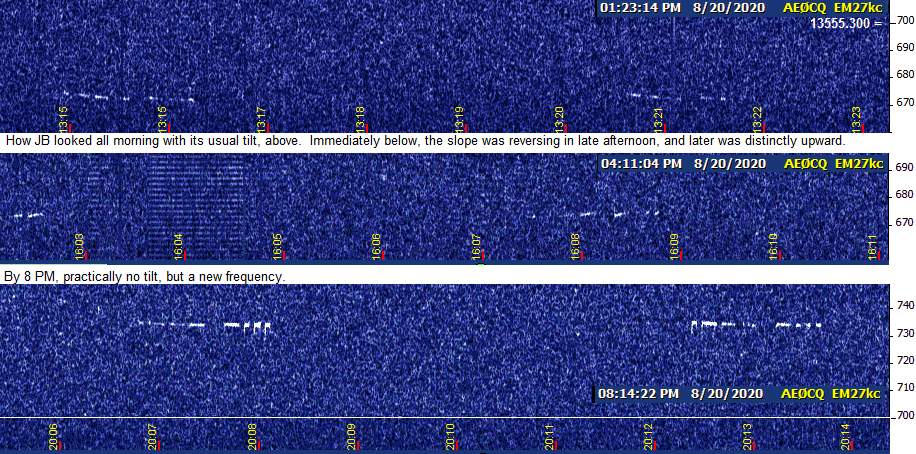
After a lackluster evening yesterday and mediocre mid-afternoon today, a few pleasant surprises this evening! There weren't all that many stations, and a few regulars didn't show up at all (WV, MN) but others that had been partly or totally AWOL the past few days were nice aural copy for a change (TON, KAH, WAS, ODX). EH was fair, NC was very strong, and sometimes so was 7P. A weak K6FRC was present, and a very tipsy AZ. I'll try to do one or more later reports on these at some point, with attached images and sound clips.
---------------------------------------------------------------
File Attachment 1: 20augb.jpg
Reminder: Lowfer net +/- 3929Khz Saturday morning 0800 California time
Reminder: Lowfer net +/- 3929Khz Saturday morning 0800 California time Re: RigExpert analyzer vs Monitor Circuits
Or listen online at kfs:
http://69.27.184.62:8901/?tune=3929lsb
or
KPH Point Reyes:
http://198.40.45.23:8073/
or
Utah Web sdr:
http://www.sdrutah.org/websdr1.html If you cannot get into the net on 80 meters you can listen on KFS and participate by sending net control your thoughts to wa6owr@gmail.com
73,
Jerry WA6OWR
Posted by Lee on August 21, 2020 at 15:29:29.
In reply to Re: RigExpert analyzer vs Monitor Circuits posted by John Davis on August 21, 2020
Did that with Roger from Monitor Circuits. 50 ohm load, no load, 25 ohms. Rig Expert 1 to 1, infinity, 4.25 to 1. 2200 transverter same sequence. 1.1 to 1, infinity, 1.96 to 1.
Re: RigExpert analyzer vs Monitor Circuits
Posted by John Davis on August 21, 2020 at 19:05:49.
In reply to Re: RigExpert analyzer vs Monitor Circuits posted by Lee on August 21, 2020
Interesting. Clearly, the transveter is more accurate (at least, with pure resistive loads) but they disagree so wildly with the antenna connected. Being no expert with Rig Expert, I confess I'm at a bit of a loss as to what to try next.
Re: RigExpert analyzer vs Monitor Circuits
Posted by Lee on August 21, 2020 at 19:25:38.
In reply to Re: RigExpert analyzer vs Monitor Circuits posted by John Davis on August 21, 2020
Same here. The RigExpert was pricey. the difference in readings is about 2. A third analyzer could solve this.
LF WSPR This Week
Posted by John Davis on August 21, 2020 at 19:59:27.
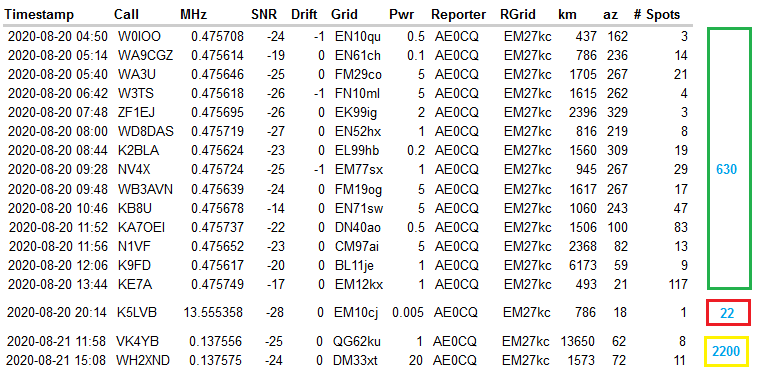
Still no WM or EAR LowFERs this week, so I tried WSPR on 630 Wed. and 2200 m Thursday night. Results are analyzed above. Between the two nighttime efforts is the lone HiFER decode that came through on Thursday afternoon.
Glad to see so many familiar calls again at 630, especially for being the middle of the week. The big surprise at 2200 is how few folks were on the air. (At least, in WSPR mode. Early in the evening I saw a lot of what appears to be JT9 5-minute mode at 137.500, right dead center in the middle of the WSPR slot.) Of those few, though, VK4YB is clearly the big winner. His signal turned up right at the start of the 1142 UTC transmission slot, which just happened to be local sunrise here. It decoded in 8 of the 9 time slots between then and the top of the hour, but went missing on Argo during the 1152 slot. WH2XND then started up at 1356 UTC.
---------------------------------------------------------------
File Attachment 1: 2021aug.gif
27 MHz ISM?
Hi folks,
Always looking for something interesting and a new opportunity, I remembered that in the region of 27 MHz (26.96-27.28 MHz to be precise) FCC allows for field strengths of 10000 V/m at 3 meters. Although this would be even less power than permitted at 22m, if conditions were right as Solar activity increases, is there any possibility or interest in operating HiFERs?
I have not delved in to the FCC blurb yet to understand the exact permissions regarding intentional radiators, unattended operations etc., but it *might* be interesting, I suppose.
Any thoughts?
Re: LF WSPR This Week
Posted by Mike N8OOU on August 21, 2020 at 20:37:08.
In reply to LF WSPR This Week posted by John Davis on August 21, 2020
John,
I have been keeping a close watch on WM Lowfer. It has been running normally, all meter readings are normal. I expect the full green foliage is helping itself to a good part of my RF Energy.
Thanks for looking, and reporting.
Mike N8OOU 73
Re: RigExpert analyzer vs Monitor Circuits
Posted by John KB5NJD on August 21, 2020 at 21:38:23.
In reply to RigExpert analyzer vs Monitor Circuits posted by Lee on August 21, 2020
Hi Lee,
What mix and size of toroid did you use for the ferrite matching transformer? I saw this come up two other times, once with a system helmed by a Monitor Sensors box on 630m and once with a home brew PA, monitored with scope match. Under power, even low power, the wrong mix seemed to result in erratic behavior in SWR compared to what the analyzer said. In short, two very different worlds between actually applying power and using a low level signal to probe the system. Perhaps that is a missing link in this discussion. 73/GL
John
PS: I did send Roger at Monitor Sensors alerting him to your reported problem in case he has additional input to offer...
Re: 27 MHz ISM?
Posted by WA1EDJ Bob on August 21, 2020 at 21:48:55.
In reply to 27 MHz ISM? posted by Ed Holland on August 21, 2020
Ed,
I'd thought of the same thing. I have not checked any regs yet but I thought walkie talkies could use 100mW on the CB.
I do have great reservations on finding a clear spot though. Tremendous interference on any CB channels.
Where would you operate?
Bob Re: RigExpert analyzer vs Monitor Circuits
EDJ
Posted by Lee on August 21, 2020 at 21:50:33.
In reply to Re: RigExpert analyzer vs Monitor Circuits posted by John KB5NJD on August 21, 2020
FT-240-77 type toroid
Re: RigExpert analyzer vs Monitor Circuits
Posted by John KB5NJD on August 21, 2020 at 22:02:30.
In reply to Re: RigExpert analyzer vs Monitor Circuits posted by Lee on August 21, 2020
Ok thank you. From my usage, should be fine. I think some guys are using 78 on 2200m but probably splitting hairs.
Assuming this is a vertical, how is your radial situation? Does the feed line look like a radial due to limited number? any additional decoupling at the station end? Maybe a non-issue but both of the setups I referenced where using very minimal radial system and before it was determined that the individuals used incorrect cores from their junk boxes, the feed line and its behavior was a consideration.
just spitballing right now...perhaps someone else is picking up on something the rest of us are missing.
73/GL
John
Re: 27 MHz ISM?
Posted by Ed Holland on August 21, 2020 at 22:04:22.
In reply to Re: 27 MHz ISM? posted by WA1EDJ Bob on August 21, 2020
Bob - no idea where I would operate, a bit of scouting required there. Probably right at the lower band edge, if I had to guess. I did read s bit further. The allocation overlaps with CB (in the USA). CB operation precludes automated transmission, or the use of non approved gear, but it does look as if there is some room for interpretation, despite the meager output that is implied.
Cheers
Ed
Re: 27 MHz ISM?
Posted by John Davis on August 21, 2020 at 22:29:40.
In reply to Re: 27 MHz ISM? posted by WA1EDJ Bob on August 21, 2020
I thought walkie talkies could use 100mW on the CB.
They can, but only as type accepted devices operating under the limits of CB rules. The old Part 15 provisions for 11 meters have not been available since the Seventies, sorry to say. That's why, despite occasional curiosity, 11-metering has not been a big Part 15 hotbed since the late Sixties. Let's look a little closer at why.
On the face of it, 10000 μV/m at 3 meters sounds fairly impressive, but carry it out to its logical conclusion. At 100 feet (30 meters), that's 1000 μV/m. At 1000 feet, it's 100 μV/m. At one mile, it's under 20 μV/m--assuming lossless free-space conditions, which never apply in the real world.
At ten miles, that'd be 2 μV/m, and at a hundred miles only 0.2 μV/m, under the same imaginarily perfect circumstances. It's theoretically possible to detect such a signal if the noise isn't too horrendous, of course, but as Bob points out it always is in the CB channels. (There are the handful of in-between radio control channels, but the noise is seldom much less on them when the band is open, thanks to outlaw CBers running off-channel and/or with splattery linears.)
Another way of looking at it: the radiation limit for 22 meters allows approximately 4.7 mW into a dipole to achieve permitted signal. But at 11 meters, it works out to 20 microwatts into a dipole...hard enough to measure accurately, let alone do anything useful with it.
Re: 27 MHz ISM?
Posted by Ed Holland on August 21, 2020 at 22:50:27.
In reply to Re: 27 MHz ISM? posted by John Davis on August 21, 2020
Thanks John for the insight. It does look like a lost cause. Were it a dedicated ISM allocation like 22m, with the chance of a quiet slice of spectrum it might be interesting, even if very very unlikely to yield results. But in a band filled with noise - not so much.
20 microwatts would be a bit of a challenge to set up, but at least an attenuator wouldn't overheat ;-)
The UK doesn't even allow for 22 m operating, so I am extremely grateful for what is possible now I live in the USA. Re: Thur. 8/20 Surprises - Change at JB?
Posted by John B on August 21, 2020 at 23:21:35.
In reply to Thur. 8/20 Surprises - Change at JB? posted by John Davis on August 21, 2020
John, that's an interesting set of grabs (and I'm really surprised at the strength of the 8PM grab. I have the following detailed information to describe the change in behavior of the Epson.
"I have no idea"
Nothing has changed here other than the fact that it's about fifteen degrees cooler ambient , than it has been. Other than that, nothing has changed. Is this a recent development, or true day over day?
How weird....
Re: Thur. 8/20 Surprises - Change at JB?
Posted by John B on August 21, 2020 at 23:34:54.
In reply to Thur. 8/20 Surprises - Change at JB? posted by John Davis on August 21, 2020
I'll go out tomorrow and measure the battery pack.
It occurred to me that I did make one change about a week ago...I moved the solar cell to a location where it gets more sun during the day, but it's hard to see how that would affect the nominal frequency that much!
Re: LF WSPR This Week
Posted by swlem3 on August 21, 2020 at 23:40:02.
In reply to LF WSPR This Week posted by John Davis on August 21, 2020
John, I saw the same transmissions of what appeared to be JT-9 5min, but I couldn't get it to decode. Maybe some error on my part, don't know. I thought that possibly it was some other mode that just looked like jt-9. Looks like I'll give VK4YB a try again on 2200m if the noise level will give me a break. It's been really noisy here in TX.
Ray
Re: RigExpert analyzer vs Monitor Circuits
Posted by Lee on August 22, 2020 at 00:08:49.
In reply to Re: RigExpert analyzer vs Monitor Circuits posted by John KB5NJD on August 21, 2020
Radial situation. Have 8ft rod at antenna base. 20 to 30 radials run under house. Concrete pad next to vertical with rebar. 20 to 30 radials sewn into rebar before pour. Ran 2 inch copper strap 30 ft around concrete pad next to mast connected with concrete fastners. This was to take advantage of rebar. All of this connects to 8 ft grd rod. Oh and my cats 6ft x 6ft x 4ft metal patio condo connects to the rod. The cat condo is about 8ft away. One feed line at 15 meter length. Vertical 33ft high, 8 radials 15ft length, a skirt wire around radials. Off one radial 214 ft of 10 gauge wire around perimeter of property. Total of 262 ft. Decoupling at station end? I do have a ground wire that connects to the antenna from equip in house. But it does not go directly to the grd rod. Connects thru a short section of cold water pipe. Coil is elevated. Ground connection about 5ft up. Antenna connection about even with top of cat condo. Re: RigExpert analyzer vs Monitor Circuits
Posted by John, W1TAG on August 22, 2020 at 00:12:54.
In reply to Re: RigExpert analyzer vs Monitor Circuits posted by John KB5NJD on August 21, 2020
Lee,
Is the toroid being used as a loading coil to resonate the antenna, or as a transformer? I’d be concerned about using ferrite (as opposed to powdered iron) as an inductor.
John, W1TAG
Re: RigExpert analyzer vs Monitor Circuits
Posted by John KB5NJD on August 22, 2020 at 00:28:43.
In reply to Re: RigExpert analyzer vs Monitor Circuits posted by Lee on August 22, 2020
Thank you Lee.
Sometimes a long feed line with respect to few shorter radials can look like a radial and depending on the length might impact something about the SWR bridge. I'm not saying that is actually happening here. Just throwing it out there. But having more system info certainly helps eliminate some possibilities.
73/GL
John
Re: RigExpert analyzer vs Monitor Circuits
Posted by Lee on August 22, 2020 at 00:34:35.
In reply to Re: RigExpert analyzer vs Monitor Circuits posted by John, W1TAG on August 22, 2020
The toroid is a matching transformer. The loading coil is air core coil. Playing with the Rig Expert again I see that it still reports 4.5 to 1 on dc dummy loads in parallel. Re: RigExpert analyzer vs Monitor Circuits
Measured the ohms. 25 ohms.
Posted by Lee on August 22, 2020 at 00:44:30.
In reply to Re: RigExpert analyzer vs Monitor Circuits posted by John KB5NJD on August 22, 2020
That's very interesting. The original idea was to go thru the wall. I might need to go back to that idea. By doing that I could reduce the feed line to 15ft from 49ft. Thru the wall was way more complex because of water heater enclosure, AC breaker box and furniture in room. Most of the radials are in the 20ft to 30ft range. And previous set ups involved the transmitter being at the base of the loading coil. Re: Thur. 8/20 Surprises - Change at JB?
Posted by John Davis on August 22, 2020 at 02:26:59.
In reply to Re: Thur. 8/20 Surprises - Change at JB? posted by John B on August 21, 2020
So far as I can tell, it's a very recent development. And, it remained at the higher frequency today, apparently.
Looking over the captures from the noon into early afternoon, JB was in the range of 13555.330 to .430 with varying degrees of upward tilt from one instance to another. (Conditions were poor today, and sometimes only one letter or part of one at a time made it through. There has been no further reception since mid-afternoon.)
Polish Radio 1 225 khz
Posted by Mike Terry on August 22, 2020 at 14:32:41.
POLAND Re: LF WSPR This Week
Public broadcaster Polish Radio is set to launch a special news service for
listeners in neighbouring Belarus, where post-election protests have grown
against longtime strongman leader Alexander Lukashenko.
The management of Polish Radio says news broadcasts in Belarusian on Polish
Radio 1 will help keep listeners beyond Poland’s eastern border informed about
what is happening in their country amid limited access to reliable information.
Thanks to transmitters at a broadcasting centre in Solec Kujawski, north-central
Poland, Polish Radio 1 can be heard on 225 kHz long wave almost throughout
Europe, including the entire territory of Belarus, public broadcaster Polish Radio’s
IAR news agency has reported.
Special news programmes produced by the Belarusian section of Polish Radio’s
External Service will be aired on Polish Radio 1 three times a day: at around 6:30
a.m., shortly after noon, and just after 10 p.m.
The initiative aims to provide Belarusians, including those living in areas where
there is no internet access or facing limitations in connectivity, with easy access
to up-to-date and reliable information about the situation in their country and
the response of the international community, Polish Radio executives have said.
“Offering support to the people of Belarus in these difficult times, and showing
solidarity by providing reliable and true information, is part of Polish Radio’s
mission as a public broadcaster,” said CEO Agnieszka Kaminska.
Broadcasts are due to start this Saturday, August 22.
(gs/pk)
https://www.polskieradio.pl/395/7785/Artykul/2568689,Polish-Radio-launches
-special-news-broadcasts-for-Belarus
via Dr Hansjoerg Biener (2020-08-21)
(Ydun's Medium Wave Info)
Posted by John Davis on August 22, 2020 at 15:56:56.
In reply to Re: LF WSPR This Week posted by Mike N8OOU on August 21, 2020
I also suspect foliage is a factor, but likely the heavy QRN is the final straw. That's why I spent one night this week looking for EAR. The fact that there was no trace at all suggests the static is just too strong right now. That's actually kind of odd, since the Blitzortung strike counts are running lower than they were earlier in the summer. Fewer strikes, but noisier ones?
Re: RigExpert analyzer vs Monitor Circuits
Posted by John KB5NJD on August 22, 2020 at 17:34:03.
In reply to Re: RigExpert analyzer vs Monitor Circuits posted by Lee on August 22, 2020
Hi Lee,
At this point I'm not sure I would go to those lengths to relocate your coax. There is time for that later if evidence warrants.
What I would like to see is a high resolution, close up image of your transformer, in situ, such that the windings are visible for primary and secondary (flat side image).
If you exceed the file limitations of the site, you can email it to me at KB5NJD@gmail.com.
Also, I would like to know how many turns you have on your primary (coax side) and secondary (antenna side).
Your measured values of R when X=0 or close to it, that would be helpful, as we try to debug this.
At this point I am also assuming that your feed line is 50 ohm. If that is incorrect, please advise.
If you would like to send all of that to my aforementioned email address to limit the bandwidth here, that is fine. I am happy to try and help you.
73!
John..
Re: RigExpert analyzer vs Monitor Circuits
Posted by Lee on August 22, 2020 at 18:57:34.
In reply to Re: RigExpert analyzer vs Monitor Circuits posted by John KB5NJD on August 22, 2020
Will e-mail the photos. I should mention that I had the same problem before I built the Re: RigExpert analyzer vs Monitor Circuits
matching transformer. I got the design from a 2200 meter web site. 10 or 9 turns primary.
5 to 8 turns secondary. While installing I realized the best match was almost 1 to 1.
9 turns to 8 turns. So I turned it around. 8 turns to 9 turns. Step up. That gave the 1.1
to 1 match. Happy Happy Joy Joy. I will send photos.
Posted by John KB5NJD on August 22, 2020 at 19:12:06.
In reply to Re: RigExpert analyzer vs Monitor Circuits posted by Lee on August 22, 2020
Thank you Lee,
I will look for your photos and will probably have some additional questions for you that I will ask via email.
Based on your specified turns (9/8) and assuming a turns ratio multiplier of 1 for your 50 ohm system, you may have too many turns on both primary and secondary of your transformer (81 ohms/64 ohms).
For a 50 ohm system with a turns ratio multiplier of 1 (meaning that you have 5 to 10 times the reactance at 136k or 250 to 500 ohms) that should require 7 turns on your primary to interface with a 50 ohm cable (square root of 50 = about 7, 7 X 7 = 49).
If, when X = 0 or is close to it, and your R is actually measured as 50 ohms as well, your secondary would also need 7 turns. Anything above that, in practice, may require some additional C to get it to play properly. Below 50 ohms, you can probably find a number of turn that works.
Also at play, there may inadvertently be a loading effect to adding a transformer like this, depending on how you wound it, so it may be necessary to tweak the tap of your series inductance. But we may not be there yet.
There are still murky details here but perhaps the images will shed some of those questions.
73!
John Hifer PBJ antenna issue found and fixed - back on air
Posted by Chris Waldrup on August 22, 2020 at 20:39:36.
Hi,
I went out this morning to change the battery and decided to connect up my antenna analyzer. The VSWR was 20:1.
It turns out that one leg of my inverted V got moved, thanks to the fiber contractor who is using directional boring machines to install the lines. The machine came through the woods where my antenna is.
Fixed now and back to normal.
Chris Re: 27 MHz ISM?
KD4PBJ
Posted by John Davis on August 22, 2020 at 22:12:25.
In reply to Re: 27 MHz ISM? posted by Ed Holland on August 21, 2020
Actually, I don't mean to be entirely discouraging. A signal that starts out with only 1/16th the field intensity of 22 meters poses severe challenges but may not be totally useless. It would indeed be a very rare thing to achieve transcontinental DX, even with slow modes, but single-hop regional Sporadic E might be feasible several times a summer when solar flux improves.
But before I spent much time and effort setting up a station, though, I'd want to research the noise prospects very carefully. Note in §15.227 that the 11 meter Part 15 allocation is a full 320 kHz wide! As Bob hinted, there just might be a few narrow slots that could be clean enough (at least on a regional basis if not nationally) to support a bit of hobby activity.
My guess is that operation there would require substantially more attention to details such as frequency selection, mode, and especially frequency stability than most HiFERs put into their rigs. Without that attention to detail, however, I can guarantee positive results will be so minimal as to limit interest in the band.
With those thoughts in mind, I've never allotted the time necessary to search for elusive quiet spots at 11 m. To do so, I would need to devise a new antenna, among other things. My standard antenna is 5/8 λ at 22 m, and therefore 1.25 λ at 11, so the vertical pattern has unwanted nulls that would skew results at 27 MHz. In addition, the buffer for my current antenna attenuates everything above LF (except 13.56 MHz) so it's deaf as a fence post at upper HF. There are CBers running enough power to be heard anyway, but my current setup is totally inadequate for Part 15 signal levels in that band.
If you'd like to do some coordinated monitoring there, I could be persuaded to install a suitable antenna and allocate some time.
[Interesting Side Notes:]
At only 12 lines of text in the printed Rules, §15.227 is the shortest section in the "Radiated Emission Limits, Additional Provisions" of Subpart C. On the face of it, that should make it the easiest to interpret, and it (almost) is. As with all FCC regulations, though, one has to take into account both what is said and what is not said in relation to other sections of the rules.
There is no requirement in 15.227, for instance, that the antenna be permanently attached to the device as in some Additional Provisions sections, and there is no limitation on transmission line length as in other sections; so, like 22 meters, you can have the transmitter indoors in a controlled environment, as long as the total radiation does not exceed 10 mV/m in any direction, three meters away from any part of the antenna or device.
Also note, unlike 22 m, that the signal strength is to be measured with an averaging meter. This is really only of concern if you're planning to operate AM or pulsed emissions. At 22 m there is no such specification, so the instrument must be a quasi-peak indicator, because that's the provision of 15.35 that applies by default to Part 15 emission measurements unless stated otherwise in specific sections. Not that anyone operates AM in 22 meters these days, but if they did, they'd have to cut the carrier power by 6 dB to ensure the modulated peaks did not exceed the limit.
At 11 meters, however, you can figure compliance with nominal 20 μW carrier power, so long as you don't exceed 100% modulation. Again, it's unlikely anyone would attempt AM under this section, because even with hypothetical free-space conditions, DX would be out of the question at much more than a mile...but in theory it could be done without the 6 dB cutback if one were stubborn enough to try it. :)
Re: Hifer PBJ antenna issue found and fixed - back on air
Posted by John Davis on August 22, 2020 at 22:26:48.
In reply to Hifer PBJ antenna issue found and fixed - back on air posted by Chris Waldrup on August 22, 2020
A boring machine caused excitement, eh? <pained expression emoticon> I'd begun to wonder where the signal went. Will check this evening, and again in the morning in case propagation is still depressed today. It'll be great to have PBJ back.
Re: Hifer PBJ antenna issue found and fixed - back on air
Posted by Chris Waldrup on August 23, 2020 at 02:06:53.
In reply to Re: Hifer PBJ antenna issue found and fixed - back on air posted by John Davis on August 22, 2020
Yeah!
I sent you a bunch of emails and photos last night and today too. I wish I could post the photos.
Chris
Re: Hifer PBJ antenna issue found and fixed - back on air
Posted by John Davis on August 23, 2020 at 03:59:20.
In reply to Re: Hifer PBJ antenna issue found and fixed - back on air posted by Chris Waldrup on August 23, 2020
Sorry to say the time from two hours before sunset to two hours after was unproductive. Absolutely no HiFERs were seen or heard here, except sometimes K6FRC was nicely audible. Have switched to 630 meter WSPR for the night, but will check again in the morning.
Re: 27 MHz ISM?
Posted by John B on August 23, 2020 at 12:16:14.
In reply to Re: 27 MHz ISM? posted by John Davis on August 22, 2020
John, thanks for the interesting notes on ISM at 27 Mhz (and the regulations in general).
It's always a bit curious to see how much detail the FCC has put into defining the regulations, only to ignore their enforcement (particularly at 27 Mhz). That said, it's the order we march to. Having managed an accredited EMC lab for the last 5 yrs of my employment, I know how hard accurate, repeatable measurements are to make, even under lab conditions (I'm thinking of the geometric accuracy required radiated emissions and the establishment of a uniform field for immunity testing purposes).
I suspect that the challenge of the receiver dynamic range requirements to parse 20uW carriers from a background din of kilowatt level sigs, would be the limiting factor, particularly when sunspots are abundant.
Even barring that there's the killer of path loss :-)
Re: Thur. 8/20 Surprises - Change at JB?
Posted by John B on August 23, 2020 at 18:37:31.
In reply to Re: Thur. 8/20 Surprises - Change at JB? posted by John Davis on August 22, 2020
Found the problem... like Chris's, it was cabling. (I knew not to trust crimp ons!) Connectors soldered on and we're back in business at a nominal 13555.2 ish signal. Must have gotten below the 5v LDO regulator min input voltage.
Battery pack is charging and we're OTA again.
Re: 27 MHz ISM?
Posted by WA1EDJ Bob on August 23, 2020 at 21:55:00.
In reply to Re: 27 MHz ISM? posted by John B on August 23, 2020
27MHz sounds a bit too challenging. I got to thinking back to the 1990's when I was doing MedFER work. I was pretty successful. Even with a pretty modest antenna I was copied. I seem to recall Todd Roberts from somewhere down south here (Savannah?) copied
me, and others. Since then the BCB has expanded to above 1600 KHz so now the only slot I'd condsider is around 1704 KHz. I've not looked at details but I think we can operate there. There is one station on the list that is MedFER on 1704 I believe.
There used to be a fair bit of activity down there.
I might look back into that.....Still have the TX and old tech EPROM CW IDer I built.
So much simplier today
Bob Re: 27 MHz ISM?
EDJ
Posted by Chris kc3gfz on August 24, 2020 at 04:13:03.
In reply to Re: 27 MHz ISM? posted by WA1EDJ Bob on August 23, 2020
Hi Bob,
That sounds like a fun project and seems more feasible to others. I have one of those “wild planet radio” toys that broadcasts at 1610am. On the second floor of home no grounding and not modified 9ft wire it will be audible in car radio just over a mile. Works good for day use. Pesky CHAA will drown it mainly evening and night time. Something I would like to look into but would have to get the frequency on par and between actual broadcast stations. Let us know if you get that thing going again.
Chris
Re: MedFER (was: 27 MHz ISM?)
Posted by John Davis on August 24, 2020 at 17:51:14.
In reply to Re: 27 MHz ISM? posted by Chris kc3gfz on August 24, 2020
Now, now, Chris...CHAA is the only way most of us on the Plains can hear Hindi pop songs. :)
Bob's recollections of the early 90s brought back a lot of fond memories. With fishing buoys gradually depopulating the band and 10 kW broadcasters not yet allowed in, the top 100 kHz of the band was a truly remarkable place to be. Even with only normal speed CW as the only digital mode back then, serious DX was possible when the noise was low enough.
Todd Roberts' MedFER ABC (Hilton Head Island) was the most regular copy at around 255 miles. His being surrounded by seawater was an advantage. Todd and I used to have multi-night QSOs. I'd program my MedFER SEA (more accurately, the Radio Shack Color Computer for which I wrote a keyer program in COLOR BASIC) with a short message and let it repeat into the night. At some point, there would be enough repetitions come through adequately for Todd to assemble the full message, and he would program a response into his memory keyer. I'd pause transmission after a while and if I noticed Todd's message seemed to be different, then I'd listen long enough to copy it all, and type in my own response. Sometimes we could do two or three exchanges in a night, and other times it took a couple of nights.
At one point I got adventurous and devised a high-efficiency DSB suppressed carrier final amplifier and attempted voice transmission. At the time, you could buy cassette tapes that repeated loops of various durations. I recorded loops featuring alternating music selections and voice ID messages, both heavily compressed for maximum average-to-peak power ratios. Lyle KØLR copied one of those sessions roughly 800 miles away in MN, not well enough to identify the songs consistently, but enough to distinguish the voice ID from the music.
MedFER EDJ was always an elusive target for me, but was regularly reported by others at greater distances. At the time I lived less than 100 miles from Bob--too far for groundwave, but too close for skywave--until one fateful sunset, when greyline propagation finally took pity on me. That was quite a thrill.
Nowadays, of course, the noise floor is orders of magnitude higher. In addition to AM sidebands, some stations also add digital modulation that fills the RF emissions mask between ±5 kHz to ±10 kHz from the carrier with pseudorandom noise, and spreads at lower levels considerably beyond the next channel...the dreaded "Din of Ibiquity" as it has been aptly called.
Section 15.219 is the provision of the rules that applies to MedFER operation. For whatever reason, the FCC set the band limits at 510 to 1705 kHz. That doesn't let us get very far from the carrier of stations on 1700, even though their sidebands are allowed to extend 10 kHz either side of the carrier. Fortunately, there tends to be less energy in sidebands above 5 kHz than there is below, but since we can't go up beyond 1705 kHz ourselves, it's kind of a moot point for us.
Logically, we want to get as near 1705 as practical, but we must take into account both the frequency stability of our rigs and the bandwidth of our modulation products. The latter factor, combined with the intrinsic noise levels of the AM band, strongly disfavor normal speed CW. QRSS with adequate click filtering, or a slow MFSK mode such as WSPR, plus some attention to detail with the oscillator, will be the key to getting as close to 1705 as possible.. But oscillator stability is complicated by the fact that antenna, transmission line, and ground lead are limited, so the unit will of necessity be outdoors...a complication that does not have to apply at 22 or even 11 meters.
Re: MedFER (was: 27 MHz ISM?)
Posted by Ed Holland on August 24, 2020 at 18:51:28.
In reply to Re: MedFER (was: 27 MHz ISM?) posted by John Davis on August 24, 2020
Interesting to contemplate. Perhaps the rules could be interpreted to allow only the finals of the transmitter to be located at the antenna feedpoint? This way, a bias tee could enable delivery of the PA drive, and the required DC power, while enabling the frequency determining part of the TX to reside somewhere more conducive to stability.
I remember a foray with LWCA long before PVC was active, where I was first contemplating a beacon. In this case it was a MedFER, and John gently dissuaded me, for many of the reasons presented in this conversation. That was sage advice, but I still like the idea. At the time I had bought one of the Ramsey AM transmitter kits, thinking this would be a good starting point. Not at all, as it turned out - it has to be the most unstable design ever, as we (my Son and I) learned again earlier this year. It did, however, provide us with some suitable equipment to pursue a school Science Fair project, where we studied radio reception using some different antennas, and radios, to determine if our problem question "Could a Part 15 station cover the school campus?" was realisable. The initial suggestion came from Dad, but my boy quickly rose to the challenge and got interested. We had a lot of fun figuring out the experiments, reframing our tests when the first results weren't quite what was expected, pacing around the school sports field, all while retuning that transmitter. The project won the Fair, and went on to win in the Physics category at county level :-).
I haven't turned him into a radio nut yet, but I keep chipping away at it!
Sunday 23rd Hifers
Posted by Ed Holland on August 24, 2020 at 18:59:29.
Hi folks,
Weak signals yesterday, but they were out there to be seen at least. This seemed to be about the only radiation that made it through the smoke from nearby wildfires...
Good traces were seen of NC and WM, with 7P also a reliable visitor. Although I didn't quite make out an ID, I suspect yesterday also saw the first reception of BNC1 here at PVC. Lastly a few repetitions of a double dash, "M"? with a pronounced downward chirp were seen and heard. While it lasted, this station repeated once each minute.
Above the mid band twitter, there was little to be seen. Hunting in the 13562 - 13567 kHz zone seems unfruitful these days.
Normal weekday operation of PVC is resumed.
73s
Ed
Re: MedFER (was: 27 MHz ISM?)
Posted by WA1EDJ Bob on August 24, 2020 at 19:36:33.
In reply to Re: MedFER (was: 27 MHz ISM?) posted by John Davis on August 24, 2020
Interesting John. Thanks for filling in the details of "new" challenges for the MedFER band after BCB expansion.
I was digging around last night and found the cassette tape you sent me back in '91 of
your reception of EDJ. I'll try to give it a listen tonight (if I have batts for the cassette player!)
I would consider MedFER QRSS operation on 1704.+ with a si5351 TX. My original MedFER
was a pole mounted transmitter at the antenna.
But, I don't know, just seem to run out of time lately. I did check out the CT MedFER beacon page and he seems to have it figured out. I need to give a listen down there.
Bob
EDJ...Staying HiFER for now....
Re: MedFER (was: 27 MHz ISM?)
Posted by John Davis on August 24, 2020 at 20:27:12.
In reply to Re: MedFER (was: 27 MHz ISM?) posted by WA1EDJ Bob on August 24, 2020
I was digging around last night and found the cassette tape you sent me back in '91 of your reception of EDJ.
Wow, that's fantastic, Bob. Most of my own copies of tapes from that era did not survive the move from Georgia, so it's great to know some of that data is still out there.
If you are able to play the tape OK, might you be willing to make a WAV file of it? It might be interesting to have an archive of HiFER sound clips on the Web, to go with the photos and other HiFER info that Jerry WA6OWR is putting together.
Re: Sunday 23rd Hifers
Posted by Mike N8OOU on August 25, 2020 at 02:53:42.
In reply to Sunday 23rd Hifers posted by Ed Holland on August 24, 2020
Ed;
Thanks for taking the time to listen and report on the Hifers. It's good to hear WM made the trip. Over the past couple weeks I have done a complete health check on both beacons. Everything has checked "good to go" for the winter season.
Mike Meek 73
Re: Sunday 23rd Hifers
Posted by Ed Holland on August 25, 2020 at 04:16:29.
In reply to Re: Sunday 23rd Hifers posted by Mike N8OOU on August 25, 2020
Mike,
You are welcome - it is a pleasure to hunt for signals, and after all, might be thought of as half the responsibility of a good beaconeer.
Cheers and 73s
Ed
Re: MedFER (was: 27 MHz ISM?)
Posted by WA1EDJ Bob on August 25, 2020 at 14:02:56.
In reply to Re: MedFER (was: 27 MHz ISM?) posted by John Davis on August 24, 2020
The tape did play ok on my cassette machine. It has EDJ and some other MedFER beacons you copied in 11/1991. I heard ABC for sure but others would take some digging.
What free audio app would you suggest to make a .wav? I hear about Audacity and have used an older version years ago. I'm not big into recording and ripping mp3's as some.
I have a better quality cassette deck with line out levels that I'll use for an archive copy. Won't probably matter much as band noise in strong on the tape.
EDJ is off WSPR and QRSS on 22M until this WX system moves through. Those Gulf storms are pouring moisture up into GA. with storms.
Bob Re: MedFER (was: 27 MHz ISM?)
EDJ
Posted by John Davis on August 25, 2020 at 15:42:10.
In reply to Re: MedFER (was: 27 MHz ISM?) posted by Ed Holland on August 24, 2020
Congratulations to you and your son on the science fair project. That's a great story, Ed.
Perhaps the rules could be interpreted to allow only the finals of the transmitter to be located at the antenna feed point?
IMO, that's a reasonable interpretation, and there is precedent for it. A number of LowFER operators in the past have made use of a separate control head and/or exciter unit, driving a final out at the antenna. Even a commercially built Part 15 sorta-HiFER (27 MHz, harking back to our original subject line) from 57 years ago, which back then had to undergo FCC Type Acceptance to be sold, used a separate exciter and a final located at the rooftop antenna.
That was the International Crystal Executive 1500 model that we talked about in The LOWDOWN about two years ago. (The attached file is an ad for the transceiver that appeared in Popular Electronics.) The "15" in the model number stood for Part 15, and the "00" was a nod to International Crystal's deluxe Executive 100 CB rig upon which it was based...although the 1500 was priced at nearly $300, a whopping 50% more than the full-power Model 100, or even the ultra-deluxe Browning model of the same era when equipped with crystals for all 23 channels. Three hundred bucks was serious money back then, so not everybody was rushing out to get one, even though that was really the only legal way to "work skip" on 11 meters...but the extra dough was, in part, to cover the costs of Type Acceptance for a product that was only expected to sell in limited quantities at best.
The 27 MHz Part 15 provisions back then allowed 100 mW into the final amplifier and a 5 foot single element antenna permanently connected to the device. The primary object was to accommodate hand-held walkie-talkies. The rules were changed in 1978 to the present day signal strength limits, and the grandfathering of previously compliant devices ended five years later. But the moral is, remote excitation of a device operating under antenna restrictions was approved for a commercially marketed product.
Conversely, one does not want to tempt fate by stretching interpretation into the realm of fantasy. In its crackdown on shady AM wannabe broadcasters a couple of years ago, the FCC finally took note of one product that had sneakily been authorized through the notification process (Type Acceptance no longer being applicable). Somehow they had failed to notice that the product consisted of two units: the actual complete transmitter itself, and a separate "antenna tuning unit" that the manufacturer bragged could be connected to it via whatever length of coax the user desired. Well, coax after the final amplifier stage is a transmission line that counts as part of the antenna system in §15.219, however you look at it! (And yes, it does radiate if it's providing any of the ground return path for the signal.) So, those clowns kind of poisoned the waters for the rest of us.
A well designed beacon is not likely to attract unwanted attention, but if it ever did, you'd want to have your design well documented and your certification label on the transmitter unit at the base of the antenna.
---------------------------------------------------------------
File Attachment 1: HiFER1963.jpg
Re: MedFER (was: 27 MHz ISM?)
Hi John,
Thanks for the background. I do remember mention of this in The Lowdown. $300 was a lot of money for that Radio!
Indeed, as in most exploits, it is rare that someone has not already thought of your independently dreamed up idea - and possibly nobbled it! Regardless, I might go and read the FCC points again, to see how the current MedFER rules apply.
The transmission line+antenna total length stipulation makes sense, since it is easy to make both part of the radiating system. At least the power restriction is simpler to interpret than a field strength limit.
We now await the results from my Son's science fair entry into a National competition!
Cheers
Ed
N8OOU on 630m
Posted by Mike N8OOU on August 25, 2020 at 18:48:57.
All;
I am testing my 630m station once again. For this test I an sending a WSPR transmission immediately followed by a FSKCW-60 transmission consisting of letters "W" and "M". A 10 wpm cw id is sent after each letter. Due to the long FSKCW-60 send time the transmission starts on the 2 and 32 minute marks.
The WSPR frequency is 475675 Hz while FSKCW is sent on 475300. The antenna is a 50Ft. tall vertical wire plus appropriate baseload/groundplane. The PA input power is 5w.
Mike N8OOU 73
Re: N8OOU on 630m
Posted by John Davis on August 25, 2020 at 20:20:13.
In reply to N8OOU on 630m posted by Mike N8OOU on August 25, 2020
I'll check for it tonight, Mike, but it may require more than one session because my CW filter is too narrow to get both frequencies in the same passband. I need to find a nice 500 Hz filter, I reckon.
A few quick questions: Is 475300 the mark or the space frequency for the FSK portion? Is the shift still extra wide? And finally, are :02 and :32 the FSK start times or the WSPR start times? Thanks.
Re: N8OOU on 630m
Posted by Mike N8OOU on August 25, 2020 at 21:06:43.
In reply to Re: N8OOU on 630m posted by John Davis on August 25, 2020
Hi John,
I understand the bandwidth issue, I know you have talked about that before. I can lower the wspr freq and raise the fsk and get them closer. Let me know how close you need them. I am monitoring locally with a wide usb filter and naturally have no issue copying both frequencies.
I set the frequency shift to 1 Hz for this test. If I find a remote receiver hearing the fsk, I wanted to see how the pattern looked on the typical lopora grabber screen. The higher frequency ie 475301 is "key down". lower 475300, key up. I am seeing a small upward drift at the beginning of the fsk (.2Hz) using ARGO.
WSPR starts at 02 and 32 and runs for 2 minutes. The FSKCW starts immediately then at 04 and 34. This U3S is under GPS control so start times should be accurate.
The SI5351A in this U3S is clocked by a very high precision/analog txco. As such the GPS frequency calibration comes up equal every time. But even though after a continuous 2 minute wspr transmission with 0 drift, the startup of the FSK shows .2Hz drift. I say there are bugs inside the 5351 chip.
Mike 73
Re: N8OOU on 630m
Posted by John Davis on August 25, 2020 at 21:50:25.
In reply to Re: N8OOU on 630m posted by Mike N8OOU on August 25, 2020
Thanks for the clarification, Mike. Let's stick with those parameters for now and see how it goes. Hope to have a report for you in the morning.
Frequency Counters
Posted by Ed Holland on August 25, 2020 at 23:08:30.
Hi Folks,
I thought it might be helpful to draw attention to something noticed recently while trying to realign a radio. Since they were inexpensive, I bought one of the small frequency counter modules available from Ebay and similar, around $15 at the time. It seemed to do the job quite well. However, recent use of a proper instrument revealed its shortcomings.
Aligning a Yaesu FRG8800 some while ago after purchase, I was a bit puzzled that after warm-up, I had to use the "fine" control to correct about 300 Hz of drift. Not a big deal, and I put it down to the radio's quirks, as this was fairly close to spec. The discrepancy between dial and signal frequency was constant with frequency, so there wasn't a significant scaling error. The LSB and USB modes gave the same beat against a carrier, so they couldn't both be off, could they? Yes they were! The radio was back on the bench this weekend to explore another small issue, and I took the opportunity to use a better counter and run through alignment again. The adjustment error in each oscillator for the sideband modes was consistent, and the blame lay squarely at the cheap frequency counter, to the tune (ahem) of about 300 Hz. Another run through the alignment sequence has the radio spot on and well within spec.
Cheers
Ed
wspr variant on 630m
Posted by swlem3 on August 26, 2020 at 01:56:28.
Re: wspr variant on 630m
Anyone know what mode of wspr is being used on 630m that doesn't decode using the normal wspr2 setting? I'm copying a few stations that aren't decoding here. The mode is still using the standard 2 min transmissions.
Posted by John Davis on August 26, 2020 at 03:28:11.
In reply to wspr variant on 630m posted by swlem3 on August 26, 2020
Not a clue myself. I noticed at least one such transmission earlier this evening too. It was plagued by multiple copies of itself, space at 60 Hz intervals. It looked like one of the JT-9 transmissions like I saw on 2200 the other night, but what the hey!? Aren't they supposed to have their own slot just below the WSPR segment??
Re: wspr variant on 630m
Posted by swlem3 on August 26, 2020 at 03:44:20.
In reply to Re: wspr variant on 630m posted by John Davis on August 26, 2020
John, thanks for the reply. At least now I know that someone else noticed this. I guess I'll have to just look around to see if one of the participants in the mode will mention it on some forum. I didn't see the transmission with the multiple copies you mention so I can't comment on it, but yes, jt-9 is segmented below the wspr activity.
Ray
Re: N8OOU on 630m
Posted by John Davis on August 26, 2020 at 07:20:45.
In reply to Re: N8OOU on 630m posted by John Davis on August 25, 2020
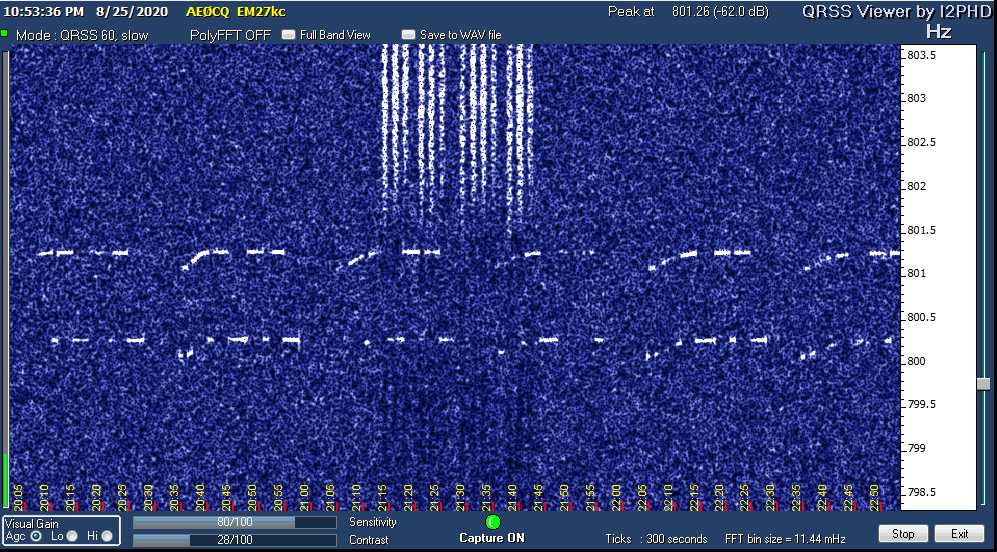
Preliminary report: No sign of the FSK until 8:04 PM, then it was pretty consistent. I see what you mean, though, about the 0.2 Hz drift. May have some thoughts on that tomorrow. Then 'round midnight, I switched over to the WSPR2 segment for the rest of the night. Guess who showed up as the first decode?
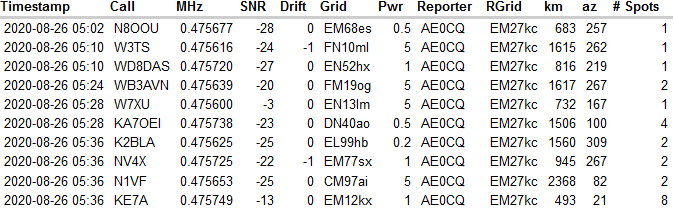
This is the signal that did the trick:
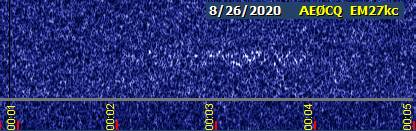
At the next transmission (0532 UTC) there was less signal, unfortunately, and no decode. But we'll see how many more we get by morning.
---------------------------------------------------------------
File Attachment 1: 25augb.jpg
File Attachment 2: 25augc.jpg
File Attachment 3: 25augWSPR1.gif
Re: N8OOU on 630m
Mike, I listened during the afternoon and the best I could manage was a weak trace of the FSK CW with ARGO at QRSS30 rate. The wspr signal wasn't even noticeable on a waterfall with QRSS3 bandwidth. Meanwhile, lowfer WM was coming in fine. Then all of a sudden at 0232Z the wspr signal showed up nicely and decoded at -21 dB SNR. Guess skywave finally kicked in. It never came in better, perhaps due to storm QRN which raised its head through the night.
73, Garry, K3SIW, EN52ta, Elgin, IL
Re: N8OOU on 630m
Posted by swlem3 on August 26, 2020 at 13:52:04.
In reply to N8OOU on 630m posted by Mike N8OOU on August 25, 2020
Overnight wspr report from this N. Texas qth Mike:
2020-08-26 09:02 N8OOU 0.475677 -30 0 EM68es 0.5 SWLEM3 EM03rf
2020-08-26 08:02 N8OOU 0.475677 -32 0 EM68es 0.5 SWLEM3 EM03rf
2020-08-26 06:32 N8OOU 0.475677 -29 0 EM68es 0.5 SWLEM3 EM03rf
2020-08-26 05:32 N8OOU 0.475677 -31 0 EM68es 0.5 SWLEM3 EM03rf
Ray Re: wspr variant on 630m
Posted by Mike N8OOU on August 26, 2020 at 14:22:24.
In reply to wspr variant on 630m posted by swlem3 on August 26, 2020
WSPR has an option to send some extended information in a second 2 minute time slot that follows the initial basic transmission. Could that be what you guys are seeing on Argo? The WSPR program normally combines the two time slots into one line entry. Both transmissions would look the same with Argo.
The WSPR program can get confused when it doesn't match the second back to the first, and logs it with garbage data.
I have used the extended option to get the 6 character grid square of my location while traveling. If the receiving station couldn't combine the two slots my 4 character location was logged.
Mike 73
Re: wspr variant on 630m
Posted by swlem3 on August 26, 2020 at 14:35:16.
In reply to Re: wspr variant on 630m posted by Mike N8OOU on August 26, 2020
Re: N8OOU on 630m
Mike, I'm not getting any garbage data on these wspr transmissions. Wsjtx just doesn't decode the transmitted data in the 2 min timeslot.
Posted by Mike N8OOU on August 26, 2020 at 14:56:44.
In reply to N8OOU on 630m posted by Mike N8OOU on August 25, 2020
John, Garry, swlem3;
Thanks to all for the reception reports. I had WSPR running the night before last and I was comparing the reception reports from wsprnet to last night and really started thinking the station was not working last night. I checked meter readings in the evening, and all was in the normal range. I decided to just let it run and see what happens. It looks like the band opened after 01:00 utc and I see more unique stations than I did the night before.
Day before yesterday in the afternoon I was being reported by N9RU and K9AN both in IL. Yesterday I never saw a report from K9AN. Maybe he went changed to another band or went QRT. The RF Current into the antenna is 3 times more than the Lowfer. (My meter is un calibrated)
I am satisfied with the basic operation of the setup. The magic smoke has been contained!! Woo Ho! I am disappointed with the stability compared to the Lowfer. The 630m transmitter is even located inside a building, compared to the lowfer outside at the antenna and in a black can.
I plan to let this run a couple more days to allow me to get a little more info. I will try a couple ideas I have to make the FSK more stable.
Mike 73.
Re: wspr variant on 630m
Posted by John Davis on August 26, 2020 at 15:09:06.
In reply to Re: wspr variant on 630m posted by Mike N8OOU on August 26, 2020
I don't think that accounts for it, Mike. The extended information format looks just like regular WSPR on Argo,* whereas the mystery format I've seen is a similar form of MFSK but with noticeably narrower shift.
In terms of decoding, the extended WSPR format normally substitutes "<....>" for the call sign if you receive the six-character locator transmission first before the four-character version with call; which lets you know to watch for further information. If you do get the call with the next normal transmission, subsequent slots with six character grids identify with the call highlighted thusly: <K9FD>.
(*Which brings up another point. There have also been transmissions lately in the WSPR segment that do look exactly like good solid, normal WSPR2 except for one thing--they lack the normal WSPR header, so they never decode. There was one of those at 475,790 pointlessly wasting power on a 50% duty cycle the whole time I was watching between midnight and 1 AM. He was joined once by another signal with a similarly non-standard header. Why bother transmitting in a propagation reporting segment if you'll never be decoded and thereby won't be reported?)
(On yet another related topic, why transmit just outside the WSPR segment and also thereby miss reports? W7XU puts in an incredible signal here all the time but is sometimes AWOL for entire nights because he's located right on 475,600 but frequently dips a Hz or two, so the decoder ignores his signal entirely.)
Clearly, I've got to give up spectral analysis at 630 m. It's bad for my blood pressure. ;)
Re: wspr variant on 630m
Posted by Mike N8OOU on August 26, 2020 at 16:39:32.
In reply to Re: wspr variant on 630m posted by John Davis on August 26, 2020
John,
OK, thanks for the additional info. I thought you were seeing a strong WSPR pattern on Argo, but not decoding in wspr-2. Also all the results from my travels were looking at wsprnet logs, not the actual wspr or wsjt program.
As far as non standard message formats I know there is arduino and other uP code out there, to create wspr or other encoding schemes. Hardware like the U3S can send that data. It is quite possible that code has been tweeked, to send info in a "vpn" fashion. In the mix of normal wspr exchanges, that data would fly right by in plain site. Who knows, maybe you are seeing K1JT testing FTD-2.5!
(Your related topic) Being a "since it's beginning" U3S user, I can see how easy it is to let the frequency on it slip "out of band".
Mike 73
Re: wspr variant on 630m
Posted by John Davis on August 26, 2020 at 21:58:36.
In reply to Re: wspr variant on 630m posted by Mike N8OOU on August 26, 2020
It is quite possible that code has been tweeked, to send info in a "vpn" fashion.
I've wondered about that myself. But if so, it would be a violation of the rules...no "secret codes," only publicly documented digital formats. Not to mention, it'd be contrary to the point of beaconing for propagation monitoring purposes.
Attached are two files illustrating the kinds of things I've been seeing, and there are two kinds. One is the seeming reduced-bandwidth variant of WSPR that I was griping about last night, but apparently did not save a picture of it. (It wasn't there later in the night with all its 60 Hz sidebands...fortunately.) However, it resembles the signal in image "20auga78.jpg" from 2200 meters last Thursday, apart from the 630 meter version lasting only two minutes at a time, instead of five. I'd go to the field and check again now, except for the threat of pop-up storms for a few more hours.
Then there's the other type...the ones that look almost exactly like WSPR2 in terms of step size, tone duration, and bandwidth, but do not possess a standard header and never decode. The file "25aug042.jpg" shows examples of these. It covers the time slots of 0530, 0532, 0534, and the start of 0536 UTC (five hours difference from the CDT shown in the picture), and is two different windows, time-aligned and stitched together, with the audio frequency scale conformed to the RF in Hz above 475.000.
The textual frequency and call labels were copied and passed directly from my ALL_WSPR.TXT file of the decodes for those specific time slots. The non-decoders in question are the one frequent sender at 475,790 and its occasional partner just above 780 Hz. (What really impresses me are successful decodes like N1VF, who was only visible for half the time slot, and K2BLA, who is so close to the permanent noise band.)
---------------------------------------------------------------
File Attachment 1: 20auga78.jpg
File Attachment 2: 25aug042.jpg
Re: N8OOU on 630m
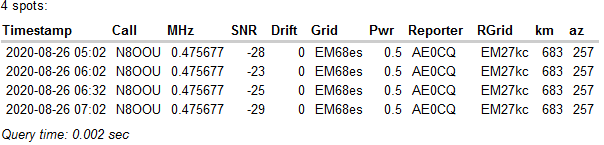
Turned out to have three more decodes of N8OOU WSPR overnight. Even with the low duty cycle of transmissions, a few more dB of power might make it one of the regulars!
Out of curiosity, was the FSK on before 8 PM CDT last night? I notice you mentioned 0100 UTC in connection with WSPR reports, and perhaps it was also relevant to the FSK reception as well.
---------------------------------------------------------------
File Attachment 1: 25augWSPRnetOOU.gif
Re: N8OOU on 630m
John, Yes the FSK was running full time. I had Argo running to watch the signal locally. I took a screen capture showing 19:45 to 21:06 8/25 UTC.
Wsprnet database shows regular decodes from N9RU up to 00:00 8/25 utc, with snr numbers of -12 / -14. At 171km I would say that was ground wave reception. Reports from N9RU after 00:00 dropped to -22 / -25. The same pattern has happened this evening.
I know wsprnet has it's issues and misses reports at times. K9AN who had good reports for me on 8/25, has not reported me on 8/26 or 8/27 utc. K9AN has reported other dx stations during that time. ?????? Maybe my 02/32 time slot is bad??????
I have 5 more volts on this power supply I can send to the PA. I am holding back in the dB department at this time. Winter propagation and less green leaves should help a bit too!
I was not successful at finding online daytime receivers that were hearing me today. The antenna RF Current is holding good today.
Mike 73
Re: wspr variant on 630m
Posted by Mike N8OOU on August 27, 2020 at 03:37:50.
In reply to Re: wspr variant on 630m posted by John Davis on August 26, 2020
John
I would say that additional tools will be needed to analyze the tones involved and the patterns in which they are used. Then other skills will be needed to decipher the patterns into something meaningful to us. There are a couple departments in the government, and maybe a few internet connected folks who could accomplish that task. Hi Hi.
WSPR-2 overnight
Mike 73
Posted by John Bruce McCreath on August 27, 2020 at 13:52:53.
There was lots of activity on 630M WSPR-2 last evening and early into the night. The map showing the various paths looked like a motorways map of London, England. I had decodes of the following stations in chronological order:
WA9CGZ, W3TS, WB3AVN, N3FL, NV4X, WD8DAS, KE7A, N9RU, KB8U, and W7XU
73, J.B., VE3EAR Re: N8OOU on 630m
LowFER Beacon EAR
188.835 QRSS30
Posted by John Davis on August 27, 2020 at 20:15:21.
In reply to Re: N8OOU on 630m posted by Mike N8OOU on August 27, 2020
Didn't get to listen last night but might try again this evening if the weather finally starts acting more like what was predicted for today.
We had threatening and colorful skies at last night's sunset, without any accompanying storms as things turned out, but I was too tired to go back to the field and risk having to evacuate at a moment's notice, just in case. Today, we were supposed to have thunderstorms this afternoon but they arrived early. They're supposed to be gone by 7 PM and leave us alone for 36 hours, but I'll believe it if/when I see it.)
What I'm looking for is further evidence of the abrupt skywave switch-on that seemed to take place Tuesday night. I was tuned to the FSK slot, figuring I'd have the greatest statistical chance of catching my first glimpse of signal there. Nothing at all from 5 o'clock until just after 8:04 PM CDT, then bam, there it was. If I can safely set up in time this evening, I'll try to be at the controls in person and switch between frequencies at the appropriate times to catch both modes around sunset.
I don't see anything wrong with the 02/32 time slots for WSPR, myself. I didn't record waterfall captures the entire night as I sometimes do, but at least while I was watching, the frequency was not subject to QRM at those times. It's probably just a question of ERP and the location of skip zones at any given time.
Frequency stability is still something of a puzzle. I couldn't say with any certainty that the Si5351A does not have bugs of some sort, but the kink of the curve makes me think more of an analog TCXO undergoing thermal compensation. Since it doesn't seem the external oscillator is shut down between modes, it makes me wonder whether it's heat variations from the synth IC being transferred to the oscillator, perhaps by a combination of radiative heating and conduction through the PCB, since both chips are in such close proximity. Although it looks drastic when viewed at QRSS60, the 0.2 Hz FSK drift is less than 0.5 ppm, well within the TCXO spec. (It's probably also there in WSPR as well, but is such a small fraction of the 1.4-something Hz tone steps of WSPR2 that it has no effect.)
Maybe the oscillator just needs a little more thermal isolation somehow...and/or, maybe more isolation from IC2 as well, because the regulator's temperature could also be slowly shifting with variations in current demand from the synth chip, and it too is right next to the TCXO.
Re: N8OOU on 630m
Posted by Mike N8OOU on August 27, 2020 at 23:42:54.
In reply to Re: N8OOU on 630m posted by John Davis on August 27, 2020
John,
I just picked up the new messages, I assume you have left already.(it's 6:30 PM CDT) If so, you may have an explanation before you submit your findings. So far today's daytime reception has been following the pattern. I have been seeing a problem with the transmitter where the PA current runs at 300 mA for a while, then just drops down to 100mA. The times in both extremes seems random. I have not resolved this yet.
I have tried a couple changes today in the thermal shielding of the Synth board. I have had issue with PCB heat transfer in the past. Now I mount all txco chips deadbug style.
This transmitter build is different from my others, in that I swapped an IRF510 FET for the BS170. It is mounted on a big heatsink inside the transmitter case. I was expecting some thermal issues from doing that.
Even with these issues, I will try to keep the station transmitting. I may have to shut down due to storms here.
Mike 73
Re: N8OOU on 630m
Posted by John Davis on August 28, 2020 at 05:44:22.
In reply to Re: N8OOU on 630m posted by Mike N8OOU on August 27, 2020
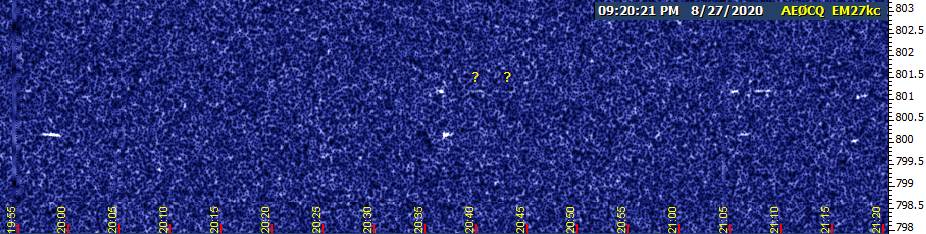
Interesting. It appears you've got a handle on freq stability. I also noticed an effect that is probably explained by the variations in final amp current you mention; but from what I saw, the times of current fluctuations may not be entirely random, though I have no plausible hypotheses why they occur.
It took a while, but I finally got everything set up again at the receive site about 7:30 PM CDT, and managed to look for WSPR at 7:32 PM/0032 UTC, 0102, 0132, 0202, and 0232. In between I monitored the FSK spot. Before sunset, there wasn't much noise--but also no signals. Just before 7:55 I thought I might be seeing a few seconds of key-down, followed by a little over a minute of key-up; after that, nothing further until just after the 0132 WSPR slot.
Then the probable FSK signal switched on again...briefly. I thought and hoped that the "ionosphere switch" had finally turned on for the night; but within a couple of minutes, I began to wonder if the ionosphere needed some contact cleaner! Using Argo's pointer-based relative signal level indicator tool, it appeared that the signal dropped almost 10 dB, hovering right at the edge of visibility in the noise. Eventually, it disappeared entirely, returning again just after the next WSPR slot, then dropping from view once more shortly thereafter.
There were no WSPR decodes of N8OOU in any of the five transmission slots I monitored, and only two other stations, for that matter. WB3AVN decoded with -27 dB SNR and NV4X with -22 dB, both in the 0132 time slot.
My plan had been to continue the manual retuning until I had a WSPR decode of N8OOU, and then ride the FSK signal the rest of the night, in order to see what time it faded away in the morning. But with such widely varying signal strengths, combined with static levels increasing so much by 0232, I decided further results might be less than meaningful and called it quits for the night. I'll probably try again tomorrow night, assuming the storms move further away from us,
---------------------------------------------------------------
File Attachment 1: 27augc14.jpg
Re: N8OOU on 630m
Oops. I forgot to mention, the capture in the preceding message was at QRSS30, not 60 as per the previous attempt. That may account for part of the apparent improvement in stability at restarts.
On the other hand, if I had remembered to switch Argo back to QRSS60, the times with full power would have been of such short duration on screen as to be easily overlooked or possibly mistaken for something else.
Re: MedFER (was: 27 MHz ISM?)
Posted by John Davis on August 28, 2020 at 06:20:55.
In reply to Re: MedFER (was: 27 MHz ISM?) posted by WA1EDJ Bob on August 25, 2020
What free audio app would you suggest to make a .wav?
The recordings I post these days usually originate as WAV files recorded by Argo.
Later, I generally edit them with Audacity. The new version has a lot more bells and whistles than the early one did, but isn't hard to get used to. I've never used this version to record yet, though, because I don't have access to the sound card input on my desktop machine. The notebook machine is the one with convenient sound inputs, and fortunately Argo is muy simpatico with most sound cards.
Reminder: Lowfer net +/- 3929Khz Saturday morning 0800 California time
Posted by Jerry Parker on August 28, 2020 at 13:49:42.
Reminder: Lowfer net +/- 3929Khz Saturday morning 0800 California time Re: N8OOU on 630m
Or listen online at kfs:
http://69.27.184.62:8901/?tune=3929lsb
or
KPH Point Reyes:
http://198.40.45.23:8073/
or
Utah Web sdr:
http://www.sdrutah.org/websdr1.htmlIf you cannot get into the net on 80 meters you can listen on KFS and participate by sending net control your thoughts to wa6owr@gmail.com
73,
Jerry WA6OWR
Posted by Mike N8OOU on August 28, 2020 at 14:05:38.
In reply to Re: N8OOU on 630m posted by John Davis on August 28, 2020
John,
Thanks a bunch for the monitor session last night. I know some or most of the reason for lack of reception originated from here. I don't know if propagation was a contributor. I appreciate you spending the time in the field.
My last decode on wsprnet was 22:34 by N9RU. Ground wave I suspect. I changed the wspr start time to 04/34 for the daytime yesterday, to see if that brought back decodes from K9AN. No luck there. I switch back to 02/32 for your monitoring.
I am letting it run this morning until noonish to see if N9RU picks me up again. I will go QRT then to try to resolve the problems. The past couple days have been extremely warm so a cooked cap or silicon part is suspect. I have several things to try so it may take a few days.
The positives from this test are my antenna/loading coil work. I can put out a usable signal. With a T/R switch I can have a cw QSO with another station. While I am working on the transmitter, I am switching the antenna to a receiver to do some monitoring.
Thanks for your help, I'll try again later.
Mike 73
Re: MedFER (was: 27 MHz ISM?)
Posted by Ed Holland on August 28, 2020 at 14:55:17.
In reply to Re: MedFER (was: 27 MHz ISM?) posted by John Davis on August 28, 2020
I have used Audacity very happily for a number of tasks. One was recording vinyl LPs at high quality for addition to our music server. I've also used it to capture and edit musical recording of guitar and bass. Very easy to use.
Article: Anatomy of a NDB
Posted by Tim Brannon WA5MD on August 28, 2020 at 23:56:31.
I ran across a link to this article last night on QRZ.com and thought this group would find it interesting. Some nice pictures of an NDB installation. 73 de Tim
https://www.hamradio.me/antennas/anatomy-of-a-low-frequency-aviation-radio-beacon.html
Re: Article: Anatomy of a NDB
Posted by Mike - N2COD on August 29, 2020 at 15:06:00.
In reply to Article: Anatomy of a NDB posted by Tim Brannon WA5MD on August 28, 2020
Thanks for the heads-up on this great article Tim. Nicely annotated and plenty of good photos of the MSQ NDB installation.
Re: Article: Anatomy of a NDB
Posted by John Bruce McCreath on August 30, 2020 at 14:28:22.
In reply to Article: Anatomy of a NDB posted by Tim Brannon WA5MD on August 28, 2020
A nice write-up and excellent pix of a typical NDB. Thanks for sharing with us!
73, J.B., VE3EAR Re: Article: Anatomy of a NDB
Posted by Lee on August 30, 2020 at 22:35:30.
In reply to Article: Anatomy of a NDB posted by Tim Brannon WA5MD on August 28, 2020
Great article. Made me realize I need to consider a much lower output power on my 2200 meter station. More like 10 to 15 watts max. KE6PCT
Re: Article: Anatomy of a NDB
Posted by John Davis on August 31, 2020 at 07:25:37.
In reply to Re: Article: Anatomy of a NDB posted by Lee on August 30, 2020
Run the numbers carefully before making any drastic decisions about power, Lee. Even if you have just as tall an antenna, just as good a ground system, and equal soil conductivity (and unfortunately, we don't know the numbers he assumed for some of those), the difference in wavelength alone will result in a radiation resistance only 0.15 as large. Rr is proportional to the square of antenna height, so the efficiency decreases exponentially with the decrease in operating frequency.
Saturday 28th August HiFERs
Posted by Ed Holland on August 31, 2020 at 17:42:20.
Good day folks,
HiFER Hunting has been sparse again in this late Summer season. However the receiving station at PVC has potential evidence of some new reports. Alongside a potential second detection of BNC1, There are matching keyed traces - alas not a positive ID - for BCN, RR, and MN. Time was around 1700 PDT. Frequencies in each case were a good match for published values.
I have captures for Sunday through Monday morning, but conditions at first glance seem to have been rather bleak.
Cheers & 73s
Ed
Re: Article: Anatomy of a NDB
Posted by Lee on August 31, 2020 at 23:03:08.
In reply to Re: Article: Anatomy of a NDB posted by John Davis on August 31, 2020
Great info John. I will look into it more carefully.
potrzebie