 File Attachment 1: 1X3ROM_v._1X1EDJ.png
Re: WSPR Callsign encoding
Hi Gary,
Your FCC is specific: Quote: "In the United States and its territories, anyone who possesses a valid Amateur Radio license (or registered in the FCC’s Universal Licensing System (ULS) database) can operate an Amateur Radio Station (transmitter) within the confines of the license grant." End quote. FCC R&R Part 97, Section 3(a)(12) refers.
The "license grant" implies for use on designated Amateur Radio bands, IMHO. And 22 m is definitely NOT a designated Amateur Radio band.
To play the Devil's advocate: If this wasn't case, I could freely use your Amateur Radio callsign (or anyone else's) and transmit with it on any license free band and there would be nothing you (or anyone else) could do about it. But I can't because of the legal phrase "within the confines of the license grant."
Sometimes what is stated as allowed can also be used to infer what is NOT allowed.
Anyway, we are in the unique position of creating a set of experimental, unlicensed station, gentleperson's transmitter agreements for this specific 22 m ISM sub-band where none have existed before. But I wax poetic as "1X3ROM".
73,
Robert
Re: WSPR Callsign encoding
Posted by Robert, VA3ROM on August 01, 2022 at 03:00:39.
In reply to Re: WSPR Callsign encoding posted by swlem3 on July 31, 2022
Thanks Ray,
I'm using an Si5351 DDS with added TCXO. I've down a rough PPM correction and the dial frequency is 13.5554600 so I'm happy to see that you are in the same ballpark at your end. Most likely using a GPS corrected or dial calibrated receiver. The ambient air temperature changes in the small unheated metal shed where the transmitter is located may pull the DDS frequency a few hertz up or down but the TCXO does a very nice job as compared to a non-TCXO Si5351A DDS.
73,
Robert
Re: WSPR Callsign encoding
Posted by Robert, VA3ROM on August 01, 2022 at 03:14:44.
In reply to Re: WSPR Callsign encoding posted by Ward K7PO on July 31, 2022
Hi Ward,
You're spot on.
Quote: "In the United States and its territories, anyone who possesses a valid
Amateur Radio license (or registered in the FCC’s Universal Licensing
System (ULS) database) can operate an Amateur Radio Station (transmitter)
within the confines of the license grant." End quote. See: FCC R&R Part 97,
Section 3(a)(12).
The "license grant" only applies to designated Amateur Radio bands and the 22 m is definitely NOT designated Amateur Radio bands. But you cold also add in the CB radio and FRS license free bands wherein you wouldn't use an Amateur Radio callsign.
73,
Robert
Re: WSPR Callsign encoding
Posted by John Davis on August 01, 2022 at 12:22:51.
In reply to Re: WSPR Callsign encoding posted by Robert, VA3ROM on August 01, 2022
Robert reads the Part 97 rules the way an FCC recognized attorney would, in comprehending the full scope of the wording he cited. A concisely written regulation often means more than one notices at first glance precisely because each word is so carefully chosen. Technical standards are much easier to parse than the purely regulatory requirements are!
Hams are in the habit of using call signs to identify themselves personally, perhaps because the most common type of license grant is called an "operator/primary station license"; but Part 97 repeatedly makes clear that call signs are assigned to the station, not the operator. Anywhere in the amateur rules that you see reference to "call sign" you'll see the word "station" associated with it. One example of many:
97.119(e) "When the operator license class held by the control operator exceeds that of the station licensee, an indicator consisting of the call sign assigned to the control operator's station must be included after the call sign."Not assigned to the operator, but to his station. Couldn't be much clearer. If you use an amateur call sign on-air, the presumption is that you're ID-ing a transmission from an amateur station.
Looking at it from the Part 15 perspective, the principal of unlicensed station identifiers not being confusable with any licensed service is long established. It used to be explicitly stated in Part 15 Subpart A, and remains in FCC public information handouts...if you can ever find them, given that their website is now mainly oriented toward promoting spectrum auctions and has a very poor search engine. The basis of the prohibition against misleading identification lies in Part 2 and can be traced back to the Communications Act of 1934, As (Endlessly) Amended, and before that to the Radio Act of 1912.
Re: WSPR Callsign encoding
Posted by John K5MO on August 01, 2022 at 14:33:05.
In reply to Re: WSPR Callsign encoding posted by WA1EDJ Bob on July 31, 2022
"X" is often used with special FCC licenses granted for... you guessed it...eXperimental purposes. There's a couple of special restrictions of its use in the call sign discussion on the FCC site, but nothing showstopping for these purposes.
In fact, the whole concern seems kind of pointless. The very worst that would happen if someone at the FCC has a slow Friday would be for them to send a "hey, knock it off " letter to an operator. It's certainly not something they're going to get wound up about , in the unlikely event it ever make it to their radar.
Parsing the fine points of ham radio callsign use associated with legal 0.004 watt transmissions on the 22M band that nobody actually hears is not nearly as important as selling spectrum to high bidders after all!
J/K5MO
Re: WSPR Callsign encoding
Posted by John Davis on August 01, 2022 at 16:02:44.
In reply to Re: WSPR Callsign encoding posted by WA1EDJ Bob on July 31, 2022
I see no reason why it shouldn't work, Bob. "1X" is definitely not an ITU recognized prefix for any radio service, and WSPRnet does not regard it as anything out of the ordinary.
Only drawback I see is that using "1X" to replace your prefix not only prevents it from being confused with a ham call, it also obscures it from being looked up.
For that matter, a simple "1" ahead of any letter is not an ITU prefix, either. So far as I can tell, you could be 1WA1EDJ if you wanted, and if your transmitter allows encoding seven characters.
Seems this discussion has been followed by other ops. Looking at the database this morning, I see calls like 1O6LKK, 1P5LKL, and 1R4NLM from time to time. Many are reported near 1X3ROM's frequency, though, so perhaps Robert is experimenting further.
Comments in some branches of this message thread suggest that not everybody is entirely clear about its purpose. I'll address that in a separate post.
Re: WSPR Callsign encoding
Posted by WA1EDJ Bob on August 01, 2022 at 16:33:16.
In reply to Re: WSPR Callsign encoding posted by John Davis on August 01, 2022
Thanks John!
Yes, I see from WSPRNet others are adopting alternate callsigns. It's catching on.
I think I'll got with the 1X1EDJ. I guess the FCC using it in experimental
call as K5MO mentioned is not an issue. I did look it up in the FCC call database and while it showed up in instances of "1XH, 1XF" for aeronautical (AC) calls,
I saw nothing for "1X1_"
As far as looking me up, those in the know, know how to find, as in your operator database.
Thanks for the input! I'll try to make the 1X1 change tonight.
Bob Re: WSPR Callsign encoding
1X1EDJ
EM83du
Posted by John Davis on August 01, 2022 at 17:16:32.
In reply to Re: WSPR Callsign encoding posted by WA1EDJ Bob on August 01, 2022
At least some of those "other" stations on WSPRnet are probably Robert utilizing the data-packet-over-WSPR protocol he mentioned earlier; something like the balloonatics use.
In Part 5 calls, the format is "W" followed by another letter (currently H), the number 2, the letter X, and then two more letters. The X is always the first letter after the number in these.
Re: WSPR Callsign encoding
Posted by Garry, K3SIW on August 01, 2022 at 19:12:08.
In reply to Re: WSPR Callsign encoding posted by Robert, VA3ROM on August 01, 2022
Robert,
The FCC has identification rules for amateur radio stations (https://www.law.cornell.edu/cfr/text/47/97.119). But part 15 operation around 13.555 MHz is unlicensed and identification isn't even required. For example, Dex, W4DEX sends a square wave with what has been labeled as hifer NC. Others have sent triangle waves, ramps, etc. Word gets around who they are and where they're located. I wouldn't be happy if someone else sent my callsign there but the case hasn't been made that would be illegal.
This callsign issue seems to be the result of the wsprnet database at https://www.wsprnet.org/drupal/wsprnet/spotquery adding 22m as a band choice. Apparently some hams took that to mean it was a new amateur band. That's their error not mine.
The old spot database has no such band choice but you can easily track hifer wpsr decodes by specifying "all" bands. For example, https://www.wsprnet.org/olddb?mode=html&band=all&limit=200&findcall=k3siw&findreporter=&sort=date.
I've sent wspr-2 with one of my hifers since 2016. I purposely unchecked "upload spots" to prevent my local decodes from making it to the spot database. But it is nice to see distant decodes from others. Yes, I can change the callsign but I wouldn't do that because it's "illegal."
I just saw John Davis's post. "If you use an amateur call sign on-air, the presumption is that you're ID-ing a transmission from an amateur station." Presumption isn't the same as required.
Further, "the principal of unlicensed station identifiers not being confusable with any licensed service is long established." If so why is it not still explicitly in Part 15? I'm curious about what still remains in FCC public information handouts. What's misleading about the operator of a station license using the callsign to ID co-located transmissions in license-free bands that require no ID? If an interference problem arises that provides an easy way to contact the operator.
73, Garry, K3SIW, EN52ta, Elgin, IL 1X1EDJ Spotted in Canary Islands
Posted by Robert, VA3ROM on August 02, 2022 at 00:00:45.
Bob,
Peter, EA8BFK spotted you. He's not quite dial corrected for frequency but it's close enough.
2022-08-01 23:08 1X1EDJ 13.555391 -27 1 EM83 0.005 EA8BFK IL38bo 6490 075
As did KFS
2022-08-01 23:48 1X1EDJ 13.555383 -27 0 EM83 0.005 KFS CM87tj 3564 288 2
If you use the DXplorer website you can run various functions to look at your data to look for interesting patterns and propagation effects. Who spots you more of the time. Etc.
Not too shabby for sub-5 mW WSPR transmissions, eh?
73,
Robert
Call Salad
Posted by John K5MO on August 02, 2022 at 11:39:23.
Not sure what to make of these....
2022-08-02 02:04 1O5KMG 13.555465 -13 0 EN58 0.005 K5MO-1 FM05 1662 147 2 5 Re: 1X1EDJ Spotted in Canary Islands
2022-08-02 01:24 1P5LMG 13.555462 -21 0 EN58 0.005 K5MO-1 FM05 1662 147 2 4
2022-08-02 00:24 1Q4MMG 13.555465 -23 0 EN58 0.005 K5MO-1 FM05 1662 147 2 1
2022-08-02 00:14 1Q4MLG 13.555465 -17 0 EN58 0.005 K5MO-1 FM05 1662 147 2 1
2022-08-01 23:34 1R4MLG 13.555466 -25 0 EN58 0.005 K5MO-1 FM05 1662 147 2 3
2022-08-01 23:24 1Q4LMH 13.555466 -15 0 EN58 0.005 K5MO-1 FM05 1662 147 2 1
2022-08-01 22:44 1R4MLL 13.555466 -21 0 EN58 0.005 K5MO-1 FM05 1662 147 2 2
2022-08-01 22:34 1R4MLM 13.555465 -22 0 EN58 0.005 K5MO-1 FM05 1662 147 2 1
2022-08-01 15:34 1Q5MKM 13.555468 -24 0 EN58 0.005 K5MO-1 FM05 1662 147 2 1
2022-08-01 15:24 1P5MKM 13.555467 -24 0 EN58 0.005 K5MO-1 FM05 1662 147 2 1
2022-08-01 13:52 1X3ROM 13.555466 -21 0 EN58 0.005 K5MO-1 FM05 1662 147 2 25
2022-08-01 13:40 K3SIW 13.555402 -27 0 EN52ta 0.005 K5MO-1 FM05 1087 129 2 3
Posted by WA1EDJ Bob on August 02, 2022 at 13:45:04.
In reply to 1X1EDJ Spotted in Canary Islands posted by Robert, VA3ROM on August 02, 2022
Thanks Robert!
I did see that yesterday. I drop in on WSPRNet frequently during the day.
WSPR gets the job done!
Bob Re: Call Salad
EDJ
Posted by WA1EDJ Bob on August 02, 2022 at 13:49:30.
In reply to Call Salad posted by John K5MO on August 02, 2022
I know. Seems like some calls I've not seen before. Unless the new format
has me confused. I don't recall any KMG, LMG, MMG, LMH, MLL, MKM in the past.
Seem a lot of similarity in the letters? Where have these come from?
Bob Re: Call Salad
EDJ
Posted by John Davis on August 02, 2022 at 15:03:35.
In reply to Re: Call Salad posted by WA1EDJ Bob on August 02, 2022
As I mentioned in the other thread yesterday afternoon, "At least some of those 'other' stations on WSPRnet are probably Robert utilizing the data-packet-over-WSPR protocol he mentioned earlier; something like the balloonatics use." I notice the ones John B has been seeing are all decoding within a couple Hz of 1X3ROM, and they seem consistent with the data protocol he cited.
Re: Call Salad
Posted by John K5MO on August 02, 2022 at 15:46:02.
In reply to Re: Call Salad posted by John Davis on August 02, 2022
Could well be, Bob I've just never seen them before, but that's probably just propagation. The bands have been pretty poor the last days.
I see you in there with your new moniker now too Bob.
John
Re: Call Salad
Posted by WA1EDJ Bob on August 02, 2022 at 16:11:57.
In reply to Re: Call Salad posted by John K5MO on August 02, 2022
Well, John explained it in the previous post. I just did not connect the dots.
I noticed the grids were all the same too.
I saw you grabbed me today too. Short hops kicking in!
TNX! Re: Call Salad
Bob
EDJ
Posted by Robert, VA3ROM on August 03, 2022 at 13:07:08.
In reply to Re: Call Salad posted by WA1EDJ Bob on August 02, 2022
Bob,
I transmit a "regular" WSPR propagation beacon as "1X3ROM EN58 7". That is followed by a telemetry-over-WSPR packet starting with "1". So you will see something like "1A7GFK EN58 7" and you would need the appropriate decoding spreadsheet to convert the callsign to whatever data it contains.
Any WSPR "callsign" starting with "0", "1" or "Q" is usually used by Amateur Radio ballooners to transmit telemetry because they are unassigned callsign blocks and they have developed various methods to pack two different sensor values into one character field.
Now, the grid square locator is not used to encode telemetry but the dBm field can be used to encode up to 19 discrete values. So, if you ever see any WSPR packet with a "callsign" starting with "0", "1" or "Q" and the dBm field has ridiculously high values that change, then you know it's being use to encode telemetry.
I'm finding that this telemetry-over-WSPR protocol being used by Amateur Radio balloon flights can also be applied to terrestrial fixed beacons to provide remote monitoring. In my case, I can attach various sensors to my Arduino Uno to remotely "watch" my RV trailer camp site. Transmitting telemetry-over-WSPR packets using a Si5351A DDS (with an added and truly awesome TCXO) for the transmitter (QRPLabs "Ultimate" Arduino shield). The most important is alerting me to a break-in (trailer or shed), solar/battery power which drives some essential devices in the trailer, temperature and a few other environmental data.
Hope that clears up things for you Bob.
73,
Robert
1X3ROM v. 1X1EDJ
Posted by Robert, VA3ROM on August 03, 2022 at 13:12:16.
Bob,
A one-day graphical comparison of our two signals. It's only a small dataset but it gives you some idea of what the Dxplorer website can do with WSPR data.
73.
---------------------------------------------------------------
File Attachment 1: 1X3ROM_v._1X1EDJ.png
1X3ROM v. 1X1EDJ Map View
Sometimes a graph doesn't give you the best overall picture.
So you can also display it on a world map and compare WSPR reception or lack thereof. I didn't open up all the popup telemetry balloons.
We are almost the same GCR distance to the Canary Islands (EA8BPK). I'm much closer to the western station(s) so I have the advantage ;)
73
---------------------------------------------------------------
File Attachment 1: 1X3ROM_v._1X1EDJ_World_View.png
Re: Call Salad
Thanks for the explanation Robert! Once John mentioned it, I figured it was you.
Good system. Was unaware you could cram that into WSPR.
I also use one of those QRPLabs Ultimate shields for a TX. Works well for an almost complete solution. I did tack a RTC module on it for WSPR timing so it looks like a real rig job. That is not what is TXing now though.
This is my barefoot Si5351a TX. Just a Nano controlling a 5351a breakout dev board driving a LPF. No finals!
I'll be watching WSPRNet for your sigs....
Bob Re: "BB" 13564.5
EDJ
Posted by Marcy on August 04, 2022 at 11:26:27.
In reply to "BB" 13564.5 posted by Marcy on July 24, 2022
Thank You guys, John, Robert, I appreciate your reply,s Re: "BB" 13564.5
back...It seemed it was just "BB" I copied no letter before
or after "BB" I will try agn my cw is pretty good been a ham
since 1980 and only operate cw since then ...but that does not
mean I,m right! (lol) 73,s Marcy
Posted by Chris on August 04, 2022 at 12:36:44.
In reply to Re: "BB" 13564.5 posted by Marcy on August 04, 2022
Marcy,
The beacon fades in and out quite a bit and it is possible you have received the “BB� portion of the call Abby. My beacon should be at about 13564.7. Antenna is a half wave EFHW vertical and beacon power output is about 3.8mw.
1X3ROM?
Posted by WA1EDJ Bob on August 04, 2022 at 13:20:42.
So Robert, is 1X3ROM off air or are we getting no spots?
Been missing from WSPRNet last day or so.
It and it's telemetry were pretty consistent the last week or so.
Bob Re: "BB" 13564.5
EDJ
Posted by Marcy on August 04, 2022 at 15:30:39.
In reply to Re: "BB" 13564.5 posted by Chris on August 04, 2022
Ok Chris, thanks totally possible I monitored for awhile Re: "BB" 13564.5
and just got "BB" over and over will try agn and let u
know??? thank you for the reply and info....73,s Marcy
Posted by John Davis on August 04, 2022 at 16:00:49.
In reply to Re: "BB" 13564.5 posted by Chris on August 04, 2022
Yes, ABBY is another possibility. It didn't occur to me because it's been so long since I've had copy of it here in Kansas.
Re: 1X3ROM?
Posted by John K5MO on August 04, 2022 at 19:08:40.
In reply to 1X3ROM? posted by WA1EDJ Bob on August 04, 2022
I snagged some last night Bob. We'll see what tonight brings.
NDB2
Posted by Bill Hensel on August 04, 2022 at 19:12:54.
Strong fade ups from 1450- 1500 utc. Re: "BB" 13564.5
Copied with my wet processor.
Posted by Chris on August 04, 2022 at 23:44:04.
In reply to Re: "BB" 13564.5 posted by John Davis on August 04, 2022
John,
I’ve noticed the last several weeks that I could hear it on the kiwisdr receivers in the Great Lakes region in Michigan and Wisconsin. It typically will be heard either in the New England area, Texas,Missouri and Kansas. Lately has favored the Midwest from what I can tell,
The Slow Demise of Longwave Broadcasting
Posted by Mike Terry on August 05, 2022 at 07:56:51.
There are only few active high-powered long-wave broadcast stations on-the-air. One of the longest serving stations, the Czech transmitter at Topolná, has now fallen silent. Starting regular services in 1923, seeing turbulent times during the second World War, and again during the Czech uprising in 1968, high operational costs finally sealed its fate. Despite the Czech Senate Defence and Security Committee calling on the government to maintain the transmitters for emergency services, while the Ministry of Culture deciding whether to declare the Topolná transmitter a monument, České Radiokomunikace blew up two 270-meter-high masts of the Topolná long-wave transmitter on Thursday, the 28th of July. Even the neighbouring village and its mayor was not made aware of the plans, they also wanted to keep the station as a memorial.
The Slow Demise of Longwave Broadcasting
Posted by Mike Terry on August 05, 2022 at 07:57:19.
In reply to The Slow Demise of Longwave Broadcasting posted by Mike Terry on August 05, 2022
There are only few active high-powered long-wave broadcast stations on-the-air. One of the longest serving stations, the Czech transmitter at Topolná, has now fallen silent. Starting regular services in 1923, seeing turbulent times during the second World War, and again during the Czech uprising in 1968, high operational costs finally sealed its fate. Despite the Czech Senate Defence and Security Committee calling on the government to maintain the transmitters for emergency services, while the Ministry of Culture deciding whether to declare the Topolná transmitter a monument, České Radiokomunikace blew up two 270-meter-high masts of the Topolná long-wave transmitter on Thursday, the 28th of July. Even the neighbouring village and its mayor was not made aware of the plans, they also wanted to keep the station as a memorial.
Re: 1X3ROM?
Posted by Robert, VA3ROM on August 05, 2022 at 13:21:17.
In reply to 1X3ROM? posted by WA1EDJ Bob on August 04, 2022
Morning Bob,
Was off air for a day for in sitio reprogramming & got it back on the air yesterday afternoon. I'm going to get another QRP Labs "Ultimate" Arduino shield and Si5351A DDS with TCXO so I can do reprogramming at home and then drive up to my RV trailer park campsite and swap it out with it's "twin".
I've noticed that our 22 m "1X" beacons are spotted until the week early hours of the morning 2 to 3 am EDT and then once again after local sunset. And, for some bizarre reason, the prefixed"1X" beacons are being spotted at a 75:25 ratio compared to the telemetry beacons that start with "1" plus a mix of encoded alphanumeric characters ("X" in the second character field, in this case, would be used to encode a temperature range of +36 to +38 C).
It's interesting because it doesn't matter when I que up the transmission start time. Statistically, the ratios should skew closer towards 50:50, one would think. The 22 m band certainly doesn't "know" what's being transmitted and in what order, and then fade out or mangle a telemetry beacon more than the prefixed "1X" WSPR beacon! So I'm leaning towards the WSPR decoding software having "bias" of some kind in the encoding and/or decoding. What I do know is that I seem to have more reach using "1X3ROM" as compared to "VA3ROM".
I did a DXplorer comparison with K3SIW and IX3ROM WSPR beacons. Garry is pretty much due south of me at just over 700 km so you would think that he and I should have pretty much identical reception patterns and ranges, all things being equal, one would think. But the graph says otherwise!
Of course, the dataset is way to small to say conclusively as to what is causing the differences.
73,
Robert
---------------------------------------------------------------
File Attachment 1: IX3ROM_v_K3SIW.png
My SID detector
Over the last few months I've been putting together a SID detector, and after much trial and error, I've got it working to my satisfaction. If there is interest here, I can post a short writeup with details. This is the heart of the system.
/Users/johnbrucemccreath/Desktop/USBaudioIface.JPG
73, J.B., VE3EAR Re: My SID detector
Posted by John Davis on August 05, 2022 at 15:20:38.
In reply to My SID detector posted by John Bruce McCreath on August 05, 2022
I, for one, would be very interested, JB. Of course, there's no way for us to access that file on your computer over the Internet. But if you'd like to post it, you can e mail it to me at the mb at lwca.org address, or sign up for the Authenticated Author program ( www.lwca.net/mb/signup.htm ) in order to be able to attach files of up to 250 kB to your own posts.
John
Re: The Slow Demise of Longwave Broadcasting
Posted by Andy G0FTD on August 05, 2022 at 16:12:49.
In reply to The Slow Demise of Longwave Broadcasting posted by Mike Terry on August 05, 2022
I am a regular user of the 198Khz BBC Radio 4 transmissions.
OK, so AM isn't hifi, but it's perfectly adequate, no hiss, no silly telescopic
antennas to get broken, no moving the antenna two inches to the left to get a better signal, and free alerts to on coming thunderstorms ;-)
A few months ago I disposed of my two DAB (220MHz audio digital broadcasting band
for those outside the UK / EU).
I got so fed up with such poor battery life of them.
AM BCB is so much easier, just tune into one or two of the national frequencies
and it's so much easier than rescanning multiplexes.
- Andy -
Re: My SID detector
Posted by John Bruce McCreath on August 05, 2022 at 16:53:03.
In reply to Re: My SID detector posted by John Davis on August 05, 2022
Hi John....I've just finished signing up for Authenticated Author program. I couldn't recall whether or not file attachments worked on the Message Board.
73, J.B., VE3EAR Re: My SID detector
Posted by John Davis on August 05, 2022 at 18:53:36.
In reply to Re: My SID detector posted by John Bruce McCreath on August 05, 2022
You're signed up and good to go. Remember to use your ham call, followed by the # symbol and your password in the Name field any time you want to post a file attachment. That way, you'll be given a dialogue box to upload files right after your message is safely on the board. (Doublecheck the Name box before sending. Although capitalization doesn't matter, if there's any other error or omission, you won't get the option to add files.)
Re: My SID detector
Posted by John Bruce McCreath on August 05, 2022 at 23:52:33.
In reply to Re: My SID detector posted by John Davis on August 05, 2022
THE SID DETECTOR AT VE3EAR
In early 2022 I set out to build and commission a Sudden Ionospheric Disturbance (SID) detector at my station. There are two main components of a SID detector, 1) the hardware, and 2) the software. I will first describe the hardware, and how signals received by my antennas make it through the chain of components of the system.
The signals that I want to receive and process fall in the range of 19 to 25 kHz. in what is known as the VLF band The wavelength is quite long at these frequencies, which rules out conventional antennas such as a dipole or a vertical. Instead of those, I use an E-Field probe and a H-Field multi-turn loop antenna.
The E-Field probe is based on an AMRAD design, modified by W1VD. It consists of a vertical whip about 30 inches long, connected to a high impedance FET followed by an emitter-follower buffer, that both amplifies
the signal and changes the impedance down to 75 ohms that can be fed via coaxial cable to the shack.
The H-Field loop consists of 25 turns of #22 AWG wire inside of a frame 40 inches square, constructed from
PVC electrical conduit and fittings. The wire is actually an old printer cable, and is shielded by a foil wrap, except for a one inch gap at the top centre, which prevents the shield being a shorted turn that would deter signal pickup.
Both antennas are located outside, the E-Probe being about 20 feet above ground on the roof of my house,
while the loop hangs in a tree at about 10 feet above ground. The feed line for the E-Probe is RG-6 coax, and
the loop’s feed line is a shielded pair audio cable.
Both feed lines enter the house and terminate in the shack, where the probe’s connects to a Bias-T which sends power to the antenna and sends the signals along to the next link in the chain, a 1:1 audio isolation transformer, the output of which is connected to the next link in the chain, as is the loop feed line.
That link is a Behringer model UMC202HD USB Audio Interface. Although designed for use in a personal
recording studio, I found that it makes an ideal preamp for VLF radio signals, which are just slightly above the hearing range of the human ear! Signals at those frequencies can be either AF or RF in nature! I use a sampling rate of 96 kb/s, allowing me to receive signals up to 48 kHz.
The loop antenna’s feed line is connected to input 1 of the 202 using a balanced XLR type connector, and the
E-probe antenna feed from the isolation transformer is connected to input 2, using a TS type connector. Input 1 uses the 202’s internal mic preamp to boost the signal, while input 2 operates at line level. I use the
isolation transformer to prevent ground loops, which could introduce 60 Hz. hum.
Both of the inputs have gain controls to set the proper levels of the signals, as well as allowing either one to be used individually, or both together. At this point, the signals leave in two separate outputs, one via the USB port to the Win10 laptop, and the other via the headphone jack to a second isolation transformer and a Sound Blaster external USB sound card dongle, connected to the Win7 PC.
Now we get to the second part of the SID detection system, the software. In both the laptop and the PC, I'm running the program Spectrum Lab by Wolf, DL4YHF. I began by using the Quick Settings option to load the VLF receiver configuration, then once I had everything set to the correct parameters, I saved that in the new file, NavalVLFstationsSID.usr so I could quickly reload if I made a catastrophic error, like hitting the wrong key or clicking the mouse in the wrong place! It does happen, believe me!
When running Spec Lab as a SID detector, only two windows are open. One displays the spectrogram of the signals in the frequency range of 19 to 25 kHz., showing their fluctuations in strength in real time. The second one plots the strength of the Watch List signals, over an extended period of time, and it’s here that we look for sudden large changes in signal strength, an indicator of a possible solar event. My watch list is for stations GBZ, NPM, HWU, DHO38, NAA, and NLK.
The plotter windows show about two hours worth of signal strength plotting at any given time, but there is a cache memory with a capacity of about 24 hours that you can scroll through to look for any signal changes over that period. If I see something that looks like a SID event, I can take a screen capture of it, which I date and save to a folder created for just that purpose.
As of the end of July, 2022, I have saved about a dozen screen shots that show sudden changes in the strength of only some, or all of the Watch List signals that may have been caused by events on the sun. I have yet to capture and confirm a genuine SID caused by a CME or Solar Flare, but it’s only a matter of time until one comes my way! That one will be special, which I will share with you all.
73, J.B., VE3EAR
My 22 m ISM spots not being spotted on WSPRnet
Posted by Robert, VA3ROM on August 06, 2022 at 18:24:05.
Okay,
This is really weird. I tried using my KiwiSDR and while I'm receiving 22 m WSPR signals and they are showing up in the KiwiSDR log and in WJST-X, they are not being spotted to the WSPRnet. I'm using "VA3ROM" and monitoring 40, 30, 22, 20, 15 and 10 m, all of which except for 22 m are making it to WSPRnet. I can't figure out what's going on. Does anyone have a clue?
1654 -29 2.0 13.555315 0 W8AC EN91 7 1006
1658 -30 2.2 13.555315 0 W8AC EN91 7 1006
1708 -24 1.3 13.555378 0 KA9SZX EN40 7 891
This is what I've received WJST-X but when I search for any 22 m spots belonging to "VA3ROM" the search comes up blank! Ditto for my KiwiSDR. Everything I received except for 22 m is going up to the WSPRnet okay and it's there in the data base.
So what is going on with 22 m WSPR!
I thought it was just a KiwiSDR problem but switching to my FT857 and WJST-X and the same problem exists! No other WSPR band is an issue so what gives with 22 m and "VA3ROM"? I'm going to try my secondary callsign to see if the same problem exists.
73,
Robert
Re: My 22 m ISM spots not being spotted on WSPRnet
Posted by Robert, VA3ROM on August 06, 2022 at 18:29:06.
In reply to My 22 m ISM spots not being spotted on WSPRnet posted by Robert, VA3ROM on August 06, 2022
Okay, problem solved for FT857D and WJST-X. Now to figure out what's going on with the KiwiSDR 22 m WSPR receive spottign issue.
73, Re: My 22 m ISM spots not being spotted on WSPRnet
Robert
Posted by John K5MO on August 06, 2022 at 23:18:19.
In reply to Re: My 22 m ISM spots not being spotted on WSPRnet posted by Robert, VA3ROM on August 06, 2022
I hear 1X3ROM x 24 spots here today Robert. I'm using a kiwi, but not the Kiwi's native WSPR decoder.
John
Re: My 22 m ISM spots not being spotted on WSPRnet
Posted by Robert, VA3ROM on August 07, 2022 at 00:14:50.
In reply to Re: My 22 m ISM spots not being spotted on WSPRnet posted by John K5MO on August 06, 2022
That's the problem I'm having. I'm running 6 WSPR extensions on my KiwiSDR and it may be too much. I have no problems using a second receiver and WSJT-X for 22 m. I'll see if reducing the number of native WSPR decoders helps.
Thanks. new wspr2 station
Posted by swlem3 on August 07, 2022 at 01:07:10.
I'm seeing a new wspr2 decode into N. Central Texas today ... Aug 6, 2022.
2022-08-07 00:32 	 VE7MED 	 13.555328 	 -14 	 -1 	 CN88gp 	 1 	 SWLEM3 	 EM03rf 	 2684 	 120 	 2
 2022-08-07 00:28 	 VE7MED 	 13.555297 	 -16 	 0 	 CN88gp 	 1 	 SWLEM3 	 EM03rf 	 2684 	 120 	 2
Ray ... 20 ft. vertical wire w/ elad FDM-S2 sdr
Re: My SID detector
Posted by J. B. McCreath on August 07, 2022 at 19:12:43.
In reply to Re: My SID detector posted by John Bruce McCreath on August 05, 2022
The device is called a USB Audio Interface, which is basically an external sound card, but with some very nice extras, like a built-in preamp, which can be fed directly from a balanced loop antenna.
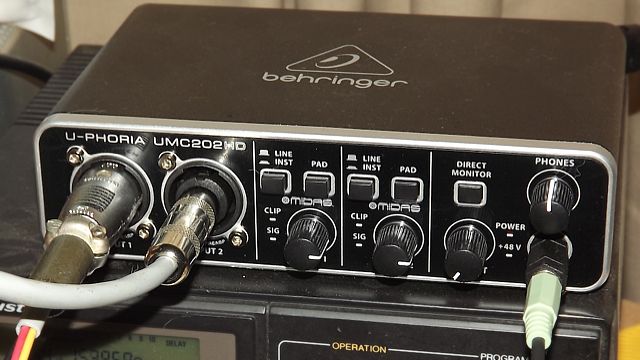
---------------------------------------------------------------
File Attachment 1: Cropped202.jpg
Re: My SID detector
Very interesting device, J.B. I wonder if you have any comments on noise emissions in the LF or MF spectrum (as observed on your regular longwave receive setup) from the unit or its interconnecting cables when in operation?
Re: My SID detector
Posted by John Bruce McCreath on August 08, 2022 at 13:26:33.
In reply to Re: My SID detector posted by John Davis on August 07, 2022
> I wonder if you have any comments on noise emissions.......
Hi John, if there is anything, I've yet to notice it. Since all of the inter-connecting cables, except for the USB ones, are done with shielded wire and the case of the unit is metal, I doubt there would be a problem. There are RFI chokes on the USB cables, both the supplied one with the 202, and the one for the Sound Blaster dongle, which I installed myself.
73, J.B., VE3EAR WSPR QRT Mowing
Posted by 1X1EDJ Bob on August 09, 2022 at 14:11:26.
Just temp till lawn gets mowed in that area.
WSPRNet been a little thin lately with Robert ROM off too?
Bob Re: WSPR QRT Mowing
EDJ
EM83du
Posted by Robert VA3ROM on August 09, 2022 at 18:21:21.
In reply to WSPR QRT Mowing posted by 1X1EDJ Bob on August 09, 2022
22 m band has totally shut down. No decodes of mine since 1210Z this a.m. The A and Kp indices are on the high side plus the ionosphere is agitated at active. Propagation forecast is for poor in the day and fair at night for 20m. That G2 geomagnetic storm that hit on the 7th (day side of Europe/Asia) is still making its "hangover" effects known, IMHO.
What's even more frustrating is that the sunspot count is like a yo-yo this month up and down and now it's heading down again (64 today). Sol just can't make up its mind if this should be its maximum or minimum cycle ;)
73.
Re: WSPR QRT Mowing
Posted by 1X1EDJ Bob on August 10, 2022 at 13:25:27.
In reply to Re: WSPR QRT Mowing posted by Robert VA3ROM on August 09, 2022
22M is looking good on K5MO HiFER this morning. Seeing more than usual. Yesterday was poor though.
1X1EDJ back QRV as of last night. Mowing complete. Good for another 2 weeks I hope. What a pain.....
Bob Re: WSPR QRT Mowing
EDJ
Posted by Robert, VA3ROM on August 10, 2022 at 15:48:12.
In reply to Re: WSPR QRT Mowing posted by 1X1EDJ Bob on August 10, 2022
I'm off air. Have to drive up to camp and see what happened. The solar panel and RV battery run through a charge controller that also has another port to drive 12 VDC devices so something is amiss.
On the plus side, my 22 m receiving station is working and I've spotted a few 22 m WSPR signals to the WSPRnet.
73
morning hifers
Posted by swlem3 on August 11, 2022 at 14:12:08.
EH looking strong this morning, and NI5F is decoding on wspr2 after a long absence.
1406 -12 0.9 13.555391 -2 NI5F EM70 7 819
Ray N. Central Texas
Morning 22 m
Posted by John K5MO on August 12, 2022 at 14:27:23.
I think I see fragments of QRSS around .55531 but that could be WSPR artifacts
https://i.imgur.com/E5XD4of.jpg .
Looks like SIW is back on the air, and I see EH opening (and closing!) the bands daily.
We just had a strong cool front pass, with several inches of rain. Was looking for Bob in there as a result and sure enough there's some good wspr spots coincident with the arrival of the front (and the rain and lightning!) right on cue @13:00 Z
I noticed NI5F in there all of a sudden too with good signals, Ray. Nice to see more folks taking advantage of the spectrum.
Re: Morning 22 m
Posted by john k5mo on August 12, 2022 at 16:28:23.
In reply to Morning 22 m posted by John K5MO on August 12, 2022
Good to see the "zig zag" back too! :-)
KAH
Posted by John, W1TAG on August 12, 2022 at 18:45:32.
Good aural copy of KAH from here in southern ME today at 1830Z. Frequency 13566.06, as advertised. There's yet another daytime Es "cloud" today.
John, W1TAG Remarkable Weekend; NHVT, PCO, More
FN43sv
Posted by John Davis on August 14, 2022 at 20:07:41.
Fair warning: expect several detailed reports when I wrap up this weekend's marathon HiFER listening session. Friday night was the first time I've heard or even seen NNVT in many months, and that first-skip-zone rarity PCO made an appearance this morning. First listening session in a month, so it has been interesting to see 1X3ROM and its trailing telemetry companions for the first time, plus 1X1EDJ, VLF's "zig-zag" at a new frequency, TSN, etc.
After solar noon today, when nearly everybody had faded out again from MUF and OWF going so high, I decided to take a quick break bsck here in town. Even as I left, though, WM's telemetry (another skip-zone near-rarity) was fading up periodically, and The Ol' Drifter NI5F was blasting in preternaturally loud.
13 & !4 August
Posted by ed holland on August 15, 2022 at 03:40:58.
Similar to Juhn Dacvis' Note earluer, it has bneen a gppd weekend for HiFER reception here in Northern California. Something has been detectable almost around the clock, with WSPR decodese through the night from NI5F, W8AC, KG7BZ.
TSN has been audible quite consistently through he day. NC and EH regular visitors, th latter providing a solid trace at the tume of writing (20:36 PDT/ 03:30 UTC).
Other highlights - Late Saturday reception of the slant mode SIW, also fading in again this evening.
PVC will return to operation in the next few minutes after posting.
73 and good DX
Ed
---------------------------------------------------------------
File Attachment 1: 14-Aug-22_x223.jpg
Excellent 22 m Band Conditions (even up North!)
GM OM
Well, it's about time! I haven't seen 22m activity like this from my locale in like NEVER! Even with forecast averages of poor (day) and fair (night) for 20m sometimes you luck out!
Even saw some CW stations just about the "sweet spot". Using a ground mounted multiband vertical antenna (10-40m) and an RSPDuo + Leo Bodnar GPS + SDRConsole. I receive with AGC "off" for 22m WSPR reception using WJST-X + VBCABLE.
A few decodes over the past day, night and morning with weakest and strongest SNR received. Total of 5 stations, not including my own spots IX3ROM and telemetry ;)
2022-08-15 03:04 1X1EDJ 13.555384 -23 0 EM83 0.005 VA3ROM EN58jk 1741 345
2022-08-15 03:20 1X1EDJ 13.555384 -29 0 EM83 0.005 VA3ROM EN58jk 1741 345
2022-08-15 05:28 KA9SZX 13.555396 -29 0 EN40 0.005 VA3ROM EN58jk 897 009
2022-08-15 06:48 KA9SZX 13.555396 -26 0 EN40 0.005 VA3ROM EN58jk 897 009
2022-08-15 13:20 KG7BZ 13.555447 -26 0 CN84pk 0.005 VA3ROM EN58jk 2584 068
2022-08-14 15:16 NI5F 13.555403 -29 -2 EM70fu 0.005 VA3ROM EN58jk 1980 352
2022-08-15 12:16 NI5F 13.555403 -9 -3 EM70fu 0.005 VA3ROM EN58jk 1980 352
2022-08-15 04:02 W8AC 13.555328 -25 0 EN91jm 0.005 VA3ROM EN58jk 993 323
2022-08-15 13:30 W8AC 13.555329 -33 0 EN91jm 0.005 VA3ROM EN58jk 993 323
I was amazed by the -33 dB SNR decode of W8AC. I had to look very hard in the WJST-X waterfall to see bits and pieces of what looked like specs of light and dark noise.
73
---------------------------------------------------------------
File Attachment 1: 22m_Reception.jpg
Re: 13 & !4 August
Apologies for the typo-laden report yesterday. It was written on the radio room latop, which has the worst keyboard layout I have ever encountered. The difficulty is exacerbated by poor lighting at the operating desk, but could have been averted by better proof reading...
A Little Bit of SID
Posted by Robert, VA3ROM on August 16, 2022 at 12:20:25.
After some solar flare inactivity, SOL flared up again and fired off a couple of back-to-back sudden ionospheric disturbances (SIDs). This Easter, there were 19 solar flares that created SIDs and then things calmed done. Now it looks like Sol is firing up, once again.
---------------------------------------------------------------
File Attachment 1: NOAA_SWC.jpg
File Attachment 2: VA3ROM_VLF_SID_Monitor.jpg
Re: A Little Bit of SID
Forgot to explain the attachments.
NOAA SWC is the X-ray solar flux recorded by the NOAA Space Weather Center (SWC). It's the best way to confirm what you record by monitoring the high power military VLF transmitters NPM, NAA, NLK and NML (for North American SID monitors). The "shark fin" is the classic indicator of a SID. It can be either upright or inverted. In this case, I'm only 30 minutes east of NML and it is usually my best SID detector, but I also see that NPM in Oahu, HI also was affected slightly by the two solar flares that hit back to back over a couple of hours. The flares weren't that strong and only caused about an 8 dB and 5 dB shark fin peaks.
NAA was in idle mode for it's usually Monday maintenance while NLK has been off-air for a while for some reason.
73 Re: A Little Bit of SID
Posted by WA1EDJ Bob on August 16, 2022 at 16:55:05.
In reply to A Little Bit of SID posted by Robert, VA3ROM on August 16, 2022
Nice Robert!
What SID RX do you use? I'm playing around and like the traditional
analog RX approach but some use a sound card.
How are you doing it?
TNX! Re: A Little Bit of SID
Bob
EDJ
Posted by Ed Holland on August 16, 2022 at 17:20:21.
In reply to A Little Bit of SID posted by Robert, VA3ROM on August 16, 2022
Very interesting data, Robert. I've played around with the chart recorder function of Spectrum Lab in the past. The objective of my tests was to try and get a picture of propagation changes for 22m beacons. My long-wire does a pretty good job at VLF, (strong reception of WWV at 60 kHz) so it would be possible to set up SID monitoring here in Northern California. I have receivers that allow for AGC to be fixed manually, so that should allow for gauging relative signal levels.
Re: A Little Bit of SID
Posted by John Davis on August 16, 2022 at 18:50:28.
In reply to Re: A Little Bit of SID posted by Robert VA3ROM on August 16, 2022
Very neat. I was listening live to 22 m when the SID hit your NML signal about 1653 UTC. The solar noise level rose over a few seconds and nearly all the HiFER signals went away seconds after that, gradually returning after the top of the hour.
I have not yet wrapped up the "weekend" ultra-marathon session at the farm, but will have to do so tonight due to approaching storms. Then I'll be free to retrieve all my data from the field computer and can be more specific in my reports.
Re: A Little Bit of SID
Posted by Robert VA3ROM on August 16, 2022 at 22:39:08.
In reply to Re: A Little Bit of SID posted by WA1EDJ Bob on August 16, 2022
I use the SuperSID receiver (basically a VLF preamp) & software that comes with to send telemetry to the Stanford SOLAR Center. I also joined the AAVSO solar group to get a Alpha number (I'm A155) and send them my manually processed SID events start, peak and times once a month using their free SID Data Grabber software (SDG).
The antennas is the no-longer available Cross Country Wireless active short vertical VLF to HF antenna. I use a 30 m run of RG6 between the antenna and its bias-t.
www.radio-astronomy.org/store/projects/supersid
I did purchase the VLF loop antenna kit but haven't gotten around to winding the loop to compare it with the CCW active short vertical.
The receiver plugs into my 96 kHz sampling soundcard and that feeds the SuperSID software and my Spectrum Lab live display of the 4 VLF transmitters I monitor. I also calibrated it to use dBm units to make it much easier to compare SID events between another VLF transmitter's signal.
The one big problem with the SuperSID software is that it's calibrated to use power spectral density (PSD) in dB/Hz, the Standford SOLAR Center graphs have no units and the SDG software displays in logarithmic values of something but all charts are separate and you can't compare anything because different scales are used. So I modified the stock VLF monitor configuration that comes with Spectrum Lab and calibrated everything in dBm and display all signals on the same chart so comparisons are much easier to make. Subtracting dBm values gives results in dB values (but addition isn't allowed) and dBm also converts easily to standard S-units.
Note the SDG and Spectrum Lab displays of the same M9.6 solar flare induced SID events with NAA and NML. The SDG display, because of the two different scales used, seems to imply that NAA's VLF signal was more affected than NML's. But the Spectrum Lab display says otherwise and you can easily calculate the dB difference between both.
---------------------------------------------------------------
File Attachment 1: 3_Spectrum_Lab_Data_Display.jpg
File Attachment 2: 1_SuperSID_Data_Display.jpg
File Attachment 3: 2_SDG_Data_Display.jpg
Re: A Little Bit of SID
I haven't been fortunate enough to be at the computer to see or hear the effects of a SID event. Bu since I do have CSV files of the dBm values generated by Spectrum Lab, it shouldn't take much effort to convert them to the chromatic scale as musical notes then play that back speeded up since the SID event has a fast attack but a prolonged and slow decay that would be too boring to listen too in real-time.
Darn, just when I figured that there wasn't anything else I could squeeze out of the data you've just found another way to "display" data, John, in the key of C major, no less!
73
Re: A Little Bit of SID
Posted by Garry, K3SIW on August 16, 2022 at 23:17:54.
In reply to A Little Bit of SID posted by Robert, VA3ROM on August 16, 2022
I've been monitoring SIDs along with VE3EAR recently and had nothing to show for it until 2154Z last night (081522). A second event occurred later around 0012Z (081622). NAA dropped a couple dB while NPM rose a couple dB and NML4 rose about 5 dB in the first event. In the second event NAA was steady but both NML4 and NPM rose a couple dB.
I can't tell what if anything I detected for the events you reported because the attached graph has no date stamp and the time scale isn't clear (probably Z but not stated). I do see a big sky wave/ground wave null from NPM around 1515Z today, as does VE3EAR, implying the date for the graph might be 081622. But NML4 was off the air then and didn't key up with MSK until nearly 2300Z.
GOES xray data at https://www.swpc.noaa.gov/products/goes-x-ray-flux shows a single large peak around 2121Z and double peaks around 1330 and 1400Z. The NAA receiver at Barnsboro, KY (http://moondog.astro.louisville.edu/) shows a small voltage peak around 2130Z, a rise of about 1.5 dB, not noticed here. Too bad NML4 was OTA then since that would have been my best chance to see a shift in received power.
I receive with a pair of eprobes separated about 100' simultaneously to sdr-iq receivers with Spectrum Lab watch list samples taken at 30 second intervals.
73, Garry, K3SIW, EN52ta, Elgin, IL
234 kHz
Posted by Mike Terry on August 18, 2022 at 07:21:09.
TWR on LW 234 kHz near Craiova, ROU?
On this new Kiwi SDR http://185.110.24.190:8073/ there`s Trans World Radio on 234 kHz, now heard at 18:43 UTC (20:43 CEST) in a unid (probably slavian) language. Now at 18:45 TWR started with Romanian service. This QRG is not listed at www.mwlist.org.
Nils Düwel (2022-08-17) via https://mediumwave.info/news/
Re: 234 kHz
Posted by Mike Terry on August 19, 2022 at 07:48:33.
In reply to 234 kHz posted by Mike Terry on August 18, 2022
18 August 2022
No surprise, no new station on LW.
Obviously all these discussions and confusions were the result of distorted signals from the Romanian Kiwi SDR installation http://185.110.24.190:8073/
Ydun Ritz
https://mediumwave.info/news/
Kevin Cary?
Posted by WA1EDJ Bob on August 19, 2022 at 13:37:28.
I've been trying to reach Kevin several times via the HQ.LWCA email and no response.
Any other way to contact him? I have subscription question.
TNX Roumoules 216 kHz
Bob
EDJ
Posted by Mike Terry on August 20, 2022 at 05:44:59.
Monaco may be reviving its old 216 khz LW transmissions from Roumoules.
Weak signals reported at various locations yesterday (Friday). Probably tests.
Mike
WSPR Rocks?
Posted by Zeak on August 22, 2022 at 17:16:15.
Anybody using WSPR Rocks? Fast, has good graphical displays and uses the WSPR database.
http://wspr.rocks/
I noticed on WSPR Rocks NI5F is regularly hitting New Zealand, Europe and North Africa.....Good Show!!
Zeak,
Re: WSPR Rocks?
Posted by Robert, VA3ROM on August 22, 2022 at 23:14:18.
In reply to WSPR Rocks? posted by Zeak on August 22, 2022
Yes it rocks and so do I!
It's a simple way to use basic SQL database queries without having to know SQL. Plus it's way faster than downloading those super megabyte WSPRnet data files and then using and using Linux grep to parse the data. Very time consuming and you have to know the basic grep query commands.
Second, check out http://wspr.rocks/zach/. If you have a ZackTek WSPR desktop version transmitter you can program and control it using a web browser. This transmitter is being used by the international WSPR beacon project https://github.com/HB9VQQ/WSPRBeaconhttps://github.com/HB9VQQ/WSPRBeacon. It's about time someone is trying to establish WSPR beacons with similar antennas and power and broadcast times ala the NCDXF beacon network albeit also using the lower HF bands, too, for WSPR.
There are a plethora of research projects that have and are using the WSPRnet data base to look for all kinds of interesting nuggets that may lay hidden in the WSPR mine across the radio spectrum.
73, Anti-Spam Update
Robert
Posted by Webmaster on August 24, 2022 at 06:16:30.
If you ever experience problems such as 403 Forbidden errors when posting legitimate messages, rather than wear yourself out by repeatedly trying again to post, please check the board FAQ. Sending a copy of your message to me at the mb@ address given at the bottom of the page will help me teach the board the difference between wanted posts and spam.
I issue this reminder because we're once again about to have to upgrade our anti-spam efforts to retain the board's integrity. I'm about to tell you why this will sometimes impact legitimate users, but first... (Click to Skip Ahead)
A Brief History of Spam. Once upon a time, when this board still consisted mainly of Matt Wright's original WWWBoard code, some halfway clever evildoer wrote a spambot that would crawl the Web looking for sites with the WWWBoard perl script installed, and when it found one, would call the executable file and pretend to be a browser. It would then use the most basic commands needed to post its evil master's spamvertising message.
Those spambots rapidly became popular in the spamiverse. Attempts to spam this board rose from half a dozen times a day to many dozens of times in just a few weeks. You never saw most of them because of swift action by the board moderators, and my own early coding efforts focusing on trapping spam keywords and email providers favored by spammers. It was a highly labor intensive effort that ultimately seemed doomed to failure. I feared I'd have to require registration to access even the most basic board features, which is directly contrary to this board's mission...until I finally realized those spambots were highly defective fake browsers.
The Spam B*****ds were too clever for their own good. By trying so hard to cover their tracks, they left huge glaring fingerprints on their efforts that I was able to exploit successfully for nearly a decade. At one point, spam attempts reached 300 per day, but the interception process was so successful that I stopped logging the defective posts and finally stopped counting them altogether. Apart from a few users sometimes having trouble posting through VPNs that were also sending defective headers to the board in a misguided attempt at privacy, it was a nearly perfect arrangement.
About once a year, someone using a real browser would manually post an ad that would make it through the keyword tests and such, which when posted would quickly get zapped by a moderator.
This apparently inspired a new generation of Spam B*****ds who now seem to have semi-automated the manual posting process with Russian Web tools, and using a high percentage of Chinese ISPs and/or email providers. These tools are a little better at evading capture, but also leave fingerprints I'm gradually uncovering in hopes of improving their automatic apprehension.
Until then, I appeal to our real users for your assistance and patience.
Now What?! In the short term, I will have to rely on keyword trapping more heavily. This entails allowing the artificial semi-intelligence of the spam trap to be more aggressive in marking potential spam words. Alas, this may also cause legit posts to be rejected from time to time. What can you do?
As I said earlier, if you get a 403 Forbidden error, don't keep trying to send the same message, but heed the FAQ. Forward it to me so I can try to teach the filter to be more discriminating.
Meanwhile, though, if you want to figure out what the trouble might be, use the same principle the spam trap employss: think "WWSD." (What Would Spammers Do?)
Hint: As I've mentioned in other posts lately, spammers are increasing their references or links to social media platforms. So, you might want to see whether you made mention of Twitter or Facebook in your own posting attempt.
Further hint: Did you say something that sounds a little like an advertising phrase? Maybe something like "Billybob's Rheostat Parlor had the fastest delivery," for example. If so, try rephrasing it a little. Or, if you used an exclamation point at the end of a few sentences, try changing one or more of them to plain periods. That might do the trick in some cases.
Another hint: Spammers are starting to use more URL-shrinking sites like Bitly, so try to avoid those. TinyURL is presently OK, but could find itself on the list at any time too. If you have long or complex links to post, it's better to just sign in as an Authenticated Author, paste the whole full-length URL, and let the board convert it to a clickable live link.
And a biggie: I've mentioned before that it's best to NOT start new threads by changing the subject line in a reply to an existing post, and the ability to do so might be blocked in future. That time is nigh! Message board spammer/scammers love to nest their venomous offspring among otherwise harmless branches of an older thread for various slightly-murky reasons. I've had the means to stop that practice entirely for some time, but didn't want to do it and disrupt the ability of honest users to branch off subtopics that are related to an existing thread.
I think I've got a workaround now that will allow for legitimate branching while making deep-nesting less likely. I'll be more specific in the FAQ when I implement it later this week, but basically to branch a thread, the new subject line will need to incorporate the exact first couple of words (if that many exist) of the original Subject line.
EXAMPLES: ORIG = Anyone heard XYZ lately? ORIG = Good Signals Today ORIG = Weekend Report
NO - - Nigerian Prince seeks pen pal with bank account. (will be rejected; not even close)
NO - - Sudden Enhancement (also rejected; not anywhere close)
NO - - Sudden Enhancement (was: Good Sigs) (not enough letters match; don't improvise)
OK - - Sudden Enhancement (was: Good Signals) (complete match of enough characters)
NO - - Saturday Night (no match here, so rejected)
OK - - Weekend Report: Saturday Night (added characters don't matter as long as the original spelling is unchanged)
OK - - Weekend Report Again Next Week (words and punctuation can be added before or after original text, but not within)
Check the FAQ in a few days for more info.
John Re: WSPR Rocks?
Posted by John Bruce McCreath on August 25, 2022 at 14:41:52.
In reply to WSPR Rocks? posted by Zeak on August 22, 2022
Hi Zeak....I found that it worked really well on the few times that I've run WSPR on the 2200M band. It is very much easier to use then PSK reporter is!
73, J.B., VE3EAR
WTB: Longwave/BCB Ferrite or Wire Loop Antenna
Posted by Alfred Rugel on August 27, 2022 at 00:35:46.
I am looking to buy a Q-Stick Ferrite Loop or similar commercial/homebrew Re: WTB: Longwave/BCB Ferrite or Wire Loop Antenna
antenna or perhaps a small wire loop to cover LW and hopefully a good portion
of the BCB. Will be using indoors with ICF-2010 and ICF SW-100 receivers.
Thanks for your help! Al W6JHO Santa Clara CA
Posted by swlem3 on August 27, 2022 at 15:28:05.
In reply to WTB: Longwave/BCB Ferrite or Wire Loop Antenna posted by Alfred Rugel on August 27, 2022
Hello Al. From my experience, I feel you may be disappointed with the results of a purchase of either antennas for indoor reception of LW-BCB. First, I'm not sure you'd gain in SNR over the built-in antennas for those radios. Secondly, generally using indoor antennas on those bands are often plagued by household "noisemakers" ruining any meaningful reception. I'd advise you to save your money, and for a very small cost, make an outdoor antenna. I use a vertical wire hung in a tree and get much better results. If you don't wish to make anything, you can purchase an e-probe or small active loop and mount it outdoors. We'll see what advice others on this forum will give to your inquiry.
13.564.58 PIE/B
Posted by Marcy on August 27, 2022 at 21:47:13.
Copying this now at 2148 PIE/B hr in Long Island,NY Re: 13.564.58 PIE/B
Marcy
Posted by Marcy on August 27, 2022 at 21:52:36.
In reply to 13.564.58 PIE/B posted by Marcy on August 27, 2022
I forgot to mention sri...it,s PIE/B FL
thats the way I copied it 73,s Marcy
Re: "BB" 13564.5
Posted by Marcy on August 27, 2022 at 22:14:02.
In reply to Re: "BB" 13564.5 posted by Chris on August 04, 2022
Chris, sri for late rply ...thank you, that Re: 13.564.58 PIE/B
is probably it I have not copied agn but have
been trying all I got was "BB" 73,s Marcy
Posted by John Davis on August 28, 2022 at 04:30:18.
In reply to Re: 13.564.58 PIE/B posted by Marcy on August 27, 2022
Had PIE/B FL here in SE Kansas too this afternoon, from 1900-1905 UTC. Lots of rapid QSB sometimes taking out individual letters. First time heard here this month.
Re: WTB: Longwave/BCB Ferrite or Wire Loop Antenna
Posted by John Bruce McCreath on August 28, 2022 at 14:33:41.
In reply to WTB: Longwave/BCB Ferrite or Wire Loop Antenna posted by Alfred Rugel on August 27, 2022
Hi Al.....my recommendation is to buy or build a PA0RDT MiniWhip active antenna. Be sure to read the installation instructions, which will ensure that you get positive results with it. I've had one for years.
73, J.B., VE3EAR
Re: WTB: Longwave/BCB Ferrite or Wire Loop Antenna
Posted by Alfred Rugel on August 28, 2022 at 15:20:13.
In reply to Re: WTB: Longwave/BCB Ferrite or Wire Loop Antenna posted by John Bruce McCreath on August 28, 2022
Thanks for the great comments! Actually, I presently do have a PA0RDT Mini Whip located about 12 feet high and 3 feet above the roof line in my apartment complex. It works great except no directivity! A good ground to coldwater pipe Strong SID events in progress
brings the noise to zero. All battery operation here ICF-2010 ICF SW100
receivers. Except for BCB DXing I really have no complaints. Al W6JHO
Posted by Robert VA3ROM on August 28, 2022 at 17:26:46.
Really strong SID events started at 1548Z August 28 when a class C2.6 solar flare hit followed at 1619Z by an M6.7 solar flare followed at 1643Z by an M3.3 solar flare. NLK and NML recording upright shark fins while NAA's baby shark fin is inverted. NML signal suddenly increase by 11 dB, NML's by about 5, while NAA decreased by about 3 dB. As I write this at 1731Z things are VLF beacon signals are very slowly returning to normal base line signals. That is unless another set of solar flares decides to strike.
NOAA SWC reporting R1 particle storm and G1 magnetic storm conditions.
73
Re: Strong SID events in progress
Posted by Robert, VA3ROM on August 28, 2022 at 19:27:45.
In reply to Strong SID events in progress posted by Robert VA3ROM on August 28, 2022
Another literal SID event wave started at up at around 1820Z. Even NPM in Hawaii is showing a teeny tiny upright shark fin bump while NAA is still inverted. SID events are slightly weaker than 2-1/2 hours ago appears to have been initiated by an M1.8 (1820Z) followed by an M4.6 (1832Z) followed by an M2.9 (1850Z) and now an M1.8 (1913Z) train of solar flares.
Forgot to mention that even the background noise (19 to 27 kHz) showed a definite shark fin rapid noise of about 6 dB with a gradual decrease back to baseline almost mirroring NML. But this time around the noise is up a couple of dB but pretty much a straight line.
73 Re: WTB: Longwave/BCB Ferrite or Wire Loop Antenna
Posted by swlem3 on August 28, 2022 at 19:42:53.
In reply to Re: WTB: Longwave/BCB Ferrite or Wire Loop Antenna posted by Alfred Rugel on August 28, 2022
Alfred, you're very fortunate to have no noise issues where your antenna is located. My antenna is an outdoor "low-noise" vertical wire, but has issues with the massive local powerline interference, so I envy your zero noise :-)
I understand your desire for directivity. There are small loops that can be mounted outdoors, but along comes the inevitable problem of rotating it and all that entails. Also waterproofing concerns, weight, wind survivabilty, etc.
If your not having much indoor noise, you may benefit from the directivity and aperture increase of a somewhat larger indoor loop over the built-in antenna. I say MAY, because on the BCB, where it seems you want the directivity, you may not see any real SNR advantage, just because you have somewhat more aperture over the loopstick. Signals are generally strong on the BCB, and once you have enough signal, you will have no further increase in "intelligibility" just boosting signal. You probably already know that.
I'm just saying the above to help you keep hard earned money in your pocket. Too bad you/we can't have whatever loop you choose under a "test run" from the place of purchase. If it really didn't improve snr over what you have, you could simply take it back for a full refund. Too bad things don't work that way.
You pays 'yer money, you takes 'yer chances. ;-)
Ray
Denmark - Kalundborg 243 kHz
Posted by Mike Terry on August 29, 2022 at 06:23:03.
August 28, 2022
It has been observed that the transmitter seems to be on reduced power.
Btw – tomorrow is the station’s 95th birthday. Hip hip hooray!
Ydun Ritz
https://mediumwave.info/news/
Re: Roumoules 216 kHz
Posted by Mike Terry on August 29, 2022 at 06:26:50.
In reply to Roumoules 216 kHz posted by Mike Terry on August 20, 2022
Further weak signals have been reported, also adrenaline junkie tower climbers.
The antenna was expected to be demolished but maybe this has been deferred. Re: 13.564.58 PIE/B
Posted by Bill Hensel on August 29, 2022 at 14:06:48.
In reply to 13.564.58 PIE/B posted by Marcy on August 27, 2022
Solid copy here in Colorado on my old Icom 735...started hearing the beacon 1242 utc -1334 utc almost 1 hour straight. 27 and 28 August HiFers
First time I have heard this beacon. The entire time I was hearing the beacon my own PCO hifer was running.
Ants: were a EFW 104ft with a 9 to 1 balun and a doty that is 53 ft long and only up about 12 ft.
Posted by Ed Holland on August 29, 2022 at 20:46:30.
Hi folks,
Conditions over the weekend changed markedly, likely in line with the SID reported in earlier posts to the board. Saturday provided very little by way of loggings, save for the stronger WSPR, and an occasional glimpse of NC. The band shot down completely in the evening.
Sunday was more fruitful. TSN was "next room" copy for a while in the local afternoon (~2200 UTC), EH showed a clear trace. I need to go through the WSPR records to get all the IDs but EDJ, NI5F and W8AC were consistent during the daylight hours.
Above the mid-band chirping, feint traces of PCO filtered through to be heard by ear - again, during mid afternoon Sunday.
PVC is back on the air following the listening session.
73
Ed
Re: Roumoules 216 kHz
Posted by Bruce WA1HGJ on August 30, 2022 at 22:41:11.
In reply to Re: Roumoules 216 kHz posted by Mike Terry on August 29, 2022
I've been hearing a weak carrier on 216 kHz for months, but no associated CW sidebands that I can ever hear. Strength of carrier is similar to NDBs that I can usually pick up the CW sideband, so it's just occurring to me this is not an NDB. Just putting 2 and 2 together here, maybe I'm hearing Roumoules? I'm sometimes able to hear European LW broadcasters here in NE Mass, either carrier (at least) or sometimes actual garbled modulation. So, seems possible. Any other possibilities come to mind?
Re: 27 and 28 August HiFers
Posted by John Davis on August 31, 2022 at 00:48:20.
In reply to 27 and 28 August HiFers posted by Ed Holland on August 29, 2022
Comparable but slightly different results here in SE Kansas over the weekend. On Saturday, after the band started recovering from the high D-layer absorption values and noise later in the afternoon, distant stations ranging from EH and NC in the east to SHO and PVC in the west showed up at different times. In late afternoon, they were joined by shorter-hop stations like both SIWs, SZX, and WM. Not long after dark, though, the band did shut down for the night.
Signals were steadier Sunday afternoon from most of the more distant stations, and RF was even stronger than it has been for some time...but there were NO sightings of shorter hop signals at all on Sunday. Again the band died fairly early in the night.
Had visual indications on both days (more on Sunday) of a few stations I could not hear, such as WV and FRC, plus a few more that I'm still trying to identify forensically that may be certain stations I've not logged in recent months, such as _maybe_ AZ, AN2, YSO, and ABBY. Re: 27 and 28 August HiFers
Posted by Ed Holland on August 31, 2022 at 17:10:56.
In reply to Re: 27 and 28 August HiFers posted by John Davis on August 31, 2022
Thanks for the report on PVC :)
Further to your observations, AZ has not been heard here for some time. It used to be very common, and similar in strength to recent reception of TSN.
potrzebie