 Welcome to the prairie, Brian! I make your frequency to be 13,555.484 kHz. From top to bottom: NC, BC, EH, MP, carrier from my computer display, and USC.
Re: WG2XCT CW Beacon on 475.1 kHz
Hey Paul. What sort of transmitter are you using? Something homebrewed, or an older, commercial MF unit? A lot of RF voltage on the antenna I'll bet. Still the 52ft. vertical you talked-about earlier? Ed WSlidell, LA EM50cg
Hifer PBJ in ME
Posted by John, W1TAG on September 02, 2013 at 23:12:15.
While tuning around tonight, I came across Hifer PBJ in QRSS3 on 13557.54 kHz. Copied several ID's - barely audible at times. The usual watering hole crew of USC, the SIW's, NC and EDJ were visible. Also copied GNK in CW.
John, W1TAG/1 MedFER GNK back on the air.
Raymond, ME FN43sv
Posted by Domenic KC9GNK on September 03, 2013 at 03:51:39.
Hello ALL, With winter on it's way, I have decided to give the MedFER band another try. The same home brew transmitter is being used on 1704.30 KHz. The antenna is not the same one used in the past, but is located in my antenna farm attic. Thanks Re: MedFER GNK back on the air.
Domenic, KC9GNK
Posted by John Davis on September 03, 2013 at 05:52:49.
In reply to MedFER GNK back on the air. posted by Domenic KC9GNK on September 03, 2013
Good luck, Domenic. What mode are you using?
John
Re: MedFER GNK back on the air.
Posted by Domenic on September 03, 2013 at 06:00:33.
In reply to Re: MedFER GNK back on the air. posted by John Davis on September 03, 2013
Thanks John, I will need it. The mode for now is CW 10 WPM, but will work on QRSS3 in the future.
Re: WG2XCT CW Beacon on 475.1 kHz
Posted by Pat Bunn on September 03, 2013 at 16:44:36.
In reply to Re: WG2XCT CW Beacon on 475.1 kHz posted by EdWSlidell,LA on September 01, 2013
Using a home brew 1 KW Class D transmitter based on W1VF's design. Also have a smaller 250 Watt Class D that I used last year. It is driven by a HP function generator, which is GPS disciplined for frequency accuracy. 52 foot vertical with a 8" PVC variometer. Lots of voltage but no flashovers so far. Was hooking up some radials last week while running about 500 watts and until the radials were hooked to the ground plate, they would buzz you good!
For WSPR and other modes, the GPS stabilization is a must. I don't think the older military stuff will work all that well. Even crystal control is marginal if the crystal is not oven stabilized.
Pat
Re: WG2XCT CW Beacon on 475.1 kHz
Posted by EdWSlidell, LA on September 03, 2013 at 18:53:32.
In reply to Re: WG2XCT CW Beacon on 475.1 kHz posted by Pat Bunn on September 03, 2013
Hi Pat. Thanks for the additional info. I can believe that the voltage IS rather high, with such a relatively short antenna. And, maybe something like 15 amps RF or better. I will try again to catch the signal if the atmospheric noise decreases here. Ed WSlidell, LA EM50cg
LYQ beacon back on the air!
Posted by WA4SZE on September 04, 2013 at 12:46:28.
Greetings to all! For YOUR DX'ing pleasure We placed LYQ ndb beacon on the air at 529 khz. We request that you provide signal reports to us via the WWRB shortwave web page email account. PLEASE provide the reports as we can justify keeping it on the air. We use it for our Aircraft operations that are ongoing and can turn it on and off by keying the aircraft's radio mike. We have chose to keep it on the air for YOU rather than turning it on /off as we need it. I have been a DX'er since 1968 I love the hobby, but see our ranks dwindling .......
please see our video at www.wa4sze.com on another type of beacon that existed in the 1940's in the long wave band the 'four course radio range' we built a model for demonstration feel free to make comments!!!!....We are thinking of converting LYQ to a four course radio range.....see the video!!! regards,
Captain David L. Frantz chief pilot, Airline Transport.
Re: LYQ beacon back on the air!
Posted by Paul on September 04, 2013 at 15:54:58.
In reply to LYQ beacon back on the air! posted by WA4SZE on September 04, 2013
First- Thank you for returning LYQ to the air.
Second- Why do you not want people to report LYQ right here on the LWCA forum? Would you be opposed to posting the best reception report mailing address where you might wish to receive mailed reports?
Re: LYQ beacon back on the air!
Posted by WA4SZE on September 05, 2013 at 00:53:25.
In reply to Re: LYQ beacon back on the air! posted by Paul on September 04, 2013
Greetings : Posting LYQ reports on this board will be fine we did not want to clog up this board but if it's ok with you guy's it's ok with us
Regards!!!
Monitoring Times Ending!
Posted by Barry on September 05, 2013 at 04:04:09.
Both Monitoring Times Magazine and Grove Enterprises will end at the end of 2013. See www.monitoringtimes.com and www.grove-ent.com for full information.
-Barry
Re: LYQ beacon back on the air!
Posted by Lee on September 05, 2013 at 04:13:50.
In reply to LYQ beacon back on the air! posted by WA4SZE on September 04, 2013
Thanks. Re: Monitoring Times Ending!
Lee
Posted by Douglas D. Williams on September 05, 2013 at 12:38:32.
In reply to Monitoring Times Ending! posted by Barry on September 05, 2013
I hate to see Grove Enterprises go. I have made several purchases from them over the years.
Re: Monitoring Times Ending!
Posted by John Davis on September 07, 2013 at 16:48:48.
In reply to Re: Monitoring Times Ending! posted by Douglas D. Williams on September 05, 2013
I had heard about the fate of Monitoring Times earlier and was preparing to post a story about it on the LWCA home page, but I didn't know Grove Enterprises was shutting down too. Very sorry to hear about both.
Fortunately, Kevin Carey will continue his LF utility loggings column in The LOWDOWN each month.
John
Hifer BC.is now on the air !!!
Posted by Brian. nb9e on September 07, 2013 at 20:43:29.
Hifer BC is now on the air from DN20fr using qrss-3 !!!
Loran C
Posted by Bill Riches, WA2DVU on September 07, 2013 at 21:22:26.
Just noticed RNAV, the company that has been using the Cape May site for tests, just got a gazillion dollar contract from GB for their Loran C system as a backup for GPS. Too bad the USA does not feel back up is necessary. 73, Bill
Re: Hifer BC.is now on the air !!!
Posted by Brian nb9e on September 08, 2013 at 01:31:52.
In reply to Hifer BC.is now on the air !!! posted by Brian. nb9e on September 07, 2013
Looking for reports , antenna is 20m hf stick on tin roof at about 60 degree angle. This is my first attempt with super qrp and QRSS-3. I hope someone can copy it !!! It seems most everyone is back East. I'm originally from the STL,MO area. Looking forward to the Winter longwave DX season. I use an FRG-100 for Longwave receive and have no problem copying WWVB as well as numerous NDB's. I have not however, ever copied a Lowfer and am hoping this year will be my first !!! I wish I had higher end equipment for rx here maybe a ic-756 pro 3 or something. I use a 706MK2G for HF mobile and an Alinco DX-77 for home( yeah I know kinda lame ) anybody know any way to improve their sensitivity on longwave ??? 73. Brian nb9e
Re: Hifer BC.is now on the air !!!
Posted by John Davis on September 08, 2013 at 01:52:09.
In reply to Re: Hifer BC.is now on the air !!! posted by Brian nb9e on September 08, 2013
Have you been able to determine your operating frequency?
John
Re: Hifer BC.is now on the air !!!
Posted by Brian nb9e on September 08, 2013 at 03:41:06.
In reply to Re: Hifer BC.is now on the air !!! posted by John Davis on September 08, 2013
13,55.360
Re: Loran C
Posted by David Frantz on September 08, 2013 at 03:47:46.
In reply to Loran C posted by Bill Riches, WA2DVU on September 07, 2013
I don't blame them..... more and more nations no longer trust the U.S.A.... they want their own system that THEY control!
I fly every day and when LORAN was up and running it worked just as well as GPS !!
The VOR/DME system works real well also so WHY?? turn it off???
The FAA wants to shut down the VOR/DME /NDB system but the rest of the world is keeping it WHY??
THEY control it in their nations so the U.S.A is powerless!
Re: Hifer BC.is now on the air !!!
Posted by John Davis on September 08, 2013 at 03:55:29.
In reply to Re: Hifer BC.is now on the air !!! posted by Brian nb9e on September 08, 2013
Excellent! I'll look for it in the morning. (I was out in the field monitoring just a little while ago, but 22 meters is already dead tonight except for EH.)
Re: Loran C
Posted by John Davis on September 08, 2013 at 04:48:03.
In reply to Re: Loran C posted by David Frantz on September 08, 2013
>>> I fly every day and when LORAN was up and running it worked just as well as GPS !!
One big difference, of course, is that GPS is a fully three dimensional positioning system, and no land based system--not even eLORAN--is or ever will be. Another is that no version of LORAN is really accurate enough in 2D to use as a backup for the most critical GPS functions, yet it costs almost as much to operate enough stations to adequately cover a geographical area as large as the U.S.
NDBs? I've got to wonder...what percentage of planes came equipped to use them over the past two decades, and what percentage of pilots actually do use them? I've sounded out our local airport board and other area pilots about interest in an NDB here, and the reaction 100% thus far has been: "What would we use it for?" I have to believe NDBs are of greater interest to us DXers than to general aviation these days, and nobody's going to keep them on just for us.
I cannot address the technical merits or usefulness of VOR/DME, but I don't think its capabilities are the real issue in its shutdown anyway; more a question of dollars and who gets to spend them. It's not just wary foreigners who want the U.S.A. to be powerless. We have people in THIS country--many now in Congress--who want our national government to be powerless, too; and they neither know nor care what important functions that government provides at a practical everyday level. All they know is "shut it down!" There's no debate over what functions are important and what's not. The only thing the weasels in Congress can seem to get together on is to make sure the public doesn't see the biggest inconveniences, like what the cutback of air traffic control would have caused, because that could hurt their re-election chances. But anything else that can be swept under the rug in the lamebrained sequester process, will be. That's why the Air Force's Space Surveillance Radar was shut down this month, for instance. If it's not a ballistic missile, we now officially don't care what's up there over our heads or what it's doing, because we can't be bothered paying to find out.
Sorry to be such a downer (now you see why we try to avoid politics here), and I know that the changes in the national radionavigation plan have been underway since well before the sequester. But realistically, as long as the "shut it down!" attitude prevails, we should not be surprised at whatever else gets cut back, retrenched, demolished, shuttered, closed til further notice, put on ice, mothballed, terminated, abandoned, scrapped, and/or surplused either...no matter how useful it may be.
John Hifers in EN52
Posted by Garry, K3SIW on September 08, 2013 at 13:29:44.
Nice copy here of CW from FRC this morning. At the watering hole only EH is coming through at the moment, and doing so very strongly.
73, Garry, K3SIW, EN52ta, Elgin, IL
BC in KS !!
Posted by John Davis on September 08, 2013 at 20:36:40.
Welcome to the prairie, Brian! I make your frequency to be 13,555.484 kHz. From top to bottom: NC, BC, EH, MP, carrier from my computer display, and USC.
Was out in my field watching on 72.4 kHz for much of the session, but thought I'd best check 22 meters before returning to town for lunch. Glad I did. I'll be going back out later this afternoon after I cool down a bit further.
John
Re: BC in KS !!
Posted by Pat Bunn on September 09, 2013 at 01:03:07.
In reply to BC in KS !! posted by John Davis on September 08, 2013
Glad to another of my little boards on the air!
Pat
Re: BC in KS !!
Posted by John Davis on September 09, 2013 at 05:04:03.
In reply to Re: BC in KS !! posted by Pat Bunn on September 09, 2013
No doubt about it, it's working well. Saw BC again this evening for a while just before sunset (just before it went into a pre-sunset fade), along with USC, MP, EH, NC, and EDJ as well.
John
JH Lowfer Testing
Posted by John Hamer on September 09, 2013 at 12:36:47.
The transmitter is on for now. It should be tuned a lot better then it ever was before. I am not sure that I am transmitting a full watt. It may be off for an hour or so tonight but then should be back up.
Re: BC in KS !!
Posted by Garry, K3SIW on September 09, 2013 at 14:44:08.
In reply to Re: BC in KS !! posted by John Davis on September 09, 2013
Very impressive capture JD. No luck here this morning with hifer BC even though FRC was in there. At the watering hole EH was very strong (it popped out of nowhere a few minutes after local sunrise), NC was pretty steady, and USC was in and out, but quite strong at times. For a few minutes when it was strong EDJ was evident too.
73, Garry, K3SIW, EN52ta, Elgin, IL
Re: BC in KS !!
Posted by Bob WA1EDJ on September 09, 2013 at 15:21:53.
In reply to Re: BC in KS !! posted by Garry, K3SIW on September 09, 2013
DN20 is off the end of my long wire so did not see anything. As usual EH pounding in every day, SIW and MP most days kind of week but identifiable. Garry, thanks for the report of EDJ at your QTH. EDJ has been on all weekend and continues QRV as long as TS's stay away. EDJ will be off for listening a few hours each night. As wx improves, I'll keep it on more...TNX...EDJ..
Re: JH Lowfer Testing
Posted by John Davis on September 09, 2013 at 17:00:48.
In reply to JH Lowfer Testing posted by John Hamer on September 09, 2013
Good luck, John. What frequency and mode this year?
Re: JH Lowfer Testing
Posted by John Hamer on September 09, 2013 at 17:18:07.
In reply to Re: JH Lowfer Testing posted by John Davis on September 09, 2013
Same as last year for now. 181.818khz QRSS30. I still want to make some changes to my antenna but I am going to let it run for a while first. I bought a antenna analyzer this summer and I have been trying to get my impedance matched. It should be pretty close now. I will retune it this afternoon when I get off work. If I plan to have the transmitter off for more then 15 minutes I will write a post. My impedance is about 350 ohms right now. I am going to work on getting that lower. My grounding system is still not very good so that is where I will start.
QRSS ACTIVE station list for 630 Meters
Posted by Charlie Vest on September 09, 2013 at 22:50:20.
Is there a composite list somewhere of the different stations that lists their frequency , mode and status ? A list of this information for any or all of the part 5 and part 15 bands , stations and modes would be appreciated .
Thank you ,
Charlie , W5COV
Re: QRSS ACTIVE station list for 630 Meters
Posted by Pat Bunn on September 09, 2013 at 23:49:40.
In reply to QRSS ACTIVE station list for 630 Meters posted by Charlie Vest on September 09, 2013
Most of the experimenters on 600 meter do not run on a specific frequency or mode. The ARRL group does have assigned frequencies and they can be found on the net with a google search. The best way to find out who is operating and where, is to join the 600MRG and the Lowfer group.
Pat Re: JH Lowfer Testing
WG2XCT (600 meters)
WG2XLP
Posted by Lee on September 10, 2013 at 00:54:06.
In reply to Re: JH Lowfer Testing posted by John Hamer on September 09, 2013
What antenna analyzer did you buy? Re: JH Lowfer Testing
Lee
Posted by john hamer on September 10, 2013 at 01:26:37.
In reply to Re: JH Lowfer Testing posted by Lee on September 10, 2013
The rig expert aa-30. Its works pretty good. I wasnt sure if it would be stable at such a low frequency but it does pretty good.
Re: QRSS ACTIVE station list for 630 Meters
Posted by John Davis on September 10, 2013 at 03:31:53.
In reply to Re: QRSS ACTIVE station list for 630 Meters posted by Pat Bunn on September 09, 2013
Just to expand a little on what Pat said, the ARRL license's band plan is available at www.500kc.com. That site doesn't get revised a lot, but Dr Raab prepares WS2XSH activity reports quarterly, and those results, along with any planned new experiments, appear regularly in The LOWDOWN.
Of course, that doesn't constitue an "active station list" in the sense a lot of DXers would probably like to have, but there can't really be such a thing for 630 meters. As we near the day when it becomes an amateur band, we can probably expect to see less beacon operation, and an increase in more typical ham communication-related activity. That's where the email reflectors Pat spoke of will become increasingly handy.
The "Lowfer group" he mentioned is a qth.net e-mail reflector, and these days it's principally about Part 5 licensed operation at 137 kHz, lately also 72 kHz, and to some extent, 600 meters. I depend on it for an overview of those bands, and Charlie is a participant there as well. A little Part 15 activity is still discussed there sometimes, but not as often as it used to be.
As Pat noted, the 600MRG (that's "600 meter research group") reflector is still around. It used to have a heavy emphasis on boat-anchor gear and heritage style operation, so I lost interest in it some years ago. But having looked at their archives recently, I'd say that group now seems more oriented toward the hard core 600m Part 5 community. If I were into the transmitting aspect, or using the trendier Internet-based automatic spotting modes found in the band, I'd definitely resubscribe. It appears to be hosted by w7ekb.com these days.
Also, if I were more involved with 2200 meters, particularly transatlantic operation, I would want to resubscribe to the RSGB reflector. It grew too busy to follow daily along with my other obligations, however, so I haven't been on it in quite some time. I understand it recently fragmented into two more or less competing lists--which never well serves such an already specialized community, IMO.
There are other e-mail groups that require having a mail account with a specific Web provider before you can join, access files, or sometimes even read archives. They shall remain unnamed by me, and our anti-spam software is set up to trap some of those company names anyway. Even if the account is free, that's completely contrary to the way we do things here...everything available to everyone to read, everyone free to post plain text messages, and registered users able to upload pictures in the Community Forum area, which everyone else is then able to view without restriction. We simply do not promote sites which are so "exclusive" that you have to be a member to read archives or view basic files.
The best Part 15* beacon lists anywhere are here at the LWCA site. We encourage both operator status updates and reception reports in this board, to enable us to keep the list as current as humanly possible. No one can guarantee that everyone in any list is truly active all the time. But that's why all our beacon entries show the month and year of the most recent contact from the operator, or else the most recent reception report posted or emailed to us, so the listener has at least some basis to gauge how likely the beacon is to still be a viable target.
John
(*For reference, by "Part 15" I mean operation on a more or less scheduled basis, by operators trying to accomplish DX or experimental objectives within the technical limits of the FCC Part 15 Rules. There are other lists of so-called Part 15 microbroadcasters, some of whom I applaud because I have seen they truly take pains to be legal...but who won't be heard outside their vicinity because they operate with audio bandwidth modulation, of necessity, and thus are of little interest to most readers at this site. There are others who claim the Part 15 mantle, but are continually pursuing imagined loopholes to achieve coverage that's simply not compatible with the Rules. We have no desire to encourage such potential interference sources. Late last year, I offered to create a parallel message board to this one for serious microbroadcast Part 15 technical discussions, but with the one caveat that it would be real technical discussion, not loophole-hunting. The offer still stands, but so far there have been no takers.)
Re: QRSS ACTIVE station list for 630 Meters
Posted by Charlie Vest on September 10, 2013 at 17:20:43.
In reply to Re: QRSS ACTIVE station list for 630 Meters posted by Pat Bunn on September 09, 2013
Thanks Pat and JD . I do belong to those groups and I also subscribe to the LOWDOWN , plus check the 500 kc web site .
The inquiry by me was generated when a foreign station , from another group that I moderate ,he sent me an inquiry for information on active 600/630 meter stations running QRSS , specifically frequencies .
I hope many people will get updated information to JD . JD is my "neighbor." We live about 30 miles apart at our home locations and just a few miles apart at our farm and rural listening locations .
I don't post very often , but I am a VERY active listener . I hope to get with Warren soon and apply for another part 5 license , this time for all of the bands the "group" is experimenting on .
I have to balance my transmitting at high power on the experimental bands with a part 5 license and JD's ability to listen . I "try" to be a good neighbor , especially on the experimental bands , since there are so few of us involved in the entire USA and I think JD and I have probably an extremely unique situation to have 2 active enthusiasts so close together and in an extremely rural area at that !!!
I have been gathering parts for a high power 4K meter station . I have a Tektronix amp that I am getting ready to start working on . Biggest problem with it is it weighs 140 pounds and I am not young or getting any younger , so it is a bit difficult to move it around .
THANKS to everyone for their work on these bands , and I'll be listening and following the groups , until we get an up to date central location that the activity is being posted in as near real time as possible .
Charlie , W5COV
HiFER 'MTI' back on the air... finally!
Posted by Thom on September 10, 2013 at 18:42:57.
┌──────────────────────────────────┐ Re: HiFER 'MTI' back on the air... finally!
│ FREQ : 13557.540 │
│ Beacon ID : MTI │
│ Mode : 5wpm CW (A1A) │
│ Grid : EM73wt │
│ Location : Stone Mountain,GA │
│ Contact Info: Thom - KV4QT │
└──────────────────────────────────┘
Posted by John Davis on September 10, 2013 at 19:29:59.
In reply to HiFER 'MTI' back on the air... finally! posted by Thom on September 10, 2013
HUZZAH! (As they used to say in olden times.) Will be listening for you soon, Thom. Best of luck.
Request for Comments (Was: QRSS ACTIVE station list for 630 M)
Posted by Webmaster on September 10, 2013 at 20:22:52.
It's one thing to have a central location for listing current activity on all amateur and Part 5 LF frequencies (as well as our current Part 15 lists)--it would undoubtedly be a great time-saver to all concerned--yet it's another to get people to use it. We could very easily have one, and it could take any number of forms. I've started this new thread to discuss that very thing, and not only to see if there's interest, but also to get some better ideas about how it should work.
Just as a preliminary observation, it seems to me one hard part is to not have it become fragmented by all the rugged individualists in the hobby going off and doing their own thing (i.e., "I put it on my own website, that ought to be enough"). Another trick is getting operators to remember to post both their on and off schedules, frequency or mode changes, etc. I'm sure you too have encountered folks, Charlie, who are understandably eager to get word of their new beacon out to the masses, but are not at all concerned about letting anyone know afterward when it goes off, either for the season or permanently.
So, I hope everyone will begin thinking about what information they as listeners would like to have in a station list--plus what features would make it easy for operators to use, and what would most encourage them to take the few seconds needed to do so.
I'm beginning with working assumptions that the list should be:
[a] Web-based, and
[b] available to everyone, as our current LowFER and MedFER/HiFER lists already are--except
[c] updatable in real time by the operators themselves; and,
[d] able to offer more information about a station via embedded links, if the operator chooses to include such data.
Feel free to offer comments on each of these assumptions, in fact, as well as all further ideas you have. As for the basic assumptions themselves, here is my own reasoning on those:
A. Web-based, meaning a Web page rather than some other net-based service, because bowsers are a standard tool available to anyone, and that's consistent with the goals of Assumption B. You don't have to sign up for anything, you can keep it in your Favorite Places or as a link on your desktop for immediate access, and you needn't go flitting off from one latest trendy site to another or keep downloading updated apps just to keep up with the "cool kids."
B. Available to everyone--that's us. 'Nuff said.
C. I worked on such an arrangement for the lists previously, but with the slowdown in traditional LowFERing over the past decade, manual updating of the Part 15 lists was adequate. If one is to include ham and Part 5 activity, though, it would appear that it needs to be real-time...and something station operators will actually use.
D. In addition to basic frequency, mode and schedule info, it should also display, show, or indicate--what else? You tell me.
Thanks.
John
Re: HiFER 'MTI' back on the air... finally!
Posted by EdWSlidell,LA on September 10, 2013 at 23:19:05.
In reply to Re: HiFER 'MTI' back on the air... finally! posted by John Davis on September 10, 2013
Hello Thom and John. Its just after 2315UT, 10 Sept., 2013, and the MTI beacon signal has been coming through for about 20 mins. or so. Was nothing about 1/2 hour earlier. Freq. appears about the same, ~13557.5 KHz, and signals are in the 3/4-3/4-9 range, with a little QSB at times. Not losing the signal even during the minimums. Was wondering if the distance between us might be too close for 22m, but apparently not. Glad to hear you back on Thom. Ed WSlidell, LA EM50cg
Re: HiFER 'MTI' back on the air... finally!
Posted by EdWSlidell, LA on September 10, 2013 at 23:45:05.
In reply to Re: HiFER 'MTI' back on the air... finally! posted by EdWSlidell,LA on September 10, 2013
Hello again Thom. The signals started to fade out after about 1835UT, and were replaced by other random shorter and longer dashes, and the usual gurgly sounds on 22m. Again, glad that I got to hear you, despite the relative closeness. I don't belive that I ever managed to do so when you were earlier located down south. Ed WSlidell, LA EM50cg
Re: Hifer PBJ in ME
Posted by Chris Waldrup on September 11, 2013 at 03:33:18.
In reply to Hifer PBJ in ME posted by John, W1TAG on September 02, 2013
Hi John,
Thanks for the confirmation. This is the first report since I returned it to the air a few weeks back.
Chris Re: JH Lowfer Testing
KD4PBJ
Posted by Lee on September 11, 2013 at 04:16:00.
In reply to Re: JH Lowfer Testing posted by john hamer on September 10, 2013
Thanks! I just puchased a "RigExpert AA-54". .1Mhz-54Mhz. Somehow I thought 6 meters should be available to me. I have had LowFer beacon JAM 187.015khz on the air since 09. its about time I got a real antenna analyzer! Or maybe I should say an affordable antenna analizer! PBJ and MTI...Together Again for the First Time!
Lee
Posted by John Davis on September 11, 2013 at 05:44:59.
Exploding across the small screen in Superduperamascope, it's...your second report since returning to the air, Chris, and Thom, your first since returning!
The path to the southeast opened up nicely this evening. I tuned in about 6:35 PM CDT and immediately began hearing MTI. Levels fluctuated widely from ID to ID, but most of the time it was clearly distinguishable. Sometimes I could even get several decent captures in Argo's NDB mode, which turns out to be a lot trickier than copying by ear.

I started hearing another carrier in the passband intermittently, but at first it tended to be coincidental with some warbly QRM, so I didn't pay it much attention for a while. At 6:45, I started an Argo run in QRSS3 to show the timing of the MTI ID cycles and enable a bit of frequency measurement. Pretty soon, as the other carrier faded into audibility on a consistent basis, I could see that it was actually PBJ! Over the next 20 minutes, PBJ remained at a fairly steady level for an extended period, while MTI experienced wide fluctuations, then PBJ eventually dipped into obscurity.
I've been checking for PBJ every time I go to the field and had begun to think we were at the wrong spacing from each other, and/or that the antenna pattern was to unfavorable for this direction. To finally see it tonight AND to witness the return of MTI from its new location really made my day!
(You'll notice a bit of receiver drift in the panoramic view below as the breeze through the car waxed and waned in the late afternoon heat--mostly waned, unfortunately. The frequency scale at the far right was calibrated at the end of the capture, and should be within ±1 Hz.)
73,
John
Re: PBJ and MTI...Together Again for the First Time!
John, the morning started here with only EH coming through at the hifer watering hole. But K6FRC CW was pretty good around 1215Z. It had faded away by 1310Z with BC never becoming visible, but by then EH was joined by NC, USC, and traces of PBJ. Retuned to 13557530 Hz and heard MTI well on CW. Tuning my hifers back on now at 1340Z.
73, Garry, K3SIW, EN52ta, Elgin, IL
Re: JH Lowfer Testing
Posted by John Hamer on September 11, 2013 at 14:21:00.
In reply to Re: JH Lowfer Testing posted by Lee on September 11, 2013
Yeah, I bought it because it was cheap. It works very well at the higher frequencys. I have connected it to my 27MHZ antenna and it gave very stable readings. The readings on my lowfer antenna seem bogus until you get it tuned in pretty close. But once it is dialed in the numbers all seem right. I transmit at 181.818KHz so I find the spot on my variable loading coil where it is resonant at 181 and at 182 and use those points as a reference. The big thing I got out of it was finding the impedance of my antenna. My filter was set for 50ohms and I know it was far from that because my waveform was distorted on my o-scope. The meter said the impedance was 350ohms so I made a 1 to 7 transformer and the waveform looks very good now with a noticeable increase in output. I think the transformer is a little lossy though. After I finish my grounding system I will just change my low pass filter to match the antenna so I can get rid of the transformer.
Re: HiFER 'MTI' back on the air... finally!
Posted by Bob WA1EDJ on September 11, 2013 at 16:48:53.
In reply to Re: HiFER 'MTI' back on the air... finally! posted by EdWSlidell, LA on September 10, 2013
I'll give a listen too....My QTH was Stone Mountain abt 15 years ago! I may be a little close to copy, Monroe is only about 35 or so miles East of Thom....Bob...EDJ....
Hifers copied today
Posted by Sal,K1RGO on September 11, 2013 at 22:10:30.
Well I checked out the Hifer watering hole and at 2100 utc, I copied EDJ,NC,SIW and USC today. Re: JH Lowfer Testing
later.............
Posted by Lee on September 12, 2013 at 00:43:12.
In reply to Re: JH Lowfer Testing posted by John Hamer on September 11, 2013
Figuring out my antenna impeadance was also my motivation. I use a tapped coil. Taps at the top of the coil to match tophat capacitance and taps on the bottom first 10-12 windings or so to match 50 ohm transmitter impeadance. It will be interesting to see the actuall impeadance on the tap that makes the most current. PBJ and MTI, The Sequel
lee
Posted by John Davis on September 12, 2013 at 01:22:27.
Seems like there's a little window just about an hour before sunset when I can copy PBJ. Tonight it was less than seven minutes wide. The frequency has moved quite a bit from yesterday, and the keying looks to be closer to QRSS6 than 3, but it's working well when it comes in!
The second MTI in this capture was the loudest HiFER ident I've ever heard. All the other MTI IDs were more normal. A few were barely visible at all, as you see, and those were not quite audible either.
Elsewhere in HiFER Land, the watering hole stations tonight included USC, MP, EH, and NC, all doing a consistently nice job. Heard a little bit out of what I take to be FRC, but could never get a full ID. Nobody else showed up this evening.
John
Re: JH Lowfer Testing
Posted by John Hamer on September 12, 2013 at 01:41:10.
In reply to Re: JH Lowfer Testing posted by Lee on September 12, 2013
I should have made my coil where I could use it to match the impedance but I did not. I might wind a new one that does that. How far has someone seen your signal? My record is 80 miles by Dex. He is also the only person who has picked me up. I have a very bad location with a lot of trees around my antenna. I am hoping I can do better this season. I want to design a transmitter that displays some graphics but I don't see any reason to do it if I can't get my signal out.
Re: JH Lowfer Testing
Posted by Lee on September 12, 2013 at 03:39:10.
In reply to Re: JH Lowfer Testing posted by John Hamer on September 12, 2013
I made my air core tapped coil for simplicity and low loss and high Q. I did a lot of reading about lowfering and the rule I started to see is low loss, low loss, low loss! I came to the conclusion early on that for 1 watt a variometer is to lossy. If we could run 25 watts then sure. Part 5 operation at major power, why not. I have had two 100 mile audio copies. A 600 mile Spectrum software copies into N Utah and E Oregon and a 1900 mile software copy into Tenn. If you want some miles don't mess with the graphic thing. I would just do a letter or multiple letters at QRSS 30 or 60. I seem to get out best Jan thru Feb. We are at the mercy of conditions. Re: JH Lowfer Testing
Lee
Posted by John Hamer on September 12, 2013 at 12:29:06.
In reply to Re: JH Lowfer Testing posted by Lee on September 12, 2013
Thats impressive. I don't know if my location will allow me to get those kinds of distances but I am going to keep at it. My antenna is only 30 feet tall with a 5 foot radious X top hat right now. I am going to add ten feet to the height and make the top hat much larger before winter.
BC off during Thunderstorms !!!
Posted by Brian on September 12, 2013 at 14:01:52.
I have BC turned off today due to thunderstorms in the area !!!
Re: PBJ and MTI, The Sequel
Posted by Chris on September 12, 2013 at 17:50:49.
In reply to PBJ and MTI, The Sequel posted by John Davis on September 12, 2013
I added insulation to my beacon box yesterday afternoon. This may account for the frequency difference.
Chris Re: JH Lowfer Testing
KD4PBJ
Posted by Lee on September 12, 2013 at 20:07:22.
In reply to Re: JH Lowfer Testing posted by John Hamer on September 12, 2013
Sounds good. If I could make a suggestion I would keep the
Re: JH Lowfer Testing
Posted by Lee on September 12, 2013 at 20:10:10.
In reply to Re: JH Lowfer Testing posted by John Hamer on September 12, 2013
Sounds good. If I could make a suggestion. I would keep the 30 to 35 ft height and increase the top hat size. My 2 bits. Re: PBJ and MTI, The Sequel
Lee
Posted by Garry, K3SIW on September 12, 2013 at 23:23:12.
In reply to PBJ and MTI, The Sequel posted by John Davis on September 12, 2013
John, I followed your lead and looked as local sunset neared. PBJ rose out of the noise nicely around 2317Z, about 10 Hz above MTI. Agree the keying is much longer than QRSS3. Probably QRSS6 like you mentioned. At the watering hole at the time NC, EH and USC were coming in well. Just a trace of FRC higher up on CW.
73, Garry, K3SIW, EN52ta, Elgin, IL
Re: Request for Comments (Was: QRSS ACTIVE station list for 630 M)
Posted by Steve VK2XV on September 13, 2013 at 00:22:35.
In reply to Request for Comments (Was: QRSS ACTIVE station list for 630 M) posted by Webmaster on September 10, 2013
G'day John,
Of course we all have different perspectives and priorities, so these comments are just that...
1. Any solution put forward, IMO, will always be a compromise which will never please everyone. We might each have our favourite areas (LF, MF & HF) and would prefer any solution to be convenient for our own particular focus. It is less than encouraging to go through the process of sifting out particular items of interest from a general amalgamation.
2. The other scenario is fragmentation into particular areas of interest. This allows easier mining of wanted information for the reader, but increases the burden for the writer/maintainer.
3. I find the "LW Message Board" the best means I have come across for providing a central meeting place for activities related to radio experimentation in the LowFer/MedFer/HiFer area. In addition to the board, the on-air lists for these are the best means, IMO, for keeping track of stations on the air. They are not perfect as it relies on operators maintaining the enthusiasm for supplying the list writer with up-to-date information.
In summary - while it is a good thing to try and find a "better mousetrap" I feel, because of the small number of participants being spread over a wide area of activity, that we might tend to want to have all activity lumped in together to provide some bulk, or have it split out into sparse separate areas of interest for ease of access to data of interest. Neither solution would be attractive - but I have a preference...
I find the "Longwave Lobby" page very useful and have it bookmarked. Perhaps an extension of this for the Part 5 and Amateur activities would be useful - while using the "LW Message Board" as the "online watering hole" might also be useful. One way of sorting out the posts is to preface the subject with [LowFer], [MedFer], etc. This is used in other email forums, but with limited success as it requires consistency of compliance from posters.
Finally - a declaration of interest/bias - my favourite area is HiFer as it provides world-wide coverage with true QRP power levels.
Cheers
Steve
Query: HiFer WSPR...
Posted by Steve VK2XV on September 13, 2013 at 00:49:03.
Lately my radio activities have reduced somewhat, but I am always thinking about some new project.
My query is whether there would be sufficient interest in looking for a HiFer WSPR signal from VK-land.
I have an RPi-based WSPR TX which was used for 630M which could be commissioned with some effort to work on 22M. The antenna would be fairly simple, but the performance of the RPi TX on HF is yet to be determined.
The question is would there be sufficient interest to spend the time putting up an antenna and implementing a WSPR transmitter ?
My feeling is that most HiFer listeners use non-digital reception, while a proportion do use semi-digital reception (e.g., ARGO and QRSS). I think those interested and/or equipped for digital reception in the HiFer band are a small minority.
Cheers
Steve
Re: HiFER 'MTI' back on the air... finally!
Posted by EdWSlidell,LA on September 13, 2013 at 01:46:05.
In reply to Re: HiFER 'MTI' back on the air... finally! posted by Bob WA1EDJ on September 11, 2013
Hi all. Have listened for MTI over the past coulple of days, 11-13 Sept., but other than a short period from about 0045-0055UT, today, 13 Sept., nothing has been heard. Signals were weak, in the 229 range, but with the MTI ID repeatedly heard. The CODAR and Spanish language stations, as well as the gurgly signals, were almost non existent at that time. Perhaps the earlier copy was something unusual for my closeness to the MTI location. Ed WSlidell, LA EM50cg
Re: Query: HiFer WSPR...
Posted by John Andrews, W1TAG on September 13, 2013 at 02:10:02.
In reply to Query: HiFer WSPR... posted by Steve VK2XV on September 13, 2013
Steve,
Personally, I think it's a great idea, BUT...
A number of guys in the WSPR community threw clots a few years ago when non-Amateur signals showed up in the reporting system. They have rolled over for the licensed Experimental service stuff at 630 and 2200 meters, but really didn't want to see WSPR reporting used for unlicensed operation on "oddball" frequencies.
I'm not defending their position, just warning about the possible blow-back.
John, W1TAG
Re: Query: HiFer WSPR...
Posted by Steve, VK2XV on September 13, 2013 at 02:37:07.
In reply to Re: Query: HiFer WSPR... posted by John Andrews, W1TAG on September 13, 2013
John,
I would imagine that globally the angst has subsided somewhat now regarding 630M and 2200M as they are both standard amateur bands in many, but not all, jurisdictions ?
In the case of 22M I haven't tinkered in depth but I think there is a block or data-cleansing function in the database to filter out non-amateur frequencies ?
In any case I had firmly in mind to request listeners NOT to have the 'Upload' button active, but merely to send 'cut and pastes' from the S/W window as is done by many already on forums for the sanctioned bands.
But you are right, based on past experience I can expect random flak over this... :-)
Steve, VK2XV
Re: Query: HiFer WSPR...
Posted by John Davis on September 13, 2013 at 02:46:21.
In reply to Re: Query: HiFer WSPR... posted by John Andrews, W1TAG on September 13, 2013
John A. makes a good point. I've been intrigued, myself, with the thought of seeing what WSPR could do on Part 15-type frequencies, but now that he mentions it, I do remember some of the initial fallout over experimental licensees using the reporting network.
In my own case, Internet connections are not even available where I do my listening and transmitting. I've always been leery, anyway, of any communications tool that needs ANOTHER communication tool to get the most out of it..."have your computer call my computer, and we'll do a signal report sometime."
But I also recall reading that WSPR can be transmitted and received WITHOUT the Internet or any connection to the WSPRnet server. So perhaps, if participants didn't mind forgoing automated reporting, and reported their spottings to one another the old fashioned way, there might still be some interest in trying the method among HiFERs?
John
Re: Query: HiFer WSPR...
Posted by Steve, VK2XV on September 13, 2013 at 03:20:05.
In reply to Re: Query: HiFer WSPR... posted by John Davis on September 13, 2013
John D - yes, you are right, you don't need to be connected to the internet. This is only needed for uploads. Being specifically NOT connected to the internet would be good as such a condition will prevent uploads and avoid any angst from other quarters.
However, you may need to be connected initially to ensure the clock time is within +/-1 second for decoding. After that it would depend on how stable the PC/laptop is w.r.t. timing.
Steve
Re: Query: HiFer WSPR...
Posted by John Davis on September 13, 2013 at 04:33:08.
In reply to Re: Query: HiFer WSPR... posted by Steve, VK2XV on September 13, 2013
>>> However, you may need to be connected initially to ensure the clock time is within +/-1 second for decoding. After that it would depend on how stable the PC/laptop is w.r.t. timing.
Interesting, and perhaps entirely feasible. My inexpensive Acer notebook (the one I take to the field) has always seemed to be reasonably close to actual time, but I never really bothered to check its RTC stability until this evening. It was last connected to the Internet 30 hours ago, and I just now compared its clock to that of the machine which has been connected all day today. The Acer appears to have lost only about 1/2 second in that time.
I also have access to multiple time signals in the field, 24/7, which I have previously used to set the clock manually... although I occasionally have some trouble getting Windows 7 to accept the change immediately when I click Apply, so the manual method sometimes requires multiple attempts.
In any case, it appears the clock may indeed remain stable enough to do the job for at least a day after it has been set. This is starting to renew my interest in WSPR.
John
John
Re: JH Lowfer Testing
Posted by John Hamer on September 13, 2013 at 14:00:34.
In reply to Re: JH Lowfer Testing posted by Lee on September 12, 2013
I would but I don't think I can. My back yard is full of trees and I may have some clearence problems. Like I said. Bad location.
Re: Query: HiFer WSPR...
Posted by jim vander maaten on September 13, 2013 at 18:22:03.
In reply to Re: Query: HiFer WSPR... posted by John Davis on September 13, 2013
John, I am transmitting WSPR-2 on 13.5560 MHz into a Re: HiFER 'MTI' back on the air... finally!
20 meter dipole. Can you copy it?
Using my Raspberry Pi computer with 15 MHz low pass filter.
Transmission is 'esa cm99 7'.
Will check back in this evening.
73 jim vm
Posted by EdWSlidell,LA on September 13, 2013 at 21:58:55.
In reply to Re: HiFER 'MTI' back on the air... finally! posted by EdWSlidell,LA on September 13, 2013
Hi Thom. I am copying the MTI beacon at this time, since 2140 UT, and it is quite strong when peaking--easily 459. However, the fades take it below audibility at times. There seems to be a cycle of 20-30 seconds in the QSB. It's really getting out well now. Ed WSlidell, LA EM50cg
Re: Query: HiFer WSPR...
Posted by John Davis on September 13, 2013 at 23:48:45.
In reply to Re: Query: HiFer WSPR... posted by jim vander maaten on September 13, 2013
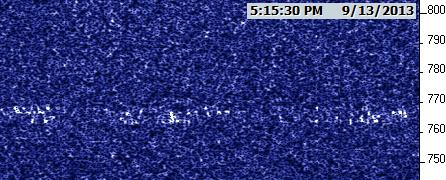
I can see you in Argo 3 seconds-slow mode, Jim, but I haven't been able to decode you in WSPR 2.0. The signal appears to be roughly 35 Hz low in frequency, well within the 200 Hz WSPR bandwidth, but is also well down in the noise a lot of the time.
I don't have prior experience with WSPR, especially for receive-only situations. At installation, I was afraid it might not get along with the soundcard in my field computer, but to my great surprise, there were no complaints. However, to my not-any-surprise-at-all, it still doesn't do what I want.
I can't get the waterfall to show much, and I have no clue how to get its frequency scale to show anything meaningful. Since WSPR 2 is pre-configured for each band it's used on, I have no idea how to lie to it about the #@$! "dial frequency" to make the waterfall scale show me anything that makes sense.
I tried the advanced settings to attempt to use the 800 Hz BFO that's standard for my receiver's CW setting instead of having to endure a 1500 Hz screech or waste the receiver's dynamic range on a voice-width SSB channel, but it wouldn't decode anything at 800 Hz, regardless of what manipulations I tried. When I tried it on 1500 Hz offset and USB, it did at least try to decode--but didn't get a single character right.
I came back to town to let the batteries charge a little bit, then I'll return to the field in a few minutes and try some more.
If anyone knows of a WSPR tutorial for receive-only, I'd appreciate knowing about it.
John
Hifer BC back on !!!
Posted by Brian nb9e on September 14, 2013 at 14:45:39.
In reply to BC off during Thunderstorms !!! posted by Brian on September 12, 2013
Hifer BC is back on the air !!!
Re: Query: HiFer WSPR...
Posted by jim vander maaten on September 14, 2013 at 15:48:40.
In reply to Re: Query: HiFer WSPR... posted by John Davis on September 13, 2013
Thanks John for trying. That is really all I wanted to know,
if you could receive the signal from my RPi computer.
I have reports near 3000 km away on 20 meters so I thought
how about 13.556 MHz using same setup with a 3 dB pad on antenna. That makes the RF output about 7 dBm or 5 mw.
Going to stop xmsns now, 9-14 @ 9 AM pdt.
Thanks again for your efforts.
73 jim vm
Re: Query: HiFer WSPR...
Posted by John Davis on September 14, 2013 at 20:00:00.
In reply to Re: Query: HiFer WSPR... posted by jim vander maaten on September 14, 2013
Thanks for the opportunity to look for it, Jim. I wanted to report further last night, but got tied up on my part-time job.
When I returned to the field after supper Friday, I continued to see your signal, varying in level considerably over time. This time I lied to WSPR 2.0 and said I was dialed to 14.045 so the sense of the sideband should match, used USB on the receiver and tuned to get your signal at 1510 Hz. The WSPR waterfall showed a line at 510, but very faint. It did track in intensity with the signal I saw on the simultaneous Argo display, so I'm confident WSPR was looking at you...but still no decodes.
No other signals from the west were coming in very well yesterday, alas. It has been almost two months since I've even heard AJO, who used to be a regular, and longer still since hearing NDB. FRC did make it through faintly by ear for a while after sunset yesterday, and showed on Argo even when no longer distinguishable by ear.
(In the watering hole, it was USC, MP, EH, and NC, both in the mid-afternoon session and up to an hour and a half after sunset. In the afternoon, I also saw and heard PBJ and MTI just after 4:30 PM, almost two hours earlier than I had seen PBJ previously. MTI continued to be audible from time to time after dark, but no further sign of PBJ.)
John
Beacon JH
Posted by Pat Bunn on September 14, 2013 at 22:02:45.
I am listening for JH this afternoon and tonight assuming that it is on.
Re: Beacon JH
Posted by John Hamer on September 15, 2013 at 03:27:14.
In reply to Beacon JH posted by Pat Bunn on September 14, 2013
yes its on tonight
Sprites and Elves on The Weather Channel
Posted by John Davis on September 15, 2013 at 07:10:25.
Natural Radio enthusiasts and other physics-minded types among us may want to tune in tonight's (Sept. 15) new episode of "Strangest Weather on Earth" at 9 PM EDT/8 PM CDT. If you have been watching the program previously, you probably noticed that they show a couple of sprites in the opening credits. Well, tonight's apparently the night that we get to see the footage in earnest!
There's a little more about the phenomenon on the home page here at lwca.org.
John
Re: Beacon JH
Posted by Pat Bunn on September 15, 2013 at 13:38:06.
In reply to Re: Beacon JH posted by John Hamer on September 15, 2013
John,
I got nothing all night or late yesterday afternoon. I received a signal that was too weak to ID but that I suspect is JH this morning between 7:30 and 8:00 AM local time. As it weakened is appeared to drift about 1 HZ. I have some screen shots if you would like them. I still have lots of foliage and that probably is reducing the effectiveness of my antenna.
Pat Bunn
LYQ Beacon Frequency - 529kHz or 530kHz?
Posted by Darwin Long on September 15, 2013 at 17:29:41.
In reply to Re: LYQ beacon back on the air! posted by WA4SZE on September 05, 2013
Captain David L. Frantz-
I can receive beacon LYQ's Morse ident very clearly behind the two AM broadcast stations on 530kHz (Radio Enciclopedia and Radio Progresso, both in Cuba) here in southern Louisiana at night. LYQ is not audible during the day (while the two broadcast stations still are).
Can you verify LYQ's MAIN CARRIER frequency? It seems to be 530kHz, not 529kHz. Might be a rather important equipment issue for you to look into.
I ask because there is NO 1kHz heterodyne with the broadcasters on 530kHz that would indicate LYQ's center carrier is on 529kHz. Several years ago, a 1kHz heterodyne WAS heard on 530kHz at night when LYQ was receivable in the South; however, during the past two years when LYQ is operating, that heterodyne is no longer audible. The 1020Hz Morse ident sidetone is clearly heard on 530kHz, 528kHz, and 532kHz, further indicative of the beacon's main carrier being dead-on 530kHz rather than 529kHz. If the beacon's frequency was 529kHz, you normally wouldn't hear the Morse ident on 530kHz clearly, especially in the presence of another 530kHz carrier (masked by the 1kHz heterodyne tone with 529kHz).
Please advise - if it's an equipment glitch, you might get more reception reports if the main carrier and double-sidetone frequencies are shifted back down 1kHz to 529kHz; otherwise, publish LYQ as 530. People on the AM BCB DXing lists are likewise showing reception of the beacon as 530kHz. And most importantly: if a pilot is expecting the beacon's main carrier (that actually is responsible for an ADF bearing) to be 529kHz, for safety of human life, it would be prudent to ensure this navigational aid is operating on the correct frequency shown on charts.
-Darwin Re: LYQ Beacon Frequency - 529kHz or 530kHz?
Buras, LA
Posted by John Davis on September 15, 2013 at 17:44:33.
In reply to LYQ Beacon Frequency - 529kHz or 530kHz? posted by Darwin Long on September 15, 2013
I have been suspecting recently that a steady carrier is not being transmitted at all, only the on-off keyed signal. A couple weeks before the recent announcement that LYQ was back on, I was hearing it intermittently under Radio Enciclopedia (which I enjoy listening to in the evenings).
Both then and a few days ago, I found I could hear R. Enciclopedia without LYQ by switching to USB mode. That would indicate to me that the keying itself is on 529 kHz.
To be candid, I'd rather be able to use LSB and eliminate some of the sideband splatter from 540 kHz. While I wish all NDBs long life and prosperity, I'd truthfully prefer not have them crowding the BCB this closely, because it does also sometimes interfere with TIS/HAR stations on 530, such as the one MoDOT operated during recent I-44 construction near here.
John
TAG WOLF 185.800
Posted by John W1TAG on September 15, 2013 at 21:45:20.
Lowfer TAG will be running WOLF(10) on 185.800 kHz until late October, when it will switch back to QRSS for the winter. Reports are always welcome.
John, W1TAG Sunday HiFERs 15 Sept 2013
Posted by John Davis on September 16, 2013 at 00:37:46.
Late this afternoon (~5:30 to 6:30 PM CDT) I watched USC, MP,BC, and NC at the watering hole. Overall, USC was the strongest, but MP's aural ID was solid some of the time as well. BC experienced the most fading, but was clear enough to copy about half the time. EH was unusually weak today, if indeed that was bits and pieces of it that I was barely seeing.
Elsewhere on 22m, MTI was solid at times and inaudible again seconds later. PBJ may have drifted in frequency below MTI today. I saw some traces that looked like dashes at QRSS6, but couldn't be sure.
Nobody else audible. Some QRN was present from a substantial line of thunderstorms less than 100 miles to the west.
John
Re: Beacon JH
Posted by John Hamer on September 16, 2013 at 14:38:19.
In reply to Re: Beacon JH posted by Pat Bunn on September 15, 2013
Hey. Thanks for looking. I got your pictures from the email you sent me. Looks like im still not doing much better then last year so far. I will let you know when I make some changes.
Re: Beacon JH
Posted by Pat Bunn on September 16, 2013 at 17:22:26.
In reply to Re: Beacon JH posted by John Hamer on September 16, 2013
Don't know - Last years I looked quite a few times and never got a trace. As things get quieter, I should be able to get an ID.
Monday evening Hifers
Posted by Garry, K3SIW on September 16, 2013 at 22:54:17.
Lots of signals coming and going as local sunset nears. The nearly always strong EH was joined by NC around 2210Z with a weak BC underlaying NC. USC was nowhere in sight. Yet by 2223Z USC was stronger than EH and the two were creating IM products in my SDR-IQ receiver. Tuned above 13.557 MHz around 2217Z and found CW from MTI coming in well. Another signal about 40 Hz lower might have been PBJ but probably not because it wasn't sending QRSS6. Instead this signal consisted of exponential upward ramps shifting a total of about 10 Hz over more than 30 seconds. Looked later for FRC but found nothing. It has been coming in well early morning here.
73, Garry, K3SIW, EN52ta, Elgin.
LYQ Beacon update
Posted by Captain David L. Frantz on September 18, 2013 at 02:50:32.
Greetings long wave fans!!!
The LYQ beacon on 529 khz is being operated in modulated CW keying : The carrier is 1020 hz modulated using on / off keying to save on electricity. Our aircraft ADF receivers have no problem with this mode of operation so we will keep using MCW modulated carrier wave.
Please report reception on this board or our E mail via wwrb web page.
regards!!!
lowdown articles by mike dormann
Posted by mike dormann on September 19, 2013 at 06:30:57.
I wrote and article about a hardware device that subtracted out power line interference in the 1 to 20 Khz region. anybdy remember the article or could direct me to it in the lowdown files?
Thanks
mike dormann w7dra
Re: LYQ Beacon update
Posted by Darwin Long on September 19, 2013 at 14:40:49.
In reply to LYQ Beacon update posted by Captain David L. Frantz on September 18, 2013
Excellent update, Capt. Frantz - thanks for the info!
Actually, NDB DXers would prefer no carrier behind the ident keyed - much less band clutter that way. So this is great.
-Darwin Re: lowdown articles by mike dormann
Buras, LA
Posted by Webmaster on September 19, 2013 at 16:02:24.
In reply to lowdown articles by mike dormann posted by mike dormann on September 19, 2013
We don't have it in the online library, Mike. Do you remember approximately when it was published? I may be able to look it up in back issues.
John
Re: JH Lowfer Testing
Posted by Douglas Williams KB4OER on September 19, 2013 at 21:07:06.
In reply to JH Lowfer Testing posted by John Hamer on September 09, 2013
Hi John. I would love to be the first one to give you a reception report, but I just want to clear up a few things first.
Are you on 24/7?
Is your frequency 181.818 kHz? (VERY important that we know your exact frequency with QRSS).
Is your mode QRSS30?
Hang in there, friend.
-Doug KB4OER
Re: JH Lowfer Testing
Posted by john hamer on September 19, 2013 at 22:11:40.
In reply to Re: JH Lowfer Testing posted by Douglas Williams KB4OER on September 19, 2013
Hey Doug. The answer to all of your questions is yes. I don't have a good way measure my exact output frequency but last year it was closer to.181819.
Longwave Rx ???
Posted by Brian nb9e on September 19, 2013 at 23:10:43.
What is everyone using for Rx Icom R75,Yaesu FRG-100,upconverter to HF rig ??? Just curios what is best ???
Re: Longwave Rx ???
Posted by John Bruce McCreath on September 20, 2013 at 01:48:54.
In reply to Longwave Rx ??? posted by Brian nb9e on September 19, 2013
A Kenwood TS-440S has been doing the job for me on both 136 and 500 kHz.
73, J.B., VE3EAR Re: Longwave Rx ???
Posted by Pat Bunn on September 20, 2013 at 02:14:32.
In reply to Longwave Rx ??? posted by Brian nb9e on September 19, 2013
Something that has excellent frequency stability or can be GPS disciplined if possible. I use a R75 with GPS disciplined up-converter and it is just marginal in my opinion. I am still looking.
Re: Longwave Rx ???
Posted by Douglas Williams KB4OER on September 20, 2013 at 20:32:51.
In reply to Longwave Rx ??? posted by Brian nb9e on September 19, 2013
Hah, a loaded question if there ever was one.
LF reception is such a complicated issue that it would be almost impossible for anyone to give you a "best" answer because so much depends on *your* individual situation.
Most amateur/experimental LF modes that are being used today, other than plain old CW, require excellent frequency stability, both from the transmitting station and the receiving station.
Another issue is sensitivity. Many HF receivers/transceivers lose a lot of sensitivity below 500 kHz.
An additional issue is local noise, and by "local" I mean from your house and your neighbor's house.
Many experimenters who are successful at DX weak signal LF reception use an upconverter. Why? Well like I mentioned earlier, many HF receivers lose sensitivity at LF. The upconverter itself adds another weak link to the chain, however, because of several factors, not the least of which is the stability of the upconverter's oscillator.
To make a long story short, the ideal LF receive system has (a) high stability, (b) good sensitivity at LF, (c) precise frequency accuracy, and is located in a (d) low noise environment.
Re: JH Lowfer Testing
Posted by Douglas Williams KB4OER on September 20, 2013 at 20:40:00.
In reply to Re: JH Lowfer Testing posted by john hamer on September 19, 2013
Thanks. Probably not much point in trying tonight or tomorrow. It looks like a band of thunderstorms is going to work it's way near me over the next 24-48 hours.
I'll be trying for a reception of JH this season.
Keep the faith.
-Doug KB4OER
Re: Longwave Rx ???
Posted by Douglas Williams KB4OER on September 21, 2013 at 11:28:00.
In reply to Longwave Rx ??? posted by Brian nb9e on September 19, 2013
And I just realized that I didn't actually answer your specific question in my previous post.
I use two receivers. The first is an R75 with TCXO and dual 250 Hz filters. This is used with an Amrad upconverter that itself has an OXCO for frequency stability.
The second receiver is a Winradio Excalibur Pro SDR.
Both have done well for me on VLF/LF. If I could only have one RX I would have to go with the Excalibur Pro.
Beacon JAM 187.015khz back up for season
Posted by Lee on September 23, 2013 at 00:25:37.
Beacon JAM 187.015khz is back up with an improved ground plane and confirmed QRSS60 firmware. I am at the mercy of my cheap chinnese freq counter. It reports 187.015khz. I am told that I am closer to 187.016 or 187.0165. What's a Hertz and a half betwwen lowfers. The message for this season is the letter J at QRSS60 a 5 WPM message and then repeat over and over again. I will post Re: Ground Radials and Concrete Rebar UFER
pic's of the improved ground plane at LWCA. For Security reasons again I will be running Holidays and weekends, Friday noon till Monday noon. And days I have off. To many criminals around here to run un-attended. If conditions get Hot I will take the chance to run un-attended 24/7
Lee
KE6PCT
Posted by Lee on September 23, 2013 at 01:24:11.
In reply to Re: Ground Radials and Concrete Rebar posted by John Davis on April 08, 2013
I will call my implementation a Psuedo Ufer ground because I did not actually bond to any rebar. I connected a 2 inch wide, 25 foot long copper strap to the concrete edge of my concrete/rebar patio closest to my ground rod using concrete fastners. Per the web site,
http://www.scott-inc.com/html/ufer.htm
concrete is more conductive than the best soil. Check out the pic at LWCA Pics of my station. Seems like a hotter FS reading but I will need to do some testing to confirm. Community Forum does not recognize PW for login
Lee
Posted by Lee on September 23, 2013 at 01:42:01.
Tried to logon to post pic's but no luck. When I do the "forgot PW" feature the link that goes to my email just sends me back to the login that does know Re: Community Forum does not recognize PW for login
my pass word. A Bug? Trying to post my Ufer ground pic.
Lee
Posted by Webmaster on September 23, 2013 at 02:48:57.
In reply to Community Forum does not recognize PW for login posted by Lee on September 23, 2013
The "forgot password?" link really shouldn't even be there. That feature is only supposed to work if we have automatic sign-up turned on, which we disabled because it wasn't secure enough. Sorry about the inconvenience, but spammers were getting through the signup process every day when I first activated the forum area.
A point that may also be helpful for other Community Forum users: as mentioned in the message about registering there, we don't store unencrypted copies of passwords, so I can't look up the old one. The workaround is to e-mail me at the address where you register (mb at lwca.org) and tell me what new password you'd like to use. Also remind me of the username you chose, in case it's not your real name.
Thanks, and good luck with those improvements, Lee.
John
Re: Beacon JAM 187.015khz back up for season
Posted by Douglas Williams KB4OER on September 24, 2013 at 20:15:04.
In reply to Beacon JAM 187.015khz back up for season posted by Lee on September 23, 2013
Welcome back, Lee. Hope to receive your beacon this season.
hifer AJO off due to storm damage
Posted by Ward K7PO on September 26, 2013 at 19:35:10.
The AJO beacon took a lightning strike recently in one of our many 'monsoons' here in SW Arizona. Even though the charred antenna made me nervous, the only damage was the Epson chip itself. It has survived several years of 24/7 service, so I don't think Epson owes me anything. Digikey has already shipped the replacement this morning, so AJO should be back on early next week.
Ward K7PO
Hifers copied today
Posted by Sal,K1RGO on September 27, 2013 at 15:12:41.
At around 1500 utc here in CT, I copied NC,EDJ,SIW and USC. All good copy with QSB. USC was pounding in here, very strong. New Season........Great Conditions
later.....Sal,K1RGO
Posted by Bill KB9IV on September 27, 2013 at 17:37:48.
I did a quick scan last night on LW propation as the static has reduced a lot and a new season has arrived here in the UP of Mich.
Propagation was quite long as semi-locals were weak and the long haul signals were the rule. Iceland on 189 KHz was strong and clear 162 KHz also. NDB's from BC,AB,Sask and Manitoba were easy. Cayman Isl and Puerto Rico NDB's were strong. Conditions last night were better than any one session last year.
I now am using a FT 1000D (loaded) with a AMRAD converter and a Pixel Pro 1B loop. The conditions allow logging Colo, MT, Wyo were easy too...the Loop really makes a difference as it is quiet and rotatable with 20 dB nulls.
The conditions last night were a welcome surprise.
Best DX
Bill KB9IV
Thursday HiFERs and EH Anomaly
Posted by John Davis on September 27, 2013 at 21:57:08.
A few months ago, I mentioned seeing a double EH. Well, it happened again last night! After dark, only USC, MP, EH, and NC were present (although EDJ had also been in there during the afternoon). I was about to shut the computer down when I noticed a second ghost copy of EH starting to materialize about 1.5 Hz below "real EH," so I let it run a while longer. Just as before, there were times when the doppelganger was stronger than the original. The image above can be scrolled to view the progression over time. The 800 Hz mark is 13,555,400 Hz within ±1 Hz.
The image below is Argo at the next slower mode, which is how I was able to better see that the separation was 1.5 Hz early on. It decreased to 0.5 Hz or a smidgen less by the end of the trace. In the EH ID I labelled, you can see that the E was missing entirely in the upper ("real EH") trace, but was plenty strong in the ghost. Other times, the situation was reversed. Also note that Doppler shift was affecting MP significantly before it vanished entirely.
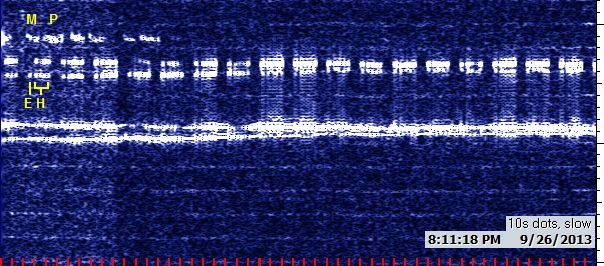
As for NC, it was its typically solid self, but then got very strong for a couple of minutes, just before the codar pulses booomed in and nearly obliterated everything.
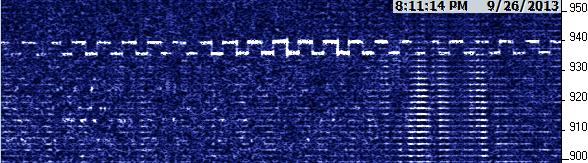
John
Re: Thursday HiFERs and EH Anomaly
That's really interesting. Any theories anybody. I note that in the faster capture they don't seem to be locked up. In the slower capture they are locked up and you can see them coming closer together. My first guess would be a faulty crystal module. It's ringing or something like that. Or a conspiracy theory. Some one is using the recieved signal from EH, using it to PLL a seperate transmitter at a different location. That could be fun. Re: Thursday HiFERs and EH Anomaly
Lee
Posted by John Davis on September 28, 2013 at 05:25:07.
In reply to Re: Thursday HiFERs and EH Anomaly posted by Lee on September 28, 2013
>>> My first guess would be a faulty crystal module. It's ringing or something like that.
That, or maybe strange modulation from a faulty power supply, were possibilities I considered the first time I saw it happen. Eventually, I discounted the idea of it being the transmitter, as the two signals have lots of level differences between them over the course of time...a time interval that roughly matches the fading pattern of other unrelated signals on the band, in fact. If the spectral split originates at the transmitter itself, the signals should track better in level.
But if a transmitter glitch is not the cause, then we're left with two possibilities: a second source (the electronic "grassy knoll" theory) that faded up out of nowhere and then was gradually being zero-beated; or, the original single signal from one transmitter and antenna must be traveling two sufficiently different paths for fading to occur differentially, and furthermore, the reflecting area forming one of those paths must be receding from me at a moderately substantial speed for a prolonged time in order for the frequency difference to result from Doppler shift.
We know dual path propagation is not uncommon at HF. This also took place far enough after dark that the F-layers were dissolving and reforming into nighttime configurations overhead. That's why I tend to favor a dual-path explanation of some sort, but I'm not entirely sold on it. I've watched HF time signal and broadcast carriers get fuzzy on Argo, and occasionally even split into two traces for a matter of seconds, but I don't comprehend how the second path could recede fast enough for over 20 minutes to produce what I saw in this case.
(Both times that I've seen this on EH, the ghost signal that faded up out of nowhere was already lower in frequency than the trace of EH I had been watching all along, and eventually the second one worked its way up closer to the original. Both times were late in the day, too. Yet if it's a natural phenomenon, why only EH thus far, and not one of the other similarly strong stations at the watering hole? Surely Sal's not in cahoots with space aliens?!)
I'd love to have some convincing explanation, but that may require more data.
John
Re: Thursday HiFERs and EH Anomaly
Posted by Lee on September 28, 2013 at 05:52:34.
In reply to Re: Thursday HiFERs and EH Anomaly posted by John Davis on September 28, 2013
Grassy knoll. Ha. You crack me up John. I considered the 2 path idea also but I think we would see more phase difference. Not so perfectly locked up if it was 2 paths. Re: Thursday HiFERs and EH Anomaly
Lee
Posted by EdWSlidell,LA on September 28, 2013 at 14:57:21.
In reply to Re: Thursday HiFERs and EH Anomaly posted by Lee on September 28, 2013
GM all. John, thanks for the detailed pix. Although math was always my nemesis, the required velocity for the frequency shift seen doesn't seem to be that high. I get around 33 m/sec or about 110 feet/sec, which is roughly 120 Km/hour, 75 mph. This would only mean a distance travelled of 25 (statute)miles/40 Km. If I were to guess, the 'ghost' signal seems to be slightly delayed from the "real" one, although the horizontal trace is too slow to really tell. Does the lower double trace in the QRSS10 display(USC?) show the same slow drift upwards, finally merging with the upper trace? Seems to do so at the same time as the two "EH" traces. Ed WSlidell,LA EM50cg
Re: Thursday HiFERs and EH Anomaly
Posted by John Davis on September 28, 2013 at 18:36:25.
In reply to Re: Thursday HiFERs and EH Anomaly posted by EdWSlidell,LA on September 28, 2013
Thanks for the comments, guys. I think your math is probably right, Ed...or at least, it matches the math I was using when I saw the previous instance of this on EH. Back then, the difference between the two signals was a bit greater (roughly 1.8 Hz) and I had calculated a velocity of about 90 MPH for the lengthening path that time.
I guess it's worth remembering for sake of perspective that we're talking about a carrier frequency of over 13.555 MHz. Down at LF, a 1.5 Hz shift would be a pretty big deal! But up here, a Doppler shift of 1.5 Hz on the carrier represents only about 0.11066 parts-per-million difference between the timing of the two signals.
That would also affect the phasing of the keying, as Lee mentions, but would it be enough to notice? Applying that same delay factor to the modulation rate (0.167 Hz for a QRSS3 signal) yields df=1.848×10⁻⁸ Hz, or somewhat under .00001 degree of phase. I don't think we're going to see that on an Argo display.
So, I believe the dual path hypothesis remains a viable one, though I can't quite picture the geometry involved.
There is, for instance, the same problem as when using a radar gun. It doesn't necessarily measure the true proper motion of an object in its own frame of reference; it measures the speed of the object relative to your frame of reference. If you're measuring the velocity of a car (or baseball or whatever) that's traveling directly toward you or directly away from you (aka, "radial motion"), then the Doppler shift does give you a direct and true indication of the speed. In the directly-toward/away case, proper motion and relative motion are both equal to the radial motion. (At least, for speeds much slower than light.)
However, in any other case where the reflecting surface is traveling on a path that takes it somewhat beside you, rather than directly toward or away, the relative motion seen by the radar reads lower than the real speed. (You can see this if you are the only car within view of one of those "your speed is" roadside radar signs. As you approach at a constant speed, there comes a point where it starts to indicate lower and lower before it loses lock.)
To compute the true velocity of proper motion, you need to correct the relative motion (as seen by the radar gun) with the tangential motion, courtesy of a bit of trigonometry. And that requires knowing the angles involved...which is a lot easier if you can see the object doing the reflecting, or have some other way of measuring the angles you're looking at.
In other words, right now we only know that one of the two paths (if that's even how this is happening) is lengthening by 75 to 90 MPH relative to the other path. Unless the moving reflecting/refracting surface is directly behind EH or directly behind my own antenna (an unlikely scenario), then there is also a tangential component of motion, and the observed frequency shift does not represent the entire velocity of the reflecting surface. The source of the reflection could actually be traveling much faster than we've calculated, since the Doppler shift only represents the component of motion relative to me.
With only a single omnidirectional vertical antenna, there is no way to infer where the reflection arrives from.
Thinking-out-loud-alert: In principle, a person could construct a dual receiver (with a single LO) in which the two inputs are fed from a crossed dipole or crossed loop array, and try to correlate the outputs. This technique has been used in direction finding, where the receivers drove the H and V plates of an oscilloscope tube, which then displayed a vector pointing to the signal source. Problem is, here we've got two signals very close in frequency, and such a display wouldn't distinguish between them; it would only show one vector that was the total product of the two relative levels and arrival directions. Not enough information. Unless we could persuade Alberto di Bene to write a sort of 3D version of Argo that could simultaneously track both the phase and level of two very close frequencies arriving simultaneously from two receivers, and plot them as two separate vectors, I don't suppose this approach will tell us much.
The only alternative I can come up with at the moment would be two receivers, two RDF loops with sense antennas, two computers running normal Argo, and ideally two sets of hands to operate them all! One rig track the main signal and the second rig would track the ghost signal if/when it ever shows up again, then try to achieve a null that would reveal its direction of arrival. Putting such an outfit together is do-able, but for something that has only shown up twice thus far, it does seem a considerable effort.
Anyone got any easier ideas to try?
And Sal, if you're monitoring, is there anything magic about EH's antenna or something else you can think of that could account for it being more susceptible to this phenomenon than other signals have been?
73 Re: Thursday HiFERs and EH Anomaly
John
Posted by Steve, VK2XV on September 28, 2013 at 20:14:46.
In reply to Re: Thursday HiFERs and EH Anomaly posted by John Davis on September 28, 2013
John - this link may be of interest...
http://www.qsl.net/zl1bpu/IONO/doppler.htm
Cheers
Steve
Re: Thursday HiFERs and EH Anomaly
Posted by John Davis on September 28, 2013 at 22:10:50.
In reply to Re: Thursday HiFERs and EH Anomaly posted by Steve, VK2XV on September 28, 2013
Thanks, Steve. Very interesting indeed.
If I could find someone halfway between EH and here to do some ionosounding while I observe EH, perhaps all sorts of correlations would show up.
John
(P.S. - Slightly OT & Length Alert:) I'm also intrigued at the mention of locking to TV sync. That brings back fond memories of the Olden Days when we could reliably do that in this country. There was a time in the 70s when our national networks all began deriving their sync and chroma timing from cesium atomic standards. All television network programming was relayed terrestrially via AT&T Long Lines microwave and cable at the time, so what was put into the pipeline in New York or Los Angeles came out intact, pulse for pulse, in Atlanta or Cedar Rapids (Iowa) or Missoula (Montana) or Phoenix, or wherever.
Since digital framestore video synchronizers were rare and costly back then, local affiliates generally passed the network feed through the video switcher directly, even in the big cities. During network programming, every television sweep circuit in the country was humming the same tune with atomic accuracy! If you lived in rural areas where interference from other stations might be present on the same channel you were watching, the extraneous sync bars no longer drifted through the frame at random, but were fixed in place. (If you had access to a broadcast grade picture monitor with cross-sync mode, you could often measure the time delays between two stations carrying the same program to within 100 nanoseconds by visual means alone.)
Those stations who didn't want glitches to show up on-air during local program switching eventually bought one of the new-fangled sync generators that could be locked to an external reference, namely the network feed. Thus, during the local news, the studio cameras and VTRs locked to local sync had the same overall accuracy available as the network, but sometimes with minor phase discrepancies. For experimenters, high precision timing and sometimes even coherent transmission modes were feasible anywhere on the continent that a television signal could be received.
As television technology progressed, however, a couple of developments changed all that. One was the widespread availability of digital frame synchronizers. It was no longer necessary to feed every single camera, VTR, remote truck, etc, from a master reference at the studio. All sources, even the network feed, could have their own independent timing and still be locked together when selected at the switcher/mixer input. This made control room design and cabling much less demanding, but meant that the station's sync was at the mercy of whatever frequency standard drove those frame synchronizers. Some larger market stations still locked to the network feed or acquired rubidium standards of their own. In small markets, each station's sync was more often referenced to a plain old crystal oscillator once again. No more network stability, even on network programs, when a station did that. Sync bars were free to roam once again.
Then came the shift away from terrestrial microwave to satellite program distribution. The big networks insisted on digital transmission so their feeds could be encrypted. The digital receiver's processor was referenced to a relatively cheap local crystal, though in most systems it could at least be disciplined by the incoming stream. The timing of sync coming out might have the same long-term accuracy as what went in, but there was no guarantee of pulse-for-pulse stability any more. It only had to be good enough to look stable on a monitor.
Nowadays, in the all-digital utopia (I can't even type that with a straight face) every TV set in the country is largely on its own...sync stability only as good as the average of what's being transmitted, with no guarantee re: instantaneous phase. At least before, your set and your neighbor's were sweeping simultaneously as long as you were tuned to the same transmitter. Now, they may be a substantial fraction of a frame apart at any given moment. No more coherent transmissions with references like that! --even assuming you could access the sync anymore, and also assuming the station in question doesn't change from one HD mode to another with a different horizontal rate during the broadcast.
Ain't progress grand?
Re: Thursday HiFERs and EH Anomaly
Posted by Sal,K1RGO on September 29, 2013 at 01:52:18.
In reply to Re: Thursday HiFERs and EH Anomaly posted by John Davis on September 28, 2013
Hi John, use of cable tv coax
Beats me whats happening, same old dipole and rig here. I'll check the oscillator for issues. Other than some temperature drift it seems ok. Maybe flying saucers are hovering over my house or HARRP is beaming the northeast or something of that sort :).......
later........Sal
Posted by Robert E Rode W9ESX on September 29, 2013 at 06:55:56.
hey, all,...any of you guys ever use cable tv coax and the 300 ohm to 75 ohm balun to feed a h-f dipole ? thnx, 73 Bob W9ESX
Re: use of cable tv coax
Posted by John Bruce McCreath on September 29, 2013 at 12:01:29.
In reply to use of cable tv coax posted by Robert E Rode W9ESX on September 29, 2013
I've been using satellite grade RG-6 with the special water-tight crimp on style of F connectors for ages on my antennas and it works very well. As to the 4:1 balun, it would best to wind your own, but you don't likely need it for an HF dipole as the 75 ohms is close enough.
73, J.B., VE3EAR Re: use of cable tv coax
Posted by Robert E Rode W9ESX on September 29, 2013 at 16:09:24.
In reply to Re: use of cable tv coax posted by John Bruce McCreath on September 29, 2013
...thanx, J.B. ur comments ...wasnt thinking when I said "300 to 75 balun, had 2 meter folded dipole in mind,...going to try it on hf, here quite fond of qrp, tho run 100 watts as needed, 73 Robert W9ESX
Re: Beacon JAM 187.015khz back up for season
Posted by Robert E Rode W9ESX on September 29, 2013 at 16:37:36.
In reply to Re: Beacon JAM 187.015khz back up for season posted by Douglas Williams KB4OER on September 24, 2013
...please a short description ur lowfer xmtr ? tnx W9ESX here or e mail ok..
WTB: Longwave Pre-amp
Posted by Bill KB9IV on September 29, 2013 at 23:34:41.
I am looking to buy a Longwave Pre-amp. 100-500 Khz about 10-15 dB gain for my experiments.
Best DX
Bill KB9IV Re: WTB: Longwave Pre-amp
Posted by John, W1TAG on September 29, 2013 at 23:57:26.
In reply to WTB: Longwave Pre-amp posted by Bill KB9IV on September 29, 2013
Bill,
If you feel like building, there's a nice one on W1VD's site:
http://www.w1vd.com/VLFLFMFpreamplifier.pdf
John, W1TAG
Re: Beacon JAM 187.015khz back up for season
Posted by Lee on September 30, 2013 at 00:11:04.
In reply to Re: Beacon JAM 187.015khz back up for season posted by Robert E Rode W9ESX on September 29, 2013
You can see the set up on youtube. The current setup uses an elevated loading coil near the roof line.
http://www.youtube.com/watch?v=XyEnXV7i1rk
Sunday HiFERs in SEK
Posted by John Davis on September 30, 2013 at 21:21:57.
The watering hole regulars were quite good Sunday. From top to bottom, below, are EDJ, NC, assorted clipper artifacts (including what I first hoped was BC, but which turns out to be an inverted copy of USC mixng with EH when the audio got very strong for a while), the display of my notebook computer (curve), something that might be artifacts except that the frequencies don't match any plausible mixing products, MP, EH, and finally USC.
Away from the watering hole I heard MTI fluctuating over a wide range of signal levels, saw a QRSS6 signal below it for a time that was probably PBJ, and heard what was likely FRC.
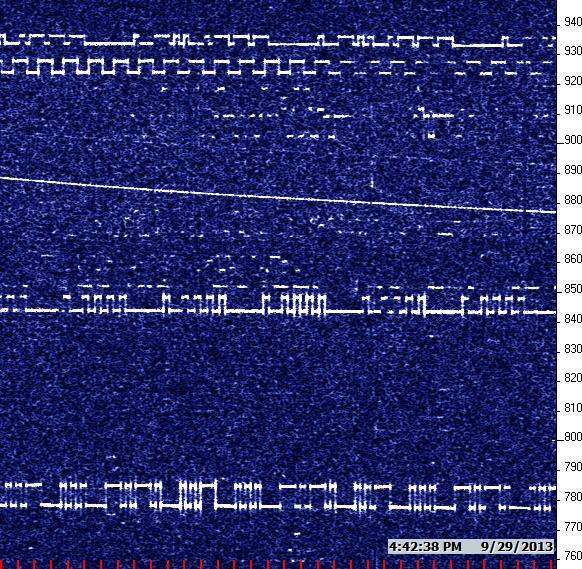
potrzebie