 File Attachment 1: 1sep-A.jpg
File Attachment 2: 1sep-B.jpg
File Attachment 3: 1sep-C.jpg
File Attachment 1: 1sep-A.jpg
File Attachment 2: 1sep-B.jpg
File Attachment 3: 1sep-C.jpg
Re: J1LPB, Other Tuesday HiFERs
Meant to mention the rest of the loggings Tuesday because they seem to illustrate the ways the band is changing at this time of year.
One of the least pleasant changes was the Cuban SWBC QRM factory just after 8 AM CDT. Wiped out the entire upper half of the band with voice under a horrendous distorted tone centered on 13570, and another copy at 13635, and ANOTHER at 13740 with somewhat less tone...and a version with voice-only, no tone but lots of distortion at 13740...followed by additional copies at various slots above that, with tone increasing again as I tuned higher.
(Made the US commercial broadcaster on 13845 sound really good by comparison, even though they were loaded with commercials clearly targeted only for a domestic audience, a blatant violation of FCC rules for HF broadcast. The program was Genesis Communications Network's 'Power Hour' featuring an anti-vaccination rant between the "IRS on your case because you're a tax deadbeat?" ads.)
On the lower part of the band, only EH and NC were at the watering hole, and USC showed up faintly and intermittently for several minutes after 8:30 AM then went away. WV was faint to the point of being uncertain.
That was the status quo until just before 10 AM, when codar began picking up dramatically. Over the next half hour, USC began appearing intermittently again, EDJ's FSK showed up intermittently, and traces of J1LPB's QRSS and WSPR began appearing occasionally too. SIW slant appeared for a time and was distinctive enough to recognize over the QRM, but the WSPR version was totally swamped and invisible amongst the codar lines.
By noon, the racket quieted down a little. When I did a band scan in the second half of the noon hours, WV was readable, and so was WAS. FRC was faintly visible and barely audible around 1 PM.
Just before 1:05 PM, the "air horn" made its first appearance at 13,555.480-.485. This was a very strong signal that lasted several seconds, appeared to be modulated in some fashion part of that time, then disappeared for several minutes, reappearing again at apparently random intervals. I named it "air horn" because it consisted of at least two simultaneous tones and enough harmonics of each getting through despite the CW filter to sound like the real thing...although I never found out where in the rest of the audio spectrum the other tone was. I also thought to switch the receiver to other modes to see if I could gather any more info about the signal, but was never fast enough. Fortunately it stopped before conditions improved for some of the regulars.
Before 2 PM, USC started showing up more regularly and so did 7P. MTI showed up shortly thereafter. The band peaked between 2 and 3, including the WSPR decodes previously reported, then slowly began deteriorating. Everybody but EH and NC were gone by 5 PM.
My log of the final band scan of the day:
531PM - WV slightly visible under codar, sometimes just audible

no pbj, no plm, no van, no gnk

541PM WAS maybe - 542p WAS definite & clear but only once!

544pm  FRC a character or two at a time
John
Saturday HiFERs
Started fairly early again today. Knowing that the MUF was high over North America (>18MHz) already, I was hoping for better signals early before the MUF rose further and the attenuation rose along with it. That didn't really pan out. Only EH and NC were present at 8 AM, though 30-some minutes later WV and WAS began making it through. GNK was fair by 8:33 AM. In the next hour, EDJ started showing up.
No SWBC sidebands early this morning, miraculously, but I expect codar has checked in by now. On my way back to see.
John
2200 m WSPR this afternoon.
Posted by John Davis on September 01, 2018 at 22:57:12.
Too much QRN here in SE Kansas to do anything at LF last night, and this morning wasn't any better. Things quieted down a bit in early afternoon. Got these decodes (below) just after local solar noon and continued monitoring through solar noon in Arizona. QRN started rising again by 2:45 PM CDT and was back to nighttime levels not long after 3:00.
Argo showed both XND and XXP signals visible before and after the lone decode of XXP, but the S/N ratio was never quite good enough for the weaker signal again. At 2:04 PM, for instance, both signals were strong enough to be audible...but that didn't last long enough to do any good for XXP.
John
1840 -26 -1.1   0.137528  0 WH2XND DM33 43
1844 -26 -1.3   0.137528  0 WH2XND DM33 43
1848 -31 -0.9   0.137507  0 WH2XXP DM33 37
1848 -26 -1.0   0.137528  0 WH2XND DM33 43
1852 -26 -0.9   0.137528  0 WH2XND DM33 43
1856 -28 -1.1   0.137528  0 WH2XND DM33 43
1900 -27 -1.1   0.137528  0 WH2XND DM33 43
1904 -28 -1.1   0.137528  0 WH2XND DM33 43
1908 -28 -1.1   0.137528  0 WH2XND DM33 43
1912 -22 -1.2   0.137528  0 WH2XND DM33 43
1916 -26 -1.0   0.137507  0 WH2XXP DM33 37
1916 -21 -1.1   0.137528  0 WH2XND DM33 43
1920 -23 -1.0   0.137528  0 WH2XND DM33 43
1924 -23 -1.0   0.137528  0 WH2XND DM33 43
1928 -23 -1.0   0.137528  0 WH2XND DM33 43
1932 -24 -1.1   0.137528  0 WH2XND DM33 43
1936 -24 -1.1   0.137528  0 WH2XND DM33 43
1940 -24 -1.2   0.137528  0 WH2XND DM33 43
1944 -24 -1.0   0.137528  0 WH2XND DM33 43
1948 -26 -1.1   0.137528  0 WH2XND DM33 43
1952 -27 -1.2   0.137528  0 WH2XND DM33 43
Re: Saturday HiFERs
Not the greatest HF propagation this morning, or the rest of today. From 9:50 to 10:15 AM CDT, EDJ joined EH and NC, then went away. Codar was prominent off and on all morning. Little bits and pieces of 7P and J1LPB began appearing from 11:30 onward, with occasional snippets of EDJ reappearing too. LPB WSPR eventually began showing a bit too, but just after 1:01, codar jumped all over everyone, much stronger than earlier in the morning, and continued through local solar noon. I finally gave up and went to 2200 meters for a while.
When I returned at 3:05pm, codar had diminished but so did propagation. WV was sometimes strong but with wide QSB fluctuations over moderate time frames, then generally poor by 311pm. No AZ, PNJ, PLM or GNK. WAS was faintly visible, but became briefly audible for one ID at 3:23 PM. It was about 40 Hz lower than where I saw it in the morning, but still in the clear. By 3:29pm, WV was strong again briefly.
I'm not too hopeful for improvements the rest of the day, but perhaps conditions are shifting back toward the way they were in late spring; in which case, maybe there'll be some activity shortly after sunset.
Re: Saturday HiFERs
Posted by Bob WA1EDJ on September 02, 2018 at 13:35:52.
In reply to Re: Saturday HiFERs posted by John Davis on September 01, 2018
Thanks John! EDJ will be off air until I get the U3 running again. It had been on since Friday. This morning I noticed no signal on the RX. Apparently the TCXO died. No output at all. I have not had the success that Mike, N8OOU has had with the TCXO's. Never got the stability he did with it. Maybe it never was working correctly. I'm not rushing to get another one since I may get one from the same batch. Going back to xtal synth board for now.
Bob Re: 2200 m WSPR at night.
EDJ
Posted by John Davis on September 02, 2018 at 17:09:01.
In reply to 2200 m WSPR this afternoon. posted by John Davis on September 01, 2018
I gave up hope for nighttime 22 meter activity about 3 AM and went to 2200, where I didn't really have any hope either, given the QRN levels of other nights over the past three months. But the noise was a few dB less than before, and signals were ample, so I got the results shown below. If anybody back East was on, they didn't quite make it through, but XXP stayed in there with XND until half an hour after sunrise. Thereafter, it was just XND, even despite a significant drop in noise levels during the morning.
John
0804 -23 -0.8   0.137507  0 WH2XXP DM33 37
0804 -21 -0.9   0.137528  0 WH2XND DM33 43
0808 -21 -0.8   0.137507  0 WH2XXP DM33 37
0808 -20 -0.8   0.137528  0 WH2XND DM33 43
0812 -24 -1.2   0.137507  0 WH2XXP DM33 37
0812 -21 -1.2   0.137528  0 WH2XND DM33 43
0816 -23 -0.8   0.137507  0 WH2XXP DM33 37
0816 -21 -0.8   0.137528  0 WH2XND DM33 43
0820 -19 -0.8   0.137507  0 WH2XXP DM33 37
0820 -20 -0.8   0.137528  0 WH2XND DM33 43
0824 -20 -0.8   0.137507  0 WH2XXP DM33 37
0824 -23 -0.8   0.137528  0 WH2XND DM33 43
0828 -22 -0.8   0.137507  0 WH2XXP DM33 37
0828 -22 -0.7   0.137528  0 WH2XND DM33 43
0832 -23 -0.8   0.137507  0 WH2XXP DM33 37
0832 -23 -0.8   0.137528  0 WH2XND DM33 43
0836 -25 -0.8   0.137507  0 WH2XXP DM33 37
0836 -23 -0.8   0.137528  0 WH2XND DM33 43
0840 -29 -0.8   0.137507  0 WH2XXP DM33 37
0844 -26 -0.9   0.137507  0 WH2XXP DM33 37
0848 -24 -0.8   0.137507  0 WH2XXP DM33 37
0852 -23 -0.9   0.137528  0 WH2XND DM33 43
0856 -26 -0.8   0.137507  0 WH2XXP DM33 37
0856 -22 -0.8   0.137528  0 WH2XND DM33 43
0900 -26 -0.9   0.137507  0 WH2XXP DM33 37
0900 -19 -0.9   0.137528  0 WH2XND DM33 43
0904 -21 -1.0   0.137528  0 WH2XND DM33 43
0908 -19 -0.9   0.137528  0 WH2XND DM33 43
0912 -26 -1.1   0.137507  0 WH2XXP DM33 37
0912 -17 -1.1   0.137528  0 WH2XND DM33 43
0916 -18 -0.8   0.137528  0 WH2XND DM33 43
0920 -16 -1.0   0.137528  0 WH2XND DM33 43
0924 -17 -0.9   0.137528  0 WH2XND DM33 43
0928 -23 -0.8   0.137507  0 WH2XXP DM33 37
0928 -16 -0.8   0.137528  0 WH2XND DM33 43
0932 -21 -0.8   0.137507  0 WH2XXP DM33 37
0932 -13 -0.8   0.137528  0 WH2XND DM33 43
0936 -23 -1.0   0.137507  0 WH2XXP DM33 37
0936 -14 -1.0   0.137528  0 WH2XND DM33 43
0940 -22 -0.8   0.137507  0 WH2XXP DM33 37
0940 -16 -0.9   0.137528  0 WH2XND DM33 43
0944 -22 -1.0   0.137507  0 WH2XXP DM33 37
0944 -15 -1.0   0.137528  0 WH2XND DM33 43
0948 -23 -1.1   0.137507  0 WH2XXP DM33 37
0948 -14 -1.0   0.137528  0 WH2XND DM33 43
0952 -21 -1.0   0.137507  0 WH2XXP DM33 37
0952 -14 -1.0   0.137528  0 WH2XND DM33 43
0956 -20 -0.9   0.137507  0 WH2XXP DM33 37
0956 -14 -1.0   0.137528  0 WH2XND DM33 43
1000 -21 -1.0   0.137507  0 WH2XXP DM33 37
1000 -14 -1.1   0.137528  0 WH2XND DM33 43
1004 -21 -1.0   0.137507  0 WH2XXP DM33 37
1004 -15 -1.0   0.137528  0 WH2XND DM33 43
1008 -21 -1.0   0.137507  0 WH2XXP DM33 37
1008 -17 -1.0   0.137528  0 WH2XND DM33 43
1012 -24 -1.0   0.137507  0 WH2XXP DM33 37
1012 -13 -1.0   0.137528  0 WH2XND DM33 43
1016 -21 -1.0   0.137507  0 WH2XXP DM33 37
1016 -15 -0.8   0.137528  0 WH2XND DM33 43
1020 -24 -1.0   0.137507  0 WH2XXP DM33 37
1020 -18 -1.0   0.137528  0 WH2XND DM33 43
1024 -24 -0.9   0.137507  0 WH2XXP DM33 37
1024 -18 -0.9   0.137528  0 WH2XND DM33 43
1028 -23 -1.0   0.137507  0 WH2XXP DM33 37
1028 -17 -1.0   0.137528  0 WH2XND DM33 43
1032 -21 -0.9   0.137507  0 WH2XXP DM33 37
1032 -19 -1.0   0.137528  0 WH2XND DM33 43
1036 -21 -1.1   0.137507  0 WH2XXP DM33 37
1036 -18 -1.1   0.137528  0 WH2XND DM33 43
1040 -23 -0.9   0.137507  0 WH2XXP DM33 37
1040 -20 -0.8   0.137528  0 WH2XND DM33 43
1044 -24 -1.0   0.137507  0 WH2XXP DM33 37
1044 -20 -1.0   0.137528  0 WH2XND DM33 43
1048 -23 -1.1   0.137507  0 WH2XXP DM33 37
1048 -19 -1.1   0.137528  0 WH2XND DM33 43
1052 -23 -1.1   0.137528  0 WH2XND DM33 43
1100 -29 -1.1   0.137507  0 WH2XXP DM33 37
1108 -28 -1.1   0.137507  0 WH2XXP DM33 37
1108 -26 -1.1   0.137528  0 WH2XND DM33 43
1112 -30 -1.2   0.137507  0 WH2XXP DM33 37
1112 -23 -1.1   0.137528  0 WH2XND DM33 43
1116 -25 -1.0   0.137507  0 WH2XXP DM33 37
1116 -22 -1.0   0.137528  0 WH2XND DM33 43
1120 -24 -1.0   0.137507  0 WH2XXP DM33 37
1120 -21 -1.0   0.137528  0 WH2XND DM33 43
1124 -19 -1.1   0.137507  0 WH2XXP DM33 37
1124 -18 -1.1   0.137528  0 WH2XND DM33 43
1128 -17 -1.1   0.137507  0 WH2XXP DM33 37
1128 -15 -1.1   0.137528  0 WH2XND DM33 43
1132 -15 -1.0   0.137507  0 WH2XXP DM33 37
1132 -14 -0.9   0.137528  0 WH2XND DM33 43
1136 -17 -1.0   0.137507  0 WH2XXP DM33 37
1136 -21 -1.0   0.137528  0 WH2XND DM33 43
1140 -13 -1.1   0.137507  0 WH2XXP DM33 37
1140 -15 -1.1   0.137528  0 WH2XND DM33 43
1144 -17 -1.0   0.137507  0 WH2XXP DM33 37
1144 -16 -1.0   0.137528  0 WH2XND DM33 43
1148 -19 -1.1   0.137507  0 WH2XXP DM33 37
1148 -17 -1.1   0.137528  0 WH2XND DM33 43
1152 -23 -1.0   0.137507  0 WH2XXP DM33 37
1152 -19 -0.9   0.137528  0 WH2XND DM33 43
1156 -21 -1.1   0.137507  0 WH2XXP DM33 37
1156 -24 -1.1   0.137528  0 WH2XND DM33 43
1200 -18 -1.1   0.137507  0 WH2XXP DM33 37
1200 -21 -1.1   0.137528  0 WH2XND DM33 43
1204 -25 -1.0   0.137507  0 WH2XXP DM33 37
1204 -20 -1.1   0.137528  0 WH2XND DM33 43
1208 -24 -1.1   0.137507  0 WH2XXP DM33 37
1220 -21 -1.2   0.137528  0 WH2XND DM33 43
1228 -23 -1.2   0.137507  0 WH2XXP DM33 37
1228 -17 -1.1   0.137528  0 WH2XND DM33 43
1232 -18 -1.2   0.137528  0 WH2XND DM33 43
1236 -24 -1.2   0.137528  0 WH2XND DM33 43
1240 -26 -1.1   0.137528 -1 WH2XND DM33 43
1352 -24 -1.1   0.137528  0 WH2XND DM33 43
1356 -27 -1.1   0.137528  0 WH2XND DM33 43
1404 -24 -1.2   0.137528  0 WH2XND DM33 43
1408 -23 -1.3   0.137528  0 WH2XND DM33 43
1412 -25 -1.2   0.137528  0 WH2XND DM33 43
1416 -24 -1.3   0.137528  0 WH2XND DM33 43
1424 -24 -1.2   0.137528  0 WH2XND DM33 43
1432 -22 -1.2   0.137528  0 WH2XND DM33 43
1440 -25 -1.5   0.137528  0 WH2XND DM33 43
1444 -25 -1.5   0.137528  0 WH2XND DM33 43
1452 -27 -1.3   0.137528  0 WH2XND DM33 43
GNK Good Sig in NC
Took WAS off air for a short listening session this afternoon...1700Z-1736Z. SDR Reception of GNK
Only heard GNK. He ranged from just at the noise floor (S1) to peaking around an S4. Lots of good signal time, with some short fades into the noise. I stopped listening at 1736 and he was still peaking an S4 at times. May try again later, but WAS is now back up.
73 de Bill K4JYS
Rcvr: Ten-Tec RX340
Ant: 22 mtr dipole
Posted by Bill Stewart, K4JYS on September 02, 2018 at 19:29:09.
Since I was hearing GNK so good this afternoon, I thought I'd try some of the many KiwiSDR rcvrs found on the web. Was hoping I might get a little snippet of WAS but not yet.....these things are all over the world. Anyway, I did hear GNK on one in Idaho...KA7U. His rcvr seems be in a pretty quiet location. GNK was about a 339 with the usual QSB into the noise.
Bill K4JYS
Sunday Hifers
Posted by Ed Holland on September 03, 2018 at 02:37:51.
Not the best conditions, but I did have several chances to listen through the day. Loggings included GNK, EH and NC. EH was the winner, being audible here in California at around 0200 UST. I could here the frequency shifts marking each character.
Regards,
Ed
WWV / WWVB Cuts
Posted by Frank Lotito on September 03, 2018 at 14:09:37.
"Since nearly every household these days has at least one "atomic clock" controlled device in it, this is a matter that deserves widespread attention by people who are not involved in radio, as well." DNU hifer beacon
..
The above quote is from the home page of the LWCA web site on the morning of 9/3/2018. OK, we're supposed to be technical orientated, at least from the view point of applied technology. What's "nearly every household" and "at least" mean?
..
In my neighborhood, a suburban community about 11 miles east of the Pittsburgh, PA city line, I can say with confidence nobody in my immediate area has an atomic clock or device requiring synchronization to atomic time. There are a few hams in my neighborhood, most know what WWV is, but use their cell phones to tell time, or reset their clocks should the need arise. If they operate WSPR, general Internet synchronization is good enough.
I know this from talking to my neighbors.
..
Bottom line - If the petition to the Government to rescind the WWV / WWVB financial cuts does not include technically sound arguments with "real data," we're not going to get sympathy from the regulators and administrators who are attempting to save a buck and weed out the unnecessary services. In our factual argument, we should also address the fact that in many parts of the world only the "select few" can afford an atomic clock type device. But the equivalent WWV / WWVB service is not available in those areas of the world. "How has no atomic clock / and no equivalent time and frequency broadcast service hindered their country's advancement for the general population?"
Posted by Adam/KE8DNU on September 03, 2018 at 17:18:39.
Good afternoon! I have finally built, and placed my 22 meter beacon on the air, connected to an inverted-V antenna.
You should, hopefully, hear it on 13.561.6, but I can tell that conditions haven't been ideal lately.
The callsign of the beacon is my amateur suffix, DNU.
Anyway, I've got some fine qsl cards printed especially for this endeavor and if you do happen to hear it, pleaae do not hesitate in letting me know!
73, and all the best
Adam Re: WWV / WWVB Cuts
Posted by John Davis on September 03, 2018 at 18:12:58.
In reply to WWV / WWVB Cuts posted by Frank Lotito on September 03, 2018
What's "nearly every household" and "at least" mean?
You live in a most remarkable neighborhood if you can categorically state that NOBODY has a radio-controlled clock of some sort! The hams know what WWV is, but never use it to check the calibration of their receivers or the time bases of their frequency counters? What remarkably trusting souls they are.
Unless one is an industry insider, he apparently has to buy the kind of statistics you seem to be asking for, especially if you want the most current sales figures. This is why we need professional reporters involved too.
But I do know, per the NIST's own presentation at the NCSL International symposium in 2003, that just four years after WWVB increased its power, the number of radio controlled clocks already utilizing it in the US was in the millions, plural. Sales figures for that year by itself were projected at 2 million units in the US alone and 20 million worldwide. I also know, per statistica.com, that from 2005-2010, the dollar amount of sales ranged from $200 to $300 million per year, every year. Since the prices of WWVB-controlled devices range from $10 at the low end to around $30 at the high end (much cheaper than their battery-draining GPS equivalents), that means 12 to 20 million units have sold each and every one of those years in the US, and most likely since then. By the most conservative estimate, that's more than enough for every household in the country by now, though admittedly some of us do use two or more of them in our own homes.
If the petition to the Government to rescind the WWV / WWVB financial cuts does not include technically sound arguments with "real data," we're not going to get sympathy from the regulators and administrators who are attempting to save a buck and weed out the unnecessary services.
Yes and no. We The People petitions are not about well reasoned arguments. They are about sheer numbers--in this case, if 100,000 people are interested enough in some issue, then somebody in the White House will wake up long enough to maybe refer it to some bureau that will look into it further. This is why the petition alone is not enough...but it is one important first step.
The fact also remains in this case that the administrator(s) involved presented NO technical arguments, sound or otherwise, for the changes in the budget proposal. This is still a useful service, and it is one of the cheapest per user for the government to provide, and for the individual user to use.
I'm not clear as to the relevance of the rest of the world to the petition, apart from the fact that every advanced/advancing and prosperous region of the globe provides an LF-based time and frequency service, and even more also provide HF equivalents; while conversely, the countries and regions that don't have been famously referred to by a vulgar epithet which I can't repeat, because its scatological nature and political connotations would both violate board rules. It's up to us to decide which category we want to be in.
The table below shows who around the world currently operates standard time stations on a 5-day-a-week or more basis. (Most of them also provide standard frequency reference, except those marked -f below.) It's interesting to note that China, Germany, Japan, and Britain each operate two LF time coded stations to provide the maximum number of their citizens with service. And France, which expressed its disdain for LF broadcasting by stopping programs from Allouis, has still found it desirable to keep the station on the air just for the time code transmissions.
COUNTRY      LF-NO TIME CODE   LF-TIME CODE     HF-NO TIME CODE     HF-TIME CODE

Argentina    --                --               LOL 10 MHz          --

Brazil       --                --               PPE 10 MHz          --

Canada       --                --               --                  CHU multiple

China        --                BPC 68.5         BPM multi (now)     BPM 5MHz (more pending)
                               BPL 100

France       --                TDF 162          --                  --

Germany      --                DCF77 77.5       --                  --
                               DCF49 129.1 -f

Hungary      --                HGA22 135.6 -f   --                  --

Japan        --                JJY 40 & 60      --                  --

Russia       multi 25kHz       RBU 66.66        RWM multiple        --

So Korea     --                --               --                  HLA 5MHz

Taiwan       --                BSF 77.5         --                  --

UK           --                MSF 60           --                  --
                               BBC 198

Venezuela    --                --               YVTO 5 MHz          --

USA          --                ???              --                  ???

All Other    zip               nada             zilch               zero
Re: WWV / WWVB Cuts
Posted by Bill Stewart, K4JYS on September 03, 2018 at 18:47:54.
In reply to Re: WWV / WWVB Cuts posted by John Davis on September 03, 2018
John....very well put and backed up with the real skinny. I wish that you guys who are so good at expressing your positive opinions would pass your comments on to the NIST. I doubt that the ones wanting to reduce funding even know just how important WWV, etc is....minds are made up, don't confuse 'em with the facts....typical now days with the present administration.
73 de Bill K4JYS
Re: DNU hifer beacon
Posted by Bill Stewart, K4JYS on September 03, 2018 at 18:55:37.
In reply to DNU hifer beacon posted by Adam/KE8DNU on September 03, 2018
Welcome Adam. Glad you got DNU up and running. I took a short listen a few mins. ago but don't hear a thing across the band...not even GNK. There are some good ears in the group and probably someone will hear you when condx improve. Re: DNU hifer beacon
GL and 73 de Bill K4JYS
Posted by Adam/KE8DNU on September 03, 2018 at 19:20:14.
In reply to Re: DNU hifer beacon posted by Bill Stewart, K4JYS on September 03, 2018
Thanks, bill! Appreciate the effort :). I made an account with hf underground as well. Once it get approved I'll be sure to make an announcement about it there as well. 73!
Re: DNU hifer beacon
Posted by Bill Stewart, K4JYS on September 03, 2018 at 19:24:14.
In reply to Re: DNU hifer beacon posted by Adam/KE8DNU on September 03, 2018
I just sent you an email re. HFU and SDR rcvrs....Bill
Re: DNU hifer beacon
Posted by ed holland on September 03, 2018 at 21:14:09.
In reply to DNU hifer beacon posted by Adam/KE8DNU on September 03, 2018
Thanks Adam,
Good luck with your beacon. I'll try for a listen. That frequency range often has persistent carriers audible at my location, so it might be hard to weed out a HiFER, but stranger things have happened in the world of low power beacons.
Cheers
Ed
Re: DNU hifer beacon
Posted by Adam/KE8DNU on September 03, 2018 at 21:28:29.
In reply to Re: DNU hifer beacon posted by ed holland on September 03, 2018
Thanks, Ed!! As it turns out, I have nearly the same exact problem and haven't figured out the cause.
Looking forward to having my beacon make it your way!!
73, Adam
Re: DNU hifer beacon
Posted by John Davis on September 03, 2018 at 21:59:55.
In reply to Re: DNU hifer beacon posted by Adam/KE8DNU on September 03, 2018
The cause is the industrial, scientific and medical devices that are the primary users of this band. Most of their carriers are clustered around the center of the band, naturally, and unlike us, there is no limit on their radiated field strengths.
Here in Kansas, they are utterly overwhelming from 13,559 through 13,562 kHz, and lesser carriers and sidebands are generally present from 13,558.5 to 13563 kHz.
I have never been able to hear any known-legitimate HiFER that was trying to operate within a kilohertz and a half of the band center. Even one that was formerly running closer to 3 watts could barely be heard in that slot until it moved to its most recent frequency (and, after standing out like a sore thumb there for a while, inserted the necessary attenuation at its output).
Best of luck with your new beacon, Adam, but if you could move it up a little higher in frequency it would stand a much better chance of being logged.
73 Re: WWV / WWVB Cuts
John
Posted by Frank Lotito on September 03, 2018 at 23:29:45.
In reply to Re: WWV / WWVB Cuts posted by Bill Stewart, K4JYS on September 03, 2018
Positive or negative argument - To be meaningful, undisputed real world data is required. Shooting from the hip with no data to support your argument gets you (individual or organization) no place with respect to funding programs, enacting new legislation, rescinding existing legislation.
Re: WWV / WWVB Cuts
Posted by John Davis on September 04, 2018 at 00:45:37.
In reply to Re: WWV / WWVB Cuts posted by Frank Lotito on September 03, 2018
"Undisputed real world data"? What would that be, exactly? Numbers precise down to the nearest thousand users? Nearest hundred? According to whom? And is it not hard data that our four biggest economic competitors in the real world still find it advisable to maintain not one, but two, LF time signals, while four others maintain at least one?
What "data" has ever been UNdisputed in the political realm? And why would it even matter in an instance where (at the risk of being tedious in repeating myself) NO data whatsoever was offered in support of the cut in the first place? How and why would we use data to refute data that's never been offered...answer me that?
The radio stations, let's be honest, are just collateral damage in a much bigher cut. I have no illusion that there's any hope of restoring the rest of the standards dissemination and technology transfer funds. The whole point of those cuts is to prevent acquisition of inconvenient data, so there's no point in applying data or reason to that part of it. But I don't care right now. That's not what we're discussing here.
It's sufficient to make the people aware who have the final decision-making responsibility that it will affect their constituents. It does NOT matter whether it's precisely 112,491 voters in their own district or whether it's merely "somewhere between" 100,000 and 200,000, or whether it's a greater number in somebody else's district. If they believe in their oath of office, it should be sufficient that they know tens of millions of users nationwide will be affected. The trick RIGHT NOW is to make enough of those tens of millions aware what's about to happen. They'll be all the data our legislators need.
Re: DNU hifer beacon
Posted by Adam/KE8DNU on September 04, 2018 at 00:45:59.
In reply to Re: DNU hifer beacon posted by John Davis on September 03, 2018
Thanks for the fantastic insight, John!! I will definitely consider that for any future projects!
I've had some luck hearing other stations on this band in the past, WAS, WV, and GNK in particular.
I hope to add as much or more value to this group than what I extract.
Re: DNU hifer beacon
73!
Posted by John Davis on September 04, 2018 at 01:53:49.
In reply to Re: DNU hifer beacon posted by Adam/KE8DNU on September 04, 2018
Extract all you want! To paraphrase the commercial, as long as we've got folks like you contributing news and reception reports, "we'll make more!" ;)
New 2200 meter beacon 136.000khz
Posted by Lee Short on September 04, 2018 at 01:58:56.
Finally got my 2200 meter beacon up. It's at 136.000khz. Call sign is KE6PCT. The letter P at QRSS30 and a 5 WPM message. Power is a tiny 1 watt final from an LF90. Larger Juma down the road a bit. Antenna is the former Lowfer JAM setup with a much bigger coil. I will publish a video some time in the not to distant future. All reports welcome.
Re: DNU hifer beacon
Posted by Adam/KE8DNU on September 04, 2018 at 02:19:04.
In reply to Re: DNU hifer beacon posted by John Davis on September 04, 2018
There are some smart cookies in this group, I can tell!
Btw, I submitted my membership...about a week or two ago. How long does that usually take to go through? No rush, just checkbook reconciliation on my end (:
Re: DNU hifer beacon
Posted by John Davis on September 04, 2018 at 05:26:40.
In reply to Re: DNU hifer beacon posted by Adam/KE8DNU on September 04, 2018
Kevin Carey handles LWCA membership matters, and unlike some of us he's not retired. so the time frame may be variable. It's about time your check should be returning to the bank, though. We have no fancy membership cards these days (and no travel or hotel discounts either, alas) but you should receive the next issue of the newsletter in a couple of weeks.
Listening
Posted by Adam/KE8DNU on September 04, 2018 at 16:43:28.
Had a break in the action today for an hour or so around 14:30-15:45 UTX. Spun the dial around the 22 MB, wasn't picking up anything. I'll give it another shot in a few hours.
Re: Saturday HiFERs
Posted by John Davis on September 04, 2018 at 22:12:32.
In reply to Re: Saturday HiFERs posted by John Davis on September 01, 2018
I wrote:
...perhaps conditions are shifting back toward the way they were in late spring; in which case, maybe there'll be some activity shortly after sunset.
Short version: Nope. Didn't work that way.
Late afternoon saw only EH and NC prominent at the watering hole, with snippets of 7P and J1LPB, all of whom gradually faded, leaving only a scraggly hint of EH after 4 PM CDT. And codar, of course.
EH revived dramatically just after 5 PM, but was gone again by 5:39. It rematerialized twice more in early evening, but only for two minutes at a time. The codar lines started showing unusual frequency-selective fading that grew more dramatic as the evening progressed. The turbulence seemed to peak between 9:30 and 10:00 with the "codar serpents" shown in the A attachment. After that, codar was still strong and there was still lots of selective QSB but it seemed more stable in its pattern, and then a lot of codar suddenly went away at 10:44 PM (the B attachment). But not quite all of it, as became evident looking at a QRSS20 display (the C attachment), showing one lone straggler gradually fading away entirely from view just after 11 PM.
Thereafter, the band was dead from one end to the other with one exception. NC appeared for less than a minute at 12:33 am (Sunday morning). That was it until I gave up at 3 AM and went to 2200 meters.
---------------------------------------------------------------
File Attachment 1: 1sep-A.jpg
File Attachment 2: 1sep-B.jpg
File Attachment 3: 1sep-C.jpg
13.600 car noise
Camping this weekend, being Labor Day, the last major long weekend and the campground was filled. fortunately got to stay after everyone packed up yesterday to make the trek home, we stayed that extra day and my lord, the campground was empty and quiet, lovely.
Brought up a SDR dongle and upconverter & 9:1 balun for a longwire attached to a tree about 30 yards from the truck. Pulled in some good 80m traffic, around 9pm every night. 20 was quieter than expected. Fearing that I might not even be able to hear my beacon ~120 km away I sat on it and no go.
Was not until a later that night, a couple had appeared to come up from the beach and took up residence in the camp two spots down, only noted by the flashlights and sound.
The camp was already there, setup - tent, car, but no one until they showed up and whatever they did almost peaked SDR# with a data burst like I had never seen before. Peak was at 13.600
Caught on - Piecing it together, being dark, I heard the lady saying "in the trunk".
I heard a click afterwards. Not loud, but a mechanical click.
Nothing registered on SDR until I heard the trunk slam shut.
The burst appeared again.
This morning, I noted it was not a trunk. It was a Toyota FJ SUV. I guess the back door? Hatch? Noted one more time, confirmed by SDR#. Time to pack up and go home....now here....and miss camping. :) So things sometimes do go bump in the night you just might not hear them....unless you are "tuned" in.
Re: DNU hifer beacon
Posted by Jason Goldring on September 05, 2018 at 13:33:43.
In reply to DNU hifer beacon posted by Adam/KE8DNU on September 03, 2018
Adam, how do you find the frequency stability with that unit? Do you find much drift? Curious as to whether or not this would be a candidate (probably after modification) for a full weatherproof outdoor standalone beacon. Solar? WA4SZE Beacon
Jason
Posted by Bill Stewart, K4JYS on September 05, 2018 at 14:45:11.
Hearing WA4SZE/Beacon again, this morning at 0914Z. Strong CW sig at about 569 near Smithfield, NC. Re: DNU hifer beacon
de Bill K4JYS
Posted by adam/ke8dnu on September 05, 2018 at 15:44:02.
In reply to Re: DNU hifer beacon posted by Jason Goldring on September 05, 2018
Hey jason! Your best clear spots in the ISM Band
It's been remarkably stable thus far. This is only officially day 2 but I have not noticed any drift whatsoever. Highly recommended...KE8DNU seal of approval :D
Posted by Ed Holland on September 05, 2018 at 18:05:10.
Hi Folks,
It occurred to me that it would be a good idea to share the quietest listening spots in the 13553-13567 ISM allocation we know and love as the HiFER band.
My reasoning for this is more or less obvious - Where is a good spot to put one's beacon, if trying to reach a particular area?
For my QTH, the only spot with consistent interference is 13560 - 13562 (as tuned in USB with a typical 2.2 kHz filter. Ergo, I can easily listen from the lower portion of the band, up to about 13,559 before whistles interfere with hearing, or the AGC kicks into action. Using a Spectrum Lab, this can be pushed a little further. On the high side, 13,562 kHz up is all quiet.
I would be interested to hear from other LWCA contributorson their local conditions.
Cheers
Ed
Re: Your best clear spots in the ISM Band
Posted by Jason Goldring on September 05, 2018 at 22:59:19.
In reply to Your best clear spots in the ISM Band posted by Ed Holland on September 05, 2018
Ed;
Great topic, as I made my post earlier about 13.6 I poked back onto the Can. Gov't. website regarding the regulations:
15.848 mV/m (84 dBμV/m) at 30 m, within the band 13.553-13.567 MHz;
334 µV/m (50.5 dBμV/m) at 30 m, within the bands 13.410-13.553 MHz and 13.567‑13.710 MHz
So the peak was noted at 13.6 by me but could have been elsewhere as well, I was only on a pretty narrow filter scanning. If 13.6 was the target freq, then the band must have been very quiet around it - given the limits.
But I must agree that higher is quieter. Is the ISM really being exploited for it's nature of being able to travel real distance compared to the typical 433mhz band for short distance and penetration? By nature, being the ISM band I am glancing at the "S" and in more populated areas, the "I", wondering if there is a defacto telemetry standard that developers are working on to mass produce the short data bursts required. Commonality and development leads to lower prices.
At home, FN03bh, I have noise consistently in the low 13.5
Not spikes, but consistent peaks of nothing discernible. Night time or day it is the same. I will get a burst now and again, but nothing like the camping event.
I am in full agreement that logically and carefully selecting a higher ISM within the 553-567 makes absolute total sense.
Jason Re: Your best clear spots in the ISM Band
J1LPB
Posted by Ed Holland on September 06, 2018 at 16:36:48.
In reply to Re: Your best clear spots in the ISM Band posted by Jason Goldring on September 05, 2018
Thanks Jason - Great conversation.
Usage is interesting. I have taken a portable set around our neighborhood while walking trails, mostly to monitor PVC to see what the local coverage is like, effect of terrain etc. This brought to attention several instances of signals that were quite localised in nature. Exact frequency was harder to determine with the portable set, but again, clustered near 13.56, and obviously above PVC. I believe cable TV and other services delivered by overground wire. Another poster recently highlighted automotive use of the frequency.
Other than man-made noise, I have found ISM to be quiet. Conditions can almost be gauged here by the level of true atmospheric noise.
Anyway, I'm thinking of using my cheap, but quite precise and controllable DDS signal generator as an exciter for PVC. The crystal oscillator used at present won't pull far away from 13.56, hence the 13558.4 kHz selection for PVC. With the generator, I could jump around the band quite readily. It would be interesting to slot in amongst the "Watering hole" stations and see if this yielded more reports.
Cheers
Ed
Re: Your best clear spots in the ISM Band
Posted by Jason Goldring on September 07, 2018 at 03:04:02.
In reply to Re: Your best clear spots in the ISM Band posted by Ed Holland on September 06, 2018
Ed, It would be interesting to see if in fact it did yield more reports, just a matter of ensuring there is an audience ;)
For the life of me I could not figure out why airplanes had you turn off transmitting devices as they "may interfere" with aircraft operation and navigation. Blind eye turned to that now, You can run WiFi in a aircraft that has Internet available. Bluetooth? Sure - Listen to you headphones. Quite sure that manufacturers have tested many more scenarios to ensure the safety of the plane.
Now if we could get that type of quality control out into the mainstream market for consumer goods, ISM would be really quiet - but at the expense of stricter emission limits no doubt, making for a much more futile DX experience with ISM (or would it....thinking of how clean the band would be?)
Jason
Re: Your best clear spots in the ISM Band
Posted by John Davis on September 07, 2018 at 07:15:54.
In reply to Re: Your best clear spots in the ISM Band posted by Jason Goldring on September 07, 2018
It's probably worth remembering in this discussion that while some ISM bands coincide with Part 15/RSS-210 designated bands, they are not fundamentally the same thing. There are actually at least five different types of radiated emissions currently authorized within the 22 m band (not counting unauthorized emissions such as Cuban fishing boats, sideband splatter from SWBC, the occasional pirate, and so on), and they are governed by very different regulations:
• Industrial/Scientific/Medical devices: industrial or medical diathermy machines, plasma welders, MRI machines, particle accelerators, hair removal devices, radio-scalpels, RF lighting systems, microwave ovens, drivers for ultrasonic cleaning and welding transducers, induction cookers, etc.; none of which involve any kind of communication or data transfer. (FCC Part 18, Canada ??)Within the ±7 kHz confines of the 13.56 MHz band, true ISM devices have no radiated field limits whatsoever (§18.305(a)). Outside the ±7 kHz limit, their emissions have to comply with field strength limits that generally correspond to the field limits of Part 15 for frequencies outside designated Part 15 bands. One notorious exception is RF lighting systems, which are allowed rather extraordinary radiated and conducted signal limits across MF and HF, especially at 2.1-3.0 MHz.
• Intentional radiators: The kind of thing we do, for instance; also, remote control devices, RFID tags, etc., where communication of information or commands via radio is the objective. (Part 15, RSS-210)
• Incidental radiators: computer circuitry, TV sweep circuits, CAN bus automotive networks, etc., that generate RF as a side-effect of their operation. (Part 15, RSS-210)
• Radar: oceanographic research (Codar, currently Part 5 Experimental Service), military OTHR (not very active at present).
• Ionosondes (FCC Part 5, NTIA)
Devices under Part 15/RSS-210 (either intentional or incidental radiators) do have specific limits, as you are aware...15.848 mV/m at 30 m, within the band 13.553-13.567 MHz, and 334 µV/m at 30 m across the rest of the 13.410 to 13.710 MHz span. You'll also sometimes encounter RF from things like automotive systems farther outside the band, which are supposed to be at even lower levels, and usually are. (But it is ironic that radio and TV receivers have to be certified to comply with Part 15 while cars don't...and some electric models certainly couldn't pass if they did have to undergo such tests!) We also have a frequency tolerance for 22 m intentional radiators of 0.01% over specified power supply voltage and temperature fluctuations, whereas the tolerance for ISM devices is the ±7 kHz limit at all times.
Codar installations radiate a few hundred watts with their two-per-second chirp-chirps in audio bandwidths (or kchunk-kchunk at CW bandwidths). They are currently in the Experimental Radio Service but have been allocated bands to which they are all supposed to migrate in the next four years.
John
Re: Your best clear spots in the ISM Band
Posted by Jason Goldring on September 07, 2018 at 12:42:11.
In reply to Re: Your best clear spots in the ISM Band posted by John Davis on September 07, 2018
Quoted "(But it is ironic that radio and TV receivers have to be certified to comply with Part 15 while cars don't...and some electric models certainly couldn't pass if they did have to undergo such tests!)"
I can attest to that as a 4 year owner of a Smart Fortwo Electric car. To the point that I wonder why they even included the AM band with the factory car radio, only the strongest signals poke through and the whining from the motor and other electronics is very annoying.
I recall Ford doing something a while back and it was my understanding that (mind you a backwards way to correct a problem) they wrapped a thin wire with wide spacing up the length of the car radio antenna before encasing it with some sort of material. It appears on my car similar was done, but in Ford's case, and I am going back years, it was to reduce ignition noise. Not sure what it is supposed to accomplish with my car, but I would not want to change the stock antenna for something else otherwise the radio might become useless.
John, I am not too sure what the Can Equivalent to Part 18 is, the government portal has thankfully changed in recent years to make things easier to search but still hard to pinpoint the exact source for a comparable set of regulations. However, I have noted that there are more similarities than differences with many North American FCC / RSS rulings (Or should I say ISEC for Canada, next week it might be different :)
And with that said, I have noted that many certification companies will permit US testing and certification results to apply towards Canadian device certification without having to go through the same testing in Canada and vice-versa. Only if questioned would the device need to be tested by a Canadian accredited lab with the appropriate findings presented.
Thinking a little further about this I poked my head into RSS-310 and noted:
3.5 Transmitters With Input Power of 6 nW or Less
Any transmitter that has a power consumption (total input power into the device) not exceeding 6 nW is excluded from any Industry Canada requirements and may operate on any radio frequency, including in the restricted frequency bands listed in RSS-Gen.
3.6 Band 0-9 kHz and Infrared Frequencies
Radio apparatus operating at 9 kHz or less and at infrared frequencies are excluded from any Industry Canada requirements.
Now hardly a lot of power we are talking about. But that creates a potential "carte blanche" for manufacturers to do pretty much anything they want. To your point though, this is something designated as a "transmitter", but not necessarily defined as unintentional or intentional. If we apply the population density and usage of such devices - RFID for example, I can see how bands could get noisy. Especially with the ultra sensitive receiver and antenna setups some people have. However, the clearly points out that operation can take place anywhere, not just ISM.
Then again, it is only nW we are talking about.
Jason
Re: Your best clear spots in the ISM Band
Posted by Adam/KE8DNU on September 07, 2018 at 17:12:39.
In reply to Re: Your best clear spots in the ISM Band posted by Jason Goldring on September 07, 2018
This whole topic fascinates me, so I thank you for bringing it up.
I have a question regarding the ISM band:
As radio amateurs, we have several bands that we share with other services, and particularly on a secondary basis, I believe 60 and 30 meters come to mind immediately, although 40 meters does have the shortwave broadcasts as well.
Is it likely that 22 meters would ever become a "ham" band on a secondary basis behind the ISM designation, and if so, what would ( or could) potentially be the restrictions we would face if so?
I only ask because, as it seems this band is mostly a dumping ground for unwanted or undesirable RF, power limits on amateur transmissions at even 5 watts or so still would be enough to battle QRM/N.
Re: Your best clear spots in the ISM Band
Posted by John Davis on September 07, 2018 at 17:46:32.
In reply to Re: Your best clear spots in the ISM Band posted by Jason Goldring on September 07, 2018
Oh those mischievous Canadian regulators! Six nanowatts total input power to the whole device, eh? Talk about squeezing a camel through the eye of a needle. Dig out the 1.2 V batteries and invent some 5 nanoampere tunnel diodes, boys!
Even if it is possible to build such a transmitter, and even if it were possible to obtain 100% conversion efficiency and couple it to a perfect dipole in free space, that's 17 μV/m at 30 meters, only slightly over the general limit for narrow band emissions in the 1.705-10 MHz range. That's 0.5 μV/m at 1 km in free space, 0.05 μV/m at 10 km, and so on, so I don't think anyone will lose much sleep over interference potential.
And it's comforting to know that if I visit Canada someday, there are no power limits on heat lamps. :)
Re: Your best clear spots in the ISM Band
Posted by John Davis on September 07, 2018 at 18:16:35.
In reply to Re: Your best clear spots in the ISM Band posted by Adam/KE8DNU on September 07, 2018
Interesting to speculate, Adam, but I don't think the extra 14 kHz would be worth the bother to the amateur service, and offers nothing 20 meters doesn't, other than the week signal opportunities/challenges enforced by the current power restrictions.
Users of RFID systems would hardly call the band a dumping ground, either. They can fit between the physical sources of ISM RF easily enough because industrial heaters and MRI scanners tend not to be located in retail areas and don't generally move around much. But a 50 watt mobile transceiver firing up in a Walmart parking lot would be another story.
Re: Your best clear spots in the ISM Band
Posted by Adam/KE8DNU on September 07, 2018 at 18:50:09.
In reply to Re: Your best clear spots in the ISM Band posted by John Davis on September 07, 2018
Excellent points, John! Your thoughts are duly noted. I hadn't considered all that, but what you said makes a lot of sense.
And, truthfully I prefer it not being an amateur band.
Part of why I fell in love with this endeavor was that the band was being utilized creatively above and beyo d it's intended purpose (:
Re: Your best clear spots in the ISM Band
Posted by Jason Goldring on September 07, 2018 at 22:05:46.
In reply to Re: Your best clear spots in the ISM Band posted by John Davis on September 07, 2018
LOL! Almost fell of my chair, true, true indeed but someone needed to justify their reasoning (more likely their salary) and so it was carved in stone. Now at some point we might be sticking our foot...but I will no doubt be long gone when Star Trek devices can sense the sweat rolling down a dung beatle back two constellations away...:) antenna change possible
Jason
Posted by Adam/KE8DNU on September 08, 2018 at 13:43:18.
Presently, our system is comprised of a 22 m Inverted V, slightly above the roof line by about 3 feet or so.
It's not the best one we've ever built, but it works.
Before the harsh Ohio weather begins to roll in around late October/early November, we may be replacing the antenna with something of slightly better quality. I'll make a formal announcement when that actually does happen, but in the meantime, our inverted V is hopefully going to produce the results I'm looking for.
73 for now,
Adam
TCXO just dropped out on U3
Posted by Jason Goldring on September 09, 2018 at 02:21:55.
Odd situation - this morning all was well, a bit cooler than the past few days but the U3 tcxo just dropped. Nothing. Pulled it from the box and it's dead.
J1LPB 22m off air until I dig up the other OSC to drop in.
Should be about an hour or so, just want to bench test it. Re: TCXO just dropped out on U3
J.
Posted by Jason Goldring on September 09, 2018 at 03:20:18.
In reply to TCXO just dropped out on U3 posted by Jason Goldring on September 09, 2018
J1LPB back on the air. Re: TCXO just dropped out on U3
Posted by Bob WA1EDJ on September 09, 2018 at 12:54:09.
In reply to TCXO just dropped out on U3 posted by Jason Goldring on September 09, 2018
Jason,
What TCXO are you using? I recently put a D75F TCXO from CW on one of my synth boards.
Got it from Digi Key. It was not easy to get on the PCB after built.
It ran for a few weeks and stopped too. I found the ground pad had lifted from the pcb creating an open. Added a small wire to fix. Ok now. It is very hard to insure good connections on this TCXO if adding after the board is built.
I have had mixed results with the TCXO. It works best if in QSSS mode left running 100% of time. WSPR which cycles TX with the frame is a bit drifty. Mike N8OOU has very good results with the same TCXO.
What TCXO are you using?
Bob Re: TCXO just dropped out on U3
WA1EDJ/EDJ
Posted by Jason Goldring on September 09, 2018 at 13:30:28.
In reply to Re: TCXO just dropped out on U3 posted by Bob WA1EDJ on September 09, 2018
Good morning Bob,
I am using a Vectron TX-704. This is the second one I have used, the first died after a power issue (short). Mind you, these were used pulls from a decommissioned Femto cell packaged in a pull-out module (as most components are in these units). Re: TCXO just dropped out on U3
This second time around around I can only surmise a premature death. On the bench it would not do a thing. Odd.
Thanks for the info about the unit you are using. Great for future reference!
Jason
J1LPB
Posted by Adam/KE8DNU on September 09, 2018 at 15:28:45.
In reply to Re: TCXO just dropped out on U3 posted by Jason Goldring on September 09, 2018
Wow! That was a quick repair! That's great news!
Sunday Hifers 9/9
Posted by John Davis on September 09, 2018 at 18:11:20.
Don't have time right now to work on captures, but I did want to mention that conditions on 22 m are better than they were a few days ago! From late morning into the noon hour, CDT, I've heard or viewed (in ascending order) WV, J1LPB, EH/NC (they've traded places as the day got warmer), 7P, traces of USC, the dashes of VAN, WAS at levels ranging from barely visible to nicely audible, and FRC much better than usual for mid-day.
Unfortunately, the first skip zone seems to have stretched way out again with the changing season. No sign of the Illinois stations, or LVB (who often tracked SIW in level despite being way around the azimuth dial, yet at nearly the same distance), and also no sign of MTI, PBJ, or GNK.
Re: Sunday Hifers 9/9
Posted by Jason Goldring on September 10, 2018 at 01:36:42.
In reply to Sunday Hifers 9/9 posted by John Davis on September 09, 2018
John, thanks for the report. As much as I like to see this unit still running over the next 48 hours I might be yanking the plug due to the high winds and pending storm alerts from the remnants of Gordon which has caused some downed power lines and strong winds. Rain expected to move in shortly.
Will wait and see.
On my end I dove off 22m for the 1/2 day focusing on 189.615khz. A slow beacon, very narrow band, caught by chance focusing on the 160-190 range.
Very faint, not QRSS but slow CW. Tried to find a similar station with a stronger signal figuring it might be a harmonic but nothing. It's gone now. Only picked up "RY".
Thanks again for the report. Re: Sunday Hifers 9/9
Jason
Posted by John Davis on September 10, 2018 at 02:29:08.
In reply to Re: Sunday Hifers 9/9 posted by Jason Goldring on September 10, 2018
Gordon must have picked up some energy after it left our area. All it did to us was raise some rivers to minor flood stage...which was actually welcome, after being in severe drought and stage one water restrictions for several weeks. If I don't see your beacon tomorrow when I return to the field, at least I'll know why.
I do have more to report on today's reception in a later post, including my first full copy of the QRSS ID! Up to now it had been a little here, a little there, over several cycles.
Interesting reception you had there on 1750 meters. I hope someone will recognize or claim the signal.
John
630M WSPR 10Sep18
Posted by Rick Hall VA3TX on September 10, 2018 at 03:19:59.
Rick:
I have QSL Reception Report for you...if you have e-mail, contact me at n8tl@woh.rr.com. Re: 630M WSPR 10Sep18
I will forward QSL report. 73, Tom N8TL
Posted by Tom N8TL on September 10, 2018 at 03:22:32.
In reply to 630M WSPR 10Sep18 posted by Rick Hall VA3TX on September 10, 2018
OOPS...post error. VA3TX contact me at [the address shown above] if you have email. I have QSL for you. Thanks, Tom N8TL
Re: Sunday Hifers 9/9 (J1LPB QRSS)
Posted by John Davis on September 10, 2018 at 05:53:13.
In reply to Sunday Hifers 9/9 posted by John Davis on September 09, 2018
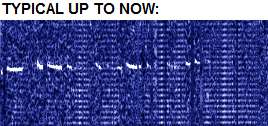
From the time LPB went on the air with this ID cycle until today, I was never quite sure what the whole pattern was. I could see the WSPR segment and sometimes decode it, but the QRSS was always broken by a combination of propagation fluctuations and reduced detection efficiency caused by the slow "chirp" (frequency fluctuation at the start of each element) smearing the energy across multiple FFT bins in Argo. That makes dots harder to pin down, especially. A little bit of codar usually comes in when a path is open that direction, too, adding to the difficulty. Thus, up until today, I had never been able to see an entire ID at one time, let alone the whole QRSS message. Suddenly this afternoon:
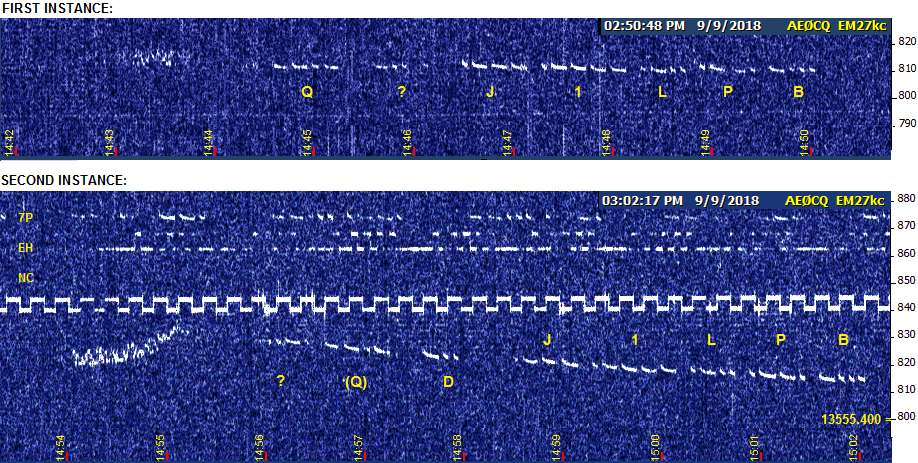
The first instance was so strong that I could hear the individual elements of the J and the 1 start keying, despite EH dominating my ears immediately above in frequency. The LPB were visual only.
The second instance was in the cycle immediately following the first, and was quite clear despite the peculiar frequency excursion. Needless to say, that WSPR slot did not decode--although a milder blip at 1854 UTC (roughly 3 Hz drift) managed to squeak through. However, I'll show the WSPR results in another post. The very next ID cycle yielded this:
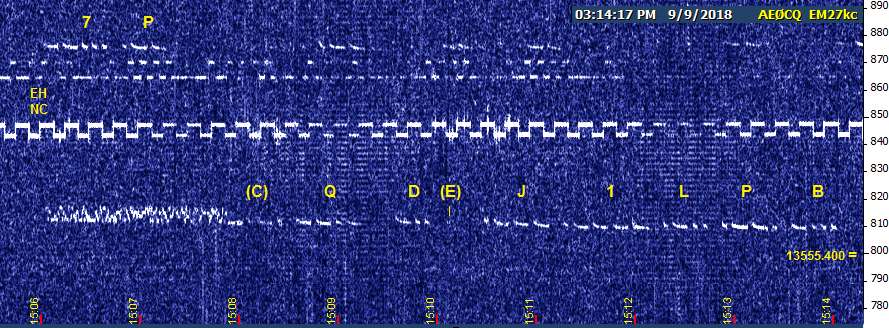
I'd like to solve the puzzle, Pat: "CQ DE J1LPB"
(Actually, the E was still questionable at that point and the C wasn't entirely great, but I was later able to confirm that my guess was correct when I reviewed the screen shots captured while I was at lunch. Early in the 1 o'clock hour CDT, there was a very clear "CQ DE" with the C starting immediately at the end of the 1806 UTC WSPR transmission.)
I can now finally conclude that the whole cycle repeats at 12 minute intervals starting at 6 minutes past the hour; consisting of 1 minute 53 seconds of WSPR, followed immediately by 6 minutes and several seconds of QRSS; then a gap until what appears to be a CW message at the 10 minute mark, based on the keying sidebands, though I haven't had good enough copy yet to say anything about it; then another gap until the cycle repeats.
John
---------------------------------------------------------------
File Attachment 1: lpb-qrss-previous.jpg
File Attachment 2: 9sep-LPB1-2.jpg
File Attachment 3: 9sep-LPB3.jpg
Re: Sunday Hifers 9/9 (J1LPB WSPR)
1630 -25 -1.5  13.555415  1 J1LPB FN03 0
1718 -21 -1.4  13.555407 -1 J1LPB FN03 0
1730 -17 -1.3  13.555409  0 J1LPB FN03 0
1754 -22 -1.4  13.555408  1 J1LPB FN03 0
1830 -15 -1.4  13.555408  0 J1LPB FN03 0
1854 -26 -1.4  13.555423 -3 J1LPB FN03 0
1906 -25 -1.6  13.555410 -1 J1LPB FN03 0
2006 -20 -1.7  13.555419  0 J1LPB FN03 0
2018 -24 -1.6  13.555418 -1 J1LPB FN03 0
The effects of frequency drift show up prominently in today's spots. The 1854 UTC time slot that shows -3 Hz drift is depicted in the attached Argo capture (file 9sepa25.jpg). It's kind of remarkable because that's a little more drift than WSPR usually tolerates, it has deep fades during the time slot, and a pulse sounder let loose during the slot as well. That's why the SNRr is so poor, but it decoded anyway.
The other attached file is a shot of the final decode of the afternoon, which I've included because the Argo trace makes it look so unlikely to decode too...and yet it did.
There were numerous other stations copied on Sunday, and I'll do a report on them during the day Monday.
John
---------------------------------------------------------------
File Attachment 1: 9sep25.jpg
File Attachment 2: 9sep-wspr.jpg
Re: WA4SZE Beacon
Blasting away here this (Monday) morning with a somewhat wasteful 170 Hz FSK CW signal about 475 kHz.
K3RWR on 2200 m WSPR
Posted by John Davis on September 10, 2018 at 09:08:50.
Was copying the Arizona powerhouses as is often the case, and saw a signal several times at 137.470 kHz that didn't want to decode. Finally it did.
0804 -12 -0.8   0.137527  0 WH2XND DM33 43
0810 -13 -0.8   0.137507  0 WH2XXP DM33 37
0810 -11 -0.8   0.137527  0 WH2XND DM33 43
0816 -16 -0.8   0.137507  0 WH2XXP DM33 37
0816  -6 -0.8   0.137527  0 WH2XND DM33 43
0820 -28 -1.0   0.137470  0 K3RWR  FM18 30
0820 -14 -1.0   0.137507  0 WH2XXP DM33 37
0820  -9 -1.0   0.137527  0 WH2XND DM33 43
0824 -12 -0.8   0.137507  0 WH2XXP DM33 37
0824 -11 -0.8   0.137527  0 WH2XND DM33 43
0828 -10 -0.9   0.137507  0 WH2XXP DM33 37
0828 -16 -0.9   0.137527  0 WH2XND DM33 43
0830 -23 -0.9   0.137470  0 K3RWR  FM18 30
At 1630 km, K3RWR sort of splits the difference in distance between XXP and XND, but in nearly the opposite direction.
Re: Sunday Hifers 9/9 (J1LPB QRSS)
John, excellent detective work!
Yes, the QRSS is CQ DE J1LPB
And your timings are on the mark. (unless WWV goes offline :)
The CW and WSPR were for my own interest about propagation, the QRSS has a bit of a story behind it.
Timings were set to allow for a realistic GPS calibration between cycles, set as such because of the seasonal fluctuation in temperature, the beacon being outside.
There are 3 stations - J1LPB, J2LPB and J3LPB. Naming convention to me made sense, First initial, Beacon Number, LPB (Lower Power Beacon). This also sets WSPR compliance for callsigns.
J2 & J3 are in listen mode (right now). These are QRSS decoding stations. J2 is located just outside of Sosua, Dominican Republic
The other is located just north of Parry Sound, Ontario. It is a pain to maintain this one so I have it offline until I can get up there, sooner than later - before the snow rolls in.
Fairly straight forward, I tried for a screen grab setup for J2 but it never worked out right.
Instead, the decoder monitors for a string of text. If decoded, sends me an email:
08-17-2018 03:22a DEC J ? ?
08-17-2018 04:13a DEC ? H ? ?
08-19-2018 11:36p DEC ? ? ? ? L
You can see the problem.
Playing with the config of the program, it seemed that creating a longer message - such as calling CQ, I found better results. The decode time was increased so it actually buffers the input and processes after a specific time delay.
As a string of text, within that string, I am looking for J1LPB. The buffered RX data is processed several times to determine a hit.
This, in combination of narrowing the filter, seemed to give me the results I am looking for. Mind you, I have only TWICE got a positive in the 44m band.
Now, I had posted the question a while back about collecting WSPR data, aside from WSPRNET.org and making it available for such band experimenters. Might I have such luck to have ears on 44m, not likely, except my own station. Any posting data outside of ham bands does not seem to be popular, most do not upload spots. I assume the consensus is not very many people do.
**However** I regained RDP access to the computer just over two weeks ago. This time I ensured that Windows Updates were OFF. That's what screwed me up - I lost access after the firewall reset or did something. A friend went to my place and I walked him through the process.
What I have done so far was change the RX to 22m for QRSS. WSPRX is installed now. I am toying around programming a script which can take the data and upload it here (Ontario) and present it in a easy to read format for WSPR and QRSS. (The later is the issue, which I may drop all together, but still working on it.)
Point being, I wanted to make this so others could install the same reporting script if they felt so inclined and review their data.
I am heading down south at the end of September, I will be able to put my eyes on the current system and hopefully come up with a reasonable solution.
At this point I cannot comment about the fluctuations of the frequency excursion deviation at this point. For WSPR and QRSS. Very odd. What has changed is the TCXO (in the past 24 hours).
I think the first thing I will check on my end is the current balun to make sure that I am not getting anything back down the line into the unit which may cause issues.
John, thanks again for the valuable feedback. Very helpful!
When I am down south I will have ears on to see what I can dig up and report on.
Jason PVC treasure hunt
Posted by ed holland on September 10, 2018 at 15:53:43.
Or, If you prefer, "Where's Waldo?"
I adapted the second crystal slot in the Vectronics transmitter to accept a signal generator input. With the puch of a button, the Standard 13,558.4 kHz Crystal can be substituted with a variable input.
PVC has been moved temporarily near the watering hole - can you find it?. Reports are welcome :)
Cheers,
Ed
Re: K3RWR on 2200 m WSPR
Posted by John Davis on September 10, 2018 at 19:18:41.
In reply to K3RWR on 2200 m WSPR posted by John Davis on September 10, 2018
During the noon hour, I uploaded the rest of the overnight and morning spots to WSPRnet. There were several more K3RWR decodes, and lots of XND and XXP.
The last K3RWR decode was for the 0938 UTC transmission slot. I'm guessing Robert shut down after that one, because it came in at a generous -16 dB SNRr reading. The Arizonans were ranging from -11 to -16 dB themselves around that decode slot.
An interesting peculiarity about the night/day transition on XND and XXP: ALL_WSPR.txt ahowed that the most difficult decodes were those occurring at and in the hour following sunrise--at the Arizona end, not local sunrise here or at the midpoint of the path, as one might expect.
John
1750 Meter Note
Posted by John Davis on September 10, 2018 at 19:26:25.
In reply to Re: K3RWR on 2200 m WSPR posted by John Davis on September 10, 2018
In the hour before I started monitoring WSPR on 2200 m, I spent half an hour each trying to find EAR and WM with Argo, but neither were making it through the noise at either QRSS30 or 60.
At mid-morning, LF was the quietest it has been here in months, so I tried again for WM from 9:30 AM CDT to nearly noon. No luck this time, either. Saw several different PLCs and an upward sloping ramped signal of some sort, but nothing that looked like WM, sadly.
John
Re: 1750 Meter Note
Posted by Steve Sykes on September 11, 2018 at 00:05:43.
In reply to 1750 Meter Note posted by John Davis on September 10, 2018
EAR is booming in here in Victor NY at 0005Z
Monday HiFERs
Posted by John Davis on September 11, 2018 at 02:18:33.
In reply to Sunday Hifers 9/9 posted by John Davis on September 09, 2018
Conditions were less ideal today, but I did copy a few signals through early afternoon (further report later). I returned to the field at 2300 UTC (6 PM CDT) to find EH still bright and loud up to 6:11 PM, at which time I tuned around the band for a little while. Nobody seen or heard, and only moderate codar. Five minutes later I returned to the watering hole and...no EH or anyone else!
I wondered if we might already be in the predicted geomagnetic disturbance, and sure enough, we are. On my way back now to see if G1 and maybe G2 storms are enough to produce a little nighttime propagation.
Re: 1750 Meter Note
Posted by John Davis on September 11, 2018 at 02:26:44.
In reply to Re: 1750 Meter Note posted by Steve Sykes on September 11, 2018
EAR is usually a nighttime regular here in SE Kansas, up to 11 months out of the year; but the last couple of summers have had more static than in previous years. There look to be fewer storms tonight, so I hope to try again. Whether that is enough will depend on how intense the storms remain in the wee hours. Its skywave signal undergoes an abrupt fade an hour or more before sunrise here.
EAR generally makes it to Illinois in the daytime, and the Illinois stations often make it here in the daytime...but the combined distance seems to be too much for EAR's groundwave signal, except (very) rarely in mid-winter.
John
Re: Monday HiFERs
Posted by John Davis on September 11, 2018 at 07:02:00.
In reply to Monday HiFERs posted by John Davis on September 11, 2018
Nope, the G1 events have not done anything for 22 m propagation tonight. The band is just as dead as when I tried overnight last week.
Re: Monday HiFERs
Posted by Adam/KE8DNU on September 11, 2018 at 11:11:31.
In reply to Re: Monday HiFERs posted by John Davis on September 11, 2018
Similar results here, John. Re: 1750 Meter Note
Low activity on the ham bands, as well.
Posted by John Davis on September 11, 2018 at 17:47:27.
In reply to Re: 1750 Meter Note posted by John Davis on September 11, 2018
No luck last night either. The QRN went away by daybreak, but the signal apparently went away before that happened.
Re: 1750 Meter Note
Posted by Mike N8OOU on September 12, 2018 at 02:27:08.
In reply to 1750 Meter Note posted by John Davis on September 10, 2018
John,
Thanks for your time listening on 1750m. WM Lowfer is operational using the same setup as last fall/winter. It would appear that conditions are just not right yet to allow the signal to make it to your way.
We received plenty of rain over the weekend to recharge our very dry soil. I was hoping that might allow a better launch pad on my end. I didn't see any change on my local monitor or meter readings. I still have plenty of green in the trees and vegetation so that is likely soaking up a lot of my power.
Thanks again. 22m beacon 13.565
Mike 73
Posted by Jason Goldring on September 13, 2018 at 01:57:49.
Fired up a 22m beacon at 13.565.850 just before this post.
This is going up north to replace the J3LPB beacon at my QRSS receive station by Parry Sound, Ont. Hopefully it will be a TX station as well as it was in the past, replacing the 44m beacon. Thanks to my friend who was travelling to YYZ Pearson airport, he stopped by to grab the equipment.
I have my J1LPB ID'er chip in it for the time being - So on 13.565.850 ~ (give or take because of potential drift, it's outdoors right now). CW only - the beacon is runnning.
The Dundas J1LPB is down for the evening to use the antenna it was using for the sake of testing.
If all is well it's going back up there and will be in service by the weekend or shortly thereafter under J3LPB grid EN95xk on 22m.
Jason
WAS QRT
Posted by Bill Stewart, K4JYS on September 13, 2018 at 10:58:21.
WAS is now down due to hurricane Florence. Re: WAS QRT
73 de Bill K4JYS
Posted by Adam/KE8DNU on September 13, 2018 at 11:14:18.
In reply to WAS QRT posted by Bill Stewart, K4JYS on September 13, 2018
Godspeed, Bill.
Re: WAS QRT
Posted by Bill Stewart, K4JYS on September 13, 2018 at 13:43:55.
In reply to Re: WAS QRT posted by Adam/KE8DNU on September 13, 2018
Tnx Adam....hoping the ole gal don't start drifting north some more. We are right on the NE edge of Hur. force and Trop. storm force winds. Will probably button down the hatches and abandon ship for a few days....Bill
Re: WAS QRT
Posted by Adam/KE8DNU on September 13, 2018 at 14:11:14.
In reply to Re: WAS QRT posted by Bill Stewart, K4JYS on September 13, 2018
Keep your wits about ya! Prayers your way.
EMAIL for AA!A
Posted by Tom N8TL on September 14, 2018 at 02:41:54.
Does anyone have a contact email for Dave AA1A? I have eQSL for his 630M WSPR.
Tom N8TL
Re: EMAIL for AA!A
Posted by John Davis on September 14, 2018 at 03:01:09.
In reply to EMAIL for AA!A posted by Tom N8TL on September 14, 2018
Fortunately, Dave was once a conventional LowFER and is still listed under 1A in the Operator Contact List through our LowFER/MedFER/HiFER pages. Direct link to the contact list:
lwca.org//sitepage/part15/callmain.htm
First QSO on 630 meters
Posted by Ed KI6R on September 14, 2018 at 05:14:22.
I just made my first QSO on the 630 meter band using CW. Worked Larry, W7IUS up in Washington state (DN07). Signals were surprisingly good. I was running about 30W into a 37 foot vertical with a large capacitance hat. My receive antenna was just an 80/40 meter wire fed Windom with a simple receive tuner on it. Signals were 559/579, easy copy. There was another station calling me on CW by I could not copy it on the Windom. Time to get my active whip set up. I think a large tunable receive loop is going to be the next project. Rig here is a Flex-6300 at about 8dBm output driving a single ended buffer amp to about +20dBm output and this driving a surplus LPB Inc LA-30 power amplifier.
Re: EMAIL for AA!A
Posted by Tom N8TL on September 14, 2018 at 14:19:29.
In reply to Re: EMAIL for AA!A posted by John Davis on September 14, 2018
John:
Thanks for that info....I'll send his QSL in that direction. 73,
Tom N8TL
ladder line?
Posted by Adam/KE8DNU on September 15, 2018 at 13:40:45.
Currently on my antenna, I'm using a an inverted-V fed with good coax. However, as with almost all coax, there is some LPF (loss per foot), and with a 4mw output, that could result in pretty substantial loss at the end.
The transmitter is approximately 50 feet or so from the antenna at this time, and will remain at that distance with the new setup, however, I am looking to use 450 ohm ladder-line as opposed to traditional coax.
Is anyone else using this method, and if so, what kind of improvement in signal (if any is to be had) are they noticing?
Adam/KE8DNU
Re: ladder line?
Posted by John, W1TAG on September 15, 2018 at 15:42:24.
In reply to ladder line? posted by Adam/KE8DNU on September 15, 2018
Adam,
But your goal in all of this is to produce a certain field strength at a certain distance. For our purposes, we go by a certain power at the feedpoint of your antenna. So if you want, say 4mW at the antenna, and expect to lose 3dB in a feedline, then just run the transmitter output up to 8 mW. The trick is to know the loss in the line, and just compensate for it at the transmitter.
That's very different than the typical ham radio application where you run a transmitter at a given power level, and try to get as much into the antenna as you can. But it's exactly what's done in FM and TV broadcasting, where losses in transmission lines and antenna gains are considered when choosing a transmitter power to produce a given ERP.
John, W1TAG
Re: ladder line?
Posted by Adam/KE8DNU on September 15, 2018 at 16:01:28.
In reply to Re: ladder line? posted by John, W1TAG on September 15, 2018
John, excellent point, a perspective I had not considered. It would be helpful to remind myself that this is a different beast than amateur radio from a regulation standpoint!
WAS Back Up
Thanks again,sir. All the best!
Posted by Bill Stewart, K4JYS on September 15, 2018 at 18:03:19.
Back home now after fleeing the wrath of Florence. No damage, just a lot of water and yard covered with limbs. Fired WAS back up....osc would not start...finger on the xtal did not do it...but a few puffs of my hot, moist breath got 'er going. Hope any others in the path don't have any problems....she is now mostly rain down in SC. Re: WAS Back Up
73 de Bill K4JYS
Posted by Adam/KE8DNU on September 15, 2018 at 18:45:18.
In reply to WAS Back Up posted by Bill Stewart, K4JYS on September 15, 2018
Great news, Bill!! Grateful to hear you are fine. 73!
Re: ladder line?
Posted by John Davis on September 15, 2018 at 19:43:51.
In reply to Re: ladder line? posted by Adam/KE8DNU on September 15, 2018
For your further consideration, though you're probably already aware of it...when calculating line loss, it's pretty straightforward if you know the loss in dB per 100 feet at the frequency of interest, because loss is exponentially proportional to multiples of distance. That is, if X feet of line wastes half the input power, doubling that length means you'll only get a quarter out (2X yields a loss factor of 22=4, tripling the length by adding another X feet means the loss is 23=8, etc. Since decibels themselves are already exponential in nature, however, expressing loss in dB means you can figure it as a simple (linear) ratio of the actual cable length vs 100 feet. If 100 feet gives a loss of 1.2 dB, then 60 feet (6/10 of 100) has a loss of .72 dB, 150 feet (1.5 times 100) has a loss of 1.8 dB, and so on.
The trick sometimes is finding the loss per 100 feet at the operating frequency. Cable manufacturers typically don't rate their products at a lot of specific frequencies. You might find specs for 1 MHz, then the next data points are at 10, 50, 144, 220 MHz and so on; but you almost certainly won't find one for 13.56 MHz. And unlike loss-per-length, loss-vs-frequency is not a simple relationship, but varies with the type of dielectric material and other factors. What to do?
Well, the easiest thing is to simply use the 10 MHz figure, which will still be accurate enough for all practical purposes at 13.56. The calculated loss will be less than the actual by maybe one or two tenths of a dB/100 ft., which will never be noticeable. But if you prefer to be very particular, or want to find the loss at some frequency farther from the test point, here's a way to do it: get some graph paper with a logarithmic x-axis for the frequency scale and a linear y-axis that you'll use for loss in dB; plot the losses given by the manufacturer for 1, 10, 50 MHz, etc.; then draw a smooth curve incorporating all those points. Now you'll be able to interpolate for the loss at any frequency between.
Or, even easier: kv5r.com/ham-radio/coax-loss-calculator/
The KV5R calculator is one of the most versatile out there, among those that I've found, at least. There are also links to many cable manufacturers' data sheets that may be useful, as well.
John D
Re: ladder line?
Posted by Frank Lotito K3DZ on September 16, 2018 at 00:41:50.
In reply to Re: ladder line? posted by John Davis on September 15, 2018
If you use open wire line, don't forget the coupler, or what ever you want to call the device at the transmitter end that makes your transmitter think its operating into a desirable unbalanced impedance, like 50 ohms. And on the distal end (antenna end) another coupler that allows matching the transmission line's characteristic impedance at 22 meters to the antenna impedance at 22 meters. To boot, the antenna end of the transmission line is sitting outside, up in the air. That definitely complicates the subject of matching open wire line to the antenna. (You could always say the heck with the coupler at the antenna end and use the transmission line as a "tuned feeder system" and perform all your matching at the transmitter end in more pristine and tame environment of the shack.) I'm sure you know open wire line at high SWR is lower loss per unit length than coax at the same SWR. But itopen wir eline loss is not zero. If you're goal is to extract every amount of flea power available, you may have to go to extremes when open wire line is used. Another concern - open wire line, ladder line, and god-forbid TV twin lead line characteristic impedance varies with the weather conditions! Last, how are you going to measure the open wire feeder and coupler(s) losses? Not an easy task for balanced high impedance lines. My pinion, stick with coax, and as initially suggested, estimate the coax cable's losses as best that you can, hang the antenna on the coax with a decent soldered joint and RTV seal, and appropriately up your transmitter's power to accommodate the estimated loss. KISS is probably the best when it comes to outside feedline and antenna durability and reliability. Don't forget the RF choke on the coax end at the antenna feed point.
Re: WAS Back Up
Posted by John Davis on September 16, 2018 at 00:53:26.
In reply to Re: WAS Back Up posted by Adam/KE8DNU on September 15, 2018
WAS is!
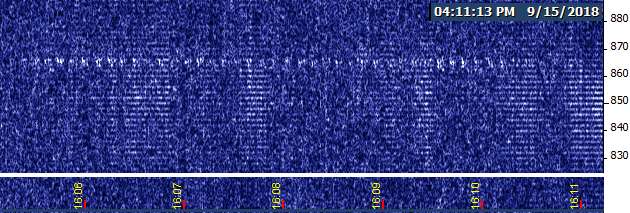
I was able to observe your fellow Carolinians, USC and NC earlier this afternoon (along with EDJ in Georgia and 7P in Arizona; picture in another post later), but then I had to be away for a while and didn't see your message until I returned home. Once I got back to the radio shack, it was late afternoon with weak signals and lots of codar...but after a few minutes, there was WAS! It was only faintly visible at first sight, but became audible around 4:06 and again around 4:10 PM CDT.
During the same band scan, there were only ragged traces of NC left at the watering hole, and FRC became slightly visible and very briefly audible at about 50% copy. No WV, MTI, GNK or anyone else.
---------------------------------------------------------------
File Attachment 1: 15sep-WAS.jpg
Re: ladder line?
Gentlemen, I appreciate the feedback. A lot of things to consider!!
PVC Back on
Posted by Ed Holland on September 16, 2018 at 02:42:29.
As the title says, PVC returned to the aetherwaves.
I wandered to the radio desk at around 1900 PST (DST) to find everything inoperative. I have no idea how long it has been out of action. Simple restoration to restart the sig gen, and the keyer.
I've received no reports while on the new frequency. It is still on the mystery channel :)
Cheers
Ed
Re: Sunday Hifers 9/9 (the other beacons)
Posted by John Davis on September 16, 2018 at 03:20:56.
In reply to Re: Sunday Hifers 9/9 (J1LPB WSPR) posted by John Davis on September 10, 2018
"There were numerous other stations copied on Sunday, and I'll do a report on them during the day Monday."
Well, apparently, given my part-time retiree workload, I can monitor OR I can report, so I'm a little behind on the latter.
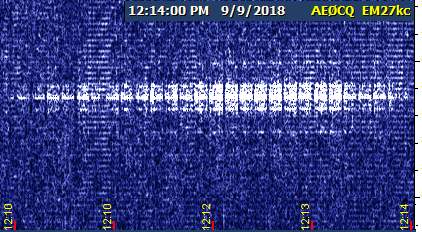
The remarkable reception of K6FRC that I alluded to in the first post of this thread is shown above. It boomed in with such clarity, well above the codar background, that I initially thought I was having a flashback to Solar Maximum, when that sort of thing would happen around local sunset or a little later. It's never been that good here so early in the day! I had to turn the speaker way down to save my hearing.
To emphasize a point I've made before, though, I should mention that even at its strongest, FRC barely budged the S-meter needle. That's usually the case with known-legitimate beacons, even during the best enhancements, and my system is intentionally set up for that result. I don't want AGC actively changing gain during weak signal work...although codar often foils that plan.
Other signals: WV was very good aural copy around 11:44 am CDT, but faded around 11:48 am. VAN was present visually before noon, but with its dashes-after-ID only. WAS was present just after noon. Then came the WSPR decodes I posted earlier.
At mid-afternoon's band scan, shortly before folks began fading away, I had brief copy of AZ for the first time in quite a while (2:21 pm). About an hour later, most signals were gone from the watering hole, but EH was very loud for a time. At 3:23 I was tuning to 13,557.71 when I caught a loud signal that seemed to key "MS" once in CW, then stopped. Seconds later, a weaker CW signal appeared a few Hz away that was keying something consistent with "PLM," but it faded before I could confirm that.
---------------------------------------------------------------
File Attachment 1: 9sep-FRC.jpg
Re: WAS Back Up
Tnx John for the report. Glad to get a report so soon after getting back on the air. Sig must be enhanced from the foot or more of rain we have had. Re: WAS Back Up
Bill
Posted by Bill Stewart, K4JYS on September 16, 2018 at 11:49:29.
In reply to Re: WAS Back Up posted by Adam/KE8DNU on September 15, 2018
Tnx Adam. Still getting a lot of rain, but very little wind. Musta had a bunch of rain during the night since the road ditches are full again. Have enjoyed the discussion on coax vs. ladder line. My non-technical view is that coax would be the most trouble free feed line. As mentioned, the wx can sure raise hob with the swr on ladder line. Plus you can adjust your xmtr pwr to compensate for the line loss. Re: WAS Back Up
Bill
Posted by John Davis on September 16, 2018 at 16:12:22.
In reply to WAS Back Up posted by Bill Stewart, K4JYS on September 15, 2018
...osc would not start...finger on the xtal did not do it...but a few puffs of my hot, moist breath got 'er going.
This makes me think you may not have a bias resistor at the oscillator gate. The Black Cat kit omitted provisions for that, which is usually considered a rather important part of a CMOS gate Pierce oscillator. A 2.2 megohm resistor soldered into the mounting holes for C4 (normally unused) might do the trick and give you more reliable restarts.
In fact, here is a schematic from the last issue of The LOWDOWN a few months back showing the modified circuit in use at HiFER VAN. Jim also included a buffer resistor between the gate output and C18, which involved a minor relocation of the hot lead of capacitor C18 to the crystal side of the C16 holes, and replacing the usual "C16" jumper with a small 1 K resistor. This tends to further improve oscillator reliability. (Edit: After posting the diagram, it occurs to me I may have discussed it before. But the 2.2 M resistor by itself may be enough to help with your situation, and should be relatively easy to retrofit.)
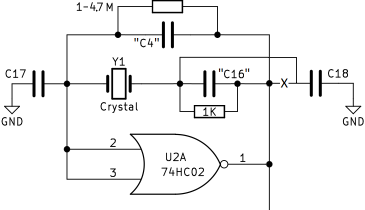
---------------------------------------------------------------
File Attachment 1: beacon-osc-1.png
Re: WAS Back Up
John, didn't you like my hi-tech osc. re-start method? Tnx for the tip. I will take a look at doing that when I get some time. I think the BlackCat info mentions that the osc. might be sluggish on re-start if the freq is pulled too far off the supplied xtal freq....which I did with the supplied capacitors. It's really not too much of a problem since it isn't turned off....except for pwr failures. And even then it will re-start on it's on, after a while, when the pwr has been restored. Your tip looks like an easy fix to try. My Current LF Strategy
Bill
Posted by John Davis on September 17, 2018 at 17:48:20.
Or maybe that's "stragedy," to borrow Bugs Bunny's term, since it hasn't been doing that much for me yet either.
With the hurricane approaching the Southeast last week and no major frontal systems pushing down from Canada, it was dry here and much quieter QRN-wise than recent months, especially in the mornings. So, I was out in the field every day and most of the nights too, knowing that a rainier pattern is expected for later this week again.
The seasonal change in 22 meter characteristics has meant mornings were unproductive there, so I spent some of the mornings watching for LowFER WM and others doing WSPR spots on 2200 m. I uploaded most of the latter to WSPRnet, but there was nothing resembling WM to report. A couple of days it was quiet enough that I typically should have seen WM, but I think Mike must be right about there being too much vegetation right now for decent transmit efficiency. In the late afternoons, after 22 m died away, the Arizona WSPR powerhouses were still evident through the increased static but there was no hope of copying Part 15 signals at LF.
Early evenings were even worse for static, so my hope was to set up Argo and watch one frequency from midnight through daybreak. I alternated between them; one night WM, the next, EAR. Traditionally, static starts diminishing by 2 AM on the central plains and LowFER skywave lingers until some time before daybreak. About 90 minutes to 2 hours before sunrise is when EAR fades abruptly, and 30-60 minutes prior to sunrise is when WM goes into a slower fade. But this year, the static has remained strong right up to daybreak, long after EAR has cut off, and too strong for WM to overcome thus far.
I'd mentioned a couple of weeks ago that my only other realistic target on 1750 meters might be WH2XVN on 183.5. No luck hearing it in the evenings so far, either. But then it dawned on me: the pre-sunrise fade that afflicts stations to the east of me before it gets around to taking out some of the static shouldn't work that way on signals from the west. The path from Burbank should remain open until (and maybe through) sunrise.
So, I gave that a try Sunday morning. I actually knocked off early Saturday evening to go home and catch up on sleep, then returned to the field an hour before sunrise. Static was down from the earlier S9+10 to only an S7 roar, but that was still way too much for normal speed CW. During the next hour, static slowly diminished (although there were occasional blasts from hunters about a mile away, probably shooting at each other more than actual deer in the dim twilight).
I was afraid signals from the west might be fading already too, so I occasionally used the memory function to switch over to 2200 m and used WH2XND and WH2XXP to confirm that the path was still solid. If I could hear the WSPR carriers tweedling away, or better yet, copy the CW IDs at the end of the transmission slots (since XVN is exclusively Morse), then I knew it was OK. That remained the case until well after the landscape was bathed in daylight and average noise was under S1...but still no sign of XVN at all. I'll keep trying this approach intermittently, though.
An interesting side note: the two Arizona WSPR beacons operate with such good synchronization that, in the absence of an Argo trace, I can't tell which is which or whether they're both on until two-thirds of the way through the Morse ID. The WSPR software always reports their time differential as being within 0.1 second of each other, but it's actually much closer. The normal speed CW IDs overlap so perfectly that it sounds like a single transmitter keying "WH2X," and only then breaks out as "ND" or "XP;" or most often, when they're both within a few dB of each other, the final two characters become a confusing mush. Even the 20 Hz beat note between the two signals seems to be coherent with the dot speed and never causes a problem that I've been able to hear.
In fact, it's when XXP became distinctly dominant that I realized the path from the west was changing enough that I should pack it in for the night, at least at LF.
John
Re: My Current LF Strategy
Posted by Jason Goldring on September 17, 2018 at 23:23:48.
In reply to My Current LF Strategy posted by John Davis on September 17, 2018
"The seasonal change in 22 meter characteristics has meant mornings were unproductive there, so I spent some of the mornings watching for LowFER WM and others doing WSPR spots on 2200 m."
This was a fantastic post John and I quoted above to see what type of input others might offer regarding 22m.
In as much as I would love to explore the lower depths I personally find myself back into 44 & 22m bands. Even EAR, hard time picking up on that, yet I feel that I should be able to get a trace - however other traces have been picked up around that range which have never been there before. And frankly, the outcome is really nothing really more than an inkling that it might be a purposed transmission.
I stand to offer the question about the other perceptions of the Part 15 bands, thoughts on recent spots or lack thereof. What you have had luck with. What has been a dry well?
Jason
Re: My Current LF Strategy
Posted by Ed, KI6R on September 19, 2018 at 17:04:22.
In reply to My Current LF Strategy posted by John Davis on September 17, 2018
Hi John, Re: My Current LF Strategy
Thanks for your analysis regarding noise conditions on the bands. I have just gotten on the 630m band and made a few CW QSOs. It appears to me that this game is going to be all about coming up with a really good quiet receive antenna. 1750m band reception was a constant search for a better active whip or narrowing IF and audio filtering to copy the CW station in the noise. Reception was always better if one hiked out into the countryside somewhere a few miles from AC power and set up a portable receiver, active whip and active audio filter. I've been using my 37' 1750m vertical re-tuned to 475 kHz for both transmit and receive. I had to add a bandpass filter on the receive side to avoid crushing my Flex-6300 front end with 313 KHz DGPS and 710 kHz AM. I've made a few CW QSOs but I'm usually scratching the signal out of the noise with 50-250 Hz bandwidth and audio peaking. I'm going to try to build a large varactor tunable receive loop to see if it will improve the S/N situation. 73, Ed, KI6R
Posted by Ward K7PO on September 20, 2018 at 05:09:57.
In reply to My Current LF Strategy posted by John Davis on September 17, 2018
John,
That's an interesting observation about Ron and I's transmissions. Not surprising to me though, as our stations are identical except for the antennas, and even they are somewhat similar. Both XXP and XND are running U3S/GPS exciters driving W1VD amps.I built all the equipment here on a sort of 'assembly line'. I built the exciters first, then geared up for a massive amplifier 'build-a-thon',with several 630m, 2200m, and 4000m amps for each of us. Every effort was made to keep the all the equipment the same to allow substitution or combining later on if needed. We quickly determined on 630m at least, that we would not be able to run more TPO than one amp would comfortably put out and stay within the ERP limits of our grants. 2200m is a different story, although Ron has no fear in the "running high power department" and usually runs somewhere around 700W - 800W TPO for a bit over 25W ERP. I, on the other hand, know the guy that built the amps, so I'm at just under 5W ERP on 2200m. So far, XXP is still on the original transistors over a year later. We may revisit the combined amp setup at XND later this season.
Are you still seeing what I call our SR/SS "twist"? I sure wish I could understand that difference in our antennas. A lot of empirical evidence suggests lower angle from XXP(?)
Oops, sorry this got so long winded.
Ward K7PO/WH2XXP LOWDOWN back issues
Tonopah, AZ
Posted by Lance Ashlock on September 20, 2018 at 15:16:47.
Hi everyone. interested in getting back in to this hobby and was looking for some back issues of The LOWDOWN from the 1980's. Want to subscribe to the current issues too. One problem is the e-mail address given to reply to HQ.LWCA at gmail.com is not working and sends back error messages.
630M REports
Posted by Tom N8TL on September 22, 2018 at 14:26:47.
Issued SWL QSL(s) this morning to VE7CNF (1975 mi) and NU6O (2143 mi) for their 630M PBJ off temporarily
Signals. Thanks to both. Tom N8TL
Posted by Chris Waldrup on September 22, 2018 at 16:24:41.
Hey Guys,
I finally made arrangements with the tree guy to remove the huge double trunk white oak that supports my Hifer inverted V.
He asked I remove the antenna and not redeploy nearby until he’s done just so he doesn’t take it down with his bucket truck. It will go in a nearby tree but till he’s done I will be QRT.
Chris Re: PBJ off temporarily (& mystery sig)
KD4PBJ
Posted by John Davis on September 22, 2018 at 19:13:45.
In reply to PBJ off temporarily posted by Chris Waldrup on September 22, 2018
Thanks for the update, Chris, and I'm sure glad the ionosphere let you through on Thursday morning for a little while. It's the first time I'd seen you in some weeks.
There was also a mystery QRSS-like signal wandering around about 20-30 Hz below PBJ, too. Never got consistent copy on it; something new to watch for, perhaps. Unlike most random pseudo-signals that occasionally appear in this part of the band, it seemed to have plausible dot-dash timing ratios. (The odd tilt in the codar bands is because I rotated the waterfall some to compensate for receiver warm-up drift.)
John
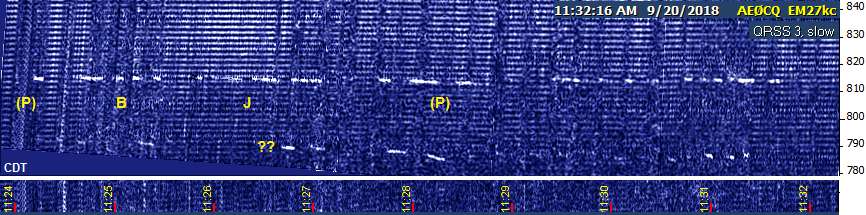
---------------------------------------------------------------
File Attachment 1: 20sepa1.jpg
WA4SZE/B
WA4SZE/B is on 475KC FSK id 170 HZ.
Antenna used is 190 foot high vertical antenna 500 foot long #8 radials. Loading coil is 3/4 inch copper tubing. vertical element is 3/8 inch cable about 190 feet long /high phase of carrier is set at -90 degrees for lane counting experiment
Re: 630M REports
Posted by Tom N8TL on September 23, 2018 at 13:15:55.
In reply to 630M REports posted by Tom N8TL on September 22, 2018
Propagation on 630M definitely picking up with fall WX change. Today, I logged ZF1EJ, VE7BDQ, and, K9FD in Hawaii. Also had a decode from 9O2XXN, but, not sure if it is valid from the Congo Republic.
Catch-up: Mon 10 Sept
Posted by John Davis on September 23, 2018 at 18:11:43.
In reply to Re: Sunday Hifers 9/9 (the other beacons) posted by John Davis on September 16, 2018
In this sub-thread I'm going to try to catch up on past due reports. My imaginary dog ate them...
Monday the 10th was mainly an LF day, but I took a break on 22 m for an hour and a half before solar noon to shortly after, just in case something interesting might turn up. Nothing too remarkable did, but I am attaching one watering hole capture that turned out to be pretty representative of typical mid-days lately: NC, 7P in there too but somewhat broken up by QSB, EH, and MTI, although it appears only rarely any more. Sometimes entire days go by without it now. Times in the image are CDT, and frequency was corrected to better than ±2 Hz.
Elsewhere during band scans:
1153a WV faint; visual but no aural copy til 1155a
1203p no WAS, then visual after 1204, then audible by 1206p
1208p visual maybe FRC, not audible, but WAS now
       very clear until fade ~1210; then still partial copy
---------------------------------------------------------------
File Attachment 1: 10sepa.jpg
Re: Catch-up: Mon 10 Sept
Hopefully i'll begin to get reports! Beginning to think 22 meters doesn't like me haha
Thanks for your updates, John. They are always enjoyable to read :)
73, Adam
Re: Catch-up: Tue 11 Sept
Posted by John Davis on September 23, 2018 at 20:32:29.
In reply to Catch-up: Mon 10 Sept posted by John Davis on September 23, 2018
During the 9 o'clock hour CDT it looked as if USC might join NC, 7P, and EH at the watering hole, but both it and MTI were only part time visitors until mid-day.
Codar was very strong at times throughout the day, but when it wasn't too overwhelming, I could sometimes see a narrow band of excess RF around 13555.495 kHz that looked as if it could be a keyed carrier. But after further review of the day's captures, I noticed other similar bands spaced about 45 Hz apart all across my CW filter's response, so it's probably something else. One of the files attached to this post shows a few of the bands in the upper part of the watering hole at a later hour when USC was doing well, 7P and NC were in collision, and EH was absent.
There was also a chirper present just below MTI nearly every time MTI was visible during the 9 AM hour, and absent most of the time when MTI wasn't showing. It was sending a poorly spaced pseudo-CW "I" or "EE" like the ones I sometimes hear around 13557 kHz. There is a capture that shows an instance of it along with some of the aforementioned noise bands that I may also attach. Whatever it is, this one may well be from the Atlanta vicinity, given how closely it tracked the propagation of MTI's signal.
Elsewhere, WV was fair copy at 1:13 pm CDT. At 1:22 pm. there was a moderately strong carrier at 13564.130, which later exhibited QSB but no sign of modulation. There was also a fair amount of broadband noise from 13566 on up quite a ways.
At 1:24 pm, P was fair to weak. First time I'd copied it in quite a while!
John
---------------------------------------------------------------
File Attachment 1: 11sepa.jpg
File Attachment 2: 11sepb.jpg
Re: Catch-up: Wed-Thu 12-13 Sept
Nothing remarkable these two days. No one logged with any certainty outside the watering hole, and almost the only captures there were NC, 7P, and USC.
I say "almost" because there was one partial and one sorta-complete cycle of QRSS and WSPR from K5LVB during the noon hour of the 13th (not quite enough to decode), accompanied by some instances of MTI. See attached.
---------------------------------------------------------------
File Attachment 1: 13sepb.jpg
Re: Catch-up: Fri-Sat 14-15 Sept
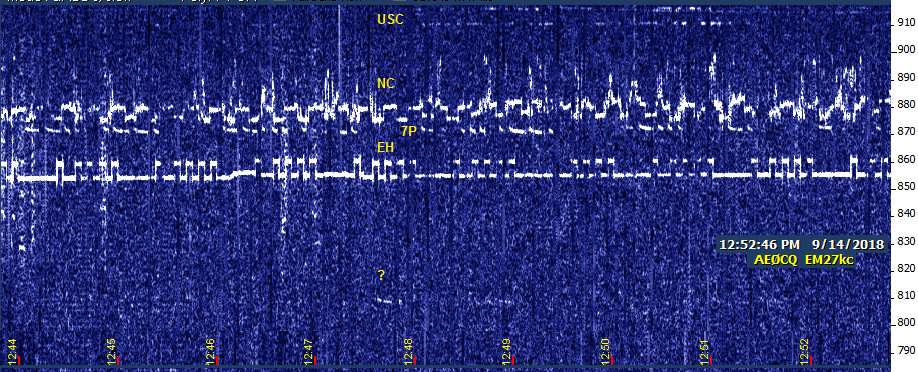
Friday the 14th: Codar was moderate in the latter half of the 10 AM CDT hour, but WV was still pretty fair copy. At 10:59 am, while trying for PLM, I heard random keying somewhere above it in frequency, then saw something that looked like a keyed signal near (but not exactly where) where PLM should have been until codar covered it up. VAN's dashes showed up at 11:05 am, but no aural copy. K6FRC was intermittently audible, although a heavy band of codar was parked right over it.
Next I sat on the watering hole for a while (see above), where USC and NC were still making it through despite Hurricane Florence. The NC signal looks as if the transmitter was being shaken pretty badly, though. In the 2 PM hour, a band scan turned up some chirpers and random keyed signals but no beacons outside the watering hole.
Saturday the 15th: WAS was back on, as reported previously in another thread. NC had settled down, and USC was good and healthy. (See other attached file.) WV put in an anemic appearance late in the 9 AM hour, and FRC was sometimes audible through the codar just after 4 PM.
---------------------------------------------------------------
File Attachment 1: 14sepa.jpg
File Attachment 2: 15sep-waterhole.jpg
WSPR on 2200 and 630 M
The 1750 meter band continues to thwart me thus far this year. No EAR at night, no WM by night or day, so I've continued to monitor and upload logs on 2200 m. That's mostly been WH2XND and WH2XXP in recent days, so after HiFER ceased to be productive this afternoon I thought I'd try something different and go to 630 m.
I suspect 630 should now be renamed the Goth Band, however. Unlike the good ol' Part 5, pre-ham era, there are no longer any "day dwellers" about, apparently only children of the night. So, I decided to go back to 2200 and watch the day/night transition again. Not long after sunset, somebody else showed up! Brief excerpt:
0028 -28 -1.1   0.137507  0 WH2XXP DM33 37
0028 -26 -1.1   0.137527  0 WH2XND DM33 43
0032 -27 -1.0   0.137527  0 WH2XND DM33 43
0036 -26 -1.0   0.137527  0 WH2XND DM33 43
0038 -24 -1.1   0.137438  0 N1BUG FN55 30
0040 -25 -1.1   0.137528  0 WH2XND DM33 43
0044 -24 -1.2   0.137438  0 N1BUG FN55 30
0044 -24 -1.1   0.137527  0 WH2XND DM33 43
0048 -31 -1.0   0.137507  0 WH2XXP DM33 37
0048 -21 -1.1   0.137527  0 WH2XND DM33 43
0050 -24 -1.1   0.137438  0 N1BUG FN55 30
0052 -27 -1.1   0.137507  0 WH2XXP DM33 37
0052 -18 -1.1   0.137527  0 WH2XND DM33 43
0056 -27 -1.1   0.137507  0 WH2XXP DM33 37
0056 -17 -1.1   0.137527  0 WH2XND DM33 43
0100 -26 -1.0   0.137507  0 WH2XXP DM33 37
0100 -17 -1.1   0.137527  0 WH2XND DM33 43
0102 -30 -1.0   0.137438  0 N1BUG FN55 30
0104 -27 -1.1   0.137507  0 WH2XXP DM33 37
0104 -20 -1.1   0.137527  0 WH2XND DM33 43
0108 -25 -1.2   0.137507  0 WH2XXP DM33 37
0108 -24 -1.2   0.137527  0 WH2XND DM33 43
0112 -27 -1.1   0.137507  0 WH2XXP DM33 37
0114 -26 -1.1   0.137438  0 N1BUG FN55 30
0116 -27 -1.3   0.137507  0 WH2XXP DM33 37
0120 -23 -1.1   0.137507  0 WH2XXP DM33 37
After the post-sunset fades were over and XND was once again stronger than XXP (around 9:30 PM CDT), I returned to my 630 meter plan and turned up these decodes fairly quickly:
0244 -15 -0.7   0.475625  0 K2BLA EL99 23
0244 -18 -1.0   0.475794  1 KU4XR EM75 33
0252 -19 -0.8   0.475625  0 K2BLA EL99 23
0254 -15 -0.9   0.475792  1 KU4XR EM75 33
I'm continuing to monitor 630 tonight and will follow up tomorrow when I return from the field.
John
Re: WSPR on 2200 and 630 M
Posted by John Davis on September 24, 2018 at 23:14:45.
In reply to WSPR on 2200 and 630 M posted by John Davis on September 24, 2018
The remainder of the night yielded over 300 decodes on 630 meters. Some of the call signs were quite familiar in the longwave community, like KU4XR, VE7BDQ and KA7OEI. Many of the others were new to me, including the last one that I don't quite believe. :)
A tiny sample:
Timestamp          Call    MHz       SNR Drift Grid      Pwr    km   az

 2018-09-24 02:54  KU4XR   0.475792  -15  1  EM75xr 	 2    1003  282
 2018-09-24 03:04  K2BLA   0.475625  -20  0  EL99hb 	 0.2  1560  309
 2018-09-24 03:30  WD8DAS  0.475720  -28  0  EN52hx 	 1     816  219
 2018-09-24 03:52  KA7OEI  0.475740  -18  0  DN40ao    	 0.5  1506  100
 2018-09-24 04:14  KE7A    0.475749  -12  0  EM12kx      1     493   21
 2018-09-24 05:10  ZF1EJ   0.475696  -26  0  EK99ig      2    2396  329
 2018-09-24 05:36  AA8HS   0.475700  -24  0  EN81        1    1147  249
 2018-09-24 05:42  KM5SW   0.475704  -25  0  DM65        0.5  1082   77
 2018-09-24 06:12  K9FD    0.475617  -30  0  BL11je      1    6173   59
 2018-09-24 06:24  VA7MM   0.475659  -24  0  CN89og      2    2597  111
 2018-09-24 06:30  WB3AVN  0.475704  -28  1  FM19og      5    1617  267
 2018-09-24 06:40  KJ6MKI  0.475762  -30  0  CM88oi     10    2428   85
 2018-09-24 09:00  VE7BDQ  0.475729  -25  0  CN89la      1    2605  110
 2018-09-24 09:38  AE2EA   0.475768  -26  0  FN12fr      0.2  1621  253
 2018-09-24 11:50  KJ6MKI  0.475762  -22  0  CM88oi     10    2428   85
 (and the final two decodes...I don't believe the last one, obviously:)
 2018-09-24 13:00  KE7A    0.475749  -19  0  EM12kx      1    493   21
 2018-09-24 14:20  806MWF  0.475723  -26  -3  LI83     200  15593  324
Re: WWV / WWVB Cuts
Many years ago, there was a joke about "What if Clear Channel bought WWV?". And, here we are. If the government cuts mean that WWV goes dark, what would be wrong with privatizing it and keeping som eor all of it on the air?
From what I read, the NIST has to make cuts. The cuts did not specify WWV. NIST can cut other parts of their budget and leave WWV alone if they choose.
Re: WWV / WWVB Cuts
Posted by John Davis on September 25, 2018 at 16:43:22.
In reply to Re: WWV / WWVB Cuts posted by Paul on September 25, 2018
Actually, the NIST budget proposal itself did specifically include cuts to the time dissemination broadcasts from Hawaii and Colorado.
As a mere mortal taxpaying citizen, I have no access to information on what's happened lately, but buried in the scandal headlines last week was some brief mention that Congress had passed a spending plan.* And now, WWV is announcing in the fourth minute of each hour that the audio broadcast is available by telephone. Putting two plus two together...we may not actually be able to say "four" just yet, but the answer looks a lot like it's going to be in that vicinity.
As for the Clear Channel/i♥Monopoly approach, that raises the "show me the money" issue. A non-profit entity might be able to operate a shortwave substitute economically for a few years until the government comes to its senses (I've got the perfect location for an antenna farm in Kansas), but there is no economical substitute for WWVB...the one used by far more people, even though they don't know it.
There's also the regulatory maze. The FCC has reserved WWVx call signs for time signal services, but there is no regulatory framework for a private time signal station. At present, it would probably have to operate under Part 5. And internationally speaking, time dissemination is recognized as a governmental function. The BIPM is a multi-national agency. Even countries that farm out transmission to the private sector still have to maintain government oversight of the contracts and verify their compliance. Nothing like that is in the NIST plan right now...another reason why it would probably have to be done as an interim Part 5 deal, if or when we ever get official words of what's happening with WWV.
John
* Edit: Turns out it was only the Senate at that time, not the whole Congress. As of 26 September, there's still no full-year appropriation, but a temporary spending bill is in place to keep the government going through 7 December. Searches of the Senate's appropriations website turns up NO details!
Tuesday 25 Sept
Posted by John Davis on September 25, 2018 at 17:05:20.
I feel like I'm getting ahead of myself by posting this before I've caught up on reports, but it's timely news. At mid-morning, conditions today are far better than they were yesterday. EH, 7P, NC, and traces of USC were already showing up at the watering hole, and MTI was there some minutes too.
WV was fair (it was absent entirely yesterday). VAN's dashes were present, then suddenly one entire cycle of three IDs showed up. WV was excellent after it came out of a fade, and so was K6FRC! I hope to post MP3 files of the latter two later, if I can find a good converter, as the WAV files are too big to post here.
John
Re: WWV / WWVB Cuts
Posted by ed holland on September 25, 2018 at 19:47:05.
In reply to Re: WWV / WWVB Cuts posted by John Davis on September 25, 2018
Good grief!
Although.... all this puts me in mind of building the ultimate HiFER or, indeed, amateur beacon, if one wanted to get silly and use actual Watts.
About $500 on ebay will get me a Rubidium frequency standard. Perhaps a cunning Wadley loop or PLL approach could place this neatly on the frequency of choice. Keying clocked from the master oscillator to provide time data.
Home made time & frequency signals anyone?
Ed
Re: Tuesday 25 Sept
Posted by John Davis on September 27, 2018 at 14:32:05.
In reply to Tuesday 25 Sept posted by John Davis on September 25, 2018
Here, at last, are the promised MP3 recordings of WAS and K6FRC. Both include three repetitions of the ID, and both are afflicted with codar pulses.
It sounds as if I faded down the WAS recoding after the second ID, but keep listening... that's just the codar signal going into a deep fade for a few moments. It leaves the final CW instance out in the open, nice and clear.
K6FRC is a little harder to hear in this file than it was in real life. My radio's speaker apparently has a resonant peak right where FRC's audio pitch happened to fall, and my computer speaker doesn't, so the signal is less enhanced than it originally was to the ear. The very first instance is the best one, so try to be ready right at the beginning. The start of the second instance is lost under the tail of a pulsed emission, of a type I've only recently begun to hear on the band, Both codar and the signal are in a slow fade by the third one.
John
---------------------------------------------------------------
File Attachment 1: was1c.mp3
File Attachment 2: frc1.mp3
Re: LOWDOWN back issues
This is the only report I have had of issues with the HQ address. It has been working normally, as near as I can tell. Possibly this was an intermittent problem with Gmail. All is verified OK as of this hour...
LOWDOWN in the mail!
Posted by Kevin Carey on September 27, 2018 at 20:27:27.
If you are an LWCA member, your issue of The LOWDOWN should arrive within the next day or so. We once again have a full 40 pages of articles and information for you in this issue.
Please be sure to check your mailing label to find your expiration date. For example, '119' indicates expiration after January 2019; '1218' indicates expiration after December 2018). Not currently a member? We welcome you to join by visiting the 'About LWCA' tab on the www.lwca.org website right now. A PayPal option is available, and all new members will receive the latest issue, while extra supplies last.
If you are a member and have not yet provided your email address to headquarters, please do so now by sending a message to HQ.LWCA@gmail.com. This allows us to stay in touch between issues. We are considering an experiment with PDF distribution as an **adjunct** to the traditional, printed version of The LOWDOWN. Note that there is no plan to replace the printed version received by our members.
73, & best LW DX!
--Kevin
Re: Thur 27 Sept
Posted by John Davis on September 28, 2018 at 04:18:13.
In reply to Re: Tuesday 25 Sept posted by John Davis on September 27, 2018
No monitoring session at all on Wednesday the 26th.
Thursday at mid-day, only NC was present at the watering hole. WAS showed up and was briefly audible, but nobody else whatsoever turned up on the band today (other than codar, of course, of which there were four...and sometimes their start times did not overlap).
Re: Tuesday 25 Sept
Posted by Bill Stewart, K4JYS on September 28, 2018 at 10:49:26.
In reply to Re: Tuesday 25 Sept posted by John Davis on September 27, 2018
Tnx John for the recording of WAS. First time I have heard it at a distance. Have tried a few of the Kiwi SDR rcvrs, but haven't heard it yet. I appreciate all of your detailed reports. Makes it worth running the electric bill up a tad....hi. NC & WAS
73 de Bill K4JYS
Posted by Jason Goldring on September 28, 2018 at 15:07:17.
Extremely quiet on the North coast of the Dominican however NC & WAS have been captured. Nothing more heard. Fading is prevalent but intervals of reception are generous. Re: WSPR on 2200 and 630 M
Sosua, DR.
Jason.
Posted by John Davis on September 28, 2018 at 16:31:03.
In reply to Re: WSPR on 2200 and 630 M posted by John Davis on September 24, 2018
Overnight on the 24th and 25th, most of the same call signs decoded here at EM27kc, along with some additional ones (only one example of each, but all were present more than once):
Timestamp        Call   MHz      SNR Drift Grid   Pwr  km    az

2018-09-25 02:10 WA9CGZ 0.475619 -21   0   EN61ch 0.5  786  236
2018-09-25 02:52 NU6O   0.475671 -29   0   CN70vr 1   2536   90
2018-09-25 04:50 KR6LA  0.475661 -30   0   CN90ao 2   2347   91
2018-09-25 06:56 WA3ETD 0.475721 -25   0   FN33lq 2   2001  256
Re: WSPR on 2200 and 630 M
Didn't go to the field on the evening of the 26th, but I was out again last night. Kind of a good thing I did, because conditions were a bit different and there were also different stations on, waiting to be snagged.
The 27th-28th started out with K5DNL (EM15lj) whose 2 W at only 256 km distance was blasting away at +10 dB SNRr in the 2328 UTC time slot. It continued to be the only station copied until 0030, when WD8DAS joined in. By then, QRN was picking up too, so K5DNL was under 0 dB by then, but still the strongest thing on the band. Twelve minutes later, KE7A and WA9CGZ appeared, and eventually the others I've mentioned over the past couple of posts.
W4BCX on 0.475710 was new at 0222 (-24 dB, EL98pd, 5 W, 1675 km) but that was the only time it appeared.
KN8DMK turned up at 1034 on 0.475652 with -33 dB, the lowest SNR I've ever seen decode. He's in EM89oo with 2 W (1110 km). It squeaked through again at the same SNR at 1048 UTC.
The hour between sunrise and 1306 UTC was mainly from W6 and K7 lands, the final one being KE7A, whose last decode was at -20. At that point, either the band died or the battery on my radio did or everyone shut down. But BEFORE that were these two decodes mixed in among the others!
2018-09-28 12:02  VK4YB  0.475797  -24  0  QG62ku  5  13650  62
2018-09-28 12:08  VK4YB  0.475797  -22  0  QG62ku  5  13650  62
My first Australian on 630 meters!
Re: NC & WAS
Holy cow, Jason....mni tnx for the DX report on WAS. I wonder if you could pass along the time of reception. Also, if you can pass along your mailing address, I will send a QSL. Friday 28 September
73 de Bill K4JYS
Posted by John Davis on September 29, 2018 at 00:00:15.
Pretty dismal this morning here in Kansas...just EH at the watering hole and a hint of WAS before codar wiped out nearly everything. When I left to get a bite to eat about noon, things weren't much better; a bit of 7P and a little NC too, but even more codar. When I returned, though, there was WSPR on the Argo screen, something I hadn't counted on. By the time I started up WSPR 2.12, there was just enough time to capture this before codar and changing propagation made things impossible again:
1748 -25 -0.4  13.555413  0 J1LPB FN03 0
1750 -24 -0.3  13.555414  0 J1LPB FN03 0
1752 -27 -0.4  13.555415  0 J1LPB FN03 0
One unusual thing I noticed about codar this time was that it tended to be concentrated in comparatively steady bands about 8 Hz wide, spaced around 68 Hz apart. That was in addition to selective QSB forming the usual psychedelic patterns in between those bands. (See attachment.)
Codar diminished later, but then the signals also began to fade shortly thereafter. Never did hear or see WV, VAN, FRC, or most of the usual suspects today.
---------------------------------------------------------------
File Attachment 1: 28sepa.jpg
EDJ back on 555.420 Long Frame
I mainly run beacon on the weekends, when I can pull the plug if needed. Back on until TS threaten, not likely for the next few days.
Running 55 min QRSS3 frame with 4 min cal cycle. Starts at the top of the hour :00.
I'm thinking a longer frame will allow for freq stabilization.
Bob Saturday 29 September
EDJ
Posted by John Davis on September 29, 2018 at 20:50:40.
In reply to Friday 28 September posted by John Davis on September 29, 2018
Codar was already strong when I first turned on the radio this morning, even though that was earlier than yesterday. NC and EH were present, with 7P making fitful intermittent appearances between them. When I broke for a band scan about 11:30 AM CDT, WV was able to make a brief but fair appearance before codar wiped it out less than a minute later, and a little keying was audible from (probably) K6FRC before it too got obliterated again.
After that scan, I saw faint traces of WSPR wedged between the codar bands back at the watering hole, just after 11:44. I was ready this time and started WSPR immediately. The attached Argo capture shows the chaotic RF environment at that time. Right at noon (1700 UTC) J1LPB became strong enough to decode. (The Argo capture has been corrected for frequency to within +1/-2 Hz, but the WSPR decodes haven't been.)
1700 -17 -0.4  13.555407  0 J1LPB FN03 0
1702 -24 -0.4  13.555407  0 J1LPB FN03 0
1704 -26 -0.5  13.555407  0 J1LPB FN03 0
1706 -25 -0.8  13.555407  0 J1LPB FN03 0
1708 -25 -0.6  13.555407  0 J1LPB FN03 0
1710 -19 -0.5  13.555407  0 J1LPB FN03 0
1720 -28 -0.5  13.555408  0 J1LPB FN03 0
1724 -25 -0.4  13.555408  0 J1LPB FN03 0
1726 -30 -0.5  13.555408  0 J1LPB FN03 0
1728 -24 -0.6  13.555408  0 J1LPB FN03 0
J1LPB wasn't decodable after 12:30, and wasn't even visible any more after 12:33 PM. The path was apparently only open while solar noon was between us.
Just after 12:17, there was a bit of what appeared to be slow FSK at EDJ's frequency, but might have been something else. It only lasted 15 seconds; not enough for even one full character. There was no MTI again today, either, suggesting that the first skip zone is still expanding with the change of season. Bummer, as the young people used to say.
---------------------------------------------------------------
File Attachment 1: 29sep03.jpg
Re: Saturday 29 September
John, thanks so much for this update. I was shy on the info before I left for the DR, but I had shut down QRSS and CW to give me a longer reception window for WSPR decodes, returning to my home to see what was visible, rather than going through the screen grab process.
Long story short, Data is cheap and WiFi is plentiful, when it works. Unfortunately open WiFi, as the wife and I were out and about town, leads to data breach issues, so we have VPN connections back to Canada and the US when we are abroad, latency and overloading leads to long page loads on screen captures - Was not going to work while commuting.
I was actually at the receiver earlier in the week when I heard the other stations I mentioned (info forthcoming but the wife insists I at least unpack), alas no WSPR on J1LPB.
As much as I tried to make a decent setup the salt air absolutely kills exposed wires and connectors, in this case, the junction box leading to an inverted V seemed intact until I pulled the cover off, to much dismay, a mess. So much for outdoor electrical boxes. They really need to be airtight. After a reinstall, things seemed better but I could only tell by "La Pulga" which has a AM broadcaster going, maybe 3/4 of a mile away, playing an age old advertising commercial over and over.....if I can hear that the antenna is "working".
Landed back in Toronto tonight, chill in the air and I am wearing shorts. Not a good plan. Lots of catch-up to do but again, your reports are greatly appreciated.
Jason
Re: WSPR on mainly 630 M
Posted by John Davis on September 30, 2018 at 16:01:24.
In reply to Re: WSPR on 2200 and 630 M posted by John Davis on September 28, 2018
Gave 630 m a shot yesterday afternoon after 22 m died, but still no day dwellers, so after a futile hour there I parked on 2200 m and got decodes of XND and XXP well into the evening. Finally switched back to 630 m again and stayed awake long enough last night to compare Argo views with the WSPR 2.12 decoding process.
Was dismayed to realize how many decodes I was missing because of the strength of K5DNL at times. This is a problem I'd observed before when 630 was occupied only by Part 5 licensees. A strong enough WSPR signal becomes a mush of 1.46 Hz sideband lines that take the software more than one entire transmission time slot to decode--and sometimes not even then. Result: at least one and sometimes two or more time slots never get decoded. During those slots, other stations have come and gone! If the decode process extends beyond the immediate next time slot, the one after that doesn't get recorded, so you can't go back and manually force a decode later. It really is possible to have too much of a good thing...
On the plus side last night, I did snag a few new ones along with the regulars:
2018-09-30 10:40  WB3AVN  0.475677  -28  1  FM19og  5 W 1617 km (one time only)

2018-09-30 10:46  W0DJK  0.475700  -28   0  EN34gh  50  814
2018-09-30 11:10  W0DJK  0.475700  -31 	 0  EN34gh  50  814
(twice only; clearly not running 50 W EIRP; may have been reporting TPO instead)

2018-09-30 05:08  VA3TX  0.475737  -30 	 0  EN94wi  10  1496 km
2018-09-30 09:14  VA3TX  0.475737  -24 	 0  EN94wi  10  1496
(these two times only)
ZF1EJ was joined once by "ZF1EC," but that was probably an erroneous decode because no such call is found by QRZ.com.
Perhaps the neatest thing about the night is what I saw when I returned to semi-consciousness. In the final hour before daybreak, I had decodes from W0DJK, KM5SW, WD8DAS, a final one from KU4XR, and:
1124 -24 -1.4   0.475786  1 KU4XR EM75 33
1130 -19 -1.3   0.475749  0 KE7A EM12 30
1134 -14 -1.2   0.475749 -1 KE7A EM12 30
1138 -16 -1.4   0.475749 -1 KE7A EM12 30
1142 -15 -1.4   0.475749  0 KE7A EM12 30
1146 -11 -1.2   0.475749  0 KE7A EM12 30
1154 -16 -1.3   0.475749  0 KE7A EM12 30
1158 -20 -1.4   0.475749  0 KE7A EM12 30
1202 -18 -1.4   0.475749  0 KE7A EM12 30
1206 -23 -1.4   0.475749  0 KE7A EM12 30
1210 -26 -1.4   0.475749  0 KE7A EM12 30
1218 -29 -1.4   0.475749 -1 KE7A EM12 30
1232 -25 -1.4   0.475749 -1 KE7A EM12 30
1236 -21 -1.3   0.475749  0 KE7A EM12 30
1244 -20 -1.4   0.475749  0 KE7A EM12 30
1248 -16 -1.5   0.475749  0 KE7A EM12 30
1256 -20 -1.3   0.475749  0 KE7A EM12 30
1300 -19 -1.4   0.475749  0 KE7A EM12 30
1306 -22 -1.4   0.475749  0 KE7A EM12 30
1310 -18 -1.5   0.475749  0 KE7A EM12 30
1314 -18 -1.5   0.475749  0 KE7A EM12 30
1320 -17 -1.4   0.475749  0 KE7A EM12 30
1324 -19 -1.4   0.475749  0 KE7A EM12 30
1332 -18 -1.5   0.475749  0 KE7A EM12 30
1338 -18 -1.4   0.475749  0 KE7A EM12 30
1342 -18 -1.4   0.475749  0 KE7A EM12 30
1348 -17 -1.5   0.475749  0 KE7A EM12 30
1354 -17 -1.5   0.475749  0 KE7A EM12 30
1402 -19 -1.5   0.475749  0 KE7A EM12 30
1408 -22 -1.5   0.475749  0 KE7A EM12 30
KE7A was still going at 9:21 AM CDT, over two hours after sunrise, when I returned to town for breakfast and this report.
Re: WSPR on 630 M
KE7A continued another hour this morning, then most likely shut down. Certainly wasn't showing any signs of fading away! As it turns out, he's only 300 miles away, almost due south in Texas...but that's still pretty darn good for 1 watt on MF in daylight!!!
1416 -23 -1.5   0.475749  0 KE7A EM12 30
1422 -24 -1.4   0.475749  0 KE7A EM12 30
1430 -18 -1.7   0.475750  0 KE7A EM12 30
1436 -17 -1.6   0.475750  0 KE7A EM12 30
1446 -17 -1.5   0.475750 -1 KE7A EM12 30
1454 -17 -1.4   0.475750 -1 KE7A EM12 30
1500 -17 -1.6   0.475749  0 KE7A EM12 30
1504 -18 -1.6   0.475749  0 KE7A EM12 30
1508 -17 -1.6   0.475749  0 KE7A EM12 30
potrzebie