Re: New 22m Beacon Testing
The beacon remains off the air for a some minor modifications. These modifications include eliminating a pretty bad chirp that exists as well as determine why the solar cell shuts down the beacon when under full sun (full power input of 30MW @ 5V), but does reasonably well when under partial sun. More to come.
Re: 22 m beacon QSY
Posted by Ian D Baines on September 02, 2019 at 13:31:52.
In reply to Re: 22 m beacon QSY posted by John, W1TAG on August 27, 2019
Thanks
Weekend HiFERs
Posted by Ed Holland on September 03, 2019 at 17:51:05.
Here at PVC, a near continuous session of 22m loggings was made during daylight hours during the "Labor Day Weekend". There was rather little to show for this, excepting a very few perhaps minute long snippets, usually EH or NC. I think 7 P made a discontinuous appearance in the late afternoon of Sept 2nd.
Saturday and Sunday (roughly the peak of the magnetic storm) were certainly the quiet days and conditions were extremely quiet. Even the mid band QRM was well down, S3 or lower. On a good day, this may come up to S5.
Beacon PVC is back on, but may go off air for listening sessions in the evening (Roughly 0100 to 0300 UTC, 6-8pm PDT).
Cheers
Ed
Re: Weekend HiFERs
Posted by Ed Holland on September 04, 2019 at 21:29:44.
In reply to Weekend HiFERs posted by Ed Holland on September 03, 2019
The early evening monitoring session yesterday (Sept3) was just as unpromising. No "Sunset Lift" occurred whatsoever. I was hopeful, as the geomagnetic conditions had returned to a quieter state compared to the weekend.
Re: ISM Band at 40.660 MHz?
Posted by Ed Holland on September 04, 2019 at 22:37:37.
In reply to Re: ISM Band at 40.660 MHz? posted by Ed Holland on August 30, 2019
looking again at the 49 MHz band, one is allowed more field strength in the range 49.82-49.90 MHz.
"The field strength of any emission within this band shall not
exceed 10,000 microvolts/meter at 3 meters. The emission limit in this
paragraph is based on measurement instrumentation employing an average
detector. The provisions in Sec. 15.35 for limiting peak emissions "
But later in the subsection, there is the statement:
" (c) For a home-built intentional radiator, as defined in
Sec. 15.23(a), operating within the band 49.82-49.90 MHz, the following
standards may be employed:
(1) The RF carrier and modulation products shall be maintained
within the band 49.82-49.90 MHz.
(2) The total input power to the device measured at the battery or
the power line terminals shall not exceed 100 milliwatts under any
condition of modulation.
(3) The antenna shall be a single element, one meter or less in
length, permanently mounted on the enclosure containing the device.
(4) Emissions outside of this band shall be attenuated at least 20
dB below the level of the unmodulated carrier."
I suppose the field strength limit is the absolute restriction, but the 100 mW input power could confuse things if not read carefully.
Ed
Re: ISM Band at 40.660 MHz?
Posted by Bob WA1EDJ on September 04, 2019 at 23:59:00.
In reply to Re: ISM Band at 40.660 MHz? posted by Ed Holland on September 04, 2019
Thanks Ed!
Yes, I've known about the 49 MHz band and 7P apparently has a beacon there now.
It is a much more viable beacon band. 100mW can go a long way there. Problem is finding anyone to listen. 22M is tough enough. I would consider it for a 6M beacon.
I'm still in TX mode and seeing myself on DJJ's grabber, along with WM and NC.
I've got a new HB RX to test soon and will switching to RX then.
Later.....Bob
EDJ
Re: ISM Band at 40.660 MHz?
Posted by Ward K7PO on September 05, 2019 at 03:43:04.
In reply to Re: ISM Band at 40.660 MHz? posted by Bob WA1EDJ on September 04, 2019
Hey guys,
Yes, 7P 49'er is alive and well, right here in downtown Tonopah, AZ. My guess is I'm the only one who's ever heard it. Before my recent retirement, 7P was located at a site my employer controlled (2800' msl). From there it was easy copy 50 or 60 miles away. Now, here at the home QTH (~1000' msl), not so much.
It's been several years since I built it so I don't remember all the details, but it uses a 3.3V Epson oscillator chip, LPF, and some matching for the 1 meter antenna. I couldn't stay below 100 mw with the PIC keyer in the box, so I ran 3 wires to the RF box with the attached 1M antenna rod, GND, PWR, and KEY. Not sure if that's a bit of a stretch or not, but I believe it complies with Part 15.
I must admit to allowing the tiniest bit of hope each E season for a report. A guy can dream, right?
Ward K7PO/WH2XXP
New kid...interested in NC members
Posted by Timothy Tapio on September 05, 2019 at 08:26:26.
I noticed there are several folks listed on here that are located in NC. I wondered if any would be interested in being a mentor or having local notes/comparisons of setups.
I'm a long time ham but new to chasing NDBs, in process of setting up antenna, then going to hit it full throttle. Would like to have friendly sharing of information among folks that are in state that could lend an old "greenhorn" advice, hints and friendly banter.
Could possibly link up realtime on digital radio (DMR or D-Star) for real time comparisons (can you hear this one?) as I'm starting out and need advice. I'm located in Raeford, about 5 miles from Ft. Bragg drop zones/impact areas.
Just an idea/thought as I start out.
Tim K4SHF Re: Weekend HiFERs
Posted by Ed Holland on September 05, 2019 at 14:51:15.
In reply to Re: Weekend HiFERs posted by Ed Holland on September 04, 2019
Early evening, until about 9 pm PDT on 4th September. Very feint traces visible at the watering hole - almost a "water mark" in the noise. Possible correspondance to NC and EH, judging from frequency.
Re: ISM Band at 40.660 MHz?
Posted by Bob WA1EDJ on September 05, 2019 at 17:47:46.
In reply to Re: ISM Band at 40.660 MHz? posted by Ward K7PO on September 05, 2019
Thanks for the report Ward. I would think that at a 100mW power, it should be heard during a E opening. Now I'm getting curious to listen. I've worked 6M and know it does not take much power to go a long way. I'd be surprised if anyone listened for you, that's why no reports. I'm not sure the "skip" distance is right for AZ to GA though?
Unfortunately, I think it is late for E skip now. At least until maybe Dec when another E window opens. I recall last year, I was amazed how much FT8 I found on 6M.
When the window closed though, it was GONE.
Can you give a accurate freq on 49MHz? 49.86~ is the listed freq. For long term monitoring I need to be close.
TNX! Ireland - update re 252
Bob WA1EDJ
EDJ
Posted by Mike Terry on September 06, 2019 at 06:53:24.
Fine Gael
By Hildegarde Naughton TD
4th September 2019
Works have begun today to help ensure the continuance of RTÉ’s longwave radio service for a minimum of two years, a Fine Gael TD has said.
Deputy Hildegarde Naughton, Chair of the Oireachtas Communications Committee, said: “I have received confirmation from the national broadcaster that works have begun today on elements of the transmission equipment which will help ensure the continuance of the longwave service for a minimum of a further two years.
“The maintenance of long wave radio for the Irish diaspora has been a significant concern to the Committee.
“Earlier this year, RTÉ committed to maintaining the service following engagement with the Committee and I am pleased that listeners abroad can now be assured that service will continue for a minimum of two years.”
Deputy Naughton continued: “While other long term alternative solutions continue to be explored, RTÉ has to undertake significant remedial works on elements of the transmission equipment, mainly the antenna/mast.
“Given the height of the mast this work has to happen now in advance of the winter. To facilitate this essential maintenance, and to ensure the safety of those undertaking the work, service was suspended for a time today and will be suspended again tomorrow, Thursday, from 9.30am until 4.30pm.
“This initial outage is to facilitate the preparatory work for a subsequent, more extensive and essential body of work to maintain this service.
“This larger body of maintenance work will be carried out between Tuesday 10th September and Thursday 17th October.
“During both of these times, RTÉ Radio 1 will not be available via LW, however listeners will be advised of the various alternatives available such as listening via apps and television while the usual service is off air.”
Deputy Naughton concluded: “I welcome the efforts being made to continue this service, which serves as an invaluable link between the diaspora and home.
“However I intend to work with the committee to explore other longer term alternative solutions to ensure this service continues in the long term.
https://www.finegael.ie/works-to-maintain-longwave-radio-service-begin-today-naughton/
Re: ISM Band at 40.660 MHz?
Posted by Ward K7PO on September 06, 2019 at 16:02:19.
In reply to Re: ISM Band at 40.660 MHz? posted by Bob WA1EDJ on September 05, 2019
Bob,
I'd love to get a report on the 49 mhz beacon! As for frequency, it's an Epson oscillator in a box 50' in the air, so while cut for 49.86 mhz, the actual frequency at any given moment is a bit of a moving target. I'll try to do some measurements and post them here. A couple days ago we had a thunderstorm come through and our temperature here in Tonopah went from over 100 to 71 degrees in less than 20 minutes, so I'm expecting some fairly wide frequency excursions.
TNX!
Ward K7PO/WH2XXP
Reminder: Lowfer net +/- 3927Khz Saturday morning 0800 California time
Posted by Jerry Parker on September 06, 2019 at 20:06:16.
Reminder: Lowfer net +/- 3927Khz Saturday morning 0800 California time Re: ISM Band at 40.660 MHz?
Or listen online at kfs:
http://69.27.184.62:8901/?tune=3927lsb
or
KPH Point Reyes:
http://198.40.45.23:8073/
or
Utah Web sdr:
http://websdr1.utahsdr.org:8901/
If you cannot get into the net on 80 meters you can listen and participate by
sending net control your thoughts at wa6owr@gmail.com
73,
Jerry WA6OWR
Posted by Bob WA1EDJ on September 06, 2019 at 22:44:09.
In reply to Re: ISM Band at 40.660 MHz? posted by Ward K7PO on September 06, 2019
Thanks for the info Ward.
I have a 6M Ringo Ranger I use. It is not high up but for Es it works fine. I'll put the 6M station back together and set RX on 49.860. I really don't expect much till we get closer to the fall/winter Es season. The best time will be in the spring. We generally have a pretty good peak on 6M then. This may take a while.
I'm looking at a 49 MHz beacon myself, just looking for a xtal. I've got a 49MHz baby monitor on .860 or .890 I might hack. Lets see.
Bob Re: Lowfer net 3927Khz Saturday morning
EDJ
Posted by John Davis on September 07, 2019 at 18:56:32.
In reply to Reminder: Lowfer net +/- 3927Khz Saturday morning 0800 California time posted by Jerry Parker on September 06, 2019
Here's a recording of today's net. Recommend right-clicking the link and Save to your local drive.
A reminder: Unlike most regular file attachments to users' messages, these are not permanent and will disappear after a few months. If there have been any net sessions you want to keep, now's the time to download them if you haven't already. Thanks, and enjoy.
John
Re: New kid...interested in NC members
Posted by Dave Childs on September 08, 2019 at 07:16:50.
In reply to New kid...interested in NC members posted by Timothy Tapio on September 05, 2019
Howdy, I live one state over from you at the far end of TN. I started out listening to NDBs back in the 1960s with a Heathkit GR-54, then a GR-78 plus some surplus receivers such as a RAK-5 & a good antenna & ground such as a metal well casing. Ideally you should live in a rural area where there's a minimum of light dimmers, switch-mode power supplies, etc., & other noise (QRM) sources because noise can easily bury weak signals. An excellent source of antenna & noise cancellation info is the LOWDOWN as mentioned on this website. Hope this helps!
TS-440S for sale
Posted by John Bruce McCreath on September 08, 2019 at 14:01:00.
A friend has asked me to sell a Kenwood TS-440S for her. I know from first hand experience that it is an excellent receiver for both the 630M and 2200M bands. Any reasonable offers will be considered. Shipping will be extra.
73, J.B., VE3EAR 7 & 8 September HiFERs
Posted by Ed Holland on September 09, 2019 at 15:38:49.
Not a particularly detailed report, but monitoring over the weekend covered the daylight hours.
On Saturday, propagation began to show changes. During the day, copies of NC, WM and EH showed fairly strong but brief periods, perhaps one minute, of opening. Intervals between these occurrences were long, 15 minutes to an hour. Just as notable was the rapid change from nothing, to a solid trace in Spectrum Lab, back to nothing.
An evening lift in the 6 pm to 7 pm (PDT) window, brought fainter but more steady reception.
On Sunday, the dramatic changes were absent, but occasional slow increases in propagation revealed NC and WM, possibly also SIW's slant mode signal. During late afternoon, the squiggly harmonics made a return, filling the band. These seem to come from some distance, as they are prone to fades. The evening produced no opening of note, and the band was quiet by ~ 7:30 pm.
Cheers
Ed
Re: 7 & 8 September HiFERs
Posted by John Davis on September 10, 2019 at 18:11:10.
In reply to 7 & 8 September HiFERs posted by Ed Holland on September 09, 2019
Interesting results, Ed. They fit with what I've noticed too about longer paths becoming both more frequent and more stable as time passes after a geomagnetic event.
On the other hand, I appreciate the occasional G1 or G2 storm, because they tend to open shorter paths within the first skip zone that are otherwise blocked from reaching here in times of low solar flux. There are several stations that fit that criterion here (SIW, WM, K5LVB, apparently GNK and PBJ nowadays, etc), so I'm glad if a magnetic event stirs things up once in a while...but it certainly does disrupt longer DX. If nearly all your prospective signals are from outside the first skip zone (as I believe is the case at your QTH) then G1 or greater events are not so welcome.
John
Re: 7 & 8 September HiFERs
Posted by Ed Holland on September 11, 2019 at 16:11:45.
In reply to Re: 7 & 8 September HiFERs posted by John Davis on September 10, 2019
That is interesting John,
There is very little that can be received here within a distance of 600 miles, so it is unlikely that this change in the balance of short and long path reception could be observed here. TON and AZ are a good example of the shortest paths. Of late, even they have been absent.
HF propagation, even on one band, is a complex and interesting matter.
Cheers
Ed
RTÉ update
Posted by Mike Terry on September 12, 2019 at 06:46:22.
"Campaigner Enda O’Kane, who used to work for RTÉ and its transmission network pointed out that RTÉ 252 LW is unlistenable in the south and south-east of England because of interference from Radio Algeria beside it on the dial. Reminder: Lowfer net +/- 3927Khz Saturday morning 0800 California time
“Just a tiny bit further down the LW dial is a frequency that is unused and would bring a much clearer, interference-free signal of RTÉ radio to London and beyond."
See this update on maintenance work:
http://www.theirishworld.com/reprieve-for-rte-longwave/
Posted by Jerry Parker on September 13, 2019 at 13:56:34.
Reminder: Lowfer net +/- 3927Khz Saturday morning 0800 California time 14th and 15th Sept HiFERs
Or listen online at kfs:
http://69.27.184.62:8901/?tune=3927lsb
or
KPH Point Reyes:
http://198.40.45.23:8073/
or
Utah Web sdr:
http://websdr1.utahsdr.org:8901/
If you cannot get into the net on 80 meters you can listen and participate by
sending net control your thoughts at wa6owr@gmail.com
73,
Jerry WA6OWR
Posted by Ed Holland on September 16, 2019 at 21:34:07.
Hi folks,
PVC ran another marathon monitoring weekend on Saturday and Sunday (14th and 15th). Conditions provided a lot more to go on than seven days previously, particularly yesterday.
Of note, NC, EH, WM, 7P (present for long stretches at a time), a hint of SIW's WSPR transmissions).
The evening bump in signal strength was noted on both days. Also a curious appearance of NC, very strongly out of nowhere, following the end of a visible period of moderately increased background atmospheric noise.
On matters below 500 kHz, I tested a new (to me) receiver having good capabilities down to 30 kHz. The WWV time signal at 60 kHz was easy reception on the transformer isolated long wire, despite a bit of QRM from the dog fence. Time for some more exploration downstairs.
I will try and put up some screenshots later.
Cheers
Ed
NRK to close LW 153 kHz
Posted by Mike Terry on September 18, 2019 at 09:22:13.
(via Alan Pennington BDXC Newsgroup)
Norway's last LW station (Ingøy, 153 kHz) to close in October. The one remaining MW station (Longyearbyen 1485 kHz, Svalbard) proposed upgraded to 3 kW.
Full report in Norwegian:
http://www.radionytt.no/r19165.php?fbclid=IwAR3R4HOU9mQxXjUN3UINwNBpeMecVjsZ2lbZ1RbsuGA6I5WBz64aTGnAKo0
(Bjarne Mjelde on DXing.info Facebook Group, 18 Sept)
Google translation from Norwegian:
Although not many people are aware of this, NRK still has broadcasts on both long and medium wave. However, today NRK has a very limited service over radio on AM. Only the long-wave transmitter at Ingøy in Finnmark is still in operation, in addition to a medium-wave transmitter in Longyearbyen on Svalbard. Here NRK P1 is distributed with extended weather reports, among other things aimed at shipping.
NRK has now considered the need to continue broadcasting on AM, according to a letter the State channel has sent to the Ministry of Culture. NRK considers the utility of the broadcasts from Ingøy to be limited. The service is, according to NRK, in low use. In April 2018, stakeholders were given the opportunity to comment on the closing of this transmitter. No one has reported any objections to the termination of the service.
The coastal fishing fleet and other smaller vessels normally stay within the 50 kilometer limit and thus have the possibility of receiving DAB as well as weather over VHF. NRK's DAB network has now been developed and covers 50 km from the coast, NRK writes.
Seagoing vessels normally have the possibility of receiving radio and weather via satellite. NRK is available with weather forecasts for both Thor 5 and Sirius 4. With this in mind, NRK will close the broadcasts on the long wave from Ingøy in October 2019
NRK has a MW transmitter on AM [1485 kHz] in Longyearbyen at 1000 Watts. Feedback from the Governor and the population shows that this consignment is still used, especially at leisure and trapping cabins in parts of Svalbard. In addition, additional reception technology is desirable for emergency preparedness.
Today's facility is approaching 50 years and must be replaced if it is to continue. NRK will therefore renew and upgrade the AM plant (from 1000watt to 3000watt) on Svalbard and continue it as Norway's last AM station, the letter from NRK to the Ministry of Culture states.
NRK has previously broadcast radio broadcasts at AM, including from Kløfta, Kvitsøy, Fredrikstad and Vigra. These were previously closed down due to low usage, as well as the introduction of alternative reception technologies that are more cost-effective and user-friendly. Public broadcasters such as the BBC, DR and SR have in recent years also reduced their offerings on AM. Swedish Radio has put down all its services over AM.
Source: Ministry of Culture
Reminder: Lowfer net +/- 3927Khz Saturday morning 0800 California time
Posted by Jerry Parker on September 20, 2019 at 18:01:04.
Reminder: Lowfer net +/- 3927Khz Saturday morning 0800 California time 19th Sept quiet evening
Or listen online at kfs:
http://69.27.184.62:8901/?tune=3927lsb
or
KPH Point Reyes:
http://198.40.45.23:8073/
or
Utah Web sdr:
http://websdr1.utahsdr.org:8901/
If you cannot get into the net on 80 meters you can listen and participate by
sending net control your thoughts at wa6owr@gmail.com
73,
Jerry WA6OWR
Posted by Ed Holland on September 20, 2019 at 19:57:58.
Hi Folks,
As a scientist, I was taught that a negative result also has value... Well, that was what we had listening last evening, except for a late case of the wavering harmonic QRN. This appears as a series of signals, separated by about 500 Hz, which all waver up and down in frequency, seemingly at random, by a few hundred Hz over the course of ~ 1 minute. The changes in signal strength suggest they emanate from some distance, rather than a local source. I'll post a pic later.
Cheers
Ed
21st and 22nd HiFERs
Posted by Ed Holland on September 23, 2019 at 16:21:10.
Hi Folks,
Quite the marathon this weekend, as PVC went into receive mode for a full 36 hours. Conditions were reasonable by current standards, and it was interesting to observe the patterns in propagation.
Longer paths seemed to be open in the morning ~8am PDT, and again in the evenings. but occasional bursts, notably EH and NC popped up briefly (circa two minutes) and strong during the day at intervals before vanishing again. On one occasion, EH appeared and NC appeared as it faded - coincidence, or a shifting propagation window?
WM also made an appearance, but no sign of 7P which is often strong and consistent.
The squiggly harmonics also returned, and seem to follow a schedule, commencing around 1700 hours, for about 60 minutes.
Overnight monitoring yielded nothing whatsoever.
Cheers
Ed
RTÉ Longwave - an update
Posted by Mike Terry on September 23, 2019 at 18:04:00.
September 23 2019
www.irishpost.com/news/temporary-suspension-rte-longwave-service-urgent-maintenance-work-171658
Re: Lowfer net 3927Khz Saturday morning
Posted by John Davis on September 24, 2019 at 05:44:27.
In reply to Reminder: Lowfer net +/- 3927Khz Saturday morning 0800 California time posted by Jerry Parker on September 20, 2019
Recording of this past Saturday's net; as usual, right-click to Save to your local drive for best results.
websdr_2019-09-21_3927kHz.mp3 (≈10 MB)
New Beacon "abby"
Posted by Chris on September 26, 2019 at 18:51:02.
New beacon "abby" broadcasting from Gibsonia, Pennsylvania. Radio i have only does 5khz steps. Frequency somewhere between 13.558-13.562. This beacon dedicated to our cat that reccently passed a month ago. Running on batteries. Power is 3-4 MW depending on battery condition into a half wave inverted V. I will probably set it up for solar power soon. Will be running most time but may only run weekends for now.
Re: Magnetic storm on the way
Posted by John Davis on September 27, 2019 at 14:08:03.
In reply to Re: Magnetic storm on the way posted by Bob WA1EDJ on August 31, 2019
The same coronal hole that produced the late August magnetic event is facing our direction once again. The forecast is for G1 levels late this afternoon and into early daylight tomorrow.
Reminder: Lowfer net +/- 3927Khz Saturday morning 0800 California time
Posted by Jerry Parker on September 27, 2019 at 15:41:46.
Reminder: Lowfer net +/- 3927Khz Saturday morning 0800 California time Re: Magnetic storm on the way
Or listen online at kfs:
http://69.27.184.62:8901/?tune=3927lsb
or
KPH Point Reyes:
http://198.40.45.23:8073/
or
Utah Web sdr:
http://websdr1.utahsdr.org:8901/
If you cannot get into the net on 80 meters you can listen on KFS and participate by sending net control your thoughts t wa6owr@gmail.com
73,
Jerry WA6OWR
Posted by Chris on September 27, 2019 at 16:13:41.
In reply to Re: Magnetic storm on the way posted by John Davis on September 27, 2019
Good timing maybe my new beacon “Abby” will be heard this afternoon.
WWV, turns 100
Posted by Mike Terry on September 27, 2019 at 17:37:16.
The world’s oldest radio station, WWV, turns 100 years on October 1, 2019.
From September 28 through October 2, 2019, the Northern Colorado ARC and WWV ARC, along with help from RMHam, FCCW, and amateur radio operators from across USA, are planning 24-hour operations of special event station WW0WWV on CW, SSB and digital modes. Operations will shift between HF bands following normal propagation changes and will include 160m and 6m meteor scatter. We will be operating right at the WWV site and face a challenging RF environment.
Festival of Frequency Measurement to Honor WWV Centennial
Posted by Mike Terry on September 27, 2019 at 17:39:28.
ARRL
09/18/2019
HamSCI and the Case Amateur Radio Club of Case Western Reserve University (W8EDU) will sponsor a “Festival of Frequency Measurement” on WWV’s centennial, October 1, from 0000 to 2359 UTC (starting on Monday evening, September 30, in the Americas). The event invites radio amateurs, short-wave listeners, and others capable of making high-quality frequency measurements on HF to participate and publish their data to the HamSCI community on the Zenodo open-data sharing site.
“Changes in ionospheric electron density caused by space weather and diurnal solar changes are known to cause Doppler shifts on HF ray paths,” the event announcement says. “HamSCI’s first attempt at a measurement of these Doppler shifts was during the August 2017 total solar eclipse. We plan a careful measurement during the 2024 eclipse.”
Some of the questions the research event is hoping to answer include how WWV’s 5 MHz propagation path varies over a given calendar day, and how various measurement techniques for understanding the path variations compare. The objectives are to measure Doppler shifts caused by the effect of space weather on the ionosphere, and to use a specified measurement protocol available to Amateur Radio operators and other citizen-scientists. The experiment will use August 1, 2019 (UTC) as a control date.
“The recordings in this experiment are expected to show formations of the D-layer at stations’ local sunrise and other daily events of the ionosphere,” the announcement said. “Space weather varies day to day and some features may be prominent. We’ll see what we get!”
EAR Again!
Posted by John Davis on September 27, 2019 at 17:42:56.
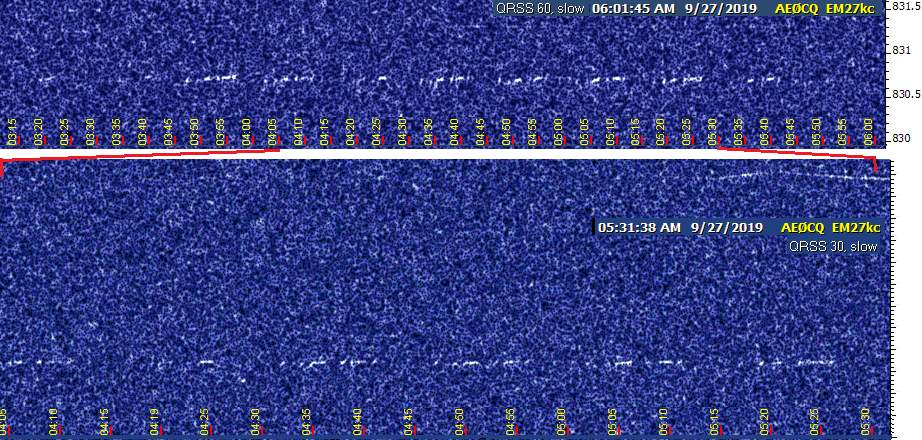
After two and a half QRN-filled months, there was enough of a lull in lightning noise last night to let EAR through once again. The continental US and Canada were surprisingly calm for a few hours, with the main static coming from southern Mexico and the Caribbean.
Although the strike count was only about half of what it had been running the past few months, there was still enough noise to preclude reception until well after midnight. The signal was finally strong enough to yield a partial trace in the 1:45 AM CDT time slot, and one fully recognizable ID an hour later. That was followed by another hour-long gap, then two more or less continuous hours of signal from 3:45-5:45 AM, as seen in the QRSS60 and 30 captures below.
They're not the greatest captures, but they're probably the best I can get this month...and enough to let me claim 10 of 12 calendar months, anyway.
---------------------------------------------------------------
 File Attachment 1: 27sepEAR.jpg
Friday HiFERs
Started baseline observations this morning to be able to study effects (if any) of today's G1 and/or G2 storms. At 9:30 AM CDT, both NC and a jumpy EH were at audible levels, WV was barely audible, and MTI was visible but not audible. Nobody above 13558 showed themselves.
Re: Friday HiFERs - Solar Noon
Posted by John Davis on September 27, 2019 at 19:32:22.
In reply to Friday HiFERs posted by John Davis on September 27, 2019
Between 1:00 and 1:30 PM CDT, 7P was strong along with NC and EH at the watering hole, but MTI was gone. WV was the best I've heard it in many weeks. AZ was visible but not audible.
A powerful (S7, subject to QSB) and rather wide signal/noise source was just above 13556.5; more on it tonight.
Above mid-band, FRC was conspicuous by its absence, and there was no sign of MN, AN, or VAN either.
However, WAS faded in nicely after a couple of false starts and hung around at nice, steady copy for three or four minutes. Meanwhile, I could also detect ODX at the top of the CW filter passband, ranging from nil copy to one or two letters to an entire strong ID. As steady as WAS had been, ODX was plagued by a double dose of QSB.
Re: Friday HiFERs - Solar Noon
Posted by John Davis on September 28, 2019 at 04:27:32.
In reply to Re: Friday HiFERs - Solar Noon posted by John Davis on September 27, 2019
Upon further review of the captures just before my solar noon listening session, I see that at 12:39 PM CDT, there were three consecutive repetitions of the "dotted line" pattern that normally denotes PVC. They look to have been loud enough to copy by ear, although I suspect the powerhouses, EH and NC, would have made it difficult. It was at 13555.530 kHz.
Just one minute before, MTI put in its last appearance of the noon hour, but returned for a few more appearances nearly two hours later.
Re: Friday HiFERs - Mid & Late Afternoon
Posted by John Davis on September 28, 2019 at 04:49:31.
In reply to Re: Friday HiFERs - Solar Noon posted by John Davis on September 28, 2019
By 3:30 PM CDT, EH was a little ways under 7P. WV was gone by 3:30, and above band center only WAS was making it through...weakly audible, but keying sidebands were quite visible. NC vanished around 3:40, then faded back in over less than 60 seconds around 4:10, and was gone again by 4:18.
NC continued its disappearing/reappearing act until 5 PM, gradually colliding with EH. It was then gone for two hours! By 7:01 PM, just before sunset here in SE Kansas, NC returned right on top of what was left on a declining 7P. (EH remained mostly steady.)
For several minutes around 6:40 PM CDT, the dotted-line typical of PVC returned at 13555.530, and briefly around 7:14. By then, EH was in partial fade sometimes, while NC was often strong. EH went away altogether at 7:41, a little over half an hour past sunset. WV was weakly visible and thoroughly inaudible, and had dipped in frequency to 13554.990. It appeared that EH and NC traded places being visible a while longer, whilst I was performing battery maintenance. By 7:57 PM, K6FRC was faintly becoming visible, but not yet audible. We'll see later tonight what transpired after that point. G1 conditions had been in effect for at least three hours by that point.
Re: EAR Again!
Posted by John Bruce McCreath on September 28, 2019 at 14:07:57.
In reply to EAR Again! posted by John Davis on September 27, 2019
Hello John....many thanks for the first report of the season and the Argo screenshots. I'm lucky that EAR is still on the air, as I discovered earlier in the week that the N-E halyard was chaffed badly and would not have lasted over the winter. Repairs have been made and I'm ready for the 2019-2020 season!
73, Bruce, VE3EAR Re: Friday HiFERs - Evening
Posted by John Davis on September 28, 2019 at 22:04:33.
In reply to Re: Friday HiFERs - Mid & Late Afternoon posted by John Davis on September 28, 2019
The closest I came to effects of the G1 storm was after sunset by an hour to an hour and a half, apparently. Usually, I expect G1 and G2 storms to produce relatively extreme QSB (both dips and enhancements) on signals from outside the first skip zone, accompanied by a good chance of seeing signals from inside the first skip zone that are usually shooting past overhead. In periods of low solar flux and seasons of low sun angles, that's sometimes the only way I'll see the Illinois HiFERs here in SE Kansas. Storms of G1 and G2 intensity are also sometimes accompanied by bifurcation of a signal's spectrum; that is, a steady carrier will appear to split into two carriers, spaced anywhere from 0.5 to 2 or more Hz apart on Argo 30 second slow mode. (It's sometimes many more than two paths, each Doppler shifted.) After the storm passes, I can usually count on the band being depressed for a few days.
Friday did not show any of those effects during daylight, even though G1 conditions were in effect during the six hours prior to UTC midnight (7 PM CDT). The first three hours of the night were below storm level, followed by three consecutive 3-hour periods at G1 again. Interestingly, it was during the period from 60 to 90 minutes after sunset, during below-G1 conditions, that I saw this:
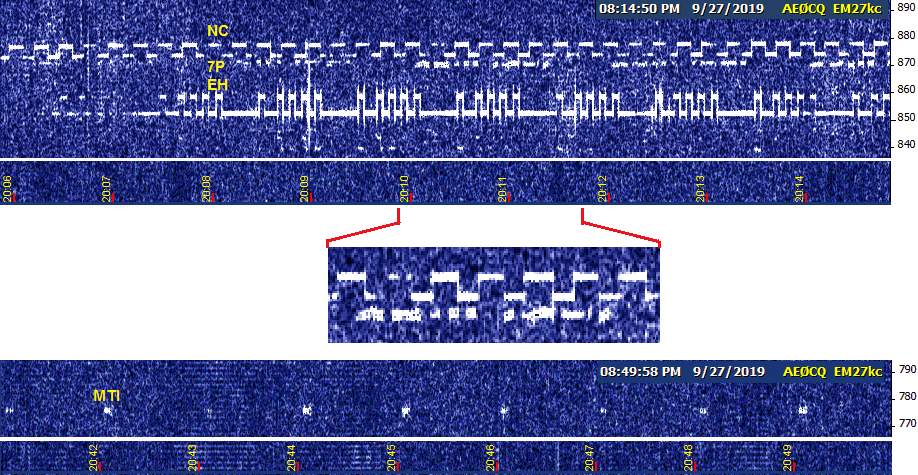
The band was open both to the east and west simultaneously. While the two easterners traded places on the signal strength scale over the course of several minutes (sometimes achieving remarkable and rare enhancements to the S3-S5 range), westerner 7P underwent bifurcation for the length of one ID. There also appears to be a Doppler-like overall frequency change during the P, but occasionally 7P does experience small shifts of that sort on its own anyway, so I can't be sure of anything beyond the 1+ Hz split being a function of the ionosphere.
K6FRC finally became visible about 8 PM, but was never really audible when I listened. However, there was still no sign of anyone from the Illinois gang, day or night.
Subsequent to these captures, the watering hole dwindled to one signal at a time, alternating between EH, NC, 7P and MTI. Gaps with no signal at all increased after 9:30 PM. A ghostly trace of EH around 11:24 PM was the last thing I saw until I shut down at 1 AM due to the risk of more earthly storm activity nearby. That means there is a break in my data, although I resumed before daylight Saturday.
John
---------------------------------------------------------------
File Attachment 1: 27sepHF.jpg
Saturday HiFERs - Morning
Since the G1 storm continued overnight Friday, North American time, and then began gradually subsiding, I was interested in seeing what effects it may have left behind. I got to the field at local sunrise and began monitoring. Apart from a few bursts of "Chinese measles" and a smidgen of midband noise, the band was dead.
At 7:54 AM CDT, I finally began seeing a few ghostly wisps of FSK where USC should be. I was eagerly hopeful, because I haven't seen Pat's signal since before the arrival of Hurricane Dorian. However, when the path switched fully "on" abruptly at 8:03 (50 minutes after sunrise), I could see it was NC that had drifted upward to that spot in the early morning coolness; see below, and/or attachment 28sep-morn.jpg. NC continued quite loud for 14 minutes, then disappeared just as abruptly as it appeared.
At 8:40, a faint surplus of RF showed up briefly at 13555.445 but was not identifiable. Promptly at 9 o'clock, 7P showed up for work at its usual spot...a little ragged at first, but very clear by the second ID. Ragged fragments of NC then began showing again, and within minutes the smudge at 555.445 materialized into EH. Midway between 9:12 and 9:13 AM, both NC and 7p simultaneously experienced strong enhancement, while EH remained ragged. At 9:17, NC went into another abrupt and prolonged deep fade, EH dipped into a little more raggedness, and 7P dimmed somewhat, too; also shown in the capture below.
I then checked WV, which was totally absent at the time. However, AZ was both visible and audible! And, K6FRC was especially good for mid-morning, ranging from fair to very good copy. No sign of MN, AN, or VAN; but WAS was coming in clearly between occasional QSB dips by 9:28 AM CDT. After 9:30, 7P and EH were adequate copy, but NC remained nil to marginally visible until after 10 AM, when I had to be back in town for the Western LowFER Net.
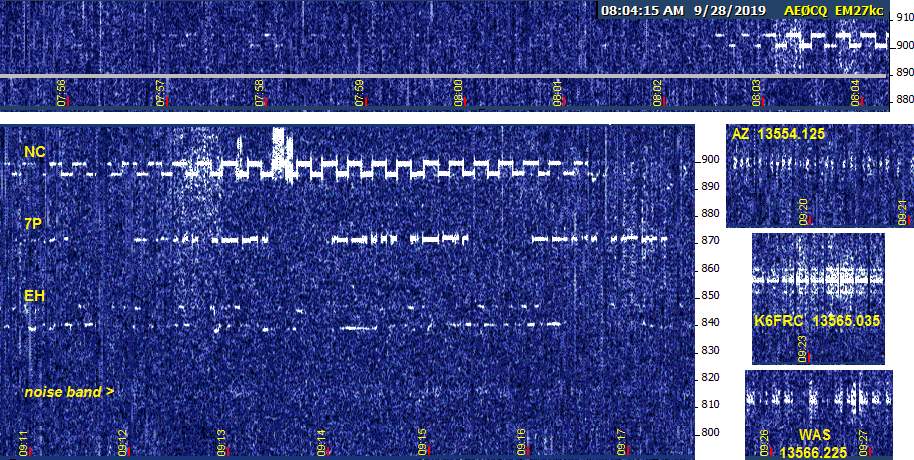
One thing that's not very clear in the picture above, but is worth pointing out: the band was filled from one end to the other with low level noise bands like the one at ≈815 Hz (13555.415). Each band was 5 to 10 Hz wide, seemingly white noise. The primary bands were 85 Hz apart, with secondary noise bands sometimes visible midway (about 42 Hz) between them. They continued into the morning, but were gone by afternoon. A slightly later view of the watering hole, showing two of the bands a little more clearly, is attached to this message as "28sep-morn2.jpg".
---------------------------------------------------------------
File Attachment 1: 28sep-morn.jpg
File Attachment 2: 28sep-morn2.jpg
Saturday HiFERs - Mid-Day & Afternoon
Codar started up just before 10 AM CDT. NC, 7P, and EH alternated in strength, frequently with only two being visible at a time. Both NC and EH were very jumpy in frequency during the morning, and 7P had a few minor instances as well.
At 11:50 AM, MTI began appearing and probably would have been audible if not for codar. It eventually got strong enough during the noon hour to be recognizable by ear over the codar racket. By noon, NC had become less jumpy, but had drifted down onto 7P. I looked for WV around 12:20 and found it to be visual-only, down near 13554.990 where it usually hangs out around daybreak. At 12:22 I looked for AZ again and found it wandering between 13554.120 and .105. In the upper half of the band, FRC was fair to good, but I could no longer detect WAS. (No sign of ODX at all on Saturday.)
From 1:20 to 1:26 PM, the Ghost of WM Present appeared, which I did not notice until I reviewed the captures later. It returned at 1:41 and gradually became more distinct. At 1:47, a trace of SIW WSPR showed up briefly, too, which I took as a hopeful sign. The opening persisted, and in a few minutes I saw SIW WSPR as well and got this decode:
1856 -31 -0.6 13.555405 0 K3SIW EN52 7That was the only sufficiently long appearance of the WSPR signal to achieve a decode. There's a little multipath visible on the SIW slant signal midway through the opening, and again near the end (see second attachment). The Illinois opening was over by 2:55 PM.
After that, the watering hole was mainly occupied by NC, sometimes accompanied by MTI and occasionally by 7P. At 3:45 I checked on WV, who was faintly audible at 13555.027 kHz. Nobody else was audible by then, and with thunderstorms not too far away, I discontinued listening for the day around 4:30.
The attachments include one of the watering hole near the peak of activity, while the SIW WSPR reception was underway, and a separate view of the entire SIW slant reception. Incidentally, the frequency calibration of the first image is good to ±0.5 Hz or better, courtesy of the ensemble of at least four OCXO/GPSDO sources within the image.
John
---------------------------------------------------------------
File Attachment 1: 28sep-WHmid.jpg
File Attachment 2: 28sep-SIWslant.jpg
Re: Saturday HiFERs - Mid-Day & Afternoon
Thanks for the hifer captures John. Must confess I've been trying to get DXCC via FT8 decodes on 60 and 80 mtrs of late so the hifers have been QRT early evening until morning. No problem getting DXCC down to 40 mtrs but lowfer has been hard and I'm only about half way. Hope propagation and activity increases as winter arrives.
By the way, we, like a lot of others, have been inundated with rain of late. Had planned to bring lowfer SIW back on the air last Saturday but that will have to wait until Monday at the earliest.
73, Garry, K3SIW, EN52ta, Elgin, IL
Re: Saturday HiFERs - Mid-Day & Afternoon
Posted by John Davis on September 30, 2019 at 16:36:57.
In reply to Re: Saturday HiFERs - Mid-Day & Afternoon posted by Garry, K3SIW on September 29, 2019
Most welcome, Garry. Glad the enhancement hit while the HiFERs were on. Best of luck with the DXCC effort on 60 and 80 meters.
Will be looking forward to watching for the LowFERs again. The static is finally starting to get a little better some nights here.
John
VAN
Posted by John Davis on September 30, 2019 at 16:59:45.
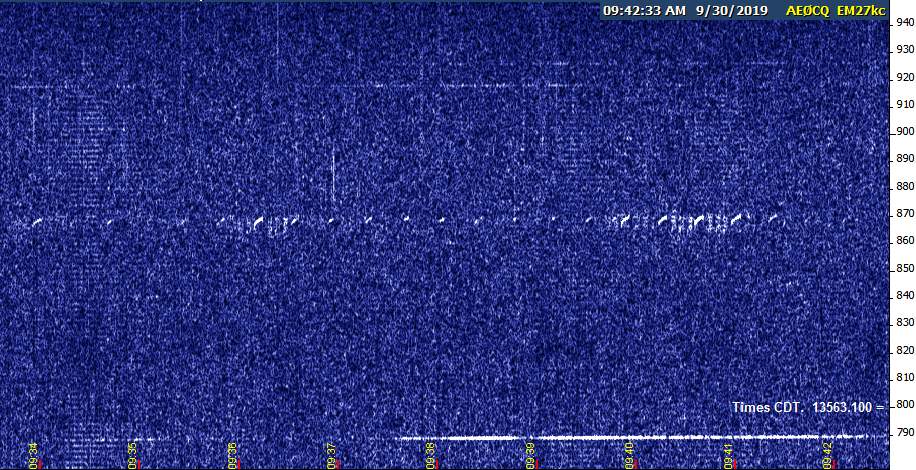
Jim, have you made a change to your oscillator recently? Last time I spotted VAN, the long dash after three IDs still made a downward curving hook, but this morning (Monday) I was parked near your frequency and after a while started noticing periodic upward curves. When the keying sidebands started to show, I was able to hear partial IDs but never the whole thing. It finally occurred to me to set up for recording, but by the time I got it going, the signal was fading rapidly.
In the picture, I've left it full height to show the codar lines and the other signals that were coming and going at the same time VAN was present. They, along with some form of seemingly random grittiness, conspired to keep my ears from syncing up better on the CW when it was audible.
Also around the same time this morning...NC and EH were strong at the watering hole, no sign of WV or AZ, but FRC was quite good and WAS was fair.
It was so exciting to see something new in the band that I just had to jump queue and post this before doing my Sunday reports.
---------------------------------------------------------------
File Attachment 1: 30sepVAN.jpg
EDJ QRV 555.420
I think QRV is the correct Q code.....
I'm back on the above freq. No TS's in sight for several days!
HOT, HOT, HOT down in GA.....
Bob
EDJ
potrzebie