 File Attachment 1: 17auga0055.jpg
Re: Sunday 8/16 HiFERs
Looks like I need a "Computer Columbo" to find out who/what is killing my files. I went out to the field and checked the original GIFs that are still archived on that computer, and they're fine! On the thumb drive that I used to transfer them, though, they were corrupted.
So, I deleted both damaged folders (Aug. 16th and 17th) from the thumb drive and copied the good files to it again. I then examined the copied files to confirm they were OK before closing Windows Explorer and ejecting the drive from the field machine. Brought the drive home, transferred the files to another folder, and...they were corrupted again, both on the HDD and on the thumb drive.
Using my Windows 10 notebook, I ran diagnostics on the portable drive, then set up an experiment to make sure the files weren't being corrupted on the thumb drive by something on the desktop machine during transfer. A hundred-some test images from the newer notebook survived that trial OK, so it would seem the damage may be taking place on the thumb drive during the process of ejecting it from the field notebook.
Thus, the good news is, Argo is still making acceptable captures. The bad news is, I can no longer harvest them to share them with anyone else.
It's too late to devise any more experiments tonight, but I'll undoubtedly be fretting over the problem in my sleep. Re: Sunday 8/16 HiFERs
Posted by Ed Holland on August 18, 2020 at 15:22:41.
In reply to Re: Sunday 8/16 HiFERs posted by John Davis on August 18, 2020
That is annoying John.
The next thing I might try is a different drive, if available, to see if it is a problem unique to one device.
/Ed
Re: Sunday 8/16 HiFERs
Posted by Ed Holland on August 18, 2020 at 15:32:02.
In reply to Re: Sunday 8/16 HiFERs posted by John Davis on August 18, 2020
Thanks for the report.
Frequency control is something I want to work on. Presently, the "master oscillator" is one of the inexpensive DDS signal generators available online. It is a decent intstrument for the main part, but has a quirk or two. It has a readout error, so I usually set it to zero beat against the intended frequency on another radio. My JRC NRD 525 has a temperature compensated reference, and is still quite accurate - to within a few Hz when checked against WWWV.
Lately, we've had a hot and humid spell. Although the transmitter setup is in our basement, the sig-gen is likely not that stable against temperature changes.
Ultimately, I would like to go back to a crystal, for the sake of simplicity and self contained operation of the TX. However, I need to experiment and find a crystal that will pull down to (or near) the current operating frequency. Used as-is, the crystals I had left me up near the band center, and its noise. Any changes will be noted here.
Cheers
Ed
Re: Sunday 8/16 HiFERs
Posted by John Davis on August 18, 2020 at 17:28:22.
In reply to Re: Sunday 8/16 HiFERs posted by Ed Holland on August 18, 2020
PVC's frequency control is actually pretty good. A few Hz difference upon restarts keeps us listeners alert ;), and as long as the short term stability is good enough to not tilt the elements of the QRSS characters, with the consequent loss of detection sensitivity, all is probably well. PVC does very well in that regard; see attached from last night.
---------------------------------------------------------------
File Attachment 1: 17auga0055.jpg
Re: Sunday 8/16 HiFERs
Thank you for the report John.
There really should be no "chirp" with this configuration, short and medium term stability should be reasonable once the generator is warmed up. I modified the Vectronics transmitter so it can work either from a crystal (as designed) or change to an external VFO at the flip of a switch. In the latter case, the oscillator transistor functions as a buffer and keying stage.
73s
Ed
Re: Sunday 8/16 HiFERs
Posted by John Davis on August 18, 2020 at 23:26:03.
In reply to Re: Sunday 8/16 HiFERs posted by Ed Holland on August 18, 2020
Exceedingly annoying. I made a list of hypotheses to check out this morning and thought I narrowed down the possibilities with further tests, but now that I'm back at the desktop machine, the results are getting even more confusing.
The basic facts that haven't changed...so far, at least: The GIF files I transferred at the previous marathon session, for 10 August and days prior, remain undamaged on all three drives (the field machine's HDD, the thumb drive, and the desktop HDD). Files from the 16th and 17th remain intact on the field HDD, and when I transfer them to the thumb drive via the USB port I have lately been using, they look OK on the thumb drive too--until I remove the thumb drive and reinsert it into the field computer or any other machine. Then the newly transferred files exhibit problems. (And, if I transfer the older, undamaged files from the field HDD into a new directory on the removable drive, they also become damaged on the removable drive.)
The scrambling is the same in the Windows Explorer preview thumbnails, in Media Viewer, or in MS Paint, in either Windows 7 or 10--but it renders as a very different type of distortion in IrfanView!
The possibilities I tested this morning included [1] doing file transfers without the battery chargers running (test possibility of electrical noise intrusion from the generator); [2] changing which USB port I was using for the mouse (test for port-specific software or connector malfunctions); and [3] removing the drive in non-standard ways (ie, closing all files and viewers associated with the drive then physically unplugging it without using the "safe to remove" dismounting tool, in case the tool itself was malfunctioning.
Test 1 turned out pretty unambiguous. With or without the generator, the files suffered equally serious damage. Power may corrupt, but that wasn't what was doing it in this case.
Test 3 was also unambiguous...no difference either way, so the removal tool wasn't responsible.
Test 2 was really puzzling. The port I had been using recently does always appear to leave files corrupted, and so does one of the other two. The third port initially seemed to be safe, and in fact allowed me to retrieve the folder with August 16 on it. The folder for the 17th appeared OK after its first removal from the USB port, but displayed damage when I got the files back to the house.
In that round, I did not try another storage device because I wanted to see how this one responded under all the different circumstances first, to provide a baseline, as it were. Secondarily, I deemed memory device problems unlikely because of the experiments I did on it with the Windows 7 and 10 machines at home last night.
But you are correct; it is worthwhile to try a second device anyway, because (a) there could be intermittent issues clouding the diagnostic results from last night, and (b) the lingering confusion from Test 2 this morning doesn't conclusively rule out anything.
243 kHz Kalundborg
Posted by Mike Terry on August 19, 2020 at 11:29:26.
Still some broadcasts at certain times of the day from Denmark on longwave.(This article written in 2018). Re: Sunday 8/16 HiFERs
https://www.radioenthusiast.co.uk/news/kalundborg-then-and-now/
Posted by John Davis on August 19, 2020 at 19:14:08.
In reply to Re: Sunday 8/16 HiFERs posted by John Davis on August 18, 2020
"Computer Columbo" is on the case. Ruminating over the inconsistent results from Test 2, I started putting two and two and two together and came up with roughly three...new hypotheses, that is. Starting at square one: Nothing of this sort had happened before. So, what has changed?
(Caution: Long post.)
Test 4 yesterday night proved it was not a defective thumb drive. Another one known to be good behaved the same way as the first...but an SD card worked perfectly, every time.
(I didn't previously know the field machine had a slot for SD. And, I'm not enthused about using SD for file swaps because the desktop machine's built-in SD reader is becoming unreliable about recognizing when a card is inserted, so I have to use an external reader with a USB port. If I've got to use USB anyway, I might as well do it with the slightly more rugged thumb drives.)
Aging of components in the field machine is possible, but the entire integrated motherboard was replaced a year and a half ago (due to a battery charging accident) and it is doing well otherwise. I've been using a USB mouse with the machine for a few months now because the touchpad is way too sensitive and I've not been able to find adjustments for it; but again, there's not been any similar problems previously during that time.
Still, I had suspected possible driver interactions, and that looked even more possible after the first part of Test 2, when relocating the mouse to a different physical slot enabled the thumb drive to work one time. But immediately afterward, it failed again, so who knows? I devised Test 5 to compare behavior with and without the mouse active. Bad news...same corruption to the thumb drive either way, no problems with the SF card.
Although a negative result is still a result, it's not something you can take to the District Attorney. That's when I started thinking like Columbo. If you have a case where all the circumstantial evidence points to one obvious suspect, but through convolution and misdirection he has constructed what appears to be an utterly airtight alibi, you have to do two things: figure out how he could have done the deed, even if the method seems implausible; then use that information to trick the suspect into breaking his own alibi!
My own whistling "This Old Man" moment came when I decided to treat hardware problems as a red herring, and focus on how driver software could be involved, despite the fact that it appeared to have an ironclad alibi. That alibi was based on one seemingly irrefutable point--when first written to the removable drive, the files opened just as fine as could be. It was only after the drive was remounted that problems showed up. "It must have been Evil Hardware or Unknown Malware, 'coz I was 10 other places at the time the crime occurred," gloats crafty old Mr Driver Software.
Except for three things. Legwork had ruled out the thumb drives and made the USB ports themselves pretty unlikely suspects. It had also made malware unlikely, since the field machine hasn't been hooked to the Internet since Microsoft ended support for Windows 7 and its version of Security Essentials, and the only contact with the outside world was through the removable drives, which tested clean.
And the biggest ralization of all: the crime did NOT occur after the files were written, as we were meant to believe, but it occurred DURING the copying process itself, right when the USB port controller and the removable disk drivers had their fingerprints all over the affected files!
How could the files be OK right after they were written, then "go bad" later? Simple--they didn't. It only looked that way because Windows cheats.
If you copy a block of files from one location to another folder on the same drive, or to another drive entirely, it takes some certain amount of time while the operating system reads data from the original location, caches it in RAM, then writes it to the new location. But if you then proceed to copy the same files to yet another folder or drive, the process goes much faster! Windows does not read the files from the disk all over again, but writes them directly from cache.
Alas, it apparently does the same thing if you open a file that has just been copied, as long as no operation has been performed on the file since copying. Hence, the file looks perfect (just as it actually was on the SD card in Test 5 when copied there from the same cache). The OS had no way of knowing that the drive controller was not delivering a faithful copy to the removable disk. It was already corrupted, but the corrupt version was not what was being displayed! At least, not until the drive was ejected then remounted, which voided the cached copy and meant it had to be read anew from the thumb drive, revealing its true condition.
So, how could I break the driver's alibi in Test 6?
I realized there had been two or three multi-day marathon monitoring sessions since the machine had last been rebooted. It had merely been in Sleep mode between. Now, that is regularly the case, without any problems before. But the difference is, as I mentioned, more frequent use of the USB mouse recently. Windows assigns drivers to USB ports dynamically, and sometimes rather arbitrarily. That tends to consume resources. So, it's entirely possible that the removable drive controller had fallen under the baleful influence of an increasingly confused USB port controller...a sort of Svengarlic, to borrow from a Three Stooges line.
If that's what's happening, how do I confirm it in Test 6 and fix the problem?
Well, how do you fix 99% of all Windows issues? You reboot!
Since doing that very thing late last night, I am able to transfer files safely again. Odds are, I'll have to shut down and restart after every two or three sessions from now on, so long as I continue to use the mouse. But at least things seem to be working normally at the moment.
Re: Sunday 8/16 HiFERs
Posted by Ed Holland on August 19, 2020 at 21:46:05.
In reply to Re: Sunday 8/16 HiFERs posted by John Davis on August 19, 2020
I was wondering if the files that seemed OK before the drive was removed were actually being retrieved from the device. Good cache Columbo!
Re: Sunday 8/16 HiFERs
Posted by John B on August 19, 2020 at 22:51:31.
In reply to Re: Sunday 8/16 HiFERs posted by John Davis on August 19, 2020
"Well, how do you fix 99% of all Windows issues? You reboot!"
Truer words were never spoken!
Having worked with VAXen from DEC for many years, which ran for years without driver corruption, memory leaks, and the other drek that inhabits our PC - ish world, it's a darned shame that we've regressed.
Re: Sunday 8/16 HiFERs
Posted by john b on August 19, 2020 at 22:52:52.
In reply to Re: Sunday 8/16 HiFERs posted by Ed Holland on August 19, 2020
"Good cache Columbo! "
Re: Sunday 8/16 HiFERs
^^ I see what you did there!!! :-)
Posted by John Davis on August 20, 2020 at 00:39:24.
In reply to Re: Sunday 8/16 HiFERs posted by john b on August 19, 2020
L. O. L. Much needed lift there, Ed. Thanks.
Help with Unknown Frequencies
Posted by Tim on August 20, 2020 at 16:35:17.
I had some tests done not too long ago in a frequency proof room and we found 2 frequencies. Does anyone know what/who operates on these radio frequencies around the Tampa Bay, FL area in 2016:
178 kHz 22M Grabbers?
292 mHz
Posted by WA1EDJ Bob on August 20, 2020 at 21:54:40.
Andy, G0FTD, posted on qrssknights if anyone knows of other (besides Dave WA5DJJ)
22M grabbers? Some of the Knights do drop down to 22M and grab from time to time but only DJJ is full time that we know of.
TNX!
Bob
WA1EDJ
EDJ
WSPR is QRT for now, storming, and will be for a few days here in EM83du.
RigExpert analyzer vs Monitor Circuits
Posted by Lee on August 21, 2020 at 03:39:43.
My RigExpert AA-54 is giving conflicting information to that generated by my Monitor Circuits 2200 meter transverter. I did update the firmware on the AA-54 FYI. Looking out from the transverter Rigexpert reports 1.15 to 1 SWR to 1.7 to 1 SWR depending on time of day. The transverter reports 4.1 to 1 SWR to 4.5 to 1 SWR also depending on time of day. And because the transverter has so many automatic ckt protections its adding a 4db attenuator in line. And I am using a toroid antenna match transformer. Any ideas folks? Is the transverter flakey. Is the AA-54 flakey. It's making me flakey. I am testing at reduced power 6 to 10 watts. Thanks
Re: RigExpert analyzer vs Monitor Circuits
Posted by John Davis on August 21, 2020 at 05:07:15.
In reply to RigExpert analyzer vs Monitor Circuits posted by Lee on August 21, 2020
First thing I think I would do is try both devices against known resistive loads in the range of 25-200 ohms and see which (if either of them) is telling something close to the truth.
Thur. 8/20 Surprises - Change at JB?
Posted by John Davis on August 21, 2020 at 06:29:45.
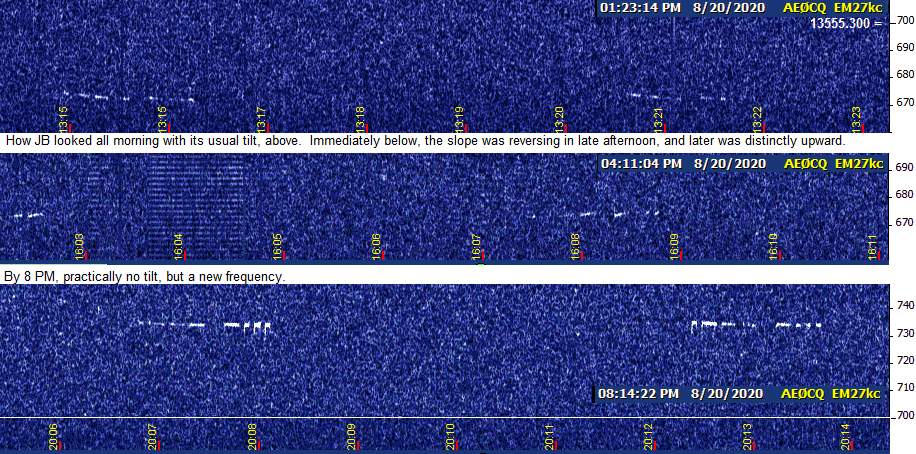
After a lackluster evening yesterday and mediocre mid-afternoon today, a few pleasant surprises this evening! There weren't all that many stations, and a few regulars didn't show up at all (WV, MN) but others that had been partly or totally AWOL the past few days were nice aural copy for a change (TON, KAH, WAS, ODX). EH was fair, NC was very strong, and sometimes so was 7P. A weak K6FRC was present, and a very tipsy AZ. I'll try to do one or more later reports on these at some point, with attached images and sound clips.
---------------------------------------------------------------
File Attachment 1: 20augb.jpg
Reminder: Lowfer net +/- 3929Khz Saturday morning 0800 California time
Reminder: Lowfer net +/- 3929Khz Saturday morning 0800 California time Re: RigExpert analyzer vs Monitor Circuits
Or listen online at kfs:
http://69.27.184.62:8901/?tune=3929lsb
or
KPH Point Reyes:
http://198.40.45.23:8073/
or
Utah Web sdr:
http://www.sdrutah.org/websdr1.html If you cannot get into the net on 80 meters you can listen on KFS and participate by sending net control your thoughts to wa6owr@gmail.com
73,
Jerry WA6OWR
Posted by Lee on August 21, 2020 at 15:29:29.
In reply to Re: RigExpert analyzer vs Monitor Circuits posted by John Davis on August 21, 2020
Did that with Roger from Monitor Circuits. 50 ohm load, no load, 25 ohms. Rig Expert 1 to 1, infinity, 4.25 to 1. 2200 transverter same sequence. 1.1 to 1, infinity, 1.96 to 1.
Re: RigExpert analyzer vs Monitor Circuits
Posted by John Davis on August 21, 2020 at 19:05:49.
In reply to Re: RigExpert analyzer vs Monitor Circuits posted by Lee on August 21, 2020
Interesting. Clearly, the transveter is more accurate (at least, with pure resistive loads) but they disagree so wildly with the antenna connected. Being no expert with Rig Expert, I confess I'm at a bit of a loss as to what to try next.
Re: RigExpert analyzer vs Monitor Circuits
Posted by Lee on August 21, 2020 at 19:25:38.
In reply to Re: RigExpert analyzer vs Monitor Circuits posted by John Davis on August 21, 2020
Same here. The RigExpert was pricey. the difference in readings is about 2. A third analyzer could solve this.
LF WSPR This Week
Posted by John Davis on August 21, 2020 at 19:59:27.
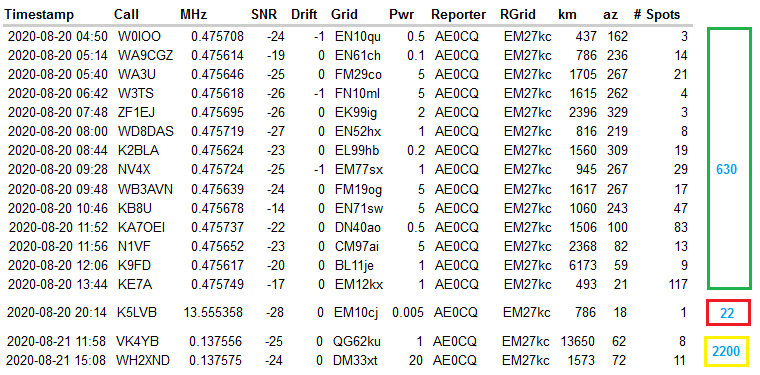
Still no WM or EAR LowFERs this week, so I tried WSPR on 630 Wed. and 2200 m Thursday night. Results are analyzed above. Between the two nighttime efforts is the lone HiFER decode that came through on Thursday afternoon.
Glad to see so many familiar calls again at 630, especially for being the middle of the week. The big surprise at 2200 is how few folks were on the air. (At least, in WSPR mode. Early in the evening I saw a lot of what appears to be JT9 5-minute mode at 137.500, right dead center in the middle of the WSPR slot.) Of those few, though, VK4YB is clearly the big winner. His signal turned up right at the start of the 1142 UTC transmission slot, which just happened to be local sunrise here. It decoded in 8 of the 9 time slots between then and the top of the hour, but went missing on Argo during the 1152 slot. WH2XND then started up at 1356 UTC.
---------------------------------------------------------------
File Attachment 1: 2021aug.gif
27 MHz ISM?
Hi folks,
Always looking for something interesting and a new opportunity, I remembered that in the region of 27 MHz (26.96-27.28 MHz to be precise) FCC allows for field strengths of 10000 V/m at 3 meters. Although this would be even less power than permitted at 22m, if conditions were right as Solar activity increases, is there any possibility or interest in operating HiFERs?
I have not delved in to the FCC blurb yet to understand the exact permissions regarding intentional radiators, unattended operations etc., but it *might* be interesting, I suppose.
Any thoughts?
Re: LF WSPR This Week
Posted by Mike N8OOU on August 21, 2020 at 20:37:08.
In reply to LF WSPR This Week posted by John Davis on August 21, 2020
John,
I have been keeping a close watch on WM Lowfer. It has been running normally, all meter readings are normal. I expect the full green foliage is helping itself to a good part of my RF Energy.
Thanks for looking, and reporting.
Mike N8OOU 73
Re: RigExpert analyzer vs Monitor Circuits
Posted by John KB5NJD on August 21, 2020 at 21:38:23.
In reply to RigExpert analyzer vs Monitor Circuits posted by Lee on August 21, 2020
Hi Lee,
What mix and size of toroid did you use for the ferrite matching transformer? I saw this come up two other times, once with a system helmed by a Monitor Sensors box on 630m and once with a home brew PA, monitored with scope match. Under power, even low power, the wrong mix seemed to result in erratic behavior in SWR compared to what the analyzer said. In short, two very different worlds between actually applying power and using a low level signal to probe the system. Perhaps that is a missing link in this discussion. 73/GL
John
PS: I did send Roger at Monitor Sensors alerting him to your reported problem in case he has additional input to offer...
Re: 27 MHz ISM?
Posted by WA1EDJ Bob on August 21, 2020 at 21:48:55.
In reply to 27 MHz ISM? posted by Ed Holland on August 21, 2020
Ed,
I'd thought of the same thing. I have not checked any regs yet but I thought walkie talkies could use 100mW on the CB.
I do have great reservations on finding a clear spot though. Tremendous interference on any CB channels.
Where would you operate?
Bob Re: RigExpert analyzer vs Monitor Circuits
EDJ
Posted by Lee on August 21, 2020 at 21:50:33.
In reply to Re: RigExpert analyzer vs Monitor Circuits posted by John KB5NJD on August 21, 2020
FT-240-77 type toroid
Re: RigExpert analyzer vs Monitor Circuits
Posted by John KB5NJD on August 21, 2020 at 22:02:30.
In reply to Re: RigExpert analyzer vs Monitor Circuits posted by Lee on August 21, 2020
Ok thank you. From my usage, should be fine. I think some guys are using 78 on 2200m but probably splitting hairs.
Assuming this is a vertical, how is your radial situation? Does the feed line look like a radial due to limited number? any additional decoupling at the station end? Maybe a non-issue but both of the setups I referenced where using very minimal radial system and before it was determined that the individuals used incorrect cores from their junk boxes, the feed line and its behavior was a consideration.
just spitballing right now...perhaps someone else is picking up on something the rest of us are missing.
73/GL
John
Re: 27 MHz ISM?
Posted by Ed Holland on August 21, 2020 at 22:04:22.
In reply to Re: 27 MHz ISM? posted by WA1EDJ Bob on August 21, 2020
Bob - no idea where I would operate, a bit of scouting required there. Probably right at the lower band edge, if I had to guess. I did read s bit further. The allocation overlaps with CB (in the USA). CB operation precludes automated transmission, or the use of non approved gear, but it does look as if there is some room for interpretation, despite the meager output that is implied.
Cheers
Ed
Re: 27 MHz ISM?
Posted by John Davis on August 21, 2020 at 22:29:40.
In reply to Re: 27 MHz ISM? posted by WA1EDJ Bob on August 21, 2020
I thought walkie talkies could use 100mW on the CB.
They can, but only as type accepted devices operating under the limits of CB rules. The old Part 15 provisions for 11 meters have not been available since the Seventies, sorry to say. That's why, despite occasional curiosity, 11-metering has not been a big Part 15 hotbed since the late Sixties. Let's look a little closer at why.
On the face of it, 10000 μV/m at 3 meters sounds fairly impressive, but carry it out to its logical conclusion. At 100 feet (30 meters), that's 1000 μV/m. At 1000 feet, it's 100 μV/m. At one mile, it's under 20 μV/m--assuming lossless free-space conditions, which never apply in the real world.
At ten miles, that'd be 2 μV/m, and at a hundred miles only 0.2 μV/m, under the same imaginarily perfect circumstances. It's theoretically possible to detect such a signal if the noise isn't too horrendous, of course, but as Bob points out it always is in the CB channels. (There are the handful of in-between radio control channels, but the noise is seldom much less on them when the band is open, thanks to outlaw CBers running off-channel and/or with splattery linears.)
Another way of looking at it: the radiation limit for 22 meters allows approximately 4.7 mW into a dipole to achieve permitted signal. But at 11 meters, it works out to 20 microwatts into a dipole...hard enough to measure accurately, let alone do anything useful with it.
Re: 27 MHz ISM?
Posted by Ed Holland on August 21, 2020 at 22:50:27.
In reply to Re: 27 MHz ISM? posted by John Davis on August 21, 2020
Thanks John for the insight. It does look like a lost cause. Were it a dedicated ISM allocation like 22m, with the chance of a quiet slice of spectrum it might be interesting, even if very very unlikely to yield results. But in a band filled with noise - not so much.
20 microwatts would be a bit of a challenge to set up, but at least an attenuator wouldn't overheat ;-)
The UK doesn't even allow for 22 m operating, so I am extremely grateful for what is possible now I live in the USA. Re: Thur. 8/20 Surprises - Change at JB?
Posted by John B on August 21, 2020 at 23:21:35.
In reply to Thur. 8/20 Surprises - Change at JB? posted by John Davis on August 21, 2020
John, that's an interesting set of grabs (and I'm really surprised at the strength of the 8PM grab. I have the following detailed information to describe the change in behavior of the Epson.
"I have no idea"
Nothing has changed here other than the fact that it's about fifteen degrees cooler ambient , than it has been. Other than that, nothing has changed. Is this a recent development, or true day over day?
How weird....
Re: Thur. 8/20 Surprises - Change at JB?
Posted by John B on August 21, 2020 at 23:34:54.
In reply to Thur. 8/20 Surprises - Change at JB? posted by John Davis on August 21, 2020
I'll go out tomorrow and measure the battery pack.
It occurred to me that I did make one change about a week ago...I moved the solar cell to a location where it gets more sun during the day, but it's hard to see how that would affect the nominal frequency that much!
Re: LF WSPR This Week
Posted by swlem3 on August 21, 2020 at 23:40:02.
In reply to LF WSPR This Week posted by John Davis on August 21, 2020
John, I saw the same transmissions of what appeared to be JT-9 5min, but I couldn't get it to decode. Maybe some error on my part, don't know. I thought that possibly it was some other mode that just looked like jt-9. Looks like I'll give VK4YB a try again on 2200m if the noise level will give me a break. It's been really noisy here in TX.
Ray
Re: RigExpert analyzer vs Monitor Circuits
Posted by Lee on August 22, 2020 at 00:08:49.
In reply to Re: RigExpert analyzer vs Monitor Circuits posted by John KB5NJD on August 21, 2020
Radial situation. Have 8ft rod at antenna base. 20 to 30 radials run under house. Concrete pad next to vertical with rebar. 20 to 30 radials sewn into rebar before pour. Ran 2 inch copper strap 30 ft around concrete pad next to mast connected with concrete fastners. This was to take advantage of rebar. All of this connects to 8 ft grd rod. Oh and my cats 6ft x 6ft x 4ft metal patio condo connects to the rod. The cat condo is about 8ft away. One feed line at 15 meter length. Vertical 33ft high, 8 radials 15ft length, a skirt wire around radials. Off one radial 214 ft of 10 gauge wire around perimeter of property. Total of 262 ft. Decoupling at station end? I do have a ground wire that connects to the antenna from equip in house. But it does not go directly to the grd rod. Connects thru a short section of cold water pipe. Coil is elevated. Ground connection about 5ft up. Antenna connection about even with top of cat condo. Re: RigExpert analyzer vs Monitor Circuits
Posted by John, W1TAG on August 22, 2020 at 00:12:54.
In reply to Re: RigExpert analyzer vs Monitor Circuits posted by John KB5NJD on August 21, 2020
Lee,
Is the toroid being used as a loading coil to resonate the antenna, or as a transformer? I’d be concerned about using ferrite (as opposed to powdered iron) as an inductor.
John, W1TAG
Re: RigExpert analyzer vs Monitor Circuits
Posted by John KB5NJD on August 22, 2020 at 00:28:43.
In reply to Re: RigExpert analyzer vs Monitor Circuits posted by Lee on August 22, 2020
Thank you Lee.
Sometimes a long feed line with respect to few shorter radials can look like a radial and depending on the length might impact something about the SWR bridge. I'm not saying that is actually happening here. Just throwing it out there. But having more system info certainly helps eliminate some possibilities.
73/GL
John
Re: RigExpert analyzer vs Monitor Circuits
Posted by Lee on August 22, 2020 at 00:34:35.
In reply to Re: RigExpert analyzer vs Monitor Circuits posted by John, W1TAG on August 22, 2020
The toroid is a matching transformer. The loading coil is air core coil. Playing with the Rig Expert again I see that it still reports 4.5 to 1 on dc dummy loads in parallel. Re: RigExpert analyzer vs Monitor Circuits
Measured the ohms. 25 ohms.
Posted by Lee on August 22, 2020 at 00:44:30.
In reply to Re: RigExpert analyzer vs Monitor Circuits posted by John KB5NJD on August 22, 2020
That's very interesting. The original idea was to go thru the wall. I might need to go back to that idea. By doing that I could reduce the feed line to 15ft from 49ft. Thru the wall was way more complex because of water heater enclosure, AC breaker box and furniture in room. Most of the radials are in the 20ft to 30ft range. And previous set ups involved the transmitter being at the base of the loading coil. Re: Thur. 8/20 Surprises - Change at JB?
Posted by John Davis on August 22, 2020 at 02:26:59.
In reply to Re: Thur. 8/20 Surprises - Change at JB? posted by John B on August 21, 2020
So far as I can tell, it's a very recent development. And, it remained at the higher frequency today, apparently.
Looking over the captures from the noon into early afternoon, JB was in the range of 13555.330 to .430 with varying degrees of upward tilt from one instance to another. (Conditions were poor today, and sometimes only one letter or part of one at a time made it through. There has been no further reception since mid-afternoon.)
Polish Radio 1 225 khz
Posted by Mike Terry on August 22, 2020 at 14:32:41.
POLAND Re: LF WSPR This Week
Public broadcaster Polish Radio is set to launch a special news service for
listeners in neighbouring Belarus, where post-election protests have grown
against longtime strongman leader Alexander Lukashenko.
The management of Polish Radio says news broadcasts in Belarusian on Polish
Radio 1 will help keep listeners beyond Poland’s eastern border informed about
what is happening in their country amid limited access to reliable information.
Thanks to transmitters at a broadcasting centre in Solec Kujawski, north-central
Poland, Polish Radio 1 can be heard on 225 kHz long wave almost throughout
Europe, including the entire territory of Belarus, public broadcaster Polish Radio’s
IAR news agency has reported.
Special news programmes produced by the Belarusian section of Polish Radio’s
External Service will be aired on Polish Radio 1 three times a day: at around 6:30
a.m., shortly after noon, and just after 10 p.m.
The initiative aims to provide Belarusians, including those living in areas where
there is no internet access or facing limitations in connectivity, with easy access
to up-to-date and reliable information about the situation in their country and
the response of the international community, Polish Radio executives have said.
“Offering support to the people of Belarus in these difficult times, and showing
solidarity by providing reliable and true information, is part of Polish Radio’s
mission as a public broadcaster,” said CEO Agnieszka Kaminska.
Broadcasts are due to start this Saturday, August 22.
(gs/pk)
https://www.polskieradio.pl/395/7785/Artykul/2568689,Polish-Radio-launches
-special-news-broadcasts-for-Belarus
via Dr Hansjoerg Biener (2020-08-21)
(Ydun's Medium Wave Info)
Posted by John Davis on August 22, 2020 at 15:56:56.
In reply to Re: LF WSPR This Week posted by Mike N8OOU on August 21, 2020
I also suspect foliage is a factor, but likely the heavy QRN is the final straw. That's why I spent one night this week looking for EAR. The fact that there was no trace at all suggests the static is just too strong right now. That's actually kind of odd, since the Blitzortung strike counts are running lower than they were earlier in the summer. Fewer strikes, but noisier ones?
Re: RigExpert analyzer vs Monitor Circuits
Posted by John KB5NJD on August 22, 2020 at 17:34:03.
In reply to Re: RigExpert analyzer vs Monitor Circuits posted by Lee on August 22, 2020
Hi Lee,
At this point I'm not sure I would go to those lengths to relocate your coax. There is time for that later if evidence warrants.
What I would like to see is a high resolution, close up image of your transformer, in situ, such that the windings are visible for primary and secondary (flat side image).
If you exceed the file limitations of the site, you can email it to me at KB5NJD@gmail.com.
Also, I would like to know how many turns you have on your primary (coax side) and secondary (antenna side).
Your measured values of R when X=0 or close to it, that would be helpful, as we try to debug this.
At this point I am also assuming that your feed line is 50 ohm. If that is incorrect, please advise.
If you would like to send all of that to my aforementioned email address to limit the bandwidth here, that is fine. I am happy to try and help you.
73!
John..
Re: RigExpert analyzer vs Monitor Circuits
Posted by Lee on August 22, 2020 at 18:57:34.
In reply to Re: RigExpert analyzer vs Monitor Circuits posted by John KB5NJD on August 22, 2020
Will e-mail the photos. I should mention that I had the same problem before I built the Re: RigExpert analyzer vs Monitor Circuits
matching transformer. I got the design from a 2200 meter web site. 10 or 9 turns primary.
5 to 8 turns secondary. While installing I realized the best match was almost 1 to 1.
9 turns to 8 turns. So I turned it around. 8 turns to 9 turns. Step up. That gave the 1.1
to 1 match. Happy Happy Joy Joy. I will send photos.
Posted by John KB5NJD on August 22, 2020 at 19:12:06.
In reply to Re: RigExpert analyzer vs Monitor Circuits posted by Lee on August 22, 2020
Thank you Lee,
I will look for your photos and will probably have some additional questions for you that I will ask via email.
Based on your specified turns (9/8) and assuming a turns ratio multiplier of 1 for your 50 ohm system, you may have too many turns on both primary and secondary of your transformer (81 ohms/64 ohms).
For a 50 ohm system with a turns ratio multiplier of 1 (meaning that you have 5 to 10 times the reactance at 136k or 250 to 500 ohms) that should require 7 turns on your primary to interface with a 50 ohm cable (square root of 50 = about 7, 7 X 7 = 49).
If, when X = 0 or is close to it, and your R is actually measured as 50 ohms as well, your secondary would also need 7 turns. Anything above that, in practice, may require some additional C to get it to play properly. Below 50 ohms, you can probably find a number of turn that works.
Also at play, there may inadvertently be a loading effect to adding a transformer like this, depending on how you wound it, so it may be necessary to tweak the tap of your series inductance. But we may not be there yet.
There are still murky details here but perhaps the images will shed some of those questions.
73!
John Hifer PBJ antenna issue found and fixed - back on air
Posted by Chris Waldrup on August 22, 2020 at 20:39:36.
Hi,
I went out this morning to change the battery and decided to connect up my antenna analyzer. The VSWR was 20:1.
It turns out that one leg of my inverted V got moved, thanks to the fiber contractor who is using directional boring machines to install the lines. The machine came through the woods where my antenna is.
Fixed now and back to normal.
Chris Re: 27 MHz ISM?
KD4PBJ
Posted by John Davis on August 22, 2020 at 22:12:25.
In reply to Re: 27 MHz ISM? posted by Ed Holland on August 21, 2020
Actually, I don't mean to be entirely discouraging. A signal that starts out with only 1/16th the field intensity of 22 meters poses severe challenges but may not be totally useless. It would indeed be a very rare thing to achieve transcontinental DX, even with slow modes, but single-hop regional Sporadic E might be feasible several times a summer when solar flux improves.
But before I spent much time and effort setting up a station, though, I'd want to research the noise prospects very carefully. Note in §15.227 that the 11 meter Part 15 allocation is a full 320 kHz wide! As Bob hinted, there just might be a few narrow slots that could be clean enough (at least on a regional basis if not nationally) to support a bit of hobby activity.
My guess is that operation there would require substantially more attention to details such as frequency selection, mode, and especially frequency stability than most HiFERs put into their rigs. Without that attention to detail, however, I can guarantee positive results will be so minimal as to limit interest in the band.
With those thoughts in mind, I've never allotted the time necessary to search for elusive quiet spots at 11 m. To do so, I would need to devise a new antenna, among other things. My standard antenna is 5/8 λ at 22 m, and therefore 1.25 λ at 11, so the vertical pattern has unwanted nulls that would skew results at 27 MHz. In addition, the buffer for my current antenna attenuates everything above LF (except 13.56 MHz) so it's deaf as a fence post at upper HF. There are CBers running enough power to be heard anyway, but my current setup is totally inadequate for Part 15 signal levels in that band.
If you'd like to do some coordinated monitoring there, I could be persuaded to install a suitable antenna and allocate some time.
[Interesting Side Notes:]
At only 12 lines of text in the printed Rules, §15.227 is the shortest section in the "Radiated Emission Limits, Additional Provisions" of Subpart C. On the face of it, that should make it the easiest to interpret, and it (almost) is. As with all FCC regulations, though, one has to take into account both what is said and what is not said in relation to other sections of the rules.
There is no requirement in 15.227, for instance, that the antenna be permanently attached to the device as in some Additional Provisions sections, and there is no limitation on transmission line length as in other sections; so, like 22 meters, you can have the transmitter indoors in a controlled environment, as long as the total radiation does not exceed 10 mV/m in any direction, three meters away from any part of the antenna or device.
Also note, unlike 22 m, that the signal strength is to be measured with an averaging meter. This is really only of concern if you're planning to operate AM or pulsed emissions. At 22 m there is no such specification, so the instrument must be a quasi-peak indicator, because that's the provision of 15.35 that applies by default to Part 15 emission measurements unless stated otherwise in specific sections. Not that anyone operates AM in 22 meters these days, but if they did, they'd have to cut the carrier power by 6 dB to ensure the modulated peaks did not exceed the limit.
At 11 meters, however, you can figure compliance with nominal 20 μW carrier power, so long as you don't exceed 100% modulation. Again, it's unlikely anyone would attempt AM under this section, because even with hypothetical free-space conditions, DX would be out of the question at much more than a mile...but in theory it could be done without the 6 dB cutback if one were stubborn enough to try it. :)
Re: Hifer PBJ antenna issue found and fixed - back on air
Posted by John Davis on August 22, 2020 at 22:26:48.
In reply to Hifer PBJ antenna issue found and fixed - back on air posted by Chris Waldrup on August 22, 2020
A boring machine caused excitement, eh? <pained expression emoticon> I'd begun to wonder where the signal went. Will check this evening, and again in the morning in case propagation is still depressed today. It'll be great to have PBJ back.
Re: Hifer PBJ antenna issue found and fixed - back on air
Posted by Chris Waldrup on August 23, 2020 at 02:06:53.
In reply to Re: Hifer PBJ antenna issue found and fixed - back on air posted by John Davis on August 22, 2020
Yeah!
I sent you a bunch of emails and photos last night and today too. I wish I could post the photos.
Chris
Re: Hifer PBJ antenna issue found and fixed - back on air
Posted by John Davis on August 23, 2020 at 03:59:20.
In reply to Re: Hifer PBJ antenna issue found and fixed - back on air posted by Chris Waldrup on August 23, 2020
Sorry to say the time from two hours before sunset to two hours after was unproductive. Absolutely no HiFERs were seen or heard here, except sometimes K6FRC was nicely audible. Have switched to 630 meter WSPR for the night, but will check again in the morning.
Re: 27 MHz ISM?
Posted by John B on August 23, 2020 at 12:16:14.
In reply to Re: 27 MHz ISM? posted by John Davis on August 22, 2020
John, thanks for the interesting notes on ISM at 27 Mhz (and the regulations in general).
It's always a bit curious to see how much detail the FCC has put into defining the regulations, only to ignore their enforcement (particularly at 27 Mhz). That said, it's the order we march to. Having managed an accredited EMC lab for the last 5 yrs of my employment, I know how hard accurate, repeatable measurements are to make, even under lab conditions (I'm thinking of the geometric accuracy required radiated emissions and the establishment of a uniform field for immunity testing purposes).
I suspect that the challenge of the receiver dynamic range requirements to parse 20uW carriers from a background din of kilowatt level sigs, would be the limiting factor, particularly when sunspots are abundant.
Even barring that there's the killer of path loss :-)
Re: Thur. 8/20 Surprises - Change at JB?
Posted by John B on August 23, 2020 at 18:37:31.
In reply to Re: Thur. 8/20 Surprises - Change at JB? posted by John Davis on August 22, 2020
Found the problem... like Chris's, it was cabling. (I knew not to trust crimp ons!) Connectors soldered on and we're back in business at a nominal 13555.2 ish signal. Must have gotten below the 5v LDO regulator min input voltage.
Battery pack is charging and we're OTA again.
Re: 27 MHz ISM?
Posted by WA1EDJ Bob on August 23, 2020 at 21:55:00.
In reply to Re: 27 MHz ISM? posted by John B on August 23, 2020
27MHz sounds a bit too challenging. I got to thinking back to the 1990's when I was doing MedFER work. I was pretty successful. Even with a pretty modest antenna I was copied. I seem to recall Todd Roberts from somewhere down south here (Savannah?) copied
me, and others. Since then the BCB has expanded to above 1600 KHz so now the only slot I'd condsider is around 1704 KHz. I've not looked at details but I think we can operate there. There is one station on the list that is MedFER on 1704 I believe.
There used to be a fair bit of activity down there.
I might look back into that.....Still have the TX and old tech EPROM CW IDer I built.
So much simplier today
Bob Re: 27 MHz ISM?
EDJ
Posted by Chris kc3gfz on August 24, 2020 at 04:13:03.
In reply to Re: 27 MHz ISM? posted by WA1EDJ Bob on August 23, 2020
Hi Bob,
That sounds like a fun project and seems more feasible to others. I have one of those “wild planet radio” toys that broadcasts at 1610am. On the second floor of home no grounding and not modified 9ft wire it will be audible in car radio just over a mile. Works good for day use. Pesky CHAA will drown it mainly evening and night time. Something I would like to look into but would have to get the frequency on par and between actual broadcast stations. Let us know if you get that thing going again.
Chris
Re: MedFER (was: 27 MHz ISM?)
Posted by John Davis on August 24, 2020 at 17:51:14.
In reply to Re: 27 MHz ISM? posted by Chris kc3gfz on August 24, 2020
Now, now, Chris...CHAA is the only way most of us on the Plains can hear Hindi pop songs. :)
Bob's recollections of the early 90s brought back a lot of fond memories. With fishing buoys gradually depopulating the band and 10 kW broadcasters not yet allowed in, the top 100 kHz of the band was a truly remarkable place to be. Even with only normal speed CW as the only digital mode back then, serious DX was possible when the noise was low enough.
Todd Roberts' MedFER ABC (Hilton Head Island) was the most regular copy at around 255 miles. His being surrounded by seawater was an advantage. Todd and I used to have multi-night QSOs. I'd program my MedFER SEA (more accurately, the Radio Shack Color Computer for which I wrote a keyer program in COLOR BASIC) with a short message and let it repeat into the night. At some point, there would be enough repetitions come through adequately for Todd to assemble the full message, and he would program a response into his memory keyer. I'd pause transmission after a while and if I noticed Todd's message seemed to be different, then I'd listen long enough to copy it all, and type in my own response. Sometimes we could do two or three exchanges in a night, and other times it took a couple of nights.
At one point I got adventurous and devised a high-efficiency DSB suppressed carrier final amplifier and attempted voice transmission. At the time, you could buy cassette tapes that repeated loops of various durations. I recorded loops featuring alternating music selections and voice ID messages, both heavily compressed for maximum average-to-peak power ratios. Lyle KØLR copied one of those sessions roughly 800 miles away in MN, not well enough to identify the songs consistently, but enough to distinguish the voice ID from the music.
MedFER EDJ was always an elusive target for me, but was regularly reported by others at greater distances. At the time I lived less than 100 miles from Bob--too far for groundwave, but too close for skywave--until one fateful sunset, when greyline propagation finally took pity on me. That was quite a thrill.
Nowadays, of course, the noise floor is orders of magnitude higher. In addition to AM sidebands, some stations also add digital modulation that fills the RF emissions mask between ±5 kHz to ±10 kHz from the carrier with pseudorandom noise, and spreads at lower levels considerably beyond the next channel...the dreaded "Din of Ibiquity" as it has been aptly called.
Section 15.219 is the provision of the rules that applies to MedFER operation. For whatever reason, the FCC set the band limits at 510 to 1705 kHz. That doesn't let us get very far from the carrier of stations on 1700, even though their sidebands are allowed to extend 10 kHz either side of the carrier. Fortunately, there tends to be less energy in sidebands above 5 kHz than there is below, but since we can't go up beyond 1705 kHz ourselves, it's kind of a moot point for us.
Logically, we want to get as near 1705 as practical, but we must take into account both the frequency stability of our rigs and the bandwidth of our modulation products. The latter factor, combined with the intrinsic noise levels of the AM band, strongly disfavor normal speed CW. QRSS with adequate click filtering, or a slow MFSK mode such as WSPR, plus some attention to detail with the oscillator, will be the key to getting as close to 1705 as possible.. But oscillator stability is complicated by the fact that antenna, transmission line, and ground lead are limited, so the unit will of necessity be outdoors...a complication that does not have to apply at 22 or even 11 meters.
Re: MedFER (was: 27 MHz ISM?)
Posted by Ed Holland on August 24, 2020 at 18:51:28.
In reply to Re: MedFER (was: 27 MHz ISM?) posted by John Davis on August 24, 2020
Interesting to contemplate. Perhaps the rules could be interpreted to allow only the finals of the transmitter to be located at the antenna feedpoint? This way, a bias tee could enable delivery of the PA drive, and the required DC power, while enabling the frequency determining part of the TX to reside somewhere more conducive to stability.
I remember a foray with LWCA long before PVC was active, where I was first contemplating a beacon. In this case it was a MedFER, and John gently dissuaded me, for many of the reasons presented in this conversation. That was sage advice, but I still like the idea. At the time I had bought one of the Ramsey AM transmitter kits, thinking this would be a good starting point. Not at all, as it turned out - it has to be the most unstable design ever, as we (my Son and I) learned again earlier this year. It did, however, provide us with some suitable equipment to pursue a school Science Fair project, where we studied radio reception using some different antennas, and radios, to determine if our problem question "Could a Part 15 station cover the school campus?" was realisable. The initial suggestion came from Dad, but my boy quickly rose to the challenge and got interested. We had a lot of fun figuring out the experiments, reframing our tests when the first results weren't quite what was expected, pacing around the school sports field, all while retuning that transmitter. The project won the Fair, and went on to win in the Physics category at county level :-).
I haven't turned him into a radio nut yet, but I keep chipping away at it!
Sunday 23rd Hifers
Posted by Ed Holland on August 24, 2020 at 18:59:29.
Hi folks,
Weak signals yesterday, but they were out there to be seen at least. This seemed to be about the only radiation that made it through the smoke from nearby wildfires...
Good traces were seen of NC and WM, with 7P also a reliable visitor. Although I didn't quite make out an ID, I suspect yesterday also saw the first reception of BNC1 here at PVC. Lastly a few repetitions of a double dash, "M"? with a pronounced downward chirp were seen and heard. While it lasted, this station repeated once each minute.
Above the mid band twitter, there was little to be seen. Hunting in the 13562 - 13567 kHz zone seems unfruitful these days.
Normal weekday operation of PVC is resumed.
73s
Ed
Re: MedFER (was: 27 MHz ISM?)
Posted by WA1EDJ Bob on August 24, 2020 at 19:36:33.
In reply to Re: MedFER (was: 27 MHz ISM?) posted by John Davis on August 24, 2020
Interesting John. Thanks for filling in the details of "new" challenges for the MedFER band after BCB expansion.
I was digging around last night and found the cassette tape you sent me back in '91 of
your reception of EDJ. I'll try to give it a listen tonight (if I have batts for the cassette player!)
I would consider MedFER QRSS operation on 1704.+ with a si5351 TX. My original MedFER
was a pole mounted transmitter at the antenna.
But, I don't know, just seem to run out of time lately. I did check out the CT MedFER beacon page and he seems to have it figured out. I need to give a listen down there.
Bob
EDJ...Staying HiFER for now....
Re: MedFER (was: 27 MHz ISM?)
Posted by John Davis on August 24, 2020 at 20:27:12.
In reply to Re: MedFER (was: 27 MHz ISM?) posted by WA1EDJ Bob on August 24, 2020
I was digging around last night and found the cassette tape you sent me back in '91 of your reception of EDJ.
Wow, that's fantastic, Bob. Most of my own copies of tapes from that era did not survive the move from Georgia, so it's great to know some of that data is still out there.
If you are able to play the tape OK, might you be willing to make a WAV file of it? It might be interesting to have an archive of HiFER sound clips on the Web, to go with the photos and other HiFER info that Jerry WA6OWR is putting together.
Re: Sunday 23rd Hifers
Posted by Mike N8OOU on August 25, 2020 at 02:53:42.
In reply to Sunday 23rd Hifers posted by Ed Holland on August 24, 2020
Ed;
Thanks for taking the time to listen and report on the Hifers. It's good to hear WM made the trip. Over the past couple weeks I have done a complete health check on both beacons. Everything has checked "good to go" for the winter season.
Mike Meek 73
Re: Sunday 23rd Hifers
Posted by Ed Holland on August 25, 2020 at 04:16:29.
In reply to Re: Sunday 23rd Hifers posted by Mike N8OOU on August 25, 2020
Mike,
You are welcome - it is a pleasure to hunt for signals, and after all, might be thought of as half the responsibility of a good beaconeer.
Cheers and 73s
Ed
Re: MedFER (was: 27 MHz ISM?)
Posted by WA1EDJ Bob on August 25, 2020 at 14:02:56.
In reply to Re: MedFER (was: 27 MHz ISM?) posted by John Davis on August 24, 2020
The tape did play ok on my cassette machine. It has EDJ and some other MedFER beacons you copied in 11/1991. I heard ABC for sure but others would take some digging.
What free audio app would you suggest to make a .wav? I hear about Audacity and have used an older version years ago. I'm not big into recording and ripping mp3's as some.
I have a better quality cassette deck with line out levels that I'll use for an archive copy. Won't probably matter much as band noise in strong on the tape.
EDJ is off WSPR and QRSS on 22M until this WX system moves through. Those Gulf storms are pouring moisture up into GA. with storms.
Bob Re: MedFER (was: 27 MHz ISM?)
EDJ
Posted by John Davis on August 25, 2020 at 15:42:10.
In reply to Re: MedFER (was: 27 MHz ISM?) posted by Ed Holland on August 24, 2020
Congratulations to you and your son on the science fair project. That's a great story, Ed.
Perhaps the rules could be interpreted to allow only the finals of the transmitter to be located at the antenna feed point?
IMO, that's a reasonable interpretation, and there is precedent for it. A number of LowFER operators in the past have made use of a separate control head and/or exciter unit, driving a final out at the antenna. Even a commercially built Part 15 sorta-HiFER (27 MHz, harking back to our original subject line) from 57 years ago, which back then had to undergo FCC Type Acceptance to be sold, used a separate exciter and a final located at the rooftop antenna.
That was the International Crystal Executive 1500 model that we talked about in The LOWDOWN about two years ago. (The attached file is an ad for the transceiver that appeared in Popular Electronics.) The "15" in the model number stood for Part 15, and the "00" was a nod to International Crystal's deluxe Executive 100 CB rig upon which it was based...although the 1500 was priced at nearly $300, a whopping 50% more than the full-power Model 100, or even the ultra-deluxe Browning model of the same era when equipped with crystals for all 23 channels. Three hundred bucks was serious money back then, so not everybody was rushing out to get one, even though that was really the only legal way to "work skip" on 11 meters...but the extra dough was, in part, to cover the costs of Type Acceptance for a product that was only expected to sell in limited quantities at best.
The 27 MHz Part 15 provisions back then allowed 100 mW into the final amplifier and a 5 foot single element antenna permanently connected to the device. The primary object was to accommodate hand-held walkie-talkies. The rules were changed in 1978 to the present day signal strength limits, and the grandfathering of previously compliant devices ended five years later. But the moral is, remote excitation of a device operating under antenna restrictions was approved for a commercially marketed product.
Conversely, one does not want to tempt fate by stretching interpretation into the realm of fantasy. In its crackdown on shady AM wannabe broadcasters a couple of years ago, the FCC finally took note of one product that had sneakily been authorized through the notification process (Type Acceptance no longer being applicable). Somehow they had failed to notice that the product consisted of two units: the actual complete transmitter itself, and a separate "antenna tuning unit" that the manufacturer bragged could be connected to it via whatever length of coax the user desired. Well, coax after the final amplifier stage is a transmission line that counts as part of the antenna system in §15.219, however you look at it! (And yes, it does radiate if it's providing any of the ground return path for the signal.) So, those clowns kind of poisoned the waters for the rest of us.
A well designed beacon is not likely to attract unwanted attention, but if it ever did, you'd want to have your design well documented and your certification label on the transmitter unit at the base of the antenna.
---------------------------------------------------------------
File Attachment 1: HiFER1963.jpg
Re: MedFER (was: 27 MHz ISM?)
Hi John,
Thanks for the background. I do remember mention of this in The Lowdown. $300 was a lot of money for that Radio!
Indeed, as in most exploits, it is rare that someone has not already thought of your independently dreamed up idea - and possibly nobbled it! Regardless, I might go and read the FCC points again, to see how the current MedFER rules apply.
The transmission line+antenna total length stipulation makes sense, since it is easy to make both part of the radiating system. At least the power restriction is simpler to interpret than a field strength limit.
We now await the results from my Son's science fair entry into a National competition!
Cheers
Ed
N8OOU on 630m
Posted by Mike N8OOU on August 25, 2020 at 18:48:57.
All;
I am testing my 630m station once again. For this test I an sending a WSPR transmission immediately followed by a FSKCW-60 transmission consisting of letters "W" and "M". A 10 wpm cw id is sent after each letter. Due to the long FSKCW-60 send time the transmission starts on the 2 and 32 minute marks.
The WSPR frequency is 475675 Hz while FSKCW is sent on 475300. The antenna is a 50Ft. tall vertical wire plus appropriate baseload/groundplane. The PA input power is 5w.
Mike N8OOU 73
Re: N8OOU on 630m
Posted by John Davis on August 25, 2020 at 20:20:13.
In reply to N8OOU on 630m posted by Mike N8OOU on August 25, 2020
I'll check for it tonight, Mike, but it may require more than one session because my CW filter is too narrow to get both frequencies in the same passband. I need to find a nice 500 Hz filter, I reckon.
A few quick questions: Is 475300 the mark or the space frequency for the FSK portion? Is the shift still extra wide? And finally, are :02 and :32 the FSK start times or the WSPR start times? Thanks.
Re: N8OOU on 630m
Posted by Mike N8OOU on August 25, 2020 at 21:06:43.
In reply to Re: N8OOU on 630m posted by John Davis on August 25, 2020
Hi John,
I understand the bandwidth issue, I know you have talked about that before. I can lower the wspr freq and raise the fsk and get them closer. Let me know how close you need them. I am monitoring locally with a wide usb filter and naturally have no issue copying both frequencies.
I set the frequency shift to 1 Hz for this test. If I find a remote receiver hearing the fsk, I wanted to see how the pattern looked on the typical lopora grabber screen. The higher frequency ie 475301 is "key down". lower 475300, key up. I am seeing a small upward drift at the beginning of the fsk (.2Hz) using ARGO.
WSPR starts at 02 and 32 and runs for 2 minutes. The FSKCW starts immediately then at 04 and 34. This U3S is under GPS control so start times should be accurate.
The SI5351A in this U3S is clocked by a very high precision/analog txco. As such the GPS frequency calibration comes up equal every time. But even though after a continuous 2 minute wspr transmission with 0 drift, the startup of the FSK shows .2Hz drift. I say there are bugs inside the 5351 chip.
Mike 73
Re: N8OOU on 630m
Posted by John Davis on August 25, 2020 at 21:50:25.
In reply to Re: N8OOU on 630m posted by Mike N8OOU on August 25, 2020
Thanks for the clarification, Mike. Let's stick with those parameters for now and see how it goes. Hope to have a report for you in the morning.
Frequency Counters
Posted by Ed Holland on August 25, 2020 at 23:08:30.
Hi Folks,
I thought it might be helpful to draw attention to something noticed recently while trying to realign a radio. Since they were inexpensive, I bought one of the small frequency counter modules available from Ebay and similar, around $15 at the time. It seemed to do the job quite well. However, recent use of a proper instrument revealed its shortcomings.
Aligning a Yaesu FRG8800 some while ago after purchase, I was a bit puzzled that after warm-up, I had to use the "fine" control to correct about 300 Hz of drift. Not a big deal, and I put it down to the radio's quirks, as this was fairly close to spec. The discrepancy between dial and signal frequency was constant with frequency, so there wasn't a significant scaling error. The LSB and USB modes gave the same beat against a carrier, so they couldn't both be off, could they? Yes they were! The radio was back on the bench this weekend to explore another small issue, and I took the opportunity to use a better counter and run through alignment again. The adjustment error in each oscillator for the sideband modes was consistent, and the blame lay squarely at the cheap frequency counter, to the tune (ahem) of about 300 Hz. Another run through the alignment sequence has the radio spot on and well within spec.
Cheers
Ed
wspr variant on 630m
Posted by swlem3 on August 26, 2020 at 01:56:28.
Re: wspr variant on 630m
Anyone know what mode of wspr is being used on 630m that doesn't decode using the normal wspr2 setting? I'm copying a few stations that aren't decoding here. The mode is still using the standard 2 min transmissions.
Posted by John Davis on August 26, 2020 at 03:28:11.
In reply to wspr variant on 630m posted by swlem3 on August 26, 2020
Not a clue myself. I noticed at least one such transmission earlier this evening too. It was plagued by multiple copies of itself, space at 60 Hz intervals. It looked like one of the JT-9 transmissions like I saw on 2200 the other night, but what the hey!? Aren't they supposed to have their own slot just below the WSPR segment??
Re: wspr variant on 630m
Posted by swlem3 on August 26, 2020 at 03:44:20.
In reply to Re: wspr variant on 630m posted by John Davis on August 26, 2020
John, thanks for the reply. At least now I know that someone else noticed this. I guess I'll have to just look around to see if one of the participants in the mode will mention it on some forum. I didn't see the transmission with the multiple copies you mention so I can't comment on it, but yes, jt-9 is segmented below the wspr activity.
Ray
Re: N8OOU on 630m
Posted by John Davis on August 26, 2020 at 07:20:45.
In reply to Re: N8OOU on 630m posted by John Davis on August 25, 2020
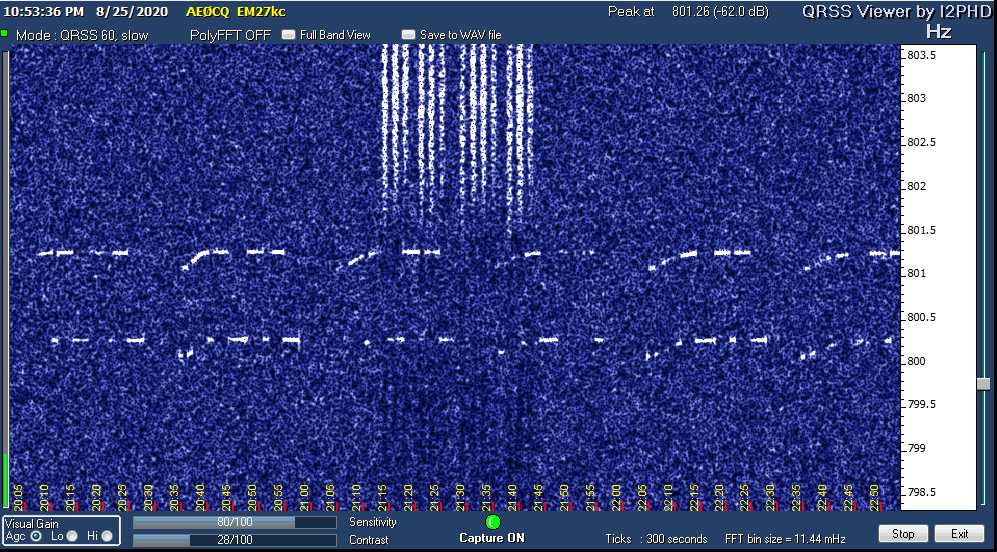
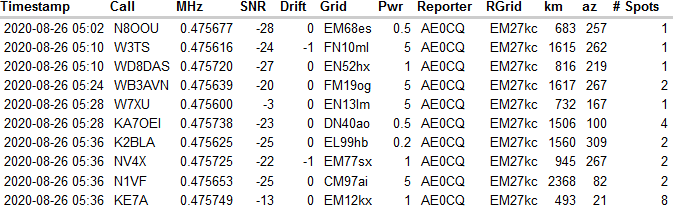
Preliminary report: No sign of the FSK until 8:04 PM, then it was pretty consistent. I see what you mean, though, about the 0.2 Hz drift. May have some thoughts on that tomorrow. Then 'round midnight, I switched over to the WSPR2 segment for the rest of the night. Guess who showed up as the first decode?
This is the signal that did the trick:
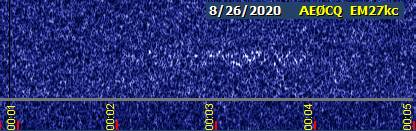
At the next transmission (0532 UTC) there was less signal, unfortunately, and no decode. But we'll see how many more we get by morning.
---------------------------------------------------------------
File Attachment 1: 25augb.jpg
File Attachment 2: 25augc.jpg
File Attachment 3: 25augWSPR1.gif
Re: N8OOU on 630m
Mike, I listened during the afternoon and the best I could manage was a weak trace of the FSK CW with ARGO at QRSS30 rate. The wspr signal wasn't even noticeable on a waterfall with QRSS3 bandwidth. Meanwhile, lowfer WM was coming in fine. Then all of a sudden at 0232Z the wspr signal showed up nicely and decoded at -21 dB SNR. Guess skywave finally kicked in. It never came in better, perhaps due to storm QRN which raised its head through the night.
73, Garry, K3SIW, EN52ta, Elgin, IL
Re: N8OOU on 630m
Posted by swlem3 on August 26, 2020 at 13:52:04.
In reply to N8OOU on 630m posted by Mike N8OOU on August 25, 2020
Overnight wspr report from this N. Texas qth Mike:
2020-08-26 09:02 N8OOU 0.475677 -30 0 EM68es 0.5 SWLEM3 EM03rf
2020-08-26 08:02 N8OOU 0.475677 -32 0 EM68es 0.5 SWLEM3 EM03rf
2020-08-26 06:32 N8OOU 0.475677 -29 0 EM68es 0.5 SWLEM3 EM03rf
2020-08-26 05:32 N8OOU 0.475677 -31 0 EM68es 0.5 SWLEM3 EM03rf
Ray Re: wspr variant on 630m
Posted by Mike N8OOU on August 26, 2020 at 14:22:24.
In reply to wspr variant on 630m posted by swlem3 on August 26, 2020
WSPR has an option to send some extended information in a second 2 minute time slot that follows the initial basic transmission. Could that be what you guys are seeing on Argo? The WSPR program normally combines the two time slots into one line entry. Both transmissions would look the same with Argo.
The WSPR program can get confused when it doesn't match the second back to the first, and logs it with garbage data.
I have used the extended option to get the 6 character grid square of my location while traveling. If the receiving station couldn't combine the two slots my 4 character location was logged.
Mike 73
Re: wspr variant on 630m
Posted by swlem3 on August 26, 2020 at 14:35:16.
In reply to Re: wspr variant on 630m posted by Mike N8OOU on August 26, 2020
Re: N8OOU on 630m
Mike, I'm not getting any garbage data on these wspr transmissions. Wsjtx just doesn't decode the transmitted data in the 2 min timeslot.
Posted by Mike N8OOU on August 26, 2020 at 14:56:44.
In reply to N8OOU on 630m posted by Mike N8OOU on August 25, 2020
John, Garry, swlem3;
Thanks to all for the reception reports. I had WSPR running the night before last and I was comparing the reception reports from wsprnet to last night and really started thinking the station was not working last night. I checked meter readings in the evening, and all was in the normal range. I decided to just let it run and see what happens. It looks like the band opened after 01:00 utc and I see more unique stations than I did the night before.
Day before yesterday in the afternoon I was being reported by N9RU and K9AN both in IL. Yesterday I never saw a report from K9AN. Maybe he went changed to another band or went QRT. The RF Current into the antenna is 3 times more than the Lowfer. (My meter is un calibrated)
I am satisfied with the basic operation of the setup. The magic smoke has been contained!! Woo Ho! I am disappointed with the stability compared to the Lowfer. The 630m transmitter is even located inside a building, compared to the lowfer outside at the antenna and in a black can.
I plan to let this run a couple more days to allow me to get a little more info. I will try a couple ideas I have to make the FSK more stable.
Mike 73.
Re: wspr variant on 630m
Posted by John Davis on August 26, 2020 at 15:09:06.
In reply to Re: wspr variant on 630m posted by Mike N8OOU on August 26, 2020
I don't think that accounts for it, Mike. The extended information format looks just like regular WSPR on Argo,* whereas the mystery format I've seen is a similar form of MFSK but with noticeably narrower shift.
In terms of decoding, the extended WSPR format normally substitutes "<....>" for the call sign if you receive the six-character locator transmission first before the four-character version with call; which lets you know to watch for further information. If you do get the call with the next normal transmission, subsequent slots with six character grids identify with the call highlighted thusly: <K9FD>.
(*Which brings up another point. There have also been transmissions lately in the WSPR segment that do look exactly like good solid, normal WSPR2 except for one thing--they lack the normal WSPR header, so they never decode. There was one of those at 475,790 pointlessly wasting power on a 50% duty cycle the whole time I was watching between midnight and 1 AM. He was joined once by another signal with a similarly non-standard header. Why bother transmitting in a propagation reporting segment if you'll never be decoded and thereby won't be reported?)
(On yet another related topic, why transmit just outside the WSPR segment and also thereby miss reports? W7XU puts in an incredible signal here all the time but is sometimes AWOL for entire nights because he's located right on 475,600 but frequently dips a Hz or two, so the decoder ignores his signal entirely.)
Clearly, I've got to give up spectral analysis at 630 m. It's bad for my blood pressure. ;)
Re: wspr variant on 630m
Posted by Mike N8OOU on August 26, 2020 at 16:39:32.
In reply to Re: wspr variant on 630m posted by John Davis on August 26, 2020
John,
OK, thanks for the additional info. I thought you were seeing a strong WSPR pattern on Argo, but not decoding in wspr-2. Also all the results from my travels were looking at wsprnet logs, not the actual wspr or wsjt program.
As far as non standard message formats I know there is arduino and other uP code out there, to create wspr or other encoding schemes. Hardware like the U3S can send that data. It is quite possible that code has been tweeked, to send info in a "vpn" fashion. In the mix of normal wspr exchanges, that data would fly right by in plain site. Who knows, maybe you are seeing K1JT testing FTD-2.5!
(Your related topic) Being a "since it's beginning" U3S user, I can see how easy it is to let the frequency on it slip "out of band".
Mike 73
Re: wspr variant on 630m
Posted by John Davis on August 26, 2020 at 21:58:36.
In reply to Re: wspr variant on 630m posted by Mike N8OOU on August 26, 2020
It is quite possible that code has been tweeked, to send info in a "vpn" fashion.
I've wondered about that myself. But if so, it would be a violation of the rules...no "secret codes," only publicly documented digital formats. Not to mention, it'd be contrary to the point of beaconing for propagation monitoring purposes.
Attached are two files illustrating the kinds of things I've been seeing, and there are two kinds. One is the seeming reduced-bandwidth variant of WSPR that I was griping about last night, but apparently did not save a picture of it. (It wasn't there later in the night with all its 60 Hz sidebands...fortunately.) However, it resembles the signal in image "20auga78.jpg" from 2200 meters last Thursday, apart from the 630 meter version lasting only two minutes at a time, instead of five. I'd go to the field and check again now, except for the threat of pop-up storms for a few more hours.
Then there's the other type...the ones that look almost exactly like WSPR2 in terms of step size, tone duration, and bandwidth, but do not possess a standard header and never decode. The file "25aug042.jpg" shows examples of these. It covers the time slots of 0530, 0532, 0534, and the start of 0536 UTC (five hours difference from the CDT shown in the picture), and is two different windows, time-aligned and stitched together, with the audio frequency scale conformed to the RF in Hz above 475.000.
The textual frequency and call labels were copied and passed directly from my ALL_WSPR.TXT file of the decodes for those specific time slots. The non-decoders in question are the one frequent sender at 475,790 and its occasional partner just above 780 Hz. (What really impresses me are successful decodes like N1VF, who was only visible for half the time slot, and K2BLA, who is so close to the permanent noise band.)
---------------------------------------------------------------
File Attachment 1: 20auga78.jpg
File Attachment 2: 25aug042.jpg
Re: N8OOU on 630m
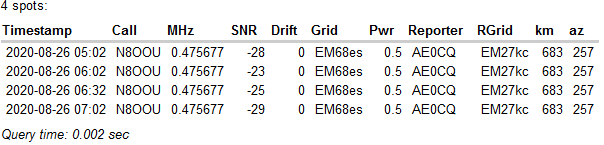
Turned out to have three more decodes of N8OOU WSPR overnight. Even with the low duty cycle of transmissions, a few more dB of power might make it one of the regulars!
Out of curiosity, was the FSK on before 8 PM CDT last night? I notice you mentioned 0100 UTC in connection with WSPR reports, and perhaps it was also relevant to the FSK reception as well.
---------------------------------------------------------------
File Attachment 1: 25augWSPRnetOOU.gif
Re: N8OOU on 630m
John, Yes the FSK was running full time. I had Argo running to watch the signal locally. I took a screen capture showing 19:45 to 21:06 8/25 UTC.
Wsprnet database shows regular decodes from N9RU up to 00:00 8/25 utc, with snr numbers of -12 / -14. At 171km I would say that was ground wave reception. Reports from N9RU after 00:00 dropped to -22 / -25. The same pattern has happened this evening.
I know wsprnet has it's issues and misses reports at times. K9AN who had good reports for me on 8/25, has not reported me on 8/26 or 8/27 utc. K9AN has reported other dx stations during that time. ?????? Maybe my 02/32 time slot is bad??????
I have 5 more volts on this power supply I can send to the PA. I am holding back in the dB department at this time. Winter propagation and less green leaves should help a bit too!
I was not successful at finding online daytime receivers that were hearing me today. The antenna RF Current is holding good today.
Mike 73
Re: wspr variant on 630m
Posted by Mike N8OOU on August 27, 2020 at 03:37:50.
In reply to Re: wspr variant on 630m posted by John Davis on August 26, 2020
John
I would say that additional tools will be needed to analyze the tones involved and the patterns in which they are used. Then other skills will be needed to decipher the patterns into something meaningful to us. There are a couple departments in the government, and maybe a few internet connected folks who could accomplish that task. Hi Hi.
WSPR-2 overnight
Mike 73
Posted by John Bruce McCreath on August 27, 2020 at 13:52:53.
There was lots of activity on 630M WSPR-2 last evening and early into the night. The map showing the various paths looked like a motorways map of London, England. I had decodes of the following stations in chronological order:
WA9CGZ, W3TS, WB3AVN, N3FL, NV4X, WD8DAS, KE7A, N9RU, KB8U, and W7XU
73, J.B., VE3EAR Re: N8OOU on 630m
LowFER Beacon EAR
188.835 QRSS30
Posted by John Davis on August 27, 2020 at 20:15:21.
In reply to Re: N8OOU on 630m posted by Mike N8OOU on August 27, 2020
Didn't get to listen last night but might try again this evening if the weather finally starts acting more like what was predicted for today.
We had threatening and colorful skies at last night's sunset, without any accompanying storms as things turned out, but I was too tired to go back to the field and risk having to evacuate at a moment's notice, just in case. Today, we were supposed to have thunderstorms this afternoon but they arrived early. They're supposed to be gone by 7 PM and leave us alone for 36 hours, but I'll believe it if/when I see it.)
What I'm looking for is further evidence of the abrupt skywave switch-on that seemed to take place Tuesday night. I was tuned to the FSK slot, figuring I'd have the greatest statistical chance of catching my first glimpse of signal there. Nothing at all from 5 o'clock until just after 8:04 PM CDT, then bam, there it was. If I can safely set up in time this evening, I'll try to be at the controls in person and switch between frequencies at the appropriate times to catch both modes around sunset.
I don't see anything wrong with the 02/32 time slots for WSPR, myself. I didn't record waterfall captures the entire night as I sometimes do, but at least while I was watching, the frequency was not subject to QRM at those times. It's probably just a question of ERP and the location of skip zones at any given time.
Frequency stability is still something of a puzzle. I couldn't say with any certainty that the Si5351A does not have bugs of some sort, but the kink of the curve makes me think more of an analog TCXO undergoing thermal compensation. Since it doesn't seem the external oscillator is shut down between modes, it makes me wonder whether it's heat variations from the synth IC being transferred to the oscillator, perhaps by a combination of radiative heating and conduction through the PCB, since both chips are in such close proximity. Although it looks drastic when viewed at QRSS60, the 0.2 Hz FSK drift is less than 0.5 ppm, well within the TCXO spec. (It's probably also there in WSPR as well, but is such a small fraction of the 1.4-something Hz tone steps of WSPR2 that it has no effect.)
Maybe the oscillator just needs a little more thermal isolation somehow...and/or, maybe more isolation from IC2 as well, because the regulator's temperature could also be slowly shifting with variations in current demand from the synth chip, and it too is right next to the TCXO.
Re: N8OOU on 630m
Posted by Mike N8OOU on August 27, 2020 at 23:42:54.
In reply to Re: N8OOU on 630m posted by John Davis on August 27, 2020
John,
I just picked up the new messages, I assume you have left already.(it's 6:30 PM CDT) If so, you may have an explanation before you submit your findings. So far today's daytime reception has been following the pattern. I have been seeing a problem with the transmitter where the PA current runs at 300 mA for a while, then just drops down to 100mA. The times in both extremes seems random. I have not resolved this yet.
I have tried a couple changes today in the thermal shielding of the Synth board. I have had issue with PCB heat transfer in the past. Now I mount all txco chips deadbug style.
This transmitter build is different from my others, in that I swapped an IRF510 FET for the BS170. It is mounted on a big heatsink inside the transmitter case. I was expecting some thermal issues from doing that.
Even with these issues, I will try to keep the station transmitting. I may have to shut down due to storms here.
Mike 73
Re: N8OOU on 630m
Posted by John Davis on August 28, 2020 at 05:44:22.
In reply to Re: N8OOU on 630m posted by Mike N8OOU on August 27, 2020
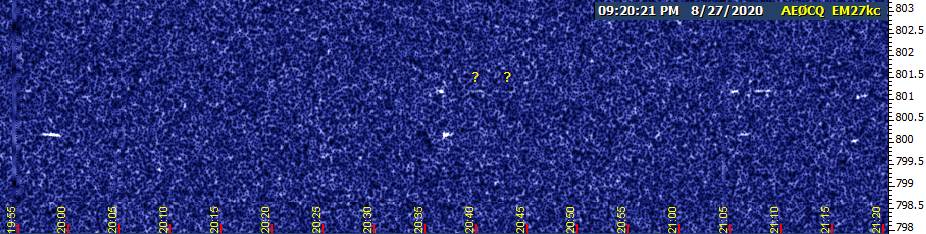
Interesting. It appears you've got a handle on freq stability. I also noticed an effect that is probably explained by the variations in final amp current you mention; but from what I saw, the times of current fluctuations may not be entirely random, though I have no plausible hypotheses why they occur.
It took a while, but I finally got everything set up again at the receive site about 7:30 PM CDT, and managed to look for WSPR at 7:32 PM/0032 UTC, 0102, 0132, 0202, and 0232. In between I monitored the FSK spot. Before sunset, there wasn't much noise--but also no signals. Just before 7:55 I thought I might be seeing a few seconds of key-down, followed by a little over a minute of key-up; after that, nothing further until just after the 0132 WSPR slot.
Then the probable FSK signal switched on again...briefly. I thought and hoped that the "ionosphere switch" had finally turned on for the night; but within a couple of minutes, I began to wonder if the ionosphere needed some contact cleaner! Using Argo's pointer-based relative signal level indicator tool, it appeared that the signal dropped almost 10 dB, hovering right at the edge of visibility in the noise. Eventually, it disappeared entirely, returning again just after the next WSPR slot, then dropping from view once more shortly thereafter.
There were no WSPR decodes of N8OOU in any of the five transmission slots I monitored, and only two other stations, for that matter. WB3AVN decoded with -27 dB SNR and NV4X with -22 dB, both in the 0132 time slot.
My plan had been to continue the manual retuning until I had a WSPR decode of N8OOU, and then ride the FSK signal the rest of the night, in order to see what time it faded away in the morning. But with such widely varying signal strengths, combined with static levels increasing so much by 0232, I decided further results might be less than meaningful and called it quits for the night. I'll probably try again tomorrow night, assuming the storms move further away from us,
---------------------------------------------------------------
File Attachment 1: 27augc14.jpg
Re: N8OOU on 630m
Oops. I forgot to mention, the capture in the preceding message was at QRSS30, not 60 as per the previous attempt. That may account for part of the apparent improvement in stability at restarts.
On the other hand, if I had remembered to switch Argo back to QRSS60, the times with full power would have been of such short duration on screen as to be easily overlooked or possibly mistaken for something else.
Re: MedFER (was: 27 MHz ISM?)
Posted by John Davis on August 28, 2020 at 06:20:55.
In reply to Re: MedFER (was: 27 MHz ISM?) posted by WA1EDJ Bob on August 25, 2020
What free audio app would you suggest to make a .wav?
The recordings I post these days usually originate as WAV files recorded by Argo.
Later, I generally edit them with Audacity. The new version has a lot more bells and whistles than the early one did, but isn't hard to get used to. I've never used this version to record yet, though, because I don't have access to the sound card input on my desktop machine. The notebook machine is the one with convenient sound inputs, and fortunately Argo is muy simpatico with most sound cards.
Reminder: Lowfer net +/- 3929Khz Saturday morning 0800 California time
Posted by Jerry Parker on August 28, 2020 at 13:49:42.
Reminder: Lowfer net +/- 3929Khz Saturday morning 0800 California time Re: N8OOU on 630m
Or listen online at kfs:
http://69.27.184.62:8901/?tune=3929lsb
or
KPH Point Reyes:
http://198.40.45.23:8073/
or
Utah Web sdr:
http://www.sdrutah.org/websdr1.htmlIf you cannot get into the net on 80 meters you can listen on KFS and participate by sending net control your thoughts to wa6owr@gmail.com
73,
Jerry WA6OWR
Posted by Mike N8OOU on August 28, 2020 at 14:05:38.
In reply to Re: N8OOU on 630m posted by John Davis on August 28, 2020
John,
Thanks a bunch for the monitor session last night. I know some or most of the reason for lack of reception originated from here. I don't know if propagation was a contributor. I appreciate you spending the time in the field.
My last decode on wsprnet was 22:34 by N9RU. Ground wave I suspect. I changed the wspr start time to 04/34 for the daytime yesterday, to see if that brought back decodes from K9AN. No luck there. I switch back to 02/32 for your monitoring.
I am letting it run this morning until noonish to see if N9RU picks me up again. I will go QRT then to try to resolve the problems. The past couple days have been extremely warm so a cooked cap or silicon part is suspect. I have several things to try so it may take a few days.
The positives from this test are my antenna/loading coil work. I can put out a usable signal. With a T/R switch I can have a cw QSO with another station. While I am working on the transmitter, I am switching the antenna to a receiver to do some monitoring.
Thanks for your help, I'll try again later.
Mike 73
Re: MedFER (was: 27 MHz ISM?)
Posted by Ed Holland on August 28, 2020 at 14:55:17.
In reply to Re: MedFER (was: 27 MHz ISM?) posted by John Davis on August 28, 2020
I have used Audacity very happily for a number of tasks. One was recording vinyl LPs at high quality for addition to our music server. I've also used it to capture and edit musical recording of guitar and bass. Very easy to use.
Article: Anatomy of a NDB
Posted by Tim Brannon WA5MD on August 28, 2020 at 23:56:31.
I ran across a link to this article last night on QRZ.com and thought this group would find it interesting. Some nice pictures of an NDB installation. 73 de Tim
https://www.hamradio.me/antennas/anatomy-of-a-low-frequency-aviation-radio-beacon.html
Re: Article: Anatomy of a NDB
Posted by Mike - N2COD on August 29, 2020 at 15:06:00.
In reply to Article: Anatomy of a NDB posted by Tim Brannon WA5MD on August 28, 2020
Thanks for the heads-up on this great article Tim. Nicely annotated and plenty of good photos of the MSQ NDB installation.
Re: Article: Anatomy of a NDB
Posted by John Bruce McCreath on August 30, 2020 at 14:28:22.
In reply to Article: Anatomy of a NDB posted by Tim Brannon WA5MD on August 28, 2020
A nice write-up and excellent pix of a typical NDB. Thanks for sharing with us!
73, J.B., VE3EAR Re: Article: Anatomy of a NDB
Posted by Lee on August 30, 2020 at 22:35:30.
In reply to Article: Anatomy of a NDB posted by Tim Brannon WA5MD on August 28, 2020
Great article. Made me realize I need to consider a much lower output power on my 2200 meter station. More like 10 to 15 watts max. KE6PCT
Re: Article: Anatomy of a NDB
Posted by John Davis on August 31, 2020 at 07:25:37.
In reply to Re: Article: Anatomy of a NDB posted by Lee on August 30, 2020
Run the numbers carefully before making any drastic decisions about power, Lee. Even if you have just as tall an antenna, just as good a ground system, and equal soil conductivity (and unfortunately, we don't know the numbers he assumed for some of those), the difference in wavelength alone will result in a radiation resistance only 0.15 as large. Rr is proportional to the square of antenna height, so the efficiency decreases exponentially with the decrease in operating frequency.
Saturday 28th August HiFERs
Posted by Ed Holland on August 31, 2020 at 17:42:20.
Good day folks,
HiFER Hunting has been sparse again in this late Summer season. However the receiving station at PVC has potential evidence of some new reports. Alongside a potential second detection of BNC1, There are matching keyed traces - alas not a positive ID - for BCN, RR, and MN. Time was around 1700 PDT. Frequencies in each case were a good match for published values.
I have captures for Sunday through Monday morning, but conditions at first glance seem to have been rather bleak.
Cheers & 73s
Ed
Re: Article: Anatomy of a NDB
Posted by Lee on August 31, 2020 at 23:03:08.
In reply to Re: Article: Anatomy of a NDB posted by John Davis on August 31, 2020
Great info John. I will look into it more carefully.
Ydun's website
Posted by Mike Terry on September 01, 2020 at 08:19:45.
Ydun's Medium Wave Info website with news from the long and medium wave bands has been redesigned.
Its an excellent resource.
Photo of the Kaldenberg tranbsmitter on the front page.
https://mediumwave.info
September Morn EAR
Posted by John Davis on September 03, 2020 at 20:10:24.
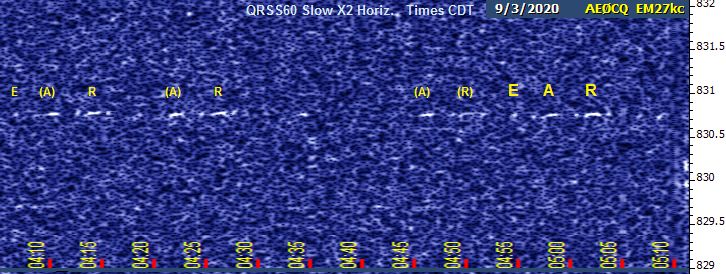
Could I finally be on track for 12 consecutive months? Last night was just quiet enough for Argo to start showing EAR for several minutes around midnight, then again about 40 minutes later, and then with gradually increasing consistency after 1:30 AM CDT/0630 UTC.
It took until nearly 5:00 AM to get an indisputably complete ID...and not a moment too soon, because that noise right after 5:10 appears to be relay chatter from the radio's undervoltage protection circuit, telling me the deep cycle battery was a bit too shallow. That was only a little more than 90 minutes before sunrise, so there was probably no more signal to be seen anyway, but it's still a bit disappointing not to be able to count on the battery for more than five or six hours. If nature cooperates, I may try again tonight in hopes of better copy.
Note: The image above is a thumbnail view that encompasses only about an hour of reception, for ease of viewing in a single window at modest download speeds. However, through a bit of Web trickery, the downloadable file attachment below contains two and a half hours for anyone interested.
---------------------------------------------------------------
File Attachment 1: 2sepd12.jpg
Re: September Morn EAR
Hello John....thanks for your efforts in copying EAR. I officially QSL your receptions, having viewed the evidence!
73, J.B., VE3EAR Reminder: Lowfer net +/- 3929Khz Saturday morning 0800 California time
Posted by Jerry Parker on September 04, 2020 at 14:03:28.
Reminder: Lowfer net +/- 3929Khz Saturday morning 0800 California time
Or listen online at kfs:
http://69.27.184.62:8901/?tune=3929lsb
or
KPH Point Reyes:
http://198.40.45.23:8073/
or
Utah Web sdr:
http://www.sdrutah.org/websdr1.html
If you cannot get into the net on 80 meters you can listen on KFS and participate by sending net control your thoughts to wa6owr@gmail.com
73,
Jerry WA6OWR
Re: Saturday 28th August HiFERs
Posted by John B on September 04, 2020 at 22:40:36.
In reply to Saturday 28th August HiFERs posted by Ed Holland on August 31, 2020
Hello Ed,
It might be that you're seeing with BCN1 is now sending, which is "JB". The frequency remains the same (I think) now that I've temporarily at least fixed the battery charge issue by moving the solar cell around. Still a mighty 0.002W
John
Re: Saturday 28th August HiFERs
Posted by John Davis on September 05, 2020 at 00:12:13.
In reply to Re: Saturday 28th August HiFERs posted by John B on September 04, 2020
Yup, JB was still in the vicinity of 13555.265 to .270 when I saw it in SE Kansas just before noon yesterday.
John D
Re: September Morn EAR
Posted by John Davis on September 05, 2020 at 06:54:10.
In reply to Re: September Morn EAR posted by john Bruce McCreath on September 04, 2020
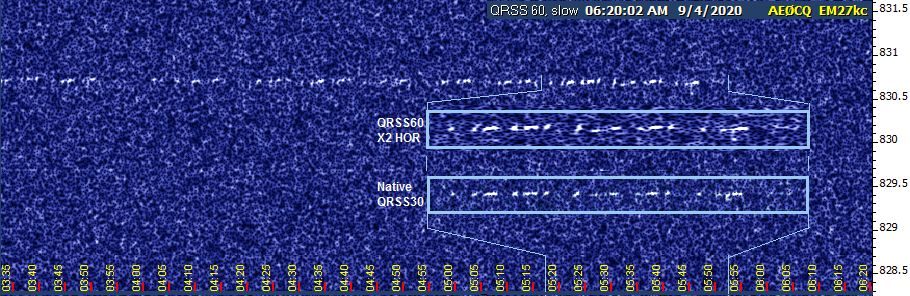
Tried again Thur night/Fri AM to see if (a) EAR would repeat, (b) the battery would hold past sunrise, and (c) I could better determine when the signal faded relative to local sunrise. Yes to all three!
The best ID of the night was the one where the E started at 5:19 AM CDT. The next one starting at 5:31 was not bad apart from the disruption to the A. The final one, starting at 5:43, fell over the edge during the R.
In the picture, the thin blue lines denote times from roughly 5:18 to a little past 5:54, showing that the final fade began almost exactly an hour before local sunrise here. The main trace is QRSS60 Slow. Below that, I've inserted two boxes, comparing my technique of stretching QRSS60 ×2 horizontally with the same time interval as the native QRSS30 Slow trace that I was running in another Argo window.
As can be seen here, the stretched 60 version is a smidgen more sensitive, although I was a little surprised to find that the 60-stretch signal looks to be a tad longer than the native 30 trace.
Re: Saturday 28th August HiFERs
Posted by John K5MO on September 05, 2020 at 19:55:16.
In reply to Re: Saturday 28th August HiFERs posted by John Davis on September 05, 2020
John, has it resumed it's more characteristic slant, rather than the varying style when the battery was failing? :-)
73
John
PS: If you have time, please rename "BNC1" to "JB" the next time you have the hood up on the Hifer list. Thanks!
Re: Saturday 28th August HiFERs
Posted by Ed Holland on September 06, 2020 at 01:29:29.
In reply to Re: Saturday 28th August HiFERs posted by John B on September 04, 2020
That could be the case John. As I mentioned, all that was discernible was a trace of keyed signal in the Spectrum Lab display, with a frequency that tallied with the listing. Re: Saturday 28th August HiFERs
Posted by John Davis on September 06, 2020 at 05:44:44.
In reply to Re: Saturday 28th August HiFERs posted by John K5MO on September 05, 2020
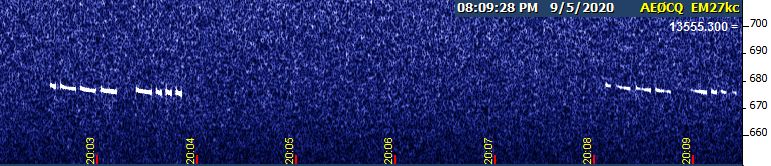
It is indeed back to its typical slant, seen here this evening. JB was in view from just after 7:20 PM CDT, approximately 20 minutes before sunset, until 30-some minutes after. It peaked near 8:02 PM.
This was my first evening of decent pre- and post-sunset captures in a few weeks, but sadly, things were so bad in late afternoon that I took a long supper break right about then and missed seeing several remarkable signals in person. I'll do a more detailed report later, after analyzing all the screen shots.
Quote: "please rename "BNC1" to "JB" the next time you have the hood up on the Hifer list."
Great minds think alike. I beat you to it by a whopping 20 minutes, according to the timestamp on the new list graphic. :)
Re: Saturday 28th August HiFERs
Posted by John B on September 06, 2020 at 12:33:59.
In reply to Re: Saturday 28th August HiFERs posted by John Davis on September 06, 2020
Thanks very much John. Good to see such a strong capture from your end.
I look forward to hooking up the good antennas this fall when thunderstorm season is over, and contributing captures of my own. Good old Argo!!
VLF Experiment on 12th Sept 14.2kHz
Posted by GW4JUN on September 06, 2020 at 18:33:19.
This just in from the Alexanderson Heritage Station on Grimeton.
I'll be taking a listen from my home station in Wales UK. It's a big antenna so might be readable farther afield !
73 Vic GW4JUN
>>>>>>>>
News from
the Alexander Association
Grimeton SAQ Veteran Radio Friends
www.alexander.n.se
Grimeton's sister station shall
reappear in the stratosphere!
A balloon experiment, launched by Warsaw University of Technology, is planned to lift off on September 12th 2020, carrying an unique VLF 210-m-long fully-airborne antenna system, creating EM field on 14.2 kHz - former frequency of the Babice Radio Station in Poland. The project is delivering very important data for a doctoral dissertation - any and all feedback on the reception of the signal (reception location, SNR, bandwidth etc.) is extremely important; your help with the listening to the transmission would be invaluable!
More details on the flight & transmission: Labor Day HiFERs
12.09.2020, estimated lift-off time: 13.00-14.00 CEST
Lift-off location: Przasnysz Airport, Poland (53°00'46.3"N 20°55'52.4"E)
Flight duration: ~3 hours
Max. altitude: 30 km ASL
Emission type: A1 (narrow-band carrier) @ 14.2 kHz (1st class mobile EM device)
Operation starts on ground, the antenna rises with the balloon ascending
Additional radionavigation signals: 144.8 MHz (seen on aprs.fi under callsign SP5AXL), 868 MHz
VLF antenna type: center-fed half-folded vertical electric dipole with capacitive sphere and vertical axial coil
If you have any questions, the Babice Radio Station Culture Park Association (trcn.pl) - the patron of the experiment - can answer via e-mail or Facebook:
stowarzyszenie@radiostacjababice.org
https://www.facebook.com/radiostacjababice/
Please note that this is not an activity arranged by the World Heritage Grimeton Radio Station, nor by the Alexander association. Any questions about this activity shall be directed to the Babice Radio Station Culture Park Association.
Posted by John Davis on September 07, 2020 at 17:13:35.
Potentially a fair day. Started listening about 10:30 AM CDT. Only fair NC, poor EH, maybe fragments of 7P, a ghost of SIW slant, and intermittent copy of WV. A thorough band scan turned up nobody else.
But when I returned to the watering hole just after 11:00, there were NC and EH in apparent collision, definite 7P, SIW slant, a fragment of SIW WSPR, a solid WM, and a ghost of JB.
No way to predict how the rest of the day will go from just part of late morning, but at least it's a better start than yesterday, which had a dismal afternoon and evening...a big letdown after Saturday's sunset period.
WA1EDJ QRV WSPR
Posted by WA1EDJ Bob on September 07, 2020 at 17:41:21.
Went QRV abt 1330 EDST 13,555 410. Just a few Hz above K3SIW WSPR. I was copying SIW as I was setting the TX up. No storms around for a day or so.
Bob PVC in and out
EDJ
Posted by Ed Holland on September 07, 2020 at 23:41:05.
Hi Folks,
Just a quick note to let the group know that PVC may be experiencing an outage, as power has been interrupted at our QTH. There is one last element, the signal generator, which is not running from the UPS system, so when power trips, this needs to be reset before PVC is operational again. This will likely be later evening tomorrow.
THanks
Ed
QRSS/WSPR 22m spotting station
Posted by Robert, VA3ROM on September 08, 2020 at 16:25:29.
First time post, but been in email QSO with Bob, WA1EDJ, about this group. Just setup a 24/7 22m QRSS/WSPR spotting station and will monitor window between 13.555400 to 13.555600 MHz. I've already spotted a station sending just a steady stream of FSK T's or ? at abpit 13.555483 MHz with about a 4 Hz shift.
I spotted a WSPR station which I assume was EDJ? this morning but didn't have WSJT-X up and running at the time when I noticed the signal in the window around 13.555410 MHz (I think that's what it was).
I'm in Thunder Bay, Ontario, EN58JK so I can pretty much cover all of North America quite easily with my various antennas and receivers. Once testing is finished, I'll activate my web page for it so LWCA users can have a look to see if they been spotted by my station. WSPR users will see their signal but no decode (obviously). I'll have to manually add that separately to the page or just upload WJST-X's WSPR log to gove with the QRSS screen grab.
73,
Robert
http://www.va3rom.com
Re: QRSS/WSPR 22m spotting station
Posted by John Davis on September 08, 2020 at 17:16:27.
In reply to QRSS/WSPR 22m spotting station posted by Robert, VA3ROM on September 08, 2020
Welcome, Robert. Your page sounds like it will be a great addition to the resources available for keeping an eye on the band.
One suggestion, though, if you wouldn't mind: If you peruse our frequency list, you might find it more productive to watch from 13,555.300 to 13,555.500 kHz (what we loosely term the Watering Hole). The de facto center of the "WSPR band" at 22 m is 13,555.400 kHz actual RF, or 13,553.900 "dial" if tuning SSB. Currently, there is one WSPR station operating above that point (WA1EDJ), one right in the center (K3SIW), and one below (K5LVB). Lots of good decodes of EDJ and LVB here in Kansas yesterday, but the path is too short for consistent reception of SIW unless the E-layer is active, which hasn't been the case lately.
Few if any QRSS or slow FSK stations intentionally operate above .500; usually only EH during extremely hot weather, or NC when it wanders up there for the winter. NC sends a squarewave in FSK instead of Morse, and is almost certainly the one you noticed as a string of T's just above .480 yesterday. Its frequency drifts diurnally as well as seasonally, and sometimes makes abrupt short-term jumps as well, possibly from wind-induced vibration.
Conversely, there are a few regulars to be found between .300 and .500, though some are seasonal. RY will likely be on again next month, the K5LVB WSPR and QRSS combo is on daily, and WM is all the way down at .300, with others that also come and go in that same hundred Hz at times.
I hope you'll keep us posted on your results.
John
A new spotting station
Posted by John B on September 08, 2020 at 22:55:38.
In reply to QRSS/WSPR 22m spotting station posted by Robert, VA3ROM on September 08, 2020
Hi Robert
Well, I'm at 1355516 or so, so I'm below your passband BUT it sure will be interesting to have a dedicated station watching the HiFer band from your part of the world!
John K5MO
Re: PVC in and out
Posted by Ed Holland on September 09, 2020 at 03:25:44.
In reply to PVC in and out posted by Ed Holland on September 07, 2020
PVC restored. We did indeed lose power during our absence, probably Sunday afternoon PST. Alas this kills the exciter, which has no backup power or non volatile memory.
Re: VLF Experiment on 12th Sept 14.2kHz
Posted by Mike Terry on September 09, 2020 at 09:39:27.
In reply to VLF Experiment on 12th Sept 14.2kHz posted by GW4JUN on September 06, 2020
Looks fascinating, thank you for posting.
Re: QRSS/WSPR 22m spotting station
Posted by WA1EDJ Bob on September 09, 2020 at 16:23:40.
In reply to QRSS/WSPR 22m spotting station posted by Robert, VA3ROM on September 08, 2020
Welcome aboard Robert! Good to have another HiFER. John's suggestion of monitoring the .555 300 to 500 range is better. I don't think I've ever seen anyone above that.
I run WJST-X and ARGO concurrently so I'm watching the whole 22M band. If I see anything out of my ARGO window, I can slide over to it. So far, I've not had to.
Any plans to run a grabber for 22M?
I am WSPRing on about .555 410 currently.
Everyone should take a look at Roberts page. Some very good info. He's quite the writer!
Bob Re: 27 MHz ISM?
EDJ
Posted by Paul on September 10, 2020 at 00:36:27.
In reply to 27 MHz ISM? posted by Ed Holland on August 21, 2020
I might remind you that I ran a beacon on 27.125 MHz. for over 13 years. It set "AOH" in MCW. 16 uW into a vertical atop the highest mountain for 100 miles+ in any direction. Sure drove the local CBers nuts. Inspected by the San Francisco FCC office once. The agent thought it was "neat".
Re: QRSS/WSPR 22m spotting station
Posted by Robert, VA3ROM on September 10, 2020 at 14:02:53.
In reply to Re: QRSS/WSPR 22m spotting station posted by John Davis on September 08, 2020
Thanks John,
That's the information I was looking for! I'll move the dial down to 13.553900 so it's 300 to 500 or the "watering hole". I figured that there must have been some kind of unofficial official standard ;)
73,
Robert
Re: QRSS/WSPR 22m spotting station
Posted by Robert, VA3ROM on September 10, 2020 at 14:15:21.
In reply to Re: QRSS/WSPR 22m spotting station posted by WA1EDJ Bob on September 09, 2020
Morning Bob,
Just sent you an email this a.m. I will put the 22 m Grabber on line. I have lots of spare computers and 5 port and 3 port antenna couplers so one antenna separate can feed up to 8 separate receivers. Now that I know it's 100 Hz to high I'll drop down to look at 13.555300 to 500 instead of 13555400 to 600. I use Spectrum Lab and 10 minute frame stacking which gives an extra 3 dB SNR. Some days you don't need stacking but right now the bands are so bad above 40 m that you need every dB you can get.
And I spotted you right on .410. My IC-7300 is spot on frequency and it's the most sensitive receiver I've owned so far. Just a notch better than my RSPduo SDR receiver, which for $300 bucks is probably the best deal going for a dual receiver with dual antenna ports and going from basically 1 Hz to 2 GHz with up front real world hardware filters to go with virtual software versions. I use it for 30 m FT8, QRSS + WSPR on one receiver/one antenna (frequencies are all within its passband and 20 m SSTV on the second receiver/antenna. Puts a load on resources once you load the other softare decoding programs and I run everything on an older Pentinum I7 quad core processor wiht 16 GB RAM. Albeit I have about a dozen other apps running (CWOP weather station, KiwiSDR monitoring 8 other WSPR frequencies, and on, and on.
73, New FSK 22m beacon on air
Robert
Posted by Robert, VA3ROM on September 10, 2020 at 14:32:46.
Morning all,
I've installed and activated a 22 m beacon up at my RV trailer park just 10 km north of the City of Thunder Bay (grid EN58jk). It's inside a shed behind my trailer so it's going to be subjected to temperatures now ranging from 0 to 20 C. Hopefully, the SG8002 FSK beacon won't wander too much from it's centre frequency of 13.555450 MHz with 4 Hz shift. I was able to receive the signal on a portable receiver driving back out to the highway to 3.5 km (ground wave) but then it takes off and I can't get it back in town at 10 km. It's connected to a 4 m high centre fed inverted-V dipole tuned for 13.555 MHz. The ends are 20 cm above the ground.
I'm transmitting as "ROM" followed by a 5-figure Morse code "cut" number sequence with a 2-figure temperature (in degrees C) and 3-figure solar/batter voltage (decimal point removed).
IE "ROM 15123" = 15 degrees C and 12.3 VDC.
So if anyone out there spots my beacon please send me a screen shot so I can analyze the signal. The SG-8002 is very frequency stable at room temps ranging from 16 to 25 C but I don't know about temps between 0 and 15 C.
Thanks and 73,
Robert
Re: New FSK 22m beacon on air
Posted by Robert, VA3ROM on September 10, 2020 at 15:43:49.
In reply to New FSK 22m beacon on air posted by Robert, VA3ROM on September 10, 2020
I should have used the on air reception example of how the telemetry is transmitted in cut the number form used (there are several variations of cut number table, but I've settled on this one):
0 1 2 3 4 5 6 7 8 9
T A U V H E B G D N
IE "ROM UTAUB" = (VA3) ROM on site air temp 20 degrees C, solar/battery voltage 126 or 12.6 VDC (decimal points not transmitted even using cut form "R").
Leading or trailing zeros are suppressed as required to save transmit time. The complete QRSS 6 FSK beacon takes around 8-1/2 minutes or so to transmit and I use the carrier lead-in and out to maintain frequency stability and as a "pilot light", so to speak to let viewers know that "something" is there in the noise at the start and end of each beacon.
73,
Robert
Re: 27 MHz ISM?
Posted by Robert, VA3ROM on September 10, 2020 at 15:59:57.
In reply to Re: 27 MHz ISM? posted by Paul on September 10, 2020
"CB" ISM is still authorized from 26.957 to 27.282 MHz centre frequency 27.12, but the restrictive 10 uV/m at only 3 m is just as restrictive as it is on the 42 m ISM band (you can only use an antenna with no more gain than a dipole). However, if you read the regs, 27 MHz R/C is also allowed and you can run up to 4 watts. The ISM concept wasn't designed for hobbyist radio beacon us. We started that using the "loopholes in the law". So if I call an ISM 27 MHz beacon an R/C device sending control commands to my nearby receiver (which is why I transmit telemetry with my call) but keeping its power below 5 mW (using say an SG-8002) what's the issue?
Albeit in Canada we were deregulated back in the early 21st century and are no longer a licensed service (we are a "certificated" service) and are also "self-policing" and the feds pretty much leave us along especially considering that the CB band is pretty much the "Wild wild West" of radio services and requires no license or call anymore, at least in Canada. Just keep it under 5 watts and no problem. Like CBers never use linear amps or "free band", eh? ;)
73, Re: 27 MHz ISM?
Robert
Posted by Robert, VA3ROM on September 10, 2020 at 16:00:52.
In reply to Re: 27 MHz ISM? posted by Robert, VA3ROM on September 10, 2020
Oops that should be "10 mV/m at 3 m) or 10000 uV/m at 3 m.
Re: 27 MHz ISM?
Posted by Chris kc3gfz on September 10, 2020 at 16:44:26.
In reply to Re: 27 MHz ISM? posted by Robert, VA3ROM on September 10, 2020
Hi Robert,
I would not worry too much about the R/C toys much anymore in the recent pas few years or so. Most of the RC stuff is now on 2.4 GHz. This being in the US anyhow . Even the non hobby grade equipment has moved mostly from the 49/27mhz bands. The good old days of cars/planes where you could only fly or drive so many at a time and the frequency flags on the antennas.
Chris
Re: A new spotting station
Posted by Robert, VA3ROM on September 10, 2020 at 19:55:31.
In reply to A new spotting station posted by John B on September 08, 2020
Yes, but the band is very wide so we need to select an area that the majority of 22 m WSPR and CW mode beacons use. I guess 13.555300 to 13.555500 MHz is where that is, if I understand correctly. the more grabbers the merrier, so if others go low and high we could cover the entire 22 m ISM band.
If everyone would have a look at https://swharden.com/qrss/plus/ you'll see that WA5DJJ has setup two 22m ISM low and high areas on the QRSS Plus website that he monitors with frame stacking. He has an awesome multi-receiver QRSS setup in his shack that's to die for! You'll also find others that are exclusively monitoring the ham band QRSS segments. Dave, WA5DJJ is located in New Mexico so he has no trouble covering all the U.S. QRSS weak signal transmitters. I'm a lot farther north!
73,
Robert
WA5DJJ 22 m Grabbers
Posted by Robert, VA3ROM on September 10, 2020 at 20:00:36.
Everyone probably know this already so excuse me if it's old news, but David, WA5DJJ in New Mexico has a super QRSS multi-receiver setup that's uploading to Scott Harden, AJ4VD's QRSS Plus web site.
David has setup two 22 m low and high band QRSS grabbers with frame stacking (works if your beacon is synchronized and locked into ten minute transmission cycles. I just had a look to compare his results with mine. I can only monitor 13.555300 to 13555.300 MHz since all my other receivers are tied up. Dave uses all Linux Raspberry Pi stuff and my head spins looking at the photos of his setup!
https://swharden.com/qrss/plus/
73, Re: New FSK 22m beacon on air
Robert
Posted by WA1EDJ Bob on September 11, 2020 at 01:17:45.
In reply to New FSK 22m beacon on air posted by Robert, VA3ROM on September 10, 2020
ROM copied at 0105 UTC here in EM83du today. Very good sig. I'll get a ARGO screen capture soon.
Robert is about 30 Hz north of my WSPR TX.
Bob Re: 27 MHz ISM (Tugging at Loopholes)
EDJ
EM83du
Posted by John Davis on September 11, 2020 at 07:18:32.
In reply to Re: 27 MHz ISM? posted by Robert, VA3ROM on September 10, 2020
The ISM concept wasn't designed for hobbyist radio beacon us(e). We started that using the "loopholes in the law
Yes and no. I think we need to forget ISM. Its rules never covered what we do under Part 15/RSS. They are not synonymous.
Below UHF, there's really very little overlap in frequencies between and license-exempt apparatus. Four of the five most popular Part 15 bands in the US among experimenters and wannabe broadcasters (1750 meters, the AM band, 49 MHz, and the FM band) are not shared with ISM at all!
The so-called ISM bands are not inscribed on stone tablets from the dawn of time, nor did ISM predate Part 15. It was known before WW II that certain shortwave frequencies were more propitious than others for medical diathermy, industrial heating and plasma generation, but it was largely up to each country to allocate them in ways that prevented interference to themselves and other nations in their ITU region. The predecessor to Part 15 was also already in place before then, too, but mainly covered the broadcast band and lower.
After the war, shortwave spectrum was in even tighter demand for a while, and even higher frequencies could be generated that would be useful and economically important if equipment could be manufactured on an internationally standardized basis. Coincident with that arose a demand for remote garage door openers and other household remotes, baby monitors and wireless intercoms, plus early forms of RFID. How to accommodate as many users as possible? Frequency sharing, of course. That's why ISM frequencies first started appearing as footnotes in the ITU regulations in 1947, more as reservations than formal allocations.
There's nothing magic about an "ISM band." Each one features a mix of ISM and non-ISM users, but just because they're in the same frequency range does not mean that the rules are interchangeable between them! A different set of rules applies to each service, enacted to fit the intended uses and interference risk each poses to the others. We're not free to just pick and choose.
Four examples specific to unlicensed operation in the 27.12 MHz band, based on FCC regs; your mileage (or kilometrage) may vary in Canada:
1. If you just wish to radiate lots of RF, you can operate an ISM device under Part 18, subject to the following:
- it still has to comply with RF exposure limits
- it has to be equipment that's approved by the FCC; no homebrew, no added antennas
- no on-off keying or modulation of any kind; no communication at all
2. To transmit voice with any power above the microwatts level, you can employ Class D CB rules under Part 95, but then, legally, you must:
- use an FCC certified transmitter; no homebrew, again
- use AM or SSB voice only (no CW or digital modes, no music; tones only for selective calling)
- output no more than 4 W carrier or 12 W PEP from the transmitter
- stick to the 40 authorized voice channels
- not try to work DX
3. The Radio Control rules in Subpart C of Part 95 allow you to transmit via a non-certified (even homebrew) rig with mean output power of 4 W, or up to 25 W on one specific channel, but:
- only on the five R/C-only channels, or shared Ch 23
- voice and Morse code are expressly prohibited, §95.733
- telemetry in the US can only consist of on/off indications from one or more sensors, no ID or human readable codes
4. To skip all restrictions on signal types or permissible channels within the band edges, there's Part 15, with its one significant inconvenience:
- the limit of 10 mV/m at 3 meters distance
We're not bad boys sneaking behind the government's back to engage in some shady activity. We have a hobby that's perfectly legit when it's in step with the regulators' words. No loopholes required. At least, as long as we're not trying to stretch the point by picking one rule from Column A and another from Column B.
Re: New FSK 22m beacon on air
Posted by John Davis on September 11, 2020 at 07:29:29.
In reply to Re: New FSK 22m beacon on air posted by WA1EDJ Bob on September 11, 2020
Hope to be looking for the new signal in this weekend, once our persistent rains let up so I can return to the field.
Re: 27 MHz ISM (Tugging at Loopholes)
Posted by Ed Holland on September 11, 2020 at 16:15:19.
In reply to Re: 27 MHz ISM (Tugging at Loopholes) posted by John Davis on September 11, 2020
Good write-up John.
I brought up the subject of 27 MHz, and did so in the manner of looking for opportunities within the regulation. The fact is, these have been largely anticipated. In part [sic] this is to reduce the risk of interference, exactly because signals can travel great distances and to ensure availability of spectrum to a large number of short range users, with specific intended purposes. There may also be commercial considerations at work, but I have nothing to support that notion.
We're actually really lucky to have 22 m. Of course it would be great to have additional bands in the HF spectrum that allow similar operation, but that seems unlikely to change. Re: New FSK 22m beacon on air
Posted by Robert, VA3ROM on September 11, 2020 at 23:32:20.
In reply to Re: New FSK 22m beacon on air posted by WA1EDJ Bob on September 11, 2020
Thanks Bob.
After I read your email, I checked Simon, DJ2LS' heat map website https://maps.dj2ls.de/. My WSPRLite transmitter is sitting next to my PICAXE transmitter and the maths said that WSPR and QRSS 6 have basically the same power spectrum density (watts per Hertz) so my QRSS 6 signals should be "landing" in the same "zone" as the WSPR signal. Just had to look for internet KiwiSDR's in the same areas and lo and behold I was able to fed the audio into my Spectrum Lab 22 m QRSS 6 grabber and WJST-X. I was spotting myself and other QRSS station.
K3SIW's 5 mW WSPR signal (he's almost due south of me) was being also being picked up in Alberta by VE6SLP along with my QRSS 6 4.6 mW signal so that's a good indication of the close equivalency between the two as far the KiwiSDRs and software are concerned. Along with "PVC" just below me and "E" or ? just above me along with "T" and "M" up higher.
A few of us were colliding around 13.555450 MHz, so I'm going to order some more SG-8002's with lower 22 m frequencies for the "watering hole" from Digikey Canada. Frame stacking allowed me to remove the overlapping stations with me enough to where I could read my telemetry for just one 10 minute frame. But shifting over to the Atlanta area, by the mid-afternoon I was spotting myself via remote KiwiSDR at Q3 to Q4 and I didn't need any stacking to read my telemetry. The on site temperature was in the upper teens (degrees C of course) and I could tell when my solar charging kick in (voltage was over 13 VDC) and when running without (voltage dropped to around 12.5 VDC) so I know that everything is working fine without having me guessing as to when to drive up to check things out in person.
So very cool, at least to me it is.
73,
Robert
Re: 27 MHz ISM (Tugging at Loopholes)
Posted by John Davis on September 12, 2020 at 00:31:37.
In reply to Re: 27 MHz ISM (Tugging at Loopholes) posted by Ed Holland on September 11, 2020
Ed wrote:
We're actually really lucky to have 22 m. Of course it would be great to have additional bands in the HF spectrum that allow similar operation, but that seems unlikely to change.
Agreed on all points. Overall, I'd say we're lucky to have an enlightened FCC. All nations have radio laws based on the premise that every intentional electromagnetic emission must be authorized by the federal government in some manner or another. This forms the basis for all station licensing and equipment authorization procedures.
The proliferation of gazillions of increasingly essential personal RF emitting devices must be accounted for within that legal framework, though, if the regulatory framework is to remain intact. That's done in a variety of ways in different countries, depending on the type of device. Since cell phones, for instance, are only capable of operation in conjunction with licensed base stations, they can be deemed to operate under a blanket license. Other devices, like wi-fi modems, RFID systems, door openers, etc., would each have to be treated as special cases were it not for broad rules allowing operation of some types of RF radiators based strictly on their compliance with very specific operating parameters.
Thus, the FCC, ISED Canada, OfCom in the UK, CEPT, and most of the rest of the world, all have rules that authorize specific equipment to be operated on a license-exempt basis. But there is sometimes a big difference in how different administrations view what are substantially the same regulations!
Some adopt the attitude that what is not prohibited is permitted, while others feel any use that is not expressly permitted is probably prohibited...or at least, needs to be viewed with severe official skepticism. Germany, for instance, requires amateurs experimenting below 8.3 kHz to get special permission to operate outside internationally and domestically allocated spectrum, presumably for the very fact that it's outside legislated authority and therefore must be scrutinized all the more carefully. Canada's regulators, on the other hand, come right out and state that frequencies below the allocated spectrum are not within IESD's jurisdiction. (Our own FCC says almost nothing at all, apart from reminding us emissions within allocated spectrum must be below the general limits set out in Part 15. But if you begin messing with secret government submarine and/or UFO VLF experiments, some have hypothesized you might receive a visit from the Men In Black.)
Or a closer to home example: Based on what Vic (JUN) wrote from Wales recently, it appears OfCom considers experimental communications at 13.56 MHz an affront to Queen and Country because the boffins in the back office didn't include specific mention of such use in the emission limits for the band. That echoes what Peter Knol told me about Dutch regulators two years ago. Because it wasn't something the promulgators affirmatively had in mind when the wrote the rule, it must automatically be discouraged.
Fortunately, our own FCC is much more laid back and pragmatic. Now, there are some Part 15 bands which have different rules that apply only to specific applications; but those are identified within the text. Cordless telephones, auditory assistance devices and field disturbance sensors are examples of devices that have their own special prerogatives and requirements within Part 15. Any section concerning a band which does not mention specific applications is open to any use that is not otherwise unlawful (no Peeping Tom escapades or coordinating bank robberies, for instance).
Sorry to disappoint any jailhouse lawyer types who were ready to argue we're all living on the ragged edge because our experimental activities were not foreseen by the supposed "original intent" of the Part 15 rules. We're fine so long as we stay within the letter of the rules. That's not just my opinion. From the FCC's OET Bulletin 63 which explains Part 15:
If a particular transmitter can comply with the general radiated limits, and at the same time avoid operating in one of the restricted bands, then it can use any type of modulation (AM, FM, PCM, etc.) for any purpose.
The Commission is well aware what sort of experimentation goes on at LowFER, MedFER, and HiFER frequencies, even if they don't necessarily follow our exploits every single day. They're OK with it as long as we make a good faith effort to follow the rules.
At the end of the first rulemaking proceeding where they declined to implement the WRC-07 recommendations for a 2200 meter LF ham band, the FCC Report & Order hinted at obtaining Part 5 Experimental Services licenses (to establish a track record of compatibility with Power Line Carrier systems), and also stated that other experimental objectives could be achieved in the interim via Part 15 operation. In support of that assertion, they cited this website for examples. Gave me a warm glow.
As for wishing there were more HF spectrum for Part 15, I do too. Don't mean to be greedy, but access to 44 meters would be nice, and I have no clue why it's not available on this side of the border. I also don't understand why the mediumwave alternative provision in §15.219 ends at 1705 kHz, when the RF emission mask of AM broadcasters extends all the way to 1710 kHz. And, what would a couple of mW hurt at 27 MHz now that "serious CBers" are no longer as plentiful as they were back in 1978 when Part 15 operation was greatly curtailed in the band. It was a rather fun place before then, and could yet be with a smidgen more signal. But...those are all issues that need to wait for another Part 15 rulemaking opportunity, which I suspect is not a very high priority for the FCC right now.
Warsaw University to launch balloon on Saturday with VLF Transmitter o
Posted by Mike Terry on September 12, 2020 at 12:08:52.
According to Babice Transatlantic Radio Station on Facebook this morning, launch time is 1400CEST (1200 UTC) and transmission on 14.2 kHz will be "just a carrier". Follow progress here:
https://www.facebook.com/radiostacjababice/
On Fri, Sep 11, 2020 at 09:49 PM, Mike Terry wrote:
News from the Alexander Association
Grimeton SAQ Veteran Radio Friends
www.alexander.n.se
Grimeton’s sister station shall reappear in the stratosphere on 12 September!
A balloon experiment, launched by Warsaw University of Technology, is planned to lift off on September 12th 2020, carrying an unique VLF 210-m-long fully-airborne antenna system, creating EM field on 14.2 kHz – former frequency of the Babice Radio Station in Poland. The project is delivering very important data for a doctoral dissertation – any and all feedback on the reception of the signal (reception location, SNR, bandwidth etc.) is extremely important; your help with the listening to the transmission would be invaluable!
More details on the flight & transmission:
12.09.2020, estimated lift-off time: 13.00-14.00 CEST
Lift-off location: Przasnysz Airport, Poland (53°00’46.3″N 20°55’52.4″E)
Flight duration: ~3 hours
Max. altitude: 30 km ASL
Emission type: A1 (narrow-band carrier) @ 14.2 kHz (1st class mobile EM device)
Operation starts on ground, the antenna rises with the balloon ascending
Additional radionavigation signals: 144.8 MHz (seen on aprs.fi under callsign SP5AXL), 868 MHz
VLF antenna type: center-fed half-folded vertical electric dipole with capacitive sphere and vertical axial coil
If you have any questions, the Babice Radio Station Culture Park Association ( http://trcn.pl/ ) – the patron of the experiment – can answer via e-mail or Facebook:
stowarzyszenie@radiostacjababice.org
( https://alexander.n.se/grimetons-sister-station-shall-reappear-in-the-stratosphere/
)
On the day of launch, we plan to post updates on the launch, flight and the experiment itself via our Facebook page: facebook.com/radiostacjababice Re: New FSK 22m beacon on air
Stay tuned! ( http://trcn.pl/do-stratosfery-to-the-stratosphere/ )
Posted by WA1EDJ Bob on September 12, 2020 at 14:57:13.
In reply to Re: New FSK 22m beacon on air posted by Robert, VA3ROM on September 11, 2020
I'm iding you with more frequency now. Quite readable and I could decode the telemetry.
I've been wanting to get a screen shot and post but it seems my machine (WIN7) is doing strange things. John can relate to that. I tried to do a screen capture and all went south with ARGO. I need to go to my other machine and try this all again.
You are about the strongest sig I'm seeing these days. I catch you in early evenings and I see you this morning.
Let me get this sorted out and I'll post.
Bob Re: "T" 13563.45 khz
EDJ
Posted by Bill Hensel on September 12, 2020 at 19:49:59.
hearing it out on the left coast KFS SDR time is 1948 utc
Re: wspr variant on 630m
Posted by Paul N1BUG on September 12, 2020 at 22:13:59.
In reply to wspr variant on 630m posted by swlem3 on August 26, 2020
What you are seeing is probably FST4W, a new mode in development. A small group has been testing FST4 and FST4W for several weeks. FST4 is for minimal two way QSOs, and works similar to JT9. It offers T/R periods of 15, 30, 60, 120, 300, 900, and 1800 seconds. FST4W is similar to WSPR but with slightly better sensitivity and T/R periods of 120, 300, 900, and 1800 seconds. I believe a public release candidate may not be far in the future at this point, so you should soon be hearing more about it.
Aurhenticated Author?
Posted by WA1EDJ Bob on September 13, 2020 at 14:13:46.
John,
I'm trying to sign up to become Authenticated and get message I don't have permission to use this resouce.
Can you fix?
Bob Re: Aurhenticated Author?
WA1EDJ
Posted by Webmaster on September 13, 2020 at 15:52:18.
In reply to Aurhenticated Author? posted by WA1EDJ Bob on September 13, 2020
"Can you fix?" Good question! Same message to me when I tried it just now. That may explain why we haven't had any requests to process in some time. Sorry about that!
It'll apparently take some investigation, which I may not be able to do in sufficient detail until tonight, once I've got the LOWDOWN material on its way to HQ.
It's kind of scary when the software won't even let its creator in. Maybe the A.I. Uprisimg has begun! Be on the alert for Terminators.
More when I know something.
John
Re: Aurhenticated Author?
Posted by WA1EDJ Bob on September 13, 2020 at 16:20:21.
In reply to Re: Aurhenticated Author? posted by Webmaster on September 13, 2020
Ok, thanks John! It's something different every day with these PC's. I just wanted to post some of the ARGO captures I'm getting of Robert's ROM HiFER. I/we can't believe how strong he is down here in EM83du. Similar to how RY would be some days (when on).
I'm curious if you RX ROM as well. I have a really good N/S path here for some reason.
Almost always see EH, now ROM.
I did catch K5LVB WSPR last night and caught a QRSS "B" just before the WSPR.
I had not realized he sends QRSS CW just prior to the WSPR.
Is it the whole "K5LVB" call or just "B"?
TNX for the help! No rush.
Bob Re: Aurhenticated ... (K5LVB)
EDJ
Posted by John Davis on September 13, 2020 at 16:58:46.
In reply to Re: Aurhenticated Author? posted by WA1EDJ Bob on September 13, 2020
He sends "LVB" in QRSS3 which takes two minutes, then the WSPR2, then a 2-minute break, for a total 6-minute cycle. Covers most bases that way. :)
Looking forward to getting away from this desk so I can finally try for ROM, too.
Re: Aurhenticated Author?
Posted by Webmaster on September 13, 2020 at 17:40:14.
In reply to Re: Aurhenticated Author? posted by WA1EDJ Bob on September 13, 2020
Not good news on the software front.
I enabled some diagnostic code that I'd built in to report errors such as this (apparently I used to be smarter than now), and according to what it tells me, Authenticate Author signup should never have worked at all! But of course, it did.
The sign-up form is correct and calls the proper method. The script on the server is looking for the correct method, too. But it's telling me the wrong one is being called, and I don't know how that's even possible. I went so far as to upload fresh copies of the signup form and the script, but no change!
I could theoretically force the software to override the error, but to do so would open up the board to possible hacking.
And to confound the situation further, Internet Explorer and Firefox behave a little differently concerning this problem. Same error message in the end, but before getting there, Firefox also objects to the supposedly "unsecured" connection. Perhaps this will turn out to be a clue of some sort.
Looks to be a time-consuming headache ahead, though, and I've really got to get back to work on the columns for now.
Meanwhile, if you'd like to post a message with attachments, you can always send it to me at the
mb lwca org
address, and I'll be glad to put it on the board as soon as I can.
John
Re: Aurhenticated Author?
Posted by WA1EDJ Bob on September 13, 2020 at 17:45:35.
In reply to Re: Aurhenticated Author? posted by Webmaster on September 13, 2020
Ok, Thanks John!
No worries, Not that critical on my end. Take care of the important stuff.
Right now I'm seeing EH and ROM. I'm out for a few hours and will check the band later.
Good luck.....It's always something with PC's.
Bob Re: Authenticated Author?
EDJ
Posted by Webmaster on September 13, 2020 at 18:40:25.
In reply to Re: Aurhenticated Author? posted by WA1EDJ Bob on September 13, 2020
"It's always something with PC's."
And something else with Linux and Apache involved!
I couldn't just let it go after that not-so-subtle hint from Firefox, so I changed the sign-up page to call the script through the HTTPS protocol, rather than making the server do it by redirection. That was even worse! Now I get 500 Internal Server Error instead.
I really must force myself to stop for now, or I'll be losing my religion...in the original meaning, not the R.E.M. song, although their use of the Icarus and Daedalus myth may actually be relevant. Maybe I've approached Nerdvana too closely, and melted my wings.
"The lengths that I will go to..."
More if/when I can figure out what changed.
Re: wspr variant on 630m
Posted by John Davis on September 13, 2020 at 19:12:33.
In reply to Re: wspr variant on 630m posted by Paul N1BUG on September 12, 2020
Thanks for that information, Paul. It seems very likely that is what we have been seeing, although it's puzzling why someone would run it in such a busy slice as the WSPR segment of 630 meters...although I haven't seen it there as much recently, come to think of it. I do continue to notice the 300 second version on 2200.
Re: wspr variant on 630m
Posted by swlem3 on September 13, 2020 at 21:51:20.
In reply to Re: wspr variant on 630m posted by Paul N1BUG on September 12, 2020
Thanks Paul for the info. If the software was available to be downloaded for testing, I would have liked to participate in giving rx reports from this area of the country. I had a good copy on the activity on both the 630 and 2200m bands.
I was looking for someone to "drop a line" or two on what was going on ... either this forum or the lowfer group on qth.net. Was disappointed that no one gave a "heads-up" before or during the activity.
Again, thanks for stopping by with the update Paul.
73 ... Ray
Re: Saturday 28th August HiFERs
Posted by KM0NAS on September 14, 2020 at 15:27:38.
In reply to Saturday 28th August HiFERs posted by Ed Holland on August 31, 2020
MN had been running on a bit of a compromised antenna for about a month as I waited for parts to change out some of my various antenna elements in the back yard. Now that my main antenna is back up and running, the one that MN is on is also back at the proper height. It may improve reception moving into this fall season.
Re: Saturday 28th August HiFERs
Posted by John Davis on September 14, 2020 at 16:42:26.
In reply to Re: Saturday 28th August HiFERs posted by KM0NAS on September 14, 2020
Thanks for that news, Kirk. Normally, I can hear MN any day that I'm able to see K5LVB. Propagation wasn't very good for a while and both were gone, so I didn't think much of MN's absence until last Monday. That day, I had fine copy of K5LVB but heard nothing from MN, so I began to wonder.
I may not have a chance to listen today, but I'll try tomorrow if weather permits. It'll be good to copy MN here in SE Kansas again.
Re: Old UNID
Posted by John Davis on September 14, 2020 at 18:01:57.
In reply to Old UNID posted by Shawn Axelrod on July 28, 2020
Hi Shawn. Sorry to take so long, but I've only been able to find one approximate match anywhere in the early to mid-1990s. If it could have actually been signing HI, then it might have been Bart Prater from Smith Mountain Lake, VA. He was close to 1660. Haven't heard from Bart in many years now.
Re: Saturday 28th August HiFERs
Posted by KM0NAS on September 14, 2020 at 18:22:44.
In reply to Re: Saturday 28th August HiFERs posted by John Davis on September 14, 2020
I'm glad people are hearing it! 136 khz 2200 meters beacon
Posted by Lee on September 16, 2020 at 01:43:54.
Now testing 136khz beacon. The letter P at QRS30 and a 5 WPM message. Approx 35 watts into the antenna. Haven't figured out what the ERP is yet. Next project is the computer interface to run WSPR. Thanks to John D. of LWCA and Roger C. of Monitor Circuits AUS for their invaluable help.
Re: New FSK 22m beacon (Tue/Wed)
Posted by John Davis on September 16, 2020 at 18:27:45.
In reply to Re: New FSK 22m beacon on air posted by WA1EDJ Bob on September 12, 2020
Got my first decode of the ROM ID late yesterday morning, and first deciphered the message payload during the 11:46-11:51 AM CDT interval. It showed up as TBAUB, or 06 °C 12.6 V ...which I note to be considerably cooler than Weather Network was showing for Thunder Bay at the time, but the first character was definitely a T. See attachment. This was at a base frequency of 13555.455 kHz ±2 Hz, where it remained through QSB and Codar to around 3:30 CDT.
Other signals at the time included NC and EH atop 7P in the watering hole, sometimes with JB; and elsewhere, WV, KAH, and WAS. WA1EDJ decoded a few times at mid-afternoon, also. PVC showed up around 13555.450, around 40 Hz lower than usual, after ROM faded out. More on that reception later.
Late this morning (Wed. the 16th) ROM appears to have moved to 13555.333. This should be a good frequency too, except not long after ROM faded in, some wandering carrier that I'd never seen before began encroaching. At the risk of being paranoid, it sometimes almost looks like intentional QRM. I'm returning to the field now for further observations.
---------------------------------------------------------------
File Attachment 1: 15sepMSG.jpg
Re: New FSK 22m beacon (Tue/Wed)
Thanks John for your post and signal reports,
PVC was reset last week after a power outage. I set it by zero beat against a receiver with TCXO, but the signal generator dial reading was different than previous setup instances. If it is helpful to ROM (Robert, VA3ROM), I will bump up again to give some breathing room.
It is great to know there are so many beacons on the air at the moment, and to see folks active here to let us know about their signals and share reports.
Cheers, 73s,
Ed
Re: 136 khz 2200 meters beacon
Posted by Eric NO3M on September 16, 2020 at 21:51:22.
In reply to 136 khz 2200 meters beacon posted by Lee on September 16, 2020
What's your callsign? Where are you located?
22m Beacon Heard (WSPR)
Posted by SWL SD on September 16, 2020 at 22:00:49.
Heard in Southern San Diego County, California, 16 September 2020
Receiver: Homebrew
WSPR Decoder: Home Brew
Antenna: 43m dipole at 23m
Frequency: 13553.53kHz
Time dB dT C/S Grid dBm/Pwr Re: New FSK 22m beacon (Tue/Wed)
2050(Z) -25 2.6 K3SIW EN52 7 (5.0 mW)
2122(Z) -18 -4.3 K3SIW EN52 7 (5.0 mW)
2126(Z) -27 0.1 K5LVB EM10 7 (5.0 mW)
2132(Z) -21 0.0 K5LVB EM10 7 (5.0 mW)
Posted by WA1EDJ Bob on September 16, 2020 at 22:06:47.
In reply to Re: New FSK 22m beacon (Tue/Wed) posted by John Davis on September 16, 2020
Thanks John. Appreciate the reporting. I did have WA1EDJ WSPR on today. I generally go QRT about 1800 EDT for some evening listening. If WX permits, I'm QRV next morning about 0800. TS's have subsided lately. Now just Sally to contend with.
Robert did get another SG-8002 osc for the new freq. While he was very strong a few days ago, I've entirely lost him now. Not even EH showing up.
Re: 136 khz 2200 meters beacon
Bob
EDJ
Posted by John Davis on September 16, 2020 at 22:31:16.
In reply to Re: 136 khz 2200 meters beacon posted by Eric NO3M on September 16, 2020
Lee is KE6PCT, former 1750 m LowFER.
Re: 136 khz 2200 meters beacon
Posted by Lee on September 17, 2020 at 01:30:17.
In reply to Re: 136 khz 2200 meters beacon posted by Eric NO3M on September 16, 2020
KE6PCT , DM04 I believe. Angeles National Forest adjacent.
Re: 22m Beacon Heard (WSPR)
Posted by John B on September 17, 2020 at 14:04:29.
In reply to 22m Beacon Heard (WSPR) posted by SWL SD on September 16, 2020
That's a really nice report, and it's really fun to read that your station is homebrew
Re: 22m Beacon Heard (WSPR)
Posted by Ed Holland on September 17, 2020 at 20:02:58.
In reply to 22m Beacon Heard (WSPR) posted by SWL SD on September 16, 2020
Hi SWL SD
Would you care to share some more info about the home-brew receiver? This would be rather interesting
Cheers
Ed
Re: New FSK 22m beacon (Tue/Wed)
Posted by Ed Holland on September 17, 2020 at 20:06:58.
In reply to Re: New FSK 22m beacon (Tue/Wed) posted by John Davis on September 16, 2020
Addendum to my previous message: PVC has been adjusted up by 40 Hz. I hope this offers a little more space in the crowded spot.
Given that using the DDS signal generator offers full flexibility on frequency, and seems relatively stable output, perhaps a move to a new slot would help. If so, I would be happy to oblige.
Cheers
Ed
Re: 22m Beacon Heard (WSPR)
Posted by John Davis on September 18, 2020 at 01:32:27.
In reply to Re: 22m Beacon Heard (WSPR) posted by Ed Holland on September 17, 2020
Agreed. I'm always intrigued by homebrew gear, and would be delighted to know more about not only the receiver, but also the WSPR decoder.
Re: New FSK 22m beacon (Tue/Wed)
Posted by John Davis on September 18, 2020 at 01:38:55.
In reply to Re: New FSK 22m beacon (Tue/Wed) posted by Ed Holland on September 17, 2020
I noticed the change late this morning, but that put the fragments of PVC right between NC and the spot where EH was stomping on 7P. The 13555.450 spot was actually a rather good one, now that ROM has moved down to the lower half of the watering hole. With the onset of slightly cooler weather, NC has begun its annual migration up away from that vicinity, and EH has not yet migrated all the way down there yet. It's temporarily fairly clear.
Re: 136 khz 2200 meters beacon
Posted by Eric NO3M on September 18, 2020 at 02:45:37.
In reply to Re: 136 khz 2200 meters beacon posted by Lee on September 17, 2020
Thank you for the info. Just trying to gauge the feasibility of reception out here from the eastern side of the country.
If you could put your transmissions somewhere around 136.4-136.6, that may work better for some folks, including myself, and shouldn't interfere with any other activity. Many have their receiver(s) set to 136.0 monitoring the digital traffic and moving up would put your signal in the passband, only requiring something like ARGO to accumulate spectrum captures.
Re: New FSK 22m beacon (Tue/Wed)
Posted by John Davis on September 18, 2020 at 04:45:24.
In reply to Re: New FSK 22m beacon (Tue/Wed) posted by John Davis on September 16, 2020
When I returned at noon Wed., ROM and JB were in the clear with no sign of the QRM, and it did not return. I made the message payload at that time to be "UTAVT", or 20 °C 13.0 V. Capture attached.
---------------------------------------------------------------
File Attachment 1: 16sepb15.jpg
Re: New FSK 22m beacon (Tue/Wed)
TUVM, John.
The telemetry data is much appreciated. My beacon isn't in Thunder Bay; it's up at my camp to the north. The City, itself, is in the Slate River Valley so when I up to my camp, it's literally 500 m up before I turn into Hidden Valley and then I drive or drop down 200 m to the campground. But I'm still 300 m above Thunder Bay. By August, the morning temps are near freezing, and this time of year predawn hours are bone chilling as cold air just flows in and fills Hidden Valley and we get "sea smoke" coming off the lake the campground surrounds. But it usually is colder and then hotter than the city given the compact climate and ecosystem of Hidden Valley.
The transmitter is inside an unheated and small galv. steel shed behind my RV, and I see that the SG-8002 transmitter frequency changes with the temperature and its about 40 Hz higher this a.m. so it was a very cold night up there with temps near 0C. It should start to drift back down as things warm up in the shed since I'm on the sunny side of the lake (great night sky site for my other hobby of astronomy).
Interestingly, Hidden Valley is surrounded by 500 m high solid Canadian Shield rock "walls" and dense bush, but I cleared a 5 m buffer zone around the 4 m high (at the apex) inverted-V bush dipole made from #22 insulated speaker wire with the ends about 20 cm above the ground. I'm feeding it with 10 m of RG-174. It had to fit into a very specific, tight location and leave room for my other antennas around it to "breath", too. I monitor the signal using public access KiwiSDRs and VE7GL's station, in my late afternoon, spots me with a very clear, strong and steady signal. I'm amazed that its so strong because the distance is nearly 2600 km and we are at the bottom of a prolonged solar minima. But the 3000 km optimum working frequency is now up around 15 MHz, so that probably explains it, somewhat.
Thanks once again for the screen grabs, John.
73,
Robert
Re: New FSK 22m beacon (Tue/Wed)
Posted by Ed Holland on September 18, 2020 at 17:32:33.
In reply to Re: New FSK 22m beacon (Tue/Wed) posted by John Davis on September 18, 2020
Thanks again for the report John, it is nice to know that PVC is being received.
I should be able to reset accurately around the other drifters, back to 13555.450. Always open to advice/suggestions here.
Although the signal generator has an offset error (more likely a scale error in proportion to the nominal output frequency) meaning that it's dial is not quite correct, it seems stable when warmed up, and is in a basement room which holds a very steady temperature. Output adjustments can be programmed to the nearest Hz, providing ample resolution. I normally make adjustments in steps of 10 Hz.
PVC may go off at the weekend to enable some listening activity.
Thanks again.
Ed
Re: 136 khz 2200 meters beacon
Posted by Lee on September 18, 2020 at 18:47:08.
In reply to Re: 136 khz 2200 meters beacon posted by Eric NO3M on September 18, 2020
A very good question. I just took another look at the band plan for 2200 meters. I could move to 136.4-136.5khz for the ARGO folks. Considering any opinions at this point. I plan to play with WSPR USB at 137.500kh +-100hz and also QRS30 and 5WPM CW at a new determined freq.
Re: New FSK 22m beacon (Tue/Wed)
Posted by WA1EDJ Bob on September 18, 2020 at 23:51:31.
In reply to Re: New FSK 22m beacon (Tue/Wed) posted by Robert, VA3ROM on September 18, 2020
Haven't heard/seen a peep down here in EM83du lately. I'm really not seeing much at all down here. Odd but, the way it goes. No EH even.
Bob LowFER WM This Week
EDJ
Posted by John Davis on September 19, 2020 at 05:40:39.
Glad to report some snippets are making it through once again, even in daylight sometimes. The band was not exactly quiet on Tuesday and Wednesday nights, but the static was down a bit and the signals were up a bot from what they had been during the summer.
The attached file 16sepc28.jpg is representative of some of the better copy on both nights. The FSK69 ID at 10:50 to 11:10 PM CDT is just clear enough to be convincing, and the W of the graphical "WM" at 11:30 is recognizable.
The way I know the radiated signal to be stronger is by the daytime reception, one example of which can be seen in the attached file 15sepd26.jpg. By 9 o'clock in the morning, the static is low enough that the PLCs and SMPS QRM is visible. Those were completely overwhelming WM as recently as a month ago, but this week WM could be seen at least part of the time in mid-morning. Progress!
---------------------------------------------------------------
File Attachment 1: 16sepc28.jpg
File Attachment 2: 15sepd26.jpg
Recent HiFer topics
SWL: I too would be interested in the HB receiver. Please post some description if you have time. Thanks!
John: Thanks for the report of JB. It appears that repositioning the solar cell is allowing enough sun to keep the 5xAA NiMH batteries topped off, (since the slant is still there).
Regarding the EPSON drift, how are others managing this? I'm using a SG8002 plastic package part. The oscillator is in a weather proof cast box, wrapped in bubble wrap and inside a horizontally positioned 2' section of white aluminum gutter downspout, horizontally positioned to minimize weather exposure.
Is this just the nature of the Epson SG8002 in a QRSS application or are there other steps I could take to minimize what appears to be drift under self heating?
Czech radio to close AM stations in 2021
Posted by Mike Terry on September 19, 2020 at 12:48:17.
On December 31, 2021, Czech Radio will turn off medium and long wave transmitters, in the ranges indicated by the abbreviation AM. “Technology is not entirely promising and is obsolete. We have to prepare for this in terms of communication, because it will not be easy to persuade senior citizens in particular to exchange their receivers, “said Karel Zýka, Director of Technology and Administration of Czech Radio. Re: Czech radio to close AM stations in 2021
That is also why the Czech Radio will launch the “Senior” station just for them. The public service media currently operates six mediumwave and one longwave transmitter.
Ydun Ritz (2020-09-18)
Posted by Mike Terry on September 19, 2020 at 12:49:21.
In reply to Czech radio to close AM stations in 2021 posted by Mike Terry on September 19, 2020
https://mediumwave.info/news.html
Re: LowFER WM This Week
Posted by Mike N8OOU on September 19, 2020 at 14:31:56.
In reply to LowFER WM This Week posted by John Davis on September 19, 2020
John
Thanks for the captures. Vegetation is still green here, but everything is really dry from minimal rainfall. I am surprised to hear that daytime reception is possible. My reception of AMBCB stations in the 200-300 mile range has been a lot weaker for the past several weeks.
Thanks for listening.
Mike 73
Re: Any copy of JB?
Posted by swlem3 on September 19, 2020 at 15:54:27.
In reply to Any copy of JB? posted by WA1EDJ Bob on August 05, 2020
Decided to try for a few hi-fers today and saw JB on Sept. 19 1536z.
https://drive.google.com/file/d/1rF7wPuMub9B0zXnKa--qsqrGys_7IBdB/view?usp=sharing
Elad sdr w/ active antenna
WA1EDJ wspr
Posted by swlem3 on September 19, 2020 at 16:04:56.
Currently copying WA1EDJ wspr2, Sept19,2020 from N Central TX.
2028 -28 0.2 13.555410 0 WA1EDJ EM83 7 1449
2032 -26 0.0 13.555410 0 WA1EDJ EM83 7 1449
1536 -29 0.1 13.555410 0 WA1EDJ EM83 7 1449
1544 -26 0.4 13.555411 0 WA1EDJ EM83 7 1449
1552 -25 0.3 13.555411 0 WA1EDJ EM83 7 1449
Note: First two decodes had erroneous time stamp so did not upload to wsprnet.
Elad sdr w/ active antenna
630 m WSPR
Posted by John Davis on September 19, 2020 at 16:15:48.
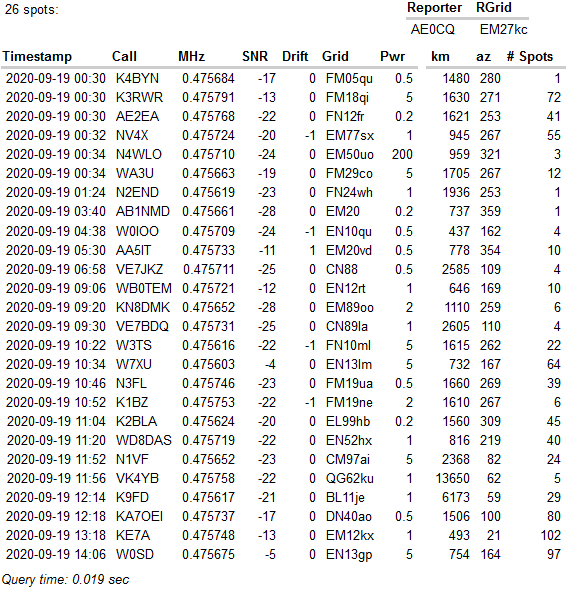
A little lower static level improved conditions last night, and apparently more stations are on with the approach of fall. Hundreds of decodes (took WSPRnet over two minutes to process the ALL_WSPR.TXT file) yielded 26 unique call sign spots. That's at least twice as many as I had been averaging most weekends lately. (See attachment).
---------------------------------------------------------------
File Attachment 1: 18sep630.gif
ID hifer help
Can't seem to figure out the ID of the hifer at approx. '340. My brain sees "A-G-A-W" and that's abut it. Looked on the hifer list and couldn't match it up.
https://drive.google.com/file/d/14vxT9MPr9cnYHNY4hzXJQYIgDoMQN_AO/view?usp=sharing
Ray ... N Cental TX
Re: 630 m WSPR
Posted by swlem3 on September 19, 2020 at 17:35:30.
In reply to 630 m WSPR posted by John Davis on September 19, 2020
I've noticed the changing condx also with the onset of Fall John. Like you said, somewhat lower qrn levels, but at my qth I'm still catching a fair amount of Gulf wx noise. My unique call spots were a bit lower. Had a count of 23. Better condx are ahead.
Ray ... N Central TX.
Re: ID hifer help
Posted by John Davis on September 19, 2020 at 18:01:41.
In reply to ID hifer help posted by swlem3 on September 19, 2020
If you'll look at your capture again, I think you'll see:
OM AGAUH (or possibly AGAUG, where a brief fade interrupted the dash)
The "OM" is the last part of ROM, the ID of the new beacon from Robert VA3ROM. The other letters are telemetry in the form of "cut numbers," as he explained in one of his posts last weekend.
The AGAUH translates to 17124, or if it's AGAUG then it would be 17127. Those would signify: Re: 136 khz 2200 meters beacon
17 °C 12.4 V or else 17 °C 12.7 V
depending on which letter it actually is, giving the temperature and state of battery charge.
Posted by Lee on September 19, 2020 at 18:47:42.
In reply to Re: 136 khz 2200 meters beacon posted by Lee on September 18, 2020
No opinions so I will be moving the freq for ARGO folks. Now moving to 136.450khz
2200 meter beacon KE6PCT now 136.450khz
Posted by Lee on September 19, 2020 at 18:53:08.
Moving to new freq 136.450khz for 2200 meter beacon KE6PCT. Still letter P at QRS30 and a 5WPM message. This should be helpful for ARGO users.
Re: ID hifer help
Posted by swlem3 on September 19, 2020 at 19:18:16.
In reply to Re: ID hifer help posted by John Davis on September 19, 2020
Thanks John, since you mentioned it, I now remember the post that Robert made concerning the cut numbers. I didn't connect that post and my decode for some reason.
73,
Ray K3SIW wspr2
Posted by swlem3 on September 19, 2020 at 19:35:39.
While decoding hifer wspr2 this afternoon, K3SIW is doing well into N Central TX besides WA1EJD. I saw 'SIW in the waterfall about the same time as the start of EJD's decodes, but being somewhat weaker, 'SIW didn't start to decode until 1804z.
2020-09-19 19:08 K3SIW 13.555407 -28 0 EN52ta 0.005 SWLEM3 EM03rf 1324
2020-09-19 19:04 K3SIW 13.555406 -29 0 EN52ta 0.005 SWLEM3 EM03rf 1324
2020-09-19 18:48 K3SIW 13.555405 -29 0 EN52ta 0.005 SWLEM3 EM03rf 1324
2020-09-19 18:36 K3SIW 13.555406 -29 0 EN52ta 0.005 SWLEM3 EM03rf 1324
2020-09-19 18:08 K3SIW 13.555406 -26 0 EN52ta 0.005 SWLEM3 EM03rf 1324
2020-09-19 18:04 K3SIW 13.555406 -26 0 EN52ta 0.005 SWLEM3 EM03rf 1324
Elad sdr w/ active antenna Re: 630 m WSPR
Posted by John, W1TAG on September 19, 2020 at 20:28:51.
In reply to 630 m WSPR posted by John Davis on September 19, 2020
26 stations spotted here in Southern Maine last night, including VK4YB. My memory may be failing, but that may be my first logging of him.
John, W1TAG
Re: 630 m WSPR
Posted by swlem3 on September 19, 2020 at 20:34:17.
In reply to Re: 630 m WSPR posted by John, W1TAG on September 19, 2020
Congrats John, that was quite a haul to decode Roger.
Re: WA1EDJ wspr
Posted by WA1EDJ Bob on September 20, 2020 at 02:00:24.
In reply to WA1EDJ wspr posted by swlem3 on September 19, 2020
Thanks swlem3!
Good to hear I'm getting spots.
Ant is 1/4w vert 12' off gnd. W3PM WSPR TX/QRP Labs Arduino shield, running off DS3231 RTC for timing, no GPS sync. 100' feedline to ant.
TX will continue as TS's permit. None in the forcasst next week!
Bob Re: WA1EDJ wspr
WA1EDJ
EM83du
Posted by swlem3 on September 20, 2020 at 02:38:53.
In reply to Re: WA1EDJ wspr posted by WA1EDJ Bob on September 20, 2020
Your welcome Bob. You're a new hifer wspr for me. Seems your ant/rig is doing well. I had a good number of spots from you. Hope those T-S stay away and give you some more TX time. You'll undoubtably pick up some more reports from others.
73,
Ray ... swlem3 in N Central Texas
2200m FST4W tonight
Posted by swlem3 on September 20, 2020 at 03:14:31.
Watching the "lookalike" wspr2 traces from K3MF (I think) at around 137.490khz in the wspr waterfall but not decoding. SNR looks to be roughly a -17db or so into N Central Texas tonight at 0300z. He must be using the experimental software Paul N1BUG mentioned.
Ray
Re: 2200m FST4W tonight
Posted by Paul N1BUG on September 20, 2020 at 12:06:39.
In reply to 2200m FST4W tonight posted by swlem3 on September 20, 2020
Ray, that one is a mystery. I reviewed WSPRnet records but found no reports of stations in North America on or about that frequency, either WSPR2 or FST4W. Maybe whoever it was had a problem with the signal and wasn't decoded by anyone? FST4W spots upload to WSPRnet unless the user disables spot uploading. I am aware of FST4W signals last night on 137.405, 137.437, 137.445, and 137.468.
Paul
Re: WA1EDJ wspr
Posted by WA1EDJ Bob on September 20, 2020 at 13:45:53.
In reply to Re: WA1EDJ wspr posted by swlem3 on September 20, 2020
Keep up the reports Ray. We always like to hear we are getting spots.
I'm often QRV during weeks days lately since I'm at work. At about 1800 EDT I QRT to do some listenig. Today I'm QRT for morning hours to try spotting a few. Been very quiet down here. It must be poor conditions for me but others seem to be catching a few.
The TX area is a good hop for me. I'd frequently see 7dBm WSPR out of TX on 10M in the summer.
Put up a HiFER TX and join in. The more the merrier.
Bob Re: 2200m FST4W tonight
EDJ
EM83du
Posted by swlem3 on September 20, 2020 at 14:36:57.
In reply to Re: 2200m FST4W tonight posted by Paul N1BUG on September 20, 2020
Paul, I also saw the other type of signal on 2200m that is very narrow band and longer in duration than the 2 min. wspr2 cycle. I did see the one mentioned and just assumed that it was also part of the testing of the new modes. It probably was, as you say, just a wspr2 transmission that for some reason didn't decode. Thanks for your response to my post.
73 Re: New FSK 22m beacon on air
Ray
Posted by swlem3 on September 20, 2020 at 16:56:47.
In reply to New FSK 22m beacon on air posted by Robert, VA3ROM on September 10, 2020
Robert, ROM looking good in N Central Texas Sept 20 2020 1619z.
https://drive.google.com/file/d/1OydEtIwJujNwAOW7uqJ5mE11m6BH7iqM/view?usp=sharing
73, Re: Any copy of JB?
Ray
Posted by John K5MO on September 20, 2020 at 18:20:10.
In reply to Re: Any copy of JB? posted by swlem3 on September 19, 2020
Hi Ray and many thanks for the screen grab from NC Texas. From my location, RF has to avoid nearby hill to make it in a westerly direction, but both you and John have produced some impressive receptions!
I really appreciate the report!
73 Re: Any copy of JB?
John
Posted by swlem3 on September 20, 2020 at 18:45:32.
In reply to Re: Any copy of JB? posted by John K5MO on September 20, 2020
You're welcome John, thanks for the reply to my report. You're sigs are still visible today in Argo. Understood on the obstructions... I've dealt with them for years. At least from John and I, you know you're "'makin the trip" westward.
73, Mid day band opening
Ray
Posted by WA1EDJ Bob on September 21, 2020 at 00:13:39.
Seems my lack of sigs is do to timing. Mid day (local noon) here EM83du was quite active today. EH back, ROM showing up, K5LVB decoded. Band is shifting with shorter days.
WA1EDJ will be QRV tonight and tomorrow.
Bob Re: New FSK 22m beacon on air
EDJ
Posted by John Davis on September 21, 2020 at 02:52:27.
In reply to Re: New FSK 22m beacon on air posted by swlem3 on September 20, 2020
Kind of a weak and broken signal in SE Kansas today, except right around 2 PM CDT when the telemetry came through solid for nearly nine minutes, reading "ANAVT" (19 °C 13.0 V). Lots of codar lines right then, too.
need help with linux qrss
Posted by swlem3 on September 21, 2020 at 03:32:04.
Anyone on the forum using glfer in linux to view qrss? I'm using linux for nearly all my radio work but have to go to Windows to use Argo for viewing hifers. I have glfer installed in Linux but it just "sits there" and displays nothing.
If anyone is successfully using glfer, I'd like to ask a few questions in setting it up. Thanks.
Ray
Re: Mid day band opening
Posted by John Davis on September 21, 2020 at 03:46:44.
In reply to Mid day band opening posted by WA1EDJ Bob on September 21, 2020
Mid-day was best here in Kansas, too, but only for the more distant "pipeline" signals, like NC, EH, and sometimes 7P. EH was not only back here, it was back-and-forth over about 25 Hz of the band. Its FSK is wider than yesterday (a full 10 Hz shift now), plus it was jumping around intermittently over another 15 Hz or so. NC was also jumpy earlier in the day. Only a few minutes of solid ROM today, and a couple of nice bright IDs from JB.
No WSPR decodes from anyone here today. Had five yesterday from WA1EDJ.
Re: 2200 meter beacon KE6PCT now 136.450khz
Posted by John Davis on September 21, 2020 at 03:47:54.
In reply to 2200 meter beacon KE6PCT now 136.450khz posted by Lee on September 19, 2020
What is your operating schedule, Lee?
Re: 2200 meter beacon KE6PCT now 136.450khz
Posted by Lee on September 21, 2020 at 06:18:10.
In reply to Re: 2200 meter beacon KE6PCT now 136.450khz posted by John Davis on September 21, 2020
Hi John. The operating schedule will be evenings when I am around to deal with problems. 1700 PST till 1000 PST the following day. Thanks.
Re: need help with linux qrss
Posted by Mike N8OOU on September 21, 2020 at 12:34:01.
In reply to need help with linux qrss posted by swlem3 on September 21, 2020
Ray
ARGO runs fine in the Linux environment using WINE. Simply install the WINE package, then run the ARGO install program just as you would in windows.
GLFER was written to run on early Linux releases. A PulseAudio module is available to transform the old style /DEV/DSP device to PulseAudio. See this page for details. It works for me.
https://nlug.ml1.co.uk/2011/12/linux-sound-devdsp-pulseaudio-interface-for-old-applications/781
Good Luck
Mike N8OOU 73
Re: 630 m WSPR
Posted by Garry, K3SIW on September 21, 2020 at 12:44:21.
In reply to Re: 630 m WSPR posted by John, W1TAG on September 19, 2020
John, thanks for the report. Things are definitely getting livelier. Got home from the 10 GHz & Above contest in time to start monitoring late last night and logged 30 callsigns here, including VK4YB. Hopefully he'll return to 136 kHz wspr at some point since he was also copied there in the US last winter.
73, Garry, K3SIW
Re: K3SIW wspr2
Posted by Garry, K3SIW on September 21, 2020 at 12:47:07.
In reply to K3SIW wspr2 posted by swlem3 on September 19, 2020
Been away a bit and just saw your report. Thanks very much, it's always good to have confirmations the equipment is working.
73, Garry, K3SIW, EN52ta, Elgin, IL
Re: K3SIW wspr2
Posted by swlem3 on September 21, 2020 at 14:03:58.
In reply to Re: K3SIW wspr2 posted by Garry, K3SIW on September 21, 2020
rr Garry.
73, Re: need help with linux qrss
Ray
Posted by swlem3 on September 21, 2020 at 14:15:00.
In reply to Re: need help with linux qrss posted by Mike N8OOU on September 21, 2020
Mike, I'll give both your methods a try. I'd like to see what glfer looks like, but it'll be great to be able to use Argo in linux. Thanks for the help Mike. If I get QRSS rx going in linux, I won't need to keep switching back to Windows at all to use my radio equipment.
Btw, I was copying your hifer beacon yesterday, late morning. If I get a good screenshot of it I'll post it on the forum.
73 Mike
Ray
Re: need help with linux qrss
Posted by John K5MO on September 21, 2020 at 16:20:05.
In reply to Re: need help with linux qrss posted by swlem3 on September 21, 2020
Ray , please let me know how you come out with this. I would love to run Argo on one of my Pi's as well, but I'm always aware of my stone hammer Linux skills!
Thanks Re: need help with linux qrss
John
Posted by swlem3 on September 21, 2020 at 16:44:37.
In reply to Re: need help with linux qrss posted by Mike N8OOU on September 21, 2020
Mike, success! I'm currently running Argo in linux. I also installed "Play on Linux" and used that front end to start Argo. That program did send up a "caution". It said that the program was installed on a fuse filesystem so it may not work, but thankfully it did. The tip on glfer worked also. I briefly ran glfer and at least got a waterfall. I'll delve deeper into that later.
Again, thanks much for help. This has made my day. :-)
Re: need help with linux qrss
Posted by swlem3 on September 21, 2020 at 16:47:12.
In reply to Re: need help with linux qrss posted by John K5MO on September 21, 2020
John, as I wrote Mike, it does work. I don't know anything about "pi's" so I can't be of help there. My linux skills are pretty limited also. Good luck with your situation with the pi.
73,
Ray
Re: need help with linux qrss
Posted by Mike N8OOU on September 21, 2020 at 16:48:17.
In reply to Re: need help with linux qrss posted by John K5MO on September 21, 2020
John,
Your message poses a problem that my simple answer to Ray didn't address. He stated he was hoping to eliminate the need to re-boot into windows. I made an assumption in my answer (bad on me) that he was running an x86 PC machine. Argo code is specific to x86 hardware. The RPi machines use ARM hardware that is incompatible with x86. This webpage explains it better, and maybe a way to solve the incompatibilities.
https://www.instructables.com/id/How-to-Set-Up-Wine-on-Raspberry-Pi-1/
If my assumption about Ray's hardware is not correct, my answer should be ignored.
Mike 73
Re: need help with linux qrss
Posted by John K5MO on September 21, 2020 at 17:09:12.
In reply to Re: need help with linux qrss posted by swlem3 on September 21, 2020
Hi Ray and Mike,
I'd really like to have it run on the Pi as they're quiet, efficient and really perfect for this (other than the ARGO software I'd like to use doesn't run on them that is!).
While this has all the makings of a typical R. Pi/ linux rabbit hole for me to drop down into, I'm game to try :-). Sometimes I've emerged with working stuff....
I've got some days coming up next week that I can devote to this and I'll give it a go. J
Re: need help with linux qrss
Posted by swlem3 on September 21, 2020 at 18:00:07.
In reply to Re: need help with linux qrss posted by Mike N8OOU on September 21, 2020
Mike, I should have mentioned my "working conditions" as far as PC hardware. I'm running a 64-bit Dell Optiplex755. It dual-boots windows 7 and Kubuntu. All is good now on my end, as I can stay in Kubuntu for all radio activities.
Ray
Re: need help with linux qrss
Posted by Mike N8OOU on September 21, 2020 at 18:30:17.
In reply to Re: need help with linux qrss posted by swlem3 on September 21, 2020
Ray,
Thanks, I'm glad it worked for you and my assumption was good. I phased out windows after win XP.
Mike
Re: 630 m WSPR
Posted by Ed Holland on September 21, 2020 at 20:30:48.
In reply to 630 m WSPR posted by John Davis on September 19, 2020
I parked the Icom on 630 m yesterday evening and collected a very pleasing haul of stations. The noise level was quite reasonable, and repeated loggings of K9FD were made by mid evening. A couple of VE stations were also notable - I'll post a more detailed report later.
Ed
Re: 630 m WSPR
Posted by John Davis on September 21, 2020 at 22:00:44.
In reply to Re: 630 m WSPR posted by Garry, K3SIW on September 21, 2020
...including VK4YB. Hopefully he'll return to 136 kHz wspr at some point since he was also copied there in the US last winter.
Apparently he still has the capability. He was on 2200 m a month ago this morning, right before sunrise on August 21. I had hopes he might be alternating between the bands, but that's the only time I've seen him there in the weeks since. (Of course, since I also have to choose one band or the other for listening purposes, it's statistically possible I've missed some chances. My five decodes of him on 630 around sunrise Saturday morning were plenty welcome, though.)
Hifer rx'ing today and then a look back
Posted by swlem3 on September 22, 2020 at 00:36:30.
Well, I finished today's hifer session at around 2200z. Thanks to Mike N8OOU's help, I was able to rx the hifers from within the linux OS environment. That's been a goal of mine... finally accomplished.
I was basically concentrating on the lower freq end of the hifer range today. JB hifer was prominent in a number of screenshots, WA1EDJ had a fair number of decodes on wspr2, ROM was in there, WM made a few appearances but not good copy, and last but not least :-( CODAR or OHR (which ever it was) sure cluttered the screenshots often. Overall propagation was a lot better yesterday, but was still worth watching, never the less.
After I closed of the hifer session for the day, I figured I do a liitle housekeeping of radio "stuff" that hadn't been done in a while. While rummaging through one of the cabinet drawers, I ran across an old cassette tape I hadn't played for years. I stopped what I was doing, dragged out my only remaining cassette player, and decided to have a seat and give a listen.
The tape is hand-written on the label and entitled "Lowfer-Medfer recordings" dated May 1990 and initialed by "B.A". Those that have been around the hobby for awhile may recognize B.A. (no, not Mr. T) ... Brice Anderson, W9PNE. Back in the day, before the internet, Brice and I exchanged a few letters (yes, paper through the US mail...hi). I was curious about his station, so he was kind enough to send me the cassette tape he made along with one of his letters. The tape has Brice narrating and playing a number of recordings that he made of the distant lowfer-medfer stations he copied previous to May of 1990. He was giving me an idea of how well he could "hear" from that quiet rural location. Of course, the recorded lowfers on the tape were a good sampling of that era's beacon ops which could be looked up if one had a past issue of the "Lowdown". Listening to the tape, it was evident that Brice had a very good station and heard quite well. You have to remember that this was cw copy, without computer aids... strictly antenna/radio and tight cw bandwidth audio. You can immediately tell he's using tight audio... very evident in the recordings. Brice also mentioned the "new" expansion of the BCB from 1600 to 1710 kc... before it became populated with broadcasters. He was quite interested in dx'ing there and noted that he had good results in copying the new "medfers" at quite a distance.
It was nice just to sit back and hear some of the lowfer and medfer stations he recorded, now long gone from the airwaves.
Thanks Brice, for taking the time to make a recording of the now three decades old lowfer activity and sharing it with a much younger (at the time) "newbie". There's been a lot of "water passed under the bridge" since then, and you wouldn't believe the technological progress made to your hobby. I'm sure you'd feel right at home, once you got the hang of it. You'd be racking up the dx with the best of 'em.
73, my friend. Re: 630 m WSPR
Posted by Ed Holland on September 22, 2020 at 05:26:01.
In reply to Re: 630 m WSPR posted by Ed Holland on September 21, 2020
Following up as promised. In the last 24 hours, I tallied the following 630 m WSPR stations:
Call Number of spots
K5 DNL 102
W6RYO 24
W7XU 65
KQ6RS 53
W0SD 5
N1VF 134
VE7CNF 20
K9FD 42
KA7OEI 125
VE7BDQ 39
KB8U 15
Re: 630 m WSPR
73s Ed
Posted by Eric NO3M on September 22, 2020 at 11:49:39.
In reply to Re: 630 m WSPR posted by John Davis on September 21, 2020
Roger, VK4YB, is on 2200m nearly every morning, but mostly on the experimental stuff at the moment to hash out issues before the software goes public. He was on 2200m WSPR for some periods this morning (9/22):
200922 1122 -26 0.11 0.1374199 VK4YB QG62 30 0 0.2
200922 1124 -29 0.15 0.1374199 VK4YB QG62 30 0 0.1
Additional decodes this morning using the 5-minute period variation of the new mode:
200922_092900 0.136 Rx FST4W -34 0.2 1418 VK4YB QG62 30
200922_094400 0.136 Rx FST4W -31 0.2 1418 VK4YB QG62 30
200922_095900 0.136 Rx FST4W -32 0.2 1418 VK4YB QG62 30
200922_103900 0.136 Rx FST4W -27 0.2 1420 VK4YB QG62 30
200922_104400 0.136 Rx FST4W -27 0.2 1420 VK4YB QG62 30
200922_105400 0.136 Rx FST4W -28 0.2 1420 VK4YB QG62 30
200922_105900 0.136 Rx FST4W -27 0.3 1420 VK4YB QG62 30
200922_110900 0.136 Rx FST4W -26 0.2 1420 VK4YB QG62 30
200922_111400 0.136 Rx FST4W -27 0.2 1420 VK4YB QG62 30
There should be a public software release candidate (WSJT-X) very soon. RX antenna here is an anti-phased double terminated loop firing west ( http://no3m.net/2020/09/2200m-double-loop-receive-antenna/ ), basically the same thing as a DHDL, DKAZ, or whatever other labels one desires to use for the various geometric variations.
Re: 630 m WSPR
Posted by swlem3 on September 22, 2020 at 12:57:53.
In reply to Re: 630 m WSPR posted by Eric NO3M on September 22, 2020
Eric, thanks for the update. I've noticed the testing on 2200m from N C Texas last night and this morning. Here's a screenshot taken this morning of one FST4W transmission:
https://drive.google.com/file/d/1nCIkXV4r_8juDxAza-HBDhXVBQLsoQqS/view?usp=sharing
Good to hear a software release is on the way.
73,
Ray
Re: Hifer rx'ing today and then a look back
Posted by WA1EDJ Bob on September 22, 2020 at 17:47:12.
In reply to Hifer rx'ing today and then a look back posted by swlem3 on September 22, 2020
I was a MedFER back in those days too. EDJ on 1641 KHz I think. John has a recording of me when he lived in GA.
Thought about doing it again but HiFER seems more productive.
Thanks for the look back Ray and the report of my WSPR. It's been on more consistently lately. Storms seem to be gone till late this week down here.
Bob Re: Hifer rx'ing today and then a look back
EDJ
Posted by swlem3 on September 22, 2020 at 18:13:47.
In reply to Re: Hifer rx'ing today and then a look back posted by WA1EDJ Bob on September 22, 2020
Bob, I've been decoding hifer wspr2 for three days now, and you're being decoded pretty consistently. Garry's also in there... just not as many decodes. Shifting propagation could change all that, of course. Agreed on the hifer over medfer. Medfer was a blast when it first opened up. I didn't participate in tx'ing, but my little Sony portable pulled in some nice Medfer catches back then. I also remember logging a bunch of TIS there on '10 and '20. I wrote some of them for confirmation and they couldn't believe someone could hear them outside of their local area. It helped that I had a rural qth. Now that band is "wall-to-wall" with BCB. Nice that John made a recording of EDJ for you. Something to hold onto.
I'll probably decode on wspr2 a few more days then move on. I'll occasionally drop in again to provide more spots. Glad the "look back" stirred up a few memories for you.
Ray
RY Spotted in EM83du N. GA
Posted by WA1EDJ Bob on September 23, 2020 at 22:41:43.
1840 EDT RY booming into Monroe, GA......Welcome back!
Bob Re: RY Spotted in EM83du N. GA
EDJ
Posted by John, W1TAG on September 24, 2020 at 00:02:32.
In reply to RY Spotted in EM83du N. GA posted by WA1EDJ Bob on September 23, 2020
Bob,
Not permanent for another month, but I decided to burn off the cobwebs. They take a LONG time to burn at this power level! Going to check the frequency tomorrow, but it looks close. Thanks for the report.
John, W1TAG
Re: RY Spotted in EM83du N. GA
Posted by swlem3 on September 24, 2020 at 00:07:54.
In reply to RY Spotted in EM83du N. GA posted by WA1EDJ Bob on September 23, 2020
John, Had a good copy in N C Texas also @ 4:28 CST Sept 23, 2020.
https://drive.google.com/file/d/159eoyBm47nmXIyoY-ZLiFclpt3EvYAAS/view?usp=sharing
73,
Ray
Re: RY Spotted in EM83du N. GA
Posted by WA1EDJ Bob on September 24, 2020 at 00:17:18.
In reply to Re: RY Spotted in EM83du N. GA posted by John, W1TAG on September 24, 2020
Glad to see you back John, even if not for a few more weeks permanenly. I can always rely on your sig down here in GA. You were about 10 Hz below my WSPRing on about .555 410. I'm QRV more frequently now that TS's are quieting down.
I'll be watching for you!
Bob Re: RY Spotted in EM83du N. GA
EDJ
Posted by John, W1TAG on September 24, 2020 at 14:59:01.
In reply to Re: RY Spotted in EM83du N. GA posted by WA1EDJ Bob on September 24, 2020
Bob,
I looked at the frequency this morning. Now I remember that the trimmer adjustment for the oven-controlled 10 MHz oscillator is physically munged-up, and I can't set the thing exactly. So, I programmed an offset in the DDS entry, and the transmitter is running on 13555.390 kHz, +/- 0.1Hz. That's more than close enough for this application, and the beacon should satisfy all of John Davis' security blanket needs!
Operation will be intermittent for the next month, as we are still at the "summer" QTH, and the transmitter has some very low level spurs on 20 meters, where many signals are in the "low level" category right now. Georgia is a nice clear shot across the lake here, and HF signals are generally very good.
John, W1TAG
Re: RY Spotted in EM83du N. GA
Posted by WA1EDJ Bob on September 24, 2020 at 18:00:02.
In reply to Re: RY Spotted in EM83du N. GA posted by John, W1TAG on September 24, 2020
I'll take a look when I get home tonight. I can't guarantee I'm exactly on 13555.410 but reports have indicated that's close. In any event, last night you were abt 10 Hz below me.
If any problems, I can move easily.
I'll be looking.
Bob hifer ODX into Texas
EDJ
Posted by swlem3 on September 24, 2020 at 21:15:54.
Argo screenshot of ODX into N. Central Texas 1709z Sept. 24, 2020
https://drive.google.com/file/d/1R1EuKsBjCbNrZSN6uWGJ1_M_QIwrBdBU/view?usp=sharing
Ray ... swlem3
USC EH hifers
Posted by swlem3 on September 24, 2020 at 22:00:01.
USC EH hifers... 2150z Sept.24,2020 qrss3.
https://drive.google.com/file/d/1FwqE4gL2YO3SD8-CfkEDNpwRp2NWKc1j/view?usp=sharing
Ray ... swlem3 N. Central Texas
Re: RY Spotted in EM83du N. GA
Posted by John Davis on September 24, 2020 at 23:49:58.
In reply to Re: RY Spotted in EM83du N. GA posted by WA1EDJ Bob on September 24, 2020
Attached is a look just before solar noon today with RY back in its proper spot in the spectrum. Sadly, no ROM, K5LVB, or WM yet this week, and no MTI or SIW for a couple of weeks now in Kansas.
NC and a very noisy EH were present, sometimes 7P with what looks to be roughly 2 Hz p-p jitter from a digital TCXO reference, and at 13555.440 what appears to possibly be PVC. It was very faint at that point, but 13 minutes later at 1:11 PM CDT there was a clear "P" followed by most of a "V." There was copy of stations elsewhere on the band, too, that I'll report later.
---------------------------------------------------------------
File Attachment 1: 24sepa.jpg
Re: hifer ODX into Texas
Good work on snagging recognizable normal-speed CW in Argo's NDB mode, Ray. I normally don't have much success with that myself unless the signal is pretty solid to begin with. My main use of Argo with CW is to ascertain the presence of signal and confirm the sideband patterns characteristic of its keying.
You also did a fine job of capturing the 2 pps "chunk chunk chunk" of codar (the array of vertical lines), which was also pretty strong at times today.
Re: USC EH hifers
Posted by John Davis on September 25, 2020 at 00:09:40.
In reply to USC EH hifers posted by swlem3 on September 24, 2020
I believe what you've actually got in that shot is NC with EH. NC has always run a "squarewave" graphical frequency shift, and it drifts around this part of the band both seasonally and daily. USC itself hasn't been reported in quite some time, but it ran a typical Morse FSK at QRSS3 rate.
Re: USC EH hifers
Posted by swlem3 on September 25, 2020 at 00:11:11.
In reply to Re: USC EH hifers posted by John Davis on September 25, 2020
Thanks John, I'm sure you're correct.
Re: hifer ODX into Texas
Posted by swlem3 on September 25, 2020 at 00:17:11.
In reply to Re: hifer ODX into Texas posted by John Davis on September 25, 2020
Wasn't by design John... hi. I forgot to switch back to cw. I was "jumping" around the hifer range, going from qrss3 and back to cw.
Oh yea, that codar stuff... I could send you some pretty awful, very heavy screenshots of that, covering up a number of hifers. :-o
Ray Re: hifer ODX into Texas
Posted by John Davis on September 25, 2020 at 00:51:11.
In reply to Re: hifer ODX into Texas posted by swlem3 on September 25, 2020
Thanks, already have plenty of folders full of those! :)
Fortunately, there are fewer codars in the 22 meter band than there were three years ago, although some afternoons it's hard to tell. Last weekend, I was struggling with an online Kiwi SDR out West and ended up watching a massive swarm of spectral lines around 13.54 and below. All new systems are going on in the recently allocated bands, and gradually some of the older ones are switching over as their experimental licenses expire. Looking forward with hope to 2022! WSPr net password
Posted by Lee on September 25, 2020 at 02:49:18.
So I am trying to set up WSPR net login. WSPR net e-mails me a one time use login to set up a permanent password. Tried it 7 times. I keep getting this message.
You have tried to use a one-time login link that has either been used or is no longer valid. Please request a new one using the form below.
Like I said tried 7 times. I can't find an e-mail link to file a complaint. What I did find says I am not authorized. Any e-mail ideas. This is for user KE6PCT Re: hifer ODX into Texas
Thanks
Posted by swlem3 on September 25, 2020 at 03:00:27.
In reply to Re: hifer ODX into Texas posted by John Davis on September 25, 2020
That's good news and encouraging John, some relief is in sight. I guess your codar carpeted screen captures are as trashed as mine... hi.
2 MINUTE CARRIER
Posted by John VE7BDQ on September 25, 2020 at 04:35:09.
Might be Lee, this evening at UTC 250402, 0414, 0416, I show a carrier on for two minutes in my wspr screen, frequency seems to be 137.400 kHz. No wspr decode but I am decoding WH2XND. John/ve7bdq
Re: WSPr net password
Posted by John Davis on September 25, 2020 at 06:26:45.
In reply to WSPr net password posted by Lee on September 25, 2020
Have you tried wsprnet@wsprnet.org ?
I have no idea whether that's still valid or not, but it's the only one I could find. Unfortunately, the way I found it was by a Google search--and the results of that search were mainly pages from the WSPRnet Forum containing complaints that the address doesn't work! No idea whether that's an intermittent or ongoing issue, as the dates of the posts are spread out over several years.
There's an address that, in theory, all Web sites are supposed to maintain: webmaster@(domain name). Webmaster was once a sacred address, but spammers are the lowest and most devolved life form infesting the planet, and care not one whit about rendering that address useless to site users. You could try it, but don't expect much.
Admittedly, we don't make a big effort to publicize our own email contact info at lwca.org/.net either, but it can be found in three separate places that are linked on the main Message Board page: the Posting Guidelines, the FAQ, and the Privacy/Terms of Service notice...all logical locations for such information, even if not readily obvious.
Re: WSPr net password
Posted by swlem3 on September 25, 2020 at 13:30:33.
In reply to WSPr net password posted by Lee on September 25, 2020
Lee,
This won't be of much help, but I'm just relaying my experience in trying to contact them. I believe I used the same address that John gave you. I used that address to ask them to delete an account. They never responded, I gave up. That was roughly 2 years ago. Guess it won't hurt for you to try though. Good luck.
WV hifer into Texas
Posted by swlem3 on September 25, 2020 at 14:46:26.
Hifer WV into N Central Texas 1436z Sept. 25, 2020
https://drive.google.com/file/d/1QUXFeH3SYFTOzGHVPLTKGKxwuVVkvkWR/view?usp=sharing
Ray ... swlem3... em03rf
Re: RY Spotted in EM83du N. GA
Posted by John B on September 25, 2020 at 16:49:54.
In reply to Re: RY Spotted in EM83du N. GA posted by swlem3 on September 24, 2020
Ray, that's a really great capture! I guess it's the magic of RF to be able to see such a busy spectrum (albeit a narrow one!) at the ebb tide of the solar cycle.
Thanks for sharing that. PVC weekend interruptions
John K5MO
Posted by Ed Holland on September 25, 2020 at 21:21:42.
Hi Folks,
Just a note to say that PVC will be interrupted for weekend beacon monitoring starting ~ 08:00 PDT.
Thanks
Ed
Re: WSPr net password
Posted by Lee on September 26, 2020 at 02:43:33.
In reply to WSPr net password posted by Lee on September 25, 2020
So I found a solution. I have long known that my e-mail program from Charter now Spectrum was worthless. If you try to complain they/Spectrum will say "you know it's free". Well it's not free. I pay...... Anyway the solution was to respond to the e-mail with the one time use password change link from my phone. Not from the e-mail program. Bazinga! I got in and was able to setup a fresh personal password. The problem was/is the Spectrum e-mail program. Thanks to all who responded.
Interesting unknown.. hifer?
Posted by swlem3 on September 26, 2020 at 15:09:43.
Seeing this on and off while looking for the ABBEY hifer over the past few days. What do you make of this?
https://drive.google.com/file/d/1oEv2haAHpuRK0dzl3XI7ytKDaiTBbtIs/view?usp=sharing
Ray... swlem3
Re: Interesting unknown.. hifer?
Posted by John Davis on September 26, 2020 at 15:41:55.
In reply to Interesting unknown.. hifer? posted by swlem3 on September 26, 2020
Interesting indeed. Out of band, and evidently pretty strong to show up so well in NDB mode...probably quite audible by ear, in which case it would have sounded like the letter Y with a pronounced chirp at the start of the first dash.
A first-rate puzzler there, Ray. Does it always seem to be the same letter, I wonder, or does it vary? Always with s chirp at the start? Generally about the same length of reception, or sometimes longer?
First thought: someone intending to be a legit HiFER, but who has serious oscillator start-up problems, maybe.
Re: Interesting unknown.. hifer?
Posted by swlem3 on September 26, 2020 at 16:01:05.
In reply to Re: Interesting unknown.. hifer? posted by John Davis on September 26, 2020
John,
I seem to get two different types of copy at that freq... the signal you saw as well as something that looks like a "proper" hifer signal. Unfortunately, the second type hasn't been good enough copy to ID. I did notice that the freq is out of the correct range for hifer. Not much more I can add until I see a better copy on the second type of transmission. If I get something better, I'll post it.
Thanks for taking a look and your comments.
Re: Interesting unknown.. hifer?
Posted by Chris kc3gfz on September 26, 2020 at 16:03:39.
In reply to Interesting unknown.. hifer? posted by swlem3 on September 26, 2020
Hi Ray,
Abby beacon does make it to the state of Texas quite frequent. I have heard it via add radio in Fourney Texas. I hear it mostly during evenings between 6-8 EST. I have heard it other times during day. It’s signal fades a bit not as strong as KAH or ODX. It running at about 13566.75~80. Happy hunting!
Chris
WAS hifer
Posted by swlem3 on September 26, 2020 at 16:07:54.
Hifer WAS ... cw mode into N. Central Texas 1516z Sept. 26, 2020.
https://drive.google.com/file/d/1T0F2dvDDyRpQ37y8eZ2oca3tspw_f9Hq/view?usp=sharing
Ray ... swlem3 ... em03rf
Re: Interesting unknown.. hifer?
Posted by swlem3 on September 26, 2020 at 16:10:22.
In reply to Re: Interesting unknown.. hifer? posted by Chris kc3gfz on September 26, 2020
Thanks Chris, appreciate the info. I'll be on the lookout for it and post the results.
73, Ray
Re: RY Spotted ...
Posted by John Davis on September 26, 2020 at 16:24:11.
In reply to Re: RY Spotted in EM83du N. GA posted by John Davis on September 24, 2020
The pipeline is open! RY hung around last night more than 2 hours after sunset (when I finally tuned away to monitor 630 meter WSPR) and was the first signal I saw this morning, 12 hours later. Mid-day signals were only fair yesterday, but RY was quite strong last night at 9:20 PM and good again at 9:20 AM CDT today.
FWIW, there was a C-class solar flare half an hour after sunset, followed by a G1 magnetic storm around 3 hours later, and another G1 event this morning about 1500 UTC. No idea whether that had any bearing on RY, but I'm hoping this morning's minor storm may have stirred up some short-hop HiFER reception.
KAH hifer in Texas
Posted by swlem3 on September 26, 2020 at 17:35:42.
Screenshot of hifer KAH 1624z Sept. 26 2020 rcvd in N. Central Texas.
https://drive.google.com/file/d/1XnkNL-4NCRdwDnqSy-9rGj9iBx3n4AM0/view?usp=sharing
Ray ... swlem3 ... em03rf
Re: WAS hifer
Posted by Bill Stewart, K4JYS on September 26, 2020 at 18:32:26.
In reply to WAS hifer posted by swlem3 on September 26, 2020
Tnx for the report Ray. First report from Texas for WAS. The trace looks like you were receiving it pretty well. What's your receiving setup? Pass along your mailing address and I will send along a QSL. ....73 de Bill K4JYS
Re: WAS hifer
Posted by swlem3 on September 26, 2020 at 19:21:22.
In reply to Re: WAS hifer posted by Bill Stewart, K4JYS on September 26, 2020
Hi Bill, Glad to be your first rx report from Texas. I've seen WAS more than once, so reception wasn't a fluke. I don't think todays' propagation was really even that good.
For rx, I'm using an Elad FDM-S2 sdr with an active antenna up 5 meters. What might help is that I'm at an elevation of 1200ft. with a fairly decent view of the horizon. I probably could do better, but the rural powerlines are somewhat noisy here... even at hf.
Bill, I've stopped collecting cards since the screenshots are "proof" of copy. Thanks much for your offer anyway my friend.
73 es gud dx, WSPR Fri Night
Ray swlem3
Posted by John Davis on September 26, 2020 at 20:59:17.
Several new calls on 630 m. I started out on 2200, but only WH2XND and some "fake WSPRs" (look just like normal WSPR except no normal header, so no decodes) were seen for the first several time slots, so I switched.
One of the new calls, N6GN from Fort Collins, had the greatest number of decodes for the night. He was still decoding two hours after my local sunrise. Other first-timers here: WB7ABP, VE7JKZ, VE7CNF, W4KZK, and (I think) KN8DMK. As is often the case, VK4YB and K9FD were the longest and second-longest DX, respectively.
Timestamp           Call    MHz         SNR  Drift  Grid     Pwr     km    az   #Spots

2020-09-26 02:56    WH2XND  0.137575    -13    0    DM33     20    1673     71     1

2020-09-26 14:08    N6GN    0.475700    -14    0    DN70ll    0.2   937    110   105
2020-09-26 13:22    KE7A    0.475749    -14   -1    EM12kx    1     493    21     77
2020-09-26 13:16    W7XU    0.475603     -4    0    EN13lm    5     732    167    99
2020-09-26 12:30    K9FD    0.475617    -22    0    BL11je    1    6173    59     37
2020-09-26 12:30    N1VF    0.475652    -23    0    CM97ai    5    2368    82     31
2020-09-26 12:28    WB7ABP  0.475775    -22    0    CM88ok    2    2427    85     35
2020-09-26 12:18    KA7OEI  0.475739    -19    0    DN40ao    0.5  1506    100    82
2020-09-26 12:10    VE7JKZ  0.475710    -25    0    CN88      0.5  2585    109    19
2020-09-26 11:58    KR6LA   0.475661    -26    0    CN90ao    1    2347    91      8
2020-09-26 11:30    WD8DAS  0.475719    -24    0    EN52hx    1     816    219    35
2020-09-26 11:24    VK4YB   0.475757    -28    0    QG62ku    1   13650    62      2
2020-09-26 11:12    NV4X    0.475724    -20   -1    EM77sx    1     945    267    44
2020-09-26 11:04    K3RWR   0.475792    -17    0    FM18qi    2    1630    271    57
2020-09-26 11:02    KN8DMK  0.475652    -26    0    EM89oo    2    1110    259     5
2020-09-26 10:54    N3FL    0.475745    -25    0    FM19ua    0.5  1660    269    19
2020-09-26 10:52    K2BLA   0.475625    -21    0    EL99hb    0.2  1560    309    32
2020-09-26 10:52    W4KZK   0.475673    -25    0    EM97xe    0.2  1336    274    39
2020-09-26 10:42    AE2EA   0.475768    -23    0    FN12fr    0.2  1621    253    26
2020-09-26 10:32    W3TS    0.475624    -23   -1    FN10ml    5    1615    262    19
2020-09-26 06:54    VE7CNF  0.475779    -24    0    CN89ng    0.5  2603    111     3
2020-09-26 04:42    WB3AVN  0.475639    -23    0    FM19og    5    1617    267    10
2020-09-26 04:26    W0IOO   0.475709    -24   -1    EN10qu    0.5   437    162     9
2020-09-26 03:22    N1DAY   0.475699    -26   -1    EM85sg    1    1154    284     1

Reporter   RGrid
 AE0CQ    EM27kc
everpresent 630m signal
Anyone who has rx'ed the 630m wspr band segment has undoubtably noticed the everpresent signal there. That "carrier" appears at approx. 1430hz in the wide graph waterfall when using the wsjt-x program... dial freq set to 474.2 khz. You can't miss it.
https://drive.google.com/file/d/1SylgT-9xjOT_MW1yswYaAdcAFD6IM0_P/view?usp=sharing
You can see in this screenshot, the relative signal strength of the wide signal in comparison to the wspr signal that is at a -4db level.
It seems to me a curious situation that no one seems interested enough to find the origin of this strong signal that is parked in a ham band. Surely with the number of ops now using that part of the spectrum, it could easily be DF'ed and its location determined. I've DF'ed it myself (very broadly) with two points of reference... one from this location in N. Central Texas, the other near Michigan. My results, again very broadly, was that the two points intersected in the general vicinity of the state of Illinois. I'm not saying it's there. That just where the loop nulls pointed to. The signal must be strong, it can be seen day or night from at least the midwest to the South. Anywhere else? I don't know. I don't see any comments on it in forums.
I guess no one cares if it's there, and the ops "just work around it". You'd think that pure curiosity would be enough that 630m ops would take a little time to DF it from locations over the CONUS and see what the results of the triangulation would be. Then someone nearby could take a short drive to see what's there, if anything. If there was nothing there, that would be an even more interesting mystery to dig into.
Just my 2 cents worth.
FWD: Release Candidate: WSJT-X 2.3.0-rc1
Posted by Eric NO3M on September 27, 2020 at 23:27:51.
FWD:
The first public candidate release of WSJT-X 2.3.0 is now available for download and use by beta testers. This release is your first chance to
try two new modes designed especially for use on the LF and MF bands, and to provide feedback to the WSJT Development Team. The new modes are:
- FST4, for 2-way QSOs. Options for sequence lengths from 15 seconds
to 30 minutes, with threshold sensitivities from -20.7 to -43.2 dB in
a 2500 Hz reference bandwidth.
- FST4W, for WSPR-like transmissions. Sequence lengths from 2 minutes
to 30 minutes, threshold sensitivities from -32.8 to -44.8 dB.
FST4-60 is about 1.7 dB more sensitive than JT9, largely because it uses multi-symbol block detection where appropriate. With AP decoding in FST4 the advantage can be as much as 4.7 dB. Additional sensitivity details with respect to path Doppler spread are illustrated in the following graph comparing JT9 and FST4-60:
https://physics.princeton.edu/pulsar/k1jt/jt9_vs_fst4.pdf
FST4W-120 is about 1.4 dB more sensitive than WSPR, and FST4W submodes with longer transmissions have proportionally better sensitivity. Decoding probabilities are plotted as a function of SNR on the additive white Gaussian noise (AWGN) channel for WSPR and all FST4W submodes here: https://physics.princeton.edu/pulsar/k1jt/wspr_vs_fst4w.pdf
Tests over the past several months have shown FST4 and FST4W frequently spanning intercontinental distances on the 2200 m and 630 m bands. Further details and operating hints can be found in the "Quick-Start Guide to FST4 and FST4W":
https://physics.princeton.edu/pulsar/k1jt/FST4_Quick_Start.pdf
We strongly recommend that users of JT9 and WSPR on the LF and MF bands should migrate to the more sensitive modes FST4 and FST4W.
Links to installation packages for Windows, Linux, and Macintosh are available here:
http://physics.princeton.edu/pulsar/k1jt/wsjtx.html
Scroll down to find "Candidate release: WSJT-X 2.3.0-rc1".
You can also download the packages from our SourceForge site:
https://sourceforge.net/projects/wsjt/files/
It may take a short time for the SourceForge site to be updated.
WSJT-X is licensed under the terms of Version 3 of the GNU General Public License (GPL). Development of this software is a cooperative project to which many amateur radio operators have contributed. If you use our code, please have the courtesy to let us know about it. If you find bugs or make improvements to the code, please report them to us in a timely fashion.
We hope you will enjoy using this beta release of WSJT-X 2.3.0. Please report bugs by following instructions found here in the User Guide:
http://www.physics.princeton.edu/pulsar/K1JT/wsjtx-doc/wsjtx-main-2.3.0-rc1.html#_bug_reports
-- 73 from Joe, K1JT, Steve, K9AN, and Bill, G4WJS
Re: FWD: Release Candidate: WSJT-X 2.3.0-rc1
Posted by swlem3 on September 28, 2020 at 02:37:00.
In reply to FWD: Release Candidate: WSJT-X 2.3.0-rc1 posted by Eric NO3M on September 27, 2020
Thanks for taking time to stop by the forum with the update Eric.
73, Ray
Re: FWD: Release Candidate: WSJT-X 2.3.0-rc1
Posted by Paul N1BUG on September 28, 2020 at 12:32:08.
In reply to FWD: Release Candidate: WSJT-X 2.3.0-rc1 posted by Eric NO3M on September 27, 2020
It is good to have a public release candidate out!
One concern is that WSPRnet does not provide a means to identify what mode is being spotted. Adding to the confusion, WSPRnet changes time stamps ending in 5 to either 4 or 6, further obscuring the T/R period in use. To help identify who is doing what, my spots to WSPRnet include a mode identifier appended to my call sign as follows:
WSPR-2 ... N1BUG/2
WSPR-15 ... N1BUG/15
FST4W-120 ... N1BUG/120
FST4W-300 ... N1BUG/300
FST4W-900 ... N1BUG/900
FST4W-1800 ... N1BUG/1800
It would be helpful if others reporting to WSPRnet would do something similar. Suffixes should not be used for transmitting, as they will force use of "type 2" messages where you have to be decoded at least twice by a given station to get a WSPRnet spot. I run several WSJT-X instances for receive only with the special identifiers. When I want to transmit I simply use an additional instance configured to just my call sign with no added suffix.
73, Re: FWD: Release Candidate: WSJT-X 2.3.0-rc1
Paul N1BUG
Posted by Garry, k3siw on September 28, 2020 at 12:58:37.
In reply to Re: FWD: Release Candidate: WSJT-X 2.3.0-rc1 posted by Paul N1BUG on September 28, 2020
Paul, thanks for the heads-up about the new wsjt-x and your comments about how to identify the T/R rate. I ran a couple instances over night on both 136 and 474.2 kHz with callsigns /120, /300, and /900 as appropriate. N1BUG decoded on 136 kHz at both the latter rates and reports showed at PSKreporter. But the ALL.TXT info differs from what WSPRnet expects and never showed up, either at http://www.wsprnet.org/drupal/wsprnet/spots or at the old database. However, reports from some others do show there. Can you indicate what's needed to get the reports to show on WSPRnet too?
Thanks and 73, Any QRSS on 136 kHz?
Garry, K3SIW, EN52ta, Elgin, IL
Posted by John Bruce McCreath on September 28, 2020 at 13:25:24.
With all of the newer digital modes getting the bulk of attention, I'm wondering if anyone is using QRSS on 2200M?
I've acquired a second PC, a Dell with Win7, and am wondering what software I should install in it.
73, J.B., VE3EAR
Re: FWD: Release Candidate: WSJT-X 2.3.0-rc1
Posted by Paul N1BUG on September 28, 2020 at 14:21:35.
In reply to Re: FWD: Release Candidate: WSJT-X 2.3.0-rc1 posted by Garry, k3siw on September 28, 2020
Garry, are you trying to upload spots after the fact? I never even thought of that as the vast majority of us are able to enable real time spotting and the program handles that after every decode period. If there is a need to batch upload later, this may be an issue that needs to be addressed. Thanks for including the mode identifiers!
73, Re: Any QRSS on 136 kHz?
Paul N1BUG
FN55mf
Posted by Paul N1BUG on September 28, 2020 at 14:27:40.
In reply to Any QRSS on 136 kHz? posted by John Bruce McCreath on September 28, 2020
J.B., there is very little to no QRSS but DFCW is still used from time to time. I spent many nights transmitting DFCW20 and DFCW60 last winter, and also was able to copy a couple of Europeans on DFCW60. There tend to be long periods of no activity, then someone (often me :) fires up, makes an announcement, and pulls a few others in for an activity period. Every night that I am active on LF I run grabbers for both the EU and TA QRSS/DFCW windows, which can be viewed here:
I do not have a PC I can dedicate to LF, so these cannot run during the day when I am working in another operating system.
73, Re: FWD: Release Candidate: WSJT-X 2.3.0-rc1
Paul N1BUG
FN55mf
Posted by Garry, K3SIW on September 28, 2020 at 15:28:31.
In reply to Re: FWD: Release Candidate: WSJT-X 2.3.0-rc1 posted by Paul N1BUG on September 28, 2020
Paul,
I have PSKreporter enabled for spots in real time. But I've also tried uploading ALL.TXT in real time via the old database after the fact. Both fail, the latter presumably because it wants the file ALL_MEPT.TXT with a different storage format. Is there something else I need to enable under the Reporting tab?
Or maybe it's just my particular version of Windows 7, 64 bit. It's surprising how 2 "identical" PCs I have with Windows 7, 64 bit fully updated do not always behave identically. A lot of people complained about the wsprx0.8 code and wspr-15 mode but I never had such troubles.
73, Garry, K3SIW
Re: FWD: Release Candidate: WSJT-X 2.3.0-rc1
Posted by Paul N1BUG on September 28, 2020 at 15:45:13.
In reply to Re: FWD: Release Candidate: WSJT-X 2.3.0-rc1 posted by Garry, K3SIW on September 28, 2020
Garry,
Oddly I did receive one WSPRnet spot from you as K3SIW/1 last night, evidently for one of my FST4W-300 transmissions.
As long as you have your call sign and grid square entered in the general settings (I'm sure you do), all that should be needed to enable real time uploading to WSPRnet is to check 'Upload spots' on the main window. As far as I know, nothing on the reporting tab applies to WSPRnet. If you have Upload spots checked and it is not working, I have no idea what might be causing it.
73, Re: FWD: Release Candidate: WSJT-X 2.3.0-rc1
Paul N1BUG
FN55mf
Posted by Garry, K3SIW on September 28, 2020 at 16:29:25.
In reply to Re: FWD: Release Candidate: WSJT-X 2.3.0-rc1 posted by Paul N1BUG on September 28, 2020
Paul, I just checked my screen captures and the problem was indeed no checkmark on "Upload spots". My first run was with a single instance and the checkmark was there for that, hence the k3siw/1 report. Later I ran two instances via command prompt and didn't notice the checkmarks weren't in either. I did surmise it was a good idea to tack on /120, /300, or /900 as appropriate to the callsign but never noticed the missing checkmarks. Thanks for pointing that out.
73, Garry, K3SIW Re: Any QRSS on 136 kHz?
Posted by Lee on September 28, 2020 at 17:16:19.
In reply to Any QRSS on 136 kHz? posted by John Bruce McCreath on September 28, 2020
Yes. Beacon KE6PCT at 136.450 is using QRSS30. The letter P at QRSS30 Re: FWD: Release Candidate: WSJT-X 2.3.0-rc1
and a 5WPM message. Daily sundown to sunrise.
Posted by John Davis on September 28, 2020 at 17:56:15.
In reply to Re: FWD: Release Candidate: WSJT-X 2.3.0-rc1 posted by Paul N1BUG on September 28, 2020
If there is a need to batch upload later, this may be an issue that needs to be addressed.
Indeed, and hopefully before the new modes become the Next Big Thing! My QTH(es) are such that I have only two choices: listen where there is Internet service but too much QRM to copy anyone, or listen from the farm where it's quiet but there is no realistic chance of having Internet in my lifetime. Of necessity, all my WSPRnet reporting is by batch upload.
One additional question, Paul...does the new software not actually report the full frequency of the transmitting station, or have I misread something? I thought I noticed on some of the posted decodes that it only read "0.136". Thanks.
Re: Any QRSS on 136 kHz?
Posted by John Davis on September 28, 2020 at 18:17:20.
In reply to Re: Any QRSS on 136 kHz? posted by Lee on September 28, 2020
Lee, I forgot to report to you on Thursday's listening effort. No sign of KE6PCT all night, unfortunately, but I'll try again in a couple of weeks when things may be a bit quieter.
Re: Any QRSS on 136 kHz?
Posted by Lee on September 28, 2020 at 18:28:29.
In reply to Re: Any QRSS on 136 kHz? posted by John Davis on September 28, 2020
Thanks John
Re: PVC weekend interruptions
Posted by Ed Holland on September 28, 2020 at 19:10:25.
In reply to PVC weekend interruptions posted by Ed Holland on September 25, 2020
PVC resumed continuous operation this morning, around 0700 PDT.
We may experience power outages due to wildfire safeguarding, so PVC may be intermittent this week.
If this proves problematic, I will revert to the internal crystal oscillator on 13558.4, which will allow PVC to run on the UPS.
Cheers,
Ed
Re: FWD: Release Candidate: WSJT-X 2.3.0-rc1
Posted by Paul N1BUG on September 28, 2020 at 19:17:01.
In reply to Re: FWD: Release Candidate: WSJT-X 2.3.0-rc1 posted by John Davis on September 28, 2020
I have reported the issue of not having a file in an appropriate format for upload to WSPRnet to the developers through an appropriate channel. I believe this was something that got completely overlooked until now.
I have not noticed any failure to upload or display full frequencies in FST4W. It should work the same as WSPR. If you can provide a specific example I will look into it.
Paul N1BUG Re: FWD: Release Candidate: WSJT-X 2.3.0-rc1
FN55mf
Posted by Paul N1BUG on September 28, 2020 at 22:54:58.
In reply to Re: FWD: Release Candidate: WSJT-X 2.3.0-rc1 posted by Paul N1BUG on September 28, 2020
Reportedly batch uploading of WSPR spots no longer works in recent versions either. The format of ALL_WSPR.TXT has changed. It appears the only way forward for continued batch uploading of WSPR (and FST4W) spots will be some sort of third party utility to convert ALL_WSPR.TXT and/or ALL.TXT into a format accepted by WSPRnet. We have someone willing to do this once we ascertain what fields must be included and verify that all required information is contained in the files written by WSJT-X. I will follow up on this to the best of my ability and report back.
73, Re: WV hifer into Texas
Paul N1BUG
FN55mf
Posted by michael tyler on September 28, 2020 at 23:37:09.
In reply to WV hifer into Texas posted by swlem3 on September 25, 2020
Thanks for the Report Ray...73
Re: Any QRSS on 136 kHz?
Posted by John Bruce McCreath on September 29, 2020 at 14:07:53.
In reply to Re: Any QRSS on 136 kHz? posted by Paul N1BUG on September 28, 2020
Hi Paul....thanks for your reply to my query. I'll install Argo, SpecLab, and Spectran in the Dell and be ready.
73, J.B., VE3EAR 2200m FST4W-1800
Posted by Paul N1BUG on September 29, 2020 at 18:18:58.
Propagation has been extremely poor during several days of geomagnetic disturbance. Tonight I am going to switch to FST4W-1800, 137437 (136.0 + 1437 Hz), 2nd period (2/2). This might be a good chance to see if your receiver has adequate stability for this slowest speed. My transmitter is GPS referenced. We had very nice trans-Atlantic results with FST4W-1800 in July and August with the heavy summer QRN.
In a few days when the ionosphere has recovered I will go back to faster speeds.
73, Re: New FSK 22m beacon on air
Paul N1BUG
FN55mf
Posted by Robert Mazur on September 29, 2020 at 20:59:13.
In reply to Re: New FSK 22m beacon on air posted by swlem3 on September 20, 2020
Thank you & much appreciated. I just can't believe that such a weak signal can travel so far!
Thanks to John, too. I didn't know what CODAR signals were and looked like. Google it and now I know.
73, Re: WV hifer into Texas
Robert
Posted by swlem3 on September 29, 2020 at 23:32:56.
In reply to Re: WV hifer into Texas posted by michael tyler on September 28, 2020
RR Michael. Re: 2200m FST4W-1800
gud dx es 73, Ray
Posted by swlem3 on September 29, 2020 at 23:43:47.
In reply to 2200m FST4W-1800 posted by Paul N1BUG on September 29, 2020
I'll give it try tonight Paul. Will be a good test of my sdr's stability as well as decoding through the competition with the heavy QRN we've been having.
Re: 2200m FST4W-1800
Posted by Mike N8OOU on September 30, 2020 at 04:23:39.
In reply to 2200m FST4W-1800 posted by Paul N1BUG on September 29, 2020
Paul;
I started listening just before this transmission slot, and was able to decode your FST4W-1800.
200930_033000 0.136 Rx FST4W -33 -0.8 1437 N1BUG FN55 30
I am using a KiwiSDR receiver with GPS, and a Low Noise Vertical antenna. I was successful at compiling and installing the WSJTX program on a Raspberry Pi-4. Audio was captured using a Mic placed close to the monitor speaker. Due to the audio coupling, I can't leave things running overnight so this will be my only report tonight..
Mike 73 Grid EM68es
Re: 2200m FST4W-1800
Posted by Paul N1BUG on September 30, 2020 at 18:14:59.
In reply to Re: 2200m FST4W-1800 posted by swlem3 on September 29, 2020
Thanks Ray. Looks like your sdr's stability is OK for these modes.
Re: 2200m FST4W-1800
Posted by Paul N1BUG on September 30, 2020 at 18:16:16.
In reply to Re: 2200m FST4W-1800 posted by Mike N8OOU on September 30, 2020
Thanks for the report Mike. They are always appreciated.
Re: 2200m FST4W-1800
Posted by Paul N1BUG on September 30, 2020 at 18:18:04.
In reply to 2200m FST4W-1800 posted by Paul N1BUG on September 29, 2020
Propagation is very poor but thanks to FST4W-1800 I got four reports from EB8ARZ and one from N6LF. Today has been rough with intermittent power and internet outages caused by strong winds, but the storm is subsiding now. I expect to be on again tonight.
Paul
Re: PVC weekend interruptions
Posted by Ed Ho on September 30, 2020 at 19:41:58.
In reply to Re: PVC weekend interruptions posted by Ed Holland on September 28, 2020
No really, PVC is actually back on, as of early evening Sept 29th. It occurred to me that I had made an oversight in restarting the system on Monday morning (09/28). All working and confirmed now.
Cheers
Ed
BBC 198 khz life extended to 2022
Posted by Mike Terry on September 30, 2020 at 20:51:53.
BBC Radio 4‘s long wave transmitters on 198 kHz should continue until at least 31 March 2022, following another extension to the Radio Teleswitch Service.
Frequencyfinder 31 Aug via BDXC Communication October (2020-09-30)
Re: BBC 198 khz life extended to 2022
Posted by Ed Holland on September 30, 2020 at 22:24:59.
In reply to BBC 198 khz life extended to 2022 posted by Mike Terry on September 30, 2020
Something of a reprieve, I suppose.
It will be a sad day when R4 LW services come to an end. It is the best way to listen to the cricket. More importantly, the powers that be need to inform the Royal Navy submarine commanders ahead of switch-off. Apparently, during the Cold War, verifying that this broadcast is still present was part of the protocol for determining if Blighty was under attack. No cricket scores or episodes of The Archers, and all heck could break loose... Re: BBC 198 khz life extended to 2022
Posted by Paul N1BUG on September 30, 2020 at 22:47:27.
In reply to BBC 198 khz life extended to 2022 posted by Mike Terry on September 30, 2020
Thanks for the update. I'm going to miss this when it is gone, as I already miss some of the other LW BC stations. When I got my first receiver in the late 1970s I discovered those stations. It was a Hallicrafters S-118 that had longwave starting at 190 kHz. That is where my interest in longwave began, though it would lay dormant until 2016 when an officer of the local amateur radio club asked me to prepare a report on the soon to be new bands at 2200 and 630 meters. Little did I know then what a great adventure that request would set in motion!
Paul N1BUG
potrzebie