Addresses and URLs contained herein may gradually become outdated.
Re: Terminated inverted U for longwave?
Posted by Geek on October 02, 2016 at 08:25:37.
In reply to Terminated inverted U for longwave? posted by Robert on September 27, 2016
Apartment dweller, eh?
Try this:
http://geek.scorpiorising.ca/GeeK_ZonE/index.php?topic=3929.0
It pulls out <25W NDB's from hundreds of miles away and you can null out QRM.
Cheers!
Re: Pixie on vlf
Posted by Mark on October 03, 2016 at 00:44:25.
In reply to Re: Pixie on vlf posted by Mark on September 30, 2016
The schematic, board layout, and parts are further down on the same ebay page.
Thanks,
Mark
Weekend HiFERs in KS
Posted by John Davis on October 03, 2016 at 04:08:23.
More appropriate to say mostly Saturday HiFERs, I suppose. The attached captures (also embedded here in the message if I have calculated the target URLs correctly) are mainly from late that afternoon after 1750 meters became unproductive from the encroaching evening static levels. In addition to these, I saw the rolling wave-like keyed carrier of AZ around 13,554.100 on Friday afternoon, and saw and heard FRC a number of evenings including Friday and Sunday.

The watering hole just after 5 PM CDT on Saturday, with loud audible copy of NC, EH, and sometimes RY. USC was just a ghost of excess RF at that time, but showed up more clearly later. I then tuned up to look for WV, and was rewarded with good audibility most of the time. (Had a similar level visually again late Sunday afternoon on WV, but no clear aural copy that time thanks to Codar racket.)

The biggest surprise was a few minutes later when both MTI and PBJ came in at clearly audible levels most of the time. Then I checked back one more time at the watering hole...

...where USC had materialized enough to be recognizable with reasonable certainty.
John
---------------------------------------------------------------
 File Attachment 1: 01oct528.jpg
File Attachment 2: 01oct510.jpg
File Attachment 3: 01oct515.jpg
Re: Terminated inverted U for longwave?
Posted by John Davis on October 03, 2016 at 04:18:43.
In reply to Re: Terminated inverted U for longwave? posted by Geek on October 02, 2016
Great minds must think alike, Geek. I'd just looked up your article as a possible solution to Robert's dilemma when I returned to the Board and saw you had posted that link. At any rate, the version that appeared in The LOWDOWN also still exists as a PDF file in our library, if anyone wants it in that format:
CompactRcvgLoop.pdf
Re: Terminated inverted U for longwave?
Posted by Geek on October 03, 2016 at 05:06:22.
In reply to Re: Terminated inverted U for longwave? posted by John Davis on October 03, 2016
That's the link, thanks John!
I thought I bookmarked it, but couldn't find it.
Cheers!
Re: Pixie on vlf
Posted by John Davis on October 03, 2016 at 06:45:30.
In reply to Re: Pixie on vlf posted by Mark on October 03, 2016
I had found the schematic in the eBay listing OK and have been taking some time to study the situation. As I mentioned previously, the huge difference in frequency is going to require some very different component values that will be difficult to accommodate with the provided circuit board.
The good news about the oscillator section is, the standard Pixie circuit should probably oscillate with the crystal you've got...but the bad news is, not with the receive frequency offset modification they show. The arrangement of D2, R6, and associated components is there to shift the crystal frequency when the key is up, so that the oscillator will produced a beat note with an incoming carrier on the same frequency. D2 acts as an inexpensive varactor diode. It will easily produce a BFO of several hundred Hz offset at 40 meters, which can be passed by the audio amp. But at 1750 meters, the offset will only be a few Hz, which will be well nigh useless; and the apparent series capacitance of D2 may be too low to let an LF crystal oscillate reliably in the first place. You might as well replace D2 with a wire and omit R6, C8 and W1.
The next area of concern is the interstage coupling capacitor, C4. I don't believe they really mean it to be 100 μF! More likely it's really 100 pF, which may be too small. You'll probably need to experiment with this value, but be aware it may need to be as high as 3900 pF (30 nF) to give adequate drive.
L3 is another component which will have to be raised in value to provide enough drive at LF. If simply scaled on the basis of frequency, it would need to be 3.9 to 4.7 mH! It'll possibly work OK with some smaller value, so you can experiment, but 100 μH is definitely too small.
L1 is also way too small for LF. It would need to be increased to the vicinity of 820 μH - 1 mH. Output coupling capacitor C2, if it is indeed 100 nF (0.1 μF), is not terribly far off, but would be better if it were up around .33 μF.
Finally, the output network (C5, L2, C6) needs to be replaced entirely with one of the versions I mentioned before from the Lyle Koehler transmitter designs:
lwca.org/library/articles/k0lr/SimpleLowFERTransmitter.htm
lwca.org/library/articles/k0lr/all-in-one
The latter shows design values for a range of antenna system resistances, while the former is for the generic 50 ohm case, similar to what the Pixie was originally intended to match.
RTÉ "reviews" 252 closure
Posted by Mike Terry on October 03, 2016 at 07:24:31.
RTÉ is reported as saying that it is conducting a 'review' of its decision to close its long wave TX on 252 kHz. The article below interprets that as meaning that the decision to close 252 has been 'ditched' but that conclusion may be too definitive. There is no commitment to increasing power on 252 or to moving to 261 to avoid interference from Algiers.
http://www.independent.ie/business/media/rte-ditches-plans-to-axe-longwave-252-radio-service-after-criticism-in-britain-35096216.html
(via John Walsh - BDXC-UK)
Re: Terminated inverted U for longwave?
Posted by Robert on October 03, 2016 at 11:20:43.
In reply to Re: Terminated inverted U for longwave? posted by Geek on October 03, 2016
Thanks guys
looks like a good idea, i can place it outside away from building when i am using it and put it away when i am not using it. i can even put a rotor on it to turn it remotely from inside. it looks like a magnetic loop in a different design from the typical pvc type. i still have all those lowdowns i got from a someone on here years ago as well.
never thought to check them, although i have looked many of them over.
Re: RTÉ "reviews" 252 closure
Posted by Mike Terry on October 03, 2016 at 17:00:11.
In reply to RTÉ "reviews" 252 closure posted by Mike Terry on October 03, 2016
"RTE ditches plans to axe longwave 252 radio service after criticism in Britain"
Sunday Independent
Ireland
By Mark O'Regan
2 October 2016
RTE is set to scrap controversial plans to axe its longwave radio service, aimed at saving the cash-strapped broadcaster €250,000 a year, the Sunday Independent has learned.
As the station grapples with an unprecedented financial crisis, it was announced two years ago that it planned to wind down longwave 252 broadcasts before full shutdown in May 2017. But the plan caused widespread anger, particularly among the Irish community in Britain, where the service is seen as a crucial lifeline for thousands of older emigrants who cannot access digital broadcasts.
RTE sources say the service was targeted for shutdown because it is considered outdated, and is an ongoing and unnecessary cost, during a time of increasing financial pressures.
However, as a result of a public backlash, the broadcaster was forced to temporarily postpone the closure until 2017, giving listeners more time to move over to digital platforms.
But the station has confirmed it is now carrying out a "review" of its previous announcement.
A spokesperson added that there is now no specific date for the termination of the service. However, it is understood there remains an ongoing risk as regards its long-term viability. RTE has argued that transition to better quality, more sustainable digital alternatives, is essential in the longer term. There are an estimated 600,000 Irish-born immigrants living in the UK.
Many of the older emigrants left Ireland in the 1950s - with only basic education - as Ireland grappled with widespread unemployment.
They are now elderly and a significant number are in difficult financial circumstances, according to social services.
This radio service is still a crucial 'link with home' for many thousands of older Irish in Britain, according to various immigrant groups working with social services. The latest development comes as RTE grapples with an ongoing financial crisis, currently forecasting a loss of up to €20m in the current year. The organisation's new Director-General, Dee Forbes, faces a difficult challenge to stem the deficit.
In the wake of the station's announcement in 2014, 'Irish in Britain', an umbrella group representing various emigrant organisation, carried out research into RTE radio broadcasting in the UK.
It looked at the frequency of Radio 1 listenership, attitudes to its content, and perceived benefits and weaknesses of the service, in England, Scotland and Wales.
It found it gives listeners a 'sense of Irishness' and helps them keep up to date with news and current affairs 'back home'. Some participants referenced their remittance contributions back to Ireland during the depression years of the 1950s.
They argued they should not now be abandoned by the public service broadcaster.
The survey also found 92pc of respondents listen to RTE "every day" or "most days".
Charlotte Curran, national health coordinator with the 'Irish in Britain' community group, says the service is an "invaluable lifeline" for the Irish diaspora.
She said there is an ongoing need for older people to maintain a link with their homeland.
"They want to hear the familiar voice of Ireland and hear the stories from back home.
"They feel a connection to that - and these are people who don't frequently travel back to Ireland."
In a statement, the Department of Foreign Affairs said while it is ultimately an operational matter for RTE, it is hoped the broadcaster will be informed by "awareness of the role that the service plays in preserving and enhancing links with Ireland."
http://www.independent.ie/business/media/rte-ditches-plans-to-axe-longwave-252-radio-service-after-criticism-in-britain-35096216.html
Re: One beacon in the darkness
Posted by Ed Holland on October 03, 2016 at 21:43:18.
In reply to Re: One beacon in the darkness posted by Ed Holland on September 27, 2016
Here's the latest progress. The chassis has been thoroughly cleaned, IF cans were removed to allow replacement of the wires leading to valve top-caps and cleaned before refitting. The tuning dial and valves are off the set for safekeeping.
Slow and steady progress - which gives time to enjoy the work :-)
---------------------------------------------------------------
File Attachment 1: Chassis_cleaned_and_IF_cans.jpg
Re: One beacon in the darkness
Posted by Paul on October 04, 2016 at 02:50:15.
In reply to Re: One beacon in the darkness posted by Ed Holland on September 27, 2016
Nice! I have one almost exactly like it! Everything looks the same except mine has some additional wood in front of the speaker area and a magic eye tube. Otherwise, same cabinet.
Reception
Posted by Ed Holland on October 04, 2016 at 17:00:43.
Good morning,
I made time for a quick listen around 15:00 UTC. (Morning Pacific time). A reasonably lively band greeted me:
USC, audible at times
SIW, Audible at times
Possibly something with a WSPR header in the vicinity of EH?
Above the continuous drones at 13,561.xxx I think there were feint but blurry snippets of GNK.
Re: One beacon in the darkness
Posted by Ed Holland on October 04, 2016 at 17:07:58.
In reply to Re: One beacon in the darkness posted by Paul on October 04, 2016
Hi Paul,
Thanks for the note. With help from Chuck Schwark at "The Philco Repair Bench" We've tracked this down to an early 5 band model 16x. I now have a correct schematic, and a collection of new capacitors at the ready. I'm pretty much done cleaning the chassis (see the pic) and have completed "restuffing" a couple of the Bakelite block condensers.
All the condensors I removed so far measure terribly leaky. However, an experiment with one, baking in the oven for 20 minutes brought it back to seemingly good health, though this was a low voltage (DMM) test. It won't go back in the radio, but the experiment was interesting.
Here's the current state of the chassis - honest, but clean condition :-)
---------------------------------------------------------------
File Attachment 1: Chassis_cleaned_and_IF_cans-1.jpg
Iceland
Posted by Mike Terry on October 05, 2016 at 01:02:57.
There is a discussion thread on the WRTH Facebook group.
David Kernick observed at 09:05 UT on 1 October 2016 the second network RAS-2 on 666 kHz medium wave - the broadcaster had recently been noted carrying test transmissions of continuous music on this frequency. This was monitored with good reception via a KiwiSDR remote receiver in Reykjavik.
Mauno Ritola reports that Reykjavik (Vatnsendi) 1 kW is operating a test transmitter for evaluating the number and power of transmitters required to cover all Iceland and fishing waters around it with medium wave transmitters and replacing the high power long wave transmitters. The details of the project will be decided upon in 2017.
Re: Pixie on vlf
Posted by Mark on October 06, 2016 at 16:17:23.
In reply to Re: Pixie on vlf posted by John Davis on October 03, 2016
Thank you for looking over the circuit.
According to some web pages, the pixie circuit works well as low as 160 meters with only the change in crystal and output matching network. You have to be a little skeptical about that, though.
First, there will be a lot of parts scavenged from a burned out computer power supply. These typically run at 60 kHz, so the toroids, etc. should be able to handle 170 kHz.
Yeah, the coupling capacitors look low. Lyle uses 0.01 mikes for his circuit. This sounds like a good value for c2 and c4.
As for C5,L2, and C6. This first thought was a pc line filter. In the differential mode (not common mode), some of these have a Fc of ~200 kHz. And according to some arrl documents, they are designed for an output impedance of 50 ohms. While this is good for a dipole, it may not be good for an electrically short 50 foot antenna. It's a starting point, though.
The replacements for L1 and L2 should be in the computer power supply.
Thank you for pointing out the problem with the "varactor". I'll keep that in mind.
DC receivers are notorious for being as wide as a barn door. Hopefully, this will allow a relatively large amount of the lowfer band to be tuned. The audio can be sent directly to a sound card and sdr sharp, spectrum lab, and/or argo for DSP to add selectivity.
By the way, if you hear some cursing and swearing coming from this keyboard, understand it was murphy having his way and the circuit isn't working.
Thanks
Re: Pixie on vlf
Posted by John Davis on October 07, 2016 at 01:18:38.
In reply to Re: Pixie on vlf posted by Mark on October 06, 2016
Mark wrote:
According to some web pages, the pixie circuit works well as low as 160 meters with only the change in crystal and output matching network. You have to be a little skeptical about that, though.
Agreed. However, if it turns out that there is some truth to that claim, then you might be able to get away with values for L1 and L3 that are half of what I suggested, perhaps as low as a quarter of those values (although I think that might be stretching it).
Yeah, the coupling capacitors look low. Lyle uses 0.01 mikes for his circuit. This sounds like a good value for c2 and c4.
Lyle's value of 0.01 should be sufficient for the interstage coupling (C4), but remember that the output coupling is working at a much lower impedance. For C2, I'd stick with something nearer to what Lyle used in his output stage, 0.33 μF.
I'm a little skeptical about a line filter for the output network, as they are not intended to be very hi-Q networks, nor do they have to maintain close component tolerances in order to serve their main function. There could be quite a bit of inadvertent loss at the intended carrier frequency, both because of resistive loss they may possess at RF that doesn't affect 50/60 Hz AC, or if the cutoff frequency ends up being a bit lower than nominal. On the other hand, it probably won't hurt to experiment. I would recommend a resistive load for the first measurements rather than an antenna, of course, and check the output transistor temperature frequently.
...according to some arrl documents, they are designed for an output impedance of 50 ohms. While this is good for a dipole, it may not be good for an electrically short 50 foot antenna. It's a starting point, though.
True. By itself, an antenna of LowFER dimensions over a perfect ground would have a fraction of an ohm of radiation resistance in series with a capacitance on the order of maybe 100-250 pF. In the real world, the resistive component will be higher. Ground loss alone will run from as low as 10 ohms in a system with lots of buried radials in good soil, to well over 100 ohms in a poorer location. In addition, there will be resistive losses in the loading coil that you need in order to resonate the capacitive component of the antenna impedance. Bottom line: 50 ohms is a decent starting point, and as you make progress with that, then you may want to consider the other impedance matching values Lyle mentioned in the all-in-one article.
Best of luck, and keep us posted on how it goes.
John
Re: RTÉ "reviews" 252 closure
Posted by Mike Terry on October 07, 2016 at 06:24:07.
In reply to Re: RTÉ "reviews" 252 closure posted by Mike Terry on October 03, 2016
Latest news on RTE website differs from press reports:
RTÉ has announced its intention to close the Radio 1 Longwave service broadcasting on 252 kHz in 2017. While this is principally an operational matter for RTÉ, we are working with a consultative steering group, including the Dept of Foreign Affairs and Trade and representatives of the Irish community in Britain, to explore possible ways forward in the context of maintaining the link with our UK audiences. We do not anticipate any revision of our position without the involvement of the consultative group.
http://www.rte.ie/radio/page/138471-rte-radio-ways-to-listen/
Norway: Ingøy 153 kHz
Posted by Mike Terry on October 11, 2016 at 12:15:01.
In less than 100 days from now Norway completes its nationwide switch to DAB.
In DXLD Bjarne Mjelde via arcticdx.blogspot.com writes:
There are currently no plans to switch off Ingøy 153 kHz.
GNK
Posted by Bill Hensel on October 11, 2016 at 13:55:23.
Very nice signal from GNK at 1153utc ...solid copy, I was surprised to see GNK coming in so early...during the summer there were long periods I did not hear GNK, you have to enjoy the games the Propagation Gods play. No Joy on any other beacons.
Re: Beacon JAM 187.015khz On Air 9/29/16
Posted by Lee on October 13, 2016 at 00:32:24.
In reply to Beacon JAM 187.015khz Scedule posted by Lee on September 29, 2016
Beacon JAM 187.015khz On Air 9/29/16
RTÉ Radio will close in 2017
Posted by Mike Terry on October 14, 2016 at 05:48:44.
Irish Post
By Aidan Lonergan
October 10, 2016
RTÉ Radio will proceed with plans to axe its longwave 252 service next year, it has been confirmed.
A spokesperson for the national broadcaster confirmed the closure will take place in 2017 but that it would “explore possible ways forward” to maintain links with the Irish community across Britain, many of whom rely on the service.
Today’s announcement comes despite efforts by the Irish community to stop, or at least further delay, the closure.
It is a disappointing blow to those who have been vocal in their opposition to the plans.
Full article here:
http://irishpost.co.uk/rte-radios-longwave-252-service-will-axed-2017-despite-campaign-irish-across-britain-save/
SAQ fire
Posted by Mike Terry on October 14, 2016 at 11:50:30.
SAQ
Sweden
7 October 2016
INCIDENT ON LONG WAVE ANTENNA
In early October, a fire occurred on the long wave antenna. This was probably due to a breakdown voltage. The fire was quickly extinguished thanks to the good work of the rescue service and no one was harmed.
Foundation World Heritage Grimeton, owner and manager of the radio station, is investigating the extent of the damage and means to begin the repairation work as soon as possible. This process will however take time. There is a risk that the incident will affect the planned transmissions with the long-wave transmitter SAQ for some time to come. More information regarding this matter will be presented on the World Heritage Grimeton’s and Society Alexander’s websites.
http://alexander.n.se/incident-on-long-wave-antenna/?lang=en
SIW WSPR Sunday
Posted by John Davis on October 16, 2016 at 23:48:03.
First time this week I've had a chance to do extensive monitoring of 1750 meters since fixing my antenna. (It was out of commission for a little over a week due to an accident that knocked it off its insulator.)
Timestamp          Call    MHz        SNR Drift Grid   Pwr    Reporter  RGrid     km  az

2016-10-16 22:45   K3SIW   0.185185   -36   0   EN51   0.001   KD4IDY   EM27kc   714  229
2016-10-16 22:30   K3SIW   0.185185   -37   0   EN51   0.001      "        "      "    "
2016-10-16 22:00   K3SIW   0.185185   -36   0   EN51   0.001
2016-10-16 21:45   K3SIW   0.185185   -37   0   EN51   0.001
2016-10-16 21:30   K3SIW   0.185185   -37   0   EN51   0.001
2016-10-16 21:15   K3SIW   0.185185   -36   0   EN51   0.001
2016-10-16 21:00   K3SIW   0.185185   -37   0   EN51   0.001
2016-10-16 20:45   K3SIW   0.185185   -38   0   EN51   0.001
2016-10-16 20:30   K3SIW   0.185185   -37   0   EN51   0.001
2016-10-16 20:15   K3SIW   0.185185   -36   0   EN51   0.001
2016-10-16 20:00   K3SIW   0.185185   -36   0   EN51   0.001
2016-10-16 19:45   K3SIW   0.185185   -36   0   EN51   0.001
2016-10-16 19:30   K3SIW   0.185185   -37   0   EN51   0.001
2016-10-16 19:15   K3SIW   0.185185   -36   0   EN51   0.001
2016-10-16 19:00   K3SIW   0.185185   -36   0   EN51   0.001
2016-10-16 18:45   K3SIW   0.185185   -35   0   EN51   0.001
2016-10-16 18:30   K3SIW   0.185185   -36   0   EN51   0.001
2016-10-16 18:15   K3SIW   0.185185   -38   0   EN51   0.001
2016-10-16 18:00   K3SIW   0.185185   -38   0   EN51   0.001
2016-10-16 17:45   K3SIW   0.185185   -37   0   EN51   0.001
HiFERs This Sunday
Posted by John Davis on October 17, 2016 at 03:10:47.
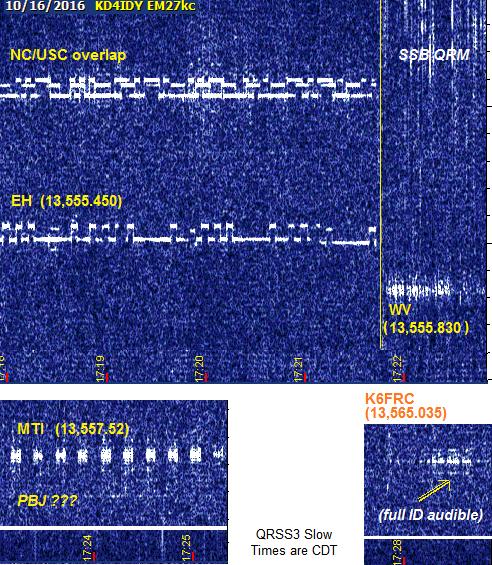
Actually, I listened to 22 m twice today. The first time was just after sunrise (7:30 AM CDT) when I discovered my target on 1750 m (SIW in WSPR mode) wasn't present yet. At daybreak, EH was very loud, and and NC was only faintly visible. In a few minutes, EH settled down a bit and NC came up to about normal. No one else was visible or audible.
By 5 PM, a G1 magnetic event had taken place, so I skipped the 1715 UTC WSPR-15 time slot to check out HF again. As you see, NC and USC were about equal...in level and, unfortunately, frequency. EH was still solid, but skipped around a Hz or two in frequency. WV was audible for a while, and would have been more copyable if it weren't for the SSB sidebands just 70 Hz above it. MTI was quite good, and FRC faded up long enough for one complete audible ID. A signal resembling AAØRQ's keying pattern was intermittently visible at 13,563.55, but couldn't be confirmed under the beat note of several close-spaced carriers in the vicinity. Nobody else seen or heard.
---------------------------------------------------------------
File Attachment 1: 16oct-hf-1.jpg
SIW WSPR Monday
Posted by John Davis on October 17, 2016 at 19:29:02.
In reply to SIW WSPR Sunday posted by John Davis on October 16, 2016
Spent much of the morning looking at 22 m since there was a chance of unusual propagation there and no change is expected in SIW LF mode or frequency today. Finally started monitoring in time for the 1730 UTC slot (12:30 PM CDT) but nothing turned up for that one. Noise is a bit higher today than yesterday at the same time by about 2 S-units, so I didn't have a lot of hope. Still, the 1745 slot decoded OK (see attached), so I'm continuing to watch.
---------------------------------------------------------------
File Attachment 1: 17oct1-siw.jpg
HiFERs This Monday
Posted by John Davis on October 17, 2016 at 19:46:46.
In reply to HiFERs This Sunday posted by John Davis on October 17, 2016
I learned (possibly a bit late) about a possible G2 event this morning, so I went to the farm and began monitoring about 9:30 AM CDT. I don't guess it exceeded G1, and it certainly didn't provide me with any openings inside the first skip zone or unusual multipaths, but it did produce interesting enhancements of some of the regulars.
When I powered up, NC and EH were both blasting in. Since this antenna system intentionally attenuates above LF, actual signals seldom exceed S0, and hardly ever reach S1. (Codar and other QRM can sometimes be S9 or higher.) Today, though, the combination of NC and EH hit S5 for a while, with no QRM or QRN noticeable! FRC was fairly solid copy, too, although it never budged the S-meter.
During the morning, NC faded out several times, while EH was always present but varied in level quite a bit. Shortly before noon, they were joined by USC, coming up out of the background fairly rapidly (attached). After while I tuned up a bit and got nice copy of WV, which appeared to be doing 11 IDs then one omission today. (Also attached; it's hard to get an exact count with random fades taking out one or two at a time, but I think that's right.) Further scanning turned up no others during the noon hours, but when I returned to the watering hole, USC was dominating and had an S3 signal!
---------------------------------------------------------------
File Attachment 1: 17oct22.jpg
File Attachment 2: 17oct23-wv.jpg
Hifers Sunday Afternoon
Posted by Ed Holland on October 17, 2016 at 23:17:34.
I Set the receiver and computer setup running whilst tinkering on the old Philco in the adjacent garage. Listening time was approx 2300 UTC.
Beacons heard included AZ and AA0RQ, possibly also GNK. The SSB interference near the watering hole mentioned in John's Sunday post was also evident. At the watering hole, USC was visible, and something resembling WV I think. A couple of traces were present but reception was weak and broken enough to prevent identification. Returning to the bottom of the band, AZ bounced up occasionally well enough to hear from the next room.
A few more of the Philco's bakelite capacitor block/terminal strips have been refurbished in the mean time.
Re: SIW WSPR Monday
Posted by John Davis on October 18, 2016 at 16:17:16.
In reply to SIW WSPR Monday posted by John Davis on October 17, 2016
Here's the complete set of captures from the time I started yesterday to the point at which it became swamped in moderate QRM. The waterfalls continued to just barely show excess RF all the way up to sunset, when I stopped. For comparison, at the same static levels, the QRSS30 signal is usually still usable.
1745  -37  -0.2    0.185185    0   K3SIW         EN51      0
1815  -38  -0.6    0.185185    0   K3SIW         EN51      0
1830  -38  -0.9    0.185185    0   K3SIW         EN51      0
1845  -38  -1.3    0.185185    0   K3SIW         EN51      0
1915  -39  -0.9    0.185185    0   K3SIW         EN51      0
1930  -37  -0.6    0.185185    0   K3SIW         EN51      0
1945  -35  -1.3    0.185185    0   K3SIW         EN51      0
2000  -38  -1.3    0.185185    0   K3SIW         EN51      0
2015  -36  -0.2    0.185185    0   K3SIW         EN51      0
2030  -37  -0.9    0.185185    0   K3SIW         EN51      0
2045  -38  -0.6    0.185185    0   K3SIW         EN51      0
2100  -37  -0.6    0.185185    0   K3SIW         EN51      0
2115  -36  -0.9    0.185185    0   K3SIW         EN51      0
2130  -38  -0.6    0.185185    0   K3SIW         EN51      0
2145  -37  -1.3    0.185185    0   K3SIW         EN51      0
2200  -38  -0.6    0.185185    0   K3SIW         EN51      0
2215  -38  -0.9    0.185185    0   K3SIW         EN51      0
Re: SAQ fire
Posted by Mike Terry on October 19, 2016 at 01:28:21.
In reply to SAQ fire posted by Mike Terry on October 14, 2016
ARRL
Antenna Fire Puts SAQ Alexanderson Alternator Station Off the Air
10/18/2016
An early October fire in the SAQ Alexanderson alternator long-wave antenna is under investigation by the Grimeton World Heritage Foundation, which owns and manages the station in Grimeton, Sweden. The fire, attributed to arcing, was quickly extinguished, and no injuries occurred. The Foundation said that determining the extent of damage and completing repairs could take a while.
“There is a risk that the incident will affect the planned transmissions with the long-wave transmitter SAQ for some time to come,” a Foundation announcement said. The fire will keep SAQ off the air for a scheduled UN Day transmission on October 24. SAQ, which operates on 17.2 kHz, also typically schedules transmissions on Christmas Eve and other occasions.
Dating from the 1900s, the Alexanderson alternator — essentially an ac generator run at extremely high speed — can put out 200 kW but typically is operated at less than one-half that power level. Once providing reliable transatlantic communication, it is now a museum piece and only put on the air on special occasions. It was built in the 1920s.
http://www.arrl.org/news/antenna-fire-puts-saq-alexanderson-alternator-station-off-the-air
Re: SIW WSPR Tuesday
Posted by John Davis on October 20, 2016 at 19:39:00.
In reply to Re: SIW WSPR Monday posted by John Davis on October 18, 2016
1645 -36 -0.9 0.185185 0 K3SIW EN51 0
That's the final WSPR-15 time slot of the morning before the changeover on Tuesday. It was intended to be at least an hour of captures, but after getting to the farm, I discovered I'd left the computer back at the house.Sorry for the long delay in reporting, but it's been a very busy week overall. Attached is a capture of the Tuesday transition compiled from two different Argo QRSS30 windows, plus a capture of only the QRSS as viewed at 60 seconds slow speed. At 60 Slow, I think a little oscillator settling can be noticed in the first 40 minutes, after which it's fully steady.
John
---------------------------------------------------------------
File Attachment 1: 18oct3.jpg
File Attachment 2: 18octe0007.jpg
Re: SIW WSPR Tuesday
Posted by Garry, K3SIW on October 20, 2016 at 20:37:42.
In reply to Re: SIW WSPR Tuesday posted by John Davis on October 20, 2016
John, very impressive to catch the switchover at noon local time from nearly 500 miles. I don't think I saved a QRSS startup capture from Oct 18 but I did save one today and I don't notice wiggle like you show, just an OCXO warmup lasting around 8 minutes. I'll send you my capture directly. Of course the idea of frequency wobble for awhile after turnon isn't unreasonable, but I'd expect it to be worse for wspr-15 than QRSS, albeit harder to identify on wspr since is purposely outputs a number of different tones. That's because the OCXO for the former has a bang-bang temperature controller set for 40C, but the latter uses proportional control.
73, Garry, K3SIW
HiFer Saturday
Posted by N1KGY on October 22, 2016 at 21:59:43.
~2215GMT/21OCT2016:: Hearing GNK on 13.563.9 quite clearly above the noise here in NC, FM05 on my 160M longwire at the moment, which is kind of interesting, as I'm not hearing NC, WV, MTI, or anyone else on it... It must be a propagation thing.
~2235GMT I briefly heard what I believe was SZX just at the noise floor on the crest of the QSB, but not for long enough to be positive on the ID.
Re: HiFer Saturday
Posted by N1KGY on October 22, 2016 at 22:02:12.
In reply to HiFer Saturday posted by N1KGY on October 22, 2016
Ha, typo'ed the date; s/b 2215GMT/22OCT2016
Algeria 252 and CLB beacon
Posted by Brock Whaley on October 23, 2016 at 14:09:06.
I am near Wilmington, NC. Powerhouse beacon CLB 216 has been off the air since hurricane Matthew. Has it been decommissioned ? It opens the frequency for Monte Carlo (xmtr in France). Algeria 252 has had huge signals here the evenings of 10/21 and 10/22 (Friday and Saturday). So strong full modulation is heard on small consumer radios (with long wave) purchased in the U.K. Yet not a peep out of France 162 or Germany 183 so far on the DX set up.
HiFers WV and GNK -- 23 Oct., 2016
Posted by EdWSlidell, LA on October 23, 2016 at 17:33:16.
Hi all. Have been hearing GNK appear on 13564 KHz, out of nowhere, for past few days. As if the GNK transmitter were on a timer. Starts about 1230 UT(0730 CDT)each morning, and seems to be good for most of the day. For first 15 mins. or so it is a good 579, then drops to a 3/4-4/5-9 for the day. Also heard WV around 13558 KHz, with good steady signal, and only small abount of QSB. Generally in the 349 range. Something not heard for quite a while. Ed W Slidell, LA (NE of New Orleans/Lake Pontchartrain).
Re: HiFers WV and GNK -- 23 Oct., 2016
Posted by John Davis on October 23, 2016 at 18:11:06.
In reply to HiFers WV and GNK -- 23 Oct., 2016 posted by EdWSlidell, LA on October 23, 2016
Good to see a report from you again, Ed. Glad to hear GNK is still on, too. Lately it's been consistently absent out here in Kansas, so I was beginning to wonder.
Forecast includes a G1 event late this afternoon, and possibly some repeats over the next two days, so maybe that will shake things up enough here to hear a couple of signals that haven't come in for a while.
John
GNK and FRC
Posted by Bill Hensel on October 23, 2016 at 21:35:36.
While cutting firewood up at 8600 ft today I could hear GNK and FRC...
Saturday listening
Posted by Ed Holland on October 24, 2016 at 02:25:04.
During a quick listening session yesterday circa 23:30 UTC a reasonable catch was made.
AZ and AA0RQ were audible at times. At the watering hole, USC was apparrent, audible even, alongside companions for which I could not determing a positive identification. I will dig up the screenshot later.
Re: Algeria 252 and CLB beacon
Posted by N1KGY on October 25, 2016 at 03:17:07.
In reply to Algeria 252 and CLB beacon posted by Brock Whaley on October 23, 2016
CLB isn't the only thing I'm not hearing - Apparently the storm did my outdoor loop some damage - I'm not hearing hardly anything below 400Khz on it - even DIW is coming in very weak on 198Khz, and that's only 125 miles from me - usually pegs my AGC even when I'm tune off carrier by 2.5~3 khz.
I'm praying for mild WX this weekend so I can put up the LF/MF SAL I bought the materials for back in August.
Spectrum Lab
Posted by Frank Lotito on October 25, 2016 at 16:45:01.
The www.qsl.net web site for DL4YHT's Spectrum Lab was last updated this month (Oct 17, 2017). The latest software revision is 2.9 b01. Additionally, the software principle writer states ""Spectrum Lab runs under Windows 98, 2000, ME, XP (home and professional), Linux/WINE, but obviously not under Windows Vista. The reason why it doesn't work under "Vista" is unknown. Since I don't use Vista myself, there's little I can do about this. Use Linux/WINE, or a virtual PC running XP (inside your shiny power-hogging Vista machine).""
I have tried running Spectrum Lab in Windows 10. It seems to "sometimes" run without incident. But, at times I get random freeze-ups. When I try to close the program short error messages appear indicating to the effect the program stalled on line #nnnnnn. In addition, certain user selected program options do not seem to respond to that option's START button. My more ancient spectrum analysis / waterfall display program "Spectran" works fine.
My questions - Does Spectrum Lab reliably run in Windows 10? Is anyone else using Windows 10 and Spectrum Lab experiencing the same problems I experience? All the remaining software on my computer seems to work just fine, including a very out dated version of the Microsoft Office Suite.
73 K3DZ / WH2XHA
Re: Spectrum Lab
Posted by John Davis on October 25, 2016 at 17:12:37.
In reply to Spectrum Lab posted by Frank Lotito on October 25, 2016
I don't use Spectrum Lab or Windows 10 myself, but have you tried running it with compatibility mode settings?
John
Gee! Oh! Magnetic Events
Posted by John Davis on October 25, 2016 at 18:44:44.
A storm peaking at G3 levels occurred today, and disturbances to the G2 level are expected off and on into mid-day tomorrow. This could produce unusual enhancements for HiFERs.
When I first checked this morning, I didn't seem to get in on any of that, but NC, USC, and EH were nice and strong. WV was nil to moderately strong with fairly rapid QSB cycles, and FRC was visible but not audible. Will look and listen again when I wrap up my current LowFER session.
Beacon MLS Back On
Posted by Mark on October 25, 2016 at 19:26:11.
Hi all. Beacon MLS on 186.204 is back on for the season. It will take a day or so to stabilize. I look forward to any signal reports. TNX. Mark
Re: One beacon in the darkness
Posted by Ed Holland on October 25, 2016 at 20:36:11.
In reply to Re: One beacon in the darkness posted by Ed Holland on September 27, 2016
Hi folks,
Philco Phettling and Phiddling continues at a steady pace.
This weekend, along with repairing some Bakelite block capacitors, I fitted two high voltage motor run capacitors in the location where the long lost electrolytic HT filter caps would have lived. I found some pics on-line that showed the strap/clamp and the use of paper insulation. The insulation isn't necessary on modern caps, but it does help cushion the clamp. I had to make the strap from some alloy sheet I had lying around and also a little extension bracket, sawn from a junkbox corner brace. That escapade took a little while to figure out, bash and bend, but I think it looks OK. The gawdy modern labels peeled off the cans of the condensers, and I think they fit in quite well. It still remains is to wire them up.
I've also done some replacement of wiring under the chassis where the insulation has crumbled - there were some interesting HT incidents waiting to happen!
Cheers
Ed
---------------------------------------------------------------
File Attachment 1: 20161024_081913s.jpg
File Attachment 2: 20161016_174009s.jpg
Re: One beacon in the darkness
Posted by Ed Holland on October 25, 2016 at 20:38:55.
In reply to Re: One beacon in the darkness posted by Ed Holland on October 25, 2016
And this pic, from the rear of the chassis:
---------------------------------------------------------------
File Attachment 1: 20161024_081929s.jpg
Re: Beacon MLS Back On
Posted by Garry, K3SIW on October 25, 2016 at 23:16:12.
In reply to Beacon MLS Back On posted by Mark on October 25, 2016
Initial copy of MLS is at more like 186.202 kHz, just like last year. Sample capture:

73, Garry, K3SIW, EN52ta, Elgin, IL
Re: Spectrum Lab
Posted by Frank Lotito on October 26, 2016 at 01:38:20.
In reply to Re: Spectrum Lab posted by John Davis on October 25, 2016
John - Can you suggest a Windows XP or Windows 10 compatible spectrum analyzer program suitable for ELF application (3 Hz to 45 Hz range),such as monitoring the Schumann resonance hum bars? 73 Frank K3DZ / WH2XHA
Re: Spectrum Lab
Posted by John Davis on October 26, 2016 at 07:38:46.
In reply to Re: Spectrum Lab posted by Frank Lotito on October 26, 2016
[Frank Lotito wrote:]
Can you suggest a Windows XP or Windows 10 compatible spectrum analyzer program suitable for ELF application (3 Hz to 45 Hz range), such as monitoring the Schumann resonance hum bars?)
Hmm, not really. I can't even suggest a sound card that would work satisfactorily as low as 3 Hz. Some years back, I knew of Schumann observers using A/D converters driven by custom software through a dedicated COM port (sigh, remember the good old days when there were such things on a computer?), but I don't know what current practice is. I'll do some checking, though.
Also, with regard to Spectrum Lab...did you install it into a separate folder if its own on your hard drive, or did you let it install itself as a subdirectory of Program Files? I don't know what the default is for Spectrum Lab, but I know some other programs of a certain age do that unless you tell them otherwise. Problem is, beginning with Vista, the operating system prevents programs from creating new files of their own within subdirectories of Program Files. That can cause them to behave very oddly indeed...sometimes with misleading error messages, and sometimes with no warnings at all.
John
TAG On Air
Posted by John Andrews, W1TAG on October 27, 2016 at 20:31:02.
Lowfer TAG, 185.297 kHz from Raymond, ME is on the air until May in QRSS60 mode. While no competition to WWVB, the frequency is pretty exact. Reports are welcome.
John, W1TAG
Re: Gee! Oh! Magnetic Events
Posted by Ed Holland on October 27, 2016 at 21:52:48.
In reply to Gee! Oh! Magnetic Events posted by John Davis on October 25, 2016
Listening last evening, and again this morning showed a flat band here, although the atmospheric noise level was a little higher - a couple of segments on the NRD's fluorescent bar graph. Other indicators, such as Radio Australia on 15.240 and 17.840 Megs were also absent, bar a faint carrier. On occasion both frequencies will boom in at S7 to S9 on the dipole with local radio audio quality.
Re: Spectrum Lab
Posted by Mark on October 27, 2016 at 23:10:29.
In reply to Re: Spectrum Lab posted by John Davis on October 26, 2016
Look up q burst radar. Gerry has a system using power lines for antennas. Drop him a note to get more details.
There are some sound cards that can go that low. Again, the q burst site is a good place to start.
Wish I could explain more. Still trying to figure out his system myself.
Good luck.
[DUPLICATE POST REMOVED 2016/10/12 0433 UTC]
Re: Spectrum Lab
Posted by John Davis on October 28, 2016 at 06:09:29.
In reply to Re: Spectrum Lab posted by Mark on October 27, 2016
Thanks Mark. I'm guessing the site in question is www.q-burst-radar.com, operated by Gerry Gore. Intriguing, but it's awfully vague about...well, ANYTHING involving his coupling arrangement, receiver, or the software used. The only technical detail I've been able to glean from his pages so far is that he appears to upconvert the ELF signals to the vicinity of 8 kHz and performs spectrum analysis there, which seems like it leaves a lot of room for errors and artifacts, especially when using power lines to detect Schumann frequencies.
Some of the other results that turn up on a Google search for "q burst radar" are a bit more informative; for example, www.lrsatx.com demonstrates that Spec Lab can be tuned to the 7.8 Hz resonance, assuming you can find a suitable sound card; while, of course, some commercial sites mean other things entirely by the term, unrelated to natural radio.
But even the relevant ones I've run across so far seem to be a bit vague about how the Lightning Radar software relates to Q burst observation--you apparently have to email the guru himself to be initiated into the mysteries of the subject. Not having done that (I find using the Internet to promote information hoarding distasteful), I have no clue how a power line's directional properties can be ascertained sufficiently to make the LR software useful with power lines. There also seems to be a LOT of quasi- and outright pseudo-science out there on the Web about Schumann cavity phenomena.
With the caveat that I don't like to promote Yahoo email reflectors for several good reasons, their ELF-ULF group may have some of the information Frank is looking for, and www.vlf.it has quite a few articles on observation of Schumann frequencies.
John
ELF Power Line "Harmonic" Noise
Posted by Frank Lotito on October 29, 2016 at 12:07:54.
I an trying to familiarize myself with the use of Spectrum Lab to monitor ELF and VLF radio emissions, both natural and man-made. Much to my surprise I continuously find very strong emissions at what some people call "sub-harmonics" of 60 Hz. In my area there is a very strong emission at 20 Hz, a weak emission at 30 Hz, and additional emissions at multiples of 20 or 30 Hz, and even at odd multiples of 15 Hz. (As expected there is a powerful emission at 60 Hz, as well as the expected 60 Hz harmonics such as 120, 180, etc.) A friend said these sub-harmonic emissions are caused by "unbalances" in the electrical power grid in my area.
I do not believe that these sub-harmonics are an artifact caused by me not correctly setting up SL's multitude of user selectable options, or something related to my computer or its sound card. (Without shame, I will admit I am definitely not an expert on digital sampling theory and techniques.)
Can anyone refer me to an authoritative article or two that describes the reason for these "sub-harmonic" emissions, their negative effect(s) if any, what the power companies do to minimize them?
73 K3DZ / WH2XHA
LowFER and HiFER WM QRT
Posted by N8OOU on October 29, 2016 at 14:57:49.
LowFER WM has developed a malady (last) weekend, and my schedule is not going to allow me to implement the fix for the next several days. I will announce its return in the near future. In order to prevent the same issue from hitting the WM HiFer, I have taken it down too.
73 de N8OOU - Mike Meek
Part 15 compliance to the FCC Rules
Posted by Mike N8OOU on October 30, 2016 at 19:24:20.
All;
I have a general question regarding Part 15 HiFer rules. Since I started using the U3S product as my high and low beacon transmitters I have had issues with out of band emissions. This fall I switched the Lowfer to the Arduino/QRPLab shield product, and it has had different, and stronger out of band emissions than the U3S. There has been discussion of out of band emissions from the U3S in a recent ARRL QST, and the QRPLabs Yahoo Forum.
I have now made extensive modifications to my HiFer Beacon to try to beat these emissions down.
The LWCA Reference section on HiFer Rules states that out of band emissions shall not exceed 30 microvolts/meter at 30 meters. I do not own, or have access to the lab equipment to perform that type of measurement. I do have an AOR AR8200 communications receiver (handheld) with a VHF Lowband rubber duck antenna. If I walk around my yard with it, as I get further away from the transmitter, the 3rd, and 5th harmonic of my HiFer beacon drop in strength until it is no longer detectable.
The manufacture specifies the receive sensitivity of that radio, in the 30 - 470 Mhz range is SSB 0.3 uV (10dB S/N). My question is;
If the point where the beacon harmonic signal is no longer detectable by ear is within 30 meters from the transmitter/antenna, will I be well in compliance with that part 15rule?
Thanks for reading, Comments and/or guidance is appreciated.
Mike 73
Hifer RY
Posted by John Andrews, W1TAG on October 30, 2016 at 20:04:55.
Hifer beacon RY is now on full-time on 13555.415 kHz from Raymond, ME, in QRSS3 mode. With luck, it will be there until May, 2017.
John, W1TAG
Re: Part 15 compliance to the FCC Rules
Posted by Frank Lotito on October 30, 2016 at 22:23:20.
In reply to Part 15 compliance to the FCC Rules posted by Mike N8OOU on October 30, 2016
Excellent question Mike! I wonder if measurement of the spectral components' power "in the coax line" feeding the antenna will allow you to get a reasonable estimate on the radiated power / nearby field strength of each spectral component of interest? To do this, I would think you will have to be able to develope a "conversion factor/transfer function" that represents your antenna's gain / directional characteristics. For example, feed the antenna with X dBm at frequency F, the transfer function gives the field strength at X meters away and at an elevation angle of Y degrees over a plain ground with a Z characteristic. In the past I believe some of the postings on the 600mrg bulletin board address similar questions. I definitely can not give you more specific guidance. Maybe N6LF could assist you? GL 73 Frank K3DZ / WH2XHA
Re: Part 15 compliance to the FCC Rules
Posted by John Davis on October 31, 2016 at 07:12:27.
In reply to Part 15 compliance to the FCC Rules posted by Mike N8OOU on October 30, 2016
I too have been following the U3s emissions discussion in QST and other forums lately, and the key seems to be having the right filter for the band in question and keeping leakage paths under control. I don't imagine your HiFER has multiple selectable filters, so it's not likely to be overly susceptible to these problems. Sounds as if you have performed due diligence in that regard. As for compliance, the FCC naturally wants the signal to be within specs, but doesn't expect us all to have access to the latest-greatest lab gear:
§15.23 (b) It is recognized that the individual builder of home-built equipment may not possess the means to perform the measurements for determining compliance with the regulations. In this case, the builder is expected to employ good engineering practices to meet the specified technical standards to the greatest extent practicable. The provisions of §15.5 apply to this equipment.
(§15.5 is the rule that states no interference shall be caused to, but any interference must be accepted from, other stations.)
The sensitivity spec for the radio is in microvolts measured across the impedance at the radio's input jack, whereas the field intensity spec is for the electric component in free space of the received wave in uV/m. How many uV is delivered to the receiver for a certain number of uV/m of field strength is a function of the antenna factor. We don't know the antenna factor for the "rubber duck" at your frequencies of interest, of course. But we can make some reasonable approximations based on worst-case assumptions.
It's obviously too small to deliver 30 uV to the receiver for 30 uV/m of field intensity anywhere in the HF range, which would be an antenna factor of 0 dB...but it is long enough to deliver a voltage equal to 7 or 8% of the field intensity to the terminals of a high-Z load. As long as the input impedance of the receiver doesn't load the antenna excessively (which also depends on the antenna's impedance at the frequency in question) you should easily be able to deliver a terminal voltage of more than 1% of the field intensity, especially at the 3rd and 5th harmonics of 13.56 MHz.
I specifically mention 1% because that's what 0.3 uV is to 30 uV. In short, yes, the radio should be more than sensitive enough to ensure the harmonics are in compliance with the limit if you can no longer hear them at 30 meters from the antenna.
John
Re: Hifer RY
Posted by Paul on October 31, 2016 at 22:44:16.
In reply to Hifer RY posted by John Andrews, W1TAG on October 30, 2016
Nothing heard in California, but will remain QRV for a while.
potrzebie