 File Attachment 1: 11oct3b.jpg
Sunday 30 September
Conditions were pretty dismal again today on 22 m, principally due to the multiple codar sources. Nobody appeared at the watering hole but NC, 7P and EH, and during three separate band scans, the only other station that ever came through was K6FRC beginning about 11:47 AM CDT. It eventually produced entire IDs, then two minutes later was completely swamped again.
The bands of codar spaced about 66 Hz apart continue, apparently related to the fact that three or four different systems are present at the same time with slightly off-synchronized pulse spacings. Re: Sunday 30 September
Posted by Ed Holland on October 01, 2018 at 18:17:58.
In reply to Sunday 30 September posted by John Davis on October 01, 2018
Brief listening here at "PVC" with no luck at all yesterday, around 3 pm local time (PST+DST). I was without the normal Spectrum Lab Assistance, as the PC is loaned to visiting family!
Since no-one has found PVC. I can reveal the temporary frequency change as 13555.7 kHz. This is achieved using an inexpensive DDS signal generator feeding the empty crystal slot in the Vectronics "20m" transmitter. That seems to work well if the drive is adjusted carefully to avoid harmonics or "half-wave" operation that leads to outputs on 27111.4 kHz or 6777.85 kHz respectively.
Cheers
Ed
Tuesday 2 October
Posted by John Davis on October 02, 2018 at 21:05:03.
In reply to Sunday 30 September posted by John Davis on October 01, 2018
Continued depressed conditions and codar on the rampage again today. During the noon hour CDT, WV was intermittently (read: once in a rare while) audible under the QRM around 12:34; and WAS came through briefly very well at 12:40 PM. Other than that, it was only the Big Three at the watering hole today...and 7P didn't really show up until NC had heated up and its lower frequency drifted down over .470, making it hard to pick out 7P.
Re: Sunday 30 September
Posted by John Davis on October 02, 2018 at 21:14:31.
In reply to Re: Sunday 30 September posted by Ed Holland on October 01, 2018
Thanks for that information, Ed. It provides at least part of the explanation for why I hadn't heard or seen anything that looked plausible in all my monitoring of the watering hole. My CW filter only passes ±120 Hz of 13555.400, which I can fit on two simultaneous Argo screens.
There's a slim chance I might have had better luck if I'd known where to look...or maybe not, considering that I also never had any luck when I used to park on 558.400, except sometimes TON. But sadly, now that codar is so ubiquitous, even knowing where to look may not help for the foreseeable future.
John
Re: Sunday 30 September
Posted by Ed Holland on October 03, 2018 at 00:00:43.
In reply to Re: Sunday 30 September posted by John Davis on October 02, 2018
You are welcome John.
I would be happy to tune into your pass-band for a while - I'll assess the signal generator for stability and choose an appropriate spot, so I don't cross anyone else's frequency. Or at least minimise the potential for overlap.
From what you say, somewhere in the range 13,55.300 to 13,555.600 should make it through the passband, and allow for a bit of drift.
Regards,
Ed
Back to 44m testing new shortened dipole
Posted by Jason Goldring on October 03, 2018 at 01:12:46.
I brought up my 44m beacon again, WSPR @ 6780.0, RX 6778.5
Recent listening sessions and to be expected, ~40m has been good to me.
This would also test the abilities of a modified dipole based on the 22m design I am using to see what can be achieved.
Now the problem is that not much is expected in the way of reports and I may be totally wrong but 44m is still off limits to the US for unlicensed low power use. (And I am still wondering why), but if you have a chance to scan the bands, with the recent reception being better than expected, at least for me, might stand a chance to get a weak signal out there a bit farther as I have in the past.
When I say problem, I am not sure who really monitors this 44m band. But if you have a spare moment, might you give a listen?
Results posted here or by email will be shared with all.
Thanks! Re: Back to 44m testing new shortened dipole
Jason
Posted by John Davis on October 03, 2018 at 05:26:56.
In reply to Back to 44m testing new shortened dipole posted by Jason Goldring on October 03, 2018
Went back to the field tonight to check on things and discovered LF was way too QRN-filled to have any hope other than the dynamic duo on 2200 m. Next, I checked 22 m and found it totally dead--no codar, no mid-band ISM noise, no static.
Then I figured, why not check 44 m? It wasn't as dead as 22, for certain, but no sign of WSPR after 20 minutes of observation, so I packed the gear back in the car and returned to town for the night. (Just a couple of fairly strong carriers at and a few Hz above 6779.990.) If the weather cooperates, I'll try4 m earlier tomorrow evening, just to see if that makes a difference. Perhaps gray line propagation will manifest itself.
John
Re: Back to 44m testing new shortened dipole
Posted by Ed Holland on October 03, 2018 at 05:57:52.
In reply to Back to 44m testing new shortened dipole posted by Jason Goldring on October 03, 2018
I'll happily give 44m a listen. I could either breakout the WD 40 and move the main receiver from 22 m or fire up one of the spare sets ;-)
Re: Back to 44m testing new shortened dipole
Posted by Mike on October 03, 2018 at 12:36:51.
In reply to Back to 44m testing new shortened dipole posted by Jason Goldring on October 03, 2018
Jason
I started WSPR reception on my KiwiSDR at about 05:00 UTC today. Shortly after local sunrise here I decoded several transmissions starting at 11:58. I have put several screen captures on a dropbox folder here;
https://www.dropbox.com/sh/3nfv5800tnwqh4s/AABytema4Vdkn3MrzUaO_T_0a?dl=0
A couple explanations, WSPR decoding with the KiwiSDR is hardcoded to the standard ham bands. when you look at the screen captured you will see it is set for the 40m band.I then manually changed the frequency to your 44m transmission. Second, the KiwiSDR uses a BFO frequency of 750, in place of the WSJT standard of 1500. My "dial frequency was adjusted accordingly. I turned off the WSPR upload option.
I am located at EM68es, an 892 km trip for your signal. The first decodes at 11:58 UTC showed a lot of drift, but later decodes have locked into a DF = 0. The band noise is fairly low with some QRN which you can see on the waterfall. I will add more screen captures to that dropbox folder as the morning progresses.
Nice job... Good Luck down the road.
73 Mike N8OOU
2200M WSPR decodes at VE3EAR
Posted by John Bruce McCreath on October 03, 2018 at 14:03:43.
Here is 4 hours of WSPR decodes on 2200M received at VE3EAR
from 00:00 to 04:00 local.
0402 -21 -0.8 0.137438 0 N1BUG FN55 30
0408 -23 -0.9 0.137438 0 N1BUG FN55 30
0414 -21 -0.9 0.137438 0 N1BUG FN55 30
0420 -21 -0.9 0.137438 0 N1BUG FN55 30
0426 -21 -0.9 0.137438 0 N1BUG FN55 30
0432 -18 -0.8 0.137438 0 N1BUG FN55 30
0438 -21 -0.9 0.137438 0 N1BUG FN55 30
0444 -19 -0.8 0.137438 0 N1BUG FN55 30
0450 -23 -0.9 0.137438 0 N1BUG FN55 30
0456 -25 -0.8 0.137438 0 N1BUG FN55 30
0456 -24 -0.9 0.137508 0 WH2XXP DM33 37
0456 -26 -0.9 0.137528 0 WH2XND DM33 43
0500 -27 -1.0 0.137507 0 WH2XXP DM33 37
0500 -27 -1.0 0.137528 0 WH2XND DM33 43
0502 -22 -1.0 0.137438 0 N1BUG FN55 30
0504 -28 -0.9 0.137507 0 WH2XXP DM33 37
0504 -29 -0.9 0.137528 0 WH2XND DM33 43
0508 -25 -0.9 0.137508 0 WH2XXP DM33 37
0508 -26 -0.8 0.137528 0 WH2XND DM33 43
0512 -29 -0.8 0.137507 0 WH2XXP DM33 37
0514 -23 -1.0 0.137438 0 N1BUG FN55 30
0516 -28 -0.7 0.137528 0 WH2XND DM33 43
0520 -25 -0.9 0.137438 0 N1BUG FN55 30
0524 -26 -0.9 0.137528 0 WH2XND DM33 43
0526 -26 -1.0 0.137438 0 N1BUG FN55 30
0528 -27 -0.8 0.137528 0 WH2XND DM33 43
0538 -25 -0.9 0.137438 0 N1BUG FN55 30
0544 -25 -0.8 0.137438 0 N1BUG FN55 30
0544 -25 -0.8 0.137528 0 WH2XND DM33 43
0548 -24 -0.9 0.137528 0 WH2XND DM33 43
0550 -24 -0.8 0.137438 0 N1BUG FN55 30
0552 -26 -0.8 0.137528 0 WH2XND DM33 43
0556 -27 -0.8 0.137438 0 N1BUG FN55 30
0556 -25 -0.8 0.137507 0 WH2XXP DM33 37
0556 -25 -0.8 0.137528 0 WH2XND DM33 43
0600 -25 -0.8 0.137507 0 WH2XXP DM33 37
0600 -25 -0.9 0.137528 0 WH2XND DM33 43
0602 -24 -0.9 0.137438 0 N1BUG FN55 30
0604 -24 -0.8 0.137507 0 WH2XXP DM33 37
0604 -22 -0.9 0.137528 0 WH2XND DM33 43
0608 -25 -0.8 0.137438 0 N1BUG FN55 30
0608 -25 -0.9 0.137507 0 WH2XXP DM33 37
0608 -25 -0.9 0.137528 0 WH2XND DM33 43
0612 -25 -1.0 0.137507 0 WH2XXP DM33 37
0612 -25 -1.0 0.137528 0 WH2XND DM33 43
0614 -26 -0.9 0.137438 0 N1BUG FN55 30
0616 -25 -0.9 0.137507 0 WH2XXP DM33 37
0616 -25 -0.9 0.137528 0 WH2XND DM33 43
0620 -22 -0.9 0.137438 0 N1BUG FN55 30
0620 -23 -0.8 0.137507 0 WH2XXP DM33 37
0620 -23 -0.8 0.137528 0 WH2XND DM33 43
0624 -25 -0.8 0.137507 0 WH2XXP DM33 37
0624 -24 -0.8 0.137528 0 WH2XND DM33 43
0626 -27 -1.0 0.137438 0 N1BUG FN55 30
0628 -26 -0.8 0.137507 0 WH2XXP DM33 37
0628 -26 -0.9 0.137528 0 WH2XND DM33 43
0632 -26 -0.9 0.137438 0 N1BUG FN55 30
0632 -27 -0.8 0.137528 0 WH2XND DM33 43
0636 -27 -0.8 0.137528 0 WH2XND DM33 43
0638 -27 -1.0 0.137438 0 N1BUG FN55 30
0644 -26 -0.9 0.137438 0 N1BUG FN55 30
0650 -24 -1.0 0.137438 0 N1BUG FN55 30
0652 -27 -0.8 0.137528 0 WH2XND DM33 43
0656 -25 -1.0 0.137438 0 N1BUG FN55 30
0732 -25 -0.8 0.137528 0 WH2XND DM33 43
0740 -29 -0.9 0.137528 0 WH2XND DM33 43
0756 -22 -0.9 0.137528 0 WH2XND DM33 43
0800 -26 -1.0 0.137528 0 WH2XND DM33 43
73, J.B., VE3EAR
LowFER Beacon "EAR" Re: Back to 44m testing new shortened dipole
188.830 kHz. QRSS30
EN93dr
Posted by John Davis on October 03, 2018 at 16:02:30.
In reply to Re: Back to 44m testing new shortened dipole posted by Mike on October 03, 2018
Ah-ha! Gray line...do I have ESPN or what? :)
My mentally pathetic powers are hard at work. Too bad I didn't think about the possibility of it working at daybreak too. It's likely to be stormy here tomorrow at sunrise, but I will at least be trying again before and through sunset this evening.
Re: Back to 44m testing new shortened dipole
Posted by Jason Goldring on October 03, 2018 at 22:33:22.
In reply to Back to 44m testing new shortened dipole posted by Jason Goldring on October 03, 2018
Thank you so much for the reports, encouraging.
I am still collecting input from some not on this board, but my own testing (thanks Mike for the idea about SDR Web Sites, and thanks Ed & John - absolutely appreciate your insight and efforts). I personally saw a number of hits on AB1KW (Concord, NH) 603 Km but the 800+km gets my hopes up.
This was mid morning. Looking at WSPRNET and prop status for the band I will run it through the night and peek around at neighboring SDR sites via SDR.HU and others.
And so it continues to run....Thanks again. Now about that gray line.... :)
Jason Lowfer SIW QRV
Posted by Garry, K3SIW on October 04, 2018 at 01:55:47.
This afternoon Bob, NK9M and I activated lowfer SIW at his QTH (EN51uq). It's currently running like last "season": 185.2993 kHz QRSS30/60 cycling on M, W, F and 185.185 kHz WSPR15, opera32, QRSS25 cycling on Tu, Th, Sa, Su. Switch time is daily at 1800Z.
Hopefully soon the 185.185 kHz transmissions will be changed to EbNaut using 8K19A coding, with 16 bit CRC and 4.0 sec symbols to send a 3 char message each half hour.
73, Garry, K3SIW, EN52ta, Elgin, IL
Re: Back to 44m testing new shortened dipole
Posted by John Davis on October 04, 2018 at 03:25:23.
In reply to Re: Back to 44m testing new shortened dipole posted by John Davis on October 03, 2018
No luck at evening gray line. Probably Friday morning before I can try again.
John
Spot Update
Posted by Jason Goldring on October 05, 2018 at 02:33:43.
Ran a few remote WSPR sessions. Weather has been all over the place, we had extremely humid conditions this morning, now we have temps falling to 5c within freezing range (Celsius, yes Canadian... LOL)
Results are coming in from a variety of stations, some of whom do not have a reporter ID or Grid Zone but the SDR description is good enough.
AB1KW - FN43FE - seems extremely consistent. Several decodes on 44m. Playing with this web SDR a bit, I popped in 13.553900 and K3SIW appeared with these decodes:
16:52 -25db
17:04 -26db
17:40 -27db
17:52 -26db
18:04 -25db
(Did not use 553.910, the feedline is being used for 44m right now)
Northern Kentucky. Kiwi SDR shows only a dipole, no callsign. Grid EM79SA. Several decodes during the afternoon on 44m.
KH6ILT Grid EN70VS. 525 km and 3 decodes in a row.
I am very impressed with SIW - that is a 1422km trip. Not bad! I would like to find out what AB1KW has going for it for the cross band reception abilities, regular in band WSPR goes crazy on that.
And so we move on....
Jason
Re: Lowfer SIW QRV
Posted by John Davis on October 05, 2018 at 17:42:43.
In reply to Lowfer SIW QRV posted by Garry, K3SIW on October 04, 2018
Am getting what appears to be QRSS30 and 60 this morning, somewhat broken up by noise today, on 185.2993...but that doesn't seem to match the announced schedule.
Re: Lowfer SIW QRV
Posted by Garry, K3SIW on October 05, 2018 at 21:21:11.
In reply to Re: Lowfer SIW QRV posted by John Davis on October 05, 2018
John, you're correct. The beacon switched to QRSS30/60 on 185.2993 kHz yesterday afternoon and today around 2 pm CDT (I think) switched to wspr15/opera32/qrss25 on 185.185... kHz. I don't think the switch timer has the wrong date, rather I didn't correctly recall which mode was for M,W,F and which was for the other days. The switch time will be 1 pm local when we change to standard time. That's an hour after the intended 1800Z but as long as it's during daylight it doesn't matter much. When EbNaut on 185.185... kHz is activated the timer will be corrected.
73, Garry, K3SIW, EN52ta, Elgin, IL (the beacon is in EN51uq)
Re: Lowfer SIW QRV
Posted by John Davis on October 05, 2018 at 23:08:59.
In reply to Re: Lowfer SIW QRV posted by Garry, K3SIW on October 05, 2018
Thanks for that update, Garry. I returned to the field about 1:30 pm CDT and discovered there hadn't been a changeover yet, so I just sort of assumed I wasn't seeing what I thought I was, because there were still no definite full IDs in the trace (still too many storms in NE Kansas for good reception). So I tuned down to 22 m a little too soon to see the real changeover!
Maybe I can catch the transmission on 185.185 this evening before I have to pack up and batten the hatches...several days of rain and thunderstorms ahead here, starting overnight.
Sigs. Around 60kc & Below
Posted by Bill Stewart, K4JYS on October 05, 2018 at 23:34:56.
Just curious about some strong sigs I heard a bit ago. Around 60kc am hearing a strong carrier being keyed on and off....no modulation noted. Also down around 24kc and 40kc I am hearing two strong digital type sigs, plus a few others in that region but weaker. Any idea what I am hearing....local trash, stuff coming from my own rcvr or a real signal. Thanks....73 de Bill K4JYS
Re: Sunday 30 September
Posted by Ed Holland on October 06, 2018 at 01:10:55.
In reply to Re: Sunday 30 September posted by Ed Holland on October 03, 2018
OK, PVC has been moved to a nominal frequency 13555.550 kHz. I'll keep an eye on this, as I am not confident in maintaining stability in the 10's Hz range.
The beacon may be switched off for listening sessions during the weekend.
Cheers
Ed
Re: Sigs. Around 60kc & Below
Posted by John Davis on October 06, 2018 at 02:23:19.
In reply to Sigs. Around 60kc & Below posted by Bill Stewart, K4JYS on October 05, 2018
Hi Bill,
There are certainly lots of stray RF sources in homes and offices that manifest at LF. But I think the odds are very good that most, maybe all, the signals you described are quite real.
The one at 60 kHz is almost certainly WWVB. The "on-off" keying is actually a 17 dB level shift that carries a one-bit-per-second pulse-width modulated BCD code containing UTC time, date, etc. It's the signal that (for now, at least) sets radio-controlled "atomic clocks," watches, etc. in the United States. There's also another version of the time code modulated onto the carrier as slow binary phase shift keying (BPSK) that you can't detect by ear. A description of how these work can be found at:
www.nist.gov/pml/time-and-frequency-division/radio-stations/wwvb
From your description and the frequencies of the others, the best guess is that they are minimum-shift keyed (MSK) military transmissions. The one at 24 kHz is most likely NAA in Cutler, Maine. NSU in Puerto Rico is on 40.75 kHz, and is possibly the other one.
A list of others can be found at www.w1vd.com/vlf.html ; it is several years old now, but there is not a lot of change in these bands over time.
John
Re: Sigs. Around 60kc & Below
Posted by Bill Stewart, K4JYS on October 06, 2018 at 14:26:13.
In reply to Re: Sigs. Around 60kc & Below posted by John Davis on October 06, 2018
Tnx John for the explanation. Interesting history on WWVB and other info from W1VD pages. Long-Running U.S. Federal Radio Stations under threat
A goodly bunch of stns down in that region and will have to tune around down there some this winter. No way to copy the digital stuff, but might hear a CW ID if I get lucky.
73 de Bill K4JYS
Posted by Mike Terry on October 08, 2018 at 12:53:50.
Starting in May 1920, the U.S. federal WWV radio stations have broadcast the official time without fail. For ham radio operators, hearing the friendly “National Institute of Standards and Technology Time!” announcement is a comforting old refrain. For others, it’s a service they’ve never heard of—yet in the background, it’s what keeps the clocks and appliances in their daily lives automatically ticking along on time.
But after 98 years, this constant companion could soon go off the air. The proposed 2019 U.S. presidential budget calls for a 34 percent cut in NIST funding; in response, the institute compiled a budget-use plan that would eliminate the WWV stations.
At first blush it might sound like the natural end to a quaint public service from a bygone era. Do we really need radio-broadcast time signals in an era of Internet-connected devices and GPS?
Many would argue: Yes, we really do. More than 50 million devices in the United States—including wall clocks, wristwatches, and industrial appliances—keep time through the signal from NIST’s WWVB station, operating from a site near Fort Collins, Colo., where it reads the time directly from an atomic clock. These radio-equipped clocks are permanently tuned to WWVB’s low-frequency, 60-kilohertz signal.
“WWVB is the pacemaker for the world around us, even if we don’t realize it,” says Thomas Witherspoon, editor of shortwave radio news site The SWLing Post. “It’s why factory workers and schools don’t need to drag out the stepladder every time we switch between daylight and standard time. Without WWVB, these devices won’t magically update themselves.”
Those household devices and industrial clocks generally don’t have Internet capability, Witherspoon points out, so without WWVB “we’d likely be getting on ladders twice a year to manually have our clocks spring forward and fall back.”
What’s more, the nonradio alternatives just aren’t reliable, says John Lowe, station manager for WWVB and its sister high-frequency stations WWV, also in Fort Collins, and WWVH out of Kauai.
Internet connections aren’t available everywhere. And “GPS does not penetrate into buildings, which is an obvious problem,” Lowe says. “Plus, it’s vulnerable, as it’s prone to jamming as well as spoofing.”
“WWVB is the pacemaker for the world around us, even if we don’t realize it”
—Thomas Witherspoon, SWLing Post
The WWV stations are more than perfect timekeepers, too. The stations emit a frequency that can be used by military personnel, mariners, ham radio operators, or anyone else to calibrate devices. Their operators also broadcast information like space weather alerts, GPS satellite health reports, and marine storm warnings.
But, at least as written in the NIST budget plan, these airwaves are slated to go silent. So is Lowe worried about his job? “I am not,” he says flatly.
Lowe points out that it’s only the presidential budget proposal that suggests cuts to NIST; the House and Senate proposals both leave the agency’s budget intact. Plus, the WWV stations have survived similar presidential proposals before, he adds.
Still, the stations’ listeners are taking the potential loss seriously. Fans have circulated multiple Whitehouse.gov petitions, while outlets like Witherspoon’s SWLing Post are using their platforms to encourage supporters to contact their local representatives. Congress has until 1 October to finalize the budget for fiscal year 2019, at which point the fate of these stations will become clear.
“As a one-way broadcast, typically it’s very difficult to ascertain our user base,” Lowe notes. “But when events like this come up, we get a lot of feedback. It’s a silver lining: We’ve received a lot of positive support, and it shows us this is still a highly valued service.
https://spectrum.ieee.org/tech-talk/telecom/wireless/longrunning-us-federal-radio-stations-beloved-by-hams-are-in-danger-of-shutdown
KU4XR 478kc Beacon Heard in NC
Posted by Bill Stewart, K4JYS on October 08, 2018 at 14:34:28.
Doing some NDB listening this AM and tuned across a stn, KU4XR, around 478kc sending random dashes with random spacing (by ear). Finally heard his ID...abt 4-5 mins. apart. Good signal here in eastern NC...about 3-4 'S' units above the noise floor. There were also some deep fades while I was listening to him (0940-1010Z). According to QRZ.com, he is in Friendsville, TN.
RX: Ten-Tec RX340
Ant.: 160m Inv. L
73 de Bill K4JYS
TGIG
Posted by John Davis on October 08, 2018 at 20:55:16.
...where the G stands for geomagnetic activity. It has been many weeks since the first skip zone was small enough to allow openings over the IL-to-KS path. With the seasonal reduction in high-angle insolation, openings from IL have been less frequent, and then MTI and GNK stopped coming through, too. Yestrerday's G! storm and today's borderline levels have changed that!
During the noon hour, both K3SIW signals were present, as was MTI (sometimes audible), and NC, 7P, and EH were showing. Later, after codar died down for a while, a keyed carrier appeared a few Hz above 13555.50 but was never strong enough to copy above the whistles from the regulars. Still later, the other two WSPRs manifested. (Elsewhere on the band, GNK ranged from fair to strong, WAS and K6FRC were present for a while, too, and WV was poor. Everybody else was non-existent.)
I'll post captures of some of these signals later, but for now, here are the WSPR spots from before I broke for lunch:
1724 -21 -1.5  13.555396  0 K3SIW EN52 7
1728 -20 -1.4  13.555396  0 K3SIW EN52 7
1732 -21 -1.0  13.555396  0 K3SIW EN52 7
1736 -19 -2.0  13.555396  0 K3SIW EN52 7
1740 -21 -1.8  13.555398  0 K3SIW EN52 7
1808 -19 -1.1  13.555392  1 K5LVB EM10 7
1814 -18 -1.0  13.555396  0 K5LVB EM10 7
1816 -20 -1.9  13.555399  0 K3SIW EN52 7
1824 -19 -1.4  13.555397  0 K3SIW EN52 7
1826 -18 -1.1  13.555401  0 K5LVB EM10 7
1828 -17 -1.4  13.555397  0 K3SIW EN52 7
1832 -12 -1.1  13.555400  0 K5LVB EM10 7
1840 -15 -1.1  13.555398  0 K3SIW EN52 7
1852 -22 -1.3  13.555399  0 K3SIW EN52 7
1856 -19 -1.4  13.555399  0 K3SIW EN52 7
1900 -21 -1.2  13.555400  0 K3SIW EN52 7
1904 -17 -0.9  13.555399  0 K3SIW EN52 7
1908 -18 -1.5  13.555399  0 K3SIW EN52 7
1912 -18 -1.5  13.555399  0 K3SIW EN52 7
1916 -14 -1.4  13.555399  0 K3SIW EN52 7
1920 -21 -0.8  13.555382 -1 J1LPB FN03 0
1920 -19 -1.2  13.555399  0 K3SIW EN52 7
These frequencies are abut 4 Hz low at the start and about 2 Hz low at the end; but it is clear that SIW is down a smidgen and LVB is up a few from last time. This caused several collisions/overlaps that prevented either signal from decoding during those time slots. Examples later.
John
Re: TGIG
Posted by Ed Holland on October 08, 2018 at 21:11:38.
In reply to TGIG posted by John Davis on October 08, 2018
I spent some time listening yesterday also.
Time was ~1600 Pacific (~0000Z) NC was visible for a while, and a trace that might well correspond to SIW on 13,555,435.
For a few moments at the beginning of the session, a strong, audible QRSS signal dominated the watering hole, with a frequency that corresponded to 7P. I did not copy a full ID to verify this.
At the lower end of the band, repeated bursts of AZ were plain copy by ear.
The improved conditions were also evident from increased atmospheric noise. My broadcast barometer signal (13840 kHz) was also sailing in at S7-9 from it's home in the Southern US.
With reference to your reception report, John, I did move PVC this weekend, tuned carefully to 13,555.55 (the quoted precision is somewhat optimistic). Whether or not this is what you heard remains to be proven. I'll leave it on this frequency for the time being, unless it proves to be a nuisance to other established beacons.
73s,
Re: TGIG
Ed
Posted by Ed Holland on October 08, 2018 at 21:14:23.
In reply to Re: TGIG posted by Ed Holland on October 08, 2018
Correction, My 22m US "Barometer" station is 13845 kHz, originating from Nashville. 13840 would be Radio New Zealand Intl!.
Re: TGIG
Posted by Garry, K3SIW on October 08, 2018 at 22:18:47.
In reply to TGIG posted by John Davis on October 08, 2018
Nice to see wspr-2 decodes again from IL to KS. The K3SIW frequency might be lower by 2 Hz because the QRP labs ultimate 3S unit keeps insisting on calibrating the frequency after recovering from power outages. This despite settings that are supposed to turn off such "corrections". I've asked Hans about this but don't have an answer yet. The OCXO/synthesizer I use is stable on it's own and doesn't need correction but of course I need GPS inputs to keep the clock accurate for wspr transmissions.
73, Garry, K3SIW, EN52ta, Elgin, IL
630 meter activty
Posted by Sal, K1RGO on October 08, 2018 at 23:15:56.
Last night around 0100 UTC, I made 2 cw contacts .K3MF QSO 559 on 474.5kHz, and NO3M also 559 on 473.83 kHz. Later I copied on 478.53 kHz KU4XR cw id 449 and QRSS that I could not decipher using Spectran. I later ran K1RGO/B on 476.5 kHz, 7 wpm beacon and also 4 sec dot QRSS later for a few cycles. Lots of QRN and QSB Re: 630 meter activty
later.........Sal,K1RGO
Posted by Sal,K1RGO on October 08, 2018 at 23:42:44.
In reply to 630 meter activty posted by Sal, K1RGO on October 08, 2018
I forgot to mention I also copied WA4SZE/beacon fsk ~ 475+kHz 579
Re: KU4XR 478kc Beacon Heard in NC
Posted by John Davis on October 09, 2018 at 00:52:09.
In reply to KU4XR 478kc Beacon Heard in NC posted by Bill Stewart, K4JYS on October 08, 2018
Dashes with random spacing sounded like OPERA mode to me, but I wasn't sure which version until I heard back from Andy today. Turns out he was running OP-8 last night.
I usually have very good copy of him in WSPR-2 most nights, a little lower down the dial, unless the receiver is being blocked by the 2 watt "powerhouse" a mere 158 miles down the road in Oklahoma. (It's amazing what just a little power can do in this band. And it's not only skywave that's productive. I copy Texans in daylight...when anyone's on, that is. I've said before, and I repeat--we're missing opportunities by not being proactive with groundwave in this band!)
Re: Sigs. Around 60kc & Below
Posted by Doug Williams KB4OER on October 09, 2018 at 18:09:02.
In reply to Re: Sigs. Around 60kc & Below posted by Bill Stewart, K4JYS on October 06, 2018
JD answered your question quite nicely. I think it's interesting to learn about the antenna systems that these VLF stations use. Many of them use multiple antenna supports 1000ft high or more holding up a capacity had that can cover acres of ground like a giant spiderweb. The military wants these signals heard all over the globe.
Lowfer SIW now sending EbNaut
Posted by Garry, K3SIW on October 10, 2018 at 21:47:50.
Thanks to the efforts of Bob, NK9M, lowfer SIW has now switched to EbNaut modulation on M,W,F. The message length is 3 characters with 4 second symbol periods, 8K19A coding, and CRC16. Not the easiest thing to decode but hopefully a few out there have GPS-stable receivers that with a recent version of spec lab can do the trick.
73, Garry
Thursday Early Morning
Posted by John Davis on October 11, 2018 at 15:59:54.
I only intended to start the radio warming up about 9:30 CDT this morning, but took about 15 minutes to listen anyway. Codar wasn't too bad yet and several stations were already doing pretty well. At the watering hole I had NC, 7P, EH, and traces of someone's FSK around 555.420. WV was very faintly present for a few moments. No AZ, P, MTI, PBJ, PLM or GNK, but was showed up faintly after a while, and K6FRC became fair to good copy too. No aural copy of VAN, but the dashes showed up on Argo.
Not bad for the aftermath of a G1 storm yesterday afternoon. I'd like to have been monitoring then, but Lake Inferior and the Okeydokey Swamp still surrounded the building at that time.
Re: Thursday (Later) Morning
Posted by John Davis on October 12, 2018 at 06:07:22.
In reply to Thursday Early Morning posted by John Davis on October 11, 2018
Following the early morning listen, I let Argo track the watering hole while I tended to other matters. The same gang (NC, 7P, EH) continued vying for best visibility, with USC showing up intermittently until about 10:15 AM when it became more consistent. It was at its best just after 1 PM CDT, around local solar noon.
A 100% duty cycle WSPR-2 signal showed up at roughly 13555.350 at 10:34 AM. It missed the 10:56 time slot. At 10:58, it appeared to be replaced by what looks like normal speed CW several Hz higher for one minute, then several more seconds commencing at 11:00.
MTI became visible at 11:07, 11:10, 11:19 AM, and a couple more times over the next 15 minutes. It might have been audible at 11:19, had I been by the radio at the time. Then the seeming CW returned at 11:34 and continued until 11:47, drifting in frequency from just over 555.360 to just under. At 12:04 PM, WSPR-2 started up around 555.405, and drifted downward gradually over the next five time slots. Eventually I returned to the radio and noticed the signal's presence, then cranked up the decoding software, which gave me:
1744 -13 -0.5  13.555382  0 J1LPB FN03 0
1746 -12 -0.5  13.555382 -1 J1LPB FN03 0
1748 -21 -0.4  13.555382  0 J1LPB FN03 0
1750 -26 -0.4  13.555383  0 J1LPB FN03 0
1800 -22 -0.5  13.555385  0 J1LPB FN03 0
1802 -19 -0.3  13.555388  0 J1LPB FN03 0
1804 -22 -0.4  13.555388  0 J1LPB FN03 0
1806 -19 -0.4  13.555388  0 J1LPB FN03 0
1810 -22 -0.4  13.555390  0 J1LPB FN03 0
1812 -21 -0.4  13.555390  0 J1LPB FN03 0
The next WSPR transmission slot started in a deep fade, so I took a break for a band scan. WV was faintly present for several seconds with strong codar, but when the pulses' level abruptly dipped later in the minute, so did WV. No sign of AZ or PBJ, though there was a strong carrier 50 Hz below where it usually is; no VAN; and no GNK. WAS showed up faintly at first, and I didn't think FRC was going to materialize at all, but after a minute or so, both became decent copy.
About that point, I went down to 1750 meters to look for the SIW freq/mode changeover.
John
Re: Long-Running U.S. Federal Radio Stations under threat
Posted by Mike Terry on October 12, 2018 at 08:21:34.
In reply to Long-Running U.S. Federal Radio Stations under threat posted by Mike Terry on October 08, 2018
Thomas Witherspoon was interviewed by NPR as to what impact this would have and why it matters. You can listen to the full interview here: https://www.npr.org/2018/08/25/641835302/what-closing-a-government-radio-station-would-mean-for-your-clocks.
Re: Long-Running U.S. Federal Radio Stations under threat
Posted by Mike Terry on October 12, 2018 at 08:22:05.
In reply to Re: Long-Running U.S. Federal Radio Stations under threat posted by Mike Terry on October 12, 2018
He also provides some in depth information about how it could impact synchronizing atomic clocks https://swling.com/blog/2018/08/synchronizing-atomic-clocks-final-tock-time-may-no-longer-be-synchronous/.
GNK reception
Posted by Jason Goldring on October 12, 2018 at 13:01:46.
First time I was able to pickup GNK during the evening hours. Quite some fade coming and going, but enough for a solid decode and a good reference clip, if interested. Re: Lowfer SIW now sending EbNaut
https://drive.google.com/open?id=1vcDLJyQFPg8LW8fmGWkQ5FlBoNnEr-hc
Posted by John Davis on October 12, 2018 at 22:09:36.
In reply to Lowfer SIW now sending EbNaut posted by Garry, K3SIW on October 10, 2018
Don't have a receiver stable enough or a computer with enough resources to decode EbNaut in the field, but we did have a quiet enough afternoon yesterday for me to see the changeover of LowFER SIW to QRSS several seconds after 2:00 PM.
The attached file (use your browser's magnifier tool to see full-size if necessary)shows the final EbNaut segment before the transition. Apparently, each frame starts at :00 or :30 minutes and ends with a couple of minutes of unmodulated carrier. No discrete carrier is visible during the active transmission, of course, because the modulation method is BPSK. At 4 seconds per bit, though, the BPSK sidebands are all clustered fairly close together and make it possible to recognize the signal under good enough viewing conditions.
The two screens incorporated in the attachment have been stacked so that the higher frequency is above the lower (where the EbNaut is), and have been aligned in time.
John
---------------------------------------------------------------
File Attachment 1: 11oct3b.jpg
Re: Lowfer SIW now sending EbNaut
John, thanks for looking. It's impressive to realize a lowfer signal in NE IL can make it to KS mid-day. Unfortunately EbNaut decoding isn't for the faint of heart. But it's fairly easy to transmit.
73, Garry, K3SIW, EN52ta, Elgin, IL
Re: Lowfer SIW now sending EbNaut
Posted by John Davis on October 13, 2018 at 04:55:13.
In reply to Re: Lowfer SIW now sending EbNaut posted by Garry, K3SIW on October 12, 2018
It's impressive to realize a lowfer signal in NE IL can make it to KS mid-day.
Indeed it is. In fact, attached is the entire record of Thursday's daytime QRSS reception at 60 second slow mode (file "11oct6.jpg"). It shows the signal fading away a half hour before local sunset here, well before nighttime QRN levels began picking up. I've also included a couple of Hz above SIW's slot to give an idea what sort of QRN LowFER WM is facing here in the daytime.
BTW, the downward bend in frequency after about 4 o'clock CDT is the receiver, not a shift in the actual signal. North winds picked up about the same time shadows of the tree line began falling on the building, so it was beginning to get chilly in the radio shack.
Once SIW had gone into twilight limbo, I switched to 188.83 to see if or when EAR might turn up. It apparently sort of did an hour and a half after sunset, but only for a little while, peaking around 8:20 PM. I show an excerpt of that in the other attachment ("11oct22.jpg"), along with part of a later shot at the watering hole. That part shows a hint of what might be WM, and a very definite SIW that appeared to be getting stronger in the QRSS60 "S"--but that was the last thing that came through there. After waiting another half hour, I went looking for EAR some more and had no luck there either.
I had to knock off around midnight Thursday night because rain was approaching. Tonight we're not expecting rain until after noon Saturday, so I tried EAR again this evening. At 8:20 PM, exactly an hour and a half after sunset, I was rewarded with a faint but unmistakable "A" and then a not so faint "R." But that was all...it went away again before the next ID cycle, just like last night.
Since no rain is expected tonight, I will return to the field and try for later copy. Usually, from midnight to an hour and a half before dawn is my best bet for EAR, but I don't know about tonight. Earlier, QRN was down a few dB from last night, but since I've been back here in town, severe thunderstorms have developed in SW Texas that may disrupt reception. We'll see.
John
---------------------------------------------------------------
File Attachment 1: 11oct6.jpg
File Attachment 2: 11oct22.jpg
Nowhere, Kansas
A little off topic, but if you're interested in people communicating with Nowhere (an actual old railroad stop in northeast Kansas), you might want to tune up to 14310 USB. Club station wØUK operates as a special event from there each year, and I discovered from looking for the Coast Guard net on the KFS WebSDR that today is the day. They've had contacts from Florida, N Carolina, New Jersey and Pennsylvania on one side of the continent, to Nevada and Washington on the other side. Kind of neat.
HiFERs Saturday AM
Posted by John Davis on October 13, 2018 at 16:54:52.
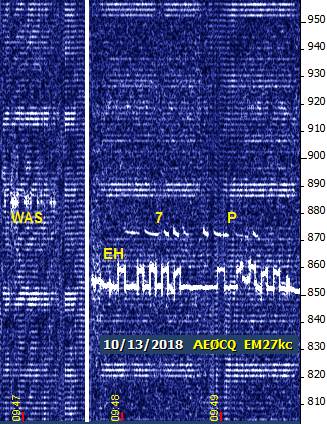
Did a band scan between 9:30 and 9:50 AM CDT. Codar was abundant from multiple sites, but only three beacons were visible or audible. In the WAS section of this capture, the receiver was tuned so 800 Hz represented 13564.800, and in the watering hole, 800 corresponds to 13555.400.
---------------------------------------------------------------
File Attachment 1: 13octa.jpg
Duck Season/Wabbit Season/LowFER Season?
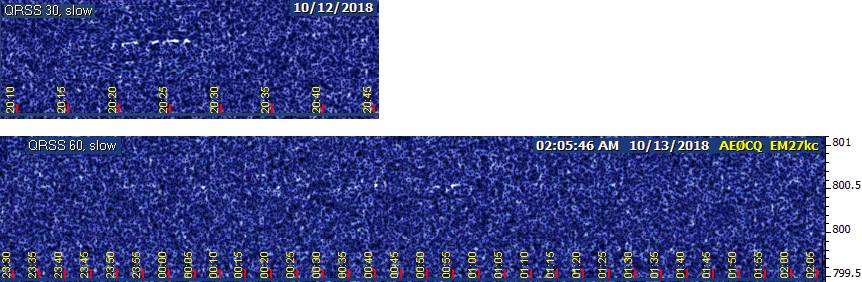
As mentioned last night in the SIW thread, I caught an "AR" at EAR's spot at 8:20 PM CDT. Here it is in the QRSS30 image below. Signals were not great the rest of the night, however, and the Texas storms continued their QRN through daybreak, so it may be a little soon yet to declare LowFER season officially open. Even the QRSS60 screen barely shows an increased smudge of RF at 188,830.5 the rest of the night. But it's more than I've seen for some months now!
---------------------------------------------------------------
File Attachment 1: 1213oct-EAR.jpg
Re: HiFERs Saturday - Noon
From civil noon through solar noon, conditions were no better than this morning. Codar got worse, but apart from NC fading in around 9:50 AM and EH fading away around 10:45, there was little other difference. 7P and WAS remained as the only other two stations present.
WA4SZE
Posted by David Frantz on October 15, 2018 at 15:19:21.
WA4SZE is back on using WSPR on 630 meters!! Ant 190 foot high vertical 3/8 cable, #8 ground radials 600 foot long every 3 degrees :3/4 inch copper loading coil. heard loud and clear in Hollywood,fl
Re: Duck Season/Wabbit Season/LowFER Season?
Posted by John Bruce McCreath on October 15, 2018 at 19:46:09.
In reply to Duck Season/Wabbit Season/LowFER Season? posted by John Davis on October 13, 2018
Thanks for the report and Argo snips John....just got back home from a two-day mini-vacation in Niagara Falls
73, J.B., VE3EAR 2200 & 630 M WSPR
Posted by John Davis on October 16, 2018 at 17:43:37.
Last night I watched the two Arizona powerhouses of 2200 m (WH2XXP and WH2XND) trade places for best SNR after sunset, which is now about 6:45 PM here. They were back to normal by 8 PM CDT (and I caught a couple of spots of K3RWR also, at -25 to -27 dB).
Next I tried for EAR for half an hour on 1750 m. The sunset+90 minute enhancement either did not take place last night, or else was buried under the higher-than-previous noise from thunderstorms in Texas and Central America.
So, after another half hour or so at 2200 m, I switched to 630 m for the rest of the night. Here's a sampling of the 600-some spots overnight, mainly the first appearance of each call sign. Except for VE3CIQ, who only decoded once, all the others reappeared multiple times...including the Australian I'd only previously copied a couple of times before (VK4YB), and a Hawaiian who was new to me (K9FD). Date stamp on all is 2018-10-16, reporter is AEØCQ and reporting grid is EM27kc.
 UTC  Call    MHz      dB Drift  Grid   W    km  az
---------------------------------------------------
02:12 KE7A   0.475630 -18   0   EM12kx  1   493  21
02:18 ZF1EJ  0.475696 -21  -1   EK99ig  2  2396 329
02:20 K4LY   0.475736 -25   0   EM85wb  1  1189 285
02:20 W4BCX  0.475714 -26   0   EL98pd  5  1675 310
02:24 WD8DAS 0.475719 -27   0   EN52hx  1   816 219
02:26 W3SZ   0.475699 -22   0   FN20ag  5  1697 264
02:28 AA8HS  0.475700 -25   0   EN81    1  1147 249
02:38 AE2EA  0.475767 -23   0   FN12fr 0.2 1621 253
03:44 WB3AVN 0.475698 -24  -1   FM19og  5  1617 267
03:46 WA3ETD 0.475721 -27   0   FN33lq  2  2001 256
03:56 NU6O   0.475671 -29   0   CN70vr  1  2536  90
05:08 VE3CIQ 0.475776 -32   0   FN15wd 0.2 1819 247
05:42 K3MF   0.475791 -22  -1   FM19sr  5  1649 266
07:48 KN8DMK 0.475651 -28   0   EM89oo  2  1110 259
08:02 WB0DBQ 0.475680 -27   0   EN46bw  1  1126 195
08:44 KR6LA  0.475659 -29   0   CN90ao  2  2347  91
09:22 K2BLA  0.475618  -4   0   EL99hb  2  1560 309
09:24 VK4YB  0.475797 -30   0   QG62ku  5 13650  62
09:28 K9FD   0.475616 -29   0   BL11je  1  6173  59
10:54 KC3OL  0.475679  -9   0   EM28ix  5   209 176
11:50 KJ6MKI 0.475761 -21   0   CM88oi 10  2428  85
Now let's jump ahead a few hours to the last appearance of some of these same stations for the night:
 UTC  Call    MHz      dB Drift  Grid   W    km  az
--------------------------------------------------
11:46 KU4XR  0.475778 -16  2   EM75xr  2  1003 282
11:54 WD8DAS 0.475718 -23  0   EN52hx  1   816 219
11:58 WB0DBQ 0.475680 -27  0   EN46bw  1  1126 195
12:12 KR6LA  0.475660 -21  0   CN90ao  2  2347  91
12:20 KJ6MKI 0.475761 -27  0   CM88oi 10  2428  85
12:30 NU6O   0.475671 -22  0   CN70vr  1  2536  90
12:38 VK4YB  0.475794 -33  0   QG62ku  5 13650  62
12:50 K9FD   0.475615 -27  0   BL11je  1  6173  59
13:34 KE7A   0.475648 -17  0   EM12kx  1   493  21
After K9FD ended, KE7A continued uninterrupted well into daylight before shutting down...again emphasizing my belief that we need to take more advantage of the daytime characteristics of this band.
John
Re: 2200 & 630 M WSPR
Posted by Jason Goldring on October 16, 2018 at 19:31:02.
In reply to 2200 & 630 M WSPR posted by John Davis on October 16, 2018
VK4YB on 630m literally blew my receiver away earlier today. Spots on WSPRnet for reporter J1LPB. My wife even asked, what is the orange red line on your screen. :) Realistic LW antennas
Thanks John, I wasn't the only one hearing the station, but luck on both bands for this callsign
Posted by Jason Goldring on October 17, 2018 at 01:52:14.
Speaking with a friend this evening, talk got into radio, in general there was interest in Lowfer opportunities especially with the change of seasons but I was confronted with a question I could not really answer.
Along the lines of "No way I can do a 1750m band at my place". And to his point, yes I could see his current disadvantage, limited in real estate. Aesthetics.
In as much as what I could offer I said Google is your best friend. He knows that, the reason why he asked, I guess because he was not getting the answers he wanted.
I got a little tech-savvy and currently at my home using the aluminum eaves (bonded) for lowfer reception around the entire perimeter of the house. One of my "thought I would fail but works extremely well" moments. He did the same and loves it, so it has been setup that way for almost a year, but TX comes an issue. He just finished a Lowfer beacon from scratch and I am picking it up on Thursday to run it for harmonics and output. Proud, since he has limited mobility yet something that keeps him motivated and I am sure he chuckled a few times when I was on the ladder bonding his eaves with a rivet gun and eyelet connectors. Rewarded with a great dinner and a good time.
How are you folks dealing with 1750m when it comes to space, antenna design?
Jason. HiFERs Tues. 16 Oct.
Posted by John Davis on October 17, 2018 at 05:52:12.
I first tuned to 22 m at 9:30 this morning CDT, with NC, 7P, and EH (all sometimes audible) at the watering hole, and abundant codar. J1LPB was intermittently visible as early as 9:32, but didn't successfully decode until 9:48, due to a combination of the codar QRN and significant drift today. (See the WSPR spots below.)
Probably the best reception of the day was when codar eased up a bit between 10 and 11 AM (part of which is shown in the attached "16oct1.jpg" file; it's large, so you may need to use your browser's Magnify tool). USC came in faintly for a while, and MTI was present from 10:10 to 10:36, sometimes pretty loud.
Right at 11:00, something anomalous happened to both NC and EH almost simultaneously, and ended even more closely together, but the other signals and the QRM were unaffected. You can see this in the left half of the attachment "16oct2.jpg". The right half of the attachment is from a capture 20 minutes later, after codar had reached near its peak intensity of the day.
The final attachment, displayed here, shows my one successful non-watering-hole reception today. WAS was surprisingly audible at 1:24 PM despite being right dead center in one of the worst codar bands (the one in the middle of the picture). It was a remarkably good signal right then.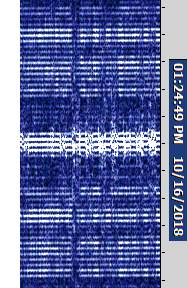
Nobody else was seen, heard, or suspected today.
John
(P.S. In the WSPR spots below, frequencies are uncorrected and contain 40 Hz of very slow receiver drift from early morning, when the shack was at the freezing mark, up to early afternoon, when it reached nearly 80° indoors. However, that's different from the -1 to -3 Hz short term drifts reported by the WSPR 2.12 software and confirmed on the Argo displays.)
1448 -20 -0.7  13.555389 -2 J1LPB FN03 0
1456 -23 -0.5  13.555388 -2 J1LPB FN03 0
1500 -17 -0.5  13.555388 -2 J1LPB FN03 0
1504 -14 -0.5  13.555388 -2 J1LPB FN03 0
1508 -24 -0.5  13.555388 -3 J1LPB FN03 0
1512 -20 -0.6  13.555388 -3 J1LPB FN03 0
1524 -33 -0.5  13.555389 -3 J1LPB FN03 0
1532 -23 -0.5  13.555391 -2 J1LPB FN03 0
1540 -22 -0.8  13.555393 -1 J1LPB FN03 0
1548 -25 -0.5  13.555395 -2 J1LPB FN03 0
1552 -32 -0.8  13.555396 -1 J1LPB FN03 0
1556 -33 -0.7  13.555397 -2 J1LPB FN03 0
1600 -20 -0.7  13.555398 -2 J1LPB FN03 0
1604 -21 -0.7  13.555399 -2 J1LPB FN03 0
1608 -28 -0.6  13.555399 -3 J1LPB FN03 0
1628 -31 -0.5  13.555399 -2 J1LPB FN03 0
1656 -24 -0.6  13.555405 -1 J1LPB FN03 0
1700 -29 -0.7  13.555407 -1 J1LPB FN03 0
1704 -27 -0.7  13.555408 -3 J1LPB FN03 0
1708 -21 -0.5  13.555410 -2 J1LPB FN03 0
1720 -25 -0.8  13.555413 -2 J1LPB FN03 0
1728 -29 -0.8  13.555412 -2 J1LPB FN03 0
1800 -20 -0.6  13.555412 -1 J1LPB FN03 0
1804 -23 -0.7  13.555412 -2 J1LPB FN03 0
1816 -22 -0.7  13.555418 -1 J1LPB FN03 0
---------------------------------------------------------------
File Attachment 1: 16oct1.jpg
File Attachment 2: 16oct2.jpg
File Attachment 3: 16oct3.jpg
Re: Wabbit Season/LowFER Season?
Still too soon to call the season "officially" open in Kansas, with only a couple of good intercepts of SIW and 2/3 of an EAR ID thus far, but we got one step closer tonight. Thus far, only some rather ambiguous hints of WM's FSK ID were present in the SIW captures, but very surprisingly, tonight it was the graphical ID that removed the ambiguity!!
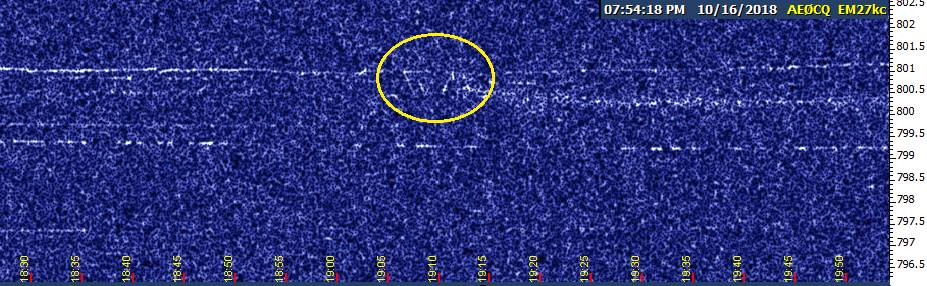
At that time, the lightning tracker showed the wet weather in Texas was no longer a major lightning producer, so I got my hopes up of trying for EAR again. Since then, though, a wide area of thunderstorms has materialized in the Gulf of Mexico, so only time will tell.
---------------------------------------------------------------
File Attachment 1: 16oct-LF.jpg
Re: Realistic LW antennas
Perhaps the most authoritative reference on 1750 meter hobby antennas is a collection of articles that was assembled by LWCA member Mike Mideke in the 1980s:
www.maxmcarter.com/lwantennas/index.html
Even so, the answer your friend wants may not exist. Limited space is a serious obstacle to effective vertical antennas for these reasons:
1. A 15 meter antenna is conspicuous and its guying takes up room.
2. An effective ground field, even if buried, needs to be at least as large in radius as the antenna is high.
3. Such an antenna needs to be well away from trees, structures, and other objects that may absorb power directly from the intense electric field around it; thus, even more space is needed than just for the antenna and ground themselves.
What people have done about these issues includes simply building the best antenna they could and accepting whatever coverage range they can get with it, all the way up to finding a friend with more space available who is willing to have a beacon located in his back yard...at least, during the non-mowing season.
One alternative invariably suggested is a transmit loop antenna, for the simple reason that trees and other obstacles interact less with the magnetic near-field than they do with the electric near-field. If one takes pains to keep loop resistance low and devises a good coupling arrangement, this method can work in a lot of situations where a vertical is impractical. BUT, while this solves the problem for space-limited amateur operators at LF and MF, it's got one serious drawback for 1750 m: it's not effective when constructed in a size that is strictly legal.
In the US, some have proposed very, er, generous (and therefore controversial) interpretations of the 15 meter length rule in the past to skirt the issue. However, in Canada, the RSS-210 regulations have at various times cited explicit examples which make it clear that the path out of the transmitter, through the loop, and back to the transmitter must not exceed 15 meters. Wish I had a more encouraging answer, but basic physics makes it easier to receive LF in a limited space than to transmit it effectively.
Re: Wabbit Season/LowFER Season?
Posted by Mike N8OOU on October 17, 2018 at 15:10:05.
In reply to Re: Wabbit Season/LowFER Season? posted by John Davis on October 17, 2018
John;
Definitely the markings of the WM Beacon. Cool weather the past few days has caused the tree leaves to loose their summer green and are now turning to a dull lackluster green. One would conclude their juices are in a hasty retreat to the root system. I may be sweeping leaves, not snow this year, to clear the path for Santa.
Thanks for the report.
Mike. 73
AR, Matey!
Posted by John Davis on October 17, 2018 at 16:25:44.
In reply to Re: Wabbit Season/LowFER Season? posted by John Davis on October 17, 2018
(Aka, Re: Be it LowFER season yet?)
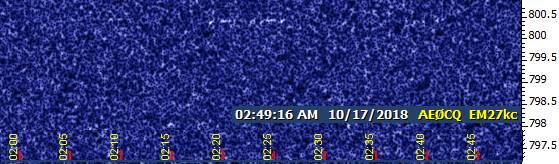
Talk Like a Pirate Day must have been extended a month or so this year, because all I've been getting from Ontario is "AR" so far. Below is the best one of the night, though there was a string of somewhat fainter captures around midnight.
---------------------------------------------------------------
File Attachment 1: 1617octc.jpg
Re: HiFERs Wed. 17 Oct.
Codar is no better today, but propagation may be improving a little. After several days of no WV, it was back this morning about 9:30 CDT. WAS was undergoing wide QSB swings, but was often easy copy. At the watering hole, NC, 7P, EH and J1LPB WSPR were visible, but the latter hadn't decoded yet by the time I left for town.
Re: Realistic LW antennas
Posted by Jason Goldring on October 17, 2018 at 18:56:19.
In reply to Re: Realistic LW antennas posted by John Davis on October 17, 2018
Certainly noted, transmit is not for the faint of heart to end up with something that might get you nowhere. The only beacon that I have personally seen in Canada, albeit not on the air at this time (1750m band) is such that the entire assembly is connected to the base of a vertical with a large diameter cap hat. Defective relay on 44m
Reception is a heck of a lot easier. Surprising in some cases.
But it is physics. Real Estate. And maybe a flag to not make it as much of an eyesore :)
Thanks for the link, I will be sure to pass it along.
Jason
Posted by Jason Goldring on October 18, 2018 at 03:40:07.
One of the relays in the antenna switch proved defective after bench testing, replaced fortunately with a comparable unit from a local electronic parts provider (Sayal Electronics). 44m is back up. 6780.0 WSPR
I believe the relay reeds were literally inducting some RF but not making full contact or poor contact. Mass production oversight I suppose. Or something along those lines.
All is good for now. Re: Realistic LW antennas
Jason.
Posted by Ed, KI6R on October 18, 2018 at 04:48:18.
In reply to Re: Realistic LW antennas posted by Jason Goldring on October 17, 2018
Back in the 80s I had a 1750m transmit setup on the air from a small back yard in Morro Bay, Ca. The TX antenna was a 24' tall vertical with the base about 7' above the ground so it cleared the side of the house. It had 16 top hat wires about 16-20 feet long pulled out to the perimeter of the back yard and sloping downward from the top. The antenna loading coil was home built with Litz wire and a Q of 330. I ran about 24 ground wires in all directions possible, bending around corners to make them fit in the small yard. I used a simple home built active whip for receive. I believe the antenna current was about 100 mA RF. I was able to have several CW QSOs with MEL on 1750 meters in San Jose. It is possible to have a successful lowfer beacon even with a small antenna. The key is to keep losses low and place a large capacity hat on the short vertical. Even if you live on a small city lot it is possible to build a pretty good transmit antenna that can be easily heard out to 50 miles or so.
Re: AR, Matey! (Waiting for LowFER Season)
Posted by John Davis on October 18, 2018 at 05:51:10.
In reply to AR, Matey! posted by John Davis on October 17, 2018
The first half of the evening, looking for WM first and EAR later, was not terribly productive due to yet another evening of unexpectedly high QRN. Decided to go back to 630 m WSPR for the night. Most of the spots I'd gotten by 10 PM were the same stations I was watching two nights ago, but at least one new one has joined the party so far tonight: W3PM. We'll see what the rest of the night brings.
SAQ Transmission on October 24
Posted by Mike Terry on October 18, 2018 at 06:43:17.
"Peace Party & SAQ Transmission on October 24:
A roaring machine, morse code and Irish folk music – celebrate the UN Day of October 24 at the World Heritage Site Grimeton!
Man’s quest for contacts and faster relationships between each other is tireless. A proof of this are the many attempts made to put a telegraph cable on the bottom of the Atlantic before the seemingly impossible project was finally landed – the connection between Europe and America was established, from Ireland to Newfoundland, and opened for telegram traffic in August 1866 .
We celebrate this great event in international relations by sending out a peace message to the world with the long-wave transmitter SAQ and then a concert in the Irish folk spirit with the Varberg band Green Hill.
Evening program:
18.00 The world heritage opens
18.30 (16.30 UTC) all visitors are greeted welcome and the long wave transmitter SAQ is started
19.00 (17.00 UTC) a peace message is sent out*
19.15 (ca) concert with Green Hill
Free entrance. Arrive in time as there are limited amount of seats.
Welcome!
The transmission is on 17,2 kHz CW.
You can also watch a live video stream of the transmission on www.alexander.n.se.
No QSL-cards will be given this time and no List of Reports will be constructed but we accept shorter Listeners Report to e-mail info@alexander.n.se.
*The world heritage site Grimeton is a living cultural heritage. All transmissions with the long-wave transmitter SAQ are therefore preliminary and may be cancelled with short notice."
http://alexander.n.se/the-radio-station-saq-grimeton/saq-transmissions/?lang=en
Re: Realistic LW antennas
Posted by Jason Goldring on October 18, 2018 at 20:38:46.
In reply to Re: Realistic LW antennas posted by Ed, KI6R on October 18, 2018
Thanks Ed, that is reassuring. I quipped about the idea of just finding an old TV tower and loading it, something that is common in the metal section of the dumps and recycling depots. I suppose that with QRSS and patience it might pay off.
But I have to wonder, in the end, John did bring up a valid point about reception being a lot easier that transmission. All things have to be taken into consideration, I guess that is where the experimentation lies, keeps us all engaged and interested.
Your story might bring some enlightenment to my friend (Cam), things are possible if you just work at it. 630 M WSPR Wed. PM/Thu. AM
Thanks again,
Jason
Posted by John Davis on October 19, 2018 at 05:49:28.
In reply to 2200 & 630 M WSPR posted by John Davis on October 16, 2018
Nearly all the same stations from Monday night/Tuesday morning were back again last night, plus numerous appearances of KA7OEI for the first time in a few days, and a few spots of two I haven't seen before: W3PM at 795 km, and K1BZ at 1610 km distance.
Re: HiFERs Wed. 17 Oct.
Posted by John Davis on October 19, 2018 at 07:42:54.
In reply to Re: HiFERs Wed. 17 Oct. posted by John Davis on October 17, 2018
Wednesday afternoon continued the pattern of fair propagation, with a little less codar later in the day.
That allowed for more frequent decodes of J1LPB, who, despite drift of -3 to +3 Hz during various time slots, managed to put in signals with SNRr ranging from -25 to -1 dB during a single hour. There were apparently worse SNR and/or drift numbers sometimes, though, as there were only two decodes during the entire 1500 hour UTC, while there were 18 the following hour. Decodes continued with some reasonable consistency up to 2316.
K5LVB was visible in QRSS3 and WSPR several times from the noon hour through early afternoon, but was possibly impacted by some of the clusters of codar lines because it only decoded twice:
1614 -23 -0.8   0.137469  0 K5LVB EM10 7
1626 -17 -0.8   0.137472  0 K5LVB EM10 7
Other watering hole residents were NC and 7P. EH was also there until 11:04 AM CDT, then disappeared, returning abruptly at 5:02 PM, gradually drifting downward 20 Hz in frequency after an evident restart. There was also a series of brief--and I mean very brief, approximately a minute at a time--openings to Illinois between 3:27 and 3:40 PM, when SIW slant mode appeared on Argo.
A sample of the SIW slant trace and the return of EH are pictured in the "17oct1hf.jpg" attachment. Note two things about the captures. First, NC is running a little higher in frequency than recently, probably indicating cooler temperatures there. Second, even with only about three codar sites with offset pulse times present, the 66 or 67 Hz spaced clusters of spectral lines are still manifesting. The cluster just above 13555.420, the one centered a smidgen below .490, and the one centered at .555 are pretty much permanent fixtures these days when multiple codars are on. I recommend that anyone hoping to be copied try to avoid these frequency ranges.
Halfway decent propagation continued until just before sunset this time, instead of the recent trend of losing everybody after mid-afternoon. Most signals faded away between 6 and 7 PM, leaving a ghost of NC and the Cheshire-like grin of 7P remaining. Sometimes 7P was also quite audible. Codar went away for a minute and a half around 7:04 PM leaving those two signals in the clear, plus a trace of a seemingly keyed carrier at just above 13555.540; but I couldn't get aural copy of the latter before the codar returned.
Away from the watering hole, WV was weakly audible at 2:22 PM CDT, WAS was fair at 2:26, and K6FRC was sometimes very good aural copy at 7:13 PM, but was subject to wide level fluctuations. The "17oct2hf.jpg" attachment contains the codar-free interval and the Argo trace of FRC.
---------------------------------------------------------------
File Attachment 1: 17oct1hf.jpg
File Attachment 2: 17oct2hf.jpg
Re: HiFERs Wed. 17 Oct.
Patiently waiting for my signal to be heard haha.
Had a quick question, though. Does my beacon have to be spotted before it's information makes it onto the operators page?
73, KE8DNU/DNU
Re: HiFERs Wed. 17 Oct.
Posted by John Davis on October 19, 2018 at 19:02:00.
In reply to Re: HiFERs Wed. 17 Oct. posted by Adam on October 19, 2018
Does my beacon have to be spotted before its information makes it onto the operators' page?
Nope. Striped, checked, solid and plaid are OK too. Sometimes paisley and tie-dyed, if they're done tastefully. ;)
(Sorry, I couldn't resist.)
For new beacons actually on the air, I don't always put them on the station list immediately because the announcement on the board suffices to let people know who's who for a little while. When I go to update the print version, then I generally post the changes to the online list as well.
I used to do that two or three times a month, to avoid any last minute rush at deadline...but now that our schedule is currently bi-monthly and deadline comes at near-random times with respect to distribution dates, I've gotten out of my usual habit. Short version: I dropped the ball, so this has been more than a little while; but I will add you to the station list this evening. The Operators' Contact List is updated less often, but your full call will appear in the station list until the contact list gets revised, so folks will be able to look you up.
(This is different from new beacons that are stated as pending or "coming soon." The normal procedure there is to wait until they write back to say they're actually on the air, or until someone reports the signal, before it gets added to the station list. Sometimes I do go ahead and put the hypothetical operator in the contact list, so he can be found if anyone copies the beacon before it's formally listed, but all too often we hear nothing further.)
John
Re: HiFERs Wed. 17 Oct.
Posted by Adam/KE8DNU on October 19, 2018 at 22:22:01.
In reply to Re: HiFERs Wed. 17 Oct. posted by John Davis on October 19, 2018
Hahaha John, thank you for the laugh, it was well timed :)
No worries, take your time and do only what works best for you. I am very familiar with what's required in a labor of love, and we all greatly appreciate your hard work and dedication to the cause.
I raise my cup of coffee to you, sir.
73
Adam
HiFERs Thu. 18 Oct.
Posted by John Davis on October 20, 2018 at 04:12:30.
In reply to Re: HiFERs Wed. 17 Oct. posted by John Davis on October 19, 2018
Thursday morning started off a little more hopefully than Wednesday, propagation wise, but still plenty of codar. By 9:42 AM, WV was audible, sometimes with good copy. A few minutes later, I found WAS visually about 30 Hz higher than recently, then briefly audible. FRC was weakly audible in the same band scan.
The watering hole had NC just above 13,555.520 kHz...it was apparently even cooler at NC that morning. USC was faintly visible at its usually spot at 555.500, 7P was generally visible and frequently audible, and J1LPB was already pretty strong before 10 AM (-11 dB at 9:52 AM/1452 UTC, then varying between -19 and a whopping -1 dB from then through solar noon).
In my final band scan before breaking for the SIW transition on 1750 m, WAS was really good aural copy at 1:22 PM. This time I measured the frequency and found it currently to be 13564.880, ±1 Hz.
Mystery HiFER "AN" - Oct 19
Posted by John Davis on October 20, 2018 at 05:26:05.
Had to wait for the rain and possible t-storms to move out before going to the field today, which meant it was after sunset before I started. The plan was to explore LF tonight, but I figured I'd take a quick look at 22 m first while the radio was warming up. Nothing was going on at the watering hole, and there was no WV, but AZ came in audibly for a while. That gave me hope that VAN might be receivable for the first time in a couple of weeks, so I tuned up there.
Surprise! Somebody was audible, all right, but there was no V! The AN signal was at 13563.003 ±1.5 Hz with some vertical spread on Argo that suggests a bit of narrower-than-audible chirp.
I listened from 0042 to 0052 UTC, during which time it ranged from swamped under codar to easy copy. Pretty fair signal overall. Anyone want to claim it?
After while, I noticed Argo was also showing dashes that correspond to VAN's DAID up at 13563.099, but VAN never became audible.
At 7:52 PM, I checked K6FRC, which was also nicely audible.
J1LPB HiFer off temporarily
Posted by Jason Goldring on October 20, 2018 at 17:33:03.
Just a FYI to those spot hunting, J1LPB was off from about 14:00UTC give or take, up until about 17:15.
That time of year, had to mount a snow shield over the charge controller assembly. Re: J1LPB HiFer off temporarily
Jason
Posted by John Davis on October 20, 2018 at 19:17:37.
In reply to J1LPB HiFer off temporarily posted by Jason Goldring on October 20, 2018
That explains it, then. No J1LPB when I did my first band scan before noon, but when I returned to the watering hole at 1724, it was visible about 20 Hz high and drifting down too rapidly to decode that time. It decoded at 1728 through 1820 with one exception (no decode of the 1804 time slot). At that point I left 22 m for the 1750 m band. SNRr varied from -17 to -28 dB this noon, and most captures showed drift of -1 Hz, some were 0, and one was +1; along with a few Hz variation in the average frequency at the beginning of each slot.
WAS Down for Listening
Posted by Bill Stewart, K4JYS on October 20, 2018 at 19:19:55.
Tnx for the reminder Jason... Re: WAS Down for Listening
WAS will be down a while listening on 22 meters plus copying KPH/KFS.
Back up later today....Bill K4JYS
Posted by John Davis on October 20, 2018 at 19:45:06.
In reply to WAS Down for Listening posted by Bill Stewart, K4JYS on October 20, 2018
And that explains that. :)
I was about to write up a report on the other HiFERs at noon time today, and noted from my log that WAS showed up visually at 12:20 PM CDT, and was audible, when codar faded briefly, but was gone when I checked an hour and something later.
Others away from the watering hole--well, that only amounted to WV today, visible and faintly audible at 12:14, and fair to good audibility at 1:23 PM.
At the watering hole, NC was up at 13555.515 todat, 7P was at its usual spot and frequently audible, and of course J1LPB.
Sure would like to find the mysterious AN again that I heard last night.
2200 M WSPR
Posted by John Davis on October 20, 2018 at 20:06:57.
Last night I tried 1750 m again, but this time with no luck at all, so I spent the first half of the night at 2200 m and the second half at 630 m (separate report on that later, but the spots are on WSPRnet if interested), looking for WSPR.
Ojn 2200, I had four visitors last night. All four decoded in the same time slot once!
0144 -27 -0.7   0.137437  0 N1BUG FN55 30
0144 -26 -0.7   0.137470  0 K3RWR FM18 30
0144 -16 -0.8   0.137507  0 WH2XXP DM33 37
0144 -19 -0.7   0.137581  0 K3MF FM19 30
I posted those results overnight on the lowfer@qth reflector with a request for someone to try daytime groundwave on the band. I don't know whether anyone took that request seriously because there was no reply, but somebody else was on the air this morning...and I hope will continue throughout the afternoon, so I can look further once I finish my current project on 1750 m.
KA9OKH was only a partial decode here (the frequency, the six-character grid and a power stated as "10" watts). It showed -31 dB SNR and was barely visible on Argo. So "barely," in fact, that I didn't even notice the trace until the WSPR software suddenly decoded the signal. The next time slot, which should have carried the call, was also visible but didn't decode. Neither did the next several. The only way I could determine it was KA9OKH was that I checked on WSPRnet and found he was also being received by Mike N8OOU, who is only 30-some miles from him and was copying more reliably with a -23 dB SNR.
Propagation seemed peculiar on 2200 m at mid-day. Noise was comfortably low, and the PLC clusters at 137.500 and (especially) .600 were quite prominent; but even WX2XXP, who is usually in the teens for SNR, was down into the high 20s today. So, KA9OKH getting through at all is not bad!
Re: WAS Down for Listening
Posted by Bill Stewart, K4JYS on October 20, 2018 at 21:40:49.
In reply to WAS Down for Listening posted by Bill Stewart, K4JYS on October 20, 2018
Back up....not much heard. GNK was fading fron RST 229 up to abt 559...around 1822Z. Cked later in the afternoon and nil. Tnx John for your reports. Re: J1LPB HiFer off temporarily
Bill
Posted by Jason Goldring on October 21, 2018 at 03:26:49.
In reply to Re: J1LPB HiFer off temporarily posted by John Davis on October 20, 2018
John, thanks very much - I think I am going to be switching out the buck converter I am using (12 > 5v) for another one that is reported to be a little more stable on draw demands (so probably a better capacitor bank for the initial frame start-up). I would like to see this as stable as possible but keeping in mind it is an outdoor beacon in an insulated weather-tight box. The temp fluctuations lately have me wondering about longevity and performance over the cold winter months and I would like to get a head start on a path to correct what I can.
Thanks again, Re: 2200 M WSPR
Jason
Posted by John Davis on October 21, 2018 at 06:47:10.
In reply to 2200 M WSPR posted by John Davis on October 20, 2018
No further decodes of KA9OKH this afternoon or evening, only WH2XXP for hours, but the waning daylight brought a couple of surprises.
At 22:54 UTC, nearly 50 minutes before local sunset here, K3RWR showed up on 0.137470 at -27 dB SNRr. Eight minutes later at 23:02 K3MF turned up on 0.137581 at -29 dB. At 23:26 when N1BUG 0.137437 materialized with -28, I figured that made the gang complete.
But hold on--at 01:38, WA9CGZ 0.137443 joined in at -26 dB. Doesn't look like it's going to be a very consistent regular, though, because it made its second and thus far final appearance of the night at 02:10.
I then checked on 1750 meters for a little while (11 PM to nearly 11:30 CDT) but it was too far lost in the QRN tonight, so I'm currently monitoring 630 meters.
happy beacon
Posted by Adam/KE8DNU on October 21, 2018 at 17:44:35.
Lately I've been questioning how well DNU has been getting out. Jason has came dangerously close to digging my signal out of the QRM on 13.560.
I've gone over the circuit board, replaced capacitors and tried to pull the frequency a bit further away, but the ones I have seem to pull it closer instead of further.
In any event, the beacon seems to be happy on that frequency, and I do happen to like a good challenge haha
So, DNU still stays strong at 13.561.6.
73!!
Adam
Re: happy beacon
Posted by Jason Goldring on October 21, 2018 at 18:28:25.
In reply to happy beacon posted by Adam/KE8DNU on October 21, 2018
When I get time I will bring up the RTL-SDR internet interface via SDRConsole so you can remotely connect to the USB RTL dongle. (The Parry Sound station I emailed you about).
It's been hit and miss with that but I reinstalled SDR Console on the machine remotely so you can view via Argo if you have Virtual Cable installed. Both can be found on the net easily.
That loop is still oriented towards your QTH. Should be good to go. Re: 2200 M WSPR Mysteries
J
Posted by John Davis on October 21, 2018 at 20:59:31.
In reply to Re: 2200 M WSPR posted by John Davis on October 21, 2018
Lots of good signals on 630 m after last night's 2200 m session, but that's a story I still need to get to later. When I returned to 2200 m for a check late this morning, two things have me puzzled.
1. Low signal from WH2XXP. This is a mystery because even in mid-summer I normally get good copy of XXP (and XND when it's on) up until afternoon QRN gets too heavy. There wasn't any of that today, just the usual PLC clusters a fraction of a Hz below 137.500 and .600, and some lesser QRM at XXP's spot that the signal itself is ordinarily able to overwhelm without any effort. Even at the unusually low level it has been the past two daytimes when I've looked, XXP still sometimes decodes.
1616 -30 -0.7 0.137507 0 WH2XXP DM33 37
The attached JPG file shows the signal that yielded this unlikely decode. Now, because I had a second Argo session going at the same time, I noticed another signal that has not been present here in days past, and it's the source of the other mystery...
2. No decodes of WA9CGZ. Last night I wrote that this one didn't look like it would be a regular here, but apparently it is--except it doesn't decode, despite having a signal that is visibly clearer than XXP in the file attachment! That's one of the drawbacks of using WSPR in isolation as an indicator of propagation. The signal may be getting through fine, strength wise, and merely not decoding for some other reason than SNR. But you won't know that unless you're using other tools simultaneously and comparing results.
The only way I know it's WA9CGZ is from finding the same frequency in my decodes from last night, then searching for decodes of the call from other reporters...who did copy the same station at the same times I did last night, but unlike me, still were copying him this afternoon! Most notably, WA9CGZ is showing up in the spots from WA3TTS and N8OOU. Mike and/or Mike, could you check your WSPR windows or the ALL_WSPR.TXT file and see whether his dT value is near the ±2 second mark this afternoon? Unfortunately, that's one parameter the WSPRnet database query does not show. It indicates his drift is negligible, but gives no clue whether timing may be marginal.
Thanks.
John
---------------------------------------------------------------
File Attachment 1: 21oct1.gif
AZ, AN, and FRC
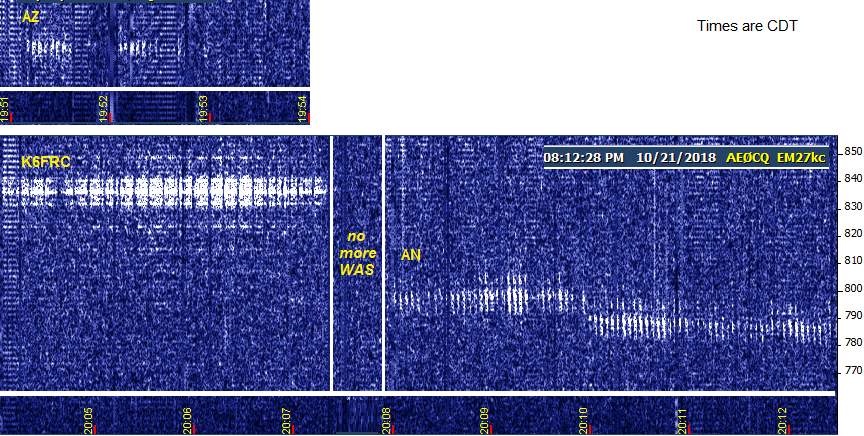
I wrapped up an LF experiment about an hour after sunset, and jumped up to 22 m before packing stuff in the truck to come home. The last ghostly remnant of 7P was leaving the watering hole and everybody else was already gone. Elsewhere on the band, an hour and a half before sunset, WV had been fair to good and WAS was booming in, but even they were gone too.
However, I heard keying under the lingering codar, right about where AZ should have been, so I settled there for a few minutes. I was rewarded with audible IDs before the visual trace, actually, which turned out to be a good thing. I might not have recognized AZ if I hadn't heard it first, because there's no longer an ocean wave effect on AZ...its frequency remained steady for the entire couple of minutes it remained visible.
That got me to wondering if California might be coming through too. No luck with PVC, and I wasn't sure about VAN the first time I looked, but K6FRC started coming in stronger and stronger! Went back to look for AN again, and found it lower in frequency than before. As I listened further, it jumped downward several more Hz, but it was a good, clean signal to the ear.
These three are shown in the picture below, and there are .WAV files attached of the AN and FRC signals. I later managed a capture of some probable DAIDs from VAN amongst the codar lines, but it's hard to be sure so I haven't included those at this time.
---------------------------------------------------------------
File Attachment 1: FRCx.mp3
File Attachment 2: 21oct-hf.jpg
File Attachment 3: ANx.mp3
Re: Mystery HiFER
Mystery HiFER "AN" is owned by K8NDB and is located at the Somerton Airport in Somerton, AZ. The beacon is a Blackcat Systems kit assembled in less than one hour. It is solar powered and is mounted in a surplus ammo can. The ammo can is placed on the roof of a metal airplane hangar. The antena is a Hamstick style vertical tuned to the HiFER band with a short 3 foot coax feed. "AN" is in the testing phase before I move it to another location at a later date. Thanks for your excellent signal reports John.
73's Jeff K8NDB
WSPR Integrity
Posted by Jason Goldring on October 22, 2018 at 22:10:00.
I admire the WSPR protocol for the fact that it has seemed relatively invaluable for measurements but I have to wonder about odd decodes that are not necessarily discarded through a error correction matrix but it really makes you ponder what is going on.
John has indicated some peculiar activity lately in the 2200m band and we do have the temp fluctuations to consider. I was receiving XXP, however I also got two hits on JH1OFX in grid PM95 but never again during the session. Power reported was not, in my mind, consistent with the distance. ~10,000km ? I hardly think so, but correct me if the dual hit is a possibility. -30 and -26 SNR
So I am not reporting a spot on the board but more a curiosity. Frequency for RY?
Jason
Posted by John, W1TAG on October 22, 2018 at 22:41:33.
John Davis (and anyone else who wants to chime in):
I'm planning to put the Hifer RY beacon back on the air later this week from Maine. I think it was on 13555.415 kHz last winter, but am wondering if that frequency is still good. It's run from a DDS synthesizer, so I can drop it anywhere. JD - you probably have the combination of most central QTH and good RX calibration of anyone. There's obviously no way to avoid the wanderers like NC, but they don't stay in place for long! RY at least has the advantage of staying put, due to the 10 MHz OCXO that's clocking the DDS.
Suggestions welcome!
John, W1TAG
Re: Frequency for RY?
Posted by Jason Goldring on October 22, 2018 at 22:53:10.
In reply to Frequency for RY? posted by John, W1TAG on October 22, 2018
Hey John, just to help out if it does, for the visual / audible / reception I have no problem bumping J1LPB from .410 to somewhere else as it's synthesized. Just an offering, I was planning on moving at some point but I seem kinda snug in there, however change can be good :)
Jason
Re: WSPR Integrity
Posted by Paul N1BUG on October 23, 2018 at 03:54:43.
In reply to WSPR Integrity posted by Jason Goldring on October 22, 2018
Jason,
That is a long distance but it seems possible to me. JH1OFX has been doing very well, being heard some weeks ago in Australia with excellent signal.
As for only seeing him twice that is not surprising. Very frequently I receive a station just once or twice during a given night, sometimes with very good SNR but never see them again. This has happened many times when I am watching the various waterfalls and can confirm that the signal was real and SNR was excellent. Fading can be extreme on 2200m and often magic happens for just a few minutes, then it is over.
I believe with WSPR, decodes which give a real call sign and appropriate grid are to be believed. The bogus ones either have real call signs with obviously bogus grids (such as in the middle of an ocean or the arctic/antarctic) and/or obviously bad call signs.
Paul
N1BUG 2200m activity
Posted by Paul N1BUG on October 23, 2018 at 04:08:13.
I have become a bit discouraged with 2200m in general but am continuing to transmit WSPR2 during the hours of common darkness between my location and Europe. I cannot keep the transmitter going all the time so I am concentrating on trans-Atlantic since I have a favorable location for it. Reports have been picking up lately as noise levels trend downward. However it is obvious we are not yet into the real quiet season.
I was hoping for more interest in amateur radio QSOs on this band, but it seems very few are interested and among those that are, quite a few have definitions of QSO which are incompatible with mine. Lack of good modes is another major problem. The slower JT9 modes which were developed, then abandoned would have been a tremendous help. Oh well. I will keep the beacon going at least for the coming winter season. I still intend to try other beacon modes later in the season. After this winter season, I don't know.
Paul
Re: Frequency for RY?
Posted by John Davis on October 23, 2018 at 04:30:32.
In reply to Frequency for RY? posted by John, W1TAG on October 22, 2018
Before I offer an opinion, I'd like to examine the clumping behavior of codar lines a little further in the neighborhood of the watering hole...but my quarterly doctors' appointments will keep me from getting to the field until Wednesday at the soonest. Will try to have a response ASAP thereafter.
JD
630M WSPR 23Oct18
Posted by Tom N8TL on October 23, 2018 at 13:05:26.
Good night for 630M WSPR....AA1A (666 mi), ZF1EJ (1493 mi), VE7BDQ (1975 mi), and VK4YB (9123 mi). Sending reception reports. Tom N8TL
WA4SZE WSPR
Posted by Tom N8TL on October 23, 2018 at 14:02:48.
Dave....WA4SZE....I have a WSPR signal report for you...if you have email, contact me. Made the SDRs at KPH available to you
Thanks, Tom N8TL
Posted by Paul on October 24, 2018 at 05:27:29.
Hi gang,
As some of you know, I am involved with the restoration and continued operation of a national treasure, the maritime ship to shore station KPH. Well, our receive site is world class in almost every way, and our reception capability has, for a long time, been the envy of the ham and SWL crowd who have visited.
I am pleased to announce that we have installed SDR web-controlled receivers at the KPH receive site and are making them available to the True Believers.
The SDRs are connected to one of the giant TCI-530 broadband receive antennas, and have proven to be nearly as sensitive as the Kenwood and Watkins Johnson receivers we use for commercial HF ops.
Go to www.kphsdr.com and feel free to tune around. Please let us know what you think.
VY 73 DE PS
ZUT!
Re: AZ, AN, and FRC
Posted by Paul on October 24, 2018 at 05:32:10.
In reply to AZ, AN, and FRC posted by John Davis on October 22, 2018
Thank you for the audio clip, John! Wow, it was really coming in strong! We could have had a Part 15.225 QSO!
73, PS 2200m & 630m WSPR last night
Posted by Paul N1BUG on October 24, 2018 at 14:30:28.
Incoming 2200m reports from Europe have been on the increase lately. It is amazing what 1W EIRP will do for those who have the space and take the time to build up to the legal limit level. Last night my WSPR2 signal was heard by G0LUJ, G3XKR, 2E0ILY, EB8ARZ/2, and DL0AO. To the west I made it to VE6JY and NI7J. But the bigger news is I decoded Luis, EA5DOM for the first time. I am still trying to achieve a better receiving antenna on this band. I still feel a bit deaf.
630m was interesting also. Early in the evening I was decoding WSPR from G3KEV, F6CWA and IW4DXW (the latter being the first reception of Italy by me on this band). At sunrise this morning I decoded Roger, VK4YB for the first time! 15,819 km! I thought I might need resuscitation for a while, but I'm OK. :)
Re: Frequency for RY?
Posted by John, W1TAG on October 24, 2018 at 14:45:28.
In reply to Frequency for RY? posted by John, W1TAG on October 22, 2018
I've temporarily parked RY on 13555.390 kHz, in QRSS3. Seemed like that would be out of the way for the listed/heard stations. Codar is another thing, and JD can report back on that.
John, W1TAG/1 Re: 2200m & 630m WSPR last night
Raymond, ME
FN43sv
Posted by Paul N1BUG on October 24, 2018 at 15:31:21.
In reply to 2200m & 630m WSPR last night posted by Paul N1BUG on October 24, 2018
Luis reports this was his first trans-Atlantic report on LF. I am happy to have been able to hear him!
Beacon VAN
Posted by Jeff K8NDB on October 25, 2018 at 00:04:40.
Good copy on VAN in Yuma, Az. today between 2330 and 2345 UTC. I was tinkering with a new homebrew delta loop trying to copy AN but copied VAN instead. To noisy here to copy AN on groundwave.
Re: Beacon VAN
Posted by Jimvm on October 25, 2018 at 00:54:52.
In reply to Beacon VAN posted by Jeff K8NDB on October 25, 2018
Tnx 4 rpt. I hrd ur an yesterday on the idaho kiwi.
Jimvm
Re: 2200m & 630m WSPR last night
Posted by Jason Goldring on October 25, 2018 at 02:42:40.
In reply to Re: 2200m & 630m WSPR last night posted by Paul N1BUG on October 24, 2018
Got spots on you. Fade, etc came into play. But you were there. I know Ontario is stones throw away but you made it with repetition. :) Signal was the indicator that we are in transition.
Jason
J1LPB off air
2320 -1 -0.1 0.137434 0 N1BUG FN55 30 903
2326 -5 0.7 0.137434 0 N1BUG FN55 30 903
2338 -16 0.7 0.137434 0 N1BUG FN55 30 903
2344 -17 0.8 0.137434 0 N1BUG FN55 30 903
2350 -19 0.9 0.137434 0 N1BUG FN55 30 903
2356 -19 0.9 0.137434 0 N1BUG FN55 30 903
0002 -17 0.9 0.137434 0 N1BUG FN55 30 903
0008 -18 0.9 0.137434 0 N1BUG FN55 30 903
Posted by Jason Goldring on October 25, 2018 at 03:28:15.
I need to do ambient noise tweaks on the RX filters I have, thanks Paul N1BUG - I've collected a number of spots to give me an idea on direction, the Grace plate I have put in place which was coined from a friend opened up a new world and blanked out a lot of noise from the town. Tin foil and fumbling for the meager. :)
Paul, you are carving out a good swing to Ontario so I cannot see why you not go Atlantic bound. Reading your spots you are making it out there. Cheers!
J1LPB is off air until 04:00
Jason
Good Conditions on 630m Tonight.
Posted by Ed on October 25, 2018 at 04:54:30.
Very good conditions on the 630m band tonight. Almost no lightening QRN and the QSB is minimal. CW QSOs with NO3M, KA7OEI, W0YSE and KL7L. Several stations were calling CQ.
Re: Beacon VAN - Wild West!
Posted by John Davis on October 25, 2018 at 05:32:17.
In reply to Beacon VAN posted by Jeff K8NDB on October 25, 2018
Very busy day today and lots to report, but I'm going to do it out of sequence and do the post-sunset receptions first because they were so unusual. Basically, every station I've ever copied before from west of the Rockies showed up this evening, all on the same day and within less than an hour of each other!
That's AZ, 7P, TON, AN, VAN and K6FRC (from lowest frequency to highest), all of which are show in the Argo displays in the attached file, and all of which were clearly identified by ear at one or more points during each capture!
The hardest to capture was AZ. I heard it before I saw it, and had to hunt it down on screen. Unlike Sunday night, when AZ's frequency had no ocean-wave appearance but was unusually steady, tonight it was jumping all over the place.
Quite an evening, all in all. One thing that made it possible was that the east coast codar sites apparently faded away about sunset, leaving sometimes only one (presumably western) site audible, and other times two; one of whose start time was about 0.2 second delayed from the other. This made it a lot easier to copy signals than the four and five sites that were crashing in early in the afternoon.
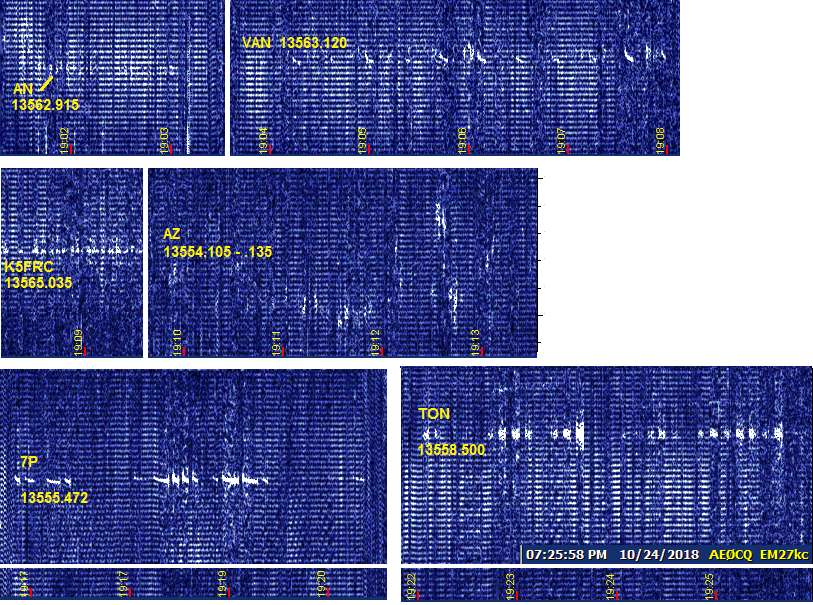
---------------------------------------------------------------
File Attachment 1: wildwest.jpg
Re: SAQ Transmission on October 24
Reports of good reception in the UK.
WM LowFER Temporarily Down
Posted by John Davis on October 25, 2018 at 15:58:30.
Got this message through an e-mail account I didn't check until today:
High winds yesterday broke a support rope on the WM Lowfer antenna, and I had to power down the beacon. I am away from the antenna site until midweek so it will be a few days before repairs can be made. I will
post when it returns to the air.Mike N8OOU 73
EH, RY maybe 7P into N GA
EH booming in, RY solid about 55 Hz south of EH. Looks like 7P about 25 Hz above EH, which seems about right according to the TOP END. RY is probably good enough for cal marker at .415.
EDJ is on an off. TS are gone but do like to listen. Off for the moment for listening.
On later....
Bob DANGER Phishing Scam!
EDJ
EM83du
Posted by Bob Confrey on October 25, 2018 at 17:49:11.
I know this in not from John Davis. Someone who hacked his mail will probably sent to everybody on his mail list.
It started with: Bob, are you around, I need some help.
Next:
John Davis
1:23 PM (21 minutes ago)
to me
Bob, I am so tied up right now, Can you purchase an iTunes gift card 5pieces - $100 each? I would like you to help me scratch the silver panel at the back and help me take a clear picture of the card including the 16 digits code and send it on here, i would reimburse you when am through, Let me know how you would want the payment back, either by check or cash, also i would have preferred to call you but can't receive or call at the moment with my line, i would like you to help me with it ASAP.
Many of us will probably be getting this....
Sorry for the OT...
Bob
EDJ Re: 2200m & 630m WSPR last night
Posted by John, W1TAG on October 25, 2018 at 17:50:06.
In reply to Re: 2200m & 630m WSPR last night posted by Jason Goldring on October 25, 2018
Jason, You have posted some amazing European LF/MF receptions in the last week. While most of the signals have been copyable in ME, the signal to noise ratios you are getting are very impressive. Can you describe your receiving setup?
John, W1TAG/1 Re: EH, RY maybe 7P into N GA
Posted by John, W1TAG on October 25, 2018 at 17:55:11.
In reply to EH, RY maybe 7P into N GA posted by Bob Confrey on October 25, 2018
Bob,
For the moment, RY is actually on 13555.390. The old .415 frequency would be crowding other stations now, so I started down there. Based on reports, I can move it again. But the .390 frequency should be pretty accurate, probably within 1/2 Hz.
Thanks!
John, W1TAG
Re: EH, RY maybe 7P into N GA
Posted by Bob Confrey on October 25, 2018 at 18:21:30.
In reply to Re: EH, RY maybe 7P into N GA posted by John, W1TAG on October 25, 2018
Thanks John,
Oops, I think I saw that post but forgot. For me .390 is in the clear, for now.
I am on .420 QRSS3 when not listening. You and EH have always been my "band check" stations. Glad you are back. I've got a U3S that works well for QRSS but I've had stability problems with on/off tx cycles (WSPR) inspite of the cal feature of the U3 with GPS attached. Unfortunately, GPS cal does not work with QRSS3 100% TX. I'm using a TCXO and not had the results I had wished. If I TX 100%, stability is excellent.
This stability issue can take you down a rabbit hole. The closer you look the worse it gets!
Later....Bob....EDJ
Re: DANGER Phishing Scam!
Posted by jimvm on October 25, 2018 at 18:40:31.
In reply to DANGER Phishing Scam! posted by Bob Confrey on October 25, 2018
I received this also. Was tricked into thinking it was from John, used the name
'VAN' to fool me. Gave them my telephone number.
jim vm Re: DANGER Phishing Scam!
Posted by John Davis on October 25, 2018 at 19:23:26.
In reply to Re: DANGER Phishing Scam! posted by jimvm on October 25, 2018
Gave them my telephone number.
Oops. When they call, give them the same thing I had prepared for the fake IRS "agents" when they called me: "Sorry, I don't have any cash right now, but if you'll give me your bank routing information and account number, I'll pass it along to that nice Nigerian prince who has been emailing lately saying that he's eager to send me money."
Sheesh! Will crass scams never cease? I assure you I will never ask anyone to expend substantial sums on my behalf, send valuables to unknown physical or electronic locations, or even "pay you Tuesday for a hamburger today."
Bob, Jim, and anyone else who gets such an email, please forward it to the lwcanews AOL address. If your email client lets you view the message header information or the entire message source code, it would be great if you could copy and paste that into a plain text file or PDF document and attach that as well. (In no case, however, should you attempt to forward it as an .eml file!) This will help find out what's going on.
The Real John Davis
Re: EH, RY maybe 7P into N GA
Posted by John Davis on October 25, 2018 at 19:34:29.
In reply to Re: EH, RY maybe 7P into N GA posted by Bob Confrey on October 25, 2018
Although I'm working on full reports for later, I'll just mention that EDJ was nicely visible in QRSS3 sometimes yesterday afternoon, and so was RY, but both were plagued by Codar Clumps much of the time. One cluster of lines was centered exactly atop EDJ, and the edge of another cluster was spread from right at, to just above, RY.
John
Re: DANGER Phishing Scam!
Posted by John Davis on October 25, 2018 at 20:00:35.
In reply to Re: DANGER Phishing Scam! posted by John Davis on October 25, 2018
While I was typing that reply, I see that Bob and Jim did forward the emails themselves to me. Thanks. I'd still appreciate the original header information if or when you have a chance to extract it.
FWIW, one identifying characteristic of the scam mail is a gmail return address. I have no gmail account.
Thus far, I've been able to ascertain that my inbox and contact list on this computer have not been compromised, and that my AOL passwords have not been hacked. That leaves the possibility of the AOL mail database having been directly breached some other way, or someone else who has communicated with the three of us has been trojan'ed, or I suspect it may even have been a much lower-tech harvesting method. I mention the latter because today I received a customized piece of spam with a subject line that was a phrase relevant to our hobby...but which, so far as I can currently tell, has never been in any real mail to or from my account, and therefor may give me a clue when I trace it back to its source.
John
Re: 2200m & 630m WSPR last night
Posted by Jason Goldring on October 25, 2018 at 20:42:35.
In reply to Re: 2200m & 630m WSPR last night posted by John, W1TAG on October 25, 2018
I've been asked a couple of times about that :)
All feeds are RG-58X
I have a dual pair of mini-whips on both ends of the property and a longwire into a 9:1 balun, one end goes directly to a ground rod 18 feet long.
The longwire is mounted with a insulator on a jpole mount at the peak of my roof, has a tap about 12 feet down from the balun to bonded house eaves, they are insulated from ground with plastic downspouts and confirmed by resistance measurements. Continuing on, it traverses the property to a derelict clothes line pole that is not going anywhere anytime soon - the installer had it cemented well below ground. Total length to that point is 130 feet. Sloped to meet the top of the pole, which is about 16 feet tall.
From the pole the wire continues on in a "L" shape to a insulator, attached to a ground mounted pipe raised about a foot from the ground. Again, there is a slope. The run is about 90 feet. Total run 220 feet plus eave lengths.
The whips go into a power injector that is solar powered off a charge controller I use for the beacon, one is away from the house on the clothesline pole. The other is at the opposite end of the property, raise about 25 feet in the air attached to a pole on a stump (damn ash beetle took down a grand old ash tree). Only recently did these whips move from move rooftop to these disjoint locations.
All coax terminates inside to a antenna switch that I can control with the SDR I am using, in addition to a LNA that has adjustable gain and inline / bypass remote capabilities.
In a previous post I mentioned the "grace method" and tinfoil LOL
Kind of a poor description, but it comes down to testing out a switching function that I have just recently started using and some SDR coding for the LNA and switch, being that a feeder line comes from the antenna switch to a second SDR dongle which measures noise and signal heat. It does this constantly on the band I have chosen while it selects or "probes" each antenna in a round robin, plus all three, to target the highest signal that is present on the frequency of choice.
It is quite possible for it to change antennas automatically during a session, instantaneously is if sees a better signal combination appear. This is all transparent to the primary receiving SDR. Recently I have also been using a MW broadcast notch filter right at the SDR input to clean things up, notching from about 650Khz to 1790Khz give or take. It's a very sharp notch on the low end with minimal loss lower than 650 and I sometimes do not use it.
...was called Grace as my friend introduced me to this and he would have his daughter (Grace) drive back and forth with her battery power Barbie - Mobile which generated huge noise, around the antennas, while still being able to have good QSO's
and minimal noise. Tinfoil was used to wrap around the whips (no longwire in his case) to check the nulling effect and ensure the noise floor was low, as something was not being generated locally since he was on house power. He actually did the PCB and initial programming for the switch.
Now the trouble is, I have a sensitivity null that I have been trying to work out in the higher bands and until I get it worked out, it only seems to like anything below 2 Mhz, but at some point I will figure it out.
Re: WM LowFER Temporarily Down
Posted by Garry, K3SIW on October 25, 2018 at 20:54:27.
In reply to WM LowFER Temporarily Down posted by John Davis on October 25, 2018
Mike, I saw WM come back on-line at 1923Z
73, Garry, K3SIW, EN52ta, Elgin, IL
Re: DANGER Phishing Scam!
Posted by Mike N8OOU on October 25, 2018 at 21:44:22.
In reply to Re: DANGER Phishing Scam! posted by John Davis on October 25, 2018
John,
I too received a fake email that came from a John Davis. It however did not ask for money, it simply ask if I was free for a moment.
I can't find the email where you give me an alternative address. If you send that address off-list to me, I will reply with the plain text email I received today.
Mike Meek
WM Lowfer on air
Posted by Mike N8OOU on October 25, 2018 at 21:56:17.
All;
I have replaced the broken support ropes and re-suspended the Marconi Style Vertical antenna for the WM Lowfer. It is back on the air now, transmitting the same QRSS and Graphic images. Thanks to all for listening, including Garry who caught the power up this afternoon.
Mike N8OOU 73
Re: Frequency for RY? - OT
Posted by Robert on October 26, 2018 at 03:58:16.
In reply to Frequency for RY? - OT posted by John, W1TAG on October 22, 2018
I was hoping to rejoin the old Longwave club but it appears to be gone; or is it? Re: Frequency for RY? - OT
Any direction would be appreciated. Rob, K5CO, Corrales, NM
Posted by John Davis on October 26, 2018 at 04:32:53.
In reply to Re: Frequency for RY? - OT posted by Robert on October 26, 2018
The club is not what it was, but The LOWDOWN is still around. Check our home page for additional information:
lwca.org/index.html
630M WSPR 26Oct18
Posted by Tom N8TL on October 26, 2018 at 13:01:25.
New wspr loggings today are W0DJK, WA3U, and J62FYP. I think J62FYP is a decode error. If WA3U has an email, I can send him an SWL QSL. Tom N8TL
Re: DANGER Phishing Scam!
Posted by Bob Confrey on October 26, 2018 at 17:31:25.
In reply to Re: DANGER Phishing Scam! posted by John Davis on October 25, 2018
is this what you needed? Or the HTML looking suff?
John Davis
Re: DANGER Phishing Scam!
Posted by Bob Confrey on October 26, 2018 at 17:33:15.
In reply to Re: DANGER Phishing Scam! posted by Bob Confrey on October 26, 2018
John Davis
presidentonline6@gmail.com
For some reason the cut and paste is not working....
Re: Frequency for RY?
Posted by John Davis on October 26, 2018 at 21:40:53.
In reply to Re: Frequency for RY? posted by John, W1TAG on October 24, 2018
Am without Internet of my own for a few days while I change residences, so this is late, and I will be largely incommunicado for a while longer. I wanted to get this part of the detailed survey out to everyone while I can.
This is a view of the watering hole vicinity from roughly 13555.280 to .555, taken Wednesday just after local solar noon. Not everyone who usually shows up had done so yet, but this is an important view because codar is most prominent at that time of day. I used SSB bandwidth because the codar banding is clearer that way; at CW Narrow, signals are a little better than this. However, even at narrow BW, the heavy 66 or 67 Hz spaced bands remain (centered at roughly .288, .354, .421, .488 and .554), while those double bands between them aren't quite as bright.
I've identified the visible stations on the capture, plus the yellow boxes show locations of those that weren't currently visible; namely USC, SIW, EDJ, and WM. The boxes' vertical dimensions are approximately the same as their signal bandwidth. All of these others, except SIW WSPR, did show up in captures from later in the afternoon...I'll have to post them later in the weekend.
Frequency calibration of this capture, immediately below, is only about ±2 Hz because I was otherwise occupied with antenna maintenance for a couple of hours and had to interpolate my calibrations from before and after. The other file attachment illustrates some of that activity; specifically, relocating mounting clamps, followed later by a thorough guy wire re-tensioning. Not a bad afternoon's work for an old geezer.
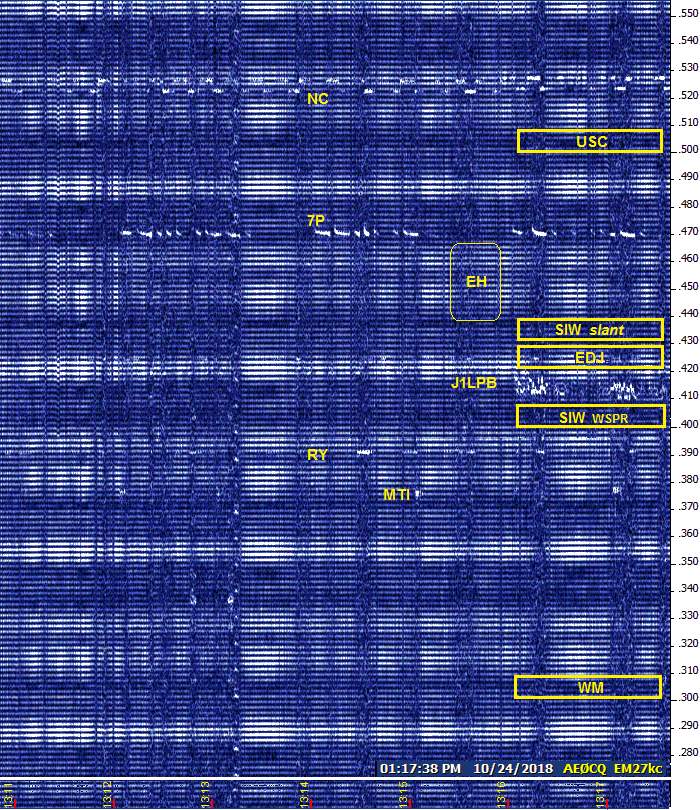
---------------------------------------------------------------
File Attachment 1: 24oct-wh1.jpg
File Attachment 2: 0587d.jpg
Re: Beacon VAN
Thanks for the AN becon report and for introducing me to the SDR.hu remote receivers. This is going to be very helpful for Hifer listening. 73's Jeff
Re: Beacon VAN - Wild West!
Posted by Jeff K8NDB on October 26, 2018 at 23:14:50.
In reply to Re: Beacon VAN - Wild West! posted by John Davis on October 25, 2018
Amazing John! Thank you for the AN capture. 73's Jeff
Re: DANGER Phishing Scam!
Posted by Chris Waldrup on October 27, 2018 at 02:13:09.
In reply to Re: DANGER Phishing Scam! posted by John Davis on October 25, 2018
John,
I’m not sure if you got my message but I received this email from “you” as well. I didn’t think it was you as I didn’t recognize the email address and a google search of the address didn’t come up with anything.
In mine it was personalized and said Chris are you available right now.
Chris Re: Frequency for RY?
KD4PBJ
Posted by John, W1TAG on October 27, 2018 at 14:50:02.
In reply to Re: Frequency for RY? posted by John Davis on October 26, 2018
JD, all,
I'm going to stick with 13555.390 for RY this winter. That doesn't line up well with John's Codar shot, but I don't see any other gaps in the typical Argo range that aren't too close to someone else.
So, John Davis - RY is on until next May, same info other than the new frequency. If anyone wants it moved, just email the mice in the cottage, and they'll try to operate the keypad. Would be interesting to get a picture of that!
John, W1TAG Hifer PBJ back on
Leaving FN43sv
Posted by Chris Waldrup on October 28, 2018 at 23:09:15.
Gentlemen,
The tree removal is done and today I managed to relocate the inverted V for the PBJ Hifer to the woods on the other side of the house.
Any reception reports would be appreciated as the antenna is oriented a little differently.
Frequency is about 13.557.
Thabks!
Chris in Tennessee
Re: Hifer PBJ back on
Posted by Jason Goldring on October 29, 2018 at 02:05:46.
In reply to Hifer PBJ back on posted by Chris Waldrup on October 28, 2018
Chris - what mode are you running now if different because I am getting something almost like FSK around the area but cannot pick anything out of that. DFCW perhaps?
Jason
Re: Hifer PBJ back on
Posted by Chris Waldrup on October 29, 2018 at 02:45:29.
In reply to Re: Hifer PBJ back on posted by Jason Goldring on October 29, 2018
Hi Jason,
I’m running QRSS.
Chris
WSPR overnight
Posted by Paul N1BUG on October 29, 2018 at 11:17:41.
An interesting night. 2200m was mostly not so good. I got just two trans-Atlantic spots from G0LUJ. QRN may have been up from storms over the Mediterranean. I spotted 2E0ILY a few times early in the evening, the notable thing being the first one was a full 30 minutes before my sunset! That is a new record, beating the old by some 10 minutes or so.
630 meters was the hot band overnight. I decoded a number of Europeans but more notably I had a single decode of LU1DOW and several of VK4YB. I also managed to snag K9FD which is quite rare for me.
Paul
27th and 28th Oct HiFERs
Posted by Ed Holland on October 30, 2018 at 17:37:41.
Hi Folks,
I had a short amount of time available for listening at the weekend. The best time was around 1 pm local time (2000 UTC) NC came in audibly, which has not happened for a while. A couple of other signals appeared at the watering hole, but I could not hear or decode them visually - one corresponding to EH in frequency.
Higher up, above 13,560 there were hints of GNK, and traces of other possible CW signals but nothing corresponding to the HiFER list.
PVC is still bashing away on 13555.55x
Cheers
Ed
SIW solid this morning
Posted by Jason Goldring on October 31, 2018 at 14:27:15.
Several decodes of SIW. Pretty consistent.
1320 -17 1.3 13.555388 0 K3SIW EN52 7 747
1324 -16 1.4 13.555388 0 K3SIW EN52 7 747
1328 -12 1.6 13.555389 0 K3SIW EN52 7 747
1332 -13 1.6 13.555388 0 K3SIW EN52 7 747
1336 -17 0.9 13.555389 0 K3SIW EN52 7 747
Jason
FLASH - K6FRC Heard in NC
Posted by Bill Stewart, K4JYS on October 31, 2018 at 15:39:49.
Just took a real quick look around the band and just barely heard K6FRC, at 1513Z. My rcvr indicated around 13.564.88...that's where the BFO had the best tone. On a couple of occasions I could copy the full ID, other times just FRC. That's a pretty good haul....good job OM. Will probably take a few more listening breaks today....WAS will be down on occasions today. I was rcving on the 22m xmitting dipole at abt 40ft.
73 de Bill K4JYS
2200m WSPR now all night
Posted by Paul N1BUG on October 31, 2018 at 21:02:51.
The beast isn't eating as many kilowatt-hours as I anticipated. Starting tonight I will be running WSPR2 from just prior to my sunset until just after my sunrise.
Paul
potrzebie