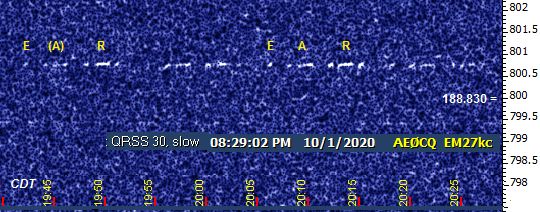
Re: RY Spotted in EM83du N. GA
Thanks John. Yep, gotta love the magic of RF. Sorry for the late response. Somehow I missed your post... too many irons in the fire I guess.
73, Ray
Overnight 2200M FST4W Decodes
Posted by Mike N8OOU on October 01, 2020 at 13:12:14.
I let the new release of WSJTX run overnight on 9/30-10/1. My decodes were;
201001_023000 0.136 Rx FST4W -35 0.3 1437 N1BUG FN55 30
201001_033000 0.136 Rx FST4W -34 1.4 1437 N1BUG FN55 30
201001_043000 0.136 Rx FST4W -37 0.6 1436 N1BUG FN55 30
201001_053000 0.136 Rx FST4W -32 0.8 1436 N1BUG FN55 30
201001_063000 0.136 Rx FST4W -35 0.6 1436 N1BUG FN55 30
201001_073000 0.136 Rx FST4W -36 1.4 1437 N1BUG FN55 30
201001_083000 0.136 Rx FST4W -28 1.4 1436 N1BUG FN55 30
Mike 73
Re: FWD: Release Candidate: WSJT-X 2.3.0-rc1
Posted by John Davis on October 01, 2020 at 14:22:59.
In reply to Re: FWD: Release Candidate: WSJT-X 2.3.0-rc1 posted by Paul N1BUG on September 28, 2020
I have not noticed any failure to upload or display full frequencies in FST4W. It should work the same as WSPR. If you can provide a specific example I will look into it.
Mike's report this morning is an example of what I mean. It shows only "0.136" for the frequency.
New tools for hifer?
Posted by swlem3 on October 01, 2020 at 16:01:36.
I'm wondering if the new wsjt-x software will provide some additional software "tools" for Hifer. FST4W was designed to replace wspr and has the additional advantage of running a longer tx time than two minutes if desired... up to 1800 seconds I believe.
Now whether the software designed for lf/mf will work well with weak signals at HF is a subject for others more knowlegeable than I to comment on.
Re: New tools for hifer?
Posted by John Davis on October 01, 2020 at 18:22:55.
In reply to New tools for hifer? posted by swlem3 on October 01, 2020
The new modes look to be a mixed bag for HF. The longer transmit times, in particular, are likely to suffer most from the deep fades that characterize this band on a typical 90 second to three minute fading cycle. That's the main reason why WSPR-15 never caught on at 22 meters. But it may be that the slightly greater sensitivity of the 120-second mode may give it a slight advantage.
Alas, I won't be in a position to participate in finding out, unless or until I can replace the field computer with a faster machine and a fancier sound card.
Re: FWD: Release Candidate: WSJT-X 2.3.0-rc1
Posted by Mike N8OOU on October 01, 2020 at 18:44:29.
In reply to Re: FWD: Release Candidate: WSJT-X 2.3.0-rc1 posted by John Davis on October 01, 2020
To explain the data source that I included in message
https://www.lwca.net/mb/msg/10514.htm
I cut and pasted from the all.txt file. The Frequency information is there, You just have to combine the 136 dial number with the "displacement" (audio frequency) included later in the line. The format of the file 'is' different than the all_wspr.txt file. I took a look at an all.txt file from the current release. That file had entries for JT-9 and FT-8 decodes, and the format of those entries are again completely different.
I don't claim to be a wspr expert, and have only looked at the PSKReporter page a couple times. What purpose does the ALL. and ALL__WSPR. TXT files perform? I thought WSPRNet and PSKReporter were not connected.
Mike 73
Re: New tools for hifer?
Posted by swlem3 on October 01, 2020 at 20:17:32.
In reply to Re: New tools for hifer? posted by John Davis on October 01, 2020
I was concerned that HF doesn't act like the low freqs, so there may not be an advantage. I guess the couple ops that run wspr on hifer can give it a try... wouldn't hurt. I'll give a listen if they wish to try it out.
Not sure if it would be worth the investment for you to swap out that field machine.. it probably does 99% of what you need it for now.
Re: FWD: Release Candidate: WSJT-X 2.3.0-rc1
Posted by Paul N1BUG on October 01, 2020 at 22:19:52.
In reply to Re: FWD: Release Candidate: WSJT-X 2.3.0-rc1 posted by Mike N8OOU on October 01, 2020
Mike,
WSPRnet and PSKReporter are not connected as far as I know. WSJT-X provides capability to upload spots to both in real time. For WSPRnet all that is needed is to check 'Upload spots' on the main window. Sending spots to PSKReporter can be enabled on the Reporting tab in Settings.
Note that FST4W spots are also uploaded to WSPRnet if 'Upload spots' is checked. The dial frequency (0.136) and audio offset (1437 Hz for my transmissions) are added for uploads to WSPRnet so the actual frequency is displayed there.
ALL.TXT is a record of every decode and every transmission made by WSJT-X. I'm sure it has many uses, but among them would be providing a record of what the program did if you need support, or checking to see if you really made a QSO that maybe you forgot to log.
ALL_WSPR.TXT is a record of all WSPR decodes. It used to be this file could be used for batch uploading spots to WSPRnet if for some reason you couldn't do it in real time. In the latest version the file format has changed and it is no longer compatible with WSPRnet.
All I can say about the format of either file is it's the format the developers chose.
73, Re: New tools for hifer?
Paul N1BUG
Posted by WA1EDJ Bob on October 01, 2020 at 22:27:14.
In reply to New tools for hifer? posted by swlem3 on October 01, 2020
Another factor for me is that my WSPR encoding is tied to a fairly simple Arduino platform. If someone built a FSTW4 version for Arduino, I might try it. I don't tie a PC to my WSPR TX since it runs 24/7 WX permitting.
Just my 2 cents....
Starting to see K5LVB WSPR and RY on the ARGO screen at 1815 EDT.
I'm WSPRing about 19 Hz north of RY when not in RX mode.
Bob Lowfer SIW QRV
EDJ
Posted by Garry, K3SIW on October 01, 2020 at 22:37:34.
Lowfer SIW at EN51uq is now back on the air. On Tu, Th, Sa transmissions Re: New tools for hifer?
will be an altering sequence of QRSS30 and QRSS60 at 185.2993 kHz. On M,
W, F the frequency shifts to 185.1852 kHz and the transmissions will
involve wspr15, opera32, and a visual rendition of the call twice before
repeating. Although quite strong at my QTH (EN52ta) 23 miles away,
nonetheless lowfer WM still comes through weakly on an ARGO waterfall.
--
73, Garry, K3SIW, EN52ta, Elgin, IL
Posted by swlem3 on October 01, 2020 at 23:22:21.
In reply to Re: New tools for hifer? posted by WA1EDJ Bob on October 01, 2020
Understood Bob. That's the way to go to not tie up a pc. Not sure when they'd get around to having a non-pc version.
Re: New tools for hifer?
Posted by John Davis on October 01, 2020 at 23:55:29.
In reply to Re: New tools for hifer? posted by swlem3 on October 01, 2020
It will probably be a while before the HiFER WSPRers can attempt the new modes. Most are using the Ultimate 3s or the other synthesizer kit that Bob recently built, instead of a computer and SSB exciter. Their implementation of WSPR is encoded in firmware. I've no idea when the software developers may be inclined to implement the different specs of the new modes in firmware. I expect it will happen someday, though.
Meanwhile, I'm reluctant to commit to the necessary investment to a new field computer, for the very reason you mention. It's still tremendously useful. Also, I got this Acer machine six years ago, and it had already seen use as a demonstrator at Radio Shack, so it was priced cheaper than some pitiful low-end Chromebooks. It may only have a 1 GHz processor and voice-grade sound card, but I feel less insecure about dragging it to the farm, exposing it to potential lightning damage or the inevitable heat, cold, vibration and grime it regularly encounters, than if it were something as fancy and co$tly as my newer HP notebook. Re: Overnight 2200M FST4W Decodes
Posted by Garry, K3SIW on October 02, 2020 at 01:21:54.
In reply to Overnight 2200M FST4W Decodes posted by Mike N8OOU on October 01, 2020
Mike, I monitored 136 kHz over night also. My WSJT-X2.3.0-rc1 T/R=1800 seconds decodes were:
201001_013000 0.136 Rx FST4W -30 0.6 1437 N1BUG FN55 30
201001_033000 0.136 Rx FST4W -30 0.3 1437 N1BUG FN55 30
201001_043000 0.136 Rx FST4W -27 0.3 1437 N1BUG FN55 30
201001_053000 0.136 Rx FST4W -28 0.3 1437 N1BUG FN55 30
201001_063000 0.136 Rx FST4W -26 0.3 1437 N1BUG FN55 30
201001_073000 0.136 Rx FST4W -28 -0.3 1437 N1BUG FN55 30
201001_083000 0.136 Rx FST4W -22 0.6 1437 N1BUG FN55 30
At T/R=300 seconds decoded stations were:
200930_224000 0.136 Rx FST4W -6 0.6 1485 NO3M EN91 30
200930_233000 0.136 Rx FST4W -23 0.6 1410 K3MF FM19 30
201001_105000 0.136 Rx FST4W -1 0.6 1531 K9KFR EN71 30
And at T/R=120 seconds decoded stations were:
200930_222800 0.136 Rx FST4W -9 0.8 1420 WA9CGZ EN61 20
201001_104400 0.136 Rx FST4W 0 0.3 1531 K9KFR EN71 30
I also decoded old wspr transmitting stations using JTDX2.1.0-rc147:
201001 0132 1 -26 0.45 0.1375751 WH2XND DM33 43 0 1 16 1 810 1
201001 0938 1 -26 0.19 0.1375008 N1DAY EM85 30 0 1 48 3 810 1
I didn't really notice any problem with 3 instances of the new wsprx code running along with jtdx.
Reports went to both pskreporter and wsprnet.
73, Garry, K3SIW, EN52ta, Elgin, IL 1750 M Tues. & Wed.
Posted by John Davis on October 02, 2020 at 05:27:03.
Tuesday night I tried for LowFER WM again, but instead of intermittent copy throughout the night, there was none at all! I'm not quite sure why, because the static didn't seem to start out any worse than the last two times, but this time there was no sign of anything at 185.3 until half an hour before sunrise, when the combination of WM largely buried under QRM sources faded into view during the twilight.
On Wednesday, the target was EAR. By around 8:20 PM CDT I finally gave up on 22 meters and switched over to 1750 m. There was a little surplus of RF at 188.8307 that looked to be keyed at QRSS30 but it was not identifiable. By 9:30 PM it faded out entirely, even in my Argo windows running QRSS60, without ever showing up in the QRSS30 window. It never returned at all during the night.
Thursday night has at least started off a little more promising. Report follows.
EAR We Go Again
Posted by John Davis on October 02, 2020 at 06:15:00.
About 40 minutes after local sunset I saw my first recognizable EAR of October with the Harvest Moon shining in the window of the Little Shack on the Prairie. With this reception, I think I now have 12 consecutive months of EAR for the first time ever, so I can now concentrate on the ultimate goal: reception in each month of the same calendar year.
Copy of EAR so early in the evening, followed by a return later in the night, seems to characterize propagation in the autumn and winter months. On Wednesday night, there was poor twilight copy and no return...while tonight I won't really know for sure because I am observing the first night of SIW for the autumn. But I do hope the weather will cooperate and allow me to try for a full night of EAR from Friday sunset into Saturday morning.
---------------------------------------------------------------
 File Attachment 1: 1octc022.jpg
Re: Overnight 2200M FST4W Decodes
Garry
Thanks for your info. I found the check boxes to get my reports sent to both PSKReporter, and WSPRnet. If anyone is interested in the numbers, they can inquire on either of those sites. I have not tried running multiple copies yet, I will look into that today if I have time.
Mike 73
Re: EAR We Go Again
Posted by John Bruce McCreath on October 02, 2020 at 14:40:12.
In reply to EAR We Go Again posted by John Davis on October 02, 2020
Hi John, thanks for the detailed report and Argo snip. I'm glad that you've been able to achieve one of your goals!
73, J.B., VE3EAR Re: New tools for hifer?
Posted by Andy G0FTD on October 02, 2020 at 22:42:28.
In reply to New tools for hifer? posted by swlem3 on October 01, 2020
What works at LF / MF might not work at HF or be easily transferable.
LF signals suffer much less Doppler effects, so you can use much narrower and longer
transmission lengths.
At HF, typical ionospheric Doppler is about 1 to 1.5Hz, that's why 1.46Hz for WSPR2
was chosen and can be used before decoding starts to fail.
To illustrate what ionospheric Doppler is typical, the site below monitors an 80m
transmission. Pay close attention to the scale. The trace wobbles about 1Hz.
https://www.qsl.net/ok1fcx/
http://ok0eu.fud.cz/
73 de Andy
Re: New tools for hifer?
Posted by swlem3 on October 03, 2020 at 00:40:36.
In reply to Re: New tools for hifer? posted by Andy G0FTD on October 02, 2020
Thanks Andy. Apparently, there's a lot more "science" involved in designing the proper tools for the slice of spectrum one wishes to communicate at. More than likely, the HF'ers will keep using what works. John Davis has stated that hardware issues come into play also, and one can't just easily try every new program that comes along.
I'll take a look at the links.
73, Productive Thur Night at LF
Ray
Posted by John Davis on October 03, 2020 at 06:53:24.
In addition to EAR early, I got to watch WM and SIW together for the first time this season.
As is often the case, best reception was just before sunrise. The QRSS30 traces in attachment 1octc0043.jpg show the pre-sunrise fade hitting at 6:30 AM CDT, about 45 minutes before sunrise. The traces continue raggedly at QRSS60 (file 1octd0025.jpg) for another hour, with increasing presence of daytime QRM sources, until 7:30 when it looked like everything abruptly faded.
In actuality, the radio shut down when the deep cycle battery dropped below safe voltage prematurely. I spent much of the day doing battery maintenance and charging, in hopes of getting an all night trace of EAR this time. We'll see.
---------------------------------------------------------------
File Attachment 1: 1octc0043.jpg
File Attachment 2: 1octd0025.jpg
VLF Signal Magnitudes
I'm in the SF Bay area in California and have been interested in monitoring signals in the VLF range. With my digitizer and receiver coil, I have 10-40 dB peaks above my noise floor picked up for 21.4 kHz, 34 kHz, 24.8 kHz, 25.2 kHz. I have my field values in digitizer units (Volts), but would like to translate them to pT. I will go through a calibration run with a small transmitter coil, but it would also be great to do a secondary comparison to these "known" signals. I know they change a lot from time to time, but it would still be nice to see that my calibration of my receiver coil is in the right ballpark.
Is there a reference available on the expected magnetic field values from these large transmitters... particular for the NorCal area?
Re: VLF Signal Magnitudes
Posted by John Davis on October 04, 2020 at 07:55:09.
In reply to VLF Signal Magnitudes posted by John Smithington on October 04, 2020
I have access to predicted field strength contours for Cutler, ME (24.0 kHz), and measured contours for Jim Creek, WA (24.8 kHz), which can readily be interpolated to give approximations for the Bay Area. It will probably take me a day or so to locate them. As is standard radio engineering practice, the field strength values will be in dB relative to 1 μV/m, which is easily convertible to absolute field intensity in units of V/m for the electric component (E) or A/m for the magnetic component (H).
If you will forgive my nosiness in the interim, why are you planning to measure flux density B in teslas? I can understand using pT or nT for natural magnetic phenomena, where flux density and permeability of the material it is found in may be relevant to each other, but I've never understood the recent trend to use T as a unit to report applied field intensity, which is essentially a free-space property of radio waves.
Re: Productive Thur Night LF (Fri Night Update)
Posted by John Davis on October 04, 2020 at 08:29:33.
In reply to Productive Thur Night at LF posted by John Davis on October 03, 2020
On Friday night, I wanted to test my hypothesis that the passage of the equinox has rendered early-evening paths open once again between EAR and here, and to ascertain whether pre-dawn propagation is holding up a little closer to sunrise. Unfortunately, circumstances disrupted both of those objectives.
I went home for supper before sunset, and when I returned a couple hours later there was not only no post-sunset enhancement, but no signal or noise at all, thanks to a bit of oxidation in a BNC cable connector out at the antenna buffer amplifier. Remedied that and resumed monitoring. No repeat tonight thus far; the post-sunset enhancement occurred o schedule, although it was not as dramatic as Thursday evening's.
On the other side of the night, the storage battery held out until dawn this time, but not much beyond, so I don't know whether there was any post-sunrise temporary rebound, either. Working on the assumption that I may not have charged the batteries long enough after Friday's maintenance, I gave them a careful and thorough charge during the day Saturday. Only time will tell whether that did the trick. If it did, I hope to stitch together a scrollable overnight capture.
If all goes well, I'll repeat the experiment with WM and SIW on Sunday night to see how their signals handle the diurnal transitions this year.
Re: VLF Signal Magnitudes
Posted by John Smithington on October 04, 2020 at 13:44:33.
In reply to Re: VLF Signal Magnitudes posted by John Davis on October 04, 2020
I'm appreciative to have the values in whatever the units are of your choosing.
Hard for me to speculate as to what might be pushing trends. For me, I'm interested in the propagation through different materials, so maybe my bias comes from mostly looking at references for those applications. *shrug*
Just for reference, my digitized 24 kHz signal is 22dBuV with the axis of my coil pointed North-South, and 18 dBuV E-W. My 24.8kHz signal is 22 dBuV N-S and 40 dBuV E-W. My noise floor is at 5 dBuV. HiFER Beacons Spotted & Changes to Mine
Posted by Robert, VA3ROM on October 04, 2020 at 21:49:17.
Good afternoon,
Been using a few KiwiSDRs to monitor the 22 m band segment spotting my beacon and a few others. VE7GL, on the left coast seems to pick me up most days. Sometimes I have to use frame stacking to read my telemetry but most times a single frame grab is perfectly readable.
My ROM telemetry beacon transmits temperature (2-digit) and battery voltage (3-digit) as cut Morse numbers and every hour I now substitute my grid square (full numbers) for propagation purposes. The transmitter is in an unheated environment and we are now getting negative temps at night (below 0 C) so I added changes to handle those temps by using an old programming trick. Negative temps have an offset of 50 added to them: I.E. -1C is computed and transmitted as 51 or cut numbers E A and at the other end -49C is transmitted as 99 cut numbers N N. No need to send a minus sign or other indicator and is less ambiguous at my end of things when using a remote KiwiSDR to monitor my signal (campsite north of the city). Obviously, positive temps of 51C to 99C coming from my part of the world at this time of year would be impossible (at least in this century)!
Today I used VE7GLs remote KiwiSDR and spotted WA1EDJs WSPR beacon:
1540 -29 2.6 13.555407 0 WA1EDJ EM83 7 3723
1904 -26 2.6 13.555414 0 WA1EDJ EM83 7 3723
1944 -30 2.6 13.555414 0 WA1EDJ EM83 7 3723
1948 -28 2.5 13.555414 0 WA1EDJ EM83 7 3723
Also spotted EH at 460 doing the wobbly frequency walk and RY at 395 coming in strong on the left coast KiwiSDR, along with mine now getting stronger into my late afternoon. As of 2145Z, EH and RY are still coming in strong while EDJ is fading away. I can just barely see his signal in Spectrum Labs waterfall but WJST-X can no longer decode his signal. QRSS 3 and WSPR 1 now 0.
73,
Robert
Totally amazing how a fleapower RF signals can fly so far through the ether and still be detected albeit not by ear but with a $300 remote KiwiSDR and some free software at the other end of the wire!
Re: HiFER Beacons Spotted & Changes to Mine
Posted by Robert, VA3ROM on October 04, 2020 at 22:22:43.
In reply to HiFER Beacons Spotted & Changes to Mine posted by Robert, VA3ROM on October 04, 2020
And no sooner than I posted hes back with a WSPR vengance!
1540 -29 2.6 13.555407 0 WA1EDJ EM83 7 3723
1904 -26 2.6 13.555414 0 WA1EDJ EM83 7 3723
1944 -30 2.6 13.555414 0 WA1EDJ EM83 7 3723
1948 -28 2.5 13.555414 0 WA1EDJ EM83 7 3723
2140 -28 2.5 13.555420 0 WA1EDJ EM83 7 3723
2144 -31 2.5 13.555420 0 WA1EDJ EM83 7 3723
2152 -28 2.4 13.555420 0 WA1EDJ EM83 7 3723
2156 -29 2.5 13.555420 0 WA1EDJ EM83 7 3723
2200 -29 2.6 13.555420 0 WA1EDJ EM83 7 3723
2204 -31 2.7 13.555420 0 WA1EDJ EM83 7 3723
2208 -26 2.5 13.555419 0 WA1EDJ EM83 7 3723
2212 -24 2.6 13.555419 0 WA1EDJ EM83 7 3723
2220 -29 2.7 13.555419 0 WA1EDJ EM83 7 3723
Re: VLF Signal Magnitudes
Posted by John Davis on October 05, 2020 at 02:21:54.
In reply to Re: VLF Signal Magnitudes posted by John Smithington on October 04, 2020
I found the reference material I mentioned, and also did another Google search to see if I could come up with coverage contours for any of the other signals you receive, but no luck on those so far.
Predicted 99% availability for NAA 24.0 kHz anywhere on the California coast is between 53 and 54 dBμV/m. For 90%, the figure rises to about 56 or 57 dBμV/m, or nearly 0.7 mV/m. This value is a mid-day average for the month of July, and local variations of 10 dB either way are possible depending on local factors.
Values for Jim Creek 24.8 kHz measured in San Diego on shipboard at mid-day in July run a smidgen over 80 dBμV/m, and predicted contours show the latitude of San Francisco receiving 3 dB stronger signal, or roughly 14 mV/m. However, the same local variabilities apply, especially considering that the measurement whip was over seawater.
Thus, your relative difference of 18 dB between Jim Creek and Cutler is a little less than the 26 dB that might be expected, but is still well within reason, statistically. It will be interesting to see what your calibration method shows.
Re: VLF Signal Magnitudes
Posted by John Smithington on October 05, 2020 at 02:59:04.
In reply to Re: VLF Signal Magnitudes posted by John Davis on October 05, 2020
That's great. Much appreciated! I'll get my calibration, and compare to these values. I'll also post the values for a couple of the other transmitters while I'm at it. Hopefully in the next day or so. Very cool.
Re: HiFER Beacons Spotted & Changes to Mine
Posted by WA1EDJ Bob on October 05, 2020 at 19:12:47.
In reply to Re: HiFER Beacons Spotted & Changes to Mine posted by Robert, VA3ROM on October 04, 2020
Thanks for the report Robert! I have had the WSPR on more lately since storming has died down. it is off today for lawn mowing but will return tonight.
I have not seen any of you lately or EH. RY is still doing well. I don't listen
mid day which is when sigs are best for our path I believe, so you may well be there.
Great work on the HiFER beacon.
73 2200m FST4W
Bob
EDJ
Posted by Paul N1BUG on October 05, 2020 at 21:22:01.
I am still transmitting FST4W-1800 each night starting at 2330z, ending usually with the 0830z transmission, 137437, 2nd period. Propagation is slowly improving with more reports from Europe starting to be received.
Last night I decoded DL0HOT several times on FST4W-1800 and this morning I had a single decode of VK4YB on FST4W-300.
73, Re: 2200m FST4W
Paul N1BUG
FN55mf
Posted by Paul N1BUG on October 05, 2020 at 21:39:12.
In reply to 2200m FST4W posted by Paul N1BUG on October 05, 2020
I said "starting at 2330z"
Actually that should read starting at 2230z.
Paul
Re: 2200m FST4W
Posted by John Davis on October 06, 2020 at 15:04:26.
In reply to 2200m FST4W posted by Paul N1BUG on October 05, 2020
Out of curiosity, how do the versions that take longer than 600 seconds handle the 10-minute station ID requirement?
Tuesday HiFERs
Posted by John Davis on October 06, 2020 at 18:09:33.
Better conditions late this morning than I've seen recently. First sign of EDJ, MTI, and ROM in a few weeks. NC, 7P, and EH were also present, as they have been most days recently. WV was fair copy. AZ was visible but only very faintly audible, all the way up at 13554.190 today. In the top half of the band, nobody was coming through but WAS, with fair to good signal levels sometimes but lots of QSB.
EDJ was pretty good on Argo at 11:28 AM CDT, but I didn't have the decoder cranked up yet. Later time slots were weaker, but hopefully will improve again. ROM was very intermittent, only one or two characters at a time, but it's nice to see it again.
No sign of RY this morning. JB had good signal level, but was in long-upward-streak mode with the battery still at very low charge, apparently.
Re: Tuesday HiFERs
Posted by Ed ho on October 06, 2020 at 18:37:20.
In reply to Tuesday HiFERs posted by John Davis on October 06, 2020
Thanks for the reports John,
I monitored for much of the weekend, but saw little aside from NC, which was quite strong for periods throughout Sunday, and EH making consistently readable traces in Spectrum Lab. 7P was also present at times, and there were noisy traces where the SIW WSPR should be.. Sunday was a little more active than Saturday.
PVC was returned to Service on Monday 5th
73s,
Ed
Re: Tuesday HiFERs
Posted by swlem3 on October 06, 2020 at 19:23:50.
In reply to Tuesday HiFERs posted by John Davis on October 06, 2020
I'm seeing better conditions here also John. I've been decoding SIW and EDJ on wspr 2 today... riding the QSB... at times enough signal to decode, at times not, but usually the traces can be seen in Argo. Garry has been as good as a -22, with EDJ in the upper '20's. Propagation seems to favor the midwest rather than the East today, at least from this Texas qth. I don't have many decodes on wsprnet to show for my efforts. My morning decodes were "bounced" by wsprnet... my fault. My constant switching between Linux and Windows screws up the windows time, so if I forget to correct the time before a wspr session, the decodes fail.
Re: Tuesday HiFERs (early afternoon)
Posted by John Davis on October 06, 2020 at 23:34:49.
In reply to Re: Tuesday HiFERs posted by swlem3 on October 06, 2020
I envy you your slight additional distance from SIW, Ray. When I returned to the field from lunch, I had a nice screenful of EDJ decodes, but still no sign of SIW. I apparently remain just inside the first skip zone from IL.
JB had returned to its normal appearance, NC, EH, and WV were still doing well, and in the top half of the band I encountered WAS again. This time ABBY also showed up, but at a quite high 13566.830 kHz.
I've been home for an extended supper break, but am on my way back to the field for a sunset session. To quote the great Yogi Berra, "it's getting late earlier these days."
Re: Tuesday HiFERs (early afternoon)
Posted by swlem3 on October 07, 2020 at 01:14:34.
In reply to Re: Tuesday HiFERs (early afternoon) posted by John Davis on October 06, 2020
I guess the extra distance from SIW here made a big difference.
Last time I was copying both wspr hifers, a week or so ago, EDJ had 5 times as many spots as SIW. Today was reversed. You had a profitable day, having a number of other hifers logged. I pretty much stayed parked in one place on the dial... it was interesting watching the "ebb and flow" of qsb on the two wspr2 signals in Argo as the day progressed.
Yep, the days are 'gettin shorter...
Re: Tuesday HiFERs
Posted by swlem3 on October 07, 2020 at 16:39:41.
In reply to Tuesday HiFERs posted by John Davis on October 06, 2020
Decodes of the wspr2 hifers started at 1628z today... so far one decode for SIW and 2 for EDJ.
just fyi...
Re: Tuesday HiFERs
Posted by WA1EDJ Bob on October 07, 2020 at 21:17:50.
In reply to Re: Tuesday HiFERs posted by swlem3 on October 07, 2020
TNX guys! Getting lots of decodes. I'll keep pumping out the mW's when not listening.
Has not been as much of that lately as I'd like. Still have the work problem...
Bob Re: Tuesday HiFERs
EDJ
Posted by Ed Holland on October 08, 2020 at 05:11:53.
In reply to Re: Tuesday HiFERs posted by WA1EDJ Bob on October 07, 2020
Same here with the "Work Problem" Bob. It gets in the way of a lot of radio progress!
Surreptitiously, I do sometimes log in to the odd SDR during weekdays, to see if any HiFers pop up, It is rare to catch anything though... The home receivers and antennas seem to have better signal gathering at 22m.
73s
Ed
Re: Tuesday HiFERs
Posted by John Davis on October 08, 2020 at 18:33:54.
In reply to Re: Tuesday HiFERs posted by Ed Holland on October 08, 2020
Seems to me the Work Problem deserves its own Q-code, but the ITU already uses QRW for something else. Since "work" is a form of manmade interference, LWCA's advice columnist--who calls himself Dr. Answer Guy, although I don't think "PDQ" is a very widely recognized degree--suggested to me that we could adapt the QRM code for this purpose.
In its formal usage, if a radiotelegraph operator asks "QRM?" ("am I being interfered with?") (other than by the grammar police), the answer comes back "QRM" followed by a number from 1 to 5, signifying the level of interference from Nil to Extreme. Instead, AG suggests appending the letter W for when work interferes with radio activities.
If that catches on, perhaps the idea could be expanded further. For instance, there's a term in the ham community, "local QRM," that seems to have been more widely used in decades past than recently. It pertained to non-RFI sources of interference with reception in the local vicinity: kids playing loud video games, spousal nagging, the neighbor's noisy lawnmower, late night sweats over the size of the electric bill, etc. It's clearly still an issue for many of us, so perhaps it could be covered by the designation "QRM L," just as work interference is "QRM W" now.
As Mr./Dr. Answer Guy likes to say, I rest my case.
Re: Tuesday HiFERs (evening)
Posted by John Davis on October 08, 2020 at 19:30:15.
In reply to Re: Tuesday HiFERs (early afternoon) posted by swlem3 on October 07, 2020
Finally getting caught up on the rest of the day...NC, 7P, occasional ghosts of ROM, and instances of JB ranging from fragmentary to bright and solid were the norm for much of the afternoon. NC faded away, though, by 3:30 PM CDT. No further WSPR signals from anyone after lunch; the 16 decodes from WA1EDJ from 1704 through 1824 UTC turned out to be it for the day.
Around 5 o'clock, a faint signal began showing up about 5 Hz above 7P, which took another two hours to become recognizable at PVC. During that time, EH drifted up over 7P than PVC, finally fading away entirely.
At 5:38, JB reappeared after a 40 minute absence. This time it had an upward tilt, which increased to upward streaks on each as the sun got lower in the sky. The last definite transmission ended at 6:05 PM CDT at the end of the second dash in the "J," at which time the frequency was 13555.400 kHz. (There was one more partial set of streaks that reached as high as .500 right at 6:22 PM, but I can't be positive it was JB.)
RY appeared abruptly with an "R" beginning at 6:11:30 and remained good until 6:38 PM, when it faded into oblivion over the course of one "Y."
At sunset, 7P was solid, some letters of PVC were visible, no more WV, AZ visual only and back down at 13554.115, while K6FRC was visible and very faintly audible.
No further listening since then...flu shot yesterday, which is a major production in this day and time, followed by too much "QRM W" to get away today.
Interesting HiFER traffic
Posted by Ed Holland on October 08, 2020 at 20:47:02.
Hi Folks,
While attempting a little clandestine listening here at my work desk (during a break, obviously). Listening in on an SDR based in Newport News, VA (98.166.65.119:8901/) I came across a CW signal skipping around the 22 m ISM band. My Morse isn't up to much, but I did decipher some copy, including "My frequency counter is..." and other equipment details. Speed is about 10 WPM
Hearing now around 13,560.5 kHz, which is quiet at the receiver's location, but it appeared high and low in the band. At one point there seemed to be a couple of stations.
Has anyone else heard similar? Could it be an SDR artifact? I'll try and monitor, and copy more.
Ed
Re: Interesting HiFER traffic
Posted by Ed Holland on October 08, 2020 at 21:01:50.
In reply to Interesting HiFER traffic posted by Ed Holland on October 08, 2020
Mystery solved.
Tuning around on the 40m band using the same SDR site and listening simultaneously on 22 m, I can hear the exact same CW output on 7050 kHz, so it is definitely a spurious response of some kind.
Oh well, I got some Morse exercise!
/Ed
Re: Tuesday HiFERs
Posted by Ed Holland on October 08, 2020 at 22:39:30.
In reply to Re: Tuesday HiFERs posted by John Davis on October 08, 2020
QRM W is quite workable I think. Please thank Dr. Answer Guy for his deliberations on the matter.
Perhaps other Q-Codes could be expanded:
QRN N: Natural interference from bird or animal calls, weather etc.
QTR B: Time for a swift pint.
QSH M: Please wear a mask, stay healthy
Re: Tuesday HiFERs
Posted by John Davis on October 09, 2020 at 06:24:28.
In reply to Re: Tuesday HiFERs posted by Ed Holland on October 08, 2020
I like those additional Q-Code extensions, and will begin applying them in my future reports.
QRN N is likely to be one of the more commonly used because of my QTH in the field (QTH F perhaps?), which is subject to coyote howls and the eponymous sound of screech owls at night, and raucous calls of crows, hawks, and mockingbirds in the daytime.
I also suspect "Z" might become a useful suffix for a number of codes:
QRN Z: It was late and my own snoring got in the way of hearing anything.
QRM Z: (1) I went QTR B for too long and ended up sleeping it off; or,
       (2) In a multi-operator contest situation, one of the other ops dozed off.
QTR Z: It's past my bedtime now, gotta snooze.
As for thanking Dr. Answer Guy, I will do so reluctantly. It only seems to encourage him.
Luxembourg - 234 kHz RTL power reduced?
October 7, 2020
Two people from a German radio forum said that RTL must have decreased the power of the LW transmitter. Maybe someone has an official document about that, so it’s not a
transmitter problem.
Marco (2020-10-07) SAQ Grimeton Transmission on October 24th, 2020
via https://mediumwave.info/2020/10/
Posted by Mike Terry on October 09, 2020 at 14:03:34.
On the United Nations Day, October 24th, 2020, the SAQ transmitter in Grimeton will again send out a message to the whole world on 17.2 kHz CW.
Programme:
16:30 (14:30 UTC): Startup and tuning of the Alexanderson Alternator SAQ.
17:00 (15:00 UTC): Transmission of a message from SAQ.
Only on our YouTube Channel
17:20 (15:20 UTC): Live music concert from the transmitter hall.
Anna Louise Ekman www.annalouiseekman.se will perform Swedish and Italian songs, accompanied by a pianist.
The entire transmission event and the following concert can be seen live at our YouTube Channel starting at 16:30 (15:30 UTC).
Live Video Stream from World Heritage Grimeton Radio Station.
Scheduled at 16:30 (14:30 UTC) on October 24th, 2020
QSL Reports to SAQ
QSL reports to SAQ are very welcome and appreciated. This time we will only accept reports via our ONLINE FORM (click link to enter your report).
The online form will be open from October 24th until November 6th.We have no possibility to confirm reports received by Email / mail / bureau.Amateur Radio Station SK6SAQ
The Amateur Radio Station with the call “SK6SAQ” will be QRV on the following frequencies:
– 7.035 kHz CW or
– 14.035 kHz CW or
– 3.755 kHz SSB
QSL-reports to SK6SAQ are kindly received via:
– Email to info@alexander.n.se
– or via: SM bureau
– or direct by postal mail (see address above)
Two stations will be on the air most of the time.
Due to the Corona pandemic, there will be no visitors to the transmission hall at the radio station during the transmission. The association will try to carry out the transmission to the world from the old Alexanderson alternator SAQ with minimal staff in place.
World Heritage Grimeton Radio station and The Alexander Association
For further details, se grimeton.org or alexander.n.se
*The world heritage site Grimeton is a living cultural heritage. All transmissions with the long-wave transmitter SAQ are therefore preliminary and may be cancelled at short notice.
https://alexander.n.se/saq-grimeton-transmission-on-october-24th-2020/?lang=en Reminder: Lowfer net +/- 3929Khz Saturday morning 0800 California time
Posted by Jerry Parker on October 09, 2020 at 14:44:32.
Reminder: Lowfer net +/- 3929Khz Saturday morning 0800 California time
Or listen online at kfs:
http://69.27.184.62:8901/?tune=3929lsb
or
KPH Point Reyes:
http://198.40.45.23:8073/
or
Utah Web sdr:
http://www.sdrutah.org/websdr1.html
If you cannot get into the net on 80 meters you can listen on KFS and participate by sending net control your thoughts to wa6owr@gmail.com
73,
Jerry WA6OWR
Friday's hifer
Posted by swlem3 on October 09, 2020 at 20:31:53.
Slow day today on the hifer front at this qth. Only saw 7P. No decodes of the wspr2 stations.
https://drive.google.com/file/d/1pBzOa0HzHt-6ol5WE0COSg10QhBgad5c/view?usp=sharing
JB recharged
Posted by John K5MO on October 09, 2020 at 21:08:12.
JB's back with the full 2mW gallon.
It's to be rainy the next couple days but the battery pack has a full charge. I'm going to add another solar cell in parallel to the other 3 in hopes of providing more charge.
I really appreciate the reports, thank you!
Re: JB recharged
Posted by swlem3 on October 09, 2020 at 21:39:02.
In reply to JB recharged posted by John K5MO on October 09, 2020
Good to hear John. Was wondering why I haven't see your station in a while. I don't think propagation been decent anyway, which wouldn't have helped. Just now, I see only traces of EH, and he usually does very well in here.
Re: Tuesday HiFERs
Posted by Ed Holland on October 09, 2020 at 23:35:09.
In reply to Re: Tuesday HiFERs posted by John Davis on October 09, 2020
Perhaps also the exchange between English hams could be simplified, for example:
QTR 1600z: It's four pm
QRT T: Stop for Tea Break?
EDJ QRV 13555.420 FSKCW3
Posted by WA1EDJ Bob on October 10, 2020 at 16:23:33.
Pulled out the orignial N4LTA Epson HiFER TX today. TX pretty close to .555 420, just a few Hz higher in freq than my WSPR was. WSPR is QRT for now.
ID is EDJ FSKCW3.
Will be QRM S (shopping with wife) for afternoon.
Bob 2200m FST4W-1800 QRPP Beacon
EDJ
Posted by Rob - K3RWR on October 10, 2020 at 18:45:47.
I will be running a continuous QRPP beacon this weekend (10/10 - 10-11) on 136.0 + 1410 at 0dBm ERP. Reports on WSPR.net and here welcome.
Re: Tuesday HiFERs
Posted by John k5mo on October 10, 2020 at 19:29:54.
In reply to Re: Tuesday HiFERs posted by Ed Holland on October 09, 2020
I see what you did there ^^
Re: EDJ QRV 13555.420 FSKCW3
:-)
Posted by Ed Holland on October 10, 2020 at 20:33:09.
In reply to EDJ QRV 13555.420 FSKCW3 posted by WA1EDJ Bob on October 10, 2020
Bob,
I think EDJ is reaching us here in CA, as I have broken snippets of FSK at the stated frequency. Not yet enough for a full ID, but the jigsaw pieces of trace in Spectrum Lab are consistent with the letters expected.
Will confirm (if possible) after more gathering.
NC is also making it here today during short lifts, and also 7P, and a trace where JB might be expected, but not enough to piece together any copy.
I will be at the mercy of QRM K (family activities) for a while...
73s
Ed
Why no list for 2200 and 630 meter band?
Posted by Robert-KB6QXM on October 10, 2020 at 22:09:30.
This message is for the webmaster mostly. As the newly allocated amateur radio 2200 and 630 meter bands are longwave. Why are there no logs or beacon lists for the 2200 and 630 meter bands on this site?
The rules are basically the same for the 2200 and 630 meter bands as the 1750 meter band, therefore, I would like to understand why there is no place on the site for those two bands. Re: EDJ QRV 13555.420 FSKCW3
Posted by Ed Holland on October 11, 2020 at 02:34:25.
In reply to Re: EDJ QRV 13555.420 FSKCW3 posted by Ed Holland on October 10, 2020
I think the attached pic clinches it!
Traces from NC, and EH. The latter improved in readability during the mid to late afternoon. EDJ continued to offer tantalising glimpses until local dusk, but it was enough to be sure of the ID.
73s
Ed
---------------------------------------------------------------
File Attachment 1: 10-OCT-20x48.jpg
Re: Why no list for 2200 and 630 meter band?
Actually, the rules are very different, but that's only a small part of the story. The main reason is, there has been almost no interest in additional lists. We'd be glad to try if someone could define parameters of a new service that would be (a) unique and (b) useful to the community.
Our current lists are primarily tailored for beacon operation under Part 15 rules, which has long been our area of specialty: 45 years of continuous updating for LF, roughly 30 for MF and HF. Traditional LowFER beacons (and most HiFERs) are somewhat akin to stations in the Fixed Services. Each has its own frequency that it sticks with for months or years at a time, and most operate with schedules and modes that seldom change.
We have also been glad to include LF ham activity that is similar to LowFER beacons. The LowFER list currently has KE6PCT at 2200 m, for instance; N8OOU's 630 m beacon operation was on the list, too, and will be again when he announces its return to operation. Before the ham bands were opened up, we also listed all of the Part 5 Experimental Service licensees who operated on a more or less regular schedule.
Now that the ham bands are open, much LF and MF ham beaconing until recently was mainly WSPR. WSPRnet.org was co-developed with the transmission protocol, and serves as both a real-time list of WSPR stations actually on the air and a tool for propagation analysis. Because there are no FCC beacon sub-bands assigned in 2200 or 630, beacons are supposed to be MEPT rather than unattended. They are thus more likely to be on the air in one or another mode, or even a different band, at an operator's whim. WSPRnet's automated process is better suited for tracking this type of activity than our kind of list, which depends on station operators or listeners to manually report updates.
Not all beacons are WSPR. Other digimodes are in wide use, too, and PSKReporter.info is one site that handles protocols such as JT-65, FT-8 and PSK.
There seems little point, in other words, for us to reinvent the wheel. However:
(1. I would like us to have more listings of QRSS and slow FSK CW beacons, of which there are undoubtedly some in both bands. I'm not currently aware of any comparable repository of that information. All it takes is for operators to let us know!
(2. We'd also be glad to list scheduled nets operating in either band, be they CW, digimodes, or even voice in the case of 630 meters. Again, just let us know!
(3. And, notices about tests and special events in the longwave ham bands are certainly welcome in the Message Board, as are reports and loggings thereof. All that's required is some user participation.
John Re: 2200m FST4W-1800 QRPP Beacon
Posted by Garry, K3SIW on October 11, 2020 at 12:08:03.
In reply to 2200m FST4W-1800 QRPP Beacon posted by Rob - K3RWR on October 10, 2020
Thanks for the QRPP test Rob. Managed decodes here at 0630 and 0700Z. A real test of the new wsjtx code at 1800 seconds as the SNR was only -44 dB and signals were just barely detectable on ARGO at QRSS60.
73, Garry, K3SIW, EN52ta, Elgin, IL
Re: EDJ QRV 13555.420 FSKCW3
Posted by WA1EDJ Bob on October 11, 2020 at 13:19:02.
In reply to Re: EDJ QRV 13555.420 FSKCW3 posted by Ed Holland on October 11, 2020
Thanks Ed! Wow, I'm amazed it made it to CA. That does look like EDJ. Where exactally in CA are you?
I'll be staying on the FSKCW mode for now. If I can find the keyer code (PICAXE) I'm going to increase the dead time between ID's. Seems a little squeezed now.
I'm waiting to see if John catches me. He should as he copied the WSPR frequently.
TNX!
Bob Re: EDJ QRV 13555.420 FSKCW3
EDJ
Posted by John Davis on October 11, 2020 at 17:03:21.
In reply to Re: EDJ QRV 13555.420 FSKCW3 posted by WA1EDJ Bob on October 11, 2020
Sorry, Bob. So far, it appears Ed is hogging all the signal out west! Either that, or the first skip zone is continuing to expand outward now that the arrival angle of solar flux is seasonally lower and the E-layer is less energetic.
Yesterday afternoon there was about a four minute slot with smudges of RF at about the right spots to be your FSK signal, but nothing definite. Nothing yet this morning, either.
It has been a couple of weeks now since I last saw and heard MTI, so I've been halfway expecting the Dome of Silence to encompass your QTH at some point too. But I'll keep trying, 'cause you never know what surprises the ionosphere may have in store.
Re: 2200m FST4W-1800 QRPP Beacon
Posted by Rob - K3RWR on October 11, 2020 at 17:04:54.
In reply to Re: 2200m FST4W-1800 QRPP Beacon posted by Garry, K3SIW on October 11, 2020
Thanks Gary! I will continue running QRPP FST4W-1800 on 2200m tonight, Sunday, through Monday to test out some additional changes made today. As always, comments welcome.
Re: EDJ QRV 13555.420 FSKCW3
Posted by Ed Holland on October 11, 2020 at 22:09:26.
In reply to Re: EDJ QRV 13555.420 FSKCW3 posted by WA1EDJ Bob on October 11, 2020
Bob,
We are about 30 miles South of San Francisco on the SF Peninsula, at about 600 ft ASL, Maidenhead reference CM87. The listening antenna is a "Random Wire" Dipole with a transformer balun (separate primary and secondary to break common mode noise) at the feedpoint, coupling to 75 Ohm coax. The centre is supported in a tree at about 20 ft, with the legs (approx 45 ft) sloping down to about 6 ft, running approximately NE-SW.
I am similarly amazed by the improbable distances we can achieve with HiFER operations. EDJ to PVC measures around 2150 miles!
Cheers and 73s,
Ed
WSPR Weekend
Posted by John Davis on October 13, 2020 at 20:51:09.
Computer was tied up with actual work Sun PM-Mon AM, then our telco decided we didn't need Internet for 24 hours. So, my apologies for just now getting around to reporting.
First, Friday night: After a mostly unremarkable afternoon on 22 meters, I switched to 2200 m about 5:20 PM CDT Friday, and almost immediately caught WH2XND 0.137575 MHz at -18 dB SNRr in the 0224 UTC time slot. It decoded over the next two hours in the -19 to -24 dB range. For the two hours after that, S/N ranged from -11 to -22 dB, then made an abrupt improvement up to -7 at 0232, and later sometimes reached +2 dB.
It began to look to me as if the trendy rush to newer protocols had left XND all alone in the WSPR-2 mode, which was a shame with such a low noise level as we had that night. But then at 0628, KA7OEI made an appearance at 0.137573 with -28 dB. It made its final appearance at 1122 UTC at the same SNRr, about an hour before our local sunrise. Its decodes between those two times varied from -23 to -29 dB, but most were around -25 dB...but it didn't decode often, and mostly in a hopscotch sort of manner. That seemed odd to me at first, considering that both signals seemed pretty stable in level for several hours. In fact, the difference in S/N between decodes of the two averaged a nearly constant 26 dB any time one happened to follow the other in consecutive time slots. That also deepened my bafflement.
Then it occurred to me that I might be witnessing SCKS. That's right, Superman/Clark Kent Syndrome--they were never both present at the same time! But of course, lots of people have never been in the same room simultaneously with Superman, me included, even though my nickname in college was Clark; so that by itself does not prove existence of a secret identity. That's when I realized the two signals were only 2 Hz apart in frequency, so of course powerhouse XND was going to obliterate OEI any time the two were on during the same transmission slot. Who knows how many times I might have decoded OEI otherwise...
As for the wide but surprisingly consistent SNR, apparently both Ron and Clint have calculated their EIRP pretty accurately. I knew that XND was running 20 watts under his Experimental Service license, but hadn't paid attention to OEI's reported power level until this morning. Sure enough, 20 W vs 0.05 W is 26 dB!
XND continued on, peaking at +5 dB in the 1200 slot, then began slowly tapering off over the next half hour to sunrise, taking a more significant dip to -20 dB at 1300, roughly half an hour after local sunrise here in EM27kc. From there until I took an HF listening break after 1508 UTC, decode levels were in the low to mid -20 range.
Saturday night: I returned to 2200 meters at 2232, with consistent WH2XND decodes in the low to mid -20s range through sunset, then improving to -14 dB at 0116, half an hour after sunset. It took another two hours for single-digit negative SNRs to become the norm. Pre-sunrise enhancement brought levels into the positive SNR range (+2 to +4) from 1108 through 1224, after which the decline started again, reaching -20ish levels roughly half an hour after sunrise again. After 1500, I switched to 22 m.
No one else showed up Saturday night. It was again moderately quiet from a QRN standpoint.
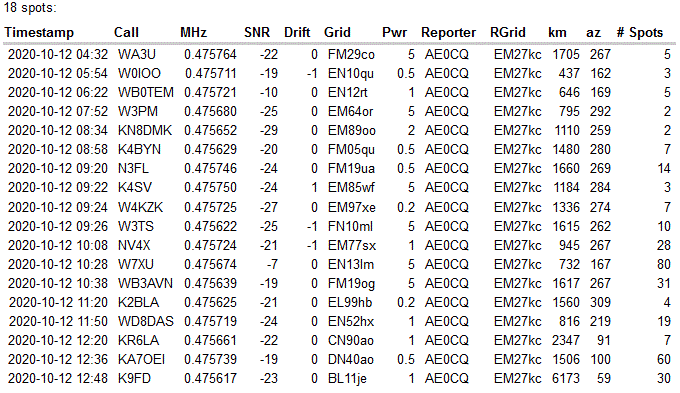
Sunday night: The target this time was 630 meters. Lots of static this time, combined with poor propagation in early evening, meant no decodes or even visible signals until N4VX showed up at -26 dB in the 0006 slot. That was it for decodes for the next two and a half hours!
I could sometimes see a signal extending just above 475.800 kHz that looked like WSPR-2 but apparently wasn't; when I moved it into the passband by deliberate detuning, it still wouldn't decode due to a different header signature. There was also someone extending below 475.600, but it did decode when I detuned the opposite direction and lied to WSJT-X about the Dial and BFO frequencies. At the 0234 slot it turned out to be K4SV, who was also visible later, but not decodable with correct tuning until its third and final decode of the night, by which time it had shifted to 475.750.
By that time, I considered abandoning the search as futile. But then WB3AVN made a weak first appearance (-27 dB) at 0334, W7XU showed up at a whopping -10 dB at 0342, WA3U and KA7OEI made it in at 0400, and the party was underway.
Many of the stations started dropping out by 1000. By 1132, the group had dwindled to KA7OEI, WD8DAS, KR6LA, and K9FD. The last DAS decode was 1150, KR6LA hung in through 1220, KA7OEI made it through 1236, and K9FD finally called a cab at 1248 UTC.
The unique-callsign summary of the session follows, apparently organized in order of the final decode of the night.
---------------------------------------------------------------
File Attachment 1: 11oct630.gif
T heard on the KFS sdr
KFS Omni antenna is picking up T 13563.45khz time is 2149 utc. SIW WSPR-15
Some nice fade ups.
Posted by John Davis on October 14, 2020 at 04:21:10.
Last week I did an overnight run on 185.300. Monday night I did 185.185 to see if I could catch the new graphical "SIW" segment, and also ran WSJT-X in WSPR-15.
No success with the graphical ID yet; in fact, the night was noisier than last week's effort, so even WSPR-15 was a challenge. But I did get one decode at 5:00 PM CDT Monday afternoon, a final one Tuesday at noon, and four in between, at 4, 6, 8 and 9 AM.
2200  -38   0.4    0.185185    0   K3SIW         EN51      0
0900  -37   0.1    0.185185    0   K3SIW         EN51      0
1100  -36   0.8    0.185185    0   K3SIW         EN51      0
1300  -35   0.4    0.185185    0   K3SIW         EN51      0
1400  -37   0.4    0.185185    0   K3SIW         EN51      0
1700  -37  -0.6    0.185185    0   K3SIW         EN51      0
Re: SIW WSPR-15
Thanks for the lowfer report John. In addition to the graphical segment on 185.185 kHz days I forgot to mention it's followed by a 10 wpm CW ID.
73, Garry, K3SIW, EN52ta, Elgin, IL
Re: T heard on the KFS sdr
Posted by Ed Holland on October 14, 2020 at 15:53:16.
In reply to T heard on the KFS sdr posted by Bill Hensel on October 13, 2020
Hi Bill,
I tuned in on the KFS receiver shortly after your post and also heard & saw strong traces for "T". Alas, being at work, I could not tune in and give you a report from PVC headquarters.
I wonder about setting up a web SDR, but not sure quite what is involved to get this off the ground.
Cheers and 73s
Ed
Re: Friday's hifer
Posted by John Davis on October 15, 2020 at 20:06:01.
In reply to Friday's hifer posted by swlem3 on October 09, 2020
Sorry to be so late reporting. Conditions were a little more favorable here on the 9th, apparently. From noon until mid-afternoon, at the watering hole I had NC with generally good signals, 7P fair to good, EH strong but jumping around wildly in frequency, ghostly appearances of ROM a few minutes at a time, but not enough to decode telemetry. Like Ray, I also saw no WSPR here that day.
I did a band scan away from the watering hole from 12:26 to about 12:50 PM CDT. WV was good, reaching some of the highest signal levels I've seen for it in a while, but also subject to deeps fades over moderate time periods. AZ was visible and sometimes faintly audible at 13554.095 kHz. TON was visible and sometimes faintly audible. WAS was fair to good at 13566.220 with a bit of flutter, which I finally perceived to be a beat note with a weak carrier that has been persistent on 566.208 for ages, and turns out to be an internal spur of the radio. I listened for a number of other stations as well (PBJ, MN, VAN, K6FRC, KAH, ODX) to no avail. Around 12:46, though, I began seeing someone fade in at 13566.805, which resolved into a faintly audible ABBY.
The watering hole then continued on much as I mentioned before, except NC and ROM disappeared by 3 PM CDT, and JB began appearing by 3:31 and lasted a few repetitions. EH switched off at 4:28:30, leaving only a weakening 7P to carry on. Around 5:20 PM, I switched over to 2200 meter WSPR for the night.
Saturday HiFERs
Posted by John Davis on October 15, 2020 at 20:40:53.
In reply to Re: Friday's hifer posted by John Davis on October 15, 2020
Resumed watching 22 m at noon Saturday. NC and 7P were good, EH was fair but jumpy again, JB was solidly visible and sometimes audible, and WV was good aural copy but had wider sidebands than usual. TON was fair visually but not audible. WAS was fair to good aural copy, and ABBY was fair on 13566.770 kHz at 12:21 PM CDT.
An hour later, I did another manual check. By then, NC was poor, 7P and EH were fair, and WV was only very faintly visible. Nobody above mid-band made any definite appearance at all.
Argo showed the band getting rather noisy in mid-afternoon from QRM, then everybody pretty much fading away but EH and sometimes 7P. By 5:10 PM, EH was loud and alone in the lower half of the band, and FRC was just becoming faintly visible in the upper half. By 5:18, even EH was on the way out so I went back to 2200 m.
Sunday HiFERs - Morning
Posted by John Davis on October 15, 2020 at 20:55:52.
Sunday was a more interesting day, so I'll report on it in three parts.
I started about 10:14 AM CDT at the watering hole, then did a band scan from 10:20 to about 10:40. NC was fair, 7P was fair to good, EH was present and became suddenly loud, and JB showed up at 10:15:30 audibly as well as nicely visible.
WV was very faintly visible down at 13554.985; AZ was briefly audible, then visual-only, on 13554.135; TON was visible and became briefly audible at 10:27. Above mid-band, K6FRC started out visual-only then reached fair audibility; none of the others appeared.
But things started getting interesting later.
Re: Saturday HiFERs
Posted by Chris on October 16, 2020 at 02:19:50.
In reply to Saturday HiFERs posted by John Davis on October 15, 2020
Thanks for the reports John. Abby seems to float between 13566.75-80~ In recent times and no changes made. Outside temps cooling down in SW Pennsylvania. I may consider adding coax and place black cat beacon inside to help stabilize frequency. If anyone has any tips on that.
Thanks, Re: SIW WSPR-15 (Wed-Thur)
Chris
Posted by John Davis on October 16, 2020 at 03:52:15.
In reply to Re: SIW WSPR-15 posted by Garry, K3SIW on October 14, 2020
Better conditions from Wed-Thur 1800 than from Mon-Tue. WM also did better, especially at night (see Attachment 1)...but still no sign of the graphical SIW ID (Attachment 2, same time frame as 1).
Only six decodes over the same time frame earlier, but 17 decodes this time...in other words, all but six of the valid 23 transmission slots. (I'm not counting the starting 1800 time slot because the transition of frequencies appeared to take place a few aeconds late, so the WSPR header may not have been sent in that particular slot.)
1900  -35   0.1    0.185185    0   K3SIW         EN51      0
2000  -35   0.1    0.185185    0   K3SIW         EN51      0
2100  -35  -0.2    0.185185    0   K3SIW         EN51      0
2200  -36   0.4    0.185185    0   K3SIW         EN51      0
0200  -39   0.1    0.185185    0   K3SIW         EN51      0
0300  -31   0.1    0.185185    0   K3SIW         EN51      0
0400  -32   0.4    0.185185    0   K3SIW         EN51      0
0500  -36  -0.6    0.185185    0   K3SIW         EN51      0
0600  -35   0.1    0.185185    0   K3SIW         EN51      0
0700  -36   0.4    0.185185    0   K3SIW         EN51      0
0800  -33   0.4    0.185185    0   K3SIW         EN51      0
0900  -32   0.1    0.185185    0   K3SIW         EN51      0
1000  -34   0.1    0.185185    0   K3SIW         EN51      0
1100  -36   0.1    0.185185    0   K3SIW         EN51      0
1200  -38   0.1    0.185185    0   K3SIW         EN51      0
1400  -37  -0.2    0.185185    0   K3SIW         EN51      0
1600  -36  -0.6    0.185185    0   K3SIW         EN51      0
1700  -36   0.1    0.185185    0   K3SIW         EN51      0
---------------------------------------------------------------
File Attachment 1: 14oct0129.jpg (WM)
File Attachment 2: 14octe129.jpg (SIW)
Re: Saturday HiFERs
Wow! Glad to hear that JB was actually audible at your QTH John. That chain link fence does a good job as a ground counterpoise I suppose, for the 1/4 wave vertical.
Looking forward to your further reports and thanks so much for posting them.
Someday these )$#*#$*)$* leaves will drop and the solar cell will have the needed sunlight to keep JB charged up!
Re: Saturday HiFERs
Posted by Ed Holland on October 16, 2020 at 17:51:50.
In reply to Re: Saturday HiFERs posted by Chris on October 16, 2020
Chris,
This is how I have run PVC since it was set up. The transmitting antenna (inverted V) being on top of the house, and wanting to be easily able to start, stop and adjust the transmitter, the latter lives on my basement radio desk. The connection uses RG6 (75 Ohm) cable, requiring a run of about 60 ft. A balun at the feed-point is employed in an attempt to keep the precious RF to just the antenna elements. No ATU or other matching device seems necessary, or beneficial. I had tried this in the past, but monitoring signal strength from one of my other antennas a reasonable distance from the beacon suggested there was no benefit.
Keep us posted on what you decide, and good luck,
Cheers
Ed
Re: Saturday HiFERs
Posted by Chris on October 16, 2020 at 18:53:57.
In reply to Re: Saturday HiFERs posted by Ed Holland on October 16, 2020
Thanks for the reply Ed, for now I moved and attached the enclosure to a thick tree that won’t sway with the wind as I previously had it attached to. The small Tree would move with slightest winds I found out later. We’ll see how this goes. Might move to basement about a 40ft run from the antenna. I will update if I decide to move it indoors.
Chris
Fri Night WSPR
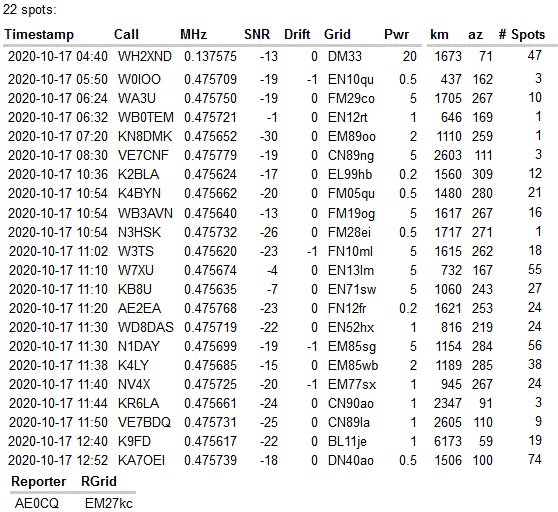
Posted by John Davis on October 17, 2020 at 17:45:06.
Started out on 2200 m and switched to 630 shortly before midnight. WH2XND was the only WSPRer at 2200. Although WSPRnet showed a few more stations as active, one of them chose to be on 137.500...a rookie mistake, as that put it directly under a batch of PLCs, which tend to cluster at 100 Hz multiples...and at least three of the others were running FST4W-1800; or maybe WD40, BVD, WTF or something else, for all I can tell with my limited receive-site computing capacity.
(Still curious how such long-form stations handle the 10-minute ID requirement. Anyone?)
At any rate, that got mighty boring, so I switched to 630 where I had the opposite problem, but generally a better one to have--too many stations to reliably snag them all. Each week this season continues to bring a number of new calls for the first time, too, which is great to see.
There were also some New Moders in the WSPR slot at 630 too that aren't in this list because I can't decode them, including one that continued well after daybreak just above the noise band at 475.630.* Most of them apprear to be FST4W-120, the new 2-minute propagation protocol, which is at least compatible with the intent of the WSPR-2 segment. But overnight, there was/were one or more that seemed to be in the new 60 second QSO mode, sometimes overlapping and probably preventing decodes of WSPR signals. Did the software developers consciously decide to skip band plans this time and unleash anarchy on us, or did they rush the beta into release and just not think about that aspect?
(*BTW, has anyone else noticed that the noise band at 475.630 is wider than before, and now appears to consist of two sources with a few Hz overlap in frequencies?)
---------------------------------------------------------------
File Attachment 1: 16oct-LW.gif
7P Loud and clear
13:10 PDT, and 7P is booming in with a great audible signal, the only presence in the "watering hole" for the time being.
J1LPB is back...
Posted by John Davis on October 17, 2020 at 22:59:31.
...this time in CW mode, and up on 13566.120, more or less. Full report later this evening.
Re: Fri Night WSPR
Posted by Paul N1BUG on October 17, 2020 at 23:58:56.
In reply to Fri Night WSPR posted by John Davis on October 17, 2020
"Did the software developers consciously decide to skip band plans this time and unleash anarchy on us, or did they rush the beta into release and just not think about that aspect?"
Please don't blame the developers. We are very fortunate that they take the time to create great new modes for us, being that they are not active on these bands themselves. If you must place blame, you can blame me. Though I was not alone, I did have a hand in this. For the record, here is how the current situation came about.
Originally the developers had set a dial frequency of 136.2 kHz with a fixed AF range of 1400-1600 Hz for FST4W. This would have created potential conflict between FST4W and WSPR15, also between FST4W and the NA/TA QRSS segment. What seemed far worse was that it would force monitoring stations who only have a single receiver to choose between monitoring the new modes *or* older modes. WSPR requires audio in the 1400-1600 Hz range, Opera 1450-1550 Hz. On 2200m I do not see forcing a choice between monitoring old or new modes as a good thing. Several of us in the early test group therefore felt that maintaining 136.0 [474.2] dial frequencies was desirable. [I do not recall the exact frequency originally proposed for 630m though I believe it was similarly just above the 474.2 frequency and would have placed FST4W just above WSPR]
I strongly felt that 137.4 - 137.6 was already overcrowded with dissimilar modes WSPR2, Opera32 and EbNaut. QRM between modes has been happening for some time. I and other members of the early test group advocated for allowing user selectable AF range for FST4W such that we would have some freedom to move FST4W to a different band segment while still maintaining 136.0 [474.2] dial frequency to facilitate easy simultaneous monitoring of multiple modes.*** At the time, I was thinking it better for the LF community to decide on a band plan than to have software developers decide for us. Since the release of rc1 I have made two attempts to interest the 2200m community in having a discussion about band planning. My attempts were met with strong opposition to band planning in any form and little to no support. The result is that I am now even further alienated from the old guard and band usage remains the same. I won't bring it up again. If you want to change band usage I suggest you connect with active 2200 and/or 630m operators and see if you can interest them in discussion toward that end.
*** Note! Currently the user selectable AF range is not particularly useful because the software will not upload spots outside 1400-1600 Hz to WSPRnet. I believe this has been corrected for the next rc or full public release, which I think we can expect prior to the November 17 expiration of rc1.
On 2200m, FST4 QSOs are taking place in the 137.1 to 137.4 segment. [No comment on 630m; I'm not active there and don't know the full story]
"Still curious how such long-form stations handle the 10-minute ID requirement."
As with older modes (WSPR15, Opera32, etc.) there is no built in ID provision in the software. I can't speak to what others may be doing but it is fairly trivial to program a QRP Labs Ultimate 3S to swap exciters by way of a relay and send a CW ID at programmed intervals. I believe a less disruptive approach might be to key a CW ID into the audio stream between the software and transmitter, if it could be done without creating other problems. Instead of completely cutting out one or more message bits, this would only partially interrupt the bits, leaving some useful (I think) portion of them present. I don't know how to sensibly implement that.
Paul
Re: Fri Night WSPR
Posted by John Davis on October 18, 2020 at 05:43:46.
In reply to Re: Fri Night WSPR posted by Paul N1BUG on October 17, 2020
Thanks for the effort at clarification, Paul. Clearly, it's a complex issue and I'll need to study it further before I can feel like I've got a handle on it.
I'm not trying to assign blame to anyone, but it's frustrating to see what was once merely mild chaos turning into further turmoil because of the new tools.
My view of new tools is that they are great if you have a need for them, and if they can be legitimately used within the rules. No doubt the new tools offer some advantages. But as for rule compliance, that's now an issue that needs to be addressed in software, not external work-arounds. Older long-form modes like WSPR15 and Opera32 were fine under Part 5 station ID requirements, and are still fine under Part 15 too, but hams turning a blind eye to the specific rules for their own service is not a good sign, IMO.
Re: Sunday HiFERs (11 Oct contd) - Midday
Posted by John Davis on October 18, 2020 at 21:35:31.
In reply to Sunday HiFERs - Morning posted by John Davis on October 15, 2020
Reckon I should finish last weekend's report before tackling new ones. EDJ was beginning to show up fair at the watering holes by the end of the noon hour, NC was good, 7P and a very jumpy EH were fair to good, ROM was weak and wispy, while JB was still strong. You can see these in the 11oct19.jpg attachment.
By 1:40 PM CDT, all the watering hole gang had diminished further. Neither WV nor AZ were visible or audible; TON was visible only; and absolutely no one above mid-band (MN, VAN, FRC, KAH, WAS, ODX or ABBY) was either audible or visible.
Reception remained in much the same doldrums through mid-afternoon until one remarkable exception that only lasted about two minutes (attachment 11oct38.jpg). Suddenly WM showed up out of nowhere, peaking in level just in time for the CW ID to be audible. Seconds later, it was gone again for the rest of the day.
But there were other surprises in store.
---------------------------------------------------------------
File Attachment 1: 11oct019.jpg
File Attachment 2: 11oct38.jpg
Re: Sunday HiFERs (11 Oct contd) - Midday
....awaiting Part III ! :-)
Re: J1LPB is back...
Posted by Steve VA3SC Burlington on October 19, 2020 at 00:20:15.
In reply to J1LPB is back... posted by John Davis on October 17, 2020
Hearing J1LPB on 13.566.42 MHz (CW) at 00:20 UTC Oct 18/2020) ....mind you, we are only about 5 miles apart...but I hear him! weak but consistent signal.
Re: T heard on the KFS sdr
Posted by Ed Holland on October 19, 2020 at 00:51:27.
In reply to Re: T heard on the KFS sdr posted by Ed Holland on October 14, 2020
Sunday, 4pm? It must be T time ;-)
Indeed it was, "T" was beeping away at 1600 PDT, good audible copy here at PVC
73s
Ed
Re: Sunday HiFERs (11 Oct contd) - Late Afternoon
Posted by John Davis on October 19, 2020 at 01:36:35.
In reply to Re: Sunday HiFERs (11 Oct contd) - Midday posted by John Davis on October 18, 2020
Late day saw brief improvements on some paths. MTI and NDB2 put in rare appearances, too.
Attachment 11oct44.jpg shows a good interval just after 4:30 PM CDT, in which NC was getting antsy to quit for the day, but EH had finally settled down in frequency (colliding with 7P, unfortunately), EDJ was more solid, and JB made a triumphant return to visibility and audibility. Between the latter two, MTI sneaked into view just briefly.
An hour later, NC was back but only at fair to poor levels, 7P and EH were fair to good with an audible beat note, EDJ had faded out, and JB was still going strong.
At that point, I did another band scan. This time, WV was visible and faintly audible. AZ seemed to be absent at first, but on review of my Argo screens I notice an RF smudge that might be it. What was remarkable, though, was audible keying fading in on 13553.495 which rapidly became copyable as NDB2 (see attached 11oct53.jpg). Like WM, it was a cameo appearance, but not as brief. I managed a recording while it was on screen, and am also attaching an MP3 excerpt.
Elsewhere on the band, there was still no PBJ (I tried for it because of the short-path opening from NDB2), but TON was visible and faintly audible. No MN or VAN. K6FRC was faintly visible. I could hear WAS, but initially couldn't see it because it was disguising itself/hiding behind the 13556.208 spur in my IC-R75. Interestingly, Argo couldn't distinguish between them until I turned off Visual AGC. No KAH, ODX, or ABBY.
Before 6 o'clock I tuned to LF for the night. By then the watering hole gang were all rather feeble except JB, who was still nicely visible and sometimes audible.
---------------------------------------------------------------
File Attachment 1: 11oct44.jpg
File Attachment 2: 11oct53.jpg
File Attachment 3: 11oct-ndb2.mp3
279 kHz Watan Radio
Interesting information on LW 279 kHz Watan Radio: Re: Sunday HiFERs (11 Oct contd) - Late Afternoon
The transmitter in Turkmenistan is working, but modulation (sound),
judging by the posts on the forums, is very rare (or very quiet).
Personally, in two years I heard modulation only three times, and then
more than a year ago.
Judging by the sound quality, somewhere in the sound channel there is
a device like a noise suppressor, whose settings have drifted away over time, and it began to completely crush not only the noise, but also the useful signal. Why the workers of the radio station for several years have not been able to find a fault and have wasted heating the air is a mystery.
The transmitter most often turns on at about 2 am UTC (5 am Kyiv time), then turns off during the day. The work schedule is irregular, but a 4-day period can be traced. It seems that the duty shifts work in a “day after three” mode, and each has its own work schedule, which is also unstable. One of the shifts often leaves the transmitter on overnight. Today is just such a night, the next – from 16 to 17 October.
https://forum.ukrtvr.org/index.php?topic=678.msg140754#msg140754
I don’t know how true this is, but it may well be. I wonder why they won’t eliminate it? If there really is a squelch, then adjust, replace or remove it altogether.
Nikolaev Gvozdenis, Ukraine
http://www.radioscanner.ru/forum/topic30247-413.html in RUS-DX (WOR groups.io (2020-10-18) (via Mediumwave.info)
Posted by Jeff K8NDB on October 19, 2020 at 10:52:41.
In reply to Re: Sunday HiFERs (11 Oct contd) - Late Afternoon posted by John Davis on October 19, 2020
John, I appreciate the the excellent NDB2 report Sunday. It is good to know that the beacon is still healthy in Illinois. Being solar powered, I often wonder if the solar charging/storage system is still working. Thanks! Jeff K8NDB
630 m reception record
Posted by Ed Holland on October 19, 2020 at 15:20:50.
Hi Folks,
Just to report that 630 m was in particularly good form last night on the West Coast USA. Usually the longest distance WSPR spot is K9FD in Hawaii ~ 3000 km away, which is impressive enough. Just before Sunrise this morning ~1358 UTC, however, I snagged two WSPR spots of VK4YB, located in Queensland, Australia - a distance of ~11000 km!
Antenna: 90 ft random wire "Inverted L" transformer coupled to 75 Ohm coax
Receiver: Icom R-72
Decode: WSJT-X
73s
Ed
Re: Sunday HiFERs (11 Oct contd) - Late Afternoon
Posted by WA1EDJ Bob on October 19, 2020 at 15:26:40.
In reply to Re: Sunday HiFERs (11 Oct contd) - Late Afternoon posted by John Davis on October 19, 2020
Thanks for the report John! Good to hear EDJ is making it again.
I'm hearing nothing here in N GA lately. Mostly because I'm looking later in the day.
I'm missing prime time since QRM-W interferes. I'll continue to be QRV most days until later in the afternoon for listening. Thanks to your calibration, I can see I'm actually TX on about .555 430.
Can't change that due to the Epson Osc. but looks like I'm in the clear.
Bob Re: 630 m reception record
EDJ
EM83du
Posted by John K5MO on October 19, 2020 at 16:09:59.
In reply to 630 m reception record posted by Ed Holland on October 19, 2020
Ed, that's absolutely amazing. Are you in a particularly quiet environment for this great reception?
John
Re: Sunday HiFERs (11 Oct contd) - Late Afternoon
Posted by John k5mo on October 19, 2020 at 16:12:21.
In reply to Re: Sunday HiFERs (11 Oct contd) - Late Afternoon posted by WA1EDJ Bob on October 19, 2020
Bob, how did you get the Epson so stable? Are you using the plastic package version (8002SG IIRC) or are you using something with better frequency stability? Very impressive!
Re: Sunday HiFERs (11 Oct contd) - Late Afternoon
Posted by John K5MO on October 19, 2020 at 16:22:21.
In reply to Re: Sunday HiFERs (11 Oct contd) - Late Afternoon posted by John Davis on October 19, 2020
One of the odd and fun things about the 11OCT44.jpg screen grab is that JB is strong , when NC has QSB'd out even though we're only about 100 miles apart.
Propagation is a wonderful and mysterious thing :-)
Re: 630 m reception record
Posted by Ed Holland on October 19, 2020 at 17:30:24.
In reply to Re: 630 m reception record posted by John K5MO on October 19, 2020
John, I thought it was too good to be true, but then noticed two distinct "spots" a few minutes apart. I'll post the WSJT log later when I get back home.
We live in a small town on the SF Peninsula, just on the Eastern Side of the Santa Cruz Mountains - Palo Alto & Menlo Park are the nearest cities, about 5 miles away.
It is hard to define quiet, but 630 m noise seems to be QRN rather than QRM, even though we have power lines in the neighborhood, and properties surrounding us. Noise level varies on the setup, but if I recall correctly, was in the S5 range this morning. The worst QRM offender was harmonics from our "invisible" dog fence, until I added some low pass filtering to the output.
I'll be listening again - it would be great to see a repeat of this trans-pacific activity.
SAQ on air 24 Oct for United Nations Day
Posted by Vic GW4JUN on October 19, 2020 at 20:49:16.
This just in from SAQ HQ
I hope to be able to listen out from my home QTH in North Wales. Tricky to hear in the US but the You Tube live feed is an excellent alternative !
73 Vic GW4JUN
>>>>>>>>>>>>>>>
On United Nations Day, October 24, 2020, the SAQ transmitter in Grimeton will again send out a message to the whole world on 17.2 kHz CW.
Programme:
(On Air and YouTube Live Video)
16:30 (14:30 UTC): Startup and tuning of the Alexanderson Alternator SAQ.
17:00 (15:00 UTC): Transmission of a message from SAQ.
We are proud to announce that this year’s message has been composed by
Anders Tegnell – Chief Epidemiologist Public Health Agency of Sweden.
(YouTube Live Video only)
17:20 (15:20 UTC): Live music concert from the transmitter hall.
Anna Louise Ekman www.annalouiseekman.se will perform Swedish and Italian songs, accompanied by a pianist.
YouTube Live Video Europe 1 on 183 kHz
The entire transmission event and the following concert can be seen live on our YouTube Channel starting at 16:30 (15:30 UTC).
Posted by Mike Terry on October 20, 2020 at 08:16:55.
Some newspaper websites of LW Saarlouis EUROPE # 1
183 kHz 750 / 375 kW mentioned it to be blown-up soon and scrapped then for ever.
Europe 1 Saarlouis site
Europe 1 antenna mast
Saarbrücker Zeitung
Access maybe blocked behind Paywall Google or Facebook etc.
Wolfgang Bueschel (2020-10-19)
(via https://mediumwave.info/2020/10/)
Re: Sunday HiFERs (11 Oct contd) - Late Afternoon
Posted by WA1EDJ Bob on October 20, 2020 at 16:49:11.
In reply to Re: Sunday HiFERs (11 Oct contd) - Late Afternoon posted by John k5mo on October 19, 2020
John,
It is the plastic version. I had observed the stability was an issue in the past. Especially when observing it on ARGO with the QRSS20 or 30 setting. Didn't look that good. So this time I just clamped the TX PCB in plastic bench vise and set a folded face cloth rag over it. This just keeps out drafts and I believe stabilizes the temp some what. It does seem to behave well at QRSS3. It is in my basement at about 68 deg F with no drafts. 100Ft of 50 Ohm coax to a 1/4W vert. 10Ft off gnd.
I think it would have stability issues outside in a box. I was thinking of doing a solar beacon on a pole but never seem to get to it.
Bob Lowfer TAG?
EDJ
Posted by John, W1TAG on October 20, 2020 at 18:14:46.
I used to run Lowfer TAG from Raymond, ME over the winter, from the end of October through some point in May. A couple of years ago, I had to take the antenna down due to tree removal next to our cottage. I'm presently at the point where I could put up something like the original loop, but probably with #12ga wire instead of the old RG-8 (I do mean OLD, as that cable is 73 years OLD).
TAG had been running on 185.297 kHz, with QRSS60. Looking at the beacon list, I see no problem, but want to be sure that there has been no observed activity there. The frequency is stable -- probably within 0.01Hz over the winter. TAG would be on the same screen used for viewing WM, SIW and SJ.
Another choice would be to resurrect WOLF, and put the beacon on 185.500 or 185.800 kHz. But I suspect there are few left who have any interest in that mode.
Any comments before I proceed?
John, W1TAG
Re: T heard on the KFS sdr
Posted by Bill Hensel on October 20, 2020 at 22:31:51.
In reply to Re: T heard on the KFS sdr posted by Ed Holland on October 19, 2020
Thanks, Re: Lowfer TAG?
Ed...73
Posted by John Davis on October 21, 2020 at 02:04:41.
In reply to Lowfer TAG? posted by John, W1TAG on October 20, 2020
It would be great to see TAG again--or to have WOLF howling through the night, either one.
Attached is a capture that seems fairly representative of last week's 96 hour ultra-marathon session of QRSS60 at 185.300 kHz. It crosses the night/day transition, revealing the slot between SIW and WM to be unoccupied by intentional signals, and not even too subject to the daytime QRM that sometimes plagues WM.
Although some might find it old-hat, I would be delighted to have more chances to work with WOLF. It's perfect for those of us who have limited computing power to devote to the most modern WSJT digital modes, and who own receivers with decent stability but which are not up to the precision required for EbNaut. For anyone not familiar, details are available at www.qsl.net/dl4yhf/wolf/index.html but in essence it is a protocol that employs 10 bit/second BPSK that repeats a block of 15 text characters. The receive software builds up an increasingly accurate decode of the message over multiple repetitions, depending on the signal to noise ratio. It's a remarkable process to watch.
John D
---------------------------------------------------------------
File Attachment 1: 16octd0184.jpg
Re: J1LPB is back...
...now the details. It was a puzzle for 1-3/4 hours Saturday afternoon who the wandering intruder was that showed up faintly above KAH at 2:16 PM CDT. (Actually, KAH was interesting by itself, as I hadn't seen or heard it in nearly two weeks, and here it suddenly was with fair to very good signal strength.)
The newcomer was briefly just audible...thought I heard a B at the end of one ID and a J at the start of a later one, but couldn't tell much else at that point. It didn't even occur to me yet that there was something odd about the signal itself, not readily apparent to the ear: two carriers, spaced about 3 Hz apart! Before that had a chance to dawn on me, the signal took off staggering across the screen like a drunken sailor on rough pavement, or a cattle herd in stampede mode. See attachment 17oct3738.jpg.
In addition to the obvious fading, the drift made it even harder to copy the call, because WAS was sometimes clearly audible as little as 50 Hz above this screen, and KAH was often quite loud, scarcely 100 Hz below. After 20-some minutes of struggling with this one, I rested my ears by checking for ODX, which came in fair, and ABBY, which didn't show up at all.
At 2:41 I returned to sit on 13566.100 for as long as necessary, and could alternately hear WAS and KAH nicely. The mystery signal had stabilized to the range of 566.128-.135 but was weak and broken for a while. About 12 minutes later, it was just strong enough to resume my quest for an ID. I'd first thought it was a three-letter ID sent at Farnsworth spacing, maybe with an L in the middle. I remained confident that the last letter was a B, but I was no longer sure of the first letter. It had begun to sound like an O followed by some longer letter. Then it became apparent there was another letter between L and B--four, maybe five characters total; no Farnsworth here.
Having made no further progress by 3:32 PM, I took another break and found ODX doing well visually but fair to poor audibly; no ABBY, FRC, VAN, MN, TON or AZ; WV varying from good to nil with wide QSB; and at the watering hole, NC fair to poor, 7P poor, EDJ fair, and JB audible again just before 3:46. I returned to 13566.100 refreshed.
What I had been hearing as OJL[?]B, with certainty only about the B, was now more like OJLPB, with certainty about the L and B. With that in mind, it seemed there must be an element missing from the presumed second letter "J", and also one from the initial "O" because I was pretty confident I'd heard the first letter correctly as a J 90 minutes before. That would likely make it J1LPB in a new guise, but I couldn't yet be positive. WAS's fade to mostly inaudible helped a little, but KAH remained too strong for a while longer. Then KAH began a slow fade, and I could finally hear the missing dot in front of the presumed "O" and the missing dash from the end of the second letter. By 3:59 PM, it was J1LPB without any doubt! The capture 17oct49.jpg documents the signal variations of that time frame, and the transition from KAH to dominant J1LPB is very clear in the (admittedly longer than usual) MP3 clip.
Notice the continued split in the carrier frequency in the later capture. This does not appear to be the multipath Doppler shift bifurcation that sometimes manifests on 22 meter signals under sporadic-E conditions; it is too consistent over time. It would appear to be emanating from the transmitter itself in some way.
John
---------------------------------------------------------------
File Attachment 1: 17oct3738.jpg
File Attachment 2: 17oct49.jpg
File Attachment 3: 17oct-LPB.mp3
2200m QRPP FST4W-1800
I will be running my 2200m QRPP FST4W-1800 beacon for the following 5 days (Wed thru and including Sun) on 136.0 + 1419 Hz at 1mW ERP both odd and even periods. Reports and spots welcome.
Re: J1LPB is back... (Canadian Corner)
Posted by John Davis on October 22, 2020 at 07:55:20.
In reply to Re: J1LPB is back... posted by Steve VA3SC Burlington on October 19, 2020
To kind of wrap up last weekend, here's some of the ODX reception on the 17th that I mentioned elsewhere in the thread. If ODX and WAS were to trade places, I could have three of the current four Canadians within my CW filter passband simultaneously.
It has only been a couple of weeks ago that I couldn't receive anyone at all from north of the border, but as of last week that changed. Sunday afternoon also saw reception of ROM, KAH, J1LPB and ODX, and conditions again favored the late afternoon for those above mid-band.
---------------------------------------------------------------
File Attachment 1: 17oct50.jpg
File Attachment 2: 17oct-odx.mp3
is there a NDB2?
I was listening on the Sedona Kiwi SDR and heard what I believe was "NDB2) at about 13554.xx . Copy was marginal and I'm really uncertain what it is I was hearing/seeing but I think that's it.
I'm guessing it might be a reincarnation of the NDB that's listed in the Hifer section?
Thursday HiFERs 22 Oct.
Posted by John Davis on October 22, 2020 at 21:36:51.
The Canadian Corner (13566+) and the watering hole were well populated today around solar noon, between 1:00 and 2:00 PM CDT. This was the first day (and very likely the last) this week that both sufficient free time and favorable weather made it feasible to go to the farm.
NC, 7P, and EH were all fair to good strength; something faintly resembling RY could be detected at times; JB was fair to very strong; and ROM was just beginning to show up and soon became quite solid for one entire message (see attachments). Later it went into a fade, before which it also suffered some frequency anomalies and seemed to have a different telemetry payload that I couldn't quite decipher.
Above mid-band, I could see and just faintly hear K6FRC and WAS. KAH (13566.062) and J1LPB (13566.112) alternated being good copy by ear. They varied from good to nil over the span of one or two IDs; much QSB. A little higher up (.465), ODX was visible and fairly audible, with very little QSB. ABBY's keying was visible at 13566.750, but was only strong enough to copy one "BY" by ear before receding into the noise.
I observe that the nearly 3 Hz split in carrier frequencies remains in LPB today, and it almost appears KAH has a similar split, partially obscured by the keying sidebands of its shorter, slightly faster message. (Is this a Canadian thing ...one carrier for French, another for English? ;)
---------------------------------------------------------------
File Attachment 1: oct22ROM1ab.jpg
File Attachment 2: oct22Can.jpg
Re: is there a NDB2?
Yes, there is, and yes, it's affiliated with beacon NDB but in a very different location. It is, in fact, the very first beacon in our 22 meter list.
Jeff K8NDB will undoubtedly be pleased to see that the signal was making it all the way from St Libory, IL, to Sedona! Who knows, that might mean he could copy it today at his home QTH in southwestern AZ.
Remembering Edward Phillips, W6IZJ
Posted by Dave Stinson AB5S on October 22, 2020 at 23:01:02.
Back in the 1980s when I was in the Nevada
desert, feeding Strawberry ice cream to the little
grey aliens, I had the privilege and blessing to work
with a group of talented and enthusiastic people,
eager to help any newbie who shared their passion
for pioneering in the 1750 Meter band (160-190 KC).
I'd always had a deep interest in Longwave.
Power and antennas were severely restricted
and many believed it was impossible to do any
useful work there, especially since most of us
had no computers other than the squishy ones
between our ears. Such a "you can't it's
impossible"challenge was irresistable to us.
You could use any mode you like, but if you
actually wanted to contact someone,
Morse Code was it.
Most of us ran continuous CW ID beacons.
Since it is a "license free" Part 15 band,
you made-up call signs.
One day in '84 or there-abouts, I got tired of
ordinary 40- and 20-meter DXing at the base
ham shack and decided to start working with
LF again. Connected the 50' 40-meter dipole
as a Marconi "T" and started listening.
It wasn't long before I heard my first "LOWFER"
beacon, which was Ed Phillips, W6IZJ. I felt
as excited as when I was a Novice working my
first out-of-state station: "Garrr-LEE!"
Ed's steady "IZJ" beacon became a "standard" for
band conditions. Got to meet him at our first
"Lowfer" get-together in California a couple of
years later. We went on to set records and
experiment with the first crude "improved SNR"
modes, like Slow- and Coherent-CW modes.
What a blessing to contribute to such a group.
Ed was a valuable asset to our endeavors.
You're free of "The Curse of Flesh" now, Ed.
We who remember you will miss you.
May The Lord comfort yours
and give you Peace.
GL OM ES 73 DE Dave AB5S Felsberg masts demoilished
Posted by Mike Terry on October 23, 2020 at 09:26:57.
wo of the antenna masts from Europe 1 in Felsberg are now history. They were taken down yesterday. “There was a bang when the masts 11 and 12 of the Europainsender in Berus were blown up at 2 p.m. A deer and a hare at full gallop quickly got to safety in the fields in the neighborhood, some small children in Ittersdorf and Düren cried in shock on their mothers’ arms, although they had previously been warned of the expected bang….” More in this article (in German) in Saarbrücker Zeitung Christian Ghibaudo (2020-10-21) via Medium Wave Info.
Bclnewshttps://www.saarbruecker-zeitung.de/saarland/saarlouis/ueberherrn/knall-im-ganzen-tal-zu-hoeren-sendemasten-in-berus-gesprengt_aid-54154059?utm_source=mail&utm_medium=referral&utm_campaign=share
Re: SAQ on air 24 Oct for United Nations Day
Posted by Mike Terry on October 23, 2020 at 09:38:18.
In reply to SAQ on air 24 Oct for United Nations Day posted by Vic GW4JUN on October 19, 2020
Thank you for posting this Vic.
Here's the link for pictures etc:
https://alexander.n.se/saq-grimeton-transmission-on-october-24th-2020/
Re: Felsberg masts demolished
Posted by Mike Terry on October 23, 2020 at 09:51:18.
In reply to Felsberg masts demoilished posted by Mike Terry on October 23, 2020
(Typos corrected)
Two of the antenna masts from Europe 1 in Felsberg are now history. They were taken down yesterday. “There was a bang when the masts 11 and 12 of the Europainsender in Berus were blown up at 2 p.m. A deer and a hare at full gallop quickly got to safety in the fields in the neighborhood, some small children in Ittersdorf and Düren cried in shock on their mothers’ arms, although they had previously been warned of the expected bang….” More in this article (in German) in Saarbrücker Zeitung Christian Ghibaudo (2020-10-21) via Medium Wave Info. Re: Remembering Edward Phillips, W6IZJ
Bclnewshttps://www.saarbruecker-zeitung.de/saarland/saarlouis/ueberherrn/knall-im-ganzen-tal-zu-hoeren-sendemasten-in-berus-gesprengt_aid-54154059?utm_source=mail&utm_medium=referral&utm_campaign=share
Posted by John K5MO on October 23, 2020 at 12:07:33.
In reply to Remembering Edward Phillips, W6IZJ posted by Dave Stinson AB5S on October 22, 2020
Very nicely done Dave.
I just recently stumbled on some pictures of you from those LW beacon days. Steve McG's LW site has a bunch of interesting photos of the folks at the "Lowfer" get togethers, including you, Steven, and John (of the KiwiSDR fame).
Best 73
John K5MO
PS: And thanks to Steven McG for the great photos.
Re: is there a NDB2?
Posted by John K5MO on October 23, 2020 at 12:13:19.
In reply to Re: is there a NDB2? posted by John Davis on October 22, 2020
I think I must be going blind, John. I looked twice at that list before posting, and found NDB, but not NDB2. DOH!
Just an FYI--- the Sedona Kiwi SDR hears extremely well. I could aurally copy NDB2 at QSB peaks yesterday.
I think I'll sent up ARGO on the audio output of a PC. While I love the Kiwis, I sure wish it had a QRSS decoder built in!
Re: Remembering Edward Phillips, W6IZJ
Posted by Frank Cathell on October 23, 2020 at 20:32:57.
In reply to Re: Remembering Edward Phillips, W6IZJ posted by John K5MO on October 23, 2020
Sorry to hear Ed passed. He lived a long and full life and I remember our many science conversations at night on 3927 in "the old days". I visited him a couple of times and was fascinated not only with his radio gear, but his incredible collection of home-made electrostatic machines and other physics "toys". RIP Ed Phillips.
Frank
Re: Thursday HiFERs 22 Oct.
Posted by Robert, VA3ROM on October 24, 2020 at 15:53:40.
In reply to Thursday HiFERs 22 Oct. posted by John Davis on October 22, 2020
Hi John,
I send my generic grid square EN58 once an hour so you know from where my beacon is originating from using regular Morse code characters so that lower image is ROM followed by the grid. The giveaway clue is the 5 dits so it can't be a cut number. I look for the 5 dits to confirm whether it's a telemetry packet or grid square.
As for frequency anomaly. Perhaps a flock of Canadian geese perhaps flying through the signal, eh? Don't know if they were bilingual geese or not ;)
73,
Robert
Lowfer TAG WOLF
Posted by John, W1TAG on October 24, 2020 at 19:25:04.
Lowfer TAG on 185.800 kHz from Raymond, ME is on the air in WOLF mode. I may need to play with it some more, but it should basically be on the air for the winter (unless Mother Nature intervenes).
Good news/bad news: The WOLF part of the equation appears to be running solidly, with the transmitter within 0.01 Hz of 185.800, and the keying timing is close to perfect. The bad news is that I gave up some efficiency by using #12 wire for the loop antenna. If this new setup survives the winter, I will try putting up the old RG-8 next year, and using the shield as the antenna conductor. That stuff is pretty heavy, and the big pine that holds up one corner is right on the lake edge, and sways a lot in the breezes.
My guess is that this will be a dead-of-winter thing for those outside of New England, but radio is full of surprises. Reports are always welcome.
For those new to WOLF, the program remains available at:
https://www.qsl.net/d/dl4yhf/wolf/index.html
I can offer advice on determining your actual receiver frequency and your computer's sound-card sampling rate. For the folks who were successful with EbNaut, this ought to be duck soup.
John, W1TAG
Re: Thursday HiFERs 22 Oct.
Posted by John Davis on October 24, 2020 at 20:36:13.
In reply to Re: Thursday HiFERs 22 Oct. posted by Robert, VA3ROM on October 24, 2020
Thanks Robert, that accounts for it. I wasn't sure if my eyes were deceiving me or whether it was really five dits or what. That makes sense now.
As for a flock multilingual geese, I suppose that's a possibility.
When I lived in Georgia, there were a colony of Canada geese that spent every summer on the lake behind my house. Moe, Larry, and Curly were three ganders who hatched there one spring, and whom I named because of their various behaviors toward each other. The next spring, they returned with mates and raised families of their own. They repeated that process happily for several years, except one summer when Mrs Larry took up with a previously unknown gander that I named Zeppo because (a) he wasn't from the same flock, (b) he obviously considered himself handsome, and (c) he was all the more exotic and special because he was banded, and had the letter Z on his neckband. Hence, Zeppo.
So much for the myth of goose monogamy! Poor Larry hung around morosely, receiving abuse from both of his brothers for a change, instead of being allowed to boss Curly around as usual. By the end of summer, though, Zeppo tired of his fling and flew the coop south with his own flock after they returned for a brief stopover on the lake.
Larry and his mate eventually reunited. Then one evening, Curly and Mrs Curly waddled up to my patio, took a polite nibble of the cracked corn I brought out for them, then decided we need to talk. Curly walked right up to me, fortunately in a non-aggressive manner (I recognize the body language of goose aggression all too well from an incident when I was four years old!), and began vocalizing as if he were discussing something very important. I tilted my head slightly on occasion in a sign of attentiveness, but I was totally clueless as to what he was babbling about. It might have been an explanation of Larry's woes, or an apology from Curly for a misunderstanding he'd had with me early in the summer, or an invitation to visit them at their wintering grounds. Over the years, I have spoken a little French, Provençal, German, and now Spanish, but I remain in the dark about Goose.
If it was supposed to be French, it certainly wasn't Parisian nor Québécois, because they had clearly never migrated that far. They overwintered on a pond at the Georgia-Pacific plywood mill a whopping five miles southwest of me; although perhaps they mingled there with other flocks, perhaps from Cajun country. Nobody understands Cajun French...not even Cajun folk. I'm convinced my friends in southern Louisiana just make it all up as they go along. ;)
Re: Lowfer TAG WOLF
Posted by John Davis on October 24, 2020 at 21:26:35.
In reply to Lowfer TAG WOLF posted by John, W1TAG on October 24, 2020
OW-OW-OWOOOO! Oh, OWOOOO I say! 
And just before Halloween, too, no less.
Hard to guess what effect the different antenna may have, but maybe we'll see over the next few months.
Sound card calibration will not be difficult and my receiver is pretty much a known quantity now. It's eerie, though, watching a signal decode on screen whose carrier can't be seen on Argo at any speed!
Thanks, JA.
Re: Lowfer TAG WOLF
Posted by John Bruce McCreath on October 25, 2020 at 15:06:45.
In reply to Re: Lowfer TAG WOLF posted by John Davis on October 24, 2020
Late last evening I downloaded the WOLF software and got it configured in my Dell Win7 PC. Sunday evening, I will take my beacon EAR off the air for a few hours, so I can have a look and listen for W1TAG's howls after local sunset here. I'll post any reception reports here and on the LowFER reflector, if I'm successful.
73, J.B., VE3EAR BBC Radio 4 198 kHz Droitwich
Posted by Garry WA1GWH on October 26, 2020 at 02:14:47.
Hello everyone,
I am not a member, but it appears I am permitted to post. A while ago I found out about BBC Radio 4 on 198 kHz. I am not a LW listener, but am an occasional MW DXer on FET regens that I build. Does anyone know if it is possible to hear Radio 4 on 198 kHz in the US? I live near Syracuse, NY and can put up an outdoor inverted L, with loading if needed.
Thank you,
Garry
Re: BBC Radio 4 198 kHz Droitwich
Posted by John Davis on October 26, 2020 at 02:56:08.
In reply to BBC Radio 4 198 kHz Droitwich posted by Garry WA1GWH on October 26, 2020
Glad to have you with us, Garry. Everyone with an interest in longwave is welcome.
It is theoretically possible to hear BBC Radio 4 in the States, but it is a considerable challenge because of aeronautical beacon DIW on 198 kHz in Dixon, NC. I think it has been done in the Northeast (possibly one of our readers in the region can confirm this), but it generally requires a loop antenna to be able to null DIW enough to do the job. I believe an inverted-L is likely to be too omnidirectional for the task.
Re: Lowfer TAG WOLF
Posted by John Bruce McCreath on October 26, 2020 at 03:37:29.
In reply to Re: Lowfer TAG WOLF posted by John Bruce McCreath on October 25, 2020
After five hours of looking/listening for TAG I'm sorry to have to report that I was unsuccessful in decoding it.
As of 11:15 PM Eastern Time, beacon EAR has returned to the airwaves. Maybe some other time I'll be lucky.
73, J.B., VE3EAR Re: Lowfer TAG WOLF
Posted by Mike N8OOU on October 26, 2020 at 13:30:15.
In reply to Lowfer TAG WOLF posted by John, W1TAG on October 24, 2020
John,
I am new to WOLF. I shut off WM this morning and tried to receive WOLF on 185800 with no luck. What dial frequency should I use, or what is the audio input frequency the WOLF program expecting?
Mike 73... (WM is back on the air now.)
Re: Lowfer TAG WOLF
Posted by Garry, K3SIW on October 26, 2020 at 14:46:41.
In reply to Re: Lowfer TAG WOLF posted by Mike N8OOU on October 26, 2020
Mike, the latest wolf gui code was compiled Feb 17, 2013. An earlier version was compiled Jan 16, 2008. Both default to a center frequency of 800 Hz with 8 kbps sampling. But one can change those to whatever is preferred. There is a helpful "Frequency measurement (RX-drift check)" under the Mode heading. Also under Mode be sure to choose Wolf10 normal speed of 10 bits/sec. A manual for the gui is at https://www.qsl.net/dl4yhf/wolf/wolf_gui_manual.html. Among other things it lists parameter options for command line operation. An example that results from clicking "Receive only" under mode is
WOLF10 -r 11025.222 -f 400 -t 1.0 -w 0.0000 -ut
This means the program is running with a sampling rate of 11025.222 sps (-r) centered at 400 Hz offset (-f) from the USB tuning dial with a frequency tolerance of 1 Hz (-t) and no Slew rate adjustment (-w). The -ut indicate to output time in GMT (it's helpful to check "Show time of day in each decoded line" under the Special tab).
I wondered why WM was missing this morning and now I know. It's back on the air again coming in fine now.
73, Garry, K3SIW, EN52ta, Elgin, IL
Saturday 24th, Sunday 25th HiFERs
Posted by Ed Holland on October 26, 2020 at 17:14:00.
More to come on this, once I have reviewed the reams of captures. This weekend showed two days of somewhat consistent reasonable conditions for longer distance reception.
NC - sometimes audible, EH notable, alongside other traces for which I have yet to make a complete ID. At times I was able to see 5 or more "Watering Hole" traces. 7P showed the most dramatic behaviour, from being invisible on the Spectrum Lab display at some times, to "next room" audible copy at others during the mid morning.
Both days were relatively similar in conditions and pattern of propagation.
Station PVC is returned to beacon operations for the week.
Re: Lowfer TAG WOLF
Posted by John Davis on October 26, 2020 at 18:56:36.
In reply to Re: Lowfer TAG WOLF posted by Garry, K3SIW on October 26, 2020
As Garry noted, this software largely pre-dates WSPR, OP, and other SSB-dependent digimodes. Although USB is involved in its transmission, it was still assumed most reception would be with radios set for good old CW mode. As long as you set the offset to what your radio uses for CW audio center frequency, just select CW mode (normal or reverse, depending on how your radio defines that; normal is upper-sideband-sense on my Kenwoods, while REV is on my ICOMs), tune to the published carrier frequency, and let the radio do the math.
It's interesting to observe how quickly everyone has gotten used to thinking not in terms of carrier frequency when receiving, but "dial frequency" and offset instead. But there are still technical advantages (in terms of noise rejection and dynamic range) to employing no more IF bandwidth than absolutely necessary for the signal you are trying to snag.
Re: BBC Radio 4 198 kHz Droitwich
Posted by Paul N1BUG on October 26, 2020 at 21:51:53.
In reply to Re: BBC Radio 4 198 kHz Droitwich posted by John Davis on October 26, 2020
I can only speak for my location in central Maine. BBC Radio 4 is very readable here on many nights, listening on a short vertical ("LNV"). I can hear DIW quite strongly, and while it can be irritating hearing CW in the background it does not appear to significantly hinder reception of Radio 4 most of the time.
Re: Lowfer TAG WOLF
Posted by Mike N8OOU on October 26, 2020 at 21:54:31.
In reply to Re: Lowfer TAG WOLF posted by John Davis on October 26, 2020
Garry, John;
Thanks for the info guys. You can add that WOLF pre-dates me. I have read about it in the message archives, and I think there was a little activity by the part 5 guys when I first got WM going here. This is my first usage of it.
The version I downloaded was the gui version compiled 2/17/13. I read the help files a couple times, but missed the info in the setup screen. I was using my Kiwi in CW mode, but it defaults to a 500 hz BFO.
I'll get the setting changed and try again this evening. I must shut WM down as it overloads my receivers.
I have done some searching today to see if WOLF has been ported to a uP like the Arduino. No real luck yet. I see the dos programs can create files to transmit with, maybe a simple solution there.
One un-related note: I seem to be banned from the Lowfer MailList for sending messages. I am receiving them, but can't post. Even after switching to my phones gmail account.
Mike 73
Re: BBC Radio 4 198 kHz Droitwich
Posted by Garry WA1GWH on October 27, 2020 at 18:21:27.
In reply to Re: BBC Radio 4 198 kHz Droitwich posted by Paul N1BUG on October 26, 2020
Thank you, John. I looked at a few versions of the LNV and both use balanced feeder. One TV twin (was that yours?) and the other twisted pair. Do you happen to know why coax is not used? TU!
Re: BBC Radio 4 198 kHz Droitwich
Posted by Garry WA1GWH on October 27, 2020 at 18:23:06.
In reply to Re: BBC Radio 4 198 kHz Droitwich posted by Paul N1BUG on October 26, 2020
Oh! It was Paul, not John. TU! Still getting used to this message system!
Re: BBC Radio 4 198 kHz Droitwich
Posted by John Davis on October 28, 2020 at 05:28:43.
In reply to Re: BBC Radio 4 198 kHz Droitwich posted by Garry WA1GWH on October 27, 2020
Coaxial line can certainly be used with an LNV (or a non-vertical, for that matter) but to maintain the low noise aspect of the antenna requires isolating the transmission line's shield from ground, particularly at the antenna end. This is usually best done with a broadband transformer.
Using balanced line pretty much requires a transformer at both ends, which further reduces noise conduction from the receiver end and improves rejection of any common mode noise that may still be picked up by the line between the antenna and receiver. It's therefore preferable to use balanced line when practical, but it's not an absolute requirement for defining low noise antennas.
Re: BBC Radio 4 198 kHz Droitwich
Posted by Paul N1BUG on October 28, 2020 at 10:00:29.
In reply to Re: BBC Radio 4 198 kHz Droitwich posted by John Davis on October 28, 2020
I agree with what John said. In my case the decision was driven in part by having plenty of twisted pair line on hand and not enough coax.
To date the LNV has been my best 2200 meter receiving antenna, although efforts to find something that beats it continue. I will add that my LNV may work best when relatively in the clear. In an experiment, relocating it into the edge of the woods caused the signal level to drop too low for my preamp and receiver to achieve optimum signal to noise. It is unclear how much of that was related to increased feed line length.
Re: BBC Radio 4 198 kHz Droitwich
Posted by Garry WA1GWH on October 28, 2020 at 14:51:40.
In reply to Re: BBC Radio 4 198 kHz Droitwich posted by Paul N1BUG on October 28, 2020
Thank you, Paul and John. I wonder if Paul's LNV, moved closer to "the woods", experienced signal loss due to signal absorption by the "vertical radiators" that make up the woods? One would think that they would be too short, wavelength-wise.
Last evening I copied DIW at 198 kHz. It was weak and I had to wait for a moment when the signal came up. I could also very faintly hear voices on that frequency. (Or maybe I was just hearing voices!)
My setup is an old Kenwood TS-430S transceiver which tunes down to 150 kHz. The antenna is about 96 feet of insulated wire lying on the lawn about in line with the UK. It is center fed with elevated TV twin to the house (40 ft?). (How to you like that?! Antenna on the ground and feedline elevated!)
I found an FT140-J in my stash and just wound 7 turns of hookup wire on for the TV twin side and 1 turn for the 50 ohm coax to the 430-S. Real shooting from the hip. I will put more turns on the feeder side of the transformer and try again. With the type J material and 50 ohm coax 1 turn should suffice, do you all think (at a guess)?
This nutty antenna works quite well for MW DXing with a single FET regen and reasonably careful Z matching to quite sensitive modern earphones (Koss, "The Plug"). I have used it for ham CW contacts on 80m, 40m and 30m, just for fun. It is based on a military tactical antenna that is simply throw out on the ground. I do realize that it is very inefficient. But it has low angle broadside nulls, FYI.
Hifer SIW now sending QRSS6 instead of wspr-2
Posted by Garry, K3SIW on October 28, 2020 at 20:58:42.
This morning I noticed no GPS 1pps and NMEA strings to my wspr-2 hifer. Checked outside and found the box containing the GPS unit was full of ice. So much for the UV tolerance of tupperware, hi. Will order a new GPS unit but in the meantime the mode for that hifer has been switched to QRSS6, sending "K3SIW". The other hifer is still sending "SIW" in VERY slow ramps, up for dots and down for dashes. Both signals are combined and sent by the same quater-wave vertical antenna.
73, Garry, K3SIW, EN52ta, Elgin, IL
Aurhenticated Author?
Posted by WA1EDJ Bob on October 29, 2020 at 23:56:17.
John,
Did the authenticated author thing get sorted out? I've got some nice screen captures I'd like to post.
Good evening here in N GA after Zeta ripped through. Seeing RY, EH, and ROM tonight.
I did spot myself and EH on the VE1VDM grabber this morning. Sometimes the amatuer QRSS guys will drop down or up to look at 22M.
No damage here in Monroe, Ga. Lots of tree debris, some trees down and my power was out for 1.5 Hr. Not that bad.
Bob Re: BBC Radio 4 198 kHz Droitwich
EDJ
Posted by Paul N1BUG on October 30, 2020 at 10:56:25.
In reply to Re: BBC Radio 4 198 kHz Droitwich posted by Garry WA1GWH on October 28, 2020
Garry, if you can get something vertical I think it may work better. Or not.
I'm not sure about the one turn. A rule of thumb I have seen is that a transformer winding should provide inductive reactance equal to at least five times the load impedance. That is probably with transmitting in mind but by a quick calculation one turn seems to be about 7.5 ohms at 198 kHz (if I didn't make a mess of the calculation). It would take six turns to get 250 ohms. Perhaps others with more knowledge in this area could comment.
Experimentation may be the name of the game. When I started I was able to hear many signals on 630m with the first antenna and receiver tried. It took several weeks of troubleshooting and messing around to be able to detect the first signal at 2200m and several more weeks to improve things so I could hear any but the very strongest signal. It turned out my receiver was part of the problem but antenna and lack of preamp were contributing factors.
Re: BBC Radio 4 198 kHz Droitwich
Posted by Garry WA1GWH on October 30, 2020 at 13:58:15.
In reply to Re: BBC Radio 4 198 kHz Droitwich posted by Paul N1BUG on October 30, 2020
Thanks again, Paul. I used the wire on the ground because, like Sir Edmond Hillary, "It was there."! I have a 40m inverted L I could try but it is a bit longer than 1/4 wave so I have some C in series with it at the base. I will short that out and try it with no base loading first. It is above 16 17ft radials in the lawn, plus the 8 ft central ground rod.
I will also try adding turns to the coax link to my FT140-J toroid using the wire on the ground. I did go from 7 to 21 turns and think I saw a slight gain. No logic here, I just took the next longest piece of hookup wire I found on the bench! (Too many pieces of cut wire lying around now to cut a new length.)
I am barely getting a background noise level at 198 kHz with what I have tried so far, so the setup is seriously lacking.
Hope I am not frustrating diehard LW folks with my on and off messing around.
Garry
LF scrapbook w2imb
Posted by swlem3 on October 30, 2020 at 17:19:44.
Was passing the time on ebay today, looking for lf-mf related hardware, ran a search on LF, and came across a book for sale that I had a few decades ago. I remember building my lowfer beacon in the late '80's from one of the schematics in Ken's book. It was a simple "divide by" circuit that took a roughly 6 mhz crystal and divided the oscillator down in freq to land in the lowfer band. Got some decent reports just running a repeating cw ID and qsl info with a cheap mfj keyer.
Anyone else remember that book? Perhaps you built your first lowfer rig with it as I did.
Ray... N Central Texas
Logs
Posted by John K5MO on October 30, 2020 at 18:15:50.
Got a PC rebuilt so I can log, and what do I see but a lot of nice signals
Ry is very strong
EH also very strong.
There's someone down a little bit below but can't quite copy
Re: Logs
Posted by WA1EDJ Bob on October 30, 2020 at 18:56:27.
In reply to Logs posted by John K5MO on October 30, 2020
John,
That could be me, EDJ. I am maybe 10 Hz below EH, when he's stable. I have a slightly wide FSK. I was making it to VE1VDM's grabber yesterday morning. Enough to ID, along with a strong at times EH.
Bob Re: LF scrapbook w2imb
EDJ
Posted by WA1EDJ Bob on October 30, 2020 at 18:59:58.
In reply to LF scrapbook w2imb posted by swlem3 on October 30, 2020
I think that was Ken Cornell's Low and Medium Frequency Scrapbook? I still have 2 editions of it. Great resource and I believe I built a few ckts from them. They work.
My MedFER beacon was based on his designs too.
Bob Re: Logs
EDJ
Posted by john k5mo on October 30, 2020 at 20:07:01.
In reply to Re: Logs posted by WA1EDJ Bob on October 30, 2020
Here's an attempt at an image link
https://imgur.com/a/MWFEemx
Re: LF scrapbook w2imb
Posted by swlem3 on October 30, 2020 at 20:16:31.
In reply to Re: LF scrapbook w2imb posted by WA1EDJ Bob on October 30, 2020
That's it Bob, you're right. Good that you still have the copies. I'm sure that the info in it is still relevant today. I remember seeing the medfer circuit you mention. I never got around to getting something on that band... just stayed on lf.
Who belongs to this? :-)
Posted by john k5mo on October 30, 2020 at 21:26:40.
Another grab from this afternoon.
https://imgur.com/a/lEaj0Df
Re: Who belongs to this? :-)
Posted by WA1EDJ Bob on October 31, 2020 at 00:14:45.
In reply to Who belongs to this? :-) posted by john k5mo on October 30, 2020
John,
That looks like ROM, Robert VA3ROM ( think i got his call correct ).
He sends ROM then some telemetry data.
Bob T heard on the KFS sdr often
EDJ
Posted by Bill Hensel on October 31, 2020 at 15:06:46.
As of recent I have been using the KFS SDR Omni Antenna for my little hifer propagation study. This morning 1458utc T was coming in at S1 and totally solid Q5 no fading. Almost everyday at 1500 utc I have been able to copy T for the past couple of weeks. There were a few days of no reception at that time. I just wonder how many other Hifer beacon ops..
are using SDRs as listening sources. T operates on 13563.45 Khz.
73 Bill in Pine, Colorado
Re: T heard on the KFS sdr often
Posted by Chris on October 31, 2020 at 17:34:50.
In reply to T heard on the KFS sdr often posted by Bill Hensel on October 31, 2020
Hey Bill,
I use them daily to see if I can hear my beacon “Abby “. I hear it almost daily in Texas and Utah. I sometimes here it on the Ft Collins ,CO Sdr. You will be surprised making a round half way across the USA and tuning in to the SDR tuners and finding yours or other beacons.
Chris
Re: T heard on the KFS sdr often
Posted by Chris on October 31, 2020 at 17:40:02.
In reply to Re: T heard on the KFS sdr often posted by Chris on October 31, 2020
Hi Bill ,
I can hear T currently on the Forney, TX Sdr.
Re: T heard on the KFS sdr often
Posted by Bill Hensel on October 31, 2020 at 18:32:00.
In reply to Re: T heard on the KFS sdr often posted by Chris on October 31, 2020
Thanks Chris,
For that recent update regarding T and the Forney Texas SDR.
I don't think I have heard T is Texas yet.
Good Dx Re: T heard on the KFS sdr often
Posted by Ed Holland on October 31, 2020 at 21:43:44.
In reply to Re: T heard on the KFS sdr often posted by Bill Hensel on October 31, 2020
T coming in just audible at PVC (14:40 PDT) today.
The tip to use SDRs is a good one. At some point I will find all the online receivers that cover 22m and share the list.
73s
Ed
Re: Saturday 24th, Sunday 25th HiFERs
Posted by Ed Holland on October 31, 2020 at 22:01:05.
In reply to Saturday 24th, Sunday 25th HiFERs posted by Ed Holland on October 26, 2020
On Saturday, extraordinary signals from 7P last weekend were among many that were detected (Shot 24Oct#14)
At times 4 - 5 traces, varying in intensity were noted from snap to snap. Here we have a very broken trace at the top that had been a clear NC 10 minutes earler, a good view of EH, and a FSK signal below these that I can't yet read. Frequency difference from 7P might be consistent with ROM 24Oct#46).
On Sunday, the picture was quite similar, but with some better openings for EH and NC (25Oct#44). Other traces made an appearance, but remained difficult to ID directly.
Apologies for the incorrect frequency scale - an oversight in setting the VFO offset in spectrum lab.
---------------------------------------------------------------
File Attachment 1: 25-OCT-20x44.jpg
File Attachment 2: 24-OCT-20x14.jpg
File Attachment 3: 24-OCT-20x46.jpg
potrzebie