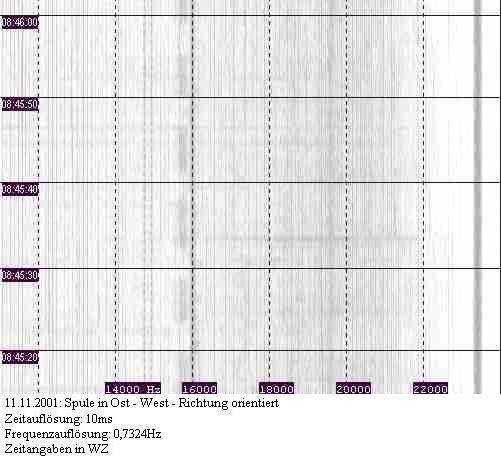
(Reception side: 48N43, 8O58, axis of recption coils showing in East - West -direction, time data in UTC, Software "SpecPlus")
Re: JDH on the air
Posted by Doug Williams on November 04, 2001 at 14:17:50
Copied JDH last night, both audible CW and good copy on QRSS using ARGO software. Grid EM86.
Re: XM(GR) in QRSS Mode
Posted by Doug Williams on November 04, 2001 at 23:35:52
Copied XM tonight. QRSS, 3 second dot length. I can audibly hear the signal also. I'm in TN, Grid EM86. Nice beacon.
I just gotta say, I love my AOR7030. Sensitive on LF. No need for a converter or a pre-amp. Excellent dynamic range.
TCXO standard.
Re: LEK copy in Maryland
Posted by Les Rayburn, N1LF on November 05, 2001 at 00:06:41
Congratulatios on a clean sweep of the available WOLF targets! Hopefully, JDH in Bonaire, GA will also be on WOLF mode within a week to 10 days. Look for WA in Mass. a little later in the season too...
Until then, you might want to try your hand at QRSS receptions...this could add a few more beacons to your log book!
73,
Les Rayburn, N1LF XM(GR) 184.898khz
JDH and XM(GR) Copied in Tennessee!
Posted by Les Rayburn, N1LF on November 05, 2001 at 00:08:53
Doug Williams, KB4OER in Watagua,TN (near the Virginia line, in North-Eastern corner of the state) logged beacons JDH and XM(GR) on the same night in QRSS mode!
Distance from here is about 335 miles, similar distance from Doug's place to JDH. Congratulations on these two receptions and for adding a new grid square/state to our log books!
Medfer?
Posted by Steven Brooks on November 05, 2001 at 01:08:49
I just copied HMY on 511.5KHZ in Avondale, AZ. Does anyone know if this is an active Medfer or some type of unknown beacon?
Any info on 646 Kits 1750 Meter transmitter?
Posted by Les Rayburn, N1LF on November 05, 2001 at 07:17:02
Just heard about a 1750 Meter transmitter kit that was marketed in the 1980's by a company called
"646 Kits".
Apparently, it was a MOSFET design, with a divide by circuit.
I'd love to get more information on this kit, including instructions, photos or best of all, the kit itself if someone has one to sell.
As most of you know, I have a small collection of most of the commercial products produced for use on the Lowfer band. I'd love to add this one...
Any info appreciated.
73,
Les Rayburn, N1LF
Re: Medfer?
Posted by Brian Helms on November 05, 2001 at 08:09:41
I copied the same beacon on Nov. 3 and cannot find any information on it. The beacon was well above the noise in North Carolina.
Re: Any info on 646 Kits 1750 Meter transmitter?
Posted by Doug Williams on November 05, 2001 at 14:01:33
Hey, Les. I e-mailed you the info. The company was 624 Kits, and this product was available in early to mid 1990's. I don't think 624 Kits is still in business. It was a very simple transmitter, but it worked.
Re: Medfer?
Posted by Mitch on November 05, 2001 at 18:26:56
Hi Brian:
I have HMY listed as Lexington (Oklahoma) Muldrew Airfield, and as ARMY. Frequency listed as 512 kHz. Also listed on the same frequency is XKQ, and listed under same location.
73 Mitch VE3OT
HIFER 13.560 MHz back on the Air
Posted by Tony Levstik on November 05, 2001 at 18:27:50
Beacon TLTX 13.560 MHz is back on the air. running QRSS // RTTY . on Weekends.
Hifer AZ now with QRSS capability
Posted by Jim Mandaville on November 06, 2001 at 11:01:07
My hifer beacon "AZ" on 13.5545 now has QRSS (6-second dits) capability on request to my email, zygo azstarnet.com
Meanwhile I'm running 24/7 in 12 wpm CW.
Jim Mandaville, Tucson, AZ
NBD Database
Posted by Mike on November 06, 2001 at 21:59:27
Kriss Larsen, in his LOWDOWN article "Longwave logs on trip to Africa and Indian Ocean", mentioned that he found a NDB database on the NIMA website. He inserted it into an Excel spreadsheet.
Does anyone have any information on this database,
or where it may be found?
Thanks,
Mike N2MS
Re: NBD Database
Posted by richard allen,w5sxd on November 06, 2001 at 23:22:17
See the reply to my question on this board at the end of September. I downloaded all this data and, while it will need some work to make it useful, it seems to be quite complete and up to date. Let us all know if you get it into a usable format.
COV temporarily off
Posted by Charlie Vest on November 07, 2001 at 00:04:07
I just returned from an extended stay in the hospital after major surgery again and found my beacon down when I returned. I will have it back on the air as soon as I am up and around again.
...COV 187.5...KC0EH...Charlie...
DDH47 Special Event
Posted by Costas SV1XV on November 08, 2001 at 01:20:43
A special event transmission in morse code on 147.3 kHz by DDH47 is scheduled on December 12, 2001 (Marconi Transatlantic Centenary).
For details:
http://www.qsl.net/sv1xv/
http://www.dwd.de/services/gfsf/sf100y.html
73 Costas SV1XV
RLD heard.
Posted by Doug Williams on November 08, 2001 at 09:43:13
Received RLD last night, three second dot QRSS mode. Distance about 130 miles. This is my third Lowfer reception this season. Good work, Brian.
-Doug KB4OER
Help ID VLF MSK signals.
Posted by Doug Williams KB4OER on November 08, 2001 at 09:46:58
I sent this message to the Lowfer reflector but it never got "reflected", so let's try it here:
I need some help IDing the origin of some VLF MSK signals I am hearing. I hear these signals 24/7 and I naturally wonder where they come from. I assume they are for submarine communications.
(1) On or around 21.4 kHz. Weak.
(2) On or around 23.4 kHz. Weak.
(3) On or around 24.0 kHz. Strong.
(4) On or around 24.8 kHz. Strong.
(5) On or around 25.2 kHz. Strong.
(6) On or around 37.4 kHz. Weak.
Re: Help ID VLF MSK signals.
Posted by Mike Thompson on November 08, 2001 at 13:58:51
Hi Doug,
Here is a list of VLF Xmitters with there 3 character ID, frequency and finally there radiated power in Kilowatts.
I see that a few of the signals you speak of are on this list.
I got the list from this website http://moondog.astro.louisville.edu/flares/stations.html Poke around there if you get a chance. There is a ton of interesting stuff there.
Very Low Frequency Radio Stations Site ID Freq(KHz) Radiated Power (KW) Cutler, ME NAA 24.0 1000 Jim Creek, WA NLK 24.8 250 Lualualei, NI NPM 21.4 566 LaMoure, ND 25.4 Aquada, Puerto Rico NAU 40.75 100 Keflavik, Iceland NRK 37.5 100 Niscemi, Italy 39.9 25 Harold E. Holt, Au NSW 19.8 1000 Rhauderfehn, Germany 18.5 500 Rosnay, France HWU 15.1 400 St. Assie, France FTA 16.8 23 Bombay, India 15.1 Tavolara, Italy ICV 20.27 43 Ebino Huyshu, Japan 23.4 Noviken, Norway JXN 16.4 45 Arkhanghelsk, Russia UGE 19.4 150 Batumi, Russia UVA 14.6 100 Kaliningrad, Russia UGKZ 30.3 100 Matotchkinchar,Russia UFQE 18.1 100 Vladivostok, Russia UIK 15.0 100 Anthorn, United Kingdom GQD 19.0 42 Criggons, United Kingdom GBZ 19.6 44 Rugby, United Kingdom GBR 16.0 45
Hope this helps. What sort of set up are you receiveing with? A loop might help in figuring out which direction the signals are coming from.
Mike T.
KG4JYA
Re: Help ID VLF MSK signals.
Posted by John Andrews on November 08, 2001 at 14:00:00
Doug, I'm at work, but I think these are right...
(1) On or around 21.4 kHz. Weak. NSS (Maryland)
(2) On or around 23.4 kHz. Weak. NPM (Hawaii?)
(3) On or around 24.0 kHz. Strong. NAA (Cutler, Maine)
(4) On or around 24.8 kHz. Strong. (NLK - Jim Creek, WA)
(5) On or around 25.2 kHz. Strong. Also NAA, I think. 25.3?
(6) On or around 37.4 kHz. Weak. (Iceland?)
John Andrews
Re: Help ID VLF MSK signals.
Posted by Jim Mandaville on November 08, 2001 at 14:18:26
Doug, some of these are the signals some of us monitor for signal strength on a chart recorder to detect solar flares (a very effective method!).
21.4 kHz is Naval station NPM in Hawaii (I monitor this one continuously).
23.4 is probably German Naval Sta.DH038
24.0 is Navy station NAA in Cutler, Maine
24.8 is Navy station NLK at Jim Creek, Washington
25.2 is a station at La Moure, North Dakota; not sure of call sign (formerly an Omega station)
37.4 (actually 37.5) is probably U. S. Naval station NRK at Keflavik, Iceland
Jim Mandaville, Tucson, AZ
Re: Help ID VLF MSK signals.
Posted by Jim Mandaville on November 08, 2001 at 14:24:08
Speaking of this MSK stuff ..... does anyone know whether this mode is readable by any available digital programs? I assume that even after "reading" it is still encrypted, but it would be fun to see it, and there might be some straight text inclusions of some kind.
Jim Mandaville, Tucson, AZ
Re: Help ID VLF MSK signals.
Posted by Doug Williams KB4OER on November 08, 2001 at 14:27:12
Thanks, Jim, and the others who responded. Those are some impressive distances. I estimate the 21.4 kHz HI station is over 4000 miles distant from me. I sure would like to tour one of these powerhouses and at the same time I'm glad I don't live near one.
Re: Help ID VLF MSK signals.
Posted by Doug Williams KB4OER on November 08, 2001 at 14:30:25
That's a good question. I also wonder what their data rate is, i.e. how many words per minute they can transmit?
Clam Lake ELF
Posted by Doug Williams KB4OER on November 08, 2001 at 14:40:16
Has anyone ever tried to or succeeded in receiving the Navy's ELF transmission from Clam Lake?
I wonder what methods one could use to receive this signal. A regular communications receiver would seem to be useless. I imagine one could connect a whistler receiver like the WR3 to the input of a sound card and look for it on Spectrogram. The signal is around 76 Hz, IIRC. I suppose it would be better to make a recording from a quiet location that is away from powerlines and then analyze the recording later. Are regular cassette tapes sensitive to such low frequencies?
It would be interesting to get a QSL card from Clam Lake. ;-)
Re: Clam Lake ELF
Posted by Mike KB6WFC on November 08, 2001 at 15:46:49
Hi Doug KB4OER,
For VLF MSK signal info & techniques for recieving Calm Lake ELF, try http://web.tiscali.it/vlfradio/
Best 73,
Mike KB6WFC
NC Heard.
Posted by Doug Williams KB4OER on November 08, 2001 at 18:01:03
Solid copy on NC here at local sunset. QRSS, 3 second dot mode. Cannot hear the signal at all by ear. QRSS is amazing.
Re: NC Heard.
Posted by Doug Williams on November 08, 2001 at 18:03:07
I guess I should have been more specific. NC Lowfer beacon copied on 177.77 kHz. QRSS, 3 second dot.
Missing NDB Databases
Posted by Paul Stroud on November 08, 2001 at 20:17:26
I've noticed that the past few days, two of the most helpful NDB web databases are no longer active.
Could anyone shed any light on the likelihood of "Worldwide Airport Finder" and "Marcus Ramos'
SA NDB List" making a reappearance? 73, Paul nr Raleigh, NC
JDH(QRSS) copy in Maryland
Posted by Lloyd Chastant on November 08, 2001 at 22:36:25
Had a nice copy on ARGO of JDH tonite at 0220z here in Maryland-Distance shows at 601 miles.
de Lloyd W3NF FM19MH
TEXAS (WOLF) copy in Maryland
Posted by Lloyd Chastant on November 08, 2001 at 22:40:52
Knowing that TEXAS is shutting down in a few days I had to try for one last copy and actually got two copies tonite at2310z and 0100z.Had 4 solid lines of copy.Distance shows at 1222 miles.73 Bill de Lloyd W3NF FM19MH
Re: JDH(QRSS) copy in Maryland
Posted by Mitch VE3OT on November 09, 2001 at 00:04:37
Have a nice ARGO capture of JDH this evening, using the K9AY antenna. Nothing on the 7 ft loop ! Time is just past midnight (Thursday NOv 8 midnight ) in London, ON. Nice signal John, first time for the Fall season.
Looks like 732 miles again.
73 Mitch VE3OT
VLF beacon
Posted by Doug Williams KB4OER on November 09, 2001 at 09:33:41
Could anyone comment on the legality, or illegality, of someone putting a beacon in operation below 9 kHz (say 8.5 kHz or so) here in the United States? It is my understanding that the FCC does not regulate transmissions below 9 kHz.
I have a transmitter that is capable of putting out about five watts from around 7 to 10 kHz and it would be interesting to do some experimenting. I know all about antenna ineffeciancy at these frequencies, so no need to comment on that.
Re: Help ID VLF MSK signals.
Posted by Doug Williams KB4OER on November 09, 2001 at 10:49:57
Doing a little more listening and I'm actually receiving Harold E. Holt, Au NSW 19.8 kHz. Now that's a long haul from Tennessee. I guess the one million watts ERP helps some.
;-)
An ELF transmitter in Berlin?
Posted by Udo Maier on November 09, 2001 at 14:23:51
There are some rumours that there should exist in Berlin an ELF – transmitter (Codename "Teddybär", Internet: http://www.fosar-bludorf.com/Tempelhof/).
This transmitter should use an underground cable laid in a loop around the airport Berlin – Tempelhof. Has anyone ever received this transmitter, which should work on the frequency of 79.6 Hertz with a bandwidth of 8 Hertz?
Would the described ring line would work as a transmitting aerial for 79.6 Hertz?
The estimated length of the line would be 12 kilometres, so the radiation resistance for 79.6 Hertz would be extremely low. So I suppose, if this facility exists, the conductor of the loop must be a superconductor. Is a superconductive loop aerial laid under an airport a sensitive way to realize an ELF transmitter?
Because of the extremely low radiation resistance of such an aerial it would require extremely high current and this could induce jam signals in other electrical installations of the airport!
Re: Clam Lake ELF
Posted by Harald on November 09, 2001 at 14:30:50
Where can I find photographs of the ELF transmitters of the US Navy?
Re: Clam Lake ELF
Posted by Doug Williams on November 09, 2001 at 15:25:50
http://enterprise.spawar.navy.mil/spawarpublicsite/docs/fs_clam_lake_elf.pdf
Re: VLF beacon
Posted by John Davis on November 09, 2001 at 17:12:20
Hi Doug,
There are no prohibitions against doing what you ask, except that it is no simple task to keep harmonics above 9kHz from exceeding emission limits.
I tried this myself on 8.8kHz a few years ago, but even with a very long antenna, the efficiency (and range) were distinctly poor. Still, it was a lot of fun to experiment with! I'd been debating with myself lately whether to try it again this winter, and now I think I just might do it.
73,
John
Re: Help ID VLF MSK signals.
Posted by John Davis on November 09, 2001 at 23:43:25
:: I guess the one million watts ERP helps some. ::
That would be antenna input power, not radiated power, alas. Even the best antennas at these frequencies are still only a few percent efficient.
If they could actually radiate a full megawatt, the field strength at 12,000 miles would be on the order of a couple millivolts/meter. Yup, millivolts, not microvolts. That'd take all the challenge out of it. :-)
73,
John
Wanted: Junk box to receive natural radio
Posted by Joshua Lambert (KC4OVD) on November 10, 2001 at 00:45:04
Hi,
Does anyone have some old vlf receiver lying around that they wouldn't mind parting with? I can't presently aford Mr. McCreavy's receiver, and can't see to build one for myself. Any help would be appreciated.
Joshua Lambert KC4OVD
Bursted signals from VLF transmitters
Posted by Harald on November 10, 2001 at 08:23:45
Some VLF transmitters transmit sometimes bursted signals. Theses are JXN Helgeland in Norway on 16.4kHz, an unidentified station on 17.8kHz and GBZ Criggion on 19.6 kHz.
GBZ Criggion sometimes transmit also signals which look like on spectrogrammes as fishes or garlands. What is the purpose of these signals and of bursted signals transmitted by VLF transmitters?
Re: Bursted signals from VLF transmitters
Posted by Harald on November 10, 2001 at 08:25:54
You can see the spectrograms showing the signals of GBZ Criggion which look like fishes and garlands on the internet page http://www.vlf.it/harald/strangerec.htm.
An unidentified VLF transmitter on 17.8kHz
Posted by Harald on November 10, 2001 at 08:31:17
Sometimes I can receive strong signals from an unknown transmitter on the frequency 17.8kHz.
The signals are very strong at my reception place in Germany (coordinates: 8 degree 59' Eastern longitude, 48 degree 43' Northern lattitude), so I believe it is not NAA Cutler from the USA.
This transmitter only transmits bursted signals.
Who knows which transmitter is it and where it works?
Re: VLF beacon
Posted by Doug Williams KB4OER on November 10, 2001 at 12:06:24
Hey, yes. I do remember listening for your VLF beacon several years ago. You would probably have a better chance of being heard nowadays, using QRSS. Heck, all one would need for a receiver is a wire or coil antenna attached to the line input of a PC sound card running Spectran.
The former longwave station Sayville on Long Island
Posted by Udo Maier on November 10, 2001 at 15:54:03
What is now on the area of the former longwave station Sayville on Long Island? Is the area still used for radiotechnical purposes? If yes, for which?
Re: Clam Lake ELF
Posted by Harald on November 10, 2001 at 15:59:18
Does the ELF transmitter of the Russian Navy and its Russian counter part have a callsign? If yes, how is it spelled?
Re: VLF beacon
Posted by John Davis on November 10, 2001 at 21:39:46
:: You would probably have a better chance of being heard nowadays, using QRSS. ::
A good point, Doug. Also, I may not have access to the big tower after this winter. I think I'll have to go ahead and give it another shot!
I'll let everyone know as soon as I get the lashup back together again.
John
Re: An unidentified VLF transmitter on 17.8kHz
Posted by Jim Mandaville on November 10, 2001 at 21:50:12
Don't know what it is, Harald, but for sure it's not NAA, which hasn't been on 17.8 for a long time. NAA is on 24.0 now.
Jim
Re: Clam Lake ELF
Posted by John Davis on November 11, 2001 at 00:20:44
:: Does the ELF transmitter of the Russian(?) Navy and its Russian counter part have a callsign? If yes, how is it spelled? ::
Hello Harald,
These stations do not have callsigns, as there would be no point in using them. Only two world powers have an extensive enough submarine fleet to bother building such massive stations. (The United Kingdom considered the idea also, but decided against it because of the cost.) During actual operational use, there would be no time for callsigns, either.
In case you haven't already read it, Trond Jacobsen's excellent article on the Russian Zevs system is at the vlf.it site. Specifically:
http://www.vlf.it/zevs/zevs.htm
It gives an interesting account of the facility's history and how messages are conveyed, as well as a description of non-military uses of ELF.
John
TEXAS WOLF received in North Carolina
Posted by Dexter McIntyre W4DEX on November 11, 2001 at 01:10:19
Perfect copy on first try just like many times last season. Thanks for a great signal Bill. Looking foward to your return.
Dexter
Unidentified transmitter on 15.8 kHz
Posted by Harald on November 11, 2001 at 11:26:42
Today I received a signal from an unknown transmitter on the frequency 15.8kHz.
This transmitter only transmits bursted signals.
Who knows which transmitter is it and where it works?
Re: Clam Lake ELF
Posted by Harald on November 11, 2001 at 13:41:21
Are Sanguine and its Russian counterpart ZEVS really the only operating ELF transmitters in the world?
Because ELF transmitters are difficult to receive (and surely as VLF transmitters not always on the air) there could surely some more facilities exist (e.g. as Udo Maier mentions in Berlin - Tempelhof).
ELF - transmitters must surely make no visible impression as transmitters for VLF to SHF because no large towers and masts are needed! (The line mentioned as antenna line of an ELF transmitter is in fact only an antenna feeder! The earth is the antenna! Therefore the antenna line could be designed -invisible- as underground cable. So only the transmitter building remains as only visible installation and I think that a solid - state ELF transmitter can be installed without any problemes in a bigger transformer building)
NC 177.777 KHz On the air
Posted by Dexter McIntyre W4DEX on November 11, 2001 at 18:09:20
After about a week of testing and tweaking I think Lowfer NC is ready for operation. I plan to run CW most of the daylight hours, QRSS from just before sunset until just after sunrise and WOLF when requested. All reprots will be appreciated and a QSL will be sent if requested.
Dexter
Re: Clam Lake ELF
Posted by John Davis on November 12, 2001 at 03:15:52
:: Are Sanguine and its Russian counterpart ZEVS really the only operating ELF transmitters in the world?
Because ELF transmitters are difficult to receive (and surely as VLF transmitters not always on the air) there could surely some more facilities exist (e.g. as Udo Maier mentions in Berlin - Tempelhof). ::
It is an interesting possibility, Harald, but if there are additional stations, the Russian and American transmitter facilities are probably the only two capable of global ELF coverage.
Although it would be possible to insulate the linear feeders and bury them just below the earth's surface, this would be somewhat less efficient and considerably more expensive than the open-air method. The antenna system would still need to be scores of kilometers long to achieve significant earth penetration.
The transmitter will output megawatts of power. Even a solid-state system is a little larger than you might expect...especially if it works over as wide a frequency range as Zevs was designed to do. More significantly, there are good reasons for locating these systems in isolated rural areas. The high power involved would cause dramatic side-effects in an urban environment: unexpected electrification of metal surfaces both outdoors and in homes, along with irregularities in electric power service.
(It is true that an ELF facility might remain halfway inconspicuous by not transmitting very much of the time, but I suspect our friends in Italy would eventually observe one as nearby as Berlin.)
A horizontal loop such as hypothesized to exist around the Tempelhof would be an extremely inefficient ELF radiator on its own, even if superconduction were involved; and it would not be the ideal configuration to drive an earthed antenna either. It's my guess that if such a loop actually exists there, it probably has some other intriguing purpose.
John
Re: NC 177.777 KHz On the air
Posted by John Andrews, W1TAG on November 12, 2001 at 08:40:23
I copied NC for the first time this season this morning. Using ARGO's 3sec/dot (slow) screen, Dex was visible most of the time between midnight and 6:30 AM EST. The ID was only "legally" readable in about 6 of the 5-minute screen shots, though. Best copy was in the half hour before sunrise, which was normal for this path last winter.
John A.
Are transmitters in operation with speech transmission below 150 kHz?
Posted by Harald on November 12, 2001 at 13:04:09
From 1927 to 1956 there existed a telephone service between Europe and Amerika on frequencies around 60 kHz. The modulation was SSB without carrier.
Nowadays I believe, that no transmitter below 150kHz transmits speech.(I never received a station transmitting speech below 150kHz and in the transmitting tables no station is mentioned, which transmits speech on frequencies below 150kHz)
Is this correct?
Or are still in Non - European countries (or for special military use [secret and most time inactive]transmitters below 150kHz in operation which transmits speech?
Are according to ITU regulations speech transmissions on frequencies below 150kHz allowed? If yes, in which modes?
Questions about a special SSB mode used in a longwave broadcasting transmission
Posted by Harald on November 12, 2001 at 15:00:18
From January 18th, 1953 to November 30th, 1962 there was in Hamburg – Billstedt (Germany) a longwave broadcasting station on the frequency 151 kHz in operation which used a special SSB – mode (in the upper side band) which can be demodulated undistorted by a normal AM – demodulator (this transmitter which was called “Deutsche Langwellensender” was the precursor of the “Deutschlandfunk”, a German information radio which transmits among the others on the longwave frequencies 153kHz and 207kHz).
How does a SSB – mode work, which can be demodulated by normal AM – demodulators?
(I suppose the signal has to be predistorted. How is this performed?)
What is the abbreviation of this special SSB – mode?
Why is this special SSB – mode not the standard for AM – broadcasting?
(The transmitter of the “Deutsche Langwellensender” was very popular, so I assume that this SSB – mode had to work very well. All AM ranges are overcrowded, so this transmission mode would save bandwidth. What was the reason why it was not introduced?)
Did (Do?) other transmitters also use SSB – modes which could be demodulated by normal AM demodulators? If yes, which transmitters did/ (do?) so?
Re: Questions about a special SSB mode used in a longwave broadcasting transmission
Posted by John Andrews, W1TAG on November 12, 2001 at 15:41:13
Harald,
The system you mention was called CSSB (Compatible Single Side Band), and was the subject of a lot of interest starting in the '50s. The former Westinghouse stations here in the eastern U.S. used it for a while, looking for a way to alleviate their mutual adjacent channel problems. Leonard Kahn was involved in the development of this system, and later marketed it through Kahn Communications. It was last known as "Power Side," I believe, and may still be available.
Perhaps someone else can provide the technical details, as my memory is hazy on the subject. I recall that the signal sounded best with manually tuning, a rarity in car radios these days. Kahn's AM stereo generation system offered a degree of independence between the sidebands, and used some of the CSSB technology.
John Andrews
Re: Clam Lake ELF
Posted by Don Moler on November 12, 2001 at 22:08:29
Back around 1975 I was expermenting with transmitting high power on 9.5 Khz. I wanted to know the methods the Navy was using to transmitt on the low frequencys so I took a trip to the Navy Research Lab in Washington D.C. With my good luck I got to meet the guy that designed the 76 Hertz antenna in Marquette Mich. and he sat down and told me every thing I wanted to know about the antenna, he spoke with a german accent. He was very supprised that I had traveled all that way to learn about his antenna design. We spent about two hours talking about low frequency antennas. Here is what he told me as I remember it. Two holes were drilled in the ground about fourteen miles apart. These holes were two miles deep and terminated in black granite rock two miles down. This black granit rock is a very good conductor and was used for the bottom conductor of the loop. Large conductor wires were put down the drilled holes and connected to the granite. The tops of the drilled holes were feed with three million watts of 76 hertz which resulted in an ERP of three watts. So when I came back to Girard Ohio I ran a heavy wire thru the woods to the next towns (McDonald) fire hydrent and hooked the other end to the Girard's water system. I ran very high power at 9.5 Khz because I called the FCC and they told me they don't regulate below 10 Khz. this was in 1976. I built a portable loop antenna resonant at 9.5 Khz and an tuned amplifier with a detector driving a micro ampmeter. I could find every waterline in Girard ..I told the water superviser in Girard about this and Every time they wanted to find a waterline that their det would not find, they would call me. It would take me only a few minutes and I could pinpoint it to a few inches. If anyone wants to experment with a system like this, write or visit me. Don Moler 2623 Morris lane Girard, Ohio 44420 vonj cboss.com ph 330-530-2059
Re: Questions about a special SSB mode used in a longwave broadcasting transmission
Posted by Lyle Koehler on November 12, 2001 at 22:26:01
Someone with more experience in the broadcasting field will correct me if I'm wrong, but I will try to provide an answer.
What we normally refer to as Single Sideband (SSB) is actually Single Sideband Suppressed Carrier (SSSC). If only one sideband is transmitted but the carrier is not suppressed, it can be received by an ordinary AM radio because the carrier is already there; it does not have to be injected at the receiving end.
I believe almost all of the Canadian NDBs use a form of transmission that is essentially upper sideband plus carrier. Since most of them transmit 400 Hz tones only, it is hard to tell whether they are modulating a carrier and then filtering out the lower sideband, or simply transmitting two carriers 400 Hz apart with the proper amplitude relationships. The Winnipeg, Manitoba NDB on 248 kHz used to transmit voice weather information using upper sideband with carrier, but there was no voice present when I listened tonight.
Some shortwave stations may also use a form of single sideband transmission with carrier. There is a religious broadcast on 21.455 MHz which I'm pretty sure is using that mode. Too weak to tell this evening whether it can be copied properly with the receiver in AM mode or not, but it is definitely not transmitting the lower sideband.
Lowfer testing
Posted by Steven Brooks on November 13, 2001 at 01:22:39
Lowfer beacon BZS at 187.3Khz is in operational and testing modes. I am transmitting CW and QRSS on alternating evenings starting around 8:00pm MST and endint at 8:00am MST. Any and all reception reports will be greatly appreciated.
NC heard
Posted by Paul Stroud on November 13, 2001 at 05:59:33
After reading the recent Lowfer reception reports, I could not stand sitting on the sidelines any longer.
It was quite a rush to see NC singing away on 177.777 khz. DEX is abt 100 miles west of my QTH.
NC has shown pretty much continuous nighttime reception using Argo set for 3 sec dots. The rx on this end is HB, and the antenna is a 1200' beverage running E/W. Now the hunt is on for those more farflung Lowfer dudes. I'm bleary eyed, but smiling. 73, Paul AA4XX nr. Raleigh, NC
Re: Lowfer testing
Posted by william.ashlock edwards.boc.com on November 13, 2001 at 13:28:52
Steve,
I have you in the MST zone but, specifically, where are you located? You may be just beyond my single hop coverage from the Boston area but I'll give you a look on my new QRSS setup. What dot time are you running?
Bill WA
185.300
Re: Lowfer testing
Posted by Steven Brooks on November 13, 2001 at 16:00:01
Sorry about the location omission, I an just west of Phoenix, AZ in Avondale. I an running 3 second dashes tonight 11/13, and I am stepping up to 10 second dashes on Thursday, 11/15. I will try longer times on request.
Re: Are transmitters in operation with speech transmission below 150 kHz?
Posted by John Davis on November 14, 2001 at 01:51:56
I could not address the question of ITU regulations regarding voice below 150kHz, but the international footnotes in the FCC table of allocations makes no mention of it in either the international band assignments or the Region 2 assignments.
Voice would be a most unreliable tool for the military at these frequencies--difficult to transmit, electrically inefficient, not secure, and much more susceptible to interference at normal power levels than digital modes.
The old telephone service was very much a point-to-point arrangement that relied on kilometers-long wave antennas for reliable reception. This would be impractical in any volatile tactical situation. Satellite phones are much more useful in the field, or VLF data under the sea.
Regards,
John
Under which conditions need transmitting stations no callsign?
Posted by Harald on November 14, 2001 at 16:08:37
When I take a close look at transmitter tables I discover that the following types of stations have no callsign
- radio and TV broadcasting stations (in Europe this kind
of transmitting stations has general no callsign)
- navigation transmitters working in chains (ALPHA, DECCA, Omega, LORAN)
- ELF - transmitters Therefore I have got an interesting question. For which kind of stations are according to ITU regulations callsigns not necessary?
30 dot second qrss
Posted by Brian Helms on November 14, 2001 at 21:43:10
I will be sending 30 dot second qrss for the next week. Maybe this will help some others detect my puny signal.
Re: 30 dot second qrss for beacon RLD 185.555
Posted by Brian Helms on November 14, 2001 at 21:44:18
Forgot to mention that this was for beacon RLD 185.555
Re: Under which conditions need transmitting stations no callsign?
Posted by John Davis on November 14, 2001 at 23:29:13
That _is_ an interesting question. I don't know all the ITU regulations in detail, but I have observed some general principles.
Almost no government-operated radio stations (including military) require callsigns under ITU regulations. For most radio services, whether there's a call sign (and if there is one, whether it is given on the air or not) appears to be left to the discretion of each administration. As long as each government is satisfied that it knows what fixed-location stations are operating on what frequency within its jurisdiction, that seems to be sufficient
It also appears that some privately-owned broadcast stations in Europe don't strictly require call signs, either, although they do have to identify in some fashion that includes a commonly recognized name of the station and its location.
Stations that generally DO require use of callsigns are typically those which are privately owned, and which can be operated (1) anywhere within a frequency band, not just on one or two specifically licensed frequencies, and/or (2) away from permanently licensed locations at certain times. This includes such services as amateur radio, land mobile radio, and (in most of the world) satellite uplink transmitters. If you are frequency-agile or theoretically capable of mobile or portable operation, you probably have a callsign and are obliged to use it during your transmissions. (In the case of satellite uplinks and certain mobile radios, this is done with Automatic Transmitter Identification Systems. An ATIS uses a digital code embedded in the signal or even plain Morse on a subcarrier along with the intended transmission.)
Aeronautical and maritime beacons, despite the appearance of using callsigns, actually do not. Technically, the letter combinations that they use are called identifiers. They are meaningful in that they relate a station to a specific location, but you may have noticed that they do not fit within the ITU system of recognized callsign prefixes.
John
RLD Heard in MA!
Posted by John Andrews, W1TAG on November 15, 2001 at 07:35:10
I copied Brian Helms' RLD beacon on 185555.3 kHz this morning at 0830Z. He was running QRSS30 last night, having just switched from QRSS3. This evidently made a big difference, because I had run screen captures overnight quite a number of times, with no clear result.
If you can hear NC in its current QRSS3 mode, you should take a shot at RLD in QRSS30.
John Andrews, W1TAG
Re: RLD Heard in MA! Not on TV, though!
Posted by John Andrews on November 15, 2001 at 11:00:09
Make that 185.5553 kHz, or 185555.3 Hz. Not TV channel 8.
John A.
IMAGE Radio Plasma Imager Test
Posted by Mark Karney on November 16, 2001 at 09:37:11
I received the following message from Bill Tylor at NASA. This is a great opportunity to participate in an exciting experiement. There will be plenty of opportunities over the next couple of weeks to listen for the tests. Your participation is encouraged.
Dear Natural Radio Observers, INSPIRE has arranged to perform experiments to test propagation to the ground from the Radio Plasma Imager instrument on the IMAGE Satellite over two weeks starting on November 21, 2001. A table at the end gives the times for the experiments. There will be two sets of experiments, at 5-15 kHz (VLF) and at 130 and 380 kHz. The 5-15 kHz experiments will be performed on the incoming (towards perigee), southward traveling part of every orbit, starting at about the point where the magnetic field line through the satellite is at about 50 degrees N latitude. They will continue until the the 130 and 380 kHz experiment begins. The 130 and 380 kHz transmissions will begin when the satellite is four minutes before the closest approach to the South Pole, and continue four minutes past closest approach. The VLF transmissions will be 0.125 seconds on, 0.375 seconds off, at 5, 7, 9, 11, 13, and 15 kHz, repeated over and over. Details of the satellite orbit, both graphical and tabular, may be found at the Satellite Situation Center web site: http://sscweb.gsfc.nasa.gov/cgi-bin/sscweb/Locator.cgi If you have trouble using the SSCWeb, I can send you a tutorial I put together a year ago for the INSPIRE Journal, but we never published it. Below is one line for each orbit at approximately a field line foot point of 50 degrees latitude, so you can identify which orbits are near your location. The first transmission will be a VLF propagation to the ground experiment starting at 0728 UT on 11/21/01. The second will be a South Pole experiment with transmission starting at 0814 UT on 11/21/01 and continuing for eight minutes. The transmissions will occur in the same sequence every orbit, scheduled with respect to the closest approach to the South Pole and will end on UT 12/04. The last two experiments will be a transmission for VLF propagation to the ground starting at 2248 UT on 12/4/01 and a South Pole transmission starting at 2334 UT on 12/4/01 and continuing for eight minutes. One of the sets of experiments in the two weeks will not occur because of a previous scheduled and very infrequent opportunity for a propagation experiment from IMAGE/RPI to the WAVES instrument on another satellite, WIND, at 508 and 828 kHz which will happen from 1100 to 1600 UT on 12/2/01. That will supercede the operations near the second perigee on 12/2/01. The table below gives the transmission start times for the two sets of experiments. Best of luck observing and I would love to hear from you about your observations. Thanks. INSPIRE: http://image.gsfc.nasa.gov/poetry/inspire INSPIRE FTP: ftp://nssdc.gsfc.nasa.gov/pub/multidis/inspire/
You could be prime observers for the VLF experiments!
I have used sscweb to get IMAGE orbital parameters to illustrate the operations before and during the first South Pole crossing. For the VLF operation, if we had an observer in the North Pacific, somewhere between Hawaii and California, they might be in a good place to hear IMAGE. We have 23 other opportunities during the two weeks, though. Note that Longitudes are give in East Longitude, whereas in the US, we are used to using West Longitude in our hemisphere. ArcLen is the distance from the satellite to the Earth's surface along the magnetic field line. DipL-Val is the a measure of magnetic latitude of the field line.
image
Time GEO NorthBtrace GEO Radius yyyy ddd hh:mm Lat Long Lat Long ArcLen (RE) DipL-Val Notes
2001 325 07:02 49.20 207.88 67.72 218.56 2.56 3.46 8.3
2001 325 07:04 48.13 207.41 67.08 217.97 2.50 3.40 7.8
2001 325 07:06 47.03 206.94 66.46 217.36 2.44 3.33 7.3
2001 325 07:08 45.88 206.46 65.82 216.72 2.38 3.27 6.9
2001 325 07:10 44.68 205.99 65.12 216.11 2.32 3.20 6.4
2001 325 07:12 43.43 205.52 64.40 215.49 2.26 3.13 6.0
2001 325 07:14 42.13 205.05 63.66 214.85 2.20 3.07 5.6
2001 325 07:16 40.76 204.58 62.85 214.24 2.14 3.00 5.3
2001 325 07:18 39.34 204.11 62.03 213.61 2.08 2.93 4.9
2001 325 07:20 37.84 203.64 61.14 212.99 2.02 2.86 4.6
2001 325 07:22 36.27 203.16 60.22 212.35 1.96 2.79 4.3
2001 325 07:24 34.62 202.69 59.23 211.74 1.90 2.72 4.0
2001 325 07:26 32.88 202.22 58.20 211.11 1.84 2.65 3.8
2001 325 07:28 31.04 201.75 57.10 210.50 1.78 2.57 3.5 VLF start
2001 325 07:30 29.09 201.28 55.95 209.89 1.72 2.50 3.3
2001 325 07:32 27.03 200.81 54.73 209.30 1.67 2.43 3.1
2001 325 07:34 24.84 200.34 53.44 208.71 1.61 2.35 2.9
2001 325 07:36 22.51 199.88 52.08 208.15 1.56 2.28 2.7
2001 325 07:38 20.02 199.41 50.66 207.60 1.51 2.21 2.5
2001 325 07:40 17.36 198.95 49.17 207.08 1.47 2.13 2.3
2001 325 07:42 14.51 198.48 47.64 206.61 1.43 2.06 2.2
2001 325 07:44 11.44 198.02 46.07 206.18 1.40 1.98 2.1
2001 325 07:46 8.14 197.56 44.51 205.82 1.38 1.91 1.9
2001 325 07:48 4.57 197.10 43.00 205.55 1.38 1.84 1.8
2001 325 07:50 0.72 196.65 41.62 205.41 1.39 1.77 1.8
2001 325 07:52 -3.46 196.20 40.49 205.44 1.44 1.70 1.7
2001 325 07:54 -7.99 195.75 39.73 205.70 1.52 1.63 1.7
2001 325 07:56 -12.91 195.31 39.54 206.30 1.67 1.56 1.7
2001 325 07:58 -18.23 194.88 40.10 207.35 1.90 1.50 1.7
2001 325 08:00 -24.00 194.46 41.53 209.01 2.26 1.45 1.7
2001 325 08:02 -30.22 194.06 43.90 211.47 2.82 1.39 1.9
2001 325 08:04 -36.90 193.67 47.10 214.96 3.72 1.35 2.1
2001 325 08:06 -44.00 193.32 50.92 219.73 5.23 1.31 2.5
2001 325 08:08 -51.49 193.03 55.08 226.11 8.02 1.28 3.3
2001 325 08:10 -59.27 192.82 59.24 234.54 15.08 1.26 4.6 VLF end
2001 325 08:12 -67.26 192.81 N/A N/A N/A 1.25 7.5
2001 325 08:14 -75.31 193.31 -nan0x -nan0x-nan0xf 1.25 14.2 SP start
2001 325 08:16 -83.28 196.10 -nan0x -nan0x-nan0xf 1.26 27.9
2001 325 08:18 -88.67 337.79 -nan0x -nan0x-nan0xf 1.28 32.5 South Pole
2001 325 08:20 -81.33 4.54 -nan0x -nan0x-nan0xf 1.31 19.2
2001 325 08:22 -74.21 6.16 63.98 312.26 23.35 1.34 10.8 SP end
Note that during the VLF operation, the longitude remains relatively constant. In the case above the longitude of the foot of the earth's magnetic field line through the satellite only changes from 210 to 234 degrees East longitude. (The longitude of the foot of the field line is the important parameter, because the waves travel approximately along the field lines.) Over the latitudes of the US the longitude changes very little.
Time GEO NorthBtrace GEO yyyy ddd hh:mm Lat Long Lat Long ArcLen Location of Longitude
2001 325 07:38 20.02 199.41 50.66 207.60 1.51 N. Pacific
2001 325 21:54 17.31 344.87 49.70 337.73 1.47 Azores Islands
2001 326 12:12 11.32 129.86 50.08 128.59 1.53 China, Japan
2001 327 02:12 29.06 279.04 49.64 277.16 1.61 West Virginia
2001 327 16:38 14.33 62.16 49.78 62.17 1.50 Uzbekistan
2001 328 06:46 22.39 209.47 50.57 217.79 1.52 N. Pacific
2001 328 21:04 17.14 354.46 50.52 348.76 1.48 Mauritania
2001 329 11:22 11.06 139.45 50.31 138.87 1.52 Japan
2001 330 01:22 29.03 288.62 49.91 284.75 1.60 New Jersey
2001 330 15:48 14.10 71.74 49.59 71.67 1.49 Afganistan
2001 331 05:54 24.66 219.52 50.54 227.46 1.54 N. Pacific
2001 331 20:16 13.98 3.57 49.52 359.36 1.45 England
2001 332 10:32 10.74 149.03 50.34 149.75 1.51 E. Australia
2001 333 00:32 28.95 298.20 50.46 292.54 1.60 Maine
2001 333 14:58 13.78 81.32 49.41 81.06 1.48 E. India
2001 334 05:02 26.76 229.56 50.59 236.64 1.56 Washington
2001 334 19:26 13.62 13.15 49.55 10.42 1.45 Italy
2001 335 09:42 10.30 158.61 49.96 161.16 1.49 New Zealand
2001 335 23:44 26.62 307.31 49.72 300.35 1.53 Guyana no operations - superceded by another experiment
2001 337 04:12 26.54 239.15 49.35 244.97 1.52 California
2001 337 18:34 16.23 23.21 50.70 21.73 1.47 Greece
2001 338 08:50 13.10 168.67 50.40 173.06 1.46 New Zealand
2001 338 22:54 26.41 316.91 50.75 309.02 1.53 Brazil
There is a receiver at the South Pole station programmed to receive the 130 and 380 kHz transmissions.
DAY# DATE TRANS START TIMES, UT
SP VLF Notes
325 11/21 0814 0728
2228 2142
326 11/22 1242 1156
327 11/23 0256 0210
1710 1624
328 11/24 0724 0638
2138 2052
329 11/25 1152 1106
330 11/26 0206 0120
1620 1534
331 11/27 0634 0548
2047 2001
332 11/28 1101 1015
333 11/29 0115 0029
1529 1443
334 11/30 0543 0457
1956 1910
335 12/01 1010 0924
336 12/02 0024 2338 VLF start on 12/01 UT
none none superceded by another experiment
337 12/03 0452 0406
1906 1820
338 12/04 0920 0834
2334 2248
If you have any questions, feel free to email them to me.
Bill
-----------------------------------------------------------------------
William W. L. Taylor Tel: 301-286-4136 Raytheon ITSS Fax: 301-286-1771 GSFC/Code 630 Internet: taylor mail630.gsfc.nasa.gov Greenbelt, MD 20771
IMAGE: http://image.gsfc.nasa.gov
Re: 30 dot second qrss
Posted by Doug Williams on November 16, 2001 at 11:39:37
Very solid copy this morning on RLD running QRSS30. I didn't realize how much difference 30 second dots would make.
Transmission from mysterious sources
Posted by Harald on November 16, 2001 at 11:58:49
There are some reports of the reception of radio signals from mysterious origin. The perhaps best known is the reception of KLEE TV at the end of the fifties in UK, although KLEE TV was at those days already since 5 years not any more on the air!
From much bigger interest is radio interference in coincidence with an UFO sighting.
There are two reasons why it is:
1.) all phenomena, which are often kept as UFOs as balloons, halos, reflections on clouds, the planet Venus do not disturb radio services. Occurrence of radio interference in coincidence with an UFO sighting gives it a note, that this is really an unidentified phenomena of special interest! (I do not believe, that UFOs are spacecraft from other stars, but why should not some UFOs be natural objects with strange properties. They could consist of a special kind of the such called “dark matter” or from multidimsional nature.)
2.) radio waves run through fog and cloud and frequencies below 30 MHz can be received far away from the radiation source. So the analysis of radio emission from UFOs would allow to build up an UFO monitoring network, which would even work at bad weather!
In fact in the Hessdalen area at Norway where sometimes strange lights in the sky occur, there are according to Massimo Teodorani (e – Mail: mteo linenet.it) sometimes strange signals in the VLF – range which appear like inclined lines in a graph which gives frequency vs. time.
An excellent report about a still – unexplained and very mysterious UFO incidence can be found on the internet page http://members.ozemail.com.au/~vufors/valensum.htm . (In this article radio interference in coincidence with the UFO is described). This page describes the mysterious disappearance of Frederick Valentich and his Cessna on October 21st, 1978 during an UFO incident near Melbourne, Australia.
The air traffic controllers of the airport of Melbourne recommended me this article, after I asked them if they have more information about this famous UFO incidence!
(In 1998 at the lighthouse of Cape Otway, where Frederick Valentich had last radio contact a memorial plate was mounted http://www.lightstation.com/unknown.htm)
Re: 76 hertz and 9.5 Khz
Posted by Barry on November 16, 2001 at 17:17:19
This offers some interesting insight into the US ELF system. I was always under the assumption that the USN system was an above ground system, and that the Soviet/Russian system at 82(?)hz was injected into the earth. I seem to recall that at one time, the USN had actually had a more ambitous project (Sanguine?), that would have made quite abit of northern Wisconsin a series of underground antenna's. Either funding or local enviromental opposition or both doomed it. I have always had an interest in ELF transmitors, just never had the money to by an entire state for the required antenna to experiment : ). Thanks for sharing your info on this subject!
Re: Unidentified transmitter on 15.8 kHz
Posted by michael brown on November 16, 2001 at 19:51:19
15.79 or therabouts is the horizontal oscillator frequency for TV sets.I hear them hear 24/7.(and their harmonics)
Re: RLD groundwave copy
Posted by Paul Stroud on November 16, 2001 at 20:17:09
RLD is solid copy now with QRSS30 mode over a 100 mile path. Looks like continuous 24 hour a day coverage now, Brian.
Going to 30 sec dots has made a huge difference in copiability of RLD.
I'm seeing partial copy with an 80M dipole, and beautiful copy with the E/W beverage which is 4' high and 1200' long, snaking thru a hardwood forest.
The receiver is HB, based on Rick Campbell's design in Jan '93 QST. For the LO, I'm using the S&S Engineering DDS VFO II, which is quite stable and accurate.
Both NC and RLD are appearing within a fraction of a hertz of their posted frequency. Thanks to the beacon stations for helping us verify our freq calibration and overall station performance.
The QTH on this end is abt 15 mi. due south of Raleigh, NC, out in the sticks.
desktop VLF loop
Posted by Dennis Hoffman on November 16, 2001 at 22:07:40
I can't seem to find time to build a VLF loop antenna. Does anyone have a desktop VLF loop (ie: Palomar) that they will sell?
MedFer NC Copied
Posted by Paul Stroud on November 16, 2001 at 23:49:32
Finally copied NC MedFer beacon on 510.5 khz running Argo in QRSS3 mode. After listening for several hours, two clean lines were received around 0400Z. The rx on this end is a homebrew DC design by KK7B, and the antenna is a 1200' beverage running E/W. Dex is abt 100 miles west of my QTH.
Re: Unidentified transmitter on 15.8 kHz
Posted by Harald on November 17, 2001 at 12:14:53
I can exclude that it is the TV oscillator frequency:
1. the TV oscillator frequency is 15.625kHz in Germany where I live and not 15.79 kHz
2. the signal shows periodic interruptions and is a bursted signal, similiar to that sometimes receiveable from Criggion
List of all transmitters receiveable in Europe below 24 kHz
Posted by Udo Maier on November 17, 2001 at 12:26:27
Has anyone an actual list of all transmitters, especially VLF - beacons, which work on frequencies below 24 kHz and are receiveable in Europe?
Which VLF - beacons can be received in Europe?
Which transmitters work on frequencies below 10 kHz, or are there no regular transmissions between 82 Hertz (ZEVS) and 11.905 kHz (ALPHA)?
How far can a VLF - signal received which s emitted from a coil?
Posted by Harald on November 17, 2001 at 12:35:17
If you connect a coil to the output of an audio frequency amplifier and put a sine signal into its input, you can receive this signal until a distance of up to 10 metres (an output of approximately 1 Watt on 8.5 kHz can be detected at a distance of up to 10 metres away from the reception coil)
Are there people which try out, how far you can transmit with a coil connected to the output of an audio amplifier?
Are therefore data available?
How far can I detect a single TV set?
Leapin' Leonids!
Posted by John Davis on November 17, 2001 at 15:42:16
In case you haven't seen it yet, you might want to check out the Leonid meteor story on the lwca.org home page. We could be in for a meteor storm tonight!
Leonids are of potential interest to LF enthusiasts because it is suspected that a large enough fireball may produce natural-radio VLF effects. Meteors are also known to produce temporary changes in the effective height of the ionosphere, affecting the received phase of otherwise stable VLF transmissions.
John
QRSS Demonstration
Posted by John Andrews on November 17, 2001 at 16:34:44
The following non-scientific tests were made using my Icom R75 receiver and 6 foot loop antenna during the daytime on 17 November. The signal source was a 10 mw exciter, feeding a small loop antenna through a variable attenuator. A minimum of 40 dB attenuation was used, which should make the level readings accurate even though the antenna did not present a 50 ohm load. The receiver was picking up whatever noise was present on 178.89 kHz at the time of the test.
Unidentified transmitter on 15.8 kHz
Posted by Harald on November 17, 2001 at 17:07:45
On November 11th, I received a signal from an unknown transmitter on the frequency 15.8kHz.
(Reception side: 48N43, 8O58, axis of recption coils showing in East - West -direction, time data in UTC, Software "SpecPlus")
This transmitter only transmits bursted signals. Who knows which transmitter is it and where it works?
Re: QRSS Demonstration
Posted by Ray Colbert on November 17, 2001 at 19:07:56
John, very interesting. thanks for taking the time and posting. Tho I am not using the program here to watch the beacons, I do enjoy the list and seeing just what you fellows are doing. Nice to see it in blue and white!!
73 Ray
Spectran problems -Help!
Posted by Lloyd Chastant on November 17, 2001 at 19:24:32
Whoa me..I have been running Spectrogram, Argo and a whole slew of digital modes with the rigblaster and all has been working very nicely...Well I decided to try the new version of Spectran-downloaded it and went to Setup and it ends with message No Signal:please check radio connections.
Well when I checked the soundcard settings all had been set from my settings to "minimum" values.I reset them and rerun and same results.Now when I tried my previous programs in order to get them to work I had to totally power down the computer and then all programs ran Ok.
In the past I also had problems with Spectran but this version seemed to indicate problems had been corrected but not when I tried it...HI!!!
So what am I doing wrong in order to give Sprectran a try???
Wow! it shouldn't be this much trouble-I know some are using Spectran so it must somehow work...Any help/suggestions de Lloyd W3NF
Re: MedFer NC Copied
Posted by Dexter McIntyre W4DEX on November 17, 2001 at 20:49:17
Thanks for the report Paul! Now everyone will know that NC Medfer 510.500 KHz does actually exist again this season.
Since this little beacon needs all the help it can get I will work toward either modifying the keyer again or converting to Lyle's computer keying program. I will advise when the speed changes from the present blazing fast QRSS3 to something slower.
Your homebrew receiver is doing a great job Paul.
73,
Dexter
Re: Spectran problems -Help!
Posted by Dexter McIntyre W4DEX on November 17, 2001 at 20:58:28
Lloyd, I'm sorry that I can't offer any suggestions on correcting your Spectran problems. Just thought I would let you know that I recently upgraded to Spectran V1.0 and it is working great for me. I hope you get the problems fixed because Spectran V1.0 is great. Last night I was able to view the timing plused from HBG 75 KHz with Spectran V1.0.
73,
Dexter
Re: QRSS Demonstration
Posted by Dexter McIntyre W4DEX on November 17, 2001 at 21:02:49
Very interesting John. Thanks for doing this and sharing the results with us.
Dexter
Re: Spectran problems -Help!
Posted by Mike KB6WFC on November 17, 2001 at 21:14:57
Hi Lloyd,
I have encountered that problem recently. It seems the program prefers audio without any isolation transformer. Try bypassing it for the setup routine, then the reconnect to the RigBlaster & it should be fine. However, if you force setup again, you will have to repeat the bypass step.
73,
Mike KB6WFC
Re: QRSS Demonstration
Posted by Brian Helms on November 18, 2001 at 06:51:03
That's pretty amazing. I was really surprised by the difference when I dropped rld from qrss 3 to 30 and have plans in the next few weeks to try qrss60.
Re: Spectran problems -Help!
Posted by Lloyd Chastant on November 18, 2001 at 11:43:31
Thanks for input Mike but I tried everything-completely disconnecting rigblaster connections and had only sound input from receiver and still got same message.The setup routine seems to be setting the sound card inputs all to zero or minimum value and its not suprising that the setup gets not input..Don't know why it can't install like Argo and Spectrogram etc..but guess I'll have to wait to try Spectran until I can figure its strangeness of install HI!!!
Thanks
Lloyd
www.vlf.it update
Posted by Renato ROMERO on November 18, 2001 at 17:36:57
Vlf. it has been update with: "ELF and VLF frequency Guide", A very complete stations list below 30kHz. By Trond Jacobsen
Why is there no longwave broadcasting in America and Australia?
Posted by Udo Maier on November 18, 2001 at 17:43:29
Why is there no longwave broadcasting in America and Australia?
Especially for the thin - populated parts of the USA, Canada and Australia, longwave broadcasting would be very sensitive!
Were there any attempts to introduce longwave broadcasting in the USA and/or Australia?
If yes, when (and on which locations on which frequencies)?
And why did they fail?
An unidentified transmitter on 17.8 kHz
Posted by Harald on November 18, 2001 at 18:22:45
Sometimes I can receive strong signals from an unknown transmitter on the frequency 17.8kHz. (Look on the following spectrogram, which I made on October 3rd, 2001. The axis of the reception coil showed in East - West - direction)
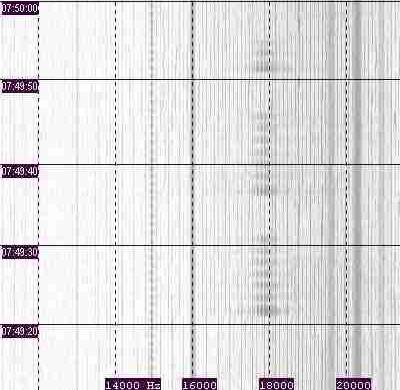
The signals are very strong at my reception place in Germany (coordinates: 8 degree 59' East longitude, 48 degree 43' North latitude), so I believe it is not NAA Cutler from the USA. At the time, this transmitter transmitted bursted signals.
Today (November 18th, 2001), the signal on 17.8 kHz was again receivable.
I made a series of spectrograms from it, which I put together, in order to show its characteristic about a longer time. It is not always of the bursted type, it is sometimes similiar to that of RJH63 (F1B - modulated).
All data about the spectrogram can be found on its foot.
Who knows which transmitter is it and where it works?
Re: Why is there no longwave broadcasting in America and Australia?
Posted by John Davis on November 18, 2001 at 20:11:32
I think there are two main reasons for this. The first is an inertia that began with regulatory philosophies, and the second is the distance involved in domestic versus international broadcasting on this side of the world.
(1) Regulatory:
I can't speak for Australia, but in the Americas, the concept of broadcasting was not very popular with federal authorities in the early days of radio. The government was so sensitive to safety of life and military uses of the technology during the First World War, for instance, that most private use of radio was shut down in this country and it was all put under the jurisdiction of the Navy Department. Afterward, there was still considerable reluctance to put radio to any other use. Signor Marconi invented the wireless to talk to ships at sea, by golly, and that's good enough for us!
The first broadcast stations tended to be experimental and amateur radio operations. They were tolerated only as long as they didn't get in the way of the much more important coastal and maritime services.
Even when broadcasting became recognized as a legitimate use of radio, all broadcast stations were assigned to a single frequency for entertainment transmissions (about 833kHz, if I recall correctly). A second frequency was made available, first for transmission of official weather bulletins to farmers, then later for a second higher-power class of broadcast stations.
As the 1920s progressed, the popularity of broadcasting prompted two actions: (1) broadcasting and amateur radio became two separate things; and, (2) more frequencies had to be made available for broadcasting. To meet the second need, amateurs were relegated to the supposedly "useless" shortwave region, and broadcasters received additional new channels in the supposedly marginal mediumwave frequencies--but durned if we were going to give up any of the valuable longwave frequencies that were so good for naval and commercial groundwave traffic.
Thus, from the very beginning, there was a bias against letting broadcasters down on the "good" frequencies. They remained the exclusive domain of Morse code, which few everyday listeners were particularly interested in. That, in turn, led to radio manufacturers not bothering to include longwave bands. And since radio manufacturing was largely a domestic industry for many decades, there was no competition on this side of the ocean to add other bands.
At least, not at first. Multiband receivers did start becoming popular here in the late Twenties, but only for frequencies that already had something interesting to receive...such as police calls, experimental television, ham radio, and eventually --yes-- international shortwave broadcasting.
And that brings us to what I believe is the second reason longwave broadcasting didn't catch on here.
(2) Distance Differentials:
In Europe, longwave broadcasting evolved into something of an international service. Reliable groundwave coverage to hundreds of miles made it ideal for that purpose on the Continent. Better, in fact, than shortwave, which may skip large chunks of territory before the signal completes its first bounce off the ionosphere.
Thus, longwave is fine for international broadcasting where the next country is at most a few hundred kilometers away. But shortwave is better if the target country is thousands of miles distant. And that's the case from the Americas and Australia.
So on one hand, we had a regulatory environment that favored local broadcasting on mediumwaves from the beginning. We grew to accept local and (eventually, as receivers got better, regional) regional broadcasting as the norm for our domestic radio service. Mediumwave met that need nicely. On the other hand, target countries for international broadcasting are so distant from here that shortwave was the best solution for us.
Now--there have been some attempts to use longwave for long-distance domestic broadcasting in the U.S. In the early 1970s, there was an experimental station testing the possibility of national emergency communication to the general public around 170kHz. A general lack of interest in buying longwave receivers for just that purpose apparently put an end to the idea.
Later, there was a proposal to assign the 1750 meter segment to public broadcasters, but regulatory interia prevailed once again; and, realization of the limited fidelity available on LF also contributed to the demise of the idea.
Re: Spectran problems -Help!
Posted by Alberto di Bene, I2PHD on November 19, 2001 at 05:16:40
Lloyd,
sorry that you are having problems with Spectran V1.
Could you please detail your configuration, i.e.
CPU used, maker of the sound board, Windows version, etc.
> Don't know why it can't install like Argo and Spectrogram etc
There is a reason for this. Argo, Spectrogram, etc. do not implement audio filtering functions, so they do not need to work in full-duplex mode, i.e. simultaneous audio input
*and* output. Spectran does, so it must have the complete control of the mixer. Unfortunately the area of the mixer APIs is one of the grayest in Windows... lack of tight specifications has led the various manufactures of sound boards to widely different implementations... hence the problems that Spectran is facing to automatically determine what hardware it has to deal with in each case.
V1 is an improvement in this respect when compared to the previous versions, but of course it is not perfect. But the more detailed feedbacks we receive from those who have problems, the more sound boards will be supported correctly. TNX.
73 Alberto I2PHD
XM Heard in MA
Posted by John Andrews, W1TAG on November 19, 2001 at 07:36:16
Successfully copied Les Rayburn's XM signal this morning around 1050Z. He was running QRSS60 on 184.8985 kHz. The signal was in and out all night, starting around midnight, but this was the only really readable ID.
Distance is 1029 miles. XM was last heard here in WOLF mode in March, 2001. I was unable to log him in QRSS mode last winter, despite many attempts.
John Andrews, W1TAG
Re: Leapin' Leonids!
Posted by Mike Thompson on November 19, 2001 at 12:27:50
Has anyone, done any activity this past Leonid season?
I managed to get outside and check out the storm, however the peak viewing times on both nites were washed out by rain clouds. I managed to hook up a whistler receiver but my QTH is too close to powerlines.
I did however catch about 7 VERY bright and colorful meteors each of which lasted a little over a second at around 1am EST.
I'm curious to hear of anyones activities on this subject.
Internet Remote Base
Posted by Andy on November 19, 2001 at 16:25:43
Any one interested in trying a remote receiver is welcome to try my site http://ka3odj.servemp3.com. The RX covers down to 100K and I am adding an active antenna very soon as the software for the antenna switch is almost done. You will also neet to connect using netmeeting for the audio connection. If you need more info E-mail me at my AD. You can use GUEST for the login and guest for the password. The information is case sensitive, please log off the system when done. The control for this is in the drop down as logg off the system. Let me know how you make out.
Andy Horn KA3ODJ
Re: Spectran problems -Help!
Posted by lloyd chastant on November 19, 2001 at 18:03:02
FB Alberto Well here is the setup here:
Dell 800 MHz with Pentium III
Windows ME OS
Soundblaster PCI64V(WDM)-says uses full duplex all the time
RAM 256Mb I've tried several things and no luck getting Spectran to run so far. Thanks and 73 de Lloyd W3NF
WA sending QRSS in slant mode
Posted by Bill Ashlock on November 19, 2001 at 23:01:16
Lowfer WA is now sending QRSS30 with an FM component that produces a distinctive 45deg slant to the dots and dashes if veiwed in the ARGO 30sec mode. The frequecy deviation is only 1 Hz for dashes and .3 Hz for the dots. Proportionally reduced slants will be seen in the 10 sec and 3 second ARGO modes due to the difference in the vertical calibration.
Please give this a look.
Bill WA
185.300
Re: WA sending QRSS in slant mode
Posted by Doug Williams KB4OER on November 20, 2001 at 10:54:29
WA copied 11/19/01 at 10:30 UTC here in Tennessee. Distance about 730 miles. This is the most distant Lowfer beacon I have ever copied. The slanting signal is very distinctive.
Re: www.vlf.it update
Posted by Doug Williams KB4OER on November 20, 2001 at 12:57:11
That is a very useful list. Thank you.
QSL - cards from VLF - stations
Posted by Harald on November 20, 2001 at 13:08:58
Receiving VLF with a PC soundcard is very convenient and the available software like “SpecPlus” allows very easily to make detailed documentation of the receptions.
So there is a big wish for QSL – cards from successful VLF reception.
Which VLF stations responds reception reports with QSL – cards?
Where should I address my letter? Is it possible to contact (which?) VLF – stations by e – Mail?
Is it possible to get such cards for the reception of ALPHA, RDL, UMB and other Russian transmitters (which are the contact addresses)?
Do ELF – transmitters also respond reception reports with QSL – cards?
Is it possible (under which conditions) that I get trouble with the police or secret services after writing a reception report to a VLF transmitter?
WA QRSS30(Slant) copy in Maryland
Posted by Lloyd Chastant on November 20, 2001 at 14:29:22
Daytime copy--Had two good copies of WA in QRSS30 (with the slant )today at 1800z and 1818z .Distance is 377miles.
Still trying for XM QRSS60.
Powerlines as transmitting aerial for VLF - or ELF - transmitters ?
Posted by Harald on November 21, 2001 at 07:12:27
Are there some VLF – transmitters which uses powerlines as aerial?
The usage of powerlines as aerial for VLF – transmission would make sense, because lines from the necessary length are nearly overall available. This would make powerlines especially as backup aerial attractive.
Of course some technical extent has to be done: the beginning and the end of the line (a line without junctions and underground earth cable sections and which runs straight – on is ideal as usage of aerial of a VLF transmitter) capacitators and coils had to be installed to block the VLF – signal and a special transformer which couples the signal in the line over a small capacitator which blocks the current of the line had to be installed.
A powerline which crosses a fjord or a deep valley would be a good aerial for a VLF – transmitter, because similar aerial systems are used under the name fjord – span aerials at some sites (JXN Helgeland, Tavolara, some former OMEGA – stations).
The usage of powerlines as aerial would be ideal for ULF/ ELF. It would allow building dipol aerials with length of the dipole halfs up to a length of 1000 kilometres without any great extension!
The only limitation factor is the maximum length of available powerlines.
In fact, there are some rumours, that the famous HVDC line “Pacific Intertie” which runs from Celilo (Oregon) to Sylmar (California near Los Angeles) can be used also as ELF – transmitter. Is it true?
(This line is approximately 1440 kilometre long and running nearly straight – on. There are no junction lines, since they are very difficult to realise in a HVDC system)
What informations about VLF- / ELF – transmitters using powerlines as aerial are available?
Where are these transmitters located?
The usage of powerlines as transmitting aerials is even not general uninteresting for amateurs, since some power companies have sometimes conductors installed on line pylons which are not connected to the power grid! (Especially in Germany and there in its south – western part this can be found. I assume, that these conductors are on the pylons for trouble cases or for later use)
Perhaps it is possible to use such dead conductors as aerial for VLF – beacons (I do not know if this the authority in Germany allows).
40 kilometres southly of Stuttgart, there is near Moessingen an approximately 15 kilometre long 110 kV – line with 6 conductors on the pylons which is not in use. At the anchor pylons the conductors are interrupted. Perhaps it is possible to use this line, which belongs the EnBw (Energieversorgung Baden – Wuerttemberg) to use as transmitting aerial for an amateur VLF – transmitter.
G3AQC copied in MA
Posted by John Andrews on November 21, 2001 at 08:43:40
I was able to copy G3AQC's 72 kHz transmission last night, after about a dozen evenings of no results dating back to September. Laurie was sending "AQC" in DFCW mode, with the dash elements on 72401.4 Hz, and the dot elements 0.1 Hz lower. In DFCW operation, dots and dashes are sent at the same length (120 seconds in this case), but at different frequencies. The resulting pattern is quite easy to recognize, and allows an ID to be sent in a shorter time than with a 1:3 dot/dash ratio.
As I have often said, my receiving location is nothing special. These UK signals should be detectable at greater distances if more of us on this side of the pond would look for them. Watch the RSGB LF reflector for announcements of operation, and give it a try.
John Andrews, W1TAG
XM copy
Posted by Roger Magnuson on November 21, 2001 at 09:56:58
I copied XM (qrss60) this morning. XM was readable on ARGO for about 3 hours. This is my first long distance LF reception this season. Glad to see you Les, now on to others. Other beacons copied here day or night are BRO, LEK, and BK.
Roger, KØMVJ, beacon RM, Duluth, Minnesota
Re: G3AQC copied in MA
Posted by Keith Ballinger VA3QF on November 21, 2001 at 11:13:13
John - What is your rx system on 72kHz - particularly the antenna? Also what are you using to decode the DFCW?
Regards,
Keith VA3QF OTTAWA
Re: G3AQC copied in MA
Posted by John Andrews, W1TAG on November 21, 2001 at 11:53:10
Keith,
My receiver is an ICOM R75, running with 250 Hz BW. The antenna is a square loop, 6 feet on a side, with 14 turns of wire, 1" spacing. The loop is series tuned into a 1:2 transformer (keeping the loop balanced), and run through coax to the shack, where I have a 30 dB 50 ohm preamp ahead of the receiver.
I am using the ARGO software to "decode" the signal. Last night, I used the 60 sec/dot mode, but will use 120 sec/dot tonight, as Laurie will be sending his complete call sign. I have continued to use a utility program called "Snag-It" to capture the screen at regular intervals. ARGO can be set to do that within the program, however.
John Andrews, W1TAG
Re: XM copy
Posted by John Davis on November 21, 2001 at 19:33:18
That's great work, Roger. Congratulations!
Re: WA sending QRSS in slant mode
Posted by Steve Olney VK2ZTO on November 21, 2001 at 20:16:52
G'day Bill,
I have a suggestion to make regarding your slant mode QRSSS. Instead of having different durations for the dots and dashes, why not have the durations the same, but have a slant upwards for (say) the dots, and a slant downwards for the dashes. This will reduce the transmission time. It could be argued that this is getting almost to the point of VFSKCW, but as most interference is horizontal, the slanting might have an advantage in a similar fashion to the present slant protocol. What do you think?
73s Steve Olney VK2ZTO
G3AQC 2nd Night
Posted by John Andrews on November 21, 2001 at 21:45:40
Below is a screen shot of G3AQC on 72.4013 kHz taken at W1TAG from about 0025 to 0120 on 22Nov01 UTC. This is from ARGO, in 90 sec/dot mode. I tried 120 sec/dot, but there was blurring between successive elements on a line. The 90 sec version is much clearer, though there isn't as much vertical separation between the dots and dashes. The "799.5" line represents 72.4015 kHz. Dashes are 0.1 Hz higher in frequency than dots.
I'll be amazed if someone else doesn't copy this tonight!
John Andrews, W1TAG FN42ch

XM Rolling into Maryland!
Posted by Larry Putman on November 21, 2001 at 22:36:28
Started copying XM QRSS60 around 2100 EDT.
Finally got ya Les!! Good ARGO capture on the way!
Using RX340 and K9AY. GREAT signal!
73
Larry WB3ANQ
Re: G3AQC 2nd Night
Posted by Tim Brannon on November 21, 2001 at 22:45:23
Great screen shot! What is the transmitter setup?
Re: XM copy
Posted by Paul Stroud on November 22, 2001 at 01:15:36
After seeing bits and pieces of XM over the last few evenings, good copy was received at 0538Z using Argo set for QRSS30. XM has been solid for the past hour.
My QTH is nr Raleigh, NC. Paul, AA4XX
JDH lookin' good
Posted by Paul Stroud on November 22, 2001 at 01:22:07
Finally snagged JDH after listening for several nights. He's running QRSS3 on 184.514 The rig on this end is a HB DC rcvr and the antenna is a beverage. A fun night of listening...
My QTH is 15 mi. s of Raleigh, NC. Paul, AA4XX
The nowadays usage of the area of former "Radio Central" in Rocky Point, Long Island, NY
Posted by Harald on November 22, 2001 at 05:37:30
What is now on the area of former “Radio Central” in Rocky Point, Long Island, NY?
Is this area still used for transmitting? If yes, for which services on which frequencies?
If no, what is its nowadays use?
Re: G3AQC 2nd Night
Posted by John Andrews, W1TAG on November 22, 2001 at 14:58:21
Tim:
Here's Laurie's description:
"This consists of a PLL synthesiser driven by a VXO which can be pulled enough to produce 1-2 cycles frequency shift by a small capacitor and relay.
This feeds a Decca transmitter producing about 1000W. This is transformer coupled to a loading coil and variometer with a max inductance of 6.5mH.which resonates the Ant. The Ant is an inv L with a vert. section 50ft high and 600ft of top load (not in a straight line) This is all hung up in trees which tend to absorb about half the power,so the 1000W from the Decca produces about 400mW at the Ant. and about 200mW is radiated.
I use QRS by Rik Strobbe to produce the DFCW information."
John A.
Re: JDH lookin' good
Posted by John Hoopes on November 22, 2001 at 18:04:56
Thanks for the signal report Paul. We do what we can. Let me know if you want a card.
73 John/AB4MS/JDH
ELF and VLF signals guide
Posted by Trond at ALFLAB, Halden in Norway on November 22, 2001 at 18:59:39
Hello Lowfrequenteers
The WUN ELF and VLF guide, version 1.0 is now online at:
http://www.wunclub.com/archive/files/ELF-VLF-GUIDE-v1.0.rtf
A html version of this guide, is also available at Renato Romero's most recomendable site, The Open Lab, radio below 22kHz www.vlf.it http://www.vlf.it/trond2/list.html
Free to download for everyone interested.
Spread the word and power up your longwave receivers.
best regards and happy monitoring
Trond at ALFLAB, Halden in Norway
59°8'12''N 11°23'55''E
Early Evening Capture of JDH In Maryland!
Posted by Larry Putman on November 23, 2001 at 21:33:18
Hi John,
Just got my first sighting and argo capture of JDH this evening 184.514 QRSS3 at 1937 EDT!
Very early for your signal so I will watch it for a while and see what happens. This must be my lucky week! WA, XM, and JDH!
73
Larry WB3ANQ FM19rc Pasadena MD.
Re: Early Evening Capture of JDH In Maryland!
Posted by John Hoopes on November 24, 2001 at 09:08:32
Congratulations Larry. A card is on the way.
73 John
RF-550
Posted by Peter on November 24, 2001 at 17:21:14
Does anyone have any software to control a HARRIS RF-550 receiver.
177.777 kHz NC LowFER sending format
Posted by Dexter McIntyre, W4DEX on November 24, 2001 at 17:52:17
I have the LowFER beacon temporarily sending a signal best viewed at QRSS30 speed. Give it a try.
Dexter
JDH in WOLF mode
Posted by John Hoopes on November 25, 2001 at 14:31:00
Just a note to let you know that JDH is in WOLF mode. Transmitter is Lyle's "All-in-one" design sent to me by Les for try out. I'll stay in WOLF for awhile and then switch back to QRSS3/CW after a few weeks. From feedback I've been receiving, it seems folks prefer the instant gratification of QRSS. Can't say that I blame them.
73 John
Re: JDH in WOLF mode
Posted by Lyle Koehler on November 25, 2001 at 18:00:45
What frequency, John?
Re: 177.777 kHz NC LowFER sending format
Posted by Dexter McIntyre on November 25, 2001 at 18:33:50
I received 3 screen shots last night showing NC's present signal pattern.
Reporting in order received were:
John Andrews W1TAG Holden, MA
Larry Putman WB3ANQ Pasadena, MD
Paul Cianciolo W1VLF Harwinton, CT
NC will remain in mystery mode a few more days.
Dexter
BZS running QRSS30
Posted by Steven Brooks on November 25, 2001 at 20:20:16
I have a new antenna, an upgraded ground plane, and BZS at 187.3KHz is operating in QRSS30 mode. With my set up, this equates to 30 second dashes and 6 second dots. Let me know if anyone copy me. I hope all my efforts were worth it.
Regards,
BZS 187.3KHz Avondale, AZ
Help file for Spectran
Posted by Alberto di Bene, I2PHD on November 26, 2001 at 08:47:39
I have been asked by some if the help file of Spectran were available or when it would be.
While the true help file is not ready yet, waiting for Vittorio to complete it, I wrote down some quick-and-dirty notes to explain how to use the program.
If you need it, it can be downloaded from :
http://www.weaksignals.com/bin/specv1doc.zip
When you expand the ZIP file, you obtain spectran.doc,
a Word 2000 document (guaranteed virus-free :-)
Only three pages, but maybe enough to get started.
73 Alberto I2PHD
Re: IMAGE Radio Plasma Imager Test
Posted by THierry on November 26, 2001 at 11:32:35
Hi Bill,
I will trying to hear something in 5-15 KHZ band here in Bordeaux,France.
Thanks.
From elf_vlf hotmail.com.
Re: BZS -not- running QRSS30
Posted by John Davis on November 26, 2001 at 12:57:14
Hi Steven,
From the description, BZS is actually using QRSS6 with nonstandard dashes. The number in the designator should be dot length, not dash length.
73,
John
Great Freeware Software for WOLF recording
Posted by Les Rayburn on November 26, 2001 at 13:42:09
For those interested in detecting WOLF signals, I've found a great piece of free software that seems perfect for the job. It's at:
http://www.dago.pmp.com.pl/messer/#download
Called "Messer"...it allows you to record .wav files using a timer, with virtually unlimited numbers of recording sessions. It can also execute other Windows programs after each recording. For example, you could record your first 23 minute try for the JDH beacon tonight at 0200 until 0223. After recording the file, Messer could then be instructed to launch your WOLF.bat file to automatically attempt to decode the file, while you were already recording another attempt at 0225-0250.
Using this tool, it is literally possible to record a half dozen or so sound files nightly, and already have them decoded when you awake in the morning. Leaving you only to look at the text files for results.
It's also useful for looking for CW beacons, as you can record lots of small recording sessions, perhaps 10 minutes in length overnight, hoping for a opening. You can even have the software automatically encode these files into .MP3 format to save hard drive space. Perfect for logging NDB's,
AM stations, etc.
Just park your receiver on the spot, and let Messer do the work for you.
With a portable MP3 player you could even search those recordings for a rare NDB during your morning commute! And it's free!
(If you want to encode file into MP3 format you'll also need to install one of the codex's .dll files which are listed on the download page. )
Hope others find this tool useful!
73,
Les Rayburn, N1LF
Les Rayburn, director High Noon Film & Interactive
100 Centerview Drive Suite 111 Birmingham, AL 35216
(205) 824-8930
(205) 824-8960 FAX
Re: Help file for Spectran
Posted by Richard Allen, W5SXD on November 26, 2001 at 14:27:19
Thanks, gentlemen. A great addition to a superb program.
Signal decoding
Posted by Udo Maier on November 26, 2001 at 15:04:41
What kinds of signal can I decode with the method of an amateur? (If it is allowed, that is another problem)
Has an amateur ever succeeded in decoding a signal of a military VLF station?
Is software available with which I can decode the signals of VLF transmitters like GBR, HWU, RDL, etc.?
If yes, on which page?
JDH QRT for the moment
Posted by John Hoopes on November 26, 2001 at 17:39:33
I had a problem with the transmitter sometime during the day. The EXOR gate that provides modulation gave up the ghost, or so it seems. I don't know what caused it but there has been some unusuall problems with my ground lately. Sorry for any inconvenience caused. I'll try and return JDH to the air ASAP.
73
Re: JDH in WOLF mode
Posted by John Hoopes on November 26, 2001 at 17:42:25
Sorry. It was 184.500. It should be back up in a couple of days. I'll keep you posted.
73 John
Re: Clam Lake ELF - is its aerial the best choice?
Posted by Harald on November 26, 2001 at 17:55:24
Was the aerial used of the ELF transmitters of the US Navy and of the Russian ZEVS the best choice?
Its effiency is only 0.0001%!
Would not a horizontal dipole which consists of a straight - running powerline have a much better effiency?
(Why does the US Navy not use the "Pacific Intertie" a more then 1000 kilometre long HVDC line connecting Oregon and California as aerial?)
Re: Great Freeware Software for WOLF recording
Posted by Lloyd Chastant on November 26, 2001 at 19:21:01
Les I looked at Messer and saw the sample rate settings for the lowest rate to be 22050 and Wolf wants 8000 setting...so how did you get the setting to 8000??I really haven't played with it too much because I still like Cooledit but thought I'd take a quick look..
de Lloyd W3NF
JDH WOLFing once again.
Posted by John Hoopes on November 26, 2001 at 21:50:46
Good news...JDH is again WOLFing at 184.500. It seems one of the inductor leads on the filter network popped off the board and the RF had no place to go. We corrected the problem and all is well. I definetly need to invest in one of those magnifying lamps. The old eyeballs ain't what they use to be.
73 John
Re: Clam Lake ELF - is its aerial the best choice?
Posted by John Davis on November 26, 2001 at 23:54:23
:: Was the aerial used of the ELF transmitters of the US Navy and of the Russian ZEVS the best choice?
:: Its effiency is only 0.0001%!
Actually, I believe the one at Clam Lake is somewhat less efficient than that. But an ERP of, say, three watts at that frequency (along with such a slow data rate) can give really amazing results.
:: Would not a horizontal dipole which consists of a straight - running powerline have a much better effiency?
Not really. The wavelength at 76Hz is almost 3.95Mm (yes, megameters). While a 1000km powerline represents nearly a quarter wavelength by itself, and while it is theoretically possible to load a short dipole consisting of two 1/8-wave sections into a reasonably effective radiator, there are several practical problems.
First, the electrical engineering problems: Resonating such a dipole would involve very substantial inductors. Given that the primary use is power transmission, the voltage and current ratings of the inductors would have to be extremely high. They would almost certainly have to contain cores of iron or various magnetic alloys to achieve the necessary inductance. The DC current through them would make it difficult to keep the cores from saturating when the ELF power was applied. The inductance would also not be stable as the power demand fluctuated.
Second, electromagnetic problems: While it is desirable to have a horizontal dipole a quarter wavelength or more above the surface of the earth, this dipole would not be located more than .0000114 wavelength above the surface, and less than .000023 wavelength above its own mirror image in the soil!
Radiation would be almost non-existent...the powerline being roughly equivalent to the efficiency of Clam Lake, if the line were truly level and straight. But in reality it is neither. It meanders horizontally due to terrain features, making it an imperfect dipole. And where it runs through valleys, the hills on either side cause serious terrain shielding. Adding in these factors would cause it to be even less efficient than Clam Lake.
Third, strategic limitations: A dipole would be unavoidably directional. There would be little or no communication possible in the directions off the ends of the antenna.
And a structure of that size would be too hard to protect. A single tower knocked down anywhere along its length would throw the whole system out of resonance; definitely enough to prevent it from radiating, and perhaps badly enough to damage the transmitter too.
Finally, there is the environmental impact to consider. Powerlines of any appreciable length will encounter population centers at some point. Conventional AC power systems run multiple conductors carrying polyphase current in a transmission line configuration, thus minimizing stray electric and magnetic fields. Inevitably, there is some imbalance between the currents in these lines, and this fact results in AC fields in the vicinity of the powerline which cause concern among citizens and even some scientists.
An ELF transmitting dipole, in which there is no attempt whatsoever to cancel the AC magnetic and electric fields (indeed, just the opposite!), would scatter enough energy to illuminate fluorescent tubes for tens of kilometers around, and frighten residents into early graves, assuming nothing else afflicted them first. It would be a nightmare for environmentalists, and a dream of epic proportions for fee-hungry lawyers.
By running their feeders through government-owned forest areas and letting conductive underground layers form the return path of a transmitting loop, the US and Russian navies are better able to protect the antennas and transmitters, control the electromagnetic radiation from them, and minimize environmental concerns, all at a more reasonable engineering cost.
Regards,
John
rld will be off the air
Posted by Brian Helms on November 27, 2001 at 08:16:27
I will be taking down my beacon this evening to use the coil for a presentation for the local club. It will be down until Wed. evening(11/28) if weather permits.
Volunteer Help
Posted by Douglas McCray on November 27, 2001 at 18:24:49
I am involved with the restoration of the USS New Jersey Radio Center and Manager of the youth encampment program. We have contacted the group that runs the USS Olimpia, docked in Philly, across the Delaware from the New Jersey in Camden.
I have been contemplating using LF radio to do radio between young people groups on the two ships and perhaps other locations as part of educational activities.
Looking for persons in the Delaware Valley area that might be interested in assisting in such a program.
TNX es 73 DE K2QWQ Doug McCray
K2QWQ voicenet.com
VA3LK 137.79 copy in Maryland
Posted by Lloyd Chastant on November 27, 2001 at 20:52:33
Guess its not too hard to copy Larrys signal here in Maryland but had a good Argo 60dot copy on his 137.79khz signal tonite about 0000z.de Lloyd W3NF
BZS at QRSS5
Posted by Steven Brooks on November 27, 2001 at 23:01:10
BZS is operating in a true QRSS5 mode. 5 second dots and 15 second dashes, this is the best I can do for now. BZS is on 187.300KHz + or - 2KHz. I do not have a frequency meter to measure the exact frequency of my final, can anyone give me a suggestion for this type of measurement?
Re: rld will be off the air
Posted by John Davis on November 28, 2001 at 00:43:23
Does that mean you will be using the coil to INDUCT new LowFERs into the hobby? :-)
Re: rld will be off the air
Posted by michael brown on November 28, 2001 at 01:29:47
I finally heard your station.Its under a noise source here..I think its a plc on your freq.At any rate, on one magic evening for 40 minutes NC on 177.777 ,JDH on 184.5 and just barely RLD were all heard on the 140FT E/W wire with an Icom R-8500 with the 500hz filter.Its not as strong as Dex here and John is strongest of all.I seem to hear north-south better than east-west, so that explains JDHs huge signal here.177.777 is clear here so Dex is easy too.But the bands got to be real hot for you to get over the local mystery noise carrier(It may be TV set harmonics...its pretty harsh).I hope some more rain will help the ground conductivity out.That should help some!
Theres a carrier on Dexs medfer freq here too.Ive never heard his medfer as a result!
Re: BZS at QRSS5
Posted by John Andrews, W1TAG on November 28, 2001 at 07:22:24
Steven,
It's not realistic to expect people to find you in a 4 kHz window unless they're right in your back yard! There's a lot of turf between 185.3 and 189.3 kHz.
In order to help with frequency calibration, I need to know what you have for LF receiving equipment.
John Andrews, W1TAG
Re: BZS at QRSS5
Posted by Steven Brooks on November 28, 2001 at 10:45:48
I have a Palistar R30C and a Sony ICF 2001. The Palistar only reads to 100 Hz so it is hard for me to tell my exact frequency. I am using the L-111 from LF Engineering and a tuned long wire as my antennas.
what's going on on 1710 khz ?
Posted by george mccormick on November 28, 2001 at 22:38:34
hi....
i know this may be a little out of this BB's subject range, but while hunting for medfer's in the 1600 to 1710 khz range, i have run across some strange transmissions at 1710, in cluding tonite ,even as i type...( 11/29/01 0244 Z). at first i thought it was a pirate,but it's xmsns are very professional,and it is on all nite long...subject matter seems to be Israeli...it comes in medium strong,but with soft audio,so characteristic of a long transmission path, and it is badly QRM'ed by nav aids...anybody know anything about this? didnt know where else to turn...
tnx, george AA1UM
Re: VA3LK 137.79 copy in Maryland
Posted by Paul Stroud on November 29, 2001 at 07:48:10
Tnx for the tip, Lloyd. Last night I was able to see "VA3L"
on 137.79 runnning Argo in 60 sec dot mode with slow speed selected. Maybe tonight Larry's complete call will make the trip.
73, Paul AA4XX nr. Raleigh, NC
Re: rld will be off the air
Posted by Keith VA3QF on November 29, 2001 at 09:07:32
No, he's just WINDING them up, although a few may TURN to the hobby. WIRE you asking??
(Sorry, couldn't RESIST....)
Re: Clam Lake ELF - is its aerial the best choice? - Power lines as VLF or ELF - transmitter
Posted by Harald on November 29, 2001 at 12:08:03
On the internet page http://www.vlf.it/trond2/below10.html there is a Russian ELF transmitter mentioned which uses a powerline as transmitting aerial.
Obviously the electrotechnical problems involved with using a powerline as transmitting aerial are not unsolveable, so I could imagine that the changing inductivity of the coupling coil which is involved with the changing current rate can be compensated by switching capacitators in paralell with the coil or by using a coil with various iron core.
Concerning power lines as transmitting aerial for low frequency transmitters look also at my article "Powerlines as transmitting aerial for VLF - or ELF - transmitters ?" in this forum.
Mideke Booklet Available
Posted by Max Carter on November 29, 2001 at 13:45:59
Limited copies of Mike Mideke's famous 60-page 1987 compilation of useful LowFER wisdom "Transmitting Antennas and Ground Systems for 1750 Meters" available for $5 post-paid from: Max Carter, 56 Cozad Rd., Wheatland, WY 82201.
Re: rld will be off the air
Posted by John Andrews, W1TAG on November 29, 2001 at 14:12:45
It's just like John Davis to start something like this. TANKS, John! It is with the greatest RELUCTANCE that I attempt to finish it off. Please don't accuse me of being over-REACTIVE! It's just time to play TAPS for this thread. It's not that I want to CHOKE off discussion, please understand. In fact, I'll leave you with one big Q:
Why was my brother called "Micro Henry?"
John A.
Re: rld will be off the air
Posted by Brian Helms on November 29, 2001 at 15:01:42
Am I responsible for this ???? :)
Re: Mideke Booklet Available
Posted by Keith VA3QF on November 29, 2001 at 15:07:41
Yes, please - will mail you an order.
73 - Keith VA3QF
Brian's Innocence Confirmed
Posted by John Andrews on November 29, 2001 at 15:38:23
No, this isn't your fault. But I suggest leaving the coil in the antenna circuit for a while. We're all worn out trying to think of puns.
John Andrews
LEK frequency change
Posted by Lyle Koehler on November 29, 2001 at 16:44:01
While JDH is running WOLF mode experiments on 184.5 kHz, LEK will be doing the same thing on 184.7 kHz. This should make it possible to capture both signals at once on a receiver with a bandwidth of 200 Hz or more.
RLD Beacon 185.555
Posted by Brian Helms on November 29, 2001 at 20:54:02
I am going to wait until Saturday to put my beacon back on the air due to weather forecast and noise. It should be heating my lawn again before dark on Saturday if my antenna survives the forecasted winds.
Brian Helms KD4RLD
I hope this thread stays under control.
Re: Mideke Booklet Available
Posted by Max Carter on November 30, 2001 at 11:16:42
Thanks Keith
Fwd: Maintenance release of Spectran
Posted by Alberto di Bene, I2PHD on November 30, 2001 at 12:08:40
I have just uploaded Spectran V1 build 107. It has no new functions, but rather a couple of bug fixes, together with some modifications to make it to try harder to support some difficult sound cards.
The two bugs corrected were :
- When specifying an offset frequency in the Spectran Controls panel, the dB level of the peak in the spectrum pane was computed incorrectly. Fixed.
- Again, when specifying an offset frequency, some too big values, or malformed values, could cause the program to crash. Fixed.
Please download this version, and trash the previous, tnx.
Thanks to Claudio IK2PII and Johan Bodin SM6LKM for spotting the bugs.
73 Alberto I2PHD
Download it from http://www.weaksignals.com
Re: Clam Lake ELF - is its aerial the best choice? - Power lines as VLF or ELF - transmitter
Posted by John Davis on November 30, 2001 at 12:24:30
Harald,
You may notice in Trond's article that the power line is not actually the radiating aerial. It is used as a feeder for a grounded dipole.
The ELF signal thus does not require that the line be resonated for transmission, but only that the signal be kept isolated from the AC power at each end. This is a much easier task, and does represent a workable dual-use arrangement.
Its remaining limitation is that population must not be exposed to excess induction fields. (The powerline represents a balanced transmission line for AC power, but is a single-ended feed for the ELF signal.) Fortunately, in Murmansk this is a minimal problem; and with the portable generator configuration they're using, the induction fields won't be overly large anyway.
Memphis, Tennessee
Posted by Mark on November 30, 2001 at 20:47:31
Are there any Lowfers or Medfers in the Memphis, Tennessee area?
Re: G3AQC copied in MA
Posted by Jerry Cross KC2INK on December 01, 2001 at 08:51:36
Hey John, Nice job! I'm a new amatuer operator in upstate NY. I would like to ask you more about the software you used. The ARGO? Where can i get my hands on it? I do have the Icom IC R75 and building an antenna is no problem. Thanks.
www.lwca.org
potrzebie