
Re: Introducing My New HiFer Beacon
I will definitely post a link here John. It will be a few weeks, but I'll let you guys know.
Dave Re: Introducing My New HiFer Beacon "SPT" on 13558KHz
AA7EE
Posted by Dave AA7EE on November 01, 2015 at 00:17:45.
In reply to Re: Introducing My New HiFer Beacon "SPT" on 13558KHz posted by Paul on October 31, 2015
That's a great idea Paul! I used to listen to Laser 558 back in the 80's, as well as Caroline. I forget what wavelength Caroline was on then - it might have been 319M. I believe the frequency at that time actually corresponded to 315M, but "Caroline 319" sounded better.
Dave Re: Introducing My New HiFer Beacon "SPT" on 13558KHz
AA7EE
Posted by Paul on November 01, 2015 at 11:39:39.
In reply to Introducing My New HiFer Beacon "SPT" on 13558KHz posted by Dave AA7EE on October 30, 2015
Hi Dave,
I have tried to copy your beacon using a few different antennas. Nothing heard.
Sorry, OM.
73, PS Re: Hifer RY On The Air
Posted by Dave on November 01, 2015 at 16:58:36.
In reply to Re: Hifer RY On The Air posted by John on October 31, 2015
I'm located in Apopka, Florida -- a suburb of Orlando.
Re: Introducing My New HiFer Beacon "SPT" on 13558KHz
Posted by Dave AA7EE on November 01, 2015 at 19:09:35.
In reply to Re: Introducing My New HiFer Beacon "SPT" on 13558KHz posted by Paul on November 01, 2015
Thanks for trying Paul.
Afternoon hifers in NE IL
Posted by Garry, K3SIW on November 01, 2015 at 20:40:43.
Haven't listened for other hifers for quite awhile so shut down my pair a few minutes to receive. At the watering hole NC, USC, EH, and RY came through well. The latter was measured at 13555415 Hz, putting it nicely between my DFCW hifer at 13555400/405 Hz and the QRSS30 hifer at 13555433 Hz. Further up the band MTI and WV came through on CW and PBJ on QRSS. Looked for CA and AZ hifers but nothing was heard.
73, Garry, K3SIW, EN52ta, Elgin, IL
HiFERs Today in FL
Posted by Dave N4EF on November 01, 2015 at 22:09:04.
Attached are today's captures of the watering hole.
Sunday morning's captures show the ever-present EH with RY peeking through. RY was not as spectacular as yesterday and the SIWs were very faint and only momentary and did not present themselves at the same time as EH and RY. RY was however the first signal I saw this morning although it was fleeting and did reappear with EH.

There is bifurcation of the EH trace lasting about a minute in a different capture with a ghost-image trace evident. How timely with Halloween just concluding.
For the captures, the solar indices were SFI =119, A= 6, K=3, with the prediction of geomagnetic storms reaching the G3 level are likely. Radio blackouts likely today, November 1 and a predicted A index of 85. Yucky space weather ahead.
Dave
Re: 135.95 kHz Transmitter on-the-air again from Dixon.
Posted by Paul on November 02, 2015 at 05:27:43.
In reply to Re: 135.95 kHz Transmitter on-the-air again from Dixon. posted by John Davis on October 26, 2015
It is full scale at my QTH. Anyone know what mode that is? I can get a lot of gibberish if I set the TrueTTY to 100 baud with the narrowest setting. But I'm sure I am doing ti wrong. Re: 135.95 kHz Transmitter on-the-air again from Dixon.
Posted by John Andrews, W1TAG on November 02, 2015 at 13:23:51.
In reply to Re: 135.95 kHz Transmitter on-the-air again from Dixon. posted by Paul on November 02, 2015
Paul,
The data would be highly encrypted, and it's unlikely that you would be able to decode it. Sort of like the old days when NSS and NAA sent perfectly copyable CW, but in code groups that made no sense to us homebodies. Of course, it DID make decent code practice, something you can't say about the current stuff!
John, W1TAG
Hifers out in the field with the KA1103
Posted by Bill Hensel on November 02, 2015 at 15:17:04.
Nov 1, 2015
I wondered out in the Pine Valley open space park where I have seen a few mtn. Lions of the past years. At 0008-0030Utc MTI, k6FRC, GNK a big signal and of course RQ.
Re: Hifers out in the field with the KA1103
Posted by Paul on November 02, 2015 at 17:19:26.
In reply to Hifers out in the field with the KA1103 posted by Bill Hensel on November 02, 2015
Thanks for risking becoming cat food for that report, OM! Will gladly QSL if you wish.
Re: 135.95 kHz Transmitter on-the-air again from Dixon.
Posted by Paul on November 02, 2015 at 17:20:45.
In reply to Re: 135.95 kHz Transmitter on-the-air again from Dixon. posted by John Andrews, W1TAG on November 02, 2015
Yes, I am aware it would be encrypted. However, all I see is a bunch of RQRQRQRQRQRQRQRQQ type stuff with an occasional K thrown in or carriage shift. Wondering what mode I should use to decode the 'pure' gibberish. If that makes sense.
Y oh Y ?
Posted by John Davis on November 02, 2015 at 17:44:53.
Took the newer radio (the R75) to the field this morning for the first time in just over a week. Immediately noticed something amiss..the pitches of signals at the HiFER watering hole seemed weird. Sure enough, the radio was no longer in CW REV mode to put things in the right order. I also noticed that I was copying MTI amd WV by ear while tuned to 13,555.40! Long story short, the poor thing had lost its mind, reverted to factory default settings, and had forgotten everything I previously taught it about which filters were installed.
(For IC-R75 owners: can that happen if the clock battery is weak, or should that only happen if a CPU reset has been forced? My understanding from the manual is that only the clock related functions should be affected by the battery, while other settings should be non-volatile in the absence of a reset. If that's correct, I'm very puzzled as to how it happened. It's too young for dementia to be setting in just yet.)
At any rate, I dug out the manual and half an hour later had restored all my settings--just in time to copy one clean "Y" at 13,555.415 before the signal diminished enough to be barely visible among the CODAR and machine-gun racket. Were it not for those, I believe I'd still have been able to copy RY adequately. NC, USC, and EH remained visible. Up the band, PBJ and MTI are both visible and, at times, both audible.
Right now I'm watching for FL. WV is visible and audible, and unfortunately appears to be right about the last known frequency of FL. Prospects for FL aren't good that way. Haven't seen signs today of the keyed carrier that I believe is probably TSN, but perhaps this afternoon... and I'll also be looking to catch more of RY.
John
Re: Y oh Y ?
Posted by Paul on November 02, 2015 at 18:04:28.
In reply to Y oh Y ? posted by John Davis on November 02, 2015
That is what happens when you leave the poor critter unplugged from power for too long. I have a radio that does the exact same thing.
Even if the power switch is off, it still maintains its memory so long as you leave it plugged in.
Re: Introducing My New HiFer Beacon "SPT" on 13558KHz
Posted by Ed Holland on November 02, 2015 at 18:36:06.
In reply to Re: Introducing My New HiFer Beacon "SPT" on 13558KHz posted by ed Holland on October 30, 2015
Hi Dave,
As predicted, no copy, despite several tries over the weekend.
I was hopeful, since I more-or-less have line of sight to your location. At one point, I thought I heard something tuning up around your frequency, but it was very intermittent, nor did it resemble your beacon's ID.
Good luck with the longer range anyway, and I'll always keep an "ear" on your freq.
Cheers
Ed
Re: Introducing My New HiFer Beacon "SPT" on 13558KHz
Posted by Paul on November 02, 2015 at 21:02:11.
In reply to Introducing My New HiFer Beacon "SPT" on 13558KHz posted by Dave AA7EE on October 30, 2015
Dave,
Right this moment- Hearing an occasional dit or dah, but not enough to get a full ID on SPT on 13.558 MHz.
FRC is coming in just fine. Some noise around the watering hole. E I E I E I on 13.560
Posted by Paul on November 02, 2015 at 21:15:33.
Hearing a fairly strong signal sending what appears to be a random sequence of E's and I's. "dit...dit...dit dit...dit...dit dit...dit..." etc. on 13.560 MHz. Re: E I E I E I on 13.560
Posted by ed Holland on November 02, 2015 at 23:48:48.
In reply to E I E I E I on 13.560 posted by Paul on November 02, 2015
...ditto... (If you pardon the pun.
Heard this morning, "dits" at approximately 4 second intervals. I gauged them a frequency of 13561.1, attempting a zero beat with the receiver. No time to fire up the PC and get an accurate readout. Very audible, easy copy.
Ed
Re: E I E I E I on 13.560
Posted by John Davis on November 03, 2015 at 02:24:10.
In reply to Re: E I E I E I on 13.560 posted by ed Holland on November 02, 2015
There are a whole menagerie of emissions from industrial/scientific/medical apparatus operating under Part 18 that account for most of the mystery signals around the center of the band. It's hard to tell the purpose of most of them, but where a signal of this sort seems relatively strong, it might be a fun project to use a small loop antenna with one's receiver and try to direction-find exactly where it's coming from.
John Re: Y oh Y ?
Posted by John Davis on November 03, 2015 at 04:32:52.
In reply to Re: Y oh Y ? posted by Paul on November 02, 2015
"I have a radio that does the exact same thing."
My favorite Texas story may be relevant here. Two Texas cattlemen are bragging about the size of their spreads. One boasts, "Why, my ranch is so big, I can climb in my truck before daybreak, and drive flat out the whole day, and still not get to the other side by dark." The other Texan says, "Yep, I had a truck like that once, too." ;)
One of my little portable AM/FM/SW/LF radios also loses its memory if the batteries run down while it's not plugged in for an extended period, but in an ICOM desktop rig I'd kind of expect a little more. The NVRAM in my somewhat less sophisticated Kenwoods holds their settings for months or years of being unplugged, for instance, long after the clock batteries have died.
A re-reading of the manual seems to confirm that only the clock and timer functions should be affected by the battery in this radio, and the battery should be good for about two years. Consequently, I think something must have happened to force a CPU reset...perhaps due to some accidental pressure on the UP or DOWN button when I turned on the power while it was in its travel carrier for purposes of warming it up prior to use today. Can any R75 users comment on the likelihood of such a thing happening?
None the less, it did a great job in my hunt for RY today, and also my routine checks on MP and SIW at LF.
John Re: Introducing My New HiFer Beacon "SPT" on 13558KHz
Posted by John Davis on November 03, 2015 at 05:30:02.
In reply to Introducing My New HiFer Beacon "SPT" on 13558KHz posted by Dave AA7EE on October 30, 2015
"...as most beacons seem to be in the segment above 13560, I thought I'd place mine in the lower half of the band. I am quite willing to move, if there are other beacons or signals too close in frequency."
It looks to me as if 13558 is a good spot. I'm curious, though, about the statement that most beacons seem to be above 13560. If you haven't done so, you might want to check our list at www.lwca.org/sitepage/part15/.
Good luck with your beacon, Dave!
John Catcher of the RY
Posted by John Davis on November 03, 2015 at 05:52:23.
As I reported earlier, this morning RY propagation tended to favor the Y. Then at mid-day, I got a lot of decent Rs without clear Ys. Finally, late in the afternoon, both started coming in about equally well.

Also present in late afternoon were WV, MTI, and GNK, although not as strong as they were earlier in the day. FRC was present for a few letters at a time, too.
The door to Illinois seems once again shut, locked, double-bolted, and barred. Not a peep out of anyone along that path.
John LowFER SJ Returns
Posted by John Davis on November 03, 2015 at 06:23:16.
Not sure when Sal turned it back on, but Michael Sapp WA3TTS reports tonight that SJ is once again on the air in the 1750 meter band.
John
Re: Catcher of the RY
Posted by John Andrews, W1TAG on November 03, 2015 at 14:37:22.
In reply to Catcher of the RY posted by John Davis on November 03, 2015
JD,
Nice catch! The RY antenna is essentially the same as the old one, but hung from a different tree, and about 10' higher above ground. The immediate terrain is wide-open on the western side, being on the edge of a N-S lake. The land does rise considerably to the east, probably explaining why the beacon traditionally hasn't done as well as others toward EU. The tough trick with vertical dipoles is bringing the feedline off at right angles to the antenna. But in this case, the A-frame cottage is about 60' away to the east, and high enough to provide a good anchor point for the coax. This makes the feedline about 100' long, but I just run the transmitter at 6.4 mw to overcome the 1.5 dB loss, and (hopefully) get 4.6 mw at the antenna feedpoint.
You seem to get the same good copy of USC and NC that we get in the northeast.
John, W1TAG
Re: Catcher of the RY
Posted by John Davis on November 03, 2015 at 15:07:53.
In reply to Re: Catcher of the RY posted by John Andrews, W1TAG on November 03, 2015
"You seem to get the same good copy of USC and NC that we get in the northeast."
Yes, it's a remarkably consistent path. One or both of them are often able to get through when other stations can't. And yet, when conditions are good, they are not necessarily the strongest signals, either.
By contrast, EH is frequently the loudest here, but at other times it is among the weakest. Or take PBJ and MTI. Both are on almost exactly the same bearing but at different distances, with the result being I can copy MTI most days with wide variability of strength, but PBJ only some days and with even more variability. And nowadays, the path to/from Illinois is the most variable of all, being wide open parts of some days and just plain unavailable for days or weeks at a time.
All very interesting to watch. I wish there were as many LowFERs on-air to track the same way. The only one consistently on at 137 kHz during daylight is MP. There are more full-timers on 1750 meters at this season, but at those power levels the groundwave range is limited to a few hundred miles. Only SIW is close enough to me now. At this point, nighttime noise levels are still running higher here on the Plains than daytime, so Part 15 stations only have a fighting chance in the very late night hours, when it's harder (and less safe) for me to be in the field.
Re: Introducing My New HiFer Beacon "SPT" on 13558KHz
Posted by Dave AA7EE on November 03, 2015 at 15:54:01.
In reply to Re: Introducing My New HiFer Beacon "SPT" on 13558KHz posted by John Davis on November 03, 2015
"I'm curious, though, about the statement that most beacons seem to be above 13560."
You're right John. I'm not quite sure what I was thinking. When first doing my (obviously rather inaccurate) research into HiFers, it seemed that most of the individual websites for them that I came across were operating above 13560. Having said that, I did check out the HiFer list on this site, which helped cement my decision to operate on 13558, so I can only surmise that it was a classic case of "fuzzy thinking", which I am very good at!
Thank you for adding me to the HiFer list, whoever did it (was it you, John?) My exact locator is CM87ut, and the intent is to have it slap-bang on 13558.0, though the most accurate method of frequency measurement I have here is an Elecraft K2, with the dial calibration checked against W1AW on that particular band. Due to the way in which the K2 does it's A/D conversion, I'd say that beacon "SPT" is within 20Hz of the intended frequency, and wanders a significant amount less than that from it's frequency (it's housed indoors). I plan to add some styrofoam insulation inside the enclosure, around the crystal and rubbering inductor, to improve the stability.
I may also change the antenna set-up, though I intend to keep SPT running 24/7 for the foreseeable future. I'll let you know if that changes.
Thanks for the informative site and message boards!
Dave Re: Y oh Y ?
AA7EE
Posted by Douglas Williams on November 03, 2015 at 17:31:50.
In reply to Re: Y oh Y ? posted by John Davis on November 03, 2015
John, I've had my R75 for several years, and I usually leave it powered down from March through September, and by powered down I mean it is completely disconnected from any power source. It has never experienced the symptoms you describe. I agree that something must have forced a CPU reset.....perhaps adding a new IF filter does that?
Probably wouldn't be a bad idea to replace the internal battery either. Who knows how long the radio sat on a shelf before purchase? I should probably replace mine also, now that I think about it.
Re: Y oh Y ?
Posted by John Davis on November 03, 2015 at 18:56:56.
In reply to Re: Y oh Y ? posted by Douglas Williams on November 03, 2015
"...perhaps adding a new IF filter does that?"
I dunno. The first installation didn't seem to trigger anything, and I haven't installed the newest filter yet.
But that does bring up an interesting possibility. From our earlier direct correspondence, you may recall that the first (used) filter did not come with either an insulating sheet or an instruction sheet, and the owner's manual does not depict the insulator, so I was clueless. Consequently, there isn't one in place under the currently installed filter. I wonder if this anomaly is the sort of thing that insulator is there to prevent?
"Probably wouldn't be a bad idea to replace the internal battery either. Who knows how long the radio sat on a shelf before purchase?"
True. This radio came from a dealer who doesn't normally stock ICOM, but had taken it as a new-in-box trade from sombeody who suddenly fancied something else. It could indeed have been sitting around for a while.
(I was naturally skeptical about the new-in-box claim, but when it arrived, all the warranty stuff was in there and the power supply had never been removed from its packaging, so I reckon they were probably being truthful.)
John
Re: Introducing My New HiFer Beacon "SPT" on 13558KHz
Posted by John Davis on November 03, 2015 at 19:03:06.
In reply to Re: Introducing My New HiFer Beacon "SPT" on 13558KHz posted by Dave AA7EE on November 03, 2015
Thanks, Dave. Yup, I keep the lists updated here and in the print publication, largely through operator announcements and listener reports posted in this board.
Don't worry about a little occasional "fuzzy thinking"...I do more than my share of that myself. :)
John
Re: LowFER SJ Returns
Posted by Garry, K3SIW on November 03, 2015 at 22:17:23.
In reply to LowFER SJ Returns posted by John Davis on November 03, 2015
Set up early to look for SJ around the watering hole and was pleasantly surprised to see WM come through. The frequency swing is between about 185300.1 and 185300.5 Hz.
73, Garry, K3SIW, EN52ta, Elgin, IL
Re: Catcher of the RY (Tuesday night followup)
Posted by John Davis on November 04, 2015 at 20:18:22.
In reply to Re: Catcher of the RY posted by John Davis on November 03, 2015
Well, as soon as I said something about their consistency, NC and USC mocked me by being the first to disappear late Tuesday afternoon, leaving EH and RY to battle it out until the band shut down altogether.
Tuned to 630 meters then and monitored WSPR transmissions until around midnight. Monitored 1750 meters for a few hours (got SIW and EAR, but no MLS, TAG or SJ), then switched back to WSPR for a while longer. It was a nice mix of stations from coast to coast (including BDQ in the wee hours!), but no transoceanic copy. Frustratingly, Argo showed me one or two additional signals in nearly every two-minute transmission time slot that weren't quite able to be decoded by WSPR, so I can only use my imagination as to who/where they might have been.
EAR and SIW (the noise level remained pretty constant, so the variations you see in both traces are actual propagation effects, not just Argo's visual AGC action):


Map of WSPR captures (there may be a few more that don't show here for some reason):
Your Best times for Hifer reception
Posted by Ed Holland on November 05, 2015 at 00:04:36.
Hi Folks,
My ability to monitor is somewhat sporadic, but generally divided between morning and evening. With that in mind I was wondering what times of day Hifers come in at your location, and from where.
I tend to find mornings (8:00-ish PST) have provided the best results since I started listening this Autumn. Evenings, where I actually have time to listen have been less fruitful.
Cheers,
Ed
Re: Your Best times for Hifer reception
Posted by jimvm on November 05, 2015 at 01:18:26.
In reply to Your Best times for Hifer reception posted by Ed Holland on November 05, 2015
Ed, where are you located? Re: Your Best times for Hifer reception
Posted by John Davis on November 05, 2015 at 04:07:59.
In reply to Re: Your Best times for Hifer reception posted by jimvm on November 05, 2015
Hi Ed. The answer varies somewhat by season and solar conditions, so it's hard to pin down any but the most general guidelines.
Here in the middle of the country, I currently find conditions to be fairly good in the morning to the east, northeast, and southeast; and occasionally also to the west (notably FRC and the former AJO). By noon, only the biggest signals make it through, although every once in a while the short Illinois path I often comment upon will sometimes open in the early afternoon. Late in the afternoon, the east and northeast signals regain strength. To a lesser extent, so do the ones from the southeast. The past few days, the ones from due east disappear right at sunset, while the northeastern ones linger a little longer. A short opportunity usually presents itself from the west about then if CODAR is not too strong. (Back in mid-summer, evening was also a good time for both east and west, up until a couple hours after sunset.)
Since you are located in California, it's not too surprising that mornings are relatively better for you since most of your targets will be to your east.
To understand the mechanism, think of HiFER propagation as if you were a shortwave broadcaster trying to reach a particular target region. To get a decent signal through, you have to pick a frequency that's below the MUF (maximum usable frequency), which is dependent on the amount of solar radiation meaching the ionosphere at the midpoint of the path. Attenuation rises dramatically above MUF because the signals are not refracted adequately by the appropriate F-layer.
But on the other hand, you don't want to be too far below MUF because, even though plenty of ionization improves reflection at and below MUF, it also adds to the absorption of lower frequency signals before they can reach the F-layer! Result: for any given set of solar-terrestrial conditions, there's a frequency somewhat below MUF called the optimum working frequency (aka FOT, from "frequence optimum du travail," assuming my French spelling is not too abominable). When planning your transmission schedule for a given season, you pick frequencies that will statistically be as close as posible to FOT and not above MUF for the desired daypart on as many days as posible during that season, based on sun angle and solar activity predictions.
Now...that's fine for broadcasters, but as HiFERs we're stuck in the same band all the time. Each day, the MUF over any given path to our QTH will approach and hopefully exceed 13.56 MHz at some point after sunrise. At that point, DX becomes possible, and it becomes more probable if the FOT reaches 13.56 too. Depending on the season, that may happen early in the morning, at mid-day, or afternoon...if it happens at all. (Sometimes this confluence of conditions also arises during the overnight hours due to various solar events. Some of my best HiFER DX has happened between 1 and 2 AM local time on winter nights. However, that's rare.)
Of course, if solar radiation is such that FOT also rises to 13.56 and then goes significantly above, then attenuation increases excessively and the band appears to die even though the MUF is plenty high. The band will re-open when FOT falls to the vicinity of 13.56 again, and then closes for the day when MUF drops below 13.56 MHz at the midpoint of the signal path. I believe that's exactly what's been happening the past few days here.
There's been plenty of solar flux for the MUF and FOT to rise quite high over North America--well above 13.56, so the middle of the day is kind of dull--but with the low sun angles at this season, they also drop fairly quickly near the end of the day. That means relatively short windows of opportunity.
Back during the summer, we actually had lower flux numbers for several weeks despite the high sun angle, so the band opened fairly early and yet stayed productive much of the day.
In short, then, the best time of day will vary with both the season and solar activity, but you can get some idea of what to expect by mentally picturing what the sun is doing over the midpoint of the path between the sender and you. The grayline/MUF map at our Solar Terretrial Page may help with that.
John
500 kHz Event, Weekend of 13-14 Nov
Posted by John Davis on November 05, 2015 at 04:20:42.
(In the first version of this message, I got ahead of myself and wrote "this weekend" when I meant "next weekend." But now, next weekend is this coming weekend, even though the correct dates were right there in front of me. Confused? Good, that means I'm not alone.)
Fritz Raab, experiment coordinator for the ARRL experimental license WD2XSH, sent us information on a great opportunity to copy both amateur and marine coastal heritage stations in action this coming weekend. The details follow:
The 630/600-meter operators will be conducting a special event during the weekend of November 13-14. This event marks the 107th anniversary of the Berlin Treaty that created the international distress frequency at 500 kHz.US EXPERIMENTAL STATIONS
For US experimental ops, this will be a CW event. -Some stations will run beacons with special messages, and some will offer special QSLs. -Other stations will simulate maritime communication. They will call CQ on a designated calling frequency and then QSY to complete the QSO. Silent periods will be observed. -Some stations will pass message traffic. The frequency bands are 465 to 480 kHz and 495 to 510 kHz. Different licensees have different frequency authorizations. The designated calling frequencies are 475 kHz for the lower band 500 kHz for the upper band.
MARITIME RADIO HISTORICAL SOCIETY
The Maritime Radio Historical Society (MRHS) will conduct a mini "Night of Nights" on Saturday night, with special attention to MF operations. This will give listeners the best chance of copying their MF signals by operating during the winter and extending operating hours well into the evening hours Pacific time. KPH will keep 500 kc and 426 kc (and HF) active with special messages, press and weather. And, they will send a verification to any listeners who mail in a reception report.
CANADIAN AMATEUR STATIONS
Five Canadian amateurs will be operating in the 472 - 429 kHz band. In addition to activities similar to those of the US experimental stations, the Canadian amateurs will conduct cross-band communication tests with amateurs operating on 80 and 40 meters:
Station: VO1NA (Joe) GN37 Torbay, Newfoundland
Time: 2130Z - 0130Z both Friday night (Nov 13-14Z) / Saturday night (Nov 14-15Z)
TX Frequency: 477.7 kHz RX (QSX) Frequency: 3562 kHzStation: VE7SL (Steve) CN88 Mayne Island, B.C.
Time: 0200Z - 0700Z both Friday night (Nov 14Z) / Saturday night (Nov 15Z)
TX Frequency: 473.0 kHz RX (QSX) Frequency: 3566 / 7066 kHzStation: VE7BDQ (John) CN89 Delta, B.C.
Time: 0430Z - 0700Z both Friday night (Nov 14Z) / Saturday night (Nov 15Z)
TX Frequency: 474.0 kHz RX (QSX) Frequency: 3536 kHzStation: VA7MM (Mark) CN89 Coquitlam, B.C.
Time: 0500Z - 0700Z Friday (Nov 14Z) 0400Z - 0800Z Saturday (Nov 15Z)
TX Frequency: 475.0 kHz RX (QSX) Frequency: 3570 kHzStation: VE7CNF (Toby) CN89 Burnaby, B.C.
Time: 0300Z - 0700Z both Friday night (Nov 14Z) / Saturday night (Nov 15Z)
TX Frequency: 476.0 kHz RX (QSX) Frequency: 3558 kHz / 7062 kHzAll stations will either call CQ or run "VVV" markers while listening on their respective QSX frequencies. QSX frequencies will be included in the CQ or marker beacon.
The official time period is 00:00 Z on Nov. 14 through 23:59 Z on Nov. 15. These include Friday and Saturday evenings in North America. Stations on the east coast may start a little earlier if they like.
More information may be available at www.500kc.com as the time approaches.
Re: Your Best times for Hifer reception
John,
Thanks for such a great detailed reply. This sort of subject matter is why I wanted to take an interest in the activity and get involved. It is a practical way to access the nuts and bolts of radio and learn something more about how it ticks.
I can certainly imagine how the sweep of daylight, and resultant changing ionisation allows certain paths to be favoured as a function of time. I had forgotten, perhaps never appreciated, the significance of MUF and Optimum frequency.
Regards,
Ed Re: Your Best times for Hifer reception
Posted by Ed Holland on November 05, 2015 at 05:26:30.
In reply to Re: Your Best times for Hifer reception posted by jimvm on November 05, 2015
We are about 5 miles West of Palo Alto, CA about 20 miles North of San Jose.
Re: Introducing My New HiFer Beacon "SPT" on 13558KHz
Posted by Dave AA7EE on November 05, 2015 at 09:24:49.
In reply to Re: Introducing My New HiFer Beacon "SPT" on 13558KHz posted by Paul on November 02, 2015
Thnaks for trying to hear it Paul. My current keyer chip firmware allows me to choose between 2 non-QRSS speeds - 6wpm and 12wpm. SPT is currently sending at 6wpm. Do you (or anyone else) think an increase to 12wpm might be advantageous?
I know that a change to QRSS would greatly help my chances of SPT being heard at a distance but, at least for now, I like a mode I can hear with my ears, for the times I travel around town and take a portable receiver with me to listen in.
Dave Re: Your Best times for Hifer reception
AA7EE
Posted by Bill Hensel on November 05, 2015 at 15:03:37.
In reply to Your Best times for Hifer reception posted by Ed Holland on November 05, 2015
I used to fly fish during optimum times when I was younger. Now that I'm an old fisherman, I fish when ever I can or want to. All that said, I do keep a log on my Hifer listening and sometimes use that to see a trend, but more times then not, I just listen when I can or want too.
When I'm hiking or fishing around my bailiwick, which is in the mountains here around Pine, Colorado, I often carry my KA 1103 receiver or the Ka 1102 with me stuffed in my little canvas ruck sack. Taking a break from fishing or hiking I just pull out the little radios and give a listen. One might be surprised what I run into on the air.
I'm in quite areas electrically and find the listening quit good. The nice thing about knowing the code is that I travel light and only listen for CW beacons...
SPT is in my sights of late....
Re: LowFER SJ Returns
Posted by Douglas Williams on November 06, 2015 at 00:10:11.
In reply to LowFER SJ Returns posted by John Davis on November 03, 2015
Welcome back Sal. I'm starting to see your SJ as I type this. It's comforting to know you are still there.
Re: LowFER SJ Returns
Posted by Sal,K1RGO on November 06, 2015 at 16:05:03.
In reply to Re: LowFER SJ Returns posted by Douglas Williams on November 06, 2015
Hi Doug, Today out in the field
I am testing SJ right now, had an issue with the xtal being a bit sluggish, so I am testing for stability. If any issues, especially in cold weather, I will go back to my old freq of 186.850kHz. So I am running for a week or so before SJ is officially back on.
So far so good.
later............Sal
Posted by Bill Hensel on November 07, 2015 at 21:03:36.
Took the KA 1103 out into the National Forest..
MTI at 2020 utc vry weak But Top DX award....
GNK 2000 -2030 weak with a few strong fad ups
FRC gets top honors with qso quality strength...
Re: Today out in the field
Posted by John Davis on November 08, 2015 at 03:49:17.
In reply to Today out in the field posted by Bill Hensel on November 07, 2015
Good work, Bill! The ionosphere was cooperative here for a little while, too, letting me have a rare opening from Ilinois to here...but too little a while, unfortunately, as I had to work until a bit after noon.
By the time I set up, I had just a couple of minutes of marginal signal from 9ZS (at lower left; a problem further compounded by being right on the knee of the filter response curve). At least I had nice visibility on WM, whose CW ID was almost readable by ear. The CW ID on the K3SIW DFCW was very clear a couple of times, and in fact, was the first thing that caught my ear when I turned the radio on. RY was visible in bits and pieces, SIW slant was fairly good, and EH, USC and NC were their usual powerhouse selves.
I needed to be working on an LF experiment by 1 PM, so I didn't get to tune around. However, I'll try to get to the field again in the early morning hours tomorrow.
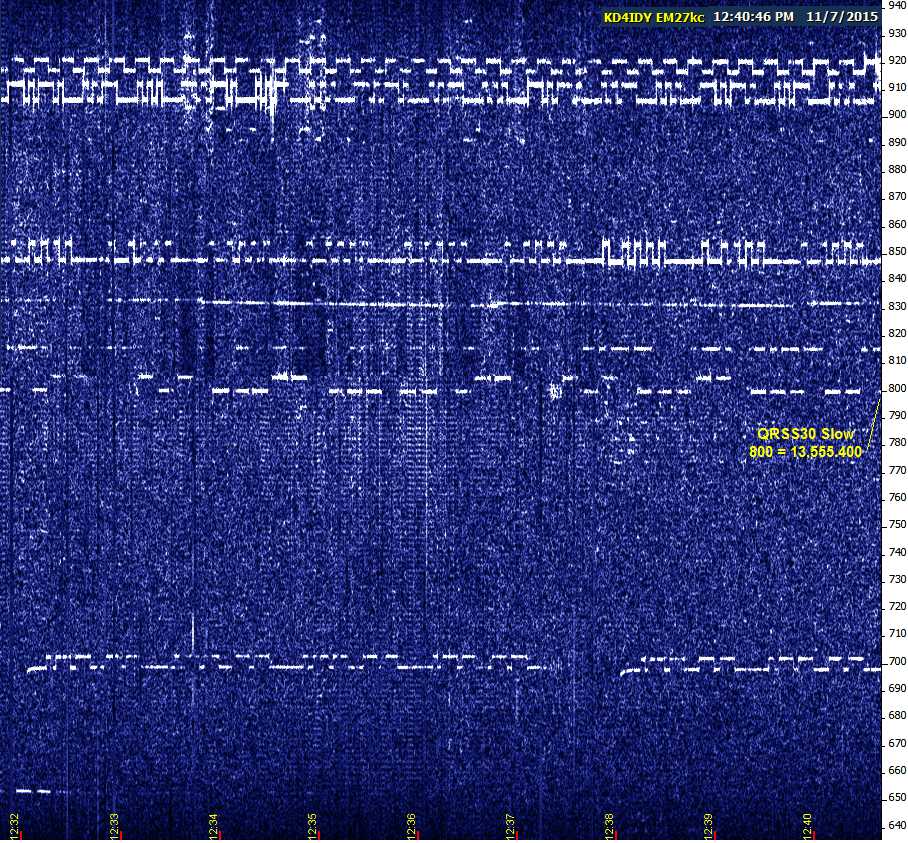
There was an assortment of noise that shows up in these traces, mostly CODAR coming and going, and when the Big Three were at their strongest there were also intermod products from my audio noise limiter showing up between them. Re: Today out in the field
Posted by Garry, K3SIW on November 08, 2015 at 14:37:13.
In reply to Re: Today out in the field posted by John Davis on November 08, 2015
JD, great Hifer activity capture. You sure have a good location to catch the activity both east and west.
73, Garry, K3SIW, EN52ta, Elgin, IL
Re: Today out in the field
Posted by Mike - N8OOU on November 08, 2015 at 17:42:48.
In reply to Re: Today out in the field posted by John Davis on November 08, 2015
Very nice to see so many signals at the same time. Good catch.
Mike N8OOU 73
Re: Today out in the field
Posted by John Davis on November 08, 2015 at 19:27:55.
In reply to Re: Today out in the field posted by Garry, K3SIW on November 08, 2015
Well, not wishing to hijack Bill's thread, but I did begin the day early as promised...or more correctly, didn't end yesterday night's activity, just switched it from monitoring 1750 meters to 22 meters. That took place at 6:30 AM, when the band was quiet as the grave. It didn't begin to liven up until nearly 9:00 AM, when I could see the Big Three and 1/2 (NC, USC, EH consistently, and RY partially). Alas, CODAR was booming in by then, too.
(My Argo window that was tuned below the center of the watering hole was devoid of HiFER signals, so it was displaying interactions between multiple CODAR sources, which looked a lot like the "codar creatures" Mike posted some months back. Although those transmitters may be GPS disciplined over the long term, they are not that stable in the short term. Their carrier frequencies and timing can wander a bit during each transmission period. When multiple sites are being received together, the result is "codar creatures" that would look right at home in the old Outer Limits TV series. There are also multipath ionospheric effects that can do similar but somewhat less dramatic things to a field of CODAR lines on screen when only one station is active.)
Additionally at mid-morning, WV started coming in quite loudly at times, moderately copyable at others, on a cycle of several minutes. Up the dial, FRC was coming in quite well for two or three characters at a time, then dropping below the noise level for several characters. No trace of MTI or PBJ at that time.
The latter two were present right before noon, though. The Big Three and 1/2 were still prominent, WV was exhibiting deeper fades at times, and FRC was still present a little bit. The path to Illinois has been shut tight so far today, unfortunately.
BTW, the overnight LowFER monitoring was productive in one sense, and frustratingly educational in another. I learned that my computer's battery has gotten very sensitive to cold weather compared to last winter. With temperatures marginally above freezing, it now only lasts 3.5 hours. I woke up in time to re-charge it on the normal 4.5 hour schedule, and found out I was an hour too late! It had stopped at 3:20-something AM, but I don't think it was a major loss. None of the captures right before or subsequent to that missing hour had any better specimens of the watering hole than I got in mid-evening.
Only good long-term solution I can see is to get a couple of laptops or other compact PCs designed to work directly from 12 volt supplies, so I'm open to suggestions! Windows 7 is highly desirable, unless someone has succeeded in getting multiple instances of Argo to run nicely in an emulator on a Linux box. (I keep hearing MS has plans to make Windows 10 available for Raspberry Pi, but who knows...either, whether that's true, or if Argo will run in 10?)
Anyway, over the course of the night I managed to watch SIW the whole time, got one good "G" and assorted other fragments from TAG despite watching at QRSS30, got some instances of "J" from SJ (and fuzz where the S should be, thanks to it being in QRSS20), and several episodes of the unmistakable, original WM! Probably would have gotten more if it weren't for the thunderstorms in the Gulf overnight, or if I had been using a loop to null that direction. It wasn't terrible static, but enough to make all the LowFERs less consistent than they could have been.

After 5 AM, I also managed to capture MLS, and right before sunrise witnessed fragments of EAR. In short, all the North American 1750 meter beacons that have been reported to be on this season made at least a brief appearance here last night.
[EDIT: I may have to retract that last statement. While working on the various captures from last night, the one that looks like a QRSS60 "G" viewed in QRSS30 appears a fraction of a Hz high to be TAG, and the fragments associated with it also seem to be drifting slightly, which is not like TAG.]
It was very neat between 4 AM and onset of twilight to witness the alignment of the moon, Venus, Mars, Jupiter and some star (whose name I don't know) stretching upward in the east, while just above the trees to the west were Orion, the Seven Sisters, and the Milky Way, all very crisp and clear in the still air. Excellent seeing for astronomy last night--and a few leftover Taurid meteors, just for good measure.
John
Re: Today out in the field
Posted by John Davis on November 09, 2015 at 03:09:49.
In reply to Re: Today out in the field posted by John Davis on November 08, 2015
Late this afternoon, NC, USC, EH and frequently RY were really blasting in. So was a steady carrier where MTI had been this morning. WV was intermittent, and by waiting long enough I could get a letter or a two at a time out of FRC. But everyone else was stubbornly absent.
Re: Planning a Hifer
Posted by Ed Holland on November 09, 2015 at 17:44:04.
In reply to Planning a Hifer posted by Ed Holland on October 15, 2015
Progress!
..at least on the antenna front. My original plan for a vertical using deck wires as a ground plane/counterpoise ended up not looking so practical when I considered the feed-point. Instead, I looked to our large, hexagonal plan flat roof. I've had an FM dipole up there on a mast for several years, little used. This has now been surplanted by a vertical, with radial wires stretched to each corner of the hexagon.
Mechanically and electrically everything is secured, including a neat way to bring the coax into the radio room. However, I've not yet considered matching, or tuned up the antenna. The vertical is composed of one 10' length of 1.25" PVC, with another 1" section slip fit into it, allowing almost any length up to about 18.5'. Inside the pipe is suspended a 14ga wire. It will be an easy matter to drop the mast, trim and tune. As to matching, I want to address the difference between the 75ohm coax used as a feedline (available free of charge!) and the 30something ohms of the antenna system, so a bit of transformer winding is in order.
Anyway, at least I can hook it up for receive, and offer up the GDO and determine the resonant freq as things stand, ready for the next moves.
Cheers
Ed
Re: Planning a Hifer
Posted by John Davis on November 09, 2015 at 22:03:34.
In reply to Re: Planning a Hifer posted by Ed Holland on November 09, 2015
That sounds like some careful planning and great progress indeed, Ed.
As for impedance matching, transformers are certainly a good way to go. Although, if you happen to know the velocity factor of that 75 ohm line and can make its electrical length an integer multiple of half a wavelength, then its characteristic impedance becomes largely irrelevant. You could then locate the antenna tuner indoors and regard the feedline connector as if it were the base of the antenna. Just a thought, if it strikes you as practical in your situation.
BTW, I hadn't encountered that usage of "offer up" since my days of consulting MG and Triumph factory manuals in the Seventies. It had me reaching for my spanner! :)
John Re: Planning a Hifer
Posted by Ed Holland on November 10, 2015 at 03:31:15.
In reply to Re: Planning a Hifer posted by John Davis on November 09, 2015
Thanks John.
Useful tips as always! It is nice to be gaining momentum even if there is still no sign of the transmitter kit. I'll try a listen & compare to the dipole tomorrow morning when the band is likely to open.
BTW its MG and Range Rover tinkering here... both classic examples. My other project this weekend was RR front axle seals... about 8 of them in total and much disassembly! It helps being English (I think), hence my odd use of language at times. I may even say aerial instead of antenna from time to time.
Ed
Re: Planning a Hifer
Posted by John Davis on November 10, 2015 at 04:37:15.
In reply to Re: Planning a Hifer posted by Ed Holland on November 10, 2015
"I may even say aerial instead of antenna from time to time."
Just mind that it is properly earthed.
A little English won't hurt a thing. Many of us here are bilingual. :) Re: Planning a Hifer
Posted by Ed Holland on November 11, 2015 at 00:34:24.
In reply to Planning a Hifer posted by Ed Holland on October 15, 2015
A further quick update, and at last we're getting somewhere :)
I just received notification that my transmitter electronics have shipped. With that, and the aerial up, the station might get on the air before the year is out.
I played with the GDO yesterday, and as expected, it looks like my vertical is a touch long, resonating at around 13.2 megahertz. Of course, with a poor match to 75 Ohm coax, I also get a host of sharp dips from feed line resonances. I must try and test & tune it on the roof, though that means getting power up there... Having a weakness for old stuff, I couldn't resist buying an old valve (tube) dip oscillator - and the price was right.
Amusingly, the vertical does a decent job of bringing in VLF signals as low down as ~34kHz and WWV was there, hiding behind the racket from our electronic dog fence... I might revisit the receive arrangements elsewhere in the garden, to see if improvements can be made.
Cheers,
Ed
Re: 500 kHz Event This Weekend
Posted by John Davis on November 12, 2015 at 15:27:19.
In reply to 500 kHz Event, Weekend of 13-14 Nov posted by John Davis on November 05, 2015
This week, the Maritime Radio Historical Society issued some additional information about the weekend's planned maritime heritage operations in their Newsletter #52. And, a further last-minute update by MRHS was issued on Thursday, clarifying their operating hours and announcing participation of a ship station as well. These links open in new browser tabs or windows. Re: 500 kHz Event This Weekend
Posted by Ed Holland on November 12, 2015 at 18:24:40.
In reply to Re: 500 kHz Event This Weekend posted by John Davis on November 12, 2015
Thanks John,
I'm looking forward to listening out for this. In preparation, (and to finally get some proper LW activity going) I've constructed a 4ft square 10 turn loop antenna, tuned by that 500pf variable I always wondered why I was keeping. Aside from buying 28AWG wire, this cost nothing.
First attempt and it peaks up beautifully at 500kHz with the tuning mid way! Cracking reception with either a portable nearby, or one of the communications receivers connected to the 1 turn coupling loop.
Based on this, I can also work out the turns required to get down to 2200m and listen for some Lowfers. OK, so it's not the Cricket on Radio 4 LW but it's intriguing.
Cheers,
Ed Re: 500 kHz Event This Weekend
Posted by Paul on November 14, 2015 at 19:13:47.
In reply to Re: 500 kHz Event This Weekend posted by John Davis on November 12, 2015
We are on the air RIGHT NOW!! Will be on as late as our OPs are able to stay awake.
Good luck!
Sincrely,
Paul Re: 500 kHz Event This Weekend
MRHS Transmitter Department
QSL Manager
Posted by John Davis on November 15, 2015 at 05:54:47.
In reply to Re: 500 kHz Event This Weekend posted by Paul on November 14, 2015
Regrettably, no go here in the middle of the country this evening. Perhaps it was because I was listening at 426 kHz instead of 426 kc but I suspect it had more to do with the four terribly loud and three moderately strong carriers that were also clustered within a few tens of Hz of the frequency. Around 0022 UTC I could see what might have been the sidebands of a CW-keyed carrier faintly on Argo at QRSS3 setting, but it was hopelessly lost to the ear.
Thought I heard some CW on 500 kHz a couple minutes before the 0045 silent period, but it was not clear enough to identify.
John
HiFER & LowFER Notes, Saturday
Posted by John Davis on November 15, 2015 at 06:04:14.
Had a photo assignment much of the day and did not get to the field until less than an hour before sunset. By then, USC was barely visible, NC was fair, EH was strong, and RY was also fair. MTI was audible up the band, but no sign of WV. FRC was moderately audible for several characters at a time, and the carrier was visually quite consistent.
At 1750 meters, SIW slant was quite good despite annoying levels of QRN and an intermittent power line buzz. Today, LowFER WM was testing an Ultimate 3 exciter with a new pattern mixing DFCW and graphical characters; but although Garry Hess copied it, I couldn't quite snag anything definite here in SE Kansas.
John
Re: 500 kHz Event This Weekend
Posted by Paul on November 15, 2015 at 06:06:15.
In reply to Re: 500 kHz Event This Weekend posted by John Davis on November 15, 2015
If you cannot QRV on MF, we are also on:
4.350.5 MHz.
6.474
8.438.3
12.993
16.914
22.445.8
All HF freq's simulcast.
MF is having a little trouble at the moment.
Re: 500 kHz Event This Weekend
Posted by Garry, K3SIW on November 15, 2015 at 16:09:23.
In reply to Re: 500 kHz Event This Weekend posted by Paul on November 15, 2015
Paul, I looked a number of times after it got seriously dark here and heard nothing on 426 kHz. HF was another matter. Around 0700Z KSM was pounding in here on 4.350.5 MHz with just an e-probe that does a good job on LF but is rather deaf on HF. Copy was good on 6.474 MHz too but nothing on the higher frequencies. No surprise there for 1 am local time.
73, Garry, K3SIW, EN%2ta, Elgin, IL
Re: 500 kHz Event This Weekend
Posted by John Andrews, W1TAG on November 15, 2015 at 19:22:39.
In reply to Re: 500 kHz Event This Weekend posted by Garry, K3SIW on November 15, 2015
Did not xmit here. Copied on CW:
WG2XKA, very nice signal Saturday night with more QRO.
WG2XJM, easy copy on the upper parts of fades.
WG2XSB, close - loud.
WH2XIL, close - easy copy.
WD2XSH/31, weaker than above, but copyable with patience.
VO1NA, signal noted on Argo, but nothing audible.
John, W1TAG
Re: Introducing My New HiFer Beacon "SPT" on 13558KHz
Posted by Bill Hensel on November 15, 2015 at 19:28:27.
In reply to Re: Introducing My New HiFer Beacon "SPT" on 13558KHz posted by John Davis on November 03, 2015
NOv 15, 2015 While hiking with my KA 1103 today in the Pike National Forest I caught one fade up with complete copy at 1845 utc...I have been trying for SPT ever since you put it on the air....73 Bill Ill keep listening for it in the near future on hikes...
Re: 500 kHz Event This Weekend
Posted by Dave AB5S on November 15, 2015 at 19:52:20.
In reply to Re: 500 kHz Event This Weekend posted by John Andrews, W1TAG on November 15, 2015
Was listening here in North Texas. Good conditions Friday evening but I only had a couple of hours. Poor conditions here on Saturday evening, with good NDB signals in the "single hop" central part of the country but nothing from the coasts. Heard KSM on 500 KC very briefly on a fade-up but otherwise buried in my noise floor. Fuller report later.
We had a "mystery man" who was very loud here near Dallas both nights. Like -65 dBm. He did a lot of tuning-around and tuning-up, "VVV"s, said "hello" and "GL" to WG2XIQ on 474.5 but never gave a call. Did anyone else hear him, get a bearing or have any idea who it was? Heard him from 500 KC down to 467.
SPT
Posted by Bill Hensel on November 15, 2015 at 20:52:27.
Nov 15, 2015 While hiking with my KA 1103 today in the Pike National Forest I caught one fade up with complete copy at 1845 utc...I have been trying for SPT ever since it went on the air....73 Bill I'll keep listening for it in the near future on hikes...
SJ is Back
Posted by Sal,K1RGO on November 15, 2015 at 22:07:16.
Well it's LF beacon season and SJ had a bit of an issue but seems stable for now. Maybe it's because the crystal is 50 years old hi........... Re: SPT
I'm in the watering hole for now at 185.303 kHz but if it fails I can go back to the original 186.850 freq...off when listening or for issues, otherwise on as usual.
later...Sal, K1RGO
Posted by Dave AA7EE on November 16, 2015 at 07:38:42.
In reply to SPT posted by Bill Hensel on November 15, 2015
Thank you Bill. Yours is only the second reception report I have received. The first was from Jeff KF7RPI in Portland, OR, shortly after SPT went on the air. The direct distance between Pike National Forest and SPT is about 900 miles. I think that's pretty good for hearing a 4.6mW beacon with the bare ear (as opposed to using QRSS techniques) - especially as my location and antenna installation are nothing out of the ordinary.
I am currently writing what I hope will be a fairly comprehensive blog-post on this little HiFer beacon, including the schematic and pictures, as well as the source code for the micro-controller. I am also including instructions on how to compile and flash the code to the ATtiny chip, for people like me who are new to the black magic of the digital world :-) I will advise when the post is complete, in case it is of any use or interest to anyone here.
You have made my day Bill. Thank you!
Re: SPT
Posted by Bill Hensel on November 16, 2015 at 14:29:34.
In reply to Re: SPT posted by Dave AA7EE on November 16, 2015
I hope to hear more fade ups this winter on my hikes....
Thanks for putting it on the air...Little RQ has only had about three dx reports....I look forward to your blog-post.
73 Bill home of RQ
Re: 500 kHz Event This Weekend
Posted by Ed Holland on November 16, 2015 at 18:35:12.
In reply to Re: 500 kHz Event This Weekend posted by Ed Holland on November 12, 2015
I didn't get as much time as was hoped for this, but late on Saturday, had some time to listen in. The 3 foot square loop that I hastily lashed together seemed to work well enough for starters, once I realized that it was the gas fire upstairs that was the source of the horrendous QRM. Delicate negotiation with Mrs H enabled a quiet listening period ;-)
The station at Pt. Reyes romped home on 426kHz, unsurprisingly. I also caught what I think was WD2XSH/20 from Oregon but my code skills are so pathetic that I don't have a positive ID. Time for more listening practice!
Anyway, it was fun and I hope to make it to the next event.
Ed
Re: Planning a Hifer
Posted by Ed Holland on November 16, 2015 at 18:46:22.
In reply to Re: Planning a Hifer posted by Ed Holland on November 11, 2015
More (minor) progress this weekend. I found time to get on the roof and tune up the antenna, and also install an impedance transformer at the feedpoint. A battery powered portable receiver helped ensure I was tuning up at the centre of the band - the scale on the GDO is a bit course!
UPS tells me that the transmitter kit should arrive today, so hopefully there will be a new signal shortly. Watch this space!
Ed
Re: Planning a Hifer
Posted by Dave AA7EE on November 18, 2015 at 10:26:24.
In reply to Re: Planning a Hifer posted by Ed Holland on November 16, 2015
Looking forward to listening out for your HiFER signal Ed!
Dave Re: Planning a Hifer
AA7EE
Posted by Ed Holland on November 19, 2015 at 00:01:03.
In reply to Planning a Hifer posted by Ed Holland on October 15, 2015
Indeed there was a package waiting when I arrived home. It contained only a case, for the transmitter, but not the kit of electronics. It seems there was a mistake at the supplier, and they assured me the balance of my order would be expedited. It is now due to arrive on the 24th of Nov...
So the wait is a little longer. Listening this morning was encouraging though, and I hope to post a report later.
SPT Beacon Blog-Post
Posted by Dave AA7EE on November 19, 2015 at 18:29:15.
Just wanted to let you gentlemen know that I completed a fairly detailed blog-post on my SPT HiFER beacon. All details of the circuit and firmware are there, along with a description (hopefully reasonably clear) of how to flash the firmware to the micro-controller, for digital newbies like myself.
The post is at https://aa7ee.wordpress.com/2015/11/18/the-sproutie-spt-beacon-a-legal-unlicensed-hifer-beacon/
All comments are welcome. If you feel that anything at all is incorrectly worded or otherwise misrepresented, please do say.
73, and I hope this information will in some small way help anyone who is new to the fascinating world of HiFERs.
Dave Re: SPT Beacon Blog-Post
AA7EE
Posted by Ed Holland on November 19, 2015 at 18:48:45.
In reply to SPT Beacon Blog-Post posted by Dave AA7EE on November 19, 2015
Hi Dave,
Thanks for this, I will check it out - I'm really interested to see what you have set up.
Cheers,
Ed
v1rgo/b qrss3
Posted by Sal,K1RGO on November 21, 2015 at 16:52:31.
Well for the helluv it I just put v1rgo/b in the watering hole on 13555.610 at qrss3 using an East West dipole to compare it with eh. I'll QSY if necessary. Re: v1rgo/b qrss3
later.............
Posted by Paul on November 21, 2015 at 19:48:36.
In reply to v1rgo/b qrss3 posted by Sal,K1RGO on November 21, 2015
I'm hearing something on 13.555.610, but unable to tell if it is really QRSS or just some kind of carrier that pops in and out.
QTH = California about 100 miles east of the loonies in San Francisco
Re: v1rgo/b qrss3
Posted by Dave on November 22, 2015 at 02:23:20.
In reply to Re: v1rgo/b qrss3 posted by Paul on November 21, 2015
I got a clear capture of V1RGO/B about 120 Hz above EH on Nov 21 at 6:03 pm EST. Both signals fell off sharply 3 minutes later in central Florida. FL moves to wateringhole in DFCW8
Dave
Posted by Dave N4EF on November 22, 2015 at 14:59:13.
I've built a new oscillator on a new frequency (13555.495 KHz according to my dial) and in dual frequency CW mode (DFCW8 with 5 Hz shift)-- the identifier is "FL".
It's undergoing some testing before I settle on a final profile and I'd appreciate some reception reports during this time of transition, including the frequency you find the signal on.
I'm using an attic dipole cut for 7 MHz, but there's a 22 meter dipole curled up on the floor next to me: it'll be erected up 1/4 wavelength high in about a month.
The present frequency appears clear in central Florida so as to avoid collisions with other beacons, but I'm happy to shift it if needed.
Dave
Re: v1rgo/b qrss3 (capture)
Posted by Dave N4EF on November 22, 2015 at 23:21:15.
In reply to Re: v1rgo/b qrss3 posted by Dave on November 22, 2015
Hifer report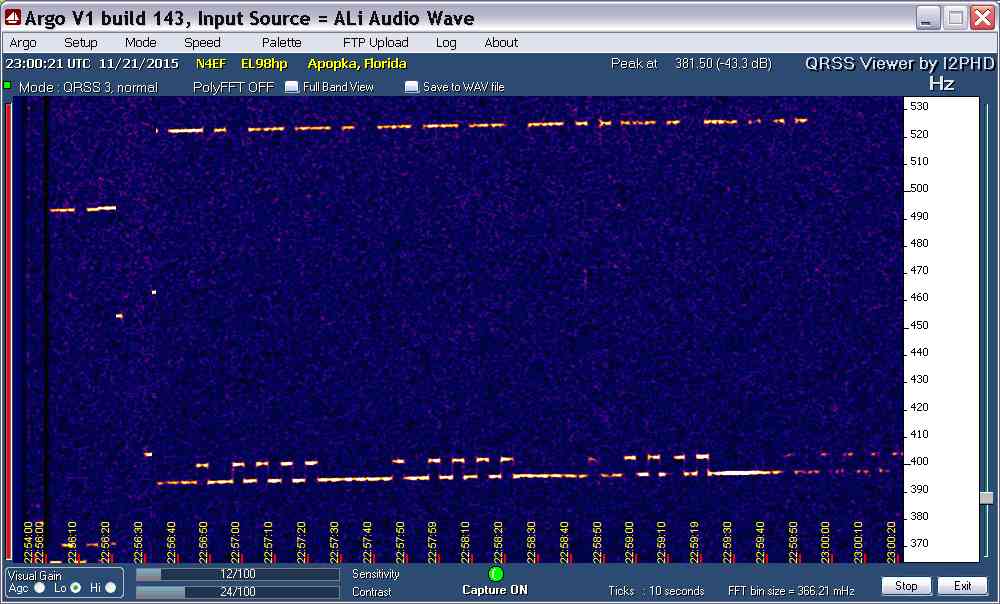
Posted by Sal,K1RGO on November 23, 2015 at 17:36:23.
Around noon today, I copied (with lots of QSB), on CW....MTI, GNK good copy and 75 ohm humbucking transformer
in the Watering hole, DCW K3SIW, NC and USC. Conditions see to be improving after a long poor propagation period.
Later..........
Posted by Lee on November 24, 2015 at 01:19:44.
75 ohm humbucking transformer. Any one use one of these for Lowfer antenna noise reduction. I found one at work. Almost forgot about them.
heard this AM
Posted by Chuck Sayers on November 24, 2015 at 02:11:20.
Popped into the shack this morning and tuned to the watering hole. I caught USC from South Carolina coming in very strong, audible at times at 13555.480 QRSS3 and SIW in QRSS30 with a decent signal too. 13555.400. This took place around 1520z 11/23/2015.
I wanted to paste a picture in here but can't get it to work.
Chuck Sayers K3ETD Re: 75 ohm humbucking transformer
FN10of
Posted by John Davis on November 24, 2015 at 08:26:32.
In reply to 75 ohm humbucking transformer posted by Lee on November 24, 2015
Hi Lee. Do you mean isolation transformers for baseband video frequencies? If so, yes, those work fine at LF if the impedance of the antenna is somewhere in the ballpark.
John
Re: SPT Beacon Blog-Post
Posted by Ed Holland on November 24, 2015 at 22:44:41.
In reply to SPT Beacon Blog-Post posted by Dave AA7EE on November 19, 2015
Hi Dave,
Lots of good information in your blog post - thanks for sharing it. I couldn't help noticing we're both Brit ex-pats!
AS for reception, I have tried two additional locations alas without success. The first attempt was near Skyline Boulevard, above Palo Alto, and with a pretty good line-of sight to your QTH across the Bay. Secondly I tried from my work location, near the intersection of HWY 101 and HWY 85 in South San Jose. The receiver was a Grundig Yacht-Boy 400PE, which is not too sensitive, with only the telescopic antenna. Also I didn't have the computer and spectrum-lab available for weak signal ID. Still, I have hopes of picking up SPRT at some point - perhaps on our trip to the mountains after the holidays.
Best wishes and good luck,
Ed
RQ heard in CA
Posted by Bill Hensel on November 24, 2015 at 23:31:29.
Tuesday 11/24 I went up to the global tuners actually on the Mojave Desert tuner located in Ridgecrest, Ca and at 2304 utc heard RQ strong at 2318 utc. and it has been pretty solid copy even as I type this at 2330 Utc. it is still solid copy.
I suspected RQ was working fine but no one was listening for it out West, anyway a new state.
Re: 75 ohm humbucking transformer
Posted by Lee on November 25, 2015 at 00:34:42.
In reply to Re: 75 ohm humbucking transformer posted by John Davis on November 24, 2015
Indeed. They are not really a transformer but a choke. Coax wound around a ferrite core. The one I have is potted so impossible to count the windings. Thanks for the Info!
GNK Reception Report
Posted by Roger V Thompson on November 25, 2015 at 15:28:26.
GNK is about +20 dB above the noise floor here in NE Mississippi (EM54tb) this morning (15:00Z, 11/25/2015). Receiver is Flex 6700 and R-8 vertical.
73, Roger AD5T.
Re: 75 ohm humbucking transformer
Posted by John Davis on November 26, 2015 at 01:49:27.
In reply to Re: 75 ohm humbucking transformer posted by Lee on November 25, 2015
"Coax wound around a ferrite core."
That type may not be as effective at lower frequencies as the true wideband transformer type, but it's definitely worth a try. Some of them used to be quite good.
John
Re: heard this AM
Posted by Chuck Sayers on November 26, 2015 at 02:02:14.
In reply to heard this AM posted by Chuck Sayers on November 24, 2015
Heard MTI 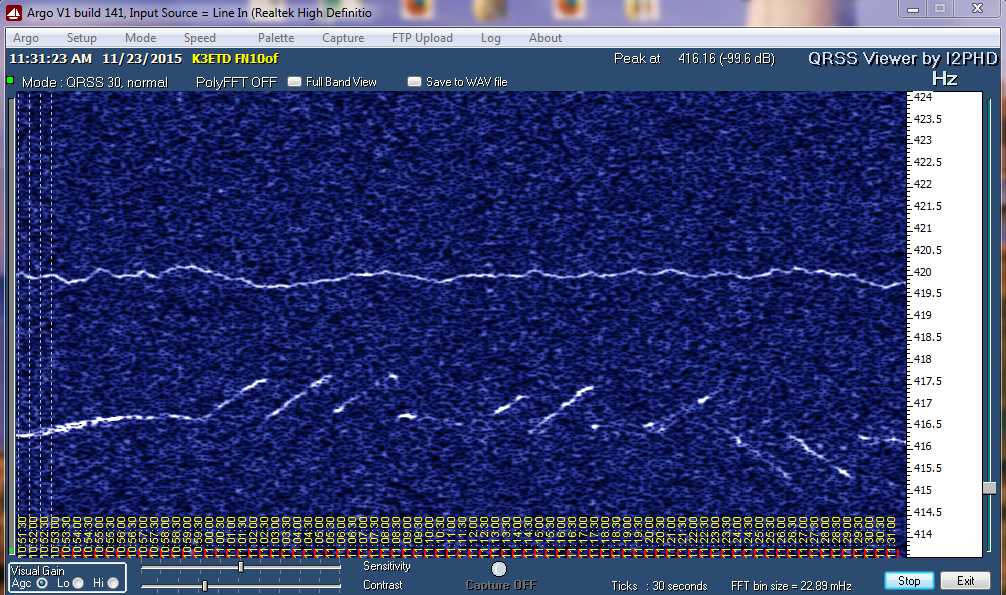
Posted by Mike on November 26, 2015 at 20:30:30.
Listened for and heard MTI today at roughly 2025z in Croton on Hudson NY (FN21). using KX3 w/APF filter to pull it out of the noise. Cool, my first hifer QSL Re: Planning a Hifer
73 & Happy Thanksgiving
Mike
Posted by Ed Holland on November 26, 2015 at 22:02:04.
In reply to Planning a Hifer posted by Ed Holland on October 15, 2015
At last the transmitter electronics have made an appearence, and I can warm up the soldering iron.
Some modification will be necessary, since the keying control acts on the oscillator circuit as well as the buffer amp. I plan to experiment with this to imbue good frequency stability. Then there is the matter of attenuating the massive 1.25W output... perhaps I will use the o/p of the buffer directly, or build a variable attenuator. First step is to get it working by the book, then try the 22m crystal and see what we get.
cheers,
Ed
Final DSWCI AGM and Jubilee Dinner
Posted by Mike Terry on November 29, 2015 at 06:57:57.
28 November 2015
Andy Sennitt writes on the PCJ Facebook group:
Thanks to Jonathan Marks for passing on the following:
DSWCI 60th ANNUAL GENERAL MEETING and JUBILEE DINNER in Kalundborg, Denmark October 8, 2016
The DSWCI Board has got permission by Radio Denmark to arrange our last AGM at the longwave station in Kalundborg on Gisseløre peninsula just west of the city on Saturday October 8, 2016, at 1400 hours Danish Summertime. After the AGM there will be a coffee break and then a conducted tour around the station by the manager Jens Christian Seeberg. In the evening we will celebrate our 60 years Jubilee with a Dinner at a restaurant downtown Kalundborg.
Of course, the Board would very much appreciate your attendance at this our last event, before the DSWCI is closed down by the end of 2016.
Kalundborg is located on the northwest coast of Zealand and famous for its five tower church.
The DSWCI has an agreement with a hotel in Kalundborg regarding accommodation at a fair price. Registration form for binding registration regarding participation in the AGM, accommodation and dinner in the evening will be published in SWN during the spring 2016. Right now, please just note the date in your calendar.
(DSWCI Board)
potrzebie