 File Attachment 1: 27octa.jpg
Re: 2200m WSPR now all night
All I am hoping for is sun, batteries are starving from the drips the panel provides :) Re: FLASH - K6FRC Heard in NC
Will keep an ear on you.
Jason
Posted by Paul on November 01, 2018 at 16:06:33.
In reply to FLASH - K6FRC Heard in NC posted by Bill Stewart, K4JYS on October 31, 2018
Thanks, Bill!
Would you like a snazzy FRC HiFer QSL card?
Re: FLASH - K6FRC Heard in NC
Posted by Bill Stewart, K4JYS on November 01, 2018 at 16:59:55.
In reply to Re: FLASH - K6FRC Heard in NC posted by Paul on November 01, 2018
You bet I would, Paul....tnx. Adr ok on QRZ.com GNK copied in Somerton, AZ
Bill
Posted by Jeff K8NDB on November 02, 2018 at 00:55:18.
GNK copied today at 2200 UTC. Signal fading in and out but was able to hear several complete ID's. Tuned around band but no other beacons copied except AN which is just down the road from my listening site.
2200 m qrss100
Posted by joe vo1na on November 02, 2018 at 01:34:20.
Tonight and tomorrow 150watts 2amps 137.777 kHz from GN37.
Reports welcomed.
73 Joe
Re: 2200 m qrss100
Posted by Rob K3RWR on November 02, 2018 at 10:55:41.
In reply to 2200 m qrss100 posted by joe vo1na on November 02, 2018
Tuned in late but caught a couple of nice traces in FM18 around 1030Z. Will monitor entire period tonight.
73 Rob Jason Goldring
Posted by SIW on the dipole.... on November 03, 2018 at 19:13:01.
While I am working out coverage issues with the whips on higher freqs, although they are doing well for LF, SIW was once again spotted, inverted V Dipole. Fluctuations today have been wild, most likely weather driven. Horrible and rainy the past few days with clear breaks.
1652 -25 1.4 13.555402 0 K3SIW EN52 7 747
1656 -26 -0.3 13.555401 0 K3SIW EN52 7 747
1700 -11 1.1 13.555401 0 K3SIW EN52 7 747
1704 -14 1.3 13.555402 0 K3SIW EN52 7 747
1708 -15 1.6 13.555401 0 K3SIW EN52 7 747
Jason
Re: Jason Goldring
Posted by Garry, K3SIW on November 04, 2018 at 14:51:00.
In reply to Jason Goldring posted by SIW on the dipole.... on November 03, 2018
Thanks for the reports Jason. Glad to know the signal is still getting out.
73, Garry, K3SIW
SIW on a dipole
Posted by Jason Goldring on November 04, 2018 at 15:19:15.
In reply to Re: Jason Goldring posted by Garry, K3SIW on November 04, 2018
I guess the autofill on the laptop is not too bright..... :) Your welcome Garry. Re: 27th and 28th Oct HiFERs
Jason
Posted by John Davis on November 04, 2018 at 20:52:02.
In reply to 27th and 28th Oct HiFERs posted by Ed Holland on October 30, 2018
I'm slow in getting around to reporting for these same dates, because the computers and my Internet service were not in the same location. That has now been remedied, so I'm trying to catch up. First, the Saturday 27 October report:
Got started relatively late in the afternoon on the 27th. The file attachment shows the watering hole about 4:23 PM CDT, with (from top to bottom) NC, faint bits and pieces od USC, 7P, EH and RY. The capture has been altered to correct for receiver warmup drift.
There was only a single codar site active, apparently, and even it was sometimes not audible. That helped me to faintly see AZ at 4:31 PM, although it was not clear aural copy; and its frequency was not only wavy, but also jumping as much as 20 Hz from time to time.
At 4:35 PM, I caught TON. I believe this is the first time I've heard it on the same day as seeing 7P.
There was no NDB or AN that day, but VAN was visible and sometimes the keying was audible too (circa 4:40 PM). At 4:45 PM, WAS ranged from excellent to fair, and FRC was fair. It was possible to just fit both of them in the CW filter bandwidth and listen to them simultaneously.
Will post results for the 28th later in a separate post.
---------------------------------------------------------------
File Attachment 1: 27octa.jpg
Re: 27th and 28th Oct HiFERs
Now the report for Sunday 28th October:
Started on HF about 11 AM CDT. Initially, NC was doing OK (but disappeared not long after), USC appeared once in a while, 7P, EH, and RY were present, and eventually MTI started showing up each minute as well. EDJ was faintly present before 11:00, then came in better and better until about 11:26, when it disappeared fairly rapidly (see file attachment 28oct-EDJ.jpg). Codar was not a big factor at first, but became a nuisance by 11:30 AM. In my first band scans, TON was good copy at 11:09 AM and WAS was fair at 11:13, with nobody else seen or heard yet.
NC started drifting back down into the Argo window with a strong signal during the noon hour, and later in the hour both codar and MTI diminished considerably, but some really annoying pulse sounder or OTH radar made its presence known.
Not much change otherwise at the watering hole until late in the 1 o'clock hour, when SIW slant began appearing, almost right under EH's lower frequency. That opening didn't last long, though.
At 3 PM I broke for another band scan. This time, some signals were present with wide fluctuations in level. WV swung from very good to nil in just seconds. AZ was weak to fair with only a very slow and slight frequency drift...no longer the waves and jumps of the day before. TON was visible but not audible. At 3:13, WAS ranged fron inaudible to good then back to fair. FRC was faintly visible at first, but became audible for a while around 3:18 PM. Nobody else turned up.
MTI had rejoined watering hole regulars NC, USC, 7P, EH and RY by 3:30 with a very strong signal. Even SIW slant reappeared faintly for a few minutes about 3:45 PM. See the other attached file for a capture from about that time.
I took a break from HF at 4 PM CDT, then returned about an hour after sunset to check on things again before switching over to 1750 meters for the evening. At 7:26, only 7P was present at the watering hole, but it was both clearly visible and distinctly audible. WV was good to fair copy, with only one fairly strong codar site active. No AN, no VAN, and no WAS by 7:37; but despite considerable power line buzz at the top end of the band, K6FRC was very good copy.
John
---------------------------------------------------------------
File Attachment 1: 28oct-EDJ.jpg
File Attachment 2: 28oct-wh.jpg
4th Nov HiFers
Conditions for 22 m were quite active today, At the watering hole, I recorded USC, EH (Almost atop one another). A trace of NC, possible SIW. Later on 7P started to come in very strongly, with a good audible signal (as I type ~15:30 PST).
Screenshot of the watering hole is attached
---------------------------------------------------------------
File Attachment 1: capt10.jpg
Re: 2200m WSPR now all night
This is the first time in almost two weeks that I looked at 2200 m so early in the evening, and already caught N1BUG at -23 dB in the 0038 UTC time slot, about an hour and 20 minutes after local sunset. Having had dismal results on 1750 meters the past few nights, I may stick with 2200 all night tonight. Will upload results to WSPRnet in the morning.
Both WH2XND and WH2XXP are back at their traditional full strength this time, which I'm somewhat glad to see, but it is a mixed blessing. WSPR 2.12 sometimes has trouble with strong signals. Among other things, they can cause decode times to run longer than two minutes, with the result that one or more subsequent slots won't get decoded--or sometimes, not even get recorded. In severe cases, it can cause the program to crash entirely. I've taken precautions to forestall crashes, but I did already see it miss a couple of decodes this evening.
Re: 2200m WSPR now all night
Posted by John Davis on November 07, 2018 at 01:26:08.
In reply to Re: 2200m WSPR now all night posted by John Davis on November 06, 2018
The early decode of N1BUG I reported last night was the only one for three more hours, probably because of the overwhelming signals from the two Part 5 stations. (They were up to 0 dB for some decodes, S9 or higher.) Paul then started coming in fairly often from the 0338 UTC time slot, through the 1032 slot.
Had one decode of K3MF at -21 dB at o340, but that was the only other signal all night.
Wind - much wind!!!
Posted by Jason Goldring on November 07, 2018 at 02:57:21.
Tree. thank god small, took down LPB so I have a 35 foot log to chop and move about before it is back online. Frankly the wind helped it out, soft ground and uplifted.
Would hate to see it grow more and fall with catastrophe.
13566.250 ~ 280 CW J1LPB is on - BlackCat. Folded dipole in the attic.
EAR now, guv!
Posted by John Davis on November 07, 2018 at 07:20:14.
At long last, 1750 m DX season has finally opened. Up to now, it had been sort of a Mike Tyson season...no more than a bite of EAR at a time.
It has been almost three weeks now since I posted the "AR, Matey" thread, and the situation had not improved perceptibly. For at least a week afterward, I got nothing more than a few feeble AR's per night, mainly in the hour after sunset. Then I started getting a few feeble strings of AR, occasionally preceded by something that might have been an E if I flogged my imagination hard enough. One night, I finally saw a single, nice, clear R an hour after sunset--and exactly nothing else the rest of the night! Many nights were hopeless from the start, due to QRN.
This past week was quieter, static wise, but there were mysterious clumps of sorta-white-noise around EAR's frequency. Then, on Saturday evening, the frequency was swamped with powerful LWBC audio sidebands. Monday night, we were back to this pitiful partial copy again, which faded in 30 minutes after sunset, then back out, and never returned thereafter:
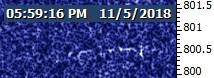
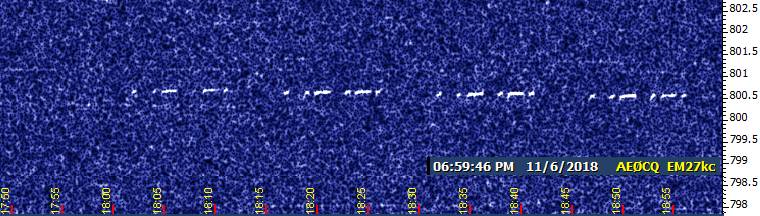
It was discouraging to think we'd gotten so far into this autumn without the traditional fine copy of EAR here on the prairie. This afternoon, I got to wondering if propagation was upside-down, and whether there might be a chance of seeing early skywave during the "critical hours" period before sunset. Since conditions were really dreadful on 22 m Tuesday afternoon, I just tuned to 188.830 early and waited. No early skywave, alas, but 40 minutes after sunset, this began...and continued:
At 8:30 PM CST, I wondered if MLS might have returned unawares, so I tuned there for half an hour. No go. Then I wondered if WM and SIW might both be good tonight, and they were:
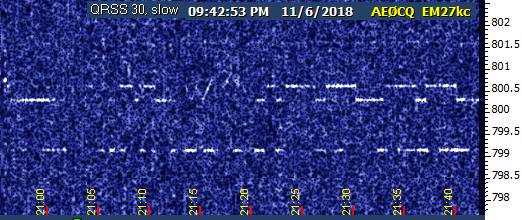
Interestingly, they were both experiencing more QSB than EAR was; and it was sometimes differential, one being up while the other was down. Then I listened a few minutes on 183.5 in hopes of hearing Dave Curry's Part 5 beacon, but no joy with that one. Looked back at EAR finally, and there it was again. Will monitor the rest of the night to see when it finally decides to disappear.
John
---------------------------------------------------------------
File Attachment 1: 5nov1.jpg
File Attachment 2: 6nov-EAR.jpg
File Attachment 3: 6nov185_3.jpg
Re: 2200m WSPR now all night
Thanks for the reports! I'm just curious, is there a reason you stay with WSPR 2.12? Those old standalone versions tend to be rather unstable and have some issues which have since been resolved. If you are running on a very old operating system it probably makes sense, and I can understand wanting to keep it simple and sticking with familiar software. But if your system supports it, WSJT-X 1.9 might work better. It much more stable (at least on recent Windows versions), works better and there have been some recent improvements to the WSPR decoder which allow more and weaker decodes on 2200 and 630 meters.
Paul
EAR now, gov!
Posted by John Bruce McCreath on November 07, 2018 at 14:39:19.
In reply to EAR now, guv! posted by John Davis on November 07, 2018
Hi John....thanks for the great report and screen snips of EAR. Last night was an odd one for propagation on the Navtex 518 kHz. transmissions. I had a string of 13 full messages from Astoria, OR. along with some fragments from Cambria. The odd thing was that many of my Atlantic coast and Gulf "regulars" were missing from the log!
73, J.B., VE3EAR K6FRC Into NC Again
Posted by Bill Stewart, K4JYS on November 07, 2018 at 15:42:25.
I took a short band tuning session this morning and heard K6FRC again at about the same time as my last report....1510Z-1520Z. Very weak and into the noise...QSA2 - RST229. Occasional IDs copy-able. Another pat on the back to Paul. If I get time will take a few more listens today....WAS will be down accordingly. Re: 2200m WSPR now all night
73 de Bill K4JYS
Posted by Jason Goldring on November 07, 2018 at 16:35:51.
In reply to Re: 2200m WSPR now all night posted by Paul N1BUG on November 07, 2018
Paul, good point - I have found WSJT-X (currently using 2.0.0 rc3) to be more sensitive, decodes into the -30 territory. Re: K6FRC Into NC Again
Finicky with the volume input though, it says 30db only when noise is present, but I have found varying input volumes between 30 to 50 to work out ok in most cases, typically set to a higher input for 2200m.
Jason
Posted by John Davis on November 07, 2018 at 18:22:59.
In reply to K6FRC Into NC Again posted by Bill Stewart, K4JYS on November 07, 2018
Congratulations, Bill and Paul. I was also copying FRC at the same time this morning, and wondered where WAS was, since sometimes I can copy both in the CW filter passband simultaneously. Now I know. :)
Re: EAR now, gov!
Posted by John Davis on November 07, 2018 at 19:06:56.
In reply to EAR now, gov! posted by John Bruce McCreath on November 07, 2018
Turns out the good reception only continued until 11 PM Central Time last night. At that point, a blob of thunderstorms apparently fired up along the Texas-Oklahoma border, adding to the otherwise tolerable noise from the line of storms in the Atlantic. The Texas storms are apparently the progenitor of a line currently making a racket from southern Louisiana up through central Alabama at noon today.
They were enough to eventually wipe out EAR entirely on the QRSS30 trace, but a smudge of RF with the same recurring frequency drift continued on the QRSS60 screen. It became fairly obscure from 2:00 to 3:30 CST, then grew a little more recognizable from 3:45 to 4:10 AM (see attached file). The "smudge" ended entirely about 5:55 AM, almost exactly an hour before sunrise.
I wondered why the pre-midnight noise increase seemed to affect the signal so adversely, since it didn't seem unusually bad on the S-meter; but in daylight this morning, I realized I still had 10 dB attenuation switched in from my 2200 m WSPR venture the night before. So, that probably means EAR was coming in at least 10 dB better here last night than it had been in recent weeks. Enough QRN remained after daybreak to prevent either WM or SIW from being visible this morning.
---------------------------------------------------------------
File Attachment 1: 6nov43.jpg
New 2200m grabbers
I have started three new full time grabbers, European QRSS window, North American QRSS window, and WSPR/Digi window. Spectrum Lab is rather complicated and I am still playing with settings, so don't be surprised if there are more changes in the days ahead. The WSPR/Digi grabber is quite sensitive so you may see a few signals on it that are too weak to decode here.
These are located at my home station so there will be QRM (blank outs) when I am transmitting on 2200 meters.
You can see the motor speed controller(s) at the waste water treatment plant 1.5 km from me intermittently around 136.171 in the European QRSS window, 137.432, 137.492, and 137.552 in the WSPR window. That is a real nuisance!
There is plenty of junk currently in the North American QRSS window but I don't know what the source is. Sometimes that goes away for a while, especially in cold weather.
Paul
13556.8 kHz dasher beacon
Posted by Exo on November 07, 2018 at 21:36:32.
An UNID dasher beacon at 13556.8 kHz
Report
2018NOV07 2020UTC
13556.81 kHz, CW, UNID, dasher beacon, distinctive chirp signature, 2.5 sec duration, variable repetition rate ~10 sec, weak but audible, fading, with constant pulsating HF radar interference
PLAY AUDIO 13556.81 kHz CW UNID dasher beacon 2018NOV07 2020UTC, note pulsing HF radar in background:
http://hfpack.com/members/exo/13556_81kHz_CW_UNID_dasher_beacon_2018NOV07_2020UTC.mp3
Waterfall image below: 13556.81 kHz CW UNID dasher beacon 2018NOV07 2020UTC, with HF radar horizontal interference showing as dashed horizontal lines, and ISM noise and carriers around 13560 kHz:
http://hfpack.com/members/exo/13556_81kHz_CW_UNID_dasher_beacon_2018NOV07_2020UTC.jpg
Received on the coast of Northern California. Re: 4th Nov HiFers
Posted by John Davis on November 07, 2018 at 22:34:33.
In reply to 4th Nov HiFers posted by Ed Holland on November 04, 2018
Excellent work, Ed. I perceive the frequencies displayed to be about 18 Hz high, based on my measurement of 7P shortly before that capture. Taking that into account, it looks as if the line with the discontinuity in it is indeed SIW slant mode, and just below it, I'd say there's a snippet of EDJ's FSK signal.
Sunday here in Kansas was "blessed" with multiple codars from both coasts, so my captures are a lot messier, and propagation seemed a little odd too. I don't always see or hear AZ, so its absence was not remarkable, but WV and FRC never showed up in my band scans, either, and that is out of the ordinary. In fact, the only signals away from the watering hole all day turned out to be a random CW-like keyed carrier at 13563.430 just before local noon, AN briefly audible at 6:20 PM CST amid power line buzz and codar, and WAS with a fair signal at 13564.890 (a bit higher than usual) at 6:23 PM.
At the watering hole, however, nearly all the regulars showed up at one time or another...even one I forgot on my chart in the RY frequency thread. (Major OOPS!...to be covered in a separate later post.)
At noon, there was a faint trace of NC just above my normal tuning, apparently drifting downward with the warmth of the day but not particularly strong and with some fading. It seemed to be gone entirely from 1:22 PM CST until a sudden reappearance with a fairly substantial signal midway between 1:41 and 1:42 PM. 7P was coming and going, EH was quite strong most of the afternoon, J1LPB WSPR was present but sometimes not decoding because of 10-20 Hz frequency jumps, and RY was mostly in the clear at first.
USC was faintly visible after 2:43 PM, and EDJ started showing up pretty clearly from 2:50 PM. MTI first became visible at 2:53, and became audible around 15 minutes later, for roughly half an hour.
Around 3:09 PM, RY was joined by another, wider signal, then at 3:11 collided with another QRSS signal scarcely 1 Hz away. This turned out to be K5LVB, which decoded in WSPR at the 3:14 (2114) time slot. LVB decoded a second time 12 minutes later, then began a fade and was gone in less than 10 more minutes.
That remained the status quo until after 5 o'clock, when the remaining folks started gradually fading away, including codar, leaving nice clear copy of 7P, EH and RY at 6:18 PM (file attached), when I changed to 1750 m to start looking for EAR.
---------------------------------------------------------------
File Attachment 1: 4nov46.jpg
Re: 4th Nov HiFers
Thanks John,
18 Hz offset is probably about right, and as close as I can typically keep the receiver (NRD 535 in this case) calibrated without chasing it every time.
Thanks for looking at the chart. Signals were coming in nicely, and I was testing a passive preselector circuit, mostly for a bit of fun with hi Q tuned circuits. Perhaps more on that another time.
I do wonder what conditions (or change of setup) might be required to get PVC further afield. Expecially as other beacons from AZ and CA reach well to the East, and I can obviously hear a lot of distant HiFERS
Regards,
Ed
630m WSPR Tonight
Posted by John Davis on November 08, 2018 at 01:52:58.
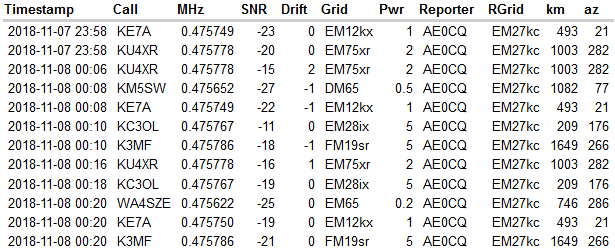
Too much QRN from the storms in the Gulf states to have any hopes for 1750 meters tonight, so for this final opportunity before the weekend, I am spending the night on 630. The hope was to see stations from sunset to sunrise, but even though there were faint traces on the waterfall shortly after dark, the first ones didn't decode until 2358. Below are the first few spots. I'll do another upload to WSPRnet later tonight and a final one after daybreak in the morning, then may report back here if anything particularly interesting shows up.
---------------------------------------------------------------
File Attachment 1: 7nov630.gif
Re: New 2200m grabbers
Both grabbers can be found here:
http://n1bug.com/station/grabber/
Good luck!
73, Re: 630m WSPR Tonight
Paul N1BUG
Posted by John Davis on November 08, 2018 at 20:13:56.
In reply to 630m WSPR Tonight posted by John Davis on November 08, 2018
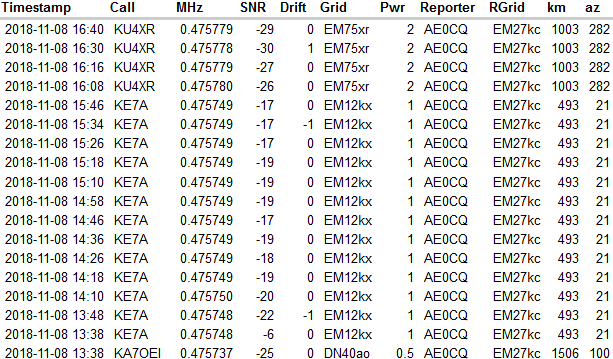
Some good results, though nothing out of the ordinary overnight...all uploaded to WSPRnet now...but I was pleased to see that two guys remained on for a time after sunrise.
In the accompanying file, showing the final 18 decodes before I packed up and came back to town, notice that KE7A was excellent copy right up until he shut down. KU4XR was at the edge, visible nearly every time on the WSPR waterfall and sometimes decoding, sometimes not. With 3 dB more power, I could probably have had spots on Andy all day. Not bad for 300 and 600+ miles in the daytime at MF! At the risk of being tedious, I still think we need more daytime experimentation and utilization of this band.
John
---------------------------------------------------------------
File Attachment 1: 8nov630.gif
Re: FLASH - K6FRC Heard in NC
Paul, I got your QSL yesterday. Very nice card. Hifer wspr2
Thanks and 73 de Bill K4JYS
Posted by swlk5 on November 09, 2018 at 17:58:41.
Within the past few days, hifer stations K3SIW and J1LPB, using wspr2 mode have been decoded in North Texas. Spots have been uploaded to wsprnet.
Re: Hifer wspr2
Posted by Jason Goldring on November 10, 2018 at 10:38:29.
In reply to Hifer wspr2 posted by swlk5 on November 09, 2018
Thanks for the spot report!
Jason
Re: Hifer wspr2
Posted by swlk5 on November 10, 2018 at 14:59:41.
In reply to Re: Hifer wspr2 posted by Jason Goldring on November 10, 2018
Your welcome Jason. What's the max distance you've gotten so far in the wspr2 mode?
Re: Hifer wspr2
Posted by Jason Goldring on November 10, 2018 at 15:27:35.
In reply to Re: Hifer wspr2 posted by swlk5 on November 10, 2018
On 22m I have hit Switzerland once and the lower states (FL, TX).
44m takes me a bit farther with more consistency. MA, NJ, Caribbean and two Iceland spots. Recently a vessel down around Barbados, a US operator - has heard me a few times.
Trouble is not many upload ISM to WSPRNET. Reporting in that regard is few and far between. they have to "dig" to find out more and make contact.
Thanks for uploading and reporting, same goes for all others. Experimenting can only be fostered by knowledge of your efforts.
Re: 630m WSPR Tonight
Posted by Jason Goldring on November 10, 2018 at 17:54:17.
In reply to Re: 630m WSPR Tonight posted by John Davis on November 08, 2018
I have to wonder how many receivers are "caving" in with the near alignment against the AM broadcast band. I know filtering works wonders as I use pass filters myself but there might be many more RX stations that are listening with no sign of life because XXXX 530 AM is broadcasting.....
A shame, a lot of potential in this band - as you mentioned, experimentation and utilization.
Jason. Re: New 2200m grabbers
J1LPB
Posted by Paul N1BUG on November 11, 2018 at 12:46:25.
In reply to Re: New 2200m grabbers posted by Paul N1BUG (fwd) on November 08, 2018
Oops. I can't believe I forgot to put the grabber URL in my post. :)
The grabbers were down yesterday for several hours due to storm related power outages. Hopefully the weather over the last month is not an indication of what kind of winter we have coming!
I have added a grabber for the WSPR/digital window just for fun. If nothing else you can use it to see where my persistent interference is. It seems quite sensitive and I often see WSPR signals which are too weak to decode.
Paul
NDB2
Posted by John on November 11, 2018 at 18:42:04.
Beacon NBD2 was received by KF7RPF at DM22 in Somerton AZ 06:37 GMT on 11-11-18.
Re: NDB2
Posted by John Bergkoetter on November 11, 2018 at 21:26:39.
In reply to NDB2 posted by John on November 11, 2018
The frequency is 13.554 MHZ.
Launch on 1750m
Posted by Jason Goldring on November 12, 2018 at 01:00:29.
This is by no means permanent (yet). The monstrosity of a wound coil around a bucket made the wife cringe until I told her it would be all covered. Now complete, I am testing on 188.810 Khz WSPR2. I have been looking at the band scope for noise and determining a settled freq will come sone after local and beyond QRM is considered.
Clear HiFER Frequencies and Interference
Posted by Exo on November 12, 2018 at 05:26:05.
Some observations about the HiFER band 13553 kHz to 13567 kHz
Example image below shows observed clear segments and interference segments in the HiFER band 13553 kHz to 13567 kHz:
IMAGE:
http://hfpack.com/members/exo/ISM_Band_13560kHz_Interference_Temperature_Zones.jpg
There is much less interference in the 3 kHz segments near the edges at the bottom and top of the band:
13553.2 kHz to 13556.2 kHz is good.
13563.8 kHz to 13566.8 kHz is good.
The centre of the band at 13560 kHz +/- 3 kHz has by far the most interference:
13557 kHz to 13563 kHz is statistically the worst.
A quick survey at 13560 kHz on some of the better remote SDRs provides an easy way to sample the interference temperature for favourable segments of the HiFER 13 MHz 22 metre band.
13.56 MHz is one of the most common laboratory, medical, and industrial plasma frequencies. The centre frequency, 13560 kHz, is populated worldwide by thousands of kiloWatt-level transmitters for MRI, NMR, semiconductor plasma ion deposition and sputtering chambers, industrial plasma, plasma arc, etc.
Luckily, most of those high power devices are within RF shield rooms or shielded chambers. But, even a little bit of leakage from a kiloWatt device in a screen room could easily compete with Part 15 HiFER beacons, especially when the propagation is favorable.
RX report
Posted by Jason Goldring on November 12, 2018 at 13:32:36.
SIW continues to decode with more consistency, from -9 to the high -20's. I have run it against varying renditions of WSJT and finding that the latest release candidate 2.0.0 rc3 seems to have better overall results with fewer passes required for a decode, but noting that some decodes are into the -30 range, somewhat foreign territory for previous versions
LVB has come in but not with any given consistency, it just randomly pops in every so often and I cannot for the life of me relate it to time, weather. A miserable day here and suddenly I get a hit. Out in the yard one morning, clear start to the day, not a cloud in the sky, again there is a spot.
On my Parry Sound station I continue to monitor for DNU noting that there is some sort of FSK taking place which was never present before (that I know of), so AGC has been left off to stabilize the inbound traffic. I also dropped the gain to 15.7db and calibrated via WWV again, not too far off.
New CW / QRSS traffic noted, but undecipherable for the noise. I can audibly hear it but far too weak. Argo was tried but I am not so privy to advanced usage of the program to pull anything out of it. I personally think my waterfall is a better story teller on the SDR.
https://drive.google.com/file/d/1eS_AzYTlddAqGfOiIrKkWYHstDPZ6xad/view?usp=sharing
Occurring around 13566~
Re: Clear HiFER Frequencies and Interference
Posted by swlk5 on November 12, 2018 at 16:09:46.
In reply to Clear HiFER Frequencies and Interference posted by Exo on November 12, 2018
You mention 13.56mhz as the most common freq for the machines. I have a huge carrier precisely on that frequency at my qth, 24/7. Was wondering what that was.
Re: Clear HiFER Frequencies and Interference
Posted by ed holland on November 12, 2018 at 17:25:22.
In reply to Re: Clear HiFER Frequencies and Interference posted by swlk5 on November 12, 2018
It would be worth bringing a radio to work here in San Jose. I work in a semiconductor fab which has several pieces of equipment that employ high power RF. This would be a chance to see an example of what emanates "at source". Then, how this changes locally with distance.
To reach out further, the RF must couple into nearby conductors or be extant as common mode currents. At 22m, with 1/4 wave being manageable dimensions in a typical building structure, it is not surprising that significant radiation occurrs.
Re: Clear HiFER Frequencies and Interference
Posted by Jason Goldring on November 12, 2018 at 18:13:04.
In reply to Re: Clear HiFER Frequencies and Interference posted by ed holland on November 12, 2018
Ed I think you are bang on correct with that synopsis. The local hospital here alone has a tremendous heat map for RF so I think a semiconductor plant would not be far off. Re: Clear HiFER Frequencies and Interference
Jason
Posted by ed holland on November 12, 2018 at 20:25:49.
In reply to Re: Clear HiFER Frequencies and Interference posted by Jason Goldring on November 12, 2018
Aha! the perfect excuse to bring the HF-150 portable setup. to work :)
Re: Clear HiFER Frequencies and Interference
Posted by Jason Goldring on November 13, 2018 at 14:38:52.
In reply to Clear HiFER Frequencies and Interference posted by Exo on November 12, 2018
I think it is wise to play around with your options if you use the BlackCat system, try to pull it as far up as possible with the caps. The bandwidth can be pretty generous if you take the time to experiment. I cannot say much for stability though based on voltage & temps if you have an outdoor unit. Re: Clear HiFER Frequencies and Interference
Posted by ed holland on November 13, 2018 at 20:12:03.
In reply to Re: Clear HiFER Frequencies and Interference posted by Jason Goldring on November 12, 2018
Well, today I am the odd guy with a weird radio on his desk. Although this receiver has no S meter, I can tell whilst inside the building that broad-band noise is off the charts.
At 13.56xx I am currently receiving a fast pulsed carried (maybe 10 Hz rep rate). Then I set about taking a picture, at which point reception of a very interesting "HiFER" started.
Aha! This must be the NFC module in my phone (Samsung Galaxy S5) pinging when the phone is awake, to see if there are RFID devices nearby.
I'll head outside with the RX later, and see if anything interesting can be heard.
Cheers
Ed
---------------------------------------------------------------
File Attachment 1: 20181113_120125.jpg
Re: Clear HiFER Frequencies and Interference
LOL I wonder if anyone would come forward to make an app that posts publicly to say "What is by me".....listening to Bluetooth, NFC, etc.
Black Cat Beacon Mods
Posted by Exo on November 14, 2018 at 04:54:24.
Many HiFER beacon operators are using the Black Cat Systems 22 meter beacon kit.
Here's a theoretically simple, cut-and-jump mod for easily changing the frequency existing Black Cat Systems 22 metre Beacon Kit.
All it takes is a low cost part, a soldering iron, and 30 minutes.
The mod provides operation on a different frequency than originally intended. A programmable oscillator replaces the crystal.
If the output filter is changed, the frequency range of the beacon can be anywhere from about 80 meters to 40 meters. But, if you keep the beacon on 22 metres, all you need to do is swap the crystal for the oscillator.
Note: This is not an official authorized mod. Black Cat Systems had nothing to do with this mod.
It is recommended that you build and test your original beacon kit first, the way it was originally designed.
Then if you choose to do this mod, you can know that it started out working OK.
If you mess up your kit, don't blame Black Cat Systems.
When you do this kind of crazy mod, it is totally your own responsibility.
With the warnings having been duly admonished, onward to the actual beacon mod:
The oscillator.
It's hard to beat a cheap programmable clock oscillator for simplicity of frequency choice.
Fixed-frequency clock oscillators can also be utilized for this purpose.
A programmable oscillator can be ordered from Digikey or another electronics dealer, pre-programmed to any frequency, or a programmer system can be acquired and you can program it yourself.
Theory of the mod circuit:
+ The programmable oscillator is keyed by the microprocessor's keying line, via one inverter of the 74HC02 that had originally been utilized as the crystal oscillator. Since the microprocessor asserts a logic Low on the keying control line for "transmit", the keying line needs to be inverted to key the programmable oscillator's control input (which requires logic Hi for operation).
+ The programmable oscillator (see data sheet) pulls as much 45mA., so power consumption can be reduced by keying the entire oscillator on/off.
+ The oscillator output feeds into the remaining 3 inverter sections of the 74HCO2, which act as as a power amplifier, as originally designed.
+ The Power Amplifier feeds the Low Pass Filter (LPF) which can be modded with capacitors and inductors to reduce harmonic energy, with a cut-off just above 7 MHz.
+ The Low Pass Filter output feeds the antenna or dummy load.
Procedure:
1. Remove Y1 crystal.
2. Remove capacitors C4, C16, C17, C18.
3. Remove Jumper at C16.
4. Remove RV1 and put a jumper on the bottom of the PCB in place of it for full power.
5. Do the other cut-and-jump mods around the 74HC02.
6. Remove the L1, L2, toroid inductors and replace with the 2 new leaded 1.5uH inductors in the Low Pass Filter mod. (Skip this if keeping 13 MHz)
7. Add the 3 capacitors C3, C8, C9, in the Low Pass Filter mod and leave all the original capacitors in place. (Skip this if keeping 13 MHz)
8. Double sticky foam tape the Programmable Oscillator upside down (dead bug style) to the board in the area where the crystal was.
9. Wire the Programmable Oscillator into the appropriate points on the board.
10. Test the unit on a dummy load or ~50 ohm resistor.
Parts List for mod version 1d.
QTY, Description, Value
1pc, Programmable Oscillator, CPPC4-HT5RT part link Digikey
https://www.digikey.com/product-detail/en/cardinal-components-inc/CPPC4-HT5RT/CPPC4-HT5RT-ND/387814
Programmed by Digi-Key (Enter your frequency in Web Order Notes)
Example: frequency 13.5650 MHz
2pc, Inductor, 1.5uH part link Digikey (Not needed if keeping 13 MHz)
https://www.digikey.com/product-detail/en/epcos-tdk/B82144F2152K000/495-6785-1-ND/5209452
2pc, Capacitor, 470pF part link Digikey (Not needed if keeping 13 MHz)
https://www.digikey.com/product-detail/en/murata-electronics-north-america/DE2B3KY471KN2AM01F/490-9543-3-ND/4421252
1pc, Capacitor, 680pF part link Digikey (Not needed if keeping 13 MHz)
https://www.digikey.com/product-detail/en/murata-electronics-north-america/DE2B3KY681KA3BM02F/490-9451-ND/4421255
Small size schematic of beacon mod version 1d:
http://hfpack.com/members/exo/Black_Cat_Beacon_Mod_v1d_small.jpg
Large size schematic of beacon mod version 1d: Re: Black Cat Beacon Mods
http://hfpack.com/members/exo/Black_Cat_Beacon_Mod_v1d.jpg
Posted by John Davis on November 14, 2018 at 06:56:16.
In reply to Black Cat Beacon Mods posted by Exo on November 14, 2018
Much simpler mod is to forget repurposing the inverter stage, leave the keying alone, run the external oscillator continuously into pins 2 & 3 of U2, and NOT remove RV1 from the circuit; especially for 22 m, where that kit is much too easy to run overpower already! (Better solution for 22 m is to change it from 1K to 100 or 200 ohms for easier adjustment.)
Keying the oscillator is only another way to reintroduce chirp and drift. How much power are you really going to save? (Answer: With this oscillator or the Epson equivalent at 5V, the current only drops 15 ma when the output is disabled.) ...and more significantly, why would it matter???
The Black Cat kit is indeed very flexible, and I have no doubt some of your mods would be very helpful in amateur band QRP applications. They may be a bit counterproductive for 22 meters, though.
(Another alternative for improving stability, using regular crystals, is to modify the Black Cat oscillator to a true Pierce configuration. See beacon-osc-1.png from an earlier post. It's not a perfect solution at 22 m, but it seems to help some, and ought to be even more effective at lower frequencies where hams are more likely to have suitable crystals in their junk boxes.)
John
Re: Launch on 1750m
Posted by John Davis on November 14, 2018 at 07:08:15.
In reply to Launch on 1750m posted by Jason Goldring on November 12, 2018
I'm eager to start looking for your signal! -- but it's going to have to wait a couple more nights until we stop setting new records for low temperatures. :(
Meanwhile, have you considered trying WSPR-15 for LF? WSPR-2 is roughly equivalent to QRSS3 for weak-signal performance, while -15 seems to give roughly the same improvement as QRSS20 or 30.
John
44 Meters, North of the Border
Posted by John Davis on November 14, 2018 at 07:20:33.
[quote]44m takes me a bit farther ...[/quote]
Jason, as I recall, you were still experimenting with that one when we first listed it, and it may even have been somewhat intermittent yet. What is its current frequency, mode, and schedule, please? I'd like to try listening for it again in the late afternoons/early evenings, as soon as it's practical to return to the field.
Thanks.
John
Re: Black Cat Beacon Mods
Posted by Exo on November 14, 2018 at 07:35:45.
In reply to Re: Black Cat Beacon Mods posted by John Davis on November 14, 2018
A tiny bit of chirp shows uniqueness and character :)
Yes, it is easy to strap the oscillator to run continuously instead of keyed.
But with the continuous oscillator, there is some backwave when received nearby.
Some users are running solar power and/or small battery packs, so keying the oscillator is provided for that.
The oscillator is more easily mounted on the PCB if the pot is removed from the top of the board.
A fixed attenuator, or moving the pot to the bottom of the board, is an alternative for setting the power level.
Re: Black Cat Beacon Mods
Posted by Exo on November 14, 2018 at 07:40:24.
In reply to Re: Black Cat Beacon Mods posted by John Davis on November 14, 2018
"Another alternative for improving stability, using regular crystals, is to modify the Black Cat oscillator to a true Pierce configuration. "
Crystals cut for a specific frequency in small quantity are becoming harder to acquire, and more expensive.
Programmable oscillators are ubiquitous, easy to use, and cheap.
Re: 44 Meters, North of the Border
Posted by Jason Goldring on November 14, 2018 at 13:56:11.
In reply to 44 Meters, North of the Border posted by John Davis on November 14, 2018
Good morning John;
Right now I have a 8 minute cycle going on a Ultimate 3 rotating through the following:
188.810 khz WSPR2
6780.0 WSPR2
13555.410 WSPR2
The gap to make up 8 minutes is the calibration cycle, hopefully it has been cleaned up a bit, a new power supply and a insulated chamber.
...Now you have me wondering about the longevity of the LPF relays...... :)
Re: Launch on 1750m
Posted by Jason Goldring on November 14, 2018 at 14:02:20.
In reply to Re: Launch on 1750m posted by John Davis on November 14, 2018
Hi John; Re: 44 Meters, North of the Border
I certainly agree the other mode would be a better fit. I might try switching to that for a period of time. The TX kit that I ordered will be solely 1750m should the current setup work out. When I say "work out" that sets a level of expectation which is not much right now but I am enthused about the change of weather, mother nature...as I sit here looking at a fresh dusting of snow. Blah!!!
Posted by swlk5 on November 14, 2018 at 14:29:17.
In reply to Re: 44 Meters, North of the Border posted by Jason Goldring on November 14, 2018
Jason, are you still transmitting into the attic antenna at this time?
Re: 44 Meters, North of the Border
Posted by Jason Goldring on November 14, 2018 at 15:25:21.
In reply to Re: 44 Meters, North of the Border posted by swlk5 on November 14, 2018
Yes & no....at this point everything is outside that is operating. The attic antenna is solely used by the BlackCat beacon now, https://photos.app.goo.gl/CXvE32MxBYu3v2Vg6
13566.250~ ish....depends on the temp and battery. There are gable vents at the side of the attic and I tried to keep things as isolated as possible from direct drafts. I mentioned "operating", the operation of the BlackCat depends on the love of nature and it's willingness to give us sunshine, something we have been missing the past few days, I therefore suspect the device will crap out soon with the battery it currently has on the panel.
The outdoor compliment is a switched pair of shortened dipoles for 22 & 44m, 1750m is a temporary mid coil vertical with a capacitance hat of 6 copper tubes connected on the far ends by a circular copper flex piece. 1665.0 was on this setup a while back and I have that offline right now to rebuild the case.
Once I removed the log for firewood, things started to come back up. I did not post a conclusion to the down time because I am still working on a better mounting setup for the beacon itself, having moved the box (and replaced) now twice due to weather and the fact that trees have good aim when they want to make a statement. For the time being though they are up. Re: 44 Meters, North of the Border
Posted by swlk5 on November 14, 2018 at 15:30:19.
In reply to Re: 44 Meters, North of the Border posted by Jason Goldring on November 14, 2018
Very good Jason. I was asking because I wanted to know if I really had a fair chance to copy the 44m beacon, and didn't think I would if it was on an indoor antenna.
Issue with KIWISdr WSPR reporting
Posted by Jason Goldring on November 14, 2018 at 15:37:03.
I noted that spots I have been getting via KiwiSDR using the WSPR extension have been reported incorrectly and it's an error that is repeatable.
When you select the WSPR mode and frequency of choice it decodes but reports it as a Amateur band frequency rather than that of which you are actually transmitting.
I was shocked to find that myself and SIW were being reported as 14.xxx when in fact we were operating in the 22m band.
So I suppose until this is fixed (if it will be) leave the upload spot feature off.
Jason
Re: Black Cat Beacon Mods
Posted by John Davis on November 14, 2018 at 22:49:28.
In reply to Re: Black Cat Beacon Mods posted by Exo on November 14, 2018
Crystals cut for a specific frequency in small quantity are becoming harder to acquire, and more expensive. Programmable oscillators are ubiquitous, easy to use, and cheap.
I couldn't agree with you more. I've been pointing this out, off and on, for months. The mass produced, wide tolerance crystal supplied with the kit is simple a way of getting folks on the air quickly and cheaply...but there's no telling where your frequency may end up, and unless you're just very lucky, you'll have to pull the frequency one way or the other with capacitors or take your chance being stuck in the center few kHz of the band, where you will probably never be heard by anyone outside the immediate neighborhood. Being able to relocate with minimal difficulty is a plus of the programmable oscillators.
My comments on the Pierce circuit were primarily for the benefit of two groups: (1) 22 meter ops who want aren't yet convinced they want to be permanent denizens of the band and don't want to get any more elaborate just yet than the kit is, but do want a signal less inclined to jump all over the band; and (2) hams who may be interested in th 40 or 80 meter possibilities and already have crystals.
Yes, it is easy to strap the oscillator to run continuously instead of keyed.
But with the continuous oscillator, there is some backwave when received nearby.
It's more than just easy. It's elegant.
As for backwave nearby, I submit that the point is to be heard farther away than "nearby." It won't be a problem there! :) And, of course, one can always put the project in a nice metal box and/or turn down the RF gain on the local monitoring receiver.
Some users are running solar power and/or small battery packs, so keying the oscillator is provided for that.
I fail to see the merit in that approach for beaconing from a fixed location, which is what most people do.
Besides, as I noted, disabling the oscillator output only saves 15 mA, tops. The enabled power consumption of typical programmable oscillators at 5 volts is rated at 45 mA, maximum, and generally runs around 30-35 ma in practice; disabled, the rated maximum current is 30 mA, an in practice is generally 10 or 12 mA less than the enabled state. It's not going to make a lot of difference.
Furthermore, it's risky running the output of the oscillator into the gates of U2 as you show it, without either a pull-up or pull-down resistor in circuit. If the module's output is tri-state and simply goes "open" when disabled, you suddenly have three paralleled gate inputs floating at ??? potential.
As useful as programmable oscillators are, they roughly double the power consumption of the transmitter, regardless of whether you disable the oscillator output during key-up or not. (With some types, there is the option to power down completely when off, but those do chirp, and badly.) If one is going to go the programmable route when power consumption is an unavoidable concern, it may be just as practical to skip the Black Cat unit entirely and implement the transmitter in its simplest possible form on soldered protoboard:
lwca.org/library/articles/k0lr/protoboardXmttr/index.htm#HiFER
The parts are mostly available from the same sources as your proposed mods. The K1EL keyer chip is now the K-ID2 version. It allows for multiple messages to be stored and called up, and it's capable of QRSS...which is, at the very least, one of the modes one should consider for serious DX.
John
RX report 44m BeFER
Posted by swlk5 on November 15, 2018 at 03:43:04.
Decoded J1LPB on 44m band in North Texas. Spots uploaded to wsprnet:
181115 0140 -27 6.7800006 J1LPB FN03 1914km
181115 0208 -30 6.7799990 J1LPB FN03 1914km
Tom ... SWLK5
Re: RX report 44m BeFER
Posted by John Davis on November 15, 2018 at 07:44:33.
In reply to RX report 44m BeFER posted by swlk5 on November 15, 2018
Good work, Tom. No decodes here in Kansas, but I think I finally did see some of Jason's WSPR signal at 2340 UTC. The attached file had to be stitched from two captures because of a test I made at 2339 and corrected at 2340. The big fat QRM lines got in the way of decodes, I expect. There were clusters upon clusters of carriers causing all sorts of beats, plus one signal that I'm sure was genuine CW because of occasional strings of VVV's at ≥22 wpm. The interference is not just local, either, but was subject to propagation changes.
Jason, would you consider a slight relocation in frequency? It looks as if 50 to 100 Hz Hz, either up or down, would be good.
As with 22 m, most of the other users are clustered right in the middle of the band. The difference here is, at 22 m the strongest signals are spread out over a roughly 3 kHz span, but they're much tighter together at 44 m. From before dark to four hours after, the bulk of the unwanted carriers were within ±15 Hz of 6.780 kHz, and the pack was even thinner beyond ±50 Hz.
John
---------------------------------------------------------------
File Attachment 1: 14novb.jpg
Re: Black Cat Beacon Mods
> "Furthermore, it's risky running the output of the oscillator into the gates of U2 as you show it, without either a pull-up or pull-down resistor in circuit."
That's not the case in this circuit, because it is a NOR gate. Take a look at the truth table. It works fine, and there's no problem with the tri-state during the unkeyed interval of the CW.
> "...it may be just as practical to skip the Black Cat unit entirely and implement the transmitter in its simplest possible form on soldered protoboard:"
lwca.org/library/articles/k0lr/protoboardXmttr/index.htm#HiFER
That's a good circuit, too.
SIW EbNaut Decode at FM18qi
Posted by Rob K3RWR on November 15, 2018 at 10:50:34.
Decoded SIW 0200UTC and 0230UTC EbNaut transmissions (first try on both) in Hollywood, MD (FM18qi). Message: SIW Rank: 0 for both. Carrier S/N 25.48 dB in 601.0 uHz, Carrier Eb/N): 13.2 dB for 0200 UTC msg and 27.65dB / 15.3 dB for 0230UTC msg. Believe this may be the first successful EbNaut event on LoFER. 73, Rob
Re: RX report 44m BeFER
Posted by Jason Goldring on November 15, 2018 at 13:55:12.
In reply to RX report 44m BeFER posted by swlk5 on November 15, 2018
Thanks very much for the spots! Re: RX report 44m BeFER
Jason
Posted by Jason Goldring on November 15, 2018 at 14:02:01.
In reply to Re: RX report 44m BeFER posted by John Davis on November 15, 2018
Hi John and thanks very much for listening; Re: RX report 44m BeFER
I have moved the beacon up to 6791.750, room to play, we will see how that works out.
On my end it's quiet for the most part, but being ISM one area is always different than another.
Again, room to play, so I can keep moving it to see what type of mileage we can get.
Jason
Posted by John Davis on November 15, 2018 at 16:06:40.
In reply to Re: RX report 44m BeFER posted by Jason Goldring on November 15, 2018
That's quite a substantial move! You guys have a lot of room in that band, which is a good thing...but I was sort of hoping you'd pick another frequency that was as easy for us old timers to remember. :)
Am on the way to the field now to set up and watch.
John
Re: SIW EbNaut Decode at FM18qi
Posted by John Davis on November 15, 2018 at 16:28:57.
In reply to SIW EbNaut Decode at FM18qi posted by Rob K3RWR on November 15, 2018
Congratulations, Rob. To my knowledge, that is the first EbNaut decode at 1750 meters.
When you get a chance, would you be willing to write up a description of your receive setup, including the decoding hardware and software? This is a pretty specialized mode, and I've only recently come to understand how to use it for direct reception on-frequency below 8.3 kHz. Receiving at RF adds another layer of challenge, so more specifics about how it's done would surely be helpful to many of us.
John
Re: RX report 44m BeFER
Posted by Jason Goldring on November 15, 2018 at 16:33:10.
In reply to Re: RX report 44m BeFER posted by John Davis on November 15, 2018
LOL now your showing your age :) Give me a number....I can make it happen. Just want to stay away from the band edges.
Jason
Re: Black Cat Beacon Mods
Posted by John Davis on November 15, 2018 at 16:37:21.
In reply to Re: Black Cat Beacon Mods posted by Exo on November 15, 2018
"That's not the case in this circuit, because it is a NOR gate. Take a look at the truth table."
I've found no truth tables that accommodate undefined (open-circuit) input states for a NOR gate! A resistor to ground or Vcc would avoid any uncertainties.
Re: SIW EbNaut Decode at FM18qi
Posted by Rob K3RWR on November 15, 2018 at 19:05:00.
In reply to Re: SIW EbNaut Decode at FM18qi posted by John Davis on November 15, 2018
Twelve total decodes in all of the SIW EbNaut beacon overnight with many dB to spare on most.
John, will be glad to take a stab at putting together a description based on my setup. I’m at the novice / journeyman level with regard to EbNaut so bear with me and recognize there may be other ways to get there. The overriding requirement, from my perspective, is that each system component must be stable and accurate in both time and frequency. All doable, but care is required.
Rob
Re: Black Cat Beacon Mods
Posted by Exo on November 15, 2018 at 20:00:14.
In reply to Re: Black Cat Beacon Mods posted by John Davis on November 15, 2018
> John Davis wrote: I've found no truth tables that accommodate undefined (open-circuit) input states for a NOR gate! A resistor to ground or Vcc would avoid any uncertainties.
An additional pull up or pull down resistor really isn't necessary where you suggest.
That's because whenever the oscillator is off (or tri-state), transmitter CW output is not enabled and the NOR gates are all locked at LO condition (zero output) by the micro keying line.
Refer to the truth table for the NOR gate that is embedded in the image of the schematic.
CW keying circuit description:
1. For active transmit CW, keying signal PB1 from the micro is LO (0 or grounded).
2. For inactive transmit CW, keying signal PB1 from the micro is HI (1 or +VCC).
3. Keying signal PB1 is connected directly to 74HC02 NOR gate "X" inputs (pins 3,5,8,11) all tied together.
Inactive (CW unkey) transmit state:
1. Referring to the truth table: if NOR gate X input is 1 (HI or CW unkey) then, the NOR gate outputs are always LO (0).
2. The NOR gate Y input port (oscillator output signal) can wiggle high, low, or anywhere in between, but the transmitter NOR gate output will always be held LO (0) while the X input is 1 (HI or CW unkey).
Active (CW key) transmit state:
1. When the micro keying port PB1 is 0 (LO or CW key) it makes NOR gate X input port = 0, then the NOR gate output is "enabled".
2. The NOR gate will then pass the oscillator output signal at NOR gate input Y port to the transmitter output.
There is no possible condition of the circuit where adding a pull up or pull down resistor on the oscillator output will make any difference at all in the transmitter output. Re: Black Cat Beacon Mods
Posted by Exo on November 15, 2018 at 20:09:07.
In reply to Re: Black Cat Beacon Mods posted by John Davis on November 14, 2018
>John Davis wrote: "If one is going to go the programmable route when power consumption is an unavoidable concern, it may be just as practical to skip the Black Cat unit entirely and implement the transmitter in its simplest possible form on soldered protoboard: lwca.org/library/articles/k0lr/protoboardXmttr/index.htm#HiFER "
The main objective of this Black Cat Beacon Mod is to provide an easy and cheap way to change the frequency of the Black Cat Systems 22 meter Beacon.
There are other excellent beacons that can be built from scratch or maybe another kit. But, this is a simple mod for an existing beacon that a number of operators already have, and they may wish to improve by changing it to another frequency.
Re: Black Cat Beacon Mods
Posted by John Davis on November 15, 2018 at 21:00:47.
In reply to Re: Black Cat Beacon Mods posted by Exo on November 15, 2018
No need to go back to first principles. I simply overlooked where you were taking the drive for the keying inverter stage.
Short version of all this: you're still switching the output stage off the usual way, directly from the microprocessor, so the ambiguity on the RF side of the gate doesn't matter. Agreed.
Re: Black Cat Beacon Mods
Posted by John Davis on November 15, 2018 at 21:04:32.
In reply to Re: Black Cat Beacon Mods posted by Exo on November 15, 2018
"this is a simple mod for an existing beacon (that) they may wish to improve by changing it to another frequency"
Agreed. I'm just saying, for someone who is starting from scratch but thinks power consumption may be a concern for them, it may be best to skip the middle man, as it were.
Re: RX report 44m BeFER
Posted by John Davis on November 15, 2018 at 22:36:52.
In reply to Re: RX report 44m BeFER posted by Jason Goldring on November 15, 2018
"LOL now your showing your age"
Tell that to the stranger I see in the mirror every morning! :)
I'm still watching the latest frequency. It'll be fine for today.
The band was very quiet as of early afternoon...although the mid-band noise was still visible, it was barely audible, and the new spot was totally quiet. But then, so was most of the band. Everything seems to hug the center really closely compared to 22 m.
(Speaking of 22 m, it was quieter than usual with almost no codar. That was a good thing, because not many signals were very strong either today. Full report later. Back to the field!)
44m BeFER & Chinese Measles
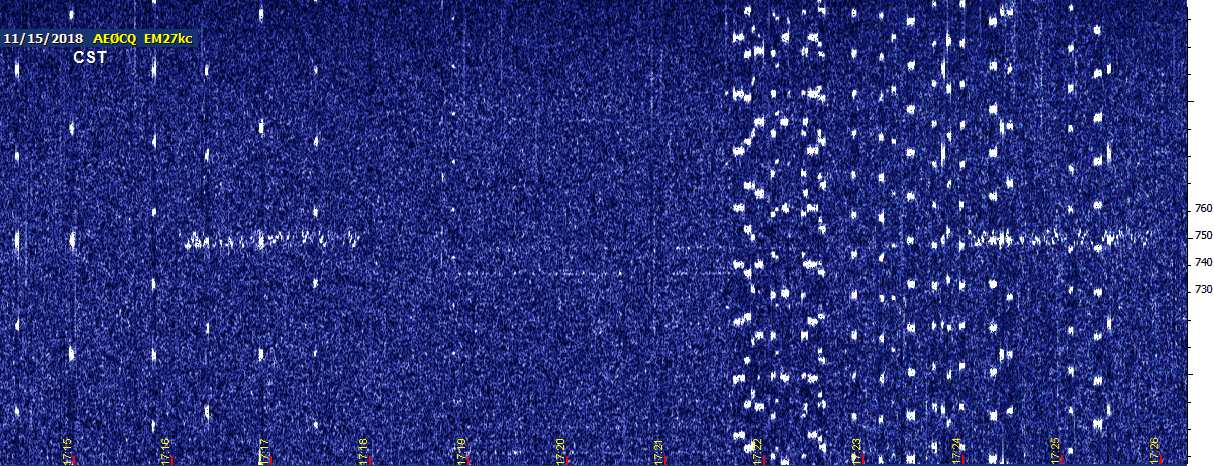
Posted by John Davis on November 16, 2018 at 02:57:09.
In reply to Re: RX report 44m BeFER posted by John Davis on November 15, 2018
At last:
2340  -25  -0.0    6.791750    0   J1LPB         FN03      0
2348  -25   0.1    6.791750    0   J1LPB         FN03      0
Hopefully, more have been recorded while I came to town for supper. On my way back out to retrieve.
No codar in this band, and no ISM carriers where you are, Jason, but it was definitely not quiet around sunset! Attached is an Argo screen showing the (probably Chinese OTH radar) pulsers that were out in full force. They were throwing everything into the wok tonight, from 8 pps to 46 pps, and a variety of new pulse shapes, apparently. Just before sunset I was able to see your signal...it was even audible sometimes...but the software simply could not decode it through the pulses! WSPR 2.12 tried mightily, but even after working on a single recording for three time slots (!) it couldn't pull it out. WSJT-X 0.8 (the highest version I've run successfully on that old notebook) couldn't, either, but at least it didn't waste as much time trying.
Finally, over half an hour later, there started to be decodes. We'll see how that has been doing in the meantime. One suggestion that might help: if you could decrease the frequency 10 Hz, that would place it in one of the few nearby frequency slots that seems to have fewer pulse sidebands at most of the rates they used.
John
---------------------------------------------------------------
File Attachment 1: 15nov44m.jpg
Pierced EARs
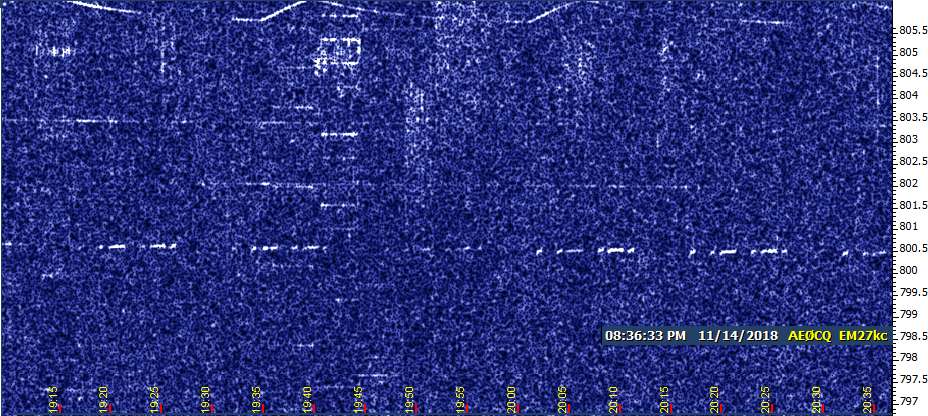
On Wednesday night I started watching for EAR about 0005 UTC, an hour after local sunset, just as it began fading in for the night and continued until just after 0340. Between 0100 and 0300, there was some peculiar noise above EAR's frequency, but the signal was strong enough for good copy of most ID cycles anyway. After the noise died down, things looked really good, so I wanted to monitor through the night and get a continuous record to daybreak. Unfortunately, it was extraordinarily cold, and the computer's internal battery charger decided it didn't want to play nice with the storage battery external source any more. Went to crank up the generator and see if I could do something about that, but the bed cover on the truck had frozen shut and wouldn't let me in! Defeated, I shut down at 0340 and returned to town. Below is one of the captures during the maximum part of the noise.
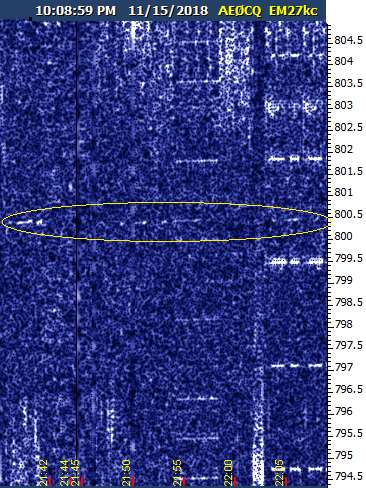
Tonight, the noise was much worse. EAR was visible, but not as consistently. Sounded like broadcast sidebands to me at first, but what sort of program would have produced this mess, I wonder?
Eventually I gave up on this venture, too, and switched to 2200 meters where I'm currently looking for WSPR.
John
---------------------------------------------------------------
File Attachment 1: 14nov7.jpg
File Attachment 2: 15novEAR.jpg
Re: 44m BeFER & Chinese Measles
Pretty consistent decodes this evening, thanks to less frequent pulsed QRM.
2356  -22   0.1    6.791750    0   J1LPB         FN03      0
0008  -22  -0.1    6.791748    0   J1LPB         FN03      0
0016  -21   0.1    6.791748    0   J1LPB         FN03      0
0024  -22   0.0    6.791749    0   J1LPB         FN03      0
0032  -22   0.0    6.791748    0   J1LPB         FN03      0
0040  -25   0.0    6.791745    0   J1LPB         FN03      0
0048  -24  -0.0    6.791745    0   J1LPB         FN03      0
0056  -23   0.0    6.791742   -1   J1LPB         FN03      0
0108  -26  -0.2    6.791742    0   J1LPB         FN03      0
0124  -26   0.0    6.791746    0   J1LPB         FN03      0
0132  -25  -0.2    6.791745    0   J1LPB         FN03      0
0140  -22   0.0    6.791745    0   J1LPB         FN03      0
0148  -23  -0.1    6.791745    0   J1LPB         FN03      0
0156  -22  -0.0    6.791744    0   J1LPB         FN03      0
0208  -19  -0.2    6.791742    0   J1LPB         FN03      0
0216  -22  -0.2    6.791742    0   J1LPB         FN03      0
0224  -20  -0.1    6.791740    0   J1LPB         FN03      0
0232  -21  -0.1    6.791740    0   J1LPB         FN03      0
0240  -21  -0.2    6.791741    0   J1LPB         FN03      0
0248  -20  -0.3    6.791740    0   J1LPB         FN03      0
0256  -19  -0.1    6.791740    0   J1LPB         FN03      0
0308  -18  -0.3    6.791738    0   J1LPB         FN03      0
0316  -18  -0.1    6.791738    0   J1LPB         FN03      0
0324  -19  -0.2    6.791738    0   J1LPB         FN03      0
0332  -21  -0.1    6.791737    0   J1LPB         FN03      0
Would like to see what the sunrise transition is like on this band, but that may have to wait a couple of nights until we get warmer temperature. :)
Re: 44m BeFER & Chinese Measles
Sounds good, I am on 6791.740 right now.
Nice artwork, and a great way to describe it :)
I am not seeing that pattern in my area but again, I should be thinking outside the region and consider other locations.
Jason
Re: 44m BeFER & Chinese Measles
Posted by Jason Goldring on November 16, 2018 at 13:55:57.
In reply to Re: 44m BeFER & Chinese Measles posted by John Davis on November 16, 2018
We just had a good dump of snow, that might change things a little, I noticed oddly that the FS meter was a slight bit higher today, maybe a better ground for the moisture we accumulated. Thanks very much for the report!
Bill if you are reading you might want to get that little beast of yours fired up!
Jason
Re: Pierced EARs
Posted by John Bruce McCreath on November 16, 2018 at 14:37:01.
In reply to Pierced EARs posted by John Davis on November 16, 2018
Thanks for the report and screen shots/snips, John. It sounds like Murphy was giving you a rough time!
73, J.B., VE3EAR 44m BeFER & 22m HiFER WSPR
Posted by John Davis on November 17, 2018 at 06:59:29.
In reply to Re: 44m BeFER & Chinese Measles posted by Jason Goldring on November 16, 2018
After daybreak and the end of my overnight 2200 m WSPR monitoring, I tuned to 44 m just before 1530 UTC and watched there for a couple of hours. I did manage one decode in all that time. Just before local noon, I switched to 22 m and was soon rewarded there:
1624  -27  -0.6    6.791736    0   J1LPB         FN03      0
1818  -16   0.1   13.555418    0   J1LPB         FN03      0
1826  -15   0.2   13.555409    0   J1LPB         FN03      0
1834  -14   0.3   13.555409    0   J1LPB         FN03      0
There were lots more spots during the afternoon, all uploaded to WSPRnet. Half an hour before sunset, I switched back to 44 m and have been sitting there ever since. Some "Chinese measles" showed up again, but not as badly as the night before. Am noticing some odd behaviors with the decoder again; see attached file.
If all goes well with the hardware and software, I plan to try for 24 continuous hours on 44 m.
John
---------------------------------------------------------------
File Attachment 1: 16nov.jpg
Re: 44m BeFER & 22m HiFER WSPR
Thanks John. Interesting about the decoder based on your screenshot. In fact, I have noticed peculiar activity which I cannot confirm being valid, for example, this morning I decoded from my J3 location (Central Ontario) this odd entry.
1238 -33 6.0 6.791732 0 Q/M16GWY 10
No gridezone, no distance. It would seem that the Q prefix may indicate telemetry or a balloon.
If it was a valid hit I believe more along the lines of balloon but how it would transmit the grid, must be a sample and hold for the duration of the frame, but this is not the case, instead it comes in with nothing. Only one hit so far on this. The DT and db are also peculiar.
Now here is the real mystery - If I go to decode the actual saved sample again, it comes up with this.
1238 -33 6.0 0.001492 0 Q/M16GWY 10
Stumped, but then again it is the beta version, bugs included I suppose...
Thanks again.
Jason
Re: 44m BeFER & 22m HiFER WSPR
Posted by John Davis on November 17, 2018 at 17:38:17.
In reply to 44m BeFER & 22m HiFER WSPR posted by John Davis on November 17, 2018
"If all goes well with the hardware and software, I plan to try for 24 continuous hours on 44 m."
Famous last words! My deep cycle batteries may have suddenly become awfully shallow.
According to analysis of the Argo captures from last night: Just four hours after I gave the batteries their final recharge of the evening, the one handling the receiver fell below the radio's drop-out voltage just after 2:15 AM CST. Around two hours later, the other one that powers the computer charger must have also expired, because about 7:15 AM the computer's own internal battery ran out and it went into hibernate mode.
So, I'll have to start over on the 24 hour project...but that may have to wait until I can determine whether the charging was inadequate in some way, or whether the batteries are just kaput and I need new one$.
(FYI, my fellow Americans, just wait til your car needs a new battery to appreciate the impact of tariffs on raw materials. I had to replace mine under warranty this week, and the pro-rated cost was greater than the original price I paid for it! Full price of the car battery is now more than I paid for the marine batteries new, in fact, $o I expect buying new one$ of tho$e i$ going to be a $eriou$ budget bu$ter, for $ure.)
The final spots before the radio went nighty-night show the signal undergoing and coming out of a fade:
0716 -22 0.0 6.791747 0 J1LPB FN03 0John
0724 -21 -0.1 6.791746 -1 J1LPB FN03 0
0732 -24 0.0 6.791745 0 J1LPB FN03 0
0740 -28 -0.1 6.791745 0 J1LPB FN03 0
0748 -18 0.0 6.791745 0 J1LPB FN03 0
0756 -12 0.0 6.791745 0 J1LPB FN03 0
0808 -18 -0.2 6.791744 0 J1LPB FN03 0
Re: 44m BeFER & 22m HiFER WSPR
Posted by John Davis on November 18, 2018 at 05:16:03.
In reply to Re: 44m BeFER & 22m HiFER WSPR posted by John Davis on November 17, 2018
I couldn't find a definite problem with the batteries, so perhaps it was a case of inadequate charge, I spent an excess of time on charging this afternoon and evening, so I got hopeful and began my 24 hour 44 m monitoring experiment again at 3:30 this afternoon.
(Actually, I began at 3:08 PM CST/2108 UTC on 44 m, where I saw but could not decode J1LPB. Then, as you'll notice in the spots below, I detoured to 22 m for the next 20 minutes. I'm greatly surprised the 2110 slot on 22 m decoded, because I didn't get the receiver on the right frequency for a couple of seconds. The Argo capture actually shows the very start of the header 10 Hz higher than the rest of the transmission.)
A preliminary observation: 44 m is probably just as subject to short and long term propagation fluctuations as 22 m. Looking back at my spots on WSPRnet last night, I see very regular decodes (no more than one missed per hour; frequently none missed) from when I started at 2256 on the 16th until the radio shut down after the 0808 slot on the 17th.
Tonight, however, conditions have been distinctly poor! The rest of the 2100 hour and the 2200 hour were mostly decent, but 2300 onward was sparse. There have been no decodes after 0056 up to 0420, when I returned to town to write this report. I do have faint traces of the signal on Argo in most transmission slots, but not for the entire two minutes; more like 20 to 60 seconds most times. So, propagation is suppressed overall compared to last night, and QSB is a short-period phenomenon at present. No space weather anomalies are evident, though.
John
2110  -18   0.2   13.555413    1   J1LPB         FN03      0
2118  -17   0.3   13.555415    0   J1LPB         FN03      0
2140  -24   0.1    6.791753    0   J1LPB         FN03      0
2148  -19   0.2    6.791753    0   J1LPB         FN03      0
2156  -25   0.1    6.791753    0   J1LPB         FN03      0
2208  -26  -0.1    6.791751    0   J1LPB         FN03      0
2224  -25   0.0    6.791752    0   J1LPB         FN03      0
2232  -19   0.1    6.791751    0   J1LPB         FN03      0
2240  -23   0.2    6.791751    0   J1LPB         FN03      0
2248  -26   0.1    6.791750    0   J1LPB         FN03      0
2316  -20   0.0    6.791747    0   J1LPB         FN03      0
2324  -20   0.1    6.791746    0   J1LPB         FN03      0
0008  -28  -0.1    6.791740    0   J1LPB         FN03      0
0040  -27   0.0    6.791739    0   J1LPB         FN03      0
0056  -29  -0.0    6.791740    0   J1LPB         FN03      0
Re: 44m BeFER & 22m HiFER WSPR
Thanks for the report John. Your battery situation reminds me of a similar issue I had a few months back, I actually had a short in one of my batteries, inconsistent though. It would take a charge then die off.
Conditions here are dull, gray, about 36F with ample moisture.
SIW has not been visual or decoded for at least 24 hours.
Faint trace of something below SIW but nothing more.
One thing I have noted is that overall noise, especially on 2200 and 1750, has dropped considerably but signal captures have been harder. Almost like someone put a metal wall up. I confirmed the timing intervals on the SDR so the program would drop the gain down to zero and AGC off while TX'ing on the same band. Not as many captures for those who transmit during the "down" time but there are still some that make it through.
Jason
Re: 44m BeFER & 22m HiFER WSPR
Posted by John Davis on November 18, 2018 at 17:27:28.
In reply to Re: 44m BeFER & 22m HiFER WSPR posted by Jason Goldring on November 18, 2018
The battery handling the radio last longer after last night's extended charge, but nonetheless died 30 minutes before I returned to the field this morning, so last night's record has a half hour gap in it. (The battery feeding the computer held up better, so I can measure the gap precisely this time.) That wouldn't be so bad, except it's evident something happened during that time.
As mentioned last night, decodes stopped after 0056 UTC. I continued to see faint traces of J1LPB during parts of some transmission slots until about 0500, with one lone decode at 0456. After that, the band appeared almost totally dead for more than two hours.
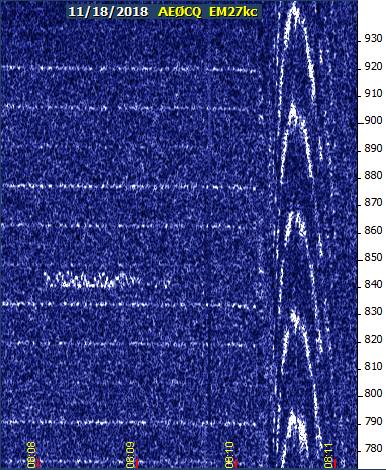
Suddenly at 236 AM CST/0826 UTC, a 14 pps pulsed signal appeared and remained on continuously. J1LPB started faintly materializing between the spectral lines late in the 0840 transmission slot. Decodes resumed shortly thereafter at 0846, and continued pretty consistently up until 1340 (7:40 AM CST) this morning. From then until the radio powered itself down, the WSPR signal remained partially visible. The file attached shows the radio's last gasp at 8:11 AM, preceded by a view of the WSPR signal nestled between the lines. (The lines were already beginning to fade by then. They had been much brighter earlier.)
Something happened in the next 30-40 minutes that I don't know about. When I completed my battery test and resumed operation, the pulser's spectral lines were gone, and so was J1LPB, alas. Am continuing to monitor.
John
0456  -27   0.0    6.791756    0   J1LPB         FN03      0
0848  -20  -0.1    6.791747    0   J1LPB         FN03      0
0856   -9  -0.2    6.791747    0   J1LPB         FN03      0
0916  -25  -0.2    6.791747    0   J1LPB         FN03      0
1008  -19  -0.3    6.791745    0   J1LPB         FN03      0
1016  -15  -0.3    6.791745    0   J1LPB         FN03      0
1024  -27  -0.2    6.791744    0   J1LPB         FN03      0
1032  -26  -0.4    6.791742    0   J1LPB         FN03      0
1040  -16  -0.2    6.791745    0   J1LPB         FN03      0
1048  -22  -0.5    6.791745    0   J1LPB         FN03      0
1116  -11  -0.4    6.791742    0   J1LPB         FN03      0
1124  -13  -0.3    6.791743    0   J1LPB         FN03      0
1132  -22  -0.4    6.791742    0   J1LPB         FN03      0
1140  -15  -0.3    6.791742    0   J1LPB         FN03      0
1148  -13  -0.3    6.791742    0   J1LPB         FN03      0
1156  -14  -0.3    6.791742    0   J1LPB         FN03      0
1208  -16  -0.3    6.791742    0   J1LPB         FN03      0
1216  -18  -0.3    6.791742    0   J1LPB         FN03      0
1224  -17  -0.4    6.791742    0   J1LPB         FN03      0
1232  -22  -0.3    6.791741    0   J1LPB         FN03      0
1240  -16  -0.3    6.791741    0   J1LPB         FN03      0
1248  -19  -0.3    6.791742    0   J1LPB         FN03      0
1256  -20  -0.4    6.791742    0   J1LPB         FN03      0
1308  -17  -0.5    6.791739    0   J1LPB         FN03      0
1324  -18  -0.5    6.791741    0   J1LPB         FN03      0
1332  -20  -0.4    6.791740    0   J1LPB         FN03      0
1340  -25  -0.3    6.791740    0   J1LPB         FN03      0
---------------------------------------------------------------
File Attachment 1: 17nov117.jpg
44m WSPR
Jason,
While working on another project today, I decided to set up for 44m WSPR reception. That band has been really quiet from mid morning to early afternoon today. I have watched the waterfalls a little, and some interesting patterns have popped in and out. I had a couple sporadic WSPR decodes of J1LPB then in the 19:00 hour I decoded all time slots. Wspr reports a distance of 898 km.
My receive setup was a 5 band trap vertical antenna, and a Kenwood TS-480 receiver. The nice thing about this band is that I don't have to shut down any of my transmitters to be able to hear/see well.
181118 1656 1 -28 0.37 6.7917414 J1LPB FN03 0
181118 1848 2 -23 0.37 6.7917418 J1LPB FN03 0
181118 1908 3 -23 0.24 6.7917406 J1LPB FN03 0
181118 1916 2 -25 0.45 6.7917408 J1LPB FN03 0
181118 1924 2 -27 0.28 6.7917403 J1LPB FN03 0
181118 1932 1 -28 0.28 6.7917410 J1LPB FN03 0
181118 1940 4 -18 0.37 6.7917412 J1LPB FN03 0
181118 1948 3 -21 0.37 6.7917420 J1LPB FN03 0
Mike - N8OOU
Re: 44m WSPR
Posted by Jason Goldring on November 18, 2018 at 21:45:20.
In reply to 44m WSPR posted by Mike N8OOU on November 18, 2018
Mike thank you for the feedback. I am interested in your 5 trap, sounds like you got it worked out on your end quite nicely. I believe the problem in my end is the AGC kicks in quick and then gets knocked to the ground when the TX starts. I suppose one factor is that I am listening in on the bands I am transmitting on with some deviation to 2200m when I switch to that.
Nice to hear that your setup is working out for you. From your report we can certainly see a bit fluctuation (-28 to -18) and John's reports show the same, bouncing around. It's a great band to play in but between chinese measles (LOL) and other common issues I am just glad to be making it through.
Jason
Re: 44m WSPR
Posted by John Davis on November 19, 2018 at 00:19:19.
In reply to Re: 44m WSPR posted by Jason Goldring on November 18, 2018
Not getting quite as much signal here today as Mike apparently was. Although there were snippets of the WSPR signal visible in at least 60% of the Argo captures all day, only four were strong enough to decode:
2140  -27  -0.8    6.791745    0   J1LPB         FN03      0
2216  -24  -0.8    6.791747    0   J1LPB         FN03      0
2240  -25  -0.8    6.791748    0   J1LPB         FN03      0
2248  -27  -0.8    6.791748    0   J1LPB         FN03      0
(frequencies have not been corrected to compensate for temperature fluctuations)
The signal was getting noticeably better as sunset approached, and the Chinese measles and other QRM had not started yet.
Too bad this band is not available to experimenters in the U.S., and I really don't know why it's not.
Re: 44m WSPR
Posted by Jason Goldring on November 19, 2018 at 02:34:37.
In reply to Re: 44m WSPR posted by John Davis on November 19, 2018
Well....technically it is available if you want to plant a beacon up here. Bring good snow boots and snow tires. And make sure the batteries are charged.
Yes, seeing the noise and realizing that they (FCC) leave for lack of a better interpretation, the way I see it is "bands of the unknown" left unsettled. Noisy, yes, clean, yes. Transparency with future intentions? Unknown. Canada follows the USA very tightly so I am at a loss to figure out this one.
I think I coined a new term . BOTU. Bands of the unknown.
Thanks again all for your input. Have a great evening. Re: 44m WSPR
Jason
Posted by Mike N8OOU on November 19, 2018 at 03:51:43.
In reply to Re: 44m WSPR posted by Jason Goldring on November 18, 2018
Jason,
The 5 band trap vertical is only special because of it's age. It is a Cushcraft AV-5 that I purchased in the mid 70's. It is mounted at ground level with a factory spec ground plane planted in the sod. The section lengths are tuned for the phone portion of the bands. The antenna is on it's 3rd QTH, and has only needed occasional eviction of homesteading spiders. I know there is a mixed opinion of vertical antennas, but this one has worked well for me in both transmit and receive.
Mike N8OOU 73
Re: 44m WSPR
Posted by John Davis on November 19, 2018 at 05:20:56.
In reply to Re: 44m WSPR posted by Jason Goldring on November 19, 2018
Only a few successful decodes from 5 to 10 PM this evening. Several faint appearances that didn't decode. There were a few cases of "Chinese measles", so at least I know the receiver is working. ;)
If it continues to work all night, I'll finally have my 24 hour continuous record of 44 meters. Just wish I'd been able to do that two nights ago while the band was so hot! We'll see whether there's a repeat of last night's ≈6 hours of 14 pps pulser.
I'm using a different battery right now. It's newer than the one that let me down last night, but it has a lower ampere-hour rating to begin with; so six of one, half a dozen of the other. (Neither would do the job in Canada, I'm sure.)
Following are the latest spots...again no effort to compensate frequency for the temperature fluctuations in the shack:
2308  -24  -0.1    6.791729    0   J1LPB         FN03      0
2324  -24  -0.0    6.791728    0   J1LPB         FN03      0
2332  -22   0.1    6.791727    0   J1LPB         FN03      0
2340  -24   0.0    6.791725    0   J1LPB         FN03      0
2356  -22   0.0    6.791723    0   J1LPB         FN03      0
0056  -22  -0.2    6.791723    0   J1LPB         FN03      0
0224  -26  -0.1    6.791721    0   J1LPB         FN03      0
Quiet Day
Really not much to report at all today. I managed to listen in to 22 m on three occasions during the day.
One possible spot of SIW at 13,555.435, and a maybe signal trace in the vicinity of RF. Otherwise, that was all.
Listening for other "barometer" signals in the nearby broadcast band, and also on 20 m suggested very flat conditions indeed.
Re: 44m WSPR
Posted by Jason Goldring on November 19, 2018 at 14:50:18.
In reply to Re: 44m WSPR posted by Mike N8OOU on November 19, 2018
Ah the Cushcraft brand, never had any issues with those, I ran a modified Ringo Ranger for a period of time for commercial purposes when I had my radio business late 90's.
I am glad to see it has endured and served for you as long as it has. Re: 44m WSPR
It's interesting to know the setup everyone is using to offer a scope of performance.
I see nothing wrong with using verticals, nothing at all. But as you say, mixed opinions. Now all you need is a bat shelter box on the property, at night time the eviction of spiders would be taken care of.
Thanks Mike, enjoy your day.
Jason
Posted by Jason Goldring on November 19, 2018 at 15:10:25.
In reply to Re: 44m WSPR posted by John Davis on November 19, 2018
Well thank you very much John. The db deviation noted over the past while, temps are a lot cooler here, weather has not been the greatest. I would have thought the last wind we had shaking remaining tree foliage off might help but maybe not.
One thing I will point out, as Ed pointed out the same, the band, at least 22m, was very quiet. I even noticed a drop in the signal of WWV on 15.0.
Jason Re: 44m WSPR
Posted by John Davis on November 19, 2018 at 17:43:52.
In reply to Re: 44m WSPR posted by Jason Goldring on November 19, 2018
The spare battery held up all night, miraculously, so I finally have 24 continuous hours of reception. Like a bad cold, I can sometimes be persistent!
Yesterday evening's conditions must not have been too good. That capture at 0056 UTC (almost an hour after sunset) was the only one that hour, and the next one at 0224 was the last for over four hours. After local midnight, decodes resumed (see below), along with the "measles" and persistent lines.
The biggest cluster of measles seemed to be the one an hour before sunrise. (This is one of the attached files. The other attachment shows how much variation in strength the WSPR signal itself underwent from cycle to cycle.)
Last night the continuous spectral lines were from a 44 pps pulser, but never got as strong as the night before. They started showing up late in the 3 AM hour CST, varied in intensity from capture to capture, and lasted until 7:50 AM CST (1350 UTC).
John
0632  -23  -0.1    6.791742    0   J1LPB         FN03      0
0640  -20  -0.3    6.791741    0   J1LPB         FN03      0
0708  -22  -0.2    6.791740    0   J1LPB         FN03      0
0716  -17  -0.3    6.791741    0   J1LPB         FN03      0
0724  -20  -0.2    6.791741    0   J1LPB         FN03      0
0732  -22  -0.3    6.791742    0   J1LPB         FN03      0
0740  -25  -0.1    6.791740    0   J1LPB         FN03      0
0748  -16  -0.3    6.791739    0   J1LPB         FN03      0
0756  -16  -0.2    6.791739    0   J1LPB         FN03      0
0808  -20  -0.4    6.791740    0   J1LPB         FN03      0
0816  -22  -0.3    6.791740    0   J1LPB         FN03      0
0824  -18  -0.3    6.791740    0   J1LPB         FN03      0
0832  -21  -0.2    6.791741    0   J1LPB         FN03      0
0840  -13  -0.3    6.791741    0   J1LPB         FN03      0
0848  -14  -0.2    6.791740    0   J1LPB         FN03      0
0856  -21  -0.3    6.791739    0   J1LPB         FN03      0
0908   -9  -0.3    6.791740    0   J1LPB         FN03      0
0916  -11  -0.3    6.791742    0   J1LPB         FN03      0
0924  -13  -0.3    6.791740    0   J1LPB         FN03      0
0932  -17  -0.3    6.791740    0   J1LPB         FN03      0
0940  -16  -0.4    6.791741    0   J1LPB         FN03      0
0948  -12  -0.3    6.791741    0   J1LPB         FN03      0
0956  -18  -0.3    6.791740    0   J1LPB         FN03      0
1008  -23  -0.3    6.791738    0   J1LPB         FN03      0
1016  -21  -0.3    6.791741    0   J1LPB         FN03      0
1024  -19  -0.3    6.791740    0   J1LPB         FN03      0
1032  -14  -0.3    6.791740    0   J1LPB         FN03      0
1040  -19  -0.5    6.791740    0   J1LPB         FN03      0
1056  -16  -0.3    6.791740    0   J1LPB         FN03      0
1108  -19  -0.3    6.791738    0   J1LPB         FN03      0
1116  -20  -0.4    6.791738    0   J1LPB         FN03      0
1140  -15  -0.4    6.791739    0   J1LPB         FN03      0
1148  -18  -0.5    6.791739    0   J1LPB         FN03      0
1156  -27  -0.4    6.791739    0   J1LPB         FN03      0
1216   -6  -0.5    6.791740    0   J1LPB         FN03      0
1224  -19  -0.5    6.791740    0   J1LPB         FN03      0
1232  -20  -0.5    6.791740    0   J1LPB         FN03      0
1248  -26  -0.5    6.791740    0   J1LPB         FN03      0
1256  -22  -0.6    6.791739    0   J1LPB         FN03      0
1308  -20  -0.6    6.791738    0   J1LPB         FN03      0
1316  -29  -0.5    6.791740    0   J1LPB         FN03      0
1340  -28  -0.6    6.791740    0   J1LPB         FN03      0
1348  -30  -0.4    6.791739    0   J1LPB         FN03      0
---------------------------------------------------------------
File Attachment 1: 17nov261.jpg
File Attachment 2: 17nov271.jpg
Re: 44m WSPR
Incredible. -6 to -30 Re: 44m WSPR
Well thank you John, that certainly paints a picture of how rapidly conditions can change. It's lonely on 44m, but at the same time a refreshing challenge to see if the noise can be surpassed with a measly signal.
Jason
Posted by John Davis on November 20, 2018 at 06:25:04.
In reply to Re: 44m WSPR posted by Jason Goldring on November 19, 2018
Although no longer maintaining a continuous watch on 44 m, I did remain tuned there for the rest of the morning, and again from mid-afternoon to an hour after sunset (when I switched to 1750 m to look for EAR.
John
1634  -24   1.8    6.791768   -4            VOK4DZ   49
1850  -18   0.4   13.555426   -1   J1LPB         FN03      0
1858  -14   0.2   13.555423    0   J1LPB         FN03      0
2042  -17   0.2   13.555415    0   J1LPB         FN03      0
2050  -21   0.3   13.555415    0   J1LPB         FN03      0
2108  -25   0.5    6.791746    0   J1LPB         FN03      0
2208  -23   0.0    6.791741    1   J1LPB         FN03      0
2216  -23   0.1    6.791740    0   J1LPB         FN03      0
2224  -24   0.1    6.791738    0   J1LPB         FN03      0
2238  -31   1.0    6.791757   -4   US/NW7XNN              33
2248  -29   0.1    6.791738    0   J1LPB         FN03      0
Re: 44m WSPR
Thanks again John. 22m for me has really diedoff lately.
44 keeps coming and going judging by 40m spots, but remaining somewhat solid.
Where SIW was coming is strong on 22, that seems to be diminished with only a few spots here and there.
Jason
The Night Has a Thousand EARs
Posted by John Davis on November 22, 2018 at 02:57:36.
Well, actually just 48 in the 12 hours covered here, less some disrupted by QSB. The signal first faded in Tuesday evening an hour and 15 minutes after sunset, and faded out 45 minutes before sunrise Thursday...itself a bit of a record, as it normally fades out nearly an hour and a half before.
Because the 12 hour scrollable capture is an 800 KB file, I'm not embedding it in this message, but you can scroll through it at:
John
Re: The Night Has a Thousand EARs
Posted by John Bruce McCreath on November 22, 2018 at 14:52:31.
In reply to The Night Has a Thousand EARs posted by John Davis on November 22, 2018
That was quite a feat, John! Your scroll made for a slick way to see the ups and downs through the night.
Thanks for posting....you and the other listeners/lookers are why I keep EAR on 24/7/52.
73, J.B., VE3EAR Re: The Night Has a Thousand EARs
Posted by Jason Goldring on November 23, 2018 at 01:57:55.
In reply to Re: The Night Has a Thousand EARs posted by John Bruce McCreath on November 22, 2018
I was quite impressed with the scrolling pic. That tells the whole story. Happy Thanksgiving to our American friends. Lots of festivities up here too, I think Canada is hooked on Black Friday (hide your wallets) :) QSL Card for W1IR
Posted by Tom N8TL on November 24, 2018 at 15:57:39.
Note to W1IR...if you have e-mail contact me and I will forward an SWL card for your 24Nov18 WSPR transmission on 630M. Tom N8TL
Re: The Night Has a Thousand EARs
Posted by John Davis on November 25, 2018 at 06:30:13.
In reply to Re: The Night Has a Thousand EARs posted by Jason Goldring on November 23, 2018
If you like that scrolling view, wait until you see the 24 hour capture of WM and SIW from November 19-20 that I'm currently working on.
Meanwhile, on the night of the 21st, it occurred to me that I could watch for LowFER J1LPB while simultaneously keeping on the lookout for EAR. I was curious how that might work out at the relatively fast speed for LPB, plus I wanted to see what that noise really was that plagued EAR's frequency. It didn't take long to appreciate how noisy that past of the band really is (see attached file).
John
---------------------------------------------------------------
File Attachment 1: 21nov4.jpg
Where have all the Hifers gone?
Sorry for the subject, but I couln't resist, since the night has ears. No?, OK, now for the real question, where have all the Hifers gone? I finished up a separate monitoring setup here at the (work) QTH in Gila Bend, AZ. After 4 days of looking at ARGO, all I've seen is what I think are traces of EH. Are conditions really that bad lately or is it my setup?
-73- Re: Where have all the Hifers gone?
Ward K7PO/WH2XXP
Posted by Jason Goldring on November 25, 2018 at 19:16:14.
In reply to Where have all the Hifers gone? posted by Ward K7PO on November 25, 2018
ward, I was going to ask the same - The band is dead right now and conditions seem very poor. 44m has been ok for me but for what I typically get on 22m, at least a few copies of SIW, not even getting that anymore.
Jason HiFER OH
J1LPB
Posted by Tom N8TL on November 25, 2018 at 22:23:55.
HiFer "OH" is back on the air starting at 11AM EST
this morning. You can find it at 13.556789 MHz. Mode: QRSS3.
Thanks, 73, and have a good Christmas,
Tom N8TL
Re: Where have all the Hifers gone?
Posted by swlk5 Tom on November 26, 2018 at 00:21:15.
In reply to Re: Where have all the Hifers gone? posted by Jason Goldring on November 25, 2018
Well, here's some hifers for you... today's loggings.
1734 -30 1.2 13.555406 0 LT0/J1LPB 53 Re: Where have all the Hifers gone?
1810 -29 1.1 13.555413 0 J1LPB FN03 0 1190
1834 -29 1.3 13.555411 0 J1LPB FN03 0 1190
1842 -26 1.3 13.555412 -1 J1LPB FN03 0 1190
1908 -28 0.1 13.555402 0 K3SIW EN52 7 758
1910 -28 1.4 13.555408 0 J1LPB FN03 0 1190
2034 -28 1.5 13.555411 0 J1LPB FN03 0 1190
2118 -27 1.7 13.555409 0 J1LPB FN03 0 1190
2126 -26 1.7 13.555410 0 J1LPB FN03 0 1190
2134 -28 1.8 13.555409 0 J1LPB FN03 0 1190
2210 -27 1.9 13.555406 0 J1LPB FN03 0 1190
2242 -24 1.8 13.555407 0 J1LPB FN03 0 1190
2250 -25 1.8 13.555407 0 J1LPB FN03 0 1190
Posted by Jason Goldring on November 26, 2018 at 03:25:22.
In reply to Re: Where have all the Hifers gone? posted by swlk5 Tom on November 26, 2018
And this is how it works.....there are always listeners, but to come forward brings cheers.
Thanks so much. Still making it out there!
Jason
J1LPB
Re: Where have all the Hifers gone?
Posted by ed holland on November 26, 2018 at 21:42:28.
In reply to Re: Where have all the Hifers gone? posted by Jason Goldring on November 26, 2018
Alas, Yesterday I found PVC powered off, and must have been that way since Tuesday last week. Certainly no way to get reports!
It is back on air now.
Yesterday, I tried listening in between chores. At one point I glanced in and it looked as if there were a few traces, but I had no chance to sit and pick through them. Later on, the band had fallen flat, and even the QRM at 13,560 was much diminished.
Ed
Re: Where have all the Hifers gone?
Posted by Jason Goldring on November 27, 2018 at 04:17:55.
In reply to Re: Where have all the Hifers gone? posted by ed holland on November 26, 2018
Trying again tonight. Granted the weather is dismal, 22m is not coming in as well as what I thought it would. WWV is still breaking through clear however the 15 Mhz station is weaker than what it normally comes in at.
Having said that, the band was low on overall noise.
At least for FN03.
Not listening on 44m and 1750m is giving me a pulsing noise across the band. Guess someone in the area got a Black Friday toy made in China that is blowing out noise.
Jason
J1LPB
Magnum Opus: 25.5 Hours of WM & SIW LowFERs
Posted by John Davis on November 28, 2018 at 01:40:50.
A week and a few hours ago, I was doing captures at the LowFER watering hole to record the transition of SIW between frequencies and modes. Attached are the captures of the transition to 185.293 QRSS30/60 on Tuesday the 20th, and to EbNaut at 185.185 on Wednesday the 21st, But wait, there's more.
I let the captures run into the evening, which turned out to be quieter than usual, so I thought "why not go for a 24 hour marathon?" Documenting the full cycle of ground and sky wave on these two had been one of my goals for a while, so this seemed a perfect time to do it...provided the batteries and the computer would cooperate for that long.
They did, but a mishap occurred early in the evening that I still hadn't noticed when I retired for the night a few hours later. My plan was to do the full 24 hours in Argo's QRSS30 mode and stitch it all together the way I did with EAR from the night before. Fortunately, I also continued to run a second instance at QRSS60, despite no obvious need to do so; fortunate, because the QRSS30 instance stopped (possibly operator error, but I don't know for sure). In the morning, I thought it was an odd coincidence that I turned on the display with at the same point in the ID as the night before...till I looked at the timestamp and saw it was still reading PM. There was almost exactly a 12 hour gap in the record!
But the QRSS60 record remained intact enough to fill the gap. The fix required morphing the QRSS60 display in both axes...stretching the horizontal by a factor of 2, and compressing the vertical by a factor of 2, in order to match the height and spacing of the traces to QRSS30 specs. (The time scale had to be treated differently, stretching horizontally but not vertically, in order to synchronize. That's why it looks so odd in the middle of the scrollable display.) That glitch made for a LOT of extra work, in other words, right with the holiday travel plans and family events right in the middle of things. The result is a composite of 13 QRSS30 screens and 6 QRSS60 screens stitched together, plus 25 time scales synchronized with the traces.
It's easy to see the pre- and post-sunset signal fluctuations over the path, along with the corresponding ones again at sunrise. Twice during the night, both signals were strong enough to be just barely detectable by ear at times, although CW would not have been feasible given all the QRM that was audible in the IF passband.
Click Here for Scrollable Presentation and view the transition captures below.
John
---------------------------------------------------------------
File Attachment 1: 20novWMSIW.jpg
File Attachment 2: 21novWMSIW.jpg
Re: Magnum Opus: 25.5 Hours of WM & SIW LowFERs
John,
This is a great view of a day in the life of a Lowfer. I would never have guessed that propagation could support continuous coverage like this. Thanks for your work to build this image. It is going to find it's way onto a wall in my Radio Shack.
Mike Meek 73
Re: Magnum Opus: 25.5 Hours of WM & SIW LowFERs
Posted by Jason Goldring on November 29, 2018 at 20:59:46.
In reply to Magnum Opus: 25.5 Hours of WM & SIW LowFERs posted by John Davis on November 28, 2018
Quite the accomplishment even though it dug into your holiday time. Great work and visual! PVC off today
I gave second thought to your comment earlier about the relatively fast mode I am running right now, so I am going to move it to QRSS30 which will change intervals for the 22 and 44m plus a calibration cycle. Let's see where that takes us.
Amazing work John!
Jason
Posted by ed holland on November 29, 2018 at 21:19:46.
Hi Folks,
Had to remove connections to PVC's antenna today when thunder and lightning jolted me awake!
I'll restore operation ASAP.
The storms also pulled down my long wire aerial for the second time in a week.
Cheers
Ed
Re: Where have all the Hifers gone?
Posted by John Davis on November 30, 2018 at 04:27:21.
In reply to Re: Where have all the Hifers gone? posted by Jason Goldring on November 27, 2018
On the day Ward posted his question, I was actually receiving several (capture farther below), but I suspect the question may really be "when have all the HiFERs gone" because of my experience on the 19th. For several days, codar had been minimal...only one or two active sites at most, so no more banding of lines from the multiple sites like before. On the 19th, signals weren't always super strong, but without the QRM they were fairly decent; at times, excellent. Then suddenly--nothing! Voila:
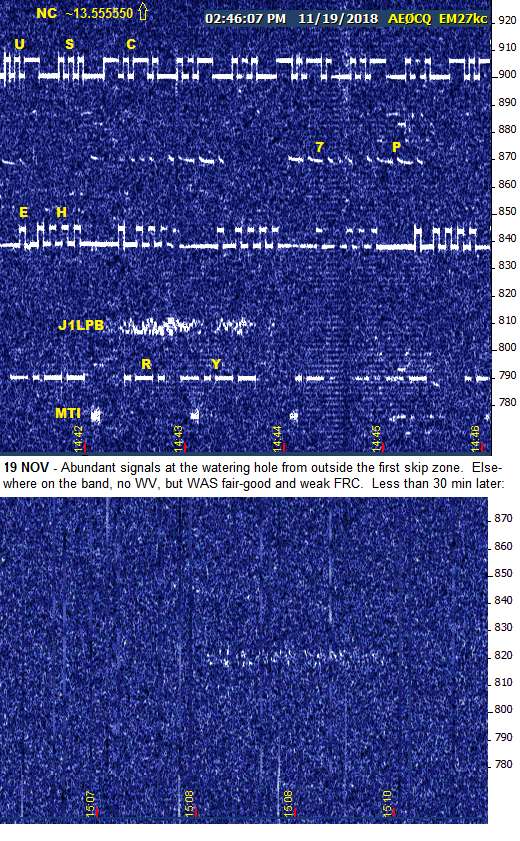
(Note that on that day, 7P still had its curves.)
On the 20th, I only made a brief check before doing the WM/SIW LowFER deal, and another check afterward on the 21st. Both of those times yielded EH, RY, a ghost of USC sometimes, and sometimes NC up above everybody else. WAS was good on the 20th, but not noticed when I checked on the 21st.
I was gone the 22nd and 23rd, but when I resumed on the 24th, something was different! ...nice, flat traces from 7P (except for occasional jumps of~2 Hz sometimes). At mid-afternoon, the watering hole contained only 7P, EH, and RY, plus a few WSPRs from J1LPB. TON was visible but only faintly audible. RY faded out before 4:30 CDT and EH evaporated just after 4:36, leaving only a nice bright 7P to rule the watering hole for the next hour, accompanied by only a single...but loud...codar transmitter. After 5:35 PM, 7P faded too, but K6FRC boomed in for several more minutes at the other end of the band.
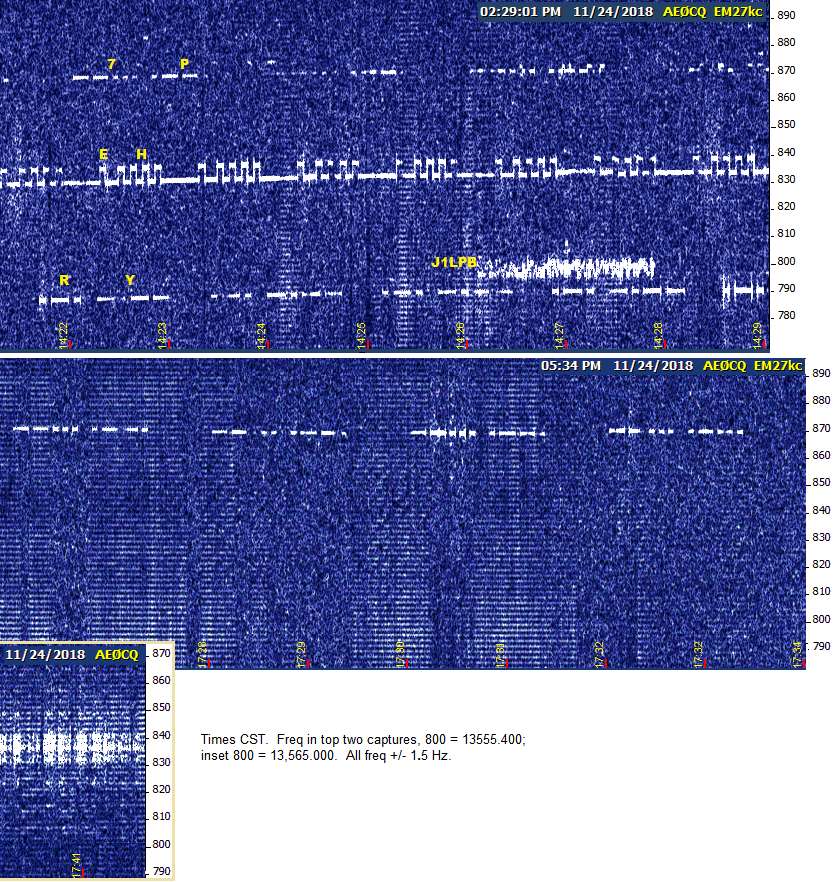
On the 25th itself (the date of Ward's question) I had numerous regulars at the watering hole, but no appearances of anyone inside nor at the edges of the usual first skip zone...only those farther away.
And there was no sign of WV, WAS, or even FRC at the times I listened. I only scanned the rest of the band briefly, twice, because I was doing a test to compare different WSPR decoders' performance under tough 22 meter conditions, as well as on 2200 and 630 m (separate report forthcoming on those). At 22 m on Sunday, there was no performance difference between WSPR 2.12 and WSPR X; every J1LPB transmission decoded by one was also decoded by the other. (That was not the case on the other bands!)
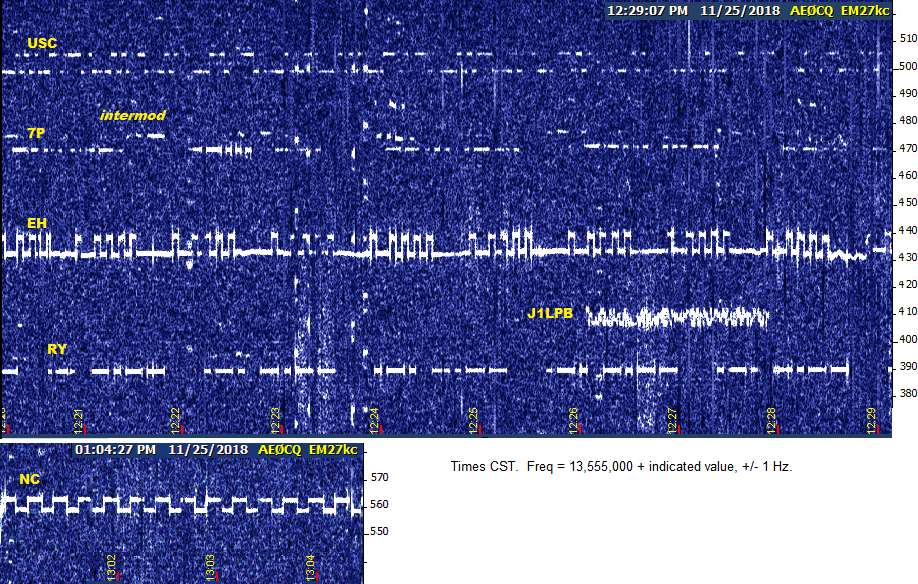
So, yes, the band was marginal Sunday--but rather surprising today, Thursday the 29th. A report on that will follow.
John
---------------------------------------------------------------
File Attachment 1: 24nova.jpg
File Attachment 2: 25nova.jpg
File Attachment 3: 19nova.jpg
Reminder: Lowfer net 3927Khz Saturday morning 0800 California time
Reminder: Lowfer net 3927Khz Saturday morning 0800 California time
Or listen online at:
http://69.27.184.62:8901/?tune=3927lsb
click on the autonotch to get rid of heterodynes
Hope to see you there.
OR Try:
KA7OEI Northern UT http://websdr1.utahsdr.org:8901/?tune=3927lsb
(NOW HAS 630M RECEIVER)
Jerry WA6OWR
Re: PVC off today
Posted by ed holland on November 30, 2018 at 18:44:57.
In reply to PVC off today posted by ed holland on November 29, 2018
Storms over for now. PVC is back on air.
testing SJ
Posted by Sal, K1RGO on November 30, 2018 at 22:29:38.
I am running SJ at sunset to sunrise and by requests for other times. Ran some tests with portable rcvr and E probe ,its good to go. Re: testing SJ
later.............
Posted by John Davis on November 30, 2018 at 23:23:30.
In reply to testing SJ posted by Sal, K1RGO on November 30, 2018
That's good news, Sal. I won't get a chance to listen tonight because we're expecting thunderstorms, but at some point this weekend I should get a chance to try for you here in Kansas.
John
potrzebie