630m digi modes
Been monitoring 630m in the evenings with multiple wsjtx windows open, looking to see what modes are being used more frequently. Seems like the replacement mode for wspr2, FST4W120 isn't really being used much. I'm seeing nearly all stations staying with wspr2.
In the two-way mode, FST460 seems to have replaced jt-9.
The slower speed modes don't seem to have much activity on 630m. I notice just a few stations overnight using FST4W300. That's about it. Perhaps N1BUG is still experimenting with the 1800 version ... not sure.
Well, that's the perspective from this rx station at this time.
Ray
EAR Computer Lock-up?
Posted by John Davis on November 01, 2020 at 08:03:47.
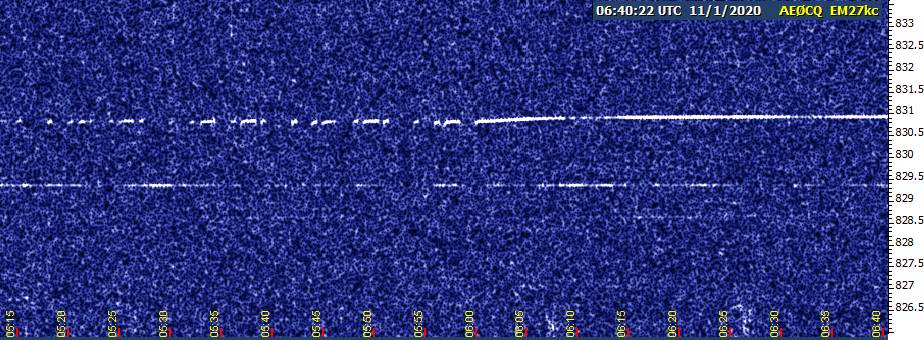
I'm guessing from the timing that the QRSS software got confused when the computer's clock reset itself from Daylight Time. I hope it was nothing "superunnatural" (as Mammy Yokum used to say in the comics) related to Halloween.
Fortunately, it was an hour after midnight local time at my QTH...so I'm counting it as November reception for purposes of my quest, until I have another opportunity to try for it again.
---------------------------------------------------------------
 File Attachment 1: c0029.jpg
Re: T heard on the KFS sdr often
SDRs found here that I use: Re: Who belongs to this? :-)
http://kiwisdr.com/public/
Posted by Robert, VA3ROM on November 01, 2020 at 15:41:05.
In reply to Re: Who belongs to this? :-) posted by WA1EDJ Bob on October 31, 2020
Bonjour Bob. Oui. C'est moi. Salut.
73,
Robert, VA3ROM
http://www.va3rom.com
Re: EAR Computer Lock-up?
Posted by John Bruce McCreath on November 01, 2020 at 19:24:36.
In reply to EAR Computer Lock-up? posted by John Davis on November 01, 2020
Hi John, you're not the only one that noticed the lockup. Andy, KU4XR, sent me a report and Argo screen shot as well.
It appears to be doing fine now, with the event being just a burp that cleared itself.
73, J.B., VE3EAR Re: EAR Computer Lock-up?
Posted by John Davis on November 01, 2020 at 20:32:21.
In reply to Re: EAR Computer Lock-up? posted by John Bruce McCreath on November 01, 2020
It appears the glitch lasted from 2:00 AM EDT to 2:00 AM EST, starting with the first dit in an R, and ending just before the dah and next dit in the R...in other words a 60 minute dot timing. In the attached file, it looks like QRSS3600 might be an effective mode if one had a short enough ID to fit in a single night. :)
Afterward, there was an interval with little signal here, which might have been an ordinary fade. (I wonder if Andy had a similar result?) Around 0825 UTC, though, while I was not conscious, there was another anomaly for 55 minutes, but this one might be at my end since the PLC signal went away too for the duration. Maybe my receiver took a lunch break; it was a spooky night, after all.
---------------------------------------------------------------
File Attachment 1: d0018.jpg
Sigs seen and heard
Some nice signals this afternoon
https://imgur.com/IQEpfJ9
WM and SIW This Noon
Posted by John Davis on November 01, 2020 at 21:40:49.
The attachment is pretty self-explanatory. Just wish we had less QRM on Mike's frequency in this area.
---------------------------------------------------------------
File Attachment 1: 1novc05.jpg
Re: Aurhenticated Author?
Did the authenticated author thing get sorted out?
It's working! Hurrah! The Moderator Approval tool is still undergoing repair, so for a while the manual approval process may take a little longer. But it's ready to use again. Thanks for your patience.
Re: WM and SIW This Noon
Posted by Mike N8OOU on November 02, 2020 at 13:52:56.
In reply to WM and SIW This Noon posted by John Davis on November 01, 2020
John;
Thanks for the capture. The QRM is not too bad this time. The image clearly shows the signal strength with the current propagation. My ECO conditions here are soggy ground after no rain in August,September and most of October. The leaves are starting to fall, but plenty of green ones still on the limbs.
Mike 73
Re: HiFER SIW now sending QRSS6 instead of wspr-2
Posted by Robert, VA3ROM on November 02, 2020 at 18:54:31.
In reply to Hifer SIW now sending QRSS6 instead of wspr-2 posted by Garry, K3SIW on October 28, 2020
Garry,
Picking you up via VE7GL KiwiSDR from Chilliwack, BC, so your signal is getting out to the left coast in the early a.m. to p.m.
I'm using various weatherproof SOCKiTBOX http://www.sockitbox.com/ instead of Tupperware. Works in rain, shine or snow and designed to make it easy to get cords and cables in/out and locked in place. No need to drill holes and try to weatherproof the holes around cables, etc. They are like Russian stacking dolls so the small fits inside the medium which fits inside the large SOCKiTBOX.
73,
Robert
Re: Hifer SIW now sending QRSS6 instead of wspr-2
Posted by Garry, K3SIW on November 02, 2020 at 21:28:11.
In reply to Re: Hifer SIW now sending QRSS6 instead of wspr-2 posted by Robert, VA3ROM on November 02, 2020
Hi Robert,
Thanks for the report that QRSS6 is making it to B.C. And also the note about the weatherproof boxes. The previous GPS receiver I had amazingly worked fine on my workbench in the basement. If the new receiver is anywhere near that good it will work indoors and that's what I'll try first.
73, Garry, K3SIW, EN52ta, Elgin, IL
ROM, the band master!
Posted by John k5mo on November 02, 2020 at 22:14:34.
Bob, ROM just is in here cleanly to NC all day long, just an excellent signal!
Thanks for the tips on the Socketboxes too!
John
Re: ROM the band master!
Posted by Robert, VA3ROM on November 03, 2020 at 02:59:41.
In reply to ROM the band master! posted by John k5mo on November 02, 2020
Thanks John,
Good to hear that the minor changes I've made made some difference! Correcting the mistake I made with the LPF and adding ferrite chokes at the feed point on the low sloping dipole I'm using probably help get back that extra bit of RF out I was losing before. But I'm truly amazed at how such a flea-power signal can travel so far. I monitored my signal from local sunrise to sunset using VE7GL's remote KiwiSDR (http://kiwisdr.com/public/). I'm still trying to wrap my head around how that's even possible but the 3000 km OWF was just over 20 MHz a couple hours after local sunrise. Guess the change from daylight saving to standard time helps with propagation ;) https://hamwaves.com/propagation/en/index.html
The next incarnation of my HiFER telemetry beacon will add a WSPR beacon into the sequence since I usually have an open 2 minute even minute slot most times. I'm having more fun than I've had in years with radio. Now if old Sol would just kick solar cycle into high gear. It's been a long time since we could work the world with 5 watts and a wet noodle. Or at least it seems that way...
73,
Robert
Software Updates to Board
Posted by Webmaster on November 03, 2020 at 04:55:39.
I'm testing some new code. You may have noticed HiFER posts sometimes showing up on the LowFER side for a matter of hours, until I have a chance to rewrite the affected message file and both the LF and HF chronological message lists. To do that, I also have to switch the Message Board to Read-Only mode for anywhere from a few minutes to half an hour, in order to avoid messing up existing posts or new replies. This has been the primary reason for any Temporarily Read-Only messages you may have seen in recent months.
It seems to have affected some users' replies more than others, but it is NOT the result of anything they did wrong. In fact, I am most grateful for their help in sorting things out, with particular thanks to John K5MO and Ed Holland.
I'll spare you most of the gory details, but the essence of it is that to track which side of the Board a post belongs on, the New Message and Post Followup forms pass a hidden variable to the server when you click Send. It's set when the writer of the first message in a thread selects either Longwave or Above 530 kHz, and is one of several variables that are passed to our server as part of every posting request (Name, Subject, the message body, thread number, etc). If the Category value goes missing, the reply post defaults to the LF side...and so do any subsequent replies until it is manually fixed.
This method of categorizing posts worked fine for over three years, until we started running our server in secure encrypted mode last year. Even then, the trouble was too infrequent to diagnose. (Don't you just love troubleshooting intermittent circuitry problems? Same sort of "fun" when it's interactions between software, too!)
Occurrences of the glitch have been on the increase in recent months, though, which seems to track with folks' increased use of VPNs and other privacy features. Whatever the precise cause(s), only this one variable ever gets stripped! It's not some elaborate value, either, just a simple 2-digit number. So, all I can figure is that sometimes a user's firewall or proxy server objects to the variable's name (msgCategory) for its own unknowable personal reasons, and refuses to transmit it.
I've changed the name to mbCategory on all new messages going forward, then had to code in some additional backward compatibility to accomodate messages already on the Board. I hope we'll notice a decline in misplaced posts after today...and that I haven't messed up anything new, of course.
Please report any new issues by posting a reply to this message. Or, use mb@lwca.org if you're unable to post here. Thanks.
Re: ROM the band master!
Posted by John Davis on November 03, 2020 at 05:56:05.
In reply to Re: ROM the band master! posted by Robert, VA3ROM on November 03, 2020
ROM has been doing pretty well here in SE Kansas too the past few mornings.
The sunspot count and solar flux numbers are distinctly on their way up in the new cycle, so we'll see what happens the next time the sun returns northward.
ROM and
Posted by john k5mo on November 03, 2020 at 20:48:35.
Disabled JB (the beacon not the operator) to do some SWLing. Here's a shot of the nice strong sigs here this afternoon
https://imgur.com/a/n09JIBm
A lowFER first at KU4XR
Congrats gentlemen!
Posted by Andy KU4XR on November 03, 2020 at 21:03:26.
Greetings all:
What looked to be a dismal night, turned out to be quite rewarding in EM75xr overnight ( 11-3-20 ) The recent storm systems, heavy rain and winds, have caused powerline noise to rise tremendously.
The four lowFER's I sought for all came through overnight.
Receive setup here is a Kenwood TS450S receiving direct, AGC-FAST ( can't turn it off ), NB to help with the static and such. Antenna is an 80 meter dipole at 40' AGL with a 1 to 1 Current BALUN at the dipole, and several snap on ferrites on the radio end of the coax. The antenna is un-tuned and connected directly to the radio. The radio has 2 IF stages, and I have them set for 6 KHz Bandwidth.
IF Shift is rolled all the way to the " High Side ".
Dial is set to 183.680 KHz - USB
SIW @ 1500 Hz ; WM @ 1620 Hz ; TAG at 2120 Hz ; EAR @ 5150 Hz
I'll start with the QRSS stations:
At the best signal; WM was 15 dB above the noise level, and that is audible with the right filtering.
https://www.dropbox.com/s/1xqp79d7kj85s9o/WM_11-3-20.jpg?dl=0
EAR was received the longest this season starting around 7:30 pm EDST and hanging in till sunrise.
https://www.dropbox.com/s/jlqn5yl8uvhudgn/EAR_11-3-20.bmp?dl=0
SIW did very good on OP32, and WSPR15, no copy on the Visual ID ( Hellschrieber )
SIW WSPR15 11-3-20
0600 -34 12.4 0.185185 0 K3SIW EN51 0
0700 -31 12.4 0.185185 0 K3SIW EN51 0
0800 -38 12.4 0.185185 0 K3SIW EN51 0
0900 -35 13.1 0.185185 0 K3SIW EN51 0
SIW OP32 11-3-20
11:48 136 K3SIW de KU4XR Op32 Deep Search 493 mi -43 dB in Friendsville,TN. EM75xr 1504.8 Hz
10:48 136 K3SIW de KU4XR Op32 493 mi -39 dB F:1% in Friendsville,TN. EM75xr 1504.8 Hz
09:48 136 K3SIW de KU4XR Op32 493 mi -38 dB F:3% in Friendsville,TN. EM75xr 1504.8 Hz
08:48 136 K3SIW de KU4XR Op32 493 mi -39 dB F:3% in Friendsville,TN. EM75xr 1504.8 Hz
07:48 136 K3SIW de KU4XR Op32 493 mi -37 dB F:3% in Friendsville,TN. EM75xr 1504.8 Hz
06:48 136 K3SIW de KU4XR Op32 493 mi -35 dB F:2% in Friendsville,TN. EM75xr 1504.8 Hz
05:48 136 K3SIW de KU4XR Op32 493 mi -38 dB F:3% in Friendsville,TN. EM75xr 1504.8 Hz
04:48 136 K3SIW de KU4XR Op32 Deep Search 493 mi -42 dB in Friendsville,TN. EM75xr 1504.8 Hz
11:48 136 K3SIW Op32 Deep Search -43 dB 1504.8 Hz
10:48 136 K3SIW Op32 1504.8 Hz -39 dB |------------------------| Fade: 1%
10:45 136 4F8MYM Op32 Deep Search -45 dB 1504.8 Hz
09:48 136 K3SIW Op32 1504.8 Hz -38 dB | --------- --------- ---| Fade: 3%
08:48 136 K3SIW Op32 1504.8 Hz -39 dB |--------- --- ----------| Fade: 3%
07:48 136 K3SIW Op32 1504.8 Hz -37 dB |------------------------Fade: 3%
06:48 136 K3SIW Op32 1504.8 Hz -35 dB |----- ------------------| Fade: 2%
05:48 136 K3SIW Op32 1504.8 Hz -38 dB |-- - ------------------ -| Fade: 3%
04:48 136 K3SIW Op32 Deep Search -42 dB 1504.8 Hz
Finally; my catch of the night was decoding TAG in WOLF10 at 920 miles distance.
WOLF locked onto the same frequency numerous times over several hours.
Screen shot:
https://www.dropbox.com/s/huzrump78iduult/TAG_11-3-20.png?dl=0
Text:
2020-11-03 06:39:02 >WOLF10  -r 44096.913 -f 2120.00 -t 1.0 -w 0.0000 -ut
06:39:26 f:-0.591 a:-0.0 dp: 98.2 ci: 7 cj:134 TX7PA596ZPX/9GB ?
06:39:50 f:-0.387 a: 0.1 dp: 96.2 ci: 5 cj:383 .279A6ZI1OBP BV ?
06:40:38 f:-0.386 a:-0.1 dp: 92.4 ci:10 cj: 12 1HC30L25O. YVEB ?
06:42:14 f:-0.566 pm:71.34 jm:193 q:-15.9 -9.5 Y.LG*UH90F./H X ?
06:43:50 f:-0.859 pm:87.99 jm:189 q:-11.5 -8.6 41FV2//GW8FW*G9 ?
06:45:26 f:-0.127 pm:122.8 jm:111 q:-10.7 -9.1 ONQ3/H7HK1XBCZ5 ?
06:47:02 f:-0.088 pm:155.1 jm:696 q: -7.2 -5.7 3. 5JQYL3*T6TBU -
06:48:38 f:-0.088 pm:181.0 jm:696 q: -6.4 -8.2 YD15C40P04SH JR ?
06:50:14 f:-0.088 pm:214.9 jm:696 q: -5.6 -8.0 V0SC4BWZ0Z0*EMC ?
06:51:50 f:-0.088 pm:274.6 jm:696 q: -4.8 -8.7 /6A9X 5O.TD2LLC ?
06:53:26 f:-0.088 pm:302.2 jm:696 q: -4.5 -7.7 92K7ISYS1C4OD.G ?
06:55:02 f:-0.088 pm:331.9 jm:696 q: -4.0 -5.8 TAG RAYMOND ME  -
06:56:38 f:-0.088 pm:349.2 jm:696 q: -3.8 -5.4 TAG RAYMOND ME  -
06:58:14 f:-0.088 pm:367.7 jm:696 q: -3.6 -5.5 TAG RAYMOND ME  -
06:59:50 f:-0.088 pm:368.5 jm:696 q: -3.7 -5.6 TAG RAYMOND ME  -
07:01:26 f:-0.088 pm:385.9 jm:696 q: -3.5 -5.8 TAG RAYMOND ME  -
07:03:02 f:-0.088 pm:387.1 jm:696 q: -3.5 -6.8 P1*K*Z*C652AQCZ ?
07:04:38 f:-0.088 pm:388.2 jm:696 q: -3.1 -8.2 54K3MG 4JR0PPTW ?
07:06:14 f:-0.088 pm:407.5 jm:696 q: -3.2 -7.2 HJ4 J C*5*NF??? ?
07:07:50 f:-0.088 pm:408.8 jm:696 q: -3.0 -9.2 R00ED49JK2CU5GI ?
07:09:26 f:-0.088 pm:416.5 jm:696 q: -2.8 -6.5 VHJ0/6YMOND ME  ?
07:11:02 f:-0.088 pm:416.8 jm:696 q: -2.4 -6.7 VHJ0/6YMOND ME  ?
07:12:38 f:-0.088 pm:417.1 jm:696 q: -2.2 -6.1 TAG RAYMOND ME  -
07:14:14 f:-0.088 pm:419.1 jm:696 q: -1.9 -7.1 XH. RAYMOND ME  ?
07:15:50 f:-0.088 pm:419.4 jm:696 q: -1.9 -7.7 66K3ONYKBELA6NM ?
07:17:26 f:-0.088 pm:434.4 jm:697 q: -1.0 -5.7 3J/V7C25EL96X9W -
07:19:02 f:-0.088 pm:436.6 jm:697 q: -0.7 -7.3 HANGSYYMOND ME  ?
07:20:38 f:-0.088 pm:445.0 jm:697 q: -0.5 -7.6 HANGSYYMOND ME  ?
07:22:14 f:-0.088 pm:494.8 jm:697 q: -0.2 -7.4 HANGSYYMOND ME  ?
07:23:50 f:-0.088 pm:496.9 jm:697 q: -0.2 -7.5 HANGSYYMOND ME  ?
07:25:26 f:-0.088 pm:498.1 jm:697 q: -0.1 -7.8 HANGSYYMOND ME  ?
07:27:02 f:-0.088 pm:503.0 jm:697 q:  0.0 -8.7 CQ4ZI.GN618FUTN ?
07:28:38 f:-0.088 pm:517.7 jm:697 q:  0.3 -5.9 TAG RAYMOND ME  -
07:30:14 f:-0.088 pm:521.1 jm:697 q:  0.3 -5.7 TAG RAYMOND ME  -
07:31:50 f:-0.088 pm:535.4 jm:697 q:  0.3 -5.6 TAG RAYMOND ME  -
Re: ROM, the band master!
ROM in Texas... qsb but visible most of the day.
https://drive.google.com/file/d/17LuCzp5iDKFJw23AH1cNL5JJkJhTW_lB/view?usp=sharing
Ray ... N Central Texas.
Testing Authenticated Author
Posted by Bob Confrey WA1EDJ on November 03, 2020 at 23:58:09.
Here's a capture from a few days ago of EH, my EDJ beacon, RY and ROM.
This may or may not work....We'll see. First time trying.
Bob
EDJ
---------------------------------------------------------------
File Attachment 1: captures0004.jpg
File Attachment 2: captures0005.jpg
Re: EAR (without) Computer Lock-up
No glitches at the transmit end Sunday night, but my radio misbehaved again; this time for a lot longer period. The attachment shows EAR approaching its first really good peak of the night. But 16 minutes later, the radio stopped sending audio to the computer for just under eight hours, then started back up just before I awoke from my nap. Don't really know the reason, but I'm suspicious of the speaker output jack.
At least the noise was nice and low and the signal was strong.
---------------------------------------------------------------
File Attachment 1: 1novc25.jpg
1750 Meter Marathon (Monday Night)
I started out at 185.3 before the SIW freq change Monday and watched SIW's WSPR-15 through Tuesday. Conditions were apparently better than during my ultramarathon two weeks ago, because this time all but one of the 24 hourly transmissions decoded fine! The only one that didn't was 0200 on the 2nd, which according to Argo was in a deep fade for the first five minutes.
Even the first slot of the day, 1900 UTC, decoded successfully on Monday. The changeover evidently occurred within 3 seconds of the hour.
1900  -38  -2.6    0.185185    0   K3SIW         EN51      0
2000  -36   0.4    0.185185    0   K3SIW         EN51      0
2100  -37   0.4    0.185185    0   K3SIW         EN51      0
2200  -38   1.1    0.185185    0   K3SIW         EN51      0
2300  -37   0.4    0.185185    0   K3SIW         EN51      0
0000  -38   0.4    0.185185    0   K3SIW         EN51      0
0100  -34   0.4    0.185185    0   K3SIW         EN51      0
0300  -34  -0.2    0.185185    0   K3SIW         EN51      0
0400  -32   0.1    0.185185    0   K3SIW         EN51      0
0500  -33  -0.2    0.185185    0   K3SIW         EN51      0
0600  -31   0.4    0.185185    0   K3SIW         EN51      0
0700  -34  -0.2    0.185185    0   K3SIW         EN51      0
0800  -30   0.1    0.185185    0   K3SIW         EN51      0
0900  -33   0.1    0.185185    0   K3SIW         EN51      0
1000  -33  -0.2    0.185185    0   K3SIW         EN51      0
1200  -35  -0.2    0.185185    0   K3SIW         EN51      0
1300  -37  -0.2    0.185185    0   K3SIW         EN51      0
1400  -36  -0.2    0.185185    0   K3SIW         EN51      0
1500  -36   0.4    0.185185    0   K3SIW         EN51      0
1600  -37   0.1    0.185185    0   K3SIW         EN51      0
1700  -39   0.1    0.185185    0   K3SIW         EN51      0
1800  -36   0.1    0.185185    0   K3SIW         EN51      0
Not bad for 443 miles with <1 W into a <0.01λ antenna.
Re: EAR (without) Computer Lock-up
Hi John....thanks for the report and Argo snip. Just to be sure, I had rebooted the QRS software on Sunday morning!
73, J.B., VE3EAR Re: 1750 Meter Marathon (Monday Night)
Posted by Garry, K3SIW on November 04, 2020 at 18:14:56.
In reply to 1750 Meter Marathon (Monday Night) posted by John Davis on November 04, 2020
John, thanks for the report. Glad wspr-15 did well. Andy in TN copied the opera32 too so for the moment things are running fine. Maybe for next year I can try the new fst4w mode. With T/R=900 seconds it might work down to about -42 dB SNR.
73, Garry, K3SIW, EN52ta, Elgin, IL
Re: 630m digi modes
Posted by Paul N1BUG on November 04, 2020 at 18:20:06.
In reply to 630m digi modes posted by swlem3 on November 01, 2020
I see very little to no use of FST4W-120 on 630 or 2200 meters. I'm not sure why people aren't switching to a mode that is significantly more sensitive than WSPR. For some it may be lack of a capable exciter for the new mode. Speaking for myself I can only do the new modes on 2200 meters for that reason.
FST4W-1800 has been seeing use by a number of North American and European stations on 2200 meters. It gets across the pond when propagation would not allow success with older or faster modes. There has been some FST4W-300 from time to time.
If I had a capable exciter I would very much like to experiment with the slower variants on 630 meters but that will have to wait.
I have been on a break from transmitting while doing major station maintenance and improvements. I will likely return very soon using FST4W-1800, perhaps as soon as tonight.
Paul
Re: 630m digi modes
Posted by swlem3 on November 04, 2020 at 20:18:57.
In reply to Re: 630m digi modes posted by Paul N1BUG on November 04, 2020
Paul, I didn't consider that the lack of hardware capability was a factor in this. Perhaps this is the main reason we're not seeing a rapid changeover. It's good to see that the slow modes have been included in the latest versions of wsjtx. Wsprx 15 software was old and "cranky", and alternatives were sorely needed. I'd like to see more use of the slow modes from those across the pond, especially on 2200m. It'd be nice to log some of the activity, even though it's kinda difficult from mid-usa. Ok on you firing up again on 1800. I have noted the you've been in the rx mode for awhile now. Well, I hope all has gone well with your maint/improvements. CUL Paul.
73, Re: 630m digi modes
Ray... N Central Texas
Posted by Paul N1BUG on November 04, 2020 at 21:28:41.
In reply to Re: 630m digi modes posted by swlem3 on November 04, 2020
Ray, the lightning map suggests it would be quite noisy in Europe tonight so I am going to do receive only one more night. Hopefully the storms over there will subside by tomorrow night. I do want to get back to transmitting.
I completely agree about WSPR-X being "cranky" and the new mode is quite a bit more sensitive. On 2200m I have decoded DL0HOT, DF6NM and IW4DXW on FST4W-1800. DL0HOT has a very good signal and mode it to K9AN one night several weeks ago. I suspect you could hear him on a good winter night. DL4DCL and R7NT have also been transmitting fairly often but I have not had luck hearing them yet. I would like to see a few more Europeans transmitting too. I think many people only have something like the QRP Labs U3S, which can only do modes its firmware supports.
I have made many convenience changes to the station, mainly remote relays so I don't have to go outside to change transformer taps two or three times on cold winter nights and a proper base for the loading coil so it can't blow over in strong winds any more. But the biggest change is a new LF/MF K9AY loop that is working amazingly well on 630m. I'm still trying to get it to play well on 2200m or at least understand why it doesn't.
73 and good luck, HiFer
Paul
Posted by John K5MO on November 04, 2020 at 23:08:31.
Latest grabs can be seen on an every 10 min basis also at
www.qsl.net/k5mo or at the QRSS compendium pages (Scott and Andy)
EIRP calculator 2200 meters
Posted by Lee on November 05, 2020 at 01:53:07.
So I have been poking around to find some guidance with EIRP calculations. Not very successful so far. I'm putting 35 watts into a 2200 meter antenna on a city lot. I'm guessing 35mw maybe for EIRP. Any pointers to web sites, equations, calculators. Being a remedial math maven I love the "fill in the blanks" calculators. They are the best. Thanxs Lee KE6PCT
Offsets?
Posted by john on November 05, 2020 at 04:42:45.
Can someone please explain to me what the offsets on LSB and USB are? For example beacon TU on RNA>Signals is at 420khz with a LSB offset of 409 and USB of 389. so for LSB do I tune down 389hz and listen at 419.711 and for USB I tune to 420.409? sorry for the dumb question, just wanting to be sure. Thanks
Re: EIRP calculator 2200 meters
Posted by Paul N1BUG on November 05, 2020 at 10:36:57.
In reply to EIRP calculator 2200 meters posted by Lee on November 05, 2020
Lee, have you seen this one?
people.physics.anu.edu.au/~dxt103/calculators/marconi.php
Paul
Re: A lowFER first at KU4XR
Posted by Garry, K3SIW on November 05, 2020 at 11:15:49.
In reply to A lowFER first at KU4XR posted by Andy KU4XR on November 03, 2020
Andy, I set up last night to monitor TAG wolf transmissions along the lines of what you did. I used a tuning that allowed my local lowfer, the watering hole, and TAG at 185.8 kHz to all be monitored together. Ran 2 versions of wolf software and while both gave decodes around 0636Z the newer code performed a bit better. It took quite awhile to achieve the first decode, indicating TAG was quite weak. Hopefully as winter sets in levels will perk up a bit.
73, Garry, K3SIW, EN52ta, Elgin, IL
Re: Offsets?
Posted by John Davis on November 05, 2020 at 11:45:37.
In reply to Offsets? posted by john on November 05, 2020
Not a dumb question, and not a complex one, just challenging to answer clearly in a few words without knowing your level of experience and what your receive setup is like. So, I'll just plunge ahead for now, but feel free to ask followup questions if I'm not being clear.
As you probably know, most aerobeacons use on-off keying of an audio tone to modulate a continuous carrier wave. This enables the beacons to be heard on relatively simple AM receivers, and the continuous carrier also allows for easy direction finding, if necessary. (DF wouldn't be so easy if the carrier itself were keyed on and off by the Morse code.)
All beacons in the old days used plain old genuine amplitude modulation, which meant that you had the carrier, plus both an upper and lower sideband which were separated from the carrier by the frequency of the applied tone. The keyed tone would have been called the sidetone, and its frequency was the sidetone frequency, which was also obviously how far the upper and lower sidebands were separated from the carrier.
Now, some beacons still transmit regular double-sideband AM, but others generate and key a second carrier at a frequency some hundreds of Hz off the frequency of the main (continuous) carrier. It is amplified with the main carrier and transmitted through the same antenna, so for all practical purposes it is like an AM signal with only one sideband, normally the upper. It's not literally a sideband, though, since it did not strictly originate from applying modulation to the main carrier.
Hence, the term "offset" is a more appropriate descriptor. It can also be applied retroactively, as it were, to sideband separation of an AM signal--although this is also where some confusion can arise.
What does offset mean for you, the listener? That depends.
* If you're listening in AM mode, it's immaterial whether two sidebands or only one are present along with the carrier. The only difference the offset of the tone makes is to provide you a potential clue to the possible origin of the signal, since most (but not all) US beacons use a tone of 1020 Hz, give or take, while most Canadians use 400 Hz.
* If you actually listen in single-sideband mode, you would set the receiver dial to the beacon's normal carrier frequency. Then you can switch between LSB and USB to receive one sideband or the other, assuming both are being transmitted, in order to take advantage of whichever side of the carrier is experiencing the least interference at a given time. Of course, if it's only a single sideband you don't have that option. That's one of the things the RNA lists can help you with. If they show both a USB and LSB offset, that means both sidebands are available, but if there's only one offset shown for a particular beacon, then that's the sideband mode you'll need to select in order to hear it.
* Serious NDB DXers like to run the receiver in CW mode and use narrow crystal IF filters, on the order of 250 Hz bandwidth. That way, they can tune to each sideband independently and reject the maximum amount of interference. It really helps on frequencies were you may pick up two or more stations at a time. Sometimes station A will be better on its USB offset while station B will be better on its LSB, so you have a shot at logging both...and maybe also station C if its offset frequency varies just enough from the other two to allow you to tune it independently.
The CW case is the one where you would do exactly what you suggest in your example: tune the carrier plus the USB offset for upper sidebands, and carrier minus LSB offset for the station's lower sideband.
I hope that helps. If not, feel free to post again.
Re: HiFer
Posted by WA1EDJ Bob on November 05, 2020 at 14:59:37.
In reply to HiFer posted by John K5MO on November 04, 2020
Thanks John! Love to drop in on the grabber to see what's up on 10 and 22M. Whish I'd see some 10M activity but give it some time...…
Bob Re: EIRP calculator 2200 meters
EDJ
Posted by Lee on November 05, 2020 at 18:20:14.
In reply to Re: EIRP calculator 2200 meters posted by Paul N1BUG on November 05, 2020
No i have not. Thanxs!
Grabbing on 22m now.
Posted by Andy G0FTD on November 05, 2020 at 21:28:15.
I'm grabbing on 22m until 0000Z via VE3 land.
https://qsl.net/g0ftd/grabber.htm
Seeing good signals now.
73 de Andy
Late afternoon goodness
Posted by john k5mo on November 05, 2020 at 21:49:20.
https://imgur.com/a/os6v5yl
^ Someone still has their key stuck down :-)
Nice signals from ROM, SIW and RY.... and that stuck key!
Re: Late afternoon goodness
Posted by John Davis on November 05, 2020 at 22:12:12.
In reply to Late afternoon goodness posted by john k5mo on November 05, 2020
Wish I could see that "stuck key" so well! Nice view of both SIW HiFERs there.
Re: Late afternoon goodness
Posted by Garry, K3SIW on November 05, 2020 at 22:18:55.
In reply to Late afternoon goodness posted by john k5mo on November 05, 2020
John, nice capture. A key isn't stuck down, rather that's my other hifer that sends slant mode at a VERY slow rate (approximately QRSS30). One needs a very stable receiver to copy the message which involves upward frequency ramps for "dots" and downward frequency ramps for "dashes". It's the result of tests run long ago with a VK to demonstrate how much more sensitive eyes are to ramps than to fixed frequency keyups like standard QRSS. Both hifers are summed to a common quarter-wave vertical antenna.
73, Garry, K3SIW, EN52ta, Elgin, IL
Re: EIRP calculator 2200 meters
Posted by Lee on November 05, 2020 at 23:50:11.
In reply to EIRP calculator 2200 meters posted by Lee on November 05, 2020
The calculator suggested by Paul N1BUG is simple to use. I got some numbers that are very sobering. Like antenna current 0.9686 Amp, total radiated power 0.02712 watts and EIRP 0.08136 watts. Yikes! Despite these tiny numbers a guy in Pahrump Nevada copied me last night. ND7M. Not a bad trip from Glendale CA.
Re: Late afternoon goodness
Posted by John k5mo on November 06, 2020 at 00:41:59.
In reply to Re: Late afternoon goodness posted by Garry, K3SIW on November 05, 2020
Hi Garry
Thanks for the explanation. I could see the slight tilt of the transmission but did not know of your encoding.
If I get another shot at it tomorrow, I'll put ARGO into a longer frame capture and see if I can see the effect more clearly. I'm glad I was able to get these captures back to you.
Re: Software Updates to Board
Posted by Webmaster on November 06, 2020 at 02:49:49.
In reply to Software Updates to Board posted by Webmaster on November 03, 2020
Well, that's disappointing. A new reply "lost" its category this evening and required manual intervention. I can't completely discount my theory about the variable name just yet, so I must recode it again this coming weekend for another try.
But if the next attempt doesn't prove fruitful, I'll have to go another route and either assume any message without a category is HiFER post (which could also prove to be wrong), or else send the reply back to the respondent with an error message requesting the category again. Both are potentially more work for one of both of us, so I hope the third time is the charm.
Re: EIRP calculator 2200 meters
Posted by John Davis on November 06, 2020 at 03:11:04.
In reply to Re: EIRP calculator 2200 meters posted by Lee on November 05, 2020
Agreed, it is an excellent calculator.
I had been looking for the link to one I used previously, which was a little more elaborate and very flexible. It had more options for describing top loading and ground quality, and thus seemed to match the measured characteristics of my antenna a little better. The Aussie calculator rather dramatically under-reported the capacitance the first time I ran it. But when I rethought the total wire in the air and tried again, the numbers came out much closer to reality! I'm impressed.
You do have to measure the actual feedpoint RF resistance of your antenna plus loading coil for the calculation to be meaningful, but it's more accurate anyway to rely on a good impedance bridge or VNA than to depend on estimates of ground loss churned out by software
Thanks Paul.
Re: EIRP calculator 2200 meters
Posted by Paul N1BUG on November 06, 2020 at 10:11:38.
In reply to Re: EIRP calculator 2200 meters posted by John Davis on November 06, 2020
Interesting, John. I had seen a more elaborate calculator at some point also, but have not been able to find it recently. If I had it bookmarked that would have been on a computer that died a year ago.
The VK1SV calculator doesn't get the capacitance correct for top hats that consist of fairly close spaced parallel wires if you enter the total wire length. There is an article somewhere, which I cannot locate at the moment, that discusses this and gives some idea how much capacitance to expect with such systems. It is significantly reduced from the same amount of wire in arrangements that don't use close spaced wires.
EH being heard in the UK.
Posted by Andy G0FTD on November 06, 2020 at 16:51:51.
Link to a sample grab taken a few moments ago.
https://qsl.net/g0ftd/other/temp/22m-hifer.jpg
Receiver is based in western England, UK.
73 de Andy
Re: T heard on the KFS sdr often
Posted by swlem3 on November 06, 2020 at 18:34:15.
In reply to T heard on the KFS sdr often posted by Bill Hensel on October 31, 2020
Bill,
I'm not sure if this screenshot is of "T" or not. Can you confirm?
https://drive.google.com/file/d/1gn5D1CN-jm94Au7MmGtFk4PaQbFDU_r7/view?usp=sharing
Ray in N Central Texas
Re: EH being heard in the UK.
Posted by John Davis on November 06, 2020 at 20:17:10.
In reply to EH being heard in the UK. posted by Andy G0FTD on November 06, 2020
Remarkable! That's definitely EH. Good work, Andy.
Re: EH being heard in the UK.
Posted by Andy G0FTD on November 06, 2020 at 22:08:15.
In reply to Re: EH being heard in the UK. posted by John Davis on November 06, 2020
Thanks John, and of course congrats to EH !
I've just made a small animation of nearly 3 hours of 22m band grabs from this afternoon.
Not brilliant, but does show how the signal lasted this side of the pond.
https://qsl.net/g0ftd/other/temp/animatedqrss.mp4
73 de Andy
Re: EH being heard in the UK.
Posted by Ed Holland on November 06, 2020 at 22:59:20.
In reply to Re: EH being heard in the UK. posted by Andy G0FTD on November 06, 2020
That is amazing Andy,
EH is a regular here in California, so whatever he's doing is really getting out.
What is the receiver, and antenna setup for the UK reception report?
Cheers & 73,
Ed
Re: EH being heard in the UK.
Posted by Andy G0FTD on November 07, 2020 at 00:54:45.
In reply to Re: EH being heard in the UK. posted by Ed Holland on November 06, 2020
Hi Ed / All
The receiver is located remotely near the Welsh border,
and uses a Kiwi rx and an untuned 80m dipole at about 60ft.
I just remotely connect to it when I have the urge to do some
listening now and again.
I use a Raspberry Pi in a custom case, and I fitted a 2 inch
screen to it for a laugh.
I have a list of Kiwi receivers on a spreadsheet that I click on.
That opens up the browser, and the Kiwi on my favourite preset
frequencies.
I loop back the audio into a USB soundcard dongle, that feeds the
grabber / uploader software, and then it can be seen on my qsl.net
webpage when it is active.
Picture here -
https://qsl.net/g0ftd/other/temp/IMG_20201020_175301107.jpg
I sometimes use a receiver in Ottawa on 22m, where I hear quite a few
Hifers with ease too.
73 de Andy
Demolition of Europe1 antennas
Posted by Mike Terry on November 07, 2020 at 12:36:05.
https://youtu.be/_-eL7GFtzUU
Re: EH being heard in the UK.
Posted by Ed Holland on November 07, 2020 at 15:19:17.
In reply to Re: EH being heard in the UK. posted by Andy G0FTD on November 07, 2020
Thank you for the details!
Cheers and 73,
Ed
22M beacon QIW up on 13.5636
Posted by Alex Engelke - N9QIW on November 07, 2020 at 20:56:46.
Just a quick note that my 22 meter beacon is up on 13.5536 with 13 wpm CW as "QIW". I have also re-oriented the dipole.
Re: 22M beacon QIW up on 13.5636
Posted by Alex Engelke - N9QIW on November 07, 2020 at 20:57:48.
In reply to 22M beacon QIW up on 13.5636 posted by Alex Engelke - N9QIW on November 07, 2020
Correction: The correct freq. is 13.5636. Sorry for the typo.
Re: T heard on the KFS sdr often
Posted by Bill Hensel on November 07, 2020 at 23:01:38.
In reply to Re: T heard on the KFS sdr often posted by swlem3 on November 06, 2020
Looks like it...
hifer K6FRC
Posted by swlem3 on November 07, 2020 at 23:13:09.
Copying hifer K6FRC at 2241z 11/7/20 in N Central Texas.
https://drive.google.com/file/d/1zKGULoWQJrdiCch09dgblJ9ISk4KLEvH/view?usp=sharing
Using Elad sdr w/active antenna
Ray... in N Central Texas
Lowfer JH
Posted by John Hamer on November 08, 2020 at 00:46:24.
I setup Lowfer JH this evening. Everything is the same as last year for now. 181.818khz qrss 60 1W. Transmitting from Conway, sc. Reports welcomed!
My local grabber is below:
http://jwhamer.me/grabber/
Regards,
John Hamer
Re: EIRP calculator 2200 meters
Posted by Paul N1BUG on November 08, 2020 at 17:47:42.
In reply to Re: EIRP calculator 2200 meters posted by Lee on November 05, 2020
Lee, for some reason I didn't see your latest message last time I reviewed this thread and commented. Getting to one watt EIRP is not as easy as it sounds! If you have posted it before, I don't recall what equipment you are using. If you have a rig that can take PC audio for digital modes and has the requisite frequency stability, you could try some of the new modes to get more distance.
Paul
Re: EIRP calculator 2200 meters
Posted by Lee on November 08, 2020 at 18:42:04.
In reply to Re: EIRP calculator 2200 meters posted by Paul N1BUG on November 08, 2020
Hi Paul. After reading the John D. post I realized I had not taken into account all the wire in the air. Saturday 7th November HiFERs
So I added the skirt wire 28.727 meters and 7 additional top hat radials for 32 more meters.
Antenna current stayed the same but total radiated power moved to 0.03098 watts and EIRP
moved to 0.09294 watts. Almost 100 milliwatts. Considering my postage stamp size city setup
I am very happy with these numbers. I am using an Alinco SR8T driving a Monitor Circuits linear
transverter. About 35 watts in to get an EIRP of 0.09294 watts. It’s not just a hobby, it’s an
adventure!
Posted by Ed Holland on November 09, 2020 at 01:08:12.
Hi Folks,
Yesterday's conditions were conducive to quite a few HiFERs reaching the listening station here at PVC. NC and EH were both prominent during daylight hours, particularly from 11 to 1400 PST.
Consistent signals, alas just short of readable, were noted where RY ought to be. It was a similar story for a possible match to JB. 7P did not make reprise its recent strength, and only made a very weak appearance, and could be pieced together from broken instances of the Spectrum Lab trace.
The band seemed to close down around 1800 PST, with nothing further received.
Cheers and 73
Ed
Re: Felsberg masts demolished
Posted by Mike Terry on November 09, 2020 at 08:30:24.
In reply to Re: Felsberg masts demolished posted by Mike Terry on October 23, 2020
The remaining two 234m masts at the Europe
1 long wave transmitter site between
Felsberg and Berus (Saar, Germany) were
demolished on Tuesday 27th October at 2pm
local time. After 65 years of broadcasting on
long wave the Lagardère Group had silenced
the Europe 1 signal on 183 kHz on 31st
December 2019.
The two towers were built in the 1970s to Re: EIRP calculator 2200 meters
serve as temporary towers when the main
aerials were modified. They were then used
as back-up, reserve aerials.
Posted by Paul N1BUG on November 09, 2020 at 12:20:26.
In reply to Re: EIRP calculator 2200 meters posted by Lee on November 08, 2020
Hi Lee. It is an adventure! 2200 meters is tough from a city lot. You're doing very well to get 0.1W EIRP with just 35 watts of transmitter power. The new FST4 and FST4W modes really bring long distances but they can be hard on transmitters and amplifiers due to the long transmissions and they definitely require excellent frequency stability. Of course there is good old QRSS or DFCW but very few grabbers or monitors these days.
LowFER "KE" 187.3 kHz
Posted by Kasey KA4SEY on November 09, 2020 at 15:55:45.
I've been doing some testing all summer and finally got the LowFER beacon on the air. Transmitting QRSS 10 currently but I may slow it down more in the future, I will post another update here when so. Please email me with a signal report if heard!
Frequency: 187.3 kHz
Mode: QRSS 10
Power: ~400mw
K5MO grabber
Posted by WA1EDJ Bob on November 09, 2020 at 19:18:28.
John is getting some nice grabs on his 22M/10M grabber page. I just dropped in to see
K3SIW, ROM and SIW slant. Keep up the good work John! Not many 22M grabbers out there.
Bob Re: Lowfer JH
EDJ
Posted by John Davis on November 10, 2020 at 08:01:01.
In reply to Lowfer JH posted by John Hamer on November 08, 2020
Sunday night was the quietest time for me to try this weekend, but results were marginal at best. The file attachment shows the beginning of the evening's reception, surprisingly early at 7:30 PM CST, and the final reception of the night scarcely more than five hours later. (Also surprisingly early!) Let's hope the next month or so brings some improvement.
---------------------------------------------------------------
File Attachment 1: 8novc.jpg
Re: hifer K6FRC
Good work, OM! Want a QSL?
Re: K5MO grabber
Posted by John K5MO on November 10, 2020 at 19:06:37.
In reply to K5MO grabber posted by WA1EDJ Bob on November 09, 2020
Hi Bob
I plan to keep this on the air during the day, and migrate it to a 24/7 affair this winter. I'm building a full size T2FD that will be fed to an SDR and Pi, but since Argo seems to be a windows-only affair I'll try to get some of the Linux compatible equivalents running and checked out.
I had the 10M version running all summer in the back woods (it's a RTL stick hooked to a PiZero ) in a 30 caliber ammo box which is bolted to a ground rod. The coax and power feeds both have gas discharge protection and the feed to the house is via my WiFi.
The 22M grabber is connected to a 160/80/40 sloper at the present. Glad to see it receives pretty well in general. It's pretty amazing to look at the QRSS grabs and realize they're from mW level transmitters.
I have JB off the air temporarily as the chain link fence it was mounted to is now gone (ooooffff) , but it will be back on later this week.
Re: hifer K6FRC
Posted by swlem3 on November 10, 2020 at 20:39:20.
In reply to Re: hifer K6FRC posted by Paul on November 10, 2020
Hi Paul,
I'll pass on the card, but thanks for the offer. I don't collect them anymore. If you wish, you can send an image of the card to my e-mail. I would be interested in the "working conditions" of your hifer station. Thanks for the reply.
Ray ... N Central Texas.
Re: Lowfer JH
Posted by John Hamer on November 10, 2020 at 23:26:45.
In reply to Re: Lowfer JH posted by John Davis on November 10, 2020
Thanks John. I'm still running the same setup as last year. I have plenty of ideas to hopefully improve the station. Last year was my most successful year by far, thanks to you and the others suggestions, so hopefully this year will be even better.
Re: LowFER "KE" 187.3 kHz
Posted by John Davis on November 11, 2020 at 07:19:01.
In reply to LowFER "KE" 187.3 kHz posted by Kasey KA4SEY on November 09, 2020
Haven't heard further from Kasey yet, but reports show KE at 187.304 kHz, now in QRSS30 mode. That ought to give it more of a fighting chance of getting through. Thanks to W4DEX for those updates.
Re: LowFER "KE" 187.3 kHz
Posted by Kasey Everhart on November 11, 2020 at 18:16:10.
In reply to Re: LowFER "KE" 187.3 kHz posted by John Davis on November 11, 2020
Hello, thank you for trying my beacon. Hopefully, you will pick it up sometime. It's running ~400mw so I could squeeze some more power out of it by possibly replacing a bad transistor?
Thanks again,
KA4SEY Kasey
EH Hifer seen in UK again today
Posted by Andy G0FTD on November 11, 2020 at 18:33:39.
Quite a good signal again into the UK despite a lot of QRM from radar earlier ?
https://qsl.net/g0ftd/other/temp/22m-hifer.jpg
https://qsl.net/g0ftd/other/temp/EH-MAKES-IT-AGAIN-TO-THE-UK.jpg
73 de Andy
Re: LowFER "KE" 187.3 kHz
Posted by John Davis on November 11, 2020 at 18:49:28.
In reply to Re: LowFER "KE" 187.3 kHz posted by Kasey Everhart on November 11, 2020
Every milliwatt helps in this hobby. :)
We're rootin' for you!
Re: K5MO grabber
Posted by WA1EDJ Bob on November 11, 2020 at 19:41:16.
In reply to Re: K5MO grabber posted by John K5MO on November 10, 2020
Thanks John! I'd love another full time 22M grabber to watch. I keep running on my desktop here at work to watch things. Right now you must be doing something. Nothing on the lower ARGO screen. Unfortunately I think I'm too close to to be seen on your grabber. Sometimes I'd catch USC (when he was on) from the Spartanburg SC area just at sunset for a brief time.
So what is a full size T2FD? Some kind of antenna? That's pretty good for a non-band resonant antenna. The mW level of sigs on 22M is what keeps me interested. As it is mine runs through 100' of coax too.
We'll be looking for JB to return!
Bob Re: Lowfer JH
EDJ
EM83du
Posted by John Davis on November 11, 2020 at 20:21:15.
In reply to Re: Lowfer JH posted by John Hamer on November 10, 2020
Quick update: JH has now been copied by W4DEX, KU4XR, AEØCQ (me), and as of this morning, WA3TTS.
Re: K5MO grabber
Posted by John Davis on November 11, 2020 at 20:34:20.
In reply to Re: K5MO grabber posted by WA1EDJ Bob on November 11, 2020
Bob, can you confirm roughly how long USC has been off the air? Do you know if Pat has any plans to return?
Re: K5MO grabber
Posted by John Davis on November 11, 2020 at 21:00:47.
In reply to Re: K5MO grabber posted by WA1EDJ Bob on November 11, 2020
"We'll be looking for JB to return!"
Sure will! I wondered why I didn't see it in any of my Sunday captures. Kind of ominous to think of what would make a chain link fence be "now gone."
John B, I'd be interested in more details of your 10 m grabber, particularly the sort of antenna and (most especially) the type of power feed you employ...type of current, source, what sort of conductors and connectors, etc. I'm working on a lightning protection article for The LOWDOWN, and such information could be very helpful.
Re: LowFER "KE" 187.3 kHz
Posted by Kasey Everhart on November 11, 2020 at 21:04:20.
In reply to Re: LowFER "KE" 187.3 kHz posted by John Davis on November 11, 2020
Yep that's for sure. Thank you!
Re: K5MO grabber
Posted by John K5MO on November 12, 2020 at 12:17:14.
In reply to Re: K5MO grabber posted by WA1EDJ Bob on November 11, 2020
I did disconnect my grabber as we've got heavy storms from Eta moving though here and there's some lightning in them. We've had about 4" of rain so far and more coming through the day into tomorrow. It's soggy! The 22M grabber is connected to my ham stuff in the house (unlike the 10M RX) so I don't want to risk running it during the storm.
John: I'll do a write up and send it to you on the 10M grabber. I will be updating it in the coming weeks with the goal to have the 22M grabber like the 10M version going 24/7 regardless of weather. I might have to go to a 50 caliber ammo can instead of 30.
Bob, the T2FD is a Tilted Terminated Folded Dipole antenna, and looks to be a good broadband antenna for general SWL use. I ordered and received the wire and spreaders (bamboo) for it and just need some time (and tree surgery) to get it installed out back. I expect it to be as good or better than the big sloper that's listening on 22M currently.
I too have been amazed at the reception on the 22m. It seems like MOST of the time there's QRSS signals to recover, at least during the day and into the early GMT morning.
I miss peeking at it during the day too.
Re: K5MO grabber
Posted by WA1EDJ Bob on November 12, 2020 at 17:17:42.
In reply to Re: K5MO grabber posted by John Davis on November 11, 2020
Well, I recall I sent you a photo of Pat's USC HiFER TX around 11/26/19. I had visited him a few weeks earlier, so I saw it working probably early Nov 2019.
He mentioned he could hear it locally on his rx. I believe he has an antenna problem as it was a dipole up in an Oak tree.
He has gotten involved with 75M AM projects lately.
You might ping him to get it back on the air. I think his email is good in your operator list. He mostly uses his business email. I did mention he should get it back on the air but life is busy for all of us.
I hope this helps!
Bob Re: K5MO grabber
EDJ
Posted by WA1EDJ Bob on November 12, 2020 at 17:23:56.
In reply to Re: K5MO grabber posted by John K5MO on November 12, 2020
Thanks John!
I too can find someone on 22M at some point in the day. I have a pipeline to EH and RY most days. Not much lately but at some point I can see them daily. Not so much out west though. John D. has the sweet spot for listening.
I'll look into the T2FD.
EDJ continues QRV, QRM-W permitting.
Bob SIW today
EDJ
Posted by swlem3 on November 12, 2020 at 20:58:02.
Hifer SIW looking good into N Central Texas this afternoon. Nov 12, 2020
https://drive.google.com/file/d/18QRNR3S3ww7N2QiVyQnu6DLpmJ6vauEd/view?usp=sharing
Re: SIW today
Posted by Garry, K3SIW on November 13, 2020 at 01:39:05.
In reply to SIW today posted by swlem3 on November 12, 2020
Thanks for the report on the slash code hifer. I assume the other hifer now sending QRSS6 is in there too but out of view lower in frequency on the cited capture. It takes really good stability to keep the signal "flat" across the waterfall.
73, Garry, K3SIW, EN52ta, Elgin, IL
Re: SIW today
Posted by swlem3 on November 13, 2020 at 05:00:32.
In reply to Re: SIW today posted by Garry, K3SIW on November 13, 2020
Garry, I did see the other hifer earlier. It was out of view in the uploaded capture. I was wondering about the drifting. I've never seen my sdr drift. I'll have to check into stability on other qrss30 sigs. Thanks for the reply.
Ray
Re: SIW today
Posted by John Davis on November 13, 2020 at 07:53:13.
In reply to Re: SIW today posted by swlem3 on November 13, 2020
Don't be too alarmed about the 3 Hz drift over an hour and a quarter time frame, Ray. That's 0.22 ppm, a figure comparable even to what the ovenized crystal in my Icom IC-R75 does in an enclosed space on a sunny afternoon and/or while I'm recharging the deep cycle battery from near empty to full charge.
You probably won't notice it on other QRSS30 sources because they're all generally at much lower frequencies. At 2200 m, for instance, the drift would amount to around 30 mHz (yes, millihertz), or not quite two pixels in an Argo 30 second Slow screen.
Did you notice the rather interesting Doppler-shifted multipath traces in your reception? Probably a sign that the rising sunspot numbers are having an effect on the E-layer.
Re: K5MO grabber
Posted by John K5MO on November 13, 2020 at 14:44:30.
In reply to Re: K5MO grabber posted by WA1EDJ Bob on November 12, 2020
the 22M grabber is back on.
We got 6.5" of rain here in 24 hours, and I disconnected the coax that currently leads to the 22M grabber.
All back on/in the air of this morning, and Im looking forward to seeing who's on!
Re: SIW today
Posted by swlem3 on November 13, 2020 at 15:44:32.
In reply to Re: SIW today posted by John Davis on November 13, 2020
John, I didn't give thought that I was running qrss30 at hifer freqs instead of down on lf. Thanks for bringing that back into my attention. I would have been "chasing my tail" trying to figure out what was going on with my rx.
I really don't see what you see in the screenshot. I don't have the technical background for that. Glad you caught something of interest in the scan, and thanks for your comments on the post.
Reminder: Lowfer net +/- 3929Khz Saturday morning 0800 California time
Posted by Jerry Parker on November 13, 2020 at 15:57:00.
Reminder: Lowfer net +/- 3929Khz Saturday morning 0800 California time
Or listen online at kfs:
http://69.27.184.62:8901/?tune=3929lsb
or
KPH Point Reyes:
http://198.40.45.23:8073/
or
Utah Web sdr:
http://www.sdrutah.org/websdr1.html
If you cannot get into the net on 80 meters you can listen on KFS and participate by sending net control your thoughts to wa6owr@gmail.com
73,
Jerry WA6OWR
Re: SIW today
Posted by John Davis on November 13, 2020 at 20:36:41.
In reply to Re: SIW today posted by swlem3 on November 13, 2020
I really don't see what you see in the screenshot.
Ah, fun stuff. In the capture, do you see ghostly copies of the signal above and sometimes below the main trace? See places where the carrier fattens up and even splits in two for a while? I assure you, Garry is transmitting a single, very clean carrier, and your receiver is not producing the artifacts either. Those are the hallmarks of multipath propagation.
The signal is reaching you from two or more reflective areas of the ionosphere at the same time--but more than that, at least one of those reflecting virtual surfaces is moving with respect to the other. It could be horizontal motion or vertical. If the effect of the motion is to stretch the overall path length of the signal from the transmitter to you, the received frequency of that ray will decrease; and conversely, if the path length is being shortened, the frequency increases while the motion is taking place. That's the Doppler aspect of it.
Doppler shift is present on every skywave HF signal to some degree. The ionosphere's refractive layers (more correctly "regions" because there is no sharp dividing line between them) are in constant motion upward and downward throughout the day as the angle of solar radiation changes. There is also turbulence from space weather, creating short term frequency fluctuations too. Most of the time, these are under one part in ten million, but sometimes can be much worse. It's instructive to watch the carrier of WWV at the high resolution provided by very slow QRSS modes, for instance, both in normal times and under geomagnetic storm conditions.
Multipath is also fairly common at HF because ionospheric regions have no exclusive "dibs" that allow only one of them to reflect a given signal. Depending on solar flux and incident angle, a pulse sounder will often detect returns from more than one layer. But this predominantly vertical form of multipath is usually not identifiable on real-world signals, other than maybe as a propensity for greater slow fading or enhancement on a given day, unless Doppler shift is also simultaneously present.
The E region is particularly susceptible to multipath modes of a more lateral type. Its great billowing invisible clouds of ionized gas can reflect high frequency signals off their sides, as it were, not just in the vertical plane; and they are often subject to high winds as well. One of our readers (sorry to say I have forgotten whom) said he pictures the effect as being like the ripples of sunlight on the bottom of a pool when wind disturbs the surface of the water, only slower. I think that's a very apt analogy.
So, take another look at your image and see if you can visualize the cause that way too. If/when I finish the columns for The LOWDOWN this weekend, I'll go into more detail with the capture, if you like.
John
Re: SIW today
Posted by Ed Holland on November 13, 2020 at 20:52:31.
In reply to Re: SIW today posted by John Davis on November 13, 2020
I think the ripples analogy might have been mine.
I don't know much about the E-layer, and the idea that it is somewhat cloud like, and affected by weather is interesting.
Deturning to Doppler shift effects, some of the captures recorded last weekend at PVC gave hints of this. I might even have a very clear example during strong reception of 7P, which at one point showed a notable broadening, before returning to a sharp trace. That particular signal is usually very well behaved.
73,
Ed
Re: SIW today
Posted by swlem3 on November 13, 2020 at 21:57:18.
In reply to Re: SIW today posted by John Davis on November 13, 2020
John, I looked at the scan closer and noticed a couple ghost copies of a trace as you said. Interesting that the ionosphere is quite complex in its structure and that these soundings and slow modes can point out what's going on up there. If you wish to add more detail when you have time, do so, as there are a number of others besides myself that are interested in the subject, I'm sure.
I may create another screenshot and post it so we can compare them. We'll see if the effect will show up again and if there is anything else of interest going on.
EH in early today
Posted by John K5MO on November 14, 2020 at 00:33:46.
SIW was quite strong here earlier. There's traces of others in this grab but not enough to ID.
https://imgur.com/a/NomCBLQ
FST4W DX
Posted by John Bruce McCreath on November 14, 2020 at 03:01:27.
I logged my first t/a DX of the season on Friday evening, when I successfully decoded DL0HOT's FST4W transmissions on the 2200 metre band. I used my PA0RDT antenna and TS-440S receiver, the same setup I use for Navtex DXing.
73, J.B., VE3EAR JH in MA
Posted by John, W1TAG on November 14, 2020 at 13:25:17.
Had some light copy of JH in central MA last night, starting just after 0300Z. Actually, that first reception was the best. Lots of J's overnight, but the H's were lighter. Here's the first one, starting at 0300Z:
http://www.w1tag.com/files/JH14NOV20.jpg
John, W1TAG
Re: FST4W DX
Posted by swlem3 on November 14, 2020 at 14:32:21.
In reply to FST4W DX posted by John Bruce McCreath on November 14, 2020
Congrats JB! A fine accomplishment. I'm also hoping to log EU on 2200m from this N Central Texas location in this Winter dx season.
KE Operational
Posted by Kasey Everhart on November 14, 2020 at 21:52:38.
Quick update, I have subscribed to the lowFER digest email and have seen multiple stations trying to recieve my station. One reason you may have not heard it was because it was off the air. The battery on it only lasted for about 10 days and I have not been to the beacon to change it out. That's been fixed and its currently operating at QRSS 30. Thanks to the stations trying. Reports are greatly appreciated.
Kasey Re: SIW today
Posted by swlem3 on November 14, 2020 at 22:55:41.
In reply to SIW today posted by swlem3 on November 12, 2020
Ok... second ( and last) screenshot of SIW hifer today for a comparison.
https://drive.google.com/file/d/1Q6Mm5f-NHYlalZc5F9nIUdeiUQIeQQi8/view?usp=sharing
Ray... N Central Texas
WSJT-X 2.3.0-rc2 available
Posted by Paul N1BUG on November 15, 2020 at 15:17:33.
The second public candidate release of WSJT-X 2.3.0 is now available for download and use by beta testers. Changes from the first release candidate are described in the Release Notes:
physics.princeton.edu/pulsar/k1jt/Release_Notes.txt
Links to installation packages for Windows, Linux, and Macintosh are available here:
physics.princeton.edu/pulsar/k1jt/wsjtx.html
Scroll down to find "Candidate release: WSJT-X 2.3.0-rc2".
You can also download the packages from our SourceForge site:
sourceforge.net/projects/wsjt/files/
It may take a short time for the SourceForge site to be updated.
WSJT-X is licensed under the terms of Version 3 of the GNU General Public License (GPL). Development of this software is a cooperative project to which many amateur radio operators have contributed. If you use our code, please have the courtesy to let us know about it. If you find bugs or make improvements to the code, please report them to us in a timely fashion.
We hope you will enjoy using this beta release of WSJT-X 2.3.0. Please report bugs by following instructions found here in the User Guide:
www.physics.princeton.edu/pulsar/K1JT/wsjtx-doc/wsjtx-main-2.3.0-rc2.html#_bug_reports
-- 73 from Joe, K1JT, Steve, K9AN, and Bill, G4WJS
Re: WSJT-X 2.3.0-rc2 available
Posted by swlem3 on November 15, 2020 at 16:18:48.
In reply to WSJT-X 2.3.0-rc2 available posted by Paul N1BUG on November 15, 2020
Thanks for the "heads up" Paul.
73,
Ray
RE "ROM" 22 m Beacon
Posted by Robert, VA3ROM on November 15, 2020 at 16:31:47.
"ROM" 22 m beacon update 15-Nov-2020.
I've put on air a PICAXE-08M2+ QRSS6 2-FSK CW and 4-FSK WSPR2 telemetry/propagation beacon driving an Epson SG-8002 RF oscillator, which turns out is actually a VCO in disguise. Since I'm probably "preaching to the choir" about how this is done I won’t go into the details.
The telemetry packet is locked into a 10-minute repeating transmission sequence using a DS3231 RTC, which has an onboard digital thermometer and an excellent TCXO. I transmit my call "ROM" followed by the ambient air temperature transmitted as 2 digits Celsius (of course). For negative temperatures, a value of 50 is added so we don't have to transmit any indicator (M, MS or - sign). This is followed by the solar/battery voltage level as measured with a 3:1 analog resistive voltage divider (0-15 VDC in = 0-5 VDC scaled down for ADC). The telemetry is transmitted using Morse cut numbers to reduce transmission time so all fits easily inside a 10-minute transmission window (for frame stacking, when required).
Example: "ROM EVAUN" The telemetry cut number group decodes to "73129" or ambient air temp is -23C & solar/battery voltage 12.9 VDC. If the telemetry doesn't go past the 8th transmission minute a WSPR2 beacon is automatically transmitted following the telemetry as "VA3ROM EN58 7". Once an hour the telemetry is replaced by my root grid square "EN58" transmitted using standard Morse code for propagation purposes and to identify the location of the beacon. This is followed by the WPSR2 beacon at the 8th minute.
I’m using a sloping dipole. One end is at 5.75 m AGL and the other at 1.75 m AGL. The slope is oriented towards the WSW. The electronics is inside a SockitBox inside a small steel shed powered by a 12 VDC 66 Ah battery and outside solar panel (facing south) up at my RV camp 10 km north of the City. Way overkill, but once the temps drop to -20C, or long periods of overcast, I'll need a battery with some oomph.
Here’s a few interesting notes (at least to me).
-------------------------------------------------------
1. The SG-8002 is temperature sensitive. As the temp goes down, its frequency goes up. When the air temp goes up the reverse happens. It's about +1 Hz for every -1 degree C, roughly. If the frequency drifts up too much, I’ll move it to town and inside the house to keep it stable. Right now it’s not too bad with temps around -10C at night and 0C so the frequency drift isn’t too bad, yet.
2. Because the shed faces south, when the sky is clear, the sun can really heat the inside quickly to about 8C to 10C higher than the outside temps! I was shocked, but I guess that it doesn't take much solar insolation (irradiance) to heat things up, but if it's overcast the inside and outside temps are pretty close so it seems to be more UV than IR radiation responsible for the extremes. After sunset, radiation cooling quickly releases any latent (IR) heat stored in the shed and surrounding ground it sits on. Probably not of much interest to most Hams, but it is to this retired weather observer/radio operator. So I may add a data logger to can collect and analyse diurnal changes of temp, frequency and isolation but I’ll need the PICAXE-14M2+ plus outside IR and UV sensors.
3. There is a correspondence between solar insolation and the solar cycle. You can generate more electrical power during solar maximums, especially in the southern hemisphere because its about 5,000,000 km closer to the sun during the southern hemisphere’s summer because of Earth's elliptical orbit around Sol.
4. I’m amazed that these sub-5 mW signals can propagate to such great distances. These radio waves (photon packets) seem to be able to enter the ionosphere’s plasma jet stream like corks and can “bob” along wending and winding their way to where ever. The only other analogy would be the tens of millions of Monarch butterflies that fly from Canada down to Mexico every year. The navigation (let alone survival) is a feat of the impossible but they seem to have a genetically programmed internal sensor that follows lines of magnetic declination to destination! Re: RE "ROM" 22 m Beacon
Sorry for the lengthy post. I get paid by the word ;) Thanks and 73.
Posted by John K5MO on November 15, 2020 at 22:08:44.
In reply to RE "ROM" 22 m Beacon posted by Robert, VA3ROM on November 15, 2020
https://imgur.com/lYaSLhq
^^ You're making the trip to NC quite clearly , and I can see what I think is the WSPR packet that's in this string. You always open the band in the morning, and while I tend to see EH later in the evening, you're usually anchoring the band all day long
All this with mW. Its what makes this magic!
John
Re: RE "ROM" 22 m Beacon
Posted by Robert, VA3ROM on November 16, 2020 at 16:53:32.
In reply to Re: RE "ROM" 22 m Beacon posted by John K5MO on November 15, 2020
Morning John,
Thanks for the reply. I've been decoding my WSPR packets using the VE7GL KiwiSDR in Chilliwack, BC. Nearly 2400 klicks west of me, and I've been getting good decodes at around -20 to -24 dB SNR's, as well as solid traces of the 2-0FSK CW signal, which is amazing (at least to me it is) for a sub-5 mW RF signal and low sloping dipole. The only problem with the Kiwi's is that they all have about that 2 sec latency processing delay which time shifts signals. But the WSPR decoding program (WSJT-X) is fairly tolerant of DT's approaching 7 seconds and even negative ones (early beacon starts) to -2 seconds. And while the symbols timing is critical, you only need to be in the ballpark in-so-far as their voltages (frequency) shifts are concerned.
So far, both modes are proving to me that they are equivalent in propagation performance with QRSS6 having a slight edge because humans are much better at using fuzzy logic and identifying patterns that are in and out of noise than any computer. AI is still a long, long, long way off, except in the SCIFI world, for "maybe" "could be" "looks like" "I have a hunch" fuzzy logic we humans are so good at. When an AI can say to me "Today I don't feel like doing anything so bugger off, human". Then I know that "Skynet" has arrived, and all we need to "Be afraid. Be very afraid!";)
73. Re: RE "ROM" 22 m Beacon
Posted by WA1EDJ Bob on November 16, 2020 at 20:27:58.
In reply to RE "ROM" 22 m Beacon posted by Robert, VA3ROM on November 15, 2020
Good report Robert! I went to WSPR RX mode today to see if I can snag your WSPR at some point. I may have some decodes when I get home tonight. My WSPR TX uses the DS3231 RTC and I rarely have to resync it. Nice for being GPS free.
I do have a companion GPS board that plugs into the TX. Can be resynced with 1 press of a PB. You do have a good signal here in EM83du often.
Been following you on John's K5MO grabber too. He is only about maybe 125 Mi from me.
Nice to have a few 22M grabbers to look at!
Bob EH seen again in the UK
EDJ
Posted by Andy G0FTD on November 17, 2020 at 01:14:22.
Good signal observed between 1400 - 1700 UTC today.
73 de Andy
TAG WOLF10 Early decodes in Friendsville, TN.
Posted by Andy - KU4XR on November 17, 2020 at 03:13:18.
Very good LF propagation early on in the evening. I typically don't start decoding TAG until around 5 UTC and later.
73 all, and Best DX: Andy, KU4XR Friendsville, TN. EM75xr
01:56:17 f:-0.029 pm:432.9 jm:428 q: -3.3 -7.4 5KY*C1TT9NIQ.WT ? EH/ROM/SIW
01:57:53 f:-0.029 pm:500.8 jm:428 q: -2.9 -8.6 ???SV2QX6ZC/DMU ?
01:59:29 f:-0.029 pm:700.7 jm:428 q: -2.4 -8.3 MPGH22FM28J8YZB ?
02:01:05 f:-0.029 pm:721.2 jm:428 q: -2.0 -7.6 N6G RAYMOND ME ?
02:02:41 f:-0.029 pm:725.3 jm:428 q: -1.9 -5.5 TAG RAYMOND ME -
02:04:17 f:-0.029 pm:835.1 jm:428 q: -1.3 -4.8 TAG RAYMOND ME -
02:05:53 f:-0.029 pm:901.3 jm:428 q: -0.8 -4.4 TAG RAYMOND ME -
02:07:29 f:-0.029 pm: 1035 jm:428 q: -0.3 -3.7 TAG RAYMOND ME -
02:09:05 f:-0.029 pm: 1076 jm:428 q: -0.4 -3.3 TAG RAYMOND ME -
02:10:41 f:-0.029 pm: 1206 jm:428 q: -0.0 -2.7 TAG RAYMOND ME -
02:12:17 f:-0.029 pm: 1207 jm:428 q: 0.0 -2.7 TAG RAYMOND ME -
02:13:53 f:-0.029 pm: 1223 jm:428 q: 0.2 -2.4 TAG RAYMOND ME -
02:15:29 f:-0.029 pm: 1293 jm:428 q: 0.6 -1.8 TAG RAYMOND ME -
02:17:05 f:-0.029 pm: 1361 jm:428 q: 0.7 -1.5 TAG RAYMOND ME -
02:18:41 f:-0.029 pm: 1427 jm:428 q: 1.0 -1.1 TAG RAYMOND ME -
02:20:17 f:-0.029 pm: 1458 jm:428 q: 1.3 -1.1 TAG RAYMOND ME -
02:21:53 f:-0.029 pm: 1459 jm:428 q: 1.4 -0.9 TAG RAYMOND ME -
Posted by John K5mo on November 17, 2020 at 16:05:24.
To follow up on Andy's post, EH is really strong in EARLY today on the east coast
https://imgur.com/a/5XkJnJm
The other regulars are doing great too!
ROM WSPR decoded EM83du
Posted by WA1EDJ Bob on November 17, 2020 at 16:22:22.
When I got home and checked the WSPR screen I had 6 decodes of ROM throughout the day.
He got through at various times all day long.
Good job Robert!
Bob Re: ROM WSPR decoded EM83du
EDJ
Posted by Robert, VA3ROM on November 17, 2020 at 17:05:15.
In reply to ROM WSPR decoded EM83du posted by WA1EDJ Bob on November 17, 2020
Thanks for the report, Bob.
It's actually the software that's doing the heavy lifting. K1JT's WSJT-X allows for a lot of "wiggle room" with WSPR2 signal decoding.
This a.m. using VE6JY's KiwiSDR (about 1750 km west of me). Picking up PVC, EH, K3SIW and myself. K3SIW is about a Q2 (hard to read except I know who it is) and the others are at least Q4. I guess K3SIW also have his slow slant carrier in their because I can see what looks like a "steady" carrier if you didn't know what it was.
With my WSPR beacon transmitting in the same 10 minute transmission sequence I can get a good idea of the visual decoding level of the FSK CW signal and how steady the ionosphere is or isn't. Right now the SNRs are averaging around -13.5 dB for VE6JY's morning (two hours behind Eastern Standard). So I'm sending a signal back in time from the future, I suppose. ;)
73.
Re: TAG WOLF10 Early decodes in Friendsville, TN.
Posted by John on November 17, 2020 at 18:26:57.
In reply to TAG WOLF10 Early decodes in Friendsville, TN. posted by Andy - KU4XR on November 17, 2020
How do I listen to these ham frequency on longwave? What frequency is TAG on? Are you guys seeing these ham based signals on a scope or audibly? Thanks. John
Re: KE Operational
Posted by John on November 17, 2020 at 18:29:54.
In reply to KE Operational posted by Kasey Everhart on November 14, 2020
What frequency is it on? I would like Re: KE Operational
To try here in Florida or is this even possible? Unlike NDB’s I’m not exactly sure what you guys are doing from the Ham end.
Posted by John Davis on November 17, 2020 at 19:09:13.
In reply to Re: KE Operational posted by John on November 17, 2020
Many of your questions are answered in earlier posts in their respective threads, such as the carrier frequencies. The earlier posts about TAG contain a link to the WOLF transmit/decode software, with explanatory documentation, and information about other modes such as QRSS and WSPR can easily be found with a Google search.
I'm not trying to brush off your inquiries, but it's a lot easier to answer specific questions you may have after you've absorbed some background on your own.
Let us know if we can help.
Re: TAG WOLF10 Early decodes in Friendsville, TN.
Posted by John Davis on November 17, 2020 at 19:19:47.
In reply to TAG WOLF10 Early decodes in Friendsville, TN. posted by Andy - KU4XR on November 17, 2020
Remarkable reception, Andy...most of the payload on the fourth pass, and perfect copy thereafter. Now that all the magazine stuff is done, I've got to get to the field tonight and take advantage of the (hopefully) quiet nights remaining this week.
Re: TAG WOLF10 Early decodes in Friendsville, TN.
Posted by John, W1TAG on November 17, 2020 at 21:28:28.
In reply to TAG WOLF10 Early decodes in Friendsville, TN. posted by Andy - KU4XR on November 17, 2020
Andy,
Great job! Looks like you’ve got everything nailed down.
John, W1TAG
Re: KE Operational
Posted by John on November 17, 2020 at 23:29:07.
In reply to Re: KE Operational posted by John Davis on November 17, 2020
No worries re: brushing me off, I get that om Re: KE Operational
Being a PITA, it’s just a lot of this is a bit over my head and I’m
Trying to figure out what it is your saying in your lingo driven messages. I was under the impression that if I couldn’t hear, I could see the signals on my perseus sdr waterfall. I’ll take a look
At the WOLF10 software link you posted and try to figure it out. One last question, will my perseus sdr be compatible? Or do I even need a radio?
Posted by John Davis on November 18, 2020 at 08:03:42.
In reply to Re: KE Operational posted by John on November 17, 2020
I was under the impression that if I couldn’t hear, I could see the signals on my perseus sdr waterfall.
Some SDRs' waterfall displays support various QRSS scroll speeds and FFT bin widths, but I have no idea whether such is included in the Perseus software or not. (Just as some SDRs have built-in support for WSPR decoding, PSK31, and other modern or semi-modern digital modes.)
If it doesn't support QRSS, it'll be necessary to do the same thing you'd have to do with WOLF...run suitable software (Argo, Spectran, Spectrum Lab etc.) either on another computer that's connected to the audio output of the one handling the SDR, or else on the same machine with "virtual audio cable" software feeding the decoder program.
Re: KE Operational
Posted by John on November 18, 2020 at 16:29:22.
In reply to Re: KE Operational posted by John Davis on November 18, 2020
Ok John, Now I have an idea of how to Re: ROM WSPR decoded EM83du
Hook up. that cleared up
A lot for me!! Thank you!
Posted by John Davis on November 18, 2020 at 16:33:44.
In reply to Re: ROM WSPR decoded EM83du posted by Robert, VA3ROM on November 17, 2020
So I'm sending a signal back in time from the future, I suppose. ;)
Better keep that ol' Flux Capacitor charged up, then! :)
Speaking of circuitry, how are you modulating the supply voltage of the Epson oscillator to achieve appropriately sized frequency steps for WSPR? Even given that the decoder may be somewhat error-tolerant, it's still got to be a lot less trivial matter than for Morse FSK. Re: ROM WSPR decoded EM83du
Posted by swlem3 on November 18, 2020 at 22:13:24.
In reply to ROM WSPR decoded EM83du posted by WA1EDJ Bob on November 17, 2020
Rom wspr as seen in Argo from Texas:
https://drive.google.com/file/d/1OydEtIwJujNwAOW7uqJ5mE11m6BH7iqM/view?usp=sharing
I'll see what I can do to provide some spots into the wspr database.
Ray
Spectran Setup question
Posted by john on November 19, 2020 at 02:10:18.
Ok so i'm another step closer to listening to some QRSS. I have argo and Spectran loaded and my question is will Spectran listen on a virtual Com Port? I would like to have Spectran listen to My Perseus which is on virtual COM 11 vs. going through the line input as my laptop doesnt have one. Is anyone doing this? Thanks again JOHN
WSPR false decodes
Posted by Lee on November 19, 2020 at 02:58:45.
So been playing around with WSPR on days I wasn't sending my QRSS30 letter P. Anyone have any info on the "false decodes". I have actually decoded Great Britain and Italy. But I also get false decodes that look like nonsense. And I also get decodes that correspond to a legit country but the call sign does not exist. Who else has seen this. Looks good but the call sign does not exist. Any thoughts. Thanx in advance. Lee KE6PCT
Re: WSPR false decodes
Posted by swlem3 on November 19, 2020 at 14:26:55.
In reply to WSPR false decodes posted by Lee on November 19, 2020
Lee, I'm sure there are other reasons false decodes are generated, but one I found is the use of noise blankers set too high in the presence of strong signals in the passband. There are more technical reasons, but I'll leave that to others more qualified to answer than myself.
Ray
Re: WSPR false decodes
Posted by John Davis on November 19, 2020 at 16:40:40.
In reply to Re: WSPR false decodes posted by swlem3 on November 19, 2020
Lee, I'd be curious to know in which band you were listening, and with which version of the decoder.
The various WSPR algorithms are all capable of mistracking random noise at times, and occasionally a false decode will pass the error checks and get through. But spontaneous false decodes like that (arising from no signal at all) are pretty rare.
More often there will be contributing factors causing intermixing of real signals, such as Ray noted. Using auxiliary software such as Argo can sometimes reveal when these artifacts are being generated, so you can take steps to minimize them. And in some versions of the software, apparently, there has been a reliance on databases for pattern recognition (similar to what OPERA calls Deep Search mode, but which would be better named Deep Fake, IMO) which tends to encourage imaginary decodes as well as real ones.
Re: ROM WSPR decoded EM83du
Posted by Robert, VA3ROM on November 19, 2020 at 18:36:06.
In reply to Re: ROM WSPR decoded EM83du posted by John Davis on November 18, 2020
And you need to hit 88 mph, too, John!
I'm going to need "Authenticated Author" status so I can send the schematic and board layout for the 2-FSK and 4-FSK design because it takes much longer to explain it in words, as you'll soon see ;) Actually, it took many "Edison experiments" (my term) to discover that the SG-8002 could do 2-FSK by switching the OE/ST pin from VCC to open (not ground) using a 2N3906 (PNP) BJT switch. It's perhaps a side-effect of the internal circuitry or it's really a "crippled" VCO by design. My 28 MHz SG-8002 will shift up by 10 Hz.
But for WSPR, it took many more Edison experiments to discover that you have to create a potential difference between the positive voltage applied to the SG-8002's VCC pin (by adding some resistance) and any varying positive voltages applied to it's OE/ST pin for specific WSPR2 symbols/frequency shifts. And there it gets complicated because you can't use an open/closed BJT switch as you can with 2-FSK CW. You have to apply a controlled, varying voltage and that has to come from the u-controller either in the form of pulse width modulation (PWM) -- easy --- or digital-analog-conversion (DAC) -- less easy -- plus an interface circuit between the u-controller and the SG-8002. Enter the good old common collector (emitter follower), which is used for both 2-FSK and 4-FSK. So I call it an "FSK modulator". However, because the signal is inverted by the common collector, the 2N3906 is replaced with a 2N3904 (NPN) BJT.
To use DAC, instead, as I had to with the 08M2+ (to use the shared SDA pin for the DS3231), requires adding a second common collector for impedance matching/voltage buffering to drive the FSK modulator. All PICAXE u-controller's DAC is high impedance and lacks any current drive and tells you the buffer circuit required. Fortunately, the PICAXE docs tells you this and the required buffer circuit to use.
That's as simple as it can be using words for the electronics. And I'll stop here.
73 Re: ROM WSPR decoded EM83du
Posted by Robert, VA3ROM on November 19, 2020 at 18:58:09.
In reply to Re: ROM WSPR decoded EM83du posted by Robert, VA3ROM on November 19, 2020
Mea culpla! The first circuit should be the common emitter (not a common collector) for the 2-FSK and 4-FSK modulator. This is the one that PWM can use directly.
The DAC interface is the common collector/emitter follower buffer.
And that's why it's easier to use a schematic and or diagram instead of words!
73
Re: ROM WSPR decoded EM83du
Posted by John Davis on November 19, 2020 at 20:37:23.
In reply to Re: ROM WSPR decoded EM83du posted by Robert, VA3ROM on November 19, 2020
You are now officially Authenticated, Robert. Post away!
Apparently, the SG8002 is a lot more versatile than most of us suspected.
Is it difficult to "dial back" the deviation a smidgen? Here are yesterday's decodes in Kansas, but these were just a fraction of those that were strong enough as seen on Argo. Looking a little closer at some that didn't decode this morning, it appears to me that the 4FSK may be a little wider than nominal. The decoder struggles a long time with each time slot, and seems to not be as tolerant as one would want when there's also 835 miles worth of random noise and QSB arriving with the signal.

---------------------------------------------------------------
File Attachment 1: ROM18nov.gif
Re: KE Operational
Hi Kasey. Great to see some more young people in the amateur radio hobby, and even better someone interested in LF!
I don't have a Perseus, but often the various weak signal modes that we use on LF these days can be decoded by the appropriate software (Argo, WSJT-X, etc.) without the signal being audible or showing up on a waterfall display running in "real time".
Good luck, and I'll be listening for your beacon.
Doug, WB4DW
Re: KE Operational
Posted by Kasey Everhart on November 19, 2020 at 21:37:27.
In reply to Re: KE Operational posted by Douglas Williams on November 19, 2020
I appreciate that, thank you. I just now read these messages on here rather than the emails from the group. I have played with both software's, Argo for this of course and WSJT for FT8 on HF. Still a work in progress but I'm advancing! :)
73,
KA4SEY Kasey
Re: ROM WSPR decoded EM83du
Posted by Robert, VA3ROM on November 19, 2020 at 22:29:37.
In reply to Re: ROM WSPR decoded EM83du posted by John Davis on November 19, 2020
Read my mind, John. I noticed that a while back that I was deviating about 5.5 Hz on the Spectrum Lab display. I changed from a 33 ohm to a 30 ohm load resistor about an hour ago. Am eyeballing a deviation around 4.5 Hz with Spectrum Lab. If it's still not enough, I'll add a small value PCB multi-turn pot to see what it needs to be exactly. It would be between 24 ohms and 30 ohms. 24 ohms under-deviates just a bit too much giving around 80% successful decodes from my earlier Edison experiments.
It is a rather versatile chip. If you add some resistance to the ground pin, other things start to happen with it ;) Will have to do some more Edison experiments to see what else I can get it to do. I do know that it's temperature sensitive and that the frequency drifts up about 1 Hz for every 1 C decrease in temperature and vice versa. It seems to have some kind of control circuit because as the temperature rapidly dropped when I put it in my freezer, the frequency shot up rapidly, but the at around -10 C it started to drop back down to normal! The Spectrum Lab curve indicates that some kind of control circuit is involved but Epson won't release any schematic or other information to the general public. So I can only observe the black from the outside and poke and prod it ;) But the WSPR spots do provide a lot of data that I can analyze. The data shows that QRSS6 and WSPR2 have nearly identical propagation characteristics, only the decoding method is different. And I'm still amazed at a sub-5 mW signal being so potent!
BTW, by using DAC instead of PWM, you can ramp the voltage up and down in a control loop to get the recommend 4.7 ms (or so) rise and fall times to soften the 2-FSK CW keying and reduce harmonics generated by hard OOK. It only adds about 250 ms to the entire beacon sequence. Will have to see if it adds anything or takes away anything from the signal at the other end. By playing around with the control loop timing, I can get some interesting 2-FSK CW keying patterns: triangle, scalloped, slant bars (forward and back), staircase ascending and descending, but they are more for showing off with what the SG-8002 can be made to do with u-controller programming.
The maximum FSK I gotten out of it so far is 100 Hz using a 100 ohm load resistor. Every 1 ohm shifts the oscillator up 1 Hz. And adding the LPF shifts it down some but I haven't made any precise measurements of by how much.
I'll finish the schematic and check it against the PCB design & will upload the images to the message board. Perhaps others would be interested in building and programming an Altoids PICAXE telemetry transmitter or modifying it for other u-controllers.
73. Re: WSPR false decodes
Posted by Lee on November 20, 2020 at 02:53:32.
In reply to Re: WSPR false decodes posted by John Davis on November 19, 2020
I was listening to 2200 meters John. WSPR version 2.0_r1714
Re: ROM WSPR decoded EM83du
Posted by WA1EDJ Bob on November 20, 2020 at 15:19:24.
In reply to Re: ROM WSPR decoded EM83du posted by Robert, VA3ROM on November 19, 2020
Robert,
I'm curious to see how you did WSPR with the SG-8002. A simple WSPR TX in a dip package and with a PICAXE controller. I see an article coming on that one.
I have not been in RX mode for a few days but will resume this weekend. Probably next week will be better too.
Keep on WSPR'in......
Bob Reminder: Lowfer net +/- 3929Khz Saturday morning 0800 California time
EDJ
Posted by Jerry Parker on November 20, 2020 at 17:12:15.
Reminder: Lowfer net +/- 3929Khz Saturday morning 0800 California time
Or listen online at kfs:
http://69.27.184.62:8901/?tune=3929lsb
or
KPH Point Reyes:
http://198.40.45.23:8073/
or
Utah Web sdr:
http://www.sdrutah.org/websdr1.html
If you cannot get into the net on 80 meters you can listen on KFS and participate by sending net control your thoughts to wa6owr@gmail.com
73,
Jerry WA6OWR
Re: ROM WSPR decoded EM83du
Posted by Robert, VA3ROM on November 20, 2020 at 17:55:14.
In reply to Re: ROM WSPR decoded EM83du posted by WA1EDJ Bob on November 20, 2020
Will post details in a few days. Just running some final "Edison experiments" to see if the changes made yesterday didn't affect something else.
Suffice to say, the SG-8002 can be made to act like a VCO albeit a small FSK range, but it just so happens to be in the range that we need for 2-FSK QRSS and 4-FSK WSPR2. Epson is very tight-lipped and won't release anything beyond the spec. sheet ("No schematic for you!") so it's literally a black box device with four connection points that you can manipulated externally by experimentation, and make observations about its behaviour. But you really don't need to know what goes on inside the black box. Just what input is required to get a desired output.
Stayed tuned!
73 Re: ROM WSPR decoded EM83du
Posted by John Davis on November 20, 2020 at 19:16:19.
In reply to Re: ROM WSPR decoded EM83du posted by Robert, VA3ROM on November 20, 2020
The changes made yesterday look pretty favorable so far. Ironically, a lot of the pre-change time slots decoded just fine, and only one after--but that was because propagation shut off right after the next FSK ID.
This morning, decodes were almost immediate with only a few exceptions. One time I tuned away for a while and was a few seconds late returning to the watering hole. I missed enough of the header that I expected no decode at all, but after just under a minute of work, it came through just fine. That tells me the "semi-archaic" decoder of WSPR-X was able to correctly identify the FSK steps without difficulty and back-fill any missing info.
Another time this morning, the powerful 42 pps buzzsaw radar obliterated about 12 seconds right in the middle of your trace. That one did not decode, but the software chugged along for two and a half minutes trying to decipher what it clearly recognized as WSPR-2 before abandoning the chase.
More detailed results later. Not a bad afternoon yesterday, but it may even better today with a slightly reduced first skip zone. Good copy of WM before noon today, for instance, and NDB2. The latter seems to be suffering from a weak battery, running high in frequency and with a bad chirp.
Re: RE "ROM" 22 m Beacon
Posted by swlem3 on November 20, 2020 at 23:47:55.
In reply to RE "ROM" 22 m Beacon posted by Robert, VA3ROM on November 15, 2020
Hi Robert, not sure how often you check your 22m wspr stats, but just a short note to tell you I ran 22m wspr all day today and had some decodes for you. Just fyi...
Ray ...swlem3 ... Texas
Re: RE "ROM" 22 m Beacon
Posted by Robert, VA3ROM on November 21, 2020 at 00:47:22.
In reply to Re: RE "ROM" 22 m Beacon posted by swlem3 on November 20, 2020
Tnx Ray, it's much appreciated!
What type of antenna and what receiver are you using?
Thanks
73 Re: RE "ROM" 22 m Beacon
Posted by Robert, VA3ROM on November 21, 2020 at 00:48:29.
In reply to Re: RE "ROM" 22 m Beacon posted by swlem3 on November 20, 2020
Forgot to mention. I check the WSPRnet daily. It's the only real way to see what's going on while you sleep ;)
73 Re: RE "ROM" 22 m Beacon
Posted by swlem3 on November 21, 2020 at 01:40:30.
In reply to Re: RE "ROM" 22 m Beacon posted by Robert, VA3ROM on November 21, 2020
You're welcome Robert. I was curious to see how often I could decode wspr2 from your station on a given day. Your qrss is often visible during the day, but it takes more signal to get a wspr2 decode. I noticed that there were times I saw the "visible wspr" in Argo but wsjt-x didn't decode it. Just under the threshold, I guess.
I'm using an Elad S2 sdr for the rx coupled to an active antenna up roughly 8 meters or so in a tree.
Ray
Re: RE "ROM" 22 m Beacon
Posted by Robert, VA3ROM on November 21, 2020 at 16:08:43.
In reply to Re: RE "ROM" 22 m Beacon posted by swlem3 on November 21, 2020
I get great results using small active receiving loops as well as the excellent CCW small active half-wave vertical dipole. I also have CCW's 5-port antenna coupler so one antenna can feed the same signal to 5 receivers, which makes it great for testing various receivers against each especially for weak signal work. My RSP Duo holds up very well against my "ancient" FT857 and new IC7300.
73
PICAXE-08M2+ & SG-8002 FSK Schematic
Posted by Robert VA3ROM on November 21, 2020 at 16:16:34.
Here's the schematic for my 22 m HiFER 2-FSK CW and 4-FSK WSPR2 transmitter. It's rather simplistic but took a lot of "Edison experiments" to play with its VCC, OE/ST and GND pins. I assumed that the SG-8002 was a VCO when I saw the output frequency shift when the OE/ST pin was raised up to VCC and then back down. From there on it was a matter of brute force trial and error and repeat 10,000 times and not technical expertise. Hence my term "Edison experiments".
Comments and/or questions welcomed!
73
---------------------------------------------------------------
File Attachment 1: 0_VA3ROM_PICAXE-08M2x_22_m_SG-8002_HiFER_FSK_CW_x_WSPR2_telemetry_transmitter_schematic.jpg
Re: PICAXE-08M2+ & SG-8002 FSK Schematic
Robert, that's really clever! Edison or analysis , it's a really neat bit of work and very sharp of you to think of using the OE pin as a VFO. :-)
Really brilliant, and it sure works! Re: PICAXE-08M2+ & SG-8002 FSK Schematic
John
Posted by John Davis on November 21, 2020 at 20:57:13.
In reply to Re: PICAXE-08M2+ & SG-8002 FSK Schematic posted by John K5MO on November 21, 2020
John B puts it more eloquently than the "Wow!" I was about to say. Well done.
A couple of questions, if I may:
1. What voltage steps does the DAC output for the 4FSK levels, and what voltages do those translate to at the collector of Q2?
2. Does the project actually require new features of the 08M2+ chip, or would the 08M2 work OK? I don't seem to be able to find documentation on the 2+ version or even a source for the newer μP itself, just offhand.
I've also got to admit being pretty impressed by all the capabilities packed into that little RTC, too.
Re: RE "ROM" 22 m Beacon
Posted by swlem3 on November 21, 2020 at 22:47:51.
In reply to Re: RE "ROM" 22 m Beacon posted by Robert, VA3ROM on November 21, 2020
Ok on your active loops and vert dipole Robert. I wasn't aware of ccw until you mentioned it. I see some interesting antennas on their website. Yep, the rsp duo...nice. These sdr's are amazing. My Elad S2 was my first departure from the "box" rx radios in 40+ years of radio. I've never looked back. The Elad blows away everything I've owned previously.
I've used small tuned passive Hi-Q loops on 22m with excellent results. The nice thing about the active antenna is that it's "no-tune" with excellent sensitivity.
Re: PICAXE-08M2+ & SG-8002 FSK Schematic
Posted by John K5MO on November 22, 2020 at 02:24:39.
In reply to Re: PICAXE-08M2+ & SG-8002 FSK Schematic posted by John Davis on November 21, 2020
I was looking at that chip too John. The miserly power consumption is really attractive for solar/portable use.
Re: WSPR false decodes
Posted by Paul N1BUG on November 22, 2020 at 11:17:44.
In reply to Re: WSPR false decodes posted by Lee on November 20, 2020
Lee,
WSPR 2.0 is very old and has not been updated in many years. The decoder has changed quite a bit since those days. Although the current decoder still produces false decodes, I would suggest using a recent version of WSJT-X, either 2.2.2 or if you want access to the new FST4W mode designed specifically for LF and MF, 2.3.0-rc2.
Paul N1BUG
Re: PICAXE-08M2+ & SG-8002 FSK Schematic
Posted by WA1EDJ Bob on November 22, 2020 at 14:24:01.
In reply to Re: PICAXE-08M2+ & SG-8002 FSK Schematic posted by John Davis on November 21, 2020
I get my PICAXE's state side from PH Anderson. Just google PH Anderson and should come up. Reasonable prices for students and experimenters and lots of example code.
Bob
EDJ
Re: PICAXE-08M2+ & SG-8002 FSK Schematic
Posted by Robert VA3ROM on November 22, 2020 at 14:30:06.
In reply to Re: PICAXE-08M2+ & SG-8002 FSK Schematic posted by John K5MO on November 21, 2020
Thanks guys. Much appreciated. Wish I had more technical expertise to do a detailed analysis.
My old teaching master taught that once you have something working well then make it work weller (better). From my measurements, when the circuit is idling at the carrier (space) frequency, current drain is around 35 ma, but when I FSK up to mark (just under 5 Hz shift) the current tops out at 105 ma (which can be held for 18 secs for QRSS6 dah's). This is just outside the range of th LM78L05 LDO regulator and it gets red hot, so I'm using the Murata DC-DC 12-5 VDC switching regulator (1.5 A rating). The problem seems to be Q2 which is the FSK modulator. I believe that it's running in class A mode when switched in from idle, and BJT's being current devices is probably the reason why the current increases so much.
So I think that switching over to N-channel MOSFETs (2N7000) would make more sense because DAC is just voltage shifts up and down and FETs are voltage driven devices (more like tubes and tube theory is what I learned). This should keep the circuit current closer to idle or even less even with FSK'ing. I have dozens of 2N7000, so I don't mind blowing up a few up in more "Edision experiments".
If anyone "out there" circuitry could "translate" the 2N3904 BJT circuits over to the equivalent 2N7000 circuitry I could make the changes at my end on a working prototype and see how that works. Or is my thinking on this off the rails?
Thanks in advance.
73.
Re: RE "ROM" 22 m Beacon
Posted by Robert VA3ROM on November 22, 2020 at 15:03:25.
In reply to Re: RE "ROM" 22 m Beacon posted by swlem3 on November 21, 2020
I've been using the CCW active half-wave vertical for LF and MF WSPR. It's the only antenna that works from 10 kHz up to 30 MHz. Like you say, no tuning required with active antennas. CCW's 5-port antenna couple is very inexpensive and very good but because it can only go down to about 500 kHz I use my K-180WLA (eBay purchase) small active loop connected to it feeding my various receivers.
The K-180WLA is a just tab better more expensive loops (in my WSPR receiving antenna side-by-side shoot outs) and only the Wellbrook loop can out perform it, but at 1/5 the cost I can live with slightly worse IMD figures, plus you can buy several (great for clubs/schools). The K-180WLA is a huge step above the cheaper active loops and runs on a 3.7 VDC bias-T, which is actually very quiet and flat in frequency response. The one thing I did was replace the small diameter 55 cm or so stainless steel (s.s.) loop and went with a 1 m diameter one made of LMR-400. I've run the antenna masthead preamp using 12 VDC down to 3.7 VDC bias-T's and there's no performance difference that WSPR can detect. Even the loop size didn't make much difference but the small s.s. loop didn't hold up well in strong wind storms. It may be okay for fair weather and indoor use but the LMR-400 loop is much better for outdoor weather extremes. It survived a 50 mph wind storm + gusts that tied one of my aluminium verticals into a knot! And took shingles off of some roofs in my end of town.
www.rtl-sdr.com/the-k-180wla-a-new-low-cost-battery-powered-active-loop-antenna/comment-page-1/
73 Re: WSPR false decodes
Posted by Lee on November 22, 2020 at 18:32:10.
In reply to Re: WSPR false decodes posted by Paul N1BUG on November 22, 2020
Thanxs Paul. Good info. But I think the obvious problem for my location is inherent back ground noise. I plan to build a ferrite bar receive antenna for reception. DX engineering has a switchable receive box with a preamp slot. I already have the type 77 bar and litz wire. I built one in the past with surplus AM radio parts. So I have the PVC pipe parts. It worked well at 1750 meters but 2200 meters not so much. Another project! Yea.
Re: WSPR false decodes
Posted by swlem3 on November 22, 2020 at 18:40:21.
In reply to Re: WSPR false decodes posted by Lee on November 22, 2020
Lee, understood that if the problem is local noise, you'd want to have a nulling capability. And you already have the bar and litz. I've built several "loopstick" antennas and used preamps near the stick for 630m. In my experience, they never worked as well as a good tuned loop that gave the same nulling ability. The loop need not be huge. I used 1m loops and somewhat smaller with good results.
"YMMV", as the saying goes, and is is fun to experiment.
Ray... swlem3 Texas
Re: PICAXE-08M2+ & SG-8002 FSK Schematic
Posted by Robert VA3ROM on November 22, 2020 at 19:59:32.
In reply to Re: PICAXE-08M2+ & SG-8002 FSK Schematic posted by WA1EDJ Bob on November 22, 2020
Tks but he doesn't ship outside of US. I get my all PICAXE stuff from Robotshop.ca and/or PICAXE UK store at great prices especially on the shipping. Anything going from US to Canada the USPS gouges like you wouldn't believe. Normally, I have my US stuff sent to the border store just a few hundred metres from the border crossing but that's all shut down until whenever.
73 Re: PICAXE-08M2+ & SG-8002 FSK Schematic
Posted by Robert VA3ROM on November 22, 2020 at 20:17:09.
In reply to Re: PICAXE-08M2+ & SG-8002 FSK Schematic posted by Robert VA3ROM on November 22, 2020
Turns out that it wasn't hard at all to convert the circuits over to the 2N7000 FET but I can't get enough FSK levels from them only 3 Hz at best.
Then I measured the current on my protoboard setup. I'm only reading 46.5 ma max as the Ic for Q2 and a slightly negative current on idle. That's definitely class B amplifier action, I believe.
The SG-8002 only draws 19 ma max at idle or full FSK about 4.5 Hz shift. So that's good.
Therefore I think I have a wiring problem on the working on air circuit on the half-sized solderless breadboard it's built on. I'll probably take it off air and put it under a loop. Perhaps a stray hair of copper wire is lurking somewhere or I did something wrong when making the first current measurements.
So, if the Q2's Ic is less than 50 ma, I think that's pretty good low current draw and since the 2N7000 FETs can't get create enough FSK action. I'll stick with the 2N3904's.
Stay tuned.
73
Stay tuned. TON & PBJ
Posted by Ed Holland on November 22, 2020 at 20:17:50.
Hi Folks,
Quick listening report from this AM (22 Nov, PST). Good conditions have been apparent, with the spotting of EH, 7P and others at the watering hole. In an attempt to explore receiver tuning vs FFT window in Spectrum Lab, PBJ and then TON were seen, the latter being audible copy for a while.
More later,
Ed
Re: PICAXE-08M2+ & SG-8002 FSK Schematic
Posted by John Davis on November 22, 2020 at 20:23:25.
In reply to Re: PICAXE-08M2+ & SG-8002 FSK Schematic posted by Robert VA3ROM on November 22, 2020
IMO, the excessive current problem is not so much that Q2 is running in Class A, but that the collector and emitter resistors are so low in value. Raising them to 47 ohms should cut the current drain during mark condition by half. Just as an eyeball estimate, I suspect R8 and R9 could both be raised to as high as 470 or 510 ohms, with a corresponding reduction in R10. There could also be a small interaction with R11.
The level translation circuit was the reason behind my question about the DAC output voltages versus the Q2 collector voltages for the 4FSK shift levels, although I must confess I'm personally more inclined toward op-amps than either discrete FETs or BJTs for this task.
But this does raise another, rather important, question for anyone who might want to replicate the transmitter: What is the full part number of the SG8002? Does it have a PT or PH following the frequency, or does it have an SH or ST? This makes a crucial difference because it denotes the actual function of pin 1.
If there is a P in the part number, pin 1 is OE, output enable. The oscillator runs all the time, but bringing the pin low causes the tri-state output to switch to open-circuit. An S in the part number, however, means pin 1 is connected for ST (inverted standby) function, where bringing pin 1 low forces the output state low and stops the oscillator. I perceive that only one of these will function correctly in this design.
Re: PICAXE-08M2+ & SG-8002 FSK Schematic
Posted by John Davis on November 22, 2020 at 20:40:08.
In reply to Re: PICAXE-08M2+ & SG-8002 FSK Schematic posted by Robert VA3ROM on November 22, 2020
Hi Robert, you posted your followup before I got mine done. :)
I don't think I'd take the working version off-air just yet. Given the values of R8 and R9, Ic is going to be heavily dependent on Q2's current gain, for which there can easily be a 2:1 variation between individual parts. Experimenting with the R8, R9 and R10 resistor values, per my recent post, will probably do the trick.
Re: TON & PBJ
Posted by John Davis on November 22, 2020 at 22:20:34.
In reply to TON & PBJ posted by Ed Holland on November 22, 2020
Encouraging report, Ed. With improving sunspot numbers there may eventually be an opportunity for me to see PBJ again too.
Too much rain yesterday and overnight for me to get to the field this weekend, but Thursday and Friday were somewhat encouraging here also. Both days I had copy of NC (who has migrated "north" of 13555.540 for the winter), 7P, EH, EDJ, RY, MTI about half the time, ROM including several WSPR decodes, and WM up to aural CW copy for a while on Friday. There was faint copy of SIW slant mode for the duration of one "I" at mid-afternoon Thursday. (No JB either day, though.) I saw snippets of PVC up near .490 off and on from noon until after 4 PM CST, but never more than two letters together at a time (P's distinctly outnumbered C's for some reason, even though both contain the same number of dots and dashes.)
Below the watering hole, WV wasn't present until late Thursday, but was fair to good copy every time I checked on Friday. NDB2 was in for a while Friday, too, with the chirp I reported in post 10802.
Above the w.h., no PBJ here either day, but TON was faintly visible, and audible enough for a couple of IDs on Friday. I saw VAN's hooked dash-after-IDs late Friday morning, for the first time in a few weeks. K6FRC was weak at mid-day, but improved around sunset both days. The KAH/J1LPB/WAS trio were visible both noons, and alternated in and out of audibility. ODX was fair both days, but no ABBY this week.
Re: TON & PBJ
Posted by Chris on November 22, 2020 at 23:14:23.
In reply to Re: TON & PBJ posted by John Davis on November 22, 2020
I may need to check the coax feed points between tx and antenna. High winds the past week might explain whyAbby is not being heard. Hearing it a short distance away with portable radio. My guess is weak connection. Will be checking this tonite or tomorrow.
Re: Spectran Setup question
Posted by Andy - KU4XR on November 23, 2020 at 05:22:44.
In reply to Spectran Setup question posted by john on November 19, 2020
John: Spectran will " listen " on any audio line. If you listen to the Perseus on the laptop speakers; You can set Spectran to listen to the speakers also. Whatever you hear from the speakers; Spectran will hear. Note this also... Spectran outputs audio to the default listening device; ie, speakers or headphones, so, when running Spectran you will be hearing audio from it as well as the Perseus. To minimize this, simply pull the " Vol " slider on Spectran down all the way, or, set the " Output Sound Card " to something - Not Used. 73: Andy
wm lowfer
Posted by swlem3 on November 23, 2020 at 13:54:55.
WM lowfer overnight into N Central Texas 1230z Nov 23, 2020. Using Elad S2 sdr w/ active antenna.
https://drive.google.com/file/d/1zXbFFQVocy6COKaYBIMZV6THv0XukKxN/view?usp=sharing
Ray ... swlem3 ... Texas
Re: RE "ROM" 22 m Beacon
Posted by swlem3 on November 23, 2020 at 14:24:09.
In reply to Re: RE "ROM" 22 m Beacon posted by Robert VA3ROM on November 22, 2020
Robert, I wasn't aware of either antenna so I appreciate you posting about them. I'd be curious to know how both the CCW and K-180WLA perform in a "shootout" with say the well established performance of the L400B active antenna. It'd be interesting.
Ray
Re: RE "ROM" 22 m Beacon
Posted by Robert VA3ROM on November 23, 2020 at 15:39:42.
In reply to Re: RE "ROM" 22 m Beacon posted by swlem3 on November 23, 2020
Well, the edge goes to the CCW active half-wave vertical because the new version 2 Chris came up with uses less current, I think it's now 10 ma @ 12 VDC! and goes goes down low (at least 10 kHz, now). The bias-T has an Owen resistive 2-port antenna spiltter so you can feed two receivers. The K-180WLA preamp only goes do to 100 kHz but it's more like 300 kHz or so, plus it uses a bit more current but you can run it off a 3.7 VDC cell or USB power. The K-180WLA is way better above 10 MHz and it's actually better than the W6LVP loop that I also have once you get up to 10 MHz. Then the K-180WLA really shines because you can go up to VHF so it covers the 4 and 6 and 8 metres bands and higher. I haven't tried it on the air bands and 2 m band and that's probably where the smaller stainless steel loop would be in it's glory. You usually need to make the loop smaller as you go higher in frequency.
So I got both and the CCW active half-wave antenna is used for low band work and the 180WLA for the 10 MHz and above work. Because the CCW active 5-port antenna splitter bottoms out at 500 kHz the 180WLA is a better match. I still have verticals and dipole antenna on my city lot because they make for superior transmitting antennas and the active ones are much superior receiving antennas. Most rigs have two antennas ports one for TX/RX and just RX but you can add an active port switcher to use two different antennas if you only have the one antenna jack on the back.
For most radio listeners the 180WLA is great for small lots, apartments (out on balconey), etc. Wrap some plastic vines around the loop or turn it into a bird feeder and no one but another radio hobbyists would know what it is! I guess you could do the same with verticals so long as you didn't run 1 kW because then I think that plastic vines would melt into a molten mess!
73
22 m HiFER Transmitter LPF
Posted by Robert VA3ROM on November 23, 2020 at 15:49:47.
This is the mashed-up hybrid LPF design I'm using. It's part 5-pole Papoulis (optimum-L or Legendre-Papoulis) and Chebyshev LPF + 6-pole Chebyshev. It give me an extra 50% power output before rounding the cut-off corner and an extra 3 dB of harmonic attenuation.
I wanted standard value capacitors (exactly) and an exact number of enamelled wire turns for the inductors using T37-6 ferrites. Between Iowa Hills RF Designer, LTSpiceVII and the old QRP HomeBuilder Series CoilBuilder this is the resulting design.
I hand measured the MLCC NP0 capacitors and only used the ones that were within a few pF of the required values. I built some variations without measuring and it makes a big difference because some capacitors were too high or too low in lost of 100 that I measured and when you plug in those values in to LTSpice you can see how it affects the LPF and also required inductance to reset things, which may me you get stuck with a 1/2 turn winding. Better to round up then round down ;)
73
---------------------------------------------------------------
File Attachment 1: LTSpice_22_m_HiFER_LPF_v3.jpg
Re: 22 m HiFER Transmitter LPF
Oops! Forgot to mention the inductors are T37-6 (yellow) ferrites with 17 turns. They are taken from the 6-pole Chebyshev design (centre pole inductor). The 470 pf caps are from the 5-pole Papoulis and the 330 pf cap are from the 5-pole Chebyshev. The SG-8002 "liked" this design best of the three variations I built.
73 Re: RE "ROM" 22 m Beacon
Posted by swlem3 on November 23, 2020 at 17:26:22.
In reply to Re: RE "ROM" 22 m Beacon posted by Robert VA3ROM on November 23, 2020
Robert, so it sounds like both those antennas are fine when used in their best performing freq range. In my circumstances, the CCW wouldn't survive my "open range" qth. Incredible wind speeds at times. I have two active antennas, both are in plastic tubes... "hardened installations", they have to be to survive. This is the antenna I use for HF, and it even does well at LF.
https://www.ebay.com/c/582797467#rwid
Ray
MN Beacon
Posted by Kirk on November 23, 2020 at 17:34:02.
Hey everyone, just to let you know MN was off the air as the cord had come unplugged. I had no idea. Not sure how long it was off. Should be back on now as long as I also remember to switch it back on after using 20 meters. The signal gets into my 20 meter antenna and is annoying so I switch off that antenna when working 20 meters. I am horrible about remembering to switch it back. :)
Re: RE "ROM" 22 m Beacon
Posted by Ivan Davidovich on November 23, 2020 at 17:39:37.
In reply to Re: RE "ROM" 22 m Beacon posted by swlem3 on November 23, 2020
Since is coming from land of Chernobyl, installations is best be hardened. But is making good antenna because can provide decadent western listeners with much radio activity, da?
Re: wm lowfer
Posted by Mike N8OOU on November 24, 2020 at 00:06:13.
In reply to wm lowfer posted by swlem3 on November 23, 2020
Ray;
Great capture, I'm glad the propagation opened your way. Thanks for listening.
Mike 73
Re: wm lowfer
Posted by swlem3 on November 24, 2020 at 00:29:13.
In reply to Re: wm lowfer posted by Mike N8OOU on November 24, 2020
Mike,
Qrn finally lessened overnight with decent propagation to give me an opportunity for copy. Glad to be able to provide you with a lowfer report from this area of N. Texas.
73, Ray
EDJ on 80M EF LW today
Posted by WA1EDJ Bob on November 24, 2020 at 15:03:23.
Was trying to listen to some 80M last night. Could not get out to switch back to the 22M vert so EDJ is feeding an 80M end fed LW today. I'd be suprised if anyone hears it but let me know.
TNX! hifer NDB2
Bob
EDJ
Posted by swlem3 on November 25, 2020 at 22:16:35.
Decoded hifer NDB2 in N. Central Texas 2206z Nov 25, 2020
(http) drive.google.com/file/d/1DJdK9lS45q7KDpdJVMGVMwYkejDQGYEa/view?usp=sharing
Ray ... swlem3 Elad S2 sdr w/ active antenna
136 kHz. FST4W - 300
Posted by John Bruce McCreath on November 26, 2020 at 00:18:19.
I’ve set up my monitoring station to look for FST4W - 300 overnight on 136 kHz if
anyone wishes to give it a shot. Hopefully I’ll see some decodes come morning!
73, J.B., VE3EAR
LowFER Beacon "EAR" Re: 136 kHz. FST4W - 300
188.835 kHz. QRSS30
EN93dr
Posted by John Bruce McCreath on November 26, 2020 at 14:24:28.
In reply to 136 kHz. FST4W - 300 posted by John Bruce McCreath on November 26, 2020
Nothing logged with 300 seconds overnight, so I'll switch back to 1800 seconds for Thursday night.
73, J.B., VE3EAR
LowFER EAR, 188.835 Re: 136 kHz. FST4W - 300
QRSS30 24/7/52
Posted by swlem3 on November 26, 2020 at 16:11:41.
In reply to Re: 136 kHz. FST4W - 300 posted by John Bruce McCreath on November 26, 2020
JB, as far as 1800 is concerned, W7IUV and K3MF were decoded down my way in the evening. I didn't leave it going overnight to see what could be caught overnight. Just fyi...
Ray ... Texas
Re: 136 kHz. FST4W - 300
Posted by swlem3 on November 26, 2020 at 16:35:58.
In reply to Re: 136 kHz. FST4W - 300 posted by swlem3 on November 26, 2020
JB, I attempted to send you an email using the address you have posted on the contact page, and the e-mail "bounced".... just fyi.
Active antenna article
Posted by swlem3 on November 26, 2020 at 19:41:12.
Interesting article on active antennas that I came across in a websearch:
www.dst.defence.gov.au/sites/default/files/publications/documents/DST-Group-TR-3522.pdf
A good "mix" of theory and practical info w/schematic and photos.
Ray
Re: Active antenna article
Posted by John Davis on November 26, 2020 at 22:02:05.
In reply to Active antenna article posted by swlem3 on November 26, 2020
Thanks, Ray...an excellent article. It employs much the same design philosophy as the popular Clifton Labs whip, but interestingly with very common transistors in the output buffer.
I was mainly interested in the active circuitry on the first pass, so I need to go back through and see if he also discusses the isolation choke in adequate detail. I perceive it is important to several aspects of the antenna's performance.
Re: Active antenna article
Posted by swlem3 on November 26, 2020 at 23:28:53.
In reply to Re: Active antenna article posted by John Davis on November 26, 2020
I agree with you about the chokes. I've found they are necessary with the common types of active antennas.
Re: 136 kHz. FST4W - 300
Posted by John Bruce McCreath on November 27, 2020 at 14:39:20.
In reply to Re: 136 kHz. FST4W - 300 posted by swlem3 on November 26, 2020
> JB, I attempted to send you an email......
My email address is weazle (at) hurontel.on.ca and is working fine.
You could also try ve3ear (at) rac.ca if that still doesn't work.
73, J.B., VE3EAR lowFER report from EM75xr 11-27-20
Posted by Andy - KU4XR on November 27, 2020 at 15:11:32.
Hi all:
Propagation was no so kind overnight. Only saw bits and pieces from " JH ",
WM and SIW were coming in, but considerably weaker, as was EAR.
After several days; it was nice to see the return of TAG. WOLF has been locking
onto the same frequency for several nights now but no decodes until last night.
My oscillator is off frequency a little, and it's been several years now since I
" touched up " the alignment on the VCTCXO. A bench project for another day.
Below is a copy & paste dropbox link to a collage of the best captures from overnight:
https://www.dropbox.com/s/v5sv9dtzvohwtd2/ALL_lowFER%27s_11-27-20.bmp?dl=0
73 all, and Best DX: Reminder: Lowfer net +/- 3927Khz Saturday morning 0800 California time
Andy, KU4XR EM75xr
Posted by Jerry Parker on November 27, 2020 at 16:01:37.
NOTICE FREQUENCY CHANGE
Reminder: Lowfer net +/- 3927Khz Saturday morning 0800 California time Re: Active antenna article
Or listen online at kfs:
http://69.27.184.62:8901/?tune=3927lsb
or
KPH Point Reyes:
http://198.40.45.23:8073/
or
Utah Web sdr:
http://www.sdrutah.org/websdr1.htmlIf you cannot get into the net on 80 meters you can listen on KFS and participate by sending net control your thoughts to wa6owr@gmail.com
Posted by John Davis on November 27, 2020 at 22:48:57.
In reply to Re: Active antenna article posted by swlem3 on November 26, 2020
Finally got a chance to re-read the article and I'm even more impressed. Although he did not spend as much time or space elaborating on the role of the chokes as he did the rest of the circuitry, Mr. Martinsen did manage to adequately explain the reason for and construction of the chokes.
Too many folks make the mistake of assuming an active whip antenna consists only of the device that you connect to the far end of the coax. They like to call it an E-probe, but then they get on antenna forums and argue at length about what's the best height to mount the whip, or why there's so much noise at a location they had checked for quietness with a portable radio, entirely neglecting the fact that such observations contradict the notion of a "probe" entirely. Just like a passive Low Noise Vertical, the transmission line for an active whip is part of the ground system for the antenna, the "other half" of an off-center dipole that may pass right by or even be grounded to active noise sources...unless it is properly decoupled.
That decoupling is one factor which enables this design (like the AMRAD active whip before it, another example that's familiar to many in the LF community) to be used as a standard antenna, possessing a consistent antenna factor suitable for field strength measurements. If the apparent gain of any active antenna varies significantly with the length of transmission line or its routing, then you cannot say the antenna is behaving as a "probe" at all. If the coax is not adequately decoupled, the antenna might just as well be a random length of wire.
(Having said all that, my own receive antenna is a 40-foot "whip" with a buffer amplifier at its base and no isolation of the coax from ground at the antenna. But the 135 feet of line to the building is buried and properly terminated, so the gain is stable. As for noise, the building is all referenced to the antenna ground, and indeed, sits atop the radial field. The receiver end of the transmission line is floating so far as electric power is concerned, except for when I take the generator out to charge batteries. It would not be nearly so successful if I had commercial power on site. When [if ever] I get to do the ham shack in town, I know I'll have to be a lot more rigorous.)
Re: TON & PBJ
Posted by Chris Waldrup on November 28, 2020 at 02:53:25.
In reply to Re: TON & PBJ posted by Chris on November 22, 2020
Thanks for the reception report Ed. What part of the country are you in?
I can send you a QSL card if you email me at kd4pbj at gmail dot com with your address.
Chris Abby back on the air
KD4PBJ
Posted by Chris on November 28, 2020 at 19:10:28.
Beacon has not been heard in a few weeks. I come to find out with the nano vna read a swr of 4.89 yikes! The battery turned out to be on the low side as this did not help either. Turns out I did not seal the bnc connection well enough to withstand the elements . I replaced the bnc connection at the coax feed line as it connects to the matching transformer and now the swr reads 1.19 and I’m good with that.
Chris
Re: Abby back on the air
Posted by John Davis on November 28, 2020 at 20:57:00.
In reply to Abby back on the air posted by Chris on November 28, 2020
ABBY made an appearance in SE Kansas at 1:15 PM CST on 13566.930 kHz this afternoon.
I tuned to the vicinity about two minutes before that. Nothing was seen for nearly a minute, then a possible faint trace of keyed carrier faded in on Argo in QRSS3 mode, and then, very abruptly, it was at audible level; sometimes just fair, and briefly quite solid, then after another minute and a half it faded back to marginal visibility.
Other signals above 13560 behaved the same way this afternoon, too. KAH was barely visible, then suddenly audible, fading again after only about a minute. Then WAS took a turn doing the same thing, only not quite as strong, and after it faded, KAH returned again. No ODX or J1LPB today, however.
Signals were a little more stable in the lower end of the band, but still subject to fairly wide QSB compared to better days like last weekend. Today NC, 7P, EH, RY, MTI and VE3ROM were fairly consistent, and WV ranged from poor to good. I also briefly snagged what looks like an "S" from SIW's slant mode between 1737 and 1747 UTC, but the opening vanished thereafter.
K3SIW Hifers modified format
Posted by Garry, K3SIW on November 28, 2020 at 22:19:18.
Got a replacement GPS kit from Hans of QRP-Labs and have wspr2 working again with the lower frequency unit at about 13555.4 kHz. The higher frequency unit at about 13555.43 kHz is sending SIW in slash code as always. The powers are balanced to the quarter-wave vertical antenna.
While waiting for the replacement I programmed the wspr2 unit to send QRSS6 instead. Decided to keep that so now each 10 minute cycle consists of a 2 minute wspr2 transmission followed by about 5 minutes of QRSS6, then dead space.
73, Garry, K3SIW, EN52ta, Elgin IL
Re: K3SIW Hifers modified format
Posted by Robert VA3ROM on November 29, 2020 at 01:26:07.
In reply to K3SIW Hifers modified format posted by Garry, K3SIW on November 28, 2020
Garry,
Picked up your signals and decoded WSPR using Rayleigh, NC KiwiSDR. Excellent decodes around .400 on WSPR and QRSS6 CW but the "S" seems to have been a bit wonky. Receiver timed out so I don't know it it was a one time propagation glitch or not.
73,
Robert
---------------------------------------------------------------
File Attachment 1: K3SIW_signals_via_Rayleighx_NC_KiwiSDR.jpg
RE "ROM" 22 m Beacon Schematic
Just did a quick Edison experiment. If you remove R8 you can key the SG-8002 using either QRSS CW (1 sec dit speed and slower) and also regular speed CW (1 wpm and up). I'll have to see what the maximum keying speed is with the SG-8002 and PICAXE. I'll add Swiss female pin headers so it can be removed and reinserted. Obviously, there's no 2-FSK and 4-FSK so no WSPR. I'd have to add another BJT or FET to electronically switch/short R8 in and out of the circuit. Alas, there are no free pins left on the PICAXE-08M2+, but my PIAXE-14M2+ version will be able to do this on the fly because I will have many more free pins to play with.
The keying is reverse because of how the OE/ST pin is controlled but that's a minor programming #define change when these modes are used. In this case, the DAC LED resistor load and TX indicator will be on when the transmitter is idling (off) and off when the transmitter is keyed (on).
The transmitter is laid out for construction on an Adafruit 1/2 sized perma-proto board, which fits nicely into an Altoids mint can. They also have quarter and full size versions and the new flexible board versions for sewing on or in to clothing. "Lada Ada" aka Limor Fried is an electrical engineering genius and a genius of an entrepreneur, IMHO. Heck, anyone who has BA and MA in Electrical Engineering and Computer Science (EECS) degrees from MIT is a bit brighter than your average Yogi bear. I read her Master's thesis and even this high school (barely, more like a four year occupancy in the hallways) graduate can understand it.
73 Re: RE "ROM" 22 m Beacon Schematic
Posted by Robert VA3ROM on November 29, 2020 at 03:13:49.
In reply to RE "ROM" 22 m Beacon Schematic posted by Robert VA3ROM on November 29, 2020
P.S. Engineers usually write stuff that even other engineers can't understand. As the old joke goes about "penguins" (the term we radio "grunts" used in the air/marine division for P.Eng.s (the professional engineer's moniker).
630m ssb
Posted by swlem3 on November 29, 2020 at 05:50:23.
Been hearing ssb on 630m the past few nights. Caught KD0VBR 0523z 29 Nov 2020 on 476 khz. Signal was Q5 as can be heard on this link. Calling CQ with no replies.
drive.google.com/file/d/14kUIy0rRgCI9DdkvL8Kcxo9krfpbsijl/view?usp=sharing
Ray ... swlem3... N Central Texas
WM and SIW Tonight
Posted by John Davis on November 29, 2020 at 06:56:27.
A representative sample of tonight's signals is attached. The fairly deep QSB cycles seem to run up to 80 or 90 minutes visible, then fades of 80-90 minutes.
At midnight CST I switched over to watch for JH.
Last night's target all night was TAG, but sadly no decodes yet this year.
---------------------------------------------------------------
File Attachment 1: 28novc28.jpg
Re: K3SIW Hifers modified format
Garry, decoding the wspr mode again in Texas, 1420z in the morning with the first decode at a -22db in wsjt-x. (thumbs up) :-)
Re: 630m ssb
Posted by swlem3 on November 29, 2020 at 14:41:51.
In reply to 630m ssb posted by swlem3 on November 29, 2020
For some unknown reason, the audio file uploaded won't play on the player offered on the link. File can be downloaded and played on your own pc. Btw, found this in a search... check out the tx he's using... wow.
drive.google.com/file/d/1JXjC-1-pvb9ZFriYYihf-U29KNqPXTex/view?usp=sharing
283kHz?
Posted by Preston on November 29, 2020 at 15:50:45.
I am new to this and was wondering what I am seeing at 283kHz. The signal appears to drop in frequency on the hour or half hour and passes through 283kHz. When it is high it is at 284.6 and low at 282.0. It appears like it could either be a time signal or very slow CW. If it is CW so far I received a “k” . It has a nice waveform over an hour. But maybe I am fooling myself and it is some known artifact. Thanks for any help.
Re: Abby back on the air
Posted by Chris on November 29, 2020 at 16:00:38.
In reply to Re: Abby back on the air posted by John Davis on November 28, 2020
Thanks for the report on Abby. I tuned into a Sdr receiver in Missouri yesterday and the signal was good. Re: 630m ssb
Thanks again!
Posted by John Davis on November 29, 2020 at 16:21:03.
In reply to Re: 630m ssb posted by swlem3 on November 29, 2020
Neat setup! BTW, the sound file played OK for me, but it may be browser-specific.
Re: 630m ssb
Posted by swlem3 on November 29, 2020 at 16:44:51.
In reply to Re: 630m ssb posted by John Davis on November 29, 2020
Your probably right about "browser specific" John, I didn't think about that "variable". Good to hear the file played properly without downloading for you. That was a neat setup!
Re: WM and SIW Tonight
Posted by John Davis on November 29, 2020 at 17:23:16.
In reply to WM and SIW Tonight posted by John Davis on November 29, 2020
The second half of the night was less successful. JH sorta showed up every so often (mostly dashes from the J and only a few dots) but a powerful unknown source of QRM kept hovering between 181818.0 and .3 throughout the night and into the daylight hours.
---------------------------------------------------------------
File Attachment 1: 28novd80.jpg
NDB2
18:30 UTC hearing NDB2 with continuous CW ID 13.554.05 MHz
Re: TON & PBJ
Posted by Ed Holland on November 29, 2020 at 19:31:13.
In reply to Re: TON & PBJ posted by Chris Waldrup on November 28, 2020
Hi Chris,
I'll email as you suggest - would love a QSL :-)
In answer to your question, beacon PVC and my listening post are located on the San Francisco peninsula, locator CM87vi, at about 600 ft above sea level on the Eastern side of the Santa Cruz mountain range.
Cheers and 73
Ed
Re: 283 kHz?
Posted by John Davis on November 29, 2020 at 19:37:24.
In reply to 283kHz? posted by Preston on November 29, 2020
This is a puzzler, Preston. There's no licensed service that would transmit such a signal around 283 kHz, but as to what type of artifact it might be, I'd have to admit it is unknown to me. Maybe one of our other readers can shed more light.
If you have a portable radio with a longwave band on it, you might carry it to different parts of your house and see if it gets stronger near any particular electronic devices, power meter, gas meter, etc. (The thought with the latter two is the possibility it might be some sort of telemetry conducted via the power mains.)
Listening in vain
Posted by Ed Holland on November 29, 2020 at 20:26:19.
Thanksgiving travel afforded the opportunity to try listening from our Northern California coastal bolt-hole about 300 miles North of SF. Alas, I have been largely unsuccessful with any reception at 600 m or 22m.
Outdoor antennas are not out of the question, but there has been no opportunity to set anything up, however, other antenna experiments are always interesting.
Option 1, a wire inside, around the frame of the living room window. This can be a random wire, or connected as a loop. Above about 5 MHz, this does pretty well on many bands. Lower down it is plagued with noise from the house wiring. This gets much worse at night, as our house and the neighborhood lights up.
Option 2, something new for me, the LOG (loop on the ground). I recently read and watched a few pieces on this approach and it was convenient and easy to lay out (15 x 15 ft square) on the front lawn with a twisted pair feedback to the radio. while signal levels are low, it does receive, and is less prone to LF & MF noise during daytime when compared to the wire. At night, the harmonic buzz returns on low bands. It is a basic installation, and lacks isolation transformers that may be of benefit, if other installations are any indications.
The LOG does hear some 22m signals, if the CODAR sweeps are anything to go by. However, another problem is that the laptop I use couples noise into the receiver via the audio cable. Operating with the screen off helps somewhat, but more isolation would help. At night, alas, the buzz returns.
The receiver used is a Lowe HF-150, which is an excellent and versatile small communications receiver, compact for travel, good sensitivity, and the facility to operate from internal batteries. The latter detail helps a lot with some aspects of isolation from the AC line. Invariably there are a number of computer power supplies and phone chargers plugged in which cause havoc (one offender even interfered with FM broadcast!). Modern lighting is also a problem, CFL or LED designs squirk harmonics everywhere.
Since we'll be returning often, I am determined to find a way to monitor, because escape here usually means there is some time to do so. However, there is also a need to be more creative with antenna solutions unless it is to become the definition of insanity - trying the same things over and over and expecting different results. More as I find it.
73
Ed
N0EMP KiwiSDR Grab 2238UTC
Posted by Robert VA3ROM on November 29, 2020 at 22:51:16.
Good evening to all.
Very goodood copy of K3SIW's WSPR and QRSS6 CW beacon via N0EMP's KiwiSDR down in Fort Collins, CO. KiwiSDR's have around a 2 second latency so it time shifts signals but WSPR is very tolerant of DT's more than a few seconds and I'm having no problems decoding our WSPR signals.
K3SIW's decode came in at -22 dB and mine was at -18 dB. I'm 200 km farther from N0EMP's KiwiSDR in Fort Collins, CO, but we're both in the same ballpark.
I'm amazed at how frequency stable and drift free the SG-8002 is even operating in outdoor air temps. Only when the temp starts to drop does the frequency start to climb about + 1 Hz up every -1.5 C and vice versa. At room temp it's probably as rock solid as the DS3231 TCXO is, which has been keeping spot on timing for weeks now.
73
Re: N0EMP KiwiSDR Grab 2238UTC
Posted by Robert VA3ROM on November 29, 2020 at 22:52:50.
In reply to N0EMP KiwiSDR Grab 2238UTC posted by Robert VA3ROM on November 29, 2020
Forgot the image.
One more time...
73. Re: N0EMP KiwiSDR Grab 2238UTC
Posted by Robert VA3ROM on November 29, 2020 at 22:53:58.
In reply to Re: N0EMP KiwiSDR Grab 2238UTC posted by Robert VA3ROM on November 29, 2020
Okay. It was too big to submit. So here it is resized.
Re: N0EMP KiwiSDR Grab 2238UTC
Posted by Robert VA3ROM on November 29, 2020 at 22:55:48.
In reply to Re: N0EMP KiwiSDR Grab 2238UTC posted by Robert VA3ROM on November 29, 2020
Fifth times a charm. Use JPEG.
---------------------------------------------------------------
File Attachment 1: N0EMP_KiwiSDR_2238-Nov-29.jpg
hifer wspr decodes today
Nov 29 2020 ... Thought I'd let wsjt-x run from morn 'till later afternoon and see what SIW and ROM looked like on wspr. Missed a couple hours of decodes but still captured some fairly strong timeslots. Missed some because I couldn't resist some doing some antenna "tweaking" while the system was capturing decodes. Anyway, here's what I caught:
22:28 VA3ROM -21
22:20 K3SIW -18
22:10 K3SIW -16
22:00 K3SIW -29
21:50 K3SIW -26
21:48 VA3ROM -24
21:40 K3SIW -25
21:30 K3SIW -24
21:18 VA3ROM -20
21:10 K3SIW -17
20:48 VA3ROM -23
20:40 K3SIW -23
20:10 K3SIW -24
19:30 K3SIW -24
19:10 K3SIW -28
19:00 K3SIW -27
18:50 K3SIW -26
18:20 K3SIW -19
18:18 VA3ROM -23
18:10 K3SIW -29
18:08 VA3ROM -18
18:00 K3SIW -27
17:58 VA3ROM -18
17:40 K3SIW -24
17:38 VA3ROM -20
17:30 K3SIW -28
17:28 VA3ROM -24
17:20 K3SIW -23
14:40 K3SIW -25
14:30 K3SIW -28
14:20 K3SIW -22
Ray ... swlem3... N Central Texas Re: hifer wspr decodes today
Posted by John Davis on November 30, 2020 at 07:29:19.
In reply to hifer wspr decodes today posted by swlem3 on November 29, 2020
Nice work, Ray, but I wish you'd not soak up all the K3SIW WSPR. :) Did get one decode of it here today amidst all the VE3ROM spots, but mostly it skips right on over.
Re: hifer wspr decodes today
Posted by swlem3 on November 30, 2020 at 14:09:49.
In reply to Re: hifer wspr decodes today posted by John Davis on November 30, 2020
That's an interesting (and darn annoying I'm sure) physics situation you have there. Makes you wonder if that would change if you were just say, 50 miles closer or farther away from siw. Also wonder about the arriving wave angle of that lone decode... would an NVIS antenna help? Different rx antenna polarization? Inquiring minds want to know. :-)
Re: hifer wspr decodes today
Posted by John Davis on November 30, 2020 at 16:42:17.
In reply to Re: hifer wspr decodes today posted by swlem3 on November 30, 2020
Interesting questions, especially about the arriving wave angle.
Per the VOACAP runs I made some time back, it appears that 100 miles or more extra spacing might make a difference under current solar and seasonal conditions, but probably not less than that.
As for angle of arrival, I'm curious about that too. My vertical antenna is roughly 5/8 λ at 22 meters, which is great for long-haul waves coming in at low angles but tends to reject high angles. At one time, I had bought some toroid cores to wind transformers for HF Beverage antennas. If I can remember what I did with those, I might wind a balun or two for some NVIS experiments.
Re: hifer wspr decodes today
Posted by swlem3 on November 30, 2020 at 17:02:23.
In reply to Re: hifer wspr decodes today posted by John Davis on November 30, 2020
a hundred further would probably be better than closer. I can see that the 5/8th vertical would be disadvantaged in this situation. Maybe try a simple easy NVIS dipole first before winding transformers, or an "on the ground" loop... just a thought.
potrzebie
