
Sunday LowFER Watering Hole
Posted by John Davis on December 16, 2013 at 17:05:04.
185KHz
WD2GJF, MP and what appears to be SJ all made an appearance on ARGO last night into western NC. HP3586B and an active 7' shield loop.
Dale W4OP
BC-306A Tuner/Variometer
Posted by Dale W4OP on December 01, 2013 at 23:16:41.
Can anyone in the group comment on the possibility of using this tuner on 470KHz and maybe lower? Here's a link I found on it:
http://amfone.net/Amforum/index.php?topic=10346.0
Dale
Re: BC-306A Tuner/Variometer
Posted by EdWSlidell,LA on December 02, 2013 at 00:51:59.
In reply to BC-306A Tuner/Variometer posted by Dale W4OP on December 01, 2013
Hello Dale. By coincidence I just obtained the upper switch(three section) shown in your link. I was wondering about its RF power/voltage handling capability. I believe that the BC-306 unit was used with WW-II transmitters like the ART-13, which had an MF feature, possibly to communicate with vessels in convoys. The power on MF was limited to 85 or 100 watts, so this would give an indication of what you could expect to run on MF/470KHz range. I know the marine MF transmitters which ran in the 250W to 500W range, with A2 modulation, used switches that had 6" standoff insulators(Mackay) or Radio Switch Model 94 types(Radiomarine) that were listed for 22KV, and had corona rings around each switch position. The BC-306 unit wouldn't handle anything above 100 watts, even without the modulation peaks. Paul, K6FRC, might be able to estimate from his experience what this unit would do(safely). Ed WSlidell, LA EM50cg
Re: BC-306A Tuner/Variometer
Posted by Dale W4OP on December 02, 2013 at 01:32:16.
In reply to Re: BC-306A Tuner/Variometer posted by EdWSlidell,LA on December 02, 2013
Thanks Ed,
I had thought, in looking at the unit, that Power rating (I guess perhaps more accurately voltage in these cases of LF) would be the limiting factor given the very hi end Z of our LF antennas.
Dale W4OP
Re: Shopping Day HiFERs
Posted by Paul on December 05, 2013 at 06:14:14.
In reply to Shopping Day HiFERs posted by John Davis on November 29, 2013
Hi John,
Just FYI- FRC is located at a commercial radio site owned by a company to whom I gave notice 2 months ago and have since left. Despite working for a new company now, the old company was kind enough to let me leave FRC at the site at no charge.
The sticky part is, I won't have 24/7 access to the site anymore. Instead, if I need to access the beacon, I'll have to arrange for my replacement to meet me there.
So, let's hope FRC doesn't fail! If it does, it may be some time before I could get up there to swap it out for the backup unit.
Meanwhile... Gratis site rent is a pretty sweet deal.
ELF/VLF official research laboratories
Posted by Andrey on December 05, 2013 at 09:53:07.
Perhaps somebody knows if there are any recent research groups dealing with signal transmission on a very low frequency level?
Re: ELF/VLF official research laboratories
Posted by John Davis on December 05, 2013 at 21:50:19.
In reply to ELF/VLF official research laboratories posted by Andrey on December 05, 2013
Could you be a little more specific about what sort of research or which range of frequencies you mean, perhaps?
There are individual amateur radio operators licensed experimentally to transmit in the allocated part of the VLF spectrum (9-30 kHz) and the LF spectrum (30-300 kHz), but very little other research because the techniques of transmitting signals at commercial and military power levels in those frequency ranges are already well understood.
Below 9 kHz, there are no international allocations for radio transmission, and some countries have no regulations at all there, except requirements for preventing interference to allocated stations on higher frequencies. It's extremely difficult to transmit any useful signals there, but military agencies--especially in countries with submarine fleets--have long experimented below that boundary, with operational systems like the former US Project ELF (Clam Lake, WI, and Republic, MI) and the Russian ZEVS facility on frequencies as low as typical powerline AC or lower. HAARP was a famous project that used high power HF signals to probe the upper atmosphere and the polar electroject, which in turn generated radio waves of a few Hz frequency There are still intermittent experiments from military sources, but there seems to be no way to get detailed, up-to-date information on these, of course. (You can find some articles on these activities at www.vlf.it, but bear in mind that the articles are several years old. You might get the impression Project ELF was still active, for instance, although it was shut down in 2004 and dismantled shortly thereafter. And, while there are many good technical articles at the vlf.it site, there are also a few writers who seem to be obsessed with "weird science" topics. Use discretion.)
Apart from the occasional military interest, some commercial entities use VLF/ELF for things like "smart grid" powerline monitoring and control. Even though they sometimes do interfere with actual radio services, these are not intentional radiators and the emissions generally don't travel all that far from the power grid. Actual radiated VLF signals are difficult and expensive to transmit, require lots of real estate, and handle slower and slower data rates as the carrier frequency itself is reduced. Hence, there is little incentive for commercial interests to pursue research there.
Now, those limitations are not necessarily obstacles to amateur experimenters, and there has indeed been some sub-9kHz activity, especially in Europe. If you are interested in reading about some of that work, see these pages:
sites.google.com/site/sub9khz
www.qrz.com/db/DK7FC
www.ok2bvg.cz (Czech and English)
These links open in new tabs or windows, provided your pop-up blocker is not overly aggressive.
If these are not the types of activity to which you are referring, please post again and someone may be able to help further.
John
Re: ELF/VLF official research laboratories
Posted by Andrey on December 07, 2013 at 09:51:15.
In reply to Re: ELF/VLF official research laboratories posted by John Davis on December 05, 2013
Thanx a lot for the answer. I am especially interested in under 9 kHz frequencies. What is the most commendable sourse about HAARP, Clam lake and other relevant projects? I understand they are not recent anymore, but still I want to read a little about them, summarizing information.
Re: ELF/VLF official research laboratories
Posted by Douglas Williams on December 07, 2013 at 12:40:01.
In reply to Re: ELF/VLF official research laboratories posted by Andrey on December 07, 2013
Clam Lake ELF was interesting.
www.fas.org/nuke/guide/usa/c3i/fs_clam_lake_elf2003.pdf
The antenna consisted of miles of wire on poles that were grounded on each end, with the earth itself forming basically a giant loop antenna. IIRC the purposely chose a transmitter site with poor ground conductivity in order to effectively make the "loop" larger.
I believe the transmit frequency was something like 76 Hz (yes, Hz).
From what I gather, the receive antenna on submarines was a long spool of wire that they strung along behind the sub.
Due to the very low data rate I don't think very much information was actually communicated via ELF. Most likely they simply told the sub to come near the surface to receive a data burst.
Not sure why it was shut down. Cost, probably.
The lowest frequency intentionally radiated signals that I know about these days is the Russian Alpha radionavigation system.
There are some radio amateurs in Europe who are experimenting around 8.9 kHz, with some success. Well, "success" being that their signals have been detected miles away. Not much actual "communications" at those frequencies.
Re: WI
Posted by John Hoopes on December 09, 2013 at 13:40:25.
In reply to WI posted by John Davis on November 22, 2013
Hi John! I have been talking with Walt via email and told me that he is up and running on 187.5. He didn't tell what speed but it looks like Dexter has that figured out. I haven't copied his signal yet, when I do, I'll report back.
BTW, I believe Walt is back in SC. Not sure of the city.
John
Re: WI
Posted by Mark AB0CW on December 09, 2013 at 15:17:44.
In reply to Re: WI posted by John Hoopes on December 09, 2013
Caught WI last night briefly between 4 and 4:30a MST in Denver.
His characteristic signal can be seen right below the heavy solid unknown carrier:
Bounced Again Community Forum
Posted by Lee on December 10, 2013 at 05:13:41.
It's happened again John. I have been bounced. I can't post a message at the Community Forum. I'm going to get a complex. Same message as before "login and password don't match". Re: Bounced Again Community Forum
Lee
Posted by John Davis on December 10, 2013 at 06:11:17.
In reply to Bounced Again Community Forum posted by Lee on December 10, 2013
Are you positive you're using the same capitalization as before? Other than that, all I can suggest is to e-mail me with the login and password you're trying to use, and I'll try to see how that matches up with your latest registration. (No guarantees that I can, as we don't leave that information unencrypted on the server and I'll have to find a paper copy.)
John
Re: Bounced Again Community Forum
Posted by lee on December 10, 2013 at 06:55:44.
In reply to Re: Bounced Again Community Forum posted by John Davis on December 10, 2013
I forgot to consider capatalization. Tried it a different way and I'm in. Thanks. Yellowknife
Lee
Posted by Bill KB9IV on December 12, 2013 at 16:53:40.
At 11:10 UTC 12/12 I logged "Yellowkife 356 KKz" with a level 2x1. Was mixed in with "ZXE Saskatoon". I only have the Yukon Territory to log all of Canada.
Best Holidays
Bill
Re: Yellowknife
Posted by John Davis on December 12, 2013 at 17:17:43.
In reply to Yellowknife posted by Bill KB9IV on December 12, 2013
Congratulations Bill!
Wednesday HiFERs
Posted by John Davis on December 12, 2013 at 20:21:43.
Meant to mention, I got a chance to go to the farm briefly during yesterday afternoon's thaw. Just prior to 4 PM CST, I managed to see USC, both SIWs, EH, 7P, and NC at the watering hole. The normal speed SIW CW ID was quite audible, but hard to copy accurately among the rythmic beat notes of the audible signals. And, EH was undergoing one of its peculiar multipath frequency splits at the time; still haven't seen that on anyone else's signal yet.
Up the dial a little ways, MTI was audible part of the time (much QSB from that direction, apparently) and PBJ was missing entirely during the time I had available to watch.
John
Re: ELF/VLF official research laboratories
Posted by Claude Baker on December 13, 2013 at 06:24:36.
In reply to Re: ELF/VLF official research laboratories posted by Douglas Williams on December 07, 2013
An interesting place to look for information about ELF/VLF is the Defense Technical Information Center (DTIC) at www.dtic.mil/dtic/
A search for the term "VLF" produces interesting results and many suggested related searches.
DTIC is open to the public and supplies a lot of "interesting" information, some of it declassified.
Re:A Global Survey of ELF/VLF Radio Noise
Posted by Lee on December 14, 2013 at 10:07:44.
In reply to Re: ELF/VLF official research laboratories posted by Claude Baker on December 13, 2013
Here is a subject I found on this WEB site! A Global Survey of ELF/VLF Radio Noise Re:ELF/VLF official research (etc)
Are you kiding me! This is unbelievable data! Very cool. Thanks for the Tip.
Lee
Posted by John Davis on December 14, 2013 at 17:42:35.
In reply to Re:A Global Survey of ELF/VLF Radio Noise posted by Lee on December 14, 2013
"This is unbelievable data! Very cool. Thanks for the Tip."
I agree, Lee. We've mentioned the DTIC site here in the past, but I'm delighted that Claude has brought it back to our attention because there is so much more there now than there was before.
This brings up another worthwhile point...if any of our readers know of an informative site that ought to be in an LWCA links page, please post it here! We had a couple such lists in the past, one for members' own pages and one for external information sources, but folks gradually stopped sharing updates about their sites, so links started getting badly outdated or downright broken. That's why we're down to mention of just the DX Info Centre, vlf.it, and the basic software sites that you find on the LWCA home page. I'd really rather have it more like the old days, though.
You can fix this and make the Web what it was intended to be--a place to spread MORE information, not a place to isolate people in their own little specialties that no one else knows about. Find an interesting Web site related to longwave? Post it here!
Please keep it mainly to Web sites that are publicly accessible. Even e-mail groups and forums are OK to mention as long as you only have to register with your current e-mail address; and if they have an archive, it should be publicly readable without having to set up a user account first with some megacorporation like Yahoo. We're not interested in promoting either that sort of personal exclusivity, or corporate power trips.*
Thanks.
- John
( * Long-time readers, did you notice what just happened there? I actually used the Y-word. You couldn't do that for a long time in this board...the spam filters wouldn't allow any mention of that name whatsoever. I've eased that restriction on a trial basis, so now you can type it in the body of a message as long as it's not outright promotion for anything--but still not in the subject line, because so many would-be spammers attempt to use it there with commercial motives.)
Hifer(s)
Posted by Brian Chapman nb9e on December 14, 2013 at 20:03:54.
Hello to all, both yesterday and today I am copying GNK and FRC sometimes on top of each other. Lots of CODAR as well. As for my Hifer missing from the bunch, back in October we had some storms move through. The unit quit oscillating. I opened the enclosure and attempted to get it going again. I was able to get it oscillating again but it it doesn't seem to be shifting the frequency 5hz as originally set. I have been busy with work and the holidays etc. So I haven't spent much time on it for the last 8 weeks. I will be off for a couple weeks during Christmas and New Year's so I hope to get it going again. Brian nb9e
SAQ TRANSMISSION DECEMBER 24
Posted by Todd WD4NGG on December 15, 2013 at 13:24:03.
SAQ TRANSMISSION ON CHRISTMAS EVE
DECEMBER 24, 2013
There will be a transmission with the Alexanderson 200 kW alternator on VLF 17.2 kHz from Grimeton Radio/SAQ on Christmas Eve, Tuesday, December 24th, 2013.
The message transmission will take place at 08:00 UTC. The transmitter will be tuned up from around 07:30 UTC.
There will be no activity on amateur radio frequencies with the call SK6SAQ this time.
The radio station is open to visitors.
QSL-reports are kindly received:
- E-mail to: info@alexander.n.se
- or via: SM bureau
- or direct by mail to: Alexander - Grimeton Veteranradios Vaenner, Radiostationen, Grimeton 72
S-432 98 GRIMETON
S W E D E N
Also read our web site: www.alexander.n.se
Yours
Lars Kalland
SM6NM Sunday HiFERs - The Mystery Grows !
Posted by John Davis on December 16, 2013 at 16:57:03.
The occasional split personality of EH is no longer exclusive to that beacon. After a year of sometimes seeing dual traces of EH on Argo (first quite rare, then more common this fall and winter) it began to look as if that's the only signal I would ever see it on. But not any more! Now USC has joined the club, and it was a real schizo...a second trace materializing at first, then after while, three nice clean traces briefly, before the phenomenon ended. All this occured just before sunset. Ironically, EH was completely unaffected this time.
At the same session, I was also seeing the two SIWs at first, EH, 7P, and NC. No sign of MP. Up the dial, I also checked for MTI and PBJ, but no copy of either of them. An odd LORAN-like chatter was on top of AJO, and extended all the up beyond NDB. Thought I might have had some CW from GNK but can't be sure, and definitely had a couple of letters at a time from FRC.
John
Sunday LowFER Watering Hole
Posted by John Davis on December 16, 2013 at 17:05:04.
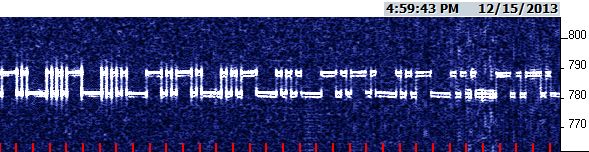
There was roughly the same amount of static last night that usually is the threshold for drowning out most Part 15 LowFERs, but the LF bands were doing amazingly well according to some reports online, so I gave the watering hole a try. Got SIW as I expected, and an unusually clear signal from SJ, plus CV. I assume Charlie was testing with low power, which was a blessing for seeing the other guys, since we're so close. The image includes captures at both QRSS30 and 20. Afterward, I went looking for LowFERs away from the watering hole. Those captures will be in another post.
John
Other Sunday LowFERs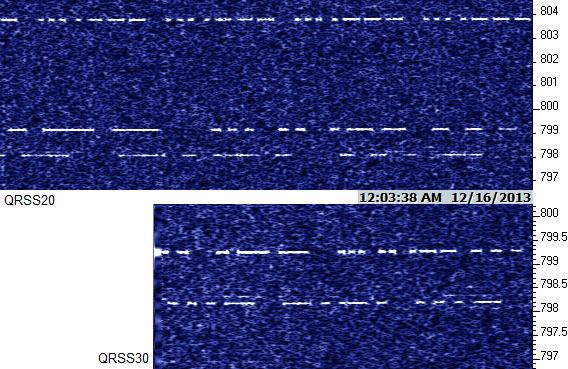
Posted by John Davis on December 16, 2013 at 17:10:26.
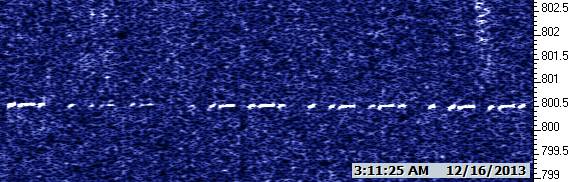
After the watering hole venture, I went looking for other LowFERs and found three of the five I targeted last night: MLS, EAR, and WI. Captures below. (I also watched for JH and J, but no luck on those two yet this year.)
John

HiFER EDJ QRT for now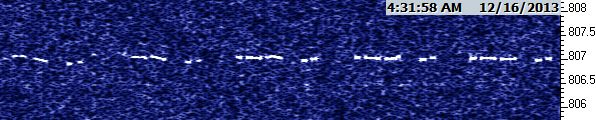
Posted by BobC on December 18, 2013 at 17:25:51.
EDJ is QRT for the winter months. Been using the antenna for other listening. I will notify when I bring it back up. Would like to build a dedicated HiFER antenna to avoid this situation over the winter.
Bob....WA1EDJ Monroe, GA
Re: HiFER EDJ QRT for now
Posted by John Davis on December 18, 2013 at 18:08:41.
In reply to HiFER EDJ QRT for now posted by BobC on December 18, 2013
Sorry to see EDJ go away even temporarily, Bob, but I understand the desire to do listening as well. It's been a good and faithful propagation indicator here in Kansas, so I hope you are successful with your dedicated HiFER antenna plans.
John
Mammoth Cave,resonate length ,
Posted by Robert W9ESX on December 19, 2013 at 09:23:31.
Gentlemen, I have in the past heard of some people that could hear/feel in back of their head, radio buzz/noises from the Navy/Marine station in upper Michigan for submarine com., while inside Mammoth Cave, Kentucky,..any thots or comments ? Guess no one knows actual length of cave...t-u de W9ESX
Experimenter to Honor Early Wireless Pioneers with Longwave Transmissi
Posted by W1FVB on December 19, 2013 at 13:35:28.
Brian Justin, WA1ZMS/4, will again transmit voice and music on 486 kHz on Christmas Eve, under his Experimental Service callsign of WG2XFQ. Details from the ARRL Website:http://www.arrl.org/news/experimenter-to-honor-early-wireless-pioneers-with-longwave-transmissions
Re: Mammoth Cave,resonate length ,
Posted by John Davis on December 19, 2013 at 22:02:17.
In reply to Mammoth Cave,resonate length , posted by Robert W9ESX on December 19, 2013
I wonder what sort of noises they were reporting, exactly. Any descriptions online anywhere?
It seems highly unlikely they would have been hearing the Project ELF transmissions, in any case, since those were all very slow speed data using carriers under 80 Hz in frequency. More than that, though, the ERP was usually 1 watt or less; both facilities in unison could produce around 8 watts maximum, I believe. That's not much field strength at all outside the immediate induction zone, which extended a few dozen miles around each antenna site. (Inside was another matter, with all those megawatts cooking earthworms and who knows what else.)
It didn't take much ERP to achieve global coverage with virtually no loss other than the inverse-distance factor affecting signal strength at that frequency, and no QRM either.
John
Beacon JAM 187.015 khz Holiday Schedule
Posted by Lee on December 21, 2013 at 06:51:46.
I am leaving beacon JAM 187.015 khz on 24/7 from today Friday 12/20/13 till Monday 1/6/14. The letter J at QRSS60 and a 5 WPM message over and over. Re: Mammoth Cave,resonate length ,
Happy Holidays to all and good DX to everyone. Thanxs.
Lee
Posted by Robert W9ESX on December 22, 2013 at 02:27:42.
In reply to Re: Mammoth Cave,resonate length , posted by John Davis on December 19, 2013
To John Davis, no other info, a friend of mine told me had been on a tour, and the "guide" made mention of this,..My thots, are not of hearing rf , but maybe the length of cave was vibrating like a resonant antenna element would, I wonder if submarines actually detect rf, or in fact do they detect mechanical vibes, again, thinking of antenna responding to rf..Dont know, John, thanks for your thots,....73 W9ESX
Re: Mammoth Cave,resonate length ,
Posted by John Davis on December 22, 2013 at 03:55:27.
In reply to Re: Mammoth Cave,resonate length , posted by Robert W9ESX on December 22, 2013
>>> My thots, are not of hearing rf, but maybe the length of cave was vibrating like a resonant antenna element would
Acoustical resonance is a very real phenomenon in caves, but generally manifests itself in the infrasonic range...long, slow pressure oscillations that require special instruments to detect because of the low frequency. The energy source would most often be winds passing surface openings. Smaller individual chambers can have their own resonances, possibly even at audible frequencies, but there's less likely to be anything to excite and sustain such an oscillation. It would need to be some unique circumstance, which I expect does present itself sometimes in complex cave systems. The National Speleological Society might have some information about that sort of thing.
>>>I wonder if submarines actually detect rf, or in fact do they detect mechanical vibes
Actually, both. But not from the same source. Sonar is acoustical/mechanical in nature of course, and there are other sonic instruments on board listening for whales, deep ocean currents, mechanical sounds from other subs, and I don't know what all. I recall the Navy was said to be testing infrasonic acoustic energy in the ocean as a communication possibility, since such sounds can be ducted great distances. There is concern that this could possibly interfere with whale navigation.
Any signal originating as RF is received as RF, on the other hand, since there's nothing to turn it into mechanical vibrations without an antenna and receiver. For the Project ELF transmissions, I believe the receiving antenna was a large ferrite rod wound with several hundred turns of wire. For the more "normal" VLF transmissions, a trailing wire does the job.
John
Re: Mammoth Cave,resonate length ,
Posted by Robert W9ESX on December 22, 2013 at 15:06:03.
In reply to Re: Mammoth Cave,resonate length , posted by John Davis on December 22, 2013
again, John, many thanks ur comments and time,..what u sent me this time, pretty much answers me,..never thot about pressure oscillations, I'm sitting here sipping coffee, and staring at the wall, and my mind is racing about caves, tubes, chambers,.etc,..I play around with 1296 mhz stuff, and have wondered many times about length of brass tubes, I under stand the length bit, but I use a screw entering the tubes to tune them,..wonder if u are into Ham Radio ? sounds like it to me,..see ya, Robert W9ESX
Re: Mammoth Cave,resonate length ,
Posted by Robert W9ESX on December 22, 2013 at 15:32:14.
In reply to Re: Mammoth Cave,resonate length , posted by Robert W9ESX on December 22, 2013
.John, I think maybe my head is a resonant chamber !..Very un related, but of interest, I think,. I made a small oscillator using a tv xtal 3.579, and it connected to my random wire, can send cw across town to a "SUPER-TECH' friend of mine, also can use it to send rtty across town, couple miles,.amazing, this qrp world,.found very good alternate spot for experiments, old resurected 10-4 good buddy cb rig, 11 meters not used muchand its fun to mod these rigs, couple of us use them converted to 10 meters on a-m,..also have sent rtty on cb ! ok, wont pester you so much, later,...
New to Lowfering
Posted by Glenn on December 23, 2013 at 19:50:34.
I am new to lowfering. I have been studying the subject for years but have just found the time to commit to the monitoring and building of equipment. I have a loop antenna built for 175 to 190 Khz. I also have a short wave receiver that will tune down to 10 Khz. The sensitivity and noise level is not that bad but I just don't hear a thing. I try rotating the loop and tuning the loop for maximum reception but have not heard one single beacon yet. The loop will pick up my function generator well even at a fairly good distance. I was wondering if any of you gentlemen could give some advice. I am in Texas.
VLF Conditions Noisy For Dec 24 SAQ Event
Posted by Todd WD4NGG on December 24, 2013 at 01:23:22.
I have been monitoring VLF listening conditions along the SC coast Monday evening Dec 23. There is a huge cold front just now pushing past the entire US Eastern coastline bringing with it heavy rain and storms in many local areas.
Static is very high along the SE Coastal region Monday evening on VLF through LF frequencies and likely along the entire U.S. Eastern seaboard. This will probably make conditions very difficult for attempting to hear SAQ early Tuesday morning at 08:00 UTC or 03:00 EST. This update posted at 8:20 PM EST Dec 23 or 01:15AM UTC Dec 24.
73 - Todd WD4NGG
Re: New to Lowfering
Posted by Tim Brannon, WA5MD on December 24, 2013 at 05:43:39.
In reply to New to Lowfering posted by Glenn on December 23, 2013
Hello Glenn, Re: New to Lowfering
The first thing I recommend is to identify your nearest local NDB beacons and see if you can hear them. Go to www.airnav.com to search for your locals.
You may also try just a random wire antenna, too, to rule out trouble with the loop.
Tim
Posted by John Davis on December 24, 2013 at 06:59:05.
In reply to Re: New to Lowfering posted by Tim Brannon, WA5MD on December 24, 2013
Both parts of Tim's advice are good. It might also be helpful to describe your loop in a little more detail and mention the make and model of the receiver. That might prompt some ideas from others who are familiar with that radio's characteristics.
Best of luck, and glad to have you on board!
John
Arctic Opening
Posted by Bill KB9IV on December 24, 2013 at 16:08:32.
Merry Xmas all. On Dec 21 @ 0400 here in the UP of Mich I experienced a major arctic opening. Local & Semi-local NDB's were weak and hollow sounding. To my surprise NDB "RB" Resolute Bay 350 KHz @ 75.4 N was 5x7 and "YGZ" Grise Fiord @ 76.5 N was 5x6....do a google map for these locations and apprieciate the land distance!
Got up at 1000 UTC and the propagation was nil NW (NWT) and NE Canada.
The WWV propagation had nothing unusual?? It was a nice Xmas present for my efforts using the Pixel Pro-1B and my FT 1000D.
73
Bill KB9IV
Re: New to Lowfering
Posted by Sal, K1RGO on December 24, 2013 at 17:54:23.
In reply to New to Lowfering posted by Glenn on December 23, 2013
Hi Glenn QRSS60 on 137.777 kHz
What kind of loop are you using? I assume it's a tunable resonant type. You will need a large loop for lowfers or a sensitive active e probe like the L-400B or a tunable preamp or a broadband preamp like the L-202 in conjuction with a long wire antenna preferably >100'. A low noise environment is also required. I am in a very noisy area and have had some success with a noise nulling scheme. Another suggestion is if your receiver is deficient at LF you may need an LF converter, like a 4-4.5MHz i-f to 0-500kHz.
Hope this helps.......Later....Sal,K1RGO
Posted by Joe VO1NA on December 24, 2013 at 20:20:51.
Greetings to all. The TX is on the air tonight 3.3 A to a 100m wire at 10m. Reports most welcomed.
73, MX & NHY thanks for your response
Joe VO1NA
Posted by Glenn on December 24, 2013 at 20:53:29.
Gentlemen,
Thank you for your response. I have two receivers. A Rycom 6041 selective level meter and a Realistic DX-302. The DX 302 has a sensitivity of about 30 uV in the lowfer segment. It is sometimes plagued by image frequencies from the broadcast band but I don't see them in the 160-190 KHz band. I have used both with my homemade loop. The loop consist of 31 turns of No. 18 stranded wire. The frame is a 29" diamond. The loop has a variable tuning capacitor in parallel with the loop. It has a very sharp bandwidth. I use a 3 turn pickup coil wound on the same frame that connects to the receiver. I am thinking that I should build or purchase a low noise preamp.
Merry Christmas to all Re: VLF Conditions Noisy For Dec 24 SAQ Event
Posted by W1FVB Frits on December 24, 2013 at 22:29:22.
In reply to VLF Conditions Noisy For Dec 24 SAQ Event posted by Todd WD4NGG on December 24, 2013
Hello Todd,
Nothing heard in Northern NH. I've recorded 1.5 hour of raw spectrum and just analyzed it today. No sign of SAQ
W1FVB Frits 137.779 Merry Christmas
VBradio.wordpress.com
Posted by John Andrews on December 25, 2013 at 05:07:08.
...for about the 10th year! 30 sec slow or 60 sec reg screens recommended.
John, W1TAG/WD2XES Re: 137.779 Merry Christmas
Posted by John Bruce McCreath on December 25, 2013 at 05:08:49.
In reply to 137.779 Merry Christmas posted by (Fwd) John Andrews on December 25, 2013
Ho Ho Ho so far, John, with an MP underscore. Merry Christmas!
73, J.B., VE3EAR
LowFER Beacon "EAR"
188.830 kHz. QRSS30
EN93dr
[6:48 PM CST]
Re: 137.779 Merry Christmas
Posted by Lloyd Chastant on December 25, 2013 at 05:10:41.
In reply to Re: 137.779 Merry Christmas posted by (Fwd) John Bruce McCreath on December 25, 2013
Happy Holidays
lloyd W3NF
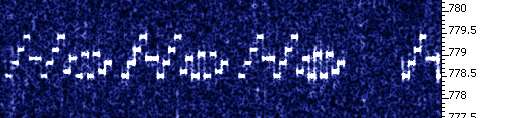
[7:43 PM CST] Re: New to Lowfering
Posted by Douglas Williams on December 25, 2013 at 14:25:17.
In reply to Re: New to Lowfering posted by John Davis on December 24, 2013
Yes, we need to know more about your loop antenna and your receiver to help you.
For example, you probably aren't going to hear much except the very strongest NDBs with a small (less than 3' diameter) unamplified loop, especially if you are trying to use it indoors.
Also, many receivers will tune down into VLF, but rapidly start losing sensitivity below 500(ish)kHz.
Your reply
Posted by Glenn on December 26, 2013 at 21:31:19.
In reply to Re: New to Lowfering posted by Douglas Williams on December 25, 2013
Thanks,
I have been (for a good while) reading numerous articles on building loops. The opinions and ideas vary so much and there are many good ideas as well as bad. Last night I plotted out the response of my loop over a wide range of frequencies and I realize now it would perform better in the a region just above the 160-190 band. It can still be resonated in the lowfer band but it's sensitivity is not so great there. I calculated this loop using RJELOOP3. I did some new simulations and realized I could do better. Also, I do believe and amplifier would help. I thought I did a good job of winding it but after further study I realize I can do better on self capacitance and experiment with the coupling winding loading of the primary. It was my first try at a lowfer loop. Using the internet as a source of information on building one can be problematic. I have seen where experimenters built loops from 25 pair phone cable coupled directly to a receiver and then swore that it was the best thing since sliced bread.
Good idea
Posted by Glenn on December 26, 2013 at 21:34:06.
In reply to Re: New to Lowfering posted by Tim Brannon, WA5MD on December 24, 2013
I tried some of the local beacons and barely pick up one. I am going back to the drawing board on my loop. I was close but no cigar. I will come up with an amplifier.
L-202 (B I think)
Posted by Glenn on December 26, 2013 at 21:39:46.
In reply to Re: New to Lowfering posted by Sal, K1RGO on December 24, 2013
The L-202 might just work. It has a 2k input impedance which should work with my secondary pickup winding.
Thanks
I posted this in the main posting area but with mistake
Posted by Glenn on December 26, 2013 at 21:46:35.
In reply to Re: New to Lowfering posted by John Davis on December 24, 2013
Corrected- I have two receivers. A Rycom 6041 selective level meter and a Realistic DX-302. The DX 302 has a sensitivity of about 30 uV in the lowfer segment. It is sometimes plagued by image frequencies from the broadcast band but I don't see them in the 160-190 KHz band. I have used both with my homemade loop. The loop consist of 35 turns of No. 18 stranded wire. The frame is a 29" diamond. The loop has a variable tuning capacitor in parallel with the loop. It has a very sharp bandwidth. I use a 3 turn pickup coil wound on the same frame that connects to the receiver.
Re: Sunday HiFERs - The Mystery Grows !
Posted by Lee on December 27, 2013 at 04:33:34.
In reply to Sunday HiFERs - The Mystery Grows ! posted by John Davis on December 16, 2013
Very Interesting. Aircraft Reflections could cause a wierd kind of multipath reception. Google is playing around with a system of ballons in the jet stream to provide WIFI to folks who live off the grid. Google can change ballon direction by raising the ballons or lowering the ballons. Ballon Reflections? Re: L-202 (B I think)
Lee
Posted by Sal,K1RGO on December 28, 2013 at 00:22:57.
In reply to L-202 (B I think) posted by Glenn on December 26, 2013
Yes it's the L-202B. It's designed for long wire antennas to add gain and reject BC signals to eliminate BC intermod. Re: Sunday HiFERs - The Mystery Grows !
Long wires or an e probe up high work well from my experience as well.
Later......Sal
Posted by Lee on December 28, 2013 at 09:11:41.
In reply to Re: Sunday HiFERs - The Mystery Grows ! posted by Lee on December 27, 2013
Ballon Reflections? Ok so I mispelled Balloons 9 times. Yikes! Re: Sunday HiFERs - The Mystery Grows !
Lee
Posted by John Davis on December 28, 2013 at 15:02:59.
In reply to Re: Sunday HiFERs - The Mystery Grows ! posted by Lee on December 28, 2013
That's what inhaling too much helium can cause, Lee. :-)
Re: I posted this in the main posting area but with mistake
Posted by Douglas Williams on December 28, 2013 at 16:33:24.
In reply to I posted this in the main posting area but with mistake posted by Glenn on December 26, 2013
Hi Glenn. 30 uV is deaf as a doorknob. You would be well served to use an LF converter with that DX-302. The converter is essentially another IF stage that will take the 0-500 kHz band and convert it up to (for example) 3.0-3.5 MHz where your receiver will have much better sensitivity.
Your loop sounds good, but is kinda small for weak signal LF work and would definitely benefit from an amplifier. There are several designs on the internet, and perhaps in back issues of the Lowdown, or perhaps someone could e-mail you a good one. The sharp selectivity is a plus in that it will help prevent intermod in your RX, but OTOH, it's a pain when you want to change your receive frequency because you have to manually adjust the tuning capacitor. This becomes a chore when the loop is located outside away from your house, which is by far the best place for it.
Re:Loop Preamp
Posted by Douglas Williams on December 28, 2013 at 16:56:50.
In reply to Re: I posted this in the main posting area but with mistake posted by Douglas Williams on December 28, 2013
Here is a proven loop preamp that found as well as a design for a broadband shielded loop.
http://members.shaw.ca/ve7sl/burhans.html
Personally, I prefer active whip antennas for VLF/LF work, because they work well and you don't have to rotate them. The key is to find a quiet spot away from your house and use common mode chokes to keep the noise from your house from being carried along the coax shield out to the antenna.
Re:Loop Preamp
Posted by Webmaster on December 28, 2013 at 21:16:22.
In reply to Re:Loop Preamp posted by Douglas Williams on December 28, 2013
Some variations on the VE7SL design, including an updated schematic of the associated Burhans amplifier, appeared in our LWCA publication The LOWDOWN recently. The pictures are in our online library at:
K3SIW LF Receive Loops
The preamp is an easy project to build, and the parts are available through Mouser Electronics.
Another couple of good loop amplifiers, if you don't mind winding toroidal ferrite transformers, include:
Todd Roberts' Version of MØAYF Loop (pictures only for now, but they're fairly self-explanatory)
LZ1AQ Loop (jumps to a different Web site)
(Just please try not to fall into the habit of calling it a "magnetic loop" as that author and so many others do. Loops DO NOT respond "only" or "primarily" or even "mostly" to the magnetic component of an electromagnetic wave...no matter how many times that misinformation is repeated on the Web. That's not the secret of their noise rejection capability.)
Anyway--all of the above are for broadband, untuned loops. If you're going to tune one or for some other reason need a high-impedance loop preamp, here's one from the more distant past:
KØLR Universal Preamp
Also, an informative related article by the same author:
Experiments on Remote Receiving Loops
And here, from the intermediate past, is another loop project that works well. It's a tuned loop, but the preamp is not hi-Z because of the author's coupling and impedance matching arrangement, so it's adaptable to various purposes:
Compact Receiving Loop
Now, having said all this, I also happen to agree with Doug's assessment that an active whip is a lot more convenient if you have a spot near your home where it will be relatively noise free. Loops are great for rejecting noise from troublesome directions, but they do have to be rotated to get some stations you might want to hear; and tuned loops, of course, have to be tuned.
John Davis
Re:Loop Preamp
Posted by Glenn on December 30, 2013 at 05:16:01.
In reply to Re:Loop Preamp posted by Webmaster on December 28, 2013
Thanks, Re: New to Lowfering
A wealth of information!
Posted by Douglas Williams on December 30, 2013 at 14:26:58.
In reply to Re:Loop Preamp posted by Glenn on December 30, 2013
Welcome aboard, Glenn. This message board is a good resource. I would also encourage you to join the Lowfer e-mail reflector at http://mailman.qth.net/ . This is where many Part 15 and Part 5 stations post their transmitting plans, which, especially in the case of the Part 5 guys, often change from day to day or even hour to hour. Not a lot of NDB talk there, but some. We also post reception reports and small images or links to photobucket or dropbox image captures. Lots of activity this time of year.
Re:Loop Preamp coupling Xformers
Posted by Lee on December 31, 2013 at 00:47:09.
In reply to Re:Loop Preamp posted by Douglas Williams on December 28, 2013
I have asked this question about loop preamps before and never got an answer that convices me. On a loop preamp that will pass a broadband signal from 10K to 500K, how can a cheap a--- audio xformer possibly work for coupling. Re: Loop Preamp coupling Xformers
Most of them are rated at best 100HZ to 10K.
Lee
Posted by John Davis on December 31, 2013 at 05:30:36.
In reply to Loop Preamp coupling Xformers posted by Lee on December 31, 2013
Well, I'm not sure if I can convince anyone of anything these days, Lee. <g>
It wouldn't be the case with all cheap audio transformers, but I can assure you it is true of some. Depends a lot on the core material, the number of turns, and the manner in which the windings are wound. Some struggle to barely meet their published specs, of course. Others which use better materials and construction can easily handle up to 100 kHz when operated at their specified input and output impedances. It's interesting to sweep the response of different makes and models, and sometimes the results are surprising. Ralph Burhans loved to test parameters of a lot of components beyond their typical uses.
If operated at something other than their rated impedances (as Ralph did with his design), the range of usable response can be shifted either up or down, too. In this case, the shift was up, which was made more feasible because the 42TL04 starts with fewer turns in its windings than other members of its family have, plus a lot lower resistance per turn in the primary winding than the others exhibit. This made it an attractive candidate for higher frequency operation.
John
Re: Loop Preamp coupling Xformers
Posted by Lee on December 31, 2013 at 06:41:56.
In reply to Re: Loop Preamp coupling Xformers posted by John Davis on December 31, 2013
Thank you John. That explanation is very plausable and much more convincing than the last response I got to that question. The last response I got was "because the xformer was not being used at it's rated working power it's response was much much wider than published spec's". Thanks. Re: Loop Preamp coupling Xformers
Lee
Posted by Lee on December 31, 2013 at 09:43:09.
In reply to Re: Loop Preamp coupling Xformers posted by Lee on December 31, 2013
I was in the Sound Post Production Biz before I escaped to a major TeleComm company. Been hiding there for 14 years. Here is the web site of a Golden Ear transformer company. Well know in the biz.
http://www.jensen-transformers.com/
Also for a while the same Xformers were available from Richenbacher [spelling] Xformers. Both companys sell/sold Xformers with 3DB points in the hundreds of kilohertz. I own a few Jenson Xformers that I plan to use on a large shielded loop. When I get Roundtoit.
Lee
Re: Loop Preamp coupling Xformers
Posted by Douglas Williams on December 31, 2013 at 19:44:22.
In reply to Re: Loop Preamp coupling Xformers posted by Lee on December 31, 2013
Thanks for posting that Lee. I've seen some of those transformers for (relatively) inexpensive prices on the net. Thought about purchasing one just because I like quality components. I use audio isolation transformers between my receivers and the Line/Mic In of my computers.
I had some idea to try to put up a solar powered "natural radio" receiver as far from my house as possible and run the feed into my house through a couple of isolation transformers, but, alas I could not find a spot free enough from power line hum and my neighbor's electric fence "popping" to make it worthwhile.
Re: Loop Preamp coupling Xformers
Posted by John Davis on January 01, 2014 at 01:46:54. (7:46 PM Dec 31 CST)
In reply to Re: Loop Preamp coupling Xformers posted by Douglas Williams on December 31, 2013
>>> Thanks for posting that Lee.
Agreed. I wasn't even sure if Jensen was still around. Glad to see they are with us, even if I still can't afford a console full of their transformers. :)
John
potrzebie