 File Attachment 1: 29nov-MLS1.gif
File Attachment 2: 29nov-MLS2.gif
File Attachment 1: 29nov-MLS1.gif
File Attachment 2: 29nov-MLS2.gif
Hifers today
While out in the field FRC was the lone beacon heard around 2030 utc...
While home a few minutes ago, I decided to shut down AA0RQ and within 3 or 4 minutes of listening up on 13558.4 on the Icom 756 little PVC popped up for three fade ups beginning at 2254 utc and then nothing heard at all. So I moved up the band and there was FRC Q5 copy.
I admit I did not spend much time listening...that's life in the fast lane . LOL
Great lw BCB tonight 11/30 Wednesday EST
Posted by Brock Whaley on December 01, 2016 at 00:36:35.
Huge signal from Morocco 171 tonight. Even great on two consumer (not DX specific) radios bought in Europe with lw. Algeria is good on 252, and my first hearing of Franc-Inter 162 this season good to excellent. No sign of Europe 1 or Luxy so far. 7:30 PM Eastern/0030 UTC 11/30 EST 12/1 UTC. I am in Wilmington, NC
MLS Tuesday Morning
Posted by John Davis on December 01, 2016 at 06:26:19.
Monday night/Tuesday morning's manageable noise levels and great signals prompted me to watch the remainder of the night for MLS. It was not the greatest signal in terms of strength (I only got recognizable captures in the 60 second Slow ARGO windows, which makes the ID look cramped), and it was subject to significant QSB. For some reason, this frequently took out part of the S, leaving it looking like "I" a lot of the time. On the other hand, the carrier appeared somewhat steadier in frequency than last year.
One of the two attached files shows MLS in the wee hours. The other includes local sunrise (7:14 AM that day), by which time a couple of very strong drifting carriers were wandering through the passband and several steadier PLCs were visible...right up until around 7:00 AM, when they started disappearing abruptly. By actual sunrise, only one of the strong ones was left, greatly attenuated.
Wednesday morning was too noisy here to copy any LowFERs, or I would have tried again. My next target now, though, is going to be JAM for a night or two, then I will return to try for better copy of MLS.
IMO, it would be most helpful if all 1750 meter beacons availed themselves of QRSS60-- or at the very least, 30 second Slow timing. Twenty seconds or even 30 seconds "Normal" sacrifices way too much of Argo's processing power in the presence of noise.
John
---------------------------------------------------------------
File Attachment 1: 29nov-MLS1.gif
File Attachment 2: 29nov-MLS2.gif
Re: Great lw BCB tonight 11/30 Wednesday EST
I was randomly scanning for beacons tonight and also heard 171 tonight. This was my first ever trans ocean LW broadcast monitored. It's 6:44 GMT Dec 1, 2016 and I'm hearing France still on 162 kHz here, Columbus, Ohio with an active antenna and my trusty Icom IC-R71A.
Sean McHenry The Lone W (and The Ghost of SJ)
KB8JNE
Posted by John Davis on December 01, 2016 at 09:21:19.
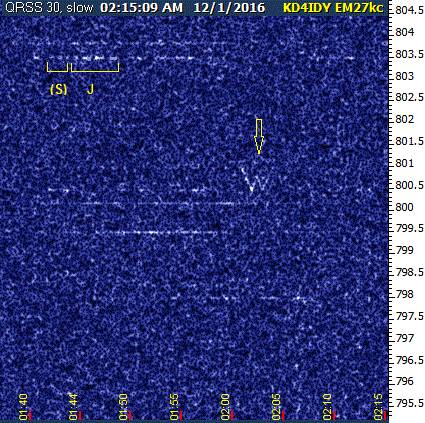
First time I've seen ANY of the graphical portion of WM on this year's vertical antenna--a delight to behold! Also appears to be part of the subsequent M. Preceding that, and a little higher in frequency, is a somewhat indistinct (but pretty convincing to my eye, following a little adjustment of gamma and contrast) SJ.
John
---------------------------------------------------------------
File Attachment 1: 01dec001.jpg
Re: Hifers today
Thanks Bill,
Nice to know PVC is still struggling out!
Ed
Re: The Lone W -- But No JAM
Posted by John Davis on December 01, 2016 at 18:31:31.
In reply to The Lone W (and The Ghost of SJ) posted by John Davis on December 01, 2016
Well, the main target of last night (the QRSS "J" of JAM) never did show up. There was a cluster of rather strong PLCs a few Hz down, but QRN was greatly reduced last night, so I was hopeful.
Lee, if you're reading, how confident are you of the listed frequency?
John
Re: MLS Tuesday Morning
Posted by Mark on December 01, 2016 at 19:59:51.
In reply to MLS Tuesday Morning posted by John Davis on December 01, 2016
Thanks For the signal report. The weather here in Ohio has been rather warm for this time of year, but that is going to change soon. I can switch to QRSS60 if you like. Perhaps for the weekend. let me know if you want me to switch. TNX. Mark
Re: MLS Tuesday Morning
Posted by John Davis on December 01, 2016 at 21:31:09.
In reply to Re: MLS Tuesday Morning posted by Mark on December 01, 2016
Thanks, Mark, that would really be helpful. I don't know yet whether I'll be sticking with my original target for tonight or not. As for the weekend, Friday night through Saturday night has too high a chance of rain for me to be in the field. But, thus far, Sunday night looks as if it might be a good listening opportunity.
John
Re: MLS Tuesday Morning
Posted by Mark on December 01, 2016 at 22:20:20.
In reply to Re: MLS Tuesday Morning posted by John Davis on December 01, 2016
OK, On Sunday afternoon I will switch MLS to QRSS60. I will Leave it in that mode till Monday afternoon. I will post again when I switch back to QRSS30. TNX Mark
Re: The Lone W (and The Ghost of SJ)
Posted by Mike N8OOU on December 02, 2016 at 03:35:24.
In reply to The Lone W (and The Ghost of SJ) posted by John Davis on December 01, 2016
John,
Yes, that is this season's style for the W. It is novel that the propagation opened for the short time it took to send that letter.
Mike
WM !
Posted by John Davis on December 02, 2016 at 08:40:12.
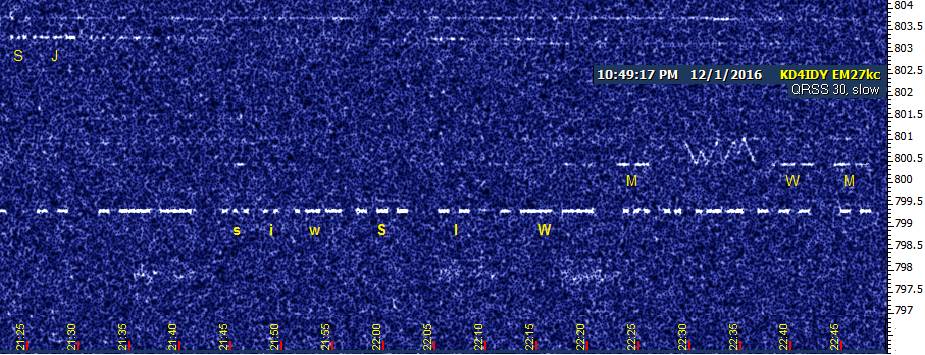
Finally got some full graphical IDs of WM tonight, at last! There are other captures from the evening that have two graphical WMs in them, others that have more of SJ, and some that are only SIW (a lot of propagation variations after dark today!), but this one shows all three signals in readily identifiable form.
Also in this display is a line at 185.297 that is the right length to be a dash from TAG, and there were a few others at different times, but never enough to be able to say with any confidence.
Just a suggestion, Mike, if it's feasible: could you extend the length of the dot in the QRSS "W" just a smidgen? The duration seems a little short somehow, and it doesn't always show up against the noise. I saw quite a few seeming MMs during the evening...which made me hungry for chocolate, for some reason. :)
---------------------------------------------------------------
File Attachment 1: 01dec026.jpg
Re: WM !
John,
It's good to see propagation in improving. I will recheck my antenna tuning later today, something I have not done now that the temps are in the 30/40 range. For the ID speed, I have wondered about the short looking dit myself, so this morning I did a straight audio capture with a program called Audacity. I can accurately measure the element timings with it and I confirmed it to be as I designed the ID to be. The inter-element spacing is dead on a 30 second dit speed. The element timing is based on a 28 second dit speed. This was by design to shorten the overall time needed to complete the ID cycle.
I can change these parameters quite easily. I think Argo is somewhat delaying the painting of the dit when receiving weak signals and noise. My strong local copy shows proper looking code. (even if it is a little short of QRSS 30)
I will work this evening and tomorrow to switch over to a full QRSS 60 ID. We can give that some time to evaluate the outcome. I will plan for the switch to happen Saturday evening.
Thanks and Good Day. TAG ! (and more)
Mike.
Posted by John Davis on December 02, 2016 at 19:12:44.
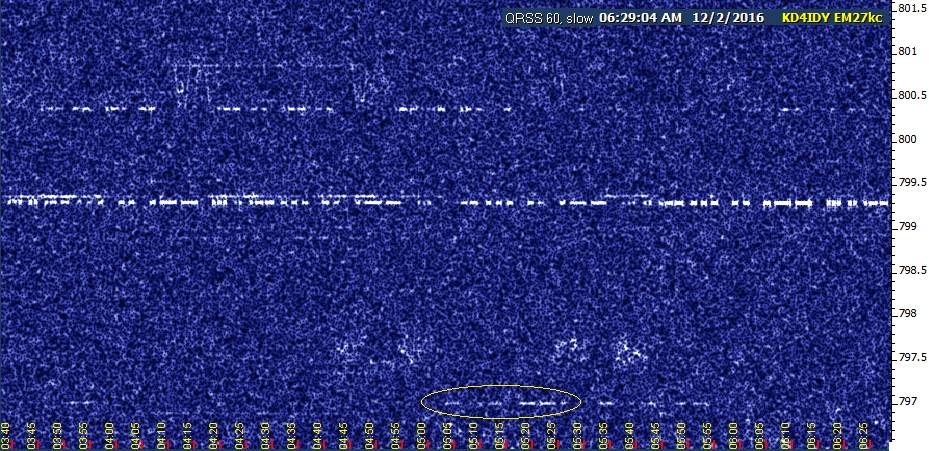
Between 5:00 and 5:30 this morning, I finally snagged one faintly recognizable specimen of last night's other primary target, TAG, for the first time this season.
The other attached file below (c0040.jpg) is a QRSS30 screen taken during the first half of this same capture, showing more nice examples of SJ and WM in the pre-dawn this morning.
John
---------------------------------------------------------------
File Attachment 1: b0060.jpg
File Attachment 2: c0040.jpg
Re: WM !
Thanks, Mike, I'll look for the QRSS60 on Sunday if the approaching rain system has moved out on schedule by then.
The inter-element spacing is dead on a 30 second dit speed. The element timing is based on a 28 second dit speed. ... I think Argo is somewhat delaying the painting of the dit when receiving weak signals and noise.
I think that description is a pretty accurate way of looking at it, and if you think about it, it's actually a consequence of those former points.
I'm not sure whether I can describe what I mean very well, but it helps if you think of FFT integration and detection in this context as a type of low-pass filter. A matched-filter response (either analog, or digitally such as implemented in Argo) makes the assumption that all elements to be detected are multiples in length of some unit squarewave, in which equal on/off intervals only require the fundamental frequency of the wave and the first few odd-order harmonics in order to reproduce the keying envelope with reasonable accuracy. That works well for the standard definitions of CW elements.
But if the unit waveform has something other than a 50% duty cycle, a lot more (and higher) frequencies have to be passed than suggested by the repetition rate in order to reproduce the envelope amplitude accurately. Having a different spacing than element timing thus results in a rectangular wave whose components extend above the cutoff of the aforementioned low-pass function, which results in attenuated detector response and a certain amount of delay and/or smearing. Those won't necessarily be apparent if the signal is well above noise, but the noisier the path, the more serious that excess attenuation becomes.
I hope that helps a little.
John
Peculiar Day on HF
Posted by John Davis on December 03, 2016 at 04:36:16.
After wrapping up the 24+ hour marathon on 1750 meters, there were only a relatively few minutes of daylight propagation left. USC was the strongest at first (plenty audible), with RY and NC taking turns at audibility as well. EH was present at times, but noisy and weak.
I tuned up the band but found no other HiFERs, so I returned to the watering hole. USC faded out shortly thereafter, between 4:08 and 4:10 PM, after which a truly bizarre version of EH became VERY bright...and noisy.
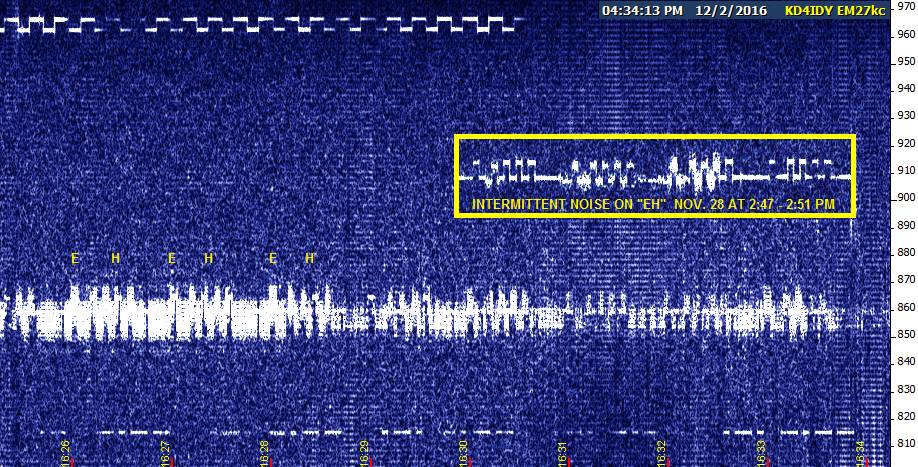
The noise modulating the beacon's keying has a strong component at multiples of about 1 Hz, and sounds mostly random to the ear. However, at its loudest point, I could even detect slow Morse keying (probably 5 or 7 wpm), although my ears couldn't sync up to it properly in all the gosh-awful racket! The slant character was pretty distinct a couple of times, but the numbers and letters would only be guesswork on my part.
John
---------------------------------------------------------------
File Attachment 1: 02dec006.jpg
Antenna height
Hi, Are there any types of Longwave antennas that perform better when mounted high up? I have a 50ft tower that i was using for HF, but now want to concentrate on the lower frequencies i.e. LW and MW and would like to use it to put up something to monitor LW. it seems the loops (air core and active) and e-field probes, such as the mini whip, don't really gain much advantage from additional height. are verticals being used with any success on the lower frequencies? Thanks john ki4ucw
Re: Antenna height
Posted by John Davis on December 03, 2016 at 21:01:09.
In reply to Antenna height posted by John on December 03, 2016
john ki4ucw wrote:
are verticals being used with any success on the lower frequencies?
Yes. All my listening over the past six years, from 13.56 MHz down to 11 kHz, has been done at my farm field with a base-insulated 40-foot vertical possessing a modest top hat, and a buffer amplifier for impedance transformation to 50 ohms.
It wasn't intended to be my primary receiving antenna because it's located only 150 feet from the nearest AC power line, but apart from infrequent insulator problems, or buzz from a neighbor's cattle water tank heater in the winter, it's a fairly quiet line. My receive site is entirely battery powered, apart from the times when I have to crank up the generator in the truck to recharge the batteries, and I take measures to ensure that there is little or no noise coupling to the antenna from ground loop currents via the coaxial cable shield.
Whether such an arrangement would work well in a residential environment, however, is debatable. While a tall vertical in the clear is able to intercept plenty of signal voltage, the more critical factor in most installations is the signal to noise ratio, which is where the smaller antenna types really shine. The main reason loops and active whips* are more frequently used is because they can be situated (and in the case of loops, oriented directionally) wherever they are subject to the least noise pickup on a given property. Alas, the main reason I listen in my field is that I cannot utilize such antennas at my home here in town; with distribution lines on all four sides of my yard, there are no quiet spots anywhere at LW or MW frequencies.
Having said that, I can picture at least one situation where your tower could aid longwave reception, even if it's in a residential area, and other readers may have more ideas as well. My humble thought: It's true that loop antennas don't need to be far above the earth to yield their maximum signal strength; but being near ground level may increase the chance that it'll be in the magnetic induction zone of an interference source, especially if your lot size doesn't allow for much separation between the antenna and your house or your neighbor's. In such a situation, there might be an advantage in mounting a loop and rotor on top of a tower to gain vertical separation from noise sources.
John
(*I don't use the term "e-field probe" myself; it's nearly always inaccurate. First, despite what one may read in 98% of all antenna Web sites, or even ARRL publications, loop antennas do not respond "only" or "primarily" or "mainly" to the magnetic component of an electromagnetic wave; nor do so-called e-field antennas respond "only" or "primarily" to the electric component. You can't strip one field from an EM wave and leave the other! Any antenna responds to both simultaneously; the only difference is in the proportion of E to H fields in the reactive zone produced by the antenna itself in response to the intercepted energy. What would be more accurate to say is that a loop responds to impinging EM waves and to local magnetic induction fields, such as those of interference sources; and that a short whip responds to EM waves and to local electric induction fields, such as those of interference sources. It's not that they only respond to one field of a radio wave and ignore the other...they merely reject more local induction from one type of field than the other. Second, the way most active whips are used, they're not "probes" at all, but actually off-center-fed vertical dipoles with one side earthed...either intentionally through a ground wire, or unintentionally by the antenna's coax outer conductor, which may intercept local noise sources enroute. To constitute a probe, an electrically short whip should really meet two criteria: 1. the input and output terminals of its transducer, be it a transformer or an amplifier, need to be isolated and not share a common ground at the frequencies of interest; and, 2. the whip needs to be working against a ground plane of greater radius than the length of the whip, so that its own local electric field will not be impacted by the end of the coax, mounting tripod, or human operator at a reasonable distance from the antenna. THEN you truly have a standard probe antenna if it's being used to receive propagating radio waves, or even an e-probe if it's being used to map an electrostatic field.)
Re: WM !
Posted by Mike N8OOU on December 04, 2016 at 01:22:09.
In reply to WM ! posted by John Davis on December 02, 2016
John, All
I have changed the WM Lowfer transmission format to a ORSS 60 second dit. The graphic has been timed to fit that format also.
Thanks for listening. MLS
--
73 de N8OOU - Mike Meek
Posted by Mark on December 04, 2016 at 16:38:43.
I switched MLS to QRSS60 for 24 hours. I will post again when I switch back Re: Antenna height
TNX. Mark
Posted by Ed, KI6R on December 04, 2016 at 17:09:41.
In reply to Re: Antenna height posted by John Davis on December 03, 2016
A good active whip may work well from an urban location but one needs to attempt to find a "quiet" location on their lot. Mount the active whip on a 10 or 15 foot pole. Using a portable VLF receiver, walk the antenna around the lot and search for a location that gives best (quietest) reception. This may or may not be on top of the house. Near the house is usually a poor location due to the noise from AC wiring and household switching power supplies. Loop antennas have an advantage in urban locations of being able to null or minimize local noise sources if they lie only in one or two directions. It would be very interesting to see if a loop antenna mounted on top of a 50' tower might be quieter due to being elevated above ground level noise. A rotatable loop on top of a tower would be worth trying. One could climb the tower with a portable VLF receiver that has a good ferrite rod to test the approach.
Re: MLS
Posted by John Davis on December 04, 2016 at 17:30:35.
In reply to MLS posted by Mark on December 04, 2016
Thanks, Mark. I'll look for it tonight if the storms down South don't make the band too noisy.
The Sunday Night QRSS60 Experiment
Posted by John Davis on December 05, 2016 at 07:20:23.
I wasn't sure what to expect tonight. given ongoing thunderstorms in and near the Gulf, and considering that everybody at the 1750 m watering hole, without exception, was in a deep fade that began before sunset and lasted until 6 PM CST/0000 GMT. European and North African LWBC were doing well right after sunset, however.
Once LowFERs did begin returning, it was a bit surprising to see SJ so early in the evening. WM and SIW showed up with great suddenness, too. There was no trace of SIW WSPR on either the Argo or WSPR X waterfalls mere minutes before 2400, but the 0000 time slot decoded just fine. (The evening's decodes appear at the bottom of this message. The fully detailed spots were also uploaded to wsprnet.org.)
WM's QRSS60 was indeed easier to discern, despite greater noise than Thursday night's session. I'll get pictures ready for posting on Monday, but for now here's a provocative observation: stretching out the time of the graphical portion actually made more of an improvement in my QRSS30 window than it did at the 60 speed!
At the halfway point of the night, QRN rose another S-unit over a span of 90 minutes, making further WSPR15 decodes impractical for the time being, and impairing WM as well. I retuned to MLS a few minutes ago, and will now watch and hope for the storms to diminish again during the night.
John
0000  -37  -0.6    0.185185    0   K3SIW         EN51      0
0030  -34  -0.9    0.185185    0   K3SIW         EN51      0
0045  -32  -0.6    0.185185    0   K3SIW         EN51      0
0100  -36  -0.9    0.185185    0   K3SIW         EN51      0
0115  -31  -0.6    0.185185    0   K3SIW         EN51      0
0130  -32  -0.6    0.185185    0   K3SIW         EN51      0
0145  -34  -0.9    0.185185    0   K3SIW         EN51      0
0200  -36  -0.2    0.185185    0   K3SIW         EN51      0
0215  -35  -0.9    0.185185    0   K3SIW         EN51      0
0300  -38  -0.9    0.185185    0   K3SIW         EN51      0
0330  -34  -1.3    0.185185    0   K3SIW         EN51      0
0345  -34  -0.6    0.185185    0   K3SIW         EN51      0
0400  -32  -0.6    0.185185    0   K3SIW         EN51      0
0415  -37  -1.3    0.185185    0   K3SIW         EN51      0
0430  -35  -0.9    0.185185    0   K3SIW         EN51      0
0445  -35  -0.2    0.185185    0   K3SIW         EN51      0
0500  -33  -0.9    0.185185    0   K3SIW         EN51      0
0515  -36  -0.9    0.185185    0   K3SIW         EN51      0
Re: The Sunday Night QRSS60 Experiment
Both noise and propagation apparently varied during the night, but I did get some decent captures of MLS. Pictures later today.
Re: Peculiar Day on HF (Monday AM)
Posted by John Davis on December 05, 2016 at 19:25:07.
In reply to Peculiar Day on HF posted by John Davis on December 03, 2016
Between the overnight 1750 m QRSS60 session and today's look fat SIW's WSPR15, I checked out 22 m briefly, between 9:30 and 9:45 AM.
EH was back to its usual clean self again, RY was visible most of the time, USC was fair to strong, and NC was quite loud up at 13,555.57. I had brief spells of audible copy of WV, interspersed with periods of no signal, visual or aural. Nobody else showed up during that time.
John
Re: The Sunday Night QRSS60 Experiment
Posted by Mark on December 05, 2016 at 21:09:53.
In reply to Re: The Sunday Night QRSS60 Experiment posted by John Davis on December 05, 2016
I will remain on QRSS60 for another 24 hours. Thanks for your efforts to receive my beacon Re: European stations closing in 2017
Mark
Posted by Mike Terry on December 05, 2016 at 21:41:54.
In reply to European stations closing in 2017 posted by Mike Terry on November 28, 2016
France Inter is now advertising a helpline for listeners to call for advice on what to do after 162 longwave closes. I wonder how many of the French people living in the UK (and Germany, Switzerland, etc) are aware that this is imminent. https://www.franceinter.fr/societe/la-fin-des-grandes-ondes
Quiet weekend
Posted by Ed Holland on December 05, 2016 at 22:06:39.
Hi Folks,
Sometimes I think it is important to report non-reception, and that is what was observed during listening sessions on 22m this weekend in CA. Both days, circa 2300Z, rather flat conditions. My check against Radio Australia showed good signals in the 16m band with bouncy fading from S3 to S7 but 19m was much weaker, barely audible.
A good time for 22m in the Bay Area often seems to be in the morning, around 8am (I've been unable to pursue this lately) and then early to late afternoon, seemingly closing down to a large degree after local dark, though closer stations in AZ and CO may remain on good days.
Re: Quiet weekend
Posted by Bill Hensel on December 05, 2016 at 22:57:03.
In reply to Quiet weekend posted by Ed Holland on December 05, 2016
1700 utc while out in the field I heard Gnk and FRC...FRC had top honors GNK was very weak.
Re: Peculiar Day on HF (Monday PM)
Posted by John Davis on December 06, 2016 at 05:23:04.
In reply to Re: Peculiar Day on HF (Monday AM) posted by John Davis on December 05, 2016
I may have spoken too soon about EH. By afternoon today, the peculiar modulation was back. In the attached captures, you can see the watering hole as it looked this AM (with a few seconds' burst of WV afterward, before it faded out again), and there's also a view this PM as everybody was fading out.
Also attached is a late afternoon capture of AZ, exhibiting not only its usual ocean-wave frequency variation, but a veritable tsunami! It started out around 13,554,118 Hz, but a few seconds before 4:43 PM CST it took a precipitous drop of more than 20 Hz. It disappeared from view a few seconds later, reappearing at 4:44 PM way up at 13,554,130 before settling back a bit half a minute later.
John
---------------------------------------------------------------
File Attachment 1: 05dec-AZ.jpg
File Attachment 2: 05dec-am.jpg
File Attachment 3: 05dec-pm.jpg
Re: The Sunday Night QRSS60 Experiment
Last night was definitely worth the effort.
Unfortunately, noise levels have remained high tonight with all the severe weather in the South. By the time things might quiet down in the pre-dawn, we're supposed to have rain here as well, so I have abandoned my post for the night and hope to be rested up and in a position to get the captures from the past 24 hours posted sometime tomorrow.
Interestingly, they've taken precipitation out of our forecast for Tuesday night, but I'm going to hold off planning anything until I get further confirmation of that forecast tomorrow.
John
6R is off the air, returning late 12/6.
Posted by Ed, KI6R on December 06, 2016 at 12:31:34.
6R is off the air. I'm modifying the DDS VFO to also provide 3.5 MHz L.O. for my AMRAD upconverter. It should be back on the air late tonight, 12/6.
MLS QRSS30
Posted by Mark on December 06, 2016 at 16:14:33.
I switched back to QRSS30. TNX. Mark
Re: The Lone W -- But No JAM
Posted by Lee on December 07, 2016 at 02:33:44.
In reply to Re: The Lone W -- But No JAM posted by John Davis on December 01, 2016
Plus or minus 1 to 1.5 hz
6R is back on-the-air
Posted by Ed, KI6R on December 07, 2016 at 04:26:08.
6R is back on-the-air. 186.7000 kHz, 24/7 unless I'm listening on VLF or post an off-the-air message here. Four slow CW 6R followed by 10 second dash. 73.
Re: The Lone W -- But No JAM
Posted by John Davis on December 07, 2016 at 04:39:55.
In reply to Re: The Lone W -- But No JAM posted by Lee on December 07, 2016
Thanks, Lee. Depending on the noise level after midnight, I may try again tonight; or if not, sometime over the next two nights. Will run two overlapping Argo screens with a couple of Hz offset just to be on the safe side.
John
Re: Peculiar Day on HF (Tues. AM)
Posted by John Davis on December 07, 2016 at 04:47:37.
In reply to Re: Peculiar Day on HF (Monday PM) posted by John Davis on December 06, 2016
Wasn't expecting to go to the field today, but our overnight rains departed earlier than predicted and I unexpectedly had someone available to cut up a fallen tree, so I went out after all. Did some HF monitoring in the half hour before 11 AM, when I switched to LF.
RY, noisy EH, USC, and NC were all present (the latter now up at 13,555.590 kHz, migrating north for the winter). No WV today, but MTI finally turned up again, and I managed fair copy of FRC as well. Nobody else made it through.
John
Re: The Sunday Night QRSS60 Experiment
Posted by John Davis on December 07, 2016 at 08:47:10.
In reply to Re: The Sunday Night QRSS60 Experiment posted by John Davis on December 06, 2016
At last, the long awaited captures (attached).
MLS at QRSS60 may not look any more impressive than my earlier capture of it in QRSS30 mode, but keep in mind that the QRN levels rose rather significantly around the transition from Sunday night to Monday morning. At that noise level, QRSS30 probably wouldn't have been recognizable at all. The capture shown here has the best ID of the night circled. The signal vanished entirely a half hour before local sunrise.
Earlier on Monday night, while noise levels were still low, WM and even SJ came in quite nicely at times. (I also had traces of TAG early on, but not enough for a complete ID.) However, you may notice something odd between the QRSS30 and 60 captures. The QRSS60 idents are distinctly clearer in the 60 second Argo window than the 30 second version, but the graphical WM is not much different. At times, in fact, the 30-sec capture looks just a little clearer to me. I'll talk further about the reason for this in the morning.
John
---------------------------------------------------------------
File Attachment 1: MonAM-MLS.jpg
File Attachment 2: 04dec-WM30SJ.jpg
File Attachment 3: 04decWM60.jpg
36 Hour Watering Hole Marathon
Just ended a 36-plus hour session tuned to 185.3 and its immediate surroundings, beginning an hour before the SIW WSPR-to-QRSS transition on Tuesday and concluding at 12:45 AM this (Thursday) morning. This was an unplanned repeat of what I attempted last Thursday and Friday with mixed results, mainly because of operator error in Argo setup.
This time I had comparably low noise levels, and (fortunately) even more consistent ones than last week, so it was easier to discern signal level fluctuations over the monitoring period...and it turns out there were quite a few: sunrise, sunset, several fades during the night, and even some actual fades in the daytime suggesting that the D-layer is not dense enough some days at this season to block all fade-producing skywave. Noise was so low at times that the discrete frequency steps in the WSPR15 signal were sometimes clearly evident.
Also, I've seen better examples of when QRM doesn't seem to affect WSPR15 decoding, and when it does (ie, a steady carrier of strength roughly equal to the WSPR signal seems to be ignored, whereas one of similar strength that drifts a few tenths of a Hz during the 15 minute time slot may disrupt decoding entirely).
I'll be trying over the next couple of days to find a way to present all the information in a coordinated fashion, although first I really ought to do my wrap-up of the WM observations of a couple nights ago.
Meantime, here are all the WSPR decodes from 11 AM Tuesday until I ended tonight:
(Tuesday 6 Dec UTC)
1700  -32  -0.6    0.185185    0   K3SIW         EN51      0
1715  -32   0.8    0.185185    0   K3SIW         EN51      0
1730  -33  -0.9    0.185185    0   K3SIW         EN51      0
1745  -34  -0.2    0.185185    0   K3SIW         EN51      0

(Wed. 7 Dec into 8 Dec UTC - note: transmission commenced with 1815 time slot)
1815  -35  -0.9    0.185185    0   K3SIW         EN51      0
1830  -35  -1.3    0.185185    0   K3SIW         EN51      0
1845  -34  -0.6    0.185185    0   K3SIW         EN51      0
1900  -34  -0.9    0.185185    0   K3SIW         EN51      0
1915  -35  -0.9    0.185185    0   K3SIW         EN51      0
1930  -35  -0.6    0.185185    0   K3SIW         EN51      0
1945  -36   0.1    0.185185    0   K3SIW         EN51      0
2000  -35   0.4    0.185185    0   K3SIW         EN51      0
2015  -36  -0.6    0.185185    0   K3SIW         EN51      0
2030  -34  -0.6    0.185185    0   K3SIW         EN51      0
2045  -33  -0.9    0.185185    0   K3SIW         EN51      0
2100  -34  -0.6    0.185185    0   K3SIW         EN51      0
2115  -34  -0.6    0.185185    0   K3SIW         EN51      0
2130  -36  -0.9    0.185185    0   K3SIW         EN51      0
2145  -37  -0.2    0.185185    0   K3SIW         EN51      0
2200  -38  -0.6    0.185185    0   K3SIW         EN51      0
2215  -36   0.4    0.185185    0   K3SIW         EN51      0
2230  -36  -0.6    0.185185    0   K3SIW         EN51      0
2245  -37  -0.2    0.185185    0   K3SIW         EN51      0
0015  -39  -0.6    0.185185    0   K3SIW         EN51      0
0030  -35  -0.6    0.185185    0   K3SIW         EN51      0
0045  -26  -1.3    0.185185    0   K3SIW         EN51      0
0100  -26  -0.9    0.185185    0   K3SIW         EN51      0
0115  -25  -0.9    0.185185    0   K3SIW         EN51      0
0130  -30  -1.3    0.185185    0   K3SIW         EN51      0
0145  -28  -1.3    0.185185    0   K3SIW         EN51      0
0200  -27  -0.9    0.185185    0   K3SIW         EN51      0
0215  -32  -0.6    0.185185    0   K3SIW         EN51      0
0230  -37  -0.6    0.185185    0   K3SIW         EN51      0
0245  -33  -0.9    0.185185    0   K3SIW         EN51      0
0300  -33  -1.3    0.185185    0   K3SIW         EN51      0
0315  -32  -0.6    0.185185    0   K3SIW         EN51      0
0330  -35  -1.3    0.185185    0   K3SIW         EN51      0
0415  -37  -0.6    0.185185    0   K3SIW         EN51      0
0445  -37  -1.9    0.185185    0   K3SIW         EN51      0
0500  -37  -0.9    0.185185    0   K3SIW         EN51      0
(the next 4 didn't get copied from the WSPR-X screen, but are from ALL_WSPR.TXT)
161208 0545   9 -33 -1.6   0.185185  K3SIW EN51 0            0     1    0
161208 0600  10 -32 -0.9   0.185185  K3SIW EN51 0            0     1    0
161208 0615   9 -32 -1.3   0.185185  K3SIW EN51 0            0     1    0
161208 0630  12 -30 -1.3   0.185185  K3SIW EN51 0            0     1    0
I'm a little surprised that the DT values remained within their usual range for over 12 hours. Normally, temperatures falling from the low 30s to below 20 would produce more error in the computer's clock. (And as I found out recently, making a correction to the clock during WSPR recording will result in failure to decode that time slot, so I can only set the clock right before the transition time and hope for the best.)
John
Re: 36 Hour Watering Hole Marathon
Posted by Garry, K3SIW on December 08, 2016 at 14:52:01.
In reply to 36 Hour Watering Hole Marathon posted by John Davis on December 08, 2016
John, thanks for the long-term logging of siw wspr-15. The wind chill is well below zero this morning with snow on the ground but I see the frequency is holding fine. So far my bang-bang temperature control of the TCXO reference oscillator is working.
73, Garry, K3SIW, EN52ta, Elgin, IL
Re: 36 Hour Watering Hole Marathon
Posted by John Davis on December 08, 2016 at 18:40:51.
In reply to Re: 36 Hour Watering Hole Marathon posted by Garry, K3SIW on December 08, 2016
Yup, the TCXO was working a lot better last night in the cold than my brain was. It kind of short-circuited my mental checklist as I was closing up for the night, and omitted the step where I was supposed to transfer the computer to external battery power before shutting down the generator for the night. As a result, I had a bit less than four hours of captures in my wee-hours attempt to catch JAM before the internal battery gave out. There weren't any signs of results by 5 AM, though, so there probably wouldn't have been much chance during the next two hours.
(The battery was so cold, the charger wouldn't even attempt to put current through it this morning. I had to bring it back to town and warm it up first. I'm capturing at the watering hole again now, but probably won't attempt anything tonight.)
It was interesting, when I uploaded the spots to wsprnet, to see your own captures of some of the same time slots alongside mine. When I first saw the database query results, I thought they'd dropped 30 dB off my reported SNR, but then I saw who the reporter was. What a difference 630 km makes, eh. :)
Posting to RNA Signals?
Posted by John on December 09, 2016 at 01:15:12.
Just wondering how one gets to post their logging's to the RNA Signals website?
Thanks John
Re: Posting to RNA Signals?
Posted by John Davis on December 09, 2016 at 05:29:01.
In reply to Posting to RNA Signals? posted by John on December 09, 2016
A person does not report directly to RNA. Their site is actually a digest of NDB loggings posted to the NDB List, a Yahoo email group. Until seeing your question, though, I didn't realize that they made that fact kind of hard to find on the RNA page!
Re: Posting to RNA Signals?
Posted by Garry, K3SIW on December 09, 2016 at 12:46:24.
In reply to Re: Posting to RNA Signals? posted by John Davis on December 09, 2016
At the bottom of the North American RNA page (http://www.classaxe.com/dx/ndb/rna/signal_list) there is an email link to the editor for NDBs and Hams, Steve at smoketronics@ymail.com. I don't join Yahoo groups but send Steve a logging report at the end of each month. He does a great job keeping things up to date.
73, Garry, K3SIW, EN52ta, Elgin, IL
Re: Posting to RNA Signals?
Posted by John Davis on December 09, 2016 at 15:48:55.
In reply to Re: Posting to RNA Signals? posted by Garry, K3SIW on December 09, 2016
Garry K3SIW wrote:
I don't join Yahoo groups but send Steve a logging report at the end of each month.
That's a great alternative approach, Garry, if they don't mind receiving reports that way. Sure beats becoming one of the half-billion or so Yahoo users whose accounts got hacked in recent years.
AZ graces Colorado once again
Posted by Bill Hensel on December 09, 2016 at 22:42:08.
I was listening on the 14060 kHz Qrp calling Freq. and was hearing Qrpers quite well. I have been getting a number of Hifer reports on AA0RQ out of Texas from one 22 meter listener, so I thought I better listen a bit for AZ and within a few seconds after dialing down on 13554 khz there was little ole AZ the beacon was solid copy until 2235 and then qsb kicked in AZ wold fade into the noise and then pop back out.
It has been a good while since I heard AZ. Always good to hear AZ.
WM Website
Posted by Mike N8OOU on December 11, 2016 at 21:48:56.
All,
I have updated the WM beacon website to reflect the changes that have been implemented to the WM LowFer beacon for 2016/17. A direct link to the page is;
http://wmbeacon.meekfarm.us/LowferBeacon2016.html
Thanks for looking.
Re: WM Website
Posted by John Bruce McCreath on December 12, 2016 at 15:24:18.
In reply to WM Website posted by Mike N8OOU on December 11, 2016
Nice job on winding those coils, Mike. I had the pleasure myself a few years back winding a pair for one of
my xtal radios. I used a twisted pair of #24 Ma Bell Station Z-Wire and they turned out looking rather nice.
I laced them with dental floss, then dipped them in clear urethane to hold everything securely in place.
73, J.B., VE3EAR Re: AZ graces Colorado once again
Posted by Ed Holland on December 12, 2016 at 22:06:25.
In reply to AZ graces Colorado once again posted by Bill Hensel on December 09, 2016
AZ made it Westwards too, coming in around 21:00z Yesterday. Rather intermittent, but definitely audible.
I may have had a snippet of PBJ during the same session, but what I saw at first (2 long dashes) vanished quickly before more data collected in Spectrum Lab. Inconclusive.
Conditions were not favourable to any other signals.
Re: Coil winder
Posted by Ed Holland on December 12, 2016 at 22:11:56.
In reply to Coil winder posted by Ed Holland on November 21, 2016
This is taking more than expected, but it is an interesting ride.
The coil winder is rather well developed now, and features tensioning, guiding and turns counting. This puts me within reach of being able to rebuild the phase splitting transformer.
Learning the art gives quite an insight into the manufacturing infrastructure on which radio and electronics was based. These parts were made on a routine and reasonably high volume basis. Recreating the apparently simple is anything but that.
Re: The Lone W -- But No JAM
Posted by Lee on December 13, 2016 at 01:38:01.
In reply to Re: The Lone W -- But No JAM posted by Lee on December 07, 2016
Correction. Plus or minus .5 to 1 hz
WH2XXP
Posted by john on December 13, 2016 at 02:14:04.
Heard WH2XXP Tonapah on 474.4 khz LSB @ 4:26 UTC Dec. 8 2016. received in Palm Coast Florida.
john Ki4Ucw
Re: The Lone W -- But No JAM
Posted by John Davis on December 13, 2016 at 03:22:09.
In reply to Re: The Lone W -- But No JAM posted by Lee on December 13, 2016
Thanks for that correction, Lee. It should fit into a single QRSS60 screen centered on 187,015 Hz, even if the frequency is at one of those extremes or the other. I ran two Argo instances last Thursday in the wee hours (until the computer battery gave out in the cold temperatures), offset a couple of Hz from the center, but never saw any sign of a J. Will check again the next time we have a night without rain predicted...but that may be a while.
John
WD2XSH/31
Posted by John on December 14, 2016 at 03:55:42.
Copied WD2XSH/31 on 477.9 khz @ 3:07 UTC Dec.13, 2016. Received in Palm Coast Florida.
WH2XND in WSPR-2
Posted by John Davis on December 17, 2016 at 02:52:10.
Mike N8OOU posted elsewhere today about his reception of WH2XND on 137.527 kHz (2200 meters). I began monitoring it after finishing up with the SIW LowFER transition, with SNRr values ranging from -19 to -21 earlier in the afternoon, to -5 and -6 (!) in the hour following sunset; sample decodes below. The signal also shows beautifully on an Argo QRSS3 screen, and the start and stop of each two minute transmission slot (50% duty cycle) has been clearly audible every time. Just got done uploading that post-sunset batch of spots to WSPRnet, and will be returning to gather more data shortly.
I expect the thunderstorms in Utah, Arizona and Colorado may have some impact on copy tonight, though.
John
 UTC  SN  DT    FREQ     DF CALL   GRID TPO

1948 -17 -1.1   0.137527  0 WH2XND DM33 40
1952 -19 -1.2   0.137527  0 WH2XND DM33 40
1956 -18 -1.2   0.137527  0 WH2XND DM33 40
2000 -18 -1.2   0.137527  0 WH2XND DM33 40
2004 -18 -1.1   0.137527  0 WH2XND DM33 40
2008 -18 -1.2   0.137527  0 WH2XND DM33 40
2012 -19 -1.9   0.137527  0 WH2XND DM33 40
2016 -18 -1.1   0.137527  0 WH2XND DM33 40
2020 -20 -1.2   0.137527  0 WH2XND DM33 40
2024 -23 -1.1   0.137527  0 WH2XND DM33 40
-----snip-----
2208 -15 -1.1   0.137527  0 WH2XND DM33 40
2212 -14 -1.4   0.137527  0 WH2XND DM33 40
2216 -16 -1.2   0.137527  0 WH2XND DM33 40
2220 -15 -1.3   0.137527  0 WH2XND DM33 40
2224 -13 -1.2   0.137527  0 WH2XND DM33 40
2228 -13 -1.2   0.137527  0 WH2XND DM33 40
2232 -15 -1.2   0.137527  0 WH2XND DM33 40
2236 -16 -1.3   0.137527  0 WH2XND DM33 40
2240 -16 -1.2   0.137527  0 WH2XND DM33 40
2244 -14 -1.3   0.137527  0 WH2XND DM33 40
2248 -16 -1.3   0.137527  0 WH2XND DM33 40
2252 -13 -1.2   0.137527  0 WH2XND DM33 40
2256 -16 -1.3   0.137527  0 WH2XND DM33 40
2300 -17 -1.1   0.137527  0 WH2XND DM33 40
2304 -16 -1.2   0.137527  0 WH2XND DM33 40
2308 -18 -1.3   0.137527  0 WH2XND DM33 40
2312 -14 -1.3   0.137527  0 WH2XND DM33 40
2316 -11 -1.3   0.137527  0 WH2XND DM33 40
2320 -10 -1.4   0.137527  0 WH2XND DM33 40
2324  -8 -1.3   0.137527  0 WH2XND DM33 40
2328  -8 -1.4   0.137527  0 WH2XND DM33 40
2332  -5 -1.3   0.137527  0 WH2XND DM33 40
2336  -5 -1.3   0.137527  0 WH2XND DM33 40
2340  -6 -1.3   0.137527  0 WH2XND DM33 40
Current email address for SJ (Sal)
Posted by Mark -- WA9ETW on December 17, 2016 at 21:51:44.
Does anyone have a current email address for Sal (K1RGO). Emails to the address shown in the LWCA listing bounce.
Thanks!
Re: Current email address for SJ (Sal)
Posted by John Davis on December 18, 2016 at 00:35:20.
In reply to Current email address for SJ (Sal) posted by Mark -- WA9ETW on December 17, 2016
Thanks for letting us know about the problem, Mark. I don't know of a new address for Sal, but if he's reading or if anyone else knows, please remember NOT to post it in plain text in the body of a message (for the sake of reducing spam risk for Sal).
The email box in the message posting form encodes the address, which has worked OK so far. Putting it in the body of a message without the @ or . is also OK...but I would not recommend writing "at" or "dot" in their place, because some spambots now also search for that combination of words to harvest addresses. Just a safety feature to keep in mind.
John
Re: Current email address for SJ (Sal)
Posted by Mark - WA9ETW on December 18, 2016 at 02:23:32.
In reply to Re: Current email address for SJ (Sal) posted by John Davis on December 18, 2016
SRI, Johm. Tnx.
Mark
HiFERs M.I.A.?
Posted by John Davis on December 18, 2016 at 05:36:11.
I recently learned from Mitch Powell that MP has been off for a while due to antenna problems, but in reviewing the list I noticed several others who either haven't updated or haven't been reported in quite some time. Has ANYBODY copied them recently? Specifically:
END FL TSN GNB TON NDB SZXIt may be that I've overlooked a report of one or two of these, and GNB hasn't been back on for too many months yet... but if you've copied ANY of them lately, please let us know here in the message board.
Thanks! LowFERs MIA?
Posted by John Davis on December 18, 2016 at 06:45:18.
Looks like we've got some really old listings among the LowFERs these days. Down at 2200 meters it's mainly because the guys who used to spend a lot of time there are doing a lot at 630 meters these days, but I don't mind leaving them on the list as long as they are known to operate there at least intermittently. (A few, such as WH2XND, are still pretty regular.) However, I am unsure about a few of them, so please let me know if you've encountered these in the 137 kHz vicinity in recent months: VE7BDQ VE7SL WD2XNS ?
Up at 1750 meters, there are a few whose operators haven't updated in some time, and for which I cannot find any reported receptions. Please advise if you've had reception of any of these in recent months, or if you know their actual status: LC JH 22A KH ?
Thanks!
137 kHz. WSPR-2
Posted by John Bruce McCreath on December 18, 2016 at 14:30:46.
I hadn't used my 137 kHz. antenna and preamp for a long time, so I decided to give it a go and take a listen/look for the WSPR-2 activity there. It seems my VE7SL design 10 foot loop and preamp still work, as I had good decodes overnight of WD2XES and WH2XND, the latter being about 2,800 km!
73, J.B., VE3EAR Re: LowFERs MIA?
Posted by John Andrews, W1TAG on December 18, 2016 at 16:44:03.
In reply to LowFERs MIA? posted by John Davis on December 18, 2016
JD,
WD2XES will spend some time on 137.779 over the holidays, interspersed with 2200 meter WSPR activity. To my knowledge, WD2XNS has not been active in more than a year. Jay had some tower work done, and didn't put the LF antenna back up.
John, W1TAG
Re: HiFERs M.I.A.?
Posted by John Andrews, W1TAG on December 18, 2016 at 16:47:11.
In reply to HiFERs M.I.A.? posted by John Davis on December 18, 2016
JD,
The RY listing should not show "intermittent." It's 24/7 until early May. I have not heard any of the beacons you listed in some time.
John, W1TAG
Re: HiFERs MIA?
Posted by John Davis on December 18, 2016 at 17:48:21.
In reply to Re: HiFERs M.I.A.? posted by John Andrews, W1TAG on December 18, 2016
>>> The RY listing should not show "intermittent."
To quote the late, great Ed McMahon, "You are correct, sir!" That's one of those artifacts that occasionally arises from having to maintain the beacon list in two different formats, one for online and one for print. Sometimes an update made to one doesn't get reflected in the other, and they get out of sync.
All operators, please check your online listing and let me know what needs to be corrected. Thanks!
In the Field
Posted by Bill Hensel on December 19, 2016 at 01:58:17.
This morning it was 20 below zero...AA0RQ battery was at 8.1, I went for a walk when the temp shot up to a balmy 22F only beacon heard was GNK.
Re: LowFERs MIA?
Posted by John on December 19, 2016 at 08:07:45.
In reply to LowFERs MIA? posted by John Davis on December 18, 2016
See my call mentioned... just a update for my 2200m wspr activity on Dec1 and 2nd
December 1st wspr2
TX decodes from KL7L, KA7U,VE7AB, N7DTP,W7IUV, W0YSE,
RX WH2XND
December 2nd wspr2
TX decodes from KL7L, KA7U, VE7AB, N7DTP,W0YSE, W7IUV, VE7CNF,
RX WH2XND, WE2XPQ
Band is a tough one to get much DX as my small inverted L and poor ground
gives a very low ERP even with 400w TPO.
Will post here next time I'm TXing on 2200m
VE7BDQ cn89la Re: HiFERs MIA? (FL is active)
Posted by Dave on December 19, 2016 at 11:51:50.
In reply to Re: HiFERs MIA? posted by John Davis on December 18, 2016
FL is transmitting 24 hours per day in the watering. However the sunspot minimum isn't the best time for finding FL I think.
Thanks for looking for FL: it's on the air!
Re: HiFERs MIA? (FL is active)
Posted by John Davis on December 19, 2016 at 17:54:25.
In reply to Re: HiFERs MIA? (FL is active) posted by Dave on December 19, 2016
Thanks for keeping it on, Dave. Is it still on the listed frequency? I sometimes think I see faint lines on Argo in that vicinity that don't match intermod products from other strong signals on the band, but it has been some time since I've gotten enough to make a positive ID.
Hifers SZX and GNK--19 Dec., 2016
Posted by Ed, WSlidell, LA on December 19, 2016 at 18:31:47.
Hello all. Have listened for SZX, and not heard it over the past few months. Today, 19 Dec., 2016, it suddenly appeared after 1800 UT. Signals good at times, in the RST 3/4-4-9 range, with quite a bit of QSB, which takes it below audibility. SZX was lost after 1815 UT. The powerhouse GNK signal was constantly heard about 1KHz above it on ~13564 KHz. GNK comes in after after 1350 UT each morning, with its usual 4/5-5/6-9 booming self. EdWSlidell, LA EM54cg
Sunday Hifers 18-12-2016
Posted by Ed Holland on December 20, 2016 at 00:38:42.
Hi Folks,
Nothing spectacular, but a little beacon activity yesterday around 0200z (3-4Pm PST).
AA0RQ faded up and down to and from audibility a few times per minute, but other friends on the high part of the band were absent from CA at that time.
Nothing From AZ, and only NC at the watering hole, visible, and occasionally audible.
The correlatory listening discovered good intelligable (S5) signals from Radio Australia on 17.840 MHz, whilst 15.240 MHz was weak (S3) and near impossible to make out. Sadly, I learn that some of these services may be lost early in 2017.
Regards,
Ed
Re: HiFERs MIA? (FL is active)
Posted by Dave on December 20, 2016 at 01:26:45.
In reply to Re: HiFERs MIA? (FL is active) posted by John Davis on December 19, 2016
I will submit a screenshot of the relative position of FL with respect to other signals within the watering hole and confirm the actual frequency. Re: Sunday Hifers 18-12-2016
Dave
Posted by Bill Hensel on December 20, 2016 at 16:32:34.
In reply to Sunday Hifers 18-12-2016 posted by Ed Holland on December 20, 2016
Ed Thanks for the AA0RQ report...
Sea to (Dark) Sea on 2200m
Posted by John Davis on December 21, 2016 at 00:46:57.
John Andrews has announced that he will be sending DFCW on 137.779 tonight, and Laurence Howell will be on 137.7765 kHz. This is a dual-tone mode in which the lower frequency represents dots and the higher represents dashes. Argo at QRSS60 seconds Slow is a good way to watch.
Re: Sea to (Not Quite) Sea on 2200m
Posted by John Davis on December 21, 2016 at 06:33:25.
In reply to Sea to (Dark) Sea on 2200m posted by John Davis on December 21, 2016
John A's XES came in like gangbusters, but Laurence's XPQ did not show during the time I had available to watch. A surprise bonus, however, was VO1NA...or at least, part of one ID, also remarkably strong.
The attached files are of the same time span, one in Argo's QRSS30 mode and one in 60. Times are Central Standard, and 800 Hz represents 137,780 Hz RF.
Note: These are large images. Depending on your browser settings, you may have to enlarge to view them in adequate detail.
John D
---------------------------------------------------------------
File Attachment 1: xes-vo30.jpg
File Attachment 2: xes-vo60.jpg
Allouis 162kHz close down
Although the licence for 162kHz LW from Allouis will be revoked from 1 January 2017, it was announced on air this morning that France Inter transmissions on that frequency will cease on 26 December 2016.
(David - British DX Club)
Re: Allouis 162kHz close down
Posted by Mike Terry on December 21, 2016 at 13:03:31.
In reply to Allouis 162kHz close down posted by Mike Terry on December 21, 2016
TDF also closes.
TDF is a time signal controlled by the LNE–SYRTE and broadcast by Télédiffusion de France from the Allouis longwave transmitter at 162 kHz, with a power of 2 MW. It is also known as FI or France Inter because the transmitter primarily broadcasts the France Inter AM signal (Wikipedia)
Re: Allouis 162kHz - correction
Posted by Mike Terry on December 21, 2016 at 13:39:20.
In reply to Re: Allouis 162kHz close down posted by Mike Terry on December 21, 2016
Correction - I have since been advised that the time signal transmissions on 162 kHz will continue.
Mike
How many beacon operators listen for Hifers
Posted by Bill Hensel on December 21, 2016 at 14:50:35.
Now I could be wrong but based on reports reflected here it appears Beacon Operators Re: Allouis 162kHz - correction
don't listen very often for other Hifers. So lets see...........
Posted by John Davis on December 21, 2016 at 17:35:42.
In reply to Re: Allouis 162kHz - correction posted by Mike Terry on December 21, 2016
Will the time signal continue with full carrier power? (If so, I wonder how much money they're actually going to save. Not to mention, how do they justify tying up an audio broadcast channel with a fundamentally non-broadcast service?)
Even though it was only audible here in the central US for a few hours a day out of a few months each year, I will miss the programs of France Inter.
Re: How many beacon operators listen for Hifers
Posted by Chris Waldrup on December 21, 2016 at 18:18:27.
In reply to How many beacon operators listen for Hifers posted by Bill Hensel on December 21, 2016
Hi Bill,
I'd like to see a basic how to article in Lowdown on how to set up a system for receiving. I have the radio part down, but am pretty clueless on software aspects. I know there are a lot of programs out there, but could use guidance as I am interested in listening for other operators beacons as well.
Chris Hifer RY
KD4PBJ
PBJ
Posted by Garry, K3SIW on December 22, 2016 at 20:02:43.
What a difference a year can make. Around this time in 2015 I copied hifers RY, EH, USB, NC, PBT, and MTI. Today all I see is RY.
73, Garry, K3SIW, EN52ta, Elgin, IL
Re: Hifer RY
Posted by John Davis on December 22, 2016 at 22:47:08.
In reply to Hifer RY posted by Garry, K3SIW on December 22, 2016
I know what you mean. Last year, RY, EH, USC, NC, PBJ, MTI and GNK were daily visitors, and WM and up to three SIWs were frequent visitors.
All those stations are still on 22m, except for the third SIW, yet I only see/hear the more distant ones on any consistent basis. The first skip zone seems to have expanded considerably. An article in QST a few months ago talking about VOACAP Online showed 20 meter contacts mapped onto a VOACAP chart, and it was evident how far out the dead zone was around the Missouri station not far from here that the plot was made for...somewhat more to the east than westward, in fact, but it encompassed all the same stations I have trouble hearing now.
The size and orientation of the zone does not appear to depend on solar flux levels alone, as these stations were not so hard to hear when we had similar flux numbers on the upside of the solar cycle.
Re: How many beacon operators listen for Hifers
Posted by Paul on December 23, 2016 at 06:21:51.
In reply to How many beacon operators listen for Hifers posted by Bill Hensel on December 21, 2016
Every once in a while, I do a scan for HiFers. However, I have not copied one in about a year (other than my own).
Re: How many beacon operators listen for Hifers
Posted by John Andrews, W1TAG on December 24, 2016 at 14:24:21.
In reply to How many beacon operators listen for Hifers posted by Bill Hensel on December 21, 2016
Bill,
I do listen and watch from time to time, certainly over the summer when there's less LF/MF stuff going on and I'm at the QTH with the better HF antennas. I do confess that I generally don't post the results, though. Of course, "beacon operator" in my case during the winter is not a hands-on thing: RY is 130 miles away, and snowed in much of the time.
That said, 22 meter propagation conditions here in the NE have been dismal this fall and early winter. Since retiring, I pay some attention to 20 meters during the day, and many days have featured low or no signals. If that "high power" stuff isn't working, then there's not much hope for milliwatts. So I confess to not even trying to listen under those conditions. 22 meters has been really great during the peak of a decent sunspot cycle, but we're sliding into the trough of a weak one.
So, some of the lack of recent reports is simple lack of anything useful to report.
John, W1TAG
Who's That on 183.48?
Posted by Gregg on December 25, 2016 at 09:22:59.
Listening to a fairly long ID (begins with "M", not good enough to copy) on the UVic KiwiSDR. 3 second DAID, repeats every minute.
Re: Who's That on 183.48?
Posted by Gregg on December 25, 2016 at 09:26:17.
In reply to Who's That on 183.48? posted by Gregg on December 25, 2016
Got enough to hear it repeating "Merry Christmas", but still too in the mud to get the call.
189khz Iceland
Posted by john on December 25, 2016 at 17:30:08.
Good copy the past few weeks on 189khz Hellissandur, Iceland. strongest signals being around 7PM - 9PM est here in Palm Coast, Florida. This is a tough one here in FLA, which isn't always present like Morocco on 171 khz.
Re: Who's That on 183.48?
Posted by John Davis on December 25, 2016 at 19:49:17.
In reply to Who's That on 183.48? posted by Gregg on December 25, 2016
>>> on the UVic KiwiSDR
QTH of that receiver, pse? Re: Who's That on 183.48?
Posted by Gregg on December 25, 2016 at 21:59:08.
In reply to Re: Who's That on 183.48? posted by John Davis on December 25, 2016
Victoria, BC, Canada
Christmass Hifer
Posted by Bill Hensel on December 25, 2016 at 22:12:02.
The only beacon I heard was FRC at 0208 Utc ... SZX beacon 13.563
Very Windy in Pine today but Sunny, to windy to hike and enjoy it...
Merry Christmas to all
Posted by Mark Garrett, KA9SZX on December 26, 2016 at 03:09:13.
SZX is in operation. It was on and off due to thunderstorms and such but it still going. I have not been checking posts lately so hope that SZX is still viable as I see most activity of reports seems to be focused on the watering hole.
Re: SZX beacon 13.563
Posted by John Davis on December 26, 2016 at 06:03:55.
In reply to SZX beacon 13.563 posted by Mark Garrett, KA9SZX on December 26, 2016
Hi Mark. Thanks for the update. One further question, please: do you still use the same Hotmail address?
Don't be discouraged. You were copied down in Louisiana at least as recently as the 19th.
The watering hole simply is where a lot of stations are, so time spent there is statistically more likely to turn up a few more stations on a given day. It happens that I do make it a point to check for SZX once or twice each session; but as you may have read, Illinois and an increasing number of other locations are currently in the first skip zone from my QTH at this point in the solar cycle.
One suggestion that I think might be helpful for all HiFERs who like conventional Morse would be to include a QRSS3 character from your ID after every so many CW idents...just one would be enough to provide a clue...or at the very least, a dash after some number of IDs. That way, someone using Argo could get a visual hint that propagation might be more favorable on a given day, and then keep an ear out for you as well.
John
"Sweet Spot" to locate E & H Field Antennas
Posted by Frank Lotito on December 26, 2016 at 19:27:03.
I am having trouble understanding what is going on in my suburban back yard when it comes to finding the "sweet spot" to locate my "E" and "H" field receiving antennas. As I understand, at the "sweet spot" (if one or more exist) these antennas intercept less man-made noise than they would if they were located in another area of my back yard. At 50 MHz and higher frequencies I would say yes, one of more sweet spots may indeed exist. I have no trouble understanding that at these "short" wave lengths (emphasize "short"), multipath signals may reinforce, or partially cancel each other as the "E" or "H" field antenna is moved a few feet one way or another.
However, at frequencies below the Standard AM Broadcast Band, for example at 500 KHz, the wavelength is 600 meters (almost 2000 feet!) How can moving a few meters in one direction or another make the adjacent and co-channel noise so different at MF, LF, VLF and even ELF frequencies? Can someone explain what is happening over short distances when the offending and desired signal's wave length measures in hundreds to tens of 1000's of meters, and then some?
One more related question having to do with the effect of distance from sources of man-made adjacent and co-channel noise. Is there a "rule of thumb" to estimate how fast the "near field" signal strength falls off as one backs away from the offending source? Is this effect wavelength dependent? This fall I constructed my version of the McGreevy BBB-4 VLF receiver. I did not make quantitative measurements, but qualitatively, I was surprised how fast the 60 Hz and "N times 60 Hz" noise dropped off as I backed away from the 13.6 KV power lines bordering my front yard. (The wavelength at 60 Hz is 5 million meters!) I suspected that the power line noise would decrease, but not as fast as it did!
73 Frank Lotito K3DZ / WH2XHA Re: Christmass Hifer
Posted by Paul on December 26, 2016 at 21:04:17.
In reply to Christmass Hifer posted by Bill Hensel on December 25, 2016
Merry CHRISTmas to you!!! DE K6FRC
Thinking about changing FRC to "DEPLORABLE BCN"
Re: SZX beacon 13.563
Posted by Paul on December 26, 2016 at 21:30:41.
In reply to Re: SZX beacon 13.563 posted by John Davis on December 26, 2016
"One suggestion that I think might be helpful for all HiFERs who like conventional Morse would be to include a QRSS3 character from your ID after every so many CW idents...just one would be enough to provide a clue...or at the very least, a dash after some number of IDs. That way, someone using Argo could get a visual hint that propagation might be more favorable on a given day, and then keep an ear out for you as well."
Thanks for the suggestion, John.
As the OP of a conventional CW HiFer beacon, maybe I should share some info as to why it runs in this mode.
Although my keyer is completely capable of QRSS in any speed, I chose 13 WPM characters sent at 5 WPM because that is how beacons sounded when I was growing up hunting them.
My first real interest in radio came by accident from a borrowed SW capable Midland receiver. I had never tuned below the AM broadcast band before, and got my first taste of LW beacons. I was hooked. This was in the late 1970's when plenty of maritime LW activity was still around, and the band below AM broadcast was very lively. At night, it was a veritable pileup. Between a lot of CW activity I found beacons, just sending their callsign over and over all night long. I did what research I could at the elementary school library. No real answers, just mystery.
When I entered Jr. High school, I met one of the teachers who had an amateur radio license and he had some answers. He also introduced me to a whole world of UTE stations and HF beacons and frequency markers (remember those?). I even found out what that woodpecker noise was.
All night long, I tuned the LW and SW bands, and was a certified radio junkie by age 14. I was building radio projects on my own by then, and had a fairly impressive station- Almost all homebrew. All I ever thought about was those haunting beacons that are built with great effort, and just send a callsign repeatedly, not knowing if anyone is listening or not... Like a call in the emptyness of space.. I wanted to have my own beacon. I did build a MedFer once, and learned a lot about antennas along the way. When College came around, I was already working part time at a local AM/FM station and didn't have time for hobby radio.
Fast forward to about 20 years ago.
Not only did I have a ham ticket, but also disposable income and could occasionally devote a little time to such a project. My first part 15 beacon was in the 11m band (OK, I admit, I chose the 11m band mostly to mess with the CBers). It was installed at the top of a VERY high mountaintop commercial radio site, surrounded by dense population. Think San Francisco bay area. It was WIDELY copied. Since it was really high up, and very low power, even those who went in search of it couldn't find it since as you approached the hill, the terrain would shield the signal from the hunters, and it would go away. They assumed they were going the wrong way. Nobody ever found it in over a decade of continuous operation. CBer paranoia helped as well. Some thought it was the FCC doing something, some thought it was a utility transmission of some sort, and some ideas were just plain crazy. Due to a need to use the 11m beacon's prime tower spot for something else, and the rapidly declining number of people on the CB band to annoy, I finally removed the 11m beacon in 2010.
My first HiFer came around 1999. The HiFer wasn't anywhere near as fun as the 11m beacon, because all I had to do for some 'instant gratification' was tune around the 11m band and hear people talking about it. But, it was a fun build (it was actually the second HiFer I built, the first one was a failure). The HiFer has been on the air mostly continuous since then.
I put some high powered ham band beacons on the air starting in 2001. The band was pretty crummy at the time, so it wasn't as fruitful as the 11m beacon was. I still operate a couple 10m beacons and the HiFer. I get anywhere from 10-30 QSLs a week from the combination of them.
I still love beacons, and the mystery behind them. Admittedly, a lot of the 'magic' behind beacons is gone now, but still, it's fun to scan the band and hear one or two pop out of the background noise. Having to use a computer to decode a beacon ID just feels wrong. I mean, beacons were always ear copy when growing up, I still think beacons should be that way.
Yes, I could go QRSS, but then it just wouldn't be the same. I purposely chose to not locate near the watering hole to keep my normal CW beacon from interfering with the majority. I like conventional CW, and I really want to stay that way.
Re: "Sweet Spot" to locate E & H Field Antennas
Posted by John Davis on December 26, 2016 at 23:37:39.
In reply to "Sweet Spot" to locate E & H Field Antennas posted by Frank Lotito on December 26, 2016
I get the impression that people tend to use the "sweet spot" terminology a bit loosely when it comes to MF and LF listening.
You are right to doubt it arising from phase cancellation. The numbers don't make sense in terms of wavelength. Instead, a "sweet spot" at LF is a broader concept...pretty much just anywhere the noise happens to be at its least practical value simultaneously from all the multiple individual noise sources in the vicinity. (That is, how far can I get away from the TV set and furnace igniter noise in my own house before the neighbor's TV and RF ballasted lights start to become the dominant noise source?)
The fact that this can work at all is based on the very phenomenon you observed with the power line hum. You know that a propagating radio wave in free space decreases in intensity in inverse proportion to distance from the source (1/r). But strength within the near field region of a given source falls off inversely with the square of the distance (1/r2). (And very close to the source, the relationship is even steeper, 1/r3 or greater under some circumstances.) So basically, anywhere within the near field, distance is your friend. Doubling it means decreasing the field by a factor of four, be the offending field electric or magnetic in nature.
And you are also correct in thinking the near field region is wavelength dependent. It is usually defined, in fact, as λ/2π, or .159 wavelength. It's not a magic, precise dividing line between the induction zone and the radiative zone, and the free-space attenuation does not instantly transition from 1/r2 to 1/r right there either, but it's a useful rule of thumb.
I hope that helps.
John
Re: Current email address for SJ (Sal)
Posted by John Davis on December 26, 2016 at 23:51:28.
In reply to Re: Current email address for SJ (Sal) posted by Mark - WA9ETW on December 18, 2016
Tried Sal's listed email address myself this weekend and got a message back from him today. May have been some temporary glitch, but it's working fine now.
John
Re: Allouis 162kHz - correction
Posted by Jim Swaters on December 27, 2016 at 03:23:09.
In reply to Re: Allouis 162kHz - correction posted by John Davis on December 21, 2016
The SDR in the Netherlands at http://websdr.ewi.utwente.nl:8901/ shows that the station that was on 162 khz is off the air.
Re: Who's That on 183.48?
Posted by Gregg on December 27, 2016 at 19:34:45.
In reply to Who's That on 183.48? posted by Gregg on December 25, 2016
We have a confirmation!
It was WD2XFJ, a Part-5 (as opposed to Part-15) LowFER in Burbank, CA.
His site:
http://www.auroralchorus.com/pli/pli.htm
Cheers!
Re: Who's That on 183.48?
Posted by Ed, KI6R on December 27, 2016 at 19:50:32.
In reply to Re: Who's That on 183.48? posted by Gregg on December 25, 2016
It is WH2XVN from DM04. This is Dave Curry's beacon out of Burbank, Ca. It has been sending Merry Christmas WH2XVN WH2XVN DM04 AR. It is Q4 in CM98, El Dorado Hills, Ca on a 1000' East wire laying on the ground.
Re: Who's That on 183.48?
Posted by John Davis on December 27, 2016 at 21:40:08.
In reply to Re: Who's That on 183.48? posted by Ed, KI6R on December 27, 2016
Thanks for that information, Ed. We hadn't heard anything out of Dave for a long time, so I was wondering if he was still active at all. That's even a new call for his Experimental Service license.
Re: Who's That on 183.48?
Posted by Gregg on December 27, 2016 at 23:33:17.
In reply to Re: Who's That on 183.48? posted by Ed, KI6R on December 27, 2016
Thanks for the correction! SAQ
I got an email QSL that it was Dave ths morning.
Posted by Mike Terry on December 28, 2016 at 09:59:16.
Listener comments following Christmas Eve broadcast
http://alexander.n.se/SAQ-Forum/topic/saq-transmission-on-christmas-eve-24-12-2016-pa1ssb-report/#post-5466
Allouis 162kHz
Posted by Mike Terry on December 28, 2016 at 14:00:58.
In reply to Re: Allouis 162kHz - correction posted by Jim Swaters on December 27, 2016
Chris Greenway on the BDXC grouop writes:
According to an article in today's Libération, the last ever broadcast of the French Shipping Forecast ("météo marine") will be on Sunday 1 January at 2004 (i.e. 1904 GMT).
From the article, it seems that the météo marine has as much a place in France's culture as the Shipping Forecast does in Britain's.
It has been broadcast only on 162 longwave since 2008.
http://www.liberation.fr/france/2016/12/27/france-inter-dit-bon-vent-a-sa-meteo-marine_1537654
Re: How many beacon operators listen for Hifers
Posted by Ed Holland on December 28, 2016 at 15:54:55.
In reply to How many beacon operators listen for Hifers posted by Bill Hensel on December 21, 2016
I try and get some listening when possible. This usually means an impromptu session during the afternoon on Saturday or Sunday. It would be nice to find more time for this, but it is tricky. Evenings would be possible, but 22 m seems to shut down after dark in CA as a general rule.
HiFer Beacon Frequecies
Posted by Frank Lotito on December 28, 2016 at 19:25:32.
http://www.lwca.org/sitepage/part15/index.htm
The above link (if I properly copied it) is a directory of MedFER and HiFER beacons. Most notable is the large number of 22 meter beacon stations. I'm curious: (1) Is there a "band coordinator" that assigns the transmit frequency for the 22 meter beacon stations? and (2) Are all of the 22 meter stations using GPS disciplined oscillators in order to maintain their listed frequencies? My gut feeling is a TCXO and even a OCXO equipped station my find it difficult to achieve the implied accuracy and stability for some of the frequencies listed. I do realize that as long as the stations stay within the prescribed 22 meter 47CFR15 limits the FCC does not really care what frequency the beacon operators use. 73 K3DZ / WH2XHA
Re: HiFer Beacon Frequecies
Posted by Mike N8OOU on December 28, 2016 at 21:00:50.
In reply to HiFer Beacon Frequecies posted by Frank Lotito on December 28, 2016
Frank,
As a fairly new beacon operator of the WM LowFer and HiFer, I ask on this forum, as well as a couple other places to get feedback on the frequencies and modes used for my beacons. You can find those HiFer messages in the early 2015 archives. After getting some positive feedback, and no negative response I put the beacons on the air. I don't know of a "band coordinator" other than public consensus.
As to frequency control of the beacons, I do not use GPS disciplined oscillators in my current exciters. The Bill Ashlock constructed WM exciter that I first put on the air was switchable between a simple crystal oscillator or an L/C oscillator. Even when in the L/C position it was incredibly stable in a normal temp controlled environment. (Home)
I currently use simple, but expensive analogue TXCO's on both beacons. The beacons are located in unheated metal buildings where the ambient temps run between -10 to +100 degrees F. I believe they are very stable, even running QRSS 60 on the LowFer.
Mike N8OOU 73
Re: HiFer Beacon Frequecies
Posted by John, W1TAG on December 29, 2016 at 03:14:18.
In reply to HiFer Beacon Frequecies posted by Frank Lotito on December 28, 2016
Frank,
There is definitely no coordinator for these things. If you make a bad choice, you'll get plenty of feedback from those who transmit and watch in this range. Actually, the most common error is put a beacon in the middle of the forest of ISM crud around 13560 kHz. You'll cause no interference, but nobody will ever find you.
Of course, as you observe, staying within such a wide band is not a problem, so there would be no FCC concern. In the very unlikely event that they got curious, they would mostly be checking that you stayed within the field strength limits.
If you are operating around the "watering hole" area, decent stability would be an asset. My RY beacon uses a 10 MHz OCXO taken from a piece of HP test equipment to run a DDS circuit in an unheated building in Maine. The resulting stability seems to be within 1 Hz of the published frequency, which is probably overkill. At the other extreme, W4DEX's NC beacon has an outdoors crystal oscillator that makes a pretty good thermometer, and can be guaranteed to go off a normal QRSS3 screen at one end of the day, and at least collide with the USC beacon at the other. But this is the only one of the currently active beacons in that range that shows such behavior. If there were more, it might become an issue.
I'd guess that a decent TCXO in a residential setting would be fine. Remember that the entire transmitter can be inside, and connected by a feedline to the antenna. You are only interested in the amount of power delivered to the antenna. In RY's case, I set the transmitter power to allow for about 80' of RG-58 feedline.
John, W1TAG
Re: 189khz Iceland
Posted by Mike Terry on December 29, 2016 at 09:42:37.
In reply to 189khz Iceland posted by john on December 25, 2016
The mast at Hellissandur is 412 metre high and its Western Europe's tallest radio mast. Power of 300 kilowatts.
Re: SAQ
Posted by Mike Terry on December 29, 2016 at 09:51:32.
In reply to SAQ posted by Mike Terry on December 28, 2016
More details of the response to the Christmas Eve broadcast will be published soon, see
http://alexander.n.se/category/news
Well over 300 official listeners’ reports had been received for the Alexanderson Day July 2016 transmission, so there's still much interest in this VLF 17.2 kHz experimental station.
Re: Allouis 162kHz
Posted by Mike Terry on December 29, 2016 at 14:19:07.
In reply to Allouis 162kHz posted by Mike Terry on December 28, 2016
It seems Libération was wrong.
There are reports that the station has already closed.
SAQ at 17.2 Khz
Posted by Frank Lotito on December 29, 2016 at 20:42:01.
Quote - Well over 300 official listeners’ reports had been received for the Alexanderson Day July 2016 transmission, so there's still much interest in this VLF 17.2 kHz experimental station.
Is SAQ being maintained as an "experimental" station or as a "historic" station? A second question - What are the requirements to become an "official listener?"
Re: SAQ at 17.2 Khz
Posted by John Davis on December 30, 2016 at 00:19:13.
In reply to SAQ at 17.2 Khz posted by Frank Lotito on December 29, 2016
SAQ is historic (a UN World Heritage site, in fact), and is not capable of much activity of an experimental nature. I believe the Swedish navy uses the antenna some of the time for VLF, but have no details.
There's no particular requirement for becoming an official listener. I think their phrase "official listeners' reports" is actually a bit ambiguous..."official" is not an adjective pertaining to "listeners" but to "reports," meaning that they only count them as reports if they go through the addresses they specify on their Web site.
John
Re: HiFer Beacon Frequecies
Posted by John Davis on December 30, 2016 at 01:41:14.
In reply to Re: HiFer Beacon Frequecies posted by Mike N8OOU on December 28, 2016
My gut feeling is a TCXO and even a OCXO equipped station may find it difficult to achieve the implied accuracy and stability for some of the frequencies listed. I do realize that as long as the stations stay within the prescribed 22 meter 47CFR15 limits the FCC does not really care what frequency the beacon operators use.
It's true the FCC doesn't care what frequency we use within the band, but it is worth remembering that this is one of the few Part 15 bands that does have a specified tolerance on whatever frequency we do choose. It's not a tight one, though; only ±0.01% over –20 to +50 °C at normal supply voltage, and for a variation in the primary supply voltage from 85% to 115% of the rated voltage. That's ±1356 Hz, which is almost trivially easy to do.
What's more important, of course, is the stability needed to remain compatible with other users of the band, and/or the mode you've chosen to use. If you're NOT planning to be in the watering hole and intend to use normal speed CW, you'll only need to be concerned about remaining where listeners can find you reliably...and remaining far enough from another CW signal that listeners have no trouble distinguishing their pitch, of course.
QRSS3 or DFCW3 don't require particularly tight tolerances due to the mode itself, but should be tighter than you might get away with for CW for maximum decoding efficiency (± several Hz long term, but less short-term); and still tighter if you're fitting them in close to other beacons. As Mike and John A both noted, such stability is easy to maintain if the oscillator is kept in a controlled environment, which is entirely within the rules. Even relatively inexpensive TCXOs are usable if the temperature ambient swings are not too rapid.
In short, just let common sense, and feedback from other users of the band, be your guide.
John
Re: HiFer Beacon Frequecies
Posted by Frank Lotito on December 30, 2016 at 02:38:43.
In reply to Re: HiFer Beacon Frequecies posted by John Davis on December 30, 2016
Quote - It's not a tight one, though; only ±0.01% over –20 to +50 °C at normal supply voltage, and for a variation in the primary supply voltage from 85% to 115% of the rated voltage. That's ±1356 Hz, which is almost trivially easy to do.
A question - I'm casually familiar with a number of FCC regulations specifying frequency tolerance. However I do not recall seeing a requirement for frequency tolerance accompanied by limits on temperature and power supply voltage. I have seen "customer" and "performance standards" requirements where frequency tolerance is keyed with other factors, such as temperature, power supply voltage, rough mechanical handling, etc. Does 47CFR15 key frequency tolerance to environmental, etc. limits?
73 Frank Lotito K3DZ / WH2XHA
Re: HiFer Beacon Frequecies
Posted by John Davis on December 30, 2016 at 07:11:29.
In reply to Re: HiFer Beacon Frequecies posted by Frank Lotito on December 30, 2016
Does 47CFR15 key frequency tolerance to environmental, etc. limits?
Sure does, although only for operation within a few bands. For the provisions under which HiFERs operate, it's §15.225(e). Others are §15.229 "Operation within the band 40.66–40.70 MHz," par. (d), §15.229(d), and §15.229(g) which pertains to cordless phones in the 40 MHz range.
This is different from the way frequency tolerance is specified in other parts of the rules. In fact, in most licensed services that have a required tolerance, there are actually two separate frequency stability regulations that apply: one that we can call an operational requirement, and the other is a requirement as part of the equipment authorization process.
In Part 73 for the broadcast service, for instance, AM stations are required to stay within ±20 Hz, FM stations within ±2 kHz, and TV ±1 kHz at all times while operating, regardless of environmental factors. But equipment in broadcasting and most other licensed services also has to be certified, notified, or type accepted. That testing is done under procedures set forth in Part 2, including factors like temperature, supply voltage, and sometimes vibration. Consequently, the licensee (1) is responsible for staying within tolerance, regardless, and (2) has bought equipment that has been shown to comply with the rules under most conditions likely to be encountered.
In those sections of Part 15 that have a frequency tolerance, you could say the operational requirement and equipment authorization spec have been merged into one rule.
John
SIW LowFER
Posted by John Davis on December 30, 2016 at 19:06:10.
The transition today apparently took place at 1803 UTC, following completion of a QRSS60 "I". The first WSPR transmission commenced at 1915 and decoded at -37. A wandering carrier is currently drifting down toward the WSPR signal; although it is relatively weak, it's drifting at a rate that has been known to disrupt decodes before, so I'll observe what happens.
John
Re: LowFERs MIA?
Posted by John on December 31, 2016 at 05:56:20.
In reply to Re: LowFERs MIA? posted by John on December 19, 2016
Hello LF
I have fired up on 2200m wspr2 and txing on the 10's until 31_1600z. So far getting out to 315km
73 John / VE7BDQ
Rouge - Unknown Beacon
Posted by Bill Hensel on December 31, 2016 at 15:31:32.
I have been listening from 1516-1526 utc this morning on Freq. 13552.4 kHz ... Re: Rouge - Unknown Beacon
I'm hearing a long dash followed by CW ID that is very poorly sent to the degree I can't make it out.
Posted by Paul on December 31, 2016 at 17:42:22.
In reply to Rouge - Unknown Beacon posted by Bill Hensel on December 31, 2016
Nothing heard in California, OM. HiFERs Friday & Saturday
Posted by John Davis on December 31, 2016 at 20:18:26.
Just checked briefly yesterday at mid-afternoon. For a long time, only RY was visible (also frequently audible). Somewhere after 3 PM, USC started showing up in bits and pieces; sometimes only the lower frequency of the FSK would be visible, other times the upper, then eventually both.
So far this afternoon, RY and EH have been fairly consistent. NC finally turned up around 13554.6. There was a faint trace of the FRC keying pattern, but nobody else.
I'm continuing to monitor this afternoon in case the forecast G1 magnetic event actually occurs before sunset.
Happy Leap Second Day!
John
SPT Beacon Off-Air
Posted by Dave AA7EE on December 31, 2016 at 22:45:58.
Please note that my SPT beacon on 13558KHz has been off-air now for a month or so and will remain that way for the foreseeable future. Space for antennas is limited here, and a few changes needed to be made!
Dave
AA7EE
potrzebie