Re: testing SJ
Hi John Re: Where have all the Hifers gone?
I started a bit late this year on 1750m. I have been on 630 meters mostly on CW and it would be nice to try daytime propagation if anyone would like to try daytime CW or QRSS. I ran some tests at some hiking areas locally and the signal was quite strong, (ground wave).
later.........
Posted by Ward K7PO on December 01, 2018 at 01:32:43.
In reply to Re: Where have all the Hifers gone? posted by John Davis on November 30, 2018
Thanks John,
I'm still not seeing much out west, but most likely it's due to my non-optimal time windows available for listening. Work is really starting to interfere with my life. In addition to the 22m RX setup in Gila Bend, I did some work to 7P, mainly adding a TCXO to the U3S, along with stiffening up the power supply a bit. Looks like I lost my 'swing', but that's what I was going for. Might need a slight tweek of the cal value, time will tell.
Thanks again for all the hours you put in on the "other end".
-73-
Ward K7PO/WH2XXP
Thurs HiFERs 29 Nov (incl. SIW, WM, K5LVB)
Posted by John Davis on December 01, 2018 at 22:21:10.
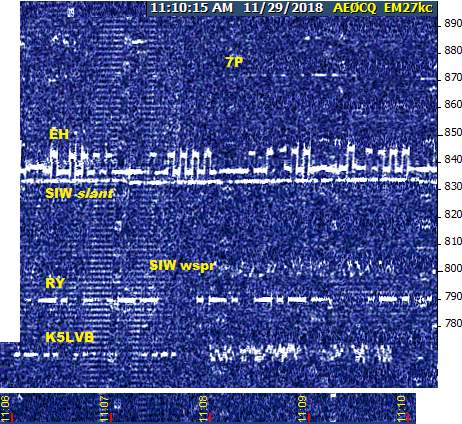
Thursday had three remarkable but short-lived episodes in which some of the less frequent visitors to SE Kansas turned up, an/or unusual things happened to more-or-less regulars. In the process, I was able to document something to which I'd made reference once before: collisions between K5LVB and RY.
The first unlikely event was a first-skip-zone opening from SIW to here during the late morning hours. With low sunspots at this season, it usually requires a geomagnetic storm for that to happen, but none was in progress. Still, there it was--both the slant mode and WSPR--but only until local noon, before which none of the westerners were coming in very well; and right after which, the westerners started showing up but SIW went away. K5LVB, also at the edge of the skip zone, was also visible and safely a couple Hz below 13555.380 at the time. (During the time of the late morning when I was watching, however, there was absolutely no sign of WM yet. Nor did I see anything of NC or USC.)
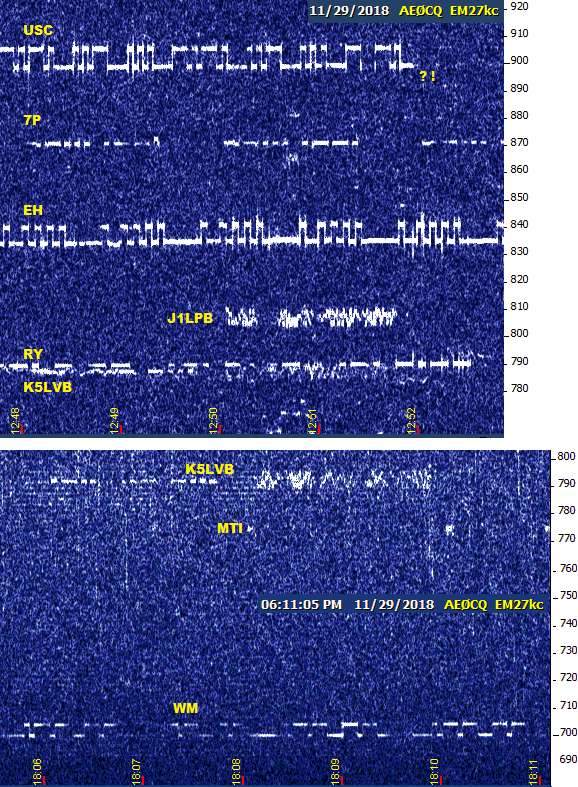
Two hours later, there had been several changes. USC and NC (not shown below) were both strong, although something suddenly happened to USC at 12:52 PM CST, and it no longer manifested very strongly the rest of the afternoon. Both SIWs were gone for the day. J1LPB started coming in (rather strongly at times), and K5LVB had drifted upward enough to just overlap RY during the WSPR segment.
WV was remarkably good around 1 o'clock. It even was clearly audible in narrow SSB bandwidth, which I was experimenting with by switching between it and CW narrow to test WSPR X decoder performance. (FWIW, apart from the narrow CW mode overloading the waterfall display, there was no apparent difference in the decoder performance under the low-to-moderate QRM levels prevailing at the time.) I made a rather long recording of WV, from which I shall post some clips later.
In the lower of the two captures below (over an hour past sunset!), you can see that K5LVB had actually drifted high enough to where it might have conflicted with SIW in addition to RY. MTI was making occasional appearances, although it was seldom audible (only at 6:10 PM), and WM had finally shown up too--entirely separately and in the absence of any SIW propagation this time.
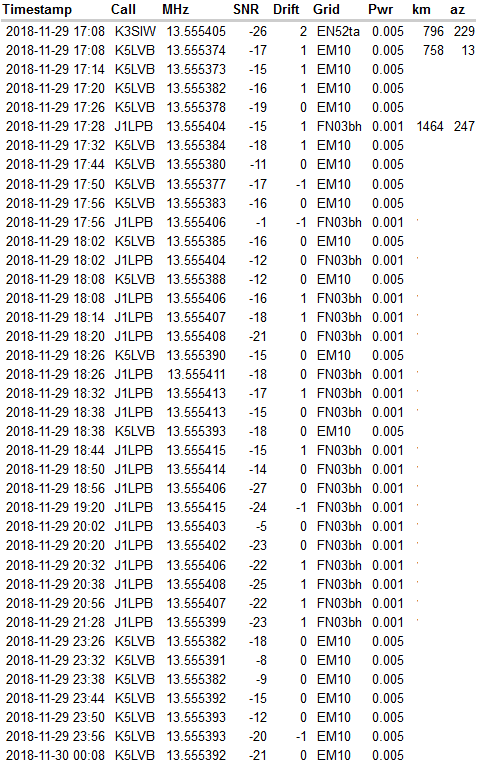
Finally, below, a look at the day's WSPR spots. Note that receiver thermal drift was compensated to within ±1 Hz on the Argo captures, but the WSPR decodes can be off by as much as ±10 Hz, in addition to any actual transmit frequency errors.
John
---------------------------------------------------------------
 File Attachment 1: 29nov13.jpg
File Attachment 2: 29nov.gif
File Attachment 3: 29nov1.jpg
Saturday HiFERs
Nothing particularly good about propagation early this afternoon. In fact, even though the forecast G1 storm activity had not yet arrived, signal levels were fluctuating dramatically, and over rather short time intervals! The trick to copying the CW stations today seems to be to sit on the frequency for 5 minutes or more and try not to doze off before you get that sudden burst of Morse out of nowhere. It'll be gone again in one or two ID cycles. That's how I managed to hear AZ and TON today.
Even WAS required careful attention. It was audible a higher percentage of the time, but would fade out abruptly in mid-character sometimes.
Only fair copy of slow modes at the watering hole. More on that later today.
Re: testing SJ
Posted by John Davis on December 01, 2018 at 22:59:29.
In reply to Re: testing SJ posted by Sal,K1RGO on December 01, 2018
I'd enjoy watching for some daytime QRSS on 630. Based on previous monitoring, I doubt that I could hear CW over this distance in daylight, but slow enough QRSS might stand a chance. Problem is, of the standard QRSS speeds, QRSS6 is the slowest that can send your entire call sign in less than 10 minutes. Still, if you'd like to try it, I can listen tomorrow afternoon.
Will try for SJ tonight if the storms Down South (the ones that gave us severe t'storms and tornados last night) die down after dark.
John
Re: Saturday HiFERs
Posted by swlk5 Tom on December 01, 2018 at 23:58:11.
In reply to Saturday HiFERs posted by John Davis on December 01, 2018
Today seemed decent for hifer propagation into N Texas:
1714 -26 1.6 13.555410 0 J1LPB FN03 0 1190 QRSS on the LF Ham Bands
1720 -25 1.5 13.555410 0 J1LPB FN03 0 1190
1738 -27 1.5 13.555411 0 J1LPB FN03 0 1190
1744 -29 1.4 13.555410 0 J1LPB FN03 0 1190
1756 -27 1.3 13.555411 0 J1LPB FN03 0 1190
1802 -27 1.4 13.555410 0 J1LPB FN03 0 1190
1808 -26 1.3 13.555410 1 J1LPB FN03 0 1190
1814 -27 1.3 13.555411 0 J1LPB FN03 0 1190
1820 -28 1.3 13.555411 0 J1LPB FN03 0 1190
1920 -27 -0.4 13.555404 0 K3SIW EN52 7 758
1940 -27 -0.2 13.555404 0 K3SIW EN52 7 758
2032 -28 0.6 13.555406 0 K3SIW EN52 7 758
2118 -28 1.4 13.555412 0 J1LPB FN03 0 1190
2128 -27 0.7 13.555405 0 K3SIW EN52 7 758
2134 -26 1.5 13.555410 1 J1LPB FN03 0 1190
2140 -27 0.0 13.555407 0 K3SIW EN52 7 758
Posted by Mike N8OOU on December 02, 2018 at 03:00:01.
All
I set up a transmission sequence in the U3S to try and address the 10 minute FCC ID requirement. I submit the idea here for feedback from the group to see if there is a hole in my thinking. I have tested the sequence, transmitting into a dummy load.
My idea is fairly simple. With the QRP-Labs U3S you can set up to 16 transmission modes. I set the first to send a "W" in QRSS 60. The next mode sends my callsign in CW at 12 WPM. The next mode is a QRSS "M", followed by another CW callsign. Repeat. At that speed most letters send in less than 10 minutes. Long letters like "0" could be sent at QRSS 40 or 50.
Now, it is not likely that the CW ID would be heard at any distance, if it is, at QRSS 60 speed it does not paint on ARGO. I don't think the Part 97 rules put a requirement on the "strength" of the ID. I decided to send "WM" as the data content to be consistent with my Part 15 beacons. A callsign could also be sent one letter at a time. (Within the stock U3S 16 mode constraint)
I look forward to reading the comments, I am very close to putting this on 2200, and 630m.
Re: Saturday HiFERs
Posted by John Davis on December 02, 2018 at 08:51:08.
In reply to Re: Saturday HiFERs posted by swlk5 Tom on December 01, 2018
Good work, Tom.
K3SIW eluded me all afternoon today. Of the available WSPR signals, only Jason's was far enough outside my first skip zone to get through. (See below.) It was visible midway through the noon hour, and became plainly audible in the 1858 time slot, but refused to decode until 1910 UTC (1:10 PM CST). After that, it was reasonably consistent until after the 2142 slot, wnen it disappeared from Argo as well as not decoding further.
During the noon hour, only weak USC, J1LPB, and RY were visible, with the brief receptions of AZ, TON, and WAS that I mentioned earlier. During the 1 o'clock hour, signals began improving, but so also did codar and the "Chinese measles" pulsers. By mid-afternoon, there were bright traces of USC at times (peaking around 2:10 - 2:40 PM), RY was stronger, and 7P showed up too.
Codar was bad enough during the 3 and 4 o'clock hours, and the last of the signals (RY) disappeared at 5 PM, right before sunset. Codar really took over then! Argo looked almost psychedelic. It shut down abruptly at 6:14, but the pulsers continued intermittently until stopping at 6:24 PM.
Then the band was almost totally dead until 10:24 PM, when something that looks like strong voice or music sidebands started spreading everywhere. (I don't know for sure what it was, as I was taking my supper break right then.) That noise abruptly ended after 19 minutes.
There was nothing more until NC started occasionally reappearing just before 11 PM. Right at 11:00, someone switched on the path to USC again. They were both doing fine when I returned to the field a few minutes later, though USC began fading out again a quarter of an hour later. I did a brief scan of the rest of the band, which turned up nothing but some mid-band ISM noise.
Upon finding out that QRN was too rough for anything on LF but a few non-DX decodes on 630 meters, I packed up for the night and returned to town 'til the morrow.
John
1910  -14  -0.1   13.555410    1   J1LPB         FN03      0
1918  -13  -0.0   13.555407    0   J1LPB         FN03      0
1934   -8  -0.0   13.555400    0   J1LPB         FN03      0
1942  -10  -0.1   13.555399    0   J1LPB         FN03      0
1950  -15  -0.0   13.555396    0   J1LPB         FN03      0
2010   -7  -0.0   13.555389    1   J1LPB         FN03      0
2018  -17  -0.1   13.555393    0   J1LPB         FN03      0
2026   -7  -0.2   13.555392    0   J1LPB         FN03      0
2034  -10  -0.2   13.555393    0   J1LPB         FN03      0
2042  -11  -0.1   13.555390    0   J1LPB         FN03      0
2058  -16  -0.3   13.555392    1   J1LPB         FN03      0
2110  -20  -0.1   13.555392    1   J1LPB         FN03      0
2126   -8  -0.1   13.555393    0   J1LPB         FN03      0
2134  -15  -0.3   13.555391    0   J1LPB         FN03      0
2142   -7  -0.2   13.555390    1   J1LPB         FN03      0
Re: testing SJ
"Will try for SJ tonight if the storms Down South die down after dark."
Famous last words. They didn't, so I eventually packed up and returned to town. Will try Sunday night.
As I say, I'd be glad to try for daytime copy on 630 m too; just specify the mode, frequency, and time frame. (If you have the means to do what N8OOU is proposing, following each QRSS letter with a full CW ID, you could probably use QRSS30.)
John
Re: QRSS on the LF Ham Bands
Posted by John Davis on December 02, 2018 at 09:06:10.
In reply to QRSS on the LF Ham Bands posted by Mike N8OOU on December 02, 2018
Looks like a very reasonable plan to me, Mike.
The early Part 5 licensees on 2200 m had a longer ID interval, and that was fortunate because they didn't have tools to intersperse CW IDs as flexibly as we do now; but some of them did do a CW ID once per complete QRSS transmission. On a weak signal, it seldom showed up on Argo at all, and on a strong one it was little more than a fuzzy tail on a QRSS dot or dash.
John
HiFER Sunday
Posted by John Davis on December 02, 2018 at 18:03:58.
The band started out nicely today at 9 AM CST, with NC, USC, J1LPB and RY (with hints of 7P and EH) already at the watering hole. WV was reasonably steady copy too. More to come.
Re: HiFER Sunday
Posted by swlk5 Tom on December 02, 2018 at 20:21:37.
In reply to HiFER Sunday posted by John Davis on December 02, 2018
rr John. I also saw J1LPB early on wspr. K3SIW has been decoding here during the day sporadically. Know what you mean about the skip zone with SIW and your location. I'm a bit farther out so that probably helps with my decodes of him.
Re: HiFER Sunday
Posted by John Davis on December 02, 2018 at 21:45:01.
In reply to Re: HiFER Sunday posted by swlk5 Tom on December 02, 2018
Before I took my break this morning for breakfast/lunch (aka brunch) it looked like I might be seeing SIW slant mode, but didn't see the WSPR signal yet so I didn't mention it in my earlier report. Now that I'm home from my afternoon lunch/supper break (lupper?) I can see that there was indeed signal from SIW, and later WSPR decodes as well, at 1536, 1540, 1544 and 1548 UTC.
SIW slant went away for a while about 10:16 AM CST, then returned about a minute after EH signed on at 11:01. The latter drifted down about 30 Hz over the remainder of the morning and kind of parked on top of SIW, but it was still discernible. SIW WSPR also returned, and decoded at 1716 and 1732 (just barely). About 11:40 AM was the last time I saw anything resembling the WSPR or slant mode.
All this time, other stations at the watering hole continued perking along; notably, very good reception of NC, USC, EH, J1 LPB and RY. 7P was present but rather broken up until the noon hour, then it started improving. MTI also became more dependable about then. Using narrow SSB bandwidth (because there was minimal QRM this morning) I had aural copy on WV most of the time as well as the Argo screens.
At 1:00, I took several minutes to do a band scan. That wasn't nearly as productive as the watering hole results would have suggested, yielding only WAS (fair to good right at 1:00, weaker 20 minutes later), maybe TON visually (but no aural confirmation), and some faint voice sidebands from somewhere.
Returning to the watering hole, I found WM showing up to join in from time to time, but no return of SIW as of 2 PM. On my way back out there shortly to see what's up now.
John
1518  -13   0.1   13.555397    1   J1LPB         FN03      0
1526  -12   0.3   13.555398    0   J1LPB         FN03      0
1534   -9   0.2   13.555399    1   J1LPB         FN03      0
1536  -24  -0.7   13.555392    0   K3SIW         EN52      7
1540  -18  -0.6   13.555394    0   K3SIW         EN52      7
1540  -15   0.7   13.555462    1            RLT5JO   49
1542   -8   0.1   13.555400    0   J1LPB         FN03      0
1544  -26  -0.4   13.555394    0   K3SIW         EN52      7
1548  -25  -0.4   13.555393    0   K3SIW         EN52      7
1550  -12   0.1   13.555400    0   J1LPB         FN03      0
1558  -10   0.0   13.555399    0   J1LPB         FN03      0
1610  -10   0.2   13.555397    0   J1LPB         FN03      0
1618   -6   0.1   13.555400    1   J1LPB         FN03      0
1634   -9   0.1   13.555399    0   J1LPB         FN03      0
1642   -8   0.1   13.555399    0   J1LPB         FN03      0
1650  -13   0.0   13.555399    0   J1LPB         FN03      0
1658   -5   0.1   13.555398    0   J1LPB         FN03      0
1710  -18   0.0   13.555396    0   J1LPB         FN03      0
1716  -24  -0.8   13.555396    0   K3SIW         EN52      7
1718  -13  -0.0   13.555399    0   J1LPB         FN03      0
1732  -28  -1.3   13.555396    0   K3SIW         EN52      7
1750   -8   0.1   13.555402    0   J1LPB         FN03      0
1810   -9   0.2   13.555398    0   J1LPB         FN03      0
1818   -3   0.0   13.555393   -1   J1LPB         FN03      0
1826  -12  -0.0   13.555393    0   J1LPB         FN03      0
1834  -14   0.0   13.555393    1   J1LPB         FN03      0
1842  -12   0.1   13.555390    0   J1LPB         FN03      0
1850   -6   0.0   13.555392    1   J1LPB         FN03      0
1858   -5  -0.0   13.555397    1   J1LPB         FN03      0
1926   -7   0.0   13.555408    0   J1LPB         FN03      0
1934  -14  -0.0   13.555410    1   J1LPB         FN03      0
1942   -5   0.0   13.555412    1   J1LPB         FN03      0
Re: HiFER Sunday
You're getting strong decodes of J1 John, wonder what you're using for an antenna? I'm using an untuned wire vertical here. You're also doing well receiving the other stations on Argo, it seems. I haven't run the Argo program to see what's on QRSS. Just too lazy to mess with anything other than wspr decoding lately ... hi.
Re: HiFER Sunday
Posted by Jason Goldring on December 03, 2018 at 00:42:10.
In reply to Re: HiFER Sunday posted by swlk5 Tom on December 02, 2018
I am wondering the same, in some cases the decodes have been in the high -20 range, but then to see them in single digits, but only (seemingly) in a southerly direction, I have to wonder if 22m has a magic wand that does that. 2.24mW tested this evening. Bounces around with rain - sorry I should say freezing rain as it is starting up. Let's see how that plays out. And we just had a burst of thunder...oh joy.
Thanks Tom & John. Re: testing SJ
Jason
Posted by Sal, K1RGO on December 03, 2018 at 02:09:43.
In reply to Re: testing SJ posted by John Davis on December 02, 2018
I have a "QRS" program that can do that, I would send my call in QRSS and follow with cw ID. Re: testing SJ
I will play with it a bit and see what happens before a sked on 630
later.........
Posted by John Davis on December 03, 2018 at 15:01:13.
In reply to Re: testing SJ posted by Sal, K1RGO on December 03, 2018
Last night's QRN once again obliterated 1750 meters. I wonder how far those storms are going to have move offshore to quiet things down...and whether it's going to happen before our next winter weather here...?
Re: HiFER Sunday
Posted by John Davis on December 04, 2018 at 08:41:57.
In reply to Re: HiFER Sunday posted by John Davis on December 02, 2018
Wanted to post my selected screenshots for the day sooner, but the capture times of my active Argo instances got out of sync somehow, so the bigger one required carefully stitching together three images and carefully aligning them in both the time and frequency domains.
In the morning shot, the path to SIW was open. It closed before noon, and after 1 PM the path to WM opened up a little. Both files are attached here.
Below are also the remainder of the J1LPB WSPR spots of the day. (K3SIW didn't return, and K5LVB never showed up on Sunday.) Quite a wide range of S/N ratios.
Outside the watering hole vicinity, I finally got K6FRC fair to weak at 4:56 PM CST.
John
1958  -15   0.0   13.555403    0   J1LPB         FN03      0
2010  -22   0.0   13.555401    1   J1LPB         FN03      0
2018  -19  -0.2   13.555404    0   J1LPB         FN03      0
2026  -19  -0.1   13.555403    0   J1LPB         FN03      0
2034  -24  -0.1   13.555403    0   J1LPB         FN03      0
2042  -15  -0.1   13.555401    1   J1LPB         FN03      0
2058   -6  -0.1   13.555400    1   J1LPB         FN03      0
2110   -6  -0.2   13.555399    1   J1LPB         FN03      0
2118  -15  -0.2   13.555399    0   J1LPB         FN03      0
2126  -10  -0.1   13.555397    0   J1LPB         FN03      0
2158  -11  -0.2   13.555394    0   J1LPB         FN03      0
2210  -25  -0.2   13.555393    1   J1LPB         FN03      0
2226  -24  -0.2   13.555396    0   J1LPB         FN03      0
2242  -26  -0.0   13.555394    0   J1LPB         FN03      0
---------------------------------------------------------------
File Attachment 1: 02dec1.jpg
File Attachment 2: 02dec2.jpg
SAQ on Christmas Eve
News from
the Alexander Association
Grimeton SAQ Veteran Radio Friends
www.alexander.n.se
Scheduled transmission from Grimeton Radio / SAQ on Christmas Eve, December 24, 2018
In the morning of Christmas Eve, December 24, we will try to start the old Alexanderson 200 kW transmitter, from 1924 and send out a Christmas message on VLF 17.2 kHz CW. The transmitter will be tuned up from around 08:30 (07:30 UTC) and a message* will be transmitted at 09:00 (08:00 UTC).
Guests are welcome to attend the transmission at the radio station in Grimeton from 08:00 local time. The Alexander association will arrange Coffee and Christmas cookies, free of charge. No entrance fee.
For those of you who can not attend, we will broadcast the event live from Grimeton, Sweden on our YouTube Channel.
QSL-reports on the SAQ transmission are kindly received via:
- E-mail to: info@alexander.n.se
- or via: SM bureau
- or direct by mail to:
Alexander - Grimeton Veteranradios Vaenner,
Radiostationen Grimeton 72
SE-432 98 GRIMETON
S W E D E N
The SK6SAQ amateur radio station will be QRV on the following frequencies:
– 7.035 kHz CW or
– 14.035 kHz CW or
– 3.755 kHz SSB
Two stations will be on the air most of the time.
*The world heritage site Grimeton is a living cultural heritage. All transmissions with the long-wave transmitter SAQ are therefore preliminary and may be set at short notice.
SIW on a beach...
Posted by Jason Goldring on December 05, 2018 at 00:01:03.
I did a double take when I saw this. Only two decodes. The only decodes I have seen since WSPR was brought back up again on 13553.910 to monitor for J1LPB and low and behold, I guess Gary's intense thoughts of lying on a beach in the south persuaded the radio waves to take a piece of him there.
(And given that the setting was .910 I think WSJT-X is a little forgiving, he should be at RX .900)
J2LPB & J3LPB are remote stations I operate for RX and sometimes TX.
And so he made the trip.
2018-12-04 15:56 K3SIW 13.555401 -26 0 EN52ta 0.005 J2LPB FK49rs 2989 140
2018-12-04 15:52 K3SIW 13.555400 -24 0 EN52ta 0.005 J2LPB FK49rs 2989 140
Posted to Wsprnet
Does not look like any others have poked through since then (so far). Unusual day today for propagation. Will keep an eye out for future events.
Good work!!! Galloping SJ
Posted by John Davis on December 05, 2018 at 22:32:33.
In reply to Re: testing SJ posted by John Davis on December 03, 2018
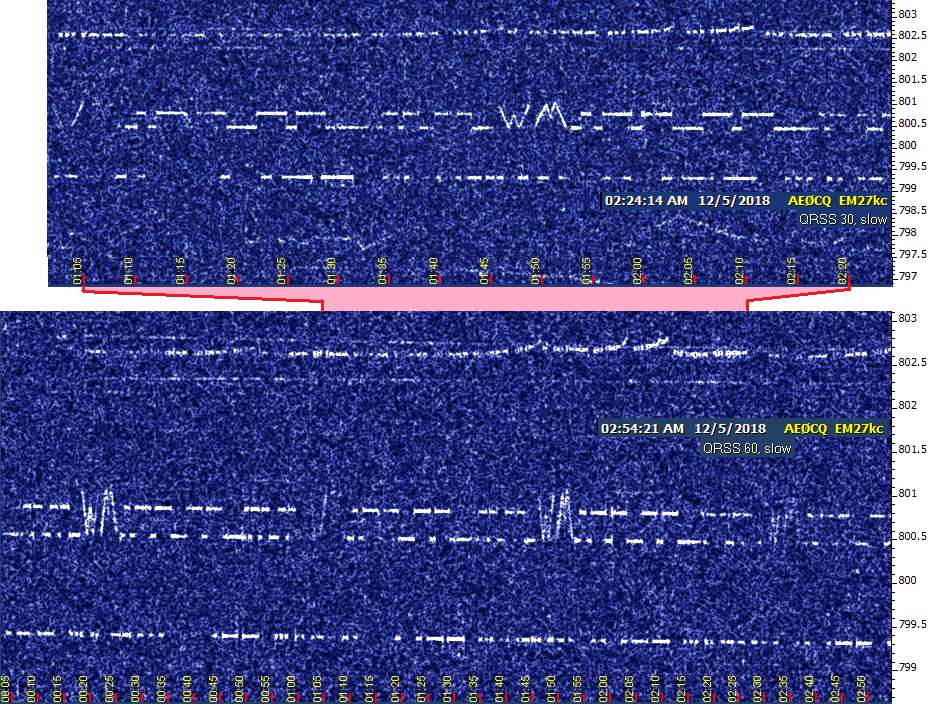
Last night still had a fair amount of static, though lots less than the past few nights, so I gave SJ another try. Beginning about an hour and a half past sunset, I started getting bits and pieces that amounted to an occasional S or J, with two full "SJ" IDs finally at 10:35 PM. Looked pretty steady right then.
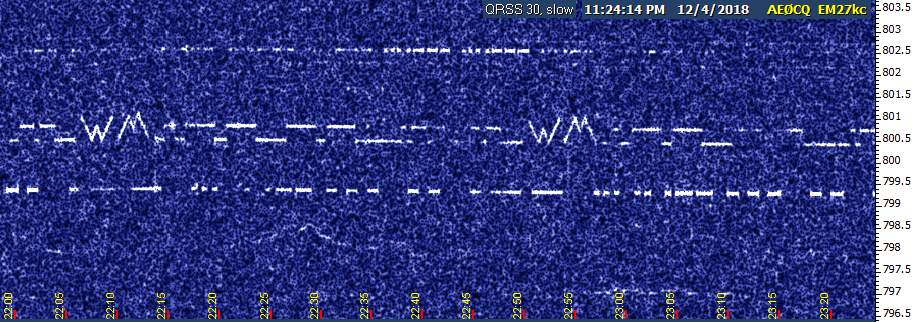
Later in the night, things got a bit peculiar. This effect persisted until the signal went away entirely about 6 AM. Will try to put together a scrollable all-night composite image later. (Times are CST, Freq scale: 800 = 185.300 kHz ± 0.1 Hz.)
---------------------------------------------------------------
File Attachment 1: 4deca.jpg
File Attachment 2: 4decb.jpg
Re: Galloping SJ
Hi John LowFER Wednesday - EAR (and more?)
It looks like that 60 year old crystal is acting up. I have to tap it at times when SJ is off for a while hi...I have a better crystal at around 186.8 or so when this one expires
later...........
Posted by John Davis on December 06, 2018 at 00:49:58.
Despite high levels of QRM nearby in frequency, EAR was starting to show up surprisingly clearly just an hour after sunset. Decided to park on 188.8 and going to try for it and J1LPB for the next few hours.
Wednesday HiFERs and BeFER
Posted by John Davis on December 06, 2018 at 02:57:10.
Started on 22 m at mid-morning and continued to mid-afternoon. Not a very productive day. Outside the watering hole, I heard only K6FRC at first, then finally WAS in the morning; but in the afternoon, it was the other way around: WAS first, then FRC. No WV today or anybody else...a bit unusual.
At the watering hole, it was only part of the usual gang. EH, J1LPB WSPR and RY were consistently the strongest. NC was present but much weaker than usual, and with cooler weather has drifted up higher in frequency than I can cover with two Argo instances centered on the 555.400 frequency. (Once in a while I run more than two, but usually only if I'm not tying up resources with one of the WSPR decoders.) USC was ghostly at best, and mostly absent. 7P was broken and not very strong today. SIW WSPR tried to make an appearance at least once, but never quite materialized.
I've now uploaded all the WSPR decodes of the day. J1LPB was all over the SNR scale, from -3 to -27 dB. After giving up on 22 m, I tuned down to 44 m and caught LPB there too after waiting a little over half an hour. SNR was steadier there, ranging from -12 to -24 dB--when it was present at all. There were several gaps in the record, including an entire hour right after sunset.
At that point, I tuned down to 188.8 kHz for this evening's monitoring effort. Caught EAR almost immediately, so maybe it'll be a better night than when I tried for LPB there over the weekend. Jason, are you still running QRSS30 on 188.810, and if so, during what time frames? Thanks.
John
Re: LowFER Wednesday - EAR (and more?)
Posted by John Bruce McCreath on December 06, 2018 at 14:51:39.
In reply to LowFER Wednesday - EAR (and more?) posted by John Davis on December 06, 2018
Thanks for the report, John. I was out to EAR's helix house yesterday and found it surrounded by a moat full of water!
73, J.B., VE3EAR Re: Wednesday HiFERs and BeFER
Posted by Jason Goldring on December 06, 2018 at 15:50:39.
In reply to Wednesday HiFERs and BeFER posted by John Davis on December 06, 2018
Hi John;
The timing cycles were not quite right and I have corrected them. LPB is what will come out on QRSS30 for 188.810, given the timing, say 19m, it's uneven so I cannot set the frames on the U3 for such.
On startup, 44m WSPR, 22m WSPR then 1750m QRSS30
I padded for a calibration between cycles so it comes to 26 minutes.
Thanks again for the report! Re: LowFER Wednesday - First Daylight EAR!
Jason
Posted by John Davis on December 06, 2018 at 19:24:26.
In reply to Re: LowFER Wednesday - EAR (and more?) posted by John Bruce McCreath on December 06, 2018
That moat must be helping, J.B.! No LPB last night, but EAR continued at varying visibilities right up until an hour before sunrise...pretty typical fade at that point. Then came sunrise, and a big surprise! Ten minutes after, there was EAR again!
That's never happened here before.
It lasted another hour. Near the end of that time, the old battery gave out just a few MINUTES before I got back to the field to recharge it. There was no further copy after 8:30 AM, though--but I was very pleased to get this much. The scrollable screen shot runs from before 5:55 AM to about 8:32 AM CST when I cranked up the generator.
FWIW, it's also unusual for 10 MHz WWV not to be solid copy by 9 AM, but today I still had to use 5 MHz to get a good signal for resetting the computer clock.
SSB on 630m Band
Posted by Ed, KI6R on December 07, 2018 at 15:27:33.
Is anyone interested in trying SSB on the the 630m amateur band? I revised my TX line-up yesterday making everything linear and can now operate modes AM/CW/SSB. After gaining some experience with 630m operations it appears to me that it may be possible to have some SSB operations on the band without causing interference that affects other CW or digital users if care is used. Almost all digital operations occur between 475 and 476 kHz. CW operations seem to appear from 473 to 475 kHz. I have never seen any daytime CW activity in the 472-475 range. There is digital activity 24/7 in the 475-476 range. My proposal is a daytime SSB net during some weekend morning. I'd propose 475.0 kHz LSB using 2.4 kHz bandwidth or less. Another choice would be 476.0 kHz USB using a 2.4 kHz or less bandwidth. I am running a Flex-6300 transceiver as my exciter. The Flex can transmit narrowband SSB at a user defined bandwidth. Ideally 630m SSB could use narrowband SSB of 1.8 or 1.6 kHz bandwidths. On the Flex a 1.8 kHz bandwidth could be defined as 100-1900 audio range. Would anyone like to test SSB on 630m sometime? Are there any comments, suggestions, concerns or recommendations? 73, Ed, KI6R
Re: SSB on 630m Band
Posted by Ed, KI6R on December 07, 2018 at 15:40:54.
In reply to SSB on 630m Band posted by Ed, KI6R on December 07, 2018
I just spotted the 8/16/2018 630m bandplan recommendation at njdtechnologies.net. It recommends SSB operations on 476.0 USB. This should work with a normal SSB exciter of 2.4 or 2.7kHz bandwidth. Anyone like to arrange a SSB schedule?
Reminder: Lowfer net 3927Khz Saturday morning 0800 California time
Posted by Jerry Parker on December 07, 2018 at 16:28:22.
Reminder: Lowfer net 3927Khz Saturday morning 0800 California time
Or listen online at:
http://69.27.184.62:8901/?tune=3927lsb
click on the autonotch to get rid of hetrodynes
see you there
KFS WebSDR in California
69.27.184.62
OR Try:
KA7OEI Northern UT http://websdr1.utahsdr.org:8901/
"NOW HAS 630M RECEIVER"
630m QRSS MEPT
Jerry WA6OWR
Posted by Mike N8OOU on December 07, 2018 at 16:44:57.
All,
I have put up a weak signal QRSS 60 transmission on 475510 Mhz. I have used the same equipment in the WSPR mode and had reception over the eastern portion of the country. Hopefully this mode gives improved signal coverage.
Transmission details are: 5W input power, matched into a 180Ft RG-8 loop. The loop runs NW-SE with the top run 75Ft long and 30Ft AGL. The bottom run is 7Ft AGL. I have the feed located at a corner. The data transmitted is the letters "W" and "M" with a 12 WPM CW id after each letter. As I am retired and do relative little traveling the "Manned" component of the transmission should be close to 24/7. This transmitter does not have the higher quality TXCO chip used in my Part 15 beacons. It has a small amount of "digital" drift due to it's outdoor location.
Signal reports are welcomed. For those who like to chase weak signals, here you go! I do have a loading coil available to switch this transmitter to the WM Lowfer vertical for future tests.
-- Re: 630m QRSS MEPT
73 de N8OOU - Mike Meek
Posted by John Davis on December 08, 2018 at 01:56:54.
In reply to 630m QRSS MEPT posted by Mike N8OOU on December 07, 2018
I'd shut down the listening post and brought everything home for a few days because of anticipated winter storm conditions, but they unexpectedly took that out of our forecast today, so I quickly set up again and am monitoring this evening.
So far, no sign of any QRSS, although I began getting WSPR decodes from back East before local sunset. (I'm hedging my bets by using narrow SSB bandwidth in the receiver and running WSPR X along with Argo. That seems to work OK on 22 m if QRM and QRN are not excessive.)
I expect this is going to be a considerable challenge. First, the loop sounds to be oriented so as to put me nearly in the side null. But if this is the same setup you were using when I copied your WSPR signal last month, perhaps there's a chance.
Second, the weather is so cold that the receiver is already 1.25 Hz off calibration. I've compensated for that in "tuning" Argo, but further temperature changes are expected during the night. Since the QRSS60 screen is only 5 Hz wide (or, more accurately, "tall") it will be very easy for the combination of transmit and receive errors to push signals out of capture range entirely. To hedge bets further, I'm also running a QRSS30 instance simultaneously...twice the bandwidth, but also half the sensitivity; so six of one, as they say. We'll see how long I can tolerate the cold tonight.
Re: 630m QRSS MEPT
Posted by John Davis on December 08, 2018 at 18:08:49.
In reply to Re: 630m QRSS MEPT posted by John Davis on December 08, 2018
Well, that was a challenge!
Mike, were you perhaps using FSK mode to generate the QRSS60 result? All night, there were two seemingly keyed signals about 0.5 Hz apart. Both were about equally faint, and both were broken up enough to make it hard to tell what was going on...but during the one convincingly complete character I got during the night (a "W" that began at 12:20 AM CST) it does appear that the lower frequency is absent when the upper is keyed on, and vice versa. Thus, my guess is based solely on the famed Clark Kent/Superman Identity Theorem. ("If you never see them at the same time, they might be the same guy.")
I magnified the traces in the attached file to make it easier to view.
John
---------------------------------------------------------------
File Attachment 1: 7-8dec.jpg
Sat. 1750 M
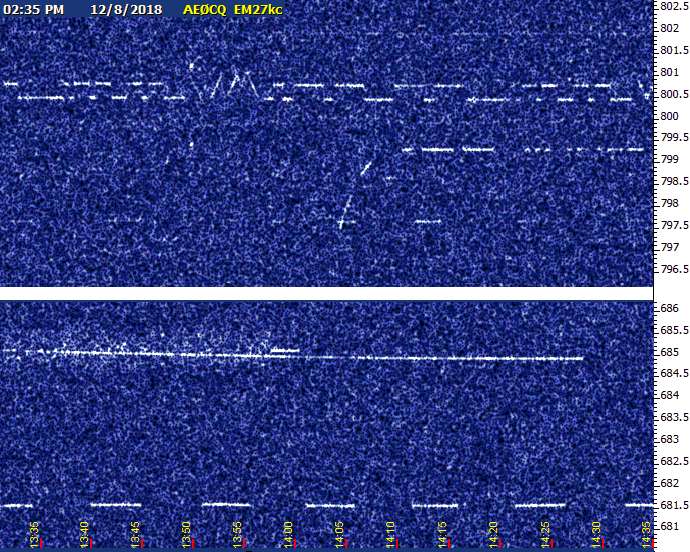
Here is today's transition of SIW from EbNaut on 185.185 (with some QRM accompaniment) to QRSS on 185.2993. Both it and WM were doing well, despite some occasional S9 static crashes from off the Louisiana coast.
---------------------------------------------------------------
File Attachment 1: 8dec1750.jpg
Re: 630m QRSS MEPT
John;
Ah Dang, you caught my setup error too! Garry, SIW sent me a similar report this morning. The day before I put the machine on air, I tested all the slow speed modes. I neglected to switch back to QRSS. Yes I was sending FSKCW with a .5 shift. I changed it to QRSS about 10 AM this morning. I suppose the mistake guaranteed my signal would be copied and reported. I hate getting old. The really sad part is that I monitored the signal all day Friday, and it didn't soak in that I was sending the wrong mode.
It is very nice to receive this report. After seeing the copy from Northern IL. I didn't expect to make it to Ks. Thanks for braving the cold to get the job done.
Mike Meek 73
Re: 630m QRSS MEPT
Posted by Mike on December 09, 2018 at 05:09:54.
In reply to Re: 630m QRSS MEPT posted by John Davis on December 08, 2018
John,
I forgot to add in my previous reply that yes, I am using the same transmitting setup for both the WSPR mode last month, and QRSS now. I plan to let this configuration run for a few weeks, then repeat the two modes using the Lowfer Vertical antenna.
73 Mike
Pulling the CW speed down on a Blackcat
Posted by Jason Goldring on December 09, 2018 at 14:40:35.
Knowing the CW Id'er chip in the Blackcat is pre-programmed with your call and as such, same with the speed, I suppose there is no way to adjust the speed to slow it down to something more realistic, even head into QRSS territory without replacing the chip with custom programming? 12WPM at 5mW to me seems a bit fast for long distance weak signal reports.
I think DNU would be interested in this as well....
Jason
Re: SSB on 630m Band
Posted by Ed, KI6R on December 09, 2018 at 16:41:23.
In reply to SSB on 630m Band posted by Ed, KI6R on December 07, 2018
Update: Saturday evening at about 9:30 PM Clint, KA7OEI and I completed a sideband contact on 630m from DN40 in Utah to CM98 in California. We used 476.0 kHz USB. I was running about 50W PEP and Clint was running about 22W. Signals were weak but 5/4 with static crashes and QSB taking out the audio at times. I think USB would be a viable mode on 630m, especially for closer distances during daytime. Is there anyone within a few hundred miles of CM98 capable of USB that would like to run some tests? If so please contact me: ki6rcm98@gmail.com
Re: Pulling the CW speed down on a Blackcat
Posted by John Davis on December 10, 2018 at 05:29:30.
In reply to Pulling the CW speed down on a Blackcat posted by Jason Goldring on December 09, 2018
The simplicity of the Black Cat board comes with inevitable trade-offs. Unlike some of the early microcontrollers that used a simple RC time constant to determine their clock frequency, the ATTiny series has a pretty sophisticated internal clocking architecture. I gather it is possible to use an external clock, but that requires both (a) external hardware and (b) additional programming.
You could download the ATTiny85 PDF datasheet directly from Microchip and take a look, but I think the only realistic solution is to contact Chris at Black Cat and see if he could offer the chip programmed for other speeds.
It would certainly be helpful for users seeking any sort of DX to have slower CW speeds available for difficult band conditions, although even QRSS might not be enough to help guys who are stuck in the noise clusters at the center of the band.
John Re: 630m QRSS MEPT
Posted by John Davis on December 10, 2018 at 06:24:35.
In reply to Re: 630m QRSS MEPT posted by Mike N8OOU on December 09, 2018
Actually, Mike, I was kind of glad for the FSK, intentional or not. I think it helped me be more confident that the "W" I saw was real and not just a coincidence.
The timing and spacing of the elements were correct, but it is conceivable that such a thing could happen randomly once or twice during an all-night session...especially considering that the signal was nestled in a low-level broadband noise fuzz of some sort during of the night. ("Broadband" in this case meaning about 1 Hz wide, roughly a fifth of the Argo display.) Having the corresponding gaps in the lower "space" frequency during that one character therefore made it unlikely that these two broken lines were part of the random noise, and thus my interpretation of the upper "mark" frequency as a Morse letter "W" was more plausible.
Mostly, alas, both lines were broken up quite a bit by QSB and/or occasional QRN. There were no times that both frequencies appeared to be on simultaneously, but there were plenty of times that both appeared to be off simultaneously, so some ambiguity existed which made it hard to use the FSK to good advantage at other times during the session.
I got sufficiently chilled yesterday afternoon that I haven't felt up to going to the field last night or tonight, but I may resume Monday night if QRN from the winter storm system pushing out over the Atlantic is not too severe by then.
John
NDB2
Posted by KF7RPF John on December 10, 2018 at 12:46:06.
CW Beacon NDB2 was captured on Argo on 12-8-2018 at 12:01 PM in Arizona.
2200m JT9 overnight
Posted by swlk5 Tom on December 11, 2018 at 18:38:41.
Saw N1BUG testing JT9-1 and JT9-2 last night on 2200m. Sending "VVV" from approx. 0344-0436z. SNR's were averaging -20db. I had seen the JT9 signals in the wspr waterfall I was monitoring, so I set up the rx for JT9 also.
Strange Visitor & Mystery Event
Posted by John Davis on December 11, 2018 at 23:27:27.
My LF & MF "stragedy" for the day (to borrow Bugs Bunny's expression) was to document the SIW transition at 2 PM CST, then see if EAR might make a pre-sunset appearance since it made a post-sunrise appearance the other day (that test is underway now), next look for SJ's first appearance after sunset, and finally watch for WM again on 630 m later tonight.
The first one didn't quite go according to plan. Instead of a normal, heartwarming transition capture, there is a new intruder at 1750 meters--and it ain't Santy Claus. At least it doesn't seem to be overloading the receiver or causing interference to anyone, as long as it stays where it is.
Then things got peculiar. As I watched the new carrier at 2:40 PM, it appeared that it might be undergoing some sort of FSK or phase modulation. After a couple of minutes, I realized something had happened to the other signals. Turning on the speaker, nothing sounded out of placed, and finally all the traces began returning to normal.
The attached is a bigger file than I normally like to post, but it enables me to show you what happened to PLCs and stray spurious signals at the same time. Most of them were affected by the event, but apparently not all at exactly the same time. I don't see any solar x-ray, proton, or geomagnetic anomalies on NOAA's SWPC dashboard. Anone have any ideas?
John
---------------------------------------------------------------
File Attachment 1: 11dec1.jpg
LF-MF "Stragedy" Phase 2 - EAR
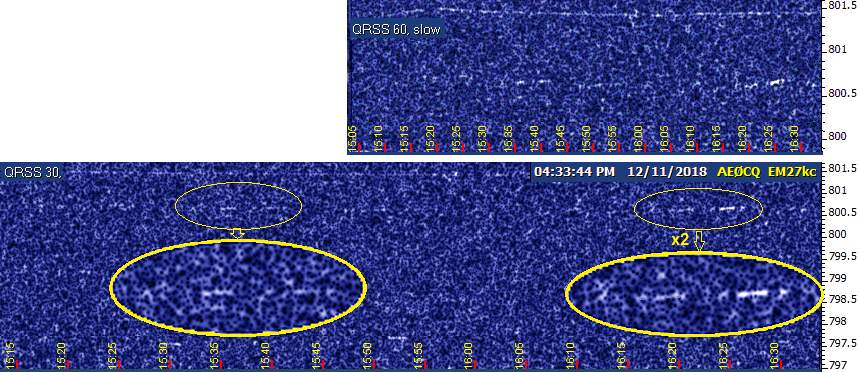
Sure enough, EAR did make daytime appearances this afternoon! Just as soon as I tuned up to 188.830 at 3 PM CST, two hours before local sunset, it was clear there was an excess of RF whose broken upward slope repeated at 15 minute intervals. In the 3:30 - 3:45 slot, it looked recognizable to me, and in the 4:15 - 4:30 slot it was pretty much unmistakable. Definitely the earliest EAR has ever shown up here!
It got better from there through 6 PM, an hour after sunset, when I switched back to the watering hole to await SJ.
John
---------------------------------------------------------------
File Attachment 1: 11dec-EAR.jpg
LF-MF "Stragedy" Phase 3 - SJ
This phase was less successful than the last. See attached image file.
One hour after sunset, I caught broken RF that may or may not have been SJ. From first apparent dot to last probable dash was about 7 minutes, and it was on 185.3025. These were positive indications, but (a) there were elements missing, even when I blew up the image, and (b) it never reappeared once over the next four hours. So, I can't be sure.
At that point, I switched to watch for N8OOU "WM" QRSS60 on 630 m. Some of the WSPR signals were strong enough tonight to seriously desense the radio in SSB mode, so I abandoned the secondary effort to spot WSPR and will go with narrow CW the rest of the night.
John
---------------------------------------------------------------
File Attachment 1: 11dec-wh.jpg
LF-MF "Stragedy" Phase 4 - WM 630
This phase was also less than a smashing success, probably in part because I overlooked something. When I switched from SSB back to CW, I should have taken the RF attenuator out of circuit. I was not driving the audio clipper very hard, so random noise broke up the characters more than should have been the case.
As is, there were several times during the 10 PM - 5 AM time frame that it was possible to find the right timing for a "WM" QRSS60 pattern. In the attached image, for instance, the time from the possible initial dot (12:29 AM) to the end of the final possible dash (12:48 AM) is 19 minutes, and the start of the next cycle appears to be about 7 minutes later. But there was no one clear character showing anywhere, so I can't say for sure.
Even if I had graphic overlay software available, I probably couldn't stack the images well enough to tell anything more because of the combined transmit and receive frequency drifts. It went from being near 50° and cloudy here at 10 PM to 24° F and crystal clear at 6 AM. (At least that gave me a magnificent naked-eye view of Venus, Orion, fuzzy Comet 46P/Wirtanen, and a couple of Geminid meteors around 5 AM!)
I'd like to try again tonight with the receiver set up correctly, but we're forecast to have rain by midnight, so that may be iffy.
As of right now, Phase 5 (EAR at sunrise) is underway.
John
---------------------------------------------------------------
File Attachment 1: 11dec630.jpg
Re: LowFER Wednesday - EAR (and more?)
Hi John, thanks for the report and Argo snips. The propagation on 518 kHz. wasn't spectacular overnite, and I copied no DX from either the Pacific Coast or Greenland. Both have been seen every day for the past week or so. I've yet to check out the SolarHam web site to see if we had a sun event.
73, J.B., VE3EAR LF-MF "Stragedy" Phase 5 - EAR in the AM
Posted by John Davis on December 13, 2018 at 04:30:38.
In reply to LF-MF "Stragedy" Phase 4 - WM 630 posted by John Davis on December 12, 2018
...or not, as the case mat be. It did well until fading out at 6:20 AM CST, an hour before sunrise. Unlike the other day, it did not return to readability afterward, However, faint traces appeared about 10 AM and lasted to roughly noon. The bits and pieces showed up again about 2 PM.
From 3 to a little after 4 I thought I'd see whether WM on 630 m stood any better chance in daylight. Apparently not, but someone seemed to be tuning up a strong but drifty carrier very close in frequency.
Returning to EAR's spot, it was clear that was indeed EAR I'd been seeing traces of. By 4:30 it was fully visible and remained that way until fading out right at sunset, just after 5:00. I then decided to take a look and see when SJ would show up for the evening.
LF-MF "Stragedy" Phase 6 - SJ in the PM
Posted by John Davis on December 13, 2018 at 05:27:53.
In reply to LF-MF "Stragedy" Phase 5 - EAR in the AM posted by John Davis on December 13, 2018
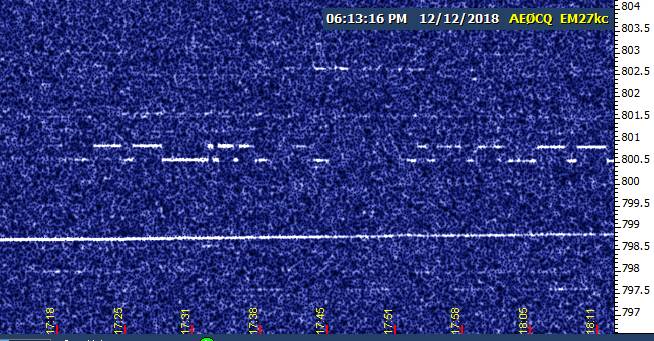
Wanted to see whether last night's apparent brief materialization of SJ was just a fluke or a real thing. It may be the latter, based on the two dashes, an S, and dot-dash on 185,302.5 (802.5) in this capture. Doesn't seem to last long, then is gone until sometime later in the evening (if at all),
Note that the mystery newcomer/visitor also dips in level after WM does.
The final phase of the current marathon session is underway (another attempt for WM on 630), but will have to wrap up shortly after midnight due to approaching rain.
---------------------------------------------------------------
File Attachment 1: 12dec06.jpg
LPB Lowfer down
Not sure when or how it happened, I have not looked at the cameras yet but the coil to the vertical had a major scratch / dent / bang (SDB?...sure I will go with that) and broke a few windings.
LPB LF is disabled right now so it's just 22m and 44m right now on a 6 min cycle to allow for calibration. WSPR mode.
Jason LF-MF "Stragedy" Phase 7 - The Winding Road to WM
Posted by John Davis on December 14, 2018 at 08:13:44.
In reply to LF-MF "Stragedy" Phase 6 - SJ in the PM posted by John Davis on December 13, 2018
Sorry for the day-long delay. It's been almost 24 hours since I wrapped up the marathon session last night, and I've used most of the intervening time to get caught up on sleep and bill paying. This final phase of the project was to see when 630 meter WM might appear, since it proved to be unavailable in daylight over the path between us.
QRM proved to be the main stumbling block during the early part of the evening. I tuned to 474.5 kHz right after the SJ capture in the previous post, a little over an hour after sunset, and was greeted immediately with S9 levels of a keyboard digital mode. The first captures show and analyze the effect of that on reception over the subsequent hour, during which WM may have been present but thoroughly uncopyable, followed by it being mingled with the noise band I reported a couple of days ago.
I was running QRSS30 along with two Argo instances at QRSS60 tuned around the anticipated location of WM. The 30 second mode spread out the signal too far over the time axis for optimum decoding, of course, but the frequency of the transmitted signal jumped around too much to properly fill the narrower FFT bins at 60 seconds to their fullest, either. However, I was finally able to get this:

With a 24+ hour rain event moving in, I decided that was about the best I was going to get and began maintenance in preparation for packing everything back to town. But while doing that, I did one more relatively quick observation (next post).
John
---------------------------------------------------------------
File Attachment 1: 12dec630b.jpg
File Attachment 2: 12dec630c.jpg
LF-MF "Stragedy" Phase 7˝ - SJ Revisited
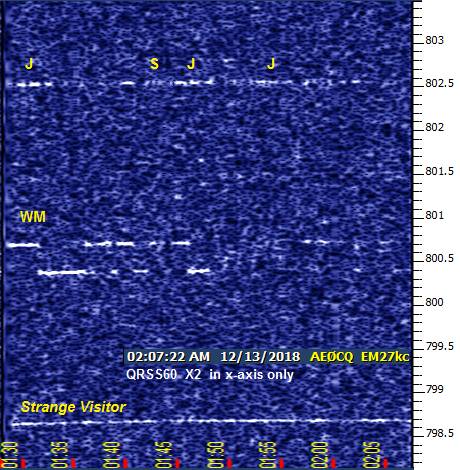 During my pre-shutdown site maintenance, I switched to the 1750 meter watering hole to see if SJ had returned to view. It had, which is not only gratifying, but under the circumstances also allowed me to make two observations.
1. We are in that magic period of good 1750 m propagation that peaks in the first two weeks of December. Now, I don't quite believe in magic, and you may wonder why I would remark upon propagation quality considering that the signals are obviously not very solid. What's not visible to you is that thunderstorms had begun firing up down in Oklahoma. QRN ranged from S2 to over S9, with a median value around S5, and increased during the half hour or so of the capture. At any other time of the year, that's the point at which I lose visibility of WM and SIW, and would not even begin to see the more distant SJ. The LowFERs themselves never even budge the meter. (SIW is absent from this capture because it was on 185.185 that night.)
So, I'm rather pleased with the band conditions that existed Thursday morning.
2. Frequency stability is a very good thing. That should seem self-evident, I suppose, but what I'm getting at in this case is that having reasonable short- and medium-term stability enables one to squeeze the last drop of goodness out of even relatively simple receiving tools.
Note that the image is a horizontally stretched screen from my QRSS60 window. I was running three Argo instances at the time: one at 20 seconds slow in hopes of seeing SJ in its "natural" state, one at 30 as a compromise that encompasses all of WM's modes but also is semi-compatible with SJ, and one in 60 second slow that was intended solely for WM. Fortunately, both signals were steady enough that most of their energy was confined to the narrow FFT bins of 60-second mode. Hence, I was able to stretch the QRSS60 image out to apparent 30-second width, thus decoding with the efficiency of QRSS60 but still displaying QRSS20 adequately enough to copy visually.
With that, I concluded the marathon session. I must now take a break from monitoring, but may resume Saturday evening if the now-restored Lake Inferior subsides enough for me to get to the tower and building.
John
---------------------------------------------------------------
File Attachment 1: 12decSJlate.jpg
Re: LF-MF "Stragedy" Phase 7 - The Winding Road to WM
John,
I have been following your reports with great interest. Thanks for spending the time in the field to create these reports.
I am beginning to think these reports on 630m WM show the average or typical signal strength of this transmitting combination. I know there will be worse days, and maybe a few with better propagation. I will leave the transmitter on the loop for at least another week with the hopes of another report or two.
I am surprised at the amount of drift in this last capture. We have warmed up a lot over the past couple days. I have placed a screenshot of my weather station data for the past week on dropbox. The most outstanding thing I see is it started raining just after midnight. That might have caused a quick temperature change for the transmitter.
www.dropbox.com/s/e9cv92hkt3equql/Screenshot_2018-12-14_08-33-07.png
I will work on a couple ideas to better stabilize the temps inside the box housing the transmitter today. Looks like I need to order a couple more high $ TCXO chips.
Thanks for listening.
Mike 73
Reminder: Lowfer net 3927Khz Saturday morning 0800 California time
Posted by Jerry Parker on December 14, 2018 at 15:26:20.
Reminder: Lowfer net 3927Khz Saturday morning 0800 California time
Take the opportunity to join us
Or listen online at:
http://69.27.184.62:8901/?tune=3927lsb
click on the autonotch to get rid of hetrodynes
see you there
KFS WebSDR in California
69.27.184.62
OR Try:
KA7OEI Northern UT http://websdr1.utahsdr.org:8901/
"NOW HAS 630M RECEIVER"
Re: Reminder: Lowfer net 3927Khz Saturday morning 0800 California time
Jerry WA6OWR
Posted by Jerry Parker on December 14, 2018 at 17:26:50.
In reply to Reminder: Lowfer net 3927Khz Saturday morning 0800 California time posted by Jerry Parker on December 14, 2018
Please join the conversation.Your input is important. You can listen on the KFS SDR and send your comments to my email
wa6owr@gmail.com
so I can put them out for discussion on the net.
Thanks
Jerry
Coil Inductance and Q Calculator
Posted by K6STI on December 15, 2018 at 14:53:12.
I've updated my COIL.EXE program from the 1990s with more-accurate methods and an optimizer. I include accuracy data for a couple dozen coils measured with an HP 4342A Q Meter. By LowFER request, form material includes HDPE since LF antenna loading coils may be wound on an HDPE plastic bucket. The program runs in Windows.
http://ham-radio.com/k6sti/coil.zip (right-click and choose Save or Save As)
Brian
Re: Coil Inductance and Q Calculator
Posted by Ed, KI6R on December 16, 2018 at 02:13:22.
In reply to Coil Inductance and Q Calculator posted by K6STI on December 15, 2018
Thanks Brian, nice job. I'll run some of my Litz wire wound inductors for 1750 and 630m using the program and see how the results compare. 73
Re: Coil Inductance and Q Calculator
Posted by Ed, KI6R on December 16, 2018 at 02:43:38.
In reply to Re: Coil Inductance and Q Calculator posted by Ed, KI6R on December 16, 2018
Compared against two 630m coils wound with 2 parallel strands of 150/44 Litz wire. Coil #1 6.09" DIA, 5" long, 34T. Calculated and measured were nearly identical at 138.7uH. A 5.09" DIA, 5" long, 34T, measured was within 1% of calculated at 102.4uH. Wire size used was #12 silver. Q values calculated were about 30% lower than actual measured on a Boonton 260A Q-meter using an HP400EL voltmeter to set the multiplier (648 measured, 488 calc) . The program lacks a way to determine the improvement Litz wire shows in the LF/VLF frequency ranges. The calculated coil value accuracy was excellent. It would be interesting to try other coil form materials.
630 Meter WM
Posted by John Davis on December 16, 2018 at 08:02:24.
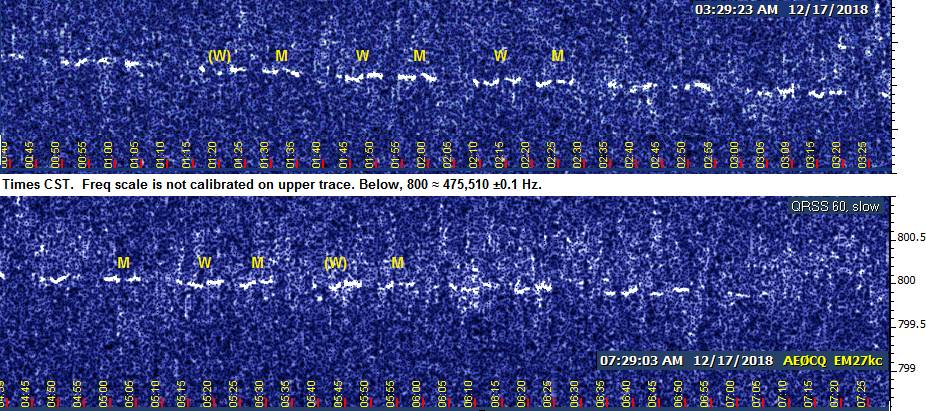
At various times during the evening, WM looked pretty promising--at least, when QRM wasn't pounding it into submission:
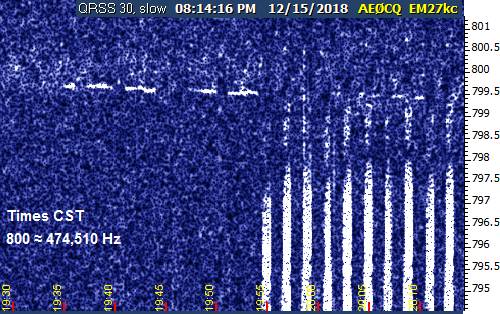
Just before midnight I took a break to look for SSB at 476 kHz (none heard) and CW at the low end of the band (very little and even harder to hear), then a very brief detour to 183.5 to listen for Dave Curry's Part 5 beacon (no copy, just the PLC on-channel and a cluster of PLCs 100 Hz above).
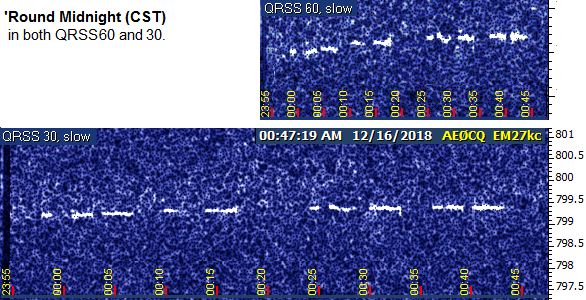
When I returned to 630, I was rewarded with the best copy of WM in the band yet! Although the short-term frequency instabilities continue to do quite a number on the QRSS60 display, the signal was strong enough to do quite nicely in the QRSS30 instance instead!
John
---------------------------------------------------------------
File Attachment 1: 15deca.jpg
File Attachment 2: 15decb.jpg
HiFERs & BeFER Saturday
Was doing LF stuff most of the afternoon, and didn't get a chance to look at 22 m until nearly 4 PM CST. Watched and listened for hald an hour, then went to 44 m for a similar interval.
At 22 m, there was a fair amount of codar. EH and RY were the main occupants of the watering hole, with 7P returning later. J1LPB was visible--and loud--once before 4 PM, but didn't decode, despite WSPR X trying for several minutes. Nobody else was seen or heard but K6FRC, which varied from just fair to downright good copy.
Down at 44 m, J1LPB was starting to become faintly visible and made Argo appearances during the 2230, 2236, and 2242 UTC time slots without decoding. It started the 2248 slot audibly as well as visually, and did decode easily from then until just after sunset. The 2306 transmission was too faint to decode, apparently. I didn't have time to waith for its return, unfortunately, but had to return to LF.
2248  -19   0.0    6.791745    0   J1LPB         FN03      0
2254  -25   0.1    6.791745    0   J1LPB         FN03      0
2300  -24  -0.0    6.791745    0   J1LPB         FN03      0
HiFERs Sunday
The band didn't seem too promising at 9:00 AM, but picked up quite nicely over the following hour.
Before long, the watering hole was populated with NC, USC, 7P, EH, J1LPB, RY, and occasionally MTI. (See attached.) Codar was present but tolerable. Nobody else had yet shown up outside that region (ie, no AZ, WV, WAS or FRC), but it strikes me as a good start.
John
---------------------------------------------------------------
File Attachment 1: 16dec1.jpg
Re: 630 Meter WM
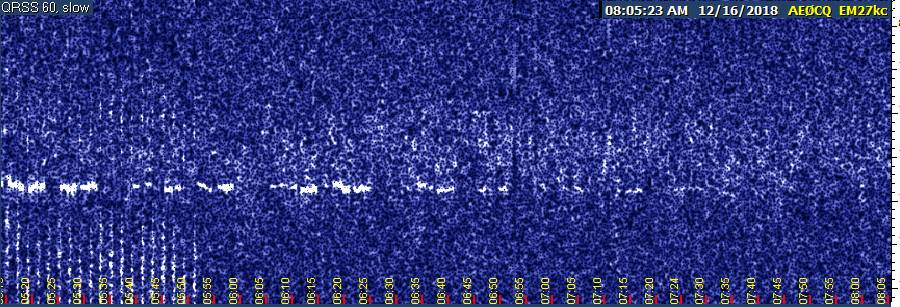
It was a considerable surprise to see WM already strong when I first tuned to it last night, an hour ofter sunset. It hadn't appeared quite that soon before. This morning it last in recognizable for several minutes beyond sunrise. (Some of the digital QRM lingered into the 5 o'clock hour and the 1 Hz wide noise band remained into mid-morning.)
Now that WM is doing so well on 630 m, I may start monitoring pre-sunset this afternoon.
---------------------------------------------------------------
File Attachment 1: 15decc.jpg
Re: 630 Meter WM
John,
Thanks for these captures of WM 630. Today I added a small light bulb in the transmitter case, and a little insulation inside the rain tight box housing the transmitter. My hope is that will reduce the wild swings in frequency. I am monitoring the transmitted signal locally.
Mike M. 73
Re: 630 Meter WM
Posted by John Davis on December 18, 2018 at 08:38:14.
In reply to Re: 630 Meter WM posted by Mike N8OOU on December 17, 2018
I can't tell with any certainty whether the light bulb helped with long-term stability Sunday night, given the rather wide temperature fluctuations that the non-TCXO R-5000 experienced in the little building.
However, it does not appear to have helped the short-term curves and jumps within individual characters. That suggests to me that they are not of ambient temperature origin. While it is certainly possible for internal heating to cause short-term fluctuations, those tend to all go in the same direction; that is, an upward tilt (such as EAR's IDs) or a downward tilt when the RF is keyed on, but not up and down at random. That one's a puzzle to me.
In the capture immediately below, it is likely that the slow downward trend over the span of nearly three hours is mainly an artifact of the receiver's environment. The temperature largely stabilized by daybreak, however, and WM disappeared just a few minutes before sunrise this time (second capture below).
Now, the next capture is at 1750 meters during my morning maintenance, and it is here to illustrate two things:
First is the receiver's response to signals of very constant frequency (the WM and SIW LowFERs) when exposed to temperature variations and battery recharging on the farm. The steeper slope at the start of the trace is with both factors active. I stopped charging at 9:30. The less steep rise continued thereafter as the air temperature rose in the building during the sunny morning hours.
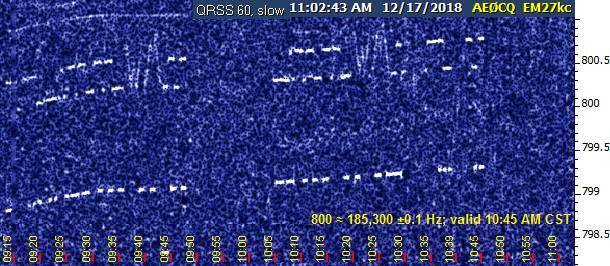
Second, notice the two long gaps in reception. These were the result of a powerline buzz that was S9 or stronger across the band for 15 or more minutes at a time, more than capable of wiping out LowFER and PLC reception. In the morning, it only seemed to affect 1750, but by late afternoon it was almost as bad on 2200 m too. That's why I'm not back in the field tonight (along with needing some rest).
I sure hope it's not still around for the SAQ transmission in the wee hours next Monday!
John
---------------------------------------------------------------
File Attachment 1: 16decd.jpg
File Attachment 2: 16decb50.jpg
Re: 630 Meter WM
John,
Interesting captures and comparison between 630 and 1750. 1750 might be a little more solid but they seem close considering 1 vs 5W and loop vs vertical.
I have put a directory on dropbox which has my local captures during the same time as your image above. I have been studying the patterns of the jitter and while there seem to be several distinct signatures, I have not been able to associate a cause or trigger. I don't think any of this it is temperature related. Being the 4 or 5 patterns seem to come randomly, but the patterns are similar, starts to make me wonder if program code is creating it.
https://www.dropbox.com/sh/80sb69ov10usrp9/AABRWkye4-IyRyvJBgKln3fLa?dl=0
73 Mike
Re: Coil Inductance and Q Calculator
Posted by K6STI on December 18, 2018 at 18:35:34.
In reply to Re: Coil Inductance and Q Calculator posted by Ed, KI6R on December 16, 2018
Ed, the program does not model Litz wire.
I posted 3.16 this morning. Don't know which version you have, but I recently improved the inductance accuracy. 3.16 also provides an RLC model useful for broadband antenna analysis.
Brian
SJ now QRSS30
Posted by Sal, K1RGO on December 18, 2018 at 19:13:19.
I am running SJ with a 30 second dot, QRSS 30. This should help. Re: SJ now QRSS30
later...............
Posted by John Davis on December 18, 2018 at 22:33:27.
In reply to SJ now QRSS30 posted by Sal, K1RGO on December 18, 2018
Thanks Sal. That should be equivalent to almost 2 dB greater signal. I'll head out to the farm in a few minutes and see if the powerline QRM has quieted down enough to let me try for LowFERs tonight.
Updating your listing also reminded me to update the online beacon lists. I last did that after deadline for the next LOWDOWN, but that's been a month and a half ago now. It's good that we have the message board for current info on a beacon-by-beacon case, of course, but it's also nice to have it all collected in one place too. They're current as of now.
John
Re: SJ now QRSS30
Posted by John Davis on December 19, 2018 at 03:41:24.
In reply to Re: SJ now QRSS30 posted by John Davis on December 18, 2018
No buzz when I went to the farm, although 185.3 was whistling along at S2 with a PLC cluster at 185.250 kHz and bumping up to S5 on static crashes. It was sunset when I started the receiver warming up and it took a few minutes to get the computer set up and running Argo. As soon as I did, there was SJ! ...not full strength yet, but more recognizable than it usually is at that point.
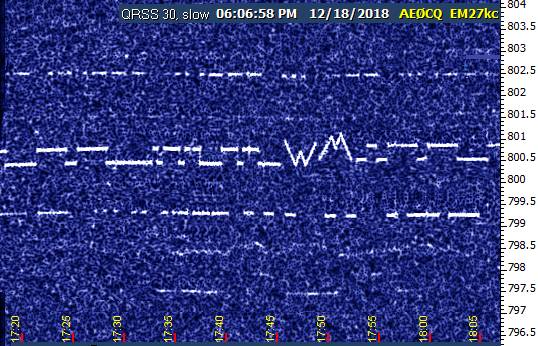
Because the radio was still warming up, the signals were plotting the curve of a quadratic equation during the time of the capture, which I have partially corrected. A few artifacts remain, but it gives a good idea of the results. I'm continuing to capture this evening.
John
---------------------------------------------------------------
File Attachment 1: 18dec0.jpg
Re: SJ now QRSS30
Hi John, I guess It did help, shudda wudda cudda done it sooner HI Litz Coils
later...................
Posted by K6STI on December 19, 2018 at 23:10:04.
I've just added the ability to model coils wound with Litz wire to my coil calculator. Before releasing it, I'd like to check a few Litz coils whose inductance and Q are known. If you have such a coil, please post its dimensions and I'll give it a try.
Brian
Re: Litz Coils
Posted by Mike N8OOU on December 20, 2018 at 01:46:41.
In reply to Litz Coils posted by K6STI on December 19, 2018
Brian,
Here is a Litz loading coil I have on my shelf waiting for a 630m test transmission.
It is a single layer, solenoid wound, on black ABS pipe. The pipe O.D is 4.25 inches, the coil has 77 turns and is 4.5 inches long. My digital LCR Meter set to 100Khz test frequency measures 418.6 uH with a Q of 165. The Litz wire is 108/40 1038 circular mils or 18.5 AWG.
M. Meek 73
Re: Litz Coils
Posted by K6STI on December 20, 2018 at 02:34:12.
In reply to Re: Litz Coils posted by Mike N8OOU on December 20, 2018
Thanks, M. This is useful data for debugging. What gear did you use to measure inductance and Q? Can you measure the DC coil resistance?
Brian Re: Litz Coils
Posted by Mike N8OOU on December 20, 2018 at 04:03:21.
In reply to Re: Litz Coils posted by K6STI on December 20, 2018
Brian,
The dc resistance measured by the LCR meter is 1.454 ohms. It displays the ESR as 1.5 ohm. This meter is labeled TENMA, Model 72-10465. purchased from MCM Electronics. It is not a Lab Grade device, and I have no way to check it's calibration. I just take it's word for what it measures.
I only run Linux here, gave up on windows after XP. I look forward to what your program says the answer should be.
Mike 73
Re: SJ now QRSS30
Posted by John Davis on December 20, 2018 at 08:15:35.
In reply to Re: SJ now QRSS30 posted by Sal, K1RGO on December 19, 2018
Thought you might like to also see some captures from later on Tuesday night, Sal. They're attached. One is from the middle of the night, and the other is of the pre-sunrise extinction, just over an hour before sunrise here. (WM also went away for a while, but returned, while SJ didn't.)
I actually wanted to do an all-night scrollable image, but when I returned to the field after my supper break I was horrified to discover that I had not turned on the capture function of Argo, so there was a gap in the record from an hour past sunset to nearly 10 PM CST. Thought I'd try again at sunset tonight, since we were only forecast to have light showers here during the evening. However, there was a lot of unexpected static, which turned out to be from storms down in the Gulf, so I finally gave up and brought everything back home. Strong storms are forecast for Florida next, so Thursday evening may also be out of the question.
One slight compensation for Tuesday night's mishap was that I was in the field at the right time to witness some of the most amazing interplay of moonlight and mist that I have even seen! At one point, it appeared that one neighbor's field was submerged in the ancient sea that covered this region, and I half expected to see a plesiosaur's long neck rise out of the water or a mosasaur's tail leaving a trail of ripples. Now, I've seen fog roll in many times, but the air was utterly still last night; so when my own field was briefly engulfed, it was fog that simply formed in place all around me, as if someone slowly turned up the opacity control on the atmosphere until it reached whiteout conditions, then gradually backed it down to transparent again. Finally, I had a view of the moon in the sky over another neighbor's field that was a study in shades of silver...an artist's conception of a wondrous, frozen sci-fi world suddenly brought to life.
I truly need to break down and get myself a Sony A7s or Panasonic GHX low light DSLR for such occasions! Only problem is, I'll either have to keep a big ol' costly, delicate, and theft-prone camera with me at all times, or else invent a time machine and go back to get the missed shots later.
John
---------------------------------------------------------------
File Attachment 1: 18decb.jpg
File Attachment 2: 18decc.jpg
Re: Litz Coils
Thanks, Mike. The Litz part of the program is just creaking to life so there could easily be bugs. It calculates inductance close to what you measure, but it thinks Q should be much higher. That's why I asked about the DC resistance. The program thinks it should be about 0.85 ohms. It's using a length of about 1045" for each strand, which includes the effect of twist. I haven't manually calculated what the resistance of 77 parallel #40 wires that long should be.
The program works really well for solid wire, but using Litz reverberates through the code in ways I hadn't anticipated. That's why I wanted to check against some measured coils.
Brian
Re: Litz Coils
Posted by K6STI on December 20, 2018 at 10:10:33.
In reply to Re: Litz Coils posted by K6STI on December 20, 2018
Mike, I just manually calculated the resistance of 108 (not 77) parallel #40 wires each 1039" long and I get 0.84 ohms. 1039" is what I get for strand length by manually multiplying pi times the mean coil diameter, which ignores lengthening due to strand twist. The program thinks the mean bundle diameter is 4.295", which includes a small amount estimated for insulation. I think the program is right about DC resistance.
The program thinks the Q of your coil should be 941 at 475 kHz. I would reserve judgment on this figure until I've checked everything more thoroughly. It thinks the effective inductance there is 428 uH and that the coil is operating at 13% of its self-resonant frequency.
Brian
Re: Litz Coils
Posted by K6STI on December 20, 2018 at 10:25:03.
In reply to Re: Litz Coils posted by Mike N8OOU on December 20, 2018
Incidentally, Mike, that coil seems like a good one. The program includes an optimizer. When I optimize coil diameter, length, and number of turns, Q increases only to 1034 from 940 (940 includes the ABS form loss, which I forgot about before). The optimized coil is about 7" in diameter and 2.5" long with 44 turns.
Brian Visual "MX NO3M"
Posted by Garry, K3SIW on December 20, 2018 at 23:58:13.
Interesting wideband visual message tonight from NO3M on 474.2 kHz + about 2000 Hz.
73, Garry, K3SIW, EN52ta, Elgin, IL
Re: Coil Inductance and Q Calculator
Posted by K6STI on December 21, 2018 at 01:30:13.
In reply to Re: Coil Inductance and Q Calculator posted by K6STI on December 18, 2018
I've posted a new version of the program that handles Litz wire. You'll find a link at the end of this page:
http://ham-radio.com/k6sti
I update the program frequently. Check the version number in the link to see if anything's new.
Brian
LF EbNaut Page
Posted by N1BUG on December 21, 2018 at 04:16:34.
With material from K3RWR and K3SIW I started a page about using EbNaut on LF. This is an attempt to help people who are interested in using EbNaut on LF but having problems understanding all the complexities.
www.n1bug.com/lfmf/ebnaut/index.shtml
I hope I will be able to put much more information there. If anyone would like to contribute articles, diagrams, photos etc. it will be very much appreciated.
I will also try to put some links to other web sites, pages, etc. but I don't promise to maintain those as things disappear or URLs change. :-)
Speaking only for myself, I am still struggling to understand hardware setups. So far, the only EbNaut hardware setup I understand well enough to build it is K3RWR. All the others still going over my feeble head. ;-)
73, Re: Coil Inductance and Q Calculator
Paul
Posted by Ed, KI6R on December 21, 2018 at 05:40:52.
In reply to Re: Coil Inductance and Q Calculator posted by K6STI on December 21, 2018
Brian, I downloaded v3.17 and will check it out. I sent you an email with some as-built coil data. If you need some additional testing of Q vs. F, I can arrange it using an HP Q-meter.
Reminder: Lowfer net 3927Khz Saturday morning 0800 California time
Posted by Jerry Parker on December 21, 2018 at 18:19:42.
Reminder: Lowfer net 3927Khz Saturday morning 0800 California time
Or listen online at:
http://69.27.184.62:8901/?tune=3927lsb
click on the autonotch to get rid of hetrodynes
see you there
KFS WebSDR in California
69.27.184.62
If you would like to comment while listening please send your comments to wa6owr@gmail.com and I will share them on the air.
Jerry WA6OWR
Re: HiFERs Sunday
Posted by Ed Holland on December 22, 2018 at 03:10:24.
In reply to HiFERs Sunday posted by John Davis on December 16, 2018
A bit late checking in. NC struggled throught to California mid afternoon Sunday, and possible hints of SIW.
Conditions have been very weak on the limited occasions I have been able to monitor. None of the beacons outside the watering hole have made it through for abwhile SAQ Reminder
Posted by John Davis on December 22, 2018 at 18:00:13.
The wee hours of Monday morning are when the Alexanderson alternator at Grimeton, Sweden, will be placed on the air at 17.2 kHz for a short transmission. The CW broadcast is scheduled for 0800UTC/ 3:00 AM EST/ 2 AM CST/ 1 AM MST/ midnight Pacific, with testing likely a half hour prior.
Additional details are found in this message.
AMA beacon
Posted by Steve VA3SC on December 23, 2018 at 13:27:41.
Hearing AMA beacon on or about 13.565.1 MHz good signal 13:25 UTC Location???
Re: AMA beacon
Posted by Jason Goldring on December 23, 2018 at 16:38:29.
In reply to AMA beacon posted by Steve VA3SC on December 23, 2018
Steve, I have SDR on that right now but not picking up anything, hoping to grab a signal at some point. 13.562.7 ** BNC1 **
J.
Posted by John on December 23, 2018 at 23:39:44.
BNC1 is active on 13562.7 to a quarter wave GP .
Will be operational 24/7 (if I did the power budgeting correctly!) :-)
Reports appreciated!
Re: SAQ Reminder
Posted by Steve Sykes on December 24, 2018 at 08:13:04.
In reply to SAQ Reminder posted by John Davis on December 22, 2018
Very good copy today. Using KiwiSDR and RF-590A with 350 foot beverage antenna. First time actually heard 100% of the transmission from FN12gx
Iding a beacon
Posted by Bob Logan on December 24, 2018 at 19:20:14.
Is there a format for a beacon transmission with a single letter and a long steady dash?
I recently heard a beacon with the letter "e" and a long dash on 254 KHz. Beacon EV is on that frequency but not identified with a dash.
Thank you for any help you might give. Bob
486 kHz Experimental license now on air
Posted by Mike Terry on December 25, 2018 at 00:27:28.
From The ARRL Letter:
Fessenden Commemorative Transmission Set for Christmas Eve
As he's done in years past, Brian Justin, WA1ZMS, of Forest, Virginia, will commemorate what may have been the first radio broadcast to include speech and music by experimenter Reginald Fessenden on Christmas Eve 1906. Justin will fire up his vintage-style transmitter operating on 486 kHz under Experimental license WI2XLQ to mark
A replica 1921 CW and Heising modulated AM transmitter constructed by Brian Justin, WA1ZMS. [Brian Justin, WA1ZMS, photo]
the 112th anniversary of Fessenden's accomplishment. Justin will begin his transmission on December 24 at 1700 UTC and continue until December 26 at 1659 UTC.
Historic accounts say Fessenden played the violin -- or a recording of violin music -- and read a brief Bible verse, astounding radio experimenters and shipboard operators who heard the broadcast. For his transmitter in 1906, Fessenden used an ac alternator modulated by placing carbon microphones in series with the antenna feed line.
Justin's homebuilt station is slightly more modern, based on a 1921 vacuum-tube master oscillator power amplifier (MOPA) design, using a UV-202 tube. The transmitter employs Heising AM modulation, developed by Raymond Heising during World War I.
Send listener reports directly to Brian Justin, WA1ZMS.
http://www.arrl.org/arrlletter?issue=2018-12-20#toc08
Re: Iding a beacon
Posted by John Davis on December 26, 2018 at 19:16:09.
In reply to Iding a beacon posted by Bob Logan on December 24, 2018
Can't say that I've ever heard of a single-letter ident format for an NDB. Two-letter formats are used, of course; but so far as I know, only for low power beacons, because the fewer the letter combinations available, the more likely a conflict could occur in distinguishing between two of the same idents if they were anywhere near each other geographically.
Although it's not a rule, it's also rare to find a beacon identifier which consists only of dots or of dashes, because that lends itself to ambiguities in the ear-brain decoding system.
For those reasons, I don't think "E" is likely to be the mystery signal's real identifier. On the other hand, some beacon installations add an "E" onto the end of an ident when the main transmitter is out of service and an auxiliary transmitter is operating. Perhaps someone failed to program its keyer correctly, in which case it could be any Canadian beacon on the channel functioning in emergency mode...even EV.
I tend to think Canadian because of the long dash. If you knew the keying sidetone frequency to be 400 Hz or thereabouts, rather than 1020, that would nearly clinch its nationality.
John
Holiday HiFER
Posted by John Davis on December 28, 2018 at 04:37:59.
I'd been tied up with family holiday activities since last Saturday, and finally got a chance to go to the field for a little while Thursday afternoon. My main target was 1750 m, but I decided to take a shot at 22 m around 1 PM CST while waiting for the receiver to stabilize.
At that time, multiple codar sites were kerchunking away. TON was visible on a band scan, but only partly audible and not really copyable. Tried without success for BNC1 and the reported AWA. Nobody else was visible or audible outside the watering hole, except for a few seconds of something that might or might not have been WAS. At the watering hole, only a faint 7P was visible, a moderately good EH until it shut down just before 1:15, and a nice, strong RY.
Shortly after EH went QRT, I noticed a faint, seemingly slow-CW signal at a higher pitch. I first took it for one of the random chirpers that wander the band, but figured I'd investigate. Opening up the receiver passband a bit and retuning my upper Argo window, I saw what indeed looked like one of the chirpers, but the trace was returning more periodically than most, and it was staying within a band no more than 10 Hz wide. Hmm, could it be Hellschreiber? Codar suddenly dropped to only one or two sites at manageable levels at 1:17:30, and sure enough...within a couple of minutes "HNY" appeared on the screen. Codar faded in and out, as did the "Chinese measles" pulsers, but over the next 45 minutes I was able to piece together the full message: MERRY XMAS HNY.
My LF project commenced at 2 PM, but static was still so strong from severe storms in the Gulf states that I gave up and went back to 22 m after 4 o'clock. By that time, K6FRC was coming in at levels ranging from just fair to armchair copy. EH was absent and RY was gone, too, but 7P and the holiday beacon were both excellent visual copy and generally audible as well. However, 7P faded out for the day about 25 minutes before sunset and the holiday greeting followed a few minutes later. I continued watching until dark, but they did not return.
John
WM QRSS transmissions on 630m QRT
Posted by Mike N8OOU on December 28, 2018 at 14:32:17.
ALL;
My testing on 630m has ended in smoke. A number of new bits and pieces need to be acquired, as well as a new plan of attack.
Thanks to all who have listened and submitted reports.
73 and Happy New Year! Mike N8OOU
Reminder: Lowfer net 3927Khz Saturday morning 0800 California time
Posted by Jerry Parker on December 28, 2018 at 16:52:08.
Reminder: Lowfer net 3927Khz Saturday morning 0800 California time
Or listen online at:
http://69.27.184.62:8901/?tune=3927lsb
Reminder: Lowfer net 3927Khz Saturday morning 0800 California time
click on the autonotch to get rid of hetrodynes
see you there
KFS WebSDR in California
69.27.184.62
If you would like to comment while listening please send your comments to wa6owr@gmail.com and I will share them on the air.
Jerry WA6OWR
Re: Reminder: Lowfer net 3927Khz Saturday morning 0800 California time
Posted by Paul on December 29, 2018 at 20:45:03.
In reply to Reminder: Lowfer net 3927Khz Saturday morning 0800 California time posted by Jerry Parker on December 28, 2018
Does anyone check in?
Just reoriented PBJ Hifer Antenna
Posted by Chris Waldrup on December 30, 2018 at 00:44:19.
I had to move the antenna when we had tree work done a month or so ago. I realized John Davis isn’t hearing it and then realized it was oriented 90 degrees off from what it had been. Furthermore I realized when I took it down for the tree guy, one dipole leg’s rope had broken and was only being held up by nearby limbs,
Re: Holiday HiFER
Chris
PBJ
Posted by John b on December 30, 2018 at 13:18:09.
In reply to Holiday HiFER posted by John Davis on December 28, 2018
That is a really great logging. Any idea of the source?
Thanks for trying BNC1. I've just done some more power supply configuration (changed solar panel) so it should be reliable. If the power budget works out well, I'll consider trying a dipole rather than the present quarter wave vertical. Re: 13.562.7 ** BNC1 **
Posted by john on December 30, 2018 at 13:19:27.
In reply to 13.562.7 ** BNC1 ** posted by John on December 23, 2018
Changed solar cell to a slightly larger one ....
Re: Holiday HiFER
Posted by John b on December 30, 2018 at 13:53:56.
In reply to Holiday HiFER posted by John Davis on December 28, 2018
That is a really great logging. Any idea of the source?
Thanks for trying BNC1. I've just done some more power supply configuration (changed solar panel) so it should be reliable. If the power budget works out well, I'll consider trying a dipole rather than the present quarter wave vertical. GNK Into NC
Posted by Bill Stewart, K4JYS on December 30, 2018 at 16:38:53.
I gave WAS a short rest and tuned the band a bit. Video of SAQ Cranking Up
Only heard GNK at 1601-1608Z ranging from an
RST 569 down into the noise. Also a bit of CODAR
QRM.
73 de Bill K4JYS
Posted by Bill Stewart, K4JYS on December 30, 2018 at 23:08:48.
GE All,
Here is a video of the operators cranking up SAQ for the 2018 Christmas Eve transmission.
Pretty interesting. There is also a video of the transmission...note the beautiful sound of the CW note. These videos are courtesy of the Maritime Radio Historical Society (KPH).
HNY & 73 de Bill K4JYS
https://www.youtube.com/watch?v=shqi43EV07c
https://www.youtube.com/watch?v=seZ0XzsgXv4
potrzebie