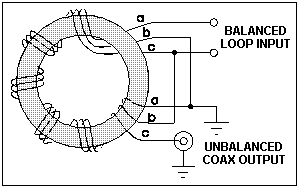
Experiments on Remote Receiving LoopsBy Lyle Koehler, KØLR; Rt 1 Box 659, Aitkin, MN 56431Loop antennas offer many advantages for LowFER reception. They're compact, don't need to be high and in the clear, and their directional characteristics can be used to null out local noise or strong interfering signals. Unfortunately a loop doesn't offer a good impedance match to a coaxial transmission line or to the input of most modern receivers. Also, unless the loop is balanced and shielded, the so-called "antenna effect" makes the loop act like a combination of a loop and a short vertical whip. The directional pattern becomes asymmetrical and the nulls off the side may be only a few dB down from the peak of the radiation pattern. An unbalanced, unshielded loop can also pick up conducted interference from the feed line. You might find a quiet location in the "back 40", put your loop out there, and then re-introduce the noise from the house when you connect the coax. Shielding adds distributed capacitance to the loop and reduces the Q, which in turn reduces the loop's sensitivity. This article gives some ideas on how to use a simple unbalanced loop with a home-brew transformer to achieve most of the benefits of a shielded, balanced loop. Impedance MatchingActually you don't need a transformer to get an acceptable impedance match between the loop and a 50 or 75 ohm coaxial cable. A typical multi-turn, tuned LowFER loop may have an inductance of a couple of millihenries and a Q of 50 to 100. The RF resistance of the loop at 180 kHz will be somewhere around 20 to 50 ohms. No taps or coupling links are required -- all you have to do is series-tune the loop. If the loop is tuned to a fixed frequency somewhere in the middle of the LowFER band, the SWR will be very high at the band edges. The total loss in 100 feet of transmission line might be 5 to 10 dB because of the high SWR. LowFERs are fortunate compared to other people doing weak-signal work. The man-made and atmospheric noise floor is so high that 10 dB of loss at the receiver input isn't as important as it might seem. A simple 50-ohm to 50-ohm isolation transformer can be made with two 16-turn windings of #30 magnet wire on an FT37-43 or FT50-43 toroid core. Keep the windings as far apart as possible to reduce the interwinding capacitance. The insertion loss is less than .2 dB between 100 kHz and 200 kHz, and the interwinding capacitance is about 8 pF. I connected one of these transformers to my portable loop, which has 19 turns of #26 insulated wire wound inside a 4-foot diameter loop of 3/4-inch plastic utility pipe. The loop was series tuned with a fixed 250 pF capacitor and fed with 100 feet of 75-ohm coax of the TV lead-in variety. Using the "Universal" preamp in the LF mode, LowFER signals are within 1 or 2 dB of the level I get with the loop parallel-tuned and with only a few feet of total coax run between the loop, preamp, and receiver. (For information on how to build the "Universal" LF/MF Preamp, click to view a Web article on the preamp.) One of the computers in my shack puts out a huge signal on 188.5 kHz, right on top of ART, but ART was easy copy on the isolated loop. Additional isolation can be obtained by breaking the transmission line between the antenna and receiver and inserting another transformer. A 1:1 toroid balun of the type described in The ARRL Antenna Book can be used to provide a balanced input for the loop. Figure 1 shows the winding connections used in this type of balun. A balun wound with 14 trifilar turns (42 turns total) of #30 wire on an FT50-43 coil has an insertion loss of less than 1 dB from below 50 kHz to above 2 MHz.
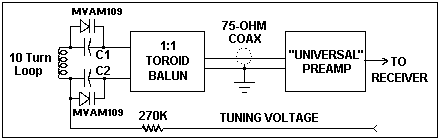
Figure 1. Winding configuration for 1:1 toroid balun ConstructionMy base-station LF receiving antenna is a 10-turn 8-foot loop, parallel tuned with three MVAM109 diodes and connected to a home-brew FET preamp that's mounted on the same rotatable mast as the loop. Six unpainted pine 1 inch by 2 inch by 4 foot spokes attached to a plywood hub make up the support frame. The #24 insulated windings are about 1/4 inch apart and are set into saw slots in the edges of the 1 by 2's, so that the windings all lie in the same plane. With the saw slots angled toward the center, the tension on the windings keeps the wires in place. The loop looks like the outer part of a giant spider web. I've used this loop for over three years with reasonable success even though it isn't shielded or balanced and doesn't have much directivity. The nulls are only about 10 dB down from the pattern maxima. Tuning the LoopI tried the circuit in Figure 2 to see whether a balun would improve the loop's directivity. Rather than exhaust the world's supply of tuning diodes to resonate the loop's relatively low inductance (about 600 microhenries) in the LowFER band, fixed capacitors C1 and C2 were placed in parallel with the MVAM109s. A separate wire was used to carry the tuning voltage, but with DC blocking capacitors at both ends, the tuning voltage could be sent through the signal coax. Because C1 and C2 were each about 2200 pF, the tuning range was very narrow. However, it did peak in the LowFER band, and the output of the "Universal" preamp in the shack was only about 4 dB below what I would get with the mast-mounted preamp. Most of that can be accounted for by mismatch loss, which would be a lot less if the loop had about 20 turns. The pattern was still somewhat asymmetrical, but with nulls of about 24 dB on one side of the loop and 17 dB on the other side it was a significant improvement. NDB's (Non-Directional Beacons, typical areo/marine beacons between 200 - 500 kHz) were booming in even with the loop tuned for the LowFER band. A half hour of scanning netted six new NDB loggings that were previously buried under strong locals.
Figure 2. Remote tuned loop with balun coupling After running these experiments, I returned the loop to the "old" configuration. However, my next loop will have about 20 turns, the preamp will be in the shack, and only the balun and tuning components will be out on the mast. This article originally appeared in The LOWDOWN, and is protected under US and international copyright laws. Please obtain the author's permission before redistributing this document or reproducing it in any other form. HTML code is property of LWCA and must not be used without permission. |