SIW Transition Wednesday
Posted by John Davis on January 11, 2018 at 07:08:50.
Re: to Rick regarding the Western Updates from the 80s
Great! I'll look for your email and will be glad to reimburse postage. I was a Lowdown subscriber in the late 1980's/early 90's and always regretted dumping my old copies during a move!
LW closing in 2018
Posted by Mike Terry on January 02, 2018 at 10:44:43.
Hopefully no news, lets hope it stays that way.
Wishing you all best 73s in 2018
Mike
HiFer "OH"
Posted by Tom Lau on January 03, 2018 at 14:21:23.
Good Morning HiFers....HiFer "OH" is back on the air as of 3Jan18 at 1400 UTC. Frequency should be about 13,555.20 KHz. E-Mail reception reports and frequency to the address shown above. Thanks, 73, Tom N8TL
Re: Transmitting on 75 KHz
Posted by Tim Brannon, WA5MD on January 03, 2018 at 16:31:54.
In reply to Transmitting on 75 KHz posted by Ron NI7J-WH2XND on December 30, 2017
Ron, is this operation under a Part 5 license? I'm trying to catch up on LF after many years away, and I haven't heard of ops at 75 kHz before.
Re: Transmitting on 75 KHz
Posted by John Davis on January 03, 2018 at 17:13:19.
In reply to Re: Transmitting on 75 KHz posted by Tim Brannon, WA5MD on January 03, 2018
Hi Tim. Yes, Ron has been operating WH2XND for some time now, previously mostly at 600 and 2200 meters. His WSPR signal at 2200 m was a regular fixture here in SE Kansas. Now that those are more-or-less regular ham bands, he and other Part 5 experimenters are branching out a bit more.
Check out some of the setup on his Web page: ni7j-wh2xnd.com/
John
HiFer "OH" (correction)
Posted by Tom Lau on January 04, 2018 at 01:10:14.
Hifer "OH" frequency correction.......13.556.673 MHz. QRSS10
Tom N8TL
Re: Big Giveaway of all... (Email & Spam Concern)
Posted by John Davis on January 04, 2018 at 06:24:53.
In reply to Big Giveaway of all my Western Updates from the 80s posted by Stephen McGreevy on December 31, 2017
Steve wrote:
I have always been loathe to post anything to this board because e-address ARE VISIBLE and thus spammable.
On this board, addresses in the Address field are only visible when interpreted in a browser window. Hypothetically, one could sit in front of a screen and copy visible addresses into a list manually--but that's not how spammers work. Automated spambots, coded to disregard the robots.txt file at this and other Web sites, spend their ne'er-do-well days parsing files stored on servers for strings containing an "@" symbol preceded by text, and followed by more text containing at least one "." at some point.
But that's not how we store addresses in the E-Mail Address field here. You can use your browser's View Source menu to see how we code them with the example address in this mail. That is the only thing that's actually "visible" to spambots, and it's not what they're looking for. It requires a browser to interpret those entities into humanly readable text. In essence, it's no different from the coded mail info in your listing at QRZ.com, apart from having to move a mouse over the link to make it display. There's a coded address within the page's source, right along with the JavaScript needed to interpret it...pretty much the same situation, bottom line.
Can the strategy be defeated? In principle, sure. But in over 15 years, it hasn't been. There are both test and working e-mail addresses in various pages at this site that are less thoroughly encoded by the same technique, and they have yet to be spammed.
There's one other thing to keep in mind: it is not necessary to show an email address when posting routine messages here! As both our FAQ and the message posting forms themselves state, that's entirely optional. (As also noted in the FAQ, however, never put an email address in the body of a message...those are not encoded at all!)
An alternative to addresses in text form, of course, is to include a link to a GIF or JPG containing the address in graphical form, such as at your own site. Authenticated Authors can post live links to a graphic or even attach it to their message, and anyone can post a non-clickable URL to a graphical address.
If it's any consolation, the odds are far higher that your email address has already been or soon will be harvested by malware on a computer owned by someone to whom you've previously sent mail.
John
Re: Big Giveaway of all... (Email & Spam Concern)
Posted by ed holland on January 04, 2018 at 19:39:51.
In reply to Re: Big Giveaway of all... (Email & Spam Concern) posted by John Davis on January 04, 2018
Thanks for the clarification John,
I'll be sure to add my email again to postings.
Happy New Year,
Ed
Re: Big Giveaway of all... (Email & Spam Concern)
Posted by John Davis on January 04, 2018 at 21:50:26.
In reply to Re: Big Giveaway of all... (Email & Spam Concern) posted by ed holland on January 04, 2018
Not quite my point, actually. Steve is not entirely wrong to be concerned about spam potential; it's just a question of realistic risks.
While we have been comparatively safe in the past, there are no guarantees for the future. Our good fortune mainly results from spammers' inherent laziness. As long as nobody figures they're missing too many addresses with their current spambots, they're not going to put forth extra effort (and slow down the bots with extra code) to incorporate additional browser-like features into them.
If the workarounds become too conspicuous, they might eventually get greedy (well, OK, greedier) and do something about it. The most common workaround folks use is to substitute "AT" or "-at-" for "@" and "-dot-" or "(dot)" for "." in plain text, and it's not terribly hard to code a pattern recognition algorithm for such substitutions; but that hasn't been a problem yet because nobody feels they're losing too many harvesting opportunities that way. So, it's sort of my canary in the coal mine. When or if we ever see that method becoming unsafe, then it might be time to worry about our own quasi-encryption method.
In this sense, email addresses are a lot like antibiotics: the less you use them needlessly, the longer they'll continue to be effective. Thus, I still do not recommend displaying email addresses in routine posts...only when a direct response is truly required, which is seldom the case in a board like this.
Happy New Year! Good DX to you, and all the best on your restorations.
John
2200 meter small PA
Posted by Lee on January 05, 2018 at 01:01:57.
So I ordered my 2200 meter starter transmitter today. It's a North Country Radio LF90. Now that 2200 meters is official who wants to play with 1 watt. Any one have a pointer towards a small, low pass filtered PA for 2200 meters. Looking for 15 to 30 watt range.
Re: Big Giveaway of all my Western Updates from the 80s
Posted by Glenn on January 05, 2018 at 14:52:01.
In reply to Big Giveaway of all my Western Updates from the 80s posted by Stephen McGreevy on December 31, 2017
Hi Steve;
I was reading your post when something caught my eye. "Vince Pinto". Back in the mid 80's, Vince was a good friend and lived close by (Suffern NY) He introduced me to lowfer operation and helped me get my first lowfer beacon on the air. AS you probably know, he published the "Lowfer Letter" news letter. Sad to hear he gave up on radio. Do you happen to have his contact info? I couldn't find it.
Thanks!
Glenn Reminder: LOWfer net at 0800 California time Saturday morning
Posted by Jerry Parker on January 05, 2018 at 15:16:19.
Hi everyone
Reminder: LOWfer net at 0800 California time Saturday morning
Or listen online at:
WEB SDR KFS
http://69.27.184.62:8901/?tune=3927lsb
click on the autonotch to get rid of hetrodines
Hope to see you there.
73's
JERRY Re: Big Giveaway of all... (Email & Spam Concern)
WA6OWR
Posted by ed holland on January 05, 2018 at 17:40:17.
In reply to Re: Big Giveaway of all... (Email & Spam Concern) posted by John Davis on January 04, 2018
John,
That makes perfect sense, thank you for the explanation.
Regards,
Ed
P.S. The lengthy Philco restoration may well see a power up test this weekend.
Re: 2200 meter small PA
Posted by Lee on January 06, 2018 at 00:19:25.
In reply to 2200 meter small PA posted by Lee on January 05, 2018
Found a 50 watt rated PA for 136khz. I can vary the drive from the LF90 to get 20 or 30 watts out of it. Thanks KE6PCT
Re: 2200 meter small PA
Posted by John Davis on January 06, 2018 at 04:32:53.
In reply to Re: 2200 meter small PA posted by Lee on January 06, 2018
Which one did you end up choosing, Lee?
Re: 2200 meter small PA
Posted by Lee on January 06, 2018 at 04:45:31.
In reply to Re: 2200 meter small PA posted by John Davis on January 06, 2018
This one John. Titled "The 137khz Low Power Transmitter" A project for the impatient. They got that right. I am nothing if not impatient. The PA in the schematic claims 50 watts. They also provides a lot of info on how to make it bigger and badder. 50 watts seems fine for me.
www.qsl.net/df3lp/projects/lftx/index.html
Re: 2200 meter small PA
Posted by John Davis on January 06, 2018 at 07:02:01.
In reply to Re: 2200 meter small PA posted by Lee on January 06, 2018
Thanks, Lee. Just by eyeball analysis, that looks to be a pretty good design. If you are familiar with decoupling requirements and lead-length considerations for stable operation of MOSFET amplifiers, it ought to do well for you.
One factor to especially keep in mind, though, is power dissipation in the final FET. DF3LP anticipated it would operate in Class D mode, which it may well do if the drive level is right (that could be a bit touchy), and if it is approximately a square wave. However, the efficiency numbers given in the text suggest it may not quite have achieved a fully squared drive waveform, or else the duty cycle was a little off. Apparently that was no problem for the heat sinks in his versions of the amplifier, but you'll want to be aware that the LF90 output is substantially a sine wave, so you may be operating more in Class C and thus need to dissipate a little more heat.
Best of luck. Let us know how it turns out.
John
Re: 2200 meter small PA
Posted by Lee on January 07, 2018 at 00:52:08.
In reply to Re: 2200 meter small PA posted by John Davis on January 06, 2018
Thanks John. Good info. Per the web site they are talking class D. And they mentioned adding another filter network to the output.
"but you'll want to be aware that the LF90 output is substantially a sine wave, so you may be operating more in Class C and thus need to dissipate a little more heat."
Good point. I have been thinking of different ways to throttle down the LF90. At the FET output or after the Bipolar driver. I will be aiming for a PA output of around 15 watts. I'll be sure to let you know how it works out.
Re: Hifer beacon
Posted by jimvm on January 09, 2018 at 03:34:10.
In reply to Hifer beacon posted by jim vm on December 31, 2017
Any reception reports welcome. Re: Hifer beacon
Posted by Mike N8OOU on January 09, 2018 at 06:26:46.
In reply to Re: Hifer beacon posted by jimvm on January 09, 2018
Jim
Since your announcement, I have searched for your beacon along with a couple other newly announced Hifers with no success. My WM beacon is located on the property which means I must shut it down to be able to receive anyone else. To get around that problem I use a number of remote online receivers. Once in a while I will hear my beacon on the remotes, but mostly I don't. Hang in there,
Mike 73 K2ORS beacon on 630m
Posted by Sal, K1RGO on January 10, 2018 at 00:18:22.
I am copying K2ORS Wayland MA FN 42hi on 472.5 kHz 569 with QSB tonight 19:00 est local. I am using a LF eng L-950 loop which is quieter than the long wire. Re: Hifer beacon
later...........
Posted by ed holland on January 10, 2018 at 21:06:59.
In reply to Re: Hifer beacon posted by Mike N8OOU on January 09, 2018
Hi Mike,
If you don't mind my asking, Which online receivers do you use? I found only couple at WebSDR.org that cover the 22m band. If there are others, I'd be interested to know about them.
I have the same issue - PVC's dipole is on top of the house, and gets S9+20db reports from recievers connected to the aerial in the garden..
Thanks
Ed
Re: Long wave broadcasting in Canada and USA
Posted by John Davis on January 11, 2018 at 00:30:20.
In reply to Re: Long wave broadcasting in Canada and USA posted by Frank Lotito on December 21, 2017
To answer the question from a historical perspective, longwave broadcasting has only ever been authorized in ITU Region I (Europe, Africa, and northern Asia), and not in Region II (the Americas) or Region III (southern Asia, Australia, and the South Pacific). Before that was fixed in stone, there actually were serious proposals for a longwave broadcast service in the US around 90 years ago. It had been worked out in some detail how many stations would be needed to cover the nation and the power levels that would be required to achieve acceptable signal-to-noise ratios.
Today, the fidelity of a signal with the impaired bandwidth that goes with LWBC would not be acceptable to many listeners, but back then it would not have been an issue. A bigger concern was the limited number of channels that would be available, and how they would be distributed among the nations of the region. That was always a big enough issue in the regular AM broadcast band, which had about nine times as many channels available back then. Given the wide open spaces of the Americas and Australasia (compared to tightly packed Europe), there was a high demand for general aviation, and that meant a high demand for navigational aids that benefited from longwave propagation. As a result, the nations of Regions II and III opted out of LW broadcasting.
As for the Internet...well, I can't bring myself to call that "broadcasting." You have to go looking for every specific "station"...you can't just tune across the dial and find something new or unique. As for efficiency, that's all in how you define it. Streaming "radio" requires servers that can handle all the connections you expect your audience to make, and you have to guess what encoding methods are available to your audience (one our local stations recently started advertising their online stream, but I apparently don't have the right media player for the connection on their Web page, and they don't seem to be able to tell me which one it is; all they know about it is they can hear it on their browsers, so it's our problem to figure out how to hear them), and instead of paying annual music royalties directly to ASCAP, BMI, and SESAC, a streaming "broadcaster" has to pay a middleman for tracking every individual connection playing each individual song, for which you have to provide them a realtime playlist, so you pretty much have to maintain an elaborate automation system and/or rent a pre-packaged music library for your format. As a result, pretty much all "radio," be it real broadcast or online, now sounds like it comes from a desktop PC in Dallas (which is exactly where a lot of it does originate) with local commercials and weather inserted cleverly at the appropriate times. As for reliability, well, let's see how that works out once net neutrality is gone and every big media conglomerate owns its own group of cable and net providers and controls the dissemination paths.
I don't mind new technology like the Web, digital broadcasting, downloadable music, etc., but I resent the big rush to treat everything else as obsolete when it still has tangible benefits of its own.
Re: Hifer beacon
Posted by Mike N8OOU on January 11, 2018 at 02:23:58.
In reply to Re: Hifer beacon posted by ed holland on January 10, 2018
Ed
Yes, most of the receivers on WebSdR have limited frequency coverage usually ham bands.
The receiver network I use can be found at sdr.hu. Most of the receivers there have 0 - 30Mhz coverage. Antenna performance of each station varies a lot. It does not take long to build a bookmark list of the good ones.
Mike 73
Wednesday HiFERs
Posted by John Davis on January 11, 2018 at 06:36:54.
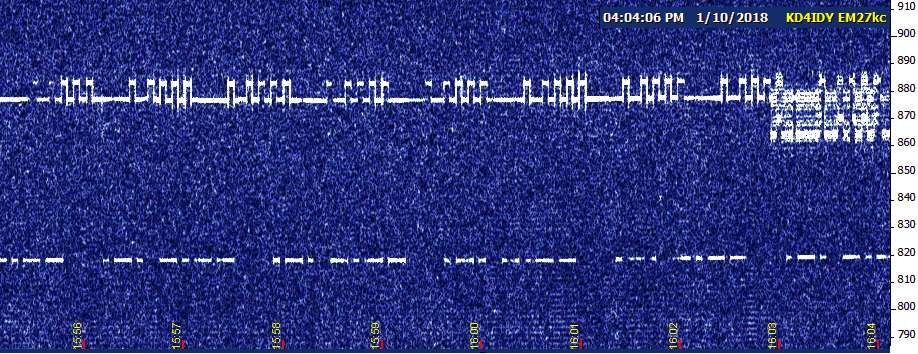
Not very good conditions today, but since it was the first time in a month I've been able to go to the farm, I thought I'd give it a try. USC, EH and RY were present in late morning, with no one else visible or audible on the band.
In mid-afternoon, it was just EH and RY, although stronger than they were in the morning. (EH became painfully strong when it went into noise and double-vision mode, the start of which is pictured here.)
SIW Transition Wednesday
Posted by John Davis on January 11, 2018 at 07:08:50.
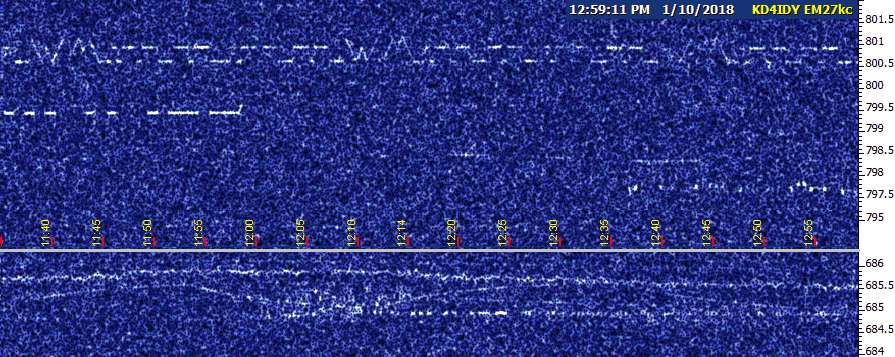
Above are captures of WM and SIW beginning 25 minutes prior to noon CST. In the composite image, 800 represents 185.300 kHz. The anomaly in the final dash of the W occurred about 15 seconds before 11:59 AM. I did not manage to decode the first WSPR-15 transmission because I'm out of practice at lying to WSPR X about non-standard dial frequencies and BFO offsets. I tried a different fib before the next hour, and even though the displayed frequency was still wrong, I at least succeeded in getting a couple of decodes before I had to return to town:
1900  -39  -0.9    0.185185    0   K3SIW         EN51      0
2000  -36  -0.9    0.185185    0   K3SIW         EN51      0
I corrected the frequencies above and in the uploads to WSPRnet, but the other image attached to this message shows what originally appeared in WSPR X. It also shows the way the signal appeared on the WSPR waterfall and in Argo...not very strong and surrounded by QRM, so I'm fairly impressed with the decodes. The 2000 UTC/2:00 PM CST decode is 3 dB better because I shifted the IF passband downward slightly, as 185.185 was at the edge of the filter response.
John
---------------------------------------------------------------
 File Attachment 1: 10jan-lf.jpg
File Attachment 2: 10jan18a.jpg
Re: Hifer beacon
Mike,
Thanks, I'll check it out
Ed
FT-8
Posted by Frank Lotito on January 12, 2018 at 10:10:58.
Does FT-8 require linear RF transmitter amplifiers for the diver and PA stages? REF: QST, January 2018, pages 41-44. 73 Frank K3DZ / WH2XHA
Re: ARGO with SDR's?
Posted by Bob,WA1EDJ on January 12, 2018 at 15:02:34.
In reply to Re: ARGO with SDR's? posted by Larry K9ZBU on December 30, 2017
Thanks Larry!
I did install VB-Audio and got the HDSDR output piped over to ARGO and am seeing some QRSS on 40M. I'm a bit confused where in the ARGO spectrum to find the HDSDR signal though. I did find it by trial and error at around 700 Hz. I have to think about the big picture of how all this works. I think my LO freq on my QRP Labs SDR and the HDSDR LO setting has a bearing on where in ARGO the HDSDR sig will appear. I'll have to spend more time on this and understand it better.
Thanks for the virtual cable suggestion, I'd never used that before.
Bob Reminder: LOWfer net at 0800 California time Saturday morning
WA1EDJ
Posted by Jerry Parker on January 12, 2018 at 15:53:09.
Reminder: LOWfer net at 0800 California time Saturday morning Re: FT-8
Or listen online at:
WEB SDR KFS
http://69.27.184.62:8901/?tune=3927lsb
click on the autonotch to get rid of heterodynes
Hope to see you there
KFS WebSDR in California
Posted by John Davis on January 12, 2018 at 16:32:02.
In reply to FT-8 posted by Frank Lotito on January 12, 2018
From Joe Taylor's release notes for WSPR-X:
Some important characteristics of FT8:

  - T/R sequence length: 15 s
  - Message length: 75 bits + 12-bit CRC
  - FEC code: LDPC(174,87)
  - Modulation: 8-FSK, tone spacing 6.25 Hz
  - Constant-envelope waveform
  - Occupied bandwidth: 50 Hz
  - Synchronization: 7x7 Costas arrays at start, middle, and end
  - Transmission duration: 79*1920/12000 = 12.64 s
  - Decoding threshold: -20 dB; several dB lower with AP decoding
  - Multi-decoder finds and decodes all FT8 signals in passband
  - Optional auto-sequencing and auto-reply to a CQ response
  - Operational behavior similar to JT9, JT65
The FSK nature of the transmission with constant envelope waveform means that linear amplification is not required.
John
RTÉ Radio 1 Ireland
Posted by Mike Terry on January 12, 2018 at 16:44:44.
[Source: Radio.nl in Dutch. Translation by Andy Sennitt]
It will be possible for foreign radio stations to broadcast in the United Kingdom via DAB+ in the future. In the first instance only stations from Ireland have received permission, but later also stations from elsewhere in Europe. The change is due to the deregulation of commercial radio that the British government is going to implement.
Up to now, only UK radio stations have been allowed to broadcast in the United Kingdom, both analogue and digital. Foreign parties were prevented from obtaining permits.
Now that more and more digital listening is done (internet and DAB) there is much more space and so the rules are being relaxed. In many European countries it is already allowed for stations from abroad to broadcast. As a result, the World Service of the BBC can be received via DAB+ in the Netherlands, Belgium and Denmark.
The intention is that the law will be changed so that foreign radio stations can also broadcast in the United Kingdom via DAB+. In the first instance, the relaxation applies only to stations from Ireland, later other European parties will also be admitted.
Due to the change, for example, the Irish public broadcaster RTÉ Radio 1 will be broadcasting digitally in the United Kingdom, creating a good alternative for the longwave.
RTÉ Radio 1 is currently still broadcasting on longwave to reach the older Irish community in the United Kingdom. Actually the broadcaster wanted to turn off the expensive longwave transmitter in 2014, but that resulted in many protests. After having postponed the shutdown several times, it is now scheduled for June 2019.
FT8 Rervisited
Posted by Frank Lotito on January 13, 2018 at 15:00:42.
A few days ago I posted a question on 2 similar interest message boards asking if linear drivers and PAs are required for FT8 modulation. I received 4 replies, 3 of which were e-mails only directed to me. I am still confused. One of the 4 replies said “yes”, the 3 others said “no.” Maybe in a more public forum, such as this message board, the topic can be discussed and my confusion resolved.
Let me reference again the January 2018 QST article on FT8. This time specifically page 44, center column, the second and third paragraphs. This is the section of the QST article that is confusing me. My reading is the author tells the readers that FT8 requires a linear RF driver and PA. However, if FT8 is a FSK (frequency shift keyed) modulation method, why linear?
My radio acquaintances who have tried FT8 use modern HF transceivers. As we know, for the last umpteen decades HF transceivers have been quite linear in design. These acquaintances do not have LF or MF below the broadcast band equipment.
Can one or more of the readership of this column post a reply on this message board clearing the confusion w.r.t. what the QST author is saying? Thank you, 73 Frank Lotito K3DZ / WH2XHA Re: FT8 Rervisited
Posted by Frank Lotito on January 13, 2018 at 15:51:01.
In reply to FT8 Rervisited posted by Frank Lotito on January 13, 2018
I may have answered my question - We use AFSK not direct FSK to generate modulation modes such as FT8. AFSK as I recall requires "linearity" in the audio processing stages. But once in the RF domain we can use non-linear devices, such as heterodyne converters, Class E amps, etc. Did I get that correct? 73 Frank K3DZ / WH2XHA
Re: FT8 Rervisited
Posted by John Davis on January 13, 2018 at 23:38:12.
In reply to Re: FT8 Rervisited posted by Frank Lotito on January 13, 2018
Frank wrote:
But once in the RF domain we can use non-linear devices, such as heterodyne converters, Class E amps, etc. Did I get that correct?
I think so.
My reading of the second paragraph in the middle column of page 44 suggests that he's saying to avoid speech processing on transmit and noise reduction on receive, not for sake of linearity, but to avoid doing anything that would upset the constant amplitude nature of the signal. Some speech processing emphasizes different frequencies in a way that would be counterproductive to decoding, and/or might add audio harmonic distortion that would translate to excess bandwidth in the RF domain. Noise reduction, on the other hand, often regards constant level tones as heterodynes and tries to null them if they settle on a single frequency for some number of milliseconds...bad news for a digimode.
As for the ALC recommendation in the third paragraph, since only a single tone is present at any one time in FT8, there's no risk of intermodulation even if the amplifier is driven hard. Therefore, the reasoning behind this recommendation probably has to do with power dissipation and duty cycle. Most linear amps should not be operated at or near their rated PEP with continuous carriers, of course, such as found in FM, key-down CW, AM, or in this case, 12-15 seconds at a time of constant amplitude FSK. Keeping drive level below ALC threshold thus provides a bit of safety factor.
John
Project progress
Posted by ed holland on January 15, 2018 at 21:53:22.
Hi Folks,
There was no time for Hifer logging this weekend, but work on the 1934 Philco restoration reached a huge milestone. With the chassis restoration complete, electrical testing started last weekend. No reception, but there were signs of life from the audio circuits. Investigation revealed some wiring anomalies which I corrected, and was finally able to recheck and test yesterday afternoon. To my delight the set emanated a fuzz-buzz which changed with the tuning dial - interference picked from the bench's fluorescent light. With a short lead clipped to the antenna terminal, it came alive with broadcast band stations up and down the dial. Enough volume to take your hat off from the push-pull audio o/p stage.
Next thing will be to attend to R.F. alignment, although it can't be too far off for Medium Wave.
It has taken over a year to revive (Autumn 2016) since the poor thing was removed from storage and - to our dismay - found to have suffered appalling physical and electrical deterioration. At times it sat on the bench while I took a break or pursued other projects. At others, I longed to resume work but could not find time. Picking away steadily, a little here and there, not allowing frustration to creep in at the slow progress has won out. I am extremely pleased that the efforts have been fruitful.
Cheers,
Ed
Re: Project progress
Posted by Tim Brannon, WA5MD on January 17, 2018 at 02:52:41.
In reply to Project progress posted by ed holland on January 15, 2018
Ed, this story brings back many fond memories. I'm glad you're having a good time with it.
Re: Project progress
Posted by Rick on January 19, 2018 at 00:47:11.
In reply to Project progress posted by ed holland on January 15, 2018
Hi Ed,
Glad you're having fun with your 1934 Philco -- what model is it? They made some really handsome console sets that year. My two Philco's are a model 84 Baby Grand (a depression-era table set that's been in the family since new!) and a 1936 model 620 tombstone style with coverage to 18 MHz. The latter is an impressive performer for listening to the 40 and 80 meter hams running AM.
When not messing with longwave stuff, I enjoy restoring these old sets. My most recent is a magnificent Stromberg-Carlson 450M from 1939; 10 tubes, variable selectivity, green eye tuning indicator, and enough audio (with its "Acoustic Labyrinth" speaker system) to blow the windows out of the house!
-- Rick
DP0GVN WSPR beacon
Posted by Mike Terry on January 19, 2018 at 15:25:39.
The DP0GVN WSPR beacon now is in operation from Antarctica's Neumayer III Research Station of the Alfred Wegener Institute for Polar and Marine Research. The installation is part of a scientific project of the Technical University of Munich in cooperation with the University of Bremen and the German Amateur Radio Club (DARC). "The beacon is still under test and will be shut down occasionally for more configuration and optimization of antennas and software, before it can be mounted at the final installation site in a few weeks," said Rainer Englert, DF2NU. The technology consists of a multiband WSPR receiver that can simultaneously monitor up to eight bands from 160 to 6 meters and feed several hundred reports per hour to WSPRnet http://wsprnet.org/. The 5-W multiband transmitter also had been commissioned and is working into a vertical antenna. Englert said that DP0GVN already has received "several thousand beacons spots." DP0GVN also will be the call sign for Matthias Maasch, DH5CW, starting in February, at Neumayer III Research Station for 1 year, and he plans to be active on HF. QSL DP0GVN via DL5EBE. -- Thanks to Tom Kamp, DF5JL, IARU Region 1 HF Committee Chairman via Rainer Englert, DF2NU, and The Daily DX http://www.dailydx.com https://www.eham.net/articles/40701
JT9 Overnight Thurs/Fri
Posted by John Bruce McCreath on January 19, 2018 at 18:31:37.
I set up for JT9 receiving early Thursday evening, and was rewarded with a nice string of decodes.
Using a PA0RDT mini whip at 7 metres AGL, connected to my TS-440S, the following stations are
what I logged overnight Thurs/Friday, in chronological order:
K8TV, K9SLO, WA9CGZ, K2BLA, W4KZK, WA3EDT, KA9OKH, NO3M, K3MF, WB4JWM, W3XY,
K0KE, KC3OL, K9KFR, NC0B, W0YSE, and N9RU.
73, J.B., VE3EAR
LowFER Beacon "EAR"
188.830 kHz. QRSS30
EN93dr
Western Updates to give to Rich: Sri I took so long...
Posted by Steve McGreevy on January 19, 2018 at 22:26:58.
In reply to Re: Big Giveaway of all my Western Updates from the 80s posted by Glenn on January 05, 2018
Hello Glenn, (RICH Barton, etc. too) So Sorry I took so long to write - thanks JOHN D. for the option of not-including e-mail addrs. to better prevent spam-bots etc.
I am late replying due to some away travel and obligations, but I only know about Vince Pinto from the various LF pubs like WU and NO and maybe some back copies of the LL. I'm not in how mode by any means - just got good antenna rigged up for 630 m operation about 473 kHz CW or QRSS (if I can get a xtal for it.)
Vince burned out about 1983 from LFing, and said in short and paraphrasing: "let me be! I am going into Zen gardening and leaving the technical stuff." (i.e. big burnout). He did do intense Lowfer research and xmtr designs.
I was "TLX" 181.71 from Marin County for years between 1986 to 1991. I heard the thing on DXpeditions to UT, NV, OR, etc. Often in UT, or NV right at dawn by the Snake Range (GBNP) with a west Bev., R-1000, audio-filter and perselector/preamp/the LF beacon- clusters on 1750m all throughout CA (south, north) would **bomb in** along with hoards of PLCs for 15 minutes @ sunrise enhancement times. Oh those were the DX days!
SORRY EVERYBODY TO TAKE LONG TIME TO REPLY. great site JohnD! I really ought to rejoin LWCA as I DX LF a lot in the noise/birdies/CFL/LED/crudgrunge/noise/desert fringe, still have about 30 kHz free of (most) noise below 430 kHz, hi, and 359 kHz like 350 kHz is remarkably in the clear for DXing the BO-ID/YAZ/YQZ-etc. Canadian mixture and propagation listening. Occ 171 Mdei-one gets in a carrier. Hets on the MWBCB frequent - big Asian opening on MFBCB 8 days ago or so - like being on the coast!
I plan on finally updating my NDB photo page on auroral chorus.com and getting all images to auto-load inline. some are missing too. I might try 3927 net sat a.m. if i get up in time as I like being a night-owl for obvious reasons-hi!
Yes... sri for the fact if i sounded vy. frustrated (or worse) in Nov. - that was a bad month for me with family issues, crisis, etc. Over it all now.
I do plan on relocating but will keep the Keeler, CA property for rental/house swapping - any desert rats desiring a house-cabin-swap? - i need a ***quiet DX spot** badly - acoustically too. NOISE of both kinds plague Keeler (jets, locals/tourists, etc.) compared to my vy. quiet (BOTH ways) Marin County days.
So it is hi-time after 21 yrs to split the noisy-southern Owens Valley for a place I can hear 630 m signals better and not like being near a mil-base. for now, I can xmit. on 630m with 12 watts input and now have gained maybe 6 dB gain with new wires up over previous my antenna system. SO maybe skywave DX on 630 m possible. Anyone OTA there? can do the 2200m band QRSS too, now with same xmtr designed for big lower/medfer tests part-5 or even pt-15 if the power is dropped to teeny levels (noise makes old style LF on 1750m not really too easy unless dxpeditioning.
well, thanks for the updated list. Rich in AZ - you were first to respond for the WUs going actually yack to #8 that Mike Mideke wrote then, before Jim Ericson took over. 85 to 1992. I have time at last to scan what I wish, send the binders to Rich IN HOPES he or somebody can PDF the entire lot for all, my noes and all - it would be awesome to get scans of the entirety, but time is low for that big effort. Maybe Rich could outsource the job? would be cool to see my stuff and all the enlightening Western Updates online. Way too much DX and experimental history to not be gifted to the DX community(ties).
Thanks for all, dudes, and back to some 630m testing… (472.9 kHz xtal div. by 16 circuit, so as such I need to get on eBay etc. and get more xtals for nearby frees or build a stable VFO…
73 for the mo…
steve mcgreevy - aroralchorus.com (the natural radio site, etc.)
Corrected website url
Posted by Steve McGreevy on January 19, 2018 at 22:39:47.
In reply to Western Updates to give to Rich: Sri I took so long... posted by Steve McGreevy (Stephen) on January 19, 2018
OOps I goofed up the URL of my site:
www.auroralchorus.com
It's been updated and I no longer sell the WR-3 for the time being since whistlers/chorus are gone or nearly DOA, and I have a client-fellow with a biz into AC grid detection/theft/defects/harmonics and the WR-3 plus higher-complexity versions are superb for AC-hum monitoring, as we all know…
I hardly listen to natural radio except for tweeks/sferics, as that is all that I can hear - mag. storms do not produce emissions these days - bummer! It's all nearly vanished. go figure…
So the ionosphere still functions below 6MHz at night… SolarFlux coming below-55 soon, anyone? S.B. good for LF tho!!!!!
I can't get on 40m any more as no short skip by day-nets.
6m lacks e-skip (10% compared to 2008-10.) 5% compared to FM band e-skip and TV back in 2000!
So with 106 grid squares worked since 2009 (remarkable stable-F2 on 6m to Hawaii Isl. where I lived once, about 5 yrs ago, too!)., I will leave 6m too, save for rare op. times.
73 for the mo and hope for a better ionosphere...,
Steve ;-) Reminder: Lowfer net 3927Khz Saturday morning 0800 California time
Posted by Jerry Parker on January 20, 2018 at 02:38:02.
Or listen online at:
WEB SDR KFS
http://69.27.184.62:8901/?tune=3927lsb
click on the autonotch to get rid of hetrodines
Hope to see you there
KFS WebSDR in California
69.27.184.62
Jerry JT9 overnight Fri/Sat additions
WA6OWR
Posted by John Bruce McCreath on January 20, 2018 at 14:12:54.
I ran JT9 again overnight Fri/Sat and copied many of the stations from the previous night,
plus some new ones added to the log, KB5NJD, W7IUV, N1BUG, K5DNL, and VE3CIQ.
73, J.B., VE3EAR
LowFER Beacon "EAR"
188.830 kHz. QRSS30
EN93dr
Re: Project progress
Posted by Ed Holland on January 20, 2018 at 16:41:25.
In reply to Re: Project progress posted by Rick on January 19, 2018
Hi Rick,
It is a model 16X, with the early 5 band chassis. 520 kHz - 1620 kHz for medium wave, then four SW bands up to 23 MHz. Top of the line as I understand it. 11 tubes and a handsome Art Deco cabinet reminiscent of "Egyptian" styling.
With the large speaker, and a hefty push pull output stage it is capable of incredible volume and rather good sound quality.
We got lucky with this - found at the end of the day by my wife for $20 at a garage sale. The owner was desperate not to have to drag it back inside.
It has been fascinating to get an insight into radio technology from a bygone age.
Cheers
Ed
Re: JT9 overnight Fri/Sat additions
Posted by John Davis on January 20, 2018 at 18:51:41.
In reply to JT9 overnight Fri/Sat additions posted by John Bruce McCreath on January 20, 2018
Are these all on 630 meters?
Re: JT9 overnight Fri/Sat additions
Posted by John Bruce McCreath on January 21, 2018 at 03:25:34.
In reply to Re: JT9 overnight Fri/Sat additions posted by John Davis on January 20, 2018
Yes John, they were all on 630M. USB dial 474.200 kHz.
73, J.B., VE3EAR JT9 overnight Sat/Sun
Posted by John Bruce McCreath on January 21, 2018 at 15:05:16.
I’m sorry to report that I had no new additions to my JT9 “weekend heard list” overnight Saturday/Sunday.
Most of the ones I had logged on the two previous nights put in re-appearances, but my hopes for at least
one or two new loggings were dashed.
73, J.B., VE3EAR
LowFER Beacon "EAR" Winter Field Day anyone?
188.830 kHz. QRSS30
EN93dr
Posted by Chuck, N1KGY on January 25, 2018 at 16:43:29.
Not exactly an LF/MF topic, but curious if any of the other folks here are going to do WFD this weekend? www.winterfieldday.com/rules
This year will be my first with it - I've been invited to come play with an informal group of fellow Army vets (who are also hams) from the Raleigh/Durham area. We'll be portable at a small farm in FM06mg, running 2 or 3 transmitters from an unheated barn, so it counts as "Outside" ;P
73 and hope to hear you on the air,
Chuck
VLF at Quartzfest
Posted by Ward K7PO on January 27, 2018 at 02:58:01.
Hi All,
Just finishing up at Quartzfest, a week long RV Hamfest in the AZ desert. We had well over 800 sign in this year. Vlf listening was awesome, starting with the Alphas bee-booping away every time I tuned for them, NAA pinning the S meter, and JJY on 40 khz from just after SS to a bit after SR each day. NDB band was full all night. WH2XND was S6 on 75 khz. XXP on 137.505 was stronger (S9), but it's only 80 miles from here.
Rig was an E probe, upconverter, and an R-71a.I heard a time signal on ~68.5 khz each morning, anybody know what that one is? Had the same sound as WWVB and JJY.
-73- Re: VLF at Quartzfest
Ward K7PO
Posted by John, W1TAG on January 27, 2018 at 03:15:31.
In reply to VLF at Quartzfest posted by Ward K7PO on January 27, 2018
Ward,
I believe the 68.5 kHz time signal is BPC in China. Nice!
John, W1TAG
Reminder: Lowfer net 3927Khz Saturday morning 0800 California time
Posted by Jerry Parker on January 27, 2018 at 04:05:55.
Or listen online at:
WEB SDR KFS
http://69.27.184.62:8901/?tune=3927lsb
click on the autonotch to get rid of hetrodines
Hope to see you there
KFS WebSDR in California
69.27.184.62
Jerry 4000 Meters or 75.595 KHz
WA6OWR
Posted by Ron Douglass on January 27, 2018 at 13:42:02.
Hi All,
Up for a challenge?
How about 4000 Meters or 75.959 KHz, we are still transmitting a WSPR beacon in no mans land!
Many thanks to the stations that are monitoring we do appreciate it.
73, TDV hifer
Ron WH2XND
Posted by Bill Hensel on January 27, 2018 at 21:52:53.
New Beacon for me...TDV 2108 utc I heard it for about 4-5 IDs
Antenna: Doty low noise antenna 9:1 transformer
Re: VLF at Quartzfest
Posted by Ward K7PO on January 27, 2018 at 22:24:16.
In reply to Re: VLF at Quartzfest posted by John, W1TAG on January 27, 2018
Thanks John! As you might imagine, my internet speed is non-existent here at Quartzfest. No way to research anything. Even email is a long process. Thanks for the info on BPC. It has been in every morning. Even with my relatively quiet qth in Tonopah, I don't think I'd hear it there.
Sunday28th Jan HiFERs
Ward K7PO
Posted by ed holland on January 29, 2018 at 23:22:42.
An early listening session yesterday, from around 0700 to 0730 PST (1500 UTC). I was hoping for better conditions, as sometimes noted in the morning from previous logs.
Of the regular CW beacons, only RF was heard directly for brief segments. Spectrum Lab recorded good traces from EH, and USC. Nearby SIW was inferred from a broken, noisy trace. However, that was about it.
Shortwave listening elsewhere revealed rather uninspiring conditions all round e.g. 20 m beacons.
Cheers
Ed
P Hifer
Posted by Bill Hensel on January 30, 2018 at 23:07:33.
Jan 29 P was very good copy from 2114utc-2122utc...in Colorado
Where is this beacon from?
Antenna: John Doty Low Noise Antenna 9:1 transformer
Re: P Hifer
Posted by John Davis on January 31, 2018 at 02:59:06.
In reply to P Hifer posted by Bill Hensel on January 30, 2018
Is that one on or very close to 13,555?
I can't imagine why someone would go to the trouble to operate a beacon, then not anyone know who or where they are.
phase encoding
Posted by WA4SZE on January 31, 2018 at 14:27:58.
WA4SZE is experimenting with phase encoding on 630 meters! carrier is shifted 90 degrees for data transmission GPS is used as ref at zero degrees see if you can make a decoder to see the WA4SZE message! Transmitter is 475 kc. EXPERIMENT!!! just making a CW contact is worthless and no big feat as Ships at sea used 475 kc with cw for years Do something cutting edge! EXPERIMENT come up with something!!! CW has been around for over 100 years it's old tech so no big feat! Ham Radio has become boring with all the crybabies wanting it their way! Tell them to take a hike and get on with EXPERIMENTING!!!!
Planned Outage -- Comments?
Posted by Webmaster on January 31, 2018 at 18:44:28.
This is to inform you that this entire site will be unavailable from approximately a minute past 23:59 UTC on the 28th of next month until March 1. Please plan accordingly.
As always, your thoughts are welcome. However, I personally suspect nobody will care.
John
Re: P Hifer 13555 khz
Posted by Bill Hensel on January 31, 2018 at 20:11:24.
In reply to Re: P Hifer posted by John Davis on January 31, 2018
Sorry John I forgot to put the freq. 13555 khz
potrzebie