
Re: Planned Outage -- and the Unplanned One
Posted by Webmaster on March 02, 2018 at 18:44:54.
In reply to Re: Planned Outage -- Comments? posted by Webmaster on March 02, 2018
Re: Planned Outage -- Comments?
I wrote:
This is to inform you that this entire site will be unavailable from approximately a minute past 23:59 UTC on the 28th of next month until March 1.
Hmmm. I wrote that in January as an early April Fools gag, inspired by something a nearby Kansas sheriff did to see the reaction of his constituents and make a point about reading websites carefully. None of you had any reaction whatsoever, so unlike the good but sometimes inattentive folks of Allen County, our readers didn't take the bait.
The joke was, of course, that there were only 28 days in the "next month," so there was no real interruption planned at all. But several replies popped up on social media anyway, protesting the sheriff arbitrarily cutting off or censoring Internet service to the inmates.
You guys didn't fall for it, but the joke was on me in the end. Tuesday night, a day early, something went amiss either with my FTP client or with our hosting service's file backups and the LWCA home page temporarily got replaced with an incomplete version of a commercial site I manage. A member let us know about it on Wednesday and I fixed it.
If we have another joke of some sort for the real April Fools Day, I hope the bugs will be less conspicuous. :)
John
Re: Planned Outage -- and the Unplanned One
Posted by Webmaster on March 02, 2018 at 18:44:54.
In reply to Re: Planned Outage -- Comments? posted by Webmaster on March 02, 2018
Yesterday I speculated that "something went amiss either with my FTP client or with our hosting service's file backups" to account for the homepage glitch we had on Wednesday morning. Turns out now there's reason to believe it was a backup failure on the part of our hosting provider, because some content I posted last weekend specifically for LOWDOWN subscribers to access this week had also disappeared. I discovered that myself when I got my copy in the mail today and went to look up the material.
It's therefore reasonable to suppose other files at this site could be misplaced, too. If you find any pages that are missing or links that don't work, please let us know right away at the email associated with this message. Thanks!
John
Reminder: Lowfer net 3927Khz Saturday morning 0800 California time
Posted by Jerry D Parker on March 02, 2018 at 19:06:08.
Reminder: Lowfer net 3927 kHz Saturday morning 0800 California time
Or listen online at:
WEB SDR KFS
http://69.27.184.62:8901/?tune=3927lsb
click on the autonotch to get rid of heterodynes
Hope to see you there
KFS WebSDR in California
69.27.184.62
Jerry HiFERs Saturday Morning
WA6OWR
Posted by John Davis on March 03, 2018 at 18:18:10.
In the 11 AM hour, CST, I managed to see RY, EH, USC, and NC at the watering hole, and heard WV with about 65% copy. EH was wandering around a fair amount and was often on top of the lower frequency of USC. NC seemed to be experiencing random frequency shifts and noise, too.
I checked for everybody on the list before returning to 1750 meters, but those were the only ones who made it through. Codar was a bit annoying this morning. I'll check again this afternoon.
John
Donebach Down
Posted by John Davis on March 04, 2018 at 18:08:31.
The Donebach LWBC station on 153 kHz was one of three 500 kW LW stations shut down in Germany at the end of 2014, even though it had recently been outfitted by Transradio with a fine DRM digital transmitter setup. It will not tickle the airwaves any more...the twin 363 meter masts were demolished this past week:
www.youtube.com/watch?v=v-jWTCJ89bk
(Caution: if you have even the slightest trace of acrophobia or vertigo, you won't want to watch some of the tower climbing and base jumping videos that YouTube will offer you afterward!)
Thanks to Stefan Schaeffer DK7FC for posting that link on the RSGB reflector. Now I know how one of the towers for which I was once responsible looked as it fell during a tornado. Normally, a tall guyed tower that fails structurally should collapse in a compact pile centered on its base; but if one or two guy anchors are blown up or damaged (as at Donebach and WACS-TV, respectively) the tendency is apparently to crumple section by section along its length as it is pulled down by the remaining guys.
If you care to see the site as it once was, for now Google's satellite view still shows them when they were standing:
maps.google.com/maps?t=h&ll=49.560031,9.176245&spn=0.005915,0.014634&om=0
John
WSJT-X 1.9 vs 1.8 WSPR test summary
Posted by Paul N1BUG on March 04, 2018 at 18:23:49.
In reply to Re: WSJT-X 1.9 v 1.8 second night posted by Garry K3SIW (fwd by JD) on February 27, 2018
Thanks to the WSJT development team for the (mainly LF and MF) WSPR decoding enhancement!
I am concluding my side by side LF and MF WSPR decoding comparison between WSJT-X 1.8.0 and 1.9.0-rc2. Here are results from the six night test. Each line specifies number of decodes in 1.9 / number of decodes in 1.8, percentage of decodes in 1.8 compared to 1.9. I never saw 1.8 decode anything 1.9 failed to decode.
02/26
LF 253/183 72%
MF 933/883 95%

02/27
LF 178/174 98%
MF 890/838 94%

02/28
LF 077/076 99%
MF 347/330 95%

03/01
LF 059/051 86%
MF 627/598 95%

03/02
LF 093/088 95%
MF 786/746 95%

03/03
LF 075/064 85%
MF 490/465 95%
The geomagnetic field was quiet the first night, active to minor storm the second and has not yet recovered fully at LF and MF (at least for high latitude paths from my location).
The number of decodes should not be considered valid for comparing one night against another. My WSPR transmitting activity on LF varied from WSPR-2 only to a combination of WSPR-2 and WSPR-15 which reduced available time slots for receiving and therefore the number of total decodes on some nights. Within a given night the numbers should provide a valid comparison between the two versions.
This is what I saw at my station. Your results may vary. I am now running only 1.9.0-rc2 for LF and MF WSPR monitoring.
73, YSH recording Smiths Falls, Ontario, Canada
Paul N1BUG
Posted by Scorpio on March 04, 2018 at 22:33:37.
Hi there, I recorded a video of the NDB Non-Directional Beacon YSH which transmits at 334 kHz in Smiths Falls, Ontario, Canada. This video was recorded near the transmitter site at the end of Empress Avenue in Smiths Falls. I thought i'd like to share this video with you! https://m.youtube.com/watch?v=nKdLdK1BjfU Re: HiFERs Saturday Morning
Posted by Ed Holland on March 05, 2018 at 04:26:47.
In reply to HiFERs Saturday Morning posted by John Davis on March 03, 2018
I Listened here in Northern California a couple of times this afternoon. I think USC and EH were in the mix, close together as reported above by John.
Very prominent at times was keying of the single letter P, around 13,555.5 kHz. Visible and at times strongly audible.
No Sign of any of my "Usual Suspects" on the high side of 13,560 kHz today.
Re: HiFERs Saturday Morning--Afternoon
Posted by John Davis on March 05, 2018 at 05:12:06.
In reply to HiFERs Saturday Morning posted by John Davis on March 03, 2018
In the 3-4 PM hour (CST) Saturday afternoon, it was only EH and RY at the watering hole, and FRC was the only one above mid-band; although there were a couple of times when the ESA dashes may have made an appearance (kind of hard to tell under Codar, and no keying was audible). EH still looked about as ragged as it did in the morning.
By the way, attached is a screen from the morning receptions.
John
---------------------------------------------------------------
 File Attachment 1: 3mar-am.jpg
Saturday at 1750 Meters
Saturday was the first time since early December that I was going to be able to go to the field at night, so I took advantage of the day to concentrate mainly on LF. First, I made it a point to catch the SIW frequency and mode transition at local noon (see relevant attachment). Both WM and SIW were very nearly equal in level all afternoon. During the transition to skywave around sunset, though, they took turns as the stronger signal, first one for 15-25 minutes, then the other.
After dark, I tried first for EAR...didn't really expect anything so early in the evening, but TA-DA! between 7:45 and 8:00, it began coming in!

Later I tried for MLS with no result (very noisy around that frequency at night), and then later went back to the watering hole in hopes of seeing SJ. Unfortunately, I had to quit by midnight, by which time SJ had not shown up yet.
John
---------------------------------------------------------------
File Attachment 1: 3mar-WMSIW.jpg
File Attachment 2: 3mar-EAR.jpg
OT - Amp/Splitter for scanners
The distribution amplifier arrived on Friday afternoon, so I had the weekend to evaluate its performance when connected to my 2-bay VHF antenna and the three receivers. In a word, WOW! It has made a huge improvement over the old three port passive splitter I had been using, for reception of the civil air band, 2 M and 70 CM ham bands, and the commercial VHF band. My main area of interest is the VHF marine band, with a dedicated scanner. The 2018 shipping season on the great lakes is due to open in a few weeks, so I'm looking forward to hearing a lot more activity from the ships.
Without hesitation, I can recommend the Channel Master CM-3414 four port HDTV amplifier for improving reception of signals in the 50 to 1,000 mHz. range. It cost me $75 CDN including tax, delivered to my door.
73, J.B., VE3EAR Re: OT - Amp/Splitter for scanners
Posted by John Davis on March 05, 2018 at 17:13:40.
In reply to OT - Amp/Splitter for scanners posted by John Bruce McCreath on March 05, 2018
That's great news, J.B. Thanks for letting us know!
John
Re: Saturday at 1750 Meters
Posted by John Bruce McCreath on March 05, 2018 at 17:19:58.
In reply to Saturday at 1750 Meters posted by John Davis on March 05, 2018
Thanks for the report and Argo snip of EAR in the early evening, John. Propagation to the N-E was good last night. I logged three Greenland Navtex stations on 518 kHz.
73, J.B., VE3EAR
LowFER Beacon "EAR" Re: Saturday at 1750 Meters
188.830 kHz. QRSS30
EN93dr
Posted by Mike N8OOU on March 05, 2018 at 17:21:31.
In reply to Re: Saturday at 1750 Meters posted by John Bruce McCreath (fwd) on March 05, 2018
John: Thanks for the very nice capture of SIW/WM. It's good to see that
your receive setup at the farm is working well.
73 de N8OOU - Mike Meek
ULF / SLF (0 - 100 Hz) Magnetic field detection
Posted by Sam Brown on March 06, 2018 at 00:47:08.
I am trying to build a mag loop that will be square shaped and have 40 meters on each side. So total "loop" (actually a square) will have 160 meters of circumfrence and have 5 - 10 coils or turn. The loop will be buried 2 feet down. I want to use this to pick up ELF / SLF mag waves occurring in nature. It will be in a field at least 1/2 mile from any power lines / human activity. Does anyone have any experience with this? Would a 10,000 turn solenoid be more sensitive? Thank in advance.
Re: ULF / SLF (0 - 100 Hz) Magnetic field detection
Posted by John Davis on March 06, 2018 at 02:41:12.
In reply to ULF / SLF (0 - 100 Hz) Magnetic field detection posted by Sam Brown on March 06, 2018
It's been a while since I've had direct experience in this frequency range, so I hope someone else will also chime in.
I think the real question is less about sensitivity in general, but more about what signals you're trying to pick up. Alignment of the antenna with respect to signal polarization is the big issue. From my own background, I can say that Schumann resonances, ULF submarine signaling systems, and such signals can be received with vertically polarized antennas, both monopoles and vertically orientable loops...but from what I remember reading on www.vlf.it, horizontal loops are generally ineffective with those. (On the other hand, horizontal loops have been reported to pick up things in the low tens of Hz whose origins are thus far debatable.)
Just my humble opinion, but of the two choices you're considering, I suspect the ability to orient the solenoid for directionality in any plane of your choosing will be the most flexible option.
John
NDB 'MOG' is off the air
Posted by jim vm on March 06, 2018 at 17:41:30.
I noticed that the NDB near Montague airport is off the air this morning.
This has happened before, coming back in a few weeks.
MOG is on 404 kHz and is close to California northern border near Yreka.
This leaves only one daytime NDB for me, TCY, 203 kHz at the Tracy, CA airport.
Re: OT - Amp/Splitter for scanners
Posted by John BDQ on March 07, 2018 at 05:10:55.
In reply to OT - Amp/Splitter for scanners posted by John Bruce McCreath on March 05, 2018
JB... Good to know
73 FRC and ESA
VE7BDQ
Posted by Bill Hensel on March 08, 2018 at 16:24:18.
Both FRC and ESA coming in at 1611 Utc...
Less QSB on FRC
New HIFEER Beacon "NDB2"
Posted by Jeff K8NDB on March 09, 2018 at 13:36:09.
I have installed a new solar powered HIFER beacon at St. Libory, IL (EM58). Call sign NDB2 transmitting 13.554 Mhz 10 wpm cw 24/7. The antenna is a inverted V. Any signal reports would be appreciated. TNX Jeff K8NDB.
Re: New HIFEER Beacon "NDB2"
Posted by John KF7RPF on March 09, 2018 at 14:29:45.
In reply to New HIFEER Beacon "NDB2" posted by Jeff K8NDB on March 09, 2018
Jeff, The beacon is transmitting and is being monitored here in St. Libory.
Re: NDB 'MOG' is off the air
Posted by jimvm on March 09, 2018 at 16:55:27.
In reply to NDB 'MOG' is off the air posted by jim vm on March 06, 2018
It's back on the air! Never mind. Reminder: Lowfer net 3927Khz Saturday morning 0800 California time
Posted by Jerry Parker on March 10, 2018 at 01:31:17.
Reminder: Lowfer net 3927 kHz Saturday morning 0800 California time
Or listen online at:
WEB SDR KFS
http://69.27.184.62:8901/?tune=3927lsb
click on the autonotch to get rid of heterodynes
Hope to see you there
KFS WebSDR in California
69.27.184.62
Jerry P
WA6OWR
Posted by Bill Hensel on March 10, 2018 at 16:04:38.
March 10 P was a big signal at 1557 utc no other beacon being heard at that time.
Thursday--SJ, WM, and SIW but no MLS
Posted by John Davis on March 11, 2018 at 05:52:20.
The dog ate my Internet! Well, not exactly...our Telco lost connectivity to the whole town for two days just as I needed to send this, We got it back Saturday, and I've been trying to catch up ever since.
Attached is my favorite capture from Thursday night, showing SJ switching on a little after 10 PM CST and giving several nice IDs. Afterward, I tuned up to watch for MLS but never saw anything that looked like it in any of the overnight captures. (Still on?)
John
---------------------------------------------------------------
File Attachment 1: 08mar-whole.jpg
Antarctica and 630m WSPR
Since a few weeks the German Antarctic research station Neumayer III ( en.wikipedia.org/wiki/Neumayer-Station_III ) is running a Red Pitaya on a wideband RX antenna to receive/decode/upload WSPR reports on up to 8 bands simultaneously. You may have noticed them already on the WSPR map on other bands. I saw regular spots on 160m from DL stations and other countries in EU.
They seem to have quite a good satellite internet connection. So uploading WSPR spots is no problem. They also run an up to date webcam showing an image for example here:
www.qrz.com/db/dp0gvn
One of the maintainers of the radio station there is Felix / DL5XL. I know him personally and, taking the idea of EA5DOM, I contacted him and asked if they want to try to receive on 630m as well. Yesterday I got an answer.
DP0GVN in IB59UH will receive WSPR(2) on 630m daily between 4...7 UTC now.
I asked them if they can extend the time to 20...07 UTC. Let's see.
So turn on your PAs and make a first contact from your continent to Antarctica on 630m! And spread the message into other reflectors, VK could be in a favorite position.
Re: New HIFEER Beacon "NDB2"
73, Stefan
Posted by Jeff K 8NDB on March 12, 2018 at 12:20:03.
In reply to Re: New HIFEER Beacon "NDB2" posted by John KF7RPF on March 09, 2018
Hifer NDB2 was built by Jeff K8NDB and installed by John KF7RPF. Without John's efforts this installation would not have happened. Thanks KF7RPF!
Re: New HIFEER Beacon "NDB2"
Posted by Mike N8OOU on March 12, 2018 at 17:43:07.
In reply to New HIFEER Beacon "NDB2" posted by Jeff K8NDB on March 09, 2018
Jeff - John
I am located one grid square East (EM68es) of NDB2. I have listened the past couple days in different time slots hoping to catch a hint of ground wave signal from NDB2. So far I have had no luck. I suppose your signal is flying just high enough overhead to be out of my earshot. Good luck!
Mike N8OOU - 73
Re: New HIFEER Beacon "NDB2"
Posted by Jeff K8NDB on March 13, 2018 at 15:39:09.
In reply to Re: New HIFEER Beacon "NDB2" posted by Mike N8OOU on March 12, 2018
Mike, Thanks for your effort to receive NDB2. Hopefully you will hear it soon. 73! Jeff
The SDRPlay RSP-2 on LF?
Posted by Tim Brannon, WA5MD on March 15, 2018 at 19:36:22.
I've been looking at the SDRPlay RSP-2 as a possible LF receiver and wonder if anyone here has experience with using it for LF? I searched this forum and found 4 references about HiFER but none for LF. I read the review in October QST but this focused on HF and V/UHF, though I did see sensitivity figures for 137 and 475 kHz and they seem OK.
The thing that may be limiting is that high-impedance antenna input for 1 kHz to 30 MHz; do the SMA coaxial inputs simply not work below 1.5 MHz? Does this prevent use of a coax-fed active antenna for LF?
Re: The SDRPlay RSP-2 on LF?
Posted by John, W1TAG on March 15, 2018 at 20:35:28.
In reply to The SDRPlay RSP-2 on LF? posted by Tim Brannon, WA5MD on March 15, 2018
Tim,
Yes, the RSP-2 makes a great MF/LF receiver, and I highly recommend it. You would definitely use the high impedance input. I'm doing that with a 50:1000 ohm transformer. Can't lay my hands on my notes at the moment, but I will post the details here tomorrow.
The only other issue is about AM broadcast band signals. If you are using a tuned antenna, that may not be much of a problem, but a broadband antenna with strong local BC signals may overload the receiver. I have generally used the 518 kHz low pass filter on my web site, and have had no issues, despite some very strong local AM stations.
The RSP-2 can be used with VBCable to allow you to run WSJT-X, Argo, and similar programs, so you're not stuck with the decoding capability of whatever program you're using to run the little box.
John, W1TAG
Hifers in the field today NDB2 and GNK
Posted by Bill Hensel on March 15, 2018 at 20:36:44.
At 1818 utc copied NDB2 and GNK on my portable radio a KA1103...while on a hike. Re: The SDRPlay RSP-2 on LF?
About 3 miles from Pine, Colorado.
Posted by John Davis on March 15, 2018 at 20:45:14.
In reply to The SDRPlay RSP-2 on LF? posted by Tim Brannon, WA5MD on March 15, 2018
Tim wrote:
The thing that may be limiting is that high-impedance antenna input for 1 kHz to 30 MHz; do the SMA coaxial inputs simply not work below 1.5 MHz? Does this prevent use of a coax-fed active antenna for LF?
Hi Tim, good to hear from you again.
Unfortunately, the way it looks from their conceptual block diagram, the choice to limit the low end of the SMA inputs to 1.5 MHz was a consequence of the preamp and filter bank design. While the 1 kilohm balanced input to the ADC sidesteps the preamp/filter section and provides a better match to random length antennas at lower frequencies, it certainly does make it less convenient to use coaxially fed antennas. Some external gadgetry would be required.
On the other hand, the balanced input could provide a good excuse to switch over to twisted-pair Ethernet or other balanced lines with so-called low noise verticals, or amplified whips that use balun decoupling at the antenna end, or loops.
I'm not totally impressed with the LF sensitivity and dynamic range numbers myself...a lot of older analog receivers can do better...but just based on the ARRL test results, this unit is an improvement over some I've seen, and certainly appears to offer plenty of flexibility. (Which I am delighted to see that John W1TAG has addressed from direct experience while I was still typing. :)
Re: The SDRPlay RSP-2 on LF?
Posted by John, W1TAG on March 16, 2018 at 13:56:24.
In reply to Re: The SDRPlay RSP-2 on LF? posted by John Davis on March 15, 2018
Tim,
Finally found my notes on the RSP-2! As I indicated, you do have to use the balanced input. I'm using a 22T:100T transformer wound on an FT-82-77 toroid core. The 100 turn secondary goes to the RSP-2 input terminals via a short piece of 2-wire shielded audio cable. The 22 turn primary goes to a BNC connector in my case, with the ground carried through to the RSP-2. I have a note that at 475 kHz a -60 dBm (50 ohm source) signal into the transformer resulted in a -59.3 dBm reading on the SDRUno screen.
I ran this setup on 630m and 2200m quite a bit last fall, and was very happy with the results. WSPR signal to noise readings were very close to those from an Icom R75. The ability to see "what's going on" in and near the ham band was useful. I did some inconclusive work with dealing with the very strong 24/7 K2ORS signal 50 Hz above the 2200m WSPR band. In the end, while my ears don't like the sound when ORS is key-down, the WSJT-X program pretty much ignores it.
Anyway, for the price you'll get a decent receiver.
John, W1TAG
Re: Hifers in the field today NDB2 and GNK
Posted by Jeff K8NDB on March 17, 2018 at 02:03:27.
In reply to Hifers in the field today NDB2 and GNK posted by Bill Hensel on March 15, 2018
Thanks for the signl report Bill. You are the first to report NDB2. I have been listening for it in Yuma, AZ, but nothing heard yet. 73s Jeff K8NDB
Reminder: Lowfer net 3927Khz Saturday morning 0800 California time
Posted by Jerry Parker on March 17, 2018 at 02:17:09.
Reminder: Lowfer net 3927 kHz Saturday morning 0800 California time
Or listen online at:
WEB SDR KFS
http://69.27.184.62:8901/?tune=3927lsb
click on the autonotch to get rid of heterodynes
Hope to see you there
KFS WebSDR in California
69.27.184.62
Jerry Re: The SDRPlay RSP-2 on LF?
WA6OWR
Posted by Tim Brannon, WA5MD on March 17, 2018 at 18:04:48.
In reply to The SDRPlay RSP-2 on LF? posted by Tim Brannon, WA5MD on March 15, 2018
Thanks guys! I'm gonna have to give this a try. I've played around with a Softrock and an RTL-SDR stick for the last year, and the waterfall on SDR displays has spoiled me. The broadband transformer on the hi-Z input is a great idea.
Re: The SDRPlay RSP-2 on LF?
Posted by Chuck, N1KGY on March 17, 2018 at 19:33:11.
In reply to Re: The SDRPlay RSP-2 on LF? posted by John, W1TAG on March 16, 2018
I now own two RPS-2 receivers, and am very happy with them. My main use for them is LF~HF, and occasionally on 6 Meters. Below 80M I use the HiZ port exclusively, doing as John does and using a BALUN to match to a 50 ohm line, although I made mine on a BN-73-202: 3t/14t of #30 wire, if I recall correctly. The turns count isn't ideal for 2200 Meters and LowFer, but it works well enough; I made it for 630M, and there it does an outstanding job.
An LPF/BPF is highly recommended for LF/MF listening - I have a Class-D AM station about 12 miles away, and even though they are a low-power station, without the LPF I notice spurs and "noise peaks" at various places in the 100~500Khz range when they are operating at 500 watts. But, as I'm less than 50 miles from the VOA farm outside Greenville, their signal has plenty to mix with ;P
Re: The SDRPlay RSP-2 on LF?
Posted by Chuck, N1KGY on March 17, 2018 at 19:38:30.
In reply to Re: The SDRPlay RSP-2 on LF? posted by Tim Brannon, WA5MD on March 17, 2018
I'm not sure about the Softrock, but I know the RTL-SDR only has an 8-Bit ADC, whereas the SDR-Play products all have a 12-Bit ADC, so you'll notice a huge difference. Enjoy!
Re: The SDRPlay RSP-2 on LF?
Posted by Tim Brannon, WA5MD on March 18, 2018 at 13:10:57.
In reply to Re: The SDRPlay RSP-2 on LF? posted by Chuck, N1KGY on March 17, 2018
Chuck, how good is the frequency stability for QRSS? Is there any significant drift? Or have you tried using the external reference input?
FL - rebuilt, new frequency, invigorated
Posted by Dave N4EF on March 18, 2018 at 19:57:30.
FL in QRSS3CW mode has a new frequency: 13555.200 khz feeding an attic dipole up 15 feet. The antenna seems to favor W1, W2, W3, W4, w8, and W9. It repeats "FL" in CW each 30 seconds or so.
The frequency change is permanent -- the Epson oscillator quit and a new one (from my junk box) of a different frequency installed.
It has been on prototype board for months: today it was reborn on a pc board and shows a bit improved output. There's still some more construction work to do,but the new vigor is evident.
FL in QRSS4FSK mode is still transmitting with a continuous FSK signal on 13555.465 khz into a different attic dipole with a different orientation from the aforementioned CW hifer.
Note: these are two different hifer beacons located in central Florida near Orlando, using different modes on different frequencies using different antennas but the same identifier, "FL".
Dave Re: FL - rebuilt, CORRECTED new frequency, invigorated
Apopka, FL
Posted by Dave on March 18, 2018 at 20:17:52.
In reply to FL - rebuilt, new frequency, invigorated posted by Dave N4EF on March 18, 2018
Correction: the new frequency is 13554.700 khz for FL QRSS3CW.
Apologies.
Dave
Saturday, Sunday HiFERs
Posted by ed holland on March 19, 2018 at 21:21:42.
Hi Folks,
Disappointing listening this weekend, despite a seeming lift in general atmospheric noise, and the constant companions near 13,560 kHz.
Yesterday, around noon local time (1900 UTC) I spotted a trace that could answer to the description of GNB, using Spectrum Lab to unearth signals.
And that, I am sorry to say, was that.
Cheers
Ed
Re: The SDRPlay RSP-2 on LF?
Posted by Chuck, N1KGY on March 20, 2018 at 14:53:30.
In reply to Re: The SDRPlay RSP-2 on LF? posted by Tim Brannon, WA5MD on March 18, 2018
Tim, I have not yet set up an external frequency reference - that's a big item on my To-Do list, more because I want absolute as well as differential correspondence of frequency among multiple units, than for stability reasons. Caveat - with calibration of both units to an (on air) frequency reference, both absolute and differential correspondence is excellent in the short and mid-term (several days), but since I want a "set it and forget it" means of absolute lock, an external disciplined source seems the only solution for my (rather picky) expectations. They do make it easy, since units can be daisy-chained to the reference source ;P
So far, I've found the frequency stability to be very good; as good as the temperature stability of the operating environment should be expected to provide. I subdued the minimal temperature sensitivity I had noticed, simply by putting my two receivers in a shared (quickly cobbled) styrofoam & packing tape enclosure. I probably wouldn't have needed to do that, except for the fact that I have an HVAC vent directly under the desk where they live, and the flow of air from that vent is directed towards them by the desk and other station accoutrements.
"The ultimate" solution will be to put the RSP-2s and their reference standard in an RF-shielded, insulated and temperature-controlled enclosure... It's probably overkill, but when you're going to do something, you might as well go all the way, right?
SJ QRT
Posted by Sal,K1RGO on March 20, 2018 at 15:26:00.
I have been running SJ from 0130 to 1330 utc for now but as the season comes to a close I will shutdown SJ as of after next weekend , Mar. 25 until next season. It's time to do some tree trimming, lots of broken branches from this years series of storms. Re: Saturday, Sunday HiFERs
later...........
Sal,K1RGO
Posted by Ed Holland on March 21, 2018 at 00:55:28.
In reply to Saturday, Sunday HiFERs posted by ed holland on March 19, 2018
I forgot also to mention that later on Sunday afteroon, there was a strong RTTY station in the middle of the 22m band, registering around S7 to S9
Transmitting DFCW on 2200m
Posted by Paul N1BUG on March 21, 2018 at 16:22:07.
I am now transmitting DFCW60 on or about 137.779 kHz with a shift of about 187.5 Hz. Frequency stability is unknown but seems plenty good enough for visual copy. Reception reports and screen shots would be greatly appreciated.
Paul
Re: Transmitting DFCW on 2200m
Posted by John Davis on March 22, 2018 at 05:35:48.
In reply to Transmitting DFCW on 2200m posted by Paul N1BUG on March 21, 2018
From captures I have seen elsewhere, I believe Paul meant to say he was transmitting with a shift of about 187.5 mHz (millihertz), or roughly 0.2 Hz. Looks like a nicely stable signal.
Unfortunately, I wasn't able to go to the farm tonight to watch for it in person, but I may be able to try Thursday evening.
John
Re: Transmitting DFCW on 2200m
Posted by Andy KU4XR on March 22, 2018 at 17:34:33.
In reply to Re: Transmitting DFCW on 2200m posted by John Davis on March 22, 2018
From my grabber: lwca.org/grabbers/ku4xr/
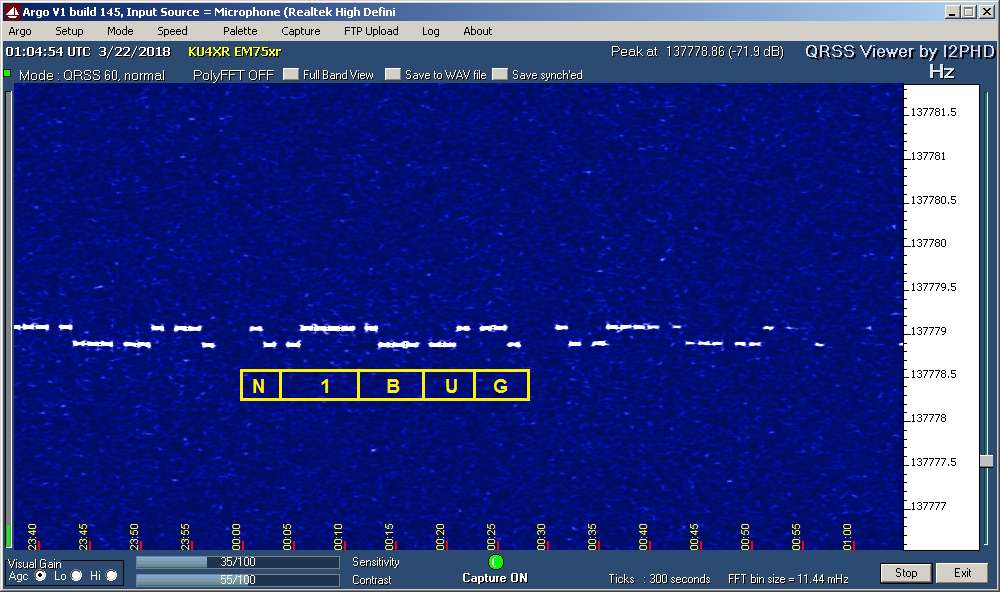
73 and GL :
Andy - KU4XR
---------------------------------------------------------------
File Attachment 1: N1BUGatKU4XR.jpg
Re: Transmitting DFCW on 2200m
A big THANK YOU to all who ran grabbers and sent captures last night. It is very much appreciated! I was seen by many in the U.S. plus G4DMA, 2E0ILY, DL/SWL, DF2JP and DK7FC. It is difficult to know how propagation was but the commercial indicators I saw in my transmission gaps (mainly DCF39 and HGA22) seemed to be rather poor.
The plan for tonight is to continue as before but change to DFCW90 for better readability. I will also increase the gap between repetitions of my call sign. I did make an error yesterday when I said 187.5 Hertz shift. Of course it is milliHertz!
73, HF Thursday
Paul N1BUG
Posted by John Davis on March 23, 2018 at 07:58:18.
Late afternoon at the watering hole (around 5:30-6:00 PM CDT) netted beautiful copy of USC, some copy of RY, and a nice, solid MTI at the top of every minute. In the top half of the band, RF was consistent. Nobody else heard or seen in either half of the band.
LF Thursday (N1BUG, EAR, SIW, WM, and XXP)
Posted by John Davis on March 23, 2018 at 08:11:14.
About mid-afternoon I went to the field to watch for N1BUG via groundwave and succeeded in doing so. (First I investigated some loud WSPR 2 down at 137.5, which turned out to be WH2XXP from Arizona.) My plan was to get a daytime reference level from BUG before the critical hours, aka pre-sunset fading period, but to my surprise I only got one full ID before the fading began. Evidently, skywave on that path begins picking up around three hours before local sunset here, rather than two. On the other hand, it began clearing up before actual sunset, too.
I then looked for SIW, WM, and SJ briefly. Got a little copy of WM, but that was all, so I decided to come back to them later. Had fair to good copy of EAR through mid-evening, then excellent nighttime copy of N1BUG's DFCW at 2200 meters 'round midnight. Went back to the 1750 m watering hole for an hour and a half and saw WM and SIW moderately well, but couldn't quite manage SJ,
I'll put together some captures and post them in the next day or two.
John
BBC Radio 4 longwave
Posted by Mike Terry on March 23, 2018 at 14:48:07.
From June 2019 when RTE Ireland is expected to switch off its transmitter on 252 khz the only remaining English speaking longwave station in Europe will be the BBC on 198 khz.
Reminder: Lowfer net 3927Khz Saturday morning 0800 California time
Posted by Jerry Parker on March 23, 2018 at 16:09:09.
Reminder: Lowfer net 3927Khz Saturday morning 0800 California time
Or listen online at:
WEB SDR KFS
http://69.27.184.62:8901/?tune=3927lsb
click on the autonotch to get rid of hetrodines
Hope to see you there
KFS WebSDR in California
69.27.184.62
Jerry The Minimal Regen
WA6OWR
Posted by John Bruce McCreath on March 23, 2018 at 16:36:52.
I've finally gotten around to fulfilling a wish to build a minimum parts count, solid state, regenerative, AM BCB receiver. I went with the one on Owen Pool's website, which he calls the "superconvertable" set:
http://crystalradio.us/wuggy/regen.htm
I built it using the lower schematic, which is a pure regen set with only seven components, not counting the battery or headphones. The performance of the little set, which I've named "The Minimal Regen" is rather spectacular when you consider its simplicity. If you want to build a bare-bones regen, I can recommend Owen's design. It was a fun build and it will be fun to use too.
73, J.B., VE3EAR
Re: The Minimal Regen
Posted by ed holland on March 23, 2018 at 19:50:03.
In reply to The Minimal Regen posted by John Bruce McCreath on March 23, 2018
Hi John,
Thanks for sharing. I've been thinking on and off about building a regenerative set. First off, I want to revisit the crystal set project I promised my son we'd build...
I like the idea of minimal component count.
Cheers
Ed
Re: BBC Radio 4 longwave
Posted by ed holland on March 23, 2018 at 20:14:42.
In reply to BBC Radio 4 longwave posted by Mike Terry on March 23, 2018
Indeed Mike, and then for how long? I have noted from at least two sources that the Droitwich transmitter is operating on its last set of valves, with no plan in place to secure replacements.
I just hope they have warned the Navy's nuclear submarine commanders ;-)
Re: The SDRPlay RSP-2 on LF?
Posted by Tim Brannon, WA5MD on March 24, 2018 at 16:18:05.
In reply to Re: The SDRPlay RSP-2 on LF? posted by Chuck, N1KGY on March 20, 2018
I've been reading about the Leo Bodnar GPS-DO recommended on the SDRPlay website. Relatively inexpensive and easy to setup. Certainly adequate for anything I'd do with it.
LF Saturday Afternoon
Posted by John Davis on March 24, 2018 at 19:12:21.
Here in the middle of the country, the band is still QRN-free thus far today. Saw WM and the SIW freq/mode transition at local noon and watched an hour, then tuned down to look for any possible N1BUG DFCW at 137.79 but did not see any.
Elsewhere on 2200 m, the Arizona WSPR 2 duo (WH2XXP and WH2XND) are solid copy. WSPR shows them at -10 and -7 dB SNRr respectively (...which illustrates how meaningless a reading made in an arbitraily large noise bandwidth is for comparison of different modes' noise performance, since the CW ID of both are perfectly audible as well).
Crank up the receiver and computer this afternoon if you want to see what groundwave can do on this band!
HF Sat. Afternoon, from ESA to Mystery Sig
Posted by John Davis on March 24, 2018 at 19:24:23.
I listened on 2200 m just before local noon. All I saw at that time was RY (barely), and I could hear RF fairly well. Nobody else came through, so I went to LF for about an hour and a half.
When I returned, RY was still present and RF was distinctly louder. At 1:30 CDT I tuned across a mystery signal that I initially thought was signing NT in slow and poorly timed CW on 13557.425, with a 15 Hz dip in frequency clearly visible during each dash. Later it appeared that the N was merely another T with a strategically coincidental brief fade in it. It may not even be a beacon, but some other device. There were five repetitions of the possible TT every minute.
At 1:35 I briefly tuned up to FRC, who was by then nicely audible, fading soon thereafter to slightly audible and fairly visible on ARGO. ESA was also fair visually and sometimes audible, but the level swings both up and down were less than FRC's.
Down at the low end of the band AZ was also fairly visible and once in a while audible. P was back on and plenty loud, although seemingly running a little less suspicious power than the last time I monitored it. (This time, fades did occasionally drop it below audibility.)
John
Re: HF Sat. Afternoon, from ESA to Mystery Sig
Posted by jimvm on March 24, 2018 at 22:19:34.
In reply to HF Sat. Afternoon, from ESA to Mystery Sig posted by John Davis on March 24, 2018
Thanks for the signal report, John. I am presently using a Hamstick vertical with one radial, 17.5 feet long.
When it drys up, I plan to experiment with the antenna layout.
Jim VM More LF Saturday
Posted by John Davis on March 25, 2018 at 02:47:37.
The WSPR 2 segment of 2200 m had more than just the two 5 watt Experimental Service licensees (WH2XXP and WH2XND) in it today. WA9CGZ was a new one for me, running the Amateur limit of 1 W at a distance of 786 km. At various times, KN5NJD showed up too; he's a mere 523 km away, but was running only 5 milliwatts!
A very few samples from the 200+ spots I just uploaded to WSPRnet this evening. with my call and grid (KD4IDY, EM27kc) omitted in hopes of fitting the rest of the info on a single line:
Time   Call    MHz	SNR   Drift Grid    Pwr	  km     az

2018-03-24
18:40  WH2XXP  0.137507 -10   0     DM33      5   1673   71
18:40  WH2XND  0.137527  -7   0     DM33xt    5   1573   72
19:42  KB5NJD  0.137438 -19   4     EM12mp  0.005  523   18
20:14  WA9CGZ  0.137423 -28   0     EN61ch    1    786  236
23:00  WH2XXP  0.137507 -21   0     DM33      5   1673   71
23:00  WH2XND  0.137527 -17   0     DM33xt    5   1573   72
2018-03-25
01:28  WH2XXP  0.137507  -9   0     DM33      5   1673   71
01:28  WH2XND  0.137527 -14   0     DM33xt    5   1573   72
As you see, the SNRr suffered about an hour before local sunset here, but it recovered right after dark.
SJ, WM, SIW
With this being the last weekend of the season for SJ, I wanted to try once more to catch it while I still can. The weather does not look very cooperative tomorrow, so I parked on the watering hole tonight, but things looked pretty barren for a while. Finally, though, things began improving:
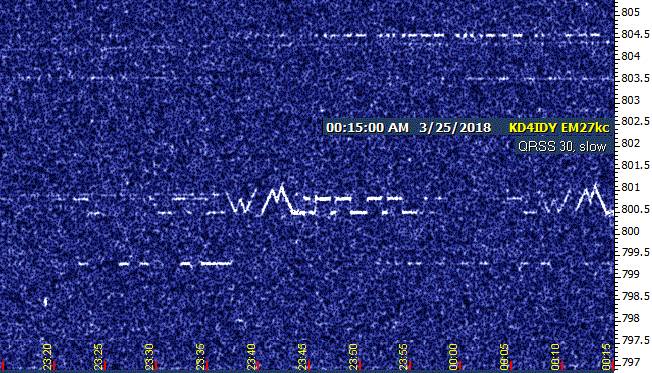
Time stamps are in CDT. I'll be trying further captures before morning.
John
---------------------------------------------------------------
File Attachment 1: 24mar0009.jpg
Re: HF Sat. Afternoon,later
I took a quick listen at HF right before local sunset, since that's sometimes a productive time of day. USC was strong, RY was weak to fair, and MTI was audible every minute on the minute...until right at sunset. Over a two minute span beginning at 7:37 PM CDT, everyone faded away! Only some of the codar remained.
I spent a few minutes scanning the rest of the band and finally began noticing a little trace of FRC, and then AZ came through, sometimes audibly, and FRC got a little better. By 7:44, RY was back, nice and solid, but only those three remained up until I switched back to 2200 meters.
Sunday Morning HiFER Event
Posted by John Davis on March 25, 2018 at 16:58:49.
I don't know what it was, exactly...there are no peaks showing in solar x-rays, proton flux, or the K-index...but something happened overhead just after 9:20 AM CDT this morning. I was doing a final check of 22 m before shutting down the listening post for a few days of storms, when things went wild.
It started out dull enough. From 9 AM onward, there had been a bit of codar and the occasional pulse sounder, but absolutely none of the regular signals. However, powerhouse beacon P apparently has some degree of frequency agility, as it was coming in at 13555.480, right in the (normally) most crowded part of the watering hole. Couldn't tell that's who it was at first because it was weak and there was a lot of QSB. Just before 9:21 AM, the codar faded away for one glorious minute, allowing me a tentative ID of P, then codar faded back in a bit stronger than before. Eventually I got positive aural ID of P when the signal grew significantly stronger just before 9:24 AM. Just after 9:24, though, the signal abruptly stopped altogether, leaving only codar.
That got boring pretty fast. Nobody else was present in the lower part of the band, and not at first in the upper half either. But then I ran across K6FRC getting kind of loud, then louder, then even LOUDER. It ultimately peaked at S2, which is about as strong as I ever see any known legitimate beacon under ideal conditions.
I briefly tried for ESA, but without success. Then I tuned to the other end of the band and found AZ both audible and nicely visible. By then, P was back near its usual spot, a few Hz below 13555.0. It was rather loud at times, but experiencing episodes of deep fading. Back up at the watering hole, RY was finally visible and sometimes audible, but also with considerable level fluctuation... sometimes the dashes appeared broken up into strings of dots.
The band seemed to be settling into an equilibrium of some sort by about 9:50 AM when I had to depart. It would be interesting to know what prompted the disruption, though.
John
John Davis - Hifer Beacon Questions
Posted by Bill K4JYS on March 25, 2018 at 22:55:02.
Hi John, Re: John Davis - Hifer Beacon Questions
You seem to be pretty active on 22 meters and I have a few questions for you. I am moderately interested in putting on a Hifer beacon and wonder how you find propagation. Generally, at what times (Z) do you find the band opening and closing back to the east coast…of course this depends on solar activity, propagation, etc. Also, what area of the band, generally, has the least amount of trash/QRM? One thing else… is there any protocol as to selecting a freq. for a beacon? Are there any freqs. that have an over population of beacons, etc that a newbie should stay away from....so as not to cause additional QRM to established beacons. Tnx for any info you might have….and would also appreciate any comments from others as well.
73, Bill K4JYS NC
Posted by John Davis on March 26, 2018 at 06:00:49.
In reply to John Davis - Hifer Beacon Questions posted by Bill K4JYS on March 25, 2018
Hi Bill. You may be familiar with our list of MedFER and HiFER beacons at lwca.org/sitepage/part15/index.htm ...it's a great tool for evaluating where you might want to park a HiFER beacon in the band. There's no specific protocol, but common sense suggests spacing farther from other beacons if your transmitter will be exposed to temperature swings that cause significant frequency drift.
The most occupied segment is within a couple hundred Hz either side of 13555.400 kHz, called the "watering hole," where slow digital modes prevail. Good stability is highly recommended in that region. Elsewhere, you'll find more gaps between signals, which is a good idea if you're going to use CW and want the listener to have a chance of distinguishing you from other carriers. One area you want to avoid is within 1.5 or 2 kHz of the band center, 13560 kHz, because that's where most of the Industrial/ Scientific/ Medical devices operate, and their racket is hard for a few milliwatts to compete with!
As for times of band openings, that has been varying a lot by season since we've entered solar minimum. I'll address that question further in a couple of days after I'm done with this month's club publication, but meanwhile I hope others will chime in too because it does seem as if the best times vary at different receive locations around the country.
Re: John Davis - Hifer Beacon Questions
Posted by Bill K4JYS on March 27, 2018 at 21:01:11.
In reply to Re: John Davis - Hifer Beacon Questions posted by John Davis on March 26, 2018
Tnx John for the info....Bill
Beacon WV
Posted by Michael Tyler on March 28, 2018 at 17:51:40.
Beacon WV is back on the air after failure of the oscillator. The frequency is now at 13.5593+-.....take a listen...I cleaned up the connectors and hope the efficiency improves getting RF to the antenna....thanks
Re: Beacon WV
Posted by John Davis on March 28, 2018 at 18:32:30.
In reply to Beacon WV posted by Michael Tyler on March 28, 2018
Just to clarify, Michael...is that 13,5593 as stated, or 13,55593 ? Thanks.
John
Re: Beacon WV
Posted by michael tyler on March 28, 2018 at 18:59:39.
In reply to Re: Beacon WV posted by John Davis on March 28, 2018
it is 13.5593
137 kHz 2E0ILY-N1BUG QSO complete
Posted by Paul N1BUG on March 28, 2018 at 19:24:10.
Last night Chris 2E0ILY and myself completed a DFCW60 QSO over a 4731 km path on 137 kHz. To my knowledge this is the first USA to Europe two way amateur radio QSO on the band. My sincere thanks to Chris for his time and effort to make this happen!
I apologize if being in the WSPR band created problems for anyone. I asked Chris to give up four nights (or more) of other activity to do this. I did not want to additionally ask him to spend hours tuning the antenna elsewhere and then back again.
Signals were at times outstanding with three hours of perfectly solid copy here one night. While not quite that good in the other direction, I am very pleased with the copy Chris had on me. We would not be able to make it on any other QSO mode, but slow DFCW made it possible!
This QSO was like an adventure. :-) The first night of transmitting I had to constantly retune the antenna due to influence of very heavy snow squalls. I'm glad I put a motor on the variometer. Without it, transmitting that night would not have been possible.
73, Bill Oliver's Passing
Paul N1BUG FN55mf
Posted by John Davis on March 29, 2018 at 20:14:18.
It is with great sorrow that I must inform you our publisher, William E. Oliver, passed away on Tuesday, March 27, 2018 in Lower Bucks County Hospital, near his home in Levittown, PA. He was 89.
His obituary is available here.
I have little additional information at this point, beyond the unavoidable consequence that there will be a disruption in publication of The LOWDOWN for an unknown interval. Please watch this site's About page for further announcements as we attempt to resume normal operations.
John H. Davis Re: Bill Oliver's Passing
Posted by Kevin Carey on March 29, 2018 at 21:46:59.
In reply to Bill Oliver's Passing posted by John Davis on March 29, 2018
Very sad news indeed. Bill was a tireless worker--often behind the scenes--who kept us all well connected and up to date via the Lowdown Journal. As I understand it, he took on the duties from a previous publisher in CA decades ago, who was on the verge of ceasing publication due to pressing demands. Bill kept marching on, month after month, to get the newsletter out to all of us on time. His passing leaves a void that will be felt throughout the longwave community. My sincere condolences to the Oliver family at this time of sadness and loss.
Re: Bill Oliver's Passing
Posted by Bill Hensel on March 30, 2018 at 01:15:16.
In reply to Bill Oliver's Passing posted by John Davis on March 29, 2018
He had a good long run. Re: Bill Oliver's Passing
I got a lot of joy from the Low Down.
Posted by John Davis on March 30, 2018 at 02:43:42.
In reply to Re: Bill Oliver's Passing posted by Kevin Carey on March 29, 2018
A tremendously sad time, for certain. I never had the pleasure of meeting Bill in person, but in our decades of correspondence he always had a keen and sometimes subtle sense of humor, he always looked forward, and was always a source of encouragement and inspiration. This is a loss that is still soaking in.
Re: Bill Oliver's Passing
Posted by Dave Childs on March 30, 2018 at 06:35:17.
In reply to Bill Oliver's Passing posted by John Davis on March 29, 2018
Yes, he'll certainly be missed by those of us in the radio hobby community. He replaced W. R. (Walter I believe) & Betty McIntosh as publisher of the LOWDOWN in the early '80s I believe. My condolences to his family as well.
Re: Bill Oliver's Passing
Posted by Edward Holland on March 30, 2018 at 23:18:09.
In reply to Bill Oliver's Passing posted by John Davis on March 29, 2018
I am very sorry to hear this. Although I can't claim to have known him, Bill was very helpful and responsive on a couple of occasions when my Lowdown went missing in the post. His efforts in producing this excellent little publication have been much appreciated here. My condolences to his family and friends.
New Beacon - WAS
Posted by Bill K4JYS on March 30, 2018 at 23:43:24.
Hello Beaconeers,
I have just put on a 22 meter beacon around 13.562 mhz. The ID is WAS. The xmtr is a Black Cat Kit. I just finished it this afternoon. It is just a temporary resident on 562 and as soon as I get a chance, I will play with the rubbering capacitors to try to move the freq. to a clearer spot. It appears there are a couple of beacons already around that freq. I will also be working on a dedicated antenna, probably a 22 meter inverted vee. For the next week or so it will be operating intermittently using a 20 meter 1/4 wave ground plane. The SWR is a bit high up on 22 meters. I will probably leave it on most of Saturday while I am at the Raleigh Hamfest…..also most of Sunday. Any reports will be appreciated. Please advise if I am interfering with another beacon or if I am getting stomped by ISM QRM. Ultimately, I hope to put it out in the woods, using a Gel-Cell and the antenna hanging from a pine tree. I will post more info as the project continues.
Tnx & 73 de Bill K4JYS Reminder: Lowfer net 3927Khz Saturday morning 0800 California time
Posted by Jerry Parker on March 31, 2018 at 02:26:29.
Reminder: Lowfer net 3927Khz Saturday morning 0800 California time
Or listen online at:
WEB SDR KFS
http://69.27.184.62:8901/?tune=3927lsb
click on the autonotch to get rid of hetrodines
Hope to see you there
KFS WebSDR in California
69.27.184.62
Jerry
RE: Bill Oliver
Posted by Jerry Parker on March 31, 2018 at 02:33:09.
I am so sorry to hear of Bill's passing.
Re: New Beacon - WAS
Posted by John Davis on March 31, 2018 at 05:36:21.
In reply to New Beacon - WAS posted by Bill K4JYS on March 30, 2018
What mode, Bill?
Re: New Beacon - WAS
Posted by Bill K4JYS on March 31, 2018 at 09:44:24.
In reply to Re: New Beacon - WAS posted by John Davis on March 31, 2018
Running CW, John. QRV in QRSS3 on 137.780
After re-thinking my previous post, I expect that since I am using close to 100ft of RG-8/X, several coax switches, numerous coax connectors, a watt meter in the line (no indication of course) plus abt 1.8:1 SWR it's doubtful a peep will be heard....hi. Hopefully that will improve when I get the final installation done.
Bill
Posted by Brian, WA1ZMS on March 31, 2018 at 15:55:47.
Fri, March 30, 2018 8:41 pm
WA1ZMS in FM07 is now transmitting on 137.780kHz in QRSS3 beacon-mode. I intend to be on for the next 36 hrs. TX pwr is 90w from a Thamway TX into a 160m dipole at 60ft as a T-ant.
The goal is for N1BUG to see if he can copy me, but all reports are welcome (if any!).
-Brian, WA1ZMS
potrzebie