Romania 153 kHz
"Antena Satelor" is a full 24h service on 153 kHz long wave - there is no "Actualitati" relay between 22:00 to 06:00 Romanian time. However, the MW frequencies of "Antena Satelor" (531, 603, 630, 2x 1314 kHz) are off air during these times. Deutschlandfunk 153 kHz tower demolished
Additional information: Every morning, between 04:53 and 04:55 Romanian time, "Antena Satelor" transmits a 1 kHz test tone. After that, the interval signal of Radio Romania is played several times. You can hear this procedure on LW 153 kHz.
Best regards, Alexander Busneag (28/2-2018)
https://mediumwave.info/news.html
Posted by Mike Terry on April 02, 2018 at 15:05:23.
The mast formerly used by Deutschlandfunk on 153 kHz was demolished in March.
There are some videos (see link), the following comments are translated from German.
https://www.swr.de/swraktuell/bw/mannheim/aus-fuer-stahltuerme-in-mudau-donebach-sendemasten-sind-geschichte/-/id=1582/did=21252978/nid=1582/1fg7xqy/index.html
The two steel pylons were almost 400 meters high, were considered a technical landmark and were popular with daredevil climbers.
The countless tensioning cables that held the masts upright were cut through with so-called cutting loads and a bang at the same time. Otherwise, says the demolition expert in the apron, you would rather be disappointed, how fast and comparatively quiet the steel pylons then crash into the open space.
Before the demolition numerous roads in the small district of Mudau Donebach were blocked. For security reasons, the direct residents of the transmitter had to leave their homes.
For more than 50 years, the masts dominated the townscape with their arm-thick ropes.
For the long-wave transmitter, which was built in 1967, there is no use. The maintenance is expensive, so they are now disassembled and removed. Many Donebacher find that a pity, that was clearly felt at the information event. With the masts also a piece of history disappears. The local carnival company "Donebacher Turmspatzen" owes its name to the towers.
It was also because so late about the imminent demolition of the almost 400 -meter-high towers informed, because the transmitter was always the target daring skippers from all over Europe. In recent years, teenagers without any security had climbed the masts several times, others had jumped from the top into the depths with so-called wingsuits. That wanted to prevent, said Roman Birle of the operator Media Broadcast.
India to employ long wave radio technology
Posted by Mike Terry on April 02, 2018 at 15:20:29.
India - 29 March 2018 The Hindu by Jacob Kosh - Two towers, about three times the height of the Qutab Minar, are likely to be erected at as-yet-undecided locations in the country for disseminating Indian Standard Time.
The National Physical Laboratory, an organisation charged with ensuring that Indian time stays accurate, has signed an agreement with IFR Information Dissemination Services (IFR) Ltd., which will set up the towers and employ long wave radio (LWR) technology to purvey this time to a range of users, from phone companies to railway stations. Customers will need a microchip that can be embedded into everything, from wall-clocks to servers.
“Long range radiowaves from the towers can be reliably transmitted even during major disasters. Other than time, information such as a tsunami warning or weather warnings can also be sent,” Pawan Kumar Kasera, director, IFR, said at a press conference. IFR is affiliated to the Germany-based EFR GmbH, which is in the business of providing similar services in Germany.
The company now requires a plethora of permissions from other government departments to host these towers, each with a range of 1,000 km, and an investment of about Rs. 600 crore, which it will raise privately.
The NPL would help IFR keep their caesium clocks (located in the tower) calibrated but wouldn’t be involved in setting up the infrastructure related to time dissemination. Last year, the Council of Scientific and Industrial Research-body had tied up with the Indian Space Research Organisation to provide time-related services for its satellites. “The advantage of LWR is that the waves travel close to the ground and so can reach out to far-flung locations, even to submarines. We’d advertised through newspapers asking private players to help us disseminate NPL-time to the public. Five companies approached us and we’ve selected IFR,” Dinesh Aswal, director, NPL, told The Hindu .
http://www.thehindu.com/todays-paper/tp-national/coming-huge-towers-to-publicise-right-time/article23377284.ece
RF
Posted by Bill Hensel on April 02, 2018 at 16:28:44.
April 1 2132 utc RF heard...no other beacons heard.
LF receiver or kit
Posted by Mike on April 04, 2018 at 07:12:16.
Hi Guys
I used to have Degen 1103 (Kaito). Sold it due to serious encoder problems. Recently I heard it is that good on LW (why now?!). Now I am using Tecsun 660 which is rather deaf. So I have been looking around to buy some inexpensive receiver to hear more on LW. Is there anything you can suggest? Kenwood 440? Or maybe some converter kit for a start (to use it with my ft857)? I saw one on ebay: https://www.ebay.pl/itm/VLF-Converter-5kHz-to-500kHz-PCB-hardware-kit-prepared-in-Dorset-UK/282537929028?hash=item41c892a944
I live in Europe, so all these wonderful boat anchors from US are not good idea. Will I have acceptable sensitivity with converter kit? Should I go for old TS440? Or should I buy second hand Sony ICF 7600GR, have its capacitors replaced? I'd really appreciate your help.
Re: New Beacon - WAS
Posted by John Davis on April 04, 2018 at 09:37:50.
In reply to Re: New Beacon - WAS posted by Bill K4JYS on March 31, 2018
Actually, I wouldn't worry much about the coax and switch losses. The Black Cat has enough output to exceed the power limit at least seven times over! You won't have that much attenuation. The real problem is adjusting it carefully enough to deliver the right power at the antenna; best done with an RF millivoltmeter or a scope at the antenna input, but touchy because R1 is a 1K pot. A much better value would be 100 ohms, as Lyle Koehler used in his classic Epson oscillator based design.
If it were me, I'd accept coax losses and keep the transmitter in a temperature controlled environment rather than putting it outdoors, to avoid wandering around the band. One drawback of the Black Cat design is its thermal stability. Its frequency varies as much as 15 Hz during normal speed keying alone, simply from changes in gate capacitance due to the keyed output stages locally heating the tiny semiconductor die. This effect is more pronounced if you're not using C17 and C18, the normal Pierce capacitor network. It is probably also exaggerated by the fact that they did not include the usual bias resistor between the gate output and its input, and the fact that they're using the two gate inputs in parallel.
Fortunately, some of those concerns can be mitigated during or after construction with three fairly simple steps: adding capacitors at C17 and C18 (maybe 20-30 pF--not too big for C18 since they made no provision to include the usual series resistor ahead of the crystal-capacitor network); then using a capacitor at C16 rather than strapping it, if necessary to raise the frequency back up a bit; and adding a 1 M to 3.3 M resistor between pins 1 and 3 on U2 (this could perhaps be done at the mounting holes for C4).
In addition, the die heating fluctuations might be reduced by lifting output pins from two of the three NAND gates that serve as the "final"...there'll still be more than enough power out, although it may not really make much difference to frequency stability. (Then again, it might. One fairly obvious trait of Black Cat ops who seem to be pushing more power than known-legal beacons is that their keying spans a wider shift on waterfall displays than those whose signals are at more typical strength. Their pitch change during keying is sometimes audible as well.)
Don't get me wrong...the Black Cat kit is a pretty good value for the price. It would be better if they had used a separate chip entirely for the keyed stage(s), though, and it would've only added a few cents to the cost. That sort of thing is harder to retrofit, alas.
Just some thoughts.
John
Re: 137 kHz 2E0ILY-N1BUG QSO complete
Posted by Doug Williams - KB4OER on April 05, 2018 at 21:27:36.
In reply to 137 kHz 2E0ILY-N1BUG QSO complete posted by Paul N1BUG (fwd) on March 28, 2018
Quite an achievement. Congratulations to the both of you.
-Doug KB4OER
Reminder: Lowfer net 3927Khz Saturday morning 0800 California time
Posted by Jerry Parker on April 06, 2018 at 16:15:33.
Reminder: Lowfer net 3927Khz Saturday morning 0800 California time
Or listen online at:
WEB SDR KFS
http://69.27.184.62:8901/?tune=3927lsb
click on the autonotch to get rid of hetrodines
Hope to see you there
KFS WebSDR in California
69.27.184.62
Re: New Beacon - WAS - Now on 13.5647mc
Jerry
Posted by Bill K4JYS on April 06, 2018 at 20:57:04.
In reply to Re: New Beacon - WAS posted by John Davis on April 04, 2018
Tnx John for the advice. I guess I musta had a duh moment and originally set the power on the BC to just under 5mw rather than adj for the erp. So now have adj it a tad higher to approximate a higher erp..and maybe overcome some of the losses, but just a guess on my part at the moment. Not using the final antenna setup yet. I also added C16 & C17 which put the freq at abt 13.5647mc. (Those little caps are so small I can't read the value even with my magnifiers, so have no idea what their values are). Here agn, this freq may be temporary due to the osc being slow to start up this morning. Will have to see if it will act better when I get the final antenna up with a lower SWR....may not make any difference. May have to dink with the rubbering caps again..C18 too. Will probably run it for a while on this freq and see what happens. You are right about the temp. situation out doors. Have been surveying the trees to see if I have a suitable one near either of the ham shacks.
I don't feel real comfortable trying to modify the ckt. Not a solid-state guy. This is the first s-s project for me in 40 years.....all tubes here, so am in the dark ages. The BC looked like a good choice for a newbie, like me. It is an economical way to give 22 meters a try plus a little experience with a s-s project.
Agn, tnx for your input. Hope I won't bug too many here while I am getting setup. Re: Reminder: Lowfer net 3927Khz Saturday morning 0800 California time
73 de Bill K4JYS
Posted by Tim Brannon, WA5MD on April 07, 2018 at 15:37:03.
In reply to Reminder: Lowfer net 3927Khz Saturday morning 0800 California time posted by Jerry Parker on April 06, 2018
Jerry,
There was a strong broadcast signal at 3927 on the KFS WebSDR that I could not notch out.
So I pulled up both the W7RNA Sedona AZ and the KA7OEI Northern Utah Web SDRs in separate tabs in Firefox simultaneously. I muted one or the other to just hear the strongest signal.
I was able to copy KA7OEI Clint, WA6OWR Jerry, WD4PLI Dave, and KI6R Ed. Dave and Clint were very strong, but Ed and Jerry were still readable, too. Interesting listening, I'll try again next weekend.
W7RNA Sedona AZ http://w7rna.dyndns-remote.com:18901/
KA7OEI Northern UT http://websdr1.utahsdr.org:8901/
73 de Tim, WA5MD in Dallas
Re: Reminder: Lowfer net 3927Khz Saturday morning 0800 California time
Posted by John Davis on April 07, 2018 at 17:04:17.
In reply to Re: Reminder: Lowfer net 3927Khz Saturday morning 0800 California time posted by Tim Brannon, WA5MD on April 07, 2018
The Asian broadcaster went away after a few minutes, Tim, but thanks for posting the alternatives. I used Clint's Utah SDR myself for a while until the KFS SDR was clear again.
22 meter transmitter kit
Posted by michael tyler on April 07, 2018 at 19:45:38.
There has been a mention about frequency drift in the 22 meter kit. I am trying a thermistor soldered to the crystal to see if it will keep things stable. So far so good it seems to be working. Here is a link to the ones I bought off of Ebay... Re: 22 meter transmitter kit
PTMS2101YP816BTA Thermistor .https://www.ebay.com/itm/10pcs-1-PTMS2101YP816BTA-Original-New-Thermistor-Sensor-PTC-2-Pin-/141987058409?hash=item210f1692e9. These are metal tab that I soldered to the crystal. I just connected the leads to the beacon power source and it keeps the crystal at a constant temperature. thanks...Beacon WV
Posted by John Davis on April 07, 2018 at 21:42:14.
In reply to 22 meter transmitter kit posted by michael tyler on April 07, 2018
Thanks for that great tip, Michael.
Lyle Koehler also used PTC thermistors for this purpose at one time, but the ones he suggested are no longer available and it's not easy to find good selections of positive coefficient units. It's good to hear of another suitable type.
Have you perhaps measured the current draw at startup and after its temperature has stabilized?
Thanks.
John
Re: 22 meter transmitter kit
Posted by michael tyler on April 07, 2018 at 23:06:54.
In reply to Re: 22 meter transmitter kit posted by John Davis on April 07, 2018
I connect one of them to my power supply with a simpson 260 in line and it shows 60 ma on start up and about 28 ma at heatup....this is with 12 volts applied....did not check any other voltage supply...
Re: 22 meter transmitter kit
Posted by John Davis on April 09, 2018 at 00:01:54.
In reply to Re: 22 meter transmitter kit posted by michael tyler on April 07, 2018
Thanks for the additional information, Michael. Looks good. A person needs to keep the current in mind when working out a power budget for battery-supplied power, of course, but this is not bad.
I hate to keep being nosey, but by any chance do you know how hot the thermistor actually gets? Thanks again.
John
Re: 22 meter transmitter kit
Posted by michael tyler on April 09, 2018 at 16:51:50.
In reply to Re: 22 meter transmitter kit posted by John Davis on April 09, 2018
Hi John, no I don't know the temperature but how about I send you one to mess with and you could let us know what you think the possibilities are? michaeltylerwv at yahoo, email me your address...mike
Re: 22 meter transmitter kit
Posted by John Davis on April 09, 2018 at 19:47:39.
In reply to Re: 22 meter transmitter kit posted by michael tyler on April 09, 2018
Thanks for the offer, but it won't be necessary. I ordered a batch over the weekend that should be here in a few days. I was mainly asking as a heads-up for what kind of insulation to enclose the crystal and heater in...whether foam rubber would do, for instance, or whether it might require something capable of handling higher temperatures.
John
Thank you, LWCA Writers
Posted by Tim Brannon, WA5MD on April 10, 2018 at 15:29:23.
I just want to say Thank You to all the LWCA newsletter writers who are working to restore the club's business operations. It is also very gracious of Bill Oliver's family to help us during such a difficult time. If there is something I can do, please contact me.
strange conditions Gander and RF Hifer
Posted by Bill Hensel on April 12, 2018 at 14:02:49.
April 12 0223 utc RF heard ... later on I was hearing echoes from the Gander tower on 8891 khz...Space wx does produce some interesting HF condx. Reminder: Lowfer Net 0800 California time Saturday
Posted by Jerry Parker on April 13, 2018 at 23:43:04.
Reminder: Lowfer net 3927Khz Saturday morning 0800 California time
Or listen online at the KFS WebSDR in California:
http://69.27.184.62:8901/?tune=3927lsb
click on the autonotch to get rid of heterodynes
Hope to see you there
OR Try the other Western US HF WebSDR systems: W7RNA Multiband WebSDR Receiver and Northern Utah WebSDR. They both work very well.
(Thanks to Tim Brannon, WA5MD for the tip.)
W7RNA Sedona AZ http://w7rna.dyndns-remote.com:18901/
KA7OEI Northern UT http://websdr1.utahsdr.org:8901/
Jerry WA6OWR
RX Testing on 22M
Posted by Bob WA1EDJ on April 14, 2018 at 14:21:31.
Diz at Kits and Parts just released a new Universal RX kit. I've been looking for a simple but effective RX for HiFER use so ordered two. I took the 20M version and just tuned it down to 13.555 MHz.
It's your basic NE602 superhet with xtal filter. I had a couple of the N3ZI 602 rx's and liked how they worked. This one is similar. I run it with a 5351A DDS ( QRP Labs 5351A VFO kit ) as LO, through a LPF and padded down to about 300 mV P-P for the mixer.
Results seem as good as my Yeasu 767. I've been seeing RY and EH nightly with ARGO here in Monroe, Ga. I have a 130' LW oriented NE so frequently see EH and RY. West not so well. So for a cheap RX the W8DIZ URX works well. It will be available for all bands soon.
Bob EDJ
SAQ on Air on May 1st
Posted by Mike Terry on April 16, 2018 at 07:20:33.
World Heritage Grimeton Radio Station participates in the ERIH event WORK it OUT – Industrial culture, on May 1 and as part of the event we plan for the first SAQ transmission since 2016.
The transmitter start-up will begin at 11.30 (9.30 UTC) and the transmission will begin on 17,2 kHz CW at 12.00 (10.00 UTC). You can also watch a live video stream of the event on www.alexander.n.se.
No QSL-cards will be given this time and no List of Reports will be constructed but we accept shorter Listeners Report to e-mail info@alexander.n.se.
We sincerely hope that all the SAQ transmission on 17,2 kHz will go as planned, but as always there is a reservation that the transmission is cancelled with short notice.
//The Alexander association team @Grimeton, Sweden
The Alexander Association Grimeton SAQ Veteran Radio Friends · Radiostationen Grimeton 72 · Grimeton 43298 · Sweden
Re: SAQ on Air on May 1st
Posted by Mike Terry on April 16, 2018 at 07:30:11.
In reply to SAQ on Air on May 1st posted by Mike Terry on April 16, 2018
YouTube channel:
https://www.youtube.com/channel/UC-83S-l9JKD1iuhsXx3XQ3g?sub_confirmation=1
47CFR5 Renewals
Posted by Frank Lotito on April 16, 2018 at 12:50:40.
I'm looking for advice on renewing my 47CFR5 experimental license - I am quite sure many of you with a 47CFR5 experimental license granting one or more frequency assignments below the standard AM broadcast band have asked the same question. Re: 47CFR5 Renewals
..
I have had my 47CFR5 license for around 3 and a half years. (It is on its second 2-year renewal.) Since 47CFR97 formally established the 2200 and 630 meter amateur radio bands, what would be the advantage of reapplying for a renewal? My grant covers only the 630 and 600 meter bands. I did not apply for other frequency assignments either for the initial application, or for the follow-up renewal.
..
73 Frank Lotito K3DZ / WH2XHA
Posted by John Davis on April 16, 2018 at 14:21:55.
In reply to 47CFR5 Renewals posted by Frank Lotito on April 16, 2018
I'd say it mainly depends on whether there's something you want to do on those frequencies that can't be done under terms of an amateur license; i.e., run greater power, or operate an unattended beacon.
Otherwise, why bother with the expense and paperwork?
The FCC has already stated that Part 5 operation to demonstrate the feasibility of amateur operation and coexistence in the new bands has served its purpose. Therefore, at some point, they are likely to require more definite experimental objectives to obtain a grant in those bands.
Also take into account the fact that a Part 5 license does not authorize communication with stations in the ARS. So, if you suddenly decided you wanted to QSO with someone, you'd have to use your ham call, drop back to ≤5 W EIRP, and otherwise comply with all Part 97 rules anyway.
John Antenna At WAS - 13.565 Mhz
Posted by Bill K4JYS on April 16, 2018 at 19:12:58.
Good Afternoon,
I now have the permanent (hopefully) antenna up for Hifer Beacon WAS.
It is a 22 meter dipole at about 40 feet, broadside NW/SE. I recently added
a couple of capacitors to the Black Cat xmtr to get the freq. up band a tad.
I am now transmitting on approx. 13.565 mhz. A slight bug-a-boo came up
after the cap. additions....the osc. won’t start after being off all night. I may
tinker with that later, but will probably run it as is for a while...just have to
put my finger on the xtal case and it will start up. I could just let it run all the
time. So far the 9ah gell-cell is holding up well. Hope condx. will improve
so someone out there in radio land will hear this peanut whistle.
73 de Bill K4JYS (WAS)
35 miles SE of Raleigh, NC
Sunday 15th April HiFERs
Posted by ed holland on April 17, 2018 at 17:03:07.
Hi folks,
Sunday afternoon allowed for a little listening at 22m. Time was ~2330 UTC Although none of my audible neighbors in CO or AZ were heard, there was a significant opening for others, and at least two signals near the "watering hole" were plainly audible. Applying Spectrum Lab to the task revealed USC and NC directly atop one another, at least that is how the trace appeared. Several other traces were detected visibly, with frequencies corresponding to beacons, but not readable for a true ID. Therefore, possible reception of SIW, at 13,555.435 (From memory - I need to refer to my notes again).
PVC has been restored to the house-top dipole, after a week on the long-wire. I have a feeling some connections would benefit from cleaning up on the roof...
Cheers
Ed
Re: Antenna At WAS - 13.565 Mhz
Posted by ed holland on April 17, 2018 at 20:12:10.
In reply to Antenna At WAS - 13.565 Mhz posted by Bill K4JYS on April 16, 2018
Hi Bill,
I'll keep an ear out for WAS, HiFER signals from your general region quite often reach us here in California.
Cheers and 73
Ed
Re: Antenna At WAS - 13.565 Mhz
Posted by Bill K4JYS on April 17, 2018 at 21:14:34.
In reply to Re: Antenna At WAS - 13.565 Mhz posted by ed holland on April 17, 2018
Hi Ed, Re: Antenna At WAS - 13.565 Mhz
Abt what time frame (Z) do you generally receive sigs from the East Coast,
NC in particular....tnx, Bill K4JYS
Posted by Ed holland on April 18, 2018 at 03:10:39.
In reply to Re: Antenna At WAS - 13.565 Mhz posted by Bill K4JYS on April 17, 2018
Mid-Late afternoon ~3pm (PST + DST) for an hour or so International Marconi Day
onward is often good for USC, NC and several other beacons in the neighbourhood of 13.555 MHz
Posted by Maritime Radio Historical Society on April 18, 2018 at 07:27:52.
K6KPH, the amateur station of the Maritime Radio Historical Society, will be active for International Marconi Day (IMD) 2018 to help celebrate the birthday of the Great Man.
IMD is organized by the Cornish Amateur Radio Club each year on the weekend closest to Marconi's birthday of 25 April 1874. This year the event will be held on 21 April UTC.
Since K6KPH transmits from the original Marconi site that went into service in 1914 it is a registered IMD station. The Cornish Amateur Radio Club will issue an award to stations that contact 15 officially registered IMD stations like K6KPH.
Date & Time - K6KPH will be in operation Saturday 21 April beginning at 0000 UTC (5:00 pm Friday 20 April PDT). Operations will continue for several hours until our operators run out of steam. See below if you would like to be a K6KPH operator for this event!
Frequencies - K6KPH will guard these frequencies:
3550.0
7050.0
14050.0
18097.5
Calling Procedure - Since we will have KPH on the air as well (see below), the operators will be very busy and may not be able to call CQ on each amateur channel. But they will be scanning all the channels. So the best bet is to use commercial procedure when calling K6KPH:
Continue to call on your chosen frequency until the K6KPH operator responds with DE. Then respond with your call sign.
The station can be reached by phone on +1 415-669-9646 if you want to call in a report or arrange a special listening watch. The phone will be answered only when the station is on the air.
Be a K6KPH Operator - If you would like to be a K6KPH operator for IMD we would welcome your help. Bring your key and 'phones or use ours (but be advised that some modern electronic keys may not work with the K6KPH keying system so bugs and straight keys are encouraged). Show up early so we can familiarize you with the K6KPH equipment and procedures. You'll be using fixed frequency 1.5kW commercial transmitters 20 miles from the receive/control site so operations are a little different from usual amateur practice! For more information please send an email to info@radiomarine.org
KPH Will Be On The Air - KPH will be transmitting on these frequencies and will of course be listening for calls from ships on 500kc and ITU channel 3 HF.
426
500
4247.0
6477.5
8642.0
12808.5
17016.8
22447.5
VY 73, Re: Antenna At WAS - 13.565 Mhz
MRHS
Posted by Bill K4JYS on April 18, 2018 at 16:40:03.
In reply to Re: Antenna At WAS - 13.565 Mhz posted by Ed holland on April 18, 2018
Tnx, Ed, for the info. I have noticed that 20 meters has been active, to the west, into early evening... according to the Dx-Maps web site. However, not sure if it is propagating from NC. I will leave it on overnight and see what happens. I will probably cut it on around mid-morning or noon here. Re: Antenna At WAS - 13.565 Mhz
Tnx, Bill
Posted by ed holland on April 18, 2018 at 16:52:01.
In reply to Re: Antenna At WAS - 13.565 Mhz posted by Bill K4JYS on April 18, 2018
Hi Bill,
I will try and listen this weekend. Conditions have been strange lately, favouring the longer distance beacons over my "Locals" in AZ and CO. The wonders of propagation!
Cheers
Ed
FRC and ESA
Posted by Bill Hensel on April 18, 2018 at 19:36:01.
April 17, K6FRC and ESA 0038 utc
Re: FRC and ESA
Posted by jimvm on April 19, 2018 at 00:59:47.
In reply to FRC and ESA posted by Bill Hensel on April 18, 2018
Thanks for the report Bill. I'll keep the battery charged. Beacon "WV" work on going
Posted by michael tyler on April 19, 2018 at 21:53:12.
In reply to Re: FRC and ESA posted by jimvm on April 19, 2018
I was wondering why I was not getting any reports on WV so I checked and it seems there was a bad cable going from the home made tuner to the antenna.....this problem did not show up when I was doing maintenance a couple weeks ago.....the antenna analyzer says swr is 1:1 now on the attached 12 foot vertical ground mounted ......so we will see...please post if you hear "WV" please....mike...wa8ywo
Reminder: Lowfer net 3927Khz Saturday morning 0800 California time
Posted by Jerry Parker on April 20, 2018 at 14:11:57.
Reminder: Lowfer net 3927Khz Saturday morning 0800 California time
Or listen online at the KFS WebSDR in California:
http://69.27.184.62:8901/?tune=3927lsb
click on the autonotch to get rid of heterodynes
Hope to see you there
OR Try the other Western US HF WebSDR systems: W7RNA Multiband WebSDR Receiver and Northern Utah WebSDR. They both work very well.
(Thanks to Tim Brannon, WA5MD for the tip.)
W7RNA Sedona AZ http://w7rna.dyndns-remote.com:18901/
KA7OEI Northern UT http://websdr1.utahsdr.org:8901/
Jerry WA6OWR
WH2XND 75.593 WSPR
Posted by Tom N8TL on April 20, 2018 at 16:02:50.
WH2XND posted in Lowfer list as 75.593 WSPR. Is this WSPR2 or WSPR15 or both??
Re: WH2XND 75.593 WSPR
Posted by Ron Douglass on April 22, 2018 at 04:45:57.
In reply to WH2XND 75.593 WSPR posted by Tom N8TL on April 20, 2018
Tom I am using WSPR 2 when transmitting. I am no longer transmitting on 75 KHz and have moved back to 137 KHz. Will return to 75 KHz this Oct-Nov.
Best Regards Re: Antenna At WAS - 13.565 Mhz
Ron NI7J-WH2XND
Posted by ed holland on April 23, 2018 at 21:01:27.
In reply to Re: Antenna At WAS - 13.565 Mhz posted by Bill K4JYS on April 18, 2018
Hi Bill,
Nothing received here this weekend from your frequency (Early afternoon Pacific time), although at least one of the NC beacons near 13,555 was traceable. I'll keep trying, one never knows when they will pop up.
Cheers
Ed
Re: Antenna At WAS - 13.565 Mhz
Posted by Bill K4JYS on April 23, 2018 at 21:14:34.
In reply to Re: Antenna At WAS - 13.565 Mhz posted by ed holland on April 23, 2018
Tnx for trying, Ed. WAS (was) in KS
Bill
Posted by John Davis on April 23, 2018 at 22:14:50.
In reply to Re: Antenna At WAS - 13.565 Mhz posted by Bill K4JYS on April 23, 2018
Congratulations, Bill. I'm very pleased to report aural copy of WAS this afternoon in SE Kansas (EM27kc) on 13,564.885 kHz at 4:21 PM CDT (2121 UTC). The keying occupied very little bandwidth and the note was nice and clean, at least insofar as I can tell under the tremendous Codar QRM that was also present at the time. Total reception was just under two minutes duration, commencing with recognition of a keyed carrier as I was slowly tuning up the band, then the call becoming discernible for about 30 seconds before a fade began. The keying sidebands continued to show on ARGO for almost a minute longer before fading away entirely.
A few minutes before this, I had been watching and hearing EH, which had drifted down to nearly RY's spot. Nobody else was visible or audible at the time. (Two hours earlier, USC had been faintly visible along with EH and RY.)
John Re: WAS (was) in KS
Posted by Bill K4JYS on April 23, 2018 at 23:08:12.
In reply to WAS (was) in KS posted by John Davis on April 23, 2018
Hot Dawg!! Beacon RF
Thanks, John, for that report....the first. I was beginning to wonder if the little 'cat' was gonna make it to the west. Just for my info, do you think the Codar QRM will mask the signal, or is there enuf sig. getting thru for folks to copy. If you would send me your mailing address, I will send a QSL to confirm your excellent report. My email is on this post. Tnx again. I will keep the cat' meowing....73 de Bill K4JYS
Posted by Jack Roblin on April 24, 2018 at 02:04:27.
Weak but solid copy at times, with QSB, of RF in Southern CA (Victorville) this evening, at 0200 Zulu. Any information yet where this beacon is from?
Monday Evening HiFERs
Posted by John Davis on April 24, 2018 at 06:56:08.
I returned to the field half an hour before local sunset. EH, RY, and USC were booming in, so I was hopeful of further copy of WAS too. No such luck at first, and when USC vanished right at sunset, I thought the path to North Carolina was probably done for the day. Not so.
First, RF was booming in...then K6FRC...then WAS returned at moderate but consistent levels. For a good while, WAS and FRC were simultaneously audible at the same tuning setting--nearly coast to coast at a single dial setting!
And finally, as it was getting good and dark outside, I noticed the curved dashes of ESA starting to show up, about 50 Hz below where it was last time I was in the field. It took nearly 10 minutes of waiting, but eventually there was aural copy of ESA too.
Dusk can be a very good time for 22 m.
John
Re: Monday Evening HiFERs
Posted by Jack Roblin on April 24, 2018 at 18:05:45.
In reply to Monday Evening HiFERs posted by John Davis on April 24, 2018
"Dusk can be a very good time for 22 m."
Yes John, so true! This has been the best time for me to hear HiFers, here in CA.
Thanks for another great report! / Jack
Tuesday Morning GNK
Posted by ed holland on April 24, 2018 at 18:56:56.
I turned on the radio briefly at ~1500UTC (8AM PST +DST) on the way out of the door. Very little audible, and then all of a sudden GNK popped up, good copy by ear. It has been quite a while since I've logged this old friend.
Re: WH2XND 75.593 WSPR
Posted by Tom N8TL on April 25, 2018 at 00:05:15.
In reply to Re: WH2XND 75.593 WSPR posted by Ron Douglass on April 22, 2018
Ron....thanks for that info. I will be monitoring when I can.
Re: The Minimal Regen
Posted by John Bruce McCreath on April 25, 2018 at 12:45:08.
In reply to The Minimal Regen posted by John Bruce McCreath on March 23, 2018
I pulled a SW crystal radio, that had disappointing performance, off the shelf where it had been collecting dust for a number of years. The plan was to make it into a regen receiver, so all parts save for the tuning varicap and the combination inductor/variometer, were removed. A few minutes spent with an on-line LC calculator indicated that with a few taps on the inductor and a switched-in fixed cap, it would cover 160, 80 and 40 metres.
I decided to use a FET, rather than a UJT, and to build it as a solid state version of the typical triode regenerative receiver, complete with tickler coil and 2,000 ohm 'phones audio out. I stole some ideas from the web and came up with a combination that worked. I found that the adjustment of the tickler was touchy, so I put a 25K linear pot across it, which is used as a coarse regen control, and rotation of the tickler as the fine.
The set works well, and it's easy to tune, thanks to a 6:1 reduction drive. I've enjoyed using it, especially on 160M, where I've found a group that rag chews about a variety of interesting topics!
73, J.B., VE3EAR Re: Beacon RF
Posted by Finman on April 25, 2018 at 12:56:47.
In reply to Beacon RF posted by Jack Roblin on April 24, 2018
Hi Jack;
Thanks for the report. Beacon is located in North central North Carolina.
Re: SAQ on Air on May 1st
Posted by Mike Terry on April 25, 2018 at 15:18:17.
In reply to Re: SAQ on Air on May 1st posted by Mike Terry on April 16, 2018
A reminder - WORK IT OUT AND SAQ TRANSMISSION
World Heritage Grimeton Radio Station participates in the ERIH event WORK it OUT – Industrial culture, on May 1 and as part of the event we plan for the first SAQ transmission since 2016.
The transmitter start-up will begin at 11.30 (9.30 UTC) and the transmission will begin on 17,2 kHz CW at 12.00 (10.00 UTC). You can also watch a live video stream of the event on www.alexander.n.se.
No QSL-cards will be given this time and no List of Reports will be constructed but we accept shorter Listeners Report to e-mail info@alexander.n.se.
We sincerely hope that all the SAQ transmission on 17,2 kHz will go as planned, but as always there is a reservation that the transmission is cancelled with short notice.
http://alexander.n.se/saq-on-air-on-may-1st/?lang=en
Re: Beacon RF
Posted by Jack Roblin on April 26, 2018 at 02:37:11.
In reply to Re: Beacon RF posted by Finman on April 25, 2018
It was a great catch! I grabbed my camera and made a quick recording, just as it was starting to fade away at dusk. It's unlisted on my channel - the camera work was terrible and it is a bit short too. But next time I hear it, I will make a good video to feature your beacon, along with the other HiFer beacon recordings on my channel. https://youtu.be/e73i2d-ri3E
Reminder: Lowfer net 3927Khz Saturday morning 0800 California time
Posted by Jerry Parker on April 28, 2018 at 05:53:17.
Reminder: Lowfer net 3927Khz Saturday morning 0800 California time
Or listen online at:
http://69.27.184.62:8901/?tune=3927lsb
click on the autonotch to get rid of hetrodines
Hope to see you there
KFS WebSDR in California
69.27.184.62
OR Try the other Western US HF WebSDR systems: W7RNA Multiband WebSDR Receiver and Northern Utah WebSDR. They both work very well.
69.27.184.62
(THANKS TO Tim Brannon, WA5MD FOR THE TIP)
W7RNA Sedona AZ http://w7rna.dyndns-remote.com:18901/
KA7OEI Northern UT http://websdr1.utahsdr.org:8901/
Jerry WA6OWR
Re: Tuesday (sans GNK)
Posted by John Davis on April 28, 2018 at 16:27:56.
In reply to Tuesday Morning GNK posted by ed holland on April 24, 2018
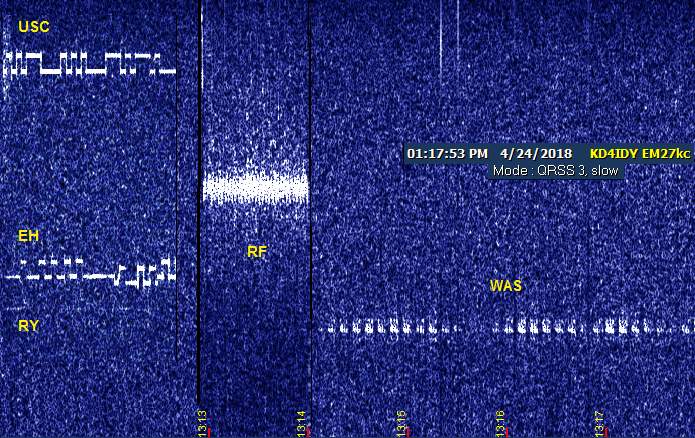
Didn't get to stay in the field nearly as late Tuesday as I did Monday, but in the afternoon EH and USC were strong, while RY was present but sometimes just below visibility. As good as USC was, I immediately thought to check out RF and WAS. Both of them were visible and audible...RF more so than one should probably expect, while WAS was exhibiting fairly typical QSB patterns but was audible roughly a third to half the time.
I heard a kind of fuzzy note where PCO should have been, but as you can see from the corresponding file attachment, it was some peculiar wideband noise source that either pulsed slowly or experienced extraordinarily regular QSB (about twice a minute). At different times over recent days, it has been as narrow as 15 Hz and as wide as 50 Hz...when it's present at all.
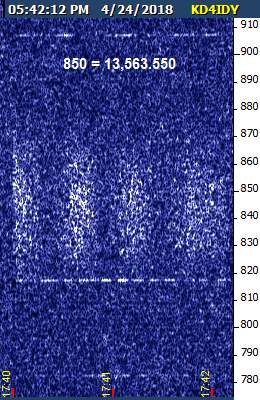
No sign of GNK, the Illinois beacons, or anyone else inside the first skip zone under current band conditions, for several months now.
John
---------------------------------------------------------------
 File Attachment 1: 24aprUSC-RF-WAS.jpg
File Attachment 2: 24apr-fuzz.jpg
Friday Night EARs
I spent the first part of Friday evening checking out WSPR on 137 kHz (separate post), then tuned over to 1750 m in time to catch EAR fading in for the night. Moderate QRM at first, but relatively quiet by about 5:10 AM CDT when the pre-sunrise fade took away all the signal (SR at 6:30 AM).
John
Re: Beacon RF
Posted by Bill Hensel on April 28, 2018 at 21:01:50.
In reply to Re: Beacon RF posted by Jack Roblin on April 26, 2018
RF coming into to Colorado 2050 utc no other beacons heard.
WSPR in the Night
Posted by John Davis on April 28, 2018 at 21:24:54.
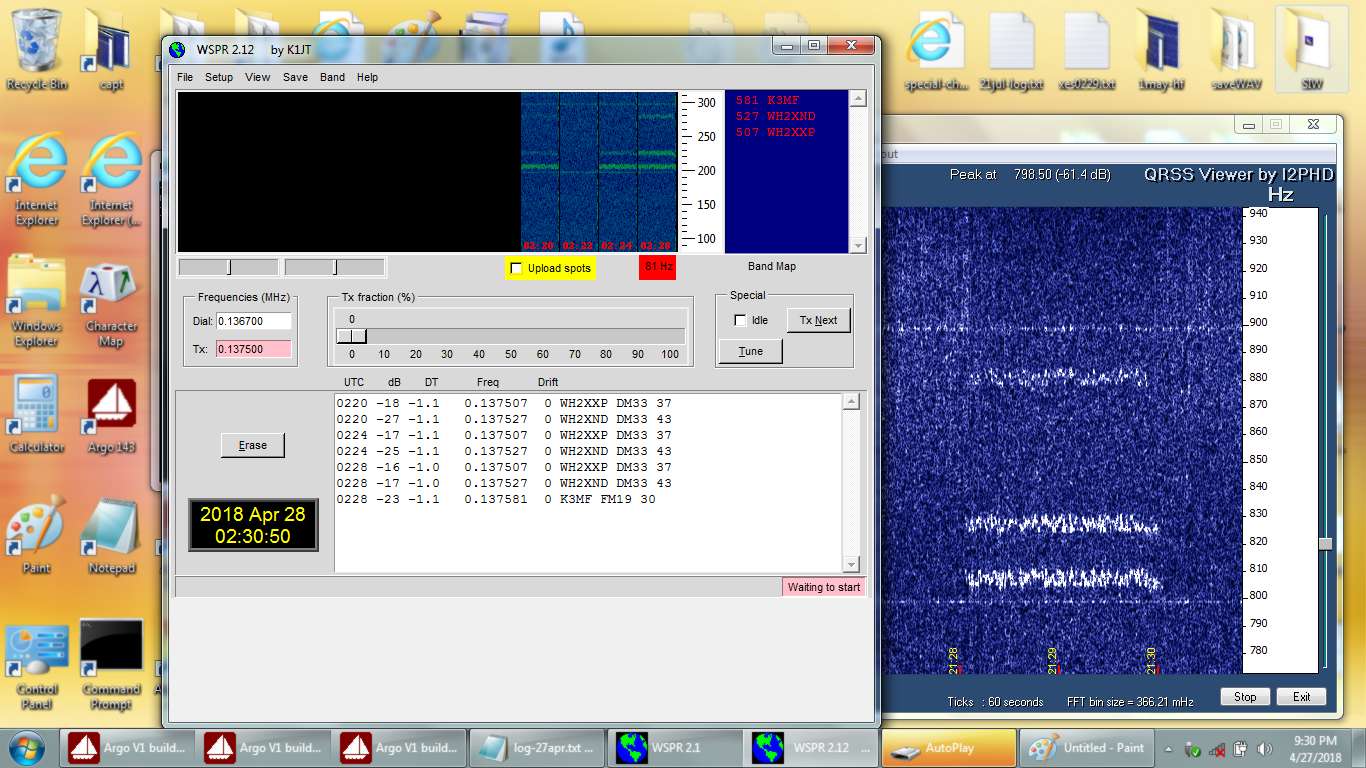 (Use your browser's Magnify tool if necessary to see image in full detail.)
WSPR2 on 2200 meters seems hot this weekend. Below is my full list of spots from last night, but if I had hung around the band longer there would have been additional opportunities including WA9CGZ, according to email reports. At the very least, K3MF writes he will be on "8 PM to 5 AM Thursday to Sunday."
0220 -18 -1.1   0.137507  0 WH2XXP DM33 37
0220 -27 -1.1   0.137527  0 WH2XND DM33 43
0224 -17 -1.1   0.137507  0 WH2XXP DM33 37
0224 -25 -1.1   0.137527  0 WH2XND DM33 43
0228 -16 -1.0   0.137507  0 WH2XXP DM33 37
0228 -17 -1.0   0.137527  0 WH2XND DM33 43
0228 -23 -1.1   0.137581  0 K3MF FM19 30
0232 -17 -1.1   0.137507  0 WH2XXP DM33 37
0232 -15 -1.1   0.137527  0 WH2XND DM33 43
0236 -18 -1.1   0.137507  0 WH2XXP DM33 37
0236 -13 -1.1   0.137527  0 WH2XND DM33 43
0240 -17 -1.3   0.137507  0 WH2XXP DM33 37
0240 -13 -1.3   0.137527  0 WH2XND DM33 43
0240 -20 -1.4   0.137581  0 K3MF FM19 30
Ward K7PO pointed out: "Notice the "twist" after our AZ sunset time? Just after SS, XXP is stronger, but shortly after that, roughly 30 minutes or so, XND dominates. We see the same patterns on our sunrise numbers. Fun stuff!" Yes indeed. I hope to be able to do a continuous sunset to sunrise session to observe that phenomenon in more detail.
John
---------------------------------------------------------------
File Attachment 1: 27apr1.jpg
HiFERs SIW Again at Last!
The plan for today was to continue my dusk-to-dusk monitoring of 2200 m WSPR, but at local noon propagation was so stable, I decided to take a quick look up at 22 m. I saw USC faintly, RY even fainter at first, and EH jumping around on top of an unknown line of some sort. It quickly became apparent that the unknown signal was an old, familiar one that I hadn't seen in many months. I quickly fired up an instance of ARGO in QRSS30 and watched! I also cranked up WSPR and was rewarded there, too; see below.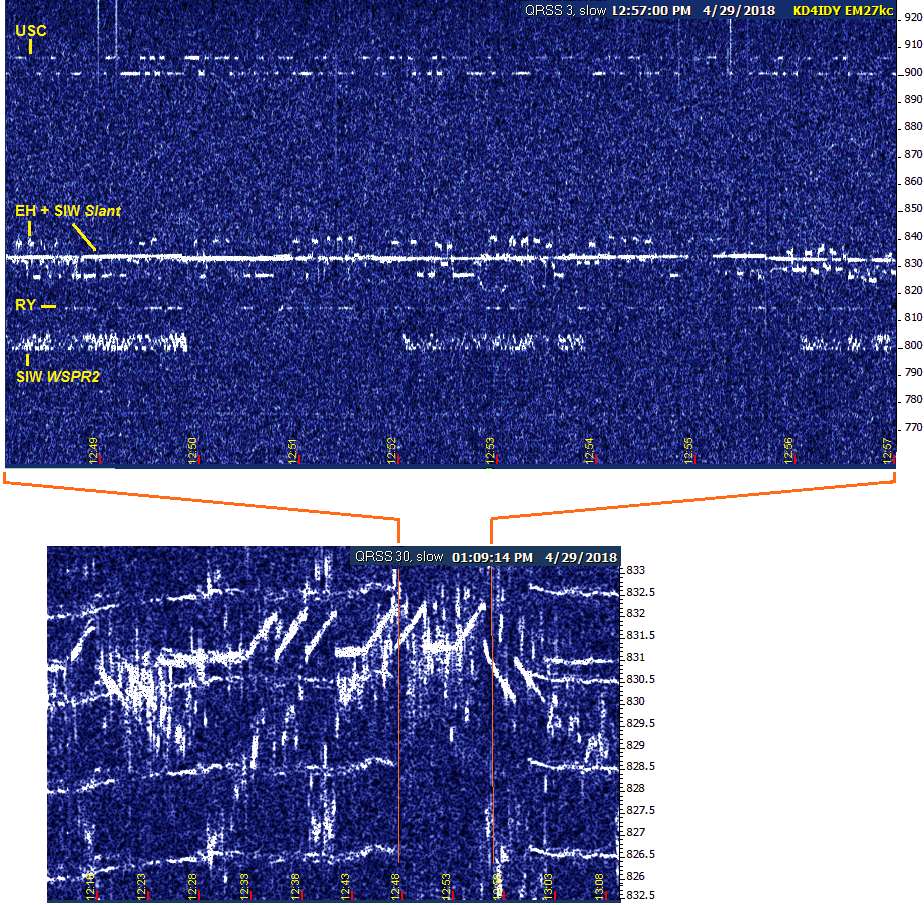
SIW WSPR was also present and decoded well through moderate Codar QRM. Codar shut down at 1748 for about 12 minutes, but QSB started increasingly knocking holes in the signal. Even though there were several strong instances from time to time, it did not decode further.
1720 -23 -1.1  13.555407  0 K3SIW EN52 7
1724 -22 -2.2  13.555407  0 K3SIW EN52 7
1732 -25 -1.6  13.555407  0 K3SIW EN52 7
1736 -21 -1.2  13.555406  0 K3SIW EN52 7
1740 -24 -1.1  13.555407  0 K3SIW EN52 7
1744 -22 -1.1  13.555406  0 K3SIW EN52 7
1748 -18 -1.9  13.555407  0 K3SIW EN52 7
1752 -22 -1.5  13.555407  0 K3SIW EN52 7
After this rare opening started to decline, I checked for other beacons. RF was relatively loud, WAS was fair, and eventually FRC joined in. Nobody else heard or seen.
John
---------------------------------------------------------------
File Attachment 1: 29apr22m.jpg
Re: HiFERs SIW Again at Last!
Thanks for the signal report John. Thought the hifers were running okay but you never know for sure until a report from outside the back yard comes in.
73, Garry, K3SIW, EN52ta, Elgin, IL
28/29 April Hifers
Posted by ed holland on April 30, 2018 at 21:27:26.
Hi Folks,
I found time for some listening and recording whilst working on the next radio restoration project.
GNK has made a welcome return, coming in with good audibility yesterday evening around 1800 - 1900 Hours (PST+DST). Also notable yesterday, in an otherwise dry watering hole, was EH Audible, and the FSK was clear copy with spectrum lab.
Elsewhere, I heard hints of the mysterious "P", and a hint of something on the computer that tallied with PBJ.
PVC is on air as usual, but I suspect the antenna connections could benefit from attention, which means a trip to the roof.
Cheers
Ed
potrzebie