Re: Sunday HiFERs in SEK
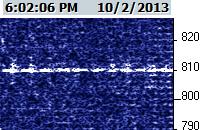
Nice capture JD. Checked yesterday morning and today in the late afternoon and NC, EH, and USC were all strong at the watering hole. Also could see traces from EDJ, but as usual nothing from MP. I'm just too close to Mitch to copy his hifer normally (while his 137 kHz signal is Q5 all the time). Probably that's why SIW is usually absent at your QTH. Higher in frequency the CW of MTI was also good both days but I could detect hints of PBJ.
73, Garry, K3SIW, EN52ta, Elgin, IL
hifer AJO back on +1
Posted by Ward K7PO on October 03, 2013 at 01:20:58.
Hifer AJO is back on, happily beaconing away once again from southwest AZ. I had an old 49er beacon on the shelf, so I put it up too. It sends 7P at 8 wpm cw on 49.86 mhz. I hear it very well here at home, ~90 miles away. While I had AJO and 7P on the bench last weekend, I also finished another hifer project, so there might be a new qrss3 signal near the water hole very soon.
Ward K7PO
Re: Sunday HiFERs in SEK
Posted by John Davis on October 03, 2013 at 03:39:38.
In reply to Re: Sunday HiFERs in SEK posted by Garry, K3SIW on October 02, 2013
Another thing that makes it hard to copy MP sometimes is the wandering of EH. Yesterday afternoon (Tuesday) MP and the mark (high) frequency of EH were almost in collision. Today it was the space (low) side of EH that was sometimes less than 1 Hz from MP.
Also from yesterday, while I'm thinking of it, the other regulars were present at the watering hole before sunset, but vanished fairly quickly after dark! Nobody of the Part 15 persuasion was left visually or aurally on the whole band by 10 PM CDT, except for FRC. The signal was fairly loud at times, but QSB was rapid and frequently quite deep. I couldn't get more than two characters at a time. Oddly, I could most often hear the "C," the "K" next most often, the "6" and "R" tied for third place...but in the 15 minutes or so that I listened, I never once could make out the "F." Odd.
Now, this evening's listening produced another peculiar mystery, but I'm still working on that one. Will post again later.
John
Re: hifer AJO back on +1
Posted by John Davis on October 03, 2013 at 04:02:17.
In reply to hifer AJO back on +1 posted by Ward K7PO on October 03, 2013
I was delighted to hear AJO at its usual spot this afternoon! Using Argo in QRSS3 mode to look at the frequency, I saw the carrier at 13,558.510 kHz today. The CW ID was fairly strong sometimes, as evidenced by the visible keying sidebands, and the DAID stands out distinctly on a QRSS trace as well (below).
Congratulations also on the 49er. For the list, what city should I give as its location? Thanks.
John
Re: hifer AJO back on +1
John,
Evidently, timing is everything. AJO went back on at about 5:00 P.M. your time. Thanks for the Argo trace, I always like seeing them.
7P and AJO are located near AJO, AZ, ~2900 ft elevation, at a site I maintain for my employer. We have 25 or so radios there, so nobody cares about a couple more antennas. I have a remote HF rig there as well, and since our radios are mostly VHF and UHF ground to air radios, it's pretty quiet on HF. I 'borrow' a couple T1's on the microwave backbone, convert to ethernet, and send them to my house on 2.4 ghz. Soon I'll be able to turn AJO off remotely when I want to listen for hifers from the hill.
Sorry, I didn't mean to get so long winded. Thanks again, and I'll probably have the qrss3 (13.555515 +/-) signal on this afternoon from the shop.
Ward
Wednesday HiFER Mystery
Posted by John Davis on October 03, 2013 at 05:38:39.
Back on January 26, I posted an enquiry about a seeming new HiFER IDing as CFV just barely within the top end of the 22 meter Part 15 slot, and asked if anyone claimed it. Nobody did, and despite repeated efforts, I never heard it again. Until this afternoon!
It was as high in frequency as 13,566,911 Hz at 6 PM CDT today and drifted down to 13,566,909.5 about 15 minutes later. Nice professional sounding keying. A little codar, but not enough to interfere when the signal was at its peak. It did fade a lot, though, at about the same rate that MTI and FRC were doing this afternoon, so I presumed it was skywave.
But...something nagged at me, and had done since January. So I took several minutes to investigate it today.
You see, CFV is the identifier of the Coffeyville, KS, NDB that is located scarcely 30 miles west of me. I've heard those letters many times, so it was a very odd coincidence to hear them on HF. What had been nagging at me is whether it might actually the same signal in some unknown fashion? By waiting for a couple of sufficiently loud IDs on HF to allow me to capture them in Argo's NDB mode, and then graphically moving the one-tick-per-second time scale up into the capture, I was able to get a reasonably close measurement of the ID cycle as 5.7 seconds.
Then I tuned down to LF and found keying from NDB CFV on 212,221.3 Hz. Did the Argo thing with it, and aligned the LF graphic to the HF capture to compare the ID cycle length. Also 5.7 seconds!
Could just be a coincidence, of course. I had no way to check whether the Morse keying is actually simultaneous on both bands. I can take my little Grundig portable to the field and hear NDB CFV on it just fine, but the trick is getting the "HiFER" version to show up again to compare.
If the HF version is coming from the NDB in some way, I can't imagine how. I've never encountered an RF amplifier that produced a 63.928th harmonic! Now, 212 kHz is supposed to be the carrier frequency of the Coffeyville NDB, but they could be using MCW keying now, like LYQ. Even so, there is no integer relationship between the carrier or its potential upper sideband and the resulting HF signal.
If there is a lower sideband being transmitted, either intentionally or otherwise, the HF signal could be a little closer to being an integer multiple...but even then, unless the sidetone frequency is appreciably greater than 1020 Kz, the 64th harmonic is still going to be a couple of kHz out-of-band.
I didn't think to check for a lower sideband on the NDB today (supper was calling) but I will look tomorrow. Even if by some improbable set of circumstances, HF CFV is actually originating in NDB CFV, it's still pretty amazing to me. The fading certainly makes it appear to be arriving by skywave. NVIS??
John
Re: hifer AJO back on +1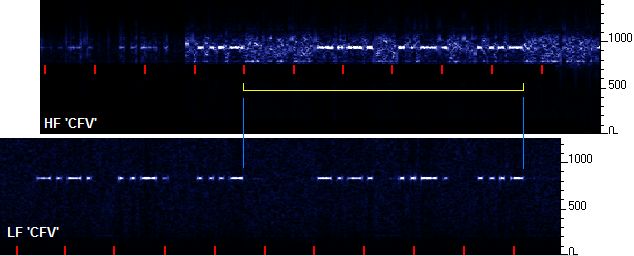
Posted by John Davis on October 03, 2013 at 05:53:44.
In reply to Re: hifer AJO back on +1 posted by Ward K7PO on October 03, 2013
>>> Sorry, I didn't mean to get so long winded.
Hey, I get long winded pretty regularly; so as an internationally recognized expert on the subject, I can assure you that post was not long winded! :)
It's always fascinating to me to hear how others install and operate their stations. There are so many different ways of doing it in this hobby, depending on local circumstances. All of them I've ever heard or read about have been interesting thus far.
John
Re: Wednesday HiFER Mystery
Posted by Lee on October 03, 2013 at 06:10:28.
In reply to Wednesday HiFER Mystery posted by John Davis on October 03, 2013
Fascinating! As a possible suspect I am going to mention the Luxembourg effect. From what I remember it's one radio transmission also showing up on a much different frequency. Re: hifer AJO back on +1
Lee
Posted by EdWSlidell, LA on October 03, 2013 at 15:00:23.
In reply to Re: hifer AJO back on +1 posted by Ward K7PO on October 03, 2013
Hello Ward and John. I also heard the AJO beacon, ~13558.5KHz, during the period around local sunset(0000 UT), with good signals in the 339 range. It only lasted about 15 minutes or so, but was fairly consistent during that period. Had the radio on and listening for MTI, but that beacon seems to only be heard from rarely now, and at varying times during the day. Maybe a result of the closer location. Perhaps the hurricane will bring more of the MTI signal this way. With regard to the CFV signal, if the 64th harmonic of 212KHz is 13658KHz, the 13KHz drift you noted would be about 200Hz at the assigned frequency. What is the frequency requirement (FCC/FAAS/ICAO) for NDB's---100ppm? Ed WSlidell, LA EM50cg
Good MTI HiFer signal today
Posted by EdWSlidell, LA on October 03, 2013 at 19:50:13.
Hi all. Just started hearing the MTI signal, around 1940 UT, on ~13557.5 KHz. Heard one ID about 339, then the signal went up to 449, and is still good around 1950 UT. The storm must be helping after all. Ed WSldell, LA EM50cg Re: Good MTI HiFer signal today
Posted by Garry, K3SIW on October 03, 2013 at 21:46:34.
In reply to Good MTI HiFer signal today posted by EdWSlidell, LA on October 03, 2013
Ed, MTI comes in here well whenever USC and NC are coming through. I'm copying it well at the moment, along with PBJ a bit higher in frequency. Haven't seen PBJ often but right now it's as strong as the big 3 at the watering hole (NC, EH, and USC). Nothing seen yet of AJO and FRC.
73, Garry, K3SIW, EN52ta, Elgin, IL
Re: Good MTI HiFer signal today
Posted by EdWSlidell,LA on October 04, 2013 at 02:53:17.
In reply to Re: Good MTI HiFer signal today posted by Garry, K3SIW on October 03, 2013
Hello Garry. The earlier MTI signal faded out abruptly after only about 15 minutes. However, around 2100 UT, it appeared out of nowhere, and probably was 559 at times. It stayed in for nearly 1.5 hours. It think this would be about the time you were hearing it also. It was a regular listen when MTI was located up in MD area, but now it is somewhat rare to hear it--or maybe only heard for shorter periods of time when I'm no listening. The SZX signal is somewhat similar. Appears suddenly, and then is quite strong at times. The GNK signal is usually quite strong for extended periods of time. Ed WSlidell, LA EM50cg
Rigexpert AA-54 readings for JAM
Posted by Lee on October 04, 2013 at 04:04:55.
So I got around today hooking up my new AA-54 antenna analyzer to the loading coil for beacon JAM 187.015khz. Very revealing. On the tap that gives me the most current connected to my 50 ohm antenna output the AA-54 reports a 5 to 1 SWR. Other near taps report much worse SWR. The impeadance graph is hard to read on the instrument. Probably easier to read when outputted to a lap top. I will do that when I get the SWR to a reasonable reading. So far it seems to be easy to use. Re: Rigexpert AA-54 readings for JAM
Lee
Posted by John Davis on October 04, 2013 at 16:40:46.
In reply to Rigexpert AA-54 readings for JAM posted by Lee on October 04, 2013
The question may actually be, do you really want or need a match to 50 ohms? It's a very common situation for a loading coil to not simultaneously produce an impedance match to an arbitrary value. Its most critical function is to resonate the antenna; and depending on the actual resistance of the antenna+ground system, there's no mathematical guarantee that it will be possible to transform the resulting impedance to 50 ohms with the coil alone.
At the tap which produces the best current, what actual resistance and reactance does the instrument show? This may be more valuable to you than VSWR.
John
Lowfer SIW QRV
Posted by Garry, K3SIW on October 04, 2013 at 21:48:51.
With the help of Bob, NK9M, the SIW lowfer was put back into service this afternoon. Transmit schedule is like last year: Su, Tu, Th, and Sa at the watering hole around 185.2993 kHz; M, W, and F around 185.185 kHz. Frequency switches occur at 1800Z each day. Transmissions at the watering hole are QRSS60 and QRSS30. The lower frequency format is "slash" code with approximately 90 second ramps (up=dot, down=dash). This can be easily switched to the "EH" form of DFCW and perhaps we'll try that eventually. The beacon is located at grid square EN51uq.
73, Garry, K3SIW, EN52ta, Elgin, IL
Re: hifer AJO back on +1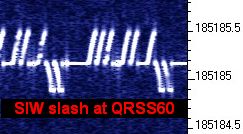
Posted by Brian nb9e on October 04, 2013 at 22:08:26.
In reply to hifer AJO back on +1 posted by Ward K7PO on October 03, 2013
What is your 49er made out of ???
Hifer FRC !!!
Posted by Brian nb9e on October 04, 2013 at 22:16:31.
Heard Hifer FRC strong today around 10-12 PDT today at the work qth (DN10tx) using a PCR-1000 to a discone of all things.Listened for AJO but could not copy anything.I will be listening for Lowfers and Hifers this weekend with FRG-100 and long wire and/or G5RV.
GNK !!!
Posted by Brian nb9e on October 04, 2013 at 22:36:19.
I am hearing GNK very strong now 3:32 PDT same setup at work QTH DN10tx !!!
Re: Rigexpert AA-54 readings for JAM
Posted by Lee on October 04, 2013 at 23:57:11.
In reply to Re: Rigexpert AA-54 readings for JAM posted by John Davis on October 04, 2013
At the tap which produces the best current, what actual resistance and reactance does the instrument show? This may be more valuable to you than VSWR.
I mentioned that R X graph was a little difficult to make out on the instrument screen. Seems to me it was showing 2 traces hanging aroud 100 ohms. My seat of the pants, dead reconing, devining rod current indicator is a modified CB field strengh meter from the 80's leaning against the mast near the top of the coil. Max needle deflection....most current. And then backed up with the clamp-on current meter. But now I've got an analyzer and some new hush puppies. I can go to school. I can be somebody. Sorry. Old Re: Rigexpert AA-54 readings for JAM
70's commercial.
What I did today is start over. Clean slate test taps with the AA-54. I ended with adding a winding at the top of the coil. Making the overall inductance bigger. And moving one tap at the bottom of coil feed point. I moved this one tap. Don't recall if I added or subtracted one tap, but it moved one. This gave me a deep null on the SWR graph down to 1.5 to 1 at 187khz. Now the r x graph shows 2 traces hanging around 50 ohms. Lets see how this shakes out. It was fun to see I was in the ballpark. Right field fence but in the ballpark.
Lee
Posted by John Davis on October 05, 2013 at 01:49:14.
In reply to Re: Rigexpert AA-54 readings for JAM posted by Lee on October 04, 2013
Sounds very encouraging, Lee. Ballparks are good places to be in, especially at this time of year. :)
Beacon JAM down UFN
Posted by Lee on October 05, 2013 at 08:46:20.
Well I just made those really cool more efficient antenna coupling mods and now it appears JAM is blowed up real good. It was up when I left at 1400. We have had major Santa Ana winds today so it could be static discharge. But more likely the PA couldn't hack the new demands. I am trying to locate a substitute for a MJE 180 transistor. Its fairly obvious to me the final is blowed up. Any suggestions for a MJE 180 silicon NPN substitute. I had all the data to interigate Rat Shack offerings but they have become off line to me. Really!!!!!!!!!. Re: GNK !!!
Lee
Posted by Domenic on October 05, 2013 at 10:28:40.
In reply to GNK !!! posted by Brian nb9e on October 04, 2013
Brian, Thank you very much for the reception report and new state. If you would like a QSL card just let me know. Thanks again. Domenic KC9GNK.
Re: Beacon JAM down UFN
Posted by EdWSlidell, LA on October 05, 2013 at 15:32:13.
In reply to Beacon JAM down UFN posted by Lee on October 05, 2013
Hi Lee. I sent you the data sheet for a MJE180 sub., the NTE184, and hopefully I used the correct email adr. Radio Shack Direct offers it on their Ebay store, and for about $3. It seems to be a fairly dinky transistor with only a 40V rating in the orignal MJE180 version. The F/t is listed as only 2MHz, so it definitely is an audio type transistor. The sub. shows an 80V rating, and higher current(4A vs. 3A). I'm not sure what size heatsink you have it on, but slightly heavier, extruded type would likely work better than one of the smaller, thinner, bent types. Good luck with it. Ed WSlidell, LA EM50cg
Re: Beacon JAM down UFN
Posted by Lee on October 05, 2013 at 18:31:50.
In reply to Re: Beacon JAM down UFN posted by EdWSlidell, LA on October 05, 2013
Thanks Ed. Very Helpfull. I am using a 1.5 inch square bended type heat sink. No room for a larger extruded type. Beacon JAM 187.015khz back up
Lee
Posted by Lee on October 06, 2013 at 01:25:10.
Beacon JAM 187.015khz back up. Replaced the blown PA transistor with a better rated sub found by Ed. Thanks Ed. And you are right. that is a dinky transister. Hopefully this one holds up better. I've been monitoring it for almost an hour and it is still up. So for now I'm calling it fixed. This may be of interest to the lowfer folks. My over the air monitor is an old Rat Shack FM wireless intercom. It is wireless in the sense that it communicates to other intercoms using the AC recepticle/wiring it is plugged into. And it uses longwave frequencys. If my beacon is on the air the intercom howls. It makes a big noise. Instant verification that I'm on the air or not. New Beacon (UK) 13.556Mhz
Lee
Posted by James Coxon on October 06, 2013 at 10:03:16.
Hi, just to say I've setup a beacon based in the UK on 13.556Mhz, running at approximately 4mW based on a Si570 and an Arduino. Its transmitting SlowHell and RTTY.
Grateful for any reception reports.
HiFERs Saturday in SE Kansas
Posted by John Davis on October 06, 2013 at 17:50:24.
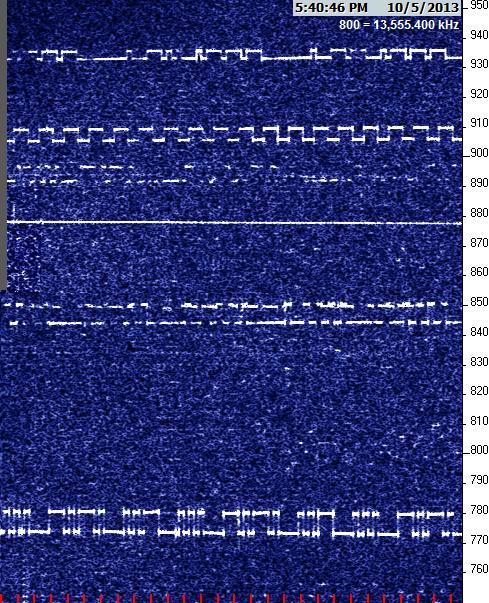
Late Saturday afternoon was fairly productive. At the watering hole (above), from top to bottom, we have EDJ, NC, BC just before it faded for the day, the spur from my computer display, MP with the mark frequency of EH drifted right on top of it, the gap where I used to see SIW more regularly than has been the case this year, and USC.
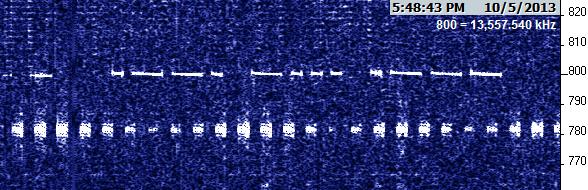
Also visible a little higher up were PBJ, during its strongest ID cycle of the afternoon (it began fading on the very next "P") and MTI. The latter was generally nicely audible, even though the QSB periodicity is quite prominent.
AJO and FRC were also present, though neither were quite as strong as my previous report.
No return of the mysterious CFV yet. If it was there yesterday, it would've been buried under a rather strong carrier that parked on the same spot. In fact, there were a lot of previously unencountered carriers in the high end of the ISM band and for several kHz above. When I return to the field in a little while, I'll be taking the Grundig portable so I can compare the airport NDB in real time with the "HiFER" version, if/when it returns. (If it doesn't return soon, I may go on a road trip to the airport and see if it shows up right there by direct wave.)
John
Re: New Beacon (UK) 13.556Mhz
Posted by James Coxon on October 06, 2013 at 19:15:14.
In reply to New Beacon (UK) 13.556Mhz posted by James Coxon on October 06, 2013
Update: beacon moved to 13.553Mhz out of local noise.
Re: New Beacon (UK) 13.556Mhz
Posted by John Davis on October 06, 2013 at 20:04:50.
In reply to Re: New Beacon (UK) 13.556Mhz posted by James Coxon on October 06, 2013
Will look for it this afternoon. The predicted MUF is high enough between us right now to support a path, but an upturn in geomagnetic activity over the last hour or two is likely to make the path much lossier and less stable than it would otherwise be.
When you get a chance, could you provide city and (if possible) grid coordinates, and perhaps operating schedule to include in the beacon list? Thanks.
John
Is 13560 kHz a no-no ?...
Posted by Steve, VK2XV on October 06, 2013 at 22:36:29.
Today I plotted the HiFer station frequencies to get visual idea of the distribution across 13553 kHz to 13567 kHz. This shows the clustering around 13555.5 kHz ('Waterhole') as expected, but also a 3 kHz 'deadband' from approximately 13558.5 kHz to 13561.5 kHz where no stations are recorded as residing.
Is there some QRM issue for that band of frequencies ? As the 'deadband' is smack-dab in the middle of the the 22M ISM band (13560 kHz) I am guessing that those ISM devices might be clustered around that frequency as thus needs to be avoided.
Comments ?
Steve, VK2XV
Re: Is 13560 kHz a no-no ?...
Posted by John, W1TAG on October 07, 2013 at 00:34:30.
In reply to Is 13560 kHz a no-no ?... posted by Steve, VK2XV on October 06, 2013
Steve, Re: Is 13560 kHz a no-no ?...
13560 +/- 1 kHz should definitely be avoided. It's a forest of carriers and intermittent signals, and appears to be the default ISM frequency.
John, W1TAG
Posted by John Davis on October 07, 2013 at 02:09:58.
In reply to Re: Is 13560 kHz a no-no ?... posted by John, W1TAG on October 07, 2013
I concur with John A's assessment, and I would even go so far as to suggest avoiding -1.5 to +2 kHz around the band center. Even in this rural area, an increase in noise sources over the past year has made it difficult to hear stations which used to be regulars here...notably AJO and NDB.
John
Re: Is 13560 kHz a no-no ?...
Posted by Steve, VK2XV on October 07, 2013 at 07:44:34.
In reply to Re: Is 13560 kHz a no-no ?... posted by John Davis on October 07, 2013
John & John - prompted by your comments I have looked at the FCC's info on this and the requirement is that ISM gear should on 13560 kHz +/- 0.05% (+/- 500ppm); which is essentially +/- 7 kHz (i.e. within the 14 kHz band of 13553 kHz to 13567 kHz). However, perhaps most (all?) ISM gear runs from crystal references which would be nominally +/- 100ppm. This is probably fortunate in that it would cluster ISM device carriers around 13560 kHz +/- 1.3 kHz. Noise sidebands (60Hz, 120Hz...) would add some extra elbow room.
Thanks for the comments - they have answered my query.
Steve, VK2XV
Re: New Beacon (UK) 13.556Mhz
Posted by James Coxon on October 07, 2013 at 10:18:53.
In reply to Re: New Beacon (UK) 13.556Mhz posted by John Davis on October 06, 2013
Hi John,
The beacon is in London, UK in grid coord IO91xl . Currently running continuously with slow CW (AT AT) followed by SlowHell and then 2 strings of RTTY. Due to space the antenna is not ideal so suspect will eventually move it out of the city to allow for a better antenna.
James
Part 15: Is 1 +1 still 1?
Posted by Ward K7PO on October 07, 2013 at 17:39:19.
While repairing AJO recently, I had a couple of ideas about changing the beacon. While I like the idea of qrss3 or slower, I'm still 'old school' about wanting to copy beacons live on cw. Yes, I could just mix the two modes with the keyer, but that's way too easy. So I tried the following today on the bench, and all looks OK on the spectrum analyzer. I put 2 Epson chips, separated by about 3 khz, on a board with a shield between. I feed each oscillator to a port of a hybrid combiner, also in a shielded box, and then to a low pass filter. Everything looks great, I can't see any interaction between the two, and both sound fine on a receiver. The power meter in my IFR freaks out with both on, but the spectrum analyzer shows no change in amplitude with one or both signals on. My implementation would be AJO on 13.558.5 mhz and another beacon (qrss3)in the watering hole about 13.555515 mhz, using one antenna.
So, how does this look RE part 15? I see it as two 'transmitters' sharing an antenna. Not sure how the FCC would see it.
Re: Part 15: Is 1 +1 still 1?
Ward K7PO
Posted by John Davis on October 07, 2013 at 18:11:01.
In reply to Part 15: Is 1 +1 still 1? posted by Ward K7PO on October 07, 2013
"So, how does this look RE part 15? I see it as two 'transmitters' sharing an antenna. Not sure how the FCC would see it."
Very good question, Ward. Since they are sharing an antenna, it may be that the FCC would regard this as one composite device. If so, it would be necessary to keep the total output for both frequencies (combined) within the emission limit for a single device.
(Update:) Upon further reflection, I am more convinced this would be the case. The main reason for supposing so is the general principle found in §15.204 that indicates a Part 15 "device" includes the antenna with which we certify operation. While we have greater flexibility with antennas under 15.225 than is allowed in alternative provisions for other bands, if the antenna is considered part of the device, then so would be any other transmitter operating into that same antenna. One plus one still equals one in that case--which is unfortunate, because under 15.31(h), measurements for compliance of a composite device (meaning, where individual sources are wired or cabled together) must be made with all the sources active. Similar definitions exist in Part 2 where measurement procedures are concerned. Hence, it would be necessary to measure the peak RF level with the two keyed on simultaneously and keep the resulting peak value under the limit of 15,848 microvolts/meter at 30 meters over the whole band. (Or at least, within the 9 kHz detector bandwidth of the CISPR quasi-peak measurement standard.)
This might not ever become an issue unless you receive an inspection. Even then, you might be able to convince a reasonable inspector that this arrangement is actually two devices, regardless of a shared antenna. But speaking only for myself, I personally wouldn't depend on it. If you want to be prudent, I believe a second antenna would be preferable.
John Re: Wednesday HiFER Mystery
Message Updated 2158 UTC 07 Oct 2013
Posted by John Davis on October 07, 2013 at 19:23:01.
In reply to Re: Wednesday HiFER Mystery posted by Lee on October 03, 2013
"As a possible suspect I am going to mention the Luxembourg effect. From what I remember it's one radio transmission also showing up on a much different frequency."
Does make a person wonder. Although, the Luxembourg Effect supposedly involves a modulation effect in the inosphere, whereby a very strong signal imposes its amplitude variations (including audio) on a weaker signal that is refracted by the same patch of ionosphere being illuminated by the powerful signal. I've got my doubts about a little Kansas aerobeacon being able to agitate enough free electrons 50 or 60 miles up to do the same thing.
Plus, this keying didn't seem to be modulated onto anything else...it was there all by itself. To cause the ionosphere to generate entirely new signals requires power levels like those of HAARP (which is now boarded up and in danger of being bulldozed once the government is back in business, so I can't put the blame on it).
Thus, it seems probable the "Coffeyville Effect" has some other origin. Until it shows up again on a low-QRM day and allows me to measure it some more, it will likely remain a nagging mystery.
John
Re: Part 15: Is 1 +1 still 1?
Posted by Ward K7PO on October 07, 2013 at 22:19:44.
In reply to Re: Part 15: Is 1 +1 still 1? posted by John Davis on October 07, 2013
John,
Your answer is exactly why I posed the question on this board. I'm amazed at the knowledge that 'lurks' here. I will just put up a separate antenna up if I decide to put another signal on the air. The last thing I want to do is bring unwanted attention to myself or the hobby.
It was a good bench exercise though, as I had never built a hybrid combiner before.
Ward K7PO
MTI beacon heard in Florida
Posted by Ernie AJ4BP on October 08, 2013 at 03:17:42.
Today at 1908 UTC I heard the Hi-Fer MTI cw beacon o 13.556.76. Two hrs. later the beacon was still being heard. This is my first beacon capture.
Re: MTI beacon heard in Florida
Posted by John Davis on October 08, 2013 at 06:13:11.
In reply to MTI beacon heard in Florida posted by Ernie AJ4BP on October 08, 2013
Congratulations, Ernie! MTI has certainly done well from its new location, and makes a great target among stations in the eastern half of the country.
HiFERs, Sunday & Monday
Posted by John Davis on October 08, 2013 at 07:03:49.
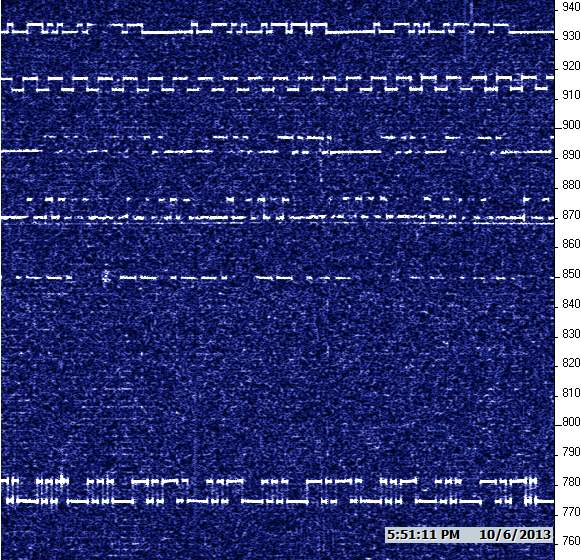
Sunday was pretty productive at 22 m. From top to bottom, we see EDJ, NC, BC, EH was safely above MP this time, and finally, USC. By ear, AJO and FRC were audible.
I began listening in late afternoon to try to catch PBJ's pre-sunset enhancement, and it worked well, too. MTI was plenty audible, with its periodic level swings taking it over a wide range. By two hours after sunset Sunday, everybody was gone except AJO and FRC for a little while longer.
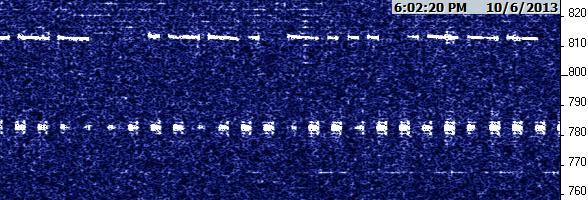
On Monday evening, I didn't get to the field until right at sunset. Within 30 minutes, the watering hole was dead except for traces of codar interference and a fair EH. AJO continued to come in faintly, and FRC was fair (would've been nicely audible were it not for codar pulses).
73 Re: HiFERs, Sunday & Monday
John
Posted by Garry, K3SIW on October 08, 2013 at 12:33:57.
In reply to HiFERs, Sunday & Monday posted by John Davis on October 08, 2013
That's impressive copy John. Sorry my hifers aren't making it to you. They are running normally as far as I can tell. Here I regularly copy NC, EH, and USC at the watering hole, with occasional indications of EDJ and yesterday BC was evident (barely). Haven't seen MP for quite awhile. Higher in frequency MTI is a regular, but PBJ isn't usually copied. Same for AJO and FRC.
Re: Lowfer SIW QRV
Posted by John Davis on October 08, 2013 at 21:55:47.
In reply to Lowfer SIW QRV posted by Garry, K3SIW on October 04, 2013
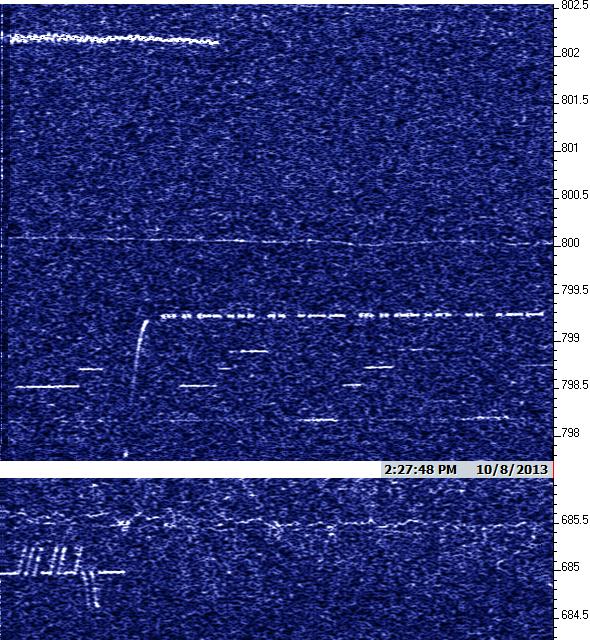
Here is today's capture of LowFER SIW in both of its formats and frequencies. I made it a point to be capturing on both sides of the 1800 UTC change-over, and also utilizing three instances of Argo to be able to watch for WMS simultaneously (no go on the latter, though). The captures are aligned in time, so that the moment of transition shows clearly.
There's also a mystery stairstep signal that I've never encountered before! Anyone else seeing this, or have a good idea what/who it is?
Also had what first looked like WSPR-15 (upper left), but it didn't decode and eventually starting wandering before it disappeared entirely.
The 800 Hz mark is 185.300 kHz within ±0.025 Hz at the moment of capture. There is slightly more error the farther one goes toward the left side.
John
Re: Lowfer SIW QRV
Posted by Garry, K3SIW on October 08, 2013 at 22:08:41.
In reply to Re: Lowfer SIW QRV posted by John Davis on October 08, 2013
John, great captures! Impressive that you're seeing anything from so far away at 1800Z (my notes indicate the path is 483 miles) but you sure caught the frequency/mode transition, including the brief OCXO warmup. The waterhole frequency is supposed to be about 185.2993 kHz when the 4.8 MHz OCXO is exactly on frequency and that seems to be the case. The slash code is to be at 185.185... kHz, assuming the 10 MHz OCXO is exactly on 10 MHz. The slash code dashes don't look bad using QRSS60, but with QRSS30 there's some bottoming out. Will revisit the beacon one of these days and try to better center the ramp.
73, Garry, K3SIW, EN52ta, Elgin, IL
Re: Lowfer SIW QRV
Posted by John Davis on October 09, 2013 at 00:13:05.
In reply to Re: Lowfer SIW QRV posted by Garry, K3SIW on October 08, 2013
Yes, I did notice the down ramps had a steeper slope than the up ramps. Gave them a little less time to deposit energy in each FFT bin, it looked like to me, but it still showed up nicely.
The band was just amazingly quiet at mid-day, so it was a great opportunity to enjoy what groundwaves can do over good soil conductivity.
Up at HF, the ionosphere was also more cooperative today than it has been for some time. Wait'll you see the HiFER capture! Will post that after Andy's frequency check tonight on 160 meters.
John
Re: Lowfer SIW QRV (and HiFER!)
Posted by John Davis on October 09, 2013 at 18:16:26.
In reply to Re: Lowfer SIW QRV posted by John Davis on October 09, 2013
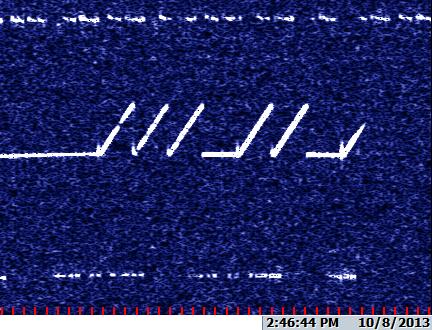
Here's the HiFER capture I mentioned from yesterday. What a big signal on the slant mode! (I'm presuming you shut down at 2:45 PM CDT to listen.) The QRSS was there too, but faded in and out some. Which antenna are each of them using?
John
Re: Lowfer SIW QRV (and HiFER!)
Posted by Garry, K3SIW on October 09, 2013 at 18:34:05.
In reply to Re: Lowfer SIW QRV (and HiFER!) posted by John Davis on October 09, 2013
Thanks for the great capture John. Yes, I do shut down to listen, generally only for 15 minutes or so. Must have chosen a bad time, hi. The slant code goes to a vertical; the QRSS6 goes to a dipole.
73, Garry, K3SIW, EN52ta, Elgin, IL
Re: New Beacon (UK) 13.556Mhz
Posted by John Davis on October 11, 2013 at 17:56:02.
In reply to Re: New Beacon (UK) 13.556Mhz posted by James Coxon on October 07, 2013
Hi James,
Just wanted to let you know I've been looking most days, but haven't seen or heard anything so far. I'll keep trying, although I suspect the path is not going to be open very long at a time this season; the least bit of darkness seems to close down 22 meters entirely now, and there are no longer very many hours when the whole path is in daylight between us.
How slow is the "slow CW," by the way, so I'll know whether to look for it as QRSS?
John
Re: New Beacon (UK) 13.556Mhz
Posted by EdWSlidell,LA on October 12, 2013 at 00:39:47.
In reply to Re: New Beacon (UK) 13.556Mhz posted by John Davis on October 11, 2013
Hi John and James. I have been monitoring the region around ~13553 KHz, and have not heard anything either, save for the "AZ" beacon, on ~13554 KHz. It has been coming in over the past few days about 339, during the 0000-0100 UT time period. It was easily copied. This is the first time I have heard anything other than the slow modes down in this area. What kind of power level is allowed in this band, there in UK? Ed WSlidell, LA EM50cg
Re: Thursday HiFERs and EH Anomaly
Posted by John Davis on October 12, 2013 at 05:43:39.
In reply to Re: Thursday HiFERs and EH Anomaly posted by EdWSlidell,LA on September 28, 2013
"Does the lower double trace in the QRSS10 display(USC?) show the same slow drift upwards, finally merging with the upper trace? Seems to do so at the same time as the two "EH" traces."
Hi Ed. My apologies...in working on the board archives this evening, I noticed that I never got around to answering this part of your question on the mysterious reception of EH.
In the QRSS3 trace from the top of the original message (excerpted here) it's easy to see the QRSS3 keying of MP, and also to distinguish the FSK mark-and-space keying of both EH and USC. Note that the dots which make up the E and H are duplicated in the top line of the EH trace--and the space between dots, namely the lower line 4 Hz beneath, are also duplicated. I've also added a closeup expanded by a factor of 2 to show both pairs clearer.
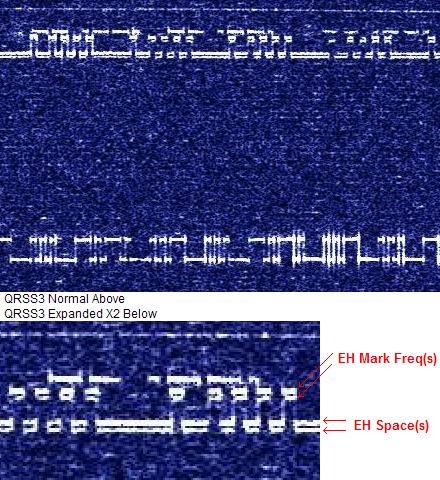
As for the 10 second trace (excerpted below), remember that the slower mode compresses the time scale horizontally by a factor of roughly three while simultaneously expanding the frequency scale vertically by a factor of three. Thus the dots and dashes which make up the M and P, and the dots which make up the E and H, all get crammed together horizontally. But everything gets stretched out vertically.
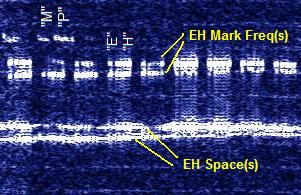
Therefore, the two lines which are merging below the active keying portion of EH aren't USC. They are actually the time squeezed lines for the space interval of EH.
I hope that answers the question without confusing matters further. :)
John
1800Z hifers received in NE IL
Posted by Garry, K3SIW on October 12, 2013 at 18:36:11.
The usual 3 watering hole hifers made a good showing here today: NC, EH, and USC. Higher up around 13557520 Hz both MTI and PBJ were good copy. Nothing detected elsewhere.
73, Garry, K3SIW, EN52ta, Elgin, IL
Re: Thursday HiFERs and EH Anomaly
Posted by EdWSlidell,LA on October 12, 2013 at 19:34:55.
In reply to Re: Thursday HiFERs and EH Anomaly posted by John Davis on October 12, 2013
Hi John. Thanks for the clarification of the two pairs of traces. There still is a question of why both the Mark and Space pairs of the 'EH' anomaly (lower lines) are rising toward the upper lines. Possibly the path length taken by the anomalous signal is lessening as the D and F (or F1 and F2?) layers get closer later in the day. Or the E and O rays are experiencing a similar effect, as discussed in the article mentioned by Steve. As you hinted, it does look somewhat like an ionosonde trace with the horizontal axis showing the time. Or, it could just be the position of the Mother Ship as it cloaks and decloaks--and possibly resonsible for the Moodus Noises there in Connecticut as well. Ed WSlidell, LA EM50cg
Re: Thursday HiFERs and EH Anomaly
Posted by John Davis on October 12, 2013 at 20:37:03.
In reply to Re: Thursday HiFERs and EH Anomaly posted by EdWSlidell,LA on October 12, 2013
Interesting observations, Ed.
I hadn't heard of the Moodus Noises before, myself, so I had to look them up. Been puzzled by other strange emanations from Connecticut lately, though.... :)
John
Re: Thursday HiFERs and EH Anomaly
Posted by EdWSlidell,LA on October 12, 2013 at 21:42:38.
In reply to Re: Thursday HiFERs and EH Anomaly posted by John Davis on October 12, 2013
Hi John. What brought up the Moodus idea was the presence of the large cyclone presently in the Bay of Bengal. It fills the entire Bay it is so large--they compare it to Hurrican Katrina in the Gulf. The northern part of the Bay is where the Barisal Guns are noted. The article: http://mysite.du.edu/~jcalvert/waves/barisal.htm discusses more 'scientific' reasons for the long range propagation. However, it notes that the D layer is well above the suspected reflection layer, and not likely to be involved. Ed, WSlidell, LA EM50cg
Re: Thursday HiFERs and EH Anomaly
Posted by John Davis on October 13, 2013 at 03:08:35.
In reply to Re: Thursday HiFERs and EH Anomaly posted by EdWSlidell,LA on October 12, 2013
Very interesting stuff, Ed. I knew of mysterious booms on the US east coast around Cape Fear, but only recently became aware of some other locations when they were the subject of a recent Science Channel program. Apparently they're even more common than the show indicated.
John
Re: New Beacon (UK) 13.556Mhz
Posted by James Coxon on October 13, 2013 at 17:10:06.
In reply to Re: New Beacon (UK) 13.556Mhz posted by EdWSlidell,LA on October 12, 2013
Hi Ed and John,
Unfortunately due to bad weather I've temporarily taken down the beacon's antenna. Will post back on here when I put it back up.
In the UK we can do 10mW licence exempt on this band. There is a chance that we might put together a high altitude balloon tracker on a similar frequency.
James
Sunday HiFERs
Posted by John Davis on October 13, 2013 at 19:30:42.
Sunday the 13th is not an unlucky day, at least here in SE Kansas. In my first listening session between civil noon and solar noon today, most of the eastern and central watering hole stations showed up. From lowest to highest, there was USC, SIW, SIW slant, MP (safely below EH for now), EH, possibly once in a very rare while BC (often just one letter at a time before being overriden by intermod products in my clipper), and NC. Only EDJ was missing.
To illustrate how the band's characteristics have changed since the equinox, not only am I copying the SIW duo again with some regularity, I haven't had to wait until nearly sunset to see PBJ lately. Got him right at 1 PM CDT (just moments before solar noon), although QSB was at just the right rate to break up the QRSS6 keying into false characters. The first "PB" I saw looked more like "EB5"! Fortunately that was followed by a reasonably clear J, and the second time around, the whole ID was much clearer with only a bite out of one dashes in the J.
No AZ or AJO or other westerners yet. I almost thought I had AJO...there was even a trace on Argo that looked like the keying pattern with the DAID...but a carrier about 5 Hz lower was too strong to hear anything under.
Just came back to home base to recharge the notebook computer, and now I'm on the way back to the field. Captures later!
John
BC !!!
Posted by Brian. nb9e on October 14, 2013 at 00:38:25.
Last night I took BC offline to charge the battery bank. This morning when I brought the unit back online it was not producing RF or a tone. I played around with the freq, shift and power pots until it seemed to be near where it was before freq wise. Without high dollar gear to be sure I can't tell if the shift is at 5 Hz and whether or not it is at the same freq as before. I'd sure like to know for sure !!! It is on the air and the power level is where it was when I got it from Pat. Please let me know if it looks like it's ok or needs better alignment !!!
Thanks, low down news letter
Brian
Posted by Robert E Rode W9ESX on October 14, 2013 at 01:49:04.
...John Davis, Is Lowdown still in print, monthly magazine ?
Re: low down news letter
Posted by Chris Waldrup on October 14, 2013 at 03:01:56.
In reply to low down news letter posted by Robert E Rode W9ESX on October 14, 2013
Hi Robert,
Yes it is.
Chris Re: low down news letter
KD4PBJ
Posted by John Davis on October 14, 2013 at 07:33:25.
In reply to Re: low down news letter posted by Chris Waldrup on October 14, 2013
Chris is right. This link from our home page includes subscription information: http://lwca.org/about_lwca.html.
The lwca.org home page itself lists the month's contents.
John
Re: BC !!!
Posted by John Davis on October 14, 2013 at 07:49:56.
In reply to BC !!! posted by Brian. nb9e on October 14, 2013
Be glad to look in the daylight and see if I can distinguish the signal from the artifacts that plague me when too many of the other stations are strong at the same time. (Kind of odd to be complaining about too much reception when mere milliwatts are involved from hundreds of miles away. Nice problem to have!)
Do you have a computer with a sound card that you can or do run Argo on, and a receiver that you can tune in HiFERs with yourself?
John
Re: Sunday HiFERs (Evening Update)
Posted by John Davis on October 14, 2013 at 08:15:09.
In reply to Sunday HiFERs posted by John Davis on October 13, 2013
Still haven't had a chance to post captures, but I did listen some more when I went out this afternoon and evening.
Bascially the same group was present at the watering hole. Couldn't see EDJ, couldn't be sure about BC, but NC, EH, MP, the SIWs, and USC were all strong.
Up the dial a little bit, I'd had both MTI and PBJ sort of fair during the noon hour, but by 4 PM they were both quite solid. Getting adventurous, I checked for AZ and got faint CW some of the time, but never could be sure if it was the right ID. Similar results at the spot where NDB should be, and where SZK should be...something like on/off keying there, but not a clear ID.
AJO was better late this afternoon than earlier, making clearer traces with the DAID even in the presence of the steady carrier nearby. On/off keying was evident to the ear, but again, I couldn't be sure aurally. The beat note was pulsating at about the rate the keying itself was, and it's way too easy to confuse my sense of rythm.
No such problem with FRC, which gave me multiple characters each cycle, and full IDs about half the time...even in the presence of strengthening codar QRM.
Also did a fair amount of LF listening today. Watched SIW at 185.2993 and captured in both QRSS30 and 60 settings simultaneously. Down at 74.55 (and a couple Hz lower) I had strong copy of XRS4 and good copy of XRS5, both before and after sunset.
John
october lowdown ?
Posted by dave sampson on October 16, 2013 at 23:30:46.
hello. was there a problem shipping the october lowdown? its the 16th and haven't received it yet. thanks dave
Re: october lowdown ?
Posted by John Davis on October 17, 2013 at 01:15:05.
In reply to october lowdown ? posted by dave sampson on October 16, 2013
No, the LOWDOWN went out on time and arrived at most members' homes right at two weeks ago. Be sure to e-mail Bill Oliver and let him know you didn't get yours.
John
MTI HiFer Strong this morning
Posted by EdWSlidell,LA on October 17, 2013 at 16:21:04.
Hello all. The MTI beacon, on about 13557.5 KHz, started to come in about 1500 UT, and has been in consistently as of now (1620UT). Earlier, it would peak about 569, with S5+ signals, but then fade regularly to below 229. Later it steadied at around 449, where it has been until present. This seems to happen often after a frontal passage. Ed WSlidell, LA EM50cg
New web site
Posted by John Bruce McCreath on October 18, 2013 at 19:10:46.
I've just finished a major rebuild and update of my web page which you are invited to check out.
Here's the link to the home page, then just click on one of "The Four Wise Men" for a sub-page:
www.hurontel.on.ca/~weazle/index.htm
73, J.B., VE3EAR Re: New web site
Posted by John Davis on October 18, 2013 at 21:14:08.
In reply to New web site posted by John Bruce McCreath on October 18, 2013
Cool pictures, JB!
Just out of curiosity, do you have a calculator that would give distance between EN93dr and EM27kc? I'm thinking you may have had much better DX since the 2006 captures.
John
Beacon JAM 187.015khz back up
Posted by Lee on October 19, 2013 at 04:27:11.
Reminder that as of 10/6/13, Beacon JAM 187.015khz back up. 74 KHz - WG2XLP
Lee
Posted by Pat Bunn on October 19, 2013 at 13:22:09.
Just completed a 74 KHz class D transmitter and hope to begin testing this weekend. Ran it yesterday at the limits of my bench supply for a simple test (3 amps at 10 volts) for a filtered output of 27 watts. Ran it for 5 hours and all seems well but noticed heating in my low pass filter (middle inductor, 250uH, T225-3 core)so it won't stand up when the power is cranked up.
W1VD and W1TAG had warned me about the type 3 material and they were correct as usual.
The easiest way would probably be to rebuild the filter with air core inductors but I may try a FT240-43 with 16 turns and see how that goes first. The air core ones will require a large enclosure.
I just finished a SWR meter for LF and will test it today and calibrate it. The transmitter is designed for about 500 watts at 48 volts DC but with the high voltages that will be generated on the matching network, that may be more than I safely want to try. I am shooting for 250 watts to my 55 foot vertical.
Hopefully I can start some on air testing this week. All reports would be appreciated.
Re: 74 KHz - WG2XLP
Posted by Doug Williams KB4OER on October 19, 2013 at 19:28:45.
In reply to 74 KHz - WG2XLP posted by Pat Bunn on October 19, 2013
Excellent. Keep us updated via the usual means (here and the LF reflector). I'll be happy to give you a signal report.
-Doug
Re: Beacon JAM 187.015khz back up
Posted by Doug Williams KB4OER on October 19, 2013 at 19:29:38.
In reply to Beacon JAM 187.015khz back up posted by Lee on October 19, 2013
Mode?
Re: MTI HiFer Strong this morning
Posted by John Davis on October 19, 2013 at 19:50:54.
In reply to MTI HiFer Strong this morning posted by EdWSlidell,LA on October 17, 2013
Been meaning to post a capture and ask a question about something I heard Thursday afternoon out in the field, but I've been awfully busy preparing the November LOWDOWN material. I figure I'd best go ahead and ask the question, at least, in case anybody else can hear it where they are over the weekend.
Between MTI and PBJ in frequency Thursday afternoon, I was sometimes copying a CW signal that was both weaker and keying faster than MTI, so I couldn't make out anything it was sending. The sequences did seem longer than the usual HiFER ID train, however.
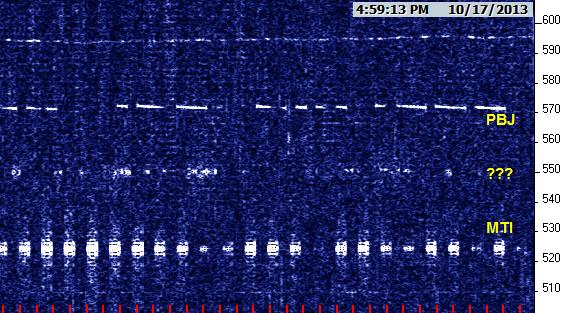
The receiver was tuned for 13,557 kHz with suitable offset so that the Hz scale in this picture corresponds directly to the number of Hz in the received signal frequency. That is, MTI was 13,557,523 Hz, etc.
Fading was at such a rate as to break up some of PBJ's dashes into false dots...a common problem with QRSS6 in this band. This was the most complete capture of the afternoon. All three signals were undergoing a fair amount of fading, actually.
(Down at the watering hole, I saw USC, both SIWs, MP, EH, and NC. Just before sunset, EH had another one of its ghosting episodes, but this time the second trace never got quite a full Hz from the original.)
John
Re: Beacon JAM 187.015khz back up
Posted by Lee on October 20, 2013 at 02:43:19.
In reply to Re: Beacon JAM 187.015khz back up posted by Doug Williams KB4OER on October 19, 2013
Weekends Friday noon till Monday noon and Holidays. The Letter J at QRSS60 and a 5WPM message over and over again. The 5 WPM message is Grid square, beacon name, e-mail address etc. Thanks for looking. Re: New web site
Lee
Posted by John Bruce McCreath on October 20, 2013 at 12:56:12.
In reply to Re: New web site posted by John Davis on October 18, 2013
Thanks for your compliments on my new web site, John! You are right about the distance....Google Maps Distance Calc. puts it at about 850 miles, so I'll have to update that. Unfortunately, if I had a capture it's been lost when my old Win98 computer crashed.
73, J.B., VE3EAR Re: 74 KHz - WG2XLP
Posted by Larry Lanberg on October 20, 2013 at 16:09:20.
In reply to 74 KHz - WG2XLP posted by Pat Bunn on October 19, 2013
Is it FSK? During this weekend I received an FSK signal (that I logged as) 75 and, alternately, 75.3 kHz. Upper sideband mode on an Icom IC-R75, so the frequency may slightly different, I'm not sure. I don't recall ever getting an FSK station right there before. Note: seperately, there was also 72.6 kHz (much stronger) but that I'm pretty sure that is the 73.6 kHz FSK out of Halifax, Canada.
Longwave season is back open for me. So I've once again brought out my trusty old HUGE loopstick wound on a 77-material core. Location: Richmond, Virginia.
Re: New web site
Posted by John Davis on October 20, 2013 at 16:22:41.
In reply to Re: New web site posted by John Bruce McCreath on October 20, 2013
>>> Unfortunately, if I had a capture it's been lost when my old Win98 computer crashed.
I think we can fix that. Still a little early in the season for me to see you yet, apparently, but I'll rummage around and see if I can find an original capture from somewhere over the past two winters. Unlike Garry, K3SIW, it's just a little too far between us for me to see you in daylight, and the nights are too noisy at present.
John
Re: 74 KHz - WG2XLP
Posted by Pat Bunn on October 21, 2013 at 01:02:44.
In reply to Re: 74 KHz - WG2XLP posted by Larry Lanberg on October 20, 2013
Was not WG2XLP. I am working on getting a signal out soon and will post when I transmit.
My LPF overheats at low power and I need a new 250uH inductor with a core that will not overheat at higher power. I have a T300A-2 core and I need to get 107 turns of #16 wound on it - that is my next not fun project. 30 feet of wire wound on a toroid is not my idea of a fun time but I'll get it done tomorrow.
Pat
HiFER OH, Limited Opportunity
Posted by John Davis on October 21, 2013 at 14:33:31.
Got the following update from Tom. HiFER monitors might want to take advantage of this opportunity.
HiFer "OH" is on the air, but, on a very random schedule. Since I have moved into a condo, I have very limited antenna resource, and, if I am on HF Ham Bands, the beacon is off the air. I have been mostly on Ham frequencies lately and had the beacon off for some time.
I use a home brew stealth vertical for radio work from the condo. It is tuned remotely from the shack. Currently, I have it tuned for the hifer band. I will leave it tuned for a couple of days to see if anyone can copy it. Maybe someone will hear it in next couple of days before I return to ham bands.
Hifers today
Posted by Sal, K1RGO on October 21, 2013 at 18:00:56.
At 09:50 UTC, in the hole, good copy with QSB: NC,EDJ,SIW ramp and ID,MP, and USC. Ear copy GNK 559. HiFer "OH"
Later,......... Sal
Posted by Tom on October 21, 2013 at 18:59:31.
John:
I forgot to mention....the move to the condo changed the maidenhead designation
from EN80 to EN81...please make that adjustment.
Thanks, 73,
Tom N8TL
Re: HiFer "OH"
Posted by John Davis on October 21, 2013 at 20:37:10.
In reply to HiFer "OH" posted by Tom on October 21, 2013
Thanks, Tom. Will do.
It was a most interesting session out in the field this afternoon. I'll post captures this evening after I get done with the material for The LOWDOWN.
John
Be On The Lookout--Another HiFER Mystery
Posted by John Davis on October 22, 2013 at 04:03:09.
I meant to post this on the 17th, but somehow missed! In between MTI and PBJ was another signal in relatively fast Morse. The "messages" were longer than HiFER IDs, and seemed to end with similar sounding characters each time, but I never could really discern what they were with the louder MTI and PBJ and Codar present. Code groups, maybe? Has anyone else been hearing anything out of the ordinary in that vicinity?
John
Monday HiFERs Galore
Posted by John Davis on October 22, 2013 at 04:07:16.
This is just sort of a preview, as I am basically goofing off--I mean, resting my eyes--when I really should be getting the LOWDOWN material finished. There will be another picture some time Tuesday morning...but for now, I was very happy to get such good copy on OH despite the occasional dot-length fade. OH was clearly audible much of the time.
I was also in time to witness a collision between PBJ and MTI.
There was also plenty going on at the watering hole, but that's for the next post.
John


Re: Monday HiFERs Galore
John:
Thanks for confirming "OH" at your QTH! I wasn't sure if it was getting out at all. This means that the antenna tuner is doing it job getting the micro watts into the antenna. OH will QRT Tuesday evening at 7PM for me to QSY to 3.576 MHz digital modes.
It is amazing how this single short vertical wire can perform on 80 meters as well as it does. I just add a
capacitor in series with the wire at the tuner output and
wallah!! I will turn the Hi Fer back on in between Ham Band
sessions.
73...Tom N8TL
Re: WI Received in Denver, CO
Posted by Walt Glazar on October 23, 2013 at 14:57:20.
In reply to WI Received in Denver, CO posted by Mark Dittmar (Fwd) on February 24, 2013
Hi All: Re: WI Received in Denver, CO
I'm not anti-social, just old (87) and only semi literate.
I have bee running the beacon most nights. I often can be found on the Geratol net. Thanks de Walt
Posted by John Davis on October 23, 2013 at 17:02:27.
In reply to Re: WI Received in Denver, CO posted by Walt Glazar on October 23, 2013
Hi Walt. Very good to hear from you. Now that static levels are decreasing for the season, I imagine lots of us will be able to look for you again.
73 LowFER SIW
John
Posted by John Davis on October 23, 2013 at 19:22:40.
After some recent intermittent glitches with unusual offsets and asymmetry in the slant mode keyer, Garry Hess advises LowFER SIW is temporarily going to a modified DFCW where "dots" are high, "dashes" are low, and the intermediate carrier frequency denotes space. You can see an example of this unique method in his capture here (opens in new tab or window): DFCW_switchover_102313.jpg
It will be transmitted on those days when the slant mode is normally scheduled on 185.185 kHz.
John
Something New Has Been Added!
Posted by John Davis on October 24, 2013 at 21:26:05.
Was watching the watering hole this afternoon, with EDJ, NC, EH, MP, the SIW duo, and USC all doing splendidly. Then I noticed a carrier just under the EH idle frequency that seemed to be keyed. At first it wasn't clear enough to make out, but later, all became clear!
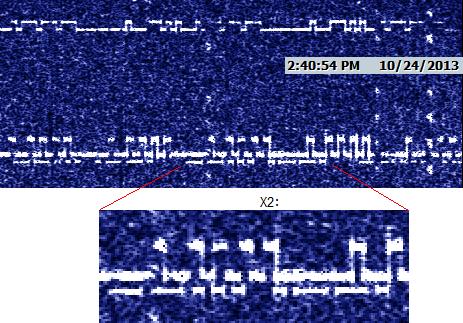
Congratulations, Ward! I also tried for AJO this afternoon, but a cluster of extraneous carriers made it hard to discern CW for all the beat notes that were present. Similar problem up around NDB's slot.
Elsewhere on the band, MTI and PBJ were pretty consistent, and GNK was intermittently in the clear.
John
Re: Something New Has Been Added!
Posted by Ward K7PO on October 24, 2013 at 22:08:33.
In reply to Something New Has Been Added! posted by John Davis on October 24, 2013
John,
Yeah, that's me. I'm not happy about ending up so close to EH, but I'll let it run for a while to see where it wants to be. I can always order another chip. AJO is still on, and I decided to go the separate antenna route. Interesting thing here, at about 50 miles from the site, is that AJO is considerably louder than 7P. Louder being highly subjective, since neither one is exactly strong, but noticeably stronger. The antennas are at opposite ends of the building, but have the same 'look' in this direction. Fun stuff!
Ward K7PO
"6R" 180.580 CW update from El Dorado Hills, Ca
Posted by Ed, KI6R on October 26, 2013 at 17:42:02.
6R has been off for the past week due to a failing static 256k RAM IC in the memory keyer. I think I have it going again. It is send 6R followed by a 4 second dash in slow cw. 73s, Ed, KI6R
Good LW Propagation
Posted by Bill KB9IV on October 26, 2013 at 20:29:37.
As I start the new LF season conditions are very active at night. During the day I can even here "YQ" 305 KHz Churchhill MB, between two DGPS stations. I find the Pixel Pro-1B runs out of useable gain below 400 Khz so I added a 20 dB pre-amp and now it is smoken hot. The pixel still is very quiet even with the additional amp.
"DIW" and "CLB" are very weak here in the UP of Mich yet "DDP" and "ZSJ" are much stronger....PR and BAH.
My quest this year are NDB's" from Yukon, NWT and Greenland. I haven't heard any LW BC stations yet.........perhaps in November.
Good Dx to All
Bill KB9IV
Re: Good LW Propagation
Posted by John Davis on October 27, 2013 at 00:44:42.
In reply to Good LW Propagation posted by Bill KB9IV on October 26, 2013
Sounds like you're off to a good start, Bill. Out there in SE Kansas, I've been copying the WG2XRS evening tests around 74.55 kHz quite well--except for tonight, when the noise is too high from the big lines of storms along the Oklahoma-Texas border. It looked like there was something on /5's frequency, but it was not readable...and I don't think /4 signed on tonight.
Last night was particularly good here, however, including LWBC. Iceland came through for the first time this year, Tangier was discernable but swamped by noise, and France Inter was S9 and would have been very enjoyable were it not for the +40 crashes being so frequent. Down at 77.5, the DFC77 time code was plenty audible and might even have been decodable despite the static.
John
Re: Good LW Propagation
Posted by John Bruce McCreath on October 27, 2013 at 14:12:38.
In reply to Good LW Propagation posted by Bill KB9IV on October 26, 2013
Indeed it is! I had a very solid decode of Navtex station $12W in Astoria, OR early this morning. Part capture below:
73, J.B., VE3EAR
NNNN NNNN 1. POINT WELLS FOG SIGNAL (LLNR 16725) HAS BEEN REPORTED SOUNDING IMPROPER CHARACTERISTICS. NNNN EXTINGUISHED. NNNN BEACON MLS BK ON LINE
BK
ZCZC WA5Ø
CGD13 BNM 1Ø12-13.
WASHINGTON - ADMIRALTY INLET AND PUGET SOUND TO SEATTLE.
1. PUGET SOUND BLAKELY ROCK LIGHT (LLNR 1683Ø) IS REPORTED
EXTGUISHED.
2. CANCEL AT TIME//Ø116ØØZ NOV 13//.
BRK
ZCZC WA96
CCGD13 BNM Ø991-13.
COLUMBIA RIVER - VANCOUVER TO THE DALLES
1. GARY ISLAND DIKE LIGHT 52 (LLNR 1156Ø) HAS BEEN REPAIRED AND
LWP.
2.152Ø45Z OCT 13, CCGD13 BNM Ø961-13 IS CANCELED.
3. CANCEL AT TIME//2816ØØZ OCT 13//.
BRK
ZCZC WA23
CCGD13 BNM 1ØØ5-13.
WA - ADMIRALTY INLET AND PUGET SOUND TO SEATTLE - PUGET SOUND
2. CANCEL AT TIME/3Ø16ØØZ OCT 1//.
BRK
ZCZ WA81
CCGD1 BNM 1ØØ3-13.
COLUMBIA RIVER - ACIFIC OCEAN TO HARRINGTON POINT
1. ASTORIA WEST BASIN LIGHT 3 (LLNR 1ØØ83) HAS BEEN REPORTED
2. CANCEL AT TIME//3Ø6Ø+ OCT 13//.
Posted by Mark on October 29, 2013 at 00:20:26.
Hi all, Re: BEACON MLS BK ON LINE
I fired up beacon MLS at 186.204 KHZ this afternoon. I'm still checking out the automatic heating system but I plan on leaving the beacon on for now. I may have to do some software updates on the Basic Stamp for heater control. It's going down in the 30's tonight here in Ohio and I want to see if my control system maintains 55 degrees in the box. Please let me know if you hear my signal. Thanks....... Mark
Posted by John Davis on October 29, 2013 at 07:59:36.
In reply to BEACON MLS BK ON LINE posted by Mark on October 29, 2013
Good luck, Mark. Is it still QRSS15?
John
Re: BEACON MLS BK ON LINE
Posted by Mark on October 29, 2013 at 22:10:35.
In reply to Re: BEACON MLS BK ON LINE posted by John Davis on October 29, 2013
Hi John, WD2XSH/20 !!!
I'll be running it at QRSS30 for most the season. Next Spring I'll switch it to QRSS60. I'll post the change when I switch over. I "may" have to shutdown this Thursday and Friday because of possible late season storms in NE Ohio. Once their past, I'll switch it back on line. I'll keep everyone posted. I did some improvements and hope to have a good season this year. Thanks..... Mark
Posted by Brian nb9e on October 30, 2013 at 03:07:01.
Very nice copy tonight on 630 meters WD2XSH/20 here in DN20fr what is his actual freq? I show 477 kHz on my FRG-100 !!!
Re: BEACON MLS BK ON LINE
Posted by John Davis on October 30, 2013 at 03:44:22.
In reply to Re: BEACON MLS BK ON LINE posted by Mark on October 29, 2013
Excellent, Mark. I think running it at one of Argo's "standard" speeds will significantly improve detection chances.
Those storms you mention are coming through here tomorrow and will add rainfall on top of our already soggy ground, so it will be a few days before I can get out into my field to listen. Good luck with Mother Nature!
John
USC
Posted by Ernie AJ4BP on October 30, 2013 at 13:20:39.
This morning at 1257 utc I have been copying the USC beacon on qrss3 here in south Florida. Rx freq on my receiver was 13.555.5 usb
Re: WD2XSH/20 !!!
Posted by John Davis on October 30, 2013 at 17:38:33.
In reply to WD2XSH/20 !!! posted by Brian nb9e on October 30, 2013
I had to track Rudy down on the 600 meter reflector, but he said 477 kHz there, so that must be right.
John
EH heard in Florida
Posted by Ernie AJ4BP on October 31, 2013 at 15:25:17.
I am now (at 1525 Z) listening to HiFer EH here in EL97th (south Florida) with a solid trace on the Spectran software.
DGPS Software
Posted by Bill KB9IV on October 31, 2013 at 20:42:51.
I cannot remember the software name for decoding DGPS on LW??....anyone?
Bet DX
Bill KB9IV
Re: DGPS Software
Posted by Mark Dittmar on October 31, 2013 at 21:47:41.
In reply to DGPS Software posted by Bill KB9IV on October 31, 2013
I've used SpectrumLab. I hear that DSCDecoder is good too.
Re: DGPS Software
Posted by Mark Dittmar on October 31, 2013 at 21:48:55.
In reply to Re: DGPS Software posted by Mark Dittmar on October 31, 2013
This link has some great info on DGPS decoding:
http://www.ndblist.info/datamodes/dgpsguide.pdf
potrzebie