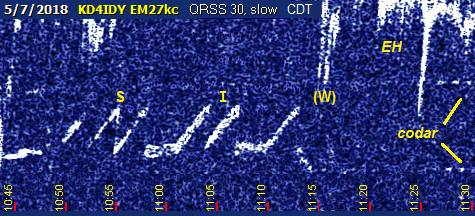
 And here's the QRSS30 capture of SIW slant mode, which did quite well until 11:15 and then was basically gone by 11:20. Note right at 11:00 how there are three separate Doppler-shifted paths, making the signal a little over 0.2 Hz wide for a while.
Hifers in Pine
May 1
1511 utc a letter now and then on vry weak PVC no complete ID.
1515 utc solid copy on GNK
Re: Hifers in Pine
Posted by ed holland on May 01, 2018 at 19:23:22.
In reply to Hifers in Pine posted by Bill Hensel on May 01, 2018
Thanks Bill!
I know conditions are so-so, but I am becoming convinced that there is a problem somewhere in PVC's antenna system... I took the portable receiver out last weekend - I thought the signal strength at my standard 1 mile point was diminished.
Cheers
Ed
Re: ULF / SLF (0 - 100 Hz) Magnetic field detection
Posted by Steve McGreevy on May 01, 2018 at 20:12:21.
In reply to Re: ULF / SLF (0 - 100 Hz) Magnetic field detection posted by John Davis on March 06, 2018
I agree entirely with John Davis re. this.
When I was consulting in Iceland Dec. 2016 for 2 weeks, my host and I visited ISOR (Icelandic Geophysical Inst. in Reykjavik). They employ horizontal loops (receivers/transmitters) to explore geology below-ground in order to map the geology (primarily basaltic there of course). They have a DENSE array of EQ sensors all over the island for obvious purposes, also.
Their receiving loops are dropped by back-packing employees all over Icelands interior and coastal regions.
It IS well known that only vertical loops (from years of my natural-radio monitoring) of course are best oriented vertically, and if you are not trying to record ELF/VLF "natural-radio" signals in pseudo-stereo using orthogonal vert. loops (my own loop/H-field rx's use 7 turn/22 ga. wire deltoid loops 3 meters tall to a 3.2 ohm input BTW). Horiz loops null above and below them! But, they do pick-up sigs. coming from horizontal locations. A 50/60 Hz fundamental and PLHR radiation from AC power-lines (i.e. ELF "AC hum") will indeed get into even buried loops close to Earth's surface (unlike e-field antennas/rxs.) Please be aware of that syndrome, as I have also experimented with using horizontal loops of several turns and they are dead to NR signals.
BUT we need more experiemtation and verification of ULF phenomena, so try ANYTHING se too if or it not your planned horiz. loop works. EQ waves have used huge solenoid sensors. ULF EQ emissions have "harmonics" extending into the ELF range, also.
On this subject, does anyone know the frequencies used in the SkyTEM sensor work re. geophysical mapping? ISOR in Iceland employed square-wave transmitters and 20 to 200 Hz emissions! I agree with John that we need further experimentation in all of this, so your findings will add to the knowledge base. 73 steve m. N6NKS
SkyTEM AC grid analysis via helicopter
Posted by Steve McGreevy on May 01, 2018 at 22:01:00.
In reply to Re: ULF / SLF (0 - 100 Hz) Magnetic field detection posted by Steve McGreevy on May 01, 2018
I poked around the internet and found the SkyTEM site and found they employ a "hanging" multi-turn horizontal loopantenna that hangs perhaps 10 ft/3 meters or maybe a bit more under aircraft such as a helicopter. and AC-systems anayists use this to find power-grid/transmission-line anomolies, etc. The freq they use is 12.5 Hz... It might be fun to construct a ULF RX for these ffreqs not much higher than the 7 hz or so Shumann Resonance... -s-
Re: SAQ on Air on May 1st
Posted by Ed, KI6R on May 02, 2018 at 20:27:18.
In reply to Re: SAQ on Air on May 1st posted by Mike Terry on April 25, 2018
I tried to hear SAQ with no luck. I am hearing HWU, NWC, NPM, JJI, NAA, NLK, NML4, NRK, JJY, NDI, CHN, GBY20 and RBU. Listening at VLF in the 15-75 kHz range is difficult due to AC power line noise getting into the active whip. A 1000' wire on the ground running to the east was quietest but not always the best S/N when compared with the AMRAAD active whip. I think a new project is in the queue: 9-75 kHz tunable loop antenna of some sort. 73s.
night time Hifers
Posted by Bill Hensel on May 02, 2018 at 21:11:45.
May 1,
From 0337-0340 utc FRC, ESA and PVC copied.
Lowfer SIW QRT for the summer
Posted by Garry, K3SIW on May 02, 2018 at 23:18:23.
Bob, NK9M took down lowfer SIW this afternoon for the summer. I'll pick it up shortly and hope to add EbNaut as yet another mode for next fall.
73, Garry, K3SIW, EN52ta, Elgin, IL
Re: 28/29 April Hifers
Posted by Chris Waldrup on May 04, 2018 at 03:50:48.
In reply to 28/29 April Hifers posted by ed holland on April 30, 2018
Hi Ed,
Thanks for the note on my PBJ.
What’s your QTH state, just curious where I was received.
Thabks!
Chris Reminder: Lowfer net 3927Khz Saturday morning 0800 California time
KD4PBJ
Posted by Jerry Parker on May 04, 2018 at 14:30:14.
Reminder: Lowfer net 3927Khz Saturday morning 0800 California time
Or listen online at:
http://69.27.184.62:8901/?tune=3927lsb
click on the autonotch to get rid of hetrodines
Hope to see you there
KFS WebSDR in California
69.27.184.62
OR Try the other Western US HF WebSDR systems: W7RNA Multiband WebSDR Receiver and Northern Utah WebSDR. They both work very well.
69.27.184.62
(THANKS TO Tim Brannon, WA5MD FOR THE TIP)
W7RNA Sedona AZ http://w7rna.dyndns-remote.com:18901/
KA7OEI Northern UT http://websdr1.utahsdr.org:8901/
Jerry WA6OWR
Re: night time Hifers
Posted by Jack Roblin on May 05, 2018 at 08:48:45.
In reply to night time Hifers posted by Bill Hensel on May 02, 2018
May 4: Surprising conditions tonight at 0400 Zulu (9pm) here in southern CA. I heard K6FRC quite well for several minutes, at S3 to S5 at times. Yes Bill, it is worth checking past sundown for sure. This is the latest time I have ever heard a HiFer.
Re: night time Hifers
Posted by Bill Hensel on May 05, 2018 at 15:21:41.
In reply to Re: night time Hifers posted by Jack Roblin on May 05, 2018
Just turning on the receiver randomly can yield some pretty interesting
events. It was like when I was 100 percent mobile HF for about 3 years with no
rig at home. I found I was hearing and working stations at times that defied logic.
TON back on 13558.5
Posted by Ward K7PO on May 05, 2018 at 21:50:14.
Finally got a little time to put TON back on, just in time for my annual Dayton roadtrip. I'll try to get a lowfer beacon on before fall as well. Just CW ID this time around, no DAID.
WH2XXP 2200m will be off in the next day or so until early June.
Ward K7PO/WH2XXP
Re: Lowfer SIW QRT for the summer (late news)
Posted by John Davis on May 07, 2018 at 05:26:30.
In reply to Lowfer SIW QRT for the summer posted by Garry, K3SIW on May 02, 2018
Meant to post this earlier...glad I had a chance to catch LowFERs SIW before the shutdown. The last time I got WSPR-15 to decode was the 24th:
180424 1600 2 -38 -0.9 0.185185 K3SIW EN51 0 0 3690 25...but I was able to see the QRSS signals up to the end (scroll as necessary to view all the image; times are CDT):
John Monday morning: EH, RY, the SIWs, FRC
Posted by John Davis on May 07, 2018 at 21:46:54.
Got to the field about 10:30 this morning (Central Daylight Time) and found EH moderately stable for a while, and RY fair, and hints of an opening to the SIW duo, so I also cranked up WSPR while I watched and listened. Only got one legit WSPR-2 decode...
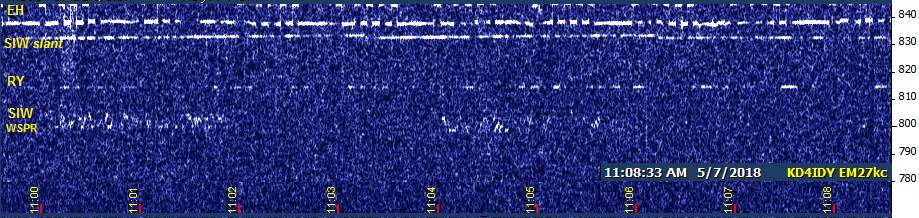
1604 -29 -1.7 13.555407 0 K3SIW EN52 7...and a couple of bogus ones from some random noise about 70 Hz higher. Several timeslots showed signal from Gary, but the others were all missing the WSPR header or had even longer holes in them from QSB. Here is the Argo capture that includes the 11:04 AM (1604 UTC) WSPR timeslot:
And here's the QRSS30 capture of SIW slant mode, which did quite well until 11:15 and then was basically gone by 11:20. Note right at 11:00 how there are three separate Doppler-shifted paths, making the signal a little over 0.2 Hz wide for a while.
Before starting this capture, I made it a point to listen for TON, WV, PCO, and WAS for several minutes, but no joy. (K6FRC came through nicely a couple of times, however.) There were hints of keyed signal where WV should have been, but above 13.559 is just too noisy here to tell. Over the next hour and a half back at the watering hole (following the SIW slant capture), there were hints of USC, MTI, and even what looked like snippets of WM FSK, but nothing definite til later in the afternoon. (See later report.)
John
---------------------------------------------------------------
 File Attachment 1: 7may-SIWslant.jpg
File Attachment 2: 07may-wh1.jpg
Re: Lowfer SIW QRT for the summer (late news)
John,
I see WM Lowfer was making it's way with SIW. The graphic segment lighter than the FSK segments, as usual. A couple weeks ago I made a small format change to send the first FSKCW segment with 60 sec dits, and the second segment at 30. This capture sure shows the value of the slower format.
I haven't seen reports of the WM Hifer from anywhere, for quite some time. It has been running normally from my meter readings, I did a full health check a couple days ago - all seemed well, so I guess poor propagation is the major factor.
73 Mike
WV
Posted by michael tyler on May 07, 2018 at 23:38:56.
With all the noise I now have WV on 13.5543....plan to leave it there since it is much more clear....Sorry for the move again but it is much better there...
RY Off for Season
Posted by John, W1TAG on May 08, 2018 at 00:32:07.
John Davis wins the prize for the final report on Hifer RY today. The beacon is now off, and will return in late October. Its antenna is a vertical 20 meter dipole, and it will be frequently exercised on that band over the summer. Thanks to all for the past season's reports.
John, W1TAG
Re: Lowfer SIW QRT for the summer (late news)
Posted by John Davis on May 08, 2018 at 02:07:16.
In reply to Re: Lowfer SIW QRT for the summer (late news) posted by Mike N8OOU on May 07, 2018
Yup, both SIW and WM were at comparable levels at 1750 meters every time I looked the past few weeks. Will try ARGO at QRSS60 setting in a couple of days to see how the new format does at that speed. As for the HiFER...
Mike wrote:
I haven't seen reports of the WM Hifer from anywhere, for quite some time....I did a full health check a couple days ago - all seemed well, so I guess poor propagation is the major factor.
Ah-ha! Agreed. In fact, see a new post in the HiFER section in just a few minutes.
:-)
Re: WV
Posted by John Davis on May 08, 2018 at 02:09:17.
In reply to WV posted by michael tyler on May 07, 2018
That should be a much clearer spot. Will begin checking there regularly.
John
Re: RY Off for Season
Posted by John Davis on May 08, 2018 at 02:11:07.
In reply to RY Off for Season posted by John, W1TAG on May 08, 2018
I will miss my most consistently visible 22 m frequency reference.
Monday afternoon: USC, EH, MTI, WM, PBJ
Posted by John Davis on May 08, 2018 at 02:31:26.
In reply to Monday morning: EH, RY, the SIWs, FRC posted by John Davis on May 07, 2018
The last two times I saw the SIW HiFER duo, I was a bit dismayed to not also see WM because they used to be nearly inseparable in the "good old days." Well, that may no longer be the case, but at long last WM has returned too! (You may need to use your browser's Magnify tool to see the full-size image.)
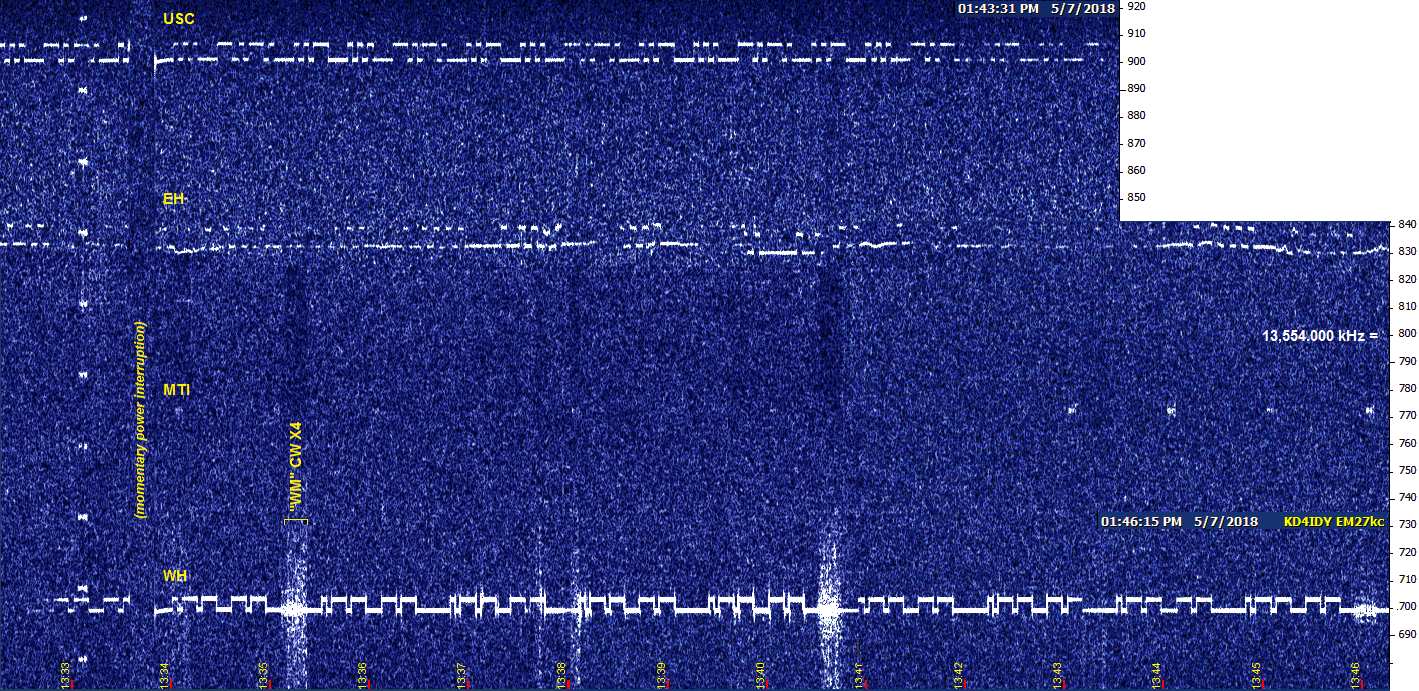
Four cycles of slow FSK are followed by four CW IDs, roughly every 5½ minutes. Though there was no further sign of SIW (not even slant mode), the excellent signal from WM and the improvement in MTI in the last four minutes served as an indication that other long-missing beacons within the first skip zone might be available. Turns out PBJ was!
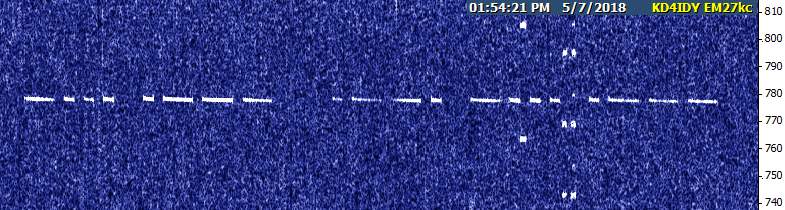
That gave me hope for GNK and/or PCO, but neither obliged before lack of water in near-90° heat drove me back to town.
John
---------------------------------------------------------------
File Attachment 1: 07may-wh2.jpg
File Attachment 2: 07may-PBJ.jpg
Tuesday morning: Regulars + SIW, WM, MTI, GNK, WAS
The seasonal change has very definitely affected when the band is open!
Very early morning (midnight) USC and PBJ were visually recognizable but broken up by QRN and rapid QSB. Then I went to 1750 m to watch for EAR.
Early morning (pre-8AM): Returned to 22 m before going off to my doctor's appointment. USC and EH were fair, MTI was visible and at the edge of audibility, WM was beginning to show up, and there seemed to be keyed CW at WV's new frequency but I couldn't be sure. There were faint visual hints of AZ's wavy signal, but no audible copy.
10AM: IW slant began showing faintly for several minutes and WM had been strong for a couple of periods by then with a weaker spell in the middle. That led me to check other beacons which have been hard to copy in the first skip zone for several months. GNK showed up in Kansas again, at last, by 10:18 AM CDT; loud and clear about half the time! PCO was still being stubborn and elusive, though. WAS was visible and eventually became audible. No RF, FRC, or ESA yet.
10:30 : Wisps of WSPR (but no decodes yet) from SIW and a little slant mode. WM and MTI CW IDs nicely audible at times. USC chugging along and EH hopping around, plus the occasional machine-gun and buzzsaw pulse sounders making up for lack of Codar this morning.
Further report sometime this afternoon, but there probably won't be much monitoring into this evening and definitely not overnight...chance of t'storms here tonight.
John
Expanding the EAR Collection
Posted by John Davis on May 08, 2018 at 20:47:40.
Trying again this year to catch EAR in every calendar month, I tuned in last night despite S9+ static from storms in northern Nebraska, because I already was aware we have a chance of local lightning tonight. From 1 AM to nearly 4 AM local time, there were occasional hints of RF at the right frequency, but it wasn't until after 4:00 that any definitely recognizable signal appeared out of the diminishing noise. It endured until about 80 minutes before local sunrise and was gone completely an hour before.
Catching pre-sunrise noise diminution opportunities is clearly going to be a challenge over the next two months. I hope to be in better physical shape to make the attempt again this year.

---------------------------------------------------------------
File Attachment 1: 08may-EAR.jpg
Re: Expanding the EAR Collection
Hi John....thanks for the report and Argo snip of EAR. I keep it on the air 24-7-52 just for fellows like yourself who look even in the off season. It's appreciated very much.
73, J.B., VE3EAR Re: Tuesday morning: Regulars + SIW, WM, MTI, GNK, WAS
Posted by Bill K4JYS on May 09, 2018 at 16:49:20.
In reply to Tuesday morning: Regulars + SIW, WM, MTI, GNK, WAS posted by John Davis on May 08, 2018
Tnx John for the mention. 'Lil ole WAS still trying. Been running it 24/7. Gotta ck the battery...still well above 5v I expect. Since it is in the house, I will probably switch over to a small 12vdc supply. Just wonder if you received my QSL? Re: Tuesday morning: Regulars + SIW, WM, MTI, GNK, WAS
Bill
Posted by John Davis on May 09, 2018 at 16:59:29.
In reply to Re: Tuesday morning: Regulars + SIW, WM, MTI, GNK, WAS posted by Bill K4JYS on May 09, 2018
Just wonder if you received my QSL?
Sure did. Sorry to be so forgetful in mentioning that fact.
After all these years, there's still a lot to be said for having tangible confirmation of reception. Thanks!
John
Tuesday late morning/afternoon
Posted by John Davis on May 09, 2018 at 18:27:46.
In reply to Tuesday morning: Regulars + SIW, WM, MTI, GNK, WAS posted by John Davis on May 08, 2018
Late morning (11AM - Noon): Not much out of SIW. Mostly EH and USC at the watering hole, with intermittent appearances by MTI (very few audible). WM continued variably until 11:21 then faded out. USC faded away rapidly by 11:58 CDT.
Early afternoon: EH got to jumping around quite a bit. MTI continued appearing intermittently. Ghosts of WM began showing up again after 1:00, materializing into more continuous copy later in the hour. MTI was audible a couple of times by the end of the hour, and SIW slant began showing at QRSS30 but not yet at QRSS3.
Before 2 o'clock, MTI was still intermittent, WM was solid again, SIW slant was broken but visible, and wisps of WSPR were appearing (see the "08may-wh1" file attachment).
2:00 - 4:30 PM: WM was slowly waning. I had to leave again for a while, but fired up WSPR 2.12 to monitor the improving SIW traces. Unfortunately, it appears to have crashed not long after I left the premises, so there were no decodes upon my return, even though Argo showed decent signals during the 2 o'clock hour, and some very solid signals in time slots around 4 PM (see attached "08may-wh2" capture). SIW slant had also been good at the same time as the WSPR, but was being stomped on by the wandering EH. Nonetheless, it remained visible until an abrupt drop at 4:19 PM CDT. The Argo QRSS2 trace shows a sudden brief enhancement of level on both SIW traces just a minute before the drop. (See "08may-slant" attachment; use your browser's Magnify tool; visible frequency shifts correspond to the receive setup's battery discharge characteristic, plus increased cloud cover cooling after 14:50 PM.)
By 5 o'clock only EH remained at the watering hole, apart from a couple of good clear IDs from MTI at 5:05 and 5:06. By then, skies were becoming threatening, so I did a quick band scan (no one else heard or seen) and packed it in for the day.
John
---------------------------------------------------------------
File Attachment 1: 08may-wh1.jpg
File Attachment 2: 08may-wh2.jpg
File Attachment 3: 08may-slant.jpg
Found WV on 13.555015
Haven't had any definite copy at 13.5543, but about 5:25 PM CDT today while tuning down to see if powerhouse P was on, I heard a faint V near its place, followed by a series of slow dits before it faded away. The trace was off the Argo screen, though, and by ear I realized I needed to tune down a little further.
I went all the way to .555000 and waited. Sure enough, pretty soon there was a trace, followed eventually by audible copy. A bit of a surprise, but it's nice to hear WV once again!
New beacon
Posted by KM N2CHX on May 10, 2018 at 02:15:45.
New 22 meter beacon and MW Part 15 station:
FREQ: ~13.557.95
LOCATOR: FN02QV
TRANSMITTER: Modified Hendricks DC20B
ANTENNA: GND MNTD 10' top-loaded vertical, diplexed with SSTRAN MW transmitter on 1700 kHz.
MODE: 5 WPM CW
CALLSIGN: BU
POWER SOURCE: 100 watt solar panel with battery storage sufficient for ~36 hours
Both transmitters are powered by the solar panel and audio/control/keying is provided via WiFi connection using custom coded ESP8266 module.
Currently the MW transmitter is off the air and the 22 meter beacon is cooking under test on the bench into a short antenna while final construction of the main antenna is completed. If all goes well, everything should be on the air by this weekend. MW format is OTR/Big Band/Variety/Local News and events.
Re: Tuesday late morning/afternoon
Posted by Mike N8OOU on May 10, 2018 at 02:52:59.
In reply to Tuesday late morning/afternoon posted by John Davis on May 09, 2018
John;
It's good to see WM, and others lighting up your screen. Thank you for putting in the time and effort to be in the field to listen and report your findings.
Mike N8OOU 73
Re: New beacon
Posted by Jack Roblin on May 10, 2018 at 06:11:41.
In reply to New beacon posted by KM N2CHX on May 10, 2018
May 9, 0245 Zulu, received in Victorville, CA (southern CA). There was a lot of severe fading but your signal was solid on peaks.
Youtube video: https://youtu.be/2i3qbnukOiM
Congrats on the new beacon! What antenna were you using at this time? I caught your beacon at dusk, which is turning out to be an excellent time for HiFer reception here in CA. You were the only beacon copied tonight. You're the most distant beacon I have received so far.
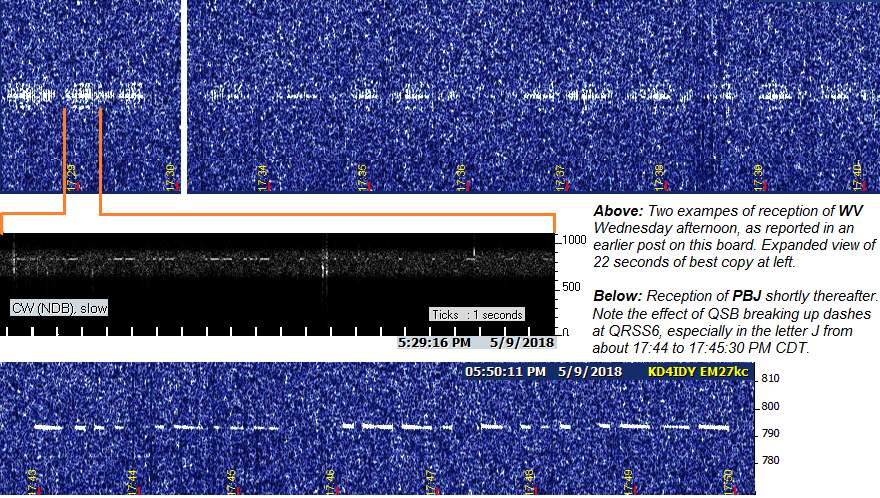
Wednesday: EH, MTI, WV, PBJ & unknwn
Posted by John Davis on May 10, 2018 at 07:28:30.
Only had a very short session this afternoon, courtesy of farm work in the neighbor's field blowing massive dust clouds my way until after 4 PM CDT, and the 90+ degree heat becoming too much by 6 PM.
At first only EH and MTI showed up. Later there were a few traces of FRC as well, but barely one or two characters audible at a time. About 4:30 I was making a scan up around 13,562.500 for the sometimes reported TDV when I ran across a fairly good signal that got my hopes up at first...but I never could "lock on" to the seeming code by ear, and concluded it was some device keying gibberish. A capture of this part of the session can be seen in the 09may-EHMTI.jpg file attachment.
Later came the copy of WV that I reported in another post; see below. Following that, I had pretty good luck with PBJ. No late-night session tonight--lightning is too close this time.
---------------------------------------------------------------
File Attachment 1: 09may-EHMTI.jpg
File Attachment 2: 09may-WVPBJ.jpg
Re: New beacon
Wow! Thank you for the reception report. That was off of a piece of random stranded wire strung up in the attic while I've been testing the controller, power supplies, and making some fixes to eliminate chirp and drift. The DC20B puts out quite a bit of power, so in the final install, a lot of signal will be attenuated and then more lost in the diplexer plus the inefficiency of the short (10') vertical.
I see the frequency also seems to be way off. My freq counter seems to agree with my RTL SDR 2832 within 100 Hz. or so, so not sure what's up there. I may have to dig out my FIL's service monitor for the final answer on frequency, as my counter isn't exactly the most accurate or robust, but I thought since the SDR agreed pretty closely, it was close to what I was seeing on both.
Thank you again! I'm going to put together a QSL for this beacon and will send one your way when I do.
Beacon wv
Posted by michael tyler on May 10, 2018 at 16:20:35.
Thanks for the report on beacon wv.....I had my receiver on USB and the frequency I listed was the frequency that gave me the best tone for copying....I am sorry for the mix up...glad you copied it and if there are no problems with stepping on anybody else I will leave it there...The SG8002 chip is temperature controlled so I am hoping it won't move around... once I am sure it is working ok I plan to start a project of putting MW beacon wv back on the air...73...mike
Another State Heard From - WAS
Posted by Bill K4JYS on May 10, 2018 at 16:57:27.
Yesterday I got the following email report from Chris, N3JLY of Black Cat Systems:
"I am hearing WAS on 13564.86 kHz at 2124 on UTC 9 May 2018. Weak signal and fading in and out, but it is there.
73
Chris Smolinski N3JLY
Black Cat Systems
Westminster, MD USA"
Kansas and Maryland so far.
73 de Bill K4JYS
Re: Beacon wv
Posted by John Davis on May 10, 2018 at 17:28:24.
In reply to Beacon wv posted by michael tyler on May 10, 2018
Thanks for the update, Mike. Looks like a good, clear spot to me. One of the things I noticed about the 9 or 10 minutes of continuous capture (not all of which was shown in my post) is how steady the carrier frequency was. WV at its original spot tended to drift back and forth a couple Hz during the same time span...not bad, by any means, but the slight waviness was part of its spectrum signature. It's even tighter now, so when it's below audibility I'll learn to recognize it solely by the timing and spacing of its keying sidebands, as I sometimes do with PCO, GNK, and FRC. Good work!
Re: Another State Heard From - WAS
Posted by Jack Roblin on May 10, 2018 at 23:04:18.
In reply to Another State Heard From - WAS posted by Bill K4JYS on May 10, 2018
Congrats on the second state!! Just to let you know, Bill, I am listening for you out here in Southern California. I have heard MTI and RF, so The South is coming in here! Good luck!
Re: New beacon
Posted by KM N2CHX on May 10, 2018 at 23:31:36.
In reply to Re: New beacon posted by KM N2CHX on May 10, 2018
BU is off the air until tomorrow when I complete the new antenna install. Everything is pretty much ready to go. I've dug out the service monitor for an accurate frequency measurement as well. I'll update when it's back up and running.
Re: Another State Heard From - WAS
Posted by Bill K4JYS on May 11, 2018 at 00:20:20.
In reply to Re: Another State Heard From - WAS posted by Jack Roblin on May 10, 2018
Tnx Jack...maybe the wind will push a few micro-micro watts out your way. Any direct experience with SDR Play receivers
Hope you can eventually hear a few peeps...Bill
Posted by Chris Waldrup on May 11, 2018 at 05:58:38.
hi,
Does anyone have any experience with using the SDRPlay receivers for VLF-LF listening?
I see there are three models and I’d rather go with testimonials vs what the manufacturer promises. Not sure which model is choose either. If they are decent I may pick up one at Dayton next week.
Chris Reminder: Lowfer net 3927Khz Saturday morning 0800 California time
KD4PBJ
Posted by Jerry Parker on May 11, 2018 at 16:30:51.
Reminder: Lowfer net 3927Khz Saturday morning 0800 California time
Or listen online at the KFS WebSDR in California:
http://69.27.184.62:8901/?tune=3927lsb
click on the autonotch to get rid of heterodynes
Hope to see you there
OR Try the other Western US HF WebSDR systems: W7RNA Multiband WebSDR Receiver and Northern Utah WebSDR. They both work very well.
(Thanks to Tim Brannon, WA5MD for the tip.)
W7RNA Sedona AZ http://w7rna.dyndns-remote.com:18901/
KA7OEI Northern UT http://websdr1.utahsdr.org:8901/
"NOW HAS 630M RECEIVER"
Jerry WA6OWR
Re: Any direct experience with SDR Play receivers
Posted by John Davis on May 12, 2018 at 02:35:33.
In reply to Any direct experience with SDR Play receivers posted by Chris Waldrup on May 11, 2018
Tim WA5MD asked a similar question a couple of months back in this topic: lwca.org/mb/msg/7675.htm I'm giving you the URL for the starting post rather than any one of the replies, as it branched into three sorta-sub-threads, each of which contains some relevant information.
The ARRL Labs test report at the SDRplay website from last October's QST should be a pretty reliable source of info. It only covers the RSP2 and RSP2pro versions, but those are the two I'd be most interested in, if it were me, because of the additional input options and filters. (The pro version appears to be little different from the regular RSP2 except for the solid metal case...which could have its advantages.) The sensitivity ratings in the ARRL report, for instance, can be meaningfully compared with John Reed's classic analog receiver tests in our free PDF e-book "Longwave Receivers, Past & Present" (11 MB).
Sensitivity isn't the only consideration, of course. With a decent analog front end, most any SDR can be made to have virtually any Minimum Discernible Signal spec you want...in the absence of any other signals, that is. The trick is to be able to pull the weak signal out of surrounding garbage. That requires dynamic range, and that, in turn, is nearly a direct function of the number of bits in the ADC. With its 12 bits, the SDRplay is a significantly better radio than any 8-bit RTL dongle--but the resulting limit on dynamic range still degrades available sensitivity in the presence of real-world noise. When adjusted for best dynamic range at 14 MHz, for example, the splendid -144 dBm MDS deteriorates to only -123 dBm. Similar down-specing can be expected on LF, where MDS at 2200 m is only -125 to begin with.
Turning to the topic of Dayton now, however: I've heard that SDRplay plans to introduce a new product there this year, although I have no idea what. If you're going to be there, Chris, perhaps you could get some information and maybe do a report on it for The LOWDOWN?
73
John
Saturday morning HiFERs
Posted by John Davis on May 13, 2018 at 00:04:10.
Had to be away from the house this morning, and fortunately the weather obliged in letting me spend some time at the farm. As soon as I cranked up the radio about 10:20 AM CDT, the WM CW ID came through loud and clear. EH was safely up at 13,555.45 today, and there were faint traces from MTI.
At 10:25 I tuned down and saw WV at 12,555.030 (up a smidgen from the other day, and with a little medium/long-term drift, but not much).
After a while I tuned to 13558.400 to look for PVC, with no luck--but I did start to see keyed carrier 100 Hz higher. It was weak, and there were too many other close carriers to hear anything anyway. A really annoying 10 Hz pulsed emission showed up there at times, too, but I determined to check back throughout the afternoon.
I took a few minutes then to scan on up through HF at random, checking out 20 m and the various SWBC bands briefly. Heard WWV at 25 MHz for the first time in decades! (It was considerably weaker than the CB crowd at 27025, though! Need to get our hands on one of those linears and send it to Boulder.)
Tuned back down to the watering hole at 11:18 AM. No more WM by then, only EH and faint MTI. That remained the case for a couple hours longer, but things changed suddenly at mid-afternoon. A re[port on that later!
John
? WAS 13.564875 11.53a
Saturday afternoon (TON, SIW, WM, GNK, PBJ)
Posted by John Davis on May 13, 2018 at 07:52:20.
In reply to Saturday morning HiFERs posted by John Davis on May 13, 2018
As bleak as the band looked at mid-day, it was interesting to see how it evolved by mid afternoon.
First, PBJ made a nice appearance. Next, the mystery signal at 13,558.500 started showing up more consistently, and the fading cycles of it and the noise carriers finally managed to get out of sync with each other. I could start to hear enough keying to suggest it might be TON. Sure enough, good solid copy of the full ID finally occurred at 2:15 and 2:18 PM CDT, although, oddly, the frequency shifted slightly upward a few times. See the PBJ-TON file attachment.
Then, the SIW duo began showing up. See the slant mode reception in the SIW attachment; some receiver frequency drift shows up because of battery discharge. The WSPR decodes are here:
1936 -25 -1.2  13.555407  0 K3SIW EN52 7
1940 -25 -2.3  13.555408  1 K3SIW EN52 7
1952 -26 -1.1  13.555407  0 K3SIW EN52 7
1956 -27 -1.2  13.555407  0 K3SIW EN52 7
2000 -23 -2.0  13.555409  0 K3SIW EN52 7
2004 -24 -1.5  13.555407  0 K3SIW EN52 7
2008 -22 -1.2  13.555409  0 K3SIW EN52 7
2012 -20 -1.2  13.555407  0 K3SIW EN52 7
2016 -20 -2.2  13.555407  0 K3SIW EN52 7
2024 -23 -1.4  13.555409  0 K3SIW EN52 7
2028 -26 -1.3  13.555407  0 K3SIW EN52 7
During this time, it became a regular party at the watering hole (see the "party" attachment), with USC, EH, both SIWs, MTI, and WM all showing up to one extent or another...not always great...simultaneously. Nobody above mid-band showed up at all, however.
Conditions deteriorated later, and by 5 o'clock only EH was left. It remained throughout the evening until about 10:25 PM CDT, when it faded away too.
But then came a unique opening to SIW that lasted until nearly 1 AM. That'll be the subject of another post.
---------------------------------------------------------------
File Attachment 1: 12may-SIWslant.jpg
File Attachment 2: 12may-party.jpg
File Attachment 3: 12may-PBJ-TON.jpg
Midnight Confessions
From sunset last night to after 10 PM CDT, there was nobody around the watering hole but EH and a little Codar. Suddenly, at 10:24, someone turned on a switch for the path to SIW, and EH began a gradual fade, disappearing entirely just after 11 PM.
Meanwhile, the two SIWs became so strong that there were frequently audible beat notes between the two carriers. Also, while interacting with Codar before it also faded, the receiver's fast AGC was modulated in such a way as to produce copies of the strong SIW slant signal every 2 Hz above and below the original. You can see one of these at the 22:35 mark in the attached "1213may-start.jpg" file. Others are visible in the full-size original if anyone's interested.
It finally occurred to me around 11 PM to crank up WSPR 2.12 and see how many uninterrupted decodes I might get. While doing that, I manually checked and unchecked the Idle box every other 120 seconds, so the software wouldn't be recording and trying to decode empty timeslots. That's because I also wanted to see what else I could find on the band during this unique opening, between SIW's WSPR transmissions. (It also resulted in 2-minute gaps in the SIW slant capture for over an hour, as you can see in the 1213may-end.jpg attachment, but the result is still substantially recognizable.)
The WSPR decodes were as follows (time is UTC; freq includes 0.4 ppm rcvr error)...
0404 -26 -1.9  13.555405  0 K3SIW EN52 7
0408 -21 -0.9  13.555406  0 K3SIW EN52 7
0412 -23 -0.9  13.555406  0 K3SIW EN52 7
0416 -23 -1.5  13.555406  0 K3SIW EN52 7
0420 -22 -1.3  13.555406  0 K3SIW EN52 7
0424 -25 -1.3  13.555406  0 K3SIW EN52 7
0428 -19 -1.1  13.555406  0 K3SIW EN52 7
0432 -20 -1.9  13.555407  0 K3SIW EN52 7
0436 -22 -1.4  13.555406  0 K3SIW EN52 7
0440 -21 -1.3  13.555407  0 K3SIW EN52 7
0444 -25 -1.2  13.555406  0 K3SIW EN52 7
0448 -22 -0.9  13.555407  0 K3SIW EN52 7
0452 -23 -0.9  13.555406  0 K3SIW EN52 7
0456 -22 -1.3  13.555406  0 K3SIW EN52 7
0500 -23 -1.3  13.555406  0 K3SIW EN52 7
0504 -26 -1.1  13.555406  0 K3SIW EN52 7
0508 -23 -2.0  13.555406  0 K3SIW EN52 7
0512 -20 -1.8  13.555407  0 K3SIW EN52 7
0516 -21 -1.3  13.555407  0 K3SIW EN52 7
...and the spate of two-minute band scans, each of which was targeted to one or two beacons at most (CDT):
11:10 PM  Likely PCO, faintly visible
11:14     GNK w/QSB, ranging nil to vy good
11:18     PCO visually recognizable, one good "O" by ear
11:22     Smudge of WAS, finally some FRC showing
11:26     No sign of ESA
11:30     WV w/QSB, marginal to good
11:34     No sign of AZ
11:38     No PCO
11:41     MTI faint, also at 11:42
11:42     PBJ, somewhat broken up
11:46     TON visible, some aural copy
11:50     No PCO, GNK moderate
11:54     FRC visible, some aural copy incl one full ID
11:58     ESA dashes barely started to show
12:02 AM  No further ESA
12:06     No AZ
12:10     PCO? too faint to be sure
12:14     TON faint, small freq jump
During all this time, there was no USC, no further EH after it faded, and only 30 seconds of faintly-visible WM during the entire opening to SIW. The opening ended just before 1 AM, just as abruptly as it began.
John
---------------------------------------------------------------
File Attachment 1: 1213may-start.jpg
File Attachment 2: 1213may-end.jpg
Sunday Morning
(The title continues the impromptu Sixties' Greatest Hits theme that I seem to have started.)
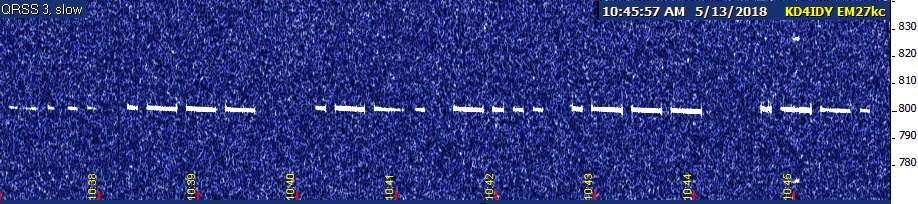
The watering hole was very quiet from 1 AM to local sunrise, following the SIW opening. There were only brief snippets of signals...basically 30 seconds of WM at 1:21, almost three minutes at 1:40, a minute of EH at 2:53 and a few ghostly hints later, MTI at 4:23 and 4:24, then nothing until some ionosounders showed up after local sunrise. It wasn't until 7:21 that EH started a slow fade-in again, becoming pretty solid by 7:28. Wisps of USC began showing up around 8:20, and MTI became pretty solid for a while at 8:45.
Not much new happened at the watering hole over the next hour and a half, so I decided to look around, and found PBJ doing a fine job:
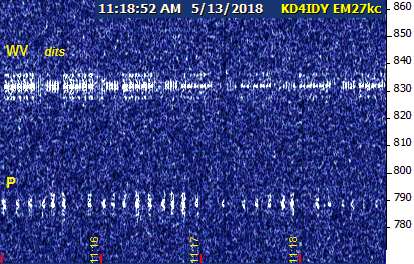
I checked the top half of the band for quite a while, but everybody there was being stubborn this morning. Eventually, I dropped down to the lower end. Couldn't find AZ, but in tuning around I heard WV coming in well and parked there for a bit. Pretty soon, P turned up too...fortunately, at what seems to be a more Part 15-ish power level, so they co-existed very nicely.
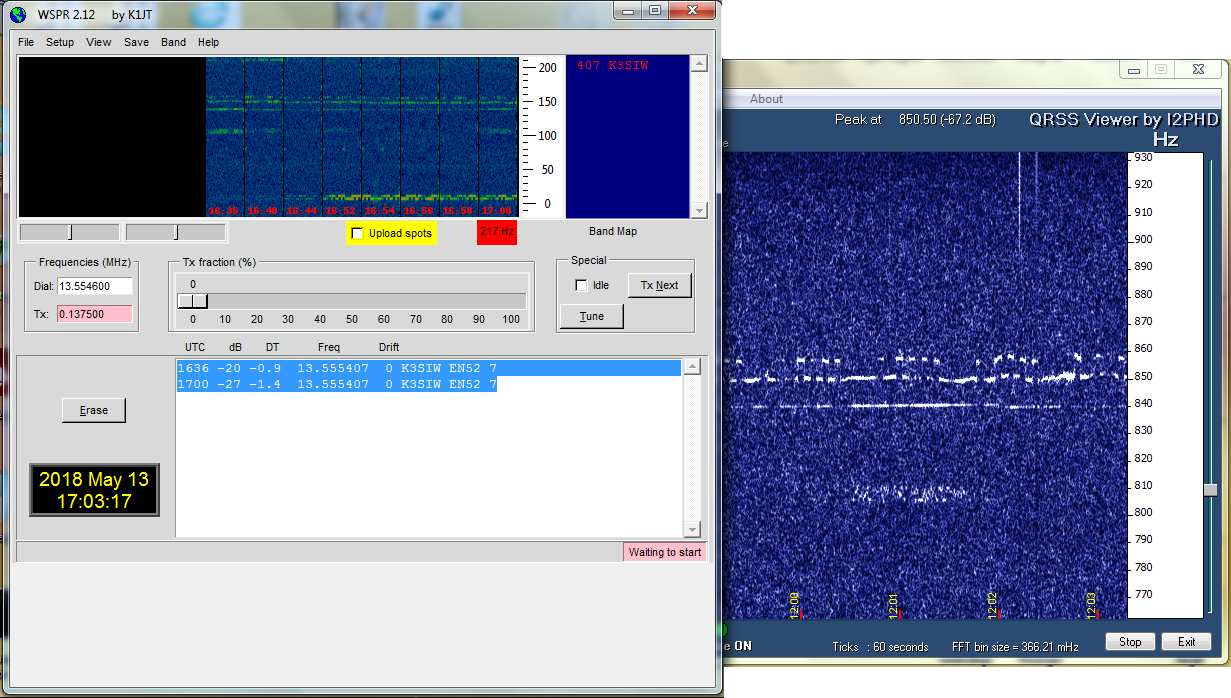
At long last I returned to the watering hole a little before noon and caught EH and the SIW duo together. I was surprised that the 1700 UTC (local noon) slot decoded, because as you can see, the header was not really discernible in the Argo trace; but there it is.
Somebody also switched the path on to WM at 11:50 AM, and it quickly became the loudest signal on the band for several minutes. MTI showed up and was nicely audible at times too. GNK made another appearance during the noon hour, but was the only signal in the upper half of the band to do so.
John
---------------------------------------------------------------
File Attachment 1: 13maySIW.jpg
File Attachment 2: 13mayPBJ.jpg
File Attachment 3: 13may-WV-P.jpg
Sunday afternoon Hifers
Hi Folks,
I tuned up for a while on the watering hole, and was rewarded with some HiFERs, including a possible WM, SIW - including a close up view of the slant mode and a possible EH.
A couple of these reached audible signal level briefly during the session. A couple of screen shots are attached.
Cheers
Ed
---------------------------------------------------------------
File Attachment 1: capt02.jpg
File Attachment 2: capt00.jpg
LOWDOWN on the way!
I have received word from Kevin Carey that the long-awaited combined April-May issue of the club publication is now on its way to members. More details as they become available.
In the field this morning
Posted by Bill Hensel on May 15, 2018 at 15:08:24.
Time 1321 utc P heard on the KA1103 freq was 13555 khz on the dial. road trip hifers (or lack of)
Boy I was surprised to hear a hifer but time and time again I have heard HIFERs
while hiking at strange times...
Posted by Ward K7PO on May 15, 2018 at 19:34:10.
In Dayton, shopping at Mendelsons. Not so much as a beep from any hifers on the way out from AZ.
Ward K7PO/WH2XXP
Hifer over night on Wed 5/16/18
Posted by Mike N8OOU on May 17, 2018 at 11:21:06.
I monitored the Hifer waterhole over night on Wed/Thur. Just beacon EH was seen from about 10PM thru 11:18 pm CSDT. It was fading in/out during that time. This ARGO screen capture shows one of those fade-outs.
https://www.dropbox.com/s/1mv18qcd6v0gjmr/may170014.jpg?dl=0
Hamvention
Mike N8OOU
Posted by Chris Waldrup on May 18, 2018 at 15:56:10.
I’m at Dayton for the hamfest. Anyone else up here?
If so maybe e could get a chance to meet.
Friday AM (USC, EH, SIW, MTI, WV, GNK, FRC, WAS)
Chris
KD4PBJ
Posted by John Davis on May 18, 2018 at 17:40:48.
Stopped at the farm with my radio about 10:45 AM CDT, and began seeing and hearing the beacons mentioned in the subject line...not all at once, of course, except for the ones at the watering hole, but during brief band scans between SIW's WSPR time slots. WAS was weak and intermittently audible, as was WV, but definitely recognizable. FRC started out weak, but became consistently audible for a minute or so, and GNK was consistently readable.
After 11 AM, I started getting SIW WSPR decodes. Am on my way back out there to see if those remained active. May post captures later. Will also try again for AZ, PBJ, TON, PCO, and others who didn't make it through this morning.
Reminder: Lowfer net 3927Khz Saturday morning 0800 California time
Posted by Jerry Parker on May 19, 2018 at 02:21:08.
Reminder: Lowfer net 3927Khz Saturday morning 0800 California time
Or listen online at:
http://69.27.184.62:8901/?tune=3927lsb
click on the autonotch to get rid of hetrodines
Hope to see you there
KFS WebSDR in California
69.27.184.62
OR Try the other Western US HF WebSDR systems: W7RNA Multiband WebSDR Receiver and Northern Utah WebSDR. They both work very well.
69.27.184.62
(THANKS TO Tim Brannon, WA5MD FOR THE TIP)
W7RNA Sedona AZ http://w7rna.dyndns-remote.com:18901/
KA7OEI Northern UT http://websdr1.utahsdr.org:8901/
"NOW HAS 630M RECEIVER"
Jerry WA6OWR
Re: Hamvention
Posted by Ward K7PO on May 19, 2018 at 13:29:08.
In reply to Hamvention posted by Chris Waldrup on May 18, 2018
There's a few of us 630/2200m guys here!
Ward K7PO
Re: Friday AM (USC, EH, SIW, MTI, WV, GNK, FRC, WAS)
Posted by Bill Hensel on May 19, 2018 at 15:54:36.
In reply to Friday AM (USC, EH, SIW, MTI, WV, GNK, FRC, WAS) posted by John Davis on May 18, 2018
Thanks for all your listening and reports on the Hifer World, thanks for the web site.
BU 13560200
Posted by Ward K7PO on May 20, 2018 at 15:26:57.
Mobile in WV, hearing BU 539 here @ 1524Z
Ward K7PO
Re: Hamvention
Posted by Chris Waldrup on May 20, 2018 at 16:44:58.
In reply to Re: Hamvention posted by Ward K7PO on May 19, 2018
Sorry I missed you guys.
I’ll make it a point to ask in advance next year so maybe we could meet up.
Chris Re: Friday AM (USC, EH, SIW, MTI, WV, GNK, FRC, WAS)
KD4PBJ
Posted by michael tyler on May 20, 2018 at 17:32:56.
In reply to Friday AM (USC, EH, SIW, MTI, WV, GNK, FRC, WAS) posted by John Davis on May 18, 2018
Thanks for the Report for beacon WV. 12ft vertical ground mounted at about 2 foot above ground. ider is arduino nano. transmitter is sg8002 with 100 ohm attenuator adjusted to legal power level. The antenna tuner is a tapped coil with a couple plastic tuning capacitors removed from a couple junked transistor a m band radios. I will be installing a thermistor attached to the oscillator to help hold temperature steady. mike
Re: BU 13560200
Posted by Ward K7PO on May 20, 2018 at 18:43:42.
In reply to BU 13560200 posted by Ward K7PO on May 20, 2018
Is BU drifting or is it my mobile rig? One of us is moving around.
Ward
Re: BU 13560200
Posted by KM N2CHX on May 20, 2018 at 22:07:00.
In reply to Re: BU 13560200 posted by Ward K7PO on May 20, 2018
Hi Ward,
Thank you for the signal report. I'd guess it's my beacon. The cabinet has been getting hot during the day and I'm working on the stability issue. Thanks for your patience and again for the report!
K
Changes to BU
Posted by KM N2CHX on May 21, 2018 at 18:32:41.
BU will be undergoing some changes over the next two weeks. I will be changing antennas from the 10' ground mounted vertical, to a roof vent-mounted 7' vertical, and a horizontal dipole. The beacon will alternate between the two antennas and will sign as BUV and BUH depending on which antenna it is transmitting on. At some point I may add a second dipole oriented 90 degrees to the existing one.
I may also add battery voltage, solar panel voltage, temperature readings and maybe some other stuff. Don't want to complicate reception too much. The frequency is indeed 13557.97 kHz, +/- ~30 Hz. or so. I verified this with the service monitor and other reception reports confirm it as well. I've taken some steps to make the frequency more stable.
I'll let you know when these changes are complete, and may post some pics if anyone is interested.
K
Weekend Hifers
Posted by ed holland on May 21, 2018 at 19:18:09.
I Heard snips of TON and caught a trace of signal corresponding to PBJ yesterday ~1300 PST + DST (2100 UTC).
I spent a little while on the high part of the band looking for GNK, PCO and friends, but heard nothing, not even RF which is often strong. With TON heard, I tried for AZ, also with no luck. 2200 meters operation question
Posted by Lee on May 22, 2018 at 00:34:07.
So I plan to be on 2200 meters by Labor Day. I am currently building the loading coil. My question is about my beacon message. I will be operating the beacon when I'm at home, so attended operation. I want to do an identifying letter at QRRS60 and then the call sign KE6PCT, e-mail address and grid square at 5wpm. Does this sound like a proper/legal I.D. In the next year or so I will be building the Juma TX136 with WSPR ability. But to get going I will be using my 1 watt rig.
Re: Changes to BU
Posted by Jack Roblin on May 22, 2018 at 03:28:15.
In reply to Changes to BU posted by KM N2CHX on May 21, 2018
Copied BUH tonight at 0315 Zulu! S3 to 4 at times, even with all the hash in that area of the band. Heavy QSB too of course. Cool idea about alternating antennas. Good luck!
Re: 2200 meters operation question
Posted by John Davis on May 22, 2018 at 04:19:25.
In reply to 2200 meters operation question posted by Lee on May 22, 2018
Your ID sounds fine, provided it occurs at least every ten minutes during the transmission, and at the end of operation. It legally only has to include the call sign. Some people also add an indicator after the call, such as "/B" or "/BCN," or incorporate the word "beacon" in the message, but this is not a requirement of the rules.
§97.119 Station identification.
§97.203 Beacon station. Re: 2200 meters operation question
Posted by Frank Lotito on May 22, 2018 at 10:29:43.
In reply to 2200 meters operation question posted by Lee on May 22, 2018
At QRSS60 can the requirements of a 10 minute ID be met? As I understand it, QRSS60 means a dot length is 60 seconds, and a dash length is 3 times that, or 180 seconds. Between the dot and dash, dot and another dot, etc is a space of another 60 seconds. 73 Frank K3DZ
Re: 2200 meters operation question
Posted by John Davis on May 22, 2018 at 14:58:00.
In reply to Re: 2200 meters operation question posted by Frank Lotito on May 22, 2018
Frank wrote:
At QRSS60 can the requirements of a 10 minute ID be met?
This is the essence of the matter, and it will depend which letter Lee chooses to use as his QRSS60 character. From his own call, unfortunately, there are two single-element characters (E and T) whose meaning would not be very self-evident in an Argo trace; while P and C and the numeral 6 would require more than 10 minutes each to send. That only leaves K out of his call sign, or I suppose he could use L (from Lee) as his QRSS60 ident.
Some alternatives would be to (1) drop to QRSS30 and bump up the power of the rig a bit, since a beacon is allowed 100 W TPO; or (2) do as some of the Part 5 operators did at one time and key a normal-speed CW ID as part of one of the longer QRSS elements to make sure the time limit is met. It makes the Argo trace a little fuzzy when that happens, but it satisfies the rules.
BUH on 13,560.15 kHz up to S7 in KS
Posted by John Davis on May 22, 2018 at 19:56:04.
In reply to BU 13560200 posted by Ward K7PO on May 20, 2018
Wasn't able to make it to the field until just before solar noon today, so the band was already thoroughly moribund. EH and MTI were barely making it through, and WV ranged from barely visible to just slightly audible. TON was recognizable visually, but not audible. Nobody was coming through at all on the top half of the band, not even GNK, RF or FRC. Even Codar, when present at all, did not show on the S-meter.
In that environment, I didn't expect a lot when I parked on the published BUH/BUV frequency, and sure enough, there was nothing whatsoever there. But when I thought to tune where Ward reported BU, right in the middle of the Part 18 maelstrom, that was a different story! The signal was about 50 Hz lower, but unmistakably present.
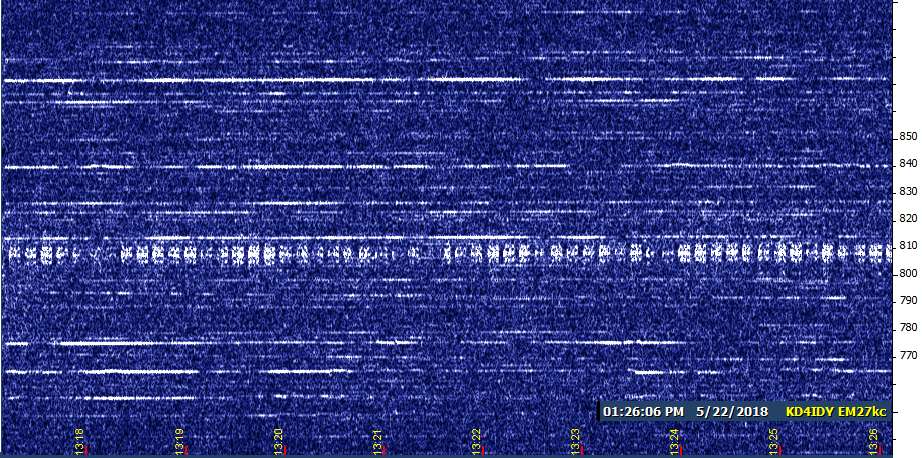
(Time is CDT. 800 Hz = 13560.150 kHz, not corrected for 0.4 ppm RX error.)
Even in the presence of continuous S3 to occasional S4 noise, the ID was audible around 80% of the time. At the peaks of the ≈2 minute QSB cycles, the signal showed S5 on the meter, sometimes briefly peaking at S7. For reference, that's roughly 5 S-units higher than other HiFERs generally exhibit here when the band is enhanced.
John
---------------------------------------------------------------
File Attachment 1: 22mayBUH.jpg
Re: 2200 meters operation question
Looks like QRSS30 is the winner using the letter P of my call sign KE6PCT. Thanks!
GNK
Posted by Wes KE4TWI on May 23, 2018 at 01:45:00.
Hearing GNK 13.564 using a log periodic and ft-890 from EM66 near Watertown, TN
BUH / GNK / in So. CA
Posted by Jack Roblin on May 25, 2018 at 01:49:02.
I am hearing both BUH and GNK here in Southern California this evening, at 0140 Zulu. Both are peaking at about S3 (with QSB of course), and within the passband of my 500 Hz CW filter of my Icom 718, close together but discernible - no problem. Very cool to hear them both at the same time! Good conditions tonight, but nothing else is being heard. / Jack WA6KYO
Re: BUH / GNK / in So. CA
Posted by KM N2CHX on May 25, 2018 at 02:28:17.
In reply to BUH / GNK / in So. CA posted by Jack Roblin on May 25, 2018
I was wondering if anyone would notice. I made a mod to the transmitter to increase stability and found a less noisy place while doing so. New frequency is 13564.2, which is between GNK and RF, and it should stay there. If I make another move with it, it will most likely be between RF and WAS. Trying to find a nice, relatively quiet spot for it.
Thanks for the report!
K
New Beacon Heard! VAN
Posted by Jack Roblin on May 25, 2018 at 03:29:57.
Seems like Southern CA is a hotspot tonight for the HiFer band! New beacon heard on 13563 KHz at 0310 Zulu. Long dash, followed by three ID's of VAN. Very weak copy, severe QSB, but a solid ID using my trusty and mighty Icom 718. Anyone copying it? Location and info? It's not on the beacon list.... Who's beacon is it??!! Step up to the plate and let us know. Congrats - you've been heard!! 73, Jack WA6KYO
Re: New Beacon Heard! VAN
Posted by jimvm on May 25, 2018 at 03:44:16.
In reply to New Beacon Heard! VAN posted by Jack Roblin on May 25, 2018
Thanks Jack for the report, you are my first one! I have this beacon on for 1 week now.
My beacon is a Black Cat one and the antenna is a hamstick. My QTH is Olivehurst, CA,
CM99fb. My other beacon is ESA with same setup and location.
I am in the operator listing under ESA and VAN.
73 jim vm Re: New Beacon Heard! VAN
Posted by John Davis on May 25, 2018 at 04:22:49.
In reply to Re: New Beacon Heard! VAN posted by jimvm on May 25, 2018
Congratulations, guys. Can either of you pin down the frequency a little more precisely for the beacon list?
Re: New Beacon Heard! VAN
Posted by jimvm on May 25, 2018 at 05:00:31.
In reply to Re: New Beacon Heard! VAN posted by John Davis on May 25, 2018
Hi John, a few notes for you. ~13.563.1xx MHz.
I have modified the Black Cat oscillator as follows and the frequency is somewhat
temperature sensitive.
C4 => 1 Meg
C16 => 1k
C17 => 27 pF NP0
C18 => 39 pF NP0, lifted and connected to Y1 C16 resistor side
When the battery gets down to less than 5 Volts, there is a chirp and tells me to change the battery!
I plan to experiment with this setup and may switch betwix ESA & VAN, who knows.
73 jim vm
[Added by Webmaster: Simplified Schematic of Beacon Kit]
BUH 13564.6
Posted by Ward K7PO on May 25, 2018 at 12:06:58.
Starting the trip west. Hearing BUH ID mobile in central VA ~439 @ 1200Z. Drifting down slowly from 13564.6 mhz.
Ward K7PO
Re: BUH 13564.6
Posted by KM N2CHX on May 25, 2018 at 14:46:39.
In reply to BUH 13564.6 posted by Ward K7PO on May 25, 2018
Ugh. Yup. Drifting all over the place. FAIL. It's off the air until I finish building this crystal oven. Should be back on by this evening or tomorrow.
Reminder: Lowfer net 3927Khz Saturday morning 0800 California time
Posted by Jerry Parker on May 25, 2018 at 16:08:18.
Reminder: Lowfer net 3927Khz Saturday morning 0800 California time
Or listen online at the KFS WebSDR in California:
http://69.27.184.62:8901/?tune=3927lsb
click on the autonotch to get rid of heterodynes
Hope to see you there
OR Try the other Western US HF WebSDR systems: W7RNA Multiband WebSDR Receiver and Northern Utah WebSDR. They both work very well.
(Thanks to Tim Brannon, WA5MD for the tip.)
W7RNA Sedona AZ http://w7rna.dyndns-remote.com:18901/
KA7OEI Northern UT http://websdr1.utahsdr.org:8901/ (NOW WITH 630 M RCVR)
Jerry WA6OWR
Re: New Beacon Heard! VAN
Posted by John Davis on May 25, 2018 at 18:13:01.
In reply to Re: New Beacon Heard! VAN posted by jimvm on May 25, 2018
Thanks Jim. I'll go listening as soon as these pop-up thundershowers decide to leave us alone long enough for safety.
You wrote part of my June column for me :>), so I may as well go ahead and attach the schematics I was working on for my review of the kit. I've already attached the simplified overall schematic to your post. The file linked in this message is of just the oscillator section, as modified. The 74HC02 be made a better oscillator by implementing the full, normal Pierce configuration around the gate, as you have done. The resistors improve oscillator startup reliability as well.
Gate input capacitance can vary over a 2:1 range with temperature. One consequence is that one should not omit C17, or the variable gate capacitance will dominate the oscillator drift characteristics. Paralleling two inputs in the oscillator section, as in this design, is another factor that makes frequency less stable than it could be. If it were feasible to tie either pin 2 or pin 3 high low*, and only use a single input from the crystal-capacitor network, I think that might also help.
I'm also planning to mention to my readers that I haven't been able to find a diagram of the semiconductor die to help me understand the reason for it, but the chip seems to be quite responsive to internal heat buildup as well as external temperature variations. I suspect that causes the minor fluctuations of frequency that show with keying, despite the oscillator running continuously and the voltage being regulated. It appears that using fewer gates for the output might reduce that effect (there's plenty of output power from one section alone, even if RV1 is reduced to a more readily adjustable 100 or 200 ohm pot).
John
[* Edited 26 May 12:15 am CDT]
---------------------------------------------------------------
File Attachment 1: beacon-osc.png
Perry Crabill
While reading the Silent Keys column in June QST today, I note the name Perry F. Crabill Jr., W3HQX, of Winchester, VA. http://www.qcwa.org/w3hqx-03726-sk.htm
I remember a Perry Crabill who was a prolific contributor of loggings to the DX Downstairs column in THE LOWDOWN back in the 90s. Does anyone else remember, and is this the same gentleman?
Re: Perry Crabill
Posted by John Davis on May 25, 2018 at 19:56:46.
In reply to Perry Crabill posted by Tim Brannon, WA5MD on May 25, 2018
Sadly, I believe it is the same Perry Crabill. I don't recall the amateur call sign with certainty, but some of the biographical details definitely ring a bell. He was a most interesting character.
John Re: New Beacon Heard! VAN
Posted by jimvm on May 26, 2018 at 00:24:12.
In reply to Re: New Beacon Heard! VAN posted by John Davis on May 25, 2018
Should that be tie pin 2 or 3 low or ground?
Interesting that the oscillator runs about 200 Hertz higher when the beacon is not keyed.
I plan to lift two of the output gates pins and tie U2 pin 3 low. Will report on this later.
73 jim vm Re: BUH 13564.6
Posted by Ward K7PO on May 26, 2018 at 00:55:17.
In reply to Re: BUH 13564.6 posted by KM N2CHX on May 25, 2018
Mobile in Alabama, BUH easy 589 copy @ 0050Z on 13564.2
Couple more hours to go, we sleep in MS tonight!
Ward K7PO/M
Re: New Beacon Heard! VAN
Posted by John Davis on May 26, 2018 at 05:06:24.
In reply to Re: New Beacon Heard! VAN posted by jimvm on May 26, 2018
Jim wrote:
Should that be tie pin 2 or 3 low or ground?
Quite right! I dunno why I looked straight at a NOR symbol when writing the earlier post and saw NAND instead, but you are correct: The redundant input must be held low in order for the active input to control the output state.
Interesting that the oscillator runs about 200 Hertz higher when the beacon is not keyed.
Interesting and puzzling. That's an even bigger change than I was seeing with my breadboard circuit. Can you tell if there's a variation of Vcc at the same time?
Will look forward to your results.
John
Saturday Morning HiFERs
Posted by John Davis on May 26, 2018 at 19:07:41.
Got to the field a little before 11 AM CDT and saw USC, EH, and MTI with fair signal strength and some tendency to slow fading. Couldn't quite distinguish any of the three by ear, and there were no signs of WM or SIW today. (Probably just as well, because EH was wandering down between .430 and .440, and would have walked all over SIW slant.
Farther down the band, WV was audible 33-50% of the time. Up the band a little later, there was no sign of PBJ, but TON was present. It was on a shorter QSB cycle, sometimes completely invisible, sometimes visible but inaudible, and sometimes clearly readable by ear.
Turning to the top half of the band, I didn't have much luck around 13562 or 13563 because of unfamiliar noise that I first assumed was an ill-behaved ISM device. When I got up around 13564 and it was still there, I switched to AM mode to try to identify it, and found out SWBC QRM is back. Yuck.
Nonetheless, GNK was coming through, and about 135 Hz higher I could also copy BUH at a similar signal level. Both were on screen at the same time (see attachment), and sometimes alternated in audibility over a span of a couple of minutes.
With the mid-day doldrums setting in, I switched over to LF, where I found nobody active in the 137.5 WSPR slot. With no active thunderstorms near today, even 1750 m is quiet enough to potentially see something, so I'm currently watching in hopes of capturing LowFER WM.
John
---------------------------------------------------------------
File Attachment 1: 26may.jpg
Saturday - BUV/BUH
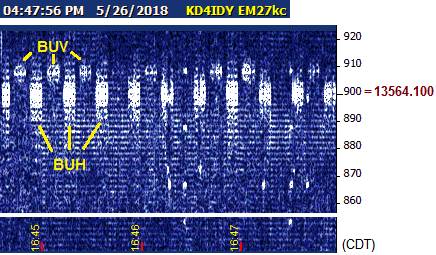
---------------------------------------------------------------
File Attachment 1: 26mayBUVBUH.jpg
WSPR-2 on 136.000 kHz. dial
Navtex monitoring has been the pits this past week, so I thought I’d try out another
digital mode and frequency for Saturday and Sunday nights. I’ll be watching for
any WSPR-2 activity on the 2,200 metre band with 136.000 kHz. USB dial.
73, J.B., VE3EAR
LowFER Beacon "EAR" Re: Saturday Morning HiFERs
188.830 kHz. QRSS30
EN93dr
Posted by Mike N8OOU on May 26, 2018 at 23:59:37.
In reply to Saturday Morning HiFERs posted by John Davis on May 26, 2018
Lowfer WM is still up and making waves.
Mike
Re: Saturday Morning HiFERs
Posted by John Davis on May 27, 2018 at 00:50:31.
In reply to Re: Saturday Morning HiFERs posted by Mike N8OOU on May 26, 2018
>>> Lowfer WM is still up and making waves.
Thanks, Mike. Unfortunately, when I returned to the field, I found that the storms down in Louisiana were also making waves, so it was no-go today. However, I'll try again tomorrow.
John
Re: Saturday - BUV/BUH
Posted by John Davis on May 27, 2018 at 05:14:51.
In reply to Saturday - BUV/BUH posted by John Davis on May 26, 2018
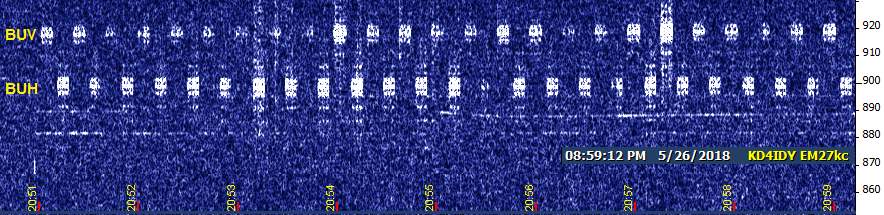
The V and H versions were both still present tonight, but running a little farther apart in frequency than just before 5 PM. Codar was gone, and the signals were sometimes painfully loud.
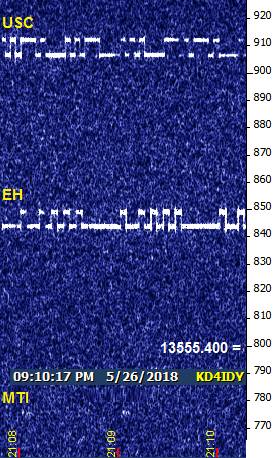 It remains a bit concerning that BUV was S2 to S3 and BUH was S5 to S7 tonight. That's comparable to when BUH was operating just above 13560, and significantly higher than this morning when GNK was also present at about the same level. For reference, the strongest other signals on the band tonight were USC and EH which, combined, barely peaked at S1. Everybody else was at more typical levels...FRC barely visible at times, barely audible at max; WAS present and sometimes audible; and WV fairly consistent with occasional fades.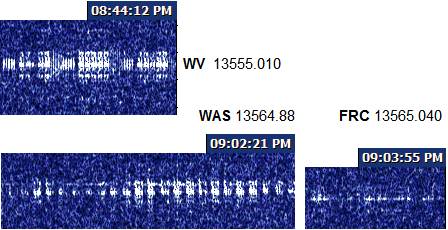
---------------------------------------------------------------
File Attachment 1: 26may0016.jpg
File Attachment 2: 26may-compare.jpg
File Attachment 3: 26may-compare2.jpg
Re: WSPR-2 on 136.000 kHz. dial
K3MF was my only decode in a five hour time span overnight. Thanks for giving me a signal, Wayde!
73, J.B., VE3EAR VAN 13563.185
Posted by John Davis on May 27, 2018 at 16:23:58.
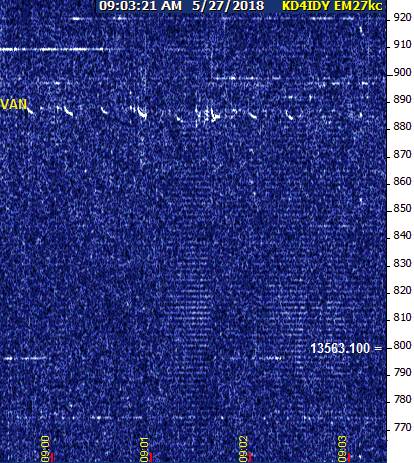
Traces of the hooked dash started showing up intermittently about 10 minutes before. By the top of the hour, the dashes were fairly consistent and the ID became audible a few times!
The band was dead except for EH and hints of WV when I started monitoring at 7:30 AM CDT, but it began waking up after 8:30. By 9 o'clock, WV was audible, there was a visual trace right below it that may have been P, TON was starting to show but wasn't yet audible, MTI was visible most minutes and audible once, GNK was ranging from marginal to good, and FRC was finally audible for part of each ID.
John
---------------------------------------------------------------
File Attachment 1: 27may-VAN.jpg
TON Finally
Mobile in Midland, TX. Left the rig parked on 13558.5 hoping to catch TON before we got too close to AZ. Around 1630Z TON came out of the noise for 6 or 8 full IDs and then was gone. Only reception of the whole trip.
Ward K7PO/M
Sunday HiFERs: SIW, WM Opening
Posted by John Davis on May 27, 2018 at 19:10:36.
The path to IL apparently began opening as early as 9:24 AM CDT today, and has lasted off and on into early afternoon. That is to say, there haven't been WSPE decodes in every time slot (partly because some of the noisier decodes overlapped into the next recording session), but SIW slant mode has been present nearly the whole time. WM has been intermittent, but still puts in regular appearances. Pictures later.
I've uploaded to WSPRnet, but here is the summary:
1424 -24 -1.6  13.555407  0 K3SIW EN52 7
1500 -26 -1.2  13.555407  0 K3SIW EN52 7
1534 -33  4.5  13.555498 -2 HUS/0I8RHO 50
1548 -26 -2.1  13.555408  0 K3SIW EN52 7
1552 -22 -1.3  13.555407  0 K3SIW EN52 7
1556 -19 -1.3  13.555407  0 K3SIW EN52 7
1604 -27 -2.1  13.555407  0 K3SIW EN52 7
1608 -27 -1.4  13.555407  0 K3SIW EN52 7
1612 -21 -1.3  13.555407  0 K3SIW EN52 7
1620 -23 -2.1  13.555407  0 K3SIW EN52 7
1624 -25 -1.5  13.555409  0 K3SIW EN52 7
1628 -24 -1.5  13.555407  0 K3SIW EN52 7
1640 -24 -2.3  13.555409  0 K3SIW EN52 7
1712 -18 -2.2  13.555410  0 K3SIW EN52 7
1720 -12 -1.5  13.555408  0 K3SIW EN52 7
1724 -22 -1.3  13.555410  0 K3SIW EN52 7
1732 -19 -1.7  13.555409  0 K3SIW EN52 7
1740 -23 -1.1  13.555409  0 K3SIW EN52 7
1744 -26 -2.1  13.555409  0 K3SIW EN52 7
1748 -21 -1.8  13.555410  0 K3SIW EN52 7
1752 -18 -1.4  13.555409  0 K3SIW EN52 7
1804 -27 -2.0  13.555409  0 K3SIW EN52 7
1808 -15 -1.6  13.555409  0 K3SIW EN52 7
1812 -19 -1.5  13.555409  0 K3SIW EN52 7
1824 -23 -1.0  13.555409  0 K3SIW EN52 7
1836 -28 -1.3  13.555409  0 K3SIW EN52 7
John
K6FRC
Just west of El Paso, K6FRC coming in nicely, S2 or so, 2115Z.7 hours to home!
Ward K7PO/M
Re: VAN 13563.185 - Now on .085
Posted by John Davis on May 28, 2018 at 01:04:52.
In reply to VAN 13563.185 posted by John Davis on May 27, 2018
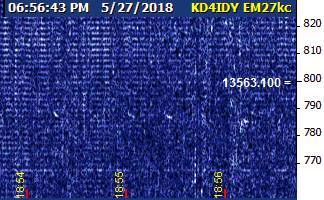
This evening, the signal was not audible, but the Δf and repetition rate of the hooked dash reveal its origin. Only EH and K6FRC were recognizable elsewhere on the band.
---------------------------------------------------------------
File Attachment 1: 27may-VAN2.jpg
Re: WSPR-2 on 136.000 kHz. dial
The Sunday/Monday overnight session brought a second station into my log:
0136 -26 0.8 0.137581 0 K3MF FM19 30
0148 -24 0.5 0.137581 0 K3MF FM19 30
0512 -27 -0.9 0.137528 0 WH2XND DM33 43
0552 -28 -0.8 0.137528 0 WH2XND DM33 43
73, J.B., VE3EAR Re: VAN 13563.185 - Now on .085
Posted by Bill Hensel on May 28, 2018 at 13:08:22.
In reply to Re: VAN 13563.185 - Now on .085 posted by John Davis on May 28, 2018
Last night at 0400 UTC caught VAN daid on 13562.96 Hifers in ME
Late night DX for sure...seems to me there was a VAN a few years ago...out of the
Desert in Eastern Ca.
Posted by John, W1TAG on May 28, 2018 at 23:05:50.
Conditions are far from great, but I did copy the following between 1400 and 1500 UTC this morning:
Both SIW's - very visible/audible signals.
USC 13555.50
MTI 13555.375
WV 13555.03
GNK 13563.98
This evening, pretty much everything was gone, but there was a CW-like trace on a QRSS3 screen corresponding to K6FRC on 13565.038 at 2240Z. Lots of distant t-storm static tonight.
Nothing seen of old standby NC. Wonder if it's still running.
John, W1TAG
Hifer opening tonight
Posted by Bill Hensel on May 29, 2018 at 02:40:24.
Started hearing VAN daid, FRC, GNK at 0209 now at 0235 utc all three beacons
strong...could this be E skip on 13 mc?
P.S. PCO was heard out in TN yesterday...that a first for PCO.
Re: Perry Crabill
Posted by Kevin Carey on May 30, 2018 at 18:37:50.
In reply to Perry Crabill posted by Tim Brannon, WA5MD on May 25, 2018
That is the same Perry Crabill, W3HQX. When I wrote for Monitoring Times he was one of my first, and most prolific contributors. A few years ago, well into his 90s, Perry sent me a compilation of all of his longwave logs, arranged in database format, and in a binder. He was very detailed with his records, and his history of monitoring went back multiple decades. I am very sorry to hear this news of his passing.
Re: Thank you, LWCA Writers
Posted by Kevin Carey on May 30, 2018 at 18:49:28.
In reply to Thank you, LWCA Writers posted by Tim Brannon, WA5MD on April 10, 2018
Thank you Tim. Your comments are very meaningful and appreciated at this time. Our newsletter staff and contributors have been fantastic about keeping the Lowdown in print and we are working to restore our normal publishing schedule. Thank you for your continued support.
TON : First Reception!
Posted by Jack Roblin on May 31, 2018 at 03:59:14.
Good copy tonight of TON, here in southern CA, at 0145 Zulu. This was my first reception of TON, so it was fun hearing a new one for me this evening.
Youtube video here: https://youtu.be/pGamh4ABvgA
Interesting conditions because I also heard K6FRC as well. So the 22 meter band was kind of short tonight!
73, Jack WA6KYO
WSPR-2 on 2200 m in KS - Tues
Posted by John Davis on May 31, 2018 at 05:17:00.
In reply to Re: WSPR-2 on 136.000 kHz. dial posted by John Bruce McCreath on May 28, 2018
Haven't been in a position to do overnight sessions here lately, but one nice thing about 2200 m is the excellent ground wave coverage, even in the daytime. Conversely. one bad thing is the QRN at this time of year.
Just before 1 PM CDT on Tuesday afternoon, I concluded that morning openings on 22 m were done for a while, so I switched to 2200 to look for WSPR from Arizona. I didn't have a lot of hope because there was already a line of thunderstorms in central Kansas, and sure enough, static levels were occasionally as low as S1 and as high as S9+10, with a median value around S7.5, which was enough to give me decodes of XND at -24 dB SNRr and XXP at -27 dB...at first.
But even during that first decode, conditions began to degrade, as you can see in the attachment "29may1.jpg". Both WSPR traces seem to dip into the noise level, and even the lower PLC right at 137.500 (800 Hz on the Argo display) gets partially swamped by the noise. In scarcely 10 more minutes, the static is registering up to +20 with a median value of >S8, at which point XND was now -27 dB and XXP was below -30 and therefore failed to decode any more (see attachment "29may2.jpg").
The 1812 UTC time slot (1:12 PM) was the last to decode. After that, the WSPR signals became barely recognizable in Argo, and the stronger PLC up at 137.600 started breaking up even more (see attachment "29may3.jpg").
When I got back to town, I was initially puzzled by the radar because the line of storms looked more broken than before. But it turned out several of them had gone severe, and were producing far more lightning than before. That situation did not end until 2 or 3 AM Wednesday, when a severe storm finally came through town and knocked down numerous large limbs. So, I decided to try again Wednesday afternoon.
---------------------------------------------------------------
File Attachment 1: 29may2.jpg
File Attachment 2: 29may3.jpg
File Attachment 3: 29may1.jpg
Re: WSPR-2 on 2200 m in KS - Wed
I didn't get as early a start Wednesday afternoon, but I thought it'd be OK since the storms today were farther away than yesterday, and tonight's batch wasn't going to form for several hours yet. I began getting decodes right away at 3 PM local, despite static peaks averaging a little higher than the day before, thanks apparently to their being a little shorter duration when they occurred. The additional distance over poorer soil may have attenuated the secondary crackles more than it did the primary strokes. But it turned out that the line down in MS and AL also turned severe while I was listening, driving up the noise density enough that no further decodes were possible by the end of the hour. The results today (all uploaded to WSPRnet, of course):
2000 -26 -1.1   0.137507  0 WH2XXP DM33 37
2000 -22 -1.1   0.137527  0 WH2XND DM33 43
2004 -27 -1.1   0.137507  0 WH2XXP DM33 37
2004 -23 -1.0   0.137527  0 WH2XND DM33 43
2008 -26 -0.9   0.137507  0 WH2XXP DM33 37
2008 -22 -0.9   0.137527  0 WH2XND DM33 43
2012 -29 -1.1   0.137507  0 WH2XXP DM33 37
2012 -24 -1.0   0.137527  0 WH2XND DM33 43
2016 -29 -1.1   0.137507  0 WH2XXP DM33 37
2016 -25 -1.0   0.137527  0 WH2XND DM33 43
2020 -25 -1.1   0.137527  0 WH2XND DM33 43
2024 -26 -1.1   0.137527  0 WH2XND DM33 43
2028 -24 -1.1   0.137527  0 WH2XND DM33 43
2032 -27 -1.0   0.137507  0 WH2XXP DM33 37
2032 -24 -1.1   0.137527  0 WH2XND DM33 43
2036 -27 -1.1   0.137507  0 WH2XXP DM33 37
2036 -24 -1.1   0.137527  0 WH2XND DM33 43
2040 -24 -1.1   0.137527  0 WH2XND DM33 43
2044 -24 -1.1   0.137527  0 WH2XND DM33 43
2048 -25 -1.0   0.137527  0 WH2XND DM33 43
John
Reminder: Lowfer net 3927Khz Saturday morning 0800 California time
Reminder: Lowfer net 3927Khz Saturday morning 0800 California time
Or listen online at the KFS WebSDR in California:
http://69.27.184.62:8901/?tune=3927lsb
click on the autonotch to get rid of heterodynes
Hope to see you there
OR Try the other Western US HF WebSDR systems: W7RNA Multiband WebSDR Receiver and Northern Utah WebSDR. They both work very well.
(Thanks to Tim Brannon, WA5MD for the tip.)
W7RNA Sedona AZ http://w7rna.dyndns-remote.com:18901/
KA7OEI Northern UT http://websdr1.utahsdr.org:8901/ (NOW WITH 630 M RCVR)
Jerry WA6OWR
potrzebie